Sunday’s coming, and I’m excited! Well, I’m weary and a bit worn, but there’s more to my excitement than what my body feels and how this world grates at my spirit.
Our #dailyPSALMchallenge has been going on since January, and the Psalm for Saturday, May 17 (Psalm 137) has been on my heart for a few weeks now. We looked at it this past Wednesday night with our CCC youth to help us understand Daniel 1. I believe this Psalm gives context to our worship gatherings, too. Bear with me as I flesh this out.
1 By the waters of Babylon, there we sat down and wept, when we remembered Zion. 2 On the willows there we hung up our lyres. 3 For there our captors required of us songs, and our tormentors, mirth, saying, “Sing us one of the songs of Zion!”
4 How shall we sing the Lord’s song in a foreign land?
Psalm 137 begins with weeping. The people of God are in exile in Babylon, far from home, grieving all that they’ve lost. They sit by the rivers of Babylon, remembering home, and they hang up their instruments. Their captors mock them and ask for songs — Sing us some of those Zion songs! Sing to us of this great Yahweh! Sing!
But how can they?
That’s a question many of us find ourselves asking. How can we sing in this broken world? How can we sing when our hearts are heavy with grief, anxiety, pain, etc.? How do we lift our voices when we’re surrounded by sin and sorrow?
We sing because Jesus was “despised and rejected by men, a man of sorrows and acquainted with grief” (Isaiah 53:3). He understands. He is acquainted with our feelings (Hebrews 4:15, Psalm 34:18).
He was the One on whom the Lord “has laid…the iniquity of us all” (Isaiah 53:6). He took our sin and shame upon Himself (1 Peter 2:24). He knows the anguish that accompanies all of that, and He bore it all for us (Isaiah 53:4-5). We sing because Jesus humbled Himself and took on the death we deserved on the cross (Philippians 2:8, Romans 5:8, Galatians 3:13).
We sing because God “has highly exalted [Jesus] and bestowed on Him the name that is above every name” (Philippians 2:9). His name is now our hope (Acts 4:12), our refuge (Proverbs 18:10), and our anthem (Psalm 96:1-3).
We sing because Jesus lives! The grave could not hold Him (Acts 2:24). And “because He lives, we can face tomorrow”.
Here’s some good news for you: if Jesus can sustain our tomorrows, He most assuredly carries us today (Matthew 6:34, Deuteronomy 33:27).
Because Jesus lives, exile is not the end of the story. He has gone to prepare a place for us, and when our sojourning in this old world is over, He will come and bring us home to be with Him forever (John 14:2-3, 6).
Those exiled worship leaders by that river of Babylon were distressed (and just plain old stressed, too). They had hung up their instruments and laid them by, but they had hope that their Rock and Redeemer was not done with them.
I believe the way the Psalms were laid out for us gives us the answer to “How can we sing the LORD’s song in a foreign land?” Psalm 137 is followed by one of those songs of Zion in Psalm 138.
Psalm 138 is a response to the exile-weary, world-weary, pain-weary, weary-weary heart. It’s the sound of a soul remembering how to sing. Where Psalm 137 ends with heaviness, Psalm 138 begins with hope. Even in the presence of false gods, grief, or enemies — David sings. He sings because the LORD answers (v. 3), strengthens (v. 3), and preserves (v. 7). He sings because the steadfast love of the LORD “endures forever” (v. 8).
So how do we sing in this foreign land, so far from the shores of heaven?
How do we sing in the midst of pain and sorrow that seems to stretch out like a horizon?
3 He was despised and rejected by men, a man of sorrows and acquainted with grief; and as one from whom men hide their faces he was despised, and we esteemed him not.
4 Surely he has borne our griefs and carried our sorrows; yet we esteemed him stricken, smitten by God, and afflicted. 5 But he was pierced for our transgressions; he was crushed for our iniquities; upon him was the chastisement that brought us peace, and with his wounds we are healed. 6 All we like sheep have gone astray; we have turned—every one—to his own way; and the LORD has laid on him the iniquity of us all.
5 Have this mind among yourselves, which is yours in Christ Jesus, 6 who, though he was in the form of God, did not count equality with God a thing to be grasped, 7 but emptied himself, by taking the form of a servant, being born in the likeness of men. 8 And being found in human form, he humbled himself by becoming obedient to the point of death, even death on a cross. 9 Therefore God has highly exalted him and bestowed on him the name that is above every name, 10 so that at the name of Jesus every knee should bow, in heaven and on earth and under the earth, 11 and every tongue confess that Jesus Christ is Lord, to the glory of God the Father.
We’re continuing in our study of Revelation called The KING is Coming. We took a break for our He Who Promised is Faithful readings during Holy Week but are glad to be back at it. Today, we will be diving into Jesus’s letter to the church at Smyrna. Once again, I am thankful for Jamie Harrison and the opportunity to do this study together.
8 “And to the angel of the church in Smyrna write: ‘The words of the first and the last, who died and came to life. 9 “ ‘I know your tribulation and your poverty (but you are rich) and the slander of those who say that they are Jews and are not, but are a synagogue of Satan. 10 Do not fear what you are about to suffer. Behold, the devil is about to throw some of you into prison, that you may be tested, and for ten days you will have tribulation. Be faithful unto death, and I will give you the crown of life. 11 He who has an ear, let him hear what the Spirit says to the churches. The one who conquers will not be hurt by the second death.’[1]
Keith Harris: Greetings, Sojourners,
We are in the letter to the church in Smyrna, continuing our study of Revelation. Jamie, why don’t you remind us as you did in our last Bible study about the form of these letters – the five things that show up in each one.
Jamie Harrison: Yes, that is correct. Each letter is going to have a salutation. In this letter, “Write to the angel of the church of Smyrna” (Revelation 2:8)[2] – the angel being, of course, the pastor, the messenger, the person delivering them the Word. Then, you’re going to have where Jesus will say something about Himself – His attributes. Then, there will be something about their works, some praise and admonition. Except in this church – Smyrna is one of two churches that does not have an admonition (correction, something to fix). Then, you’re going to have a universal admonition which is to anyone who hears, who has ears to hear – to listen to what the Spirit says to the churches. Finally, each letter will contain a final promise.
Keith: Alright, talk to us about Smyrna. What does Jesus tell us about Himself here?
Jamie: He starts off by saying, “Thus says the First and the Last, the one who was dead and came to life” (Revelation 2:8). The letter to Ephesus referenced back to the description of Jesus in Revelation 1, and so does this one. In Revelation 1:17, Jesus says, “Don’t be afraid. I am the First and the Last…”; He continues to say, “I was dead, but look – I am alive forever and ever, and I hold the keys to death and Hades.” It’s really cool that Jesus keeps going back to what He’s already said – to almost repeat for emphasis.
Keith: He’s doing it on purpose.
Jamie: Correct. He’s is the First and the Last which, like I said in Revelation 1, is a claim that He is God. He was there in the beginning as we know. “In the beginning was the Word, and the Word was with God, and the Word was God” (John 1:1). So He was the First, and He will be the Last.
It’s also important to note that He points out again that He is the one who was dead and has now came to life because all of Christianity is a complete waste of time if He didn’t raise from the dead (1 Corinthians 15:14-17). There’s a lot of dead people, but He’s the only one….
Keith: What is it that John Goldwater says? “Dead saviors can’t save.”
Jamie: That’s correct. You know, I was talking to someone the other day and – I apologize if this bothers anybody, but you know where people are like, You know that my dead relative was looking down on me today, or I was talking to them and they clearly gave me an answer. I know this is going to bother some people, but if you’re expecting some dead relative to help you with something, you’re [in a pickle]. I’m sorry, but when you take your last breath, you’re done. So, it’s important that we make a decision for Jesus before that happens….
Keith: …because He was dead and came to life – not was brought to life. He just stopped being dead (Revelation 2:8, John 10:17-18). Like Jamie was saying on the part of our relatives, it may seem to have someone we care about look from what we would describe as an afterlife, but we have something better than that: we have the God of the universe who was there at the beginning, pre-existed the beginning (John 1:1-3, Colossians 1:17) – He’s going to be there at the end and continue eternally. He is the God who saves, the God who looks after (Zephaniah 3:17, Psalm 121:3-5). He’s Emmanuel – God with us (Matthew 1:23). We shouldn’t be satisfied with lesser things (Psalm 119:37). Jesus is clearly superior to everybody and everything (Hebrews 1:3-4, Philippians 2:9-11).
Jamie: That’s right.
After Jesus says this, He goes into telling them some things about themselves. He says, “I know your affliction and poverty, but you are rich. I know the slander of those who say they are Jews and are not, but are a synagogue of Satan” (Revelation 2:9). Let’s touch on that real quick. When He says, “I know your affliction and poverty.” History tells us that Smyrna was a very wealthy town – very well-to-do. Why would the Christians there experience “affliction and poverty”? It’s simple when you look at it.
In order to work, you had to join a guild, which is like what we would call a labor union, right? Each one of those guilds back during that time, would have been represented by some god or goddess. In order to join, you had to worship that god or goddess. So as a Christian….
Keith: …almost like your dues….
Jamie: As a Christian, I’m not going to worship this god or goddess because that’s a false god. I’m not going to be able to join a guild, which means I’m not going to work because I can’t get a job. It wasn’t laziness – they couldn’t get a job. A lot of Christians ended up begging for food and things like that, but it’s because they were willing to suffer that affliction to follow Christ.
So, we ask ourselves the question of if someone comes to you at work and asks you to do something immoral (or whatever the case may be), are you going to do it to keep your job or say “no” and that whatever happens happens? Are you going to compromise your relationship with Christ to advance at the workplace? Or are you going to put Him first? These Christians here at Smyrna put Him first.
Then He tells them that He knows the slander of “those who say they are Jews and aren’t but are a synagogue of Satan”. He tells [the believers there] that they are about to suffer – that the devil is going to throw some of them in prison to test them, and they’ll “experience affliction for ten days”; He tells them, “Be faithful to the point of death, and I will give you the crown of life” (Revelation 2:10).
He kind of tells them exactly what’s about to happen. There’s this synagogue of “Jewish” people who are claiming to be Jews but in the biblical sense, they’re not.
Keith: Ethnically, they are, right? But just as Jesus told the Pharisees on more than one occasion – you’re talking about your father Abraham but you’re of your father the devil. The fruit of your life is showing what you are more than your ethnicity is.
Jamie: Mmmm…. This was happening. This synagogue was slandering them. They would be jailed normally about ten days. They experienced, obviously, persecution and things like that while in prison – sometimes to the point of death. But Jesus says, “Be faithful to the point of death and I will give you the crown of life.” So, what is the crown of life talking about? I think we probably know the answer to that, but let’s look at James 1:12. Again, we always want the Bible to speak for itself. James 1:12 says, “Blessed is the one who endures trials, because when he has stood the test he will receive the crown of life that God has promised to those who love Him.” So, it’s eternal life with Jesus.
You notice, you know, this book of Revelation a lot of times – when we look at it, we think it’s just a sign of what’s going to happen and all these different things and how bad things are going to be – and it is, but it’s not at the same time. The revelation is of Jesus Christ (Revelation 1:1). It’s about Jesus Christ. It’s to lead us to Jesus Christ (Revelation 1:17-18, 5:9-10). The whole central setting of Revelation is the throne room (Revelation 4:2-6). Everything centers around the throne room where God – the Father, the Son, the Holy Spirit – is present with multitudes around them worshiping Him, praising Him (Revelation 4:8-11, 5:11-13). Right? As all of these things are going on.
There’s no admonition in this letter to Smyrna. There’s no this is what you’re doing wrong. They have it. They get it. They have a relationship with Jesus, and because of that relationship, they are putting off these other things and are following after Him. Because of that they’ll receive the crown of life.
Keith: I mean, just that idea in and of itself: be faithful unto death. If you’re living in an area of the world where following Jesus means certain death, you’re going to be in less need of an admonition because if you’re know that following Jesus means certain death here on earth, you’ve counted the cost like Jesus said in Luke 14:27-28.
The idea there that “be faithful unto death, and I’ll give you the crown of life”, He doesn’t say when you die in prison in ten days or when you die in the tribulation; it’s for all of life. If you’re like John, who’s on the island of Patmos in probably his 80s or 90s – that just because he didn’t get martyred, he’s no less faithful unto death. He’s faithful until the time that God calls him home. That crown of life isn’t just for martyrs; it’s for those who are saved for all of life.
Jamie: You know, you’re talking about people who are being persecuted even to the point of death today…. Was it Richard Wurmbrand in that book we read[3]? They put him in a room – in a closet, basically smaller than a closet, and all four walls were nails. There was just enough room for you to stand. If you moved at all, you were going into these nails. They had him in that room for days on end. No food. No water. Nothing like that. Eventually, they would open the door and he would just collapse to the ground. They would defecate and make him eat it – urinate in his mouth, things like that….
Keith: …beat his feet so much that he could never wear shoes again the rest of his life….
Jamie: Right. And not once did he waver. Not once did his relationship with Christ come into question. He continued to tell the guards about Jesus the whole time he was there. And eventually did get out. But what it did was it strengthened his faith. So, if there was any point, to all of these trials is that it strengthens our faith in God.
Keith: Speaking of, I had forgotten about this, but while you were talking…there was a guy named Polycarp. He was a pastor in Smyrna and a disciple of the apostle John. And at [Polycarp’s] martyrdom, when he’s about to be executed for Christianity, they gave him an opportunity to recant. We talked last week where Jesus gave the church at Ephesus to repent and remember the love they had at first – those who were going to execute Polycarp gave him an opportunity to repent and remember his love for the powers-that-be, His love for Jesus was more. He says,
“For eighty and six years I have been his servant, and he has done me no wrong. And how can I now blaspheme my king who saved me?”
They killed him for that, but Jesus’s own words here – and I don’t think that’s an accident – I mean, it’s more than ten days later, but I don’t think it’s an accident that Jesus told Smyrna this knowing full well that Polycarp and those in the immediate context living in the same situation as Polycarp – that they were faithful unto death.
Polycarp has a crown of life. John has a crown of life. And if we, in our churches today, are faithful unto death, then we’ll receive that crown of life. The proof’s in the pudding, so to speak.
Jamie: It is. That pudding’s pretty good stuff…..
Just to finish this out real quick…. I always say real quick, and it always takes forever. I take that back.
Keith: It takes the time it takes.
Jamie: Just to finish this out, we have Jesus with a universal admonition, which in a word, you know, is let anyone who has ears to hear, listen to what the Spirit says to the churches. What is the Spirit saying to us? He says, “To the one who conquers”. Remember 1 John 5:4-5 here. This is those who are saved, those who have a relationship with Jesus will never be harmed by the second death.
11 Then I saw a great white throne and one seated on it. Earth and heaven fled from his presence, and no place was found for them. 12 I also saw the dead, the great and the small, standing before the throne, and books were opened. Another book was opened, which is the book of life, and the dead were judged according to their works by what was written in the books. 13 Then the sea gave up the dead that were in it, and death and Hades gave up the dead that were in them; each one was judged according to their works. 14 Death and Hades were thrown into the lake of fire. This is the second death, the lake of fire. 15 And anyone whose name was not found written in the book of life was thrown into the lake of fire.
This is not a scare tactic by any stretch of the imagination. It’s explaining what the second death is. You might have died here on earth, but the second death is the one – it’s the one. If you have a relationship with Christ, you won’t experience the second death (John 3:16, 5:24). You will have a life everlasting with God the Father (John 17:3). If you don’t have a relationship with Christ, you will experience that second death, which – even with all of the lake of fire and all that – the punishment of hell is an eternal separation from God (2 Thessalonians 1:8-9; Matthew 25:41, 46). You’re never with Him again. You’re eternally separated from your Creator.
Keith: And the ever-presence of His wrath.
Jamie: That’s right, but I think the people who are there will still blame Him – will still be angry with Him. So imagine living in eternal punishment, being angry the entire time. That’s the feeling it’s going to be. I can’t describe it. We’ve never been there. We don’t understand it. We don’t want to be there.
Sometimes, like right now, people will be like, now, let me invite you to come to know Jesus, but I don’t want you to come to know Jesus because you’re scared to go to hell. If you come to know Jesus, it needs to be because you were convicted by His Word and want to have a relationship with Him – and you want to love Him.
Keith: How does Paul say it in Philippians 3:8? The surpassing worth of knowing Christ. That’s a far cry from the surpassing worth of not wanting to go to hell.
You think about different people you’ve heard talk. Well, I got married to so-and-so because they were the only person in my community or if I didn’t marry this person I’d have to marry that person. That’s not love. … The idea that you’re just pursuing one thing because you don’t want the other, that’s not it.
That’s not the image you get in Matthew 13:44-46 where Jesus is giving the parables of the man who is walking through a field and finds a treasure worth more than any treasure he’s ever seen. He immediately goes back to his house, cashes out all of his assets, and buys the field. He’s not willing for anyone else to find this treasure. The pearl merchant who, upon finding the pearl of great price, doesn’t haggle – doesn’t negotiate – he cashes out everything he has to buy this one pearl.
Jamie: And that’s what these people in Smyrna did. They were willing to give up their jobs – the opportunity to own their house, purchase food for their family, things of that nature – for the sake of Christ.
Keith: That’s one of the things that I wonder here, and I’m not trying to speculate. But He’s talking to them about how they were rich before Christ in a worldly sense. Now in a worldly sense they’re in poverty. Jesus reminds them that they are rich – that their life is in danger but they have Life. I would imagine some of them were in definite danger – not necessarily of martyrdom or execution but just in the ability to sustain themselves and live.
As we look at this to close it out, think about how we talked about Polycarp and Richard Wurmbrand. It reminds me of the perspective here – “the one who conquers will not be hurt by the second death” (Revelation 2:11) – the idea that the closest to hell believers will ever experience is what they experience here on earth. That’s the greatest threat the world can give us – that it’s going to kill us, leads us to our greatest reward (Philippians 1:21-23, Revelation 21:4-5).
This reminds me of Dietrich Bonhoeffer.I’ve been reading through his Letters and Papers from Prison[4]…. There are times where he’d be aggravated that he had opportunities for the gospel and he’d repent and minister to this or that person. Everyone who was thrown into the concentration camps wasn’t Jewish ethnically. They weren’t even necessarily for the cause. If they Nazis wanted to just get someone out of the way, they had the camps for this.
Bonhoeffer, on the last day of his life, got up and preached. There was a guy there as a witness – a British intelligence officer kind of kept the Nazi guards at bay to let him finish his sermon. Then Bonhoeffer willing went with them – walked to his execution almost consoling the guards because – you know, you’d have to feel some kind of way when somebody’s looking at you and talking about the love of Christ, preaching the gospel and you’re going to be the one to kill him. And what he told those guards right before they took his life was: “This is the end, but for me, it is the beginning.”
Where so many face the second death, those believers in Smyrna, they face the beginning.
The tears they had for persecution were wiped away by the nail-scarred hands of their Savior whom they served unto death.
That’s good news.
Jamie: Amen.
Keith: Well, Jamie, that about wraps it up for Smyrna. Sojourners, we’ve enjoyed our time with you today. Check with us next time as we look at the letter to the church at Pergamum.
25 For I know that my Redeemer lives, and at the last he will stand upon the earth. 26 And after my skin has been thus destroyed, yet in my flesh I shall see God, 27 whom I shall see for myself, and my eyes shall behold, and not another. My heart faints within me!
With those words, the grave was silenced, death was defeated, and hope reigned eternal.
Long before that first Resurrection Sunday morning, Job declared through tears and pain, “I know that my Redeemer lives” (Job 19:25). He didn’t have all the answers, but he held onto the living hope that one day, beyond death and decay, he would see his God for himself. That hope was not misplaced.
Because Jesus lives, we can face anything – even death – with confidence. The Redeemer Job longed to see is the risen Christ who lived on earth, bore our sorrows unto death, and now lives reigns in glory. And as surely as He rose, He promises that all who trust in Him will rise too (John 11:25).
Today is not just a celebration of what happened – it is a declaration of what is to come. Our Redeemer lives! And one day, with resurrected eyes and glorified bodies, we will see Him face to face.
Let your heart rise with resurrection hope. Jesus is not here. He has risen just as He said. He ascended back to heaven and has promised to return to gather His people to Himself.
12 Then I said to them, “If it seems good to you, give me my wages; but if not, keep them.” And they weighed out as my wages thirty pieces of silver. 13 Then the Lord said to me, “Throw it to the potter”—the lordly price at which I was priced by them. So I took the thirty pieces of silver and threw them into the house of the Lord, to the potter.
The Original Context
Psalm 41 expresses the voice of a faithful sufferer, King David, who faced betrayal not just from his enemies but from a trusted companion. In ancient cultures, sharing bread was a sign of intimate friendship or loyalty, so the betrayal of such a companion added deep pain to hardship. Yet the psalm ends in hope, with a declaration that the Lord upholds the righteous.
Zechariah 11 paints a vivid picture of Israel’s spiritual rebellion against the Lord. The prophet assumes the role of a rejected shepherd, illustrating how Israel would reject God’s true care. The “wages” of thirty pieces of silver – a paltry sum for the value of a shepherd – shows their contempt. The odd command to throw the money “to the potter” at the temple conveys divine disdain for their decision, while also symbolizing judgment and redirection.
Fulfillment in Jesus
Jesus was no stranger to betrayal. Psalm 41:9 is quoted in John 13:18 on the very night of the Last Supper, as Jesus identified Judas Iscariot as His betrayer – the one who dipped bread with Him would “lift his heel” against Him. Judas’s act fulfilled both Scripture and sorrow.
The thirty pieces of silver In Zechariah found direct fulfillment In Matthew 26:14-16 when Judas agreed to betray Jesus for that exact amount. Later, overwhelmed by guilt, Judas returned the silver to the temple, and the chief priests used it to buy a potter’s field (Matthew 27:3-10) – fulfilling Zechariah’s prophecy to the letter.
These betrayals were real. They were evil. And yet they did not thwart the redemptive plan of God. Even through betrayal the Good Shepherd laid down His life for His sheep.
Hope for Today
Betrayal is a bitter sorrow many of us face. Whether in friendship, family, or faith, the sting of being hurt by someone close can feel like a wound that may never heal. But Jesus knows this pain firsthand. He was betrayed by a friend, abandoned by His followers, and sold out for thirty pieces of silver. Yet His story did not end in betrayal. It was merely a precursor to His victory over death, hell, and the grave.
In Christ, our pain isn’t wasted. God sees. God knows. And God redeems.
So today, if you’ve ever been betrayed or wounded by someone close, take heart. Jesus walks with you in that pain. He is the faithful friend who never leaves.
Trust Him to bring beauty even from and through brokenness. And rest in the Savior who was betrayed but not defeated.
6 “And the foreigners who join themselves to the LORD, to minister to him, to love the name of the LORD, and to be his servants, everyone who keeps the Sabbath and does not profane it, and holds fast my covenant— 7 these I will bring to my holy mountain, and make them joyful in my house of prayer; their burnt offerings and their sacrifices will be accepted on my altar; for my house shall be called a house of prayer for all peoples.” 8 The Lord GOD, who gathers the outcasts of Israel, declares, “I will gather yet others to him besides those already gathered.”
The Original Context
Isaiah spoke these words to Israel during a time of spiritual renewal, casting a vision of God’s heart for the nations. In contrast to the idea that Israel alone was God’s chosen people, Isaiah announced that foreigners who loved and followed the Lord were welcomed into His house.
This radical promise highlighted something about God’s covenant: His salvation was never meant for Israel alone because God was gathering worshipers from every tribe and tongue to find joy and belonging in His presence. His temple was never meant to be a barrier but a beacon.
Fulfillment in Jesus
When Jesus entered the temple in the final week of His life, He saw that its courts – meant for Gentile worshipers – had been turned into a marketplace. In righteous anger, He drove out the merchants and quoted Isaiah 56:7 in Matthew 21:13:
“My house shall be called a house of prayer, but you make it a den of robbers.”
Jesus was restoring the temple to its true purpose. And ultimately, He became the new and better temple (John 2:19-21). In Him, all who trust and follow God, all who confess Him as Lord and believe in their hearts He is risen from the dead – regardless of background or nationality – are brought near (Romans 10:9-13, Ephesians 2:11-22).
Hope for Today
Jesus is still gathering outcasts. He is still welcoming foreigners. He is still saving sinners. And He is still building a house of prayer for all peoples.
If you’ve ever felt like an outsider – too far off, too broken, too different, too sinful, too shameful – know this: there is room for you in God’s house. The joy of His presence is not reserved for some select few who have it all together or who have the right genealogy, but offered to all who come to Him through Christ.
This Holy Week, let your prayers rise in confidence and hope. Jesus has not merely opened a way for people to come to Him, He IS the Way (John 14:6), and He prepares a place for Him in His Father’s house for all He saves (John 14:2-3). If He has saved you, you belong there; you are home with Him. And through Him, your worship is welcomed with joy.
22 The stone that the builders rejected has become the cornerstone. 23 This is the LORD’s doing; it is marvelous in our eyes. 24 This is the day that the LORD has made; let us rejoice and be glad in it.
25 Save us, we pray, O LORD! O LORD, we pray, give us success!
26 Blessed is he who comes in the name of the LORD! We bless you from the house of the LORD.
27 The LORD is God, and he has made his light to shine upon us. Bind the festal sacrifice with cords, up to the horns of the altar!
The Original Context
Psalm 118 was likely sung during one of Israel’s major festivals, like Passover. It was a song of thanksgiving – a declaration of God’s steadfast love and salvation. The image of the “stone that the builders rejected” (v. 22) captured Israel’s story: once overlooked and often oppressed, now lifted up by the Lord to a place of prominence and purpose. God had done something unexpected and wonderful, and the people were called to rejoice.
In its immediate context, this passage may have celebrated a king’s return to the temple after a victory, or perhaps commemorated God’s steadfast love and deliverance of His people. Verses 25-27 echo the cries of those longing for salvation, welcoming the one who comes in God’s name and leading the sacrifice to the altar in thanksgiving.
Fulfillment in Jesus
Centuries later, as Jesus rode into Jerusalem on a donkey, the people cried out these very words:
“Hosanna! Blessed is He who comes in the name of the Lord!”
Their cry of “Hosanna!” literally means “Save us now!” and is the Hebrew word from the beginning of v. 25. They waved palm branches and welcomed Jesus as the promised King. Yet they did not realize the kind of salvation He had come to bring – not military or political victory, but a deeper, eternal rescue.
Jesus is the true and better cornerstone – the One whom the religious “builders” rejected but God exalted (Matthew 21:42, Acts 4:11). He is the foundation of a new and everlasting temple, not made with hands but built through His body, the church (Ephesians 2:19-22). And he did not merely lead the sacrifice to the altar – He Himself was the festal sacrifice. He was not led in by a priest but rode into Jerusalem willingly. He did not have to be bound with cords because He “humbled Himself by becoming obedient to the point of death, even death on a cross” (Philippians 2:8).
The light of God’s salvation has Indeed shone on us through Jesus. And it is beautiful and marvelous to behold.
Hope for Today
Palm Sunday is a call to see the faithfulness of God in action. What He promised, He fulfilled. The long-awaited King came. The cornerstone was set. The sacrifice was made.
And because “He who promised is faithful” (Hebrews 10:23), we too can hold fast to the confession of our hope without wavering. Even when we feel rejected, overlooked, or uncertain, we can trust that God is building something good and glorious, even when we cannot fully see it yet.
So today, don’t glance at this moment in Jesus’s story – step into it. Cry out to Him with “Hosanna!” knowing full well that He has saved and will save, knowing that He will meet you in your time of need. Lift your voice in praise and cry out “Blessed is He who comes in the name of the Lord!” knowing that He was promised to come and that He did – and that He will again! And let your heart rest in the Savior who was once rejected but now reigns forevermore!
Sunday’s coming — the LORD’s day, and I’m excited!
Every Sunday is a celebration of the goodness and grace of God, reminding us that He not only died for us but that He raised from the dead and LIVES for us! This Sunday at Christ community, we are going to sing about His goodness and grace and remember His mercy and how He saves.
In Titus 3:4-5a, Paul gives us one of the clearest, richest summaries of the gospel:
“But when the goodness and loving kindness of God our Savior appeared, He saved us, not because of works done by us in righteousness, but according to His own mercy….”
Let’s break that down and take it to heart:
“But….”
This is a very important conjunction. It takes everything before, cancelling it in favor of what comes after. In the context of Titus 3, what came before is what we once were: “once foolish, disobedient, led astray, slaves to various passions and pleasures, passing out days in envy, hated by others and hating one another” (Titus 3:3). BUT Jesus cancels that out in favor of His salvation.
“But when the goodness and loving kindness of God our Savior appeared….”
Paul is reminding us that salvation starts with GOD — not with us, not with our efforts or any righteousness of our own. The word “appeared” points us directly to Jesus’s first coming — God in flesh. He didn’t send a proxy or representative. He didn’t send salvation. God showed up Himself.
Jesus is the visible expression of God’s goodness and loving kindness, because He Himself is God being good and loving. He didn’t wait for us to climb up to Him (which we can’t do — remember, not with our efforts); He came down to us. His goodness and light broke into our sin and darkness.
“…He saved us….”
These three words change everything. God didn’t tell us what we could be doing better. He didn’t merely advise or improve us — He SAVED us. That speaks of our reality and need. we were lost, helpless, and dead in our sin, but HE acted. He rescued. He redeemed. These three words are a beautiful reminder that salvation is not self-help but divine deliverance!
“…not because of works done by us in righteousness….”
This part humbles us. There is no room for pride or patting oneself on the back in the gospel. We can’t earn our salvation by cleaning up our act or doing good deeds. There are no scales that we can balance by heaping service and good deeds; in fact, if there is a scale, our sin has it solidly weighted down unless Jesus acts upon the other side. We can’t impress God into loving us. All our best works can’t bridge the gap between our sin and His holy, holy, holiness.
“…BUT according to His own mercy….”
There’s another “but” here. It takes the false hope of our own righteousness and cancels it out with the hope of God’s own mercy. This gets at the heart of the gospel: God saved us because He is merciful. That’s who He is. Mercy means that He does not treat us as our sins deserve. Instead, He pours out grace through Jesus — grace that cleanses, restores, and makes us new.
That’s good news!
And that good news — that gospel — no, “our great God and Savior Jesus Christ” is who we are going to read, sing, and preach about this Sunday. We’re going to sing of His mercy.
Songs like “Holy Water” and “Washed Clean” will remind us that Jesus’s grace is what refreshes our hearts and keeps us coming back to Him in gratitude and worship. Then, we’ll read Philippians 2:5-11 and lift our eyes to Jesus, declaring His beautiful and powerful name — the name that is above every other. We’ll sing “Your Great Name” and “What a Beautiful Name” as a response to the Savior who stooped low to save us and is now exalted on high at the right hand of the Father.
If you have been saved by Jesus in His mercy, come ready to rejoice!
And if you haven’t yet trusted in Jesus, know this: His goodness and loving kindness have appeared. He is still saving. He is still merciful. Come lay your burdens on Him. Come and receive the mercy that never runs dry. Come to Him.
4But when the goodness and loving kindness of God our Savior appeared, 5He saved us, not because of works done by us in righteousness, but according to His own mercy, by the washing and regeneration and renewal of the Holy Spirit, 6whom He poured out on us richly through Jesus Christ our Savior, 7so that being justified by His grace we might become heirs according to the hope of eternal life.
5Have this mind among yourselves, which is yours in Christ Jesus, 6who, though He was in the form of God, did not count equality with God a thing to be grasped, 7but emptied Himself, by taking the form of a servant, being born in the likeness of men. 8And being found in human form, He humbled Himself by becoming obedient to the point of death, even death on a cross. 9Therefore God has highly exalted Him and bestowed on Him the name that is above every name, 10so that at the name of Jesus every knee should bow, in heaven and on earth and under the earth, 11and every tongue confess that Jesus Christ is Lord, to the glory of God the Father.
1 My little children, I am writing these things to you so that you may not sin. But if anyone does sin, we have an advocate with the Father, Jesus Christ the righteous. 2 He is the propitiation for our sins, and not for ours only but also for the sins of the whole world.
📖 Revelation 4:1–11In this episode of The King is Coming, Keith Harris and Jamie Harrison move beyond Jesus’s letters to the churches and into the next part of John’s vision. In Revelation 4, John is invited through an open door into heaven—and what he sees is the throne room of God.At the center of everything is a throne, and seated on it is the Lord in all His glory. From this point forward in Revelation, the throne becomes the focal point of the entire book.John describes the scene the best way he can: the brilliance of precious stones, a rainbow surrounding the throne, flashes of lightning and thunder, and a crystal-like sea before it. Surrounding the throne are twenty-four elders and four living creatures who never cease to worship the Lord.Together, Keith and Jamie discuss:✔️ Why Revelation 4 marks a shift from the letters to the churches to John’s heavenly vision✔️ What the throne room reveals about God’s authority and security over all things✔️ Why John uses comparisons (“like” and “as”) to describe the glory he sees✔️ The mystery of the twenty-four elders and what we can—and cannot—know✔️ The constant worship of the living creatures crying “Holy, holy, holy”✔️ Why heaven’s worship centers on God simply because He is worthyIn the throne room, everything points to one truth: God alone is worthy of worship.“Worthy are you, our Lord and God, to receive glory and honor and power, for you created all things, and by your will they existed and were created.” (Revelation 4:11)🔗 If you would like to see a written version of this podcast, complete with footnotes and cross-references, you can find it here.
When I started doing this five years ago, I never intended for it to become an ongoing thing. The pandemic was in full swing, and I became aware that some members of Christ Community—and others in our greater community—were unable to attend church due to health concerns. Some lacked technology or internet access to livestream services and be spiritually fed. So, I began writing Bible studies and sending them out. I even purchased the justKeithHarris.com site to make it easier to share the studies with folks.
As Covid began to settle into a more “normal” part of life and things started moving again, John Goldwater gave us a challenge during a pastors’ meeting. He asked us to think of something God had moved us to do during the pandemic—something extra to reach out—and to consider keeping it going. These Bible studies are what the Lord has continued to stir in me. Now, have I been as consistent over the past year or so as I would like to be? Definitely not. But my heart to encourage people through the Word of God hasn’t changed. That pastor’s heart—God’s call on my life—is what compels me to write this Bible study today.
So many people are hurting right now (and many of you may have burdens I don’t even know about). But God’s Word is “profitable for teaching, for reproof, for correction, and for training in righteousness, that [we] may be complete, equipped for every good work” (2 Timothy 3:16–17). Revelation 2 and Jesus’ letter to the church in Ephesus would certainly be good for us and would build us up. But I can’t get 1 John 2:1–2 off my heart and out of my mind.
I feel a deep burden—and a burning desire—to break open 1 John 2:1–2 with you “clearly,” to give “the sense,” and to help you understand “the reading” (Nehemiah 8:8). I want to help you see whatever it is in this passage that God’s Spirit desires to open up to you. As I write (and truly, I don’t know how this is all going to turn out), there are a few things I want to share before diving into the text:
We – all of us, myself especially – are sinners.
Even if we are saved, there is still a struggle with sin (and unfortunately, we will fall into sin).
When we sin – again, even if we are saved, there are consequences that must be faced.
However, if you are saved and have been adopted into God’s family, you have an advocate, Jesus Christ the Righteous who stands for you when you have fallen into sin and shame. His blood covers sin. He is the God who saves. We never stop needing Him.
If you are reading this and are not saved, He can save you.
Again, my heart is heavy for many of you, and I don’t know exactly how all of this is meant to work together. But I do know this: God’s Word going out is always a good thing. His Word never returns to Him empty; it always accomplishes what He intends (Isaiah 55:11). I may never know how this helps you—but I pray that, according to God’s purpose, it does.
My Little Children (v. 1a)
John opens up this section of 1 John with a term of endearment – a term of love – for these people. By calling them his “little children”, he is not belittling them or making it seem like he sees them as less but rather letting them know that he loves them as a father is supposed to love his children. He is about to tell them some good and bad news and this term of endearment reminds them of their relationship and his love for them.
For me, both at school and at church, I’ve found myself using the word “kiddos” the same way I do with my own children at home. At first, it just slipped out without me thinking, but over the years, it’s become a way to express my care for them—like I consider them mine. It communicates relationship. There’s good news and hard conversations. There’s encouragement, correction, and discipline. They laugh and joke about what’s become my catchphrase at the end of each class—“Good class, kiddos!”—but they always notice if I forget to say it. If I miss it, they’ll ask, “Aren’t you going to say it?” They want to know that, no matter how the class went, I thought it was good. That little phrase reassures them. And even in times when I’ve had to correct them, that word—“kiddo”—still shows up. It reminds both them and me that our relationship remains, through the good and the hard.
Thinking of it that way, I can almost hear John saying with a sigh, “Kiddos, I need you to make sure you’re picking up what I’m laying down: I’m telling you all of this so that you will stop sinning.”
Let that sink in – “so that you may not sin” (v. 1).
How far will you make it with that? How far have you ever made it not sinning?
Yeah, me too.
From a religious standpoint, that might sound like bad news, because we know we can’t do it. The Bible is clear on this. Psalm 14:3 and 53:3 both say, “there is none who does good, not even one,” and the Holy Spirit, through Paul, drives this home in Romans 3:10: “None is righteous, no, not one.” Anyone who honestly looks at their life and compares it to the holy standard of our holy, holy, holy God knows what Isaiah meant when he said, “all our righteous deeds are like a polluted garment” (Isaiah 64:6). Even what we might think of as righteousness is tainted by sin—those “iniquities” that “like the wind, take us away.” That’s why we can’t earn salvation. There’s no amount of scrubbing, trading, or weighing good against bad that can remove sin or make us righteous. It doesn’t work that way. As we’d say in Mississippi, you either are or you ain’t—and, well, we ain’t. The “wages” of our sin give us what we earn—what humanity has earned since Adam—namely death (Romans 6:23).
That’s more than just bad religious news—it’s bad life news.
But praise God, John didn’t stop there! The next word is only three letters in English (and in Greek), but it’s a powerful word for us: “BUT”. That conjunction takes everything that came before it—our sin, our inability to be righteous on our own—and sets it aside to introduce what comes next. John is honest: he tells these spiritual children he loves that he’s writing to them so they “may not sin.” But he knows they will. He knows because he himself didn’t make it far either. John was a sinner too. And how could he not know that? He had walked in the presence of Jesus. How could anyone be in Jesus’ presence and not be fully aware of their sin?
But more than being aware of his sin, John was aware of his Savior. He wrote that they may not sin—but that when they do, they would look to the Savior. Look at the beauty of that second sentence in 1 John 2:1: “But if anyone does sin, we have an advocate with the Father, Jesus Christ the righteous.”
That’s good news! Let me show you why.
We Have an Advocate (v. 1b)
Before we go any further, let’s take a moment to understand what John is saying when he writes that “we have an advocate with the Father, Jesus Christ the righteous.” It’s important to grasp the weight of this biblical truth before we move forward. The word translated “advocate” here is significant. To the native Greek speakers who weren’t writing in a biblical context, this word was used of “a legal advisor, pleader, proxy, or advocate…who comes forward in behalf of and as the representative of another”[1], which carries the idea of a defense attorney today. This was someone who came forward to speak on behalf of another, stepping in to represent and intercede.
But this word also has rich biblical meaning. It’s the same word Jesus used to describe the Holy Spirit, whom He called our “Helper” (John 14:16, 26; 15:26). The Holy Spirit now carries out Jesus’s work in our hearts—He is the One who indwells believers and represents Christ within us. While Jesus ascended to the right hand of the Father, the Holy Spirit fills those who are saved, continuing His ministry as our Helper and Advocate here on earth.
That might sound a bit complex, especially since the idea of a defense attorney already makes sense. But Jesus is so much more than just a spiritual lawyer. Just like the Holy Spirit within us knows we are guilty, Jesus knows it too. He’s not trying to work out a plea deal or pretend we didn’t sin. He doesn’t spin the truth or fudge the facts. Jesus was and is sinless, and He will never lie. But here’s the powerful truth: Jesus knows we’re guilty—and yet He stands in for us anyway.
Jesus doesn’t rely on courtroom tricks to win our case. He is, in a sense, both our advocate and our judge. What He does for those He saves is beyond anything a human defender could do—or would be willing to do. He substitutes Himself on our behalf. He takes our place. And when He stands before the Father, it’s His plea, His righteousness, and ultimately His judgment that matters.
But don’t miss this: when the divine gavel comes down, it’s not on us—it’s on Him. The wrath of God due to our sin falls on Him. That’s how it works.
This is huge—monumental. There’s a theological term that’s been used since the Reformation to describe this: penal substitutionary atonement. It may sound like a mouthful, but it means exactly what it says. “Penal” refers to the penalty our sin deserves. “Substitutionary” means someone is taking someone else’s place. And “atonement” means covering sin and making it right. Put it all together, and it means Jesus took the punishment we deserve for our sin so that we could be forgiven and made right with God.
And that truth is captured in two key words from this passage: “advocate,” which we’ve just unpacked—and the next word we’re turning to now: “propitiation.”
He is the Propitiation for Our Sins (v. 2)
“Propitiation” might sound like what some folks call a fifty-cent word—or a seminary word—but really, it’s just a Bible word. There’s not a single perfect English word that fully captures it, which is why some translations use phrases like “atoning sacrifice” (NIV, CSB) or “sacrifice that atones for our sins” (NLT). But since the Holy Spirit chose to use this word, it’s one we need to understand—not just for head knowledge, but so we can grasp what God is telling us through it. Basically, the word translated “propitiation” in 1 John 2:2 “is the means of putting away sin and establishing righteousness”[2], but let me break it down even further.
At its core, “propitiation” refers to the way Jesus took the punishment for our sins and made peace between us and God. It’s the means by which sin is dealt with and righteousness is established. Jesus didn’t just do something to help us—He is the sacrifice that removes our sin (John 1:29).
In the Old Testament, on the Day of Atonement, the high priest would enter the Holy of Holies and sprinkle the blood of a sacrifice on the mercy seat—the top of the ark of the covenant—to atone for the sins of the people (Leviticus 16:14–15; Hebrews 9:5). But Jesus did something far greater. He was both the perfect High Priest and the perfect sacrifice (Hebrews 10:12–14). His blood wasn’t a symbol on a religious holy day—it was poured out for real, once and for all, on the cross (Hebrews 9:26).
Propitiation doesn’t mean God changed His mind about sin. Jesus, as our Advocate, knows full well the depth of our sin—and we need to understand that Jesus is God. He is holy and has always hated sin. But in His love, God provided the sacrifice Himself (Romans 3:25; 1 John 4:10). He knew we couldn’t save ourselves. He knew we had nothing to offer that could earn forgiveness. The honest and universal plea of humanity is “GUILTY as charged.” Yet through Jesus’ death on the cross—as our substitute—He made a way for us to be forgiven and declared righteous in God’s sight (2 Corinthians 5:21).
This wasn’t just a one-time historical act—it still holds power today. Jesus remains our propitiation. His life, death, resurrection, and ongoing love are what keep us in relationship with God (1 John 3:16; Hebrews 7:25). That matters because Revelation 12:10 tells us that Satan is constantly accusing believers before God “day and night.” Now, Satan is a liar and the father of lies (John 8:44), but speaking from experience, he doesn’t have to make things up to accuse me. My sin is real. God knows it. But I’ve been saved by grace through faith in Jesus (Ephesians 2:8–9).
So when Satan stands before God accusing me, I’m not sitting there alone in shame. I have an Advocate—Jesus Christ the Righteous. I don’t even have to speak in my own defense because Jesus speaks for me. And what He says is powerful and final: I am forgiven. The punishment I deserved has already been carried out—He died in my place. And when the Father looks at me, He doesn’t see my sin. He sees the righteousness of His Son, because I’m covered by His blood.
That’s good news!
Wrapping Up
I hope all of this made sense. All I can really think to say about it is, “Whew! I needed that!” – and that I hope it helps you, dear Sojourner, as well.
One question keeps stirring in my heart as I reflect on everything we’ve seen in this passage: if God loved me enough to do all of that—and to keep doing all of that—for me, won’t He take care of everything else?
The answer to that is easy: a resounding YES.
He loved me enough to save me. He loves me enough to keep me. And He will keep loving me—through my sin, despite my failures, and even in the face of the consequences I bring on myself. Why? Because I belong to Him.
And if you’re reading this and realize that you’re sitting before the divine Judge with no Advocate—if you’re trying to represent yourself—let me gently remind you: it’s unwise to defend yourself in court here on earth, but it’s eternally deadly to try and do it before the holy and all-powerful God of the universe. He already knows the truth: none is righteous, not even one (Romans 3:10). Your sin—any single sin—is enough to condemn you.
So what will it take to convince you to turn to Jesus? What will it take for you to see that He loves you, that He died for you, and that He will save you if you simply bow your knee and confess Him as Lord, believing that He is the risen Savior (Romans 10:9–10)?
I know my words are too weak to convince you. But God’s Word is strong enough. Go back and reread the verses. Click the cross-references. Don’t take my word for it—test it against Scripture. I’m not selling anything. I don’t get a prize if you believe. But if you do put your faith in Jesus, oh what a reward there is for you! Know this: if you need me, I’m here. I’m praying for you. But more than that, I write to you, dear Sojourner that you may not sin. But when you do…there is an advocate. His name is Jesus. He is the Righteous One. He is the propitiation for my sins – and the sins of the whole world.
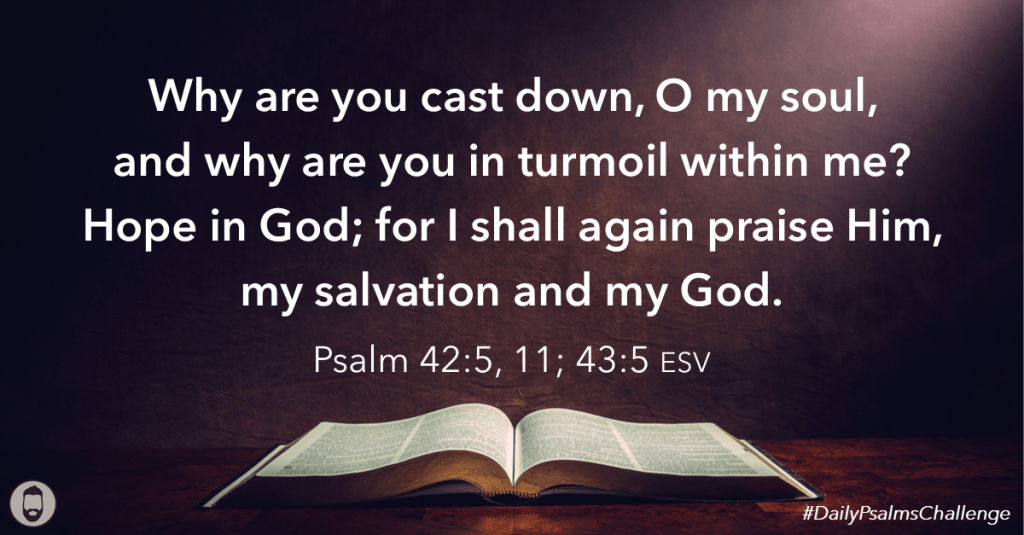
Why are you cast down, O my soul, and why are you in turmoil within me? Hope in God; for I shall again praise Him, my salvation and my God.
Psalm 42:5-6a, 11; 43:5
Psalm 42 and Psalm 43 are deeply connected, forming a single lament that expresses the struggle of a soul longing for God in the midst of despair.
Psalm 42 opens with vivid imagery: “As a deer pants for flowing streams, so pants my soul for you, O God” (v. 42:1). There is a beautiful hymn based on this image, but for those who are crying out to the Lord, it is often anything but beautiful. Picture a deer being hunted, running from a hunter or predator, panting and out of breath and seeking a cool stream to provide sustenance and relief. Such is the plight of the sons of Korah in these psalms. They are spiritually thirsty, longing for the presence of the living God (v. 42:2), yet instead of refreshment, they find themselves overwhelmed by sorrow, being fed by tears (v. 42:3) and haunted by the taunts of people mocking their faith by asking “Where is your God?” (vv. 42:3, 10)
This spiritual turmoil is compounded by distance from the place of worship or from the joy accompanying better times of leading God’s people in His praise and worship (v. 42:4). They remember what it was to joyously lead God’s people in worship at His tabernacle but now feel cut off and alone. The lament deepens as they describe being overwhelmed by waves of suffering, described a waves of the sea crashing over them (v. 42:7). Yet, even in their distress, they cling to this foundational truth: “By day the Lord commands His steadfast love, and at night His song is with me” (v. 42:8).
Psalm 43 continues their cry for deliverance, shifting from lament to pray to God for vindication. They plead for God to “send out [His] light and…truth” to lead them back to worship at His altar, where they may rejoice in Him again (vv. 43:3-4). But there is beautiful solace to be found in their refrain found in vv. 42:5, 11 and 43:5 that not only asks their own souls “why” they are “cast down” and “in turmoil” within themselves but points to the refreshment they know their panting souls will receive by saying, “Hope in God; for I shall again praise Him, my salvation and my God.”
This refrain teaches us the discipline of preaching the truth to ourselves in the face of despair. Instead of passively listening to their own troubled thoughts, they preach to their own souls, reminding themselves of who God is and where their hope must rest. This does not change their circumstances but points them to the God who provides hope in the midst of circumstances. He is faithful. He provides rest. He provides solace. He IS their hope.
Seeing Jesus in Psalms 42 & 43
These psalms find their fulfillment in Jesus, who fully experienced the anguish of a downcast soul. In the Garden of Gethsemane, Jesus echoed the sons of Korah when He said, “My soul is very sorrowful, even unto death” (Matthew 26:38). On the cross, He endured the mockery of His enemies jsut as they did (vv. 42:3, 10; Matthew 27:39-43). Yet, even in His suffering, Jesus fully entrusted Himself to His Father’s will and endured the full weight of God’s wrath against sin – our sin – that we might never be truly abandoned.
The sons of Korah longed for God’s presence, and through Jesus, that longing is ultimately fulfilled. Jesus Himself is the “light and truth” that leads us to God (v. 43:3; John 8:12, 14:6). He is Emmanuel, God with us, who will never leave nor forsake His people. And because of His resurrection and promised return, we can confidently hope in God, knowing that no matter our circumstances we too will “again praise Him” (v. 43:5).
Reflection
Can you identify with the sorrow and despair found in Psalms 42 and 43? If so, I hope you see the promise of hope and relief found in Jesus. He bore our shame and sin and adopts us into His family.
There is coming a day when the tears that flow ever so easily here in this fallen world will be wiped away for the last time by His nail-scarred hand when He comes to dwell with His people – where death will be nothing more than a fading memory – where there shall be no more “mourning, nor crying, nor pain anymore, for the former things have passed away” (Revelation 21:3-4).
In the meantime between that promise and its fulfillment, there is a lot of despair and downcast souls and pain and sorrow. There is a lot of panting for streams of relief. But, oh, there is so much hope to be found. May we not be left in the question of why our souls are downcast but let us preach the beautiful truth of the psalmists refrain: “Hope in God; for I shall again praise Him, my salvation and my God”!
Here’s a song inspired by Psalm 42:
The #dailyPSALMSchallenge gives us the opportunity to start 2025 in God’s Word by digging into a psalm a day. Each day will identify a key passage for us to meditate on as well as seeking to help us see Jesus in the psalm and reflect on what we have read.
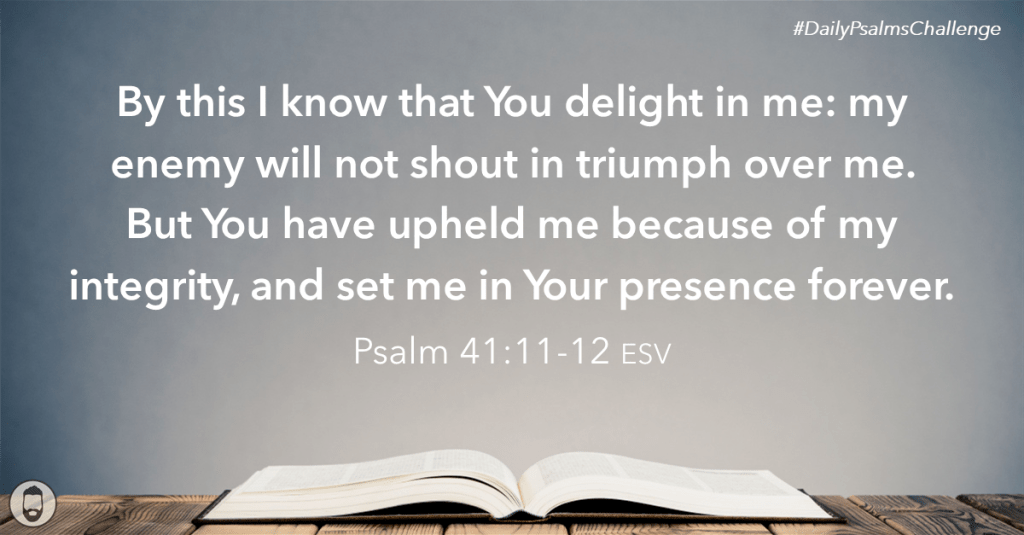
By this I know that You delight in me: my enemy will not shout in triumph over me. But You have upheld me because of my integrity, and set me in Your presence forever.
Psalm 41:11-12
Psalm 41 is a psalm of both confidence and lament, showing David’s trust in God even as he faces sickness, slander, and betrayal. It begins with a blessing on the “one who considers the poor” because the Lord will deliver him in “the day of trouble” (v. 1). David knows that God sees and cares for those who show mercy, and he clings to this truth as he cries out to God for grace and healing (v. 4).
David’s suffering at the hands of his enemies is worsened by the betrayal of a “close” and “trusted” friend, one who he once shared meals with (v. 9). His foes whisper in the shadows about his downfall, waiting for him to die and be forgotten (vv. 5-8). In his distress, David prays, “O Lord, be gracious to me, and raise me up, that i may repay them!” (v. 10). His hope doesn’t rest in his strength as he clearly has none and cannot overcome his foes on his own. His only hope is in God’s strength and faithfulness; he trusts that the Lord will uphold him and not allow his enemies to triumph over him (vv. 11-12).
The psalm ends with a beautiful doxology (formula for praising the Lord) that we can echo today: “Blessed be the LORD, the God of Israel, from everlasting to everlasting! Amen and amen.” (v. 13) This shows that, despite his suffering, David praises the Lord and exalts His name and that no matter what, God’s justice and mercy will prevail.
Seeing Jesus in Psalm 41
Psalm 41 finds its ultimate fulfillment in Jesus, the true and greater King. David’s words about the betrayal of a close friend in v. 9 are quoted by Jesus in reference to Judas Iscariot (John 13:18). Judas, who had walked with Jesus and shared meals with Him, turned against Him and handed Him over to His enemies.
Like David, Jesus was surrounded by those who whispered against Him, mocked Him, and plotted His demise (vv. 5-8, Matthew 26:3-4). Yet, unlike David, Jesus did not pray for deliverance from death but submitted to His Father’s will and plan by willingly enduring betrayal, suffering, and the cross for our salvation. Though His enemies thought they had triumphed, God raised Him up in victory (v. 10), exalting Him to His rightful place at the Father’s right hand (Philippians 2:9-11). And through His resurrection, Jesus secured ultimate healing, restoration, and vindication for all who have faith in Him.
Reflection
For those who have faced betrayal, affliction, or opposition, Psalm 41 offers a reminder that God sees, sustains, and vindicates His people. It is tempting to try and vindicate ourselves or to give up in the face of overwhelming circumstances, but Jesus has made a way for us. He endured so that we may have eternal life, leaving us with the reminder that this world is not all there is. For those who have confessed Him as Lord and believed He is risen from the dead (Romans 10:9), He saves not only from our sin but forevermore!
Even when we are afflicted, betrayed, or opposed, God remains faithful. He will sustain us. Follow the example of David in Psalm 41, and trust that the Lord delights in His people – that He delights in saving us.
The #dailyPSALMSchallenge gives us the opportunity to start 2025 in God’s Word by digging into a psalm a day. Each day will identify a key passage for us to meditate on as well as seeking to help us see Jesus in the psalm and reflect on what we have read.






 Just Keith Harris