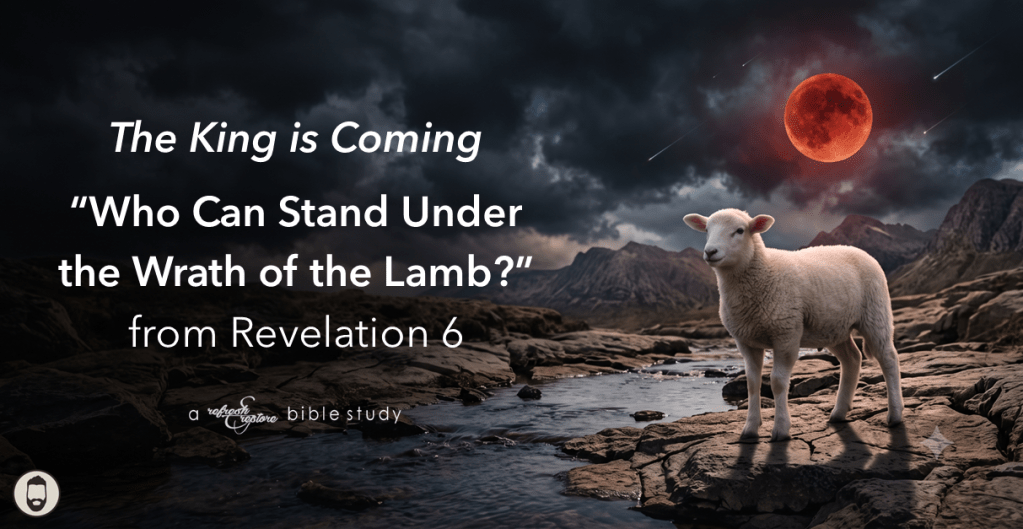
“Who Can Stand Under the Wrath of the Lamb?” from Revelation 6 — a Refresh & Restore Bible Study


Click below to listen:


We’re back in our study of Revelation called The KING is Coming, where we’re taking a verse-by-verse approach to see what the book truly reveals—Jesus Christ Himself. As always, I’m joined by Jamie Harrison, and I’m thankful for the opportunity to walk through this study together. Today, we’ll be turning to Revelation 6, a heavy chapter where the Lamb who was worshiped as worthy in Revelation 5 begins to open the seals of the scroll. As judgment unfolds, this passage presses us to see both the holiness of God’s wrath and the urgency of standing in the grace and mercy of the Lamb. This week’s passage is Revelation 6:

1 Now I watched when the Lamb opened one of the seven seals, and I heard one of the four living creatures say with a voice like thunder, “Come!” And I looked, and behold, a white horse! And its rider had a bow, and a crown was given to him, and he came out conquering, and to conquer.
When he opened the second seal, I heard the second living creature say, “Come!” And out came another horse, bright red. Its rider was permitted to take peace from the earth, so that people should slay one another, and he was given a great sword.
When he opened the third seal, I heard the third living creature say, “Come!” And I looked, and behold, a black horse! And its rider had a pair of scales in his hand. And I heard what seemed to be a voice in the midst of the four living creatures, saying, “A quart of wheat for a denarius, and three quarts of barley for a denarius, and do not harm the oil and wine!”
When he opened the fourth seal, I heard the voice of the fourth living creature say, “Come!” And I looked, and behold, a pale horse! And its rider’s name was Death, and Hades followed him. And they were given authority over a fourth of the earth, to kill with sword and with famine and with pestilence and by wild beasts of the earth.
When he opened the fifth seal, I saw under the altar the souls of those who had been slain for the word of God and for the witness they had borne. 10 They cried out with a loud voice, “O Sovereign Lord, holy and true, how long before you will judge and avenge our blood on those who dwell on the earth?” 11 Then they were each given a white robe and told to rest a little longer, until the number of their fellow servants and their brothers should be complete, who were to be killed as they themselves had been.
12 When he opened the sixth seal, I looked, and behold, there was a great earthquake, and the sun became black as sackcloth, the full moon became like blood, 13 and the stars of the sky fell to the earth as the fig tree sheds its winter fruit when shaken by a gale. 14 The sky vanished like a scroll that is being rolled up, and every mountain and island was removed from its place. 15 Then the kings of the earth and the great ones and the generals and the rich and the powerful, and everyone, slave and free, hid themselves in the caves and among the rocks of the mountains, 16 calling to the mountains and rocks, “Fall on us and hide us from the face of him who is seated on the throne, and from the wrath of the Lamb, 17 for the great day of their wrath has come, and who can stand?”[1]

Keith Harris:     
Greetings, sojourners.

This is a heavy chapter, and so I think that’s about all the segue I’ve got there. Jamie, dive in.

Jamie Harrison:
All right. So we pick up with the Lamb, who we talked about in the last episode, being the One who was worthy to take the scroll and open it. And He does take the scroll here, and one of the four living creatures says with a voice like thunder. Now, if you remember back from chapter 4, thunder is a sign of judgment to come, and it’s going to be said several times again throughout Revelation every time a judgment is coming. And so the first thing you see here is a white horse. And a lot of people get interested — excuse me — get confused about this rider on a white horse, because in Revelation 19 there’s a rider on a white horse who is Jesus. But this rider on the white horse is given a bow. It doesn’t say a bow and arrows. It just says bow, which is interesting. But he’s got a crown. It’s given to him. Notice the crown is given to him. And he goes out as a conqueror in order to conquer. So remember, the Jews are looking for somebody who will come and conquer and take over. And so this rider comes in as a conqueror to conquer. And so this is most likely a depiction of the Antichrist who is going to come.

And so the entire world is going to follow him. They’re going to be obsessed with him. He is going to go for a peace in the world. That’s going to be his—we’ll just say—the way he kind of takes power is, “I’ll bring peace to the world, and I can do this and that.” And it’s not going to be through war. We’re going to do it in a peaceful manner through treaties and stuff. And so if you go to Daniel chapter 9, in Daniel 9:27[2], he says:

He will make a firm covenant with many for one week, but in the middle of the week he will put a stop to sacrifice and offering. And the abomination of desolation will be on a wing of the temple, until the decreed destruction is poured out on the desolator.”

So he’s going to make a covenant of peace. He’s going to do it in a peaceful manner, not by war. But it’s going to be a false peace, which I think is key to point out and talk about. Then you go back to Matthew 24, which is where Jesus is talking about the end times and what that will look like. And in Matthew 24, verse 4, it says:

Jesus replied to them, “Watch out that no one deceives you. For many will come in my name, saying, ‘I am the Messiah,’ and they will deceive many.

And so that’s who we have here—somebody who’s going to deceive.

Keith:                  
Well, and just in case you’re wondering where we get some of this stuff too, this isn’t just commentary or interpretation that we’re spouting out back to you. You look at the language there—I think it’s in verse 2—where it describes this rider on the white horse. The Spirit of God has told us twice here, like in quick succession, that he is coming to conquer because people aren’t going to realize it. It says, “He came out conquering and to conquer.” That’s what he was doing when people thought he was bringing peace. And I’m speaking of it in past tense, but many believe this is a future thing here. “…conquering and to conquer”—that’s his purpose. And the Spirit of God has to tell us. This is another reason why many look at this to be the Antichrist, because he’s coming imitating Christ. Like Jamie said, he’s also riding a white horse. He’s imitation. This is Great Value imitation here. And he had a crown, and that was given to him because he doesn’t have dominion. Just like the song in Revelation 5: dominion belongs to the Lamb, to Him who sits on the throne. He allows him this opportunity, but He also allows us a glimpse at what he’s really doing—coming out conquering with the purpose to conquer.

Jamie:                 
And I think there we talk about the rider holds a bow. Again, it doesn’t say bow and arrow. It just says bow, meaning there’s no fight that’s going to take place. He’s going to give this false peace, again by a covenant, like it says in Daniel.

Keith:                  
Symbolic.

Jamie:                 
That’s right. And we know it’s false. We know in Daniel it also says there will be a war. Matthew says there will be wars and rumors of wars, and we’ll get into that a little bit more. So we know three-and-a-half years in, that false peace is going to go away, and he’s going to show his true self.

Keith:                  
You say three-and-a-half years in—that’s referencing the seven-year period known as the Great Tribulation, correct?

Jamie:                 
Correct. Okay, so the crown that he’s wearing here—I found it interesting that the word here in Greek for crown, and Keith, you’ll have to tell me if I’m pronouncing this correctly, stephanos. Is that accurate?

Keith:                  
Yes. Reminds me of Stefano from Days of Our Lives that my mom and grandmother used to watch. You know, he was dead and alive and dead and alive and dead and alive.

Jamie:                 
Yeah, that’s the guy. It’s my cousin. So that is the victor’s crown, okay? That’s like a laurel wreath that they would give you if you were an athlete and you won the race or whatever. So it’s given to you for your victory. It’s a laurel wreath. Again, in Revelation 19:12, the word that’s used for crown is diadēma—the kingly crown. And this crown only belongs to the King. And so that’s how we know that this rider is not Jesus. Not only the fact that he’s coming in order to conquer and to conquer, and he’s bringing about evil—that’s obvious in and of itself—but the fact that the crown is going to be given to him. Which means, most likely, the world is going to elect him as their leader, whether it’s through maybe the United Nations or something and he becomes a leader of that—however you want to look at that. He’s going to become the leader, elected by the people despite the cost—despite what it’s’s going to cost them. They’re going to elect him as leader. So again, I just want to point out: this is not Jesus. Jesus is not given His crown.

Keith:                  
And to clarify, when you say “elect” there, you’re not trying to make some political prophecy. They’re going to back this guy. He’s coming with his own agenda, in his own way. God’s allowing him to do this to bring about these things that have been prophesied. But folks are just in his corner. They’re going to get what they want.

Jamie:                 
And I think—I don’t want to spend much time talking about this—but there’s something people forget. Every leader who has ever existed has been placed in leadership, or allowed to be placed in leadership, by God for His purposes. And in Romans, He said, “Pray for your leaders”—all your leaders—because God placed them there. So, you know, we say, “Oh, we need to get back to being a praying nation.” Here in America, I agree with that. We do need to pray more. All of us do. All believers do. And non-believers—first get saved, and then pray. Obviously it doesn’t work in reverse order. But praying is important. God’s going to put in charge who He wants in charge.

Keith:                  
And in this case right here, He is coming as the Lion, bringing judgment. And part of doing this is giving people what they wanted in the first place. That’s right. I mean, it’s no different than the book of Judges, when there was no king in Israel and people did what was right in their own eyes. Or 1 Samuel, when they wanted a king like everybody else. He’s giving them what they wanted in judgment. And that’s a big part of this.

Jamie:                 
And what’s really — I’m jumping way ahead of myself here — but what’s really interesting is you would say, “Well, the people didn’t even know that’s what they were doing.” They didn’t know. But it says right at the end of the chapter that they actually cry out to the rocks, asking the rocks to fall on them. And they say, “Fall on us and hide us from the face of the One seated on the throne, from the wrath of the Lamb, because the great day of their wrath has come, and who is able to stand?” So the people are going to recognize this is the wrath of God and are going to continue to support the Antichrist. They’re going to continue to worship the Antichrist. They’re going to take the mark of the beast willingly.

Keith:                  
Willingly being tricked.

Jamie:                 
Correct. And will most likely say some kind of vow that says there is no other god but him — the Antichrist.

Keith:                  
Which is not a new thing. People have been doing that — going along to get along, getting what they want out of it — for centuries. Roman Empire, Persian Empire, Greek Empire — I know I’m out of order historically — Babylonian Empire. They’re getting what they want, getting what they asked for here.

Jamie:                 
Which is why people say, “Be careful what you ask for. You might just get it.” So that’s the first seal. The first seal most likely is going to set the course of events in motion. First seal — sorry, I said scroll. There’s only one scroll. The first seal is going to set in motion the Antichrist coming to power. And then we get to the second seal. This is the second seal. He hears the second living creature say, “Come,” and another horse goes out. So these are — a lot of people call these the Four Horsemen of the Apocalypse, right? This horse is a fiery red horse, and its rider is allowed to take peace from the earth so that people will slaughter one another, and a large sword was given to him. And so obviously this one’s very simple. This rider represents war. I mean, this red—blood, right? People are going to die. They’re going to be killed. And again, back in Matthew 24, they’re going to be killed and kill each other. Verses 6 and 7:

You are going to hear of wars and rumors of wars. See that you are not alarmed, because these things must take place, but the end is not yet. For nation will rise up against nation, and kingdom against kingdom. There will be famines, and earthquakes in various places. All these events are the beginning of labor pains.

So understand that Jesus is telling us this. And right after that He’s going to talk about persecution happening. So I need people to understand that, as we’re looking at these seals, if this happens in our lifetime, we will be here for this. This will happen with Christians present on the earth. According to Jesus, Christians will be here.

Keith:                  
And this is going to be the point where some of y’all are like, “Hold on. We are pre-trib rapturists.” Now here’s the deal. There is nobody who wants a pre-trib rapture—yes, Lord—more than us two. When we look at this, we’re not trying to fit any of this into a camp. We’re trying to take this verse by verse. Do I want a pre-trib rapture? Yes. But let’s look at a little bit of reality here. And I’m not trying to take a rabbit trail. You need to look at passages like Matthew 24, which is Jesus talking. Jesus trumps your favorite Bible preacher. He does. Jesus trumps your favorite prophecy preacher. Jesus trumps all of that. But I want you to think about some other folks here in the Bible. Look at 1 Peter chapter 5, where he describes tribulation being experienced by the brothers throughout the world. I want you to understand Peter died in the midst of an act of tribulation and persecution in Rome. Paul—the whole idea of a peaceful, prosperous life—it didn’t seem like the apostle Paul, through his service to the Lord, earned health, wealth, and prosperity. You need to understand, as long as there’s been a church, they have experienced persecution. And again, who trumps your favorite Bible preacher? Jesus. He said in John chapter 16, “In this world you will have tribulation, but take heart. I have overcome the world.” So when we look at this, we’re not trying to make a prophetic stance here. We’re just following the text. And it does seem like—

Jamie:                 
John 16

Keith:                  
Jamie’s checking my reference here, which is always a good thing.

Jamie:                 
John 15—that’s what I was looking at. Jesus says:

Remember the word I spoke to you: ‘A servant is not greater than his master.’ If they persecuted me, they will also persecute you. If they kept my word, they will also keep yours.

And so, you know, it’s this whole section here. Persecution is predicted.

Keith:                  
And John 16—the one I was talking about—double-checking the reference there—the end of the chapter, verse… Excuse me. Thirty-three. I knew it was a double number there.

I have said these things to you, that in me you may have peace. In the world you will have tribulation. But take heart; I have overcome the world.”

So the idea here is we follow the text. Jesus talks about persecution that is going to come. Now, when it comes to the Great Tribulation here—that’s what Jesus was referencing in Matthew 24. What we’re looking at here with these seals in Revelation 6, like Jamie said, it does seem like the church is still going to be present in this time.

Jamie:                 
That’s right. So we move to the third seal. When He opens the third seal, the third living creature says, “Come.” And he looks, and this time there’s a black horse, and its rider holds a set of scales in his hand. And he heard someone say, “A quart of wheat for a denarius and three quarts of barley for a denarius, but do not harm the oil and the wine.” And so the idea you get here is that there’s going to be worldwide famine and worldwide war from the second seal. And so you think a natural outcome of a worldwide war is going to be famine. I was just talking yesterday or two days ago — on Thanksgiving Day — asking about my grandmother, who recently passed, had a ration book left over from World War II.

Keith:                  
Oh, wow.

Jamie:                 
And I was asking if they knew what happened to it, because it was real cool, you know, just a cool thing to look at, talk about, whatever. But because the world was at war, the people at home were given ration booklets. You know, you could get so much sugar, so much bread, so much butter — whatever it was — and that’s all you could get. And so what’s going to happen here in this third seal is that you’re going to have worldwide famine. The war is going to obviously destroy the food supply, because when you have war — think about in modern times — we’re blowing crap up. And so when you’re blowing stuff up, it is going to harm the food supply, the water supply, all of those things. And it’s going to cause, I’m going to say, rationing by governments, which is going to drive prices up. We’ve experienced that here for sure. Inflation, I think, was up 24%. It’s risen another 2% now. I don’t think it’s rising at the moment we’re talking right now. But still, you go to Walmart — somebody say amen — and you buy one bag of nothing, and it’s $127,423.62. And then you get home and you’re like, “Wow, I didn’t even buy enough to eat a snack.” So — but we’re talking about, like, there’s a country — and I can’t remember the exact name of the country. I want to say it’s Zimbabwe — that they would walk around literally with wheelbarrows full of their currency to buy a loaf of bread.

Keith:                  
It was like that in lots of places in Europe. I remember reading The Hiding Place, talking about how their currency became worthless. But man, what it reminds me of—and this might be the only economic term I can remember from my high school economics class, Mr. Nez Watson. He told all of us, “Scarcity exists.” And that’s in normal times, right? This is abnormal. So economic scarcity leading to actual scarcity of provisions—that’s a byproduct, like you say, of war. And so extreme measures would have to take place to survive. And I think that’s part of the implication here. Many will not survive.

Jamie:                 
That’s correct. And so to kind of get, I guess, a little bit more specific, in case you’re wondering where we’re coming up with this, where it says, “A quart of wheat for a denarius.” Remember that a denarius is a day’s wages during this time. So you’re talking about somebody working an entire day to be able to buy one quart of wheat, which would maybe feed one person—definitely not enough for a family. So if you’re a dad, you work an entire day—you know, twelve hours, however long that is. War is going on, so it might be longer. And it’s only enough to buy just enough to feed one person. During this time you would have gotten anywhere from eight to twelve quarts of wheat for a denarius, to kind of put that in perspective. The three quarts of barley—we know that barley is normally fed to animals because it’s low in nutrients. It’s cheaper than wheat, and they’ll eat it. And so here it says that a denarius will get you three quarts of barley. Now that would be enough to feed a small family, but it’s very low in nutrients, so it’s not going to keep you alive very long. So again, back to what Keith said, people are going to start dying. And now, “Don’t harm the oil and the wine.” There’s a lot of possible interpretations here. Maybe the rich people will have plenty of it, or it’ll be some type of luxury that has to be protected because people are going to be killing for it. Oil does a lot. Oil, obviously, you’d use it to make bread. Wine—for cooking, to purify water—all these things. But it’s the idea that “don’t harm the oil and wine.” I lean toward, you’re going to have to protect it because there ain’t going to be much of it out there.

Keith:                  
Well, it also might be because some folks are going to think, “No, this isn’t really happening.” They’re going to be the people who are more insulated from it. I was reading about a time—this was toward the end of the first century—when the emperor Domitian, because there was a shortage of grain, was going to have the vineyards cut down and use that fertile farmland for planting grain. And the rich gave such a backlash that he said, “Never mind.” Pour it up. Drink up, guys. So this might have some kind of social aspect to it as well. Because it always happens like that. The ones who are most affected in these times are the weaker, the poor, the less affluent. There are some people who are going to think they’re insulated from this. But as we continue, the insulation gets thinner.

Jamie:                 
So the fourth seal is opened, and this time we get this pale green horse, and its rider is named Death, and Hades is following after him. They’re given authority over a fourth of the earth to kill by the sword, by famine, by plague, and by the wild animals of the earth. So here’s where we get confirmation that death is going to occur. Now notice it says they’re given authority over a fourth of the earth. It doesn’t say that they’re going to kill a fourth of the people on the earth, but they can. It is being allowed at this time.

Keith:                  
And we’ll see that percentage change, and it’s based on what they’re allowed—what authority is given.

Jamie:                 
That’s correct. And back in Matthew 24, in verse 7, which we read just a second ago, He says again:

For nation will rise up against nation, and kingdom against kingdom. There will be famines, and earthquakes in various places.

Some manuscripts and some translations also add in “epidemics” or “pestilences” in various places. Again, Jesus confirms before Revelation is even written that these things are going to happen. He tells us these things are going to happen.

Keith:                  
And when you say “some manuscripts,” to clarify there, it’s not different versions of the Bible. Some fragments that we have of some manuscripts would have included footnotes or notes in the margin where, more than likely, through pastoral oversight, someone was looking and going, “Okay, Matthew 24, Revelation 6—these go together.” And they probably just kind of jotted down “pestilence” over in the margin, so to speak. And when we get a little piece of a fragment, it’s like, “Oh look, there’s a word there.”

Jamie:                 
Yep, that is correct. So the word here for “pale green horse” is chlōros, which is where the word chlorophyll comes from. And it basically describes a pale, ashen green characteristic of a decomposing corpse.

Keith:                  
Yeah, and just to clarify, that word is used four times in the New Testament. Three of those times it’s just translated “green.” This isn’t stuff we’re making up. But yeah, hopefully you haven’t seen a bunch of decomposing corpses. They don’t look good.

Jamie:                 
Correct.

Keith:                  
And this passage right here always makes me think of the movie Tombstone, with Johnny Ringo describing the situation: “Death’s coming, and hell’s coming with it.” I mean, people use this like they’re bringing some sort of vengeance. People are victims of these. Ain’t nobody steering the pale rider, so to speak. This is the judgment being poured out—the wrath of the Lamb, as they’re going to recognize later on. This is no joke. Nothing to play with.

Jamie:                 
Not at all. And so, like Keith has already said, the rider’s name is Death, so death is coming, and Hades is following after him. Hades is seen as the place of the dead. So the idea there being death claims the body, and Hades is going to collect the soul. Not a good thing at all. And then he mentions four means of extermination: The sword—which is obviously war. Hunger—famine. Death by plagues, infections, diseases. And unrestrained beasts of the earth. So there is a lot going on here. And “unrestrained beasts of the earth”—what does that mean? Who knows? I guess the animals start going crazy because of all the war that’s going on. If their habitats are being blown up and destroyed, they start coming into the cities. Who knows what it’ll look like? I just know you don’t want to run up on one of them.

Keith:                  
A hungry, starving, domesticated animal will go back to its nature.

Jamie:                 
Correct. And then we get to the fifth seal. Here in the fifth seal you see a group of people under the altar that have been slaughtered because of the Word of God and the testimony they’ve given. So you go to Revelation 5:8, and you see where the saints’ prayers are ascending to God. It’s the same idea. These are the saints who have been slaughtered, most likely during the Tribulation. And they cry out with a loud voice and ask God, “How long until You judge those who live on the earth and avenge our blood?” It’s like, “God, what are You waiting for? Why are You holding off on this?” But here’s the response. It says they were each given a white robe and told to rest a little while longer until the number would be completed of their fellow servants and their brothers and sisters who were going to be killed just as they had been. So there are going to be more believers who are going to be killed for their faith. That number is not completed yet. But also there are going to be more people who are going to be saved. And that number is not completed. Once the number of people who are going to be saved are saved—that’s the end.

Keith:                  
And so the idea there is God, in His sovereignty, is in charge of this. But you need to look—God, in His grace and mercy, is still in the business of saving people. We could cry out and be like, “You know, we do…” Like I say, “Man, do I want a pre-trib rapture?” But if I had my way, then, “Well, God, You’ve saved enough folks. You’ve saved me. Go on and rescue me.” But in this right here, you look—obviously they’re still going to be here. It says, “Until that number should be complete who were to be killed”—future—”as those who were crying out had been”—past. And so we know this could have happened in John’s day. People had already been martyred in the thousands. We’ve got tens of thousands who have been martyred within the last year. We talked about Nigeria in some news here recently. We know in a lot of Middle Eastern countries, a lot of Asian countries, there are a lot of things going on. That goes back to the 1 Peter passage—that these things have been experienced by the brotherhood around the world. People are being persecuted. People are being killed for their faith. And that’s the thing here. It’s not just Christians who have died. These are people who were slain for the Word of God, for the witness they had borne. Just a reminder there—that word witness. If you go back to the first chapter of the book of Acts, that Greek word is where we get the English word martyr. This is not a passive thing. These people are actively involved in evil, actively persecuting the Lamb, taking it out on those who belong to the Lamb, and killing them. This is not just a passive evil-on-evil sort of crime here. It’s like, “You know what? We don’t want this.” And I think that’s also—and I’m not trying to get ahead again—but we’ve mentioned it several times: The wrath of the Lamb. That’s a weird way of saying it. Because we’ve already talked about that. What they’re getting right now ain’t the Lamb. They’re getting the Lion. But still, man, people have such a hatred for Jesus being who the Bible says He is. They’re all right with Him being a good person. They’re all right with Him being a good teacher. But they’re not all right with somebody being willing to die for their sins. I mean, you take guys like—what’s his name from the American Revolution? Thomas Paine. Man did such great things for the founding of this republic. But you get that dude talking about Jesus, like in his book The Age of Reason. That dude had a hatred for the Lamb of God. He had a hatred for the idea of Him being crucified for sin. He had a hatred for the idea that a holy God could call him a sinner. And he was tame compared to the evil that’s going to be poured out on these martyrs—and soon-to-be martyred.

Jamie:                 
No doubt. And then we get to the sixth seal. And a violent earthquake occurs to the point that the sun turns black like sackcloth made of hair, the entire moon becomes like blood, the stars of heaven fall to the earth as a fig tree drops its unripe figs when shaken by a high wind, the sky is split apart like a scroll being rolled up, and every mountain and island are moved from their places. Catastrophic. I mean, we could get into the technicalities of all this, but in order for every island and mountain to be moved from its place, all the earth’s fault lines would have to begin to—

Keith:                  
Yes. Yes.

Jamie:                 
—all over the world. You’re talking about a global earthquake. And this is just the first of three. There’s three of these that’s going to happen. Now remember, the timeline of Revelation is just what John saw next. So the three that are mentioned—maybe it’s the same one mentioned three times. Maybe it’s three different ones. We don’t know. It doesn’t say. It doesn’t say, “This happens, then this happens, then this happens.” It’s what John saw next. But worst-case scenario, it’s three different earthquakes of this magnitude. The sun becoming black like sackcloth made of hair. The moon turning to blood. I read in several places that this could obviously—an earthquake of this magnitude would cause volcanic eruptions all over the place, which would cause ash and debris to blow into the atmosphere, which could possibly make the sun look like that.

Keith:                  
And I mean, you think it’s definitely sackcloth made of hair. It’s talking about the sun being occluded. Something in between.

Jamie:                 
That’s right. And then you’ve got some kind of asteroid or meteor shower that happens with the stars falling to the earth. The sky recedes like a scroll. Who knows what that means? We just know it ain’t gonna look like it looks right now by any stretch of the imagination. And when those earth’s plates begin to shift, the whole earth is going to be realigned in that moment. No island, no mountain—nothing—is going to be in the same place. To the point that the kings of the earth—we’re talking about the rulers of the earth—all the way down to every slave and every free person and everybody in between are going to hide in caves. They’re going to hide among the rocks of the mountains. They’re going to say to the mountains and the rocks, “Please fall on us and hide us from the face of the One who is seated on the throne and from the wrath of the Lamb, because the great day of their wrath has come, and who is able to stand?” So I just want to go back to the point that the people recognize this is the wrath of God. They recognize, “Okay, Jesus told us this was going to happen.”

Keith:                  
Well, and recognize the wrath of God—but what specific God it is. They ain’t talking generic.

Jamie:                 
They know the Lamb. The wrath of the Lamb. And, you know, I’ll just say this. God’s judgment is going to come. You know you can’t withstand His wrath. But that’s not why you get saved. And I hope, if you’re not saved, you’re listening to this. I heard a pastor the other day on a little clip say they had listened to something about what hell was going to look like, and a person came down and said, “I don’t know anything about heaven, but I know I don’t want to go to hell.” And that’s a good first step. Hear me—that’s a good first step. We don’t get saved because we don’t want to go to hell. We don’t get saved because we don’t want to experience God’s judgment. We get saved because we have a genuine love for the Lamb. Right?

Keith:                  
We talked a little bit ago about how these people are willingly following the leader here in the first seal. People must willingly follow the Lamb. This Jesus isn’t a byproduct of heaven. If you listened last week when we looked at Revelation 5, there’s a reason why we don’t know about the scenery, about anything more than Him who’s seated on the throne. He occludes everything. More so than sackcloth made of hair will occlude the sun in those seals. I think of Paul’s language in Philippians chapter 3, when he talks about the surpassing worth of knowing Christ.

Jamie:                 
And to jump in there, when we’re talking through Revelation, if you get more excited about what these horses represent, or these locusts represent, or whatever represents, than you do the fact that Jesus is the King of kings and the Lord of lords, then we have to step back and look at our relationship with Christ and ask, number one, “Do I even have one?” Because the joy of heaven is being with Him.

Keith:                  
And I think, I guess if we’re looking at this in that context… Jamie, if you were living in this time—we don’t want this to happen in our lifetime. Church folks will sing, “Come, Jesus, come,” in a heartbeat. But “Come, Jesus, come”—this comes too.

Jamie:                 
I’d say all hell is going to break loose. Which actually…

Keith:                  
It is. But I mean, heaven. Right? And that’s the thing here. When you look at this, if you were living through Revelation 6, which seal would you be found in? Would you be found in the fifth seal, where you have all of these people who have been saved by the blood of the Lamb, who are crying out to their Sovereign Lord, holy and true, knowing that ushering in the judgment He’s bringing about? Or are you in those who are talking about the wrath of the Lamb and you’re not affiliated with Him? Essentially, like Jamie said, it’s not for fire insurance. It’s not to scare hell out of you or heaven into you. Do you look at this Lamb of God and see Him for who He is—the King of kings, the Lord of lords? If you don’t have a relationship with Him, that lordship isn’t to be found when you’re under His boot, so to speak. It’s to be found now. It says in Romans chapter 10, verse 9:

…because, if you confess with your mouth that Jesus is Lord and believe in your heart that God raised him from the dead, you will be saved.

Revelation is clear. He is the Sovereign Lord. He’s in charge. He gave authority over a fourth of the earth to experience His judgment. Thus far in the book of Revelation, He’s got authority over one hundred percent of everything that’s ever been. The scroll—that’s the deed to everything that is—is His. He can open the seals. Where do you stand in light of the Lord? I think that’s a good place to end. Where do you stand? Because there’s going to come a day where the question is asked here at the end of Revelation 6: “For the great day of their wrath has come, and who is able to stand?” It’s better to stand in His grace and mercy now than under His judgment ever. I think that’s it for us. We’ll pick up with Revelation 7 next week.


[1] The Holy Bible: English Standard Version (Wheaton, IL: Crossway Bibles, 2025), Re 6:1–17.

[2] When Jamie quotes Scripture, he uses the Christian Standard Bible (Nashville, TN: Holman Bible Publishers, 2020).
“Before the Throne of God Above” from Revelation 4 — a Refresh & Restore Bible Study

We’re back in our study of Revelation called The KING is Coming, where we’re taking a verse-by-verse approach to see what the book truly reveals—Jesus Christ Himself. As always, I’m joined by Jamie Harrison, and I’m thankful for the opportunity to walk through this study together. Today, we’ll be moving out of the letters from Jesus to the churches and into the rest of the Revelation of Jesus Christ with Revelation 4:

After this I looked, and behold, a door standing open in heaven! And the first voice, which I had heard speaking to me like a trumpet, said, “Come up here, and I will show you what must take place after this.” At once I was in the Spirit, and behold, a throne stood in heaven, with one seated on the throne. And he who sat there had the appearance of jasper and carnelian, and around the throne was a rainbow that had the appearance of an emerald. Around the throne were twenty-four thrones, and seated on the thrones were twenty-four elders, clothed in white garments, with golden crowns on their heads. From the throne came flashes of lightning, and rumblings and peals of thunder, and before the throne were burning seven torches of fire, which are the seven spirits of God, and before the throne there was as it were a sea of glass, like crystal.
And around the throne, on each side of the throne, are four living creatures, full of eyes in front and behind: the first living creature like a lion, the second living creature like an ox, the third living creature with the face of a man, and the fourth living creature like an eagle in flight. And the four living creatures, each of them with six wings, are full of eyes all around and within, and day and night they never cease to say,            
“Holy, holy, holy, is the Lord God Almighty,       
who was and is and is to come!”

And whenever the living creatures give glory and honor and thanks to him who is seated on the throne, who lives forever and ever, 10 the twenty-four elders fall down before him who is seated on the throne and worship him who lives forever and ever. They cast their crowns before the throne, saying,               

11 “Worthy are you, our Lord and God,       
to receive glory and honor and power,     
for you created all things,
and by your will they existed and were created.”[1]


Keith Harris:     
Greetings, sojourners. We have a lot to dive into today, and frankly I am excited. I’m beside myself — and also beside Jamie. Jamie, talk to us about Revelation 4. Yes, yes — threw you off with that.

Jamie Harrison:
Yes, yes you did. So we have here — just to get started — to remind you the timeline of Revelation from this point forward. So we finished the seven letters to the churches, and from here on out we have to understand that the timeline is what John saw next. So does this mean historically this is what did happen or will happen, or whatever is happening right now? No. It’s just what John saw next.

Keith:                  
So does it mean it’s not?

Jamie:                 
No — it’s just what John saw next.

And so it starts by[2], “After this I looked, and there in heaven was an open door.” And we learned just a couple of weeks back that Jesus is the one who opens doors. So Jesus opens this door, and the first voice that I had heard speaking to me like a trumpet — now we know that that first voice he heard was Jesus way back in chapter 1, verse 10 — and he speaks to him again in a voice sounding like a trumpet. And he says, “Come up here, and I will show you what must take place after this.”

And so again, what John saw next — this is what’s going to take place after this. After what? We don’t know. We have no idea. But what we do know is what’s going to take place next — right, at some point.

And so just to hit real quick on the trumpet deal — because of what’s coming up in Revelation — the idea of a trumpet in the Bible, especially in the Old Testament, would have been something that was used to signal a warning. Like a warning that maybe there was an enemy approaching and a war was about to happen. Sometimes they would blow a trumpet to signify that the Lord had delivered a message, and then they would deliver the message.

Keith:                  
And so I know those are both really negative sounds, and this isn’t necessarily one of those, but it kind of makes me think about in today’s time like a tornado siren or the sound your phone makes when an emergency alert comes through. And again, I’m not saying that it’s exactly that — those are very negative in our minds — but they get your attention.

You know, when you hear those, stop what you’re doing. Listen.

Jamie:                 
That’s right. And so that’s the idea here. And again, in every single letter that we read — all seven letters — it was “For those who have ears to hear, listen to what the Spirit says to the churches.”

And so here again Jesus is saying — voice like a trumpet — you better listen. I’m trying to tell you.

And so immediately John is in the Spirit, and there’s a throne in heaven and someone was seated on it. So he is taken to the throne room, which is pretty awesome — somewhere that I look forward to seeing one day, whatever that’s going to look like. Jesus will be there. I’ll be there. It’s going to be pretty awesome.

And so what we do know is that from here on out the focal point of the book of Revelation is the throne room. Every time something happens we’re going to be taken back to the throne room. Something will happen — we’ll be taken back to the throne room.

Fourteen times in chapters 4 or 5 — fourteen times in just chapters 4 and 5 — the throne room is talked about. In the rest of the book of Revelation, forty-six times the throne room is mentioned, with God the Father of course being the one sitting on the throne.

And so again, just to help you understand that: what is the setting of the rest of this book of Revelation? It’s the throne room. It’s centered around the Godhead.

Keith:                  
And one thing, just as you were describing that — you know a lot of times in literature or movies, if you’ve got a king and a battle is going to be waged, the throne room is kind of like that last resort, like a place of safety. But we also know the throne room is at risk.

None of those times in the book of Revelation is the Godhead in the throne room hiding. Nothing’s — there’s no catapult of hell, so to speak, in danger of reaching them. God is so high and lifted up and unapproachable.

And so God — this is a place of safety and security beyond our greatest fears. God’s in no danger whatsoever. And so in that case, even despite worldly danger, that tells us the things in here that frighten us — we’re safe in the arms of Christ.

Jamie:                 
And so John goes into a description of what he sees. And again, so many times in Revelation we get descriptions of things, and it’s just the best John could do to describe what he saw. I think some of these things he probably didn’t have words for, and so this is the best thing he could compare it to.

And so he tells us that the one seated on the throne — verse 3 — had the appearance of jasper and carnelian stone, and a rainbow that had the appearance of an emerald surrounded the throne.

And so the jasper and carnelian stone of course were in the breastplate of the high priest back in Exodus 28 — you can see that. Jasper being a crystal-clear gem, diamond-looking, reflects all — refracts all — the colors of the spectrum in wonder. It’s brilliant.

So just think about that for a second — refracting all of these colors of the spectrum in this brilliance is what it looks like to him.

Keith:                  
So more shiny and shining than the shiniest, brightest thing we can come up with.

Jamie:                 
That’s right. And carnelian stone — or sardius stone — which is a fiery, bright ruby-looking red stone. So you put all that together, and so far that’s the description we have of what he sees when he looks at God.

And then you get this rainbow that has the appearance of an emerald — of course an emerald being like this cool green hue — dominates the rainbow that he sees that is surrounding the throne.

And remember that a rainbow back in Genesis is the sign of God’s faithfulness to keep His word and His promise that He gave to us then. And so I want to just kind of stop there for a minute and point out that what he’s seeing here is God’s glory. He is seeing the glory of God and describing it the best way that he possibly can.

But you have this rainbow that surrounds the throne. It’s not a half rainbow like we see — this is the full rainbow. This is the complete promise of God. This is the complete fulfillment. This is His mercy even in judgment. This is all of these things completed around Him.

And I’ve got Keith who’s going to read this cool deal from the Jesus Storybook Bible. And if you want to kind of talk about it and then read it.

Keith:                  
Yeah. The Jesus Storybook Bible is not a translation of the Bible, but it’s where Sally Lloyd-Jones has tried to communicate through all the parts of the Bible to children who God is in Christ. And so this is from the chapter on the flood.

“The first thing Noah did was to thank God for rescuing them, just as He had promised.
“And the first thing God did was to make another promise. ‘I won’t ever destroy the world again.’ And like a warrior who puts away his bow at the end of a great battle. God said, ‘See, I have hung up my bow in the clouds.’
“And there, in the clouds – just where the storm meets the sun – was a beautiful bow made of light.
“It was a new beginning in God’s world.
“It wasn’t long before everything went wrong again, but God wasn’t surprised; He knew this would happen. That’s why, before the beginning of time, He had another plan – a better plan. A plan not to destroy the world but to rescue it – a plan to one day send His own Son, the Rescuer. “God’s strong anger against hate and sadness and death would come down once more – but not on His people, or His world. No, God’s war bow was not pointing down at His people.
“It was pointing up, into the heart of Heaven.”[3]

Jamie:                 
So again, that rainbow signifying that promise — Jesus took the wrath for us so that we could be saved. And this is what we are seeing in the throne room — His complete promise, His glory.

So again, that rainbow signifying that promise — Jesus took the wrath for us so that we could be saved. And this is what we are seeing in the throne room: His complete promise, His glory.

And I want to read a little excerpt from a book by Paul David Tripp called Do You Believe? This is from pages 69 and 70. I think that covers us on copyright stuff. Is that accurate?

Keith:                  
Yes. And then write this stuff — we’re quoting it.

Jamie:                 
This is quotation marks.

“Glory is not a thing like a shoe, a steak, a candle, or a cottage. Those are particular physical things that can be carefully described by words so that you would immediately have an accurate picture in your mind of what is being talked about. One could draw a picture or take a photograph of a shoe, and you could see it and know what it was, but glory is not like that. No single picture could ever capture glory. Glory simply cannot be photographed. Glory is not so much a thing as it is a description of a thing. Glory is not a part of God; it is all that God is. Every aspect of who God is and every part of what God does is glorious. But that’s not even enough of a description of God’s glory. Not only is He glorious in every way, but His glory is glorious.
“Scripture does, however, put the hugeness of the glory of God into the smallness of human language so that we can at least get some sense of what it’s like. For example, the prophet Isaiah, under the inspiration of the Holy Spirit in Isaiah 40, stretches human language in order to give us a little glimpse of God’s glory. ‘Who has measured the water in the hollow of his hand?’ Imagine how much water you could hold in the palm of your hand, then consider that God could hold all of the liquid in the universe in His hand and not spill a drop! ‘Who has…weighed the mountains in scales? … Behold, the nations are like a drop from a bucket [to God]. … He spreads [the heavens] like a tent to dwell in’ (Isa. 40:12, 15, 22). Isaiah is employing incalculably huge word pictures to help us to have even a twinge of understanding of how glorious God is. Yet even these very picturesque and helpful descriptions fall miserably short of capturing the awesome glory of God.
“We cannot gain a full understanding of the glory of God from a few passages, because the reason glory is glory is because it lives above and beyond that kind of description and definition. You can say for sure that God is glorious, because your Bible declares He is, but you cannot accurately and fully describe in words the glory that Scripture declares. Perhaps the only workable path 9into some understanding of the grandeur of the glory of God is to read the entire Word of God again and again, looking for divine glory. Why? Because the glory of God isn’t hidden in His Word; no, His glory is so grand that it splashes across every page of His book.”[4]

Keith:                  
One thing’s for sure — there’s awe in everything John writes. Like, this is John, good friend to Jesus on earth. And he’s not saying, “Hey, that’s my buddy.” That’s my God. That’s the throne. That’s — it’s amazing, glorious.

And again, there’s nothing we can say that’s going to do it justice.

Jamie:                 
That’s right. And you can go to Revelation 21:9–27 and look at New Jerusalem. That’s what heaven will be — what it will look like. And it talks about God’s glory and how glorious it is.

But again, it’s something that is indescribable — or undescribable? Is that the — it’s both of them.

Keith:                  
It’s both of them.

Jamie:                 
Yes, it is. I wasn’t sure if that was even a word until just then. So John moves on and he says in verse 4:

“Around the throne were twenty-four thrones, and on the thrones sat twenty-four elders dressed in white clothes with golden crowns on their heads.”

And these twenty-four elders throw a lot of people off. You know — who are they? What are they? What do they represent? Are they really twenty-four people?

And the answer is: we don’t know. Because it doesn’t tell us.

You know, I can tell you that in Revelation 21:12–14 the Bible talks about the twelve tribes of Israel and the twelve apostles. And it could be that these twenty-four elders are literally those people. It could be that they’re representation of those people. It could be that they represent the fact that every human being — despite race, despite ethnicity, despite whatever you want to fill in the blank with — will be in heaven if they have a relationship with Christ.

It could represent that — so to speak — the complete church.

Keith:                  
It could be representatives from the twelve tribes and the twelve apostles.

Jamie:                 
That’s right.

Keith:                  
If you’ve got that many “could be’s,” then we need to look at what can we know for sure.

Jamie:                 
That’s right.

Keith:                  
That’s the big deal with the study of Revelation — or any sort of prophetic book like this. We want to find our favorite preacher guys or writers to tell us definitively, because we get comfort from it.

I get comfort from having a God who’s so big that He doesn’t need me to know everything. That kind of tells me in some cases — if you’ve got something that’s completely explainable by the mind of man, some dude made it up, right?

And this is so otherworldly that, like Jamie said, John’s doing the best he can.

Jamie:                 
The absolute best he can.

And now on that thought, we do know in Daniel chapter 7 and verse 9 where God sits down on His throne, and you look around — there’s other empty thrones around Him in Daniel. And now when John sees them, there are twenty-four people sitting on them.

Keith:                  
So what was empty is, at this point, going to be full.        

Jamie:                 
That’s right.

Keith:                  
Now full with who?

Jamie:                 
Again, we don’t know. And I think that’s okay.

Keith:                  
Well — and well, I know that’s okay.

When you look at this, the point of them — just like when you see angels in Scripture — they’re very quick to say, “Hey, don’t worship me. I worship the One worthy of worship.”

Their whole everything is to say, “Look — look to the throne. Look to Jesus.” They’re not in any sense saying, “Hey, we’ve arrived. Look at how good we are.” They lay their crowns down. They are continually in worship of the One.

So who the twenty-four are — they would say very clearly, “We point to Him.”

Jamie:                 
That’s right.

Keith:                  
And so I think that’s enough for me.

Jamie:                 
And when we see them, we see that they lay their crowns down before the throne.

Keith:                  
That’s exactly right — which the only reason we know they have crowns is because it tells us they have them.

Jamie:                 
That’s right.

Keith:                  
And then it tells us they lay them down.

Jamie:                 
That’s right.

And so it goes on from there in verse 5: flashes of lightning and rumblings and peals of thunder came from the throne.

And this reminds me of Exodus 19 and Exodus 20 where God speaks through the thunder right before He gives the laws and punishments. So kind of another idea of God speaking here.

Flashes of lightning, rumblings, and peals of thunder come from the throne. And then if you look further in Revelation — Revelation 8:5, 11:19, and 16:18 — that lightning and thunder is a sign of the fury of the judgment to come.

So it’s kind of like God is about to speak, or God is speaking through this to help us understand, to get ready for the fact that His judgment is coming. His judgment is going to be complete, and it is going to be furious.

And we’ll get there in a few chapters. But it is — it’s intense, I think may be the best word I can think of.

And it goes on — same verse, verse 5 — seven fiery torches were burning before the throne, which are the seven Spirits of God. And we know that to be the Holy Spirit, as we’ve talked about before.

Something like a sea of glass, similar to crystal, was also before the throne.

And notice he says “something like a sea of glass.” So is it a sea of glass? No, it’s not. It’s something like that — meaning that it’s some type of crystal-clear pavement that’s around God’s throne that looks like some kind of glistening sea.

A lot of the commentaries that you read say that this is a symbol of God’s holiness. And I’m — you know — I’ll go with those guys. They’re a lot smarter than me.

But we do know that Revelation 15:2 and 21:1 say there’s no sea in heaven. So it’s not a literal sea, but it is some type of idea of His holiness and that it’s around His throne.

But again, I think it just goes to the fact that there are these things that are indescribable that John’s doing the best he can to describe.

Keith:                  
Well, and employing language that we use — and again this is an English translation of the Greek — but that’s the language we use when we don’t know how to describe something. We use similes.

And he says, “as it were a sea of glass like crystal.” He’s literally trying to describe this.

But again he keeps making a beeline back to the throne, back to God, back to the praises — because a lot of the stuff that we very easily get caught up on are trappings, wall hangings, adornments, decorations. Jesus is the main thing.

Jamie:                 
That’s exactly right. And so he goes on again in verse 6 to talk about four living creatures covered with eyes in front and in back, and they’re around the throne on each side. And that’s kind of a freaky—

Keith:                  
Yeah.

Jamie:                 
—I wouldn’t think about these as Precious Moments cherubim. And then he describes the four living creatures. And now remember, before we go into this, that we’ve already got the rainbow surrounding the throne, which is going to be your Noahic covenant.

And now here we go. The first living creature was like a lion, the second living creature was like an ox, the third living creature had a face like a man, and the fourth living creature was like a flying eagle.

Now if you’ve got your Bible with us, turn to Genesis 9 — going almost all the way back to the beginning here — Genesis chapter 9. And we look at verses 8 through 11 and it says:

Then God said to Noah and his sons with him, “Understand that I am establishing my covenant with you and your descendants after you, 10 and with every living creature that is with you—birds, livestock, and all wildlife of the earth that are with you—all the animals of the earth that came out of the ark. 11 I establish my covenant with you that never again will every creature be wiped out by floodwaters; there will never again be a flood to destroy the earth.”

And you notice every single thing that is listed here is exactly who these four living creatures appear to be in Revelation. So it tells us in Revelation that one looked like a lion, and this covenant is with the beast of the earth — or the wildlife of the earth. In Revelation it says one looks like a calf. Well here you have that — it tells us livestock or cattle. And in Revelation it says the face of a man. Well it tells us that with you, Noah, and your descendants after you — that’s man. And then you have like a flying eagle, and it tells us with the birds or the fowl.

And so it appears as though these four living creatures would be representative of this Noahic covenant. In other words, His promises that He is not going to flood the earth again. In fact, He’s going to send His Son to die on a cross, to be raised again three days later so that we could be saved.

And so all of this again going back to Jesus — every bit of it. Did you have something you wanted to add there?

Keith:                  
No, just a thought — or take away. I thought of a phrase from Scripture. I don’t have the address right off the top of my head, but it says, “The whole earth is full of His glory.” He’s not going to flood in wrath anymore, but instead with His glory.

And we’ve already said that it’s incalculable, indescribable. But at this point we just see Him better. Again, if you can look in Revelation 4 and go back and see ties to Genesis, there’s a reason God does that — and it’s to show us He’s got this.

He knows what He’s doing. He’s not saying stuff by accident. He’s got a definite plan that has already been fulfilled and victorious while we’re waiting for it to pan out. He’s 100% sure on it. He sat down, right?

If we’re looking at creation — seventh day is a day of rest. We’re reading about Revelation wondering what’s going to happen this day, that day, this year, that year. God’s already said it and sat down.It’s finished.

Jamie:                 
And I think on that note it’s cool to point out — which I feel like this is related here — but in the temple, the Holy of Holies, all of these things that they built in the Old Testament and performed sacrifices in… what’s the one piece of furniture that wasn’t there?

Keith:                  
Nothing to sit on — except for the mercy seat.

Jamie:                 
That’s right. There’s no chair for the priest — the high priest — because those sacrifices were never ending. They continued on and on and on. But once Jesus raises again three days later, what does He do?

Keith:                  
Sits down.          

Jamie:                 
Sits down.

Keith:                  
Well, I know this doesn’t directly tie, but thinking about who’s sitting on those twenty-four thrones — we ain’t got to worry about it. We don’t need to be looking for a place to sit down. It’s occupied.

Jamie:                 
That’s accurate. And so what are these four living creatures doing while they’re in heaven? Verse 8 says each of the four living creatures has six wings. They’re covered with eyes around and inside. Day and night they never stop saying:

Each of the four living creatures had six wings; they were covered with eyes around and inside. Day and night they never stop, saying,

Holy, holy, holy,

Lord God, the Almighty,

who was, who is, and who is to come.

Keith:                  
And that’s the address I was looking for earlier — Isaiah 6. That’s what the angels there are saying in the throne room.

And one called to another and said:

            “Holy, holy, holy is the Lord of hosts;

                   the whole earth is full of his glory!”

Jamie:                 
And to what Keith spoke about earlier, the next couple of verses say that whenever the living creatures give glory, honor, and thanks to the One seated on the throne — the One who lives forever and ever — which we know is day and night, they never stop saying it.

It says the twenty-four elders fall down before the One seated on the throne and worship the One who lives forever and ever. And they cast their crowns before the throne and say:

10 …the twenty-four elders fall down before the one seated on the throne and worship the one who lives forever and ever. They cast their crowns before the throne and say,

11 Our Lord and God,

    you are worthy to receive

    glory and honor and power,

    because you have created all things,

    and by your will

    they exist and were created.

And so I think it’s just awesome to think about heaven for a second, right? This throne room — you’ve got these four living creatures constantly crying out to the Lord. You’ve got these twenty-four elders constantly crying out to the Lord and worshiping the Lord and praising the Lord. And His glory and His brilliance is there, and this rainbow is there. Just how awesome it’s going to be if we have a relationship with Him.

Keith:                  
And again that’s the kicker. When we look at these things, a lot of time is spent in the world today — more “Christian” books written on the end times than any other particular subject — because people want to know what Jesus says cannot be known. He doesn’t know the day or the hour. And if Jesus isn’t read in on it, there’s not a soul on the earth who’s going to be like, “You know…”

Because here’s the thing: what we can know is Jesus is worthy. Jesus is God. And when we see these descriptions we should be moved, at the very least, to be like Isaiah in his vision of the throne room:

And I said: “Woe is me! For I am lost; for I am a man of unclean lips, and I dwell in the midst of a people of unclean lips; for my eyes have seen the King, the Lord of hosts!”

When we look at these we need to be moved to worship. It should drive us to our faces. It should drive us toward His throne. It should drive us — for all the things that we think we have that are of worth, which is nothing comparable to a crown of an elder with a throne around His throne — to focus on the worthiness of Him.

When we move forward in Revelation that is a consistent theme: the glory of God on full display. Him being God, being all powerful, not being in danger. War being made against Him and Him being able to fell all the forces of evil with a word. It’s not going to be a battle. It’s not going to be a fight. We’ve got a toothless lion seeking to devour and destroy. But as we’ll see next week, seated on the throne—

Jamie:                 
—Is the Lion.

And I want to just say this before we close out, kind of to piggyback on what Keith said. I think it’s important to note that these elders and these living creatures aren’t worshiping God because of what He did for them. They’re not worshiping Him because of what He can offer. They’re not worshiping Him because He filled their bank accounts up or He did this or did that or whatever. A lot of times as believers — I’m not going to say a lot of times — sometimes we get caught up in that. “Well, God blessed me with this,” or “God’s given me that.” But we worship Him because He is who He is.

Keith:                  
And the Bible does describe being thankful and grateful in our worship to Him for what He’s done — yes. But if He had done nothing for us, He’s still worthy.

Earlier we mentioned Philippians 2 — that because Jesus is who He is and He’s done what He’s done, God has bestowed on Him the name that is above every name.

Therefore God has highly exalted him and bestowed on him the name that is above every name, 10 so that at the name of Jesus every knee should bow, in heaven and on earth and under the earth, 11 and every tongue confess that Jesus Christ is Lord, to the glory of God the Father.

These are people who didn’t want Jesus, don’t want to fool with Him, aren’t bowing in worship — they’re bowing in submission and subjection because He is the King. And when it’s time to bow, you bow.

So whether it be like the elders casting their crowns before the throne, or those under the earth bowing in subjection — Jesus is Lord. Jesus is God. He lives forever and ever. He is worthy to receive glory, honor, and power. He created everything. It’s by His will they exist. It’s by His will that we were created. By the word of His power that it’s all held together.

And He is thrice holy. Holy, holy, holy.

How will you stand — or kneel — in response to the King?


[1] The Holy Bible: English Standard Version (Wheaton, IL: Crossway Bibles, 2025), Re 4:1–11.

[2] When Jamie cites Scripture, it’s from the CSB – The Christian Standard Bible (Nashville: Holman Bible Publishers, 2017).

[3] Sally Lloyd-Jones, The Jesus Storybook Bible: Every Story Whispers His Name, illus. Jago (Grand Rapids, MI: Zondervan, 2007), 46–47.

[4] Paul David Tripp, Do You Believe?: 12 Historic Doctrines to Change Your Everyday Life (Wheaton, IL: Crossway, 2021), 69–70.

“Lukewarm Yet Not Without Hope: Jesus’s Letter to the Church at Laodicea” — a Refresh & Restore Bible Study

We’re back in our study of Revelation called The KING is Coming, where we’re taking a verse-by-verse approach to see what the book truly reveals—Jesus Christ Himself. As always, I’m joined by Jamie Harrison, and I’m thankful for the opportunity to walk through this study together. Today, we’ll be looking at the last of Jesus’s letters to the churches, this time turning to the church in Laodicea. This week’s passage is Revelation 3:14-22:

14 “And to the angel of the church in Laodicea write: ‘The words of the Amen, the faithful and true witness, the beginning of God’s creation.

15 “ ‘I know your works: you are neither cold nor hot. Would that you were either cold or hot! 16 So, because you are lukewarm, and neither hot nor cold, I will spit you out of my mouth. 17 For you say, “I am rich, I have prospered, and I need nothing,” not realizing that you are wretched, pitiable, poor, blind, and naked. 18 I counsel you to buy from me gold refined by fire, so that you may be rich, and white garments so that you may clothe yourself and the shame of your nakedness may not be seen, and salve to anoint your eyes, so that you may see. 19 Those whom I love, I reprove and discipline, so be zealous and repent. 20 Behold, I stand at the door and knock. If anyone hears my voice and opens the door, I will come in to him and eat with him, and he with me. 21 The one who conquers, I will grant him to sit with me on my throne, as I also conquered and sat down with my Father on his throne. 22 He who has an ear, let him hear what the Spirit says to the churches.’ ”[1]


Keith Harris:     
Welcome to this week’s Refresh & Restore Bible study. We are in our The King Is Coming study of the book of Revelation, and today we’re closing out the section on Jesus’s letters to the churches with what’s probably the best known of those — Jesus’s letter to the church in Laodicea.

Today, just as we have been recently, we are here with Jamie Harrison. Hey, Jamie.

Jamie Harrison:
Hey Keith. Good to be here with you today doing this Bible study. I feel as though we’ve never left.

Keith:                  
Well, sometimes it can just feel like we’ve recorded two or three of these right in a row.

Jamie:                 
Again, it can feel just like that.

Keith:                  
Sometimes it is that. Before we get into too much banter, let’s dive into the letter to Laodicea. What have you got for us today?        

Jamie:                 
Hopefully the Bible has stuff for us and not me.

Keith:                  
Amen. Amen.

Jamie:                 
So the letter to Laodicea — Laodicea, Laodicea — yes, yes — is the toughest letter of all the seven letters to the churches. With Sardis, which was a tough letter — you have Him saying, you know, Jesus says that you’re dead, right? You’re living on a reputation, but you’re dead. But He even gives them a little bit of praise where He says, “Hey, you’ve got some who are still keeping My word.” But with this letter to Laodicea, there is none of that right there. There is no praise at all.

Keith:                  
There’s opportunity, that’s right — but no praise. And for context — we talked about this a little while ago — for context, the church in Laodicea and the church of the Colossians, thirty years prior to this, twenty years prior to this, Paul talked about them in unison. That, you know, you read this person’s letter, y’all read this one. He talked about them well. But here we are a generation or so later, and Jesus says a lot of tough stuff to them.

Jamie:                 
And so, of course, the letter starts off just as the other ones have — with that salutation of “Write to the angel of the church in Laodicea,” which again, the angel — the pastor. And then He gives attributes of Himself. “Thus says the Amen, the faithful and true witness, the originator of God’s creation.” So you get the idea here. The Amen is certainty. Veracity. Christ has the final word, so to speak. The faithful and true witness — He is completely trustworthy. He’s a perfectly accurate witness to the truth of God, so to speak. And the originator of God’s creation — so there’s this heresy that was going on in Laodicea and Colossae that Christ was a created being. And you can look back at Colossians 1:15–19 for that.

Keith:                  
And heresy — that’s a word that means it has been clearly established and understood to be not biblical. And it’s really and truthfully meant to be not biblical — to throw people off, right? And so I just wanted to clarify that. It’s not a word we hear often, because we live in a very permissive society where some people — even pastors — will have sort of a laissez-faire, hands-off, anything-goes attitude. Jesus especially didn’t when He came to the church at Colossae, because He corrected that, like Jamie’s about to do here.

Jamie:                 
And so the originator of God’s creation is — I’ve been here since the beginning. I’m not a created being. I was here at the beginning. “In the beginning was the Word, and the Word was with God, and the Word was God.” And even back in Genesis — it’s “Let us make man.” It’s plural. We were here from the beginning. We created the heavens and the earth. We did those things. And so Jesus corrects this: I’ve been here from the beginning, and what I’m about to say is truth — and has always been — and it is the final word. So He jumps right into it and He says: “I know your works. You are neither cold nor hot. I wish that you were cold or hot.” So in all these letters, you’ll notice that Jesus is personal with these churches. He points out different things that would have been personal to them. Last week we talked about the church in Philadelphia and the earthquakes they had — and being called pillars, something that would not fall apart when the earthquake hits. So it’s very personal to them. And here He gets personal right off the bat. He says, “I know that you’re neither cold nor hot.” What you need to know about Laodicea is that they didn’t have a water source there. They had all of their water piped in through underground aqueducts. And as you can imagine, by the time the water got to them, it was very lukewarm. It wasn’t cold, it wasn’t hot — but in fact, it was dirty and lukewarm.

Keith:                  
In lots of places at the time — if you think about it in the context of the era in which this was written, where this church existed — if they had hot springs, they were renowned for that. People would come to those hot springs. If they had cool, clear water, people would come from miles around to get some of this cool, clear water. But by the time it got to them, it wasn’t either of the valuable water sources, right?

Jamie:                 
Meaning it wasn’t useful, right? And so, of course, the people that live there — you know, you get used to it after a while. I guess your stomach builds up a tolerance to it, whatever the case may be. I don’t know how that works. I’m not a doctor or scientist by any stretch of the imagination or anything like that. But what we do know is that especially with visitors — when they would come to the city — if they would take a drink of the water, they would immediately puke it out. Because of the lukewarmness, because of the dirt and stuff that was in it, it would cause an immediate reaction from the body to puke. Or throw up. Or spit out. Whatever you want to say. And so don’t get lost in the fact that Jesus is being very personal with this church. “Hey, you guys are like this water. You’re not useful.” And because you’re not useful, He goes on in verse 16: “Because you are lukewarm and neither cold nor hot, I am going to vomit you — or spit you — or puke you — whatever you want to call it — out of My mouth.” So again — very, very personal. You guys are not useful to Me. You are something that needs to be thrown up and gotten rid of.

Keith:                  
And the tense of that word in Greek is almost like a snapshot — like a Polaroid. He’s wanting them to get this picture, get this image, and realize — you know, sometimes when we see a spit take or something like that, we might find it humorous in today’s time. But if you’re the one who’s taking something into your mouth that is not what you wanted, not what you were going for — it’s not a pleasant experience. You want to expel it. You don’t want to deal with it. It’s an instantaneous reaction. And Jesus is saying, the way y’all are right now — this is what it will be if it continues. That’s a big deal.

Jamie:                 
And again, He identified Himself as the originator of God’s creation. So this is the Creator of the world saying to you —

Keith:                  
“You’re useless.”             

Jamie:                 
Right. And so as we move forward here — a couple more things about Laodicea that will help us put this in context and make sense. They were a very, very wealthy city. They trusted in themselves a lot because of this wealth — as oftentimes happens. And they had three main industries. One of those industries was banking. One of those industries was wool. And one of those industries was medicine. Specifically salve for eyes. Very specifically, they had created this tablet and they would crush it up and put it on the eyes and supposedly it would help you with stuff. And I’m sure it did. I don’t know. I didn’t live back then. But I’m sure it worked to some extent.

Keith:                  
I mean, if you’re famous for something — it’s not like they could go to a market and buy it back then. If people are coming to buy it —

Jamie:                 
Must have worked, right? And so with the wool — obviously you think garments. Banking — you think money. And so again, Jesus being very, very personal with this church, as He goes forward He says in verse 17: “For you say, ‘I am rich. I have become wealthy and need nothing.’” So He gives one side of the coin. You’re rich. I need nothing. I’ve got everything I need. here’s your banking industry. And then He turns around and gives the spiritual counterpart to that. He says, “But you don’t realize that you are wretched, pitiful, poor, blind, and naked.” So He’s going to hit every single industry on this one. You’re poor. You’re blind. And you’re naked.

Keith:                  
And rather than being respected, people are going to pity you. And you just can’t see it.

Jamie:                 
That’s right. And so He goes forward to say: “I advise you to buy from Me gold refined in the fire so that you may be rich.” And I think back to 1 Peter 1:5–7 there, that tells us that fire proves the purity of gold. We know that. But what Peter tells us there in chapter 1 is that it proves the character of our faith. So what is Jesus saying here? “I advise you to buy from Me gold refined in the fire so that you may be rich.” In other words — you live for Me. You have a relationship with Me. You do the things that I’ve called you to do and asked you to do. And when you’re put through the fire of testing, through the fire of trials, through the fire of persecution — you’ll come out on the other side and be with Me for eternity.

Keith:                  
Versus thinking you’re fine by yourself.

Jamie:                 
That’s right.

Keith:                  
And I mean, that’s the case. You think about it — pure gold. He’s giving something of higher value. If you’re in a banking industry, that’s something you’re going to understand. Hey, you’ve got gold — sure. But this is pure, refined gold. This is a higher carat weight, so to speak. So He’s basically saying, “You think you’ve got all this — but I’ve got the real thing.”

Jamie:                 
And think about right now — the time that we live in. January of 2025. Think about the inflation that’s been going on the last few years and how much everything costs. You know how much it’s worth, right? So I think of — just say me personally — financially, every month my wife and I get a check from the school where we work. We know how much we’re going to get paid. We have a budget. We pay the bills. We have X amount for food and things like that. When this inflation hit — it wasn’t the case anymore. All of a sudden, I talked to a lot of people during these last couple of years who have been like, “Man, with the interest rates going up, with the food prices going up, the gas prices going up — I just don’t know what to do. I can’t afford to live anymore. What am I supposed to do?” And it reminds me of this letter. You get to the point where you’re comfortable and you depend on yourself to pay the bills, to get the food that you need — instead of, even when times are good, knowing where it comes from.

Keith:                  
“I am rich. I have prospered. I need nothing.” You get a shift in verb tenses there. “I am currently rich because I have prospered in the past.” And essentially when we get to that point — and it’s much more difficult to seek Christ when things are going well, because you forget how needy you are. And they did.

Jamie:                 
And I think back to — you know — whoever the richest person in the world is right now. I don’t know who it is today. It seems to change from day to day.

Keith:                  
Not us. 

Jamie:                 
Definitely not us. But the fact is — according to the Word — you can be the richest man in the world and have nothing if you don’t have Jesus. I think of that song: “I’d rather have Jesus than anything.” You know, “I’d rather have Jesus than silver or gold.” That’s it. And so that’s the idea that Jesus is getting at here. And so He goes on to say, “I advise you to buy from Me gold refined in the fire so that you may be rich, white clothes so that you may be dressed and your shameful nakedness not be exposed.” Now He’s hitting that second industry — that wool industry. Those garments. They had very nice clothes. Because of the wool they produced, the dark wool, the dyed garments. So they thought, “Look at how clothed I am. Look at how nice I look. Look at me. Look at me.” You watch some of those award shows — I don’t think anybody watches anymore — and they come in with their dresses and suits. “Who are you wearing?”

Keith:                  
Walmart.            

Jamie:                 
That’s right. Walmart. Whichever one’s on sale. Amazon. China. We don’t care. Just something cheap. But their idea was: “Look at me.” And Jesus says, “But you need to ask Me for white clothes so that you may be dressed and your shameful nakedness not be exposed.” In other words — you don’t even realize you’re naked. I think back to Adam and Eve in Genesis. They didn’t realize they were naked. They were clothed with God’s righteousness in the beginning. They were pure. Without sin. That’s that idea of white. Then in Genesis 3 they sin, and the shame forces them to go get itchy, scratchy leaves and put them on to cover themselves up because their nakedness has been exposed. It’s the exact same idea. Isaiah 20:1–4 gives that same idea of shame for nakedness. Ezekiel 23:29 — two immoral sisters. Revelation 16:15 — another example you can look at.

Keith:                  
There’s something John and I were talking about a couple of weeks ago. It kind of reminds me of Hebrews 4:12–13. You know, a lot of times we talk about the Word of God being living and active, sharper than any two-edged sword, dividing even soul and spirit, joints and marrow, discerning the thoughts and intentions of the heart. A lot of times we talk about that as being the written Word of God. But we were looking at it the other day — in the direct context of Hebrews 4, it’s not talking about the written word. It’s talking about Jesus — the Word. And so He’s already told them in this letter — and again, I never put it together like this — He is the beginning of God’s creation, the originator of it. He’s the Word that was spoken in which everything is made. Everything is held together by the word of His power. And now the church at Laodicea is laid before Him — their sin being naked and exposed, like Hebrews 4:13. He knows the thoughts and intentions of their heart. They need to listen to Him. Because they’re in danger.

Jamie:                 
Yeah. That’s right. And so He tells them — you need these white clothes that come from Me. In Revelation 19:8 it says — this is talking about the church, the bride of Christ: “She was given fine linen to wear, bright and pure, for the fine linen represents the righteous acts of the saints.” These believers — the church — the bride of Christ — will be dressed with God’s grace, with God’s righteousness when we get to heaven and spend eternity with Him. So what do they need? They need His grace. And what do we need now? His grace. And so He goes from there and He’s going to hit that third industry. He says not only do you need white garments, but you need ointment to spread on your eyes so that you may see. So He’s hitting this church hard. You guys sell all this stuff. You think it’s awesome because it fixes your eyes and you’re not blind anymore and you can see better. But no — you’re blind. Even with yourself. You’re blind. He says you need ointment that can only come from Me. In 2 Peter 1:5–9 it says: “For this very reason, make every effort to supplement your faith with goodness, goodness with knowledge, knowledge with self-control, self-control with endurance, endurance with godliness, godliness with brotherly affection, and brotherly affection with love. For if you possess these qualities in increasing measure, they will keep you from being useless or unfruitful in the knowledge of our Lord Jesus Christ. The person who lacks these things is blind and short-sighted and has forgotten the cleansing from his past sins.” So you talk about a direct correlation here. The Word literally says that if you don’t have these things, you’re blind and short-sighted and you’ve forgotten that you’ve been cleansed from your sins.

Keith:                  
Twenty, thirty years ago everything was fine. But now things were fine for so long they forgot. They needed the Lord.

Jamie:                 
And so then He doubles down here — I don’t know if “doubles down” is the right word — but in verse 19 He says: “As many as I love, I rebuke and discipline.” Okay, so in other words — look guys, I know I’m coming down hard on you. I’m speaking the truth to you. But it’s because I love you. It’s because I love you. Now hear that. Because some people will listen to this and say, “Look, there’s God. He’s such a dictator. All He does is bash people.” And I’ve told on this podcast before — my vision of God when I was growing up was a dude sitting on a throne with a pitchfork waiting to throw me into hell the first time I messed up. And then if I got saved and messed up, I had to get saved again and again and again and again and again and again and again — because He was going to throw me into hell every time that I sinned. And He was waiting for it. Like He was literally sitting — you know how you picture a guy crouched down in a video game and he’s waiting on you to come around the corner and then he pounces on you? That’s how I pictured God.

Keith:                  
Like He’s trying to keep you from some fulfillment you were going to get.

Jamie:                 
That’s right. And instead it says: Look — as bad as you guys are — I want to puke you out of My mouth. But in verse 19: “As many as I love, I rebuke and discipline.” So He doubles down on the rebuke. He doubles down on the discipline. But He explains why. It’s because I love you. It’s because I care about you. It’s because I want you to spend eternity with Me. And then He tells them what to do: “So be zealous and repent.” So if you notice, that repent word keeps coming up over and over and over and over in this study.

Keith:                  
The whole Bible, really.

Jamie:                 
And so I think before we move on, it’s imperative to say here — Look guys. And I heard a guy say this one time and it freaked me out when he said it, but now I understand it. He said, “It doesn’t matter what you do. God loves you.” And I was like, whoa. Hold on just a minute. That’s not true. But here’s what he meant. No matter what we’ve done — if we repent, confess Jesus as Lord, believe in our heart beyond a shadow of a doubt that He was raised from the dead — then we’ll be saved. No matter what we’ve done. No matter how bad it is. There’s not much that shocks me anymore being a middle school principal. I hear lots and lots of stories and things that have happened to kids — and things that just make you stare at the wall at night. Keep you up. But all of that stuff I’ve heard that’s been done — if those people ask for forgiveness, Jesus will forgive them.

Keith:                  
And just as it was with the church at Laodicea — He knows the heart. It’s more than words. It’s more than religion. This is genuinely looking at the love God has. And even when it seems like He’s excitable here in His wrath and judgment — He wants to puke them from His mouth — He’s tempered by His love. And they need to get excitable. They need to warm up. They need to be heated — heated to repentance. He’s not saying this trying to scare people into some words. He’s not trying to get an emotional response. He’s trying to remind people that the God who loves them has made a way for them in Jesus. And that if they don’t respond in faith, they’re going to get what He’s promised. It’s not a threat. It’s a reality. He is the way.

Jamie:                 
And that brings the question up that a lot of people ask: “If God is so loving, then why do people go to hell?” If God is so loving — all these things. Here’s the fact: If God didn’t love us, He would not be as patient as He is with us. Everything we’re about to read for the rest of this book of Revelation could happen real quick and in a hurry. Why hasn’t it happened yet? Because He’s still giving us a chance to repent. Right? And so to go along with verse 19 there — “be zealous and repent” — Hebrews 12:5–6 says: “My son, do not take the Lord’s discipline lightly or lose heart when you are reproved by Him, for the Lord disciplines the one He loves and punishes every son He receives.” In other words, the Lord is going to discipline us to get us where we need to be. Sometimes we will go through times of trial. We will go through things in our lives where you go, “Lord, where are You in all this?” But we’re going to grow through it if we remain faithful to Him. We’re going to draw closer to Him through it if we remain faithful. And so the idea there is — repent.

Keith:                  
Sounds kind of silly in the context, but I watched a clip yesterday from an old video where Mr. Rogers — sweater, cardigan, PBS Mr. Rogers — was sitting and listening and talking to a group of parents way back when. Had to be at least the ’80s. As they’re sitting there talking, he’s asking these parents, you know, “Are there some times when you’re raising your kids that you disciplined in a way that you wish you hadn’t?” And these parents are sharing with Mr. Rogers. And you’re expecting him — because he’s always this chill, calm, caring presence — I mean, he epitomizes care in my mind. But he described a time when his boys were young — one who was very boisterous — and there’d be times when he would be so angry at the kid because of something he had done or was doing. But rather than responding in kind in his discipline, he just wrapped his arms around the kid and hugged him up. And I remember sitting there thinking — first off, I can’t imagine Mr. Rogers getting angry in the first place. He literally said he was furious. So I’m like, wow. That’s kind of scary. I think I would be frightened by angry Mr. Rogers. But what he said — just as Jamie was talking about the love and the discipline that comes with the love of God — he said he wrapped his arms around his son because his son’s arms weren’t enough. And so we can’t course-correct on our own. We’re not going to repent if left to our own devices. Left to our own — period. God wraps us up in His love. And sometimes that love He wraps us up in is discipline. But it’s because our arms aren’t enough. His are. And so when you look at this — again, like Jamie said — we get the image of God as this dictator who’s trying to keep us from the fun we want to have or the life we think would be fulfilling. He didn’t have to tell them they were lukewarm. He didn’t have to tell them He wanted to puke them from His mouth. He didn’t have to make Adam and Eve better clothing to cover their shame. He didn’t have to expel them from the garden and let them live. But in love — He did. It’s so important to see there that yes, He’s telling you to repent. Yes, that means you’ve done wrong. He’s telling you out of a heart of love. Because He knows what works best. And He’s trying to keep you from hurting yourself — and others.

Jamie:                 
So the end of this letter here — verse 20 — says: “See, I stand at the door and knock. If anyone hears My voice and opens the door, I will come in to him and eat with him, and he with Me.” And I don’t think there’s much more intimate of a setting than to eat with somebody. It’s a pretty cool thought. You think of the marriage supper of the Lamb and that we’ll all be sitting with Jesus eating that meal together. So that’s the idea. He is standing at the door of this church — which is us believers. He’s knocking. He’s not banging. He’s not forcing the door open. He’s just knocking. And if we’ll open that door, then He’ll come in and we can have a relationship with Him. And guys — that’s powerful. It’s very, very powerful. And again He goes to: “To the one who conquers I will give the right to sit with Me on My throne, just as I also conquered and sat down with My Father on His throne.” In other words — we’ll spend eternity with Him if we conquer. 1 John 5:4–5 — we keep going back to that — who is the one who conquers? It’s the one who is saved. The one who has a relationship with Him. And of course the letter ends the same way the rest have: “Let anyone who has ears to hear listen to what the Spirit says to the churches.” And I think what the Spirit seems to be saying to the churches is: One — if you don’t know Me, it’s time. Two — if you do know Me but you’ve become spiritually lukewarm, spiritually cold, spiritually distant — then it’s time to get right. It’s time to respond. Big John preached again last Sunday — January 5, 2025 — if you want to go back and look at that. His point was every member of the body has a function. Even the appendix has a function — because if it bursts, the whole body goes away. So whether you think you’re the appendix or the kidney — we all have to be doing our job as Christ has called us to do. The idea I get through these seven letters is this: What I think being a Christian is, and what Jesus says being a Christian is, might be two different things. So I need to step back and reflect. What has Jesus called me to do? What am I missing because I’m not listening? And again — if I don’t know Jesus — that’s where we have to start.

Keith:                  
Yeah. And the idea here — and we’re not trying to be cheesy.

Jamie:                 
I’m not a big cheese guy anyway.

Keith:                  
Not trying to do some invitation where music’s playing softly and somebody’s saying—

Jamie:                 
“I surrender all…”

Keith:                  
Definitely not that. But here’s the deal. We’ve got to be clear on the invitation. And I think, you know, out of all the letters to the churches, the church at Ephesus was meant to be written first. The church at Laodicea was meant to be written last. The idea is — He has offered this invitation. He wants to eat with you. He wants to dwell with you. He wants you to confess Him as Lord. It is His desire that all people be saved — but not at the expense of His holiness. He says it’s His desire that all should be saved and come to a knowledge of the truth. He is the faithful and true witness. He is God. And as He offers this — He’s knocking. Not forcing Himself upon you. As one of my FCA kiddos said a while back — “Jesus is a gentleman.” He’s not forcing Himself on anybody. As He stands there at the door and knocks and you hear His voice — understand this: Nothing Jamie and I say in teaching has any lasting power. It’s the Bible that we point you to. If you’ve heard the Bible read here today — If you read it written — You’ve heard His voice. Are you going to open to Him?

And ultimately, as we go through the rest of this book, you can get caught up in end-times stuff. You can seek to have your questions answered. Know who the 144,000 are. When the millennium is. When this is. When that is. But ultimately — if you look for the Revelation and you miss Jesus — Then you had an ear. You had the opportunity to hear. And you left the door closed.

Sojourner — it’s up to you. Jesus is knocking. Are you going to open?


[1] The Holy Bible: English Standard Version (Wheaton, IL: Crossway Bibles, 2025), Re 3:14–22.

“Strengthen What Remains: Jesus’s Letter to the Church at Sardis” — a Refresh & Restore Bible Study

We’re continuing in our study of Revelation called The KING is Coming, where we’re taking a verse-by-verse approach to see what the book truly reveals—Jesus Christ Himself. As always, I’m joined by Jamie Harrison, and I’m thankful for the opportunity to walk through this study together. Today, we’ll be looking at another of Jesus’s letters to the churches, this time turning to the church in Sardis. This week’s passage is Revelation 3:1–6:

“And to the angel of the church in Sardis write: ‘The words of him who has the seven spirits of God and the seven stars.
“ ‘I know your works. You have the reputation of being alive, but you are dead. Wake up, and strengthen what remains and is about to die, for I have not found your works complete in the sight of my God. Remember, then, what you received and heard. Keep it, and repent. If you will not wake up, I will come like a thief, and you will not know at what hour I will come against you. Yet you have still a few names in Sardis, people who have not soiled their garments, and they will walk with me in white, for they are worthy. The one who conquers will be clothed thus in white garments, and I will never blot his name out of the book of life. I will confess his name before my Father and before his angels. He who has an ear, let him hear what the Spirit says to the churches.’[1]


Keith Harris:      
Greetings, Sojourners,

Jamie, are you ready to dive into our study of the letter to the church at Sardis?

Jamie Harrison:
Man, I’m ready. Are you ready?

Keith:                   
I don’t think I could be any more ready than I am right now. Not at all. I’m full go, full tilt…. I praise the Lord. I was reborn ready…. So, as we go through this, we’ll give a little bit of witty banter.

Jamie:                  
You’re not going to think it’s funny, but we do.

Keith:                   
And that’s because we’re dads.

Jamie:                  
We are.

Keith:                   
And that’s what we bring to the table. We can study the Bible and make dad jokes.          

Jamie:                  
That’s accurate.

Keith:                   
Alright, Jamie, talk to us about the letter to the church in Sardis.

Jamie:                  
So just to get started, kind of a reminder of how each letter is set up—it follows the same general format. You start with the salutation, “To the angel of the church in Sardis.”[2] Each letter starts that way, and each one gives some type of attribute of Jesus.

This one says in verse 1, “Thus says the one who has the seven spirits of God and the seven stars.” That’s a correlation back to chapter 1, verse 4, and chapter 1, verse 16. Of course, the seven spirits of God—talking about the Holy Spirit there, the perfect Spirit of God. The seven stars represent the pastors of the churches.

Then He says to them, “I know your works. You have a reputation for being alive, but you’re dead.” And just to hit on that for a minute, He doesn’t praise them at all. He doesn’t say anything about their good works, which He has done with other churches.

Keith:                   
So are you saying that Jesus isn’t going to tell us something good and positive if it’s not true?      

Jamie:                  
Correct…. That’s how He rolls.

So when Jesus jumps right into it, He says the word “reputation”—“You have a reputation for being alive, but you’re dead.” This always reminds me of how our pastor, Big John [Goldwater, pastor of Christ Community Church], always says, you know, a lot of people think they’re going to make it to heaven because their uncle was a Baptist preacher, or their grandmother was in church every Sunday, or that kind of thing.

So it’s this reputation—it’s something people thought you had at some point, but you don’t anymore. That’s what Jesus is getting at. You have a reputation for being alive. Your reputation is that you have good works. Your reputation is that you do things for the Lord—but you don’t. You’re dead.

Keith:                   
And that word for reputation there is literally “name.”

Jamie:                  
Yes.

Keith:                   
So we know that if you have been made alive in Christ, your name is written in the Lamb’s Book of Life. If you have life, your name is there. It’s not going to matter—what is it, Matthew 7:21-23—where Jesus says, “Many of you are going to say, ‘Lord, I’ve done this,’ and, ‘Lord, I’ve done that,’” and He’s going to say, “Depart from me. I never knew you.”

So the idea here, like you’re saying with reputation, it’s not about works. It’s whether or not He has made you alive.

Jamie:                  
That’s right. That’s exactly right.

And so He goes on from there and says, “Be alert, and strengthen what remains, which is about to die. For I have not found your works complete before my God.”

So again, He reiterates—look, y’all do have a little bit left. There’s something there. There’s a little fire to work with. But it’s about to die. And if you don’t strengthen it, it’s going to go away as well. Now, does He mean that whole church [at Sardis] is going to cease to exist? Does He mean that those believers are going to cease to exist? I don’t know the answer to that. I think it’s more of a “Hey, you better get yourselves right with Me.”

Keith:                   
And they would’ve known, right?

Jamie:                  
Right. He goes on in verse 3: “Remember, then, what you have received and heard. Keep it, and repent. If you’re not alert, I will come like a thief, and you have no idea what hour I will come upon you.”

So look—what have they received and heard?

Keith:                   
The gospel.        

Jamie:                  
Right.

Keith:                   
And that’s consistent language across the New Testament—gospels, epistles, and here in Revelation with Jesus Himself saying it. You’ve received it. You’ve heard it. It’s consistent—it’s the gospel. And we know that through the preaching of the gospel is how God awakens us, saves us. And when we confess Him as Lord, He makes us alive.

Jamie:                  
That’s right.

Keith:                   
And so the things in this that are very clear are clear to us and our churches today as well.            

Jamie:                  
Accurate.

So I find it… I’m not going to use the word interesting here—I’m not sure what word I’d be looking for—but He says, “If you’re not alert, I’m going to come like a thief, and you have no idea what hour I will come upon you.” Well, if you knew when the thief was coming, you’d be prepared for it. So don’t misconstrue this—Jesus is not saying He is a thief. What He’s saying is that He’s going to come when we least expect it.

And so they’d better repent. There’s that word—repent—again, right? And I want to read the definition of the word repent:

To change one’s way of life as a result of a complete change of thought and attitude with regard to sin and righteousness—to repent, to change one’s way.[3]

So in other words, to repent is not lip service. It’s not just saying, “Lord, I repent.” It’s life service. It’s a complete change. Again, to change one’s way of life. Not an easy thing to do—because we all have things we’d like to hold onto. Things we’d rather not get rid of.

We’ve all got that one little… you know, I think of—what was that homeboy’s name in Lord of the Rings? That’s like, “My precious…”

Keith:                   
Ah….

Jamie:                  
Smeagol.[4]

Keith:                   
Yeah.    

Jamie:                  
My cousin Gollum. That’s him. And his one thing that he just couldn’t get his mind off of was the ring.

And so we all have that thing—that thing we just don’t want to let go of, that thing we hold onto. Jesus is [essentially] saying, “You’ve got to repent. You’ve got to turn away from it. To change your entire life—a complete change in attitude with regard to sin.”

Keith:                   
Which, in this context, is keeping with what you’ve heard—keeping with the gospel.

Jamie:                  
That’s correct. And in James chapter 2, verses 14 through 26—I’m not going to read that whole section—but this is that “faith and works” section that James talks about. And he goes through and basically says, you know, if you look at people who don’t have clothes or daily food, and you say, “Stay warm and be well fed,” what have you really done to help them?

Keith:                   
Right.   

Jamie:                  
That’s right—you’ve done nothing.

Well, the gospel teaches us that we are supposed to act. We are supposed to have works. Those works will prove our faith. They will prove that we love Jesus, that we have a relationship with Him. And if we don’t have those works, then we should repent—to show our faith.

So I think that’s a real good correlation to what He’s talking about here because He tells them, “I know your works. You have a reputation, but you’re dead. You’re not doing anything.” Which is what James is talking about—you’re spiritually dead. And I think about churches I’ve been to before where so many people in the church would say to me, “Well, it’s your turn to do such and such. I’ve done my time.” To which my response was always, “I don’t think you have—’cause you’re still alive.”

Keith:                   
Right.

Jamie:                  
You probably would be physically dead.

Keith:                   
There’s no retirement from being saved.              

Jamie:                  
Right.

Keith:                    Part of that is…what is it L.G. [Schmitz] says? “God has a plan for your life.” And he cites—and I find it interesting that this comes at the end of that section in Ephesians 2:1-10 – that section dealing with how we were dead in our trespasses and sins (Ephesians 2:1-2)?

You get to Ephesians 2:4“But God…” made you alive in Christ. At the end of that, you have Ephesians 2:10: “For we are His workmanship, created in Christ Jesus for good works, which He prepared beforehand.” They’re not our works earning salvation, but rather fruit proving the salvation that He has given. He’s put the life in you—you live it as long as you have it.

Jamie:                  
That’s right. Amen.

And so, to go on there—verse 4: “But you have a few people in Sardis who have not defiled their clothes, and they will walk with Me in white because they are worthy.” So there are some people there who are dressed in white. Which, again—I know we’ve hit on it already—but that’s purity, that’s holiness.

As we look at glimpses into heaven further in Revelation, you see the saints clothed in white, right? That’s the idea here. So they’re still doing what Jesus has called them to do. And He says, “In the same way, the one who conquers will be dressed in white clothes.”

And that’s, again, back to the setup of the letters—we had the salutation, we had the attributes of Jesus, we’ve just talked about the works, praise, and admonition to the church—or in this case, the lack of works and the lack of praise. You get the universal admonition: “Let anyone who has ears to hear listen to what the Spirit says to the churches.” And then you get this final promise, which is where we are now. And that final promise is that “the one who conquers…”1 John 5:4–5 tells us that the one who conquers is the one who is saved, who has a relationship with Jesus.

So how are you a conqueror? You’re saved. You have a relationship with Him. And that relationship is going to lead to good works. It’s going to lead to doing things for Christ.

Now, are those things always going to be… pleasant at the end of the day? Are things going to happen to us if we step out for Jesus? Probably.

Will people say stuff about us or to us? Probably.

Are people going to scrutinize our lives? Yeah—for sure.

Because that’s how people are when they’re being convicted of sin and they don’t like it. But our job is to follow Him—in works, in faith—to do what He asks us to do, to be led by Him.

And then He says we’ll be conquerors, we’ll be dressed in white clothes, and “I’ll never erase your name from the Book of Life, but I’ll acknowledge your name before My Father and before His angels.” And so you get this really cool ending to this letter, where He says, “Look guys, if you all will repent—change your attitude, change your lifestyle, come to Me, do the things I’ve asked you to do—then your name will be in My Book of Life, and you will spend eternity with Me.” So I think the question, looking at this letter—each of these letters should lead us to ask ourselves a question. And I think the letter to Sardis leads me to ask myself: Do I have a relationship with Christ?

When you look at this, when you think about this, you go—am I leaning back on a reputation I had? Because I used to be a good Sunday School teacher… or I used to be a good pastor… or I used to be a good van driver… or I used to be a good garbage picker-upper… or whatever it is that you used to do.

Or are you still doing things for Christ? Do I have a relationship with Christ?

If you have a relationship with Christ, but the works haven’t been there, then it’s time to repent.

It’s time to do what He’s telling us to do—and that’s repent.

Big John [Goldwater] preached a message last Sunday—which, of course, I don’t know when this podcast will be put out—so that would’ve been January the…

Keith:                    5th.         

Jamie:                   January the fifth. And you can go find that on his Facebook page, I’m sure. Or the….

Keith:                    Christ Community YouTube page (look no further for John’s sermon from January 5, 2025 — HERE IT IS).

Jamie:                   Yeah, either one. And that’s not a shout-out like, “Hey, come to Christ Community Church, we’re the best thing since sliced bread”—which, of course, I think we are; that’s why I go there.

But the message was on point. It was about doing what Christ has asked us to do, growing in our faith with Christ. And I’m gonna tell you—it convicted the… the—I don’t even know what word to say. I started to say “pee,” but that’s probably inappropriate….

Keith:                   
In the context of repentance: the sin out of you.

Jamie:                  
Yes, it did. And so I’ve been honestly struggling with that all week long. But that’s the idea there.

Now, the other thing is, if you realize, “You know what? I don’t even have a relationship with Christ”—the good news is, you can. I was talking to somebody just yesterday about this—somebody who’s close family. They said, “I’m not sure I’m asking God the right questions. How do I know if I’m asking Him the right questions?” And so I started praying about it, and I was led to kind of our verse at Christ Community—it’s Romans 10:9. And in that verse, it tells us how to be saved. And the first part of that is to confess with your mouth that Jesus is Lord. And the issue with that—that most people have—is they’re like, “Yeah, I don’t have a problem confessing Jesus is Lord. I can say ‘Jesus is Lord’ all day long.” But the definition of the word Lord is like—a master or an owner, the possessor of someone or something. It’s the kind of word that’s even spoken of a husband. Which, of course, we know that Jesus is referred to as the groom—the husband. And so, someone that has absolute authority over whatever it is. And so when you think about those things, you go, “Man—confessing Jesus as Lord means I have to give everything over to Him. All of it. My whole life over to Him.”

Now, what I told the guy I was talking to was—when we confess Jesus as Lord and we grow in our relationship with Him, the Holy Spirit begins to answer the questions through His Word.

So maybe it’s not as much a matter of What questions do I ask?—as it is:
          Have I submitted to the Lord?
          Have I given Him my everything?
          Is He my Lord and Savior?

And so, guys—at the end of the day, if you don’t have a relationship with Him… and we always say it’s really simple… well, it’s simple to say the words, but—surrender yourself to the Lord. Believe in your heart that God raised Him from the dead—which is faith—and you will be saved.

So I think that’s a good place to kind of finish today.

Keith:                   
Yeah. And as we wrap—just, each of these…

Jamie:                  
I really can’t rap. That is, um… Tupac, Eminem—those guys.

Keith:                   
W-R-A-P. My bad.           

Jamie:                  
Right.

Keith:                   
“He who has an ear, let him hear what the Spirit says to the churches.”

As you look at this—if you have confessed Him as Lord and He’s saved you—the works are proof of that. They don’t produce that. And Jesus says He will never blot a name out of His Book of Life. If you are saved, you are saved.

Jamie:                  
That’s right.

Keith:                   
Because He accomplishes it—not something you can lose. And so if you look at this and start thinking about it—that you haven’t been consistent—there’s no “losing” of one’s salvation. You may have only been doing lip service.

Jesus talked to the Pharisees—who were the religious who’s who—and they thought they were already dressed in white. They thought they were religiously perfect. And He told them they were whitewashed tombs.

John the Baptist even told the Pharisees to bear fruit in keeping with repentance. If you’re not, you haven’t lost your salvation. This may be that initial repentance—where, like Jamie said, you need to confess Jesus as Lord, have faith in Him, and then He will save you. You’re not getting re-saved, saved again, saved 2.0.

You either are, or you aren’t.

You’re either dead, or you’re alive.

And so, if you read this or listen to this today and realize that you aren’t alive—you can be made alive in Christ today. And that’s our hope and prayer.

Jamie:                  
Mm-hmm.

Keith:                   
Well, this one has been relatively short—as these go. And so, as Big John says, “No one complains about a short sermon.”

Jamie:                  
Amen.

Keith:                   
God bless. Thank y’all—and we look forward to hearing from y’all soon. 


[1] The Holy Bible: English Standard Version (Wheaton, IL: Crossway Bibles, 2016), Re 3:1–6.

[2] Jamie – unless he states otherwise – uses the Christian Standard Bible (copyright © 2018 by Holman Bible Publishers).

[3] Walter Bauer, A Greek-English Lexicon of the New Testament and Other Early Christian Literature, 3rd ed., rev. and ed. by Frederick William Danker (Chicago: University of Chicago Press, 2000), s.v. “μετανοέω.”

[4] Smeagol (also called Gollum) is a character from The Lord of the Rings books and movies. He becomes so obsessed with a magical ring that he calls it “my precious” and can’t let it go. Jamie uses this as an example of how we can get stuck holding on to sin instead of letting it go and turning to Jesus.

“Hold Fast Until Jesus Comes: Jesus’s Letter to the Church at Thyatira” — a Refresh & Restore Bible Study

We’re continuing in our study of Revelation called The KING is Coming. Today, we will be diving into Jesus’s letter to the church at Pergamum. Once again, I am thankful for Jamie Harrison and the opportunity to do this study together. This week’s passage is Revelation 2:18-29:

18 “And to the angel of the church in Thyatira write: ‘The words of the Son of God, who has eyes like a flame of fire, and whose feet are like burnished bronze.
19 “ ‘I know your works, your love and faith and service and patient endurance, and that your latter works exceed the first. 20 But I have this against you, that you tolerate that woman Jezebel, who calls herself a prophetess and is teaching and seducing my servants to practice sexual immorality and to eat food sacrificed to idols. 21 I gave her time to repent, but she refuses to repent of her sexual immorality. 22 Behold, I will throw her onto a sickbed, and those who commit adultery with her I will throw into great tribulation, unless they repent of her works, 23 and I will strike her children dead. And all the churches will know that I am he who searches mind and heart, and I will give to each of you according to your works. 24 But to the rest of you in Thyatira, who do not hold this teaching, who have not learned what some call the deep things of Satan, to you I say, I do not lay on you any other burden. 25 Only hold fast what you have until I come. 26 The one who conquers and who keeps my works until the end, to him I will give authority over the nations, 27 and he will rule them with a rod of iron, as when earthen pots are broken in pieces, even as I myself have received authority from my Father. 28 And I will give him the morning star. 29 He who has an ear, let him hear what the Spirit says to the churches.’[1]


Keith Harris:     
Greetings, Sojourners,
Welcome back to The King is Coming.[2] My name is Keith, and I’m joined once again by my friend and co-host, Jamie Harrison. Jamie, how’s it going, man?

Jamie Harrison:
It’s going great. I’m looking forward to walking through another letter to the churches in Revelation.

Keith:                  
Yeah, me too. We are now in the fourth of the seven churches, and this is the letter to Thyatira. This is the longest of the seven letters, even though Thyatira is probably the least-known of the seven cities. So, let’s jump in. This is the longest of the seven letters, and it starts with Jesus identifying Himself in a striking way: “The Son of God, who has eyes like a flame of fire and whose feet are like burnished bronze.” Jamie, what stands out to you in this introduction?

Jamie:                 
Man, I love how every letter begins with one of the descriptions of Jesus from chapter 1. And this one — “eyes like fire, feet like bronze” — it’s strong. It’s intense. His gaze pierces through everything. The eyes of fire speak to His ability to see right through hypocrisy. And the feet of bronze are strong, stable, pure — He’s coming with authority and judgment.      

Keith:                  
Yeah, and I think that’s really important for what He’s about to say to this church. Because on the one hand, He has some really good things to say. He says, “I know your works — your love, your faith, your service, your endurance.” And then He says, “Your later works exceed the first,” so they’re growing. But on the other hand, there’s this deep compromise going on.

Jamie:                 
Yeah, this is one of those churches where you see a really mixed picture. Like, they’ve got some great stuff going on. And it’s interesting that love is mentioned — because that wasn’t the case in Ephesus. In Ephesus, they had truth but no love. Here in Thyatira, they have love — but they’re lacking in truth.

Keith:                  
That’s a great observation. Jesus tells them, “I see your love and your faith and your service and your endurance.” Those are all things we’d celebrate in a church today. But then comes verse 20: “But I have this against you, that you tolerate that woman Jezebel….”       

Jamie:                 
That’s a heavy name to drop.

Keith:                  
Yeah. Most scholars believe “Jezebel” isn’t her actual name — it’s a symbolic reference to the Old Testament queen Jezebel from 1 and 2 Kings, who led Israel into idolatry and sexual immorality. She influenced King Ahab and the people to turn away from God.  

Jamie:                 
So this person in Thyatira — whoever she really was — was doing something similar. Claiming to be a prophetess, teaching false doctrine, and leading people into sin under the guise of spiritual insight. That phrase, “the deep things of Satan,” shows just how off-track it had gotten.

Keith:                  
Exactly. And Jesus doesn’t just say she’s wrong — He says she’s dangerous. She’s seducing His servants. He says, “I gave her time to repent, but she refuses.” That’s both terrifying and gracious. Jesus gave her an opportunity to turn around. 

Jamie:                 
Right, and that’s important. He’s not quick to judge — He gives space for repentance. But when someone refuses, judgment is coming. And He says He’ll throw her on a sickbed, bring great tribulation on those who commit adultery with her, and even strike her children dead. That’s intense.

Keith:                  
It is. But that’s the seriousness of sin in the church — especially sin that’s being taught and normalized. Jesus says this judgment will serve as a warning: “All the churches will know that I am He who searches mind and heart.” He’s not just looking at outward appearances.

Jamie:                 
And that’s so needed in today’s world. We live in a time when churches are often pressured to tolerate sin in the name of love. But Jesus shows us here that real love doesn’t tolerate what’s destructive to His people. He calls His church to purity — not just kindness, but truth and holiness.

Keith:                  
Yes — love without truth leads to compromise. And truth without love leads to cold legalism. Jesus is calling Thyatira to hold both — to grow in love and to stand in truth. And for those who haven’t bought into this false teaching, He says: “I don’t lay on you any other burden — just hold fast to what you have until I come.”         

Jamie:                 
That’s such a gracious word from Jesus — “I don’t lay on you any other burden.” Just hold fast. That’s the call. Sometimes in the middle of confusion or pressure or even division in the church, the call is just to cling tightly to Jesus and remain faithful.

Keith:                  
Yeah, and I love that the letter ends with promises — not just warnings. He says: “The one who conquers and who keeps My works until the end, to him I will give authority over the nations.” That’s a big promise.          

Jamie:                 
It is. And it’s drawn from Psalm 2 — that idea of ruling the nations with a rod of iron, breaking them like earthen pots. That’s messianic language, and Jesus is sharing that reign with His people. It’s a picture of participating in His authority, His victory, and His kingdom.

Keith:                  
Absolutely. It’s incredible that Jesus says those who stay faithful — who “conquer” by persevering in obedience — will reign with Him. And then He adds: “I will give him the morning star.” There’s a lot of debate about what exactly that means, but I think it points back to Jesus Himself.     

Jamie:                 
Yeah — Revelation 22:16 says Jesus is “the bright morning star.” So when He says, “I will give you the morning star,” He’s giving Himself. That’s the ultimate reward: not just reigning, not just escaping judgment, but having Jesus Himself.

Keith:                  
That’s such a good word. He’s not just promising relief from suffering or an escape from persecution. He’s promising Himself. And that makes sense with the tone of this whole letter. The people in Thyatira needed clarity — and Jesus gives them that. He says, “I see what’s good. I see what’s dangerous. And I’m calling you to stay faithful.” 

Jamie:                 
Yeah, and that ending refrain is still the same: “He who has an ear, let him hear what the Spirit says to the churches.” That means this message isn’t just for Thyatira — it’s for us too.

Keith:                  
Exactly. Jesus wants His whole church to hear this. In a world where compromise is so easy — where it’s tempting to tolerate false teaching in the name of unity or kindness — Jesus reminds us that love and truth must go together. And that He’s coming. So hold fast.

Jamie:                 
That’s the key — hold fast to what we’ve been given, stay faithful to the truth, and trust that Jesus sees, Jesus judges rightly, and Jesus rewards those who overcome.

Keith:                  
Amen. That’s a good word. Anything else you’d want to say to listeners before we wrap this one up?      

Jamie:                 
Just that encouragement — don’t let the pressure to “go along” with something false wear you down. Jesus sees your faithfulness. He knows. Hold fast. He is worth it.

Keith:   
He is.

Thank you, Jamie. And thank you for listening to The King is Coming. We’ll be back next week as we move into the letter to the church in Sardis. Until then, hold fast — and keep your eyes on Jesus.


[1] The Holy Bible: English Standard Version (Wheaton, IL: Crossway Bibles, 2016), Re 2:18–29.

[2] We’re trying out something a little different and giving a condensed transcript to make it easier to read, but if you want the full Bible study, click the podcast link above or click here.

“Church at a Crossroads: Jesus’s Letter to the Church at Pergamum” — a Refresh & Restore Bible Study

We’re continuing in our study of Revelation called The KING is Coming. We took a break for our He Who Promised is Faithful readings during Holy Week but are glad to be back at it. Today, we will be diving into Jesus’s letter to the church at Pergamum. Once again, I am thankful for Jamie Harrison and the opportunity to do this study together. This week’s passage is Revelation 2:12-17:

12 “And to the angel of the church in Pergamum write: ‘The words of him who has the sharp two-edged sword.
13 “ ‘I know where you dwell, where Satan’s throne is. Yet you hold fast my name, and you did not deny my faith even in the days of Antipas my faithful witness, who was killed among you, where Satan dwells. 14 But I have a few things against you: you have some there who hold the teaching of Balaam, who taught Balak to put a stumbling block before the sons of Israel, so that they might eat food sacrificed to idols and practice sexual immorality. 15 So also you have some who hold the teaching of the Nicolaitans. 16 Therefore repent. If not, I will come to you soon and war against them with the sword of my mouth. 17 He who has an ear, let him hear what the Spirit says to the churches. To the one who conquers I will give some of the hidden manna, and I will give him a white stone, with a new name written on the stone that no one knows except the one who receives it.’”[1]


Keith Harris:      
Greetings, Sojourners,

Today’s letter to the church at Pergamum is tough, Jamie. And, so speaking, I turn it over to you because this is a lot.

Jamie Harrison:
It is a lot, so y’all buckle up and stay buckled up – especially if you are driving and listening to this Bible study. No reading while driving.

Keith:                   
Click it or ticket.

Jamie:                  
Yeah, I’ve heard that somewhere.

Just a quick reminder of the similarities between each letter. Each letter is going to start with that same salutation. Write to the angel of the church, this week in Pergamum. Then we’re going to look at what Jesus says about Himself, His attributes. Then we’re going to get maybe something about their works, some praise and then admonition – something they need to work on (in all but two of the churches). Then, that same universal admonition to let anyone who has ears to hear, listen to what the Spirit says to the churches. Finally, we’ll get a promise.

Before we start, in the first letter, we really talked a lot about listening to what the Spirit is saying, not just to the church at Ephesus or Smyrna, now Pergamum, but what He is saying to the Church today as a whole and to our local church body. What is He saying? And as a part of your local church body, what is He saying to you?

Keep those things in mind as we dive into this letter because I think this letter hits on a lot of stuff that’s probably affecting us today. So, here we go.

Jesus starts off by saying something about Himself does not have the best positive connotation to it.

Keith:                   
Yes, it is not the portrait of Jesus people would like to paint. But, nevertheless, it’s the one He gives us here.    

Jamie:                  
In the letter to Smyrna, we get that He is the first and the last. In the letter to Ephesus, He’s the One who holds the seven stars and who walks among the golden lamp stands. In Pergamum, all He says about Himself is, “Thus says the One who has the sharp, double-edged sword” (v. 12)[2], which again, does go back to ch. 1:16 where He had seven stars in His right hand and a sharp double-edged sword came from His mouth. I think it’s interesting that the sword comes from His mouth because I want to – I’m kind of jumping ahead of myself real quick. Turn to Revelation 19:19, and I’m going to read a couple of verse, actually starting in verse 11 of Revelation 19 (and go through v. 13):

11 Then I saw heaven opened, and there was a white horse. Its rider is called Faithful and True, and with justice he judges and makes war. 12 His eyes were like a fiery flame, and many crowns were on his head. He had a name written that no one knows except himself. 13 He wore a robe dipped in blood, and his name is called the Word of God.

If any of this sounds familiar, it’s because, again, in Revelation 1, that’s how He is described. He is called the Word of God. We know that the sword is the Word of God.

Keith:                   
Yeah, Hebrews 4:12, Ephesians 6….         

Jamie:                  
Right. Ephesians 6, right. Continuing in Revelation 19 in verse 14-16:

14 The armies that were in heaven followed him on white horses, wearing pure white linen. 15 A sharp sword came from his mouth, so that he might strike the nations with it. He will rule them with an iron rod. He will also trample the winepress of the fierce anger of God, the Almighty. 16 And he has a name written on his robe and on his thigh: King of Kings and Lord of Lords.

And then we get this horrible supper of God where all these people are wiped out who were gathered together. And then in verse 21, it says,

The rest were killed with the sword that came from the mouth of the rider on the horse, and all the birds ate their fill of their flesh.

So, this sharp double-edged sword that comes from His mouth is what eventually will end everything. That’s the sword He chooses – that’s, excuse me, the attribute He chooses to describe Himself with here (in the letter to the church at Pergamum). So, if you’re listening to this, and you’re in Pergamum, this is not good news. It’s terrifying.

Keith:                   
I mean, there is the admonition opportunity for repentance, but their current standing without repentance is not good at all. That sword Jesus speaks of is pointed at Pergamum.

Jamie:                  
It is pointed at Pergamum.

He goes from there to the works and the praise that He’s going to give. He tells them (in v. 13), “I know where you live – where Satan’s throne is. Yet you are holding on to my name and did not deny your faith in me.” Please don’t mistake that when He says, “where Satan’s throne is,” to think He means hell. Satan wasn’t (isn’t) cast into hell yet. That has not happened. He was cast down to earth.

Keith:                   
And hell doesn’t have a throne. Satan is going to be inmate number one there.  

Jamie:                  
That’s correct, and we’ll see that actually in Revelation 19 and 20 when we get there, that he’ll be one of the first couple beings cast into hell. But what it’s talking about when it says that the satanic throne – Satan’s throne…. Literally, during this time, Pergamum was considered the headquarters of Satanic opposition. That would have been a literal thing. It was a gentile base for false religion. They had a throne there that was a throne-shaped altar that looked like Zeus at the acropolis, the city’s highest peak, a throne-shaped altar to Zeus.

Then a lot of people from all over the [Roman] empire at that time would come to a palace that was built for Asclepius – the god of healing. His symbol was a rod in his hand and a snake wrapped around the rod, kind of like what we see on the back of ambulances and things like that today. That was what he held, that was his symbol, the snake-wrapped rod. People would come from all over the empire to sleep in his temple to get touched by one of the numerous non-venomous snakes that would be slithering around on the floor. Just to repeat, they would intentionally and willingly sleep on a floor that was covered in snakes in hopes that a snake would slither on them. Just because they are non-venomous doesn’t mean they don’t bite. They thought this would heal them.

So, that’s where Satan’s throne comes in. Because literally, that’s what it was considered to be during that time – not a good place to be. I would imagine if you were a Christian there at the time, and Jesus says “yet you are holding on to my name” and “did not deny [their] faith in [Him], even in the days of Antipas…who was put to death” among them. That’s a big deal. It’s really cool, like, hey, these awful things are going on around you…. We understand how easy it is now to get drawn away or moved away from Christ – we have to say this is ok because it’s what everybody says, and I don’t want to offend anybody…. These guys didn’t do that. They stuck with Jesus. They didn’t deny their faith even though all these things were going on around them. Even though it might seem easy that a snakebite might heal you, they trusted in Him.

Keith:                   
Well, it’s like how sometimes people want to take things into their own hands. In our churches today, there’s no Christian culture in the world. Everything is in the realm held by, how does Paul say it in Ephesians 2? The prince of the power of the air (Ephesians 2:2)? I imagine this was a really terrible things because I know when we have conversations with people about what the Bible says about things, people find great offense.

This isn’t a pastor, this isn’t a Christian, this isn’t some church guy, preacher saying, hey, I think the worldliness you are involved in is satanic. This is Jesus. He says that this whole idea there, whether it’s Zeus or Asclepius, what you’re dealing with here is Satan. This is heavy. This is not, oh, well, I just believe something different. Jesus says He is the only way and everything else is opposed to me. He ain’t playing here.

Jamie:                  
Let me interject here. I was having a conversation with a young man who had been talking to one of his buddies who claimed to be a Christian who said at the same time said he doesn’t believe everything the Bible says. Well, it’s either all or none. There’s no in between. I think me and you – or it might’ve been me and Kevin one, I can’t remember…but if there’s anything in the Bible that you’re not going to believe it would be the resurrection of Christ because that’s the most far-fetched thing, right? Jesus rose again. That’s the basis of Christianity. If you believe that, everything else is believable. So, with the Bible, it’s either all or it’s nothing. We can’t add. We can’t take away from the Word of God. He wrote it. All Scripture is breathed out by God. All of it. So, I just wanted to interject that before we move forward.

Keith:                   
I mean, the sword coming from His mouth is what He said. I think this is a very good example that sometimes – and I don’t even want to use sometimes because it sounds like I’m trying to make it more palatable – Jesus doesn’t speak on a basis of what’s going to make us more comfortable or happy or what’s going to fit in, He’s God. He’s the Creator. He’s the Author of life. He speaks and it is – or it ain’t.           

Jamie:                  
Yeah. So, there’s not your truth or my truth. Is that what you’re saying?

Keith:                   
We don’t have to say what I’m saying. The whole idea is what Jesus said. In John 14:6, Jesus said, “I am the way, the truth, the life, and no one comes to the Father but by me.” So, when He is talking here to the church at Pergamum and telling them what they’ve experienced and that He knows their living in a terrible place – that this is where the throne-shaped alter is, again where Satan dwells. Jesus tells them they’ve done well despite all of that, but that there’ve been casualties as well, which is I think that’s where you are headed next.

Jamie:                  
Yes. So, the very next thing He says, is but I have a few things against you. With Ephesus, He had one thing: they had lost their first love. With Smyrna, they had nothing. Now we get to Pergamum, and it’s like, hey, here are a few things against y’all. So, let’s go through these.

He says that there are some who hold to the teachings of Balaam, who taught Balak to place a stumbling block in front of the Israelites, to eat meat sacrificed to idols and commit sexual immorality. What He’s talking about there is the story of Balaam. If you go back to Numbers 22-25, you’ll get the whole story. Balaam was this guy who was called a seer of the gods – kind of like a pagan divination expert.

Keith:                   
And just to clarify, I had heard Balaam – the story of Balaam and the donkey – preached many times in my childhood. I was a grown man before I read it fully for myself, which is on me, but Balaam was always treated like a hero in those sermons. Balaam was not of God’s people (Numbers 22:5–6). Balaam was not a prophet of the God (2 Peter 2:15; Jude 11; Revelation 2:14). He was a mess (Numbers 31:16).

Jamie:                  
Mmm Hmmm. I firmly believe that he would have absolutely cursed Israel had God allowed him to (Numbers 22:12, 20–22; Numbers 23:11). So, that’s what you get when you read the story. You get introduced to Balaam. He comes and is asked to curse Israel (Numbers 22:5–6). He gets on his donkey, and there’s an angel in the way who is about to kill him (Numbers 22:21–23). The donkey just quits (Numbers 22:24–27). He beats the donkey (Numbers 22:27–28). Then the donkey talks to him; that’s where you get that whole conversation from (Numbers 22:28–30). That all happened to remind Balaam that God is in control and that he should do what He said (Numbers 22:31–35).

Keith:                   
It doesn’t matter where the money is, where the fame is, where the fortune is…. When the God speaks, the lowercase g gods have to bow in subjection.

Jamie:                  
Right. So, in looking at the oracles that Balaam gives, he gives three different ones, and in all three he ends up blessing Israel because the Lord will not allow him to curse them (Numbers 23:5–12; 23:16–24; 24:2–9). The first one was at a place that was known as the high places of Baal—a cultic center for the worship of Baal (Numbers 22:41). The second oracle takes place atop Mt. Pisgah, and so that is where all the heavenly omens were made or astrological observations were made—things like that, everything that people would have looked at during that time to see signs and things of that nature (Numbers 23:13–14). If that sounds familiar.

Keith:                   
It unfortunately does.   

Jamie:                  
The third place is on Peor, which is another cultic center of worship (Numbers 23:28). So, all three places he takes him, where Balaam tells him to meet him, are places of Baal—places that are against God (Numbers 22:41; 23:14; 23:28). What you end up happening is Balaam advises Balak to be friendly to Israel, share his women with them, things like that (Numbers 31:16; Revelation 2:14), and…

Keith:                   
And if you draw them in, you’ll destroy them from the inside out.

Jamie:                  
That’s right, and Israel ends up following along. By the way, you can check out Numbers 31:16 to see where Balaam tells him to be friendly with them and Numbers 25:1-9 you get this horrible story of Israel having sexual relations with these Moabites and eating meat sacrificed to idols. These Moabite women are encouraging them to do it. As we were just talking about before we got started, they make it all the way to the entrance to the tabernacle.

Keith:                   
One guy is planning on taking his Moabite cult prostitute right up inside the tabernacle to show Israel what’s up.

Jamie:                  
That’s right, and at that point, a plague had started because of what was going on. That is until Phineas drives a spear through the man and the woman and ends the plague. 24,000 Israelites are killed in this plague.

So, when Jesus tells the church there that they are holding to the teaching of Balaam (Revelation 2:14), Balaam taught Balak to place a stumbling block in front of the Israelites (Numbers 31:16). It’s like they were telling folks that they see they follow Jesus but add this or take away this (Galatians 1:6–9). We could name so many examples of this, but none of it is ok. If you are placing a stumbling block in front of people—placing something that is not biblically accurate—you are causing them to fall away (Romans 16:17; Matthew 18:6–7). I think that’s part of why James says that not everyone needs to be a teacher. You’ve got to be careful (James 3:1).

Keith:                   
It’s definitely why Jesus says you can’t serve two masters.

Jamie:                  
That’s correct. Especially when you’re teaching children. If you don’t know God’s Word and you’re not studying God’s Word, don’t teach children – don’t teach adults for that matter, but definitely don’t teach children.

Keith:                   
That’s another reason, and I know we said this in the first or second part of this study, if you don’t know, say, “I don’t know.” There’s no shame in saying that you have to look something up because you don’t want to cause somebody to stumble.

And I mean the issue here is you have two pictures. They could very well have that zeal of Phinehas—not saying go run people through with spears, but God Himself said that Phinehas was jealous with His jealousy (Numbers 25:10–13). You can dwell where Satan’s throne is. You can dwell where Satan dwells and hold fast to the name of Christ and not deny your faith even when people are getting killed (Revelation 2:13), or you can go the way of Balaam and go along to get along (Revelation 2:14; Numbers 31:16). I think there’s probably—and I’m definitely not welcoming terrible persecution—but when persecution sets in, those who have faith in Christ hold fast unto death, like we saw with Smyrna last week (Revelation 2:10), or they cut bait and fish. They either join the culture or go further into Christ. What he’s telling the church at Pergamum is that they have some folks playing with some stuff they don’t need to be playing with, telling them specifically to go back and test the Scriptures and see what happened to Balak and Balaam (Numbers 25:1–3; 2 Peter 2:15; Jude 11).

Jamie:                  
It didn’t work out so well. Specifically, what was going on during that time in Rome – to help make this understandable, is you’ve got – in order to join the guilds or unions like we were talking about in Smyrna, you would have the people in Rome and in Pergamum having to take a little pinch of incense and put it on the altar to affirm their loyalty to Caesar, the emperor. And that is spiritual fornication, obviously, because when you do that, you’re saying Caesar is lord. Then they would be able to have a job and things like that. So that’s what was specifically going on, but not only were they committing spiritual fornication, they were committing adultery, too. It says, “In the same way, you also have those who hold to the teaching of the Nicolaitans” (v. 15), which we mentioned back in the letter to Ephesus was a group of people who believed in giving in to sensual pleasure, basically elevating what they want over anybody, anytime, whoever, whenever, type of thing – as long as it feels good to you, it’s good.

If it feels good, it’s good. That’s not the case because what feels good for 20-30 seconds is not always good for you. I think it’s pretty clear here that God has a design, God has a way, and specifically, God Himself – Jesus – is talking to these folks telling them that this is not they way He called them to be. Come to Him. Don’t go toward Balaam or Nicholas. Follow Him, not the world. You can’t serve both.

You start to notice a common thread here through these letters, and you’ll see it in the next one to Thyatira, is sexual immorality. Think about how this applies today with easy access to pornography. You know when I was coming up and computers first came out, we got one in our house, and I remember everybody at school saying you have to have a subscription to look at that type of stuff. They will talk about it. Now you just click on there and you can look at whatever you want. Pick your own category – whatever you like to see.

Keith:                   
At the time we are recording this, this is the week after Twitter, or X, decided to be a pro-porn platform, and the comment on that is, in the state of Mississippi as well in some other states in the United States, there’s been some legislature that was meant to make it more difficult for people to access porn so that people, especially in their formative years, aren’t building pathways in their brains looking at this stuff. Now, one of the big three social media platforms (out of the originals) is allowing people to be free to put porn on there. It is their right as American citizens – as part of their freedom of speech… but I guess the word from Jesus would be to those who have ears to hear would be to ask what rights do you have in Christ. It may be permitted by the government, but what honors Him? What glorifies Him?

This is the kind of crossroads they were at. It’s where we are right now.

Jamie:                  
That’s right, and there’s a lot more we could say on that. I guess we shall digress at this time.

Keith:                   
Because of the same opportunity that’s given to the church at Pergamum, if we’re going to talk about the things today, the same opportunity is offered to people today: repentance.

Jamie:                  
Exactly. That’s exactly what the next verse says. Repent! Man, if you’re addicted to sexual immorality type stuff, be it literally, physically, or just emotionally – whatever the case is, repent. Now does that mean that after you repent, you’ll never fall into that temptation again? No, it doesn’t. Then, you repent.

Keith:                   
What did John the Baptist tell the Pharisees? Bear fruit in keeping with repentance (Matthew 3:8)?

Jamie:                  
That’s right. It’s constant vigilance. That’s part of sanctification, becoming more like Christ. He tells them repent or else He will come to them quickly and fight against them with the sword of His mouth. Look again, fight against them with the sword of His mouth. We just read in Revelation 19 where basically He just speaks a word.

Keith:                   
The ESV says, “war against them.” That word is what we’re alluding to.

Jamie:                  
One word and they’re done. That’s how serious it is. Repent. Otherwise, if you don’t, this is what is going to happen. Jesus is going to come quickly and take them out. I mean, there’s no nice way to say that, but it’s exactly what He’s saying here. And if there’s ever been anything to fear, it would be Jesus with a sword out of His mouth.

Keith:                   
He’s very effective in His warfare.

Jamie:                  
He is. 100% accuracy. And that’s real warfare, not video game warfare. It’s real life.

Keith:                   
This isn’t figurative. We’ve been talking about not being able to serve two masters. What Jesus is telling them – and us – is that you’re either of His Kingdom or of the kingdom of the world. That doesn’t mean anyone is going to lose their salvation, but sometimes we have these warnings from God’s Word that show us that it takes more than saying some words or “making a decision” or an emotional response and not confessing Jesus as Lord. Jesus being Lord means endure unto death. It doesn’t mean sinless perfection. It does mean bearing fruit in keeping with repentance. This is where the church at Pergamum was. They were at a crossroads. They either keep heading toward the throne of Satan, the side he is dwelling on or change. We’ll see when we get to Revelation 19 and 20…I think the words of the hymn by Martin Luther, “A Mighty Fortress is Our God”: “one little word will fell him”. When Jesus speaks – that is when He says it is finished, nothing can stay His sword.

Jamie:                  
That’s heavy. Heavy.

So, after this admonition, we get the universal admonition: Let anyone who has ears to hear, listen to what the Spirit says to the churches. We asked at the beginning what the Spirit is saying to you now. Remember these letters are to us now as well as to these churches. Where are you at? Have we allowed stuff to come in that shouldn’t be there? Do we need to clean house, so to speak? And if you do, man, repent. Don’t be embarrassed of it. Don’t let your feelings of guilt hold you back. Repent.

Keith:                   
That’s right. There’s no condemnation on the other side of repentance, but only condemnation without it.

Jamie:                  
So then we get to our final promise to the one who conquers. Remember 1 John 5:4-5 there. The one who conquers being those who are saved.

He says He will give some of the hidden manna. What’s He talking about there? John 6:35 – Jesus declares Himself the Bread of Life. He gives salvation. He says He will also give the one who conquers a white stone with a new name inscribed on it that no one knows but the one who receives it. That’s cool. Now I’m going to tell you guys really quick that what the stone that has a new name that nobody knows. No, I’m not. It says nobody knows it. So again, if the Bible doesn’t give the answer, we’re probably not meant to know the answer.

Keith:                   
The one who receives it. I just think about the beautiful picture there of the new beginning, that clean slate – literally, in this case. And the God who saves is the God who adopts and the things that came before are done away with. He has borne the wrath we deserve. He bore our sin on the cross that we deserved. He adopts us and gives us a new name. We’re His.

Jamie:                  
Amen. And that white stone, I want to point out really quick. They used to hold the games in Pergamum back then, so win athletes would win, they would be given a white stone as part of the prize. That white stone was their admission ticket, so to speak, to the winner’s celebration after the games were over. So, you know, whether that is what Jesus is what Jesus is referencing here or not – I don’t know. Historically speaking, it’s possible. I just want to point out how cool it is. If you think about this, put together, if He’s giving us a white stone with a new name that no one knows but the one who receives it, that’s our admission ticket – our ticket to get into eternity with Him. He gives us salvation. He gives us eternal life with Him. He’s going to adopt us in like you said – as His children, as co-heirs with Christ. That is awesome. That is good news. And I like ending on good news because this letter did not have a whole lot of good news in it except in the end when Jesus told them that despite all the bad, they could repent and spend eternity with Him. That. Is. Good. News.

Keith:                   
Amen.

Well, we will continue this next time with the letter to the church at Thyatira. I hope that this has been fruitful for you and given you more than food for thought. Again, just to reiterate, admonitions are painful and uncomfortable, but the admonition to repent, just as Jamie said, is good news. Dear Sojourner, we leave you. Have a good week and God bless!


[1] The Holy Bible: English Standard Version (Wheaton, IL: Crossway Bibles, 2016), Re 2:12–17.

[2] Jamie – unless he states otherwise – uses the Christian Standard Bible (copyright © 2018 by Holman Bible Publishers).

Holy Saturday | “Waiting in the Dark”

Lamentations 3:21-26 —

21 But this I call to mind,
and therefore I have hope:

22 The steadfast love of the LORD never ceases;
his mercies never come to an end;
23 they are new every morning;
great is your faithfulness.
24 “The LORD is my portion,” says my soul,
“therefore I will hope in him.”

25 The LORD is good to those who wait for him,
to the soul who seeks him.
26 It is good that one should wait quietly
for the salvation of the LORD.


The Original Context

Lamentations is a book of grief written in the aftermath of Jerusalem’s destruction. It gives voice to the sorrow of a people who had lost everything – temple, city, freedom. 

Lamentations 3 is a turning point where there is a flicker of hope in the midst of lament. In the middle of darkness, the character of God shines forth: steadfast love, daily mercy, and great faithfulness.

These verses are not spoken from comfort but from ruin. They don’t deny suffering; they declare hope despite suffering, despite crying out in lament. Waiting quietly for the Lord’s salvation was not easy, but it was the only way forward.

Fulfillment in Jesus

Holy Saturday represents the in between. Jesus’s body lay in the tomb. His disciples were scattered and silent. The heavens were quiet. From the outside, it looked like all hope had been buried.

But even in silence – in the in between, God was faithful. Jesus had already promised that after three days He would rise (Mark 8:31). Even when the world couldn’t see it, God’s mercies were not on pause. His redemptive plan was still unfolding.

Holy Saturday reminds us that waiting is part of redemption. Jesus entered the grave, but He wouldn’t stay there. Sunday was coming.

Hope for Today

Many of us live in “Saturday” seasons – waiting for prayers to be answered, healing to come, or joy to return. The silence of God – the in between – can feel unbearable. But Lamentations gives us a word for these moments. God’s mercies never end. His faithfulness is great. And even when we wait in the dark, we wait with hope. 

So today, rest in the character of God. Remember His past faithfulness. Trust in His promises. Wait quietly – not because you see the answer yet but because you know and trust that Jesus will bring it. 

Sunday is coming.

The tomb is not the end.

And even in the waiting God is at work.


Maundy Thursday | “The Passover Lamb Prepared”

Exodus 12:1-14 —

The Lord said to Moses and Aaron in the land of Egypt, “This month shall be for you the beginning of months. It shall be the first month of the year for you. Tell all the congregation of Israel that on the tenth day of this month every man shall take a lamb according to their fathers’ houses, a lamb for a household. And if the household is too small for a lamb, then he and his nearest neighbor shall take according to the number of persons; according to what each can eat you shall make your count for the lamb. Your lamb shall be without blemish, a male a year old. You may take it from the sheep or from the goats, and you shall keep it until the fourteenth day of this month, when the whole assembly of the congregation of Israel shall kill their lambs at twilight.
“Then they shall take some of the blood and put it on the two doorposts and the lintel of the houses in which they eat it. They shall eat the flesh that night, roasted on the fire; with unleavened bread and bitter herbs they shall eat it. Do not eat any of it raw or boiled in water, but roasted, its head with its legs and its inner parts. 10 And you shall let none of it remain until the morning; anything that remains until the morning you shall burn. 11 In this manner you shall eat it: with your belt fastened, your sandals on your feet, and your staff in your hand. And you shall eat it in haste. It is the Lord’s Passover. 12 For I will pass through the land of Egypt that night, and I will strike all the firstborn in the land of Egypt, both man and beast; and on all the gods of Egypt I will execute judgments: I am the Lord. 13 The blood shall be a sign for you, on the houses where you are. And when I see the blood, I will pass over you, and no plague will befall you to destroy you, when I strike the land of Egypt.
14 “This day shall be for you a memorial day, and you shall keep it as a feast to the Lord; throughout your generations, as a statute forever, you shall keep it as a feast.


The Original Context

Exodus 12 tells the story of the first Passover – the night when God delivered His people from slavery in Egypt. Each household was to sacrifice a lamb without blemish and spread its blood on their doorposts. When the Lord passed through Egypt to strike down the firstborn, He would “pass over” the homes marked by the blood. It was a night of both judgment and mercy, death and deliverance.

This event became central to Israel’s identity. Every year after that night in Egypt, they celebrated Passover to remember how God saved them by the blood of a lamb. The Passover meal – the lamb, the unleavened bread, and the bitter herbs – became symbols of God’s redemption and a foreshadowing of something greater to come.

Fulfillment in Jesus

The night before His crucifixion, Jesus gathered His disciples to celebrate the Passover one final time (Luke 22:15). But He transformed the meal. Instead of focusing on the lamb on the table, Jesus pointed to Himself: “This is my body…. This is my blood…poured out for many” (Mark 14:22-24). 

Paul makes it clear in 1 Corinthians 5:7: “Christ, our Passover Lamb, has been sacrificed.” Jesus is the true Lamb without blemish, slain for our deliverance. His blood does not merely cover a door – it cleanses our hearts. His death does not rescue us from one night of judgment but an eternal separation from God.

And just as God instructed His people to remember the Passover forever, Jesus commanded us to remember His sacrifice through the Lord’s Supper until He returns.

Hope for Today

Maundy Thursday reminds us that Jesus went to the cross with full knowledge and purpose. He chose to be the Lamb. He prepared the table. He washed the feet of His disciples (and betrayer). He gave His body and blood to establish a new covenant of grace.

As we remember the Last Supper, let us not rush past it. Jesus wanted us to remember that night – to remember His love, His blood, His sacrifice. 

So today, receive the Lamb. Rest in His finished work on the cross. And give thanks that the wrath of God due our sin has passed over us because the blood of Jesus has covered us. This is truly the Lord’s Passover.


Holy Tuesday | “A House of Prayer for All Nations”

Isaiah 56:6-8 —

“And the foreigners who join themselves to the LORD,
to minister to him, to love the name of the LORD,
and to be his servants,
everyone who keeps the Sabbath and does not profane it,
and holds fast my covenant—
these I will bring to my holy mountain,
and make them joyful in my house of prayer;
their burnt offerings and their sacrifices
will be accepted on my altar;
for my house shall be called a house of prayer
for all peoples.”
The Lord GOD,
who gathers the outcasts of Israel, declares,
“I will gather yet others to him
besides those already gathered.”


The Original Context

Isaiah spoke these words to Israel during a time of spiritual renewal, casting a vision of God’s heart for the nations. In contrast to the idea that Israel alone was God’s chosen people, Isaiah announced that foreigners who loved and followed the Lord were welcomed into His house.

This radical promise highlighted something about God’s covenant: His salvation was never meant for Israel alone because God was gathering worshipers from every tribe and tongue to find joy and belonging in His presence. His temple was never meant to be a barrier but a beacon. 

Fulfillment in Jesus

When Jesus entered the temple in the final week of His life, He saw that its courts – meant for Gentile worshipers – had been turned into a marketplace. In righteous anger, He drove out the merchants and quoted Isaiah 56:7 in Matthew 21:13:

“My house shall be called a house of prayer, but you make it a den of robbers.”

Jesus was restoring the temple to its true purpose. And ultimately, He became the new and better temple (John 2:19-21). In Him, all who trust and follow God, all who confess Him as Lord and believe in their hearts He is risen from the dead – regardless of background or nationality – are brought near (Romans 10:9-13, Ephesians 2:11-22). 

Hope for Today

Jesus is still gathering outcasts. He is still welcoming foreigners. He is still saving sinners. And He is still building a house of prayer for all peoples.

If you’ve ever felt like an outsider – too far off, too broken, too different, too sinful, too shameful – know this: there is room for you in God’s house. The joy of His presence is not reserved for some select few who have it all together or who have the right genealogy, but offered to all who come to Him through Christ.

This Holy Week, let your prayers rise in confidence and hope. Jesus has not merely opened a way for people to come to Him, He IS the Way (John 14:6), and He prepares a place for Him in His Father’s house for all He saves (John 14:2-3). If He has saved you, you belong there; you are home with Him. And through Him, your worship is welcomed with joy. 


Holy Monday | “The Lord Will Come to His Temple”

Malachi 3:1-4

“Behold, I send my messenger, and he will prepare the way before me. And the Lord whom you seek will suddenly come to his temple; and the messenger of the covenant in whom you delight, behold, he is coming, says the Lord of hosts. But who can endure the day of his coming, and who can stand when he appears? For he is like a refiner’s fire and like fullers’ soap. He will sit as a refiner and purifier of silver, and he will purify the sons of Levi and refine them like gold and silver, and they will bring offerings in righteousness to the Lord. Then the offering of Judah and Jerusalem will be pleasing to the Lord as in the days of old and as in former years.


The Original Context

Malachi delivered this prophetic word to a people disillusioned and spiritually dull. They had returned from exile and rebuilt the temple, but they had fallen into apathy. Their worship was half-hearted, their priests were corrupt, and their hearts were far from God. Still, they longed for God to show up – to vindicate the righteous and judge the wicked. The trouble with that is that they were the wicked and not the righteous.

Malachi declared that the Lord would indeed come to His temple, but not the way they were expecting. His coming would not be comfortable – it would be refining. His messenger would prepare the way, and the Lord Himself would purify His people, beginning with the priests. Only then would their worship be pleasing to God.

Fulfillment in Jesus

John the Baptist fulfilled the role of the messenger who prepared the way (Matthew 11:10, Mark 1:2-4). Then Jesus, the long-awaited Lord, came to His temple and found it much like the days of Malachi – the wicked playing righteous. And just as Malachi foretold, Jesus cleansed His temple – not only by driving out money changers (Matthew 21:12-13) but by calling Israel back to true worship in spirit and truth (John 4:23). 

Jesus is the messenger of the covenant, both its fulfillment and its mediator (Hebrews 8:6). His mission was not only to forgive sinners but to purify worshipers. Like a refiner’s fire, Jesus came to cleanse hearts and renew righteousness. His blood purifies our conscience (Hebrews 9:14), and His Spirit sanctifies those He saves daily.

Hope for Today

We may long for God to show up and make things right, but are we ready for what that might require of us? Jesus comes not just to comfort, but to confront – not only to forgive, but to refine.

This Holy Week, ask the Spirit to search your heart. What needs to be purified? Where have you offered half-hearted devotion? The Lord is still refining His people – and He will not stop until our faith shines like gold (1 Peter 1:7). Rejoice that Jesus makes our worship acceptable. And offer yourself to Him today as a living sacrifice – holy and pleasing to God (Romans 12:1).