O LORD, You hear the desire of the afflicted; You will strengthen their heart; You will incline Your ear to do justice to the fatherless and the oppressed, so that man who is of the earth may strike terror no more.
Psalm 10:17-18
Psalm 10 opens with a heartfelt cry, “Why, O LORD, do you stand far away/ Why do You hide Yourself in times of trouble?” (v. 1). This lament resonates deeply with anyone who has ever tried to reconcile what may look like God being silent toward the rampant injustice in the world.
The psalmist (no one is specifically named as the writer of Psalm 10) paints a vivid picture of the wicked — arrogant, oppressive, and violent — preying upon the helpless with no fear of accountability (vv. 2-11). Their hearts are full of pride, and they make the bold proclamation that “There is no God” (v. 4).
The wicked seem to prosper — seem. Their prosperity is only temporary because their ways are deceptive and cruel. They lurk in ambush like predators, exploiting the vulnerable like their prey and doing so with what seems to be no punishment or repercussions. The psalmist pleads with GOd to respond — to rise up, defend the afflicted, and bring the wicked to account (vv. 12-15). These cries are not expressions of doubt but of trust that God is just and able to intervene.
Psalm 10 concludes with renewed confidence (rather than disappointment) in the Lord, who is “King forever and ever” (v. 16). The wicked may seem to prevail, but the power is fleeting. God hears the cries of the afflicted, strengthens their hearts, and ensures justice for the fatherless and the oppressed (vv. 17-18). This is the assurance that while human justice is rampant, divine justice will ultimately prevail.
Seeing Jesus in Psalm 10
Jesus embodies the heart of Psalm 10. He demonstrated God’s care for the afflicted and oppressed during His earthly ministry — healing the sick, comforting the grieving, and extending grace to the outcasts. On the cross, Jesus bore the ultimate injustice — dying for sins He did not commit — so that justice and mercy could be perfectly reconciled in Him.
When Jesus returns to establish His eternal Kingdom of justice and peace, He will fulfill the psalmist’s cry that “man who is of the earth may strike terror no more” (v. 18).
Reflect
Psalm 10 reminds us that even when God seems distant, He is neither unaware nor indifferent to injustice.
Are you wrestling with situations where the wicked appear to prosper? Bring your concerns — and even your laments — to the Lord, trusting that He sees, hears, and will act.
Consider ways you might be able to defend the weak, care for the vulnerable, and trust in His ultimate plan to right every wrong. May Psalm 10 strength your faith as you learn to wait on the Lord.
The #dailyPSALMSchallenge gives us the opportunity to start 2025 in God’s Word by digging into a psalm a day. Each day will identify a key passage for us to meditate on as well as seeking to help us see Jesus in the psalm and reflect on what we have read.
Luke 24 concludes with the hope and joy of Jesus’ resurrection and ascension, a fitting reflection on Christmas Eve as we prepare to celebrate His birth tomorrow. This chapter invites us to marvel at the completeness of God’s redemptive plan, which began in a humble manger and was fulfilled in an empty tomb.
A New Beginning: The resurrection marks the triumph of life over death, just as Jesus’ birth ushered in light to a dark world. As you reflect on the empty tomb, remember that Christmas celebrates the beginning of this miraculous story.
Hope Fulfilled: The disciples on the road to Emmaus moved from despair to joy as Jesus opened their eyes to God’s promises. This Christmas, let your heart burn with hope as you trust the One who fulfilled every prophecy.
Peace and Assurance: Jesus brought peace to His disciples, proving His resurrection by showing His scars and eating with them. He offers us the same assurance—our Savior lives, and His peace is for all who believe.
A Call to Worship and Witness: The disciples responded to the risen Christ with worship and proclamation. As we celebrate His birth tomorrow, let our joy overflow in worship and bold witness, sharing the good news that Christ has come, died, and risen for us.
On this Christmas Eve, look forward to tomorrow with awe and wonder, knowing that the child born in Bethlehem is the risen Lord who reigns in heaven. May your celebration of His birth be filled with the same joy and hope that the disciples experienced as they worshiped the resurrected Savior. Merry Christmas!
📖 Revelation 7After the terrifying events of Revelation 6, John is given a breathtaking glimpse of hope. Before judgment continues, God reveals that His people are known, sealed, and secure in Christ. The chapter culminates with one of Revelation's most beautiful pictures: the Lamb who was slain is also the Shepherd who leads His people forever.In this episode, Keith Harris and Jamie Harrison discuss:✔️ Why Revelation 7 is an interlude between the sixth and seventh seals✔️ What it means for God's servants to be sealed✔️ The two primary views of the 144,000—and why faithful Christians differ✔️ How John's pattern of hearing one thing and seeing another helps interpret the chapter✔️ The innumerable multitude worshiping before the throne✔️ Why Jesus, the Lamb, is also our Shepherd who leads us to living waterThis chapter reminds us that our greatest hope isn't solving every prophetic question—it's belonging to Christ. Those who trust Him are safe in Him, and one day He will wipe away every tear from their eyes.📖 "For the Lamb in the midst of the throne will be their shepherd, and he will guide them to springs of living water, and God will wipe away every tear from their eyes." (Revelation 7:17, ESV)🔗 If you'd like to see a written version of this podcast, complete with footnotes and cross-references, you can find it here.
But on the first day of the week, at early dawn, they went to the tomb, taking the spices they had prepared. 2 And they found the stone rolled away from the tomb, 3 but when they went in they did not find the body of the Lord Jesus. 4 While they were perplexed about this, behold, two men stood by them in dazzling apparel. 5 And as they were frightened and bowed their faces to the ground, the men said to them, “Why do you seek the living among the dead? 6 He is not here, but has risen. Remember how he told you, while he was still in Galilee, 7 that the Son of Man must be delivered into the hands of sinful men and be crucified and on the third day rise.” 8 And they remembered his words, 9 and returning from the tomb they told all these things to the eleven and to all the rest. 10 Now it was Mary Magdalene and Joanna and Mary the mother of James and the other women with them who told these things to the apostles, 11 but these words seemed to them an idle tale, and they did not believe them. 12 But Peter rose and ran to the tomb; stooping and looking in, he saw the linen cloths by themselves; and he went home marveling at what had happened.
13 That very day two of them were going to a village named Emmaus, about seven miles from Jerusalem, 14 and they were talking with each other about all these things that had happened. 15 While they were talking and discussing together, Jesus himself drew near and went with them. 16 But their eyes were kept from recognizing him. 17 And he said to them, “What is this conversation that you are holding with each other as you walk?” And they stood still, looking sad. 18 Then one of them, named Cleopas, answered him, “Are you the only visitor to Jerusalem who does not know the things that have happened there in these days?” 19 And he said to them, “What things?” And they said to him, “Concerning Jesus of Nazareth, a man who was a prophet mighty in deed and word before God and all the people, 20 and how our chief priests and rulers delivered him up to be condemned to death, and crucified him. 21 But we had hoped that he was the one to redeem Israel. Yes, and besides all this, it is now the third day since these things happened. 22 Moreover, some women of our company amazed us. They were at the tomb early in the morning, 23 and when they did not find his body, they came back saying that they had even seen a vision of angels, who said that he was alive. 24 Some of those who were with us went to the tomb and found it just as the women had said, but him they did not see.” 25 And he said to them, “O foolish ones, and slow of heart to believe all that the prophets have spoken! 26 Was it not necessary that the Christ should suffer these things and enter into his glory?” 27 And beginning with Moses and all the Prophets, he interpreted to them in all the Scriptures the things concerning himself.
28 So they drew near to the village to which they were going. He acted as if he were going farther, 29 but they urged him strongly, saying, “Stay with us, for it is toward evening and the day is now far spent.” So he went in to stay with them. 30 When he was at table with them, he took the bread and blessed and broke it and gave it to them. 31 And their eyes were opened, and they recognized him. And he vanished from their sight. 32 They said to each other, “Did not our hearts burn within us while he talked to us on the road, while he opened to us the Scriptures?” 33 And they rose that same hour and returned to Jerusalem. And they found the eleven and those who were with them gathered together, 34 saying, “The Lord has risen indeed, and has appeared to Simon!” 35 Then they told what had happened on the road, and how he was known to them in the breaking of the bread.
36 As they were talking about these things, Jesus himself stood among them, and said to them, “Peace to you!” 37 But they were startled and frightened and thought they saw a spirit. 38 And he said to them, “Why are you troubled, and why do doubts arise in your hearts? 39 See my hands and my feet, that it is I myself. Touch me, and see. For a spirit does not have flesh and bones as you see that I have.” 40 And when he had said this, he showed them his hands and his feet. 41 And while they still disbelieved for joy and were marveling, he said to them, “Have you anything here to eat?” 42 They gave him a piece of broiled fish, 43 and he took it and ate before them.
44 Then he said to them, “These are my words that I spoke to you while I was still with you, that everything written about me in the Law of Moses and the Prophets and the Psalms must be fulfilled.” 45 Then he opened their minds to understand the Scriptures, 46 and said to them, “Thus it is written, that the Christ should suffer and on the third day rise from the dead, 47 and that repentance for the forgiveness of sins should be proclaimed in his name to all nations, beginning from Jerusalem. 48 You are witnesses of these things. 49 And behold, I am sending the promise of my Father upon you. But stay in the city until you are clothed with power from on high.”
50 And he led them out as far as Bethany, and lifting up his hands he blessed them. 51 While he blessed them, he parted from them and was carried up into heaven. 52 And they worshiped him and returned to Jerusalem with great joy, 53 and were continually in the temple blessing God.
[1] On the first day of the week, women arrived at Jesus’ tomb with spices but found the stone rolled away and the tomb empty. Two angels appeared, reminding them of Jesus’ words that He would rise on the third day. They reported this to the apostles, but their testimony was met with disbelief. Peter ran to the tomb, saw the linen cloths, and marveled.
[2] Two disciples, one named Cleopas, walked to Emmaus, discussing the events of Jesus’ death. A stranger joined them, explaining how Scripture foretold the Messiah’s suffering and glory. At dinner, their eyes were opened, and they recognized the stranger as Jesus, who then vanished. Filled with joy, they returned to Jerusalem to share the news.
[3] Jesus appeared to His disciples, offering peace and proof of His physical resurrection by showing His hands and feet and eating with them. He explained that His death and resurrection fulfilled Scripture and commissioned them to proclaim repentance and forgiveness to all nations, beginning in Jerusalem. He promised the Holy Spirit would empower them.
[4] Leading the disciples to Bethany, Jesus blessed them and ascended into heaven. Overwhelmed with joy, they returned to Jerusalem, worshiping Him and continually praising God in the temple.
And it’s almost Christmas! Tomorrow, we will be singing about the true meaning of Christmas.
What is the true meaning of Christmas?
It is a simple question, but sometimes we make simple things complicated. The Christmas season can quickly become one of the busiest times of the year. Some say family is the true meaning of Christmas, but it is easy to get so busy or distracted that we miss out on being with our loved ones. Others say joy is the true meaning of Christmas, but many people find themselves mourning or feeling alone during the holiday season. Still others say the giving and receiving of presents is the true meaning of Christmas, but Christmas cannot be put in a box.
No, Christmas is all of these things and much more. Christmas finds its true meaning in Jesus, who gives family, joy, and gifts their meaning and place. Jesus is the true meaning of Christmas, and if you will forgive the pun, His presence illustrates that better than any presents ever could.
When I think about Jesus’s presence at Christmas, it becomes clear that there would be no Christmas without Him. The world “walked in darkness” (Isaiah 9:2), and God became flesh and dwelled among us. Jesus, the Light of the World, shined in the darkness (John 1:5, 14; 8:12). The world needed a Savior and received “Christ the Lord” (Luke 2:11). God could have chosen to save us in any way, but He knew we needed His presence as Emmanuel, “God with us.” What a beautiful picture of love and grace! Better than a storybook hero, Jesus came Himself to rescue and save us—not just showing up in our time of need but living among us and remaining until He had saved “to the uttermost those who draw near to God through Him” (Hebrews 7:25).
If all Jesus had done was live on earth and die on the cross, that would have been more than enough. But death usually ends presence—except with Jesus. His presence goes beyond His first coming and His death on the cross. Jesus rose from the dead and has given us His Spirit. Emmanuel, “God with us,” is not just something from a Christmas story. Christmas reminds us that God is with us now because His Holy Spirit “dwells with you and will be in you” (John 14:17).
It is so easy to feel alone in this world, especially around the holidays. It is easy to feel joyless when people around you seem so cheerful. But if you are in Christ, He is closer than you can imagine. His presence is within you.
Finally, Christmas points to the promise of God’s presence not just in the past but also in the future. Advent, a word meaning “arrival” or “coming,” represents the anticipation Israel felt as they awaited the Messiah. Theirs was an anxious anticipation, waiting for a king to rescue them. For us, the King of kings has already come to our rescue. Ours is an expectant anticipation because we are waiting for our King to return and take us home. Jesus’s return will be one of joy, comfort, and peace, when God will dwell with us, and we will dwell with Him. His nail-scarred hands will wipe away every tear from our eyes, and His presence will remove mourning, crying, pain, and death forever (Revelation 21:3–4).
The true meaning of Christmas is found in His presence. He has come for us. He is here with us. And He is preparing a forever home for us. That’s good news! As the old Christmas hymn says, “Let every heart prepare Him room.” This Christmas, let’s make room in our hearts to feel and experience His presence, allowing His love and grace to refresh and restore us.
Lord willing, His love and grace will refresh us tomorrow as we sing to Jesus, in the presence of His Spirit, and awaiting the advent of His coming. We will lift our voices in praise. We will sit under the teaching of His Word.
As the fourth candle, the candle of love, shines, ponder God’s profound love revealed through Christ’s birth and sacrifice, echoing 1 John 4:10. Reflect on John 3:16 and Romans 5:8, recognizing the Gospel as the ultimate display of God’s unconditional love. This divine love calls for embracing it fully and extending it sacrificially to others, as highlighted in Ephesians 5:2. Let Christ’s love inspire you to practice radical love in your relationships, mirroring His example.
The heart of Christmas lies in God’s immense love shown by sending His Son, Jesus, as the ultimate gift. This Advent phase illuminates the depth of the Father’s love, echoing the truth found in 1 John 4:10. Amidst the festivities, remember that Christmas revolves around God’s extraordinary love revealed through the sacrificial gift of His beloved Son for unworthy sinners like us.
9 In this the love of God was made manifest among us, that God sent his only Son into the world, so that we might live through him. 10 In this is love, not that we have loved God but that he loved us and sent his Son to be the propitiation for our sins.
The Christ candle marks the culmination of Advent, embodying hope, peace, joy, and love of Jesus. He is the heart of the Gospel message, representing hope for humanity’s reconciliation with God. Embrace His presence, allowing His light to shine through your life, illuminating the world with the Gospel’s transformative power.
Jesus’ birth led to His sacrificial death, offering us new life through His resurrection. He is our sole hope, the Way, the Truth, and the Life. Amid the Christmas hustle, ponder the profound impact of Christ’s birth in history, changing humanity forever.
This Christmas, reflect on His birth, mourn the necessity of His death, celebrate His resurrection, and gather with fellow believers to worship Him.
5 Have this mind among yourselves, which is yours in Christ Jesus, 6 who, though he was in the form of God, did not count equality with God a thing to be grasped, 7 but emptied himself, by taking the form of a servant, being born in the likeness of men. 8 And being found in human form, he humbled himself by becoming obedient to the point of death, even death on a cross. 9 Therefore God has highly exalted him and bestowed on him the name that is above every name, 10 so that at the name of Jesus every knee should bow, in heaven and on earth and under the earth, 11 and every tongue confess that Jesus Christ is Lord, to the glory of God the Father.
Song | What a Beautiful Name — Scripture Inspiration: John 1:1, John 10:30, John 1:14, John 1:3, John 1:10, Matthew 6:13, 1 Timothy 6:15, Isaiah 40:18-20, 1 Timothy 2:3-4, John 14:6, Philippians 2:5-11, Romans 6:23, Romans 8:36-39, Isaiah 9:6, Revelation 1:18, Matthew 27:51, Romans 6:9, Revelation 19:1-6, 1 Corinthians 15:1-8, 1 Corinthians 8:6, Colossians 1:16, Deuteronomy 11:25
I usually start off with “Sunday’s coming, and I’m excited”, but I’m not always excited. I don’t want to be disingenuous or depressing. The reality of that phrase “Sunday’s coming” is rooted in Jesus’s resurrection and His return. The reality of this fallen world is that there is sorrow and terror and unspeakable things; so I look to the hope that comes from Jesus’s resurrection, the expectation of peace that comes with His return, and echo my earlier sentiment: I’m ready. I need it.
This week’s Advent theme is peace.
If there was ever a week that I longed for peace, it has been this one. It seems that there are more pieces and shambles than peace. My heart has cried out, “Come, Lord Jesus” (Revelation 22:20), more in the past few days than in some time. I have prayed and pleaded with Him, seeking to intercede for folks I love, asking Him to pick up the broken pieces and mend mournful and sorrowful hearts giving His indescribable peace numerous times (1 Timothy 2:1, Psalm 147:3, Isaiah 61:1, Philippians 4:7, John 14:27). I pray it even now.
Peace is in short supply here on Earth, but it is in overflowing abundance in heaven where Christ is!
Look at the way Colossians 1:19-20 describes the peace of our Lord Jesus Christ:
For in Him all the fullness of God was pleased to dwell, and through Him to reconcile to Himself all things, whether on earth or in heaven, making peace by the blood of His cross.
Read that last part again: “making peace by the blood of His cross”.
Isaiah gave us a picture of this centuries before Jesus’s life, His crucifixion:
But He was pierced for our transgressions; He was crushed for our iniquities; upon Him was the chastisement that brought us peace, and with His wounds we are healed.
Read the part about peace again: “upon Him was the chastisement that brought us peace”.
Jesus makes peace. Jesus bears the sin, shame, and sorrows that we have a brings peace instead. Jesus is the Prince of Peace and gives peace to His people (Isaiah 9:6-7, Luke 2:14).
This is the reason I have been pleading with Him on behalf of hurting people (2 Corinthians 1:3-4, Philippians 4:6-7). This is the reason I come to Him in prayer. Peace is His (John 14:27). It is in short supply in our broken, sinful, fallen world — in this world of death and destruction (Romans 8:22), but in Jesus is Light (John 8:12), in Jesus is Love (1 John 4:9-10), in Jesus is Salvation (Acts 4:12, John 14:6), in Jesus there is peace (John 16:33). He manufactures it. He holds the trademark and copyright. Peace belongs to Him. Peace comes from Him. Peace is part of who He is (Ephesians 2:14, Isaiah 9:6).
When I think about how people desire peace in the world today, I am reminded of the reason that comic books were so great a draw for me as a kid. There was nothing like seeing someone in their most desperate moment have the hero swoop down in between them and danger. Superman was always my favorite. You could have a train bearing down on you, and he could fly down, take the impact of the train, and never even slide toward you. He could catch bullets with his hands. He could do, well, whatever danger and come out unscathed and unhurt. But Superman isn’t real. Comic book rescues are make believe, barely a genre away from fairy tales and nursery stories.
There is danger in this world. There is destruction. There is death. There is no caped crusader swooping in to save the day, and even if there was, he or she can only save some. They are limited. Regardless, the fact that they are fictional limits them altogether.
Jesus, however, is real. He did not swoop in and come out unscathed. He came and lived the life we couldn’t live — remaining sinless through it all (Hebrews 4:15, 2 Corinthians 5:21). God put on flesh and lived here on the earth with us (John 1:14) and then bore our sin and shame on the cross (1 Peter 2:24, Isaiah 53:5-6), taking the full brunt of God’s wrath due our sin, and paying the ultimate price for the wages of our sin (Romans 3:23-25, 6:23). We deserve death, and Jesus did that for us (Romans 5:8, 1 Peter 3:18).
One of the coolest, most awe-inspiring hero scenes in a movie comes at the end of The Passion of the Christ. This is just a movie’s representation, but it points to the awesome reality and real life event of Jesus’s resurrection. Check it out here:
Whatever troubles and sorrows plague you now have an expiration date. Jesus is alive. Jesus is coming. Jesus has made a way for us to have peace in Him and is the only One who can give it.
Won’t you look to Him in your time of need?
That’s why we are singing about how we are in awe of Him tomorrow. We don’t sing to and praise Him out of some religious obligation; no, we have just never seen anything like Him. We have never experienced anything like Him. This world has troubles and tribulations, but He has already overcome this world (John 16:33).
So, tomorrow, we at Christ Community invite you to come and seek the Prince of Peace with us. We invite you to come and read from His Word. We invite you to come and hear His Word sung — and to lift your own voice to sing as well. We invite you to sit under the preaching of His Word. We invite you, more than anything, to come to Him. His is worthy. He is willing to save. And what’s better news than that?
Here are our Scriptures and songs:
Advent Reading | Peace —
As the second candle of peace shines, consider the profound peace brought by Jesus, the Prince of Peace, mentioned in Isaiah 9:6-7 and Luke 2:14. His birth signifies reconciliation between God and humanity, offering a deep, lasting peace found only in a personal relationship with Christ. His teachings guide us towards peace with God, ourselves, and others. Let this candle inspire a desire for reconciliation and peacemaking in a divided world.
This portion of Advent also draws attention to Bethlehem. Reflecting on Bethlehem’s seemingly insignificant setting reminds us of God’s penchant for using ordinary places for extraordinary purposes. In this portion of Advent, amidst feelings of insignificance, remember that God loves you dearly. Take a moment to pause, acknowledging how God specializes in using the small and insignificant for His glory. Pray that God uses you for His purpose—to bring peace and reconciliation to those around you, to bring people to Him.
5 Have this mind among yourselves, which is yours in Christ Jesus, 6 who, though he was in the form of God, did not count equality with God a thing to be grasped, 7 but emptied himself, by taking the form of a servant, being born in the likeness of men. 8 And being found in human form, he humbled himself by becoming obedient to the point of death, even death on a cross. 9 Therefore God has highly exalted him and bestowed on him the name that is above every name, 10 so that at the name of Jesus every knee should bow, in heaven and on earth and under the earth, 11 and every tongue confess that Jesus Christ is Lord, to the glory of God the Father.
1 I will extol You, my God and King, and bless Your name forever and ever. 2 Every day I will bless You and praise Your name forever and ever. 3 Great is the LORD, and greatly to be praised, and His greatness is unsearchable.
📖 Revelation 7After the terrifying events of Revelation 6, John is given a breathtaking glimpse of hope. Before judgment continues, God reveals that His people are known, sealed, and secure in Christ. The chapter culminates with one of Revelation's most beautiful pictures: the Lamb who was slain is also the Shepherd who leads His people forever.In this episode, Keith Harris and Jamie Harrison discuss:✔️ Why Revelation 7 is an interlude between the sixth and seventh seals✔️ What it means for God's servants to be sealed✔️ The two primary views of the 144,000—and why faithful Christians differ✔️ How John's pattern of hearing one thing and seeing another helps interpret the chapter✔️ The innumerable multitude worshiping before the throne✔️ Why Jesus, the Lamb, is also our Shepherd who leads us to living waterThis chapter reminds us that our greatest hope isn't solving every prophetic question—it's belonging to Christ. Those who trust Him are safe in Him, and one day He will wipe away every tear from their eyes.📖 "For the Lamb in the midst of the throne will be their shepherd, and he will guide them to springs of living water, and God will wipe away every tear from their eyes." (Revelation 7:17, ESV)🔗 If you'd like to see a written version of this podcast, complete with footnotes and cross-references, you can find it here.
In Luke 7, Jesus reveals His compassion, power, and authority. He heals, raises the dead, and forgives sins, affirming His identity as the Messiah. His reassurance to John the Baptist reminds us to trust God’s plan even in uncertain times. The sinful woman’s story shows that faith in Jesus transforms hearts and leads to love and worship. This Advent, may we open our hearts to His grace, trusting Him as our Savior and Redeemer.
📖 Revelation 7After the terrifying events of Revelation 6, John is given a breathtaking glimpse of hope. Before judgment continues, God reveals that His people are known, sealed, and secure in Christ. The chapter culminates with one of Revelation's most beautiful pictures: the Lamb who was slain is also the Shepherd who leads His people forever.In this episode, Keith Harris and Jamie Harrison discuss:✔️ Why Revelation 7 is an interlude between the sixth and seventh seals✔️ What it means for God's servants to be sealed✔️ The two primary views of the 144,000—and why faithful Christians differ✔️ How John's pattern of hearing one thing and seeing another helps interpret the chapter✔️ The innumerable multitude worshiping before the throne✔️ Why Jesus, the Lamb, is also our Shepherd who leads us to living waterThis chapter reminds us that our greatest hope isn't solving every prophetic question—it's belonging to Christ. Those who trust Him are safe in Him, and one day He will wipe away every tear from their eyes.📖 "For the Lamb in the midst of the throne will be their shepherd, and he will guide them to springs of living water, and God will wipe away every tear from their eyes." (Revelation 7:17, ESV)🔗 If you'd like to see a written version of this podcast, complete with footnotes and cross-references, you can find it here.
1 After he had finished all his sayings in the hearing of the people, he entered Capernaum. 2 Now a centurion had a servant who was sick and at the point of death, who was highly valued by him. 3 When the centurion heard about Jesus, he sent to him elders of the Jews, asking him to come and heal his servant. 4 And when they came to Jesus, they pleaded with him earnestly, saying, “He is worthy to have you do this for him, 5 for he loves our nation, and he is the one who built us our synagogue.” 6 And Jesus went with them. When he was not far from the house, the centurion sent friends, saying to him, “Lord, do not trouble yourself, for I am not worthy to have you come under my roof. 7 Therefore I did not presume to come to you. But say the word, and let my servant be healed. 8 For I too am a man set under authority, with soldiers under me: and I say to one, ‘Go,’ and he goes; and to another, ‘Come,’ and he comes; and to my servant, ‘Do this,’ and he does it.” 9 When Jesus heard these things, he marveled at him, and turning to the crowd that followed him, said, “I tell you, not even in Israel have I found such faith.” 10 And when those who had been sent returned to the house, they found the servant well.
11 Soon afterward he went to a town called Nain, and his disciples and a great crowd went with him. 12 As he drew near to the gate of the town, behold, a man who had died was being carried out, the only son of his mother, and she was a widow, and a considerable crowd from the town was with her. 13 And when the Lord saw her, he had compassion on her and said to her, “Do not weep.” 14 Then he came up and touched the bier, and the bearers stood still. And he said, “Young man, I say to you, arise.” 15 And the dead man sat up and began to speak, and Jesus gave him to his mother. 16 Fear seized them all, and they glorified God, saying, “A great prophet has arisen among us!” and “God has visited his people!” 17 And this report about him spread through the whole of Judea and all the surrounding country.
18 tThe disciples of John reported all these things to him. And John, 19 calling two of his disciples to him, sent them to the Lord, saying, “Are you the one who is to come, or shall we look for another?” 20 And when the men had come to him, they said, “John the Baptist has sent us to you, saying, ‘Are you the one who is to come, or shall we look for another?’ ” 21 In that hour he healed many people of diseases and plagues and evil spirits, and on many who were blind he bestowed sight. 22 And he answered them, “Go and tell John what you have seen and heard: the blind receive their sight, the lame walk, lepers are cleansed, and the deaf hear, the dead are raised up, the poor have good news preached to them. 23 And blessed is the one who is not offended by me.”
24 When John’s messengers had gone, Jesus began to speak to the crowds concerning John: “What did you go out into the wilderness to see? A reed shaken by the wind? 25 What then did you go out to see? A man dressed in soft clothing? Behold, those who are dressed in splendid clothing and live in luxury are in kings’ courts. 26 What then did you go out to see? A prophet? Yes, I tell you, and more than a prophet. 27 This is he of whom it is written,
“ ‘Behold, I send my messenger before your face, who will prepare your way before you.’
28 I tell you, among those born of women none is greater than John. Yet the one who is least in the kingdom of God is greater than he.” 29 (When all the people heard this, and the tax collectors too, they declared God just, having been baptized with the baptism of John, 30 but the Pharisees and the lawyers rejected the purpose of God for themselves, not having been baptized by him.)
31 “To what then shall I compare the people of this generation, and what are they like? 32 They are like children sitting in the marketplace and calling to one another, “ ‘We played the flute for you, and you did not dance; we sang a dirge, and you did not weep.’
33 For John the Baptist has come eating no bread and drinking no wine, and you say, ‘He has a demon.’ 34 The Son of Man has come eating and drinking, and you say, ‘Look at him! A glutton and a drunkard, a friend of tax collectors and sinners!’ 35 Yet wisdom is justified by all her children.”
36 One of the Pharisees asked him to eat with him, and he went into the Pharisee’s house and reclined at table. 37 And behold, a woman of the city, who was a sinner, when she learned that he was reclining at table in the Pharisee’s house, brought an alabaster flask of ointment, 38 and standing behind him at his feet, weeping, she began to wet his feet with her tears and wiped them with the hair of her head and kissed his feet and anointed them with the ointment. 39 Now when the Pharisee who had invited him saw this, he said to himself, “If this man were a prophet, he would have known who and what sort of woman this is who is touching him, for she is a sinner.” 40 And Jesus answering said to him, “Simon, I have something to say to you.” And he answered, “Say it, Teacher.” 41 “A certain moneylender had two debtors. One owed five hundred denarii, and the other fifty. 42 When they could not pay, he cancelled the debt of both. Now which of them will love him more?” 43 Simon answered, “The one, I suppose, for whom he cancelled the larger debt.” And he said to him, “You have judged rightly.” 44 Then turning toward the woman he said to Simon, “Do you see this woman? I entered your house; you gave me no water for my feet, but she has wet my feet with her tears and wiped them with her hair. 45 You gave me no kiss, but from the time I came in she has not ceased to kiss my feet. 46 You did not anoint my head with oil, but she has anointed my feet with ointment. 47 Therefore I tell you, her sins, which are many, are forgiven—for she loved much. But he who is forgiven little, loves little.” 48 And he said to her, “Your sins are forgiven.” 49 Then those who were at table with him began to say among themselves, “Who is this, who even forgives sins?” 50 And he said to the woman, “Your faith has saved you; go in peace.”
[1] A Roman centurion sends Jewish elders to Jesus, asking for the healing of his servant. His faith is remarkable because he believes that Jesus can heal with just a word, showing a deep understanding of authority. Jesus praises his faith, saying, “Not even in Israel have I found such faith” (v. 9). The servant is healed at that moment, illustrating Jesus’ power to heal beyond physical proximity.
[2] As Jesus approaches the town of Nain, He encounters a funeral procession for a widow’s only son. Moved by compassion, Jesus touches the pall and commands the young man to rise, and he does! This miracle, which demonstrates Jesus’ authority over death, causes the people to glorify God, saying, “A great prophet has arisen among us!” (v. 16).
[3] John the Baptist, in prison for confronting King Herod’s sin, sends his disciples to ask Jesus if He is the promised Messiah. Jesus responds by pointing to His miracles—healing the sick and raising the dead—as evidence of His messianic role (Isaiah 35:5-6; 61:1). Jesus also critiques the religious leaders, comparing them to children who are never satisfied, whether they are called to joy or repentance. Despite their rejection, Jesus praises the faith of those who accept His message.
[4] A Pharisee named Simon invites Jesus to dinner, where a woman known for her sinful life comes to anoint Jesus’ feet with perfume and tears. Simon criticizes Jesus for allowing such a woman to touch Him, but Jesus uses the moment to teach about forgiveness. He tells a parable about two people forgiven of debts, one larger than the other, and emphasizes that the one forgiven more will love more. Jesus forgives the woman’s sins, showing that faith in Him leads to salvation.
Tomorrow, we kick of the Advent season at Christ Community. The first week is all about hope. We’ll be singing Christmas songs and lighting the first Advent candle, but it’s about more than that — hope is about and found in Jesus!
The hope that comes from Jesus is not a vague, hypothetical wish but a confident expectation based on the promises of God. Advent draws our attention to God’s faithfulness, seen in His fulfillment of the prophecies surrounding Jesus’s first coming AND His promise that Jesus will return!
Isaiah 7:14 declares, “Behold, the virgin shall conceive and bear a son, and shall call His name Immanuel.” Centuries before Jesus’s birth in Bethlehem, God promised our redemption through His Son Jesus.
Romans 15:12-13 reminds us that hope isn’t limited to just Israel — or us — but extends to all peoples and nations: “The root of Jesse will come, even He who arises to rule the Gentiles; in Him will the Gentiles hope. May the God of hope fill you with all joy and peace in believing, so that by the power of the Holy Spirit you may abound in hope.” If you’re reading this, it is likely that you are one of the Gentiles. Paul wrote this letter to the church at Rome longer ago than Isaiah was before Jesus’s birth, and we can hope in it just the same! That’s good news, especially since we find out that this hope is not based on our feelings but on the Holy Spirit’s power within us!
So, we wait. We wait with expectation. We hope.
Lamentations 3:26 gives us a good picture of this: “It is good that one should wait quietly for the salvation of the Lord.” Well, Israel had centuries of silence, centuries without a prophet with a thus-saith-the-Lord, until the silence was broken by the cry of an infant — by the literal and divine Word of God (John 1:1-14)! We don’t have to wait in silence, though, waiting for a Word because we HAVE THE WORD FULLY — in Jesus and in His written Word! And it is in His Word — in Him — that we find hope as we wait for His promised return, trials and troubles and worldly sorrow notwithstanding because God’s hope has been poured out on us in love by the Holy Spirit to carry us through (Romans 5:1-5)!
Tomorrow, at Christ Community, we are going to sing a version of “O Come, O Come, Emmanuel” that has quickly become one of my favorite songs — not just at Christmas but of all time. This song captures the heart of Advent and calls us to reflect on the longing that Israel had for Jesus and see how our anticipation of Jesus’s return should be.
Rejoice! Rejoice! Emmanuel! Shall by His Word our darkness dispel!
O Come, Thou King of nations bring An end to all our suffering Bid every pain and sorrow cease And reign now as our Prince of Peace!
Rejoice! Rejoice! Emmanuel!
Rejoice! Emmanuel (God with us) has come and is coming again! Rejoice!
We can hope in Him because He has promised, and “He who promised is faithful” (Hebrews 10:23)!
Won’t you gather with us as we read from God’s Word, sing from God’s Word, and hear John open and preach from God’s Word tomorrow?
Here are our Scriptures & songs:
Scripture | John 1:1-5 —
1In the beginning was the Word, and the Word was with God, and the Word was God. 2He was in the beginning with God. 3All things were made through him, and without him was not any thing made that was made. 4In him was life, and the life was the light of men. 5The light shines in the darkness, and the darkness has not overcome it.
9The true light, which gives light to everyone, was coming into the world. 10He was in the world, and the world was made through him, yet the world did not know him. 11He came to his own, and his own people did not receive him. 12But to all who did receive him, who believed in his name, he gave the right to become children of God, 13who were born, not of blood nor of the will of the flesh nor of the will of man, but of God.
14And the Word became flesh and dwelt among us, and we have seen his glory, glory as of the only Son from the Father, full of grace and truth.
I believe that Luke’s words to Theophilus in the beginning of his gospel sum up what we are trying to do with this resource – to present to you “a narrative of the things that have been accomplished among us, just as those who were eyewitnesses and ministers of the Word have delivered to us” (Luke 1:1-2). There are twenty-four chapters in Luke’s narrative, and between December 1st and 24th (Christmas Eve), we have time to look at the full account of Jesus’s life.
We want to give you the opportunity to look at the whole Story of Jesus – not just the divine swaddled baby in the manger, but the young boy who taught the teachers in the temple, the man who served rather than being served, and the Savior who died and rose again “in accordance with the Scriptures” (1 Corinthians 15:3-4).
Luke addressed his gospel to Theophilus, a name combining the words Theos (God) and philos (love) to mean “lover of God”. Some speculate whether or not Theophilus was an individual or just Luke’s name for those who love God, but it is my hope that whether or not you begin this journey through Luke’s gospel a lover of God, you will find yourself on Christmas day enamored and enraptured in love, “waiting for our blessed hope, the appearing of the glory of our great God and Savior Jesus Christ, who gave Himself for us to redeem us” (Titus 2:13-14).
Won’t you join us?
Below, you can find audio for each day’s reading as well as brief commentary if needed for understanding, or you can download a pdf of the entire reading guide here:
📖 Revelation 7After the terrifying events of Revelation 6, John is given a breathtaking glimpse of hope. Before judgment continues, God reveals that His people are known, sealed, and secure in Christ. The chapter culminates with one of Revelation's most beautiful pictures: the Lamb who was slain is also the Shepherd who leads His people forever.In this episode, Keith Harris and Jamie Harrison discuss:✔️ Why Revelation 7 is an interlude between the sixth and seventh seals✔️ What it means for God's servants to be sealed✔️ The two primary views of the 144,000—and why faithful Christians differ✔️ How John's pattern of hearing one thing and seeing another helps interpret the chapter✔️ The innumerable multitude worshiping before the throne✔️ Why Jesus, the Lamb, is also our Shepherd who leads us to living waterThis chapter reminds us that our greatest hope isn't solving every prophetic question—it's belonging to Christ. Those who trust Him are safe in Him, and one day He will wipe away every tear from their eyes.📖 "For the Lamb in the midst of the throne will be their shepherd, and he will guide them to springs of living water, and God will wipe away every tear from their eyes." (Revelation 7:17, ESV)🔗 If you'd like to see a written version of this podcast, complete with footnotes and cross-references, you can find it here.
I’m thankful evil meant against me can be turned for good!
Joseph’s story is one of God’s sovereign grace working through even the darkest circumstances. As a young man, Joseph was betrayed by his brothers who sold him into slavery out of jealousy (Genesis 37:28). He was taken to Egypt where he endured years of hardship, including false accusations and imprisonment (Genesis 39:20). Yet, through it all, God was with him, blessing him with favor and wisdom.
This is not a health, wealth, prosperity gospel sort of story. Joseph was a slave and a prisoner through all of this blessing. No, this is God blessing Joseph despite the circumstances his brothers and Potiphar’s wife put him in. Over time, because of God blessing, Joseph rose to a position of great power in Egypt, ultimately saving countless lives — including his own family — by preparing for a severe famine (Genesis 41:39-41, 45:5-7).
When Joseph’s brothers feared his vengeance after their father’s death, Joseph responded with mercy and a profound trust in God’s purposes. He acknowledged the evil intent behind their actions but pointed to God’s greater plan: “You meant evil against me, but God meant it for good.” What his brothers intended for harm, God used to save lives and fulfill His promises.
This truth reminds us that God is sovereign over every situation. Even when others act with malice, God can take what is meant for evil and use it to accomplish His good purposes (Romans 8:28). Joseph’s story points us to the ultimate example of this: Jesus. The cross, intended as a tool of destruction, death, and shame, was the means of salvation for all who trust in Him (Acts 2:23-24).
Today, I’m thankful for a God who is always at work, even in the most painful and unjust situations. He is faithful to bring good from what seems hopeless. How might God be using the challenges in your life to accomplish His purposes, both for your good and His glory?
Trust Him. He’s got a plan for your life (and your troubles)!
Lord, thank you for taking care of us even when others mean us harm. Thank you for the example of Your working in Joseph’s life and the reminder You gave us in Your Word of Your faithfulness. Help us to see that this is not a story of how to get blessed but a means for us to give You glory with our lives. Help us to be like Joseph and look to You in times of hardship and then respond to those who did us wrong like Joseph did — like You did on the cross when You asked the Father to forgive them. Amen.
All through the month of November, our Christ Community Church family is focusing on what we are thankful for and expressing our thanks to our “great God and Savior Jesus Christ, who gave Himself for us to redeem us” (Titus 2:13-14).
This, like the #DailyWisdomChallenge we went through in October, is a challenge from our pastor John Goldwater — the #GRATITUDEandHOPEchallenge — where we have the opportunity to post Bible passages that move us to thanksgiving or in which we find hope. May this lead you to be grateful and find your hope in Jesus!
I’m thankful for the Father of Mercies and the God of All Comfort!
In 2 Corinthians 1:3-4, Paul invited the church at Corinth (and us today) to praise God for who He is — the source of mercy and comfort. God, in His great love, shows compassion to us in our pain and suffering. He doesn’t stand far off or push us away but instead draws near, meeting us in our affliction with His presence, peace, and sustaining grace. Whether we face sorrow or loss, trials or tribulations, we can cling to the promise that the “God of all comfort” is with us, strengthening and reminding us that we are never alone.
But God’s comfort doesn’t end with only Him comforting us. Paul emphasized here that as we receive mercy and comfort from the Lord, we are called to extend it to others. God often works through His people, the Church, to show His love and care to those in need. When we have experienced God’s mercy, we are uniquely equipped to share it with others and minister to them. Our struggles and the comfort we received become tools in His hands, allowing us to walk alongside those who are hurting, offering hope and encouragement.
As His Church, we are His hands and feet, bringing His comfort and gospel to a broken and lost world. This is a beautiful picture of God’s redemption, even in the midst of our suffering. He uses the suffering and trials we experience to shape us, sanctify us, draw us closer to Him, and equip us to serve others for His glory.
Today, I am thankful for the mercy and comfort God has shown me, and I’m challenged to share that same mercy and comfort with those around me.
How can you reflect the heart of the “Father of Mercies” in someone’s life today? Consider those around you who are hurting and mourning as we enter the holiday season. Not everyone is ready or willing to be holly and jolly because or real hurts and hangups in their lives. Think of how Jesus has brought you through your own hurts and hangups and extend His love to others in the midst of theirs.
Lord, I thank you for being the Father of mercies and God of all comfort. Thank You for never leaving me alone when all the world has and adopting me into your family. There is nothing like the comfort of a loving Father, and I thank You for allowing your people to reflect that love and comfort to others. Help us to notice those who need to be comforted by You. Amen.
All through the month of November, our Christ Community Church family is focusing on what we are thankful for and expressing our thanks to our “great God and Savior Jesus Christ, who gave Himself for us to redeem us” (Titus 2:13-14).
This, like the #DailyWisdomChallenge we went through in October, is a challenge from our pastor John Goldwater — the #GRATITUDEandHOPEchallenge — where we have the opportunity to post Bible passages that move us to thanksgiving or in which we find hope. May this lead you to be grateful and find your hope in Jesus!
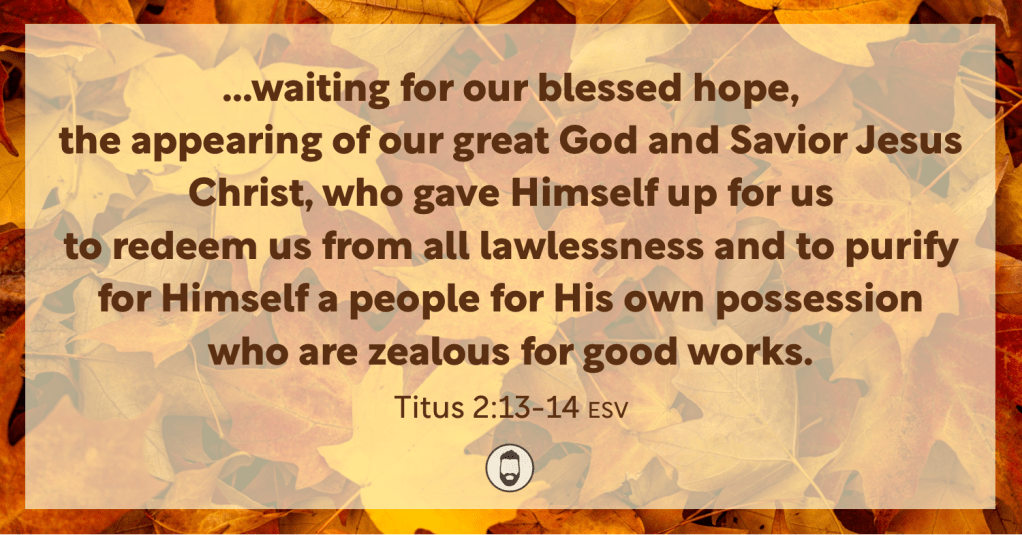
I love that phrase that Paul uses to describe the second coming of Christ in Titus 2:13: “blessed hope”. It is unique and very clearly and carefully describes what those who are in Christ have in Him and how they are able to live in this world with the expectation of Him coming again.
First, to see why I am so thankful, we need to know what Paul meant by “hope”. That word in the original language meant being able to desire something good and expect to obtain it. This is different from the way the word “hope” is used in modern English where it operates closer to a wish. My school kiddos might say something like, “I hope I make a good grade on this test”, but if they stay up until the middle of the night on their phone, fall asleep in the middle of the test, and/or zone out while reading passages, their will fail it. They hoped or wished, maybe merely even wanted, to make a good grade, but there was no real expectation or reason to expect doing well.
Biblical hope is different from that, and primarily because it is not left up to us but left up to Jesus. We can desire His coming and expect to experience it because He has already come, meaning we can trust He will again. We can desire His coming and expect to experience it because He is “our great God and Savior” with the strength and wherewithal to make anything happen. In fact, everything that exists has happened because of Him. His track record is proven and proof.
Second, that word “blessed” adds a whole other level to “hope”. The word translated “blessed” here is the same word that we see in the beatitudes at the beginning of the Sermon on the Mount (Matthew 5:3-12). People have been tempted to translate that word as happy, but happy in English has the connotation of good luck because hap- refers to circumstances. Think about the difference between happy and joyful. Happiness is fleeting and changes based on, well, circumstances. This word “blessed” is not circumstantial but Christ-produced. It is marked by God’s favor and that fullness/satisfaction that comes His Spirit within us.
Blessed hope, then, is the expectation of Jesus, our Redeemer, coming again that has been produced in our heart by God Himself. Blessed hope is saturated in the favor of God because it is a grace-gift to know that the One who redeemed us, purchased us by paying our sin debt with His blood on the cross, is coming to take possession of us. Blessed hope satisfies even in the not yet of life now because God’s very Spirit is already with us now, giving us more than a hypothetical happenstance because of His sure ever-presence.
I know that is a long and nerdy way of saying this, but “blessed hope” is really something else and only exists through Jesus. This world is constantly changing and getting worse the farther we get from the Fall, and if we’re not careful, we can fall into despondency and despair. We need the Holy Spirit reminder that this world is not all there is. We need to be able to trust in something and know that everything will be good eventually. But looking at the world gives us none of that, and the hypothetical hopes fail and hurt us.
We need something better than this world. We need something out of this world. We need Jesus. He’s coming. Our “blessed hope” is coming. And we are waiting for His appearance.
Lord, thank You for being our blessed hope and giving us reason to hope for the future. Thank You for being the God we can trust and know that Your promises will come to pass. Help us to be the people You are redeeming us to be. Help us to live as Your people. Help us to live in the expectation that Your coming will be soon. Amen.
All through the month of November, our Christ Community Church family is focusing on what we are thankful for and expressing our thanks to our “great God and Savior Jesus Christ, who gave Himself for us to redeem us” (Titus 2:13-14).
This, like the #DailyWisdomChallenge we went through in October, is a challenge from our pastor John Goldwater — the #GRATITUDEandHOPEchallenge — where we have the opportunity to post Bible passages that move us to thanksgiving or in which we find hope. May this lead you to be grateful and find your hope in Jesus!