“The Lamb Who is Our Shepherd” from Revelation 7 — a Refresh & Restore Bible Study

"The Lamb Who is Our Shepherd" from Revelation 7 (The KING is Coming) Refresh & Restore | A JustKeithHarris.com Podcast

📖 Revelation 7After the terrifying events of Revelation 6, John is given a breathtaking glimpse of hope. Before judgment continues, God reveals that His people are known, sealed, and secure in Christ. The chapter culminates with one of Revelation's most beautiful pictures: the Lamb who was slain is also the Shepherd who leads His people forever.In this episode, Keith Harris and Jamie Harrison discuss:✔️ Why Revelation 7 is an interlude between the sixth and seventh seals✔️ What it means for God's servants to be sealed✔️ The two primary views of the 144,000—and why faithful Christians differ✔️ How John's pattern of hearing one thing and seeing another helps interpret the chapter✔️ The innumerable multitude worshiping before the throne✔️ Why Jesus, the Lamb, is also our Shepherd who leads us to living waterThis chapter reminds us that our greatest hope isn't solving every prophetic question—it's belonging to Christ. Those who trust Him are safe in Him, and one day He will wipe away every tear from their eyes.📖 "For the Lamb in the midst of the throne will be their shepherd, and he will guide them to springs of living water, and God will wipe away every tear from their eyes." (Revelation 7:17, ESV)🔗 If you'd like to see a written version of this podcast, complete with footnotes and cross-references, you can find it here.
  1. "The Lamb Who is Our Shepherd" from Revelation 7 (The KING is Coming)
  2. "Who Can Stand Under the Wrath of God?" from Revelation 6 (The KING is Coming)
  3. "Musings on Marriage, Missions, and My Walk with Christ" (Refresh & Restore)
  4. "Light Momentary Afflictions, Eternal Weight of Glory" (Refresh & Restore)
  5. "Worthy is the Lion, the Slain Lamb Who Lives" from Revelation 5 (The KING is Coming)

We’re back in our study of Revelation called The KING is Coming, where we’re taking a verse-by-verse approach to see what the book truly reveals—Jesus Christ Himself. As always, I’m joined by Jamie Harrison, and I’m thankful for the opportunity to walk through this study together. Today, we’ll be in Revelation 7, where John sees what comes after the opening of the sixth seal. After the wrath and judgment of Revelation 6, this chapter gives us a picture of God’s people being sealed, saved, and gathered before the throne, where the Lamb who was slain is also the Shepherd who leads His people to living water. This week’s passage is Revelation 7:

After this I saw four angels standing at the four corners of the earth, holding back the four winds of the earth, that no wind might blow on earth or sea or against any tree. Then I saw another angel ascending from the rising of the sun, with the seal of the living God, and he called with a loud voice to the four angels who had been given power to harm earth and sea, saying, “Do not harm the earth or the sea or the trees, until we have sealed the servants of our God on their foreheads.” And I heard the number of the sealed, 144,000, sealed from every tribe of the sons of Israel:
12,000 from the tribe of Judah were sealed,
12,000 from the tribe of Reuben,
12,000 from the tribe of Gad,
12,000 from the tribe of Asher,
12,000 from the tribe of Naphtali,
12,000 from the tribe of Manasseh,
12,000 from the tribe of Simeon,
12,000 from the tribe of Levi,
12,000 from the tribe of Issachar,
12,000 from the tribe of Zebulun,
12,000 from the tribe of Joseph,
12,000 from the tribe of Benjamin were sealed.
After this I looked, and behold, a great multitude that no one could number, from every nation, from all tribes and peoples and languages, standing before the throne and before the Lamb, clothed in white robes, with palm branches in their hands, 10 and crying out with a loud voice, “Salvation belongs to our God who sits on the throne, and to the Lamb!” 11 And all the angels were standing around the throne and around the elders and the four living creatures, and they fell on their faces before the throne and worshiped God, 12 saying, “Amen! Blessing and glory and wisdom and thanksgiving and honor and power and might be to our God forever and ever! Amen.”
13 Then one of the elders addressed me, saying, “Who are these, clothed in white robes, and from where have they come?” 14 I said to him, “Sir, you know.” And he said to me, “These are the ones coming out of the great tribulation. They have washed their robes and made them white in the blood of the Lamb.
15 “Therefore they are before the throne of God,
and serve him day and night in his temple;
and he who sits on the throne will shelter them
with his presence.
16 They shall hunger no more, neither thirst anymore;
the sun shall not strike them,nor any scorching heat.
17 For the Lamb in the midst of the throne will be their shepherd,
and he will guide them to springs of living water,
and God will wipe away every tear from their eyes.”[1]

Keith Harris:     
Greetings, sojourners.

Here we are, back in our The KING Is Coming study, and today we’re in Revelation 7. Jamie, you got anything preliminary you want to say, or you just want to dive right in?

Jamie Harrison:
Let’s just dive right in.

Keith:                  
Let’s do it. So Revelation 7 is following—because, again, it’s been a minute since we recorded—Revelation 6. We see some wrath being poured out.

Jamie:                 
Well, I was sure wondering if Revelation 7 followed Revelation 6. I appreciate you really clarifying that for me.

Keith:                  
You may be joking, but part of what we’re—

Jamie:                 
That is a new development.

Keith:                  
But in looking at this, one of the things that we’re doing—and I said it that way as a sort of reminder—

Jamie:                 
Yes.

Keith:                  
Our point in this study isn’t to answer every question, because every one of our questions is not meant to be answered. The text wasn’t designed that way. We’re seeing what God showed John. And so, when we look at this, we’re looking at what John saw next. And I’ll let you take it from there.

Jamie:                 
Yeah, that’s really important. And I’m glad you went back to chapter 6 just to kind of point out that the last thing we saw was that sixth seal being opened, and this huge earthquake. The sun turns black. The moon becomes like blood. You know, all these different things happen. Stars are falling to the earth. All these things. And every single mountain and island is moved from its place.

So you’re talking about worldwide destruction going on when this sixth seal is busted open. And then the next thing he sees—now, again, it’s very important, just like Keith said—that’s not necessarily the next thing that happens. That’s the next thing he sees.

The next thing he sees are four angels standing at the four corners of the earth, restraining the four winds of the earth so that no wind can blow on the earth or on the sea or on any tree. So, in other words, right after this extremely destructive storm, the next thing he sees is calm. There’s no wind.

Keith:                  
And sees the supernatural reason for why the calm has come. Like, he can see these angels.

Jamie:                 
That’s right. And so what you get here is—you know, we always talk about the calm before the storm—and judgment is coming. And it’s about to come hot and heavy right after this.

And so you kind of get the idea here that everything is calm for a minute because the Lord is about to seal some people who are going to make it through the tribulation. And we can go back to Ezekiel chapter 9. We get the idea of that sealing, what it looks like. Ezekiel has a vision of a slaughter in Jerusalem. That’s going to be chapter 9, verses 4 through 7. I mean, you can read the whole chapter, but kind of where the seal starts is verse 4 there.

And they’re being sealed from judgment. They’re being sealed on their forehead by a mark. So you get the same kind of idea here. Same idea as the Passover, Exodus chapter 12, you know, where they’re sealed by the blood of a lamb from their firstborn being killed there.

And so, in Revelation 14:1, we find out this is the same group of people in Revelation 14. And it says:

Then I looked, and there was the Lamb, standing on Mount Zion, and with him were 144,000 who had his name and his Father’s name written on their foreheads.[2]

And so it looks like that seal is something to do with Jesus’s name and the Father’s name on their foreheads—some type of, what we’re going to learn, spiritual protection from the coming judgment.

Keith:                  
Yeah, and that symbol would have looked like what the Hebrew letter tav looked like at the time of Ezekiel, which some interpret as kind of a cross at an angle or an X. Either which way, it’s obviously pointing forward to Christ and the fact that He—I think it’s John 10, and I think it fits with the end of Revelation 7, not getting ahead—but Jesus being the Good Shepherd, and that He holds His people in His hand, and no one can pluck them from His hand.

The symbolic seal represents the spiritual reality that Jesus has them.

Jamie:                 
Yes and amen. And this group of people that we’re looking at here, they’re being sealed until the number would be completed. Look at chapter 6, verse 11 of Revelation. It says:

So they were each given a white robe, and they were told to rest a little while longer until the number would be completed of their fellow servants and their brothers and sisters, who were going to be killed just as they had been.

Now, you ask, why do we connect those together? Great question. Because in chapter 7, where Keith just read, in verse 14—well, right above, in verse 13—he says, “Hey, who are these people in white robes, and where did they come from?” And he says, “Sir, you know.”

Then he told me these were the ones coming out of the great tribulation. They washed their robes and made them white in the blood of the Lamb.

So each of those connect together to show us that these are the people that are going to be sealed, that are going to be saved, that are going to be persecuted for their faith during the great tribulation, that are going to reach other people for Christ. And when that number is completed, then the Lord’s judgment will be completed directly after.

I hope all that makes sense.

I do want to point out that this is the exact opposite of the mark that we’re going to learn about in Revelation 13, verses 16 through 17, where it says:

16 And it makes everyone—small and great, rich and poor, free and slave—to receive a mark on his right hand or on his forehead, 17 so that no one can buy or sell unless he has the mark: the beast’s name or the number of its name.

And, of course, it’s commonly referred to as the mark of the beast. And so this is the exact opposite. That mark is going to bring judgment.

Keith:                  
Well, and I mean, when you look in the context of Ezekiel 9 to get the understanding there, it’s those who are faithful to God. And the faithfulness to God—in Ezekiel chapters 4 through 7 preceding that—the faithfulness to God is very important in the context of Revelation.

Your mark shows to whom you’re faithful. And so nobody who is faithful to Christ is at risk of being hoodwinked into getting this other one. Your mark shows your allegiance. I think that’s a very important thing there.

Jamie:                 
Absolutely. No doubt about it.

So now we get into the real controversial part, right? What is this 144,000 number? Is there only 144,000 people going to heaven?

And let’s just go ahead and hit that one right off the bat: no. That’s dumb. I don’t know any other way to say it. And I don’t joke anymore. That’s a very serious statement. That’s dumb. There’s way more than 144,000 people going to heaven, and the Bible is going to tell us that here in just a minute.

Keith:                  
And the danger—and really where the idea of only 144,000 people are going to heaven comes from—the fact that different cults, like the Jehovah’s Witnesses, have gained ground, and people are believing what they’ve heard or what they’ve seen on social media, or some random jake-leg—I’m using my quotey fingers—preacher says.

What the Bible says matters. And so when anybody says anything—us, your pastor, especially Jehovah’s Witnesses and jake-leg internet TV preachers—check it with the Bible. That doesn’t pass the test.

Jamie:                 
Yeah, just a lot of people believe whatever’s on social media is true. If it made it on social media, it’s got to be true, right? And that’s also very dumb. I can attest to that personally.

Keith:                  
I mean, last week I saw a picture of a cloud that was shaped like a soldier, including kneeling at his gun. And no cloud ever was that clear. And people are like, “Oh my gosh, look at this sign from God!” And under it was the city of Jackson that did not resemble the city of Jackson, and nobody noticed because they were looking at the soldier in the sky.

Jamie:                 
Wow.

Keith:                  
Don’t get your theology from social media.

Jamie:                 
Correct.

Keith:                  
Or look for truth there at all.

Jamie:                 
Yeah. Just that. Period. The end.

So with the 144,000, there’s two main approaches to that number. One is that it’s a literal number. One is that it’s a figurative number. And so I think the best way to go about it is, let’s look at both. Let’s talk about the—I don’t want to use the word justification—but I’ll use the verses that people use for each. Okay?

And then read the Bible on your own, and ask the Holy Spirit to guide you, and He will guide you into truth.

So the literal number—we’ll start there—and it comes from, you go all the way back to Numbers, where there was a military census performed at different times. And what they would do, Israel would do, is they would count the military-aged males to see how many people they had that were of age and eligible to fight in a war. Okay?

And in Revelation 14:4—remember, Revelation 14 is also talking about this same group of people—it says:

These are the ones who have not defiled themselves with women, since they remained virgins. These are the ones who follow the Lamb wherever he goes. They were redeemed from humanity as the firstfruits for God and the Lamb.

So this is talking about males from the tribes of Israel, and they have been counted as a military census would have been counted.

Keith:                  
Yeah, and I think Numbers 31 is the reference there. In that case, just to clarify, it wasn’t 144,000 in the book of Numbers, right? But the book of Numbers obviously contains a lot of numbers and censuses, and they weren’t always clear, round numbers.

Numbers 31:4-5:

4 You shall send a thousand from each of the tribes of Israel to the war.” So there were provided, out of the thousands of Israel, a thousand from each tribe, twelve thousand armed for war.

It’s not always so clear-cut a number.

Jamie:                 
That’s right. And so, again, same thing. Numbers chapter 2, you know, it talks about—it goes through how they camped in the military formation. And this tribe camps here on the east side. This tribe camps on the north side. This tribe on that—the Levites in the middle, where the Ark of the Covenant would have been, the temple would have been—the tabernacle would have been.

And so this, you kind of can go back again to Revelation chapter 14, verse 4, where it says they follow the Lamb wherever He goes. Because as the Spirit—as the glory of God moved, the cloud moved, so the Israelites followed.

And I do think it’s very interesting that Judah is the first tribe listed, and that in Numbers chapter 2, Judah is the first tribe listed. And so there is a connection to who is the Lion of the tribe of Judah, and that would be Jesus. So that is a pretty cool correlation there, where you look at it and go, “Hey, regardless of whether this is an exact number or a figurative number, they’re following the Lion of the tribe of Judah.”

And we’re going to come back to that thought in just a minute. A lot of people also look at Ezekiel chapter 37, where the dry bones become an army. The Lord puts His Spirit in them. That would be the thought of salvation. And so the idea is that this 144,000 number gets saved.

Keith:                  
Well, and I think we need to pause there, because so much conversation—again, a lot of it from these random social media snippets that people put pictures up there and stuff—there is nobody, no matter what their ethnicity, who is going to heaven unless they’ve been saved.

Jamie:                 
Correct.

Keith:                  
In the Old Testament, it was still by grace through faith. Jesus, God in flesh, had not yet become incarnate. But think about Abraham. Abraham believed God, and it was counted to him as righteousness.

Everyone who trusted and called upon the name of the Lord showed faith in Him. And every Israelite who’s ever walked the earth hadn’t got saved.

Jamie:                 
Right.

Keith:                  
Every son of Adam, daughter of Eve, as C. S. Lewis says it—they’re not in heaven. Those who have faith—You look in the book of Numbers. The ground opened up and swallowed thousands. It didn’t catapult them up to heaven. They were in open rebellion.

I think the reading we’re currently looking at, Seeing Jesus in the Old Testament, in our Bible reading plans—yesterday, they were—it was where Phinehas, the Priest came up and literally skewered people who were taking their cult prostitutes and trying to go into the tabernacle with them. And Phinehas is like, “That’s enough.”

And then when people are like, “Dude, why are you acting like this?” God audibly spoke from heaven. He’s like, “Hey, y’all need to be glad he killed those two, because he’s jealous with My jealousy.”

You have God’s people, generically talking about Israel, but you have God’s people—those who, by grace through faith, are saved and, I guess in the context, we say sealed to Him. They belong to Him by grace through faith. No other way.

And so, in any understanding of the 144,000, there’s nobody getting in because they descended from Abraham.

Jamie:                 
Correct.

Keith:                  
Not a one. Zero.

Jamie:                 
Only by the blood of the Lamb.

Keith:                  
Amen.

Jamie:                 
So, just to really briefly, I guess, quickly finish the Ezekiel thought: you know, God puts His Spirit in them to salvation. And then, in Ezekiel 36:24 through 28, Ezekiel 37:24 through 28, you have the Jewish people coming under the new covenant, which would be salvation. But it very distinctly says they will be under one King, and that’s a reference directly to Jesus.

And so, the idea of witnesses—how do we, what makes us think that they’re witnesses? Because this just looks like a list of 144,000 people.

Well, in Revelation chapter 14, again, what we get is that—let’s start in verse 4:

These are the ones who have not defiled themselves with women, since they remained virgins. These are the ones who follow the Lamb wherever he goes. They were redeemed from humanity as the firstfruits for God and the Lamb. No lie was found in their mouths; they are blameless.

Then I saw another angel flying high overhead, with the eternal gospel to announce to the inhabitants of the earth—to every nation, tribe, language, and people. He spoke with a loud voice: “Fear God and give him glory, because the hour of his judgment has come. Worship the one who made heaven and earth, the sea and the springs of water.”

So you have this proclamation of the gospel, and right before it, we’re told that these 144,000—this number—are the ones redeemed from humanity as the firstfruits. Okay? Firstfruits infers that there’s more fruit.

Keith:                  
Or at least last fruits.

Jamie:                 
That’s right. And so that’s where the idea that they’re witnesses comes from, is that they will be sent forth as a quote-unquote army of witnesses to reach people for the name of Christ.

Keith:                  
And that makes sense because you were talking about—I just found the verse I was looking for—you were talking about until the number has been completed. Matthew 24:14:

And this gospel of the kingdom will be proclaimed throughout the whole world as a testimony to all nations, and then the end will come.

And that’s red letters. That’s Jesus.

Jamie:                 
Yes. So then, let’s talk for a second about, all right, is this a symbolic number? Is it just a number? We know that 12 is the number of completion in the Bible: 12 tribes of Israel, 12 disciples, on and on and on.

Revelation 21:12 through 14, you have that same number 12 come back around with the foundations and things. And so you get the idea that number 12 is just the perfect unity of God’s kingdom.

And I think that Revelation 21 is really important there, because in verses 12 through 14, this is talking about the New Jerusalem:

12 The city had a massive high wall, with twelve gates. Twelve angels were at the gates; the names of the twelve tribes of Israel’s sons were inscribed on the gates. 13 There were three gates on the east, three gates on the north, three gates on the south, and three gates on the west. 14 The city wall had twelve foundations, and the twelve names of the twelve apostles of the Lamb were on the foundations.

And so the idea there being is that the church is unified. It is one in heaven. There is no distinction of male or Greek, Jew or male or female. Do you agree?

Keith:                  
Yeah.

Jamie:                 
Wow. Okay. There’s that. And so, again, is this a symbolic number? Is it a literal number? You know, you walk through it and you look and you go, “All right, 12 is the number of completion. That makes sense to me. I get that.”

We know that the Lion of the tribe of Judah will be leading this group of people. And I want to point out something very important here. And, and, and hopefully this makes sense. If it doesn’t, you can leave Keith a comment and let him know, because I will not be looking at the comments, but Keith will.

Revelation chapter 5—chapter 6. Excuse me. I don’t know what I’m talking about. It is chapter 5. I’m just—wow. Maybe we need to hit the pause button and take a break.

Keith:                  
No, you got it.

Jamie:                 
Okay. So Revelation 5:5, same place it’s always been. This is one of mine and Keith’s favorite Scriptures. It says:

Then one of the elders said to me, “Do not weep. Look, the Lion from the tribe of Judah, the Root of David, has conquered so that he is able to open the scroll and its seven seals.”

Now, who leads the 144,000?

Keith:                  
Jesus.

Jamie:                 
Jesus, the Lion from the tribe of Judah.

Look, the Lion from the tribe of Judah, the Root of David, has conquered so that he is able to open the scroll and its seven seals.”

Okay, so this is what John hears the elder say. He hears him say, “Look, the Lion of the tribe of Judah.” And we know that the 144,000 is led by the Lion of the tribe of Judah.

And then he looks, and in verse 6 it says:

Then I saw one like a slaughtered lamb standing in the midst of the throne and the four living creatures and among the elders. He had seven horns and seven eyes, which are the seven spirits of God sent into all the earth.

And it goes on. He takes the scroll, and He unseals the scroll, and then they have this awesome praise moment there together.

And so the “he hears, and then he looks and sees” connects right together with chapter 7, because watch this: in verse 4 he says, “I heard the number of the sealed.” But watch this in verse 9: “After this, I looked.” So he hears the number, just like he heard, “Look, the Lion from the tribe of Judah,” but he saw one like a slaughtered Lamb. So he looks—or, excuse me, he hears—144,000, 12,000 from each tribe. But he looks, and there’s a vast multitude from every nation, tribe, people, and language—which no one could number—standing before the throne and before the Lamb.

So first off, there goes your 144,000 people are going to be saved, and that’s all.

Keith:                  
Well, and also, this numberless multitude—if it’s all tribes and peoples and languages—there are obviously Jews in there.

Jamie:                 
That is correct. And so the last part of this is, we look and we go, okay, he sees this number. He sees—or sees this group of people that nobody can number standing before the throne. They’re clothed in white robes with palm branches in their hands.

And in verse 14—again, back to the same verse we talked about earlier—he asks, you know, “Who are these people?” And he says they’re the ones coming out of the great tribulation. They’ve washed their robes and made them white in the blood of the Lamb.

So this innumerable number of people are people that come out of the great tribulation, who are persecuted for their faith, most likely killed for their faith—not necessarily all of them, but most likely killed for their faith—persecuted for their faith. They came out of the great tribulation.

In other words, there’s a seal placed on their forehead, and once that number is completed, the Lord’s judgment will come. And so I think we, when you put all these things together—

Keith:                  
Well, I think there’s one more Scripture that goes with that before you put it all together. Romans 11, which talks about the remnant of Israel coming to Christ. Romans 11:25. And I think—and I think the wording of this is particularly helpful for when we put this all together:

Lest you be wise in your own sight, I do not want you to be unaware of this mystery, brothers: a partial hardening has come upon Israel, until the fullness of the Gentiles has come in.

So we’re seeing all these places—Old Testament, New Testament, with future vision for John—talking about till the number has become complete. Now we see the number, and then we see the numberless. Like, it does seem that when we put all this together—again, this isn’t like, there are way more popular theories—

Jamie:                 
Right.

Keith:                  
But sticking with what the Bible says, it seems to reason, “lest you be wise in your own sight,” that where there is a lot of clear evidence in Scripture—a good rule of Bible interpretation is the clear things are important, and the important things are clear. Or, as Alistair Begg says, “The main things are the plain things.” So when Jamie puts all this together, this is coming out of a volume of Scripture.

Jamie:                 
For sure. And again, I go back—I guess the word is, I guess, to say, to put all this together—we have this group of people. And again, it says these are the ones coming out of the great tribulation.

And in verses 15 through 17, you get all these things that they’re going to be protected from. But in verse 15, it says, “For this reason, they are before the throne of God.” For what reason? For the reason they were persecuted for their faith, and they came out of the great tribulation.

So we know this is an innumerable group of people that was persecuted for their faith, and for that reason, they’re before the throne of God and serve Him day and night in His temple.

Which, first off, that’s just—that’s an incredible thought. You know, I was listening to a song—maybe it was yesterday—a song came on, and one of the lyrics were—I can’t remember the exact wording now that I brought it up—but it’s basically that we get to join a song they’re already singing when we get to heaven.

Like, just think about that for a minute. There’s these awesome worship sessions going on in heaven right now as we speak, and one day we’ll be part of the choir.

Keith:                  
And I think we lose sight of that sometimes. And again, the reason for us doing this—we’re not trying to be relevant, not trying to be cool, not trying to be any such thing.

It’s so easy to try to have religion outside of relationship with Jesus. And none of these people who are standing around the throne are there for some religious experience. Religion does not withstand persecution. Right now, around the world—and I was looking at something else Jesus said in Matthew 24:21:

For then there will be great tribulation, such as has not been from the beginning of the world until now, no, and never will be.

Y’all, persecution has been increasing and been going on since Jesus ascended into heaven. You’ve got Stephen, the first martyr, all the way up through—you go through the Roman Empire where they were killing Christians.

Finally get to the point where they realize, “We’ve got to burn this book that they’re preaching from, because killing the folks ain’t stopping it.” And then God puts an end to that persecution.

They meet together. You get the canon of Scripture going. And then every so often, all over the world—like even right now—there are countries in the world where you will be imprisoned for the rest of your life for the preaching of the gospel, be shunned and never be a part of your family again because of the preaching of the gospel.

There are places right now on the continent of Africa where they are killing Christians by the hundreds and thousands. And none of these people are sitting there begging for their life. They’re being witnesses.

Literally, the word that we see for witness in the New Testament—that Greek word is martyrion, where we get our word for martyr. They gave their life to point to the eternal life that comes from the life of Jesus Christ.

They’re not resentful that when they see Him in glory, after they lose their life for Him on earth, they see fulfillment. They see not personal achievement, but their personal Savior.

And y’all, I think we lose that when we spend too much time trying to figure out what exactly is the 144,000. I’m fine if it’s literal. I’m fine if it’s figurative, because I’m going to be standing before Jesus. And I might have a lot of questions when I get up there, but I don’t think they’re going to come to mind as readily.

Jamie:                 
Nope.

Keith:                  
Like, yeah, I don’t—you know, it’s going to be eternity, but I think I’m going to have better things to do.

Jamie:                 
Yeah, I think verse 11 there says:

All the angels stood around the throne, and along with the elders and the four living creatures they fell facedown before the throne and worshiped God….

I think that’s—I think that’s going to be what we’re doing.

Keith:                  
It does say, “forever and ever, amen.” That’s good enough for Randy Travis. That’s good enough for me.

Jamie:                 
Amen. I was going to go into some other things here, but I think, instead, just to close this out, I think to look at—it says back in verse 15:

15 For this reason they are before the throne of God,
and they serve him day and night in his temple.
The one seated on the throne will shelter them:
16 They will no longer hunger;
they will no longer thirst;
the sun will no longer strike them,
nor will any scorching heat.
17 For the Lamb who is at the center of the throne
will shepherd them;
he will guide them to springs of the waters of life,
and God will wipe away every tear from their eyes.

Now, there’s all kinds of correlations to the Old Testament and Israelites and Greeks being brought together. But I think here’s what I want to point out, is that all of these things that it just listed are judgments that are going to happen. And some of them will affect these people to an extent.

I mean, they’ll no longer hunger—they’re going to be hungry, right? They’re going to be thirsty. The sun’s still going to be hot while they’re here on earth. But all of these protections, all of these things that will no longer happen, happen after they have died for their faith.

Keith:                  
Yeah, the division between the sixth seal and the seventh—that, I mean, you think about—and just as reference for the fact there were those sealed who didn’t go into exile, but that doesn’t mean that no one who went into exile had faith in God.

Look at Daniel, Hananiah, Azariah, Mishael. Like, but when God’s ultimate wrath is poured out, God’s not unjust. If Jesus has borne the wrath, there’s no need for His people to bear the wrath. It’s been borne.

And so I think it’s important, as we close out, to kind of just look at the paradox here. Because the beauty of this—more beautiful than a symmetry of numbers. I know, to some people, numbers and understanding and clarity, it just resonates with their soul. “For the Lamb in the midst of the throne will be their shepherd. He will guide them to springs of living water. God will wipe away every tear from their eyes.” When you look at all this language, it’s Revelation 21. The beauty of eternity being outside of time—you skip, you skip things.

And I think that paradox right there, that thing that doesn’t make sense from an earthly perspective: lambs aren’t shepherds; shepherds are. But Jesus, the Lamb of God who takes away the sins of the world, will be their Shepherd. He’ll be the Shepherd of all who, by grace through faith in Him, are saved by Him from the wrath of God.

And I think the beautiful thing here is what you need to be asking yourself, more so than anything about a number, more so than anything about anything else, is: Who is your shepherd? Who is your Savior? Is your hope in the Lamb?

If thinking about heaven being forever and ever, amen—standing around the throne, around the Lamb, waving palm branches, singing hosanna—if that bores you, you’ve got eternal problems. In fact, as we record this today, the next day is Sunday, the Lord’s Day, when we’re supposed to gather. If the thought of gathering in worship of Jesus tomorrow bores you, you might want to look at the eternal forecast. If you are bored gathering around the Lamb now, maybe you need to analyze, more than you need to theorize, whether you are covered by the blood of the Lamb. And I don’t mean a momentary lapse, or you’ve got something else to do. I mean, you really need to look and see if practicing for heaven here on earth is something that you just can’t stand.

You’re either with Him or you’re not—sealed and saved, or you ain’t.

Thank you. God bless, and we’ll see you next time with Revelation 8.


[1] The Holy Bible: English Standard Version (Wheaton, IL: Crossway Bibles, 2025), Re 7:1–17.

[2] When Jamie quotes from Scripture, he uses the Christian Standard Bible (Nashville, TN: Holman Bible Publishers, 2020), Re 14:1.
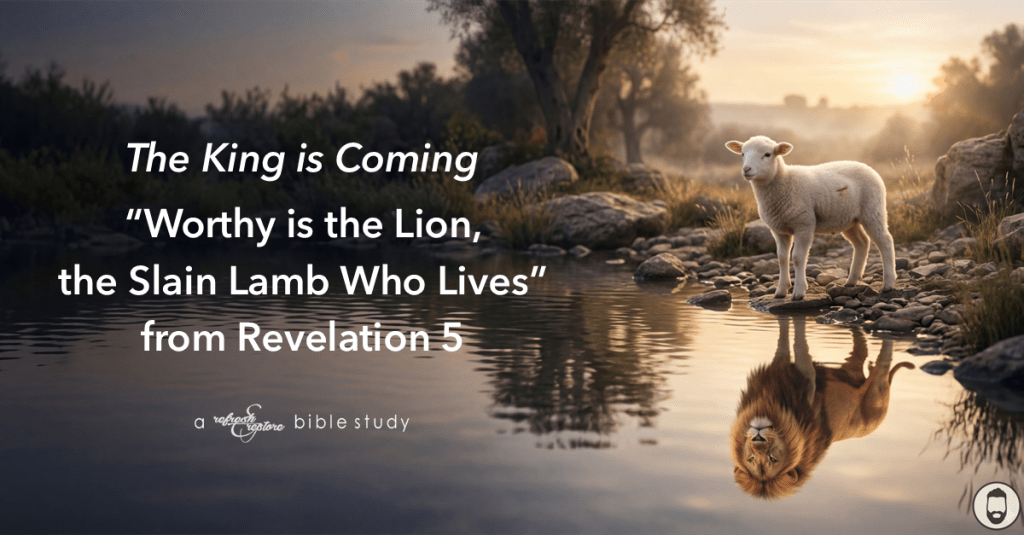
“Worthy Is the Lion, the Slain Lamb Who Lives” from Revelation 5 — a Refresh & Restore Bible Study

We’re back in our study of Revelation called The KING is Coming, where we’re taking a verse-by-verse approach to see what the book truly reveals—Jesus Christ Himself. As always, I’m joined by Jamie Harrison, and I’m thankful for the opportunity to walk through this study together. Today, we’ll be in a passage that is probably quite familiar if you’re a member or regular-attender of Christ Community Church as we read it in worship fairly often – Revelation 5:

Then I saw in the right hand of him who was seated on the throne a scroll written within and on the back, sealed with seven seals. And I saw a mighty angel proclaiming with a loud voice, “Who is worthy to open the scroll and break its seals?” And no one in heaven or on earth or under the earth was able to open the scroll or to look into it, and I began to weep loudly because no one was found worthy to open the scroll or to look into it. And one of the elders said to me, “Weep no more; behold, the Lion of the tribe of Judah, the Root of David, has conquered, so that he can open the scroll and its seven seals.”
And between the throne and the four living creatures and among the elders I saw a Lamb standing, as though it had been slain, with seven horns and with seven eyes, which are the seven spirits of God sent out into all the earth. And he went and took the scroll from the right hand of him who was seated on the throne. And when he had taken the scroll, the four living creatures and the twenty-four elders fell down before the Lamb, each holding a harp, and golden bowls full of incense, which are the prayers of the saints. And they sang a new song, saying,

“Worthy are you to take the scroll
     and to open its seals,for you were slain,
and by your blood you ransomed people for God
     from every tribe and language and people and nation,
10 and you have made them a kingdom and priests to our God,
     and they shall reign on the earth.”
11 Then I looked, and I heard around the throne and the living creatures and the elders the voice of many angels, numbering myriads of myriads and thousands of thousands, 12 saying with a loud voice,
“Worthy is the Lamb who was slain,
      to receive power and wealth and wisdom and might
      and honor and glory and blessing!”
13 And I heard every creature in heaven and on earth and under the earth and in the sea, and all that is in them, saying,
      “To him who sits on the throne and to the Lamb
      be blessing and honor and glory and might forever and ever!”
14 And the four living creatures said, “Amen!” and the elders fell down and worshiped.[1]


Keith Harris:     
Greetings, sojourners. We have a lot to dive into today, so, Jamie, let’s go ahead and dive in.

Jamie Harrison:
All right, so for real, let’s dive in, man, because this really is like — this is it. This is the big climactic scene in heaven. We mentioned in chapter 4 that the throne room is going to be the setting for the remainder of Revelation, and it’s mentioned over and over and over — the throne room, the throne room. And we know that the One seated on the throne is God the Father. And we know that Jesus is going to come and He’s going to sit at His right hand, and the Holy Spirit is there — we’ll see in just a second. And so it starts with this scroll that’s got writing on both sides and sealed with seven seals there in verse 1. And back in Roman times we know that a will or a title deed would be sealed with seven seals. And basically what they would do is they would roll it, seal it, roll it, seal it, roll it, seal it — and again there would be seven seals. And nobody was able to open that scroll except the appointed heir.

Keith:                  
Is there a significance to the seven in Roman Empire days, or is that just — you think — significant biblically here?

Jamie:                 
I would say biblically significant. I know people try to read a lot into a lot of different things, but there’s — obviously there’s seven churches, so people say one seal for each church, right? Those kinds of things. You know what I think is that it’s just biblically significant — the number seven in and of itself. And so no necessary hidden meaning per se, but it’s completely sealed — it’s locked down.

Keith:                  
Correct. Gotcha. As the number seven being the number of completion..

Jamie:                 
Amen. So this thing is sealed up. And in verse 2 we see the angel ask, “Who is worthy to open the scroll and break its seals?” And this angel is a mighty angel. And you would think if anybody could, you know, it’d be this really mighty angel — but he’s not worthy to open it. And then in verse 3 it says no one in heaven or on earth or under the earth was able to open the scroll or even to look in it. Now understand, when it says no one in heaven or on earth or under the earth, that’s everybody that has ever been.

Keith:                  
All the places to be.

Jamie:                 
Correct, right? So that is covering everybody, and nobody is able to open the scroll.

Keith:                  
And I think that’s an interesting wording there. The question is “who is worthy,” not “who is able.” So we’re covering strength here, but worthiness is the question. Excuse you.

Jamie:                 
Thank you.

Keith:                  
So talk to me — take a sip — the difference with worthiness and ability here is not about strength. You mentioned the mighty angel. You mentioned everybody who is. What’s the deal here?

Jamie:                 
It kind of goes back to — who was it? Was it King Arthur that pulled Excalibur out of the stone?

Keith:                  
Allegedly.

Jamie:                 
Right — yeah, that’s a myth. And so the idea of that story being all these strong guys came up and tried to get it out and couldn’t — only the one who was worthy. And so I want to limit — let’s get to that in a second.

Keith:                  
All right.

Jamie:                 
Let’s not get ahead of ourselves.

Keith:                  
We’ll put a pin in it.

Jamie:                 
Yes, put a pin in it — but not too hard, that will hurt. All right, so I’m going to jump over to Hebrews chapter 1, verses 1 through 3 real quick, because this is going to help us as we move forward. I’m going to jump over to Hebrews chapter 1, verses 1 through 3 real quick, because this is going to help us as we move forward.

1 Long ago God spoke  to the fathers by the prophets  at different times and in different ways.  In these last days,  He has spoken to us by His Son. God has appointed Him heir of all things  and made the universe  g through Him. The Son is the radiance  of God’s glory and the exact expression  of His nature,  sustaining all things by His powerful word.  After making purification for sins,  He sat down at the right hand of the Majesty on high.[2]                 

And that’s a really cool Scripture there because it tells us who is the heir — Jesus. Jesus is the heir. And the Son is the radiance of God’s glory, the exact expression of His nature, sustaining all things by His powerful word. After He makes purification for sins — not His sins, for sins — He sat down at the right hand of the Majesty on high. And that’s going to answer your question about who’s worthy, but we’re still not going to jump ahead.

Keith:                  
Well, and also — who’s able to atone for sins? Not us. Not those on earth or under the earth, for sure.

Jamie:                 
It’s kind of like Big John says all the time — that if Jesus did 99% of the forgiving and we did the one, all we would brag about is the one.

Keith:                  
But clearly here we got the none.

Jamie:                 
That’s correct — definitely the none. Not to be confused with nuns — this is N-O-N-E, none. Okay, so now we can move forward, because nobody is able to open the scroll. And then John begins to weep. It says, “I wept and wept because no one was found worthy to open the scroll or even to look at it.” Can you imagine — like you see this scroll in the right hand of the Father, and I don’t know at that point if John necessarily knew what it was or not. I mean, he doesn’t say he knows what it is. But obviously he was alive during that time, so if it’s sealed with seven seals his mind probably went straight to some type of title deed or a will or something like that as well. And so can you imagine this climactic moment where you see this scroll and then nobody is worthy to open it?

Keith:                  
I wonder too — just thinking about the vision that he’s seeing there — it kind of puts me… it reminds me of Isaiah 6, the vision that Isaiah got in the year that King Uzziah died. Like thinking about worthiness — you’re sitting there, you can see the throne. And we talked about this back in Revelation 1 — like in my mind, seeing the throne, you’re not looking at it alone. When we say “high and lifted up,” He literally was high and lifted up. I mean, think Ezekiel — the visions he had of the throne. Like he’s looking at the soles of His feet from way down. And when you ask who is worthy — I know when I am confronted with the holiness and worthiness of God, my first thoughts turn to my unworthiness and why I’m unworthy. Like — gotta be feeling some guilt, gotta be feeling overwhelmed in the first place. This disciple whom Jesus loved, outliving all the rest of the apostles — more than likely in his late 80s, early 90s at this point — like he’s feeling some stuff. He’s well acquainted with his unworthiness, and his friend, the worthy One — the Lamb of God — that’s how his gospel describes Him — died. He knows He rose, but still at the same time, that’s a lot to process.

Jamie:                 
And so he weeps and weeps because nobody is worthy to open the scroll or even to look in it. And then in verse 5 — here we go — one of the elders says to me… which we talked about in chapter 4, you know, what the elders might represent. And it says, “Do not weep. Look.” Now the word’s important — he says, “Look.” “The Lion from the tribe of Judah, the Root of David, has conquered, so that He can open the scroll and its seven seals.” So the Lion from the tribe of Judah — let’s talk about that for a second. Way back in Genesis chapter 49, verses 8 through 10, these are Jacob’s last words. He gives the scepter over to the tribe of Judah, meaning the kings will come from that tribe, obviously starting with David there. But we know that he also references that Shiloh will come — and that’s an idea that someday the King is going to come and He’s going to take over and He’s going to reign for eternity. That’s talking about Jesus again. And so the Lion from the tribe of Judah is like the King of kings.

Keith:                  
In the wording of the prophecy all the way back pre-king — hence that — what does it say? The Root of David, correct? And it’s a big deal.

Jamie:                 
And the Root of David goes back to Isaiah 11. Hey — I’m turning to Isaiah 11… maybe I should have used the digital Bible instead, because these pages—

Keith:                  
Well, this is where the preacher wants to say, “I still hear pages turning — we’ll wait.”

Jamie:                 
That’s going to be Isaiah 11 — the eleventh chapter of Isaiah. That’s what preachers do, in case you were wondering — it’s because they’re trying to find it themselves. Isaiah 11, verses 1 through 10:

11 Then a shoot will grow from the stump of Jesse,
and a branch  from his roots will bear fruit.
The Spirit of the Lord will rest on Him —
a Spirit of wisdom and understanding,
a Spirit of counsel and strength,
a Spirit of knowledge and of the fear of the Lord.
His delight will be in the fear of the Lord.
He will not judge
by what He sees with His eyes,
He will not execute justice
by what He hears with His ears,
but He will judge the poor righteously
and execute justice for the oppressed of the land.
He will strike the land
with discipline  from His mouth,
and He will kill the wicked
with a command  from His lips.
Righteousness will be a belt around His loins;
faithfulness will be a belt around His waist.
The wolf will live with the lamb,
and the leopard will lie down with the goat.
The calf, the young lion, and the fatling will be together,
and a child will lead them.
The cow and the bear will graze,
their young ones will lie down together,
and the lion will eat straw like the ox.
An infant will play beside the cobra’s pit,
and a toddler will put his hand into a snake’s den.
None will harm or destroy another
on My entire holy mountain,
for the land will be as full
of the knowledge of the Lord
as the sea is filled with water.
10 On that day the root of Jesse
will stand as a banner for the peoples.
The nations will seek Him,
and His resting place will be glorious.

I understand, again — this is a prophecy of Jesus that is going — He’s going to come. At this point this is obviously before He has come. And so this is who the Jews were looking for — this conquering king, okay? Now that’s very important, because they were looking for a conquering king. But when Jesus came, He did not conquer, so to speak, the way they thought He was going to in that moment — thinking He was going to free them from Roman oppression, right? And so here’s where it gets really exciting, because this conquering king — remember, “the Root of David has conquered,” is what it says in Revelation 5. And so when you read this, you’re like, “Okay, I see the Lion from the tribe of Judah. I hear you saying the Root of David, and it says that He’s conquered.” Well, how has He conquered? Because He came and He died, and then He rose again — and the Romans are still in control. They’re still in control. Still in control at this point. Now remember, they told him to turn and look. And when you turn and look, it says “the Lion from the tribe of Judah.” But when he turns and looks — in verse 6 — he sees One like a slaughtered Lamb standing in the midst of the throne. He does not see the Lion from the tribe of Judah, so to speak, like you would think you would turn and literally see some type of very strong, mighty force standing there.

Keith:                  
Like Aslan in The Chronicles of Narnia, right? Kind of a Mufasa — that’s right — big old lion.

Jamie:                 
Lion, lion — right. And instead he turns and he sees One like a slaughtered Lamb standing in the midst of the throne. Now just picture this for a minute — you’re John. You’ve lived with Jesus, you’ve walked with Jesus, you’ve seen Jesus. And then you turn expecting to see this lion, and instead you see One like a slaughtered Lamb. You see the scars in His hands. You see the scars in His feet. You see the scars in His side. And the idea you get kind of takes us back to the Passover lamb — you know, put the blood on your doorpost and it will cover you, and we’ll spare you from death.

Keith:                  
So — and I think too — it’s got to draw him back to what the Holy Spirit led him to write down by his own hands. “Behold the Lamb who takes away the sins of the world.” That’s what he wrote down in John 1:29 — the words of John the Baptist. Like, I think this is a huge perspective change, because if anybody should have known the answer to “who is worthy” and not been so bereft that he’s crying, it’d be the disciple whom Jesus loved, right? But here he turns around and — I don’t know — it’s almost liberating. If John can forget, maybe it’s a little more understandable — sometimes not excusable, but at least understandable. If John, standing there in heaven, doesn’t immediately think, “Jesus is worthy,” — remember Him? — yeah, we need that reminder too. But I mean, he’s looking for this archetypal Lion of the tribe of Judah, this conquering leader. Maybe you think some kind of warrior angel is fit to come out and put a whooping on—I mean, he’s having this vision from a prison island in his 90s. He’s needing a little liberation, no doubt. But liberation theology doesn’t match up to the beauty of the Lamb standing as though slain.

Jamie:                 
And that’s key — what you just said — is that He’s standing. How many slaughtered lambs do you know that are standing?

Keith:                  
None.

Jamie:                 
None. That is the whole idea of slaughtering. But Jesus is standing. He isn’t timid, He isn’t laying down, He isn’t dead — He’s alive.

Keith:                  
And I think, going back to your — and I guess this is probably what you’re getting into — like things that are showing that He’s standing, He’s not propped up. He has seven horns — that fullness of strength. Seven eyes — that fullness of clarity and sight and knowledge and all of that representing the seven Spirits of God sent out into all the earth. That the second person of the Godhead — still fully God, still fully man — fully alive and fully eternal. Because full death did nothing to stop Him.

Jamie:                 
Correct.

Keith:                  
That’ll preach — that’s what they say.

Jamie:                 
I can tell you want to do it, man.

Keith:                  
I’m trying to hold him back. It’s okay — saving a little bit for Sunday.

Jamie:                 
He turns — he sees Jesus standing in the midst of the throne, One like a slaughtered Lamb, but He’s standing to receive the scroll. The scroll that nobody has been found worthy to open at this point. But Jesus comes over, and at that moment when He takes that scroll, He identifies Himself as our kinsman-redeemer — the One that is worthy to open the scroll. The Root of David. The Lion of the tribe of Judah. The all-conquering King. The all-prevailing Lord. The King of kings. The Lord of lords. I know you want to go, man. I know you want to go. Take it away.

Keith:                  
I mean — He’s the answer to the question. And you look at this, and I’m not trying to get ahead, but what’s so beautiful to me in the response of the elders and the myriads standing around the throne and all of the creatures there is their worship. Just like in the Old Testament, going all the way back to that praise song written by Moses — “the horse and the rider were thrown into the sea.” It’s in response to what they see there. Like they literally, spontaneously — Holy Spirit-led — sing a song about Him being worthy to take and open the scroll. And not just take it — to open it. He’s not worthy to hold it — it’s not a baton being passed on in some marathon race of faithfulness. He’s worthy to take it, to open it, because He was slain. And His blood ransomed people for God from every tribe and language and people and nation. And did what God said all the way back when He’s talking to Abraham, when He’s talking to Moses, when He’s talking to His people throughout the millennia — to make them a kingdom and priests to our God, and they shall reign on the earth. This is the fulfillment of all these earthly things — and even it points to the ways that evil has tried to fight against the kingdom of God, but it can’t. It literally killed Jesus — God in flesh — and He didn’t stay dead. It didn’t take. Was it Peter who says in Acts chapter 3 that the pangs of death were unable to keep Him? You’ve got the beautiful resurrection chapter in 1 Corinthians 15 where Paul talks about the hope and glory that is in the resurrection. That we are saved by His finished work on the cross, but we’re kept and we get this eternal life through His resurrection. This is a huge deal right here, because nobody else can do that — which is why He alone is worthy. He’s singular. He’s holy. He’s unique. He’s God. And it’s just beautiful — beautiful.

Jamie:                 
Some of the commentaries I read through say that this is the greatest act in all of human history. And I think it’s fitting to look at it that way — that this is the culmination, this is the completion. And I know — I hate to even have to clarify this almost — but I do know there will be people listening to this that don’t know Christ. And in the next episode, Jesus is going to open the scroll — and when He opens the scroll, bad stuff is going to start happening, right? And so the idea would be, “You’re really excited about this scroll that’s bringing bad stuff about?” You know — what it’s bringing about is our inheritance, because we’re heirs with God and co-heirs with Christ, according to Paul in Romans chapter 8. And so I get where the idea could come from — “Well, you’re excited bad things are going to happen.” No, no, no, no, no. Understand this — throughout all of this, salvation is available. Salvation is available when these seals start breaking. Salvation is available later on in chapter 9, where it’s going to say, in essence, that this huge demonic army kills all these people, and then the people continue to worship the demons that were just killing them. So it’s still a choice. There’s still the opportunity to come to know Christ and repent here. So is it bringing about bad stuff? No. It’s bringing about what we deserve, which is God’s judgment.

Keith:                  
Kind of along the lines that you’re talking here — it’s not for us to be excited or terrified for what He’s going to bring about. We’re excited that it’s in His hands. That none of this stuff that happens is out of His control, outside the realm of His sovereignty. And it’s kind of like — and we’ve quoted Big John several times today — but his answer when people want to ask about the problem of evil: “Where is this good God in the midst of all this evil?” How can God still be good in the midst of the things we’re going to read about in the next chapter? If it wasn’t for this good God, there would be no goodness at all. It would just be the evil and wickedness that honestly we ourselves are no less capable of than the ones we would deem more wicked or more evil. The difference is what our good God does with it. And that’s the thing — it’s all in His hands now. He’s not playing with sin. He’s not playing with feelings. This is — I mean, when He came the first time, we got the Lamb. This time, we get the Lion. And that’s no light thing. It’s kind of like — y’all know I’m a nerd — in The Chronicles of Narnia, where Aslan is meant to be a picture of Jesus. One of the kids — I think it’s Lucy — asks, “Is he a safe lion?” And I think it’s the beaver who responds, “A safe lion? He’s a lion.” Like — ain’t nothing safe about a lion. Safety came when He came as the Lamb, taking away the sins of the world. Sins of the world have been taken away. He has conquered. Now you get the teeth.

Jamie:                 
Yep — that’s a good word.

Keith:                  
Sound effect — onomatopoeia.

Jamie:                 
Yep, that. So I don’t want to just keep harping on the same point over and over, because we could — I mean definitely this is very exciting. It’s very exciting to know how — not that one day I’ll get to go to heaven and have a big mansion and see streets of gold — but one day I’ll get to see the King of kings and Lord of lords who is worthy to open the scroll. Face to face.

Keith:                  
There’s no scenery even described in a lot of these places. When you’re in the presence of Jesus, in the presence of the throne, they’re not talking about all the things that sometimes we would sing about. All the rest of it pales in comparison to Him. When the Lamb stands as though slain, the eyes are on Him — not the floor.

Jamie:                 
And when we get to Revelation 21 we’ll talk a lot more about that. But we know there will be no sun or moon in the New Jerusalem, because the Trinity will be the light. There will be no shadows. There will be no dark corners. There will be no dark anything. They will be the light. We know there’s no temple because they’re there — there’s no need of a temple. And so yeah — it’s like all eyes on Him.

Keith:                  
Well, and Hebrews says all these things are shadows pointing to Christ — like that’s figurative shadows. But there will be no figurative nor literal shadows, right? Because all is light.

Jamie:                 
And I think — I almost feel like that’s a good place to stop. You know, we could continue on and talk about some little things here and there. But when you look at the song — that song — and then the second one, what they say — not a song again, it’s a recitation. Is that the right word?

Keith:                  
Yeah — well, I mean it says, “And they sang a new song, saying…” So it’s not about the musical aspect of it as much as it kind of reminds me of church traditions that’ll get to talking about shouting. Sometimes they’re singing — there’s a melodic thing to it — but it’s more about the substance than the song.

Jamie:                 
And that’s it. And the substance here is Jesus. You died for us. You were slaughtered. You purchased people by Your blood — not just a certain group of people, but people from every tribe and language and people and nation. And now because of that we can be saved. We can have a relationship with Christ. We can one day spend eternity with Him.

And in the second one — it’s every creature in heaven and on earth and under the earth and in the sea and everything in them — this is like everybody, everything that he’s seeing here. They say, “Blessing and honor and glory and power be to the One seated on the throne and to the Lamb forever and ever.” And then they fall down and worship. And I think when we begin to really dive into the book of Revelation and the rest of the Bible, that should be our response — to fall down in worship. And this is something I’m guilty of a lot of times — I’ll read just for the sake of reading, to do my reading for the day. But is there ever a moment during that reading where I stop and I just begin to worship the Lord because of what I read, because of who He is, because of what He did for me — because He’s worthy?

Keith:                  
And I mean, like Jamie said, this is a good time to segue into a close. That’s why we’re studying the book of Revelation like this. We’re not trying to answer every unanswerable question. We’re not trying to sweep out the nooks and crannies of prophecy. We’re not trying to convince anyone of our own wisdom or knowledge. We’re trying to point people to the Lamb. And so that’s what we close with today.

As we get ready next week to move into Revelation 6 and see what’s in the scroll, right now we leave you in the hands of Him holding the scroll — who’s worthy not only to hold it but able to open it. The Lion of the tribe of Judah. The Lamb of God who has taken away the sins of the world. He is mighty. He’s high and lifted up. But He’s approachable.

I think Hebrews 4:15-16 is a good passage to end on — and again, if you’re listening and you’re part of Christ Community Church or The Foundry, we’ve been in the book of Hebrews for most of this year. I think it’s a good time to look at the approachable nature of our great God and King.

15 For we do not have a high priest who is unable to sympathize with our weaknesses, but one who in every respect has been tempted as we are, yet without sin. 16 Let us then with confidence draw near to the throne of grace, that we may receive mercy and find grace to help in time of need.

When you look at this, we see John moved by the presence of the Lamb in literally the shadow of the throne. He’s approachable. He is available for us.

Jamie talked about how we look at this — that while all this is going on, there’s still opportunity to be saved. It says multiple times in the Bible — I know in Isaiah — “Seek the Lord while He may be found.”

Well, sojourner, we have presented you the Lion, the Lamb, the King — our great God and Savior, Jesus Christ.

What are you going to do with Him today?

He’s approachable.

He can be found.

Why don’t you seek Him?


[1] The Holy Bible: English Standard Version (Wheaton, IL: Crossway Bibles, 2025), Re 5:1–14.

[2] When Jamie reads from his Bible, it’s from the CSB (The Holy Bible: Holman Christian Standard Version. (Nashville: Holman Bible Publishers, 2009)).

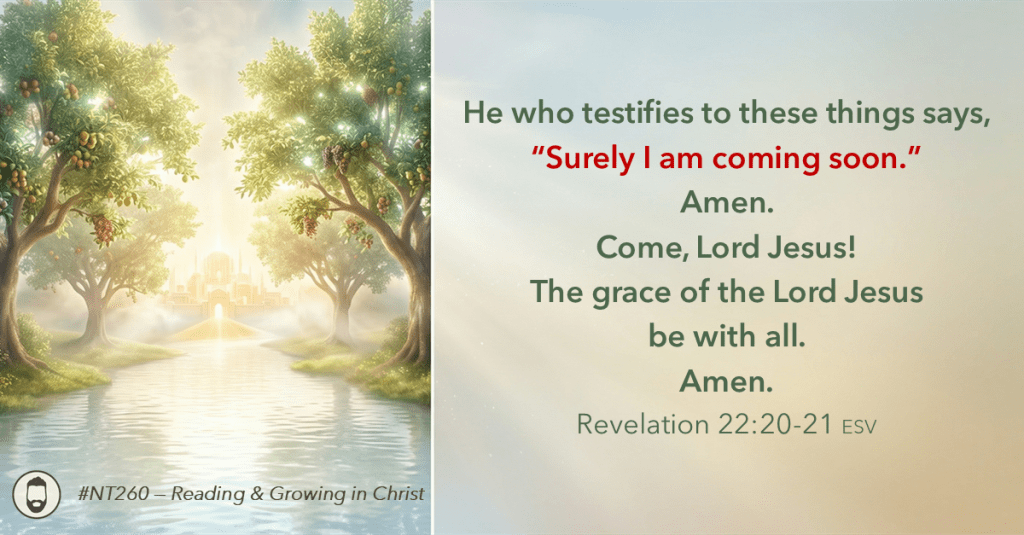
Revelation 22 on 4/17 | The Finale to the NT260 Reading Plan

Click here for Revelation 22 audio:


Read it. Pray it. Share it. Live it.

Today’s post represents more than the finish of a Bible reading plan — it helps us see that the Bible ends on the Person of Christ, the same place it starts and is consistently centered upon.

If you read to check a box off a to-do list or out of some sense of religious obligation, you’re missing out. Look at the beauty of Revelation 22. There is audio above, but look at it in a paper Bible and see the red letters. Jesus is alive. He has promised that He is coming again. And He who promised is faithful (Hebrews 10:23).

Look upon Him. Look for His coming. Come, Lord Jesus!


Chapter Overview:
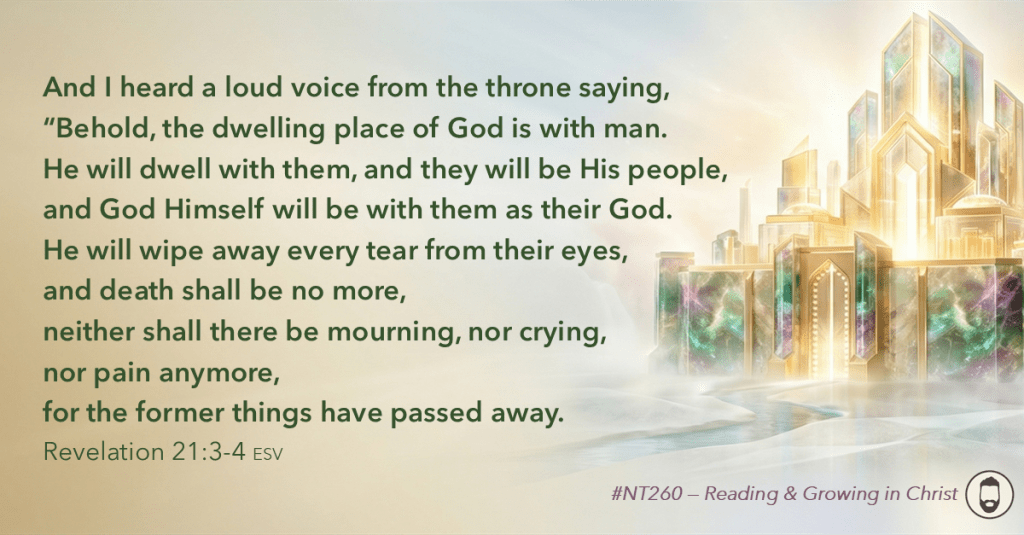
Revelation 22 completes the vision of the new creation, showing a restored Eden where the river of life flows from God’s throne and the tree of life brings continual blessing and healing (vv. 1–2). The curse is gone, and God’s people dwell with Him, seeing His face and reigning forever in His light (vv. 3–5). The chapter then closes with a final call to respond: the message is trustworthy, Jesus is coming soon, and blessing is promised to those who keep His Word (vv. 6–7). There is both invitation and warning – an open call for all who are thirsty to come and receive life, and a serious warning not to reject or distort God’s Word (vv. 17–19). The book ends with the promise of Christ’s return and the prayer of His people: “Come, Lord Jesus!” (v. 20).

Seeing Jesus in This Chapter:
Revelation 22 reveals Jesus as the living source of eternal life and the returning King who brings all things to completion. From His throne flows the water of life, satisfying His people forever (vv. 1, 17). He is the One who has removed the curse, restoring what was lost and bringing His people into perfect fellowship with God (vv. 3–4). He is both the Root and the Descendant of David, fully God and fully man, the promised King who fulfills all of Scripture (v. 16). And He is the One who is coming soon – bringing reward, justice, and the fullness of His kingdom (vv. 12, 20). Jesus stands at both the beginning and the end – the Alpha and the Omega – and He invites all who are thirsty to come to Him and live. The story of Scripture ends not just with a promise, but with a Person – Jesus Himself.

🌀 Reflection:
Jesus promises that He is coming soon. Are you living with that expectation – longing for His return and remaining faithful until He comes?

💬 Mission Challenge:
Live today in light of Jesus’ return, and invite someone to come to Him and receive the gift of life.


Thanks for joining us in the NT260 readings! It is our prayer that the time in God’s Word has led your heart to worship Jesus and grow close to Him.

Join us for our next reading plan from the Old Testament where we see Jesus revealed from the very beginning!


Revelation 21 on 4/16 | NT260 — Reading & Growing in Christ

Click here for Revelation 21 audio:


Read it. Pray it. Share it. Live it.

Today’s post includes a brief overview of the chapter and a focused look at what it reveals about Jesus (Rev. 1:1) — so our eyes stay fixed on Him.


Chapter Overview:
Revelation 21 reveals the final renewal of all things as John sees a new heaven and a new earth, where sin, death, and suffering are gone forever (vv. 1–4). God declares that He is making all things new and invites those who are thirsty to receive life freely (vv. 5–6). The new Jerusalem descends as a beautiful bride, representing God’s redeemed people, where He dwells fully with them in perfect relationship (vv. 2–3). The city is described in breathtaking detail – secure, radiant, and filled with God’s glory – where there is no temple because God Himself is present, and no darkness because His glory is its light (vv. 22–23). Only those whose names are written in the Lamb’s book of life enter this eternal city (v. 27).

Seeing Jesus in This Chapter:
Revelation 21 reveals Jesus as the Lamb who makes all things new and brings His people into eternal life with God. He is the One through whom redemption is complete, bringing an end to sin, death, and sorrow forever (vv. 4–5). As the Bridegroom, He welcomes His people – the bride – into perfect, unbroken relationship, fulfilling God’s promise to dwell with His people (vv. 2–3). He is the source of living water, freely giving eternal life to those who come to Him (v. 6). And in the new creation, His presence replaces every need – the Lamb is the light of the city, the center of all joy, and the reason His people will dwell in glory forever (v. 23). Jesus is not only the One who saves us from judgment – He is the One who brings us home.

🌀 Reflection:
Jesus doesn’t just rescue us from sin – He restores everything. How does the promise of a new creation shape the way you live and hope today?

💬 Mission Challenge:
Live today with eternity in mind, and share with someone the hope that Jesus makes all things new.


Continue reading in our NT260 plan in the rest of Phase 4 — That You May Believe.


Revelation 20 on 4/15 | NT260 — Reading & Growing in Christ

Click here for Revelation 20 audio:


Read it. Pray it. Share it. Live it.

Today’s post includes a brief overview of the chapter and a focused look at what it reveals about Jesus (Rev. 1:1) — so our eyes stay fixed on Him.


Chapter Overview:
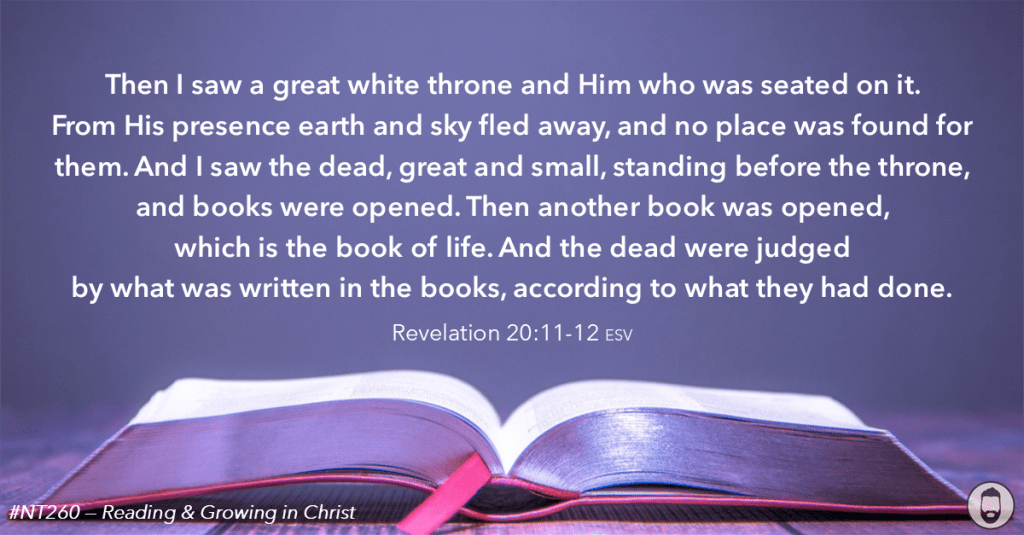
Revelation 20 describes the binding of Satan, the reign of Christ, and the final judgment (vv. 1–15). Satan is bound and prevented from deceiving the nations for a thousand years, while believers reign with Christ and share in the first resurrection (vv. 1–6). After this period, Satan is released for a final rebellion, but it is quickly defeated, and he is thrown into the lake of fire forever (vv. 7–10). The chapter ends with the great white throne judgment, where all the dead are raised and judged according to their deeds, and those not found in the book of life are cast into the lake of fire (vv. 11–15).

Seeing Jesus in This Chapter:
Revelation 20 reveals Jesus as the sovereign King and final Judge who defeats evil completely and reigns forever. He has authority over Satan, who is bound and ultimately destroyed under His rule (vv. 1–3, 10). He shares His reign with His people, giving them life, victory, and the privilege of ruling with Him (vv. 4–6). And He is the One seated on the throne of judgment, before whom all people must stand – perfectly just, seeing every deed, and rendering a final, righteous verdict (vv. 11–13). Yet for those whose names are written in the book of life, there is no fear of the second death (v. 15). Jesus is both the King who reigns with His people and the Judge who brings all things to their final and just end.

🌀 Reflection:
Every person will stand before Jesus as Judge. Are you trusting in Him as your Savior now, knowing that your only hope is to have your name written in the book of life?

💬 Mission Challenge:
Take time today to thank Jesus for saving you, and share the urgency of that truth with someone who needs to hear it.


Continue reading in our NT260 plan in the rest of Phase 4 — That You May Believe.


Revelation 19 on 4/14 | NT260 — Reading & Growing in Christ

Click here for Revelation 19 audio:


Read it. Pray it. Share it. Live it.

Today’s post includes a brief overview of the chapter and a focused look at what it reveals about Jesus (Rev. 1:1) — so our eyes stay fixed on Him.


Chapter Overview:
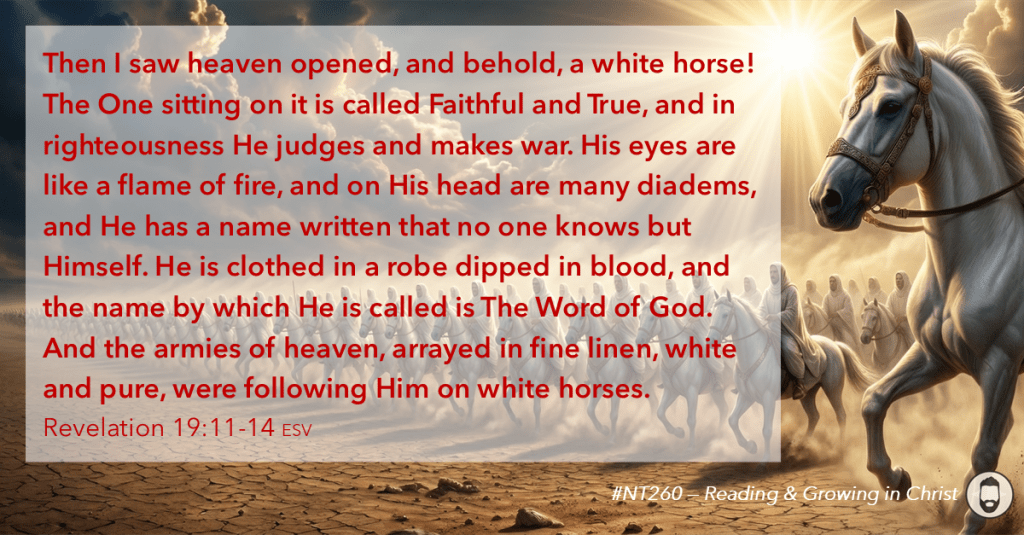
Revelation 19 celebrates God’s victory over Babylon and prepares for the return of Christ (vv. 1–21). Heaven erupts in praise, declaring that God’s judgments are true and just and that He has avenged His people (vv. 1–5). The scene then shifts to the marriage supper of the Lamb, where God’s people are united with Him in joy and purity (vv. 6–10). Finally, heaven opens, and Jesus returns as the conquering King – riding on a white horse, defeating the beast and the false prophet, and establishing His authority over all (vv. 11–21).

Seeing Jesus in This Chapter:
Revelation 19 reveals Jesus as the glorious Bridegroom and victorious King who comes to judge and reign. He is the Lamb whose people are made ready for Him, clothed in righteousness and welcomed into eternal joy at the marriage supper (vv. 7–9). At the same time, He is the rider on the white horse – called Faithful and True – who comes in righteousness to judge and make war against evil (vv. 11). His eyes see all, His word carries absolute authority, and His rule is unmatched as “King of kings and Lord of lords” (vv. 12–16). He defeats His enemies completely (and by Himself), showing that no power can stand against Him (vv. 19–21). Jesus is both the One who saves His people into joy and the One who brings final justice – His victory is total, and His reign is forever.

🌀 Reflection:
Jesus is not only the Savior who invites us into joy, but the King who will return in power. Are you living in a way that reflects both your hope in Him and your readiness for His return?

💬 Mission Challenge:
Live today in light of Jesus’ return, and share with someone the hope of the King who is coming again.


Continue reading in our NT260 plan in the rest of Phase 4 — That You May Believe.


Revelation 18 on 4/13 | NT260 — Reading & Growing in Christ

Click here for Revelation 18 audio:


Read it. Pray it. Share it. Live it.

Today’s post includes a brief overview of the chapter and a focused look at what it reveals about Jesus (Rev. 1:1) — so our eyes stay fixed on Him.


Chapter Overview:
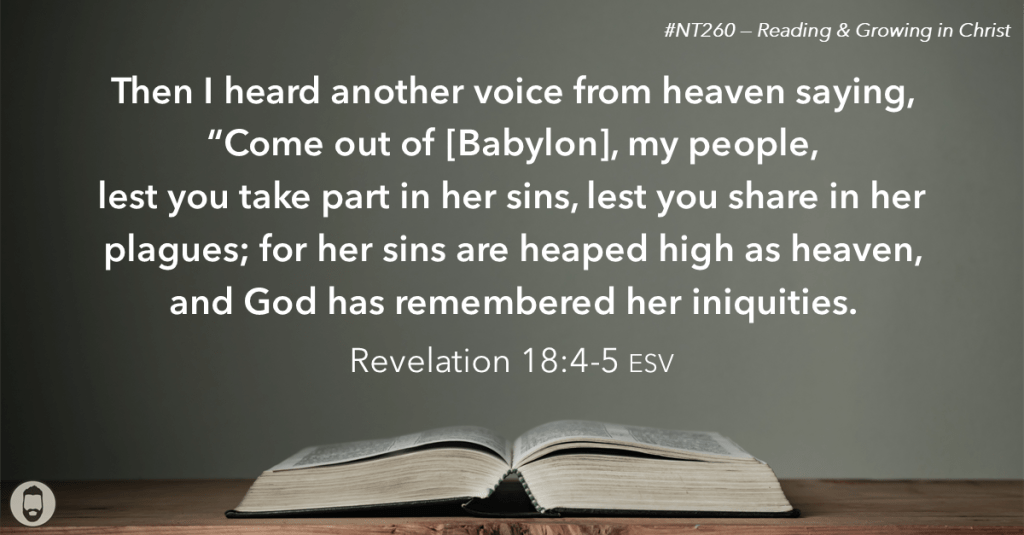
Revelation 18 announces and describes the complete fall of Babylon, the corrupt system that seduced the nations through wealth, power, and immorality (vv. 1–3). God calls His people to separate from her so they do not share in her sins or judgment (vv. 4–5). Her destruction comes swiftly and decisively, repaying her for her arrogance and evil (vv. 6–8). The kings, merchants, and sailors who profited from her mourn her sudden collapse, grieving the loss of their wealth and influence (vv. 9–19). In contrast, heaven rejoices because God has judged her and vindicated His people (v. 20). The chapter ends with a powerful image of Babylon’s final and irreversible destruction – never to rise again (vv. 21–24).

Seeing Jesus in This Chapter:
Revelation 18 reveals Jesus as the righteous Judge who brings down every system built on sin and self-glory. Babylon appeared strong, wealthy, and untouchable, but her fall comes suddenly because God’s justice cannot be delayed forever (vv. 8, 10). Jesus sees the pride, greed, and injustice that the world often celebrates, and He will bring it all to account (vv. 5–7). His judgment is not unjust – it is a fitting response to the harm done to His people and the rebellion against His rule (vv. 6, 24). At the same time, He calls His people to come out and live differently, refusing to be shaped by the values of a fallen world (v. 4). Jesus is both the One who judges and the One who rescues, calling His people to faithfulness now and promising that all evil will one day be brought to an end.

🌀 Reflection:
The world’s systems can look powerful and appealing, but they will not last. Are you living shaped more by the values of this world or by the kingdom of Christ?

💬 Mission Challenge:
Identify one area where the world’s values are influencing you and choose today to live differently in obedience to Jesus.


Continue reading in our NT260 plan in the rest of Phase 4 — That You May Believe.


Revelation 17 on 4/12 | NT260 — Reading & Growing in Christ

Click here for Revelation 17 audio:


Read it. Pray it. Share it. Live it.

Today’s post includes a brief overview of the chapter and a focused look at what it reveals about Jesus (Rev. 1:1) — so our eyes stay fixed on Him.


Chapter Overview:
Revelation 17 gives a detailed vision of Babylon, pictured as a great prostitute sitting on a beast, representing a powerful, corrupt system that influences the nations through wealth, immorality, and false worship (vv. 1–6). She is adorned in luxury but is filled with evil and is responsible for the persecution of God’s people (vv. 4–6). The angel then explains the symbolism of the woman and the beast, showing the temporary nature of their power and their ultimate destruction (vv. 7–13). Though they unite in opposition to God, their rebellion is short-lived, as they will make war against the Lamb – and be defeated (v. 14). In the end, even the forces that support Babylon will turn against her, fulfilling God’s sovereign purposes (vv. 16–17).

Seeing Jesus in This Chapter:
Revelation 17 reveals Jesus as the victorious King over every corrupt and counterfeit system of the world. Though Babylon appears powerful – seducing nations, influencing kings, and opposing God’s people – her power is temporary and ultimately under God’s control (vv. 1–2, 17). The beast and its allies gather to make war against Jesus, but the outcome is never in doubt: “the Lamb will conquer them” because He is “Lord of lords and King of kings” (v. 14). His authority surpasses every earthly ruler, and His kingdom will outlast every system built on rebellion, greed, and idolatry. Those who belong to Him are described as “called and chosen and faithful,” reminding us that our security is not in the world’s systems, but in Christ alone. No matter how strong evil appears, Jesus reigns, and His victory is certain.

🌀 Reflection:
The world often looks powerful and appealing, but it will not last. Are you placing your hope in what is temporary, or in the King who reigns forever?

💬 Mission Challenge:
Reject the pull of worldly compromise today and live as someone who belongs fully to Jesus, the true King.


Continue reading in our NT260 plan in the rest of Phase 4 — That You May Believe.


Revelation 16 on 4/11 | NT260 — Reading & Growing in Christ

Click here for Revelation 16 audio:


Read it. Pray it. Share it. Live it.

Today’s post includes a brief overview of the chapter and a focused look at what it reveals about Jesus (Rev. 1:1) — so our eyes stay fixed on Him.


Chapter Overview:
Revelation 16 describes the pouring out of the seven bowls of God’s wrath, completing His judgment on a rebellious world (vv. 1–21). These judgments affect the earth, sea, rivers, sun, and the beast’s kingdom, bringing sores, blood, scorching heat, darkness, and devastation (vv. 2–11). Despite the severity, many still refuse to repent and instead curse God (vv. 9, 11). The sixth bowl prepares the nations for the final battle at Armageddon (vv. 12–16). With the seventh bowl, a voice from heaven declares, “It is done!” as a great earthquake and catastrophic destruction bring the collapse of human systems opposed to God (vv. 17–21).

Seeing Jesus in This Chapter:
Revelation 16 reveals Jesus as the righteous Judge whose justice is complete and undeniable. Every bowl poured out shows that His judgment is not random but deserved – He gives people what their rebellion has earned, and heaven declares that His judgments are “true and just” (vv. 5–7). He is fully sovereign over creation, using even the natural world to carry out His purposes (vv. 8–9). Yet even in judgment, His call to repentance remains clear, though many continue to harden their hearts (vv. 9, 11). Jesus also warns His people to stay ready – “Behold, I am coming like a thief” – calling them to live with watchfulness and faithfulness (v. 15). When the final declaration comes – “It is done!” – it marks the completion of God’s plan and the certainty that evil will be fully judged and removed. Jesus is both the One who warns and the One who will bring history to its appointed end.

🌀 Reflection:
God’s judgment is just, even when it is severe. Do you trust His justice, and are you living ready for His return?

💬 Mission Challenge:
Live with urgency today – turn fully to Jesus and encourage someone else to be ready for His return.


Continue reading in our NT260 plan in the rest of Phase 4 — That You May Believe.


Revelation 14 on 4/9 | NT260 — Reading & Growing in Christ

Click here for Revelation 14 audio:


Read it. Pray it. Share it. Live it.

Today’s post includes a brief overview of the chapter and a focused look at what it reveals about Jesus (Rev. 1:1) — so our eyes stay fixed on Him.


Chapter Overview:
Revelation 14 contrasts those who belong to the Lamb with those who follow the beast and announces what is coming (vv. 1–20). John sees the Lamb standing with His redeemed people, marked as His own and singing a new song of redemption (vv. 1–5). Three angels then proclaim a final call to worship God, announce the fall of Babylon, and warn of the coming judgment on those who follow the beast (vv. 6–11). Believers are called to endure faithfully, with the promise of rest and blessing (vv. 12–13). The chapter ends with a vision of harvest – one gathering of God’s people and another depicting the judgment of the wicked (vv. 14–20).

Seeing Jesus in This Chapter:
Revelation 14 reveals Jesus as the Lamb who redeems, the Lord who calls, and the Judge who will return. He stands victorious with His people, who belong to Him and follow Him wherever He leads (vv. 1, 4). He is the One who has redeemed them by His blood, making them pure and blameless before God (vv. 4–5). At the same time, He calls all people to turn from false worship and give glory to God before judgment comes (vv. 6–7). And as the Son of Man, He is the One who will return to reap the earth – gathering His people to Himself and executing righteous judgment on sin (vv. 14–16). Jesus is both Savior and Judge, offering salvation now but ensuring justice in the end.

🌀 Reflection:
Following Jesus requires endurance, especially in a world that pulls us toward compromise. What does it look like for you to remain faithful to Him today?

💬 Mission Challenge:
Choose to follow Jesus faithfully today, even in small decisions, showing that your life belongs to Him.


Continue reading in our NT260 plan in the rest of Phase 4 — That You May Believe.