“Preaching Truth to Yourself When Your Soul is Downcast” from Psalms 42 & 43 (#dailyPSALMSchallenge)

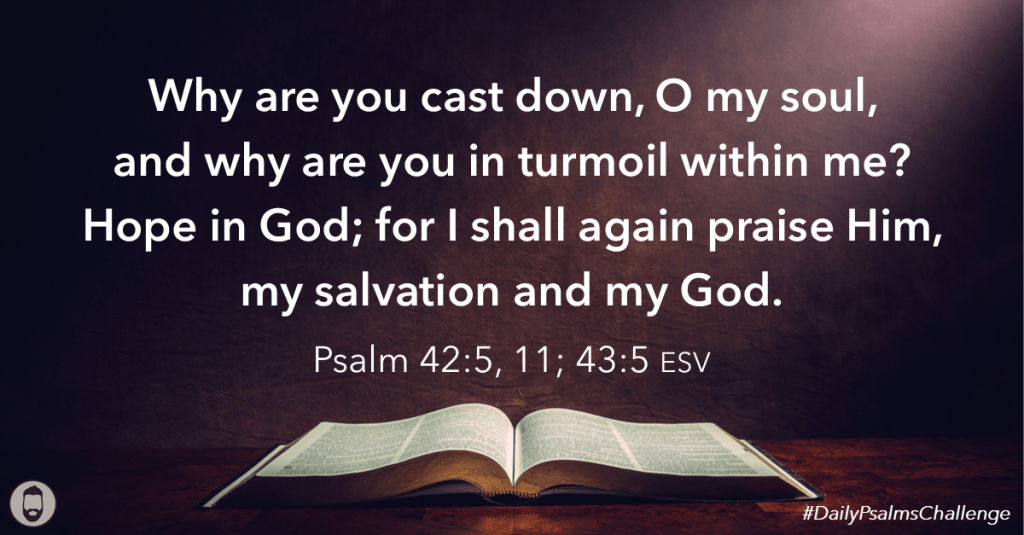
Why are you cast down, O my soul, and why are you in turmoil within me? Hope in God; for I shall again praise Him, my salvation and my God.

Psalm 42:5-6a, 11; 43:5

Psalm 42 and Psalm 43 are deeply connected, forming a single lament that expresses the struggle of a soul longing for God in the midst of despair. 

Psalm 42 opens with vivid imagery: “As a deer pants for flowing streams, so pants my soul for you, O God” (v. 42:1). There is a beautiful hymn based on this image, but for those who are crying out to the Lord, it is often anything but beautiful. Picture a deer being hunted, running from a hunter or predator, panting and out of breath and seeking a cool stream to provide sustenance and relief. Such is the plight of the sons of Korah in these psalms. They are spiritually thirsty, longing for the presence of the living God (v. 42:2), yet instead of refreshment, they find themselves overwhelmed by sorrow, being fed by tears (v. 42:3) and haunted by the taunts of people mocking their faith by asking “Where is your God?” (vv. 42:3, 10)

This spiritual turmoil is compounded by distance from the place of worship or from the joy accompanying better times of leading God’s people in His praise and worship (v. 42:4). They remember what it was to joyously lead God’s people in worship at His tabernacle but now feel cut off and alone. The lament deepens as they describe being overwhelmed by waves of suffering, described a waves of the sea crashing over them (v. 42:7). Yet, even in their distress, they cling to this foundational truth: “By day the Lord commands His steadfast love, and at night His song is with me” (v. 42:8).

Psalm 43 continues their cry for deliverance, shifting from lament to pray to God for vindication. They plead for God to “send out [His] light and…truth” to lead them back to worship at His altar, where they may rejoice in Him again (vv. 43:3-4). But there is beautiful solace to be found in their refrain found in vv. 42:5, 11 and 43:5 that not only asks their own souls “why” they are “cast down” and “in turmoil” within themselves but points to the refreshment they know their panting souls will receive by saying, “Hope in God; for I shall again praise Him, my salvation and my God.”

This refrain teaches us the discipline of preaching the truth to ourselves in the face of despair. Instead of passively listening to their own troubled thoughts, they preach to their own souls, reminding themselves of who God is and where their hope must rest. This does not change their circumstances but points them to the God who provides hope in the midst of circumstances. He is faithful. He provides rest. He provides solace. He IS their hope.

Seeing Jesus in Psalms 42 & 43

These psalms find their fulfillment in Jesus, who fully experienced the anguish of a downcast soul. In the Garden of Gethsemane, Jesus echoed the sons of Korah when He said, “My soul is very sorrowful, even unto death” (Matthew 26:38). On the cross, He endured the mockery of His enemies jsut as they did (vv. 42:3, 10; Matthew 27:39-43). Yet, even in His suffering, Jesus fully entrusted Himself to His Father’s will and endured the full weight of God’s wrath against sin – our sin – that we might never be truly abandoned.

The sons of Korah longed for God’s presence, and through Jesus, that longing is ultimately fulfilled. Jesus Himself is the “light and truth” that leads us to God (v. 43:3; John 8:12, 14:6). He is Emmanuel, God with us, who will never leave nor forsake His people. And because of His resurrection and promised return, we can confidently hope in God, knowing that no matter our circumstances we too will “again praise Him” (v. 43:5).

Reflection

Can you identify with the sorrow and despair found in Psalms 42 and 43? If so, I hope you see the promise of hope and relief found in Jesus. He bore our shame and sin and adopts us into His family.

There is coming a day when the tears that flow ever so easily here in this fallen world will be wiped away for the last time by His nail-scarred hand when He comes to dwell with His people – where death will be nothing more than a fading memory – where there shall be no more “mourning, nor crying, nor pain anymore, for the former things have passed away” (Revelation 21:3-4).

In the meantime between that promise and its fulfillment, there is a lot of despair and downcast souls and pain and sorrow. There is a lot of panting for streams of relief. But, oh, there is so much hope to be found. May we not be left in the question of why our souls are downcast but let us preach the beautiful truth of the psalmists refrain: “Hope in God; for I shall again praise Him, my salvation and my God”!


Here’s a song inspired by Psalm 42:

The #dailyPSALMSchallenge gives us the opportunity to start 2025 in God’s Word by digging into a psalm a day. Each day will identify a key passage for us to meditate on as well as seeking to help us see Jesus in the psalm and reflect on what we have read.

Won’t you take the challenge?
“From Betrayal to Blessing” from Psalm 41 (#dailyPSALMSchallenge)

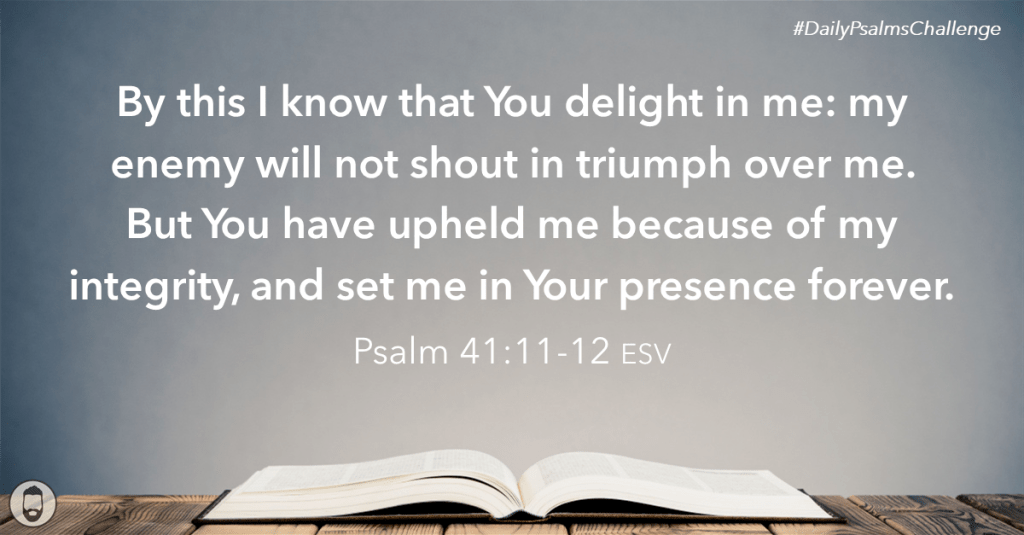
By this I know that You delight in me: my enemy will not shout in triumph over me. But You have upheld me because of my integrity, and set me in Your presence forever.

Psalm 41:11-12

Psalm 41 is a psalm of both confidence and lament, showing David’s trust in God even as he faces sickness, slander, and betrayal. It begins with a blessing on the “one who considers the poor” because the Lord will deliver him in “the day of trouble” (v. 1). David knows that God sees and cares for those who show mercy, and he clings to this truth as he cries out to God for grace and healing (v. 4).

David’s suffering at the hands of his enemies is worsened by the betrayal of a “close” and “trusted” friend, one who he once shared meals with (v. 9). His foes whisper in the shadows about his downfall, waiting for him to die and be forgotten (vv. 5-8). In his distress, David prays, “O Lord, be gracious to me, and raise me up, that i may repay them!” (v. 10). His hope doesn’t rest in his strength as he clearly has none and cannot overcome his foes on his own. His only hope is in God’s strength and faithfulness; he trusts that the Lord will uphold him and not allow his enemies to triumph over him (vv. 11-12). 

The psalm ends with a beautiful doxology (formula for praising the Lord) that we can echo today: “Blessed be the LORD, the God of Israel, from everlasting to everlasting! Amen and amen.” (v. 13) This shows that, despite his suffering, David praises the Lord and exalts His name and that no matter what, God’s justice and mercy will prevail.

Seeing Jesus in Psalm 41

Psalm 41 finds its ultimate fulfillment in Jesus, the true and greater King. David’s words about the betrayal of a close friend in v. 9 are quoted by Jesus in reference to Judas Iscariot (John 13:18). Judas, who had walked with Jesus and shared meals with Him, turned against Him and handed Him over to His enemies. 

Like David, Jesus was surrounded by those who whispered against Him, mocked Him, and plotted His demise (vv. 5-8, Matthew 26:3-4). Yet, unlike David, Jesus did not pray for deliverance from death but submitted to His Father’s will and plan by willingly enduring betrayal, suffering, and the cross for our salvation. Though His enemies thought they had triumphed, God raised Him up in victory (v. 10), exalting Him to His rightful place at the Father’s right hand (Philippians 2:9-11). And through His resurrection, Jesus secured ultimate healing, restoration, and vindication for all who have faith in Him.

Reflection

For those who have faced betrayal, affliction, or opposition, Psalm 41 offers a reminder that God sees, sustains, and vindicates His people. It is tempting to try and vindicate ourselves or to give up in the face of overwhelming circumstances, but Jesus has made a way for us. He endured so that we may have eternal life, leaving us with the reminder that this world is not all there is. For those who have confessed Him as Lord and believed He is risen from the dead (Romans 10:9), He saves not only from our sin but forevermore!

Even when we are afflicted, betrayed, or opposed, God remains faithful. He will sustain us. Follow the example of David in Psalm 41, and trust that the Lord delights in His people – that He delights in saving us.

The #dailyPSALMSchallenge gives us the opportunity to start 2025 in God’s Word by digging into a psalm a day. Each day will identify a key passage for us to meditate on as well as seeking to help us see Jesus in the psalm and reflect on what we have read.

Won’t you take the challenge?

“Sin Whispers, But God’s Love Shouts!” from Psalm 36 (#dailyPSALMSchallenge)

How precious is Your steadfast love, O God! The children of mankind take refuge in the shadow of Your wings.

Psalm 36:7

Psalm 36 presents a striking contrast between the wickedness of sinful man and the steadfast love of God. David opens the psalm with a sobering description of human sinfulness (which describes every one of us at some point). The wicked are deceived by their own arrogance (v. 2). Their words bring trouble and deceit (v.3). And they “do not reject evil” (v. 4). 

What is at the root of all of this sin? David clarified that back in v. 1: “There is no fear of God before [the wicked’s] eyes”. Sin speaks to the hearts of the wicked because they do not fear the Lord and leads them further and further into wickedness and darkness.

But, in contrast to the darkness, the love of God shines brilliantly! David exalts God’s steadfast love, faithfulness, righteousness, and justice (vv. 5-6). These attributes of God are described in magnificently limitless terms in v. 5: “ Your steadfast love, O LORD, extends to the heavens, Your faithfulness to the clouds.” God’s righteousness is described as firm as mountain, and His judgments as deep as the oceans (v. 6). 

This steadfast love is at the root of His covenant with His people, leading Him to offer abundant blessings to those who trust in Him. Those who trust in Him “feast on the abundance of [His] house” and drink deeply from “the river of [His] delights” (v. 8). This is a picture of deep satisfaction found only in relationship and refuge in the Lord. He Himself is the “fountain of life” (v. 9), the source of all true joy, meaning, and fulfillment.

David closes Psalm 36 with a prayer for God’s continued love and protection for His people (vv. 10-12). He asks that pride and wickedness – that he understood was a danger to his own sinsick heart – would not overtake him and that God’s enemies would ultimately fall.

This leaves all reading Psalm 36 with a clear choice: will we walk in the way of the wicked, or will we seek shelter under the wings of a loving God?

Seeing Jesus in Psalm 36

Jesus is not only the fulfillment of Psalm 36 but the perfect embodiment and demonstration of God’s steadfast love. The apostle John showed this clearly in 1 John 4:9-10 – that in Jesus the love of God is illustrated, illuminated, and literally embodied:

“In this the love of God was made manifest among us, that God sent His only Son into the world, so that we might live through Him. In this is love, not that we have loved God but that He loved us and sent His Son to be the propitiation of our sins.”

Not only does Jesus encapsulate the love of God, but He is the fullest expression of the way God’s love was shown throughout Psalm 36. He is the Good Shepherd (John 10:11), the Bread of Life (John 6:35), the Fountain of Living Water (John 7:37-38), and the Light of the World (John 8:12). It is in Jesus alone that we experience the inexhaustible and ever-present satisfaction that David spoke of in his deepest longings. 

Refection

What David prayed for, we can know fully in Jesus. The world offers temporary pleasures, but Jesus not only embodies David’s longings but offers His fulfillment of them to all who trust in Him. That’s good news!

As you meditate on the beauty of God’s love in Christ, consider the following questions:

  • Do you recognize the voice of sin whispering in your own heart? How can you guard against it?
  • What does it mean to take refuge in God’s steadfast love? Where are you seeking satisfaction apart from Him?

The world offers fleeting joys, but true and lasting joy is found in His presence – presence that we can experience through His Spirit within us. 

Run to Him.

Take refuge under His wings.

Rest in the promise of His never-stopping, never-failing, never-giving-up steadfast love.


Here’s a song inspired by Psalm 36:

The #dailyPSALMSchallenge gives us the opportunity to start 2025 in God’s Word by digging into a psalm a day. Each day will identify a key passage for us to meditate on as well as seeking to help us see Jesus in the psalm and reflect on what we have read.

Won’t you take the challenge?

“Entrusting Your Battle to the LORD” from Psalm 35 (#dailyPSALMSchallenge)

Let those who delight in my righteousness shout for joy and be glad and say evermore, “Great is the LORD, who delights in the welfare of His servant!”

Psalm 35:27

Psalm 35 is a cry for justice and protection. David pleads with God to rise up as his defender against people who were seeking to destroy him. He begins with a desperate call on the Lord to “contend…with those who contend with [him]” and to “fight against those who fight against [him]” (v. 1). He is asking God to take up weapons of war on his behalf. 

At the heart of the psalm is the reality of unjust and undeserved suffering. David is being pursued, falsely accused, and mistreated. His enemies are deceitful and malicious (v. 11), repaying the kindness he has shown them with hatred (v. 12). When they mourned, David mourned with them (v. 14), yet they now rejoice at his downfall (v. 15). This deeply distresses David, prompting him to call out and ask, “How long, O LORD, will You look on?” (v. 17). This is a question that everyone familiar with anguish and feelings of being abandoned in suffering has felt – and likely asked themselves.

Yet, Psalm 35 is not only pleading with God for justice – it is David declaring faith in God’s righteousness, knowing that God has not abandoned or forsaken him. David knows that God will be glorified “according to [His] righteousness” when He vindicates him (v. 24). This faith means that David does not have to take these matters into his own hands but entrusts his cause to the Lord, knowing that His justice and righteousness will prevail and leading David to end the psalm with joyful praise: “Great is the LORD, who delights in the welfare of His servant!” (v. 27). Neither his enemies nor his suffering will have the final word because God’s justice and goodness will triumph.

Seeing Jesus in Psalm 35

Jesus directly quoted Psalm 35:19 in John 15:25: “They hated me without a cause.” Like David, Jesus knew what it was to be falsely accused, mistreated, and hated – except for Jesus it wasn’t merely those He had mourned with but those He came to save. 

David sought vindication and protection, but Jesus is greater than David. He prayed that those who were responsible for arresting, mocking, torturing, and even crucifying Him would be forgiven rather than condemned or taken out by God’s righteous wrath (Luke 23:34). Furthermore, Jesus bore the full weight of injustice on the cross so that all who trust in Him – including those who were formerly His enemies (Romans 5:10) – might be saved through Him. And yet, as David prayed, Jesus will return as the righteous Judge who will one day set all things – all injustice and wrongdoing – right (Revelation 19:11-16).

Reflection

If you are reading this and feel as David did in the beginning of Psalm 35 – that God might not see his trials and suffering, know this: God sees your pain. He fights for His people. And His righteousness will win out. 

He exhibits this clearly in His care for His people throughout the ages. You can trust Him. You can take refuge in Him. When you put your trust in Him, you can truly cry out as David did: “Great is the LORD, who delights in the welfare of His servant!”

The #dailyPSALMSchallenge gives us the opportunity to start 2025 in God’s Word by digging into a psalm a day. Each day will identify a key passage for us to meditate on as well as seeking to help us see Jesus in the psalm and reflect on what we have read.

Won’t you take the challenge?

“Whom Shall I Fear If the Lord is My Stronghold?” from Psalm 27 (#dailyPSALMSchallenge)

The LORD is my light and my salvation; whom shall I fear? The LORD is the stronghold of my life; of whom shall I be afraid?

Psalm 27:1

Psalm 27 reflects confident trust in the Lord, even in the face of fear, opposition, and uncertainty. David declares that God is his light, salvation, and stronghold, assuring him ultimate safety and peace. This psalm is a beautiful and powerful tapestry of praise, prayer, and hope.

David begins by proclaiming unshakable confidence in God (vv. 1-3). He asks twice, “whom shall I fear?” (v. 1). He describes God as his light and salvation but also as his stronghold – a fortress in whom he can find refuge when his enemies rise up against him. He trusts God to protect him as well as causing his enemies to stumble and fall. 

David’s heart’s desire is revealed in v. 4: “One thing I have asked of the Lord…that I may dwell in the house of the Lord all the days of my life.” He longs for uninterrupted communion with God – eternally dwelling with him rather than seeking temporary shelter. For him, being in God’s presence – gazing upon His beauty and inquiring of His temple – is the ultimate source of joy and security.

David rejoices in the protective care of God who hides him in His shelter and also lifts him high upon a rock (vv. 5-6). David’s response to God’s care is to praise Him with shouts of joy and songs. 

In vv. 7-12, the psalm takes an intimate turn as David cries out to God for continued grace and deliverance. He pleads with Him not to hide His face or abandon Him, expressing a deep dependence on God as his help and salvation. Even when forsaken by all others, David has confidence that “The Lord will take [him] in” (v. 10).

Psalm 27 concludes with a bold statement and encouragement to wait on the Lord: “I believe that I shall look upon the goodness of the Lord in the land of the living!” (v. 13). The way the KJV translates v. 13 is helpful: “I had fainted, unless I had believed to see the goodness of the Lord in the land of the living”, meaning that David knew that he would have despaired and been hopeless without his belief and faith in God, faith that knew and trusted that he would see God’s goodness in the world and not as something he would have to wait on in heaven. Because of that he could encourage people to “Wait for the Lord; be strong, and let your heart take courage” (v. 14).

Seeing Jesus in Psalm 27

Psalm 27 points to Jesus as the ultimate fulfillment of David’s longing for light, salvation, and communion with God. Jesus declared that He was “the Light of the World” (John 8:12). He is the true light who dispels the darkness of sin and death, bringing salvation to all who believe in Him. Jesus is also our stronghold, the One who secures our place in the presence of God. Through His death and resurrection, He opened the way to His heavenly sanctuary, where we can dwell with God forever (Hebrews 10:19-22).

David’s desire to “dwell in the house of the Lord” (v. 4) finds its fulfillment in Jesus, who enables believers to experience God’s presence through His Holy Spirit. In eternity, we will gaze upon the beauty of the Lord and worship Him face-to-face (Revelation 22:4).

When David cries, “My father and my mother have forsaken me, but the Lord will take me in” (v. 10), we are reminded of Jesus’s promise to never leave or forsake His people (Matthew 28:20, Hebrews 13:5). He is the faithful Savior who sustains us through every trial and assures us of eternal life in His presence. 

Reflection

Psalm 27 invites us to trust God in every circumstance, finding confidence, joy, and peace in His presence. Consider the following questions to help you reflect on what you’ve read.

How can you remind yourself of God’s light and salvation in times of fear and certainty?

Do you, like David, have a desire to dwell in the presence of God? What steps can you take to cultivate this desire?

In what ways has God demonstrated His faithfulness to you, even when others have let you down?

Take time today to praise God for being your light and salvation. Ask Him to increase your confidence in His care and help you wait patiently for His perfect will to unfold. Let the truth of this psalm strengthen your heart and encourage your soul as you continue to trust in Him!

The #dailyPSALMSchallenge gives us the opportunity to start 2025 in God’s Word by digging into a psalm a day. Each day will identify a key passage for us to meditate on as well as seeking to help us see Jesus in the psalm and reflect on what we have read.

Won’t you take the challenge?

“Walking Faithfully in a Wicked World” from Psalm 26 (#dailyPSALMSchallenge)

But as for me, I shall walk in my integrity; redeem me, and be gracious to me. My foot stands on level ground; in the great assembly I will bless the LORD.

Psalm 26:11-12

Psalm 26 is a prayer of confidence and commitment to walking in integrity before God. David appeals to God for vindication, affirming his trust and faithfulness in the midst of a corrupt world. His prayer reflects a heart committed to holiness, worship, and reliance on God’s steadfast love and faithfulness (without which neither David nor us would be able to be holy or stand before God).

David begins with a declaration of his integrity and trust (v. 1). His pleas that follow are not self-righteous boasting but again a plea to God based on God’s consistent character and faithfulness. David knows God and understands how God had worked and was currently working in his life. This is why David openly invited God to test his heart and mind, knowing that God’s steadfast love and faithfulness are ever before him (vv. 2-3).

In vv. 4-5, Psalm 26 transitions to a rejection of worldly wickedness and hypocrisy (similar to the contrast in Psalm 1). He refuses to associate with evildoers and hypocrites, distancing himself from their schemes. His separation of sin is paired with his love for worshiping the Lord. His heart is set on the “habitation of God’s house” and the glory of God’s presence (vv. 6-8). He declares his innocence symbolically through the washing of his hands and offering thanksgiving to God.

David also expresses his confidence in God’s justice, asking to be separated from sinners in judgment (vv. 9-10). His trust in God leads him to reaffirm his commitment to walk in integrity. He concludes with further confidence that his feet stand on level ground and that he will bless the Lord in the great assembly (vv. 11-12).

Seeing Jesus in Psalm 26

Psalm 26 ultimately points to Jesus as the true Man of integrity. While David’s integrity was obviously imperfect, Jesus perfectly fulfilled God’s standard of holiness and righteousness. He lived without sin, fully trusting in His Father and walking blamelessly.

Jesus also fulfills David’s longing for the “habituation of God’s house” and the “place where [His] glory dwells” (v. 8). In Christ – Emmanuel (God with us), we have access to the presence of God, believers becoming the temple where His Spirit dwells (Ephesians 2:22). 

Reflection

As followers of Jesus, we are called to live lives of integrity, not on our own merits or abilities but empowered by His Spirit. Our confidence is not in our own righteousness but in the perfect righteousness of Christ, who enables us to walk faithfully before God.

Psalm 26 challenges us to live that life of integrity. Ask yourself the following questions and reflect on them.

Are you willing to invite God to examine your heart and mind as David did?

Do you distance yourself from sin while pursuing the joy of worship and fellowship with God’s people?

How does the integrity of Jesus encourage and empower you to walk faithfully before God?

Take time to pray, asking God to test your heart, deepen your love for Him, and guide you in integrity. Rejoice in Jesus’s righteousness, which covers and sustains you as you bless the Lord in the assembly of His people.

The #dailyPSALMSchallenge gives us the opportunity to start 2025 in God’s Word by digging into a psalm a day. Each day will identify a key passage for us to meditate on as well as seeking to help us see Jesus in the psalm and reflect on what we have read.

Won’t you take the challenge?

“Trusting the Good Shepherd in Green Pastures and Dark Valleys” from Psalm 23 (#dailyPSALMSchallenge)

The LORD is my shepherd; I shall not want…. Surely goodness and mercy shall follow me all the days of my life, and I shall dwell in the house of the LORD forever.

Psalm 23:1, 6

Psalm 23 is among the most beloved and often quoted passages of Scripture, offering profound comfort and hope. It uses two main illustrations: the Lord as Shepherd (vv. 1-4) and the Lord as Host (vv. 5-6). These metaphors vividly illustrate God’s care, guidance, protection, and provision for His people.

David begins with the declaration that “The Lord is [his] shepherd” and that because He is he “shall not want” (v. 1). This is not just a statement of confidence but more of a deep personal affirmation of David’s trust in his Lord. In the ancient world, kings were often compared to shepherds, tasked with providing for and protecting their people. Here, David, Israel’s literal shepherd-king, acknowledges that he himself is a sheep under the care of the Chief Shepherd.

God provides abundantly for His flock. The “green pastures” and “still waters” (v. 2) symbolize rest, nourishment, and peace. The Shepherd knows what His sheep need and leads them accordingly. Even in “the valley of the shadow of death” (v. 4), the darkest and most dangerous of places, the sheep are secure. Why? Because the Shepherd is there. His rod (used for protection) and His staff (used for guidance) bring comfort and assurance.

Psalm 23 then shifts from the image of a shepherd to that of a host preparing a large and lavish banquet. The phrase “You prepare a table before me in the presence of my enemies” (v. 5) speaks of victory, provision, and honor. In the face of opposition and perceived danger, God sustains and blesses His people. Anointing the head with oil was a sign of hospitality and joy, and the overflowing cup reflects the abundance of God’s blessings.

It concludes with the confidence that God’s goodness and mercy (His steadfast love, His chesed) will pursue His people all the days of their lives, culminating in their dwelling with Him forever (v. 6), when He will no longer pursue because we will be safe in His presence. 

Seeing Jesus in Psalm 23

Jesus is the fulfillment of Psalm 23. He is the Good Shepherd who laid down His life for His sheep (John 10:11). Just as David declared, “He restores my soul” (v. 3), Jesus restores the lives of those He saves, leading them on paths of righteousness for His name’s sake.

In the New Testament, Jesus embodies both Shepherd and Host. He leads His followers through the trials and dangers of life, offering His constant presence and peace as Emmanuel (God with us). Through His death and resurrection, He conquered the ultimate valley of death, not merely its shadow (v. 4), ensuring that His sheep will never be abandoned or forsaken.

The table prepared “in the presence of…enemies” (v. 5) points forward to the victory banquet (marriage supper) of the Lamb (Revelation 19:9), where Jesus invites His people to eternal fellowship with Him, dwelling in His house forever and His goodness and mercy will no longer follow but be the ambiance of God’s glory in His house forevermore (v. 6)!

Reflection

Psalm 23 invites us to rest in the care of the Good Shepherd. Are you weary, burdened, or fearful? Remember that Jesus not only walks you through life’s green pastures but also through its darkest valleys. His presence and protection are enough.

Take time today to reflect on God’s abundant provision and steadfast love in your life. Trust Him to lead, sustain, and guide you – even when the path ahead seems uncertain or fraught with danger or death. He is a Shepherd who never leaves His sheep, a Host who welcomes His people with joy, and a King who reigns with goodness and mercy.

Are you following the Shepherd’s voice today? Rest in the assurance that you are His, and He will guide you safely home.

The #dailyPSALMSchallenge gives us the opportunity to start 2025 in God’s Word by digging into a psalm a day. Each day will identify a key passage for us to meditate on as well as seeking to help us see Jesus in the psalm and reflect on what we have read.

Won’t you take the challenge?

Songs for Sunday, January 26, 2025 @ Christ Community Church

Sunday’s coming, and that’s good news!

Have y’all ever gotten something stuck in your mind that you just couldn’t get unstuck? Of course you have – everyone has experienced this at some point and time. For me, it is the key verse from John’s sermon last week, Romans 12:15:

Rejoice with those who rejoice, weep with those who weep.

It’s simple. Straightforward. Clear. As John explained to us, this verse is really only four words in the Greek, essentially “rejoice — rejoicers, weep — weepers”. We, those of us who are saved and have been adopted into God’s family and grafted into His church, are to be there for our brothers and sisters, hurting when they hurt. That’s what family does, right? It should especially be so in the family of God.

As I have pondered on that verse (really simmered or stewed like a crockpot), it has had me thinking on why it is to be this way. And essentially, I have arrived at the conclusion that it stems from us extending grace to others as Jesus has extended grace to us.

One Scripture that came to mind is from the Sermon on the Mount right after Jesus gave us what we call “The Lord’s Prayer”. Look at Matthew 6:14-15:

For if you forgive others their trespasses, your heavenly Father will also forgive you, but if you do not forgive others their trespasses, neither will your Father forgive your trespasses.

This is not saying that we earn God’s forgiveness by forgiving others. If that were the case, we’d have no hope because humanity as a whole is not a forgiving people but rather quite selfish and self-serving. No, what Jesus is saying here is that the way we forgive is based on how we have been forgiven. If we understand that our sin put us at odds and enmity with Jesus and that He reconciled us to Himself and showed us love while we were still sinners, we will have an appreciation for that love and forgiveness that will show in how we forgive others.

This isn’t some theory on my part or some great epiphany. Jesus explained it similarly to Simon the Pharisee after the woman came in and washed Jesus’s feet with her tears, dried them with her hair, and anointed them with costly perfume. When Simon (and Jesus’s own disciples) were critical of the woman’s wastefulness with pouring out very expensive perfume on Jesus’s feet, Jesus told them that the woman’s sins “which are many” had been forgiven which was why she “loved much”, and He clarified that the one who has been “forgiven little, loves little” (Luke 7:47).

If you are saved, you know that you have been forgiven MUCH because your sin — no matter how the world might view it — is a LOT, and definitely more than our sinless Savior should’ve had to bear on the cross. We deserve the cross, not Jesus. We deserve death, not Jesus. But because of His great love and richness in grace and mercy, He forgave much, loved much, and gave much. That kind of forgiveness, love, and grace changes folks’ lives. If you are saved, you have received this from Jesus and cannot help but extend it to others.

Simon didn’t get it. He thought he had some earthly status as a Pharisee. But when you look at the other gospels, you get, as Paul Harvey would’ve said, the rest of the story. Matthew 26:6 doesn’t call Simon a Pharisee; there he is referred to as “Simon the leper”. You don’t have to read a lot of the Bible to know that folks typically kept their distance from lepers. They were considered unclean. Folks would walk on the opposite side of the road to keep from touching one. They surely wouldn’t touch one, much less go to his house for supper. Long story short, Jesus wasn’t at Simon’s house to honor him but because Jesus had compassion on those no one else did. Jesus was a friend to sinners. He ate with tax collectors. He showed compassionate care to those the world had thrown away. No one was lining up at Simon’s door because Simon was unclean, untouchable, and unmistakably ostracized from society. Yet he looked at that poor woman weeping at Jesus’s feet and had the audacity to remark how pitiful it is that Jesus would let her touch Him (when anyone passing by could’ve remarked how pitiful it was for Jesus to go in Simon the leper’s house).

Simon didn’t get it.

Do we?

That woman had received a lot of grace because she’d committed a lot of sin.

That woman had experienced greater love from God who not only forgave her sin but would go on to die on the cross her sin deserved.

That woman had reason to weep sorrowfully over her sin against a holy God but had more reason to weep out of rejoicing that her sin was wholly forgiven by God and show love to Him in return.

What about us? Do we get it?

Look at how Paul put it in 2 Corinthians 1:3-4:

Blessed be the God and Father of our Lord Jesus Christ, the Father of mercies and God of all comfort, who comforts us in our affliction, so that we may be able to comfort those who are in any affliction, with the comfort which we ourselves are comforted by God.

God has shown us grace and comfort because He loves us. We have the opportunity to show that grace and comfort to others. And this is sorely needed in a world today that seems like the rejoicing is getting more seldom and weeping is ever increasing.

Thankfully, Sunday’s coming. There is a coming Day when Jesus will return and gather His people to Him. The last tears of sorrow will be cried and wiped away by His nail-pierced hand. Death will be abolished. The sad things of this earth will come untrue. As the old hymn says, “What a Day — glorious Day — that will be!”

Until that day, we will gather and read God’s Word, sing God’s Word, and hear God’s Word preached. That’s what we’re singing about this Sunday: telling what Jesus has done for us. And as we do so, we will have brothers and sisters who are rejoicing about this or that. Rejoice with them. Assuredly there will be those with much to weep about. Weep with them. You have been given much grace and love. Christ Community family, it’s time to extend that grace and love to others.

Won’t you gather with us?


Here are our Scriptures & songs:

  • Scripture | Titus 3:1-7

1Remind them to be submissive to rulers and authorities, to be obedient, to be ready for every good work, 2to speak evil of no one, to avoid quarreling, to be gentle, and to show perfect courtesy toward all people. 3For we ourselves were once foolish, disobedient, led astray, slaves to various passions and pleasures, passing our days in malice and envy, hated by others and hating one another. 4But when the goodness and loving kindness of God our Savior appeared, 5He saved us, not because of works done by us in righteousness, but according to His own mercy, by the washing of regeneration and renewal of the Holy Spirit, 6whom He poured out on us richly through Jesus Christ our Savior, 7so that being justified by His grace we might become heirs according to the hope of eternal life.


  • Scripture | Galatians 6:14

But far be it from me to boast except in the cross of our Lord Jesus Christ, by which the world has been crucified to me, and I to the world.


  • Scripture | Revelation 1:17-18

17When I saw Him, I fell at His feet as though dead. But He laid His right hand on me, saying, “Fear not, I am the first and the last, 18and the living one. I died, and behold I am alive forevermore, and I have the keys of Death and Hades.


“God’s Revelation of Himself from Creation to the Christ” from Psalm 19 (#dailyPSALMSchallenge)

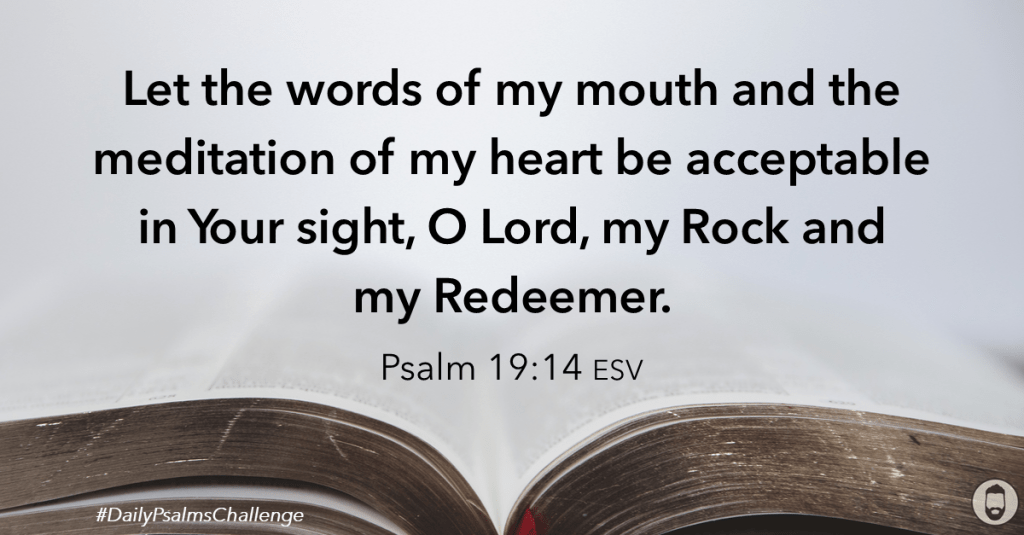
Let the words of my mouth and the meditation of my heart be acceptable in Your sight, O LORD, my Rock and my Redeemer.

Psalm 19:14

Psalm 19 is a celebration of God’s revelation of Himself to the world. These two revelations are known by the terms natural revelation and special revelation and are seen in Psalm 19 through God’s glory displayed in creation (vv. 1-6) and His grace revealed through His Word (vv. 7-14). 

The heavens declare God’s majesty so powerfully that no one is able to say that there is no God and is without excuse (vv. 1-4; cf. Romans 1:20). David marvels at how the sun, like a joyous bridegroom or a victorious runner, hurries to proclaim God’s power and order (vv. 4-6). That’s what natural revelation does: proclaim God’s handiwork and point people toward Him. But natural revelation is not enough to bring people to saving knowledge of God. We need a specific introduction – a special revelation. 

Psalm 19 transitions to the Word of God and God’s special revelation of Himself through it, which is described as perfect, trustworthy, right, radiant, pure and true (vv. 7-9). These descriptions highlight how Scripture revives the soul, makes the simple wise, rejoices the heart, and provides light for life’s path. As we read through the Psalms, this is what God’s Spirit does in our hearts as we read. Look at how David shows that he treasures God’s Word more than gold and finds it sweeter than honey (v. 10).

The end of Psalm 19 illustrates what an appropriate response to God’s revelation of Himself looks like. In vv. 12-14, David offers a brief and humble prayer for forgiveness, protection from his own sin, and a life pleasing to God. God’s Word – His revealing of Himself – changed David’s life (and can do the same for us).

Seeing Jesus in Psalm 19

Psalm 19 points to Jesus as the ultimate revelation of God (John 1:14, Hebrews 1:1-3) – a literal, incarnate face-to-face introduction of God and man. Jesus perfectly obeyed God’s law and revealed God’s glory in His life, death, and resurrection. 

He is the Word made flesh (John 1:1-3, 14), and through Him alone can we be made acceptable in God’s sight, revealing the true and definitive response to David’s prayer (vv. 12-14). David prayed for God’s Word to guide him and protect him from sin; Jesus is the very Rock and Redeemer to perfectly answer his prayer!

Reflection

The skies and the Scriptures both testify to God’s glory and grace. Have you paused today to marvel at God’s creation or His Word? If you have read this far, you’ve spent time in His Word. Have you marveled at the power of God in keeping His Word so that you have it before you these millennia later?

Let David’s prayer in v. 14 be your prayer today: “Let the words of my mouth and the meditation of my heart be acceptable in Your sight, O LORD, my Rock and my Redeemer”, and know that, this is one more opportunity to sing and rejoice as we did in Psalm 18:46: “The LORD lives, and blessed be my Rock, and exalted be the God of my salvation”!

The #dailyPSALMSchallenge gives us the opportunity to start 2025 in God’s Word by digging into a psalm a day. Each day will identify a key passage for us to meditate on as well as seeking to help us see Jesus in the psalm and reflect on what we have read.

Won’t you take the challenge?
“Foundations of Faith” from Psalm 11 (#dailyPSALMSchallenge)

For the LORD is righteous; He loves righteous deeds; the upright shall behold His face.

Psalm 11:7

Psalm 11 speaks directly to a moment of crisis, when fear and doubt creep in while everything around David seems to be going wrong because of wicked enemies. David starts off with a declaration of his trust in the LORD: “In the LORD I take refuge” (v. 1). This is David’s response to being told to “flee like a bird” (v. 1) in the face of danger. He refused to flee anywhere other than to the LORD. Why? Because his hope is not found in his circumstances but in the sovereignty and power of God.

People looked at David and saw chaos – wicked men lurking in the shadows, preparing to strike out at the righteous (v. 2). They questioned what the righteous could do once “the foundations are destroyed” (v. 3), yet David’s confidence was not shaken. His response was to turn his gaze upward, away from the troubles and wicked enemies, declaring, “The LORD is in His holy temple; the LORD’s throne is in heaven” (v. 4). His foundations are too high and too deep to be in danger of crumbling or shaking! From His throne, He sees all, tests all men’s hearts, and brings judgment on the wicked while vindicating the righteous.

Psalm 11 culminates in a beautiful promise: “The upright shall behold His face” (v. 7). For those whose trust is in the LORD, there is not only refuge now but the ultimate reward of seeing God face-to-face. This hope is unshakable because it rests on the unchanging character of the LORD, who is righteous and loves justice (v. 7).

Seeing Jesus in Psalm 11

Jesus fulfills the promise of Psalm 11. In His life, He endured the attacks of the wicked, standing firm in the face of betrayal, violence, and the cross. He is the ultimate example of trusting the Father as a refuge. On the cross, He bore the judgment we deserve, drinking the cup of wrath described in v. 6 so that those who believe in Him can experience the joy of seeing God’s face (1 John 3:2).

Jesus triumphed over sin and death through His resurrection, ensuring that the righteous will one day be vindicated, and His return will bring ultimate justice, proving that no wickedness escapes His notice.

Reflection

In times of crisis, where do you turn for refuge? Psalm 11 challenges us to put our trust in the LORD not human solutions or fleeing.

Let the hope of seeing Jesus face-to-face sustain you as you navigate the challenges of life.

The #dailyPSALMSchallenge gives us the opportunity to start 2025 in God’s Word by digging into a psalm a day. Each day will identify a key passage for us to meditate on as well as seeking to help us see Jesus in the psalm and reflect on what we have read.

Won’t you take the challenge?