Nearly 2,000 years ago on that Sunday — the first day of the week before Passover, Jesus rode into Jerusalem on a colt to cries of “Hosanna!” (Matthew 21:9, Mark 11:10, John 12:13) and “Blessed is the King who comes in the name of the Lord!” (Luke 19:38)
Over the past few weeks at Christ Community, we have been singing songs that mirror those cries, hoping to help us see Jesus as who He is — the King of kings, Emmanuel, our God who has come and is coming again. We lifted our voices together singing “O Come, O Come, Emmanuel”, yearning for Jesus to return. We lifted our voices together singing the words of the songs from Revelation 4, 5 and 7, wanting to sing the songs of Heaven dedicated to the Lion of the tribe of Judah, the Lamb standing on the throne as though slain. And tomorrow, Lord willing, we will sing songs that mirror the cries heard along the streets of Jerusalem when the King came to town — as we also sing songs that look forward to the end of that week when Jesus was crucified and the beginning of the next when He rose from the grave!
One of the things I love about being able to sing these songs is that they are not merely commemorative. They are not icons pointing to a merely historic moment. They are not idols to a dead god. No, our God is alive and well — death could not keep Him! We sing these songs, and they are prophetic because Jesus has done all He promised and will coming again as He promised. We can sing “Hosanna!” (save us, O Lord — we praise You, O Lord) with the knowledge that He hears our praises just as He did the voices of those on that Jerusalem street! We can sing “Blessed is the King who comes in the name of the Lord!” because He is coming in the name of the Lord again!
These are not idle words (or idol words). Jesus IS King. Jesus IS alive. Jesus REALLY saves. He REALLY lives. All of this REALLY does MATTER!
Last week fired me up for Palm Sunday in a way I had not considered. Again, what we do in worship is not merely commemorative — it is active and prophetic and a present offer of praise to “our blessed hope…our great God and Savior Jesus Christ” (Titus 2:13)! You see, last week we lifted our voices together and read about a time when palm branches will be lifted in worship of the King (Revelation 7:9-12). 2,000 years ago, some of those voices lining the streets were sure to be some who also cried “Crucify Him!” a few days later. These voices in Revelation 7 will be those who have had their cries of “Hosanna!”, their cries for the Lord to save them and praising His name, those cries will have been answered. No, this lifting of palms will be from an uncountable “great multitude” of people saved by grace through faith in Jesus “from every nation, from all tribes and peoples and languages”; they will be standing “before the throne” — standing “before the Lamb”! And with palm branches in their hands and white robes on their bodies, they will cry out at the top of their voices, “Salvation belongs to our God who sits on the throne, and to the Lamb!”
Let’s do that tomorrow!
Let’s gather in worship of the Lamb!
Let’s gather in anticipation of the coming of the King!
Let’s lift our voices and declare to our God who saves that He is worthy and acknowledge that salvation comes from Him alone!
Let’s gather and singing “Hosanna!” and “Blessed is the King who comes in the name of the Lord!”
Let’s sit under the teaching of His Word and have His Spirit move our hearts to worship Him all of our days and not just for an hour or so on Sunday.
Let’s proclaim to the world that we have a God that death could not keep down and that He offers life to all who call upon Him and confess Him as Lord!
Won’t you gather with us?
Here are our Scriptures and songs:
Scripture | Luke 19:28-40 —
28And when He had said these things, He went on ahead, going up to Jerusalem. 29When He drew near to Bethphage and Bethany, at the mount that is called Olivet, He sent two of His disciples 30saying, “Go into the village in front of you, where on entering you will find a colt tied, on which no one has ever yet sat. Untie it and bring it here. 31If anyone asks you, ‘Why are you untying it?’ you shall say this: ‘The Lord has need of it.'” 32So those who were sent went away and found it just as He had told them. 33And as they were untying the colt, its owners said to them, “Why are you untying the colt?” 34And they said, “The Lord has need of it.” 35And they brought it to Jesus, throwing their cloaks on the colt, they set Jesus on it. 36And as He rode along, they spread their cloaks on the road. 37As He was drawing near — already on the way down the Mount of Olives — the whole multitude of His disciples began to rejoice and praise God with a loud voice for all the mighty works that they had seen, 38saying, “Blessed is the King who comes in the name of the Lord! Peace in heaven and glory in the highest!” 39And some of the Pharisees in the crowd said to Him, “Teacher, rebuke your disciples.” 40He answered, “I tell you, if these were silent, the very stones would cry out.”
37″O Jerusalem, Jerusalem, the city that kills the prophets and stones those who are sent to it! How often would I have gathered your children together as a hen gathers her brood under her wings, and you were not willing! 38See, your house is left to you desolate. 39For I tell you, you will not see me again, until you say, ‘Blessed is He who comes in the name of the Lord.'”
Scripture | Psalm 118:25-26 —
25Save us, we pray, O LORD! O LORD, we pray, give us success!
26Blessed is He who comes in the name of the LORD! We bless you from the house of the LORD!
There is something about the approach of Easter — of Resurrection Sunday — that stirs something within me. There is hope in the emptiness of the borrowed tomb that is unlike anything this world has to offer. Well, the world cannot exactly offer empty or borrowed tombs, can it?
I think about Israel around that time. They had experienced Babylonian (and Mede-Persian) exile because of their sin. Their return home never quite met the luster or glory of the former days. But there was a promise — a Promised One, in fact, who would come and rescue them. They sought rescue from worldly oppression and wicked rulers and regimes, but this Promised One would rescue them from the wicked idolatry and sin that reigned in their own hearts. They would just have to wait for that rescue.
And they waited.
And waited.
In the silence of no more “Thus saith the Lord”, they waited about 400 years for this Promised One. Empires changed. The Persians were displaced by the Greeks, the Greeks inevitably by the Romans. They waited until the silence was broken by the cry of an infant.
God had promised that the Messiah (Promised One/Anointed One/Greek: Christ) would come — that He Himself would come. Emmanuel, translated God-with-us, would be born of a virgin. This child, this Son, would be given to bring Light and rescue to God’s people. They were desperate. They were helpless. They had no way to save themselves.
It is not hard to empathize with that kind of desperation. The effects of the Fall, sin and death, are all around us. Wickedness is rampant. Death is rampant. Idolatry is rampant. Hope seems to be in small supply. But we do not have to wait in silence! Emmanuel has already come, and He is coming again! His Spirit is with His people! His Word has and is and will continue to speak hope of rescue and salvation — of grace and mercy — of the good news of Jesus!
That’s what we are singing about tomorrow.
We are going to pour out our hearts and long for the return of Emmanuel, God-with-us. We are going to praise God for the finished work of Jesus. We are going to praise God for His steadfast love. And we are going to cry out — through the pain and sorrow and fear and longing — “Come, Lord Jesus”!
Won’t you join us?
Here are our Scriptures & songs:
Scripture | Isaiah 9:2-7 —
2The people who walked in darkness have seen a great light; those who dwelt in a land of deep darkness, on them has Light shone. 3You have multiplied the nation; You have increased its joy; they rejoice before You as with joy at the harvest, as they are glad when they divide the spoil. 4For the yoke of his burden, and the staff of his shoulder, the rod of his oppressor, you have broken as on the day of Midian. 5For every boot of the tramping warrior in battle tumult and every garment rolled in blood will be burned as fuel for the fire. 6For to us a Child is born, to us a Son is given; and the government shall be upon His shoulder, and His name shall be called Wonderful Counselor, Mighty God, Everlasting Father, Prince of Peace. 7Of the increase of His government and of peace there will be no end, on the throne of David and over His Kingdom, to establish it and to uphold it with justice and with righteousness from this time forth and forevermore. The zeal of the LORD of hosts will do this.
9In this the love of God was made manifest among us, that God sent His only Son into the world, so that we might live through Him. 10In this is love, not that we have loved God but that He loved us and sent His Son to be the propitiation for our sins.
***NOTE: We are revising the lyrics of this song to better reflect the love of God — that which we read about all through Scripture, that which was “made manifest” as we read in the verses above. Many might be familiar with the Greek word agape that describes the unique love of God; the Hebrew word for that type of never-ending, never-failing, never-stopping, never-giving-up love is chesed. It is often translated “steadfast love” in the Old Testament. This is a word God uses to describe Him and His love over 500 times!
This is an opportunity for the theology of what we sing to more specifically reflect the Scriptures, and therefore more accurately reflect the love of God as He shares it with us in His Word. The word “reckless” in the original lyrics was meant to show that God lavishly pours out His love for us. He does! He has poured out His love on us and made it manifest through the gift of Jesus Christ for our sins. Let’s praise God for and sing about His steadfast love!
3 For I passed on to you as of first importance what I also received, that Christ died for our sins according to the scriptures, 4 and that he was buried, and that he was raised up on the third day according to the scriptures, 5 and that he appeared to Cephas, then to the twelve, 6 then he appeared to more than five hundred brothers at once, the majority of whom remain until now, but some have fallen asleep.
1 Corinthians 15:3-6
He made the one who did not know sin to be sin on our behalf, in order that we could become the righteousness of God in him.
2 Corinthians 5:21
8 But what does it say? “The word is near to you, in your mouth and in your heart” (that is, the word of faith that we proclaim), 9 that if you confess with your mouth “Jesus is Lord” and believe in your heart that God raised him from the dead, you will be saved. 10 For with the heart one believes, resulting in righteousness, and with the mouth one confesses, resulting in salvation. 11 For the scripture says, “Everyone who believes in him will not be put to shame.” 12 For there is no distinction between Jew and Greek, for the same Lord is Lord of all, who is rich to all who call upon him. 13 For “everyone who calls upon the name of the Lord will be saved.”
Romans 10:8-13
“Good News of Great Joy” or “The Weary World Rejoices”
We have spent a good bit of time this week in Luke 2:10 and the verses around it. The declaration of the angels to those poor and frightened shepherds should just about be memorized at this point: “Do not be afraid, for behold, I bring good news to you of great joy which will be for all the people”. Good news. Great joy. For all people.
The word translated “good news” is often translated gospel, and the message that the angels proclaimed on that hillside 2,000 years ago is a beautiful and succinct picture of the gospel. They preached that the Savior “who is Christ the Lord” was born for them – for those dirty, stinky shepherds – and that He could be found that very day in Bethlehem. It was news that would and could change the trajectory of their lives. They just needed to believe in Him and receive the salvation He had to offer – they would receive grace by faith through Him.
Now, I know that on the day they heard that gospel message Jesus was still laying in the feeding trough, still an infant, and was decades away from His death, burial, and resurrection. But the babe in the manger was still “the Word [become] flesh” (John 1:14). He was still the Lamb slain “before the foundation of the world” (Ephesians 1:4).
We sometimes want to overcomplicate things. We know the whole story and want to add and fill in the gaps in the angels’ proclamation that day, but the “good news of great joy” is still just as simple. In fact, Paul gives very succinct proclamations of the gospel, too. The first can be found in 1 Corinthians 15 where he tells the church at Corinth that he is passing on to them the most important message he had to offer – the very same message that he received himself: Jesus died for our sins according to the way that the Bible said He would, He was buried, and He rose from the dead on the third day exactly as the Bible and His own preaching said He would. That’s good news!
Paul’s second succinct gospel summary comes in his next letter to the church at Corinth in 2 Corinthians 5:21. In one complex little sentence, he shares that God put the sins of those who would be saved on Jesus. Jesus had never sinned and did not deserve any condemnation, but He willingly bore our sin on our behalf. Those who trust in Him no longer are under the condemnation and shame due to their sin; Jesus bore that (Colossians 2:13-14). In a great exchange, Jesus traded His righteousness for our sin. He bore the wrath of God and exchanged that for God’s favor. Basically, He traded His extravagantly full bank account for our bankrupt one so that when God looks upon those who Jesus has saved, He does not see their sinfulness but Jesus’ righteousness! That’s good news!
The gospel is good news, but there is also bad news. Those who do not confess Jesus as Lord and believe He died for their sins and rose again to not receive part in that great exchange. They remain in their sin. Their condemnation remains their own. It does not have to be that way. All who call out to Jesus in faith will be saved. Anyone who believes in Him will not be but to shame, but not believing leaves the shame where it belongs – on the sinner.
Look at how the Christmas hymn “O Holy Night” puts it:
Long lay the world in sin and error pining Till He appeared and the soul felt its worth A thrill of hope, the weary world rejoices For yonder breaks a new and glorious morn Fall on your knees!
Those who are without Jesus are still in their sin and “pining” after the wrong things, sinful things. But everyone – all people – have the opportunity to fall on their knees, believe in Him – confess Him as Lord, and repent of their sin. And those who do will not only have heard the good news of great joy but also to have believed it and received the salvation Jesus offers.
I love the phrase “good news of great joy” because 1) it is straight from the Bible, and 2) it captures what Jesus offers. But I also love the way the writer of “O Holy Night” captured what it is to be a sinner and receive Christ: “a weary world rejoices”. If you have been reading with us over these past two weeks, you have read snippets of the “good news of great joy”, but have you received it? Have you believed on Jesus, or are you still on the fence? If you haven’t, I urge you: fall on your knees, believe what the Bible says about Him, confess Him as Lord, and rejoice in the salvation He brings!
Reflection Questions:
This devotion emphasizes different outcomes for those who believe in Jesus and those who do not. How does this reality influence your understanding of the urgency of sharing the gospel with others?
There is an earnest call to embrace Jesus and rejoice in the salvation He brings in today’s devotion. How does this challenge you to examine your own beliefs and relationship with Jesus? What steps can you take to deepen your faith in Jesus?
📖 Revelation 4:1–11In this episode of The King is Coming, Keith Harris and Jamie Harrison move beyond Jesus’s letters to the churches and into the next part of John’s vision. In Revelation 4, John is invited through an open door into heaven—and what he sees is the throne room of God.At the center of everything is a throne, and seated on it is the Lord in all His glory. From this point forward in Revelation, the throne becomes the focal point of the entire book.John describes the scene the best way he can: the brilliance of precious stones, a rainbow surrounding the throne, flashes of lightning and thunder, and a crystal-like sea before it. Surrounding the throne are twenty-four elders and four living creatures who never cease to worship the Lord.Together, Keith and Jamie discuss:✔️ Why Revelation 4 marks a shift from the letters to the churches to John’s heavenly vision✔️ What the throne room reveals about God’s authority and security over all things✔️ Why John uses comparisons (“like” and “as”) to describe the glory he sees✔️ The mystery of the twenty-four elders and what we can—and cannot—know✔️ The constant worship of the living creatures crying “Holy, holy, holy”✔️ Why heaven’s worship centers on God simply because He is worthyIn the throne room, everything points to one truth: God alone is worthy of worship.“Worthy are you, our Lord and God, to receive glory and honor and power, for you created all things, and by your will they existed and were created.” (Revelation 4:11)🔗 If you would like to see a written version of this podcast, complete with footnotes and cross-references, you can find it here.
I love Christmas, but over recent years, I have grown to especially love Advent at Christ Community. It’s not about lighting the candles or tradition or, well, anything I can really put into words. It’s just been special – and is special.
Tomorrow, our Advent focus will be on Joy and Love.
In thinking of joy, it seems that this season – festivities and the hustle-and-bustle nature of our calendars – really shows how much people seek after joy amid life’s challenges. This is a season for some where joy seems to be out of place, or at least out of reach. It never will be in reach if we only seek joy here on earth.
Jesus’s birth was heralded by an angel army choir as “good news of great joy for all people” (Luke 2:10) to a group who understood difficult circumstances. I mean, not many of us will be camped out on a hillside working with a bunch of dumb sheep this Christmas. But this is exactly who Jesus came for – people like those shepherds, in fact those specific shepherds: people who need Him, sinners in need of a Savior. Amid our flaws and sins, the good news of great joy stands – a Savior born to rescue sinners from sin and death was born that day in Bethlehem, and even though He died on the cross to save us from our sins (Romans 5:8), He is alive and on His throne today (1 Corinthians 15:3-4)! That’s good news – of great joy!
In our world that seems to be plunging more and more quickly into the darkness, we sometimes let that joy be eclipsed. But just as the moon (that looks big to us but is infinitesimally smaller than our sun) cannot completely block out the light of our sun, darkness cannot block out the Light – Jesus. One thing that helps that Light shine so brightly is the power of His love. Just as darkness cannot withstand the flame of a single candle, the hatred and darkness of sin cannot stand in the light of His love (1 John 1:5).
The love of God in Christ offers hope amid chaos! And that love is truly a gift, epitomized by John 3:16, showing that God loved the world in such a way that He gave His only Son. The good news that brings great joy is that there is a Savior for sinners. God became flesh to live the life we cannot live (sinless) and die the death due our sin in our place (Romans 6:23, 2 Corinthians 5:21). And anyone – all people – who confess Him as Lord and believe in Him shall be saved (Romans 10:9, 13) – those shall not perish but have eternal life (John 3:16).
If you seek joy and love from the glitz and glamour of the lights and presents around a Christmas tree, you will come up empty. No amount of gifts and trappings found on earth can satisfy – none can save. But Jesus can. He wants to save. So, amid the hustle and the bustle and the gifts and the goings, remember the gift of Christ – the Son of God offered for our salvation. May our hearts rejoice in His presence more than in presents. For Emmanuel – God with us – dispels the darkness, saves souls, produces joy, and freely gives of His love!
And if you need someone to talk to or to just listen to you or pray with you, we at Christ Community would love to point you to the One who can meet your needs. We would love to point you to Jesus (Matthew 11:28-30).
Won’t you gather with us and make much of Him?
Here are our Scriptures & songs:
Advent Reading | JOY
Scripture | Luke 2:8-12 —
8 And in the same region there were shepherds out in the field, keeping watch over their flock by night. 9 And an angel of the Lord appeared to them, and the glory of the Lord shone around them, and they were filled with great fear. 10 And the angel said to them, “Fear not, for behold, I bring you good news of great joy that will be for all the people. 11 For unto you is born this day in the city of David a Savior, who is Christ the Lord. 12 And this will be a sign for you: you will find a baby wrapped in swaddling cloths and lying in a manger.”
1 Therefore, since we have been justified by faith, we have peace with God through our Lord Jesus Christ. 2 Through him we have also obtained access by faith into this grace in which we stand, and we rejoice in hope of the glory of God. 3 Not only that, but we rejoice in our sufferings, knowing that suffering produces endurance, 4 and endurance produces character, and character produces hope, 5 and hope does not put us to shame, because God’s love has been poured into our hearts through the Holy Spirit who has been given to us. 6 For while we were still weak, at the right time Christ died for the ungodly. 7 For one will scarcely die for a righteous person—though perhaps for a good person one would dare even to die— 8 but God shows his love for us in that while we were still sinners, Christ died for us.
📖 Revelation 4:1–11In this episode of The King is Coming, Keith Harris and Jamie Harrison move beyond Jesus’s letters to the churches and into the next part of John’s vision. In Revelation 4, John is invited through an open door into heaven—and what he sees is the throne room of God.At the center of everything is a throne, and seated on it is the Lord in all His glory. From this point forward in Revelation, the throne becomes the focal point of the entire book.John describes the scene the best way he can: the brilliance of precious stones, a rainbow surrounding the throne, flashes of lightning and thunder, and a crystal-like sea before it. Surrounding the throne are twenty-four elders and four living creatures who never cease to worship the Lord.Together, Keith and Jamie discuss:✔️ Why Revelation 4 marks a shift from the letters to the churches to John’s heavenly vision✔️ What the throne room reveals about God’s authority and security over all things✔️ Why John uses comparisons (“like” and “as”) to describe the glory he sees✔️ The mystery of the twenty-four elders and what we can—and cannot—know✔️ The constant worship of the living creatures crying “Holy, holy, holy”✔️ Why heaven’s worship centers on God simply because He is worthyIn the throne room, everything points to one truth: God alone is worthy of worship.“Worthy are you, our Lord and God, to receive glory and honor and power, for you created all things, and by your will they existed and were created.” (Revelation 4:11)🔗 If you would like to see a written version of this podcast, complete with footnotes and cross-references, you can find it here.
22 And when the time came for their purification according to the Law of Moses, they brought Him up to Jerusalem to present Him to the Lord 23 (as it is written in the Law of the Lord, “Every male who first opens the womb shall be called holy to the Lord”) 24 and to offer a sacrifice according to what is said in the Law of the Lord, “a pair of turtledoves, or two young pigeons.”
Luke 2:21-24
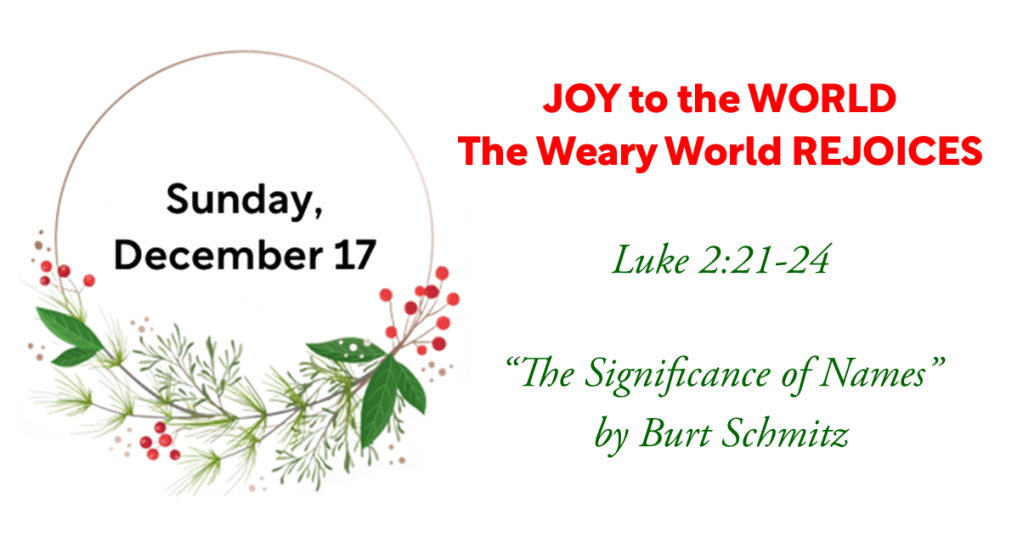
“The Significance of Names” by Burt Schmitz
Luke brings us from the rejoicing of the angels and shepherds to what seems to be a mundane event. A couple of things happen on the eighth day after His birth that are significant. First, He is circumcised. He receives the sign of the covenant as a descendent of Abraham (Genesis 17:7-12). The baby is now identified as a member of the household of faith. Second, the baby is given His name, Jesus. This is the name that the angel Gabriel told Mary to give her child (Luke 1:31). Jesus, “the Lord is salvation”, is His name. Matthew 1:21 tells us “For He will save His people from their sins.”
Names are significant. When we lived in Togo, we learned that the names that were given to children at their birth could be used to give the child identity as well as to indicate a significant event. My friend Lamoutidja’s name signified that he was born on a Thursday. His name literally means “Thursday’s man”. Lamoutidja had a lot of brothers. Another friend was the first born of his mother and was given the name Nanlieb, “Everyone envies me”. Having a son was very important and especially as a first born.
The name Jesus, “the Lord is salvation”, has great significance for us. It is Jesus, that even from His birth, is identified as the Savior of the world. Luke 2:11, the angels declare, “there has been born for you a Savior, who is Christ the Lord.” Christ, Messiah, Anointed One, all indicating that Jesus was the Son of God, born to accomplish the task of providing salvation.
Luke 2:29-32 identifies Jesus not only as the Savior of the Jews, but also of the Gentiles, the whole wide world. We see in the names and titles given to Jesus around His birth, circumcision, and purification in the temple that Jesus is the baby born to die. “And there is salvation in no one else; for there is no other name under heaven that has been given among men by which we must be saved.” (Acts 4:12).
What will you do with Jesus?
Reflection Questions:
Reflect on Acts 4:12. Since Jesus is the only way of salvation, how does that impact our desire to share the gospel – good news of great joy – with others?
Today’s devotion closed with a question: what will you do with Jesus? Belief in Him is supposed to impact one’s whole life. How does this question challenge the way our daily lives reflect (or do not reflect) Him?
📖 Revelation 4:1–11In this episode of The King is Coming, Keith Harris and Jamie Harrison move beyond Jesus’s letters to the churches and into the next part of John’s vision. In Revelation 4, John is invited through an open door into heaven—and what he sees is the throne room of God.At the center of everything is a throne, and seated on it is the Lord in all His glory. From this point forward in Revelation, the throne becomes the focal point of the entire book.John describes the scene the best way he can: the brilliance of precious stones, a rainbow surrounding the throne, flashes of lightning and thunder, and a crystal-like sea before it. Surrounding the throne are twenty-four elders and four living creatures who never cease to worship the Lord.Together, Keith and Jamie discuss:✔️ Why Revelation 4 marks a shift from the letters to the churches to John’s heavenly vision✔️ What the throne room reveals about God’s authority and security over all things✔️ Why John uses comparisons (“like” and “as”) to describe the glory he sees✔️ The mystery of the twenty-four elders and what we can—and cannot—know✔️ The constant worship of the living creatures crying “Holy, holy, holy”✔️ Why heaven’s worship centers on God simply because He is worthyIn the throne room, everything points to one truth: God alone is worthy of worship.“Worthy are you, our Lord and God, to receive glory and honor and power, for you created all things, and by your will they existed and were created.” (Revelation 4:11)🔗 If you would like to see a written version of this podcast, complete with footnotes and cross-references, you can find it here.
8 And in the same region there were shepherds out in the field, keeping watch over their flock by night. 9 And an angel of the Lord appeared to them, and the glory of the Lord shone around them, and they were filled with great fear. 10 And the angel said to them, “Fear not, for behold, I bring you good news of great joy that will be for all the people. 11 For unto you is born this day in the city of David a Savior, who is Christ the Lord. 12 And this will be a sign for you: you will find a baby wrapped in swaddling cloths and lying in a manger.” 13 And suddenly there was with the angel a multitude of the heavenly host praising God and saying,
14 “Glory to God in the highest, and on earth peace among those with whom he is pleased!”
15 When the angels went away from them into heaven, the shepherds said to one another, “Let us go over to Bethlehem and see this thing that has happened, which the Lord has made known to us.” 16 And they went with haste and found Mary and Joseph, and the baby lying in a manger. 17 And when they saw it, they made known the saying that had been told them concerning this child. 18 And all who heard it wondered at what the shepherds told them. 19 But Mary treasured up all these things, pondering them in her heart. 20 And the shepherds returned, glorifying and praising God for all they had heard and seen, as it had been told them.
Luke 2:8-20
“Good News of Great Joy”
In our journey with Jesus, we often hear the refrain: in Him, we are new creations – born again (2 Corinthians 5:17, John 3:1-16). It’s a reminder that our old self is transformed by the Holy Spirit into something fresh and beautiful (Ephesians 4:22-24). But at times, this transformation might seem distant, especially when life’s challenges cloud our perspective.
Consider Israel in the Old Testament—a cycle of mistakes, repentance, and the certainty of God’s welcome upon repentance (Isaiah 55:7). They felt secure in God’s love, knowing they were chosen, set apart, and deeply cherished by Him (Deuteronomy 7:6; Jeremiah 31:3). But for those outside God’s chosen people, Gentiles, this language might feel alienating (Ephesians 2:11-13).
Understanding our identity in God’s eyes—realizing whose we are—is crucial (1 John 3:1). It means recognizing that we belong to a loving Father who chose and set us apart (1 Peter 2:9). When Jesus died, He knew us intimately—flaws and all (Romans 5:8). He not only chose us but transformed us to be His ambassadors (Ephesians 2:10). The terms used for God’s people—chosen, set apart, loved—are rooted in the Old Testament but remain equally true for us today (1 Peter 2:9). Like Israel, even amidst our failings, we can rest in God’s enduring love (Psalm 103:13-14). His correction is a sign of His care for us as beloved children (Hebrews 12:6).
This profound truth isn’t about our abilities or origins; it’s about God’s unwavering love, choosing us despite our imperfections (Romans 8:28-30). Personally, I’ve experienced this—I’m chosen not for my merit but to showcase what Jesus can accomplish in someone like me (Ephesians 2:8-9). Embracing this truth means embracing the Gospel—the good news of great joy (Luke 2:10). It’s about recognizing that God’s love, shown through Jesus’ sacrifice, offers us a new life (John 3:16). It’s an invitation for you, too, to experience this transformative love that surpasses our flaws and backgrounds (Romans 10:9-10).
Reflecting on the shepherds’ encounter in Luke 2:8-20 sheds light on this transformative message. Shepherds were often disregarded, yet they were the first witnesses to the Savior’s birth. The heavenly host announced His arrival to these practical men, not the religious elite, emphasizing God’s grace toward all humanity. Their encounter wasn’t just a revelation; it was a call to action. They responded by seeking the newborn Messiah and spreading the good news, glorifying and praising God. These humble shepherds, disregarded by society, became bearers of the greatest news—the arrival of the long-awaited Savior.
Just like these shepherds, we’re invited to embrace and share this good news—the gospel of Christ. Let’s join in proclaiming this good news to the world and find our purpose in embracing the Savior who came for us all.
Reflection Questions:
How does the encounter with between the shepherds and the angels demonstrate God’s choice to reveal His transformative love to those often overlooked in society?
Today’s devotion mentions how our identity in Christ is not determined by our abilities or background but by Him. How does this truth shape your perception of what God does for us in salvation? How does it impact our call to continue to share good news of great joy — the gospel – with all people?
📖 Revelation 4:1–11In this episode of The King is Coming, Keith Harris and Jamie Harrison move beyond Jesus’s letters to the churches and into the next part of John’s vision. In Revelation 4, John is invited through an open door into heaven—and what he sees is the throne room of God.At the center of everything is a throne, and seated on it is the Lord in all His glory. From this point forward in Revelation, the throne becomes the focal point of the entire book.John describes the scene the best way he can: the brilliance of precious stones, a rainbow surrounding the throne, flashes of lightning and thunder, and a crystal-like sea before it. Surrounding the throne are twenty-four elders and four living creatures who never cease to worship the Lord.Together, Keith and Jamie discuss:✔️ Why Revelation 4 marks a shift from the letters to the churches to John’s heavenly vision✔️ What the throne room reveals about God’s authority and security over all things✔️ Why John uses comparisons (“like” and “as”) to describe the glory he sees✔️ The mystery of the twenty-four elders and what we can—and cannot—know✔️ The constant worship of the living creatures crying “Holy, holy, holy”✔️ Why heaven’s worship centers on God simply because He is worthyIn the throne room, everything points to one truth: God alone is worthy of worship.“Worthy are you, our Lord and God, to receive glory and honor and power, for you created all things, and by your will they existed and were created.” (Revelation 4:11)🔗 If you would like to see a written version of this podcast, complete with footnotes and cross-references, you can find it here.
1 In those days a decree went out from Caesar Augustus that all the world should be registered. 2 This was the first registration when Quirinius was governor of Syria. 3 And all went to be registered, each to his own town. 4 And Joseph also went up from Galilee, from the town of Nazareth, to Judea, to the city of David, which is called Bethlehem, because he was of the house and lineage of David, 5 to be registered with Mary, his betrothed, who was with child. 6 And while they were there, the time came for her to give birth. 7 And she gave birth to her firstborn son and wrapped him in swaddling cloths and laid him in a manger, because there was no place for them in the inn.
Luke 2:1-7
“The Quiet Birth That Changed the World” by Burt Schmitz
The birth of a child is always a joyous occasion. Here we have the birth of not just any child, but the birth of the Son of God, Jesus. This is a very significant moment in history. The Apostle Paul writes, “But when the fullness of the time came, God sent forth His Son, born of a woman, born under the law, so that He might redeem those who were under Law, that we might receive the adoption of sons.” (Galatians 4:4-5). Jesus’ birth is in fulfillment of the promise given in Genesis 3:15 of the one who shall crush the serpent’s head. And yet, the birth of the Son of God is recorded in these verses in a manner that is seems so insignificant.
Joseph and Mary travel to Bethlehem to be counted in a census “because he was of the house and family of David.” (Luke 2:4). The Scripture does not indicate that Joseph was moving to fulfill the prophecy in Micah 5:2 that the Messiah was to be born in Bethlehem. No, Joseph took his wife, Mary, so they could be counted, nothing less or nothing more. While there in Bethlehem, “the days were completed for her to give birth” (Luke 2:6) and Jesus is born. No fanfare for the birth of the King of Kings. There was no rejoicing by the multitudes. There was no one singing the Hallelujah Chorus, nor was there the reciting of Isaiah 9:6-7. “For a child will be born to us, a son will be given to us; and the government will rest on His shoulders; and His name will be called Wonderful Counselor, Mighty God, Eternal Father, Prince of Peace. There will be no end to the increase of His government or of peace, on the throne of David and over his kingdom, to establish it and to uphold it with justice and righteousness from then on and evermore.” No, Mary gave birth to Jesus and wrapped Him in cloths and laid Him in a manger because there was no room in the inn. A very quiet and unassuming birth, that changed the world.
Much in our lives seems exactly like Jesus’s birth. Our thoughts go something like this. It is just another boring day where nothing exciting happens. God why don’t You choose me to do something great in Your Kingdom? How come I am never recognized for what I do like…? God has not forgotten you. Ephesians 2:10 affirms that each of us is saved for a purpose. There are good works for us to do that God “prepared beforehand so that we would walk in them”. Just as Jesus’s birth was not an insignificant event, even though it looks that way in today’s passage, neither is your birth into the Kingdom of God. Jesus chooses us to follow Him and then to do His work (John 15:16). So here it is. Jesus came to save us and then to choose us to do His work.
Will you answer the call to follow Jesus first in salvation and then to do the good works to which He has called you?
What will you do with the Babe of Bethlehem?
Reflection Questions:
Reflecting on the quiet and humble birth of Jesus in Bethlehem, how does this challenge our culture’s expectations of grandeur and recognition for significant events?
How does Ephesians 2:10 encourage us to view our lives and the good works prepared for us?
📖 Revelation 4:1–11In this episode of The King is Coming, Keith Harris and Jamie Harrison move beyond Jesus’s letters to the churches and into the next part of John’s vision. In Revelation 4, John is invited through an open door into heaven—and what he sees is the throne room of God.At the center of everything is a throne, and seated on it is the Lord in all His glory. From this point forward in Revelation, the throne becomes the focal point of the entire book.John describes the scene the best way he can: the brilliance of precious stones, a rainbow surrounding the throne, flashes of lightning and thunder, and a crystal-like sea before it. Surrounding the throne are twenty-four elders and four living creatures who never cease to worship the Lord.Together, Keith and Jamie discuss:✔️ Why Revelation 4 marks a shift from the letters to the churches to John’s heavenly vision✔️ What the throne room reveals about God’s authority and security over all things✔️ Why John uses comparisons (“like” and “as”) to describe the glory he sees✔️ The mystery of the twenty-four elders and what we can—and cannot—know✔️ The constant worship of the living creatures crying “Holy, holy, holy”✔️ Why heaven’s worship centers on God simply because He is worthyIn the throne room, everything points to one truth: God alone is worthy of worship.“Worthy are you, our Lord and God, to receive glory and honor and power, for you created all things, and by your will they existed and were created.” (Revelation 4:11)🔗 If you would like to see a written version of this podcast, complete with footnotes and cross-references, you can find it here.
18 Now the birth of Jesus Christ took place in this way. When his mother Mary had been betrothed to Joseph, before they came together she was found to be with child from the Holy Spirit. 19 And her husband Joseph, being a just man and unwilling to put her to shame, resolved to divorce her quietly. 20 But as he considered these things, behold, an angel of the Lord appeared to him in a dream, saying, “Joseph, son of David, do not fear to take Mary as your wife, for that which is conceived in her is from the Holy Spirit. 21 She will bear a son, and you shall call his name Jesus, for he will save his people from their sins.” 22 All this took place to fulfill what the Lord had spoken by the prophet:
23 “Behold, the virgin shall conceive and bear a son, and they shall call his name Emmanuel”
(which means, God with us). 24 When Joseph woke from sleep, he did as the angel of the Lord commanded him: he took his wife, 25 but knew her not until she had given birth to a son. And he called his name Jesus.
Matthew 1:18-25
“Hope in Emmanuel: God With Us”
As we approach Christmas, seeking solace in the presence of King Jesus amid the trials of this year, our focus turns to the facets of hope, joy, and love that emanate solely from the Lord. To commence this journey, let’s delve deeper into the profound narrative of Joseph, often overshadowed by Mary’s pivotal role.
Joseph, described as a “just man” (v. 19), faced a dilemma when confronted with Mary’s unexpected pregnancy. Despite the social norms and legal avenues available to him, Joseph chose a path of grace rather than justice. In a society quick to condemn and shun Mary, Joseph’s decision to spare her from shame embodies God’s profound mercy and compassion. It’s a poignant reflection of the gospel – choosing redemption over condemnation, displaying the heart of God toward His people.
The angel’s revelation to Joseph validated the truth behind Mary’s conception and urged him not to fear but to embrace his role in God’s divine plan. This narrative mirrors Christ’s embrace of the flawed yet beloved Church, demonstrating the beauty of redemption amid societal scrutiny and judgment.
The significance of the name Jesus reverberates throughout history. Beyond its literal meaning of salvation and divine assistance, it embodies the unparalleled authority and saving grace encapsulated who Jesus is (Acts 4:12, Philippians 2:9-10).
Emmanuel – God with us, a promise foretold by Isaiah in 7:14, served as a beacon of hope for Israel amid turmoil. It assured them of God’s presence, dispelling fear and fortifying their spirits against adversity. This promise resonates with timeless relevance today, assuring us that God’s presence transcends circumstances, offering unwavering hope and strength.
To close, let’s meditate on Romans 8:31-34, a profound reminder encapsulating the essence of Emmanuel:
31 What then shall we say to these things? If God is for us, who can be against us? 32 He who did not spare His own Son but gave Him up for us all, how will He not also with Him graciously give us all things? 33 Who shall bring any charge against God’s elect? It is God who justifies. 34 Who is to condemn? Christ Jesus is the one who died – more than that, who was raised – who is at the right hand of God, who indeed is interceding for us.
These verses reassure us that with God on our side through Jesus, no force or circumstance can overpower us. Christ’s intercession for us solidifies our hope and assurance in His unwavering love and support. Despite uncertainties that lie ahead, remember this truth: while challenges may arise, the throne of heaven remains unshakeable. God’s sovereignty prevails, and He orchestrates all things, offering us an unshakable foundation of hope.
Embracing the profound truth encapsulated in the name Emmanuel – God with us, let’s find rest, solace, and hope in the promises it holds. In acknowledging God’s abiding presence with us, both now and forever, may this Christmas season be a source of renewed hope and unwavering assurance.
Reflection Questions:
Think about the name Jesus and its meaning of salvation and divine help. What does this name mean for you personally, and how does Jesus bring hope and rescue into your life?
Reflect on times when you have felt overwhelmed or anxious. How does the idea of Emmanuel – God with us – offer comfort and strength in these moments in your life?
📖 Revelation 4:1–11In this episode of The King is Coming, Keith Harris and Jamie Harrison move beyond Jesus’s letters to the churches and into the next part of John’s vision. In Revelation 4, John is invited through an open door into heaven—and what he sees is the throne room of God.At the center of everything is a throne, and seated on it is the Lord in all His glory. From this point forward in Revelation, the throne becomes the focal point of the entire book.John describes the scene the best way he can: the brilliance of precious stones, a rainbow surrounding the throne, flashes of lightning and thunder, and a crystal-like sea before it. Surrounding the throne are twenty-four elders and four living creatures who never cease to worship the Lord.Together, Keith and Jamie discuss:✔️ Why Revelation 4 marks a shift from the letters to the churches to John’s heavenly vision✔️ What the throne room reveals about God’s authority and security over all things✔️ Why John uses comparisons (“like” and “as”) to describe the glory he sees✔️ The mystery of the twenty-four elders and what we can—and cannot—know✔️ The constant worship of the living creatures crying “Holy, holy, holy”✔️ Why heaven’s worship centers on God simply because He is worthyIn the throne room, everything points to one truth: God alone is worthy of worship.“Worthy are you, our Lord and God, to receive glory and honor and power, for you created all things, and by your will they existed and were created.” (Revelation 4:11)🔗 If you would like to see a written version of this podcast, complete with footnotes and cross-references, you can find it here.
“My soul magnifies the Lord, 47 and my spirit rejoices in God my Savior, 48 for he has looked on the humble estate of his servant. For behold, from now on all generations will call me blessed; 49 for he who is mighty has done great things for me, and holy is his name. 50 And his mercy is for those who fear him from generation to generation. 51 He has shown strength with his arm; he has scattered the proud in the thoughts of their hearts; 52 he has brought down the mighty from their thrones and exalted those of humble estate; 53 he has filled the hungry with good things, and the rich he has sent away empty. 54 He has helped his servant Israel, in remembrance of his mercy, 55 as he spoke to our fathers, to Abraham and to his offspring forever.”
56 And Mary remained with her about three months and returned to her home.
Luke 1:46-56
“Rejoicing in God’s Care: Lessons from Mary’s Song”
When thoughts of God occupy our minds, what shapes our perceptions? Each person has their own view of God, influenced by feelings, family, and life. Some see God as distant, others as always present, loving, or serious.
Think about Mary, a big part of the Christmas story. She sang a song about God, not herself. This song came from her heart, filled with feelings. This song, called “The Magnificat,” reflects the reversal of fortunes people will experience through her son, Jesus (vv. 52–55). It shares themes and language with Hannah’s song in 1 Samuel 2:1–10, foreshadowing God’s acts of deliverance and echoing thanksgiving psalms in the Old Testament (Psalms 30, 34, 138).
In this song, Mary first speaks personally, saying that God paid attention to her, even though she was lowly. She says God chose her, a regular girl, for an important job (Luke 1:46–48). Mary doesn’t only talk about herself but also about God caring for everyone. This connects to God’s big plan for His people, reversing the fortunes of the poor and marginalized, remembering His covenant with Abraham (v. 55).
Mary’s song shows God’s care and strength. It shows that God knows us closely, even when the world might not see it. Despite what the world thinks, God shows His care, promise-keeping, and actions toward His people. He’s the caring God, who knows us deeply despite what people think.
This important truth shows God cares about us and is stronger than us. It changes how society sees things, making proud people humble and surprising rich people. Mary’s song talks about this, showing how God’s strength changes what people think (Luke 1:49–53).
As we think about Mary’s song, look at how it is similar to Nahum 1:7: “The Lord is good. He is a stronghold in the day of trouble. He knows those who are His.” Thankfully, through Mary’s willingness, she gave birth to the One who had come to be all of those things for us too. Let us look at her example of praise and worship Him!
Reflection Question:
How does Mary’s emphasis on God’s attention to the humble and lowly challenge the way society bestows value or attention?
In what ways does Mary’s song reveal the intimate relationship between God and His people? How does this contrast with the way the world views God’s involvement in our lives?
📖 Revelation 4:1–11In this episode of The King is Coming, Keith Harris and Jamie Harrison move beyond Jesus’s letters to the churches and into the next part of John’s vision. In Revelation 4, John is invited through an open door into heaven—and what he sees is the throne room of God.At the center of everything is a throne, and seated on it is the Lord in all His glory. From this point forward in Revelation, the throne becomes the focal point of the entire book.John describes the scene the best way he can: the brilliance of precious stones, a rainbow surrounding the throne, flashes of lightning and thunder, and a crystal-like sea before it. Surrounding the throne are twenty-four elders and four living creatures who never cease to worship the Lord.Together, Keith and Jamie discuss:✔️ Why Revelation 4 marks a shift from the letters to the churches to John’s heavenly vision✔️ What the throne room reveals about God’s authority and security over all things✔️ Why John uses comparisons (“like” and “as”) to describe the glory he sees✔️ The mystery of the twenty-four elders and what we can—and cannot—know✔️ The constant worship of the living creatures crying “Holy, holy, holy”✔️ Why heaven’s worship centers on God simply because He is worthyIn the throne room, everything points to one truth: God alone is worthy of worship.“Worthy are you, our Lord and God, to receive glory and honor and power, for you created all things, and by your will they existed and were created.” (Revelation 4:11)🔗 If you would like to see a written version of this podcast, complete with footnotes and cross-references, you can find it here.
Early in 2022, we began a study on the epistle of Colossians but were unable to complete it at that time due to my schedule. Over the next month or so, we will finish that study: Jesus Over All!
Rather than diving in right where we left off, it is important that we refresh our memories – definitely necessary for me – so that we keep our study in context. We will revisit Colossians 1[1] today, Colossians 2 next week, and then revisit each of the two sections of Colossians 3 after that. This will poise us to be able to finish the study and to grow by God’s Spirit in the study of His Word as He intended when Colossians was written – to the church then, now, and until the return of Christ. Furthermore, I will be including the biblical cross references[2] in the footnotes so that those who are interested can see what the Bible says about itself.
Colossians 1 is important for understanding Paul’s letter to the church at Colossae not only because it is the first chapter but because it contains the beautiful Christological hymn (vv. 1:15-20) which illustrates Jesus’ preeminent position over everything that is – over all creation, and especially over us. God has graciously revealed this to us so that we can see Jesus appropriately – high above us and worthy of all worship. Yet, despite our own sinfulness and unworthiness, He offers us “redemption” (v. 1:14) and the opportunity to be delivered “from the domain of darkness” and to be transferred to His Kingdom (v. 1:13). What a beautiful opportunity to recognize Jesus is Lord and above all else and to move our hearts to believe in Him (Romans 10:9-10)!
Introduction (vv. 1:1-2)
1 Paul, [3]an apostle of Christ Jesus [4]by the will of God, and Timothy [5]our brother,
2 To the [6]saints and faithful brothers in Christ at Colossae: [7]Grace to you and peace from God our Father.
Colossians 1:1-2
The book of Colossians is an epistle written by the apostle Paul to the church in Colossae, which was established by their pastor, Epaphras. It highlights the importance of everyday individuals like Epaphras in spreading the gospel and emphasizes the significance of Jesus in our lives and churches.
One of the main themes in Colossians is the preeminence of Jesus Christ over everything. Paul teaches the Colossians deeper truths about Jesus to build upon the gospel they received from Epaphras. The whole epistle highlights various aspects of Jesus and warns against false teachings that damage His church.
False teachers and distractions continue to challenge the Church today, but the good news is that Jesus is our shepherd who offers abundant life and eternal security. His grace and love – the opposite of what we deserve – provide us with peace. The goal of studying Colossians is to recognize Jesus’ supremacy, deepen our faith, and display Him as sufficient in the face of all difficulties, those that come from within and from without.
Throughout this epistle, Paul urges us to focus on Jesus, trust in His work, and guard ourselves against false teachings. Jesus is the center of our faith, offering hope and salvation to all who believe.
For more, check out the original Bible studies from this section:
Thankfulness and Prayer for the Church at Colossae (vv. 1:3-14)
3 [8]We always thank God, the Father of our Lord Jesus Christ, when we pray for you, 4 since we heard of [9]your faith in Christ Jesus and of the love that you have for all the saints, 5 because of [10]the hope [11]laid up for you in heaven. Of this you have heard before in [12]the word of the truth, the gospel, 6 which has come to you, as indeed [13]in the whole world it is [14]bearing fruit and increasing—as it also does among you, since the day you [15]heard it and understood [16]the grace of God in truth, 7 just as you learned it from [17]Epaphras our beloved [18]fellow servant. He is a faithful minister of Christ on your behalf 8 and has made known to us your [19]love in the Spirit.
9 And so, [20]from the day we heard, [21]we have not ceased to pray for you, asking that [22]you may be filled with the knowledge of his will in all [23]spiritual wisdom and understanding, 10 so as [24]to walk in a manner worthy of the Lord, [25]fully pleasing to him: [26]bearing fruit in every good work and increasing in the knowledge of God; 11 [27]being strengthened with all power, according to his glorious might, for [28]all endurance and patience [29]with joy; 12 [30]giving thanks to the Father, who has qualified you to share in [31]the inheritance of the saints in light. 13 He [32]has delivered us from [33]the domain of darkness and transferred us to [34]the kingdom of [35]his beloved Son, 14 [36]in whom we have redemption, the forgiveness of sins.
Colossians 1:3-14
In this section, Paul offers a prayer of thanksgiving to God for the church at Colossae. He expresses gratitude for their faith in Christ, their love for one another, and the hope they have that comes from Christ. Despite facing false teachings, Paul prays for their continued growth in knowing God and walking with Him. He highlights the significance of faith, love, and hope within the church, emphasizing that faith in Christ is the foundation, love for fellow believers comes from God’s Spirit, and their hope is centered on Jesus and their eternal inheritance.
Paul also celebrates the effectiveness of the gospel, the Word of Truth, which is bearing fruit and growing. He emphasizes the importance of continually embracing and sharing the gospel message, which centers on Christ’s death, burial, and resurrection. Despite his own circumstances, Paul finds encouragement in knowing that the gospel is still being preached and producing faith, love, and hope. He recognizes that the gospel’s power lies in Jesus, who is living and active.
Paul expresses admiration for Epaphras, who has shared about the Colossian church and its faith, love, and understanding of God’s grace. Both Paul and Epaphras celebrate what God is accomplishing through the gospel and the Holy Spirit’s power. They demonstrate humility and joy, desiring Christ to be exalted above themselves. Paul refers to Epaphras as a fellow servant and faithful minister of Christ.
This section concludes with a call to reflection and prayer. Readers are encouraged to reflect on their relationship with Christ and to offer prayers of thanksgiving for hearing the gospel, having faith in Christ, and the hope of eternity. They are also urged to express gratitude for their faith community, the impact of the gospel, and the opportunity to be part of God’s work. Additionally, there is a call to thank God for the privilege of sharing the good news and to pray for those who have not yet heard and need the opportunity to embrace faith in Christ. Paul’s prayer for the Colossian believers encompasses their faith, love, and hope, and he prays for their growth, endurance, and thankfulness for their salvation and inheritance in Christ.
For more, check out the original Bible studies from this section:
15 [37]He is the image of [38]the invisible God, [39]the firstborn of all creation. 16 For by him all things were created, [40]in heaven and on earth, visible and invisible, whether [41]thrones or [42]dominions or rulers or authorities—all things were created [43]through him and for him. 17 And [44]he is before all things, and in him all things [45]hold together. 18 And [46]he is the head of the body, the church. He is [47]the beginning, [48]the firstborn from the dead, that in everything he might be preeminent. 19 For [49]in him all the [50]fullness of God was pleased to dwell, 20 and [51]through him to reconcile to himself all things, whether on earth or in heaven, [52]making peace [53]by the blood of his cross.
This section is a hymn that exalts and explains the identity of Jesus Christ. Throughout these six verses, the importance of understanding the true nature of Jesus in response to false teachings that had infiltrated the early church is clearly emphasized. Jesus, God in flesh and the Truth, is the only way to salvation and surpasses any distorted versions of the gospel presented by false teachers. This section points to the historical context of heresies and the recurring need to affirm the biblical understanding of Jesus throughout church history.
This passage presents scriptural evidence for Jesus being fully God and fully man, emphasizing his divine nature and his humanity. Jesus is described as the “image of the invisible God,” representing the visible representation of God and embodying His glory and nature. It needs to be clarified that the term “firstborn of all creation” does not imply that Jesus is a created being, but rather emphasizes His authority and position as the King of kings.
The passage further establishes Jesus as the creator of all things, both visible and invisible, in heaven and on earth. Jesus is credited with the power to bring everything into being and sustain the universe. He is described as being before all things and encompasses the entirety of existence. These verses highlight the divinity, authority, and creative power of Jesus, establishing Him as the preeminent and sovereign ruler over all creation.
The significance of Jesus and the beliefs surrounding Him for believers and non-believers is consistently emphasized here. This stresses the importance of recognizing Jesus as the ultimate authority and helps one not be swayed by false teachings or idolatry. Jesus is clearly shown to be the head of the Church, guiding and leading believers through His Word and Spirit. Furthermore, there is also an emphasis on Jesus’ role in reconciliation. Jesus is referred to as “the firstborn from the dead,” signifying His role as the origin of everything and the one who has conquered death. Through His life, death, and resurrection, Jesus made a way for humanity to be reconciled with God. His sacrifice on the cross and subsequent reconciliation of all things to God demonstrate God’s grace, mercy, and love.
The significance of understanding the true nature of Jesus Christ and the importance of holding onto the biblical depiction of Him cannot be emphasized enough – His divinity, authority, and creative power, as well as His role in reconciliation between God and humanity. Let us reflect on the magnitude of Jesus’ sacrifice and the love of God in reconciling humanity to Himself and worship Him!
For more, check out the original Bible studies from this section:
21 [54]And you, who once were alienated and hostile in mind, [55]doing evil deeds, 22 he has now reconciled [56]in his body of flesh by his death, [57]in order to present you holy and blameless and [58]above reproach before him, 23 [59]if indeed you continue in the faith, [60]stable and steadfast, not shifting from [61]the hope of the gospel that you heard, which has been proclaimed [62]in all creation under heaven, [63]and of which I, Paul, became a minister.
Colossians 1:21-23
The way Colossians 1 wraps up gives an invitation from God to the readers and hearers of the epistle – the original audience and even today – to respond to His Word and Spirit. Throughout the Bible, there are invitations extended by God to humanity. Examples include God inviting Noah and his family into the ark, inviting Israel through His prophets, and Jesus inviting all who labor and are heavy laden to find rest in Him. Through the work of His Spirit through the reading, hearing, and preaching of His Word, God offers the same to us today.
Reconciliation is offered by God through Jesus, an offer that acknowledges that humanity, due to sin, was alienated and hostile toward God, described as being dead in trespasses and sins. This challenges the notion that all people are inherently good and highlights the need for Jesus’ sacrifice on the cross. God, in His love and mercy, reconciled humanity through Jesus’ death, offering salvation and presenting believers as holy and blameless.
It is my prayer that all of us recognize our need reconciliation with God, and that if any have not that they respond by repenting of their sins and believe in Jesus. Remember, this invitation emphasizes that salvation is by grace through faith, not based on deserving it. It is also an invitation for those who believe to continue in the faith, remaining stable, steadfast, and rooted in the hope of the gospel. Re-reading Colossians 1 has led me to examine my own life. I pray it does you, too.
[1] All Scripture references unless otherwise noted are from the English Standard Version (Wheaton, IL: Crossway Bibles, 2016), Col 1:1–2.
[2] Cross references show what the Bible says about a particular verse, section, or word. I use the cross references heavily in my study of the Word, especially when preaching and/or teaching the Word. Cross references that parallel the verse, section, or word but do not directly reference it are marked by brackets, for example [1 Peter 2:9-12]. Cross references of similar themes will be designated by the word “See”.
[3] See 2 Corinthians 1:1 – Paul, an apostle of Christ Jesus by the will of God, and Timothy our brother, to the church of God that is at Corinth, with all the saints who are in the whole of Achaia….
[4] See 1 Corinthians 1:1 – Paul, called by the will of God to be an apostle of Christ Jesus, and our brother Sosthenes….
[5] See 1 Thessalonians 3:2 – …and we sent Timothy, our brother and God’s coworker in the gospel of Christ, to establish and exhort you in your faith….
[6] Ephesians 1:1 – Paul, an apostle of Christ Jesus by the will of God, To the saints who are in Ephesus, and are faithful in Christ Jesus…. | See Philippians 1:1 – Paul and Timothy, servants of Christ Jesus, To all the saints in Christ Jesus who are at Philippi, with the overseers and deacons…..
[7] Romans 1:7 – To all those in Rome who are loved by God and called to be saints: Grace to you and peace from God our Father and the Lord Jesus Christ. | 1 Corinthians 1:3 – Grace to you and peace from God our Father and the Lord Jesus Christ.
[8] Ephesians 1:15-16 – For this reason, because I have heard of your faith in the Lord Jesus and your love toward all the saints, I do not cease to give thanks for you, remembering you in my prayers…. | Philemon 4 – I thank my God always when I remember you in my prayers….
[9] See 1 Thessalonians 1:3 – …remembering before our God and Father your work of faith and labor of love and steadfastness of hope in our Lord Jesus Christ.
[10] v. 23 | See Acts 23:6 – Now when Paul perceived that one part were Sadducees and the other Pharisees, he cried out in the council, “Brothers, I am a Pharisee, a son of Pharisees. It is with respect to the hope and the resurrection of the dead that I am on trial.” | Titus 1:2 – …in hope of eternal life, which God, who never lies, promised before the ages began…. | Hebrews 3:6 – …but Christ is faithful over God’s house as a son. And we are his house, if indeed we hold fast our confidence and our boasting in our hope.
[11] 2 Timothy 4:8 – Henceforth there is laid up for me a crown of righteousness, which the Lord, the righteous judge, will award to me on that day, and not only to me but also to all who have loved his appearing. | 1 Peter 1:4 – …to an inheritance that is imperishable, undefiled, and unfading, kept in heaven for you….
[12] See Ephesians 1:13 – In him you also, when you heard the word of truth, the gospel of your salvation, and believed in him, were sealed with the promised Holy Spirit….
[13] [v. 23] | [Psalm 98:3] – He has remembered his steadfast love and faithfulness to the house of Israel. All the ends of the earth have seen the salvation of our God. | See Matthew 24:14 – And this gospel of the kingdom will be proclaimed throughout the whole world as a testimony to all nations, and then the end will come.
[14] John 15:5 – I am the vine; you are the branches. Whoever abides in me and I in him, he it is that bears much fruit, for apart from me you can do nothing. | John 15:16 – You did not choose me, but I chose you and appointed you that you should go and bear fruit and that your fruit should abide, so that whatever you ask the Father in my name, he may give it to you. | [Philippians 1:11] – …filled with the fruit of righteousness that comes through Jesus Christ, to the glory and praise of God.
[15] [Romans 16:26] – …but has now been disclosed and through the prophetic writings has been made known to all nations, according to the command of the eternal God, to bring about the obedience of faith…. | [Ephesians 4:21] – …assuming that you have heard about him and were taught in him, as the truth is in Jesus….
[16] See Acts 11:23 – When he came and saw the grace of God, he was glad, and he exhorted them all to remain faithful to the Lord with steadfast purpose….
[17] ch. 4:12 – Epaphras, who is one of you, a servant of Christ Jesus, greets you, always struggling on your behalf in his prayers, that you may stand mature and fully assured in all the will of God. | Philemon 23 – Epaphras, my fellow prisoner in Christ Jesus, sends greetings to you….
[18] ch. 4:7 – Tychicus will tell you all about my activities. He is a beloved brother and faithful minister and fellow servant in the Lord.
[19] [Romans 15:30] – I appeal to you, brothers, by our Lord Jesus Christ and by the love of the Spirit, to strive together with me in your prayers to God on my behalf….
[21] 2 Thessalonians 1:11 – To this end we always pray for you, that our God may make you worthy of his calling and may fulfill every resolve for good and every work of faith by his power….
[22] [Ephesians 1:17] – …that the God of our Lord Jesus Christ, the Father of glory, may give you the Spirit of wisdom and of revelation in the knowledge of him….
[23] ch. 4:5 – Walk in wisdom toward outsiders, making the best use of the time. | Ephesians 1:8 – …which he lavished upon us, in all wisdom and insight…. | [1 Corinthians 12:8] – For to one is given through the Spirit the utterance of wisdom, and to another the utterance of knowledge according to the same Spirit….
[24] [Psalm 1:1-3] – Blessed is the man who walks not in the counsel of the wicked, nor stands in the way of sinners nor sits in the seat of scoffers; but his delight is in the law of the Lord, and on his law he meditates day and night. He is like a tree planted by streams of water that yields its fruit in its season, and its leaf does not wither. In all that he does, he prospers. | See Ephesians 4:1 – I therefore, a prisoner for the Lord, urge you to walk in a manner worthy of the calling to which you have been called….
[25] [2 Corinthians 5:9] – So whether we are at home or away, we make it our aim to please him. | [Ephesians 5:10] – …and try to discern what is pleasing to the Lord. | [1 Thessalonians 4:1] – Finally, then, brothers, we ask and urge you in the Lord Jesus, that as you received from us how you ought to walk and to please God, just as you are doing, that you do so more and more.
[27] See Ephesians 3:16 – …that according to the riches of his glory he may grant you to be strengthened with power through his Spirit in your inner being….
[28] Ephesians 4:2 – …with all humility and gentleness, with patience, bearing with one another in love….
[29] See Matthew 5:12 – Rejoice and be glad, for your reward is great in heaven, for so they persecuted the prophets who were before you.
[30] ch. 3:15 – And let the peace of Christ rule in your hearts, to which indeed you were called in one body. And be thankful. | Ephesians 5:20 – …giving thanks always and for everything to God the Father in the name of our Lord Jesus Christ….
[31] See Acts 26:18 – …to open their eyes, so that they may turn from darkness to light and from the power of Satan to God, that they may receive forgiveness of sins and a place among those who are sanctified by faith in me.”
[32] 1 Thessalonians 1:10 – …and to wait for his Son from heaven, whom he raised from the dead, Jesus who delivers us from the wrath to come.
[33] Luke 22:53 – When I was with you day after day in the temple, you did not lay hands on me. But this is your hour, and the power of darkness.” | Ephesians 6:12 – For we do not wrestle against flesh and blood, but against the rulers, against the authorities, against the cosmic powers over this present darkness, against the spiritual forces of evil in the heavenly places.
[34] 2 Peter 1:11 – For in this way there will be richly provided for you an entrance into the eternal kingdom of our Lord and Savior Jesus Christ.
[35] [Ephesians 1:6] – …to the praise of his glorious grace, with which he has blessed us in the Beloved.
[36] See Ephesians 1:7 – In him we have redemption through his blood, the forgiveness of our trespasses, according to the riches of his grace….
[37] See 2 Corinthians 4:4 – In their case the god of this world has blinded the minds of the unbelievers, to keep them from seeing the light of the gospel for the glory of Christ, who is the image of God.
[38] See 1 Timothy 1:17 – To the King of the ages, immortal, invisible, the only God, be honor and glory forever and ever. Amen.
[39] [Psalm 89:27] – And I will make him the firstborn, the highest of the kings of the earth. | See Romans 8:29 – For those whom he foreknew he also predestined to be conformed to the image of his Son, in order that he might be the firstborn among many brothers.
[40] Ephesians 1:10 – …as a plan for the fullness of time, to unite all things in him, things in heaven and things on earth.
[41] [Ezekiel 10:1] – Then I looked, and behold, on the expanse that was over the heads of the cherubim there appeared above them something like a sapphire, in appearance like a throne.
[42] Ephesians 1:21 – …far above all rule and authority and power and dominion, and above every name that is named, not only in this age but also in the one to come.
[43] Romans 11:36 – For from him and through him and to him are all things. To him be glory forever. Amen. | 1 Corinthians 8:6 – …yet for us there is one God, the Father, from whom are all things and for whom we exist, and one Lord, Jesus Christ, through whom are all things and through whom we exist.
[44] [John 8:58] – Jesus said to them, “Truly, truly, I say to you, before Abraham was, I am.” | See John 1:1 – In the beginning was the Word, and the Word was with God, and the Word was God.
[45] [Hebrews 1:3] – He is the radiance of the glory of God and the exact imprint of his nature, and he upholds the universe by the word of his power.
[46] See Ephesians 1:22-23 – And he put all things under his feet and gave him as head over all things to the church, which is his body, the fullness of him who fills all in all.
[47] Revelation 3:14 – “And to the angel of the church in Laodicea write, ‘The words of the Amen, the faithful and true witness, the beginning of God’s creation.
[48] Acts 26:23 – …that the Christ must suffer and that, by being the first to rise from the dead, he would proclaim light both to our people and to the Gentiles.” | 1 Corinthians 15:20 – But in fact Christ has been raised from the dead, the firstfruits of those who have fallen asleep. | Revelation 1:5 – …and from Jesus Christ the faithful witness, the firstborn of the dead, and the ruler of kings on earth. To him who loves us and has freed us from our sins by his blood….
[49] ch. 2:9 – For in him the whole fullness of deity dwells bodily….
[50] See John 1:16 – For from his fullness we have all received, grace upon grace.
[51] See 2 Corinthians 5:18 – All this is from God, who through Christ reconciled us to himself and gave us the ministry of reconciliation…. | See Ephesians 1:10 – …as a plan for the fullness of time, to unite all things in him, things in heaven and things on earth.
[52] See Ephesians 2:14 – For he himself is our peace, who has made us both one and has broken down in his flesh the dividing wall of hostility….
[53] [Ephesians 2:13] – But now in Christ Jesus you who once were far off have been brought near by the blood of Christ.
[54] See Ephesians 2:1-2 – And you were dead in the trespasses and sins in which you once walked, following the course of this world, following the prince of the power of the air, the spirit that is now at work in the sons of disobedience…. | See Ephesians 2:12 – …remember that you were at that time separated from Christ, alienated from the commonwealth of Israel and strangers to the covenants of promise, having no hope and without God in the world.
[55] [Titus 1:16] – They profess to know God, but they deny him by their works. They are detestable, disobedient, unfit for any good work.
[56] [Romans 7:4] – Likewise, my brothers, you also have died to the law through the body of Christ, so that you may belong to another, to him who has been raised from the dead, in order that we may bear fruit for God.
[57] Jude 24 – Now to him who is able to keep you from stumbling and to present you blameless before the presence of his glory with great joy…. | See Ephesians 1:4 – …even as he chose us in him before the foundation of the world, that we should be holy and blameless before him. | See Ephesians 5:27 – …so that he might present the church to himself in splendor, without spot or wrinkle or any such thing, that she might be holy and without blemish.
[58] 1 Corinthians 1:8 – …who will sustain you to the end, guiltless in the day of our Lord Jesus Christ.
[59] See John 15:4 – Abide in me, and I in you. As the branch cannot bear fruit by itself, unless it abides in the vine, neither can you, unless you abide in me.
[60] ch. 2:7 – …rooted and built up in him and established in the faith, just as you were taught, abounding in thanksgiving. | Ephesians 3:17 – …so that Christ may dwell in your hearts through faith – that you, being rooted and grounded in love….
[62] Mark 16:15 – And he said to them, “Go into all the world and proclaim the gospel to the whole creation. | [Acts 2:5]
[63] See 2 Corinthians 3:6 – …who has made us sufficient to be ministers of a new covenant, not of the letter but of the Spirit. For the letter kills, but the Spirit gives life.








 Just Keith Harris