God opens doors, builds His church, and brings the right people at the right time. In Corinth, Paul meets Aquila and Priscilla, receives encouragement from the Lord (vv. 9–10), and sees both Jews and Gentiles believe and be baptized (v. 8). Even through opposition and legal pressure, the gospel moves forward.
Later, we meet Apollos, a gifted speaker with partial knowledge—until Priscilla and Aquila graciously guide him in the truth. God uses Paul the builder and Apollos the encourager (1 Cor. 3:6). Everyone has a role in the mission.
🎯 Theme: Do not be afraid – Jesus is with you and has many people in a lot of places.
🌀 Reflection: Are you more like Paul, Priscilla, or Apollos in this season? How can you faithfully do your part in strengthening others?
💬 Mission Challenge: Find a way today to encourage someone in their spiritual growth—share a Scripture, pray with them, or send a kind word.
From Thessalonica to Berea to Athens, Acts 17 shows how different people respond to the same gospel. Some oppose it (v. 5), some examine it eagerly (v. 11), others mock it (v. 32)—but some believe (v. 34).
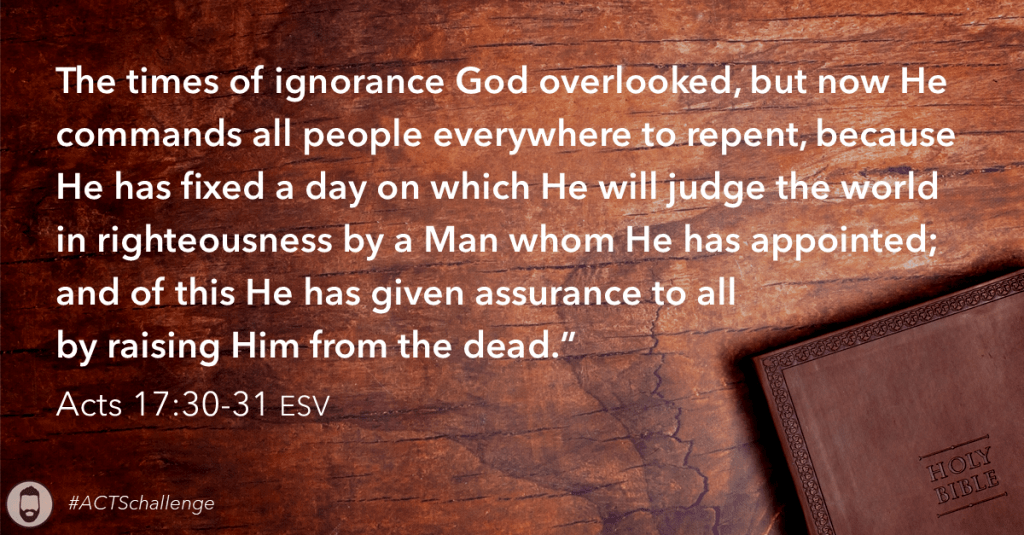
Paul reasons from the Scriptures (v. 3), explains the gospel in the marketplace (v. 17), and proclaims the one true God before philosophers at the Areopagus (vv. 22–31). His message climaxes in the resurrection of Jesus, the assurance that judgment is coming and that salvation is available to all who repent (v. 30).
🎯 Theme: God now commands all to repent, for He has fixed a day of judgment.
🌀 Reflection: Which group in this chapter do you most relate to—skeptical, searching, or surrendered? How can your heart remain open to the truth?
💬 Mission Challenge: Share one verse or truth from today’s reading with someone you know who is curious or questioning faith.
The gospel reaches Europe in Acts 16—and God’s sovereignty is on full display. The Spirit closes some doors and opens another through a vision (vv. 6–10). In Philippi, the Lord opens Lydia’s heart (v. 14), casts out a demon (v. 18), shakes a prison (v. 26), and saves a jailer and his household (vv. 30–34).
Paul and Silas, beaten and imprisoned, choose to pray and sing (v. 25). Their pain becomes a platform for praise and a witness that leads to salvation. Even injustice becomes an opportunity to defend the gospel and protect the young church (vv. 37–40).
🎯 Theme: Believe in the Lord Jesus, and you will be saved.
🌀 Reflection: Where might God be using closed doors or unexpected circumstances to lead you or shape your witness?
💬 Mission Challenge: Encourage someone facing hardship today. Share how God has worked in your life during difficult seasons.
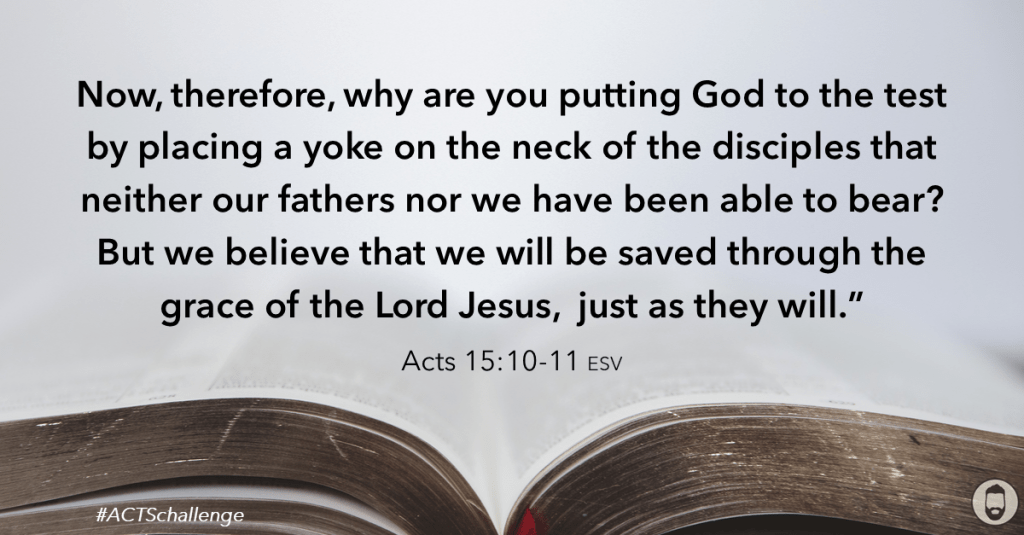
Acts 15 records the Jerusalem Council, where the early church had to answer a crucial question: Is Jesus enough? Some said Gentiles had to follow the law of Moses to be saved, but the apostles stood firm—salvation is by grace through faith in Christ alone (v. 11, Ephesians 2:1-10).
The result? A joyful affirmation of the gospel and practical steps to preserve unity between Jewish and Gentile believers. Even when disagreements followed (vv. 36–41), the mission continued. Grace held them together and moved them forward.
🎯 Theme: Salvation is by grace, not by burdening others with the law.
🌀 Reflection: When differences arise, do you fight for grace and unity? How does the gospel shape your convictions and your conversations?
💬 Mission Challenge: Encourage someone in your church family today—especially someone different from you. Affirm your shared hope in Jesus.
As I write this, I am on my seventh day of my current hospital stay. This hospitalization — or even the illness really — is not the subject of my reflections but merely a backdrop. However, I will give enough details for clarity and hopefully none for complaint.
Many of you most likely do not know that I am in the hospital, and that is because I don’t care for that sort of attention. Outside of the Christ Community prayer group and a few personal messages, I have not shared much. Ultimately, this is pride — not trying to hide things necessarily, but some difficulties are hard to share even when you should (2 Corinthians 12:9). So I’m sharing now.
Two weeks ago (May 29), I woke up with what I thought to be gout flare ups in both feet. This was odd as gout typically manifests in just one, isolated joint. I already knew that I am an atypical sort of guy, so I just was going to roll with the weird. Within an hour, both feet were fully swollen up to the ankle. By lunch, my left wrist and the little finger joint on the right hand had joined in with swelling and pain.
The next morning (May 30) I awoke to walking being nearly impossible because of excruciating pain in both feet. I needed assistance eating because the pain in both hands was nearly as bad. I still managed to walk to the bathroom a few times. Little did I know I would only walk one more time the following day.
The next Monday (June 2), Candice took me to an orthopedic doctor in Oxford. They performed x-rays and examinations that revealed my feet were “full of arthritis”, meaning there was no space in my foot not taken up by inflammation which explained why walking or even standing, and the doctor scheduled a wide array of labs to be run and started me on a steroid pack. The following day (June 3), Kevin took me to Oxford to get the labs run. And the wait began.
Long story short, steroids brought little relief and the lab results were largely inconclusive except to say that wide spread inflammation was occurring in my body. By the end of the week (June 6), the total joints inflamed and in pain expanded to both knees, the right hip, and eventually both shoulders. We went to the hospital that night and ended up staying (and are still here).
Ultimately, there is no official diagnosis, but what is known is:
There was gout involved.
Even though there initially was thought to be some sort of infection, none was found.
My body had an autoimmune response and was fighting against itself causing the wide spread inflammation to all the joints.
God is still seated on His throne, still loves me, still cares for me, can heal me if He so chooses, and — for whatever reason — has me where I need to be even if it’s not where I want to be (Romans 8:28, 2 Corinthians 4:16-17).
The reason I am writing this is because in the midst of the worst two weeks of my life, I have consistently seen and experienced the goodness of God on display (Psalm 27:13) and want to share that. So, with no further ado, let me share with you about the goodness of God.
Reflection #1 — An Excellent Wife I Have Found
10 An excellent wife who can find? She is far more precious than jewels. 11 The heart of her husband trusts in her, and he will have no lack of gain. 12 She does him good, and not harm, all the days of her life.
Proverbs 31:10-12
So far (and for the rest of this), Candice is typing instead of me. I have gained about 95% usage of my left arm and hand back and only about 75% of my right arm and hand (which also has an IV in a less-than-helpful position). This is the first collaboration of this sort Candice and I have ever done, and judging by how much she hates that she’s having to type out a reflection thanking God for her and bragging on her, this may be our last.
Over the last two weeks, Candice has tirelessly (despite exhaustion and being as overwhelmed and scared as I have been) cared for me night and day. She has advocated for me with doctors (even ferociously at times), fed me, bathed me, and loved me through this time. While I was humiliated for being so unable to do for myself, her love humbled me and reminded me that wedding vows spoken by young adults prove out by the deeper-than-romance love that God can foster between a husband and a wife.
This has not been easy for her. She didn’t expect it to be. The love that she has shown me, even as she types this now through her own tears, has preached the gospel of Jesus’s love for His Church more eloquently and effectively than my words ever could (Ephesians 5:32). Her selfless actions and unrelenting care were more than “word or talk”, showing her love “in deed and in truth” (1 John 3:18).
I could not, should I live a thousand years, hope to ever repay or match her show of love and care (although I can’t wait to get to go home and try). She’s more precious than treasure (Proverbs 31:10), has all of my trust, is my favorite person and the love of my life, and has shown real-life love more than I could have ever dreamed of 22 years ago.
Reflection #2 — God Exulted Over Me With Loud Singing
The LORD your God is in your midst, a mighty One who will save; He will rejoice over you with gladness; He will quiet you by His love; He will exult over you with loud singing.
Zephaniah 3:17
We were supposed to be on a mission trip with our Christ Community youth group in New Mexico right now, but obviously we are not.
I am immensely thankful that God allows me to be one of the pastors at Christ Community, and getting to serve and disciple our kiddos is one of the greatest joys of my life. Needless to say, a large portion of my heart has been in New Mexico while my body has been confined to this hospital bed.
Sara Goldwater worked it out with Candice that they would FaceTime us so that we could participate in some of their nightly worship times. I knew we needed that, but at the time I was so mentally, physically, and emotionally overwhelmed I almost said no. Thankfully, I didn’t because the kiddos and adult leaders who are so dear to my heart ministered to me more that night than I ever have to them.
The time they spent singing and songs they chose were so carefully, lovingly, and thoughtfully arranged that by the end I was ugly crying and raising the only hand I could in worship of God.
The first song they chose was “Battle Belongs“, reminding that God is our fortress, mighty to save, and has already won the only battle that eternally matters through the cross and His empty tomb (Colossians 2:14-15).
The second song was “Firm Foundation (He Won’t)“, reminding me that Jesus is my rock and firm foundation, who has never failed in all of history, will never fail in the time that remains, and will protect and keep me through the storms of this life (Matthew 7:24-25). It brought to mind a quote from Charles Spurgeon (who dealt with debilitating gout and health problems that often left him bedridden for longer than I have been):
I have learned to kiss the waves that throw me up against the Rock of Ages.
After a verse and chorus of “Because He Lives“, and being reminded that I know who holds the future, the mission team humbled me and loved me in a way that was nearly overwhelming. They passed the phone around and one-by-one spoke something meaningful, encouraging, personal, and loving. To say that I was wrecked is a vast understatement. I was reminded of Zephaniah’s words to Israel above about how, even in times of trials and exiles, God was still in their midst, still mighty to save, still rejoicing over them. But it’s the last part of Zephaniah 3:17 that was so poignant and clear to me that night as it describes God Himself quieting His people, those He loves, by exulting over them with loud singing. I experienced God singing over us by His mission team singing over me. That memory will stay with me from here on out.
Reflection #3 — Built Up and Burdens Borne
Therefore encourage one another and build one another up, just as you are doing.
1 Thessalonians 5:11
Bear one another’s burdens, and so fulfill the law of Christ.
Galatians 6:2
We have experienced such a great outpouring of love, concern, care, and prayer from our family, faith family, and friends. Difficult times are often lonely times, but that has not been our experience. I could not begin to recount all of the text messages and phone calls. Family (both biological and church) have come to sit and visit to lift spirits. The days leading up to the hospital stay, Candice did not have to cook as well as care for me because God has people in our life who took care of that, even being so thoughtful as to find out some foods our kiddos would like and sending us to the hospital with our own vending machine stockpile so as to not go without at all.
Sometimes it is not until after tragedy or loss that people step up in this way. I have often wondered why we do not share more freely how we feel with people while they are still with us. However, I do not have to wonder anymore because God has used the kindness and care of our families and friends to show His goodness toward us.
Without hesitation, Katherine and my parents have taken care of Xander for the entirety of the hospital stay, keeping him busy and worry-free while Candice and I were living out the opposite. Candice’s dad wanted to show appreciation for our helping him through similar health difficulties that we may experience the way he felt when cared for. And as far as helping bear our burdens, Kevin got me in and out of the vehicle and wheelchair multiple times, and he and Daddy literally carried me out of the house the day I went to the hospital.
Keri was still able to go with our church on the mission trip, and we did not have to doubt for a second that she would be cared for, looked after, and loved like she was their own (because that’s how our faith family loves). We received many text messages at various times making sure that we knew she was being cared for looked after (while still letting her be the independent young woman she is). We are thankful for the spiritual aunts, uncles, and cousins who have adopted our kiddos and love them.
While tangible shows of care and physical presence are big, nothing has moved me more than the sheer volume of people praying for us. Too often, we treat prayer like the least we can do, but what more can you do than seek God Most High on behalf of someone? I felt like the man in Mark 2:1-12 whose friends carried him on the roof of where Jesus was, removed a section, and lowered their friend to where Jesus could help him. It’s humbling to know that so many were willing to approach the throne of grace and seek mercy from the King on my behalf (Hebrews 4:16). It is the most they could do, and they did it tirelessly.
When you are feeling alone in sickness and pain, it’s too easy to be isolated, but God in His goodness, as reminded us at every turn, that He is with us and has given us family, friends, and a faith family to remind us of that.
Reflection #4 — Lord From Sorrows Deep I Call
Why are you cast down, O my soul, and why are you in turmoil within me? Hope in God; for I shall again praise Him, my salvation and my God.
Psalm 42:11
Sunday night/the wee hours of Monday morning was probably the longest of my life thus far. I have been avoiding pain medication as much as possible, but should have taken it sooner that night. The pain got to be too much, and coincided with a night requiring multiple lab draws with arms too swollen to find veins. I had just become overwhelmed.
In normal circumstances, I use the Dwell app (an audio Bible/Scripture meditation app) to take my mind off of difficulties or trials, but I could not work my phone or hold a Bible in my hands. My mind was so frantically distracted that I found it difficult to bring Scripture to mind. I laid in the dark, pleading with the Lord, praying for help or relief or whatever.
Now, if you know Candice, sleep has always been very precious to her. If you know hospitals at night, you know sleep is for well people at home. However, Candice stood over my bed for hours, playing various playlists of Scripture verses to help me fix my mind on things above, on Jesus, “not on things that are on earth” (Colossians 3:1-2). She played “psalms and hymns and spiritual songs” to help the “Word of Christ dwell in [me] richly” more than the pain that overwhelmed me physically (Colossians 3:16).
Dark times can cloud our vision. Sometimes hope is eclipsed by temporary trials. But for those who have been saved by grace through faith in our great God and Savior Jesus Christ, “suffering produces endurance”, “endurance produces character”, “character produces hope”, and “hope does not put us to shame, because God’s love has been poured into our hearts through the Holy Spirit who has been given to us” (Romans 5:3-5). My hope remains because it is not fickle, moveable, earthly hope; my hope is a person. My hope’s name is Jesus. And I can cast “all [my] anxieties on Him, because He cares for [me]” (1 Peter 5:7).
One of the clearest evidences of God’s goodness is that He has given us His Word — not only to reveal Himself, but to renew our minds, anchor our hearts, and strengthen us in every season of life. In His mercy, God does not leave us to be shaped by the world around us, but transforms us through the renewal of our minds so that we can discern His will and walk in it (Romans 12:2). His Word brings comfort and life in the midst of affliction, reviving our hearts when they are weary (Psalm 119:50). When our minds are fixed on Him through the promises of Scripture, He surrounds us with perfect peace (Isaiah 26:3). Rather than letting anxiety consume us, He invites us to bring everything to Him in prayer, and as we dwell on what is true and good, His peace guards our hearts and minds in Christ (Philippians 4:6-8). In trials, His Word gives strength and courage, equipping us for every step of obedience (Joshua 1:8-9). Because Scripture is breathed out by God, it thoroughly equips us for every good work — not just in easy seasons, but especially when life is hard (2 Timothy 3:16-17). When we delight in His Word and meditate on it daily, we become like trees planted by water — stable, nourished, and fruitful no matter the conditions around us (Psalm 1:2-3). And as we not only hear His Word but live it out, we experience His blessing and see more clearly who He is (James 1:22-25). In spiritual battle, His Word is our sword (Ephesians 6:17), and even Jesus, in the wilderness of temptation, showed us that we do not live by bread alone, but by every word that comes from the mouth of God (Matthew 4:4).
Every verse is a testimony to His kindness — He has not left us in the dark, but has spoken light and truth to sustain us.
That night, when my body had failed me and there was no strength to attempt to battle for myself, God sustained me with His Word. It was a refreshing reminder of His goodness, goodness I learned of from His Word and experience anew through His Word again and again. Here are some examples of both song and Scripture playlists:
I do not (we do not) write this seeking sympathy or trying to complain. I am thankful to have a God who does not leave me nor forsake me (Hebrews 13:5, Deuteronomy 31:6) but instead meets me in my darkness with His light (John 1:5, Psalm 18:28).
On the way to the hospital last Friday night, Kevin reminded me of Satan’s words to God when seeking to tear apart Job’s life to make him curse God (Job 1:8-12, 2:3-6). Now, I am far from Job, and I am not saying this is all some elaborate test of my faith. The consequences of the Fall on the world and within human bodies (death, decay, sickness, etc.) is enough. But if you think on Satan’s rationale for needing to hurt Job, his earthly logic seems sound:
9 Then Satan answered the Lord and said, “Does Job fear God for no reason? 10 Have you not put a hedge around him and his house and all that he has, on every side? You have blessed the work of his hands, and his possessions have increased in the land. 11 But stretch out your hand and touch all that he has, and he will curse you to your face.”
Job 1:9-11
and,
3 And the LORD said to Satan, “Have you considered my servant Job, that there is none like him on the earth, a blameless and upright man, who fears God and turns away from evil? He still holds fast his integrity, although you incited me against him to destroy him without reason.” 4 Then Satan answered the Lord and said, “Skin for skin! All that a man has he will give for his life. 5 But stretch out your hand and touch his bone and his flesh, and he will curse you to your face.”
job 2:3-5
Kevin reminded me that Satan knew that by attacking Job’s health it could fundamentally affect how he lived and thought. So Satan was right — insomuch as the things of this earth being all that there are. His logic, at face value, was sound. However, what Satan discounted — what he always overlooks in his passion and sinful pride — is that the LORD is not of this world. The Creator of all that is, the King of kings and Lord of lords is not bound by the logic of a being He created because He Himself is Truth.
When He saves people, He fundamentally changes them from the inside out, making them new creations not religious converts (2 Corinthians 5:17). His change in those He saves is not a mere change of mind but truly a change from death to life, delivering them from “the domain of darkness” to the “kingdom of His beloved Son, in whom we have redemption, the forgiveness of sins” (Colossians 1:13-14).
I am not Job. But I have been saved by grace through faith in Jesus (Ephesians 2:8-9). My faith has wavered at times these last two weeks, I have forgotten who and whose I am, but praise God when all else is stripped away and I find myself at rock bottom, Jesus is the Rock (Psalm 18:2, 1 Corinthians 10:4).
I have to remind myself that God is no more or less good if He chooses to heal me immediately and/or completely or if whatever purpose He allows this to go on. He is good because that is who He is.
God is good all the time.
And all the time God is good.
As difficult as this period is (and seems to continue to be), I can rejoice that in the midst of sickness and pain I have seen the goodness of God and can see more clearly the sweetness and beauty of Jesus’s return when He will dwell with His people, wiping away their last tears with His nail-scarred hand as well as wiping away death, mourning, crying, and pain (Revelation 21:3-4). All of those things have an expiration date that is set and sure.
The goodness of God has no expiration date.
We are thankful to have the opportunity to share with you and would appreciate your prayers. If anything has helped you, lifted your spirits, or helped you see the goodness of God in Christ, then I’m glad to be where I am. And I am learning to be content that whatever season I find myself in I am not alone for He is with me.
The Holy Spirit came with power, just as Jesus promised, filling the believers and birthing the Church. Peter boldly preached Christ crucified and risen, and the Spirit moved—three thousand believed, repented, were baptized, and joined the family of faith. What followed was a Spirit-shaped community: learning, praying, sharing, worshiping. The Church was alive—and the Lord kept adding to it, day by day (v.47). That same Spirit still empowers, convicts, and unites us today.
🎯 Theme: Jesus was crucified according to God’s plan – but God raised Him!
🌀 Reflection: Are you making space for the Spirit and the Word to shape your daily life and church family?
💬 Mission Challenge: Share a truth from today’s chapter or offer to pray for someone today—just like the early Church, let Jesus be seen through your words and actions.
We’re continuing in our study of Revelation called The KING is Coming. We took a break for our He Who Promised is Faithful readings during Holy Week but are glad to be back at it. Today, we will be diving into Jesus’s letter to the church at Smyrna. Once again, I am thankful for Jamie Harrison and the opportunity to do this study together.
8 “And to the angel of the church in Smyrna write: ‘The words of the first and the last, who died and came to life. 9 “ ‘I know your tribulation and your poverty (but you are rich) and the slander of those who say that they are Jews and are not, but are a synagogue of Satan. 10 Do not fear what you are about to suffer. Behold, the devil is about to throw some of you into prison, that you may be tested, and for ten days you will have tribulation. Be faithful unto death, and I will give you the crown of life. 11 He who has an ear, let him hear what the Spirit says to the churches. The one who conquers will not be hurt by the second death.’[1]
Keith Harris: Greetings, Sojourners,
We are in the letter to the church in Smyrna, continuing our study of Revelation. Jamie, why don’t you remind us as you did in our last Bible study about the form of these letters – the five things that show up in each one.
Jamie Harrison: Yes, that is correct. Each letter is going to have a salutation. In this letter, “Write to the angel of the church of Smyrna” (Revelation 2:8)[2] – the angel being, of course, the pastor, the messenger, the person delivering them the Word. Then, you’re going to have where Jesus will say something about Himself – His attributes. Then, there will be something about their works, some praise and admonition. Except in this church – Smyrna is one of two churches that does not have an admonition (correction, something to fix). Then, you’re going to have a universal admonition which is to anyone who hears, who has ears to hear – to listen to what the Spirit says to the churches. Finally, each letter will contain a final promise.
Keith: Alright, talk to us about Smyrna. What does Jesus tell us about Himself here?
Jamie: He starts off by saying, “Thus says the First and the Last, the one who was dead and came to life” (Revelation 2:8). The letter to Ephesus referenced back to the description of Jesus in Revelation 1, and so does this one. In Revelation 1:17, Jesus says, “Don’t be afraid. I am the First and the Last…”; He continues to say, “I was dead, but look – I am alive forever and ever, and I hold the keys to death and Hades.” It’s really cool that Jesus keeps going back to what He’s already said – to almost repeat for emphasis.
Keith: He’s doing it on purpose.
Jamie: Correct. He’s is the First and the Last which, like I said in Revelation 1, is a claim that He is God. He was there in the beginning as we know. “In the beginning was the Word, and the Word was with God, and the Word was God” (John 1:1). So He was the First, and He will be the Last.
It’s also important to note that He points out again that He is the one who was dead and has now came to life because all of Christianity is a complete waste of time if He didn’t raise from the dead (1 Corinthians 15:14-17). There’s a lot of dead people, but He’s the only one….
Keith: What is it that John Goldwater says? “Dead saviors can’t save.”
Jamie: That’s correct. You know, I was talking to someone the other day and – I apologize if this bothers anybody, but you know where people are like, You know that my dead relative was looking down on me today, or I was talking to them and they clearly gave me an answer. I know this is going to bother some people, but if you’re expecting some dead relative to help you with something, you’re [in a pickle]. I’m sorry, but when you take your last breath, you’re done. So, it’s important that we make a decision for Jesus before that happens….
Keith: …because He was dead and came to life – not was brought to life. He just stopped being dead (Revelation 2:8, John 10:17-18). Like Jamie was saying on the part of our relatives, it may seem to have someone we care about look from what we would describe as an afterlife, but we have something better than that: we have the God of the universe who was there at the beginning, pre-existed the beginning (John 1:1-3, Colossians 1:17) – He’s going to be there at the end and continue eternally. He is the God who saves, the God who looks after (Zephaniah 3:17, Psalm 121:3-5). He’s Emmanuel – God with us (Matthew 1:23). We shouldn’t be satisfied with lesser things (Psalm 119:37). Jesus is clearly superior to everybody and everything (Hebrews 1:3-4, Philippians 2:9-11).
Jamie: That’s right.
After Jesus says this, He goes into telling them some things about themselves. He says, “I know your affliction and poverty, but you are rich. I know the slander of those who say they are Jews and are not, but are a synagogue of Satan” (Revelation 2:9). Let’s touch on that real quick. When He says, “I know your affliction and poverty.” History tells us that Smyrna was a very wealthy town – very well-to-do. Why would the Christians there experience “affliction and poverty”? It’s simple when you look at it.
In order to work, you had to join a guild, which is like what we would call a labor union, right? Each one of those guilds back during that time, would have been represented by some god or goddess. In order to join, you had to worship that god or goddess. So as a Christian….
Keith: …almost like your dues….
Jamie: As a Christian, I’m not going to worship this god or goddess because that’s a false god. I’m not going to be able to join a guild, which means I’m not going to work because I can’t get a job. It wasn’t laziness – they couldn’t get a job. A lot of Christians ended up begging for food and things like that, but it’s because they were willing to suffer that affliction to follow Christ.
So, we ask ourselves the question of if someone comes to you at work and asks you to do something immoral (or whatever the case may be), are you going to do it to keep your job or say “no” and that whatever happens happens? Are you going to compromise your relationship with Christ to advance at the workplace? Or are you going to put Him first? These Christians here at Smyrna put Him first.
Then He tells them that He knows the slander of “those who say they are Jews and aren’t but are a synagogue of Satan”. He tells [the believers there] that they are about to suffer – that the devil is going to throw some of them in prison to test them, and they’ll “experience affliction for ten days”; He tells them, “Be faithful to the point of death, and I will give you the crown of life” (Revelation 2:10).
He kind of tells them exactly what’s about to happen. There’s this synagogue of “Jewish” people who are claiming to be Jews but in the biblical sense, they’re not.
Keith: Ethnically, they are, right? But just as Jesus told the Pharisees on more than one occasion – you’re talking about your father Abraham but you’re of your father the devil. The fruit of your life is showing what you are more than your ethnicity is.
Jamie: Mmmm…. This was happening. This synagogue was slandering them. They would be jailed normally about ten days. They experienced, obviously, persecution and things like that while in prison – sometimes to the point of death. But Jesus says, “Be faithful to the point of death and I will give you the crown of life.” So, what is the crown of life talking about? I think we probably know the answer to that, but let’s look at James 1:12. Again, we always want the Bible to speak for itself. James 1:12 says, “Blessed is the one who endures trials, because when he has stood the test he will receive the crown of life that God has promised to those who love Him.” So, it’s eternal life with Jesus.
You notice, you know, this book of Revelation a lot of times – when we look at it, we think it’s just a sign of what’s going to happen and all these different things and how bad things are going to be – and it is, but it’s not at the same time. The revelation is of Jesus Christ (Revelation 1:1). It’s about Jesus Christ. It’s to lead us to Jesus Christ (Revelation 1:17-18, 5:9-10). The whole central setting of Revelation is the throne room (Revelation 4:2-6). Everything centers around the throne room where God – the Father, the Son, the Holy Spirit – is present with multitudes around them worshiping Him, praising Him (Revelation 4:8-11, 5:11-13). Right? As all of these things are going on.
There’s no admonition in this letter to Smyrna. There’s no this is what you’re doing wrong. They have it. They get it. They have a relationship with Jesus, and because of that relationship, they are putting off these other things and are following after Him. Because of that they’ll receive the crown of life.
Keith: I mean, just that idea in and of itself: be faithful unto death. If you’re living in an area of the world where following Jesus means certain death, you’re going to be in less need of an admonition because if you’re know that following Jesus means certain death here on earth, you’ve counted the cost like Jesus said in Luke 14:27-28.
The idea there that “be faithful unto death, and I’ll give you the crown of life”, He doesn’t say when you die in prison in ten days or when you die in the tribulation; it’s for all of life. If you’re like John, who’s on the island of Patmos in probably his 80s or 90s – that just because he didn’t get martyred, he’s no less faithful unto death. He’s faithful until the time that God calls him home. That crown of life isn’t just for martyrs; it’s for those who are saved for all of life.
Jamie: You know, you’re talking about people who are being persecuted even to the point of death today…. Was it Richard Wurmbrand in that book we read[3]? They put him in a room – in a closet, basically smaller than a closet, and all four walls were nails. There was just enough room for you to stand. If you moved at all, you were going into these nails. They had him in that room for days on end. No food. No water. Nothing like that. Eventually, they would open the door and he would just collapse to the ground. They would defecate and make him eat it – urinate in his mouth, things like that….
Keith: …beat his feet so much that he could never wear shoes again the rest of his life….
Jamie: Right. And not once did he waver. Not once did his relationship with Christ come into question. He continued to tell the guards about Jesus the whole time he was there. And eventually did get out. But what it did was it strengthened his faith. So, if there was any point, to all of these trials is that it strengthens our faith in God.
Keith: Speaking of, I had forgotten about this, but while you were talking…there was a guy named Polycarp. He was a pastor in Smyrna and a disciple of the apostle John. And at [Polycarp’s] martyrdom, when he’s about to be executed for Christianity, they gave him an opportunity to recant. We talked last week where Jesus gave the church at Ephesus to repent and remember the love they had at first – those who were going to execute Polycarp gave him an opportunity to repent and remember his love for the powers-that-be, His love for Jesus was more. He says,
“For eighty and six years I have been his servant, and he has done me no wrong. And how can I now blaspheme my king who saved me?”
They killed him for that, but Jesus’s own words here – and I don’t think that’s an accident – I mean, it’s more than ten days later, but I don’t think it’s an accident that Jesus told Smyrna this knowing full well that Polycarp and those in the immediate context living in the same situation as Polycarp – that they were faithful unto death.
Polycarp has a crown of life. John has a crown of life. And if we, in our churches today, are faithful unto death, then we’ll receive that crown of life. The proof’s in the pudding, so to speak.
Jamie: It is. That pudding’s pretty good stuff…..
Just to finish this out real quick…. I always say real quick, and it always takes forever. I take that back.
Keith: It takes the time it takes.
Jamie: Just to finish this out, we have Jesus with a universal admonition, which in a word, you know, is let anyone who has ears to hear, listen to what the Spirit says to the churches. What is the Spirit saying to us? He says, “To the one who conquers”. Remember 1 John 5:4-5 here. This is those who are saved, those who have a relationship with Jesus will never be harmed by the second death.
11 Then I saw a great white throne and one seated on it. Earth and heaven fled from his presence, and no place was found for them. 12 I also saw the dead, the great and the small, standing before the throne, and books were opened. Another book was opened, which is the book of life, and the dead were judged according to their works by what was written in the books. 13 Then the sea gave up the dead that were in it, and death and Hades gave up the dead that were in them; each one was judged according to their works. 14 Death and Hades were thrown into the lake of fire. This is the second death, the lake of fire. 15 And anyone whose name was not found written in the book of life was thrown into the lake of fire.
This is not a scare tactic by any stretch of the imagination. It’s explaining what the second death is. You might have died here on earth, but the second death is the one – it’s the one. If you have a relationship with Christ, you won’t experience the second death (John 3:16, 5:24). You will have a life everlasting with God the Father (John 17:3). If you don’t have a relationship with Christ, you will experience that second death, which – even with all of the lake of fire and all that – the punishment of hell is an eternal separation from God (2 Thessalonians 1:8-9; Matthew 25:41, 46). You’re never with Him again. You’re eternally separated from your Creator.
Keith: And the ever-presence of His wrath.
Jamie: That’s right, but I think the people who are there will still blame Him – will still be angry with Him. So imagine living in eternal punishment, being angry the entire time. That’s the feeling it’s going to be. I can’t describe it. We’ve never been there. We don’t understand it. We don’t want to be there.
Sometimes, like right now, people will be like, now, let me invite you to come to know Jesus, but I don’t want you to come to know Jesus because you’re scared to go to hell. If you come to know Jesus, it needs to be because you were convicted by His Word and want to have a relationship with Him – and you want to love Him.
Keith: How does Paul say it in Philippians 3:8? The surpassing worth of knowing Christ. That’s a far cry from the surpassing worth of not wanting to go to hell.
You think about different people you’ve heard talk. Well, I got married to so-and-so because they were the only person in my community or if I didn’t marry this person I’d have to marry that person. That’s not love. … The idea that you’re just pursuing one thing because you don’t want the other, that’s not it.
That’s not the image you get in Matthew 13:44-46 where Jesus is giving the parables of the man who is walking through a field and finds a treasure worth more than any treasure he’s ever seen. He immediately goes back to his house, cashes out all of his assets, and buys the field. He’s not willing for anyone else to find this treasure. The pearl merchant who, upon finding the pearl of great price, doesn’t haggle – doesn’t negotiate – he cashes out everything he has to buy this one pearl.
Jamie: And that’s what these people in Smyrna did. They were willing to give up their jobs – the opportunity to own their house, purchase food for their family, things of that nature – for the sake of Christ.
Keith: That’s one of the things that I wonder here, and I’m not trying to speculate. But He’s talking to them about how they were rich before Christ in a worldly sense. Now in a worldly sense they’re in poverty. Jesus reminds them that they are rich – that their life is in danger but they have Life. I would imagine some of them were in definite danger – not necessarily of martyrdom or execution but just in the ability to sustain themselves and live.
As we look at this to close it out, think about how we talked about Polycarp and Richard Wurmbrand. It reminds me of the perspective here – “the one who conquers will not be hurt by the second death” (Revelation 2:11) – the idea that the closest to hell believers will ever experience is what they experience here on earth. That’s the greatest threat the world can give us – that it’s going to kill us, leads us to our greatest reward (Philippians 1:21-23, Revelation 21:4-5).
This reminds me of Dietrich Bonhoeffer.I’ve been reading through his Letters and Papers from Prison[4]…. There are times where he’d be aggravated that he had opportunities for the gospel and he’d repent and minister to this or that person. Everyone who was thrown into the concentration camps wasn’t Jewish ethnically. They weren’t even necessarily for the cause. If they Nazis wanted to just get someone out of the way, they had the camps for this.
Bonhoeffer, on the last day of his life, got up and preached. There was a guy there as a witness – a British intelligence officer kind of kept the Nazi guards at bay to let him finish his sermon. Then Bonhoeffer willing went with them – walked to his execution almost consoling the guards because – you know, you’d have to feel some kind of way when somebody’s looking at you and talking about the love of Christ, preaching the gospel and you’re going to be the one to kill him. And what he told those guards right before they took his life was: “This is the end, but for me, it is the beginning.”
Where so many face the second death, those believers in Smyrna, they face the beginning.
The tears they had for persecution were wiped away by the nail-scarred hands of their Savior whom they served unto death.
That’s good news.
Jamie: Amen.
Keith: Well, Jamie, that about wraps it up for Smyrna. Sojourners, we’ve enjoyed our time with you today. Check with us next time as we look at the letter to the church at Pergamum.
Sunday is the Lord’s Day – Resurrection Sunday, and I am excited!
The original resurrection Sunday, when Jesus walked out of the tomb alive and well, is the day that changed everything.
Why? How?
At the heart of the Christian faith is one message – the proclamation of the gospel message – that Paul calls “of first importance – a message that holds the power to give life, forgive sin, and secure eternity with Jesus:
“…Christ died for our sins in accordance with the Scriptures, that He was buried, that He was raised on the third day in accordance with the Scriptures….”
This is not just an inspirational story or some religious tradition. It is the true, good, victorious news that Jesus died for sinners like us, was buried in a borrowed tomb, and rose again just like the Scriptures said He would.
Yes, Jesus died for our sins – taking our punishment and paying our sin debt.
Yes, He was buried – truly dead, wrapped in grave clothes and laid in the silence of the grave.
But praise God, HE IS RISEN!
When the women arrived at the tomb that first Resurrection Sunday morning, they heard the words that still echo throughout history:
Jesus always – ALWAYS – keeps His word. And His resurrection proves it. It proves His power over sin and death. It proves His identity as the Son of God – as God incarnate. It proves that all who trust in Him can have a living hope, an unshakable promise of eternal life.
This Sunday at Christ Community, we’ll gather not just to remember an empty cross or to commemorate an empty tomb. No, we’ll gather to worship our risen and resurrected King! We’ll sing “King of Kings” and “Holy, Holy, Holy (Jesus Reigns)” because Jesus is alive and reigning even now, interceding on behalf of those He saves at the right hand of the Father. We’ll celebrate our “Living Hope” and declare that “Ain’t No Grave” able to hold Jesus or those He gives eternal life!
John is going to open the Word of God and point us to our resurrected Lord and King, our great God and Savior Jesus Christ.
All in all, we’ll embody the truth of the beloved hymn “Because He Lives”. Because He lives, we can face tomorrow. Because He lives, all fear is gone. Because He lives and we know that He holds the future in His hands, life is worth living. Jesus has changed everything because He lives!
So, come and worship. Come and believe. Come and rejoice in the Savior who died, who was buried, and who rose again – just as He said.
Most Sundays, we list out the Scriptures and songs we’ll use in our worship gathering to help people prepare their hearts. These posts are typically titled “Songs for Sunday”.
Here are our Scriptures and songs for Sunday, April 20:
1Now after the Sabbath, toward the dawn of the first day of the week, Mary Magdalene and the other Mary went to see the tomb. 2And behold, there was a great earthquake, for an angel of the Lord descended from heaven and came and rolled back the stone and sat on it. 3His appearance was like lightning, and his clothing white as snow. 4And for fear of him the guards trembled and became like dead men. 5But the angel said to the women, “Do not be afraid, for I know that you seek Jesus who was crucified. 6He is not here, for he has risen, as he said. Come, see the place where he lay. 7Then go quickly and tell his disciples that he has risen from the dead, and behold, he is going before you to Galilee; there you will see him. See, I have told you.”
3Blessed be the God and Father of our Lord Jesus Christ! According to his great mercy, he has caused us to be born again to a living hope through the resurrection of Jesus Christ from the dead, 4to an inheritance that is imperishable, undefiled, and unfading, kept in heaven for you, 5who by God’s power are being guarded through faith for a salvation ready to be revealed in the last time.
25 For I know that my Redeemer lives, and at the last he will stand upon the earth. 26 And after my skin has been thus destroyed, yet in my flesh I shall see God, 27 whom I shall see for myself, and my eyes shall behold, and not another. My heart faints within me!
With those words, the grave was silenced, death was defeated, and hope reigned eternal.
Long before that first Resurrection Sunday morning, Job declared through tears and pain, “I know that my Redeemer lives” (Job 19:25). He didn’t have all the answers, but he held onto the living hope that one day, beyond death and decay, he would see his God for himself. That hope was not misplaced.
Because Jesus lives, we can face anything – even death – with confidence. The Redeemer Job longed to see is the risen Christ who lived on earth, bore our sorrows unto death, and now lives reigns in glory. And as surely as He rose, He promises that all who trust in Him will rise too (John 11:25).
Today is not just a celebration of what happened – it is a declaration of what is to come. Our Redeemer lives! And one day, with resurrected eyes and glorified bodies, we will see Him face to face.
Let your heart rise with resurrection hope. Jesus is not here. He has risen just as He said. He ascended back to heaven and has promised to return to gather His people to Himself.
21 But this I call to mind, and therefore I have hope:
22 The steadfast love of the LORD never ceases; his mercies never come to an end; 23 they are new every morning; great is your faithfulness. 24 “The LORD is my portion,” says my soul, “therefore I will hope in him.”
25 The LORD is good to those who wait for him, to the soul who seeks him. 26 It is good that one should wait quietly for the salvation of the LORD.
The Original Context
Lamentations is a book of grief written in the aftermath of Jerusalem’s destruction. It gives voice to the sorrow of a people who had lost everything – temple, city, freedom.
Lamentations 3 is a turning point where there is a flicker of hope in the midst of lament. In the middle of darkness, the character of God shines forth: steadfast love, daily mercy, and great faithfulness.
These verses are not spoken from comfort but from ruin. They don’t deny suffering; they declare hope despite suffering, despite crying out in lament. Waiting quietly for the Lord’s salvation was not easy, but it was the only way forward.
Fulfillment in Jesus
Holy Saturday represents the in between. Jesus’s body lay in the tomb. His disciples were scattered and silent. The heavens were quiet. From the outside, it looked like all hope had been buried.
But even in silence – in the in between, God was faithful. Jesus had already promised that after three days He would rise (Mark 8:31). Even when the world couldn’t see it, God’s mercies were not on pause. His redemptive plan was still unfolding.
Holy Saturday reminds us that waiting is part of redemption. Jesus entered the grave, but He wouldn’t stay there. Sunday was coming.
Hope for Today
Many of us live in “Saturday” seasons – waiting for prayers to be answered, healing to come, or joy to return. The silence of God – the in between – can feel unbearable. But Lamentations gives us a word for these moments. God’s mercies never end. His faithfulness is great. And even when we wait in the dark, we wait with hope.
So today, rest in the character of God. Remember His past faithfulness. Trust in His promises. Wait quietly – not because you see the answer yet but because you know and trust that Jesus will bring it.







 Just Keith Harris