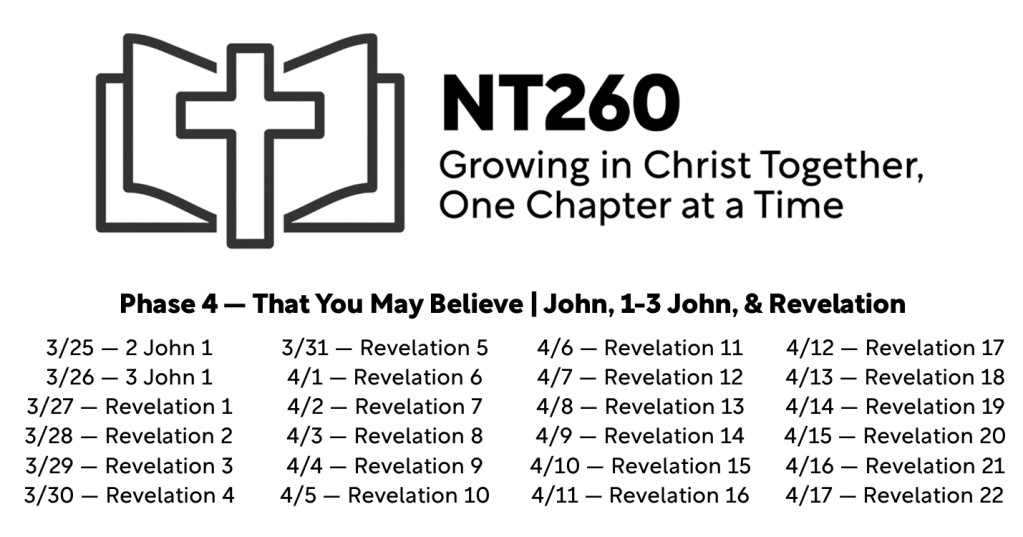
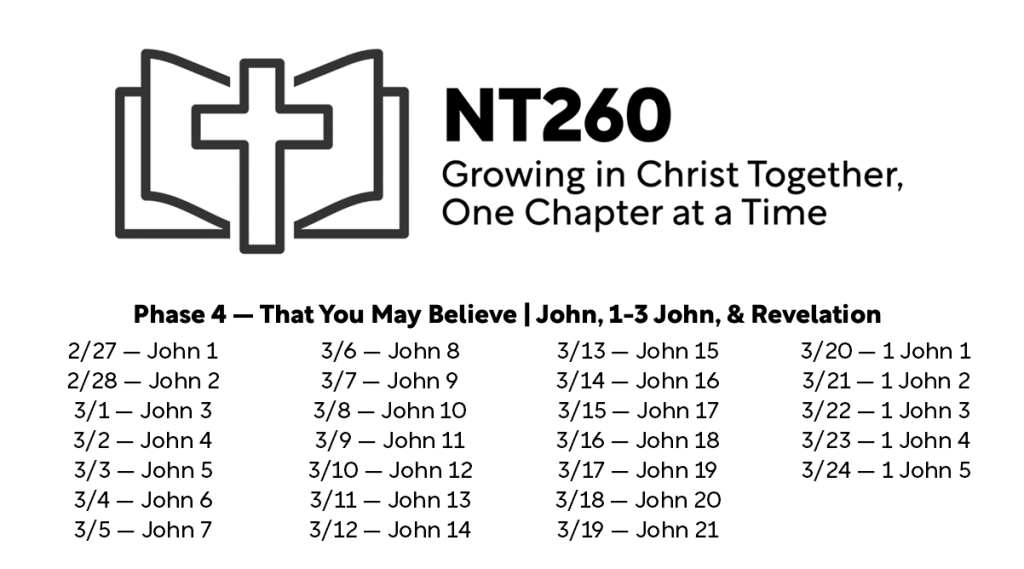
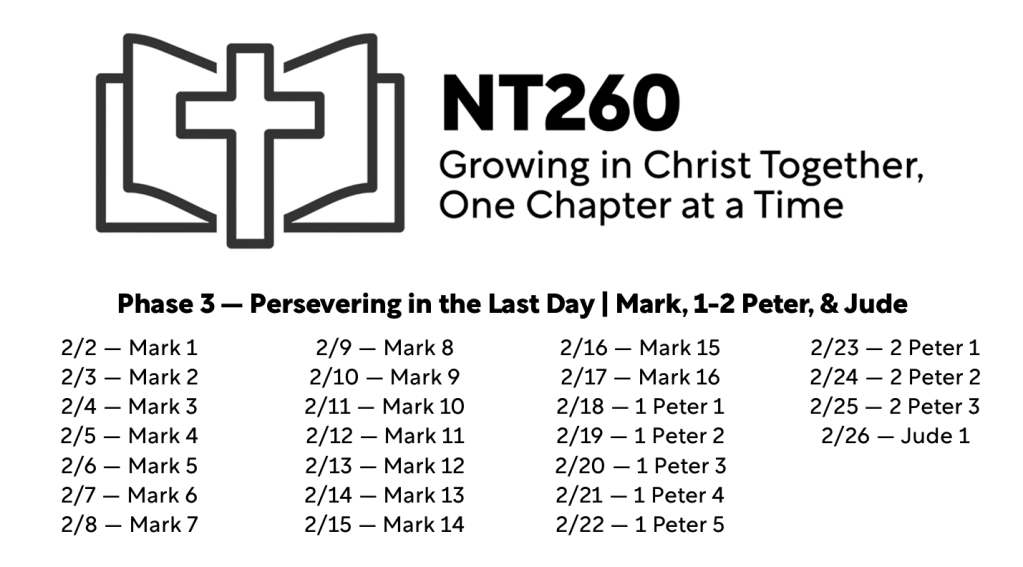
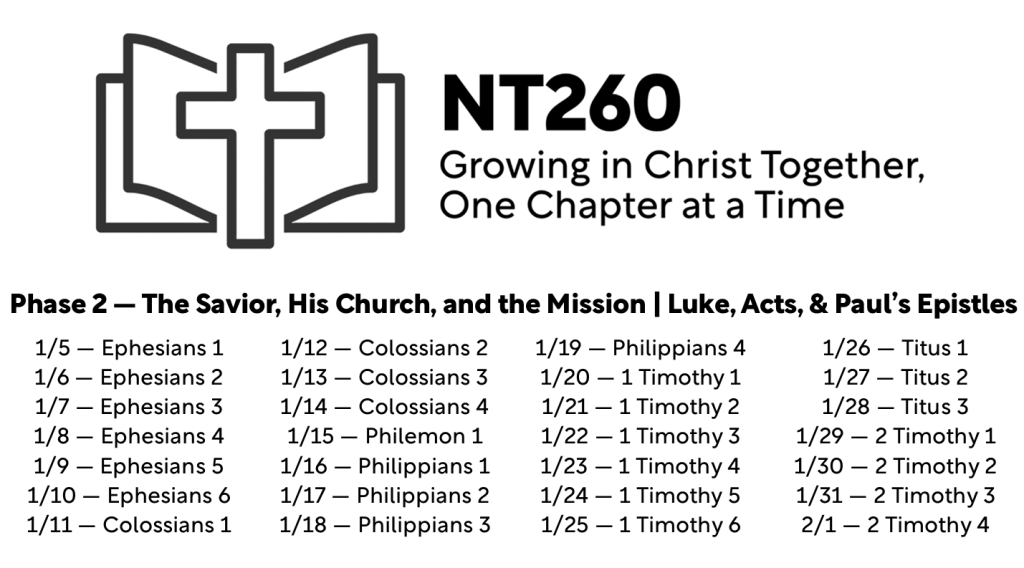
NT260 | Phase 2.4 — The Savior, His Church, and the Mission

This phase will have us reading about Jesus’s life in the gospel of Luke, the formation of the Church in Acts, and walk through the theology found in Paul’s letters that the Church needs to know about and live out the eternal life given by grace through faith in Jesus.

Below, you’ll find brief synopses of each book in this phase to help you understand the scope of the book and most importantly, how it fits into the full Story of the Bible.

When you click on each day’s link, you will find a link to audio, a summary of the chapter, a key verse from the chapter, and opportunities for reflection and outreach.

We’re moving into Paul’s epistles, which we’ll go through chronologically rather than in the order they appear in our Bibles.


Ephesians

Ephesians is a letter written by the apostle Paul around A.D. 60–62 while he was imprisoned in Rome (Ephesians 3:1, 6:20; Acts 28). Although traditionally addressed “to the Ephesians,” the letter was likely intended as a circular letter for several churches in the region of Asia Minor, with Ephesus as its primary hub (Ephesians 1:1). Paul had spent several years ministering in and around Ephesus (Acts 19:10), but the letter’s broad and impersonal tone suggests he is addressing a wider group of believers. Rather than responding to a specific crisis, Paul writes to remind the church who they are in Christ and how they are to live in light of God’s saving work.

At the heart of Ephesians is the breathtaking truth that God is uniting all things in Christ (Ephesians 1:9–10). Paul begins by praising God for the spiritual blessings believers have received “in Christ,” including election, redemption through Christ’s blood, forgiveness of sins, and the sealing of the Holy Spirit (Ephesians 1:3–14). He then reminds readers of what God has done for them personally: though they were once dead in sin, God made them alive by grace through faith—not by works (Ephesians 2:1–10). This saving grace does more than rescue individuals; it creates a new people. In Christ, Jews and Gentiles who were once divided are now reconciled to God and to one another, forming one new humanity and one household of God (Ephesians 2:11–22).

In the story of the Bible, Ephesians lifts our eyes to the cosmic scope of redemption. What God promised throughout the Old Testament has come to fulfillment in Jesus Christ, and the church now stands at the center of God’s plan to display His wisdom and grace to the world—and even to the heavenly powers (Ephesians 3:10–11). Christ reigns over all authority and power, and the church is His body, filled by Him and united under His headship (Ephesians 1:20–23). This new covenant people exists by grace alone and lives for the glory of God, awaiting the final consummation of all things in Christ.

The second half of Ephesians shows how these glorious truths shape everyday life. Because believers have been called into one body, they are urged to walk in unity, holiness, love, and wisdom (Ephesians 4:1–6, 5:1–2). Paul applies the gospel to relationships in the home, the church, and the world, showing what it looks like to live as those who belong to Christ (Ephesians 5:21–6:9). The letter closes with a call to stand firm in spiritual battle, clothed in the armor God provides, relying on His strength rather than our own (Ephesians 6:10–18). Ephesians reminds us that the church does not create its identity—it receives it from Christ—and then lives it out for His glory until He brings all things to completion.


Colossians & Philemon

Colossians is a letter written by the apostle Paul, with Timothy alongside him, to believers in the small city of Colossae (Colossians 1:1). Paul likely wrote during his imprisonment, most commonly connected to his Roman imprisonment, around A.D. 60–62 (Colossians 4:3, 10, 18; Acts 28). The letter was carried by Tychicus, and Onesimus traveled with him (Colossians 4:7–9), linking Colossians closely with Philemon and placing it in the same “Prison Letters” cluster as Ephesians. Paul had not personally visited Colossae (Colossians 2:1). Instead, the church seems to have been founded through the ministry of Epaphras, who likely came to faith during Paul’s years in Ephesus and then returned home to proclaim the gospel (Colossians 1:7, Acts 19:10).

Paul writes because a dangerous teaching was unsettling the church and threatening their confidence in Christ. While scholars debate the exact label for the error, the letter itself makes clear what was happening: voices were pressuring believers to look beyond Jesus for spiritual “fullness,” protection, or maturity—through additional spiritual intermediaries, mystical experiences, and a regimen of rules or ascetic practices (Colossians 2:8, 16–23). There are Jewish elements (festivals, Sabbaths) and spiritual/angelic elements (“worship of angels”), along with the sense that special insight or extra steps were needed to be truly secure (Colossians 2:16–18). Epaphras was so concerned that he sought Paul’s help, and Paul responds by pulling the church back to the center: Christ is enough, and nothing must be allowed to diminish His supremacy or the believer’s identity “in Him” (Colossians 2:9–10).

In the overall story of the Bible, Colossians declares with stunning clarity who Jesus is and what His saving work has accomplished. Christ is the image of the invisible God, the creator and sustainer of all things—visible and invisible—and the One through whom God will reconcile all things to Himself (Colossians 1:15–20). He is not one spiritual option among many; He is Lord over every power and authority, and in Him the fullness of deity dwells bodily (Colossians 2:9–10, 15). Because believers are united to Christ, they share in His death and resurrection life: they have been delivered from darkness, forgiven, and brought into the kingdom of the beloved Son (Colossians 1:13–14, 2:11–14). That means they do not need other mediators, rituals, or spiritual add-ons to make them complete—God has already made them full in Christ (Colossians 2:10).

Colossians also shows how a Christ-centered gospel produces a Christ-shaped life. Since believers have been raised with Christ, they are called to set their minds on the things above, put off the old patterns of sin, and put on the new virtues that reflect the character of Jesus—compassion, kindness, humility, patience, love, and thankful worship (Colossians 3:1–17). Paul brings that transformation into everyday relationships and households, showing that the lordship of Christ reaches into the ordinary places of life (Colossians 3:18–4:1). In the end, Colossians is both a warning and an encouragement: don’t be captured by man-made religion or fear-driven spirituality, but hold fast to Christ—the Head of the church, the Savior who reconciles, and the victorious Lord who is sufficient for His people in every way (Colossians 1:18–20, 2:19).

  • January 11 — Colossians 1
  • January 12 — Colossians 2
  • January 13 — Colossians 3
  • January 14 — Colossians 4

Philemon is a short, one-chapter personal letter from the apostle Paul (with Timothy named alongside him) to a believer named Philemon, a leader in Colossae whose home hosted a local church (Philemon 1–2). It was written during Paul’s imprisonment, most likely in Rome, around A.D. 60–62, at roughly the same time as Colossians, and it travels with the same delivery team—Tychicus and Onesimus (Colossians 4:7–9). That connection matters: when the church in Colossae gathered to hear Colossians read aloud—Christ’s supremacy, the believer’s new identity “in Him,” and the call to put on love and forgiveness (Colossians 1:15–20, 2:9–14, 3:12–14)—Philemon would have heard those truths first, and then received a second letter that applied them to a real situation in his own home.

The situation centers on Onesimus, who had wronged Philemon in some way (likely by running away and possibly causing financial loss), but who encountered Paul and was converted to Christ (Philemon 10, 18). Paul then sends Onesimus back—not merely to “return property,” but to pursue reconciliation shaped by the gospel. The heart of Paul’s appeal is that the gospel transforms people and relationships: Onesimus, once “useless,” has become truly “useful” (Philemon 11), and Philemon is urged to receive him “no longer as a bondservant but more than a bondservant, as a beloved brother” (Philemon 16). Paul could have commanded, but for love’s sake he appeals, even offering to cover any debt Onesimus owes (Philemon 8–9, 18–19). In the story of redemption, Philemon is a small letter with a big message: because Christ has forgiven and reconciled us to God, believers are called to extend that same grace toward one another—letting Jesus be “over us” not only in doctrine, but in everyday obedience, forgiveness, and restored fellowship (Philemon 15–17; cf. Colossians 3:13).


Philippians

Philippians is a warm, joy-filled letter written by the apostle Paul to the Christians in Philippi, a Roman colony in Macedonia and the first place in Europe where Paul established a church (Acts 16:12–40). From the beginning, this congregation had a special partnership with Paul: Lydia was the first convert, the Philippian jailer was brought to faith through God’s dramatic deliverance, and the church consistently supported Paul’s gospel work through prayer and generous giving (Acts 16:14–15, 33–34; Philippians 1:5, 4:15–16). Paul writes while imprisoned—most likely in Rome around A.D. 60–62—since he mentions the “praetorium” and “Caesar’s household,” and he speaks as though his case could soon end either in release or death (Philippians 1:13, 20–23; 4:22; cf. Acts 28:16, 30–31). The immediate occasion includes the Philippians’ gift sent through Epaphroditus and Paul’s desire to send news back—especially that Epaphroditus recovered from a serious illness and is returning to them (Philippians 2:25–30, 4:10–18).

Even so, Philippians is far more than a thank-you note. Its heartbeat is encouragement—calling believers to live as citizens of a heavenly kingdom in the middle of a proud Roman culture (Philippians 1:27, 3:20). Paul shows what that looks like through repeated themes of gospel-centered unity, humble service, steady joy, and faithful perseverance even in suffering (Philippians. 1:27–30, 2:1–4, 4:4–7). The centerpiece of the letter is the stunning portrait of Jesus in Philippians 2:5–11: though truly divine, Christ humbled Himself, took the form of a servant, and obeyed to the point of death on a cross—therefore God highly exalted Him so that every knee will bow and every tongue confess that Jesus Christ is Lord (Philippians 2:6–11). That Christ-shaped pattern then becomes the model for the church: Paul points to Christ first, and then to living examples like Timothy and Epaphroditus, urging the Philippians to put others first and to labor together for the gospel (Philippians 2:19–30).

Philippians also makes clear that spiritual growth is not passive. Paul presses the church to keep moving forward—never settling into spiritual complacency—because the gospel is too glorious and the world too dangerous for “coasting” (Philippians 1:25, 3:12–16). He warns them about false teachers who would replace Christ with confidence in the flesh, reminding them that righteousness comes through faith in Christ, not law-keeping or religious status (Philippians 3:2–9). Yet even while calling them to effort—“work out your own salvation with fear and trembling”—Paul anchors their confidence in God’s active grace: “for it is God who works in you, both to will and to work for his good pleasure” (Philippians 2:12–13). In short, Philippians teaches a church how to live with deep joy and deep humility, holding tightly to Christ, standing together in unity, and pressing on until the day when their King is fully revealed (Philippians 1:6, 10; 3:14, 20–21).

  • January 16 — Philippians 1
  • January 17 — Philippians 2
  • January 18 — Philippians 3
  • January 19 — Philippians 4

1 Timothy

First Timothy is a pastoral letter from the apostle Paul to his younger coworker Timothy, whom Paul calls his “true child in the faith” (1 Timothy 1:2). Timothy had traveled and ministered alongside Paul for years (Acts 16:1–3, 19:22; Philippians 1:1), and at the time of this letter Paul had left him in Ephesus to help strengthen the church and confront serious problems there (1 Timothy 1:3). Ephesus was a major and influential city, and Paul had already warned that dangerous teachers would arise and draw people away from the truth (Acts 20:29–30). First Timothy addresses that exact kind of threat: teaching that sounded religious but produced confusion, pride, quarrels, and greed rather than love and godliness (1 Timothy 1:4–7, 6:3–10). Although some modern scholars dispute Paul’s authorship, the letter plainly names Paul as its author (1 Timothy 1:1), reflects a strong personal and autobiographical tone, and was received as Pauline and authoritative very early in the church’s life.

The timing likely fits after Paul’s first Roman imprisonment (Acts 28:16, 30–31). On the traditional understanding, Paul was released, continued mission work, and then later faced a second imprisonment that led to his death. In that window, 1 Timothy would fall in the early-to-mid 60s (often dated around A.D. 62–64), written from an unknown location while Timothy labored in and around Ephesus (1 Timothy 1:3, 3:14–15). Paul hopes to come to Timothy, but he writes so Timothy will know “how one ought to behave in the household of God,” which is the church (1 Timothy 3:14–15). In other words, this is not a detached manual—it’s an urgent, fatherly charge to protect the gospel and shepherd God’s people well (1 Timothy 1:18, 6:20–21).

A key thread through the whole letter is that right doctrine produces real-life change. Paul is not mainly interested in winning arguments; he is concerned that the true gospel leads to love from a pure heart, a good conscience, and sincere faith (1 Timothy 1:5). That’s why he keeps returning to the contrast: false teaching fuels empty speculation and moral collapse, but sound teaching produces visible godliness (1 Timothy 1:3–7, 4:6–16, 6:3–14). Paul anchors this in the message of salvation itself—God’s mercy to sinners in Christ (1 Timothy 1:12–16), the one Mediator who gave Himself as a ransom (1 Timothy 2:5–6), and God’s desire for the gospel to go to all peoples (1 Timothy 2:1–7, 4:10). Because the gospel is true, the church must be shaped by it in worship, leadership, relationships, and everyday conduct.

So Paul gives Timothy practical instructions that flow from the gospel: guard the church’s public worship with prayer, unity, and holiness (1 Timothy 2:1–15); appoint qualified overseers and deacons whose lives display maturity and self-control (1 Timothy 3:1–13); train for godliness and model faithful ministry (1 Timothy 4:6–16); honor and care for people wisely—older and younger, widows, elders, and even slaves—so that love and integrity mark the congregation (1 Timothy 5:1–6:2). He also warns against greed and calls believers to contentment, generosity, and a firm grip on “the faith” (1 Timothy 6:6–19). In the end, 1 Timothy is a clear call to protect the purity of the gospel and to show its power in the day-to-day life of the church—so that God’s household reflects God’s character and Christ’s saving work (1 Timothy 3:15–16).

  • January 20 — 1 Timothy 1
  • January 21 — 1 Timothy 2
  • January 22 — 1 Timothy 3
  • January 23 — 1 Timothy 4
  • January 24 — 1 Timothy 5
  • January 25 — 1 Timothy 6

Titus

Titus is a short pastoral letter from the apostle Paul to his trusted coworker Titus (Titus 1:1, 4). Like 1 Timothy, it’s written to a ministry partner who is helping establish and stabilize young churches, and it strongly links sound faith with godly living—belief and behavior belong together (Titus 1:1, 2:11–14). Though some modern scholars question Paul’s authorship, the letter clearly identifies Paul as its author (Titus 1:1), fits well with Paul’s theology, and was received early in the church as a Pauline, authoritative writing.

The letter is typically dated to the early-to-mid 60s (around A.D. 62–64), during the period after Paul’s first Roman imprisonment and before a later imprisonment that ended in his death (cf. Acts 28:30–31). Paul had recently ministered on the island of Crete and left Titus there to “put what remained into order” by appointing elders in the churches (Titus 1:5). Paul plans to meet Titus in Nicopolis (Titus 3:12), but in the meantime he writes with urgency and clarity, giving Titus marching orders for healthy church life.

A key reason for the letter is the presence of false teachers—especially those with a strong Jewish flavor (“the circumcision party”), who traffic in “myths” and distorted teaching while producing ungodly lives (Titus 1:10–16). Paul’s concern is not just their ideas but their fruit: they “profess to know God, but…deny him by their works” (Titus 1:16). In a culture known for disorder and immorality (Titus 1:12), that kind of “religion” would blend right in. Paul expects the gospel to do the opposite: to create a people whose lives make the message believable and beautiful (Titus 2:5, 8, 10).

So Titus gives a portrait of a healthy church. It starts with godly leadership—elders who are above reproach, able to teach what is true, and able to correct what is false (Titus 1:5–9). It includes firm handling of error and divisiveness (Titus 1:10–16, 3:9–11). And it presses the gospel into everyday life for everyone in the church—older and younger, men and women, and even servants—so that the church’s conduct “adorns” the doctrine of God our Savior (Titus 2:1–10).

At the heart of the letter are two gospel-rich summaries that show why Christian ethics matter. God’s grace has appeared in Jesus to save and to train His people to renounce ungodliness and live self-controlled, upright lives while waiting for Christ’s return—“our great God and Savior Jesus Christ” (Titus 2:11–14). And salvation is not earned by works, but comes by God’s mercy through the washing and renewal of the Holy Spirit—so believers devote themselves to good works as the fitting fruit of grace (Titus 3:4–8, 14). In short, Titus shows that the gospel doesn’t only rescue sinners—it reshapes communities, builds healthy churches, and sends believers into the world with a credible, compelling witness.

  • January 26 — Titus 1
  • January 27 — Titus 2
  • January 28 — Titus 3

2 Timothy

Second Timothy is Paul’s final and most personal pastoral letter to Timothy (2 Timothy 1:1–2). Like 1 Timothy, it addresses ministry in and around Ephesus and the need to guard the gospel against error, but the tone is different: this is a “farewell” letter written with death in view. Paul is imprisoned in Rome again—this time not in relatively open house arrest (Acts 28:16, 30–31), but “chained like a criminal” and expecting execution (2 Timothy 2:9, 4:6–8). Most date it during Nero’s reign, likely in the mid-to-late 60s (about A.D. 64–67).

The heart of the letter is a bold call to persevere in the gospel despite suffering. Paul urges Timothy not to shrink back in fear, not to be ashamed of Christ or of Paul’s chains, and to be willing to suffer for the gospel by God’s power (2 Timothy 1:7–8, 12). Timothy is to guard “the good deposit” of sound teaching “by the Holy Spirit” (2 Timothy 1:13–14), pass that gospel truth on to faithful men who will teach others (2 Timothy 2:2), and do the steady work of ministry even in a hard season (2 Timothy 2:3–7, 4:5).

Because Paul knows time is short, he speaks with clarity about what will threaten Timothy and the church: people who quarrel about words, drift into irreverent babble, and distort the truth (2 Timothy 2:14–18), and a worsening climate of godlessness and opposition in the “last days” (2 Timothy 3:1–9). The primary safeguard is not novelty but Scripture. Timothy is to continue in what he has learned, because the Scriptures are able to make one wise for salvation through faith in Christ, and because “all Scripture is breathed out by God” and equips the servant of God for every good work (2 Timothy 3:14–17).

The letter culminates in Paul’s solemn charge: “preach the word…in season and out of season” with patience and careful teaching (2 Timothy 4:1–5), because a time is coming when many will not endure sound doctrine (2 Timothy 4:3–4). Then, in one of the most moving moments in the New Testament, Paul reflects on his own finished race and sure hope: he is being “poured out,” but he looks ahead to “the crown of righteousness” that the Lord will give to all who love Christ’s appearing (2 Timothy 4:6–8). Even as friends have scattered and only Luke remains (2 Timothy 4:10–11), Paul’s confidence is steady: the Lord will bring him safely into His heavenly kingdom (2 Timothy 4:18). Second Timothy is, in the end, a last word from a spiritual father: hold fast to Christ, treasure the Scriptures, proclaim the gospel, and endure—because Jesus is worth it, and His coming is sure.

  • January 29 — 2 Timothy 1
  • January 30 — 2 Timothy 2
  • January 31 — 2 Timothy 3
  • February 1 — 2 Timothy 4

Continue reading in our NT260 plan with Phase 3 — Persevering in the Last Day.

Christ Has Come: The Promised King & His Gift of JOY — a Refresh & Restore Bible Study

Luke 1:39-56

39 In those days Mary arose and went with haste into the hill country, to a town in Judah, 40 and she entered the house of Zechariah and greeted Elizabeth. 41 And when Elizabeth heard the greeting of Mary, the baby leaped in her womb. And Elizabeth was filled with the Holy Spirit, 42 and she exclaimed with a loud cry, “Blessed are you among women, and blessed is the fruit of your womb! 43 And why is this granted to me that the mother of my Lord should come to me? 44 For behold, when the sound of your greeting came to my ears, the baby in my womb leaped for joy. 45 And blessed is she who believed that there would be a fulfillment of what was spoken to her from the Lord.”
46 And Mary said,

“My soul magnifies the Lord,
47 and my spirit rejoices in God my Savior,
48 for he has looked on the humble estate of his servant.
For behold, from now on all generations will call me blessed;
49 for he who is mighty has done great things for me,
and holy is his name.
50 And his mercy is for those who fear him
from generation to generation.
51 He has shown strength with his arm;
he has scattered the proud in the thoughts of their hearts;
52 he has brought down the mighty from their thrones
and exalted those of humble estate;
53 he has filled the hungry with good things,
and the rich he has sent away empty.
54 He has helped his servant Israel,
in remembrance of his mercy,
55 as he spoke to our fathers,
to Abraham and to his offspring forever.”

56 And Mary remained with her about three months and returned to her home. [1]


Merry Christmas, Sojourners!

As we move deeper into this Advent/Christmas season, I keep coming back to the way the Lord trains our hearts through the gifts He gives. He doesn’t just announce that His Son has come – He teaches us to receive Him.

In our first study in this series, we focused on hope – the kind of hope that doesn’t rest on circumstances but on the faithful God who keeps His promises, even through brokenness and waiting. In the second study, we turned to peace – not a thin calm or temporary quiet, but the steady peace Jesus secured by entering our darkness, reconciling us to God, and holding us fast through every season.

Now, we come to joy – and we pause. We need to know what it is – and what it isn’t.

Biblical joy is deeper than a mood or feeling. It’s not the fleeting and ever-changing “happiness” our world tries to chase and manufacture. In Scripture, joy is gladness rooted in God – gladness that can exist even when life is still hard, even when answers are still unfolding. The New Testament word often translated “joy” can describe the rejoicing God inspires, and it can even describe the occasion or grounds for joy – what joy is built on and rises out of (Luke 2:10, Romans 14:17).[2] That’s why biblical joy isn’t fragile. It isn’t dependent on a perfect day or easy circumstances. It grows where mercy takes root, where pride is lowered, where need is admitted, and where God is trusted.

We can miss it if we move too quickly through the Christmas story. In Luke’s Christmas narrative, joy arrives before the word shows up when the shepherds hear “good news of great joy” (Luke 2:10). Months before Bethlehem, joy is already stirring in the hill country of Judea. A baby, filled with the Holy Spirit, leaps for joy in the womb (Luke 1:44). A woman, filled with the Holy Spirit, blesses the mother of her Lord (Luke 1:41-43). And that young mother, Mary – lowly, standing at the beginning of a road she doesn’t yet understand – rejoices in God her Savior (Luke 1:46-47). Joy was already breaking through the darkness, because Jesus was already there!

Luke 1:39-56, our passage for today, shows us that the joy of Christ is grounded in God’s unfolding mercy – mercy that humbles the proud, lifts the lowly, feeds the hungry, and keeps covenant promises stretching all the way back to Abraham (Luke 1:50-55; Genesis 12:1-3, 17:7; Micah 7:18-20). We see this joy in the song Mary sings. The song is deeply personal but not small. It echoes the hope of Hannah long before her (1 Samuel 2:1-10), and it reaches forward to the Kingdom her baby will grow and usher in – a Kingdom where God’s grace reverses what sin has marred, and where the Savior lifts those who put their faith in Him (Luke 4:18-19, 6:20-23; Isaiah 61:1-3).

In Luke 1:39-56, we’ll see that joy is not something Mary manufactures or inspires in others – it’s something God gives as His mercy begins to unfold. We’ll begin by looking at the original context and setting of Mary’s visit to her relative Elizabeth, where joy first breaks through the silence in unexpected ways. Then we’ll listen carefully to Mary’s song – known as the Magnificat, where joy rises from a heart overwhelmed not with herself, but with her God and His mercy. From there, we’ll see how this song points beyond Mary to Jesus Himself – the coming King who fulfills God’s promises and brings lasting joy. And finally, we’ll consider what this passage teaches us about the gift of joy God gives to the lowly and the lifted, to those who know their need of Him and trust His Word.

Original Context & Setting: Joy Breaks the Silence (vv. 39-45)

Luke tells us that “in those days” Mary rose and went “with haste” into the hill country of Judea to visit her relative Elizabeth (Luke 1:39). This small phrase links what follows directly to the angel’s announcement (Luke 1:26-38). Mary doesn’t linger in Nazareth to sort out the social consequences of her pregnancy or demand clarity about her and the baby’s future. Instead, she moves forward in faith (v. 38). She goes to see the sign God Himself had given her: her much older relative Elizabeth, once barren, is now six months pregnant by God’s grace and power (Luke 1:36-37).

Their meeting is inconsequential by worldly standards. No crowds gather. No rulers take notice. Yet this is one of the most theologically rich encounters in all of Scripture. Two miraculous pregnancies meet. Two stories of God’s mercy intersect. And joy erupts before a single word is spoken.

When Mary greets Elizabeth, John the Baptist leaps in his mother’s womb (v. 41). Luke – the physician – is careful to explain that this is no ordinary movement, and Elizabeth, filled with the Holy Spirit, interprets it for us: “the baby in my womb leaped for joy” (v. 44). Even before his birth, John fulfills his calling to prepare the way of the Lord as he recognizes and announces the presence of the Messiah in utero (Luke 1:17, 76; Malachi 3:1; Isaiah 40:3). Joy breaks out not because circumstances are easy, but because Jesus is near.

Elizabeth is then filled with the Spirit herself and cries out in a loud voice, pronouncing Mary “blessed among women”, not for who she is but because of the Child she carries – “blessed is the fruit of your womb” (v. 42). Then, Elizabeth goes further calling Mary “the mother of my Lord” (v. 43). This is a staggering confession. Months before Bethlehem, months before angels sing to shepherd, Jesus is confessed as Lord by a Holy Spirit-filled woman and acknowledged by a Spirit-filled unborn child. The joy here is deeply Christ-centered, not found in Mary but magnifying the Son.

Finally, Elizabeth speaks a blessing that turns our attention to Mary’s response to God’s Word: “Blessed is she who believed that there would be a fulfillment of what was spoken to her from the Lord” (v. 45). That emphasis on faith matters, especially when we remember that this moment follows a season of silence brought on by unbelief. The Spirit-inspired words spoken through Elizabeth stand in quiet contrast to her husband Zechariah’s earlier doubts, which left him unable to speak until God’s promise began to unfold just as He had said (Luke 1:18–20, 64).[3]

At this point in the Christmas narrative, Mary doesn’t yet see the full shape of God’s plan, but she trusts the God who spoke. And in a time when God had been silent for centuries, His Word breaking forth again was no small thing (Amos 8:11-12). Even though Mary didn’t know how all of this would work out, God was already showing her that He was with her on the journey (Matthew 1:23). We begin to see here that joy doesn’t wait for completion or a finish line. It doesn’t require resolution. It doesn’t depend on our full comprehension of what’s going on or how things will turn out. Joy springs up where God’s Word is believed (Psalm 119:111, Jeremiah 15:16).

Now, the word “joy” doesn’t appear here, but it is already present – present in the leaping child, the Spirit-filled confession of Jesus as Lord, and in Mary’s quiet faith in God’s promise. And it is out of this joy that Mary’s song will rise – not as a sudden emotional outburst, but as a thoughtful, Scripture-shaped response to the mercy of God at work in her life.

The Joy of God’s Mercy in the Magnificat (vv. 46-55)

When Mary finally speaks, she doesn’t begin with explanations, questions, or fear. She begins with worship. Luke tells us, “And Mary said…” (v. 46), and what follows is not a spontaneous emotional overflow but a carefully shaped song, steeped in Scripture and centered on God. This song, as I have mentioned, is known as the Magnificat, named after its opening word in Latin, drawn from Mary’s opening declaration: “My soul magnifies the Lord.” And that opening line sets the tone for everything that follows.

Mary’s joy in this song is not focused on herself. She’s not magnifying her experience, her obedience, or her unique role in human and redemptive history. She magnifies the Lord. Her joy is vertical before it’s personal. She magnifies her Lord and her “spirit rejoices in God [her] Savior” (vv. 46-47). In humility, she calls God her Savior, acknowledging her sin and need for God’s mercy. Joy grows where pride is lessened and God’s grace is welcomed.

She goes on to explain why her soul rejoices: God has looked upon her “humble estate” (v. 48). Mary wasn’t wealthy, powerful, or impressive by any worldly standards. She was young, obscure, and vulnerable. Yet God has seen her. The joy she experiences isn’t rooted in her being chosen because she was worthy, but in being shown mercy despite her lowliness.

From there, Mary’s song widens. What God has done for her personally reveals something true about His character universally. “Holy is His name,” she declares, and “His mercy is for those who fear Him from generation to generation” (vv. 49-50, Exodus 34:6-7, Psalm 103:17). Joy, in Mary’s song, is never detached from who God is. It flows from His holiness, His power, and especially His mercy. This isn’t a one-time act of kindness but a continuation of what God has been unfolding throughout history and continues to unfold today.

As the song continues, Mary celebrates the great reversal God brings—scattering the proud, bringing down the mighty, exalting the humble, filling the hungry, and sending the rich away empty (vv. 51–53, 1 Samuel 2:6-8). These words are not political slogans or rhetoric but theological declarations. Mary rejoices in the way God’s mercy turns worldly values upside down (1 Corinthians 1:27-28). Joy comes not to those who trust in their own strength—because human strength fails and fades—but to those who know their need and look to God to strengthen and save.

Finally, Mary anchors her joy in God’s faithfulness to His promises. He has helped His servant Israel, remembering His mercy “as He spoke to our fathers, to Abraham and to his offspring forever” (vv. 54-55; Genesis 12:1-3, 22:17-18). Her joy rests in God’s covenant faithfulness to His people (Deuteronomy 7:9). God was doing in Mary what He had promised long ago. The mercy unfolding in her womb is connected to promises stretching back generations, all the way to Genesis and Abraham. And she rejoices in the assurance that the God who spoke to her keeps His Word.

This is what makes the Magnificat so magnificent. Mary’s joy is deeply personal but not private. It’s shaped by Scripture, grounded in God’s mercy, and oriented toward His purposes and plan rather than her own. She doesn’t rejoice because she experienced an influx of health, wealth, and prosperity as some falsely promise; she rejoices because God is doing exactly what He said He’d do. And this kind of joy – joy rooted in mercy and tempered in humility and faith – prepares us to see the true significance of the Child she carries. Because Mary’s song does not end with her; it presses us forward to the work this Child has come to accomplish.

Fulfillment in Jesus, the Coming King

In the last two weeks, we’ve looked a lot at Old Testament references in Matthew’s genealogy of Jesus and in the prophecy from Isaiah. It took some work to flesh out the promises of God and show their fulfillment in Jesus. Luke 1:39-56 is much easier because Jesus is already there in Mary’s womb (Luke 1:31-33, Galatians 4:4).

The promises Mary celebrates are no longer distant or abstract. They aren’t waiting centuries to be fulfilled. They are present, personal, and alive in the Child she carries. The mercy she sings about has taken on flesh (John 1:14). The King she rejoices in is not merely promised – He is already at work, even before He is born (Luke 1:35, Matthew 1:21).

This is what makes Mary’s joy so striking. She’s not rejoicing in who Jesus will one day become, but in who He already is. The reversals she proclaims – the proud scattered, the lowly lifted, the hungry filled – are not wishful thinking or poetic exaggeration but the certain outworking of God’s mercy now embodied in her Child. Luke has already told us who this Child is. The angel Gabriel announced that He would be given “the throne of His father David”, that He would reign forever, and that “of His Kingdom there will be no end” (Luke 1:32-33, 2 Samuel 7:12-13, Isaiah 9:6-7). Those promises stand quietly behind every line of the Magnificat. When Mary sings of God helping His servant Israel and remembering His mercy (v. 54), she is rejoicing in the arrival of the long-awaited King who would finally do what no earthly ruler – even her ancestor King David – could: bring salvation, righteousness, and lasting joy (Jeremiah 23:5-6, Zechariah 9:9).

Jesus fulfills everything expressed in Mary’s song. The proud are scattered as human self-sufficiency is exposed by grace (Luke 18:9-14). The mighty are brought low as the true King enters the world unnoticed and lives a life culminating in the cross (Luke 19:38, 23:33; Philippians 2:6-8). The hungry are filled as Jesus offers Himself as the Bread of Life to those who know their need (Luke 6:20-21, John 6:35). And those who cling to wealth, status, and self-righteousness are sent away empty because they refuse to partake of the mercy He so freely gives (Luke 12:15, 18:24-25).

The mercy Mary rejoices in here reaches its fullest expression at the cross, a reality that would one day pierce her own heart (Luke 2:34-35). There, the lowly are lifted, sinners are forgiven, and the proud illusion of being able to earn righteousness collapses. Jesus is not a mere announcement of God’s mercy – He becomes its means, bearing sin and the wrath of God due for it, and reconciling sinners to God (Luke 22:19–20, Romans 5:8–11, Isaiah 53:4-6, 2 Corinthians 5:21). Mary’s joy isn’t sentimental; it’s anchored in the coming sacrifice of her Son.

Thankfully, the sacrifice she would later witness was not the end. The resurrection she would also witness confirms that her joy was well-founded (Luke 24:1-8, Acts 1:14). God keeps His promises (Hebrews 10:23). The King lives. Jesus rises, reigns, and continues to extend the mercy she sang about – gathering the lowly, forgiving the guilty, and bringing true joy to all who trust in Him. This means Mary’s song was not simply a celebration for what God had done for her, but a declaration of what God had begun to do for the world. The Child in her womb is the King who fulfills every promise, secures lasting joy, and proves once and for all that God’s mercy never fails.

Wrapping Up

We’ve talked a lot about joy today, and, if I’m honest, I find myself longing to feel more of that joy myself. Thankfully, biblical joy is more than a feeling. Feelings ebb and flow, changing with circumstances and surroundings. But joy, biblical joy, is found – just as it was with Elizabeth, John the Baptist, and Mary in Luke 1:39-56 – in the presence of Jesus. It is found fixing our eyes on Him and lifting our entire worldview toward Him, seeking what is above rather than being hijacked by all of the bad this fallen world has to offer (Colossians 3:1-4, Hebrews 12:2).

The joy found in Jesus is available today. He brings joy for the lowly and the lifted.

The lowly are those who know their need – who don’t pretend to have it all together, who feel the weight of weakness, guilt, grief, and sin. Like Mary, they may feel insignificant, overlooked, or uncertain about the road ahead. But as Mary taught us, God looks upon our humble estates. He fills the hungry. He draws near to those who fear Him and trust His Word. For the lowly, the joy of Christ isn’t ignoring or denying hardship or difficulty – it’s the assurance that God sees, God keeps His promises, and God is at work even when we can’t see the outcome.

If that’s you today – if you feel lowly, burdened, or aware of your need – Scripture holds out a clear and gracious invitation. The same Jesus who brought joy to Elizabeth and Mary calls you to confess him as Lord and believe that He is who God says He is in His Word. Romans 10:9 makes this clear: “if you confess with your mouth that Jesus is Lord and believe in your heart God raised Him from the dead, you will be saved.” It’s not complicated. It’s not earned. It’s trusting Him. It’s faith (Ephesians 2:8-9). And just as it was for them, Jesus is enough.

The lifted are those God raises up by grace. To be lifted by God is not the same thing as being elevated by the world. The lifted are not those who boast in strength, status, or success but those who have been brought low enough to receive mercy. They are forgiven, reconciled, redeemed – and they know that this status is a gift from God by grace through faith in Jesus (Titus 3:4-7, Colossians 1:13-14).

If you find yourself here today – resting in Christ, walking in forgiveness, knowing the mercy He has shown you – this passage invites you not to move on from joy but to return to it again and again – to ask the Lord to remind you of what He has done, to renew your wonder in worshiping Him, and to meet you each day with new mercies (Lamentations 3:23, Hebrews 4:16). Joy deepens as we remember what Jesus has done and entrust ourselves to Him daily.

Joy is not something we can manufacture. It’s something we receive. And it grows wherever Jesus is trusted. May the joy of God’s mercy – secured by Christ our King – take root in your heart and rise in praise, just as it did in Mary’s song.


[1] The Holy Bible: English Standard Version (Wheaton, IL: Crossway Bibles, 2016), Lk 1:39–56.

[2] Chará (χαρά) is commonly used for “joy/rejoicing,” and can also mean the cause/occasion/ground of joy (e.g., Luke 2:10; Rom. 14:17). | Spiros Zodhiates, The Complete Word Study Dictionary: New Testament (Chattanooga, TN: AMG Publishers, 2000).

[3] Zechariah questioned how he could be sure God would give him a son citing that he was “an old man” and Elizabeth was “advanced in years” (Luke 1:18). Because he didn’t believe the angel’s word, he was made mute until “the day that these things take place” (Luke 1:20), and his speech returned when John was named, just as God had promised (Luke 1:57-64). Although the text makes no reference to it, Zechariah would have been mute during the entirety of Mary’s visit to their home.

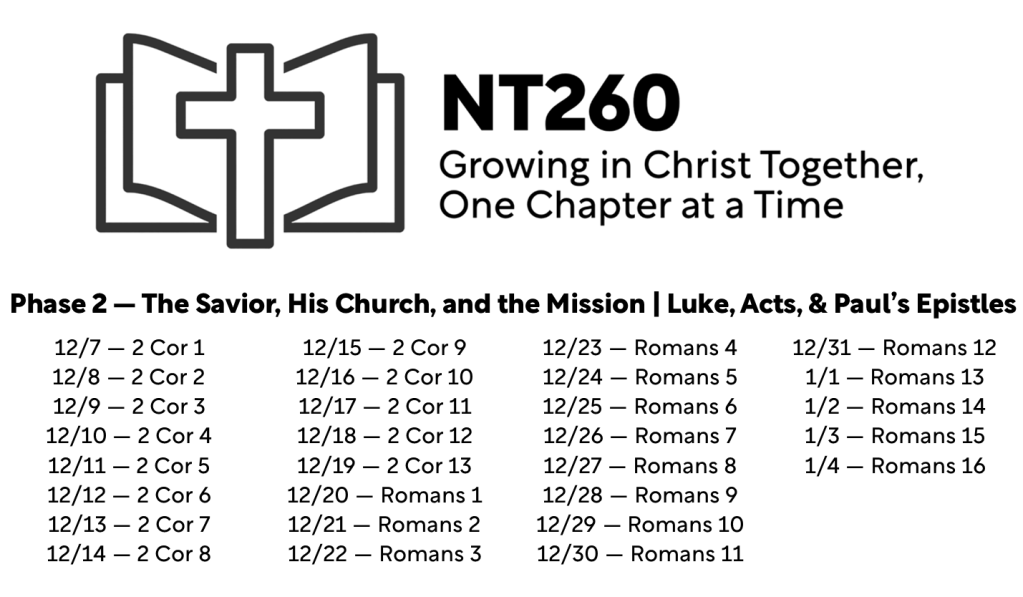
NT260 | Phase 2.3 — The Savior, His Church, and the Mission

This phase will have us reading about Jesus’s life in the gospel of Luke, the formation of the Church in Acts, and walk through the theology found in Paul’s letters that the Church needs to know about and live out the eternal life given by grace through faith in Jesus.

Below, you’ll find brief synopses of each book in this phase to help you understand the scope of the book and most importantly, how it fits into the full Story of the Bible.

When you click on each day’s link, you will find a link to audio, a summary of the chapter, a key verse from the chapter, and opportunities for reflection and outreach.

We’re moving into Paul’s epistles, which we’ll go through chronologically rather than in the order they appear in our Bibles.


2 Corinthians

Paul writes 2 Corinthians after a painful season with the church in Corinth. Some had challenged his integrity and authority, and the church was divided. When Titus brought news that many had repented, Paul responded with this deeply personal letter (2 Corinthians 7:5–16). He defends his ministry not by boasting in strength but by pointing to his suffering and God’s comfort: “the Father of mercies and God of all comfort” meets us in affliction so we can comfort others (2 Corinthians 1:3–7). Paul explains that his trials don’t disprove his calling—they display Christ’s life in a fragile jar of clay (2 Corinthians 4:7–12, 12:9–10).

The letter moves through pastoral appeals and rich teaching. Paul announces the glory of the new covenant, where the Spirit gives life and transforms believers into Christ’s image (2 Corinthians 3:6, 17–18). He proclaims reconciliation: in Christ, God makes us new and entrusts to us the message of reconciliation—“be reconciled to God” (2 Corinthians 5:17–21). He urges holiness and wholehearted devotion to the Lord (2 Corinthians 6:14–7:1), calls the church to forgive and restore the repentant (2 Corinthians 2:5–8), and encourages generous giving for the saints in need (2 Corinthians 8–9). In the closing chapters, he confronts false apostles and “boasts” in his weaknesses so that Christ’s power might be seen (2 Corinthians 11:23–30, 12:9).

In the story of salvation, 2 Corinthians shows how God’s strength shines through human weakness. The crucified and risen Christ brings a new creation, writes His law on our hearts by the Spirit, and sends us as ambassadors of His grace (2 Corinthians 3:3, 5:17–20). Until we stand before Christ’s judgment seat, we live by faith—not by sight—seeking to please Him, comfort His people, and spread the aroma of His gospel in the world (2 Corinthians 5:7–10, 2:14–17).


Romans

Paul wrote Romans around A.D. 57 while he was in Corinth, near the end of his third missionary journey (Romans 16:1–2, 23; Acts 20:2–3). He addressed the letter to believers in Rome—a church he had not yet visited but deeply desired to see (Romans 1:10–13). The Roman church was made up of both Jews and Gentiles, and tensions had developed over how God’s law, faith, and daily Christian living fit together (Romans 14:1–15:7). Paul wrote to explain the gospel clearly, to unite the church around that gospel, and to prepare them to partner with him in future mission work, especially his planned journey to Spain (Romans 15:22–24).

At the heart of Romans is the gospel—the good news that God’s righteousness is revealed through Jesus Christ (Romans 1:16–17). Paul shows that all people, without exception, are sinners in need of salvation—both Jews under the law and Gentiles without it (Romans 1:18–3:20). No one is made right with God by works; instead, sinners are justified by grace through faith in Christ alone (Romans 3:21–26, 4:16). Using Abraham as an example, Paul explains that God’s promise has always been received by faith, not earned by obedience (Romans 4:1–5, 23–25). Jesus’s death and resurrection stand at the very center of God’s saving plan (Romans 5:6–11).

Romans also explains what the gospel accomplishes in the life of the believer. Those who are united to Christ are no longer slaves to sin but are given new life through the Holy Spirit (Romans 6:4–14, 8:1–11). Believers now live with peace with God, assurance of salvation, and a certain hope of future glory—even in suffering (Romans 5:1–5, 8:18–39). Paul addresses the difficult question of Israel’s place in God’s plan, showing that God is faithful to His promises and sovereign in salvation, working all things according to His mercy and wisdom (Romans 9–11).

In the story of salvation, Romans shows how God’s Old Testament promises are fulfilled in Jesus and how the gospel creates one new people—Jew and Gentile together—united by faith (Genesis 12:3, Romans 15:8–13). This gospel does not merely save; it transforms. Because of God’s mercy, believers are called to live holy lives marked by humility, love, service, and hope (Romans 12:1–2, 13:8–10). Romans helps us understand both what the gospel is and how to live it out, all for the glory of God among the nations (Romans 11:33–36, 15:5–6).


Continue reading in our NT260 plan with the fourth part of Phase 2 — The Savior, His Church, and the Mission.

Songs for Sunday, December 7, 2025 @ Christ Community Church (Advent Week 2)

Tomorrow is the Lord’s day, and I’m excited! I’m also grateful for another week in this Advent season, remembering Jesus’s first coming and longing with hope for His return!

Last week, we lit the candle of hope and remembered that our confidence in Jesus isn’t vague, wishful thinking — it’s anchored in the character of our faithful God (Hebrews 10:23). This week, we move to the second candle: peace. And just like hope, the peace we find in Advent isn’t shallow or sentimental. It’s not the temporary ease the world (falsely) offers. It’s a deep, steady peace secured by Jesus Himself (John 14:27).

We light this second candle to remind us that true peace came to us through the humility of Jesus. Hebrews tells us that the eternal Son took on flesh and blood “so that through death He might destroy the one who has the power of death, that is, the devil, and deliver all those who through fear of death were subject to lifelong slavery” (Hebrews 2:14-15). He didn’t stand at a distance. He entered our weakness, stepped into our struggles, and became like us “in every respect” so that He could be a merciful and faithful High Priest — able to reconcile us to God and bring lasting peace (Hebrews 2:17).

The peace that Jesus brings isn’t weak or merely sentimental. It is the victory-won peace that came “by the blood of His cross” (Colossians 1:20). Hebrews tells us He destroyed” the one who has the power of death” (Hebrews 2:14) — and He did it not by mounting a worldly assault but by humbling Himself (Philippians 2:6-8). The world wins peace by force (unpeacefully), but Jesus wins peace by laying His life down. His strength is not seen in crushing armies or empires but in crushing sin, Satan, and death through His own suffering and resurrection. And because Jesus is the Resurrection and the Life (John 11:25), His peace means we no longer fear death at all — He has already passed through it and triumphed over it for us. It’s the beautiful paradox of salvation: the humility of Christ is stronger than all the strength of the world, and His finished work is more than enough (Philippians 2:9-11).

Bethlehem shows us this and more. In Bethlehem, we see that God came near — not in power but humility, not with fanfare but quiet mercy (Micah 5:2, Luke 2:7). And the same Jesus who put on flesh and dwelt among us in the manger in Bethlehem now reigns in glory (Philippians 2:9-11). Because He lived, suffered, died, and rose again (1 Corinthians 15:3-4), we can draw near to His throne of grace with confidence, sure that we can and will receive the mercy and help we need in every moment (Hebrews 4:14-16). As this candle of peace shines, we rest in the peace Jesus secured for us, and we pray that His peace would shine through our lives into a world that needs Him desperately (Matthew 5:9).

But Advent isn’t some mere set of religious exercises inviting us to remember theological ideas — it invites us to come to the One who is our peace (Ephesians 2:14). If you find yourself anxious, restless, or burdened, hear the good news: Jesus came near to save people just like us, and “He is not ashamed to call them brothers” (Hebrews 2:11). He welcomes you. So, come to Him. Bring your fears, your wounds, your weariness. His peace is real, and His mercy is sure (1 Peter 5:7).

Tomorrow at Christ Community, we also have the joy of celebrating the peace and salvation of Jesus through baptism — a visible picture of the gospel and a reminder of what Jesus has done for us. When someone goes beneath the water and rises out of it, we’re seeing Romans 6:4 lived out before our eyes: “We were buried therefore with Him by baptism into death, in order that, just as Christ was raised from the dead by the glory of the Father, we too might walk in newness of life.” Baptism tells the story of Advent’s promise fulfilled — Jesus came to save sinners (Matthew 1:21), to make us new (2 Corinthians 5:17), and to bring us into His peace forever (John 16:33).

This is also why we take the time to share these “Songs for Sunday” posts each week (or at least as often as we can). We want to help you prepare your heart for corporate worship—that time each week when we come together as a church family to sing, pray, and hear God’s Word—to let the Scriptures and songs we’ll share this week begin settling in your soul before Sunday ever arrives. When we come ready, familiar with the Word and expectant to sing, our hearts are strengthened and our worship deepens (Colossians 3:16).

Take a few moments to read through the passages and listen to the songs we’ll be singing. Let them draw your thoughts and hearts to Jesus — our merciful High Priest, our Prince of Peace, and our soon-coming King.

We would love to invite you to gather with us as we sing and John opens God’s Word and points us to Jesus.

Everyone is welcome!


Here are our Scriptures, songs, and Advent readings:

  • Advent Reading | Peace

The second candle reminds us that true peace came to us through the humility of Jesus Christ. Hebrews tells us that the eternal Son took on flesh and blood so that He might break the power of death and free us from fear (Hebrews 2:14–15). He was made like us “in every respect,” entering our weakness and our struggles, so that He could become a merciful and faithful High Priest—able to reconcile us to God and bring us lasting peace (Hebrews 2:17).

Bethlehem shows us that God came near—not in power, but in humility; not with fanfare, but in quiet mercy. Because Jesus came, lived, suffered, and rose again, we can now draw near to the throne of grace with confidence, finding the mercy and help we need in every moment (Hebrews 4:14–16). As this candle of peace shines, let us rest in the peace Christ secured for us and pray that His peace would shine through our lives into a world that desperately needs Him.

14Since therefore the children share in flesh and blood, he himself likewise partook of the same things, that through death he might destroy the one who has the power of death, that is, the devil, 15and deliver all those who through fear of death were subject to lifelong slavery. 16For surely it is not angels that he helps, but he helps the offspring of Abraham. 17Therefore he had to be made like his brothers in every respect, so that he might become a merciful and faithful high priest in the service of God, to make propitiation for the sins of the people. 18For because he himself has suffered when tempted, he is able to help those who are being tempted.

14Since then we have a great high priest who has passed through the heavens, Jesus, the Son of God, let us hold fast our confession. 15For we do not have a high priest who is unable to sympathize with our weaknesses, but one who in every respect has been tempted as we are, yet without sin. 16Let us then with confidence draw near to the throne of grace, that we may receive mercy and find grace to help in time of need.


Songs for Sunday, November 16, 2025 @ Christ Community Church

Tomorrow is the Lord’s day, and I’m excited!

Plus, it’s baptism Sunday at Christ Community tomorrow — a day when we celebrate a visible proclamation of faith and the public confession of our hope: JESUS is LORD! And while we get to watch this, we are reminded that baptism itself doesn’t save us but instead illustrates the saving work of Jesus in the lives of those He saves.

Paul gives us a clear picture of this in Romans 6:4:

We were buried therefore with Him by baptism into death, in order that, just as Christ was raised from the dead by the glory of the Father, we too might walk in newness of life.

Baptism is a symbol of union with Christ — we go under the water as a picture of His death and burial and rise out of the water as a picture of His resurrection. When a believer participates in baptism, he or she procaims that “Jesus died for me, Jesus rose for me, and by faith in Him, I now walk in newness of life!” It’s a public testimony that Jesus saves and that He has brought us from dead in our sins to alive in Christ (Ephesians 2:1-5).

Watching these new believers being baptized will give us a picture of the gospel. We will also read a presentation of the gospel in our worship time in Titus 3:3-7:

3For we ourselves were once foolish, disobedient, led astray, slaves to various passions and pleasures, passing our days in malice and envy, hated by others and hating one another. 4But when the goodness and loving kindness of God our Savior appeared, 5He saved us, not because of works done by us in righteousness, but according to His own mercy, by the washing of regeneration and renewal of the Holy Spirit, 6whom He poured out on us richly through Jesus Christ our Savior, 7so that being justified by His grace we might become heirs according to the hope of eternal life.

This passage shows both who we are and what God has done:

  • Who we are: sinners enslaved, lost, angry, guilty, unable to save ourselves
  • What God did: “He saved us” — not because of our goodness, effort, or religious zeal and “not because of works done by us in righteousness
  • How He saves: “according to His own mercy”, giving us new birth and new life through His Holy Spirit
  • Who we are after salvation: “justified by His grace” — declared righteous — and “heirs according to the hope of eternal life”

And we’ll see this gospel a third way as John opens up Hebrews and points us to Jesus in the preaching of His Word.

So, come tomorrow.

Come rejoice with those being baptized.

Come remember the mercy of God.

Come sing of His grace and see His salvation on display.

And make sure above all you come to Jesus.


Here are our Scriptures and songs:

  • Scripture | Titus 3:3-7

3For we ourselves were once foolish, disobedient, led astray, slaves to various passions and pleasures, passing our days in malice and envy, hated by others and hating one another. 4But when the goodness and loving kindness of God our Savior appeared, 5He saved us, not because of works done by us in righteousness, but according to His own mercy, by the washing of regeneration and renewal of the Holy Spirit, 6whom He poured out on us richly through Jesus Christ our Savior, 7so that being justified by His grace we might become heirs according to the hope of eternal life.

  • Scripture | Romans 6:3-4

3Do you not know that all of us who have been baptized into Christ Jesus were baptized into His death? 4We were buried therefore with Him by baptism into death, in order that, just as Christ was raised from the dead by the glory of the Father, we too might walk in newness of life.


Songs for Sunday, November 9, 2025 @ Christ Community Church

Sunday’s coming, and I’m excited!

It’s been a minute since I’ve gotten to write one of these because I’ve gotten to preach. On that note, I want to pause to say thank you, Christ Community Church.

I’ve had the joy and privilege of preaching this past month — a brief series on the new life in Christ as well as one back in our Hebrews series. It’s not every church that would listen to someone other than their primary pastor for several weeks in a row, let alone a month, and I’m so thankful that Christ Community is that kind of church. Not because I feel I’m worth listening to, but because you prioritize the Word being preached over the personality preaching it. It has blessed my heart to open the Word with you — to study, worship, and grow together in the grace of Jesus. I am thankful to John for the opportunity.

Candice, Keri, Xander, and I are deeply grateful to have found a church home where we are welcomed, loved, and get to be part of what God is doing here.

Now, on to the business at hand: preparing our hearts and minds to gather together in worship this Sunday.

Sunday at Christ Community, we will remember, rejoice, and rest in the mercy of God in Jesus Christ our Savior. As per usual, we will read from the Word and sing from it, and this week we will also partake of the Lord’s Supper together. The two passages we’ll read together in worship (Lamentations 3:19-24 and 1 Peter 1:17-19) will help us prepare for that by showing both the depth of our need and the greatness of Jesus’s mercy and grace.

Lamentations 3:19-20 says, “Remember my affliction and my wanderings, the wormwood and the gall! My soul continually remembers it and is bowed down within me.” In these verses, Jeremiah’s grief runs deep in this passage as he remembers the weight of suffering and sin. Yet, even in the depths of lament, he turns to the Lord. This serves as a powerful example for us. When we gather, we’re not pretending the world isn’t fallen or broken, or that our hearts aren’t weary; we bring all of that to the God who heals, restores, and saves.

Lamentations 3:21-23 says, “But this I call to mind, and therefore I have hope: The steadfast love of the LORD never ceases; his mercies never come to an end; they are new every morning; great is your faithfulness.” This is the turning point in Jeremiah’s lament — remembering gives way to hope. God’s mercies are never exhausted by our sin. Even when we fail (and we will), His mercy remains new, steady, and sure. This is reflected in the words we will sing and celebrate with in “His Mercy is More” — that though our sins be many His mercy is always greater. We’ll also rejoice in His mercy and grace as we sing “Amazing Grace (My Chains are Gone)”, rejoicing that mercy doesn’t merely comfort — it redeems!

Lamentations 3:24 says, “‘The LORD is my portion,’ says my soul, ‘therefore I will hope in Him.'” This verse caps off the section by giving us the foundation of our worship: our hope is not found within ourselves but in Christ — in GOD — alone! He alone is our portion, our satisfaction, our salvation. And that truth leads us to the cross, where mercy and justice meet and grace flows freely.

1 Peter 1:18-19 tell us that we “were ransomed … not with perishable things such as silver or gold, but with the precious blood of Christ, like that of a lamb without blemish or spot.” The mercy and grace God so lavishly bestows on His people are not cheap but purchased at a cost — the blood of Jesus. He is the spotless Lamb of God who takes away the sin of the world, our perfect substitute. As we sing to Him of what He’s done for us in “At the Cross (Love Ran Red)” and “O the Blood”, we will be able to look back on the hope Jeremiah spoke of and rejoice that it comes to us fully today and for all time in Jesus!

And that mercy — that grace — that love — leads us to the Table together at the end of our worship gathering.

When we gather for the Lord’s Supper, we remember not only what Jesus has done for us (1 Corinthians 11:23–26) but also the new covenant He secured for us with His blood (Luke 22:20; Hebrews 9:15). It is the new covenant promised and prophesied in Scripture and fulfilled in Him (Jeremiah 31:31–34; Ezekiel 36:26–27; Hebrews 8:6). In His death and resurrection, Jesus became our merciful and faithful High Priest, offering Himself once for all to bring us near to God (Hebrews 2:17; Hebrews 7:26–27; 1 Peter 3:18). The bread and the cup are symbols of that mercy made visible — grace we can taste and see (Psalm 34:8; John 6:35).

We’ll sing “Behold the Lamb (Communion Hymn)” and look back to the cross, look around at our faith family united by the grace of Jesus, and look forward to the Day when faith becomes sight and we’ll feast with Him forevermore (Revelation 19:6–9; 1 Corinthians 13:12; Revelation 21:3–4).

So, come and gather with us this Sunday.

Come with your burdens and brokenness (Matthew 11:28–30; Psalm 34:18). Come with gratitude and praise (Psalm 100:4; 1 Thessalonians 5:18). Come to remember the mercy of Jesus (Titus 3:4–5; Luke 22:19). Rejoice in His grace, and behold the Lamb who takes away the sin of the world (John 1:29; Ephesians 2:8–9; Revelation 5:12–13).

Won’t you join us?


Here are our Scriptures and songs:

19Remember my affliction and my wanderings, the wormwood and the gall! 20My soul continually remembers it and is bowed down within me. 21But this I call to mind, and therefore I have hope: 22The steadfast love of the LORD never ceases; His mercies never come to an end; 23they are new every morning; great is Your faithfulness. 24“The LORD is my portion,” says my soul, “therefore I will hope in Him.”

17And if you call on him as Father who judges impartially according to each one’s deeds, conduct yourselves with fear throughout the time of your exile, 18knowing that you were ransomed from the futile ways inherited from your forefathers, not with perishable things such as silver or gold, 19but with the precious blood of Christ, like that of a lamb without blemish or spot.


NT260 | Phase 2.2 — The Savior, His Church, and the Mission

This phase will have us reading about Jesus’s life in the gospel of Luke, the formation of the Church in Acts, and walk through the theology found in Paul’s letters that the Church needs to know about and live out the eternal life given by grace through faith in Jesus.

Below, you’ll find brief synopses of each book in this phase to help you understand the scope of the book and most importantly, how it fits into the full Story of the Bible.

When you click on each day’s link, you will find a link to audio, a summary of the chapter, a key verse from the chapter, and opportunities for reflection and outreach.

We’re moving into Paul’s epistles, which we’ll go through chronologically rather than in the order they appear in our Bibles.


Galatians

The letter to the Galatians (check out this cool visual summary from the Bible Project) was written by Paul to churches in the Roman province of Galatia who were facing a spiritual crisis. After Paul preached the gospel of grace, other teachers arrived saying Gentile believers had to be circumcised and keep parts of the Mosaic law to belong to God’s people. Paul writes with urgency to defend the true gospel and his apostolic message, warning that any “different gospel” is no gospel at all (Galatians 1:6–9). His aim is pastoral and clear: believers are made right with God not by works of the law but by faith in Jesus Christ (Galatians 2:15–16).

Galatians shows how Christ’s cross brings a new era of freedom and life. Jesus bore the curse of the law so that blessing might come to the nations and the Spirit be given through faith (Galatians 3:13–14). Paul explains the law’s temporary role—it guarded and pointed to Christ—but now that Christ has come, we are God’s children by faith and clothed with Christ (Galatians 3:24–27). This freedom is not for selfishness but for love: “through love serve one another” (Galatians 5:13–14). The Christian life is life in the Spirit, where the desires of the flesh are put to death and the Spirit produces his good fruit—love, joy, peace, and more (Galatians 5:16–25). At the center stands the cross, which reshapes our identity and boasts (Galatians 2:20, 6:14).

In the story of salvation, Galatians declares that the promise to Abraham is fulfilled in Christ: Jew and Gentile are one family, justified by faith and adopted as sons through the Son (Genesis 12:3; Galatians 3:8, 3:26–29, 4:4–7). The gospel does not add law to Christ; it gives Christ alone by grace, and with him the Spirit who makes us new. Because Jesus has set us free, we stand firm in that freedom, walking by the Spirit and bearing one another’s burdens until the day of glory (Galatians 5:1, 5:16, 6:2).


1 Thessalonians

Paul writes 1 Thessalonians to a young church he planted in a strategic, bustling city and had to leave sooner than he wanted (Acts 17:1–10). After sending Timothy to check on them, Paul hears a mostly good report—but also real concerns: grief over believers who had died, questions about the day of the Lord, ongoing persecution, and a few idle members refusing to work (1 Thessalonians 3:1–6, 4:13, 5:1–11, 4:9–12). With a warm pastoral tone, he defends the integrity of the gospel workers (1 Thessalonians 2), thanks God for their evident faith, love, and hope (1 Thessalonians 1:2–3), and urges them to keep growing in holiness, especially in sexual purity and brotherly love (1 Thessalonians 4:1–8, 9–12).

A major theme is Christ’s return—the “coming” of Jesus appears in every chapter (1 Thessalonians 1:10, 2:19, 3:13, 4:13–18, 5:23). Paul comforts grieving believers: those who have died “in Christ” will rise first, and together with the living they will be caught up to meet the Lord—and “so we will always be with the Lord” (1 Thessalonians 4:14–17). He reassures them that the day of the Lord will not overtake them like a thief because they belong to the day, not the night (1 Thessalonians 5:1–5, 9–10). In light of this hope, he calls the church to a steady, everyday obedience—respecting leaders, helping the weak, rejecting idleness, praying constantly, and testing everything by God’s Word (1 Thessalonians 5:12–22).

In the story of salvation, 1 Thessalonians looks back to Jesus’ death and resurrection as the ground of our hope and forward to His coming as the goal of our hope (1 Thessalonians 4:14, 5:9–10). The God who chose and called them is faithful; He Himself will sanctify them completely and keep them blameless at the coming of the Lord Jesus (1 Thessalonians 1:4, 5:23–24). Until that day, the church waits with active faith, steadfast love, and durable hope—turning from idols to serve the living and true God and to wait for His Son from heaven (1 Thessalonians 1:3, 9–10).


2 Thessalonians

Paul’s second letter to the Thessalonians comes soon after the first and meets a church still under pressure. Persecution had not let up, and a false claim had spread that “the day of the Lord” had already come, leaving some shaken and afraid (2 Thessalonians 1:4, 2:1–2). Paul reassures them: when Jesus returns, He will bring justice—rest for His people and judgment on those who oppose the gospel (2 Thessalonians 1:5–10). He prays that God would make them worthy of their calling and glorify the name of Jesus in them, even as they suffer (2 Thessalonians 1:11–12).

Building on 1 Thessalonians, Paul clarifies what must happen before the Lord’s coming: a rebellion and the revealing of “the man of lawlessness,” whom Jesus will overthrow by the breath of His mouth at His appearing (2 Thessalonians 2:3–8; cf. 1 Thessalonians 4:13–18, 5:1–11). Until that day, the church must “stand firm and hold to the traditions” taught by the apostles, trusting the Lord to comfort and strengthen their hearts (2 Thessalonians 2:15–17). Paul also addresses a practical problem—idleness—commanding believers to work quietly and earn their own living, and instructing the church to correct those who refuse to obey (2 Thessalonians 3:6–12, 14–15). In the story of salvation, 2 Thessalonians keeps our eyes fixed on Christ’s certain return and calls us to steady, holy, hope-filled lives while we wait (2 Thessalonians 3:5, 13).


1 Corinthians

Paul writes 1 Corinthians to a gifted but divided church in a major port city shaped by status, rhetoric, and idolatry (Acts 18:1–11). After hearing troubling reports and receiving their questions, he calls them back to the gospel—to humble unity and holy living (1 Corinthians 1:10–13, 5:1–2, 7:1, 11:18). From the start, Paul centers everything on “Christ crucified,” God’s wisdom and power, not human show (1 Corinthians 1:18–25, 2:1–2). Because they belong to Jesus, they must stop boasting in leaders, flee sexual sin, and remember they are God’s temple where the Spirit dwells (1 Corinthians 3:16–17, 5:1–13, 6:18–20). Love—not pride or personal rights—must shape their life together (1 Corinthians 8:9–13, 13:1–7).

Paul also answers practical questions about marriage and singleness (1 Corinthians 7), food and idolatry (1 Corinthians 8–10), and gathered worship (1 Corinthians 11–14). He urges them to build up the church: take the Lord’s Supper in a worthy way, honor one another, and use spiritual gifts for the common good, not for display (1 Corinthians 11:23–26; 12:4–7; 14:12, 26). The famous “love chapter” shows that without love, even the greatest gifts amount to nothing (1 Corinthians 13:1–3). Above all, Paul insists on the bodily resurrection of Jesus and its hope for believers; because Christ is raised, our faith is not empty, our labor is not in vain, and we will be raised imperishable (1 Corinthians 15:3–4, 20–22, 51–58).

In the story of salvation, 1 Corinthians shows the gospel forming a holy people in a worldly place. The church is God’s family, Christ’s body, and the Spirit’s temple—set apart to reflect His character (1 Corinthians 1:2, 3:16, 12:12–27). So we lay down our rights for the weak (1 Corinthians 8:11), pursue love (1 Corinthians 14:1), and do all to the glory of God (1 Corinthians 10:31). Standing on the sure foundation—Jesus Christ our Lord—we work together for the advance of the gospel until He comes (1 Corinthians 3:11; 16:13–14, 22–24).


Continue reading in our NT260 plan with the third part of Phase 2 — The Savior, His Church, and the Mission.

Join Us as We Celebrate 27 Years at Christ Community Church — a Songs for Sunday post

Sunday’s coming, and I’m especially thankful this week.

Not only do we get to gather again as the people of God, but we also get to celebrate 27 years of God’s faithfulness to and through Christ Community Church. That’s no small thing. The local church is one of God’s greatest gifts to His people — where the gospel is proclaimed, disciples are made, and the love of Jesus is lived out in community.

I want to say how personally thankful I am that God has allowed me and my family to be a part of Christ Community. I’ve had the privilege of serving in churches for two decades, but this church has become the church home and faith family we had always hoped for. Candice, Keri, Xander, and I are genuinely grateful — not only to serve here, but to belong here. Christ Community is a gift, and we thank God for it.

That’s exactly the sentiment Paul had in Colossians 1:3-6 when he was opening his letter to the church at Colossae: sharing his gratitude for a gospel-shaped church.

Paul began in v. 3 by saying, “We always thank God, the Father of our Lord Jesus Christ, when we pray for you.” He’s not flattering them but pointing to God as the source of their growth and faithfulness. Every local church that stands firm in Christ is a reason to give thanks.

In v. 4, he reflects on what he’s heard about them: their “faith in Jesus” and the love they have “for all the saints”. These aren’t vague religious concepts. Their faith was real, anchored in Jesus. Their love was visible, expressed toward one another. This kind of gospel life is evidence of Christ working.

But where does that kind of faith and love come from? The answer is in v. 5: “because of the hope laid up for you in heaven”. Their faith and love are rooted in something eternal — not wishful thinking, but a secure hope. Their faith and love are rooted in something objective, already laid up, already theirs. That’s our shared hope, too: an imperishable inheritance kept in heaven (1 Peter 1:4), secured not by our own goodness but in Jesus’s blood and resurrection (1 Peter 1:18-21).

Then in vv. 5-6, Paul shifts the spotlight to the gospel itself, “the Word of the truth…which has come to you, as indeed in the whole world it is bearing fruit and increasing…”. You see, the gospel isn’t merely information. It’s power. Wherever it goes — when it’s understood and received by grace through faith in Jesus — it grows, it bears fruit, it transforms lives. That’s what God has done at Christ Community for 27 years, and that’s what we’re asking Him to keep on doing until Jesus returns.

When we gather Sunday, we’ll celebrate that very gospel in song. We’ll sing “Holy Water” thanking God for washing away our sin in His grace and mercy. We’ll sing “Graves Into Gardens” proclaiming the power of Jesus to bring life where there was death. We’ll sing “In Christ Alone” declaring our firm hope rooted in Jesus’s death and resurrection. We’ll sing “Thank You Jesus for the Blood” remembering the precious price He paid to redeem us.

We’ll be reminded of that gospel in our Scripture readings, as in Titus 3:4-7 where we’ll clearly see that our salvation is not in our works but Jesus’s, not in our righteousness (which we don’t have) but His mercy.

We’ll be reminded of that gospel and the Savior it proclaims as John opens up the Word of God and shows us the King of kings, unpacking the value and depth of His sacrifice for sinners like us and the salvation that comes only by grace through faith in Jesus alone.

So, let’s gather together.

Let’s gather on the Lord’s day — on Sunday — not just to mark an anniversary but to lift high the name of Jesus, the One who saved us, who brought us together as a church family, and who is still working in and through us for His glory and our good.

The gospel has borne fruit here, and we pray it continues to do so for generations to come — until Jesus comes.

Won’t you gather with us?


Here are our Scriptures and songs:

4But when the goodness and loving kindness of God our Savior appeared, 5He saved us, not because of works done by us in righteousness, but according to His own mercy, by the washing of regeneration and renewal of the Holy Spirit, 6whom He poured out on us richly through Jesus Christ our Savior, 7so that being justified by His grace we might become heirs according to the hope of eternal life.

18…knowing that you were ransomed from the futile ways inherited from your forefathers, not with perishable things such as silver or gold, 19but with the precious blood of Christ, like that of a lamb without blemish or spot. 20He was foreknown before the foundation of the world but was made manifest in the last times for the sake of you 21who through Him are believers in God, who raised Him from the dead and gave him glory, so that your faith and hope are in God.


NT260 | Phase 2.1 — The Savior, His Church, and the Mission

This phase will have us reading about Jesus’s life in the gospel of Luke, the formation of the Church in Acts, and walk through the theology found in Paul’s letters that the Church needs to know about and live out the eternal life given by grace through faith in Jesus.

Below, you’ll find brief synopses of each book in this phase to help you understand the scope of the book and most importantly, how it fits into the full Story of the Bible.

When you click on each day’s link, you will find a link to audio, a summary of the chapter, a key verse from the chapter, and opportunities for reflection and outreach.


Luke

Luke is the first part of a two-volume story (with Acts) written to give believers confidence about Jesus and the good news (Luke 1:1–4; Acts 1:1–2). Early Christians understood the author to be Luke, a physician and coworker of Paul (Col. 4:14; 2 Tim. 4:11). He writes to Theophilus—and to a wider audience—to show that Jesus is the promised Savior for all people: Jews and Gentiles, the poor and the powerful, the outcast and the insider (Luke 2:10–11; 4:18–19; 19:10). Big themes include prayer, the Holy Spirit, costly discipleship, warnings about riches, and God’s grace that lifts the lowly (Luke 1:52–53; 3:21–22; 6:20–26; 11:1–4; 12:32–34).

As a Gospel, Luke reads like an ancient biography centered on Jesus’ public ministry, death, and resurrection. It moves from the temple in Jerusalem to Galilee and back again, with a long “journey to Jerusalem” where Jesus heads to the cross (Luke 9:51). Luke’s style is vivid and orderly, weaving in songs, parables unique to him (e.g., the Good Samaritan; the Prodigal Son), and many scenes of table fellowship that show who belongs in God’s family (Luke 7:36–50; 10:25–37; 15:1–32). Throughout, Jesus is the Spirit-anointed Son of Man who teaches, heals, forgives, and welcomes sinners (Luke 4:1, 14, 18; 5:20–32).

In the big story of the Bible, Luke shows God keeping his promises to Israel and opening salvation to the nations. Jesus fulfills the Scriptures, suffers, rises, and sends his followers out with the Spirit’s power (Luke 24:44–49; Acts 1:8). The kingdom has arrived in Jesus’ words and works, yet we still wait for its fullness—so we live awake, generous, prayerful, and bold in witness until he returns (Luke 11:2; 12:32–40; 21:34–36).


Acts

The book of Acts is Luke’s sequel to his Gospel, written to Theophilus and to a broader audience of early Christians (Acts 1:1; Luke 1:3). Tradition and internal evidence identify Luke, the beloved physician and companion of Paul (Col. 4:14; 2 Tim. 4:11; Philem. 24), as the author. He carefully investigated eyewitness testimony and recorded an orderly account of the risen Christ’s work through His apostles (Luke 1:2–3; Acts 1:21–22). Most likely written in the early 60s A.D., Acts gives believers certainty that the gospel is true and that Christianity is the fulfillment of God’s promises, not a new or dangerous sect (Luke 24:44–47; Acts 24:14–15).

At its heart, Acts shows how the ascended Jesus continues His mission by sending the Holy Spirit to empower His church. The book’s key verse, Acts 1:8, provides its outline: the gospel spreads from Jerusalem (Acts 2:1–47), into Judea and Samaria (Acts 8:4–25), and then outward to the ends of the earth, symbolized by Paul’s ministry in Rome (Acts 28:30–31). Along the way, Luke highlights miracles (Acts 3:1–10; 19:11–12), persecution (Acts 4:1–22; 7:54–60), and the unstoppable advance of God’s Word (Acts 12:24; 19:20). Through it all, Acts demonstrates that nothing—not prison, plots, or shipwrecks—can hinder the spread of the gospel (Acts 5:41–42; 27:23–25).

Acts emphasizes both continuity and fulfillment. Jesus’ death and resurrection fulfill the Scriptures (Acts 2:25–36; 13:32–33), and His exaltation confirms Him as both Lord and Christ (Acts 2:36). The Holy Spirit marks the arrival of the new age of salvation (Acts 2:16–21; Joel 2:28–32) and unites Jews and Gentiles into one people of God (Acts 10:44–48; 15:7–11). Like Jesus in Luke’s Gospel, His followers perform miracles, face opposition, and walk in obedience to God’s plan (Luke 4:18–19; Acts 3:6–8; 14:8–10; Luke 23:4; Acts 26:31–32). The church’s mission is shown to be both ancient—rooted in God’s promises to Israel (Acts 3:25–26)—and worldwide, extending to “all who are far off” (Acts 2:39).

In the Story of the Bible, Acts is the bridge between Christ’s finished work and the church’s Spirit-empowered witness. It records the first thirty years of gospel proclamation, showing how God’s plan of salvation moves from Jerusalem to Rome and beyond (Acts 1:8; 9:15; 13:47). Acts assures us that the risen Christ still reigns, His Spirit still empowers, and His mission still advances until the day He returns (Acts 2:33; 7:55–56; 28:28). The same Spirit who emboldened Peter, Stephen, and Paul continues to strengthen the church today to proclaim Jesus Christ as Lord to the ends of the earth (Acts 4:31; 20:24; 28:31).


Continue reading in our NT260 plan with the second part of Phase 2 — The Savior, His Church, and the Mission.

Songs for Sunday, September 7, 2025 @ Christ Community Church

Tomorrow is the Lord’s day, and I’m excited!

Every Sunday, our faith family at Christ Community gathers for one reason: to worship and glorify our resurrected King, Jesus Christ. We don’t meet out of routine or ritual or religion but in response to the good news that Jesus lived, died, rose again, and reigns forever!

This Sunday (like every Sunday), the songs we sing and Scriptures we read will walk us through the gospel story. Let’s take a look and prepare our hearts to gather and worship.

The Mind and Majesty of Jesus (Philippians 2:5-11)
Paul tells the Philippians — and us — to adopt the mindset of Jesus (v. 5). This isn’t some moral challenge but a call to reflect the heart of our Savior. Though He was truly God (v. 6), Jesus didn’t grasp at His heavenly privilege but rather chose the path of humility.

He made Himself nothing — not by ceasing to be God, but by becoming human and taking on the nature of a servant (v .7). God Himself put on flesh and stepped down into our broken world (John 1:14). He lived a perfect, sinless life, obeying the Father perfectly, even to the point of death — “even death on a cross” (v. 8). This crucifixion was not just excruciating; it was humiliating and degrading, the lowest form of execution reserved for criminals. But Jesus bore it willingly for us.

Because of His humility and obedience, “God has highly exalted Him and given Him the name that is above every name” (v. 9). One day, every knee will bow and every tongue will confess Him as Lord, all to the glory of God the Father (vv. 10-11). The One who stooped low to serve and to save now reigns on high as King of kings and Lord of lords.

But if we stop there, we might miss the full weight of what happened on the cross. That’s why Isaiah 53, written hundreds of years before God became flesh and dwelt among us, speaks so powerfully into what Jesus endured.

The Suffering Savior (Isaiah 53:3-6)
Isaiah paints a vivid picture of the Servant who would come — not with power and acclaim but with sorrow and rejection (v. 3). Jesus wouldn’t just brush up against human suffering but enter into it fully, yet while people dismissed Him, thinking He was being punished by God (v. 4), Isaiah prophesies an important truth for us to understand today: when Jesus was “pierced”, it was for “our transgressions” — when He was “crushed”, it was for “our iniquities” (v. 5).

Jesus didn’t suffer for His sins because He had none. He suffered for ours. And His “punishment…brought us peace”, and “His wounds” brought us healing (v. 5). The wrath of God fell on His spotless Son so that mercy could be poured out on us.

Just as we’ve read in Philippians 2:5-11, the cross wasn’t an accident. It wasn’t injustice. It was God’s plan to redeem sinners through the willing sacrifice of His Son. And that’s good news for sinners like us.

That’s why we can sing “King of Kings”, the story of Jesus’s humility, crucifixion, resurrection, and glory. It’s why we can sing “Man of Sorrows” and “Jesus Paid It All”, recognizing that Jesus endured sorrow, pain, and death to pay the price for our sin. It’s why we can sing “What a Beautiful Name” — because He is the One who has been given a name above all names and exalted above everything that is.

That’s why we sing. That’s why we gather. Jesus is God, and He is worthy. He bore our griefs, carried our sin, paid our debt with His life, rose from the grave, and now reigns forevermore, seated at the right hand of the Majesty on high.

This is the Jesus we gather to worship.

This is the gospel — the good news — we proclaim and rejoice in.

Won’t you join us?


Here are our Scriptures and songs:

Have this mind among yourselves, which is yours in Christ Jesus, who, though he was in the form of God, did not count equality with God a thing to be grasped, but emptied himself, by taking the form of a servant, being born in the likeness of men. And being found in human form, he humbled himself by becoming obedient to the point of death, even death on a cross. Therefore God has highly exalted him and bestowed on him the name that is above every name, 10 so that at the name of Jesus every knee should bow, in heaven and on earth and under the earth, 11 and every tongue confess that Jesus Christ is Lord, to the glory of God the Father.

3He was despised and rejected by men, a man of sorrows and acquainted with grief; and as one from whom men hide their faces he was despised, and we esteemed him not.

4Surely he has borne our griefs and carried our sorrows; yet we esteemed him stricken, smitten by God, and afflicted. 5But he was pierced for our transgressions; he was crushed for our iniquities; upon him was the chastisement that brought us peace, and with his wounds we are healed. 6All we like sheep have gone astray; we have turned—every one—to his own way; and the Lord has laid on him the iniquity of us all.