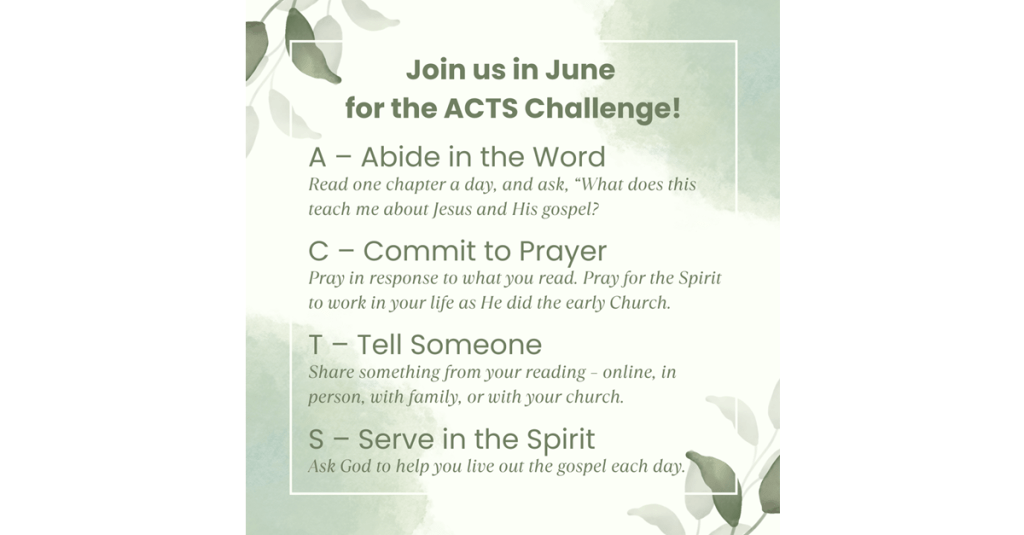
We’re excited to spend the month of June diving into the book of Acts—one chapter each day—as we follow the Spirit-empowered mission of the early Church. This isn’t just a reading challenge. It’s a call to live out the gospel.
Each day, we’re walking through the ACTS Challenge:
A – Abide in the Word Read one chapter a day and ask, “What does this teach me about Jesus and His gospel?”
C – Commit to Prayer Pray in response to what you read. Pray for boldness and the Spirit to work in your life like He did in the early Church.
T – Tell Someone Share something from your reading—online, in person, with family, or your church.
S – Serve in the Spirit Ask God to help you live out the gospel each day in tangible ways.
Read it. Pray it. Share it. Live it.
What to Expect in Each Daily Post:
Each day, we’ll post a short devotion that includes:
A brief summary of that day’s chapter in Acts
A core theme or truth drawn from the passage
A personal reflection to help you think through what God is teaching you
A practical mission challenge to help you live out what you’re learning
We believe God’s Word is powerful—and that reading Acts together as the Church will deepen our faith, grow our courage, and prepare us to join God in His mission right where we are.
Let’s walk through Acts together—one chapter, one day at a time.
(📱Prefer listening? Each day’s chapter is available in audio format, so you can hear the Word even if you’re on the go!)
We’re continuing in our study of Revelation called The KING is Coming. We took a break for our He Who Promised is Faithful readings during Holy Week but are glad to be back at it. Today, we will be diving into Jesus’s letter to the church at Pergamum. Once again, I am thankful for Jamie Harrison and the opportunity to do this study together. This week’s passage is Revelation 2:12-17:
12 “And to the angel of the church in Pergamum write: ‘The words of him who has the sharp two-edged sword. 13 “ ‘I know where you dwell, where Satan’s throne is. Yet you hold fast my name, and you did not deny my faith even in the days of Antipas my faithful witness, who was killed among you, where Satan dwells. 14 But I have a few things against you: you have some there who hold the teaching of Balaam, who taught Balak to put a stumbling block before the sons of Israel, so that they might eat food sacrificed to idols and practice sexual immorality. 15 So also you have some who hold the teaching of the Nicolaitans. 16 Therefore repent. If not, I will come to you soon and war against them with the sword of my mouth. 17 He who has an ear, let him hear what the Spirit says to the churches. To the one who conquers I will give some of the hidden manna, and I will give him a white stone, with a new name written on the stone that no one knows except the one who receives it.’”[1]
Keith Harris: Greetings, Sojourners,
Today’s letter to the church at Pergamum is tough, Jamie. And, so speaking, I turn it over to you because this is a lot.
Jamie Harrison: It is a lot, so y’all buckle up and stay buckled up – especially if you are driving and listening to this Bible study. No reading while driving.
Keith: Click it or ticket.
Jamie: Yeah, I’ve heard that somewhere.
Just a quick reminder of the similarities between each letter. Each letter is going to start with that same salutation. Write to the angel of the church, this week in Pergamum. Then we’re going to look at what Jesus says about Himself, His attributes. Then we’re going to get maybe something about their works, some praise and then admonition – something they need to work on (in all but two of the churches). Then, that same universal admonition to let anyone who has ears to hear, listen to what the Spirit says to the churches. Finally, we’ll get a promise.
Before we start, in the first letter, we really talked a lot about listening to what the Spirit is saying, not just to the church at Ephesus or Smyrna, now Pergamum, but what He is saying to the Church today as a whole and to our local church body. What is He saying? And as a part of your local church body, what is He saying to you?
Keep those things in mind as we dive into this letter because I think this letter hits on a lot of stuff that’s probably affecting us today. So, here we go.
Jesus starts off by saying something about Himself does not have the best positive connotation to it.
Keith: Yes, it is not the portrait of Jesus people would like to paint. But, nevertheless, it’s the one He gives us here.
Jamie: In the letter to Smyrna, we get that He is the first and the last. In the letter to Ephesus, He’s the One who holds the seven stars and who walks among the golden lamp stands. In Pergamum, all He says about Himself is, “Thus says the One who has the sharp, double-edged sword” (v. 12)[2], which again, does go back to ch. 1:16 where He had seven stars in His right hand and a sharp double-edged sword came from His mouth. I think it’s interesting that the sword comes from His mouth because I want to – I’m kind of jumping ahead of myself real quick. Turn to Revelation 19:19, and I’m going to read a couple of verse, actually starting in verse 11 of Revelation 19 (and go through v. 13):
11 Then I saw heaven opened, and there was a white horse. Its rider is called Faithful and True, and with justice he judges and makes war. 12 His eyes were like a fiery flame, and many crowns were on his head. He had a name written that no one knows except himself. 13 He wore a robe dipped in blood, and his name is called the Word of God.
If any of this sounds familiar, it’s because, again, in Revelation 1, that’s how He is described. He is called the Word of God. We know that the sword is the Word of God.
14 The armies that were in heaven followed him on white horses, wearing pure white linen. 15 A sharp sword came from his mouth, so that he might strike the nations with it. He will rule them with an iron rod. He will also trample the winepress of the fierce anger of God, the Almighty. 16 And he has a name written on his robe and on his thigh: King of Kings and Lord of Lords.
And then we get this horrible supper of God where all these people are wiped out who were gathered together. And then in verse 21, it says,
The rest were killed with the sword that came from the mouth of the rider on the horse, and all the birds ate their fill of their flesh.
So, this sharp double-edged sword that comes from His mouth is what eventually will end everything. That’s the sword He chooses – that’s, excuse me, the attribute He chooses to describe Himself with here (in the letter to the church at Pergamum). So, if you’re listening to this, and you’re in Pergamum, this is not good news. It’s terrifying.
Keith: I mean, there is the admonition opportunity for repentance, but their current standing without repentance is not good at all. That sword Jesus speaks of is pointed at Pergamum.
Jamie: It is pointed at Pergamum.
He goes from there to the works and the praise that He’s going to give. He tells them (in v. 13), “I know where you live – where Satan’s throne is. Yet you are holding on to my name and did not deny your faith in me.” Please don’t mistake that when He says, “where Satan’s throne is,” to think He means hell. Satan wasn’t (isn’t) cast into hell yet. That has not happened. He was cast down to earth.
Keith: And hell doesn’t have a throne. Satan is going to be inmate number one there.
Jamie: That’s correct, and we’ll see that actually in Revelation 19 and 20 when we get there, that he’ll be one of the first couple beings cast into hell. But what it’s talking about when it says that the satanic throne – Satan’s throne…. Literally, during this time, Pergamum was considered the headquarters of Satanic opposition. That would have been a literal thing. It was a gentile base for false religion. They had a throne there that was a throne-shaped altar that looked like Zeus at the acropolis, the city’s highest peak, a throne-shaped altar to Zeus.
Then a lot of people from all over the [Roman] empire at that time would come to a palace that was built for Asclepius – the god of healing. His symbol was a rod in his hand and a snake wrapped around the rod, kind of like what we see on the back of ambulances and things like that today. That was what he held, that was his symbol, the snake-wrapped rod. People would come from all over the empire to sleep in his temple to get touched by one of the numerous non-venomous snakes that would be slithering around on the floor. Just to repeat, they would intentionally and willingly sleep on a floor that was covered in snakes in hopes that a snake would slither on them. Just because they are non-venomous doesn’t mean they don’t bite. They thought this would heal them.
So, that’s where Satan’s throne comes in. Because literally, that’s what it was considered to be during that time – not a good place to be. I would imagine if you were a Christian there at the time, and Jesus says “yet you are holding on to my name” and “did not deny [their] faith in [Him], even in the days of Antipas…who was put to death” among them. That’s a big deal. It’s really cool, like, hey, these awful things are going on around you…. We understand how easy it is now to get drawn away or moved away from Christ – we have to say this is ok because it’s what everybody says, and I don’t want to offend anybody…. These guys didn’t do that. They stuck with Jesus. They didn’t deny their faith even though all these things were going on around them. Even though it might seem easy that a snakebite might heal you, they trusted in Him.
Keith: Well, it’s like how sometimes people want to take things into their own hands. In our churches today, there’s no Christian culture in the world. Everything is in the realm held by, how does Paul say it in Ephesians 2? The prince of the power of the air (Ephesians 2:2)? I imagine this was a really terrible things because I know when we have conversations with people about what the Bible says about things, people find great offense.
This isn’t a pastor, this isn’t a Christian, this isn’t some church guy, preacher saying, hey, I think the worldliness you are involved in is satanic. This is Jesus. He says that this whole idea there, whether it’s Zeus or Asclepius, what you’re dealing with here is Satan. This is heavy. This is not, oh, well, I just believe something different. Jesus says He is the only way and everything else is opposed to me. He ain’t playing here.
Jamie: Let me interject here. I was having a conversation with a young man who had been talking to one of his buddies who claimed to be a Christian who said at the same time said he doesn’t believe everything the Bible says. Well, it’s either all or none. There’s no in between. I think me and you – or it might’ve been me and Kevin one, I can’t remember…but if there’s anything in the Bible that you’re not going to believe it would be the resurrection of Christ because that’s the most far-fetched thing, right? Jesus rose again. That’s the basis of Christianity. If you believe that, everything else is believable. So, with the Bible, it’s either all or it’s nothing. We can’t add. We can’t take away from the Word of God. He wrote it. All Scripture is breathed out by God. All of it. So, I just wanted to interject that before we move forward.
Keith: I mean, the sword coming from His mouth is what He said. I think this is a very good example that sometimes – and I don’t even want to use sometimes because it sounds like I’m trying to make it more palatable – Jesus doesn’t speak on a basis of what’s going to make us more comfortable or happy or what’s going to fit in, He’s God. He’s the Creator. He’s the Author of life. He speaks and it is – or it ain’t.
Jamie: Yeah. So, there’s not your truth or my truth. Is that what you’re saying?
Keith: We don’t have to say what I’m saying. The whole idea is what Jesus said. In John 14:6, Jesus said, “I am the way, the truth, the life, and no one comes to the Father but by me.” So, when He is talking here to the church at Pergamum and telling them what they’ve experienced and that He knows their living in a terrible place – that this is where the throne-shaped alter is, again where Satan dwells. Jesus tells them they’ve done well despite all of that, but that there’ve been casualties as well, which is I think that’s where you are headed next.
Jamie: Yes. So, the very next thing He says, is but I have a few things against you. With Ephesus, He had one thing: they had lost their first love. With Smyrna, they had nothing. Now we get to Pergamum, and it’s like, hey, here are a few things against y’all. So, let’s go through these.
He says that there are some who hold to the teachings of Balaam, who taught Balak to place a stumbling block in front of the Israelites, to eat meat sacrificed to idols and commit sexual immorality. What He’s talking about there is the story of Balaam. If you go back to Numbers 22-25, you’ll get the whole story. Balaam was this guy who was called a seer of the gods – kind of like a pagan divination expert.
Keith: And just to clarify, I had heard Balaam – the story of Balaam and the donkey – preached many times in my childhood. I was a grown man before I read it fully for myself, which is on me, but Balaam was always treated like a hero in those sermons. Balaam was not of God’s people (Numbers 22:5–6). Balaam was not a prophet of the God (2 Peter 2:15; Jude 11; Revelation 2:14). He was a mess (Numbers 31:16).
Jamie: Mmm Hmmm. I firmly believe that he would have absolutely cursed Israel had God allowed him to (Numbers 22:12, 20–22; Numbers 23:11). So, that’s what you get when you read the story. You get introduced to Balaam. He comes and is asked to curse Israel (Numbers 22:5–6). He gets on his donkey, and there’s an angel in the way who is about to kill him (Numbers 22:21–23). The donkey just quits (Numbers 22:24–27). He beats the donkey (Numbers 22:27–28). Then the donkey talks to him; that’s where you get that whole conversation from (Numbers 22:28–30). That all happened to remind Balaam that God is in control and that he should do what He said (Numbers 22:31–35).
Keith: It doesn’t matter where the money is, where the fame is, where the fortune is…. When the God speaks, the lowercase g gods have to bow in subjection.
Jamie: Right. So, in looking at the oracles that Balaam gives, he gives three different ones, and in all three he ends up blessing Israel because the Lord will not allow him to curse them (Numbers 23:5–12; 23:16–24; 24:2–9). The first one was at a place that was known as the high places of Baal—a cultic center for the worship of Baal (Numbers 22:41). The second oracle takes place atop Mt. Pisgah, and so that is where all the heavenly omens were made or astrological observations were made—things like that, everything that people would have looked at during that time to see signs and things of that nature (Numbers 23:13–14). If that sounds familiar.
Keith: It unfortunately does.
Jamie: The third place is on Peor, which is another cultic center of worship (Numbers 23:28). So, all three places he takes him, where Balaam tells him to meet him, are places of Baal—places that are against God (Numbers 22:41; 23:14; 23:28). What you end up happening is Balaam advises Balak to be friendly to Israel, share his women with them, things like that (Numbers 31:16; Revelation 2:14), and…
Keith: And if you draw them in, you’ll destroy them from the inside out.
Jamie: That’s right, and Israel ends up following along. By the way, you can check out Numbers 31:16 to see where Balaam tells him to be friendly with them and Numbers 25:1-9 you get this horrible story of Israel having sexual relations with these Moabites and eating meat sacrificed to idols. These Moabite women are encouraging them to do it. As we were just talking about before we got started, they make it all the way to the entrance to the tabernacle.
Keith: One guy is planning on taking his Moabite cult prostitute right up inside the tabernacle to show Israel what’s up.
Jamie: That’s right, and at that point, a plague had started because of what was going on. That is until Phineas drives a spear through the man and the woman and ends the plague. 24,000 Israelites are killed in this plague.
So, when Jesus tells the church there that they are holding to the teaching of Balaam (Revelation 2:14), Balaam taught Balak to place a stumbling block in front of the Israelites (Numbers 31:16). It’s like they were telling folks that they see they follow Jesus but add this or take away this (Galatians 1:6–9). We could name so many examples of this, but none of it is ok. If you are placing a stumbling block in front of people—placing something that is not biblically accurate—you are causing them to fall away (Romans 16:17; Matthew 18:6–7). I think that’s part of why James says that not everyone needs to be a teacher. You’ve got to be careful (James 3:1).
Keith: It’s definitely why Jesus says you can’t serve two masters.
Jamie: That’s correct. Especially when you’re teaching children. If you don’t know God’s Word and you’re not studying God’s Word, don’t teach children – don’t teach adults for that matter, but definitely don’t teach children.
Keith: That’s another reason, and I know we said this in the first or second part of this study, if you don’t know, say, “I don’t know.” There’s no shame in saying that you have to look something up because you don’t want to cause somebody to stumble.
And I mean the issue here is you have two pictures. They could very well have that zeal of Phinehas—not saying go run people through with spears, but God Himself said that Phinehas was jealous with His jealousy (Numbers 25:10–13). You can dwell where Satan’s throne is. You can dwell where Satan dwells and hold fast to the name of Christ and not deny your faith even when people are getting killed (Revelation 2:13), or you can go the way of Balaam and go along to get along (Revelation 2:14; Numbers 31:16). I think there’s probably—and I’m definitely not welcoming terrible persecution—but when persecution sets in, those who have faith in Christ hold fast unto death, like we saw with Smyrna last week (Revelation 2:10), or they cut bait and fish. They either join the culture or go further into Christ. What he’s telling the church at Pergamum is that they have some folks playing with some stuff they don’t need to be playing with, telling them specifically to go back and test the Scriptures and see what happened to Balak and Balaam (Numbers 25:1–3; 2 Peter 2:15; Jude 11).
Jamie: It didn’t work out so well. Specifically, what was going on during that time in Rome – to help make this understandable, is you’ve got – in order to join the guilds or unions like we were talking about in Smyrna, you would have the people in Rome and in Pergamum having to take a little pinch of incense and put it on the altar to affirm their loyalty to Caesar, the emperor. And that is spiritual fornication, obviously, because when you do that, you’re saying Caesar is lord. Then they would be able to have a job and things like that. So that’s what was specifically going on, but not only were they committing spiritual fornication, they were committing adultery, too. It says, “In the same way, you also have those who hold to the teaching of the Nicolaitans” (v. 15), which we mentioned back in the letter to Ephesus was a group of people who believed in giving in to sensual pleasure, basically elevating what they want over anybody, anytime, whoever, whenever, type of thing – as long as it feels good to you, it’s good.
If it feels good, it’s good. That’s not the case because what feels good for 20-30 seconds is not always good for you. I think it’s pretty clear here that God has a design, God has a way, and specifically, God Himself – Jesus – is talking to these folks telling them that this is not they way He called them to be. Come to Him. Don’t go toward Balaam or Nicholas. Follow Him, not the world. You can’t serve both.
You start to notice a common thread here through these letters, and you’ll see it in the next one to Thyatira, is sexual immorality. Think about how this applies today with easy access to pornography. You know when I was coming up and computers first came out, we got one in our house, and I remember everybody at school saying you have to have a subscription to look at that type of stuff. They will talk about it. Now you just click on there and you can look at whatever you want. Pick your own category – whatever you like to see.
Keith: At the time we are recording this, this is the week after Twitter, or X, decided to be a pro-porn platform, and the comment on that is, in the state of Mississippi as well in some other states in the United States, there’s been some legislature that was meant to make it more difficult for people to access porn so that people, especially in their formative years, aren’t building pathways in their brains looking at this stuff. Now, one of the big three social media platforms (out of the originals) is allowing people to be free to put porn on there. It is their right as American citizens – as part of their freedom of speech… but I guess the word from Jesus would be to those who have ears to hear would be to ask what rights do you have in Christ. It may be permitted by the government, but what honors Him? What glorifies Him?
This is the kind of crossroads they were at. It’s where we are right now.
Jamie: That’s right, and there’s a lot more we could say on that. I guess we shall digress at this time.
Keith: Because of the same opportunity that’s given to the church at Pergamum, if we’re going to talk about the things today, the same opportunity is offered to people today: repentance.
Jamie: Exactly. That’s exactly what the next verse says. Repent! Man, if you’re addicted to sexual immorality type stuff, be it literally, physically, or just emotionally – whatever the case is, repent. Now does that mean that after you repent, you’ll never fall into that temptation again? No, it doesn’t. Then, you repent.
Keith: What did John the Baptist tell the Pharisees? Bear fruit in keeping with repentance (Matthew 3:8)?
Jamie: That’s right. It’s constant vigilance. That’s part of sanctification, becoming more like Christ. He tells them repent or else He will come to them quickly and fight against them with the sword of His mouth. Look again, fight against them with the sword of His mouth. We just read in Revelation 19 where basically He just speaks a word.
Keith: The ESV says, “war against them.” That word is what we’re alluding to.
Jamie: One word and they’re done. That’s how serious it is. Repent. Otherwise, if you don’t, this is what is going to happen. Jesus is going to come quickly and take them out. I mean, there’s no nice way to say that, but it’s exactly what He’s saying here. And if there’s ever been anything to fear, it would be Jesus with a sword out of His mouth.
Keith: He’s very effective in His warfare.
Jamie: He is. 100% accuracy. And that’s real warfare, not video game warfare. It’s real life.
Keith: This isn’t figurative. We’ve been talking about not being able to serve two masters. What Jesus is telling them – and us – is that you’re either of His Kingdom or of the kingdom of the world. That doesn’t mean anyone is going to lose their salvation, but sometimes we have these warnings from God’s Word that show us that it takes more than saying some words or “making a decision” or an emotional response and not confessing Jesus as Lord. Jesus being Lord means endure unto death. It doesn’t mean sinless perfection. It does mean bearing fruit in keeping with repentance. This is where the church at Pergamum was. They were at a crossroads. They either keep heading toward the throne of Satan, the side he is dwelling on or change. We’ll see when we get to Revelation 19 and 20…I think the words of the hymn by Martin Luther, “A Mighty Fortress is Our God”: “one little word will fell him”. When Jesus speaks – that is when He says it is finished, nothing can stay His sword.
Jamie: That’s heavy. Heavy.
So, after this admonition, we get the universal admonition: Let anyone who has ears to hear, listen to what the Spirit says to the churches. We asked at the beginning what the Spirit is saying to you now. Remember these letters are to us now as well as to these churches. Where are you at? Have we allowed stuff to come in that shouldn’t be there? Do we need to clean house, so to speak? And if you do, man, repent. Don’t be embarrassed of it. Don’t let your feelings of guilt hold you back. Repent.
Keith: That’s right. There’s no condemnation on the other side of repentance, but only condemnation without it.
Jamie: So then we get to our final promise to the one who conquers. Remember 1 John 5:4-5 there. The one who conquers being those who are saved.
He says He will give some of the hidden manna. What’s He talking about there? John 6:35 – Jesus declares Himself the Bread of Life. He gives salvation. He says He will also give the one who conquers a white stone with a new name inscribed on it that no one knows but the one who receives it. That’s cool. Now I’m going to tell you guys really quick that what the stone that has a new name that nobody knows. No, I’m not. It says nobody knows it. So again, if the Bible doesn’t give the answer, we’re probably not meant to know the answer.
Keith: The one who receives it. I just think about the beautiful picture there of the new beginning, that clean slate – literally, in this case. And the God who saves is the God who adopts and the things that came before are done away with. He has borne the wrath we deserve. He bore our sin on the cross that we deserved. He adopts us and gives us a new name. We’re His.
Jamie: Amen. And that white stone, I want to point out really quick. They used to hold the games in Pergamum back then, so win athletes would win, they would be given a white stone as part of the prize. That white stone was their admission ticket, so to speak, to the winner’s celebration after the games were over. So, you know, whether that is what Jesus is what Jesus is referencing here or not – I don’t know. Historically speaking, it’s possible. I just want to point out how cool it is. If you think about this, put together, if He’s giving us a white stone with a new name that no one knows but the one who receives it, that’s our admission ticket – our ticket to get into eternity with Him. He gives us salvation. He gives us eternal life with Him. He’s going to adopt us in like you said – as His children, as co-heirs with Christ. That is awesome. That is good news. And I like ending on good news because this letter did not have a whole lot of good news in it except in the end when Jesus told them that despite all the bad, they could repent and spend eternity with Him. That. Is. Good. News.
Keith: Amen.
Well, we will continue this next time with the letter to the church at Thyatira. I hope that this has been fruitful for you and given you more than food for thought. Again, just to reiterate, admonitions are painful and uncomfortable, but the admonition to repent, just as Jamie said, is good news. Dear Sojourner, we leave you. Have a good week and God bless!
Let me clarify, specifically, what I’m thinking about Sunday coming being good news. I’m talking about the Lord’s Day, but I’m also talking about the Day of the Lord when He comes and gets His people.
This world is hard and full of tribulations and sorrows. There is good, and that can only be attributed to Jesus, but there is a lot of…well, a lot.
There’s a lot of pain. A lot of questions. A lot of reasons to feel weary, overwhelmed, or even undone. But Sunday is coming — JESUS is coming. And that’s good news.
It’s good news for us because Sunday is the Lord’s Day — the first day of the week when we remember that Jesus rose from the dead, victorious over sin and death. It’s also good news because it reminds us that the Day of the Lord is still ahead — when He will come again, right every wrong, wipe away every tear, and bring His people home.
Until that Day comes, we live in the tension, in a broken world with hopeful hearts. We are people who still struggle. We still suffer. And unfortunately we still sin. Yet by grace we have a great high priest — Jesus Christ — who not only reigns from the throne but invites us to draw near as we see in Hebrews 4:14-16:
14 Since then we have a great high priest who has passed through the heavens, Jesus, the Son of God, let us hold fast our confession. 15 For we do not have a high priest who is unable to sympathize with our weaknesses, but one who in every respect has been tempted as we are, yet without sin. 16 Let us then with confidence draw near to the throne of grace, that we may receive mercy and find grace to help in time of need.
This is the throne of the King of kings, the One who is seated high and holy (Revelation 4), yet He still welcomes sinners and sufferers who have been saved by grace through faith in Him to come boldly. We don’t draw near because we’ve got it all together—we draw near because Jesus does.
This Sunday at Christ Community, Lord willing, we will lift our eyes to the throne, beginning with Psalm 24, asking “Who is this King of Glory?” and joyfully answering, “The LORD of hosts, He is the King of Glory!” (Psalm 24:10)
And then, together, we’ll join the worship of heaven found in Revelation 4 and 5 where saints and angels cry out that Jesus alone is worthy of worship and “holy, holy, holy is the Lord God Almighty”!
You may not feel worthy to approach His throne—I know I don’t. So let’s settle that here: we’re not. But He is. He is worthy of worship, worthy of being sought, worthy of glory, praise, and honor. And He, the Worthy One, has invited us.
He wants us to approach. Because He “has passed through the heavens” (Hebrews 4:14) and sympathizes “with our weaknesses” (Hebrews 4:15). Because He loves us and cares for us and wants to give us the mercy we need and to help us find the grace we need “to help in time of need” (Hebrews 4:16).
He wants us.
And because He does, we can approach His throne with the confidence of a toddler approaching their mommy or daddy’s bed to ask for water at three in the morning. If earthly parents and caretakers can show grace like that, how much more will our “great God and Savior Jesus Christ” (Titus 2:13)?
So let’s approach together. Let’s lay our burdens down. Let’s seek Him and make much of Him. We may not always feel like it. Everything in life may seem to be pulling us back. But we get to do this. And we need to—if for no other reason than that He wants us to.
1The earth is the LORD’s and the fullness thereof, the world and those who dwell therein, 2for He has founded it upon the seas and established it upon the rivers.
3Who shall ascend the hill of the LORD? And who shall stand in His holy place? 4He who has clean hands and a pure heart, who does not lift up his soul to what is false and does not swear deceitfully. 5He will receive blessing from the LORD and righteousness from the God of his salvation. 6Such is the generation of those who seek Him, who seek the face of the God of Jacob. Selah.
7Lift up your heads, O gates! And be lifted up, O ancient doors, that the King of Glory may come in. 8Who is this King of Glory? The LORD, strong and mighty, the LORD, mighty in battle! 9Lift up your heads, O gates! And lift them up, O ancient doors, that the King of Glory may come in. 10Who is this King of Glory? The LORD of hosts, He is the King of Glory! Selah
8And the four living creatures, each of them with six wings, are full of eyes all around and within, and day and night they never cease to say,
“Holy, holy, holy, is the Lord God Almighty, who was and is and is to come!”
9And whenever the living creatures give glory and honor and thanks to him who is seated on the throne, who lives forever and ever, 10the twenty-four elders fall down before him who is seated on the throne and worship him who lives forever and ever. They cast their crowns before the throne, saying,
11“Worthy are you, our Lord and God, to receive glory and honor and power, for you created all things, and by your will they existed and were created.”
8And when he had taken the scroll, the four living creatures and the twenty-four elders fell down before the Lamb, each holding a harp, and golden bowls full of incense, which are the prayers of the saints. 9And they sang a new song, saying,
“Worthy are you to take the scroll and to open its seals, for you were slain, and by your blood you ransomed people for God from every tribe and language and people and nation, 10and you have made them a kingdom and priests to our God, and they shall reign on the earth.”
11Then I looked, and I heard around the throne and the living creatures and the elders the voice of many angels, numbering myriads of myriads and thousands of thousands, 12saying with a loud voice,
“Worthy is the Lamb who was slain, to receive power and wealth and wisdom and might and honor and glory and blessing!”
13And I heard every creature in heaven and on earth and under the earth and in the sea, and all that is in them, saying,
“To him who sits on the throne and to the Lamb be blessing and honor and glory and might forever and ever!”
14And the four living creatures said, “Amen!” and the elders fell down and worshiped.
Sunday’s coming, and I’m excited! Well, I’m weary and a bit worn, but there’s more to my excitement than what my body feels and how this world grates at my spirit.
Our #dailyPSALMchallenge has been going on since January, and the Psalm for Saturday, May 17 (Psalm 137) has been on my heart for a few weeks now. We looked at it this past Wednesday night with our CCC youth to help us understand Daniel 1. I believe this Psalm gives context to our worship gatherings, too. Bear with me as I flesh this out.
1 By the waters of Babylon, there we sat down and wept, when we remembered Zion. 2 On the willows there we hung up our lyres. 3 For there our captors required of us songs, and our tormentors, mirth, saying, “Sing us one of the songs of Zion!”
4 How shall we sing the Lord’s song in a foreign land?
Psalm 137 begins with weeping. The people of God are in exile in Babylon, far from home, grieving all that they’ve lost. They sit by the rivers of Babylon, remembering home, and they hang up their instruments. Their captors mock them and ask for songs — Sing us some of those Zion songs! Sing to us of this great Yahweh! Sing!
But how can they?
That’s a question many of us find ourselves asking. How can we sing in this broken world? How can we sing when our hearts are heavy with grief, anxiety, pain, etc.? How do we lift our voices when we’re surrounded by sin and sorrow?
We sing because Jesus was “despised and rejected by men, a man of sorrows and acquainted with grief” (Isaiah 53:3). He understands. He is acquainted with our feelings (Hebrews 4:15, Psalm 34:18).
He was the One on whom the Lord “has laid…the iniquity of us all” (Isaiah 53:6). He took our sin and shame upon Himself (1 Peter 2:24). He knows the anguish that accompanies all of that, and He bore it all for us (Isaiah 53:4-5). We sing because Jesus humbled Himself and took on the death we deserved on the cross (Philippians 2:8, Romans 5:8, Galatians 3:13).
We sing because God “has highly exalted [Jesus] and bestowed on Him the name that is above every name” (Philippians 2:9). His name is now our hope (Acts 4:12), our refuge (Proverbs 18:10), and our anthem (Psalm 96:1-3).
We sing because Jesus lives! The grave could not hold Him (Acts 2:24). And “because He lives, we can face tomorrow”.
Here’s some good news for you: if Jesus can sustain our tomorrows, He most assuredly carries us today (Matthew 6:34, Deuteronomy 33:27).
Because Jesus lives, exile is not the end of the story. He has gone to prepare a place for us, and when our sojourning in this old world is over, He will come and bring us home to be with Him forever (John 14:2-3, 6).
Those exiled worship leaders by that river of Babylon were distressed (and just plain old stressed, too). They had hung up their instruments and laid them by, but they had hope that their Rock and Redeemer was not done with them.
I believe the way the Psalms were laid out for us gives us the answer to “How can we sing the LORD’s song in a foreign land?” Psalm 137 is followed by one of those songs of Zion in Psalm 138.
Psalm 138 is a response to the exile-weary, world-weary, pain-weary, weary-weary heart. It’s the sound of a soul remembering how to sing. Where Psalm 137 ends with heaviness, Psalm 138 begins with hope. Even in the presence of false gods, grief, or enemies — David sings. He sings because the LORD answers (v. 3), strengthens (v. 3), and preserves (v. 7). He sings because the steadfast love of the LORD “endures forever” (v. 8).
So how do we sing in this foreign land, so far from the shores of heaven?
How do we sing in the midst of pain and sorrow that seems to stretch out like a horizon?
3 He was despised and rejected by men, a man of sorrows and acquainted with grief; and as one from whom men hide their faces he was despised, and we esteemed him not.
4 Surely he has borne our griefs and carried our sorrows; yet we esteemed him stricken, smitten by God, and afflicted. 5 But he was pierced for our transgressions; he was crushed for our iniquities; upon him was the chastisement that brought us peace, and with his wounds we are healed. 6 All we like sheep have gone astray; we have turned—every one—to his own way; and the LORD has laid on him the iniquity of us all.
5 Have this mind among yourselves, which is yours in Christ Jesus, 6 who, though he was in the form of God, did not count equality with God a thing to be grasped, 7 but emptied himself, by taking the form of a servant, being born in the likeness of men. 8 And being found in human form, he humbled himself by becoming obedient to the point of death, even death on a cross. 9 Therefore God has highly exalted him and bestowed on him the name that is above every name, 10 so that at the name of Jesus every knee should bow, in heaven and on earth and under the earth, 11 and every tongue confess that Jesus Christ is Lord, to the glory of God the Father.
As I sit and write today, thinking about Sunday morning, I find my mind on Luke 15 where Jesus tells a story many of us know as the parable of the prodigal son. But if you look closely, Jesus begins that story not by focusing on either son but by saying, “There was a man who had two sons” (Luke 15:11). The main character is neither the prodigal nor the faithful son; it’s the father. Jesus is painting a picture of God the Father, whose mercy and love extend freely to the rebellious and the self-righteous alike.
The younger son demands his share of the inheritance — an insult in itself — and leaves home to squander it all in reckless living (Luke 15:13). When famine hits, he finds himself feeding pigs and wishing he could eat their slop (Luke 15:16), utterly broken and alone. But “when he came to himself” (Luke 15:17), he decided to return home, but not to try and reclaim his place as a son. He planned to appeal to his father to be hired on as a servant.
While he was still a long way off, his father saw him, ran to him, and embraced him with compassion (Luke 15:20). He could have shamed him and railed at him, but he didn’t. He rejoiced that his “son was dead, and is alive again; he was lost, and is found” (Luke 15:24) instead of scolding. What a powerful picture of grace and mercy!
But Jesus doesn’t stop there.
The older son, who never left home and worked for the father through all of his brother’s foolishness, came in from working and heard a celebration. When he found out it was celebrating his prodigal brother, he became angry and bitter that his brother was receiving what he thinks should have been his (Luke 15:28-30). Yet again, the father seeks out his child: “Son, you are always with me, and all that is mine is yours”, and “It was fitting to celebrate…for your brother was dead, and is alive; he was lost, and is found” (Luke 15:31-32).
In both cases, the father goes out to meet his sons. One ran off and returned in shame. The other stayed home but harbored resentment. The father invites both of them to come in — to the same house, no less — to repent, to be restored, and to rejoice in his love.
This is the heart of our God and Father. He is slow to anger, abounding in steadfast love, and He is inviting sinners to come to Him.
We see this invitation echoed throughout Scripture:
“Come to me, all who labor and are heavy laden, and I will give you rest.”
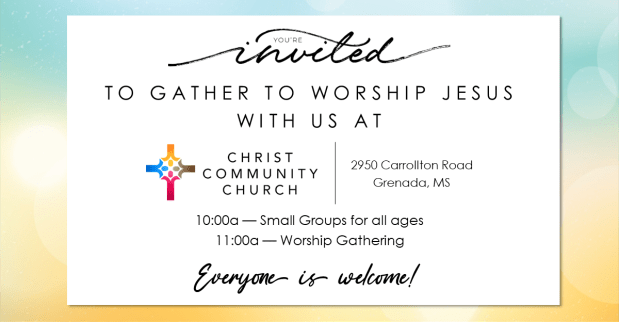
That’s the same invitation we offer every Sunday at Christ Community. Not a mere invitation to come to a gathering or event but an invitation to come to the father. Whether you are running in from rambunctious revelries in sin or have been standing off on your own in self-righteousness, the Father is waiting and watching, ready to embrace with open arms — not because we’ve earned it or are worthy but because He is full of grace.
The chorus of our invitation song sums this up well:
I run to the Father, I fall into grace I’m done with the hiding, no reason to wait My heart needs a surgeon, my soul needs a friend So, I’ll run to the Father again and again and again and again
If you’re weary, run to the Father.
If you’re guilty, come to Him.
If you need forgiveness, healing, or hope — come to the Father through His Son Jesus.
Romans 10:9-13 reminds us that everyone who comes to Him and calls upon Him will be saved. This is the message we preach, the hope we hold, and the reason we sing and live.
And once we’ve tasted His grace, how can we not respond in praise? That’s what we plan to do when we gather Sunday because He is mighty to save, His cross and empty tomb have made a way for us, and all who have confessed Him as Lord, believed that He is risen from the dead, and put their trust in Him have been saved by His grace.
Won’t you gather with us?
Here are our Scriptures and songs for Sunday:
Scripture | Romans 10:9-13 —
9…because, if you confess with your mouth that Jesus is Lord and believe in your heart that God raised him from the dead, you will be saved. 10For with the heart one believes and is justified, and with the mouth one confesses and is saved. 11For the Scripture says, “Everyone who believes in him will not be put to shame.” 12For there is no distinction between Jew and Greek; for the same Lord is Lord of all, bestowing his riches on all who call on him. 13For “everyone who calls on the name of the Lord will be saved.”
1Praise the LORD, all nations! Extol Him, all peoples! 2For great is his steadfast love toward us, and the faithfulness of the LORD endures forever. Praise the LORD!
We’re continuing in our study of Revelation called The KING is Coming. We took a break for our He Who Promised is Faithful readings during Holy Week but are glad to be back at it. Today, we will be diving into Jesus’s letter to the church at Smyrna. Once again, I am thankful for Jamie Harrison and the opportunity to do this study together.
8 “And to the angel of the church in Smyrna write: ‘The words of the first and the last, who died and came to life. 9 “ ‘I know your tribulation and your poverty (but you are rich) and the slander of those who say that they are Jews and are not, but are a synagogue of Satan. 10 Do not fear what you are about to suffer. Behold, the devil is about to throw some of you into prison, that you may be tested, and for ten days you will have tribulation. Be faithful unto death, and I will give you the crown of life. 11 He who has an ear, let him hear what the Spirit says to the churches. The one who conquers will not be hurt by the second death.’[1]
Keith Harris: Greetings, Sojourners,
We are in the letter to the church in Smyrna, continuing our study of Revelation. Jamie, why don’t you remind us as you did in our last Bible study about the form of these letters – the five things that show up in each one.
Jamie Harrison: Yes, that is correct. Each letter is going to have a salutation. In this letter, “Write to the angel of the church of Smyrna” (Revelation 2:8)[2] – the angel being, of course, the pastor, the messenger, the person delivering them the Word. Then, you’re going to have where Jesus will say something about Himself – His attributes. Then, there will be something about their works, some praise and admonition. Except in this church – Smyrna is one of two churches that does not have an admonition (correction, something to fix). Then, you’re going to have a universal admonition which is to anyone who hears, who has ears to hear – to listen to what the Spirit says to the churches. Finally, each letter will contain a final promise.
Keith: Alright, talk to us about Smyrna. What does Jesus tell us about Himself here?
Jamie: He starts off by saying, “Thus says the First and the Last, the one who was dead and came to life” (Revelation 2:8). The letter to Ephesus referenced back to the description of Jesus in Revelation 1, and so does this one. In Revelation 1:17, Jesus says, “Don’t be afraid. I am the First and the Last…”; He continues to say, “I was dead, but look – I am alive forever and ever, and I hold the keys to death and Hades.” It’s really cool that Jesus keeps going back to what He’s already said – to almost repeat for emphasis.
Keith: He’s doing it on purpose.
Jamie: Correct. He’s is the First and the Last which, like I said in Revelation 1, is a claim that He is God. He was there in the beginning as we know. “In the beginning was the Word, and the Word was with God, and the Word was God” (John 1:1). So He was the First, and He will be the Last.
It’s also important to note that He points out again that He is the one who was dead and has now came to life because all of Christianity is a complete waste of time if He didn’t raise from the dead (1 Corinthians 15:14-17). There’s a lot of dead people, but He’s the only one….
Keith: What is it that John Goldwater says? “Dead saviors can’t save.”
Jamie: That’s correct. You know, I was talking to someone the other day and – I apologize if this bothers anybody, but you know where people are like, You know that my dead relative was looking down on me today, or I was talking to them and they clearly gave me an answer. I know this is going to bother some people, but if you’re expecting some dead relative to help you with something, you’re [in a pickle]. I’m sorry, but when you take your last breath, you’re done. So, it’s important that we make a decision for Jesus before that happens….
Keith: …because He was dead and came to life – not was brought to life. He just stopped being dead (Revelation 2:8, John 10:17-18). Like Jamie was saying on the part of our relatives, it may seem to have someone we care about look from what we would describe as an afterlife, but we have something better than that: we have the God of the universe who was there at the beginning, pre-existed the beginning (John 1:1-3, Colossians 1:17) – He’s going to be there at the end and continue eternally. He is the God who saves, the God who looks after (Zephaniah 3:17, Psalm 121:3-5). He’s Emmanuel – God with us (Matthew 1:23). We shouldn’t be satisfied with lesser things (Psalm 119:37). Jesus is clearly superior to everybody and everything (Hebrews 1:3-4, Philippians 2:9-11).
Jamie: That’s right.
After Jesus says this, He goes into telling them some things about themselves. He says, “I know your affliction and poverty, but you are rich. I know the slander of those who say they are Jews and are not, but are a synagogue of Satan” (Revelation 2:9). Let’s touch on that real quick. When He says, “I know your affliction and poverty.” History tells us that Smyrna was a very wealthy town – very well-to-do. Why would the Christians there experience “affliction and poverty”? It’s simple when you look at it.
In order to work, you had to join a guild, which is like what we would call a labor union, right? Each one of those guilds back during that time, would have been represented by some god or goddess. In order to join, you had to worship that god or goddess. So as a Christian….
Keith: …almost like your dues….
Jamie: As a Christian, I’m not going to worship this god or goddess because that’s a false god. I’m not going to be able to join a guild, which means I’m not going to work because I can’t get a job. It wasn’t laziness – they couldn’t get a job. A lot of Christians ended up begging for food and things like that, but it’s because they were willing to suffer that affliction to follow Christ.
So, we ask ourselves the question of if someone comes to you at work and asks you to do something immoral (or whatever the case may be), are you going to do it to keep your job or say “no” and that whatever happens happens? Are you going to compromise your relationship with Christ to advance at the workplace? Or are you going to put Him first? These Christians here at Smyrna put Him first.
Then He tells them that He knows the slander of “those who say they are Jews and aren’t but are a synagogue of Satan”. He tells [the believers there] that they are about to suffer – that the devil is going to throw some of them in prison to test them, and they’ll “experience affliction for ten days”; He tells them, “Be faithful to the point of death, and I will give you the crown of life” (Revelation 2:10).
He kind of tells them exactly what’s about to happen. There’s this synagogue of “Jewish” people who are claiming to be Jews but in the biblical sense, they’re not.
Keith: Ethnically, they are, right? But just as Jesus told the Pharisees on more than one occasion – you’re talking about your father Abraham but you’re of your father the devil. The fruit of your life is showing what you are more than your ethnicity is.
Jamie: Mmmm…. This was happening. This synagogue was slandering them. They would be jailed normally about ten days. They experienced, obviously, persecution and things like that while in prison – sometimes to the point of death. But Jesus says, “Be faithful to the point of death and I will give you the crown of life.” So, what is the crown of life talking about? I think we probably know the answer to that, but let’s look at James 1:12. Again, we always want the Bible to speak for itself. James 1:12 says, “Blessed is the one who endures trials, because when he has stood the test he will receive the crown of life that God has promised to those who love Him.” So, it’s eternal life with Jesus.
You notice, you know, this book of Revelation a lot of times – when we look at it, we think it’s just a sign of what’s going to happen and all these different things and how bad things are going to be – and it is, but it’s not at the same time. The revelation is of Jesus Christ (Revelation 1:1). It’s about Jesus Christ. It’s to lead us to Jesus Christ (Revelation 1:17-18, 5:9-10). The whole central setting of Revelation is the throne room (Revelation 4:2-6). Everything centers around the throne room where God – the Father, the Son, the Holy Spirit – is present with multitudes around them worshiping Him, praising Him (Revelation 4:8-11, 5:11-13). Right? As all of these things are going on.
There’s no admonition in this letter to Smyrna. There’s no this is what you’re doing wrong. They have it. They get it. They have a relationship with Jesus, and because of that relationship, they are putting off these other things and are following after Him. Because of that they’ll receive the crown of life.
Keith: I mean, just that idea in and of itself: be faithful unto death. If you’re living in an area of the world where following Jesus means certain death, you’re going to be in less need of an admonition because if you’re know that following Jesus means certain death here on earth, you’ve counted the cost like Jesus said in Luke 14:27-28.
The idea there that “be faithful unto death, and I’ll give you the crown of life”, He doesn’t say when you die in prison in ten days or when you die in the tribulation; it’s for all of life. If you’re like John, who’s on the island of Patmos in probably his 80s or 90s – that just because he didn’t get martyred, he’s no less faithful unto death. He’s faithful until the time that God calls him home. That crown of life isn’t just for martyrs; it’s for those who are saved for all of life.
Jamie: You know, you’re talking about people who are being persecuted even to the point of death today…. Was it Richard Wurmbrand in that book we read[3]? They put him in a room – in a closet, basically smaller than a closet, and all four walls were nails. There was just enough room for you to stand. If you moved at all, you were going into these nails. They had him in that room for days on end. No food. No water. Nothing like that. Eventually, they would open the door and he would just collapse to the ground. They would defecate and make him eat it – urinate in his mouth, things like that….
Keith: …beat his feet so much that he could never wear shoes again the rest of his life….
Jamie: Right. And not once did he waver. Not once did his relationship with Christ come into question. He continued to tell the guards about Jesus the whole time he was there. And eventually did get out. But what it did was it strengthened his faith. So, if there was any point, to all of these trials is that it strengthens our faith in God.
Keith: Speaking of, I had forgotten about this, but while you were talking…there was a guy named Polycarp. He was a pastor in Smyrna and a disciple of the apostle John. And at [Polycarp’s] martyrdom, when he’s about to be executed for Christianity, they gave him an opportunity to recant. We talked last week where Jesus gave the church at Ephesus to repent and remember the love they had at first – those who were going to execute Polycarp gave him an opportunity to repent and remember his love for the powers-that-be, His love for Jesus was more. He says,
“For eighty and six years I have been his servant, and he has done me no wrong. And how can I now blaspheme my king who saved me?”
They killed him for that, but Jesus’s own words here – and I don’t think that’s an accident – I mean, it’s more than ten days later, but I don’t think it’s an accident that Jesus told Smyrna this knowing full well that Polycarp and those in the immediate context living in the same situation as Polycarp – that they were faithful unto death.
Polycarp has a crown of life. John has a crown of life. And if we, in our churches today, are faithful unto death, then we’ll receive that crown of life. The proof’s in the pudding, so to speak.
Jamie: It is. That pudding’s pretty good stuff…..
Just to finish this out real quick…. I always say real quick, and it always takes forever. I take that back.
Keith: It takes the time it takes.
Jamie: Just to finish this out, we have Jesus with a universal admonition, which in a word, you know, is let anyone who has ears to hear, listen to what the Spirit says to the churches. What is the Spirit saying to us? He says, “To the one who conquers”. Remember 1 John 5:4-5 here. This is those who are saved, those who have a relationship with Jesus will never be harmed by the second death.
11 Then I saw a great white throne and one seated on it. Earth and heaven fled from his presence, and no place was found for them. 12 I also saw the dead, the great and the small, standing before the throne, and books were opened. Another book was opened, which is the book of life, and the dead were judged according to their works by what was written in the books. 13 Then the sea gave up the dead that were in it, and death and Hades gave up the dead that were in them; each one was judged according to their works. 14 Death and Hades were thrown into the lake of fire. This is the second death, the lake of fire. 15 And anyone whose name was not found written in the book of life was thrown into the lake of fire.
This is not a scare tactic by any stretch of the imagination. It’s explaining what the second death is. You might have died here on earth, but the second death is the one – it’s the one. If you have a relationship with Christ, you won’t experience the second death (John 3:16, 5:24). You will have a life everlasting with God the Father (John 17:3). If you don’t have a relationship with Christ, you will experience that second death, which – even with all of the lake of fire and all that – the punishment of hell is an eternal separation from God (2 Thessalonians 1:8-9; Matthew 25:41, 46). You’re never with Him again. You’re eternally separated from your Creator.
Keith: And the ever-presence of His wrath.
Jamie: That’s right, but I think the people who are there will still blame Him – will still be angry with Him. So imagine living in eternal punishment, being angry the entire time. That’s the feeling it’s going to be. I can’t describe it. We’ve never been there. We don’t understand it. We don’t want to be there.
Sometimes, like right now, people will be like, now, let me invite you to come to know Jesus, but I don’t want you to come to know Jesus because you’re scared to go to hell. If you come to know Jesus, it needs to be because you were convicted by His Word and want to have a relationship with Him – and you want to love Him.
Keith: How does Paul say it in Philippians 3:8? The surpassing worth of knowing Christ. That’s a far cry from the surpassing worth of not wanting to go to hell.
You think about different people you’ve heard talk. Well, I got married to so-and-so because they were the only person in my community or if I didn’t marry this person I’d have to marry that person. That’s not love. … The idea that you’re just pursuing one thing because you don’t want the other, that’s not it.
That’s not the image you get in Matthew 13:44-46 where Jesus is giving the parables of the man who is walking through a field and finds a treasure worth more than any treasure he’s ever seen. He immediately goes back to his house, cashes out all of his assets, and buys the field. He’s not willing for anyone else to find this treasure. The pearl merchant who, upon finding the pearl of great price, doesn’t haggle – doesn’t negotiate – he cashes out everything he has to buy this one pearl.
Jamie: And that’s what these people in Smyrna did. They were willing to give up their jobs – the opportunity to own their house, purchase food for their family, things of that nature – for the sake of Christ.
Keith: That’s one of the things that I wonder here, and I’m not trying to speculate. But He’s talking to them about how they were rich before Christ in a worldly sense. Now in a worldly sense they’re in poverty. Jesus reminds them that they are rich – that their life is in danger but they have Life. I would imagine some of them were in definite danger – not necessarily of martyrdom or execution but just in the ability to sustain themselves and live.
As we look at this to close it out, think about how we talked about Polycarp and Richard Wurmbrand. It reminds me of the perspective here – “the one who conquers will not be hurt by the second death” (Revelation 2:11) – the idea that the closest to hell believers will ever experience is what they experience here on earth. That’s the greatest threat the world can give us – that it’s going to kill us, leads us to our greatest reward (Philippians 1:21-23, Revelation 21:4-5).
This reminds me of Dietrich Bonhoeffer.I’ve been reading through his Letters and Papers from Prison[4]…. There are times where he’d be aggravated that he had opportunities for the gospel and he’d repent and minister to this or that person. Everyone who was thrown into the concentration camps wasn’t Jewish ethnically. They weren’t even necessarily for the cause. If they Nazis wanted to just get someone out of the way, they had the camps for this.
Bonhoeffer, on the last day of his life, got up and preached. There was a guy there as a witness – a British intelligence officer kind of kept the Nazi guards at bay to let him finish his sermon. Then Bonhoeffer willing went with them – walked to his execution almost consoling the guards because – you know, you’d have to feel some kind of way when somebody’s looking at you and talking about the love of Christ, preaching the gospel and you’re going to be the one to kill him. And what he told those guards right before they took his life was: “This is the end, but for me, it is the beginning.”
Where so many face the second death, those believers in Smyrna, they face the beginning.
The tears they had for persecution were wiped away by the nail-scarred hands of their Savior whom they served unto death.
That’s good news.
Jamie: Amen.
Keith: Well, Jamie, that about wraps it up for Smyrna. Sojourners, we’ve enjoyed our time with you today. Check with us next time as we look at the letter to the church at Pergamum.
Sunday is the Lord’s Day – Resurrection Sunday, and I am excited!
The original resurrection Sunday, when Jesus walked out of the tomb alive and well, is the day that changed everything.
Why? How?
At the heart of the Christian faith is one message – the proclamation of the gospel message – that Paul calls “of first importance – a message that holds the power to give life, forgive sin, and secure eternity with Jesus:
“…Christ died for our sins in accordance with the Scriptures, that He was buried, that He was raised on the third day in accordance with the Scriptures….”
This is not just an inspirational story or some religious tradition. It is the true, good, victorious news that Jesus died for sinners like us, was buried in a borrowed tomb, and rose again just like the Scriptures said He would.
Yes, Jesus died for our sins – taking our punishment and paying our sin debt.
Yes, He was buried – truly dead, wrapped in grave clothes and laid in the silence of the grave.
But praise God, HE IS RISEN!
When the women arrived at the tomb that first Resurrection Sunday morning, they heard the words that still echo throughout history:
Jesus always – ALWAYS – keeps His word. And His resurrection proves it. It proves His power over sin and death. It proves His identity as the Son of God – as God incarnate. It proves that all who trust in Him can have a living hope, an unshakable promise of eternal life.
This Sunday at Christ Community, we’ll gather not just to remember an empty cross or to commemorate an empty tomb. No, we’ll gather to worship our risen and resurrected King! We’ll sing “King of Kings” and “Holy, Holy, Holy (Jesus Reigns)” because Jesus is alive and reigning even now, interceding on behalf of those He saves at the right hand of the Father. We’ll celebrate our “Living Hope” and declare that “Ain’t No Grave” able to hold Jesus or those He gives eternal life!
John is going to open the Word of God and point us to our resurrected Lord and King, our great God and Savior Jesus Christ.
All in all, we’ll embody the truth of the beloved hymn “Because He Lives”. Because He lives, we can face tomorrow. Because He lives, all fear is gone. Because He lives and we know that He holds the future in His hands, life is worth living. Jesus has changed everything because He lives!
So, come and worship. Come and believe. Come and rejoice in the Savior who died, who was buried, and who rose again – just as He said.
Most Sundays, we list out the Scriptures and songs we’ll use in our worship gathering to help people prepare their hearts. These posts are typically titled “Songs for Sunday”.
Here are our Scriptures and songs for Sunday, April 20:
1Now after the Sabbath, toward the dawn of the first day of the week, Mary Magdalene and the other Mary went to see the tomb. 2And behold, there was a great earthquake, for an angel of the Lord descended from heaven and came and rolled back the stone and sat on it. 3His appearance was like lightning, and his clothing white as snow. 4And for fear of him the guards trembled and became like dead men. 5But the angel said to the women, “Do not be afraid, for I know that you seek Jesus who was crucified. 6He is not here, for he has risen, as he said. Come, see the place where he lay. 7Then go quickly and tell his disciples that he has risen from the dead, and behold, he is going before you to Galilee; there you will see him. See, I have told you.”
3Blessed be the God and Father of our Lord Jesus Christ! According to his great mercy, he has caused us to be born again to a living hope through the resurrection of Jesus Christ from the dead, 4to an inheritance that is imperishable, undefiled, and unfading, kept in heaven for you, 5who by God’s power are being guarded through faith for a salvation ready to be revealed in the last time.
25 For I know that my Redeemer lives, and at the last he will stand upon the earth. 26 And after my skin has been thus destroyed, yet in my flesh I shall see God, 27 whom I shall see for myself, and my eyes shall behold, and not another. My heart faints within me!
With those words, the grave was silenced, death was defeated, and hope reigned eternal.
Long before that first Resurrection Sunday morning, Job declared through tears and pain, “I know that my Redeemer lives” (Job 19:25). He didn’t have all the answers, but he held onto the living hope that one day, beyond death and decay, he would see his God for himself. That hope was not misplaced.
Because Jesus lives, we can face anything – even death – with confidence. The Redeemer Job longed to see is the risen Christ who lived on earth, bore our sorrows unto death, and now lives reigns in glory. And as surely as He rose, He promises that all who trust in Him will rise too (John 11:25).
Today is not just a celebration of what happened – it is a declaration of what is to come. Our Redeemer lives! And one day, with resurrected eyes and glorified bodies, we will see Him face to face.
Let your heart rise with resurrection hope. Jesus is not here. He has risen just as He said. He ascended back to heaven and has promised to return to gather His people to Himself.
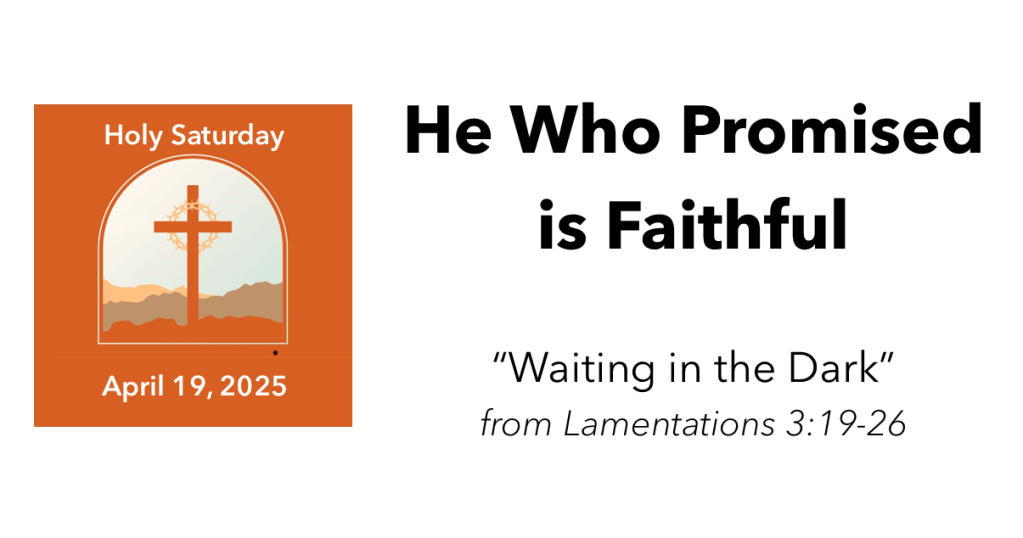
21 But this I call to mind, and therefore I have hope:
22 The steadfast love of the LORD never ceases; his mercies never come to an end; 23 they are new every morning; great is your faithfulness. 24 “The LORD is my portion,” says my soul, “therefore I will hope in him.”
25 The LORD is good to those who wait for him, to the soul who seeks him. 26 It is good that one should wait quietly for the salvation of the LORD.
The Original Context
Lamentations is a book of grief written in the aftermath of Jerusalem’s destruction. It gives voice to the sorrow of a people who had lost everything – temple, city, freedom.
Lamentations 3 is a turning point where there is a flicker of hope in the midst of lament. In the middle of darkness, the character of God shines forth: steadfast love, daily mercy, and great faithfulness.
These verses are not spoken from comfort but from ruin. They don’t deny suffering; they declare hope despite suffering, despite crying out in lament. Waiting quietly for the Lord’s salvation was not easy, but it was the only way forward.
Fulfillment in Jesus
Holy Saturday represents the in between. Jesus’s body lay in the tomb. His disciples were scattered and silent. The heavens were quiet. From the outside, it looked like all hope had been buried.
But even in silence – in the in between, God was faithful. Jesus had already promised that after three days He would rise (Mark 8:31). Even when the world couldn’t see it, God’s mercies were not on pause. His redemptive plan was still unfolding.
Holy Saturday reminds us that waiting is part of redemption. Jesus entered the grave, but He wouldn’t stay there. Sunday was coming.
Hope for Today
Many of us live in “Saturday” seasons – waiting for prayers to be answered, healing to come, or joy to return. The silence of God – the in between – can feel unbearable. But Lamentations gives us a word for these moments. God’s mercies never end. His faithfulness is great. And even when we wait in the dark, we wait with hope.
So today, rest in the character of God. Remember His past faithfulness. Trust in His promises. Wait quietly – not because you see the answer yet but because you know and trust that Jesus will bring it.
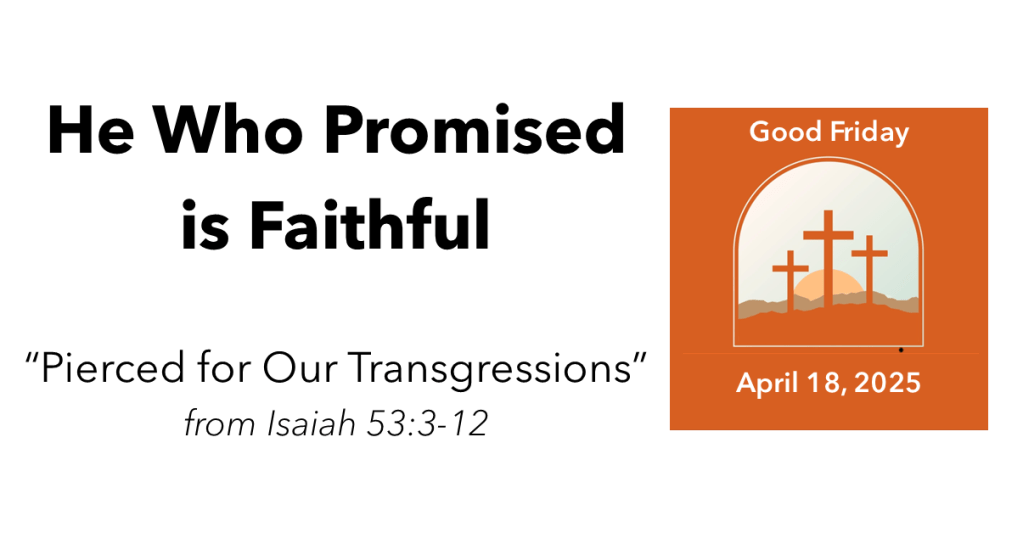
3 He was despised and rejected by men, a man of sorrows and acquainted with grief; and as one from whom men hide their faces he was despised, and we esteemed him not.
4 Surely he has borne our griefs and carried our sorrows; yet we esteemed him stricken, smitten by God, and afflicted. 5 But he was pierced for our transgressions; he was crushed for our iniquities; upon him was the chastisement that brought us peace, and with his wounds we are healed. 6 All we like sheep have gone astray; we have turned—every one—to his own way; and the LORD has laid on him the iniquity of us all.
The Original Context
Isaiah 53 is one of the clearest prophecies in the Old Testament about the coming of a Suffering Servant – One who would be rejected, bear sorrow, and ultimately carry the guilt of others. Verses 3-6 portray this Servant as misunderstood and mistreated. The people saw His suffering and assumed it was punishment from God for His own sins, but Isaiah pulls back the curtain: the Servant wasn’t suffering for His own wrongs – He was bearing the griefs, sorrows, transgressions, and iniquities of others.
This wasn’t punishment for failure. It was substitution. God laid the guilt of His people on this Servant. He was pierced, crushed, chastised – not because of what He had done but because of what we have done. It’s the language of atonement. It is one life being laid down to bring peace and healing to many.
Fulfillment in Jesus
Jesus is the Suffering Servant who Isaiah foretold. He was despised and rejected by His own people. He wept over the unbelief in Jerusalem (Luke 19:41), was betrayed by a friend (Luke 22:47-48), and was abandoned by His disciples (Matthew 26:56). He was beaten, mocked, and crucified – pierced by nails and crushed under the weight of humanity’s sin and the wrath of God against that sin.
But this was neither accidental nor tragic. Jesus didn’t die a victim of injustice but as a willing substitute, the Lamb of God who takes away the sin of the world (John 1:29). It was the purpose for which He came: “Christ died for our sins in accordance with the Scriptures” (1 Corinthians 15:3). At the cross, Jesus bore our griefs and carried our sorrows. Our rebellion against God became His burden. The punishment that brought us peace was laid upon Him. And by His wounds, we are healed – not just physically or emotionally, but spiritually and eternally.
Hope for Today
Good Friday is not a tragedy – it is a triumph through sacrifice.
Good Friday reminds us that salvation isn’t something we earn but something we receive. The weight of our guilt was laid on Jesus. Our wandering hearts find a home in Him who died that we may live.
We are all like sheep – wayward, distracted, self-reliant (or trying to be), but the Shepherd became the Lamb and was led to the slaughter for our sake. If today feels heavy, let it. The cross was no small thing. But don’t stop at sorrow – look through it to see the love of God on full display.
If you have ever felt too sinful to be forgiven, too broken to be loved, or too far gone to be reached – Isaiah 53 is for you. Your sin is not too much for the Savior. The Servant of Isaiah 53 – Jesus Christ – came for sinners just like me and you.
You are not alone in your brokenness and sin. You are not stuck in your guilt. You are not without hope. Jesus was pierced for you. And those who put their faith in Him are forgiven, healed, and brought near.
So come and behold the Lamb – despised and rejected yet full of mercy and grace. Let your heart rest in the peace He purchased with His blood.
Come to the cross.
Let your heart be pierced by His mercy.
Marvel that God would do this for you.
And remember: while Good Friday ended in death, it opened the door to life because Sunday’s coming!




 Just Keith Harris