The LORD is my shepherd; I shall not want…. Surely goodness and mercy shall follow me all the days of my life, and I shall dwell in the house of the LORD forever.
Psalm 23:1, 6
Psalm 23 is among the most beloved and often quoted passages of Scripture, offering profound comfort and hope. It uses two main illustrations: the Lord as Shepherd (vv. 1-4) and the Lord as Host (vv. 5-6). These metaphors vividly illustrate God’s care, guidance, protection, and provision for His people.
David begins with the declaration that “The Lord is [his] shepherd” and that because He is he “shall not want” (v. 1). This is not just a statement of confidence but more of a deep personal affirmation of David’s trust in his Lord. In the ancient world, kings were often compared to shepherds, tasked with providing for and protecting their people. Here, David, Israel’s literal shepherd-king, acknowledges that he himself is a sheep under the care of the Chief Shepherd.
God provides abundantly for His flock. The “green pastures” and “still waters” (v. 2) symbolize rest, nourishment, and peace. The Shepherd knows what His sheep need and leads them accordingly. Even in “the valley of the shadow of death” (v. 4), the darkest and most dangerous of places, the sheep are secure. Why? Because the Shepherd is there. His rod (used for protection) and His staff (used for guidance) bring comfort and assurance.
Psalm 23 then shifts from the image of a shepherd to that of a host preparing a large and lavish banquet. The phrase “You prepare a table before me in the presence of my enemies” (v. 5) speaks of victory, provision, and honor. In the face of opposition and perceived danger, God sustains and blesses His people. Anointing the head with oil was a sign of hospitality and joy, and the overflowing cup reflects the abundance of God’s blessings.
It concludes with the confidence that God’s goodness and mercy (His steadfast love, His chesed) will pursue His people all the days of their lives, culminating in their dwelling with Him forever (v. 6), when He will no longer pursue because we will be safe in His presence.
Seeing Jesus in Psalm 23
Jesus is the fulfillment of Psalm 23. He is the Good Shepherd who laid down His life for His sheep (John 10:11). Just as David declared, “He restores my soul” (v. 3), Jesus restores the lives of those He saves, leading them on paths of righteousness for His name’s sake.
In the New Testament, Jesus embodies both Shepherd and Host. He leads His followers through the trials and dangers of life, offering His constant presence and peace as Emmanuel (God with us). Through His death and resurrection, He conquered the ultimate valley of death, not merely its shadow (v. 4), ensuring that His sheep will never be abandoned or forsaken.
The table prepared “in the presence of…enemies” (v. 5) points forward to the victory banquet (marriage supper) of the Lamb (Revelation 19:9), where Jesus invites His people to eternal fellowship with Him, dwelling in His house forever and His goodness and mercy will no longer follow but be the ambiance of God’s glory in His house forevermore (v. 6)!
Reflection
Psalm 23 invites us to rest in the care of the Good Shepherd. Are you weary, burdened, or fearful? Remember that Jesus not only walks you through life’s green pastures but also through its darkest valleys. His presence and protection are enough.
Take time today to reflect on God’s abundant provision and steadfast love in your life. Trust Him to lead, sustain, and guide you – even when the path ahead seems uncertain or fraught with danger or death. He is a Shepherd who never leaves His sheep, a Host who welcomes His people with joy, and a King who reigns with goodness and mercy.
Are you following the Shepherd’s voice today? Rest in the assurance that you are His, and He will guide you safely home.
The #dailyPSALMSchallenge gives us the opportunity to start 2025 in God’s Word by digging into a psalm a day. Each day will identify a key passage for us to meditate on as well as seeking to help us see Jesus in the psalm and reflect on what we have read.
Have y’all ever gotten something stuck in your mind that you just couldn’t get unstuck? Of course you have – everyone has experienced this at some point and time. For me, it is the key verse from John’s sermon last week, Romans 12:15:
Rejoice with those who rejoice, weep with those who weep.
It’s simple. Straightforward. Clear. As John explained to us, this verse is really only four words in the Greek, essentially “rejoice — rejoicers, weep — weepers”. We, those of us who are saved and have been adopted into God’s family and grafted into His church, are to be there for our brothers and sisters, hurting when they hurt. That’s what family does, right? It should especially be so in the family of God.
As I have pondered on that verse (really simmered or stewed like a crockpot), it has had me thinking on why it is to be this way. And essentially, I have arrived at the conclusion that it stems from us extending grace to others as Jesus has extended grace to us.
One Scripture that came to mind is from the Sermon on the Mount right after Jesus gave us what we call “The Lord’s Prayer”. Look at Matthew 6:14-15:
For if you forgive others their trespasses, your heavenly Father will also forgive you, but if you do not forgive others their trespasses, neither will your Father forgive your trespasses.
This is not saying that we earn God’s forgiveness by forgiving others. If that were the case, we’d have no hope because humanity as a whole is not a forgiving people but rather quite selfish and self-serving. No, what Jesus is saying here is that the way we forgive is based on how we have been forgiven. If we understand that our sin put us at odds and enmity with Jesus and that He reconciled us to Himself and showed us love while we were still sinners, we will have an appreciation for that love and forgiveness that will show in how we forgive others.
This isn’t some theory on my part or some great epiphany. Jesus explained it similarly to Simon the Pharisee after the woman came in and washed Jesus’s feet with her tears, dried them with her hair, and anointed them with costly perfume. When Simon (and Jesus’s own disciples) were critical of the woman’s wastefulness with pouring out very expensive perfume on Jesus’s feet, Jesus told them that the woman’s sins “which are many” had been forgiven which was why she “loved much”, and He clarified that the one who has been “forgiven little, loves little” (Luke 7:47).
If you are saved, you know that you have been forgiven MUCH because your sin — no matter how the world might view it — is a LOT, and definitely more than our sinless Savior should’ve had to bear on the cross. We deserve the cross, not Jesus. We deserve death, not Jesus. But because of His great love and richness in grace and mercy, He forgave much, loved much, and gave much. That kind of forgiveness, love, and grace changes folks’ lives. If you are saved, you have received this from Jesus and cannot help but extend it to others.
Simon didn’t get it. He thought he had some earthly status as a Pharisee. But when you look at the other gospels, you get, as Paul Harvey would’ve said, the rest of the story. Matthew 26:6 doesn’t call Simon a Pharisee; there he is referred to as “Simon the leper”. You don’t have to read a lot of the Bible to know that folks typically kept their distance from lepers. They were considered unclean. Folks would walk on the opposite side of the road to keep from touching one. They surely wouldn’t touch one, much less go to his house for supper. Long story short, Jesus wasn’t at Simon’s house to honor him but because Jesus had compassion on those no one else did. Jesus was a friend to sinners. He ate with tax collectors. He showed compassionate care to those the world had thrown away. No one was lining up at Simon’s door because Simon was unclean, untouchable, and unmistakably ostracized from society. Yet he looked at that poor woman weeping at Jesus’s feet and had the audacity to remark how pitiful it is that Jesus would let her touch Him (when anyone passing by could’ve remarked how pitiful it was for Jesus to go in Simon the leper’s house).
Simon didn’t get it.
Do we?
That woman had received a lot of grace because she’d committed a lot of sin.
That woman had experienced greater love from God who not only forgave her sin but would go on to die on the cross her sin deserved.
That woman had reason to weep sorrowfully over her sin against a holy God but had more reason to weep out of rejoicing that her sin was wholly forgiven by God and show love to Him in return.
What about us? Do we get it?
Look at how Paul put it in 2 Corinthians 1:3-4:
Blessed be the God and Father of our Lord Jesus Christ, the Father of mercies and God of all comfort, who comforts us in our affliction, so that we may be able to comfort those who are in any affliction, with the comfort which we ourselves are comforted by God.
God has shown us grace and comfort because He loves us. We have the opportunity to show that grace and comfort to others. And this is sorely needed in a world today that seems like the rejoicing is getting more seldom and weeping is ever increasing.
Thankfully, Sunday’s coming. There is a coming Day when Jesus will return and gather His people to Him. The last tears of sorrow will be cried and wiped away by His nail-pierced hand. Death will be abolished. The sad things of this earth will come untrue. As the old hymn says, “What a Day — glorious Day — that will be!”
Until that day, we will gather and read God’s Word, sing God’s Word, and hear God’s Word preached. That’s what we’re singing about this Sunday: telling what Jesus has done for us. And as we do so, we will have brothers and sisters who are rejoicing about this or that. Rejoice with them. Assuredly there will be those with much to weep about. Weep with them. You have been given much grace and love. Christ Community family, it’s time to extend that grace and love to others.
Won’t you gather with us?
Here are our Scriptures & songs:
Scripture | Titus 3:1-7 —
1Remind them to be submissive to rulers and authorities, to be obedient, to be ready for every good work, 2to speak evil of no one, to avoid quarreling, to be gentle, and to show perfect courtesy toward all people. 3For we ourselves were once foolish, disobedient, led astray, slaves to various passions and pleasures, passing our days in malice and envy, hated by others and hating one another. 4But when the goodness and loving kindness of God our Savior appeared, 5He saved us, not because of works done by us in righteousness, but according to His own mercy, by the washing of regeneration and renewal of the Holy Spirit, 6whom He poured out on us richly through Jesus Christ our Savior, 7so that being justified by His grace we might become heirs according to the hope of eternal life.
17When I saw Him, I fell at His feet as though dead. But He laid His right hand on me, saying, “Fear not, I am the first and the last, 18and the living one. I died, and behold I am alive forevermore, and I have the keys of Death and Hades.
2Continue steadfastly in prayer, being watchful in it with thanksgiving. 3At the same time, pray also for us, that God may open to us a door for the Word, to declare the mystery of Christ, on account of which I am in prison — 4that I may make it clear, which is how I ought to speak. 5Walk in wisdom toward outsiders, making the best use of the time. 6Let your speech always be gracious, seasoned with salt, so that you may know how you ought to answer each person.[1]
📖 Revelation 7After the terrifying events of Revelation 6, John is given a breathtaking glimpse of hope. Before judgment continues, God reveals that His people are known, sealed, and secure in Christ. The chapter culminates with one of Revelation's most beautiful pictures: the Lamb who was slain is also the Shepherd who leads His people forever.In this episode, Keith Harris and Jamie Harrison discuss:✔️ Why Revelation 7 is an interlude between the sixth and seventh seals✔️ What it means for God's servants to be sealed✔️ The two primary views of the 144,000—and why faithful Christians differ✔️ How John's pattern of hearing one thing and seeing another helps interpret the chapter✔️ The innumerable multitude worshiping before the throne✔️ Why Jesus, the Lamb, is also our Shepherd who leads us to living waterThis chapter reminds us that our greatest hope isn't solving every prophetic question—it's belonging to Christ. Those who trust Him are safe in Him, and one day He will wipe away every tear from their eyes.📖 "For the Lamb in the midst of the throne will be their shepherd, and he will guide them to springs of living water, and God will wipe away every tear from their eyes." (Revelation 7:17, ESV)🔗 If you'd like to see a written version of this podcast, complete with footnotes and cross-references, you can find it here.
I don’t know about y’all, but last fall and early winter were so busy. We’ve been traipsing back and forth across the South following my daughter and the high school band, writing this past year’s Advent guide (hopefully you got to follow along with the “Good News of Great Joy” readings in Luke), preaching a revival, serving the Lord at Christ Community and wherever else opportunity has arisen, started writing the #dailyPSALMSchallenge posts, and managed to work teaching school, too. Busy, busy, busy. It had been my intention to be finished with our Colossians study by now, but I am finding the older I get that things get done when they are done. Additionally, things worth doing well are worth working on until they are ready (even if I was ready to get it done before it was complete).
This closing exhortation (Bible word that is a mixture of warning, encouragement, and coming alongside someone to help them) of Paul’s here in Colossians 4:2-6 has been working on me throughout my busyness. The way I study these days – whether to write or preach or teach or whatever – is to work through the cross-references for a passage in my notebook, and I carry that notebook with me most places. I study and ponder on the passage and the verses throughout Scripture that give its context. I dwell with the passage. I meditate on it. Really, it is not as academic or spiritual as that sounds but more like the action of a crockpot where I simmer in the passage and its connecting verses until it’s done and ready to serve. I said Colossians 4:2-6 has been working on me; maybe the better way to say it is God has been working it into my life.
To understand this closing exhortation, you need to think of it in the context of the whole letter of Colossians. The first two chapters focus on doctrine, teachings about Jesus, His gospel, and the eternal life He gives, that the church at Colossae was missing. False teachers were coming in, taking advantage of the gaps in their knowledge and seeking to fill them with dangerous teachings and practices meant to lead them away from Christ. The last two chapters focus on putting that doctrine into practice. The church at Colossae needed to learn what it is to put our focus on Christ, namely taking off and putting to death the sin that belonged to their old life and putting on Christ, being adorned in and with Him, and living as His Spirit and Word direct. The biggest part of that application is where Paul helps the church at Colossae – and us – to be adorned in Christ in all areas of our lives, marriages, families, vocations, and so on. This exhortation fits at the tail end of how to be adorned in Christ in all areas of our lives.
As I said earlier, an exhortation is a kind of like coming alongside someone to help them. Picture being on a battlefield and your brother or sister soldier injures their leg and cannot walk on their own. You don’t just leave them there and save yourself. No, you reach down, grab their arm and put it across your shoulder, and you become a leg for them. They cannot walk, but y’all together can. This is recognition that in this spiritual battle, those who belong to the Kingdom of God lift one another up. In this case, Paul is writing to them from his place on the battle field in prison to lift them up and encourage them to keep the faith as they go through life and to lift up one another.
You might read this and be startled by the imagery of battle, but that is the reality of living in Christ for His Kingdom while we still live among the kingdoms of this world. Much of Paul’s letter to Ephesus mirrors aspects of the letter to Colossae. Where we have the exhortation in Colossians 4:2-6, this portion of Ephesians describes the need for putting on the “whole armor of God, that you may be able to stand against the schemes of the devil” (Ephesians 6:11) and recognizes that we are wrestling – literally fighting – against an enemy that is not of this world – not “against flesh and blood, but against the rulers and authorities, against the cosmic powers over this present darkness, against the spiritual forces of evil in the heavenly places” (Ephesians 6:12).
We will walk through three ways in which we can lift one another up as we are on the Church’s mission, through prayer, preaching, and practice.
Prayer is Imperative to the Mission (vv. 2-4)
Prayer is literally the most we can do. A lot of times folks are willing to neglect prayer so that they can do something or make something – like praying or serving or whatever, but when you really get down and think about it, what more can you do than take your petitions to the almighty God of the universe?
That’s not a rhetorical question: what more can you do than take things in prayer to God Most High? The obvious and only answer is a resounding “no”.
Look at the way the author of Hebrews describes prayer in Hebrews 4:16:
Let us then with confidence draw near to the throne of grace, that we may receive mercy and find grace to help in time of need….
Consequently, He is able to save to the uttermost those who draw near to God through Him, since He always lives to make intercession for them.
Prayer is an opportunity to approach the throne of God with the same level of confidence of a toddler approaching a parent’s bed in the middle of the night, scared from some lurking shadow or bad dream. That baby knows they will not experience reproach even though they rouse the sleeping parent in the middle of the night. They know they will find mercy and grace, love and peace. We get to approach God’s throne knowing He will not reprove or rebuke but dispense the mercy and grace in our “time of need”.
Furthermore, Jesus not only meets our needs but saves “to the uttermost those who draw near to God through Him”. Read that again – “to the uttermost”, meaning completely and at all times. Also, if we aren’t careful, we can miss that last part of Hebrews 7:25; Jesus “always lives” – ALWAYS LIVES – “to make intercession” for His people, “those who draw near to God through Him”. That phrase “make intercession” means that Jesus is appealing to the Father on our behalf, to give us mercy and grace in our time of need.
That’s what Paul is telling the Colossian church – and us to do: “Continue steadfastly in prayer”. It is clear that Paul wants them, and us, to pray for each other and him, but he is specific in how he wants them to do it.
First, he tells them to be “watchful” in prayer “with thanksgiving”. The idea of being watchful there reflects Ephesians 6:18 and his command to the church at Ephesus to “keep alert [in prayer] with all perseverance, making supplication for all the saints”; to be “watchful” or “keep alert” in “perseverance” in prayer means to be alert to the needs of people around you and to lift them up specifically to God rather than being vague and unfocused. Sometimes we are tempted to almost have a prayer genealogy of be with so and so and be with this one and be with that one, never pleading with God (supplication) for what they need or seeking God on their behalf (intercession) in their time of need or even peril. We should be aware of what’s going on in our brothers’ and sisters’ lives – or at least aware something is going on – and approaching the “throne of grace” for them. This should be done “with thanksgiving” because 1)we can already be thankful that we have a place to go where we can be confident to receive help and 2)that we know God wants to dispense mercy and grace in the time of need.
Second, Paul asks them to pray for him and gives a specific prayer request. Keep in mind that Paul penned this letter from prison. He could have easily asked them to pray that he be released or that God would supernaturally get him out of prison; many of the apostles and early church folks experienced all of that. But Paul didn’t. He was confident that he was right where God had him. His prayer request was for God to “open…a door for the Word, to declare the mystery of Christ, on account of which [he was] in prison”; he wanted God to provide an opportunity for preaching the gospel where he was.
This is a big deal because it differs from how we pray sometimes. We often pray to be delivered from our trying times – and there is nothing inherently wrong with that. As I said, Paul could have prayed for that as well. He didn’t though, and that reveals something to us that reflects how Jesus told us to pray in His model prayer in Matthew 6:10 – “Your Kingdom come, Your will be done, on earth as it is in heaven.” While we pray to be delivered, as Paul obviously desired in Philemon 22, let us pray, like Paul, to have an opportunity for the gospel in the midst of the situation we are in, right where God has us. And Paul is also specific to his desire for this gospel opportunity: that he “may make it clear”. He wanted them not only to pray that the gospel would be preached but that it be preached clearly and people understand it (Nehemiah 8:8). Just as we should be “watchful” in prayer, attentive and not vague, for our brothers and sisters in Christ, we should be specific in our prayer for people to hear the gospel – that God would save specific people through the preaching of His Word. If we pray for specific people to hear the gospel and get saved, it’s possible we will finally be alert to the fact that God may have placed them on our minds and us in their lives that we may be the one to share the gospel with them, which leads us to our next point.
Preaching is Imperative to the Mission (vv. 3-4)
Preaching is important. You might have heard this quote (falsely attributed to St. Francis of Assisi), “Preach the gospel wherever you go, and – if necessary – use words.” Well, if being clear with the gospel is how Paul says he “ought to speak”, words are definitely necessary. Paul’s language here reminds me of Nehemiah 8:8, the verse that drives how I seek to write about or preach/teach the Word:
They read from the book, from the Law of God, clearly, and they gave the sense, so that the people understood the reading.
At this point in Nehemiah, the captives had returned home after Babylonian captivity and had to rebuild walls, houses, and essentially their lives as a people. They had just brought out the “book”, the Law of God, and read it in one sitting. They could have called it a day and thought that they had accomplished something, but they didn’t. Ezra had a group of guys ready to help the people understand “the reading”.
This is important in understanding the sort of preaching and teaching Paul was asking to get to do. This was not one-off revival preaching where you show up and visit a place, preaching a few times or even once and going on your way. This was not a Sunday morning proclamation that can be heard and promptly discarded to take up our real lives when we leave. No, this is discipleship. This is answering the call of the Great Commission to “make disciples” (Matthew 28:19). Paul is wanting God to open a door for the Word to be taught, people to be saved, and for opportunity to be given to teach them similarly to what Paul is doing in the letter to the Colossian church. Remember what Paul prayed for the Colossian church in Colossians 1:9-10?
And so, from the day we heard, we have not ceased to pray for you, asking that you may be filled with the knowledge of His will in all spiritual wisdom and understanding, so as to walk in a manner worthy of the Lord, fully pleasing to Him: bearing fruit in every good work and increasing in the knowledge of God….
He had prayed that for them, and now, as part of bearing fruit of the life of Christ, they are to live out their faith and pray for others in the same way, which takes us to the practical, real nature of our last point.
Practicing Our Faith in Real Life is Imperative to the Mission (vv. 5-6)
This last exhortation is meant to be practical and affect the way they live their lives in Colossae. We have talked many times about how easy it is to do these things within our local churches but that it is another thing entirely to carry them out in the real world. It is Paul’s intent here to help them see that they were never meant to keep it within their local church family but to carry it out, that making disciples was never meant to stay where we are or where we are comfortable but to be for “all nations” (Matthew 28:19) – all people everywhere, wherever we are going (Matthew 28:18). To do that, we need to be careful how we carry ourselves and use our time wisely.
I want you to notice how carefully I am being in my wording here. I said be careful how we carry ourselves and not act right. This is not about acting right or acting at all; it’s about living the life that Christ has given you. It’s about all of life being adorned in Christ. Just as we looked at in the last few studies in Colossians, we do not only need to be adorned in Christ in our marriages, in our families, and in our vocations; we need our lives to be adorned in Christ when we go out into the world. Just as we would not walk out into public naked but rather adorned in an appropriate level of clothing, we need not walk out unadorned of Christ.
As I said, this is not an act. We are to walk “in wisdom”, meaning we live the life God has called us to how He called us to live it. The proverbs are extremely helpful for this. In our time in the Daily Wisdom Challenge back in October, we talked about that a lot, and much of what we looked at in Proverbs was concerned with, just as Paul is here, our speech. Here are a few practical applications for how we can use our words and conversations to point people to Jesus:
“making the best use of the time” – Be mindful of the time you have. Sometimes we waste time talking about unimportant things because we are unwilling to make an awkward transition in a conversation or because we might be afraid to broach a subject folks might be uncomfortable talking about (namely the gospel and even mentioning Jesus). We do not, however, have unlimited time to wait for whatever we think the right moment is. I read an anonymous quote on social media a while back that has plagued my thoughts and impacted my life in big ways: “Time is the only currency we spend without ever knowing the balance.” If God has put you in a position to share Him with others and put folks on your heart to share His gospel with, the time is now. We are not guaranteed another opportunity and tomorrow is not promised. Let’s get busy living in and for Him.
“Let your speech always be gracious” – Our speech should be characterized with grace. Now, this is the part where folks begin excusing their ugly talk by explaining that folks deserve this or that. I will agree that there are times when harsher speech is necessary, but God considered this when He chose the words Paul would use here. He said “gracious” meaning that the content and intent and substance of our speech, in the context here to “outsiders” but also to our church family, should be grace – undeserved favor. This should not be something we are unfamiliar with because if we are in Christ we have received grace. We have also just talked about how when we go to Him in prayer He has grace in our time of need. Here he reminds us of the grace we have received and tells us to extend it to others in how we talk to them.
“Let your speech…be…seasoned with salt, so that you may know how you ought to answer each person.” Salt doesn’t mean the same thing for us today as it did to Paul’s original audience. Salt is a preservative. It could be used to keep meat from spoiling. The idea here is that our speech should be a benefit – a blessing – to others and be used of God for good, echoing Jesus’s teaching in the Sermon on the Mount that we are to be the “salt of the earth” (Matthew 5:13). In the context of Jesus’s teaching, salt that has lost its “saltiness” is to be thrown out and trampled underfoot, meaning that speech that is not good and edifying is worthless and once again echoes Ephesians, specifically Ephesians 4:29 that tells us not to let “unwholesome talk” come from our mouths but only speech that is “helpful for building others up according to their needs”.
How we talk matters. Elementary kiddos are often taught the adage about sticks and stones being able to damage but “words can never hurt me”. By the time we are adults, we realize that is a lie. Words hurt. They wound us deeply. Furthermore, we often mean our words to be mean. But this is a deeper issue than conversation or its substance. It’s a bigger deal than merely being willing to talk about good, gospel things or to be nice when speaking. The content of our speech ultimately reveals whether or not we are in Christ or of the world. Jesus Himself said “out of the abundance of the heart the mouth speaks” (Matthew 12:34, Luke 6:45) to reference that speech is fruit that reveals whether we are good trees (saved; in Christ) or bad trees (lost; of the world).
Wrapping Up
This little section seems like it is light and simply a final exhortation, but when you take it in context, Paul is getting real with them. The Christian life goes beyond religion and definitely beyond the fringes of our lives, relegated to weekends and some evenings of our weeks. When he taught them, and us, that we are to put on Christ and have our lives adorned with Him – our whole lives, he wanted us to see how Christ as Lord commands our life and desires to see us minister to the lost world around us as well as to each other.
Paul wrote this letter from prison and sought to exhort, to come alongside and help, the Colossian church. He wanted to reach out and disciple them, and us, so that we not be hoodwinked by false teaching that replaces relationship with Christ with religious distractions and busyness. At the same time, he sought to be ministered to by them, asking them to pray for him to be able to live the life Jesus had called him to in his own time of need. How about us?
If you are a member of a local church (if you are saved, you are meant to be), your relationship with Christ is to impact your real, everyday life and the lives of your brothers and sisters in your faith family are meant to intersect and interact with one another. We are not meant to do this alone. We are Sojourners, but rather than being a heavenly hobo traipsing through this world alone we are pilgrims journeying together and making disciples as we go.
Consider how you can pray specifically for your brothers and sisters in Christ. Pray for your pastors and church leaders. Pray for the lost you know. Pray for someone to have the opportunity to share the gospel with them and for the Spirit of God to work on their hearts and help them understand. Pray that if God has called you to share the gospel with them that he will open a door for the Word and give you words seasoned with salt rather than merely salty speech.
Consider how you can be a beacon of God’s Word where God has planted you.
Consider how the teachings of God’s Word are (or are not) showing up in your real, everyday lives and repent where necessary. Consider this exhortation from Paul and exhortation from me as well. I may be one of your pastors if you are a member of Christ Community, but whether I am or not, let me come alongside you and help lift you up. Be encouraged by the counsel in this Bible study and not beat down. If you recognize that there are things in God’s Word that need to be changed in your life, consider that an opportunity to grow closer to Him. Know this, dear Sojourner, that I am praying for you as specifically as I can and have hope that God is not done working on us.
When I say that, I’m not talking about some sort or religious obligation for attending church or anything like that. My mind is drawn to my need for Jesus and the fact that He would deign to accept one like me.
There were times in my life when thinking of Sunday was more religious than relationship, but the older I get and the more I think about all that Jesus has done (and is doing and will do), the more I think of Sunday like the imagery in Hebrews 4:14-16.
The writer of Hebrews begins this section talking about Jesus as the “great high priest”. That phrase can definitely be acquainted with religious ideas and temple life and sacrifices, but Jesus is something different.
High priests are typically “chosen from among men” and “appointed to act on behalf of men in relation to God” (Hebrews 5:1). Jesus is different. He is God become man to be the sacrifice for men to be able to come to God.
High priests would typically need to “offer sacrifice” for their own sins “fust as [they do] for those of the people” (Hebrews 5:3). Jesus is different. He has no sins to sacrifice for because He “has been tempted as we are, yet without sin” (Hebrews 4:15). He is the Lamb of God bearing our sin.
High priests worked and worked and worked on behalf of the people before God, but all of their work was just a shadow of what was to come. Jesus is different. Jesus is all substance, and no shadow, being Himself “the source of eternal salvation to all who obey Him, being designated by God a high priest after the order of Melchizedek” (Hebrews 5:9-10).
Because Jesus is different, we are not limited to showing up for some religious observances over and over again, dwelling only in the suburbs of God’s grace and partaking only of shadows. Because Jesus is our high priest, He has made a way for us not just to be in relation to God but for us to be able to approach Him — to go directly to “the throne of grace” (Hebrews 4:16).
For those bringing their animals for the high priest to slaughter and make atonement for their sins, the idea of approaching God’s throne would be a frightening thing. Think of Isaiah’s “woe is me” talk when he had a vision of the holy, holy, holy God seated on His throne; he knew he was unclean and unworthy to look upon “the King, the LORD of hosts” (Isaiah 6:1-5)! The King of kings seated on the throne is still holy, holy, holy and we are still sinners. the King of kings seated on the throne is the divine word who discerns “the thoughts and intentions” of our hearts, laying us bare — “naked and exposed to the eyes of Him to whom we must give an account” (Hebrews 4:12-13).
Yes, Jesus is the King of kings.
Yes, Jesus is holy, holy, holy.
Yes, Jesus is Lord.
No, we are not any of those things and neither worthy nor holy. We are not God, and most of us could not stand even alongside Isaiah to state our “woe” in God’s presence. But Jesus is also our high priest! He has made atonement for our sins! He has made a way for us to come before Him (John 14:6, 2 Corinthians 5:21, 1 John 2:1-2)!
This is why the imagery of Hebrews 4:14-16 is so heavy on my mind. I have the opportunity and privilege to approach the throne of grace in my time of need. Because I have confessed Jesus as Lord and believed upon Him — but my trust in Him to save me, I have assurance to be able to approach Him without fear of death and punishment because He Himself has “bore [my] sins in His body on the tree, that [I] might die to sin and live to righteousness” (1 Peter 2:24). I don’t have to say “woe is me” because He put Himself through woes on my behalf.
Because of this, I can approach His throne with the confidence of a child waking a parent in the middle of the night for a drink of water. I can turn to Him with the assurance that I not only may approach Him for help but be confident that I will “receive mercy and find grace to help in time of need” (Hebrews 4:16).
That’s good news!
But it’s not just good news for me. It is good news for all who trust in Him, all who are saved by grace through faith in Him.
So, Sunday’s coming, and we have the opportunity to gather together on the first day of the week — the Lord’s day — and remember His death, burial, and resurrection. We have the opportunity to gather with brothers and sisters who have been saved by grace through faith and approach the throne of our Lord together, confident that His grace and mercy are enough, sufficient, and eternally flowing toward those He loves.
If this doesn’t describe you, know that there is good news and grace enough for you, too. Your sin can be forgiven. You can be saved. There is grace enough and room enough and good news enough for you and all who call on His name.
You won’t find anything relgiously impressive. You won’t find impressive priests or practices. You won’t find perfect people. You will find a bunch of sinners — and hypocrites — whose only hope is Jesus. He is who will will read about. He is who we will sing about. He is who we will preach about. And that’s because He’s our only hope. He’s our King. He’s our God. He made a way for us and there is no place we’d rather be than gathered around His throne in a small picture of how we will get to be when this world passes away and He gathers His people to Himself.
14Since then we have a great high priest who has passed through the heavens, Jesus, the Son of God, let us hold fast our confession. 15For we do not have a high priest who is unable to sympathize with our weaknesses, but One who in every respect has been tempted as we are, yet without sin. 16Let us then with confidence draw near to the throne of grace, that we may receive mercy and find grace to help in time of need.
4We were buried therefore with Him by baptism into death, in order that, just as Christ was raised from the dead by the glory of the Father, we too might walk in newness of life. 5For if we have been united with Him in a death like His, we shall certainly be united with him in a resurrection like His. 6We know that our old self was crucified with Him in order that the body of sin might be brought to nothing, so that we would no longer be enslaved to sin. 7For one who has died has been set free from sin.
3 For I passed on to you as of first importance what I also received, that Christ died for our sins according to the scriptures, 4 and that he was buried, and that he was raised up on the third day according to the scriptures, 5 and that he appeared to Cephas, then to the twelve, 6 then he appeared to more than five hundred brothers at once, the majority of whom remain until now, but some have fallen asleep.
1 Corinthians 15:3-6
He made the one who did not know sin to be sin on our behalf, in order that we could become the righteousness of God in him.
2 Corinthians 5:21
8 But what does it say? “The word is near to you, in your mouth and in your heart” (that is, the word of faith that we proclaim), 9 that if you confess with your mouth “Jesus is Lord” and believe in your heart that God raised him from the dead, you will be saved. 10 For with the heart one believes, resulting in righteousness, and with the mouth one confesses, resulting in salvation. 11 For the scripture says, “Everyone who believes in him will not be put to shame.” 12 For there is no distinction between Jew and Greek, for the same Lord is Lord of all, who is rich to all who call upon him. 13 For “everyone who calls upon the name of the Lord will be saved.”
📖 Revelation 7After the terrifying events of Revelation 6, John is given a breathtaking glimpse of hope. Before judgment continues, God reveals that His people are known, sealed, and secure in Christ. The chapter culminates with one of Revelation's most beautiful pictures: the Lamb who was slain is also the Shepherd who leads His people forever.In this episode, Keith Harris and Jamie Harrison discuss:✔️ Why Revelation 7 is an interlude between the sixth and seventh seals✔️ What it means for God's servants to be sealed✔️ The two primary views of the 144,000—and why faithful Christians differ✔️ How John's pattern of hearing one thing and seeing another helps interpret the chapter✔️ The innumerable multitude worshiping before the throne✔️ Why Jesus, the Lamb, is also our Shepherd who leads us to living waterThis chapter reminds us that our greatest hope isn't solving every prophetic question—it's belonging to Christ. Those who trust Him are safe in Him, and one day He will wipe away every tear from their eyes.📖 "For the Lamb in the midst of the throne will be their shepherd, and he will guide them to springs of living water, and God will wipe away every tear from their eyes." (Revelation 7:17, ESV)🔗 If you'd like to see a written version of this podcast, complete with footnotes and cross-references, you can find it here.
We have spent a good bit of time the past few weeks at Christ Community in Luke 2:10 and the verses around it. The declaration of the angels to those poor and frightened shepherds should about be memorized at this point: “Do not be afraid, for behold, I bring good news to you of great joy which will be for all the people”. Good news. Great joy. For all people.
The word translated “good news” is often translated gospel, and the message that the angels proclaimed on that hillside 2,000 years ago is a beautiful and succinct picture of the gospel. They preached that the Savior “who is Christ the Lord” was born for them – for those dirty, stinky shepherds – and that He could be found that very day in Bethlehem. It was news that would and could change the trajectory of their lives. They just needed to believe in Him and receive the salvation He had to offer – they would receive grace by faith through Him.
Now, I know that on the day they heard that gospel message Jesus was still laying in the feeding trough, still an infant, and was decades away from His death, burial, and resurrection. But the babe in the manger was still “the Word [become] flesh” (John 1:14). He was still the Lamb slain “before the foundation of the world” (Ephesians 1:4).
We sometimes want to overcomplicate things. We know the whole story and want to add and fill in the gaps in the angels’ proclamation that day, but the “good news of great joy” is still just as simple. In fact, Paul gives very succinct proclamations of the gospel, too. The first can be found in 1 Corinthians 15 where he tells the church at Corinth that he is passing on to them the most important message he had to offer – the very same message that he received himself: Jesus died for our sins according to the way that the Bible said He would, He was buried, and He rose from the dead on the third day exactly as the Bible and His own preaching said He would. That’s good news!
Paul’s second succinct gospel summary comes in his next letter to the church at Corinth in 2 Corinthians 5:21. In one complex little sentence, he shares that God put the sins of those who would be saved on Jesus. Jesus had never sinned and did not deserve any condemnation, but He willingly bore our sin on our behalf. Those who trust in Him no longer are under the condemnation and shame due to their sin; Jesus bore that (Colossians 2:13-14). In a great exchange, Jesus traded His righteousness for our sin. He bore the wrath of God and exchanged that for God’s favor. Basically, He traded His extravagantly full bank account for our bankrupt one so that when God looks upon those who Jesus has saved, He does not see their sinfulness but Jesus’ righteousness! That’s good news!
The gospel is good news, but there is also bad news. Those who do not confess Jesus as Lord and believe He died for their sins and rose again to not receive part in that great exchange. They remain in their sin. Their condemnation remains their own. It does not have to be that way. All who call out to Jesus in faith will be saved. Anyone who believes in Him will not be but to shame, but not believing leaves the shame where it belongs – on the sinner.
Long lay the world in sin and error pining Till He appeared and the soul felt its worth A thrill of hope, the weary world rejoices For yonder breaks a new and glorious morn Fall on your knees!
Those who are without Jesus are still in their sin and “pining” after the wrong things, sinful things. But everyone – all people – have the opportunity to fall on their knees, believe in Him – confess Him as Lord, and repent of their sin. And those who do will not only have heard the good news of great joy but also to have believed it and received the salvation Jesus offers.
I love the phrase “good news of great joy” because 1) it is straight from the Bible, and 2) it captures what Jesus offers. But I also love the way the writer of “O Holy Night” captured what it is to be a sinner and receive Christ: “a weary world rejoices”. If you have been reading with us over these past two weeks, you have read snippets of the “good news of great joy”, but have you received it? Have you believed on Jesus, or are you still on the fence? If you haven’t, I urge you: fall on your knees, believe what the Bible says about Him, confess Him as Lord, and rejoice in the salvation He brings!
Matthew 1:1-17 — 1 The book of the genealogy of Jesus Christ, the son of David, the son of Abraham.
2 Abraham was the father of Isaac, and Isaac the father of Jacob, and Jacob the father of Judah and his brothers, 3 and Judah the father of Perez and Zerah by Tamar, and Perez the father of Hezron, and Hezron the father of Ram, 4 and Ram the father of Amminadab, and Amminadab the father of Nahshon, and Nahshon the father of Salmon, 5 and Salmon the father of Boaz by Rahab, and Boaz the father of Obed by Ruth, and Obed the father of Jesse, 6 and Jesse the father of David the king.
And David was the father of Solomon by the wife of Uriah, 7 and Solomon the father of Rehoboam, and Rehoboam the father of Abijah, and Abijah the father of Asaph, 8 and Asaph the father of Jehoshaphat, and Jehoshaphat the father of Joram, and Joram the father of Uzziah, 9 and Uzziah the father of Jotham, and Jotham the father of Ahaz, and Ahaz the father of Hezekiah, 10 and Hezekiah the father of Manasseh, and Manasseh the father of Amos, and Amos the father of Josiah, 11 and Josiah the father of Jeconiah and his brothers, at the time of the deportation to Babylon.
12 And after the deportation to Babylon: Jechoniah was the father of Shealtiel, and Shealtiel the father of Zerubbabel, 13 and Zerubbabel the father of Abiud, and Abiud the father of Eliakim, and Eliakim the father of Azor, 14 and Azor the father of Zadok, and Zadok the father of Achim, and Achim the father of Eliud, 15 and Eliud the father of Eleazar, and Eleazar the father of Matthan, and Matthan the father of Jacob, 16 and Jacob the father of Joseph the husband of Mary, of whom Jesus was born, who is called Christ.[1]
📖 Revelation 7After the terrifying events of Revelation 6, John is given a breathtaking glimpse of hope. Before judgment continues, God reveals that His people are known, sealed, and secure in Christ. The chapter culminates with one of Revelation's most beautiful pictures: the Lamb who was slain is also the Shepherd who leads His people forever.In this episode, Keith Harris and Jamie Harrison discuss:✔️ Why Revelation 7 is an interlude between the sixth and seventh seals✔️ What it means for God's servants to be sealed✔️ The two primary views of the 144,000—and why faithful Christians differ✔️ How John's pattern of hearing one thing and seeing another helps interpret the chapter✔️ The innumerable multitude worshiping before the throne✔️ Why Jesus, the Lamb, is also our Shepherd who leads us to living waterThis chapter reminds us that our greatest hope isn't solving every prophetic question—it's belonging to Christ. Those who trust Him are safe in Him, and one day He will wipe away every tear from their eyes.📖 "For the Lamb in the midst of the throne will be their shepherd, and he will guide them to springs of living water, and God will wipe away every tear from their eyes." (Revelation 7:17, ESV)🔗 If you'd like to see a written version of this podcast, complete with footnotes and cross-references, you can find it here.
One thing that I love about Christmas is that people are abnormally willing to be open to talk about Jesus. Much of the year, people’s attitudes toward Scripture or gospel can be very Scrooge-like, very “Bah! Humbug!” But for a few weeks in one month out of the year, people’s hearts swell like the Grinch’s after encountering Cindy-Lou-Who.
Another thing I love about Christmas is the way this season produces stories. As I type, The Polar Express is on in the background, a narrative of a young boy regaining the childlike sense of wonder and hope. I will no doubt watch It’s a Wonderful Life on Christmas day, a fairly new tradition at the Harris household, and follow good old George Bailey finding that his life has more blessings than curses and realizing the value and impact a single life can have. I’ll even watch one of my favorite Christmas stories chronicling John McClain’s daring rescue during the hijacking of Nakatomi Corporation’s Christmas party. More than those fictional stories, though, I love the stories that come from real life, from real people.
Christmas is a time of joy and celebration, but for many, it is a time of mourning, grieving, and faking-it-till-you-make-it. As I have talked with folks about this in recent years, I find that the thing that bridges the gap between those two groups – the joyful and the weary – is their stories. Even those who are mourning have stories and memories of bygone traditions. There are funny and happy memories, and yes, sad ones, too, that come out during this season. Those memories can kind of weave together into the tapestry of who we are. They become part of our story.
Jesus’s story is not different in that aspect because part of becoming flesh and dwelling among us (John 1:14) is the sin and death we need rescuing from. His Story is of the perfect and sinless Savior deigning to live among – to live for and on behalf of – those He came to save. In order for Isaiah’s prophecy that “those who dwelt in a land of deep darkness, on them has light shone” (Isaiah 9:2), Jesus needed to come and shine in the darkness, and we need to be reminded that the “darkness has not overcome” Him (John 1:4)!
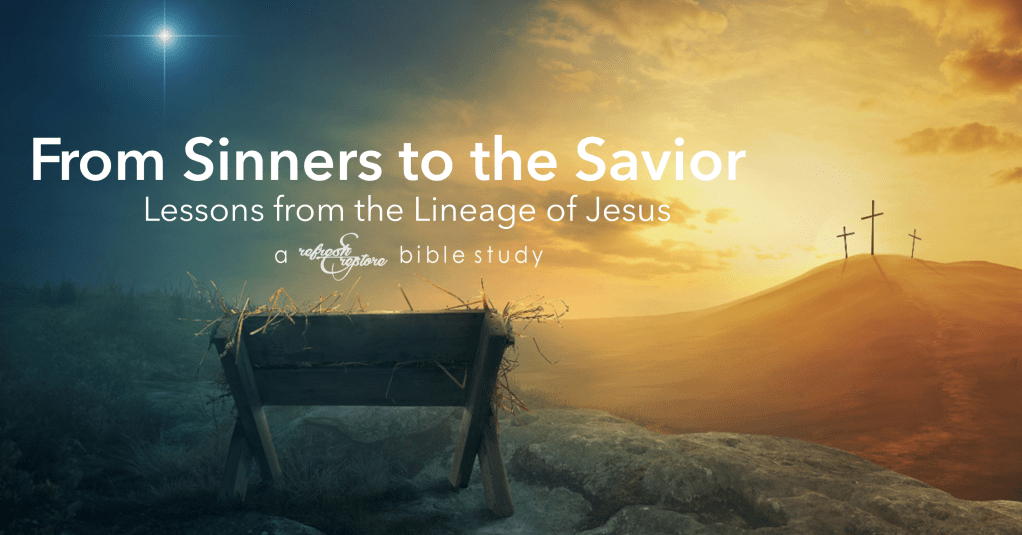
So today, let’s take a moment and look at Jesus’s Story, specifically the Story of the lineage God chose to make Jesus a part of. Sometimes we look at stories in the Bible and feel inadequate. Rest assured that Jesus’s lineage as seen in Matthew 1:1-17 is full of people just like us – people who needed a Savior like Him!
Once upon a time, there was a great and powerful King. He was foretold of old to be a hero who would come from His far away country to redeem and win back His lost love. His Story is one of romance as He left His palace to rescue His Bride. His lineage hailed back to other…great…well, um….
One of the things I love about God’s Word is how it does not fall into the temptation of prettying things up or rewriting them to be more acceptable to folks’ sensibilities. Yes, Jesus is the great King – the King of kings who was prophesied for centuries to come from heaven and rescue His people. Yes, Jesus’s Story is one of romance, where He left His throne on high and traded it for a lowly manger in a tumble-down stable. But His lineage? It wasn’t filled with kings and queens, although there were a few sprinkled in toward the middle. It wasn’t filled with flawless heroes – the flaws are many. No, Jesus’s family tree was filled with regular sinners with real sin and problems – people like me and you.
This Bible study will look at the women emphasized in Jesus’s family tree who point us to Him in specific ways. We won’t go into their full stories, but I will give you the cross-references so you can check them out directly from Scripture.
Tamar (v. 3) …and Judah the father of Perez and Zerah by Tamar….
The first woman mentioned is Tamar (v. 3), and her story is found in Genesis 38. Tamar was Judah’s – you know, Judah as in the lion of the tribe of – she was his daughter-in-law. Originally, she was married to Judah’s oldest son, Er, until “the Lord put him to death” because he was “wicked in the sight of the Lord” (Genesis 38:7). By levirate marriage customs, it became the responsibility of Judah’s second son, Onan, to father children on behalf of his deceased big brother. But Onan was selfish and wicked, refusing to fulfill his duty; the Lord put him to death as well (Genesis 38:10). Judah promised his youngest son, Shelah, to Tamar when he came of age but had no intention of ever fulfilling that promise. Tamar, left without hope of bearing children, took matters into her own hands. Disguised as a prostitute, she tricked Judah into sleeping with her. Her actions were scandalous – and so were Judah’s.
So, why is Tamar mentioned in Jesus’s genealogy? Her story shows us God’s providence and mercy in bringing about His purposes despite human sin. Tamar’s inclusion reminds us that God can use even the most broken situations to fulfill His promises. Judah’s declaration, “She is more righteous than I” (Genesis 38:26), points to her determination to preserve the family line, a role God used in the lineage of Jesus. Her child that would be Jesus’s earthly ancestor was marked by a scarlet string around his foot. It brings to mind the way that God used her story and the stories of people like her almost like a scarlet thread of salvation running through His Story.
Rahab (v. 5) …and Salmon the father of Boaz by Rahab….
The second woman is Rahab (v. 5), whose story is found in Joshua 2:1-21, 6:17, and 6:22-25, with further mentions in Hebrews 11:31 and James 2:25. Rahab wasn’t one of God’s chosen people. She was a Canaanite from Jericho, known for her sinful profession. But she had heard of the God of Israel and believed in His power. She protected His spies, siding with the Lord and marking her house with a scarlet cord as a sign of her faith and obedience. When Jericho’s mighty walls fell by the power of God and the city was taken, Rahab and her family were spared.
Why would someone like Rahab be included in Jesus’s official lineage? Her faith in God is the answer. Rahab’s faith stood out like a scarlet cord, demonstrating that salvation is not about where you come from but about the one you put your faith in – in the God you trust. Her inclusion reminds us of God’s grace and His power to redeem and use anyone for His glory. Rahab’s life became part of the story of salvation history, pointing us to the greater salvation found in Jesus, who rescues all who place their faith in Him.
Ruth (vv. 5-6) …and Salmon the father of Boaz by Rahab, and Boaz the father of Obed by Ruth, and Obed the father of Jesse, and Jesse the father of David the king.
The third woman is Ruth (v. 5), whose story is told in the book of the Bible bearing her name. Like Rahab, Ruth wasn’t one of God’s chosen people. She was a Moabite, descended from incest between Lot and his daughter (Genesis 19:30-37). When famine struck Israel, Ruth’s husband Mahlon and his family came to Moab for refuge, but tragedy followed. Ruth’s father-in-law, brother-in-law, and husband all died, leaving Ruth and her mother-in-law in dire straits. Despite her own loss, Ruth chose to return to Israel with Naomi, declaring, “Your people shall be my people, and your God my God” (Ruth 1:16). She returned with Naomi to Bethlehem – yes, the Christmas Bethlehem – and met Boaz, a kinsman-redeemer who married her and restored their family’s inheritance.
Why is Ruth mentioned in Jesus’s genealogy? Ruth’s story is one of God’s grace extending beyond Israel to include the nations. Her faith and devotion to God stand as a testament to His redeeming love. Her role as David’s great-grandmother and an ancestor of Jesus reminds us that God’s plan of salvation always included people from every nation.
The Wife of Uriah (vv. 6-7) … and Jesse the father of David the king. And David was the father of Solomon by the wife of Uriah….
The fourth woman is not named directly but is referred to as “the wife of Uriah” (v. 6). Her story is found in 2 Samuel 11:1-25. Her name was Bathsheba, and she was the wife of Uriah the Hittite, one of David’s mighty men. King David, in a moment of temptation and sin, saw Bathsheba bathing on her roof and had her brought to him so that he could sleep with her. She became pregnant, and David attempted to cover his sin by arranging Uriah’s murder. His actions were heinous, and the wages of his sin brought tragedy to his family and others.
Why is Bathsheba included in Jesus’s genealogy? The mention of her as “the wife of Uriah” highlights David’s sin and the brokenness of humanity. Jesus being a descendent of David and rightful king as his heir is meant to be a good and special thing, but “by the wife of Uriah” highlights David’s sin. Yet God’s promises are unshaken. Through Bathsheba came Solomon, the king who would build the temple, pointing forward to the great King, Jesus – who everyone, all who sin, need as Savior. That includes kings. Bathsheba’s inclusion reminds us of God’s power to bring beauty from ashes and fulfill His covenant despite human failure.
Mary (v. 16) …and Jacob the father of Joseph the husband of Mary, of whom Jesus was born, who is called Christ.
The fifth and final woman is Mary (v. 16). Her story is found in Luke 1:26-38 and Matthew 1:18-25. Mary was a young woman of humble means, betrothed (like engaged but more intentional and binding) to Joseph. When the angel Gabriel announced to her that she would conceive by the Holy Spirit, she responded in faith and submission: “Behold, I am the servant of the Lord; let it be to me according to your word” (Luke 1:38). The fact that she was a virgin fulfilled the prophecy of Isaiah 7:14, demonstrating that Jesus’s conception was a miraculous act of God.
Why is Mary included in Jesus’s genealogy? Well, first how can one be born without a mother? God could have chosen to come and save in any way He wanted, but to come as the baby of a mother is one of the oldest promises in the Book. Genesis 3:15 promises victory of the “seed” of woman over the serpent, over Satan. Victory over our sin comes from her seed as well. Furthermore, Mary’s role here points to God’s grace. She bore the Savior of the world, yet she also needed Him as her Savior (Luke 1:47). Her inclusion highlights the miracle of the incarnation: God becoming flesh to dwell among us (John 1:14). Mary’s life, from the miraculous conception to standing at the foot of Jesus’s cross during his crucifixion (John 19:25), consistently points us to Jesus, to the Savior, and the fulfillment of God’s promises.
Wrapping Up
Why does the Bible recognize the sins and sinners in Jesus’s lineage? Simply put: because it all really happened. Sin happens. All people “have sinned and fall short of the glory of God” (Romans 3:23). None of us – not a single person in the history or future of the world – deserve to be in Jesus’s family tree, not even the great King David. But faith in God, trusting in Him, His work, and His steadfast love, is woven through that lineage like a scarlet cord. Looking at the sin and faith in Jesus’s genealogy reminds us that none are worthy of saving. That’s why He came. Jesus Himself said He came to “seek and save the lost” (Luke 19:10).
So, as you gather with family and friends and notice some rough-looking fruit in your family tree – or whether you notice the same by looking in your own mirror – realize that Jesus is more than the reason for the season. He’s more than a holiday. He’s the King. He’s the Savior. He’s the Christ. He is God. And He came to save sinners like me and you.
While Jesus is more than a holiday, He offers His salvation to us as a gift. There is no season like this one that highlights something important about gift giving: it’s no good if the gift is not received.
Won’t you receive Him?
The Bible tells us that “all who…receive Him,” who believe in His name, He gives “the right to become children of God” (John 1:12). The Bible also shows us what that belief looks like. In Romans 10:9, it says, “if you confess with your mouth that Jesus is Lord and believe in your heart that God raised Him from the dead, you will be saved.” This goes beyond mere words or understanding the concept of who He is – it’s giving Him your life, ceding control to Him as Lord and trusting that His death on the cross paid the penalty for your sin and His resurrection gives you eternal life in Him.
That’s good news.
That’s a wonderful gift, freely given but not cheap. Won’t you receive it – receive Him? Merry Christmas, dear Sojourner, and I pray that God blesses you and yours this season — not necessarily with the traditional holiday trappings but absolutely by seeing Him for who He is in your lives.
I touched on the subject of Jesus as our Advocate in the last entry in the #DailyWisdomChallenge, so I guess this has been on my mind and heart for a few weeks now.
Sin brings guilt, shame, and condemnation. our enemy, Satan, is quick to accuse us, pointing out our failures and declaring us unworthy before God (Revelation 12:10). But in 1 John 2:1-2, we are reminded of the incredible hope we have in Jesus as our Advocate. An advocate is someone who pleads on behalf of another, and Jesus does this perfectly for us. When we sin, He intercedes for us before the Father — not by minimizing our sin but by pointing to His finished work on the cross!
Jesus is described as “the righteous”, the One who lived a sinless life and was perfectly obedient to the Father. Because of His righteousness, He could offer Himself as the perfect sacrifice for our sins. John tells us that Jesus is the “propitiation for our sins” — a wrath-bearing atonement. On the cross, Jesus took upon Himself the punish our sins deserved, fully satisfying God’s justice and turning away His righteous wrath (Romans 3:25-26). His blood covers us, and through Him, we are forgiven and cleansed (1 John 1:7).
Now, when God looks at us, He sees us through the righteousness of His Son. Jesus speaks on our behalf, declaring that our debt has been paid in full and that we belong to Him. Because of Jesus, God does not deal with us according to our sin but according to His grace and mercy (Psalm 103:10-12).
Today, I am thankful that I don’t have to stand before God in my own strength or righteousness. When I fail, Jesus is my Advocate, reminding me that my sin has been dealt with once and for all.
If you are in Christ, this is true for you, too. Let this truth silence the voice of guilt and shame — the voice of our accuser, and fill your heart with gratitude to the Savior who stood in our place.
If you are not in Christ, understand that you stand before God as judge and represent yourself. There’s more than enough evidence of our sin to convict. Turn your life over to Jesus, confess Him as Lord and put your trust in Him. He will save all who call on Him (Romans 10:9-10, 13)!
That’s good news!
All through the month of November, our Christ Community Church family is focusing on what we are thankful for and expressing our thanks to our “great God and Savior Jesus Christ, who gave Himself for us to redeem us” (Titus 2:13-14).
This, like the #DailyWisdomChallenge we went through in October, is a challenge from our pastor John Goldwater — the #GRATITUDEandHOPEchallenge — where we have the opportunity to post Bible passages that move us to thanksgiving or in which we find hope. May this lead you to be grateful and find your hope in Jesus!
I’m thankful evil meant against me can be turned for good!
Joseph’s story is one of God’s sovereign grace working through even the darkest circumstances. As a young man, Joseph was betrayed by his brothers who sold him into slavery out of jealousy (Genesis 37:28). He was taken to Egypt where he endured years of hardship, including false accusations and imprisonment (Genesis 39:20). Yet, through it all, God was with him, blessing him with favor and wisdom.
This is not a health, wealth, prosperity gospel sort of story. Joseph was a slave and a prisoner through all of this blessing. No, this is God blessing Joseph despite the circumstances his brothers and Potiphar’s wife put him in. Over time, because of God blessing, Joseph rose to a position of great power in Egypt, ultimately saving countless lives — including his own family — by preparing for a severe famine (Genesis 41:39-41, 45:5-7).
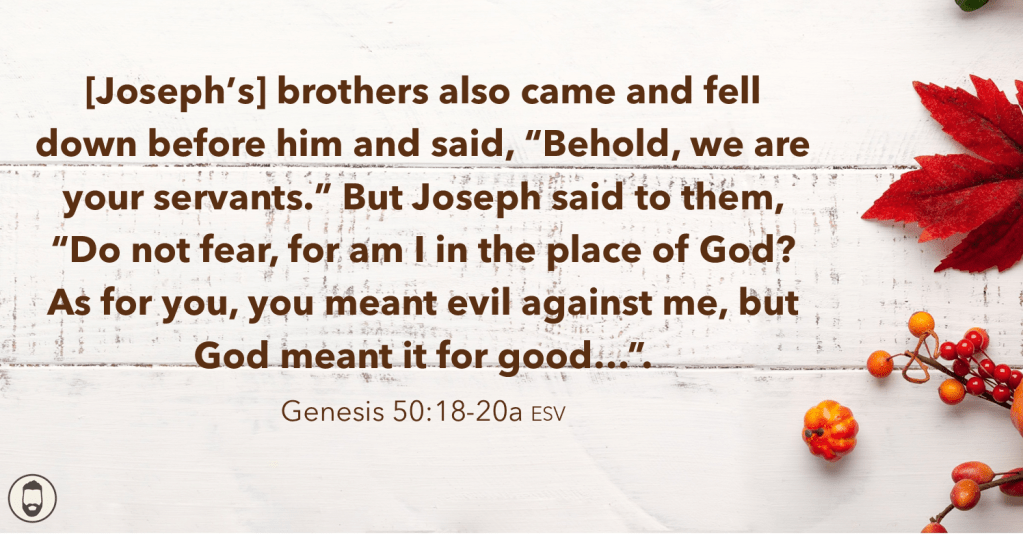
When Joseph’s brothers feared his vengeance after their father’s death, Joseph responded with mercy and a profound trust in God’s purposes. He acknowledged the evil intent behind their actions but pointed to God’s greater plan: “You meant evil against me, but God meant it for good.” What his brothers intended for harm, God used to save lives and fulfill His promises.
This truth reminds us that God is sovereign over every situation. Even when others act with malice, God can take what is meant for evil and use it to accomplish His good purposes (Romans 8:28). Joseph’s story points us to the ultimate example of this: Jesus. The cross, intended as a tool of destruction, death, and shame, was the means of salvation for all who trust in Him (Acts 2:23-24).
Today, I’m thankful for a God who is always at work, even in the most painful and unjust situations. He is faithful to bring good from what seems hopeless. How might God be using the challenges in your life to accomplish His purposes, both for your good and His glory?
Trust Him. He’s got a plan for your life (and your troubles)!
Lord, thank you for taking care of us even when others mean us harm. Thank you for the example of Your working in Joseph’s life and the reminder You gave us in Your Word of Your faithfulness. Help us to see that this is not a story of how to get blessed but a means for us to give You glory with our lives. Help us to be like Joseph and look to You in times of hardship and then respond to those who did us wrong like Joseph did — like You did on the cross when You asked the Father to forgive them. Amen.
All through the month of November, our Christ Community Church family is focusing on what we are thankful for and expressing our thanks to our “great God and Savior Jesus Christ, who gave Himself for us to redeem us” (Titus 2:13-14).
This, like the #DailyWisdomChallenge we went through in October, is a challenge from our pastor John Goldwater — the #GRATITUDEandHOPEchallenge — where we have the opportunity to post Bible passages that move us to thanksgiving or in which we find hope. May this lead you to be grateful and find your hope in Jesus!
I’m thankful for the Father of Mercies and the God of All Comfort!
In 2 Corinthians 1:3-4, Paul invited the church at Corinth (and us today) to praise God for who He is — the source of mercy and comfort. God, in His great love, shows compassion to us in our pain and suffering. He doesn’t stand far off or push us away but instead draws near, meeting us in our affliction with His presence, peace, and sustaining grace. Whether we face sorrow or loss, trials or tribulations, we can cling to the promise that the “God of all comfort” is with us, strengthening and reminding us that we are never alone.
But God’s comfort doesn’t end with only Him comforting us. Paul emphasized here that as we receive mercy and comfort from the Lord, we are called to extend it to others. God often works through His people, the Church, to show His love and care to those in need. When we have experienced God’s mercy, we are uniquely equipped to share it with others and minister to them. Our struggles and the comfort we received become tools in His hands, allowing us to walk alongside those who are hurting, offering hope and encouragement.
As His Church, we are His hands and feet, bringing His comfort and gospel to a broken and lost world. This is a beautiful picture of God’s redemption, even in the midst of our suffering. He uses the suffering and trials we experience to shape us, sanctify us, draw us closer to Him, and equip us to serve others for His glory.
Today, I am thankful for the mercy and comfort God has shown me, and I’m challenged to share that same mercy and comfort with those around me.
How can you reflect the heart of the “Father of Mercies” in someone’s life today? Consider those around you who are hurting and mourning as we enter the holiday season. Not everyone is ready or willing to be holly and jolly because or real hurts and hangups in their lives. Think of how Jesus has brought you through your own hurts and hangups and extend His love to others in the midst of theirs.
Lord, I thank you for being the Father of mercies and God of all comfort. Thank You for never leaving me alone when all the world has and adopting me into your family. There is nothing like the comfort of a loving Father, and I thank You for allowing your people to reflect that love and comfort to others. Help us to notice those who need to be comforted by You. Amen.
All through the month of November, our Christ Community Church family is focusing on what we are thankful for and expressing our thanks to our “great God and Savior Jesus Christ, who gave Himself for us to redeem us” (Titus 2:13-14).
This, like the #DailyWisdomChallenge we went through in October, is a challenge from our pastor John Goldwater — the #GRATITUDEandHOPEchallenge — where we have the opportunity to post Bible passages that move us to thanksgiving or in which we find hope. May this lead you to be grateful and find your hope in Jesus!
I’m thankful for salvation in Christ alone by grace alone through faith alone!
What makes grace so amazing? It’s that God saves us not because of who we are or what we’ve done but because of who He is. In our sin, we are spiritually dead, unable to save ourselves. But God, rich in His mercy and overflowing with His love, makes us alive through Jesus. Salvation is not something we can earn; it is a gift of God’s grace that must be received through faith in Jesus (alone).
This means that our works, our goodness, or even our religious or church activities cannot save us. No one can ever be good enough to meet God’s perfect standard (Romans 3:10, 23) but Jesus (1 John 2:1-2). He lived the sinless life we couldn’t live, died the death we deserved on the cross, and rose again to offer us new life. When we trust in Jesus — put our faith in Him believing that He is enough and that He died and rose again, we are forgiven, made alive, and welcomed into God’s family through adoption (John 1:12, Romans 10:9-10).
Faith is not about trying harder to fix ourselves but about turning to Jesus and trusting Him fully.
Grace means that God does what we cannot do. Jesus makes the dead alive, the lost found, and the broken whole. That’s good news!
Today, if you’ve not experienced this grace, I invite you to put your faith and trust in Jesus. if you’ve already trusted in Christ, let your heart overflow with thankfulness for the gift that you did not earn but He gave freely — salvation by grace alone through faith alone in Christ alone!
This is why I’m thankful, and this is why I have hope. What about you?
All through the month of November, our Christ Community Church family is focusing on what we are thankful for and expressing our thanks to our “great God and Savior Jesus Christ, who gave Himself for us to redeem us” (Titus 2:13-14).
This, like the #DailyWisdomChallenge we went through in October, is a challenge from our pastor John Goldwater — the #GRATITUDEandHOPEchallenge — where we have the opportunity to post Bible passages that move us to thanksgiving or in which we find hope. May this lead you to be grateful and find your hope in Jesus!