Join Us as We Celebrate 27 Years at Christ Community Church — a Songs for Sunday post

Sunday’s coming, and I’m especially thankful this week.

Not only do we get to gather again as the people of God, but we also get to celebrate 27 years of God’s faithfulness to and through Christ Community Church. That’s no small thing. The local church is one of God’s greatest gifts to His people — where the gospel is proclaimed, disciples are made, and the love of Jesus is lived out in community.

I want to say how personally thankful I am that God has allowed me and my family to be a part of Christ Community. I’ve had the privilege of serving in churches for two decades, but this church has become the church home and faith family we had always hoped for. Candice, Keri, Xander, and I are genuinely grateful — not only to serve here, but to belong here. Christ Community is a gift, and we thank God for it.

That’s exactly the sentiment Paul had in Colossians 1:3-6 when he was opening his letter to the church at Colossae: sharing his gratitude for a gospel-shaped church.

Paul began in v. 3 by saying, “We always thank God, the Father of our Lord Jesus Christ, when we pray for you.” He’s not flattering them but pointing to God as the source of their growth and faithfulness. Every local church that stands firm in Christ is a reason to give thanks.

In v. 4, he reflects on what he’s heard about them: their “faith in Jesus” and the love they have “for all the saints”. These aren’t vague religious concepts. Their faith was real, anchored in Jesus. Their love was visible, expressed toward one another. This kind of gospel life is evidence of Christ working.

But where does that kind of faith and love come from? The answer is in v. 5: “because of the hope laid up for you in heaven”. Their faith and love are rooted in something eternal — not wishful thinking, but a secure hope. Their faith and love are rooted in something objective, already laid up, already theirs. That’s our shared hope, too: an imperishable inheritance kept in heaven (1 Peter 1:4), secured not by our own goodness but in Jesus’s blood and resurrection (1 Peter 1:18-21).

Then in vv. 5-6, Paul shifts the spotlight to the gospel itself, “the Word of the truth…which has come to you, as indeed in the whole world it is bearing fruit and increasing…”. You see, the gospel isn’t merely information. It’s power. Wherever it goes — when it’s understood and received by grace through faith in Jesus — it grows, it bears fruit, it transforms lives. That’s what God has done at Christ Community for 27 years, and that’s what we’re asking Him to keep on doing until Jesus returns.

When we gather Sunday, we’ll celebrate that very gospel in song. We’ll sing “Holy Water” thanking God for washing away our sin in His grace and mercy. We’ll sing “Graves Into Gardens” proclaiming the power of Jesus to bring life where there was death. We’ll sing “In Christ Alone” declaring our firm hope rooted in Jesus’s death and resurrection. We’ll sing “Thank You Jesus for the Blood” remembering the precious price He paid to redeem us.

We’ll be reminded of that gospel in our Scripture readings, as in Titus 3:4-7 where we’ll clearly see that our salvation is not in our works but Jesus’s, not in our righteousness (which we don’t have) but His mercy.

We’ll be reminded of that gospel and the Savior it proclaims as John opens up the Word of God and shows us the King of kings, unpacking the value and depth of His sacrifice for sinners like us and the salvation that comes only by grace through faith in Jesus alone.

So, let’s gather together.

Let’s gather on the Lord’s day — on Sunday — not just to mark an anniversary but to lift high the name of Jesus, the One who saved us, who brought us together as a church family, and who is still working in and through us for His glory and our good.

The gospel has borne fruit here, and we pray it continues to do so for generations to come — until Jesus comes.

Won’t you gather with us?


Here are our Scriptures and songs:

4But when the goodness and loving kindness of God our Savior appeared, 5He saved us, not because of works done by us in righteousness, but according to His own mercy, by the washing of regeneration and renewal of the Holy Spirit, 6whom He poured out on us richly through Jesus Christ our Savior, 7so that being justified by His grace we might become heirs according to the hope of eternal life.

18…knowing that you were ransomed from the futile ways inherited from your forefathers, not with perishable things such as silver or gold, 19but with the precious blood of Christ, like that of a lamb without blemish or spot. 20He was foreknown before the foundation of the world but was made manifest in the last times for the sake of you 21who through Him are believers in God, who raised Him from the dead and gave him glory, so that your faith and hope are in God.


Songs for Sunday, August 17, 2025 @ Christ Community Church

Sunday’s coming, and I’m excited!

Every week at Christ Community Church, we gather and lift our voices in worship of Jesus by reading Scripture together and singing to and about Him. The Scriptures we are reading this week remind us of who God is and what He has done. Psalm 103:8-13 is one of the most beautiful descriptions of the LORD’s mercy in the Bible, and when we look at it alongside the picture of redemption that is found in Christ in Colossians 1:13-14, it calls us to worship Him with grateful hearts.

Take a second and look at these passages and catch a glimpse of our great God and Savior Jesus Christ:
Psalm 103:8“The LORD is merciful and gracious, slow to anger and abounding in steadfast love.” This echoes how God introduced Himself in Exodus 34:6, the foundational confession of His character. He is not quick to flare up in wrath but abounds in His deep covenant love for His people.
Psalm 103:9“He will not always chide, nor will He keep His anger forever.” Like Psalm 30:5 and Micah 7:18, this shows that while God’s anger against sin is real, His mercy outlasts His anger for those who belong to Him. His justice is perfect but not greater than His grace.
Psalm 103:10“He does not deal with us according to our sins, nor repay us according to our iniquities.” If God gave us exactly what our sin deserved, none could stand (Ezra 9:13, Romans 6:23), but He shows mercy in judgment, forgiving sin, iniquity, and transgressions just as He promised in Exodus 34:7.
Psalm 103:11“For as high as the heavens are above the earth, so great is His steadfast love toward those who fear Him….” The psalmist piles up comparisons here to show the depth and height of God’s kindness, as abundantly immeasurable as the heavens, decisively removing our sin, and enduring like a father’s compassion toward his children. God’s love is higher than we can measure and deeper than we can comprehend (Psalm 36:5).
Psalm 103:12“…as far as the east is from the west, so far does He remove our transgressions from us.” East and west never meet. That’s how completely God forgives in Christ — our sins are gone, removed to never return (Micah 7:18-20, 2 Corinthians 5:21).
Psalm 103:13“As a father shows compassion to His children, so the LORD shows compassion to those who fear Him.” Unlike the gods of the nations who are apathetic and hostile, the LORD relates to His people as a true Father — compassionate, tender, and faithful. Jesus Himself taught us that we can approach God in this way (Matthew 6:9, Mark 14:36).

And how has this mercy been most clearly revealed to us? In Jesus!
Colossians 1:13-14He has delivered us from the domain of darkness and transferred us to the Kingdom of His beloved Son, in whom we have redemption, the forgiveness of sins. — Just as God rescued Israel from Egypt (Exodus 6:6, 14:30), He has rescued us from a greater slavery: the domain of darkness, the power of Satan and sin (Acts 26:18, Ephesians 5:8). Through JESUS, we have been drawn out of the shadows and placed into the Kingdom of His beloved Son. That’s redemption — the ransom paid through His blood, freeing us from bondage to sin and granting us forgiveness once and for all (Ephesians 1:7, 1 Peter 1:18-19).

This is the gospel. The mercy described in Psalm 103 is fulfilled in Jesus. Our sin is removed. Our debt is cancelled. And we are safely in Him.

That’s why tomorrow we can lift our voices and read these Scriptures. It’s why we can lift our voices to our holy, holy, holy God and sing that His mercy is more and we have hope in Christ alone. Every verse and lyric will remind us of who God is and what He has done for us in Jesus. Every verse preached will point us to Him and give opportunity to see Him more clearly.

So come on out and gather with us tomorrow. Come with gratitude, come with hope, come ready to worship the God who shows compassion like a Father and saves by the blood of His Son.

Won’t you gather with us?


Here are our Scriptures and songs:

8The LORD is merciful and gracious, slow to anger and abounding in steadfast love. He will not always chide, nor will He keep His anger forever. 10He does not deal with us according to our sins, nor repay us according to our iniquities. 11For as high as the heavens are above the earth, so great is His steadfast love toward those who fear Him; 12as far as the east is from the west, so far does He remove our transgressions from us. 13As a father shows compassion to his children, so the LORD shows compassion to those who fear Him.

13 He has delivered us from the domain of darkness and transferred us to the kingdom of his beloved Son, 14 in whom we have redemption, the forgiveness of sins.


Songs for Sunday, July 27, 2025 @ Christ Community Church

Sunday’s coming, and I’m excited!

It’s been a month since I’ve been able to write one of these, and my heart is full looking forward to gathering with my faith family this Sunday. The Scriptures we will read and the songs we will sing declare what the weary world — and our own weary hearts — need to hear: GOD is with us.

I know it’s not Christmas (and it’s hard to even think about it in the midst of a Mississippi summer), but I am reminded of what the prophet Isaiah said about Jesus’s coming — He would come and be the Light that would pierce the darkness:

“The people who walked in darkness have seen a great light…. For to us a child is born, to us a Son is given….” (Isaiah 9:2,6)

Jesus is that Son, the promised Emmanuel (which means God with us). He isn’t distant or disinterested. No, Jesus is the God who stepped into our world, entered our pain, and walked among sinners. He bore the weight of our sin and carried our sorrows. But even more than being with us, Jesus is also for us.

Look at 1 John 2:1-2:

“But if anyone does sin, we have an advocate with the Father, Jesus Christ the righteous. He is the propitiation for our sins, and not for ours only but also for the sins of the whole world.”

That word advocate means someone who speaks on your behalf, who stands beside you when you have no defense of your own. One day, we’ll stand before the Holy God of the universe to answer for our works — for our sin. It’s hard to imagine the crushing weight of the volume of our sin or how we could ever bear it (Psalm 38:4, Romans 3:23). But before we can be under that crushing weight, our advocate steps up. When our Judge asks how we plead, our advocate speaks up, but He doesn’t just plead for us — He points to His own finished work on the cross (John 19:30, Hebrews 10:12-14) — to His blood that covers and blots out our sin (Isaiah 1:18, Colossians 2:13-14, Revelation 1:5). He doesn’t speak up to ask God to forgive or overlook; He says He’s already paid for our sin — paid in full (Romans 8:1, 33-34; 2 Corinthians 5:21).

Those who are saved know that Jesus is our righteousness. He is our covering. And He is our confidence before the Father. As we’ll read in Colossians 2:13-15 this Sunday, we’ll find that the very same God who is our advocate and defends us is the same God who died for us.

The One who stands in heaven interceding for us (Romans 8:34, Hebrews 7:25) is the One who once hung on the cross we deserve, bearing our sin against the wrath of God, to save us (Isaiah 53:4-6, 2 Corinthians 5:21, 1 Peter 2:24).

The cross is where our debt was cancelled (Colossians 2:13-14), and Jesus’s resurrection is where death was defeated (1 Corinthians 15:54-57, Romans 6:9).

That’s why we can sing “O Come, O Come Emmanuel” — because we need Him and can know He’s returning just as He’s already come to us. We can sing “Great I Am” because Jesus is not merely the babe in the manger but God Almighty come to us. We can sing “Jesus Paid It All (O Praise the One)” because our sins, not in part but the whole, were nailed to the cross and the debt of our sin paid in full. And we can sing “Thank You Jesus for the Blood” because His blood wasn’t a mere payment for sin committed but the means by which we are brought near to God.

So, this Sunday come with hope. Come with need. Come with thanksgiving. And come ready to worship the One who is God with us, our Advocate, and our Savior. We will read from God’s Word together (1 Timothy 4:13) and lift our voices to proclaim the gospel to one another as we offer praise to God (Colossians 3:16). We will sit under the teaching of God’s Word as John points us to Jesus (John 20:31). We will have the opportunity for a few hours to get a brief glimpse into the glory that awaits when we find our faith becoming sight (1 Peter 1:8-9, 2 Corinthians 4:17-18) when we come at last to be with Jesus for eternity (Revelation 21:3-4).

Won’t you come and gather with us?


Here are our Scriptures and songs:

2The people who walked in darkness have seen a great light; those who dwelt in a land of deep darkness, on them has light shone. 3You have multiplied the nation; you have increased its joy; they rejoice before you as with joy at the harvest, as they are glad when they divide the spoil. 4For the yoke of His burden, and the staff for His shoulder, the rod of His oppressor, you have broken as on the day of Midian. 5For every boot of the tramping warrior in battle tumult and every garment rolled in blood will be burned as fuel for the fire. 6For to us a child is born, to us a son is given; and the government shall be upon His shoulder, and His name shall be called Wonderful Counselor, Mighty God, Everlasting Father, Prince of Peace. 7Of the increase of His government and of peace there will be no end, on the throne of David and over His Kingdom, to establish it and to uphold it with justice and with righteousness from this time forth and forevermore. The zeal of the LORD of hosts will do this.

13And you, who were dead in your trespasses and the uncircumcision of your flesh, God made alive together with Him, having forgiven us all our trespasses, 14by canceling the record of debt that stood against us with its legal demands. This He set aside, nailing it to the cross. 15He disarmed the rulers and authorities and put them to open shame, by triumphing over them in Him.


Songs for Sunday, April 27, 2025 @ Christ Community Church

Sunday’s coming, and I’m excited!

As I sit and write today, thinking about Sunday morning, I find my mind on Luke 15 where Jesus tells a story many of us know as the parable of the prodigal son. But if you look closely, Jesus begins that story not by focusing on either son but by saying, “There was a man who had two sons” (Luke 15:11). The main character is neither the prodigal nor the faithful son; it’s the father. Jesus is painting a picture of God the Father, whose mercy and love extend freely to the rebellious and the self-righteous alike.

The younger son demands his share of the inheritance — an insult in itself — and leaves home to squander it all in reckless living (Luke 15:13). When famine hits, he finds himself feeding pigs and wishing he could eat their slop (Luke 15:16), utterly broken and alone. But “when he came to himself” (Luke 15:17), he decided to return home, but not to try and reclaim his place as a son. He planned to appeal to his father to be hired on as a servant.

While he was still a long way off, his father saw him, ran to him, and embraced him with compassion (Luke 15:20). He could have shamed him and railed at him, but he didn’t. He rejoiced that his “son was dead, and is alive again; he was lost, and is found” (Luke 15:24) instead of scolding. What a powerful picture of grace and mercy!

But Jesus doesn’t stop there.

The older son, who never left home and worked for the father through all of his brother’s foolishness, came in from working and heard a celebration. When he found out it was celebrating his prodigal brother, he became angry and bitter that his brother was receiving what he thinks should have been his (Luke 15:28-30). Yet again, the father seeks out his child: “Son, you are always with me, and all that is mine is yours”, and “It was fitting to celebrate…for your brother was dead, and is alive; he was lost, and is found” (Luke 15:31-32).

In both cases, the father goes out to meet his sons. One ran off and returned in shame. The other stayed home but harbored resentment. The father invites both of them to come in — to the same house, no less — to repent, to be restored, and to rejoice in his love.

This is the heart of our God and Father. He is slow to anger, abounding in steadfast love, and He is inviting sinners to come to Him.

We see this invitation echoed throughout Scripture:

“Come to me, all who labor and are heavy laden, and I will give you rest.”

Matthew 11:28

and

“Let us then with confidence draw near to the throne of grace, that we may receive mercy and find grace to help in time of need.”

Hebrews 4:16

That’s the same invitation we offer every Sunday at Christ Community. Not a mere invitation to come to a gathering or event but an invitation to come to the father. Whether you are running in from rambunctious revelries in sin or have been standing off on your own in self-righteousness, the Father is waiting and watching, ready to embrace with open arms — not because we’ve earned it or are worthy but because He is full of grace.

The chorus of our invitation song sums this up well:

I run to the Father, I fall into grace
I’m done with the hiding, no reason to wait
My heart needs a surgeon, my soul needs a friend
So, I’ll run to the Father again and again and again and again

If you’re weary, run to the Father.

If you’re guilty, come to Him.

If you need forgiveness, healing, or hope — come to the Father through His Son Jesus.

Romans 10:9-13 reminds us that everyone who comes to Him and calls upon Him will be saved. This is the message we preach, the hope we hold, and the reason we sing and live.

And once we’ve tasted His grace, how can we not respond in praise? That’s what we plan to do when we gather Sunday because He is mighty to save, His cross and empty tomb have made a way for us, and all who have confessed Him as Lord, believed that He is risen from the dead, and put their trust in Him have been saved by His grace.

Won’t you gather with us?


Here are our Scriptures and songs for Sunday:

  • Scripture | Romans 10:9-13

9…because, if you confess with your mouth that Jesus is Lord and believe in your heart that God raised him from the dead, you will be saved. 10For with the heart one believes and is justified, and with the mouth one confesses and is saved. 11For the Scripture says, “Everyone who believes in him will not be put to shame.” 12For there is no distinction between Jew and Greek; for the same Lord is Lord of all, bestowing his riches on all who call on him. 13For “everyone who calls on the name of the Lord will be saved.”


  • Scripture | Psalm 117

1Praise the LORD, all nations! Extol Him, all peoples! 2For great is his steadfast love toward us, and the faithfulness of the LORD endures forever. Praise the LORD!


  • Invitation | Run to the Father
    Scripture Inspiration: Galatians 6:2, Matthew 11:28-30, Jeremiah 17:9-10, Matthew 9:12, 1 Timothy 2:5, Hebrews 9:15, 1 Samuel 16:7, Psalm 44:21, Psalm 139:1, Proverbs 16:2, Luke 16:15, Isaiah 53, Matthew 20:28, John 1:29, John 3:16, Acts 4:12, Romans 5:6-10, 2 Corinthians 5:21, Titus 2:14, Proverbs 16:4, John 6:44, Romans 8:28-30, Ephesians 2:8-10, Revelation 13:8, Romans 6:1-11, Galatians 2:19-20, 1 Peter 2:24, Romans 8:9-11, 1 Corinthians 6:16-19, 1 Timothy 1:14


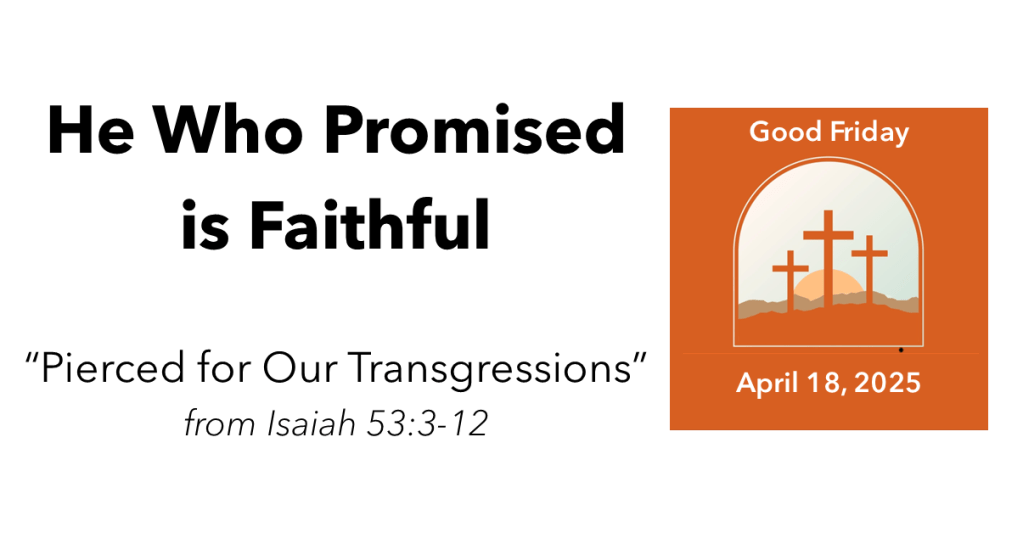
Good Friday | “Pierced for Our Transgressions”

Isaiah 53:3-6

He was despised and rejected by men,
a man of sorrows and acquainted with grief;
and as one from whom men hide their faces
he was despised, and we esteemed him not.

Surely he has borne our griefs
and carried our sorrows;
yet we esteemed him stricken,
smitten by God, and afflicted.
But he was pierced for our transgressions;
he was crushed for our iniquities;
upon him was the chastisement that brought us peace,
and with his wounds we are healed.
All we like sheep have gone astray;
we have turned—every one—to his own way;
and the LORD has laid on him
the iniquity of us all.


The Original Context

Isaiah 53 is one of the clearest prophecies in the Old Testament about the coming of a Suffering Servant – One who would be rejected, bear sorrow, and ultimately carry the guilt of others. Verses 3-6 portray this Servant as misunderstood and mistreated. The people saw His suffering and assumed it was punishment from God for His own sins, but Isaiah pulls back the curtain: the Servant wasn’t suffering for His own wrongs – He was bearing the griefs, sorrows, transgressions, and iniquities of others. 

This wasn’t punishment for failure. It was substitution. God laid the guilt of His people on this Servant. He was pierced, crushed, chastised – not because of what He had done but because of what we have done. It’s the language of atonement. It is one life being laid down to bring peace and healing to many.

Fulfillment in Jesus

Jesus is the Suffering Servant who Isaiah foretold. He was despised and rejected by His own people. He wept over the unbelief in Jerusalem (Luke 19:41), was betrayed by a friend (Luke 22:47-48), and was abandoned by His disciples (Matthew 26:56). He was beaten, mocked, and crucified – pierced by nails and crushed under the weight of humanity’s sin and the wrath of God against that sin.

But this was neither accidental nor tragic. Jesus didn’t die a victim of injustice but as a willing substitute, the Lamb of God who takes away the sin of the world (John 1:29). It was the purpose for which He came: “Christ died for our sins in accordance with the Scriptures” (1 Corinthians 15:3). At the cross, Jesus bore our griefs and carried our sorrows. Our rebellion against God became His burden. The punishment that brought us peace was laid upon Him. And by His wounds, we are healed – not just physically or emotionally, but spiritually and eternally.

Hope for Today

Good Friday is not a tragedy – it is a triumph through sacrifice.

Good Friday reminds us that salvation isn’t something we earn but something we receive. The weight of our guilt was laid on Jesus. Our wandering hearts find a home in Him who died that we may live.

We are all like sheep – wayward, distracted, self-reliant (or trying to be), but the Shepherd became the Lamb and was led to the slaughter for our sake. If today feels heavy, let it. The cross was no small thing. But don’t stop at sorrow – look through it to see the love of God on full display.

If you have ever felt too sinful to be forgiven, too broken to be loved, or too far gone to be reached – Isaiah 53 is for you. Your sin is not too much for the Savior. The Servant of Isaiah 53 – Jesus Christ – came for sinners just like me and you. 

You are not alone in your brokenness and sin. You are not stuck in your guilt. You are not without hope. Jesus was pierced for you. And those who put their faith in Him are forgiven, healed, and brought near.

So come and behold the Lamb – despised and rejected yet full of mercy and grace. Let your heart rest in the peace He purchased with His blood.

Come to the cross.

Let your heart be pierced by His mercy.

Marvel that God would do this for you.

And remember: while Good Friday ended in death, it opened the door to life because Sunday’s coming!


Songs for Sunday, April 6, 2025 @ Christ Community Church

Sunday’s coming — the LORD’s day, and I’m excited!

Every Sunday is a celebration of the goodness and grace of God, reminding us that He not only died for us but that He raised from the dead and LIVES for us! This Sunday at Christ community, we are going to sing about His goodness and grace and remember His mercy and how He saves.

In Titus 3:4-5a, Paul gives us one of the clearest, richest summaries of the gospel:

“But when the goodness and loving kindness of God our Savior appeared, He saved us, not because of works done by us in righteousness, but according to His own mercy….”

Let’s break that down and take it to heart:

“But….”

This is a very important conjunction. It takes everything before, cancelling it in favor of what comes after. In the context of Titus 3, what came before is what we once were: “once foolish, disobedient, led astray, slaves to various passions and pleasures, passing out days in envy, hated by others and hating one another” (Titus 3:3). BUT Jesus cancels that out in favor of His salvation.

“But when the goodness and loving kindness of God our Savior appeared….”

Paul is reminding us that salvation starts with GOD — not with us, not with our efforts or any righteousness of our own. The word “appeared” points us directly to Jesus’s first coming — God in flesh. He didn’t send a proxy or representative. He didn’t send salvation. God showed up Himself.

Jesus is the visible expression of God’s goodness and loving kindness, because He Himself is God being good and loving. He didn’t wait for us to climb up to Him (which we can’t do — remember, not with our efforts); He came down to us. His goodness and light broke into our sin and darkness.

“…He saved us….”

These three words change everything. God didn’t tell us what we could be doing better. He didn’t merely advise or improve us — He SAVED us. That speaks of our reality and need. we were lost, helpless, and dead in our sin, but HE acted. He rescued. He redeemed. These three words are a beautiful reminder that salvation is not self-help but divine deliverance!

“…not because of works done by us in righteousness….”

This part humbles us. There is no room for pride or patting oneself on the back in the gospel. We can’t earn our salvation by cleaning up our act or doing good deeds. There are no scales that we can balance by heaping service and good deeds; in fact, if there is a scale, our sin has it solidly weighted down unless Jesus acts upon the other side. We can’t impress God into loving us. All our best works can’t bridge the gap between our sin and His holy, holy, holiness.

“…BUT according to His own mercy….”

There’s another “but” here. It takes the false hope of our own righteousness and cancels it out with the hope of God’s own mercy. This gets at the heart of the gospel: God saved us because He is merciful. That’s who He is. Mercy means that He does not treat us as our sins deserve. Instead, He pours out grace through Jesus — grace that cleanses, restores, and makes us new.

That’s good news!

And that good news — that gospel — no, “our great God and Savior Jesus Christ” is who we are going to read, sing, and preach about this Sunday. We’re going to sing of His mercy.

Songs like “Holy Water” and “Washed Clean” will remind us that Jesus’s grace is what refreshes our hearts and keeps us coming back to Him in gratitude and worship. Then, we’ll read Philippians 2:5-11 and lift our eyes to Jesus, declaring His beautiful and powerful name — the name that is above every other. We’ll sing “Your Great Name” and “What a Beautiful Name” as a response to the Savior who stooped low to save us and is now exalted on high at the right hand of the Father.

If you have been saved by Jesus in His mercy, come ready to rejoice!

And if you haven’t yet trusted in Jesus, know this: His goodness and loving kindness have appeared. He is still saving. He is still merciful. Come lay your burdens on Him. Come and receive the mercy that never runs dry. Come to Him.

Won’t you join us?


Here are our Scriptures and songs:

4But when the goodness and loving kindness of God our Savior appeared, 5He saved us, not because of works done by us in righteousness, but according to His own mercy, by the washing and regeneration and renewal of the Holy Spirit, 6whom He poured out on us richly through Jesus Christ our Savior, 7so that being justified by His grace we might become heirs according to the hope of eternal life.


5Have this mind among yourselves, which is yours in Christ Jesus, 6who, though He was in the form of God, did not count equality with God a thing to be grasped, 7but emptied Himself, by taking the form of a servant, being born in the likeness of men. 8And being found in human form, He humbled Himself by becoming obedient to the point of death, even death on a cross. 9Therefore God has highly exalted Him and bestowed on Him the name that is above every name, 10so that at the name of Jesus every knee should bow, in heaven and on earth and under the earth, 11and every tongue confess that Jesus Christ is Lord, to the glory of God the Father.


“BUT If Anyone Does Sin: Finding Hope in Jesus Christ the Righteous” — a Refresh & Restore Bible Study

My little children, I am writing these things to you so that you may not sin. But if anyone does sin, we have an advocate with the Father, Jesus Christ the righteous. He is the propitiation for our sins, and not for ours only but also for the sins of the whole world.

1 John 2:1-2

"Kept Through the Trial: Jesus's Letter to the Church at Philadelphia" (The KING is Coming) Refresh & Restore | A JustKeithHarris.com Podcast

📖 Revelation 3:7–13We’re back!After a few months off, The King is Coming returns in 2026 with one of the most encouraging letters in Revelation — Jesus’s message to the faithful church in Philadelphia. In a world filled with opposition and weakness, Jesus opens a door no one can shut.In this episode, Keith Harris and Jamie Harrison explore:✔️ Jesus’s identity as the Holy One, the True One — God Himself✔️ What the “key of David” means and how Jesus alone opens and shuts✔️ The debated phrase “I will keep you from the hour of trial” — and how to read it biblically✔️ Why “little power” doesn’t disqualify faithfulness✔️ How being kept through the trial glorifies Christ’s strength in us✔️ What it means to be a pillar in God’s presence foreverThis church had no rebuke — only encouragement. And Jesus’s call still stands today: “Hold fast what you have, so that no one may seize your crown.” (Revelation 3:11, ESV)🔗 Missed earlier episodes in the series? You can click here to catch up and listen from the beginning.✍️ If you’d like to see a written version of this podcast, complete with footnotes and cross-references, you can find it here.
  1. "Kept Through the Trial: Jesus's Letter to the Church at Philadelphia" (The KING is Coming)
  2. Christ Has Come: The Promised King & His Gift of Love" (Advent 2025)
  3. Christ Has Come: The Promised King & His Gift of Peace (Advent 2025)
  4. Christ Has Come: The Promised King & His Gift of PEACE (Advent 2025)
  5. Christ Has Come: The Promised King & His Gift of HOPE (Advent 2025)

Greetings Sojourners!

I had planned to release the next Bible study in our The King is Coming series on Revelation yesterday, but I believe 1 John 2:1–2 is where we need to be today—at least, it’s where I need to be.

When I started doing this five years ago, I never intended for it to become an ongoing thing. The pandemic was in full swing, and I became aware that some members of Christ Community—and others in our greater community—were unable to attend church due to health concerns. Some lacked technology or internet access to livestream services and be spiritually fed. So, I began writing Bible studies and sending them out. I even purchased the justKeithHarris.com site to make it easier to share the studies with folks.

As Covid began to settle into a more “normal” part of life and things started moving again, John Goldwater gave us a challenge during a pastors’ meeting. He asked us to think of something God had moved us to do during the pandemic—something extra to reach out—and to consider keeping it going. These Bible studies are what the Lord has continued to stir in me. Now, have I been as consistent over the past year or so as I would like to be? Definitely not. But my heart to encourage people through the Word of God hasn’t changed. That pastor’s heart—God’s call on my life—is what compels me to write this Bible study today.

So many people are hurting right now (and many of you may have burdens I don’t even know about). But God’s Word is “profitable for teaching, for reproof, for correction, and for training in righteousness, that [we] may be complete, equipped for every good work” (2 Timothy 3:16–17). Revelation 2 and Jesus’ letter to the church in Ephesus would certainly be good for us and would build us up. But I can’t get 1 John 2:1–2 off my heart and out of my mind. 

I feel a deep burden—and a burning desire—to break open 1 John 2:1–2 with you “clearly,” to give “the sense,” and to help you understand “the reading” (Nehemiah 8:8). I want to help you see whatever it is in this passage that God’s Spirit desires to open up to you. As I write (and truly, I don’t know how this is all going to turn out), there are a few things I want to share before diving into the text:

  1. We – all of us, myself especially – are sinners.
  2. Even if we are saved, there is still a struggle with sin (and unfortunately, we will fall into sin).
  3. When we sin – again, even if we are saved, there are consequences that must be faced.
  4. However, if you are saved and have been adopted into God’s family, you have an advocate, Jesus Christ the Righteous who stands for you when you have fallen into sin and shame. His blood covers sin. He is the God who saves. We never stop needing Him.
  5. If you are reading this and are not saved, He can save you.

Again, my heart is heavy for many of you, and I don’t know exactly how all of this is meant to work together. But I do know this: God’s Word going out is always a good thing. His Word never returns to Him empty; it always accomplishes what He intends (Isaiah 55:11). I may never know how this helps you—but I pray that, according to God’s purpose, it does.

My Little Children (v. 1a)

John opens up this section of 1 John with a term of endearment – a term of love – for these people. By calling them his “little children”, he is not belittling them or making it seem like he sees them as less but rather letting them know that he loves them as a father is supposed to love his children. He is about to tell them some good and bad news and this term of endearment reminds them of their relationship and his love for them. 

For me, both at school and at church, I’ve found myself using the word “kiddos” the same way I do with my own children at home. At first, it just slipped out without me thinking, but over the years, it’s become a way to express my care for them—like I consider them mine. It communicates relationship. There’s good news and hard conversations. There’s encouragement, correction, and discipline. They laugh and joke about what’s become my catchphrase at the end of each class—“Good class, kiddos!”—but they always notice if I forget to say it. If I miss it, they’ll ask, “Aren’t you going to say it?” They want to know that, no matter how the class went, I thought it was good. That little phrase reassures them. And even in times when I’ve had to correct them, that word—“kiddo”—still shows up. It reminds both them and me that our relationship remains, through the good and the hard.

Thinking of it that way, I can almost hear John saying with a sigh, “Kiddos, I need you to make sure you’re picking up what I’m laying down: I’m telling you all of this so that you will stop sinning.”

Let that sink in – “so that you may not sin” (v. 1). 

How far will you make it with that? How far have you ever made it not sinning?

Yeah, me too.

From a religious standpoint, that might sound like bad news, because we know we can’t do it. The Bible is clear on this. Psalm 14:3 and 53:3 both say, “there is none who does good, not even one,” and the Holy Spirit, through Paul, drives this home in Romans 3:10: “None is righteous, no, not one.” Anyone who honestly looks at their life and compares it to the holy standard of our holy, holy, holy God knows what Isaiah meant when he said, “all our righteous deeds are like a polluted garment” (Isaiah 64:6). Even what we might think of as righteousness is tainted by sin—those “iniquities” that “like the wind, take us away.” That’s why we can’t earn salvation. There’s no amount of scrubbing, trading, or weighing good against bad that can remove sin or make us righteous. It doesn’t work that way. As we’d say in Mississippi, you either are or you ain’t—and, well, we ain’t. The “wages” of our sin give us what we earn—what humanity has earned since Adam—namely death (Romans 6:23).

That’s more than just bad religious news—it’s bad life news. 

But praise God, John didn’t stop there! The next word is only three letters in English (and in Greek), but it’s a powerful word for us: “BUT”. That conjunction takes everything that came before it—our sin, our inability to be righteous on our own—and sets it aside to introduce what comes next. John is honest: he tells these spiritual children he loves that he’s writing to them so they “may not sin.” But he knows they will. He knows because he himself didn’t make it far either. John was a sinner too. And how could he not know that? He had walked in the presence of Jesus. How could anyone be in Jesus’ presence and not be fully aware of their sin?

But more than being aware of his sin, John was aware of his Savior. He wrote that they may not sin—but that when they do, they would look to the Savior. Look at the beauty of that second sentence in 1 John 2:1: “But if anyone does sin, we have an advocate with the Father, Jesus Christ the righteous.”

That’s good news! Let me show you why.

We Have an Advocate (v. 1b)

Before we go any further, let’s take a moment to understand what John is saying when he writes that “we have an advocate with the Father, Jesus Christ the righteous.” It’s important to grasp the weight of this biblical truth before we move forward. The word translated “advocate” here is significant. To the native Greek speakers who weren’t writing in a biblical context, this word was used of “a legal advisor, pleader, proxy, or advocate…who comes forward in behalf of and as the representative of another”[1], which carries the idea of a defense attorney today. This was someone who came forward to speak on behalf of another, stepping in to represent and intercede.

But this word also has rich biblical meaning. It’s the same word Jesus used to describe the Holy Spirit, whom He called our “Helper” (John 14:16, 26; 15:26). The Holy Spirit now carries out Jesus’s work in our hearts—He is the One who indwells believers and represents Christ within us. While Jesus ascended to the right hand of the Father, the Holy Spirit fills those who are saved, continuing His ministry as our Helper and Advocate here on earth.

That might sound a bit complex, especially since the idea of a defense attorney already makes sense. But Jesus is so much more than just a spiritual lawyer. Just like the Holy Spirit within us knows we are guilty, Jesus knows it too. He’s not trying to work out a plea deal or pretend we didn’t sin. He doesn’t spin the truth or fudge the facts. Jesus was and is sinless, and He will never lie. But here’s the powerful truth: Jesus knows we’re guilty—and yet He stands in for us anyway.

Jesus doesn’t rely on courtroom tricks to win our case. He is, in a sense, both our advocate and our judge. What He does for those He saves is beyond anything a human defender could do—or would be willing to do. He substitutes Himself on our behalf. He takes our place. And when He stands before the Father, it’s His plea, His righteousness, and ultimately His judgment that matters.

But don’t miss this: when the divine gavel comes down, it’s not on us—it’s on Him. The wrath of God due to our sin falls on Him. That’s how it works.

This is huge—monumental. There’s a theological term that’s been used since the Reformation to describe this: penal substitutionary atonement. It may sound like a mouthful, but it means exactly what it says. “Penal” refers to the penalty our sin deserves. “Substitutionary” means someone is taking someone else’s place. And “atonement” means covering sin and making it right. Put it all together, and it means Jesus took the punishment we deserve for our sin so that we could be forgiven and made right with God.

And that truth is captured in two key words from this passage: “advocate,” which we’ve just unpacked—and the next word we’re turning to now: “propitiation.”

He is the Propitiation for Our Sins (v. 2)

“Propitiation” might sound like what some folks call a fifty-cent word—or a seminary word—but really, it’s just a Bible word. There’s not a single perfect English word that fully captures it, which is why some translations use phrases like “atoning sacrifice” (NIV, CSB) or “sacrifice that atones for our sins” (NLT). But since the Holy Spirit chose to use this word, it’s one we need to understand—not just for head knowledge, but so we can grasp what God is telling us through it. Basically, the word translated “propitiation” in 1 John 2:2 “is the means of putting away sin and establishing righteousness”[2], but let me break it down even further.

At its core, “propitiation” refers to the way Jesus took the punishment for our sins and made peace between us and God. It’s the means by which sin is dealt with and righteousness is established. Jesus didn’t just do something to help us—He is the sacrifice that removes our sin (John 1:29).

In the Old Testament, on the Day of Atonement, the high priest would enter the Holy of Holies and sprinkle the blood of a sacrifice on the mercy seat—the top of the ark of the covenant—to atone for the sins of the people (Leviticus 16:14–15; Hebrews 9:5). But Jesus did something far greater. He was both the perfect High Priest and the perfect sacrifice (Hebrews 10:12–14). His blood wasn’t a symbol on a religious holy day—it was poured out for real, once and for all, on the cross (Hebrews 9:26).

Propitiation doesn’t mean God changed His mind about sin. Jesus, as our Advocate, knows full well the depth of our sin—and we need to understand that Jesus is God. He is holy and has always hated sin. But in His love, God provided the sacrifice Himself (Romans 3:25; 1 John 4:10). He knew we couldn’t save ourselves. He knew we had nothing to offer that could earn forgiveness. The honest and universal plea of humanity is “GUILTY as charged.” Yet through Jesus’ death on the cross—as our substitute—He made a way for us to be forgiven and declared righteous in God’s sight (2 Corinthians 5:21).

This wasn’t just a one-time historical act—it still holds power today. Jesus remains our propitiation. His life, death, resurrection, and ongoing love are what keep us in relationship with God (1 John 3:16; Hebrews 7:25). That matters because Revelation 12:10 tells us that Satan is constantly accusing believers before God “day and night.” Now, Satan is a liar and the father of lies (John 8:44), but speaking from experience, he doesn’t have to make things up to accuse me. My sin is real. God knows it. But I’ve been saved by grace through faith in Jesus (Ephesians 2:8–9).

So when Satan stands before God accusing me, I’m not sitting there alone in shame. I have an Advocate—Jesus Christ the Righteous. I don’t even have to speak in my own defense because Jesus speaks for me. And what He says is powerful and final: I am forgiven. The punishment I deserved has already been carried out—He died in my place. And when the Father looks at me, He doesn’t see my sin. He sees the righteousness of His Son, because I’m covered by His blood.

That’s good news!

Wrapping Up

I hope all of this made sense. All I can really think to say about it is, “Whew! I needed that!” – and that I hope it helps you, dear Sojourner, as well.

One question keeps stirring in my heart as I reflect on everything we’ve seen in this passage: if God loved me enough to do all of that—and to keep doing all of that—for me, won’t He take care of everything else?

The answer to that is easy: a resounding YES.

He loved me enough to save me. He loves me enough to keep me. And He will keep loving me—through my sin, despite my failures, and even in the face of the consequences I bring on myself. Why? Because I belong to Him.

And if you’re reading this and realize that you’re sitting before the divine Judge with no Advocate—if you’re trying to represent yourself—let me gently remind you: it’s unwise to defend yourself in court here on earth, but it’s eternally deadly to try and do it before the holy and all-powerful God of the universe. He already knows the truth: none is righteous, not even one (Romans 3:10). Your sin—any single sin—is enough to condemn you.

So what will it take to convince you to turn to Jesus? What will it take for you to see that He loves you, that He died for you, and that He will save you if you simply bow your knee and confess Him as Lord, believing that He is the risen Savior (Romans 10:9–10)?

I know my words are too weak to convince you. But God’s Word is strong enough. Go back and reread the verses. Click the cross-references. Don’t take my word for it—test it against Scripture. I’m not selling anything. I don’t get a prize if you believe. But if you do put your faith in Jesus, oh what a reward there is for you! Know this: if you need me, I’m here. I’m praying for you. But more than that, I write to you, dear Sojourner that you may not sin. But when you do…there is an advocate. His name is Jesus. He is the Righteous One. He is the propitiation for my sins – and the sins of the whole world.


[1] Spiros Zodhiates, The Complete Word Study Dictionary: New Testament (Chattanooga, TN: AMG Publishers, 2000).

[2] Zodhiates.

“Paul’s Final Greeting & a Tale of Two Legacies” — a Refresh & Restore Bible Study

Tychicus will tell you all about my activities. He is a beloved brother and faithful minister and fellow servant in the Lord. I have sent him for you for this very purpose, that you may know how we are and that he may encourage your hearts, and with him Onesimus, our faithful and beloved brother, who is one of you. They will tell you of everything that has taken place here. 
10 Aristarchus my fellow prisoner greets you, and Mark the cousin of Barnabas (concerning whom you have received instructions – if he comes to you, welcome him), 11 and Jesus who is called Justus. These are the only men of the circumcision among my fellow workers for the Kingdom of God, and they have been a comfort to me. 12 Epaphras, who is one of you, a servant of Christ Jesus, greets you, always struggling on your behalf in his prayers, that you may stand mature and fully assured in all the will of God. 13 For I bear him witness that he has worked hard for you and for those in Laodicea and in Hieropolis. 14 Luke the beloved physician greets you, as does Demas. 15 Give my greetings to the brothers at Laodicea, and to Nympha and the church in her house. 16 And when this letter has been read among you, have it also read in the church of the Laodiceans; and see that you also read the letter from Laodicea. 17 And say to Archippus, “See that you fulfill the ministry that you have received in the Lord.” 
18 I, Paul, write this greeting with my own hand. Remember my chains. Grace be with you.

Colossians 4:7-18

"Kept Through the Trial: Jesus's Letter to the Church at Philadelphia" (The KING is Coming) Refresh & Restore | A JustKeithHarris.com Podcast

📖 Revelation 3:7–13We’re back!After a few months off, The King is Coming returns in 2026 with one of the most encouraging letters in Revelation — Jesus’s message to the faithful church in Philadelphia. In a world filled with opposition and weakness, Jesus opens a door no one can shut.In this episode, Keith Harris and Jamie Harrison explore:✔️ Jesus’s identity as the Holy One, the True One — God Himself✔️ What the “key of David” means and how Jesus alone opens and shuts✔️ The debated phrase “I will keep you from the hour of trial” — and how to read it biblically✔️ Why “little power” doesn’t disqualify faithfulness✔️ How being kept through the trial glorifies Christ’s strength in us✔️ What it means to be a pillar in God’s presence foreverThis church had no rebuke — only encouragement. And Jesus’s call still stands today: “Hold fast what you have, so that no one may seize your crown.” (Revelation 3:11, ESV)🔗 Missed earlier episodes in the series? You can click here to catch up and listen from the beginning.✍️ If you’d like to see a written version of this podcast, complete with footnotes and cross-references, you can find it here.
  1. "Kept Through the Trial: Jesus's Letter to the Church at Philadelphia" (The KING is Coming)
  2. Christ Has Come: The Promised King & His Gift of Love" (Advent 2025)
  3. Christ Has Come: The Promised King & His Gift of Peace (Advent 2025)

Greetings Sojourners!

We have made it – the end of our study of the book of Colossians! I have enjoyed getting to study and write about this letter and hope it has been helpful for you. It is good for us to spend time studying His Word and especially good for us to truly understand that Jesus is indeed over all.

Our passage today is often just tacked on at the end of an expository book study (preacher language for preaching and teaching through a book, verse-by-verse) as a sort of wrap up. But I want us to see that this passage, like all of Scripture, is breathed out by God and profitable (2 Timothy 3:16). I think it serves as a good reminder that this was an actual letter to a real church. The church at Colossae – and all of the churches in all of the cities Paul visited on his missionary journeys and wrote to – was a real church filled with real people. Paul’s close to this letter is similar to the rest of his letters as he and those present with him greet the recipients of the letter. There are also specific greetings, similar to how in modern speech, say a phone call to family or friends you haven’t seen in a while might say, “Tell your folks I said, ‘hi’” or “tell Aunt So-and-So I love her”. It’s personal.

At the same time, this letter – and the other letters/epistles in the New Testament – are more. They are Scripture because, as I mentioned above, the Holy Spirit breathed out this letter through Paul. He chose to use Paul’s writing to this church, to these real people, to write to our churches and all the churches in the years between and beyond until Jesus returns to gather His people to Himself. In a sense, these letters are as much from God’s Spirit to His people as it ever was Paul’s to the church and people he cared for in Colossae.


So we are going to look at a couple of the guys Paul mentions at the close of his letter and find some application for our lives. Before we do that, though, I want us to briefly review some big takeaways from our Jesus Over All study of Colossians.

Nine Takeaways from Our Previous Bible Studies in Colossians 

Each of these takeaways come from early Bible studies in our Jesus Over All study and serve to help us wrap our minds around the whole book in context. Let’s dive in. 

  1. Jesus is enough, and His gospel transforms lives (1:1-14).

Paul reminds us that Jesus is sufficient to save and especially against all false teachings. When He saves people, His gospel bears fruit of that salvation in their transformed lives. This is the kind of growth we should seek after, and it should drive us to pray, rely on God’s power, and exhibit gratitude for our redemption in Jesus.

  1. Jesus is supreme over all creation and reconciles sinners to God through His blood on the cross (1:15-23).

Jesus is the visible image of the invisible God. He is both Creator and Redeemer, holding all things together. His being preeminent as well as the Savior who sacrificed Himself for our sins forms the foundation for our faith, securing our hope in Him alone and calling us to believe what His Word says about Him.

  1. God can use suffering to strengthen His Church, and His Word is the foundation for spiritual maturity (1:24-2:10).

Paul’s endurance for the gospel challenges us to view our own trials and difficulties as a means of growing in Christ. If we are rooted in Him and His truth, we will – through His power and Spirit – be able to stand firm against deception and grow in our faith, walking in Him with gratitude and confidence.

  1. Jesus frees us from spiritual captivity and forgives sin through His victory on the cross (2:8-15).

False teachings seek to deceive us, but Jesus seeks to give fullness of life and freedom. Through His death and resurrection, Jesus cancels the debt of sin and triumphs over the forces of evil, securing an eternal salvation that cannot be taken away.

  1. True faith rests in Christ alone, not human traditions of religious practices (2:16-23).

The equation is simple: Jesus + nothing = everything! Paul warns against adding rules and regulations to the gospel, reminding us that only Jesus can save. False teachings want distort and confuse, but they lack the power to bring any true or lasting change. 

  1. Believers are called to set their minds on Jesus and live for His Kingdom (3:1-4).

Having been raised with Jesus, our focus shifts. We no longer need to be distracted by things on earth because our eyes (and lives) should be focused on the eternal hope of Christ in glory. Our identity is not wrapped up in earthly things but hidden in Christ. This means that our lives should reflect Jesus’s rule over us – He is Lord, after all.

  1. Be killing sin in your life, or it will be killing you (3:5-11).

Sin in our lives needs to be put do death, reminding us that Jesus’s redemption frees us from sin’s power. Being born again in Jesus means living as new creations and calls us to cast off our old selves and embrace being renewed in His image.

  1. Christlike character leads to unity, love, and peace in the church and is exhibited in worship that exalts Christ, is rooted in His Word, and overflows into real, every-day life (3:12-17).

As God’s chosen people, we are called to put on compassion, kindness, humility, patience, and love. These are more than mere actions because they are fruit of having new life in Jesus. They are part of our worship of Him. Worship, then, is more than personal preference because it is shaped by His Word, instructing our hearts and all we do in His name – every word, song, and action.

  1. Every aspect of life – home, work, and speech – should reflect Jesus’s rule in our hearts (3:18-4:6).

We see here again that Jesus saving us is to impact our real, everyday lives – how we live in all aspects of our lives. Whether in our families, jobs, or conversations with people, those Jesus saved are to live in a way that honors and points to Him. Walking in wisdom, speaking with grace, and serving others faithfully are a few ways Paul uses to show how our lives are to display Jesus’s lordship in all things.

One Final Takeaway: Learning from the Lives and Legacies of Mark and Demas (vv. 10, 14)

All of the people mentioned in this last section mattered to Paul. He wasn’t idly name-dropping or merely recognizing acquaintances. These were men who were involved in Paul’s ministry or had specific messages for the Colossian church. The emphasis in Colossians 3:1–4:6 on how being in Christ should impact real life was not just religious talk—it had shaped Paul’s life, and it was shaping the lives of those he wrote to as well.

Tychicus and Onesimus (vv. 7-9) hand-delivered this letter to the Colossian church. They had additional information about Paul’s circumstances and were sent to serve and encourage the believers.

Aristarchus, Mark, and “Jesus who is called Justus” (vv. 10-11) were with Paul in his imprisonment. They were the only Jewish believers remaining in Rome with Paul, ministering to him and taking part in the kingdom work happening from his prison cell. Paul says that they were “a comfort” to him, and they sent their greetings to the Colossians.

Epaphras (vv. 12-13), the Colossian church’s pastor, also sent greetings. Though he was on mission in Rome, ministering to Paul, he was still “struggling” for the Colossians in prayer, asking that they “may stand mature and fully assured in all the will of God” (v. 12). Paul testified to his continual labor in prayer, not only for his own church but also for the believers in Laodicea and Hierapolis (v. 13).

Luke, “the beloved physician” (v. 14)—who would later write the Gospel of Luke and the book of Acts—also sent his greetings, along with Demas.

Paul extended his greetings to the church at Laodicea, particularly to Nympha and the church meeting in her home (v. 15). Though this letter was addressed to the Colossians, it was meant to be read in Laodicea as well. Paul also had a specific word for a Laodicean believer named Archippus, encouraging him to “see that [he] fulfill the ministry [he had] received in the Lord” (v. 17).

These were real people whom Paul loved and cared about. He wanted them to know that, which is why this final section was written with great effort in his own handwriting, even as his hands were bound in chains (v. 18).

So, what does this mean for us? Paul didn’t mention any of you dear sojourners who I care about today. There were no personal greetings to future churches in yet-undiscovered or unsettled regions of the world. What are we supposed to take from this?

I’m glad you asked.

Our final takeaway from this study in Colossians is to consider the lives of two men Paul mentioned in this section: Mark and Demas.

Mark, also known as John Mark—the writer of the Gospel that bears his name—had a complicated history with Paul. That’s why Paul included specific instructions that the Colossians should welcome him. Mark’s cousin, Barnabas, had been Paul’s partner in his first missionary journey (Acts 13:1-3), and Mark had joined them. But after facing hardships, Mark abandoned the mission and returned home (Acts 13:13). Paul took this seriously. So, when Paul and Barnabas were preparing for their second journey, Barnabas wanted to bring Mark again (Acts 15:37). Paul disagreed, believing it was unwise to take someone who had withdrawn from the work (Acts 15:38). Their disagreement was so sharp that Paul and Barnabas parted ways—Barnabas took Mark to Cyprus, while Paul took Silas and continued elsewhere (Acts 15:39-41).

Yet here, years later, we see Mark restored. Not only was he no longer a liability, but he was one of the few Jewish believers standing with Paul in his imprisonment. The same man who had once quit now endured alongside Paul in even greater trials. God had grown and matured him. The Holy Spirit had worked in him, and Paul recognized that. Paul wanted the Colossians to know that Mark was no longer the same man he had once been—he was to be welcomed as a fellow laborer in the faith.

Then, there was Demas.

We don’t know Demas’s backstory, only that at the time Paul wrote to the Colossians and to Philemon, Demas was counted among his fellow laborers (Philemon 24). Paul took seriously those who ministered alongside him, and Demas had been part of his team. Like Luke, he had the privilege of sending greetings to the churches.

Yet, by the time Paul wrote 2 Timothy—his final letter, written as he awaited execution—Demas had abandoned him. But unlike Crescens, Titus, and Tychicus, who had left to serve elsewhere (2 Timothy 4:10-12), Demas had left for another reason: he was “in love with this present world” (2 Timothy 4:10).

Read that again. Paul was on death row, awaiting execution, and Demas deserted him—not because of a call to another ministry, but because of love for the world. This wasn’t just a personal disappointment for Paul—it was recorded as Scripture, meaning the Holy Spirit moved Paul to write it (2 Timothy 3:16).

But in that same chapter, we see something else. Paul, who had once written Mark off as unfit for ministry, now told Timothy, “Get Mark and bring him with you, for he is very useful to me for ministry” (2 Timothy 4:11).

What a contrast!

Wrapping Up

I suppose this is where we try to bring everything together, but in truth, the contrast between Mark and Demas does much of the work for us. Their lives illustrate the heart of what we’ve seen throughout Colossians—Jesus is over all, but will we live as if that’s true?

Both of these men participated in ministry and mission. Both walked alongside Paul. Both had moments where they turned away. But what set them apart was not just their failures—it was where they turned afterward. Mark, despite quitting early on, was restored. He grew. The same gospel that Paul proclaimed in Colossians transformed him, matured him, and drew him back to faithfulness (Colossians 1:6). By the end of Paul’s life, Mark was a trusted and needed partner in ministry (2 Timothy 4:11).

Demas, however, loved this present world. That love pulled him away. We don’t know how his story ended, but we do know that he abandoned Paul in his greatest hour of need (2 Timothy 4:10). And that leaves us with a question: when trials come, when the cost of following Christ feels too high, when the comforts of the world beckon—who will we be? A Demas, in love with the world? Or a Mark, restored by the grace of God?

The entire book of Colossians has pressed us to consider the sufficiency and supremacy of Christ. We have seen that Jesus is enough, that His gospel transforms lives (Colossians 1:13-14), that He holds all things together (Colossians 1:17), and that His rule should be evident in our everyday lives (Colossians 3:17). We have been reminded that true faith rests in Christ alone, not in religious performance (Colossians 2:16-17). We have been challenged to put sin to death (Colossians 3:5), to walk in wisdom (Colossians 4:5), to love and serve in His name (Colossians 3:12-14), and to set our minds on things above (Colossians 3:1-2).

So, as we conclude, the real question is this: Do we believe it? Is Jesus truly over all in our lives—not just in theory, but in how we live, work, worship, and relate to others? When hardship comes (Colossians 1:24), when the world entices (Colossians 2:8), when following Christ requires sacrifice (Colossians 3:3-4), what will our response be?

I don’t know your story, but I do know this—God is faithful. He is patient. He is at work in you just as He was in Mark, just as He was in Paul, just as He has been in all who are His (Philippians 1:6). The same Jesus who rules over creation rules over your life (Colossians 1:18), and He is able to strengthen you, sustain you, and keep you until the end (Jude 24-25).

Sojourners, it has been a privilege to study Colossians with you. I pray, like Epaphras prayed for the Colossians, that you “may stand mature and fully assured in the will of God” (Colossians 4:12). May we live as people who truly believe that Jesus is over all. And may He be glorified in our lives, both now and forever.


“The Joy of Forgiveness” from Psalm 32 (#dailyPSALMSchallenge)

Blessed is the one whose transgression is forgiven, whose sin is covered.

Psalm 32:1

Psalm 32 is a joyful song of relief – the rejoicing of a sinner who has experienced the forgiving and redeeming grace of God! David begins this psalm with a double blessing – blessed is “the one whose transgression is forgiven” and blessed is “the man against whom the Lord counts no iniquity” (vv. 1-2). The word translated “blessed” here means happy, but it is not the surface-level happiness people often think of. It is the deep joy of knowing that sin has been wiped away and the burden of guilt lifted.

David speaks here from experience. When he tried to conceal his sin, his “bones wasted away through…groaning all day long” (v. 3). He gives the illustration of God’s hand pressing on him as an image of conviction that led from exhaustion and despair (v. 4) to finally coming out of hiding and confessing, immediately finding forgiveness when he “acknowledged his sin” (v. 5). This psalm teaches us a crucial lesson about joy and blessing: it doesn’t come from us trying to cover our sin but by God covering it. 

When we humble ourselves and confess, we are not met with condemnation but with mercy. This is why David calls us to respond by offering prayer to God in a time when He may be found (v. 6). Sin hardens our hearts – especially that which we try to hide or ignore – making confession more difficult. Instead of resisting and trying to hide, we should run to God who is our hiding place and protector in trouble (v. 7). Rather than being like a stubborn mule that resists correction (v. 9), we should trust in the Lord, for “steadfast love surrounds the one who trusts in the Lord” (v. 10).

The psalm ends with a call to celebration and reminds us again that the forgiven heart is a joyful heart.

Seeing Jesus in Psalm 32

Psalm 32 finds its fulfillment in Jesus. Paul quotes Psalm 32 in Romans 4:7-8 to show that justification comes by faith in Him and not by our works. 

The blessing of forgiveness is only possible because of Him. He bore our iniquities and covered our sin with His own righteousness. Jesus endured the penalty for our transgressions on the cross so that we can receive the blessing of forgiveness. And when we confess our sins to Him, we do so in confidence that “if we confess our sins, He is faithful and just to forgive us our sins and to cleanse us from all unrighteousness” (1 John 1:9).

Reflection

Have you ever tried to ignore or hide your guilt or, like David, live carrying unconfessed sin? That’s an easy question to answer for every one of us: yes – too often. God’s invitation for us here is clear: “Let everyone who is godly offer prayer…at a time when [He] may be found” (v. 6). 

Don’t wait.

Come to the Lord in confession and receive the joy of His forgiveness. Meditate on the double blessing of vv. 1-2 and know that, if you are in Christ, your transgressions are forgiven, your sin is governed, and God does not count your iniquity against you.

That’s good news and reason for rejoicing!

The #dailyPSALMSchallenge gives us the opportunity to start 2025 in God’s Word by digging into a psalm a day. Each day will identify a key passage for us to meditate on as well as seeking to help us see Jesus in the psalm and reflect on what we have read.

Won’t you take the challenge?

Songs for Sunday, January 26, 2025 @ Christ Community Church

Sunday’s coming, and that’s good news!

Have y’all ever gotten something stuck in your mind that you just couldn’t get unstuck? Of course you have – everyone has experienced this at some point and time. For me, it is the key verse from John’s sermon last week, Romans 12:15:

Rejoice with those who rejoice, weep with those who weep.

It’s simple. Straightforward. Clear. As John explained to us, this verse is really only four words in the Greek, essentially “rejoice — rejoicers, weep — weepers”. We, those of us who are saved and have been adopted into God’s family and grafted into His church, are to be there for our brothers and sisters, hurting when they hurt. That’s what family does, right? It should especially be so in the family of God.

As I have pondered on that verse (really simmered or stewed like a crockpot), it has had me thinking on why it is to be this way. And essentially, I have arrived at the conclusion that it stems from us extending grace to others as Jesus has extended grace to us.

One Scripture that came to mind is from the Sermon on the Mount right after Jesus gave us what we call “The Lord’s Prayer”. Look at Matthew 6:14-15:

For if you forgive others their trespasses, your heavenly Father will also forgive you, but if you do not forgive others their trespasses, neither will your Father forgive your trespasses.

This is not saying that we earn God’s forgiveness by forgiving others. If that were the case, we’d have no hope because humanity as a whole is not a forgiving people but rather quite selfish and self-serving. No, what Jesus is saying here is that the way we forgive is based on how we have been forgiven. If we understand that our sin put us at odds and enmity with Jesus and that He reconciled us to Himself and showed us love while we were still sinners, we will have an appreciation for that love and forgiveness that will show in how we forgive others.

This isn’t some theory on my part or some great epiphany. Jesus explained it similarly to Simon the Pharisee after the woman came in and washed Jesus’s feet with her tears, dried them with her hair, and anointed them with costly perfume. When Simon (and Jesus’s own disciples) were critical of the woman’s wastefulness with pouring out very expensive perfume on Jesus’s feet, Jesus told them that the woman’s sins “which are many” had been forgiven which was why she “loved much”, and He clarified that the one who has been “forgiven little, loves little” (Luke 7:47).

If you are saved, you know that you have been forgiven MUCH because your sin — no matter how the world might view it — is a LOT, and definitely more than our sinless Savior should’ve had to bear on the cross. We deserve the cross, not Jesus. We deserve death, not Jesus. But because of His great love and richness in grace and mercy, He forgave much, loved much, and gave much. That kind of forgiveness, love, and grace changes folks’ lives. If you are saved, you have received this from Jesus and cannot help but extend it to others.

Simon didn’t get it. He thought he had some earthly status as a Pharisee. But when you look at the other gospels, you get, as Paul Harvey would’ve said, the rest of the story. Matthew 26:6 doesn’t call Simon a Pharisee; there he is referred to as “Simon the leper”. You don’t have to read a lot of the Bible to know that folks typically kept their distance from lepers. They were considered unclean. Folks would walk on the opposite side of the road to keep from touching one. They surely wouldn’t touch one, much less go to his house for supper. Long story short, Jesus wasn’t at Simon’s house to honor him but because Jesus had compassion on those no one else did. Jesus was a friend to sinners. He ate with tax collectors. He showed compassionate care to those the world had thrown away. No one was lining up at Simon’s door because Simon was unclean, untouchable, and unmistakably ostracized from society. Yet he looked at that poor woman weeping at Jesus’s feet and had the audacity to remark how pitiful it is that Jesus would let her touch Him (when anyone passing by could’ve remarked how pitiful it was for Jesus to go in Simon the leper’s house).

Simon didn’t get it.

Do we?

That woman had received a lot of grace because she’d committed a lot of sin.

That woman had experienced greater love from God who not only forgave her sin but would go on to die on the cross her sin deserved.

That woman had reason to weep sorrowfully over her sin against a holy God but had more reason to weep out of rejoicing that her sin was wholly forgiven by God and show love to Him in return.

What about us? Do we get it?

Look at how Paul put it in 2 Corinthians 1:3-4:

Blessed be the God and Father of our Lord Jesus Christ, the Father of mercies and God of all comfort, who comforts us in our affliction, so that we may be able to comfort those who are in any affliction, with the comfort which we ourselves are comforted by God.

God has shown us grace and comfort because He loves us. We have the opportunity to show that grace and comfort to others. And this is sorely needed in a world today that seems like the rejoicing is getting more seldom and weeping is ever increasing.

Thankfully, Sunday’s coming. There is a coming Day when Jesus will return and gather His people to Him. The last tears of sorrow will be cried and wiped away by His nail-pierced hand. Death will be abolished. The sad things of this earth will come untrue. As the old hymn says, “What a Day — glorious Day — that will be!”

Until that day, we will gather and read God’s Word, sing God’s Word, and hear God’s Word preached. That’s what we’re singing about this Sunday: telling what Jesus has done for us. And as we do so, we will have brothers and sisters who are rejoicing about this or that. Rejoice with them. Assuredly there will be those with much to weep about. Weep with them. You have been given much grace and love. Christ Community family, it’s time to extend that grace and love to others.

Won’t you gather with us?


Here are our Scriptures & songs:

  • Scripture | Titus 3:1-7

1Remind them to be submissive to rulers and authorities, to be obedient, to be ready for every good work, 2to speak evil of no one, to avoid quarreling, to be gentle, and to show perfect courtesy toward all people. 3For we ourselves were once foolish, disobedient, led astray, slaves to various passions and pleasures, passing our days in malice and envy, hated by others and hating one another. 4But when the goodness and loving kindness of God our Savior appeared, 5He saved us, not because of works done by us in righteousness, but according to His own mercy, by the washing of regeneration and renewal of the Holy Spirit, 6whom He poured out on us richly through Jesus Christ our Savior, 7so that being justified by His grace we might become heirs according to the hope of eternal life.


  • Scripture | Galatians 6:14

But far be it from me to boast except in the cross of our Lord Jesus Christ, by which the world has been crucified to me, and I to the world.


  • Scripture | Revelation 1:17-18

17When I saw Him, I fell at His feet as though dead. But He laid His right hand on me, saying, “Fear not, I am the first and the last, 18and the living one. I died, and behold I am alive forevermore, and I have the keys of Death and Hades.