Songs for Sunday, December 8, 2024 @ Christ Community Church

Sunday’s coming, and I’m ready. I need it.

I usually start off with “Sunday’s coming, and I’m excited”, but I’m not always excited. I don’t want to be disingenuous or depressing. The reality of that phrase “Sunday’s coming” is rooted in Jesus’s resurrection and His return. The reality of this fallen world is that there is sorrow and terror and unspeakable things; so I look to the hope that comes from Jesus’s resurrection, the expectation of peace that comes with His return, and echo my earlier sentiment: I’m ready. I need it.

This week’s Advent theme is peace.

If there was ever a week that I longed for peace, it has been this one. It seems that there are more pieces and shambles than peace. My heart has cried out, “Come, Lord Jesus” (Revelation 22:20), more in the past few days than in some time. I have prayed and pleaded with Him, seeking to intercede for folks I love, asking Him to pick up the broken pieces and mend mournful and sorrowful hearts giving His indescribable peace numerous times (1 Timothy 2:1, Psalm 147:3, Isaiah 61:1, Philippians 4:7, John 14:27). I pray it even now.

Peace is in short supply here on Earth, but it is in overflowing abundance in heaven where Christ is!

Look at the way Colossians 1:19-20 describes the peace of our Lord Jesus Christ:

For in Him all the fullness of God was pleased to dwell, and through Him to reconcile to Himself all things, whether on earth or in heaven, making peace by the blood of His cross.

Read that last part again: “making peace by the blood of His cross”.

Isaiah gave us a picture of this centuries before Jesus’s life, His crucifixion:

But He was pierced for our transgressions; He was crushed for our iniquities; upon Him was the chastisement that brought us peace, and with His wounds we are healed.

Isaiah 53:5

Read the part about peace again: “upon Him was the chastisement that brought us peace”.

Jesus makes peace. Jesus bears the sin, shame, and sorrows that we have a brings peace instead. Jesus is the Prince of Peace and gives peace to His people (Isaiah 9:6-7, Luke 2:14).

This is the reason I have been pleading with Him on behalf of hurting people (2 Corinthians 1:3-4, Philippians 4:6-7). This is the reason I come to Him in prayer. Peace is His (John 14:27). It is in short supply in our broken, sinful, fallen world — in this world of death and destruction (Romans 8:22), but in Jesus is Light (John 8:12), in Jesus is Love (1 John 4:9-10), in Jesus is Salvation (Acts 4:12, John 14:6), in Jesus there is peace (John 16:33). He manufactures it. He holds the trademark and copyright. Peace belongs to Him. Peace comes from Him. Peace is part of who He is (Ephesians 2:14, Isaiah 9:6).

When I think about how people desire peace in the world today, I am reminded of the reason that comic books were so great a draw for me as a kid. There was nothing like seeing someone in their most desperate moment have the hero swoop down in between them and danger. Superman was always my favorite. You could have a train bearing down on you, and he could fly down, take the impact of the train, and never even slide toward you. He could catch bullets with his hands. He could do, well, whatever danger and come out unscathed and unhurt. But Superman isn’t real. Comic book rescues are make believe, barely a genre away from fairy tales and nursery stories.

There is danger in this world. There is destruction. There is death. There is no caped crusader swooping in to save the day, and even if there was, he or she can only save some. They are limited. Regardless, the fact that they are fictional limits them altogether.

Jesus, however, is real. He did not swoop in and come out unscathed. He came and lived the life we couldn’t live — remaining sinless through it all (Hebrews 4:15, 2 Corinthians 5:21). God put on flesh and lived here on the earth with us (John 1:14) and then bore our sin and shame on the cross (1 Peter 2:24, Isaiah 53:5-6), taking the full brunt of God’s wrath due our sin, and paying the ultimate price for the wages of our sin (Romans 3:23-25, 6:23). We deserve death, and Jesus did that for us (Romans 5:8, 1 Peter 3:18).

In comic books, like in soap operas, death is just a momentary hindrance. A few strokes of the pen can come up with some cavalier and clever explanation for why the hero wasn’t really dead. Not Jesus, though. He really died (John 19:30, 34; Mark 15:37). He was buried (Mark 15:46). But, praise be to God, He rose from the dead (Matthew 28:5-6, 1 Corinthians 15:3-4)! We have looked at passages above that show how He made our peace and brings us peace by His chastisement and cross (Isaiah 53:5, Colossians 1:19-20, Romans 5:1), but He keeps that peace because He is alive (Romans 8:34, Hebrews 7:25, Revelation 1:18).

One of the coolest, most awe-inspiring hero scenes in a movie comes at the end of The Passion of the Christ. This is just a movie’s representation, but it points to the awesome reality and real life event of Jesus’s resurrection. Check it out here:

Whatever troubles and sorrows plague you now have an expiration date. Jesus is alive. Jesus is coming. Jesus has made a way for us to have peace in Him and is the only One who can give it.

Won’t you look to Him in your time of need?

That’s why we are singing about how we are in awe of Him tomorrow. We don’t sing to and praise Him out of some religious obligation; no, we have just never seen anything like Him. We have never experienced anything like Him. This world has troubles and tribulations, but He has already overcome this world (John 16:33).

So, tomorrow, we at Christ Community invite you to come and seek the Prince of Peace with us. We invite you to come and read from His Word. We invite you to come and hear His Word sung — and to lift your own voice to sing as well. We invite you to sit under the preaching of His Word. We invite you, more than anything, to come to Him. His is worthy. He is willing to save. And what’s better news than that?


Here are our Scriptures and songs:

  • Advent Reading | Peace

As the second candle of peace shines, consider the profound peace brought by Jesus, the Prince of Peace, mentioned in Isaiah 9:6-7 and Luke 2:14. His birth signifies reconciliation between God and humanity, offering a deep, lasting peace found only in a personal relationship with Christ. His teachings guide us towards peace with God, ourselves, and others. Let this candle inspire a desire for reconciliation and peacemaking in a divided world.

This portion of Advent also draws attention to Bethlehem. Reflecting on Bethlehem’s seemingly insignificant setting reminds us of God’s penchant for using ordinary places for extraordinary purposes. In this portion of Advent, amidst feelings of insignificance, remember that God loves you dearly. Take a moment to pause, acknowledging how God specializes in using the small and insignificant for His glory. Pray that God uses you for His purpose—to bring peace and reconciliation to those around you, to bring people to Him.


Have this mind among yourselves, which is yours in Christ Jesus, who, though he was in the form of God, did not count equality with God a thing to be grasped, but emptied himself, by taking the form of a servant, being born in the likeness of men. And being found in human form, he humbled himself by becoming obedient to the point of death, even death on a cross. Therefore God has highly exalted him and bestowed on him the name that is above every name, 10 so that at the name of Jesus every knee should bow, in heaven and on earth and under the earth, 11 and every tongue confess that Jesus Christ is Lord, to the glory of God the Father.


I will extol You, my God and King, and bless Your name forever and ever. Every day I will bless You and praise Your name forever and ever. Great is the LORD, and greatly to be praised, and His greatness is unsearchable.


Join us in our Good News of Great Joy advent readings:

"Kept Through the Trial: Jesus's Letter to the Church at Philadelphia" (The KING is Coming) Refresh & Restore | A JustKeithHarris.com Podcast

📖 Revelation 3:7–13We’re back!After a few months off, The King is Coming returns in 2026 with one of the most encouraging letters in Revelation — Jesus’s message to the faithful church in Philadelphia. In a world filled with opposition and weakness, Jesus opens a door no one can shut.In this episode, Keith Harris and Jamie Harrison explore:✔️ Jesus’s identity as the Holy One, the True One — God Himself✔️ What the “key of David” means and how Jesus alone opens and shuts✔️ The debated phrase “I will keep you from the hour of trial” — and how to read it biblically✔️ Why “little power” doesn’t disqualify faithfulness✔️ How being kept through the trial glorifies Christ’s strength in us✔️ What it means to be a pillar in God’s presence foreverThis church had no rebuke — only encouragement. And Jesus’s call still stands today: “Hold fast what you have, so that no one may seize your crown.” (Revelation 3:11, ESV)🔗 Missed earlier episodes in the series? You can click here to catch up and listen from the beginning.✍️ If you’d like to see a written version of this podcast, complete with footnotes and cross-references, you can find it here.
  1. "Kept Through the Trial: Jesus's Letter to the Church at Philadelphia" (The KING is Coming)
  2. Christ Has Come: The Promised King & His Gift of Love" (Advent 2025)
  3. Christ Has Come: The Promised King & His Gift of Peace (Advent 2025)
  4. Christ Has Come: The Promised King & His Gift of PEACE (Advent 2025)
  5. Christ Has Come: The Promised King & His Gift of HOPE (Advent 2025)

Good News of Great Joy | December 6 — “Jesus Teaches About True Discipleship”

As we meditate on Luke 6 during Advent, we see Jesus calling us to a discipleship marked by love, humility, and obedience to God’s will. He challenges us to embrace the values of God’s Kingdom rather than the world’s. The Pharisees’ legalism contrasts sharply with Jesus’ message of grace and compassion. This Advent season, may we embrace the call to follow Jesus, not as a moral teacher, but as the Lord who fulfills the law with love.

"Kept Through the Trial: Jesus's Letter to the Church at Philadelphia" (The KING is Coming) Refresh & Restore | A JustKeithHarris.com Podcast

📖 Revelation 3:7–13We’re back!After a few months off, The King is Coming returns in 2026 with one of the most encouraging letters in Revelation — Jesus’s message to the faithful church in Philadelphia. In a world filled with opposition and weakness, Jesus opens a door no one can shut.In this episode, Keith Harris and Jamie Harrison explore:✔️ Jesus’s identity as the Holy One, the True One — God Himself✔️ What the “key of David” means and how Jesus alone opens and shuts✔️ The debated phrase “I will keep you from the hour of trial” — and how to read it biblically✔️ Why “little power” doesn’t disqualify faithfulness✔️ How being kept through the trial glorifies Christ’s strength in us✔️ What it means to be a pillar in God’s presence foreverThis church had no rebuke — only encouragement. And Jesus’s call still stands today: “Hold fast what you have, so that no one may seize your crown.” (Revelation 3:11, ESV)🔗 Missed earlier episodes in the series? You can click here to catch up and listen from the beginning.✍️ If you’d like to see a written version of this podcast, complete with footnotes and cross-references, you can find it here.
  1. "Kept Through the Trial: Jesus's Letter to the Church at Philadelphia" (The KING is Coming)
  2. Christ Has Come: The Promised King & His Gift of Love" (Advent 2025)
  3. Christ Has Come: The Promised King & His Gift of Peace (Advent 2025)
  4. Christ Has Come: The Promised King & His Gift of PEACE (Advent 2025)
  5. Christ Has Come: The Promised King & His Gift of HOPE (Advent 2025)

Jesus is Lord of the Sabbath (vv. 1-5)[1]

On a Sabbath, while he was going through the grainfields, his disciples plucked and ate some heads of grain, rubbing them in their hands. But some of the Pharisees said, “Why are you doing what is not lawful to do on the Sabbath?” And Jesus answered them, “Have you not read what David did when he was hungry, he and those who were with him: how he entered the house of God and took and ate the bread of the Presence, which is not lawful for any but the priests to eat, and also gave it to those with him?” And he said to them, “The Son of Man is lord of the Sabbath.”

Healing on the Sabbath (vv. 6-11)[2]

On another Sabbath, he entered the synagogue and was teaching, and a man was there whose right hand was withered. And the scribes and the Pharisees watched him, to see whether he would heal on the Sabbath, so that they might find a reason to accuse him. But he knew their thoughts, and he said to the man with the withered hand, “Come and stand here.” And he rose and stood there. And Jesus said to them, “I ask you, is it lawful on the Sabbath to do good or to do harm, to save life or to destroy it?” 10 And after looking around at them all he said to him, “Stretch out your hand.” And he did so, and his hand was restored. 11 But they were filled with fury and discussed with one another what they might do to Jesus.

Jesus Chooses the Twelve Apostles (vv. 12-16)[3]

12 In these days he went out to the mountain to pray, and all night he continued in prayer to God. 13 And when day came, he called his disciples and chose from them twelve, whom he named apostles: 14 Simon, whom he named Peter, and Andrew his brother, and James and John, and Philip, and Bartholomew, 15 and Matthew, and Thomas, and James the son of Alphaeus, and Simon who was called the Zealot, 16 and Judas the son of James, and Judas Iscariot, who became a traitor.

The Sermon on the Plain (vv. 17-49)[4]

17 And he came down with them and stood on a level place, with a great crowd of his disciples and a great multitude of people from all Judea and Jerusalem and the seacoast of Tyre and Sidon, 18 who came to hear him and to be healed of their diseases. And those who were troubled with unclean spirits were cured. 19 And all the crowd sought to touch him, for power came out from him and healed them all.

20 And he lifted up his eyes on his disciples, and said:

“Blessed are you who are poor, for yours is the kingdom of God.

21 “Blessed are you who are hungry now, for you shall be satisfied.

“Blessed are you who weep now, for you shall laugh.

22 “Blessed are you when people hate you and when they exclude you and revile you and spurn your name as evil, on account of the Son of Man! 23 Rejoice in that day, and leap for joy, for behold, your reward is great in heaven; for so their fathers did to the prophets.

24 “But woe to you who are rich, for you have received your consolation.

25 “Woe to you who are full now, for you shall be hungry.

“Woe to you who laugh now, for you shall mourn and weep.

26 “Woe to you, when all people speak well of you, for so their fathers did to the false prophets.

27 “But I say to you who hear, Love your enemies, do good to those who hate you, 28 bless those who curse you, pray for those who abuse you. 29 To one who strikes you on the cheek, offer the other also, and from one who takes away your cloak do not withhold your tunic either. 30 Give to everyone who begs from you, and from one who takes away your goods do not demand them back. 31 And as you wish that others would do to you, do so to them.

32 “If you love those who love you, what benefit is that to you? For even sinners love those who love them. 33 And if you do good to those who do good to you, what benefit is that to you? For even sinners do the same. 34 And if you lend to those from whom you expect to receive, what credit is that to you? Even sinners lend to sinners, to get back the same amount. 35 But love your enemies, and do good, and lend, expecting nothing in return, and your reward will be great, and you will be sons of the Most High, for he is kind to the ungrateful and the evil. 36 Be merciful, even as your Father is merciful.

37 j“Judge not, and you will not be judged; condemn not, and you will not be condemned; forgive, and you will be forgiven; 38 give, and it will be given to you. Good measure, pressed down, shaken together, running over, will be put into your lap. For with the measure you use it will be measured back to you.”

39 He also told them a parable: “Can a blind man lead a blind man? Will they not both fall into a pit? 40 A disciple is not above his teacher, but everyone when he is fully trained will be like his teacher. 41 Why do you see the speck that is in your brother’s eye, but do not notice the log that is in your own eye? 42 How can you say to your brother, ‘Brother, let me take out the speck that is in your eye,’ when you yourself do not see the log that is in your own eye? You hypocrite, first take the log out of your own eye, and then you will see clearly to take out the speck that is in your brother’s eye.

43 “For no good tree bears bad fruit, nor again does a bad tree bear good fruit, 44 for each tree is known by its own fruit. For figs are not gathered from thornbushes, nor are grapes picked from a bramble bush. 45 The good person out of the good treasure of his heart produces good, and the evil person out of his evil treasure produces evil, for out of the abundance of the heart his mouth speaks.

46 “Why do you call me ‘Lord, Lord,’ and not do what I tell you? 47 Everyone who comes to me and hears my words and does them, I will show you what he is like: 48 he is like a man building a house, who dug deep and laid the foundation on the rock. And when a flood arose, the stream broke against that house and could not shake it, because it had been well built. 49 But the one who hears and does not do them is like a man who built a house on the ground without a foundation. When the stream broke against it, immediately it fell, and the ruin of that house was great.”


[1] When the Pharisees accuse Jesus’ disciples of breaking the Sabbath by picking grain, Jesus reminds them of David eating consecrated bread and declares, “The Son of Man is lord of the Sabbath” (v. 5). Jesus makes it clear that the Sabbath was made for human benefit, not as a burdensome law to follow rigidly. The question is not, “Is it lawful?” but “Is it loving?” (1 Samuel 21:1-6; Micah 6:8). Jesus’s authority over the Sabbath reveals His intent in the Sabbath as well as His authority as the One who gave and fulfills the Law.

[2] In another confrontation, Jesus heals a man with a withered hand on the Sabbath, exposing the Pharisees’ hypocrisy. Jesus restores the man openly demonstrating that honoring God involves compassion, even on the Sabbath. The Pharisees respond with anger, rejecting His authority.

[3] Before making an important decision, Jesus spends the night in prayer. The next day, He selects twelve disciples from a larger group, designating them as His apostles. This moment marks the beginning of a special commission for the twelve, who will carry forward His mission.

[4] Jesus delivers a teaching that contrasts the values of the Kingdom of God with the ways of the world. He pronounces blessings on the poor, hungry, and persecuted, and woes on the rich, satisfied, and popular (vv. 20-26). These blessings and woes reflect Jesus’s concern for spiritual poverty and a call to discipleship. He calls for love of enemies, forgiveness, and humility, challenging His followers to live out their faith. He concludes with the parable of the wise and foolish builders, urging obedience to His words as the foundation for a faithful life.

I’m Thankful to Jesus for Being My Advocate — Gratitude & Hope Challenge | November 22

I’m thankful to Jesus for being my Advocate!

I touched on the subject of Jesus as our Advocate in the last entry in the #DailyWisdomChallenge, so I guess this has been on my mind and heart for a few weeks now.

Sin brings guilt, shame, and condemnation. our enemy, Satan, is quick to accuse us, pointing out our failures and declaring us unworthy before God (Revelation 12:10). But in 1 John 2:1-2, we are reminded of the incredible hope we have in Jesus as our Advocate. An advocate is someone who pleads on behalf of another, and Jesus does this perfectly for us. When we sin, He intercedes for us before the Father — not by minimizing our sin but by pointing to His finished work on the cross!

Jesus is described as “the righteous”, the One who lived a sinless life and was perfectly obedient to the Father. Because of His righteousness, He could offer Himself as the perfect sacrifice for our sins. John tells us that Jesus is the “propitiation for our sins” — a wrath-bearing atonement. On the cross, Jesus took upon Himself the punish our sins deserved, fully satisfying God’s justice and turning away His righteous wrath (Romans 3:25-26). His blood covers us, and through Him, we are forgiven and cleansed (1 John 1:7).

Now, when God looks at us, He sees us through the righteousness of His Son. Jesus speaks on our behalf, declaring that our debt has been paid in full and that we belong to Him. Because of Jesus, God does not deal with us according to our sin but according to His grace and mercy (Psalm 103:10-12).

Today, I am thankful that I don’t have to stand before God in my own strength or righteousness. When I fail, Jesus is my Advocate, reminding me that my sin has been dealt with once and for all.

If you are in Christ, this is true for you, too. Let this truth silence the voice of guilt and shame — the voice of our accuser, and fill your heart with gratitude to the Savior who stood in our place.

If you are not in Christ, understand that you stand before God as judge and represent yourself. There’s more than enough evidence of our sin to convict. Turn your life over to Jesus, confess Him as Lord and put your trust in Him. He will save all who call on Him (Romans 10:9-10, 13)!

That’s good news!

All through the month of November, our Christ Community Church family is focusing on what we are thankful for and expressing our thanks to our “great God and Savior Jesus Christ, who gave Himself for us to redeem us” (Titus 2:13-14).

This, like the #DailyWisdomChallenge we went through in October, is a challenge from our pastor John Goldwater — the #GRATITUDEandHOPEchallenge — where we have the opportunity to post Bible passages that move us to thanksgiving or in which we find hope. May this lead you to be grateful and find your hope in Jesus!

I’m Thankful for Salvation in Christ Alone by Grace Alone through Faith Alone — Gratitude & Hope Challenge | November 19

I’m thankful for salvation in Christ alone by grace alone through faith alone!

What makes grace so amazing? It’s that God saves us not because of who we are or what we’ve done but because of who He is. In our sin, we are spiritually dead, unable to save ourselves. But God, rich in His mercy and overflowing with His love, makes us alive through Jesus. Salvation is not something we can earn; it is a gift of God’s grace that must be received through faith in Jesus (alone).

This means that our works, our goodness, or even our religious or church activities cannot save us. No one can ever be good enough to meet God’s perfect standard (Romans 3:10, 23) but Jesus (1 John 2:1-2). He lived the sinless life we couldn’t live, died the death we deserved on the cross, and rose again to offer us new life. When we trust in Jesus — put our faith in Him believing that He is enough and that He died and rose again, we are forgiven, made alive, and welcomed into God’s family through adoption (John 1:12, Romans 10:9-10).

Faith is not about trying harder to fix ourselves but about turning to Jesus and trusting Him fully.

Grace means that God does what we cannot do. Jesus makes the dead alive, the lost found, and the broken whole. That’s good news!

Today, if you’ve not experienced this grace, I invite you to put your faith and trust in Jesus. if you’ve already trusted in Christ, let your heart overflow with thankfulness for the gift that you did not earn but He gave freely — salvation by grace alone through faith alone in Christ alone!

This is why I’m thankful, and this is why I have hope. What about you?

All through the month of November, our Christ Community Church family is focusing on what we are thankful for and expressing our thanks to our “great God and Savior Jesus Christ, who gave Himself for us to redeem us” (Titus 2:13-14).

This, like the #DailyWisdomChallenge we went through in October, is a challenge from our pastor John Goldwater — the #GRATITUDEandHOPEchallenge — where we have the opportunity to post Bible passages that move us to thanksgiving or in which we find hope. May this lead you to be grateful and find your hope in Jesus!

I’m Thankful for the Ministry of the Word of God — Gratitude & Hope Challenge | November 17

I’m thankful for the ministry of the Word of God!

As I sit here and see the way I worded that statement, it makes it sound like I’m thankful for ministry — like preaching ministry. I am, but that is not what I am talking about. What I’m saying here is that I am thankful for the way the Word of God ministers TO us and THROUGH us — for the way the Spirit of God moves through His Word.

Colossians 3:16 is a passage that I think about multiple times a week as I am planning worship services and/or preparing to preach. This verse comes at the end of the section of Colossians where Paul has just taught that we are to take off the old self, putting to death the sins that plague our lives, and putting on the new self “which is being renewed after the image of its Creator” (Colossians 3:10).

Colossians 3:16 flows out of that new life in Christ as much as compassion, kindness, humility, meekness, patience, forgiveness, and love do. Letting the Word of Christ dwell in us richly is part of that new life because God uses His Word to teach us how to live and correct sin, to teach us what to believe and correct heresy, to equip us for His work or rebuke our deviations from His plan for us (2 Timothy 3:16-17). This shows that the place of the Word is more than a 15 minute devotion in the morning or at night and a couple hours on Sunday mornings. It is meant to be integral to the lives of the individual members of Christ’s church and the substance of the gathering when the members come together as a local church.

In those gatherings, the Word informs our faith and practice. That’s good news! Too often folks try to twist and turn the Word to make it work for them, but God has given us everything we need to know about Him and how to live in His Word. For example, in Colossians 3:16 alone, we find the substance of what we are to sing and in what mind and heart-set we should sing it. I’m thankful for that because this means we give God what He wants and do not have to wonder whether what we are doing fits that plan.

Furthermore, “the Word” is the term John uses to describe Jesus in John 1:1-14. It does, of course, refer to the written Word, the Scriptures, and to the words of Christ recorded in the gospels, but to John, the Word was/is God. That’s good news for us, too, because we are not being led by some dusty old religious book but instead by the “living and active” Word of God (Hebrews 4:12) — by God Himself by extension.

I’m thankful for the Word of God because I know that I am hearing from Him when I read or listen to it (2 Timothy 3:16-17, Hebrews 4:12). I’m thankful because I am not at the mercy of some religious official leading me one way or the other because God Himself is leading me — literally speaking to me — through His Word by His Spirit (John 16:13, 1 Corinthians 2:12-13). I’m thankful because God Himself has promised in His Word that He is our teacher (John 14:26, Psalm 32:8). No other religious words, no other religion, works like that. No other God is so powerful and insightful, yet personal and inviting (Isaiah 40:13-14, Psalm 145:18-19).


Lord, thank You for Your written Word. Thank You for revealing Yourself to us through it. Thank You for being the Word and making sure we know how to be saved. Thank You for teaching, correcting, training, and rebuking us. Thank You for ministering to us Yourself and telling us what You want from us and how You want us to interact with You and each other. Amen.

All through the month of November, our Christ Community Church family is focusing on what we are thankful for and expressing our thanks to our “great God and Savior Jesus Christ, who gave Himself for us to redeem us” (Titus 2:13-14).

This, like the #DailyWisdomChallenge we went through in October, is a challenge from our pastor John Goldwater — the #GRATITUDEandHOPEchallenge — where we have the opportunity to post Bible passages that move us to thanksgiving or in which we find hope. May this lead you to be grateful and find your hope in Jesus!

I’m Thankful for the FREE GIFT of Eternal Life — Gratitude & Hope Challenge | November 14

I’m thankful for the FREE GIFT of Eternal Life!

If you are reading this, I have good news for you: Jesus Saves! I hope that you’ll read on and see what it means to receive the FREE GIFT He offers us in salvation. If you’ve already received the gift, keep on reading anyway and be reminded of what you’ve been given.

Let’s look at what it means to be saved, why we need to be saved, and how you can be saved.

What It Means to Be Saved

Imagine someone swimming who has gone out over their head and is drowning. They cry out for a lifeguard to help. Thankfully, the lifeguard hears them and is able to rush to their rescue, pulling them to safety on the shore. That person has been saved from drowning.

This could also apply to someone who has been stuck in a burning building and fallen unconscious from inhaling all the smoke. Firefighters are called to the building and discover them. The firefighter picks up this totally helpless individual, carries them out of the building, and gets them to the paramedics. The firefighter and paramedics have saved this person from certain death.

In the same way, God provided Jesus to save or rescue every sinner who puts their trust in Him. No matter what we have done or who we are, Jesus can save us. Through Jesus, we find salvation by and eternal life by putting our faith and trust in Him.

The Bible describes this in John 3:16

“For God so loved the world, that He gave His only Son, that whoever believes in Him should not perish but have eternal life.”

Why We NEED to Be Saved

You might be thinking: well, it makes sense for someone drowning or trapped in a burning building to need to be saved, but what about me?

The Bible teaches us that all of us have sinned. Sin is an archery term that describes missing the bullseye. The bullseye is perfection and goodness. We might try to do right and good, but we fail at that. God is right and good, and our missing the mark or failing in this way separates us from Him.

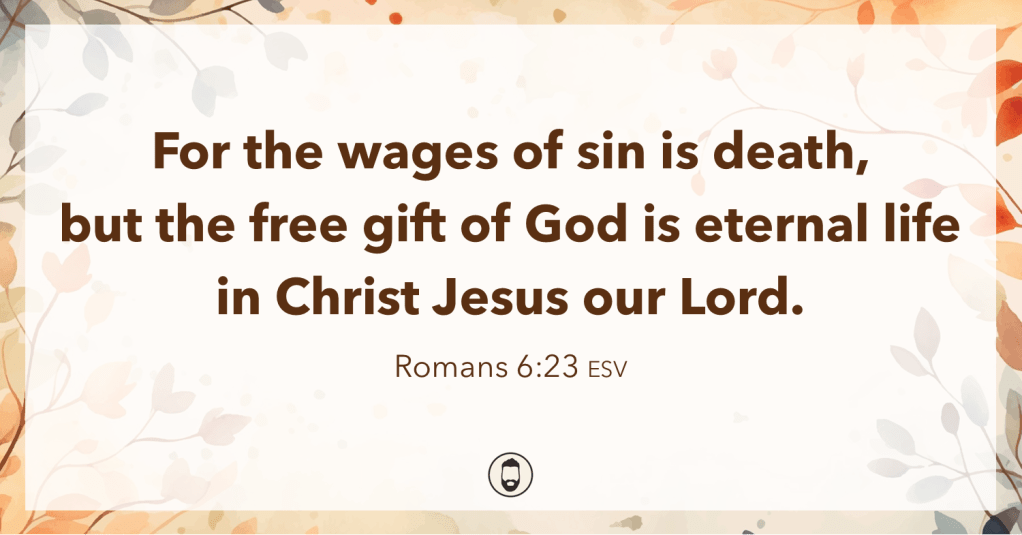
Romans 6:23 tells us that the “wages of sin is death”. This means that our sin has earned us death and that there is nothing we can do to earn our way out of it. Thankfully, that is not the end of Romans 6:23; check out the full verse: “For the wages of sin is death, but the free gift of God is eternal life in Christ Jesus our Lord.” God has made a way for us! Just as John 3:16 tells us above, Jesus paid the penalty for our sin. He died in our place and offers us life instead. That’s good news!

How You Can Be Saved

The only way for us to be saved is to turn from our sins (and the punishment we deserve because of them) to Jesus and put our faith and trust in Him. We turn from our sin because we realize that we are in trouble and deserve death because of them. We turn to Jesus because we realize that, just like the person who was drowning or trapped in the burning building, we cannot save ourselves. 

To put our faith and trust in Him means that we believe that Jesus fully paid the penalty for our sins and offers us forgiveness. The Bible teaches us that Jesus “Himself bore our sins in His body on the tree (the cross)” (1 Peter 2:24). Here is how the Bible tells us we can be saved:

“if you confess with your mouth that Jesus is Lord and believe in your heart that God raised Him from the dead, you will be saved. For with the heart one believes and is justified, and with the mouth one confesses and is saved.” (Romans 10:9-10)

This is what it means when we say put our faith and trust in Jesus; we confess Him as Lord and give our lives over to Him, trusting that He knows best and acknowledge He is God, asking Him to take charge of our lives. We tell Him that we believe He is who the Bible says He is: the Savior who died for our sins and rose again. If we do this, not just saying some magic words but genuinely believing and seeking Him, the Bible tells us that we are saved!


Lord, thank you for offering salvation that is free to all who believe but cost so much at the cost of Your Son. Thank You for raising again and offering that life to all who believe and confess You as Lord. Thank You.

All through the month of November, our Christ Community Church family is focusing on what we are thankful for and expressing our thanks to our “great God and Savior Jesus Christ, who gave Himself for us to redeem us” (Titus 2:13-14).

This, like the #DailyWisdomChallenge we went through in October, is a challenge from our pastor John Goldwater — the #GRATITUDEandHOPEchallenge — where we have the opportunity to post Bible passages that move us to thanksgiving or in which we find hope. May this lead you to be grateful and find your hope in Jesus!

I’m Thankful for God’s Forgiveness — Gratitude & Hope Challenge | November 12

These verses are a beautiful picture of God’s forgiveness and are good reminders for those who are saved to see what the “free gift of eternal life” is in light of the “wages of [our] sin” (Romans 6:23). We are going to briefly unpack these verses, and Lord willing, you will be moved to be thankful as well.

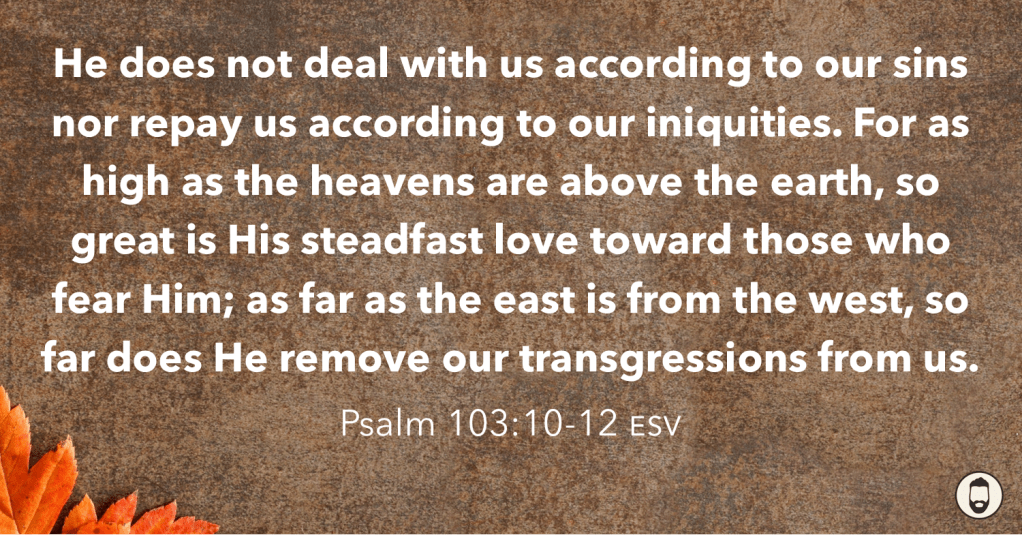
“He does not deal with us according to our sins nor repay us according to our iniquities.” This is a beautiful example of the otherness of God. I know that term sounds weird, but when we talk about God, it is important to remember that He is not like us. This otherness is really linked to His holiness, meaning that He is entirely set apart and above us in His worth, splender, and perfection. God is God, and we are not. 

Human beings deal with each other according to their sin and iniquity. If someone has wronged us or someone close to us, it is likely that we will forever treat them differently because of it. Even if we forgive, we are quick to let folks know we won’t forget. If we catch someone in a lie, they will forever be defined as a liar (even though we have been guilty of the same). The sin is a defining point for us because we don’t want to fall victim of it again. Yet God does not deal with US that way. 

That “us” is very important here because it is a distinction from how others are dealt with. This is not the us v. them where we make ourselves to be righteous (Romans 3:10-12). No, this is referencing the difference between those who have believed and put their faith in God and have been saved by grace through faith in Jesus (Ephesians 2:8-9) and those who have not (John 3:18). He does not deal with “us” according to our sin because Jesus has paid for our sin (1 Peter 2:24). Our sin does not define us because He defines us based on our relationship with Jesus (2 Corinthians 5:17, 21; Romans 8:1). 

“For as high as the heavens are above the earth, so great is His steadfast love toward those who fear Him….” Here we see the otherness of God again. This is literally the 6,000 mile view, one that God sees easily from His vantage point that we might struggle with from ours. 6,214 miles above our vantage point is when the earth stops being the earth; that’s literally how high the heavens are above the earth. God’s steadfast love – His never-stopping, never-failing, never-giving-up, everlasting love – is astronomically greater than our human hearts can fathom or feature (Isaiah 55:8-9). 

This qualifies the “us” from the last section because the “us” is made up of those who fear the Lord – those who follow and worship Him, those who have been saved by Him (Psalm 25:12-14). It also builds on the last section specifically because it shows that God not only has decided not to “deal with us according to our sins or repay us according to our iniquities” because He has paid the penalty for them (2 Corinthians 5:21) but did this because He loves us (John 3:16, Ephesians 2:4-5). This love is foreign to us because in our sinfulness we want to repay evil with evil, sin with sin (Matthew 5:44-45, 1 Peter 3:9). God is different. He loved us and saved us from our sin when we were still in it – when we still deserved death and hell; that “demonstrates” how much higher His love is than ours (Romans 5:8).

“…[A]s far as the east is from the west, so far does He remove our transgressions from us.” I love the contrast of imagery between the atmospheric levels of love in the last section and the global stretch of His forgiveness in this one. It is really cool to see how God specifically created the earth in such a way that it illustrates this, too. If His love requires a 6,000 foot view, His forgiveness requires understanding of what infinity is. You see, if you set out westward here on earth, you will go infinitely west. West will never start being east, and vice versa. God infinitely removes our sin from us. It is gone. Period. Finito. Over with. It is finished.

When Jesus forgives, He can allow Himself to forget because when He saves us He will not lose us. The eternal life He gives is, well, eternal. The change He produces in people’s lives is continual because it stems from His love and faithfulness, not ours. So, He doesn’t have to deal with us “according to our sins” because they have been infinitely removed. They have been paid for and we cannot repossess them. He has the receipt and is not taking returns. 

This is good news. It is nearly incomprehensible for us because we know the weight and evil nature of our sin (Psalm 51:3-5, Jeremiah 17:9). Yet He loved us and became the propitiation (wrath bearing sacrifice that trades the punishment due our sin for the favor due His Son) for our sin (Romans 3:23-25; 1 John 2:1-2, 4:10). 

What about you? Have you experienced the forgiveness of God? Will you stand before Him and have Him see Jesus’s blood and righteousness or stand before Him in your sin? 


Thank You, Lord, for offering forgiveness and salvation through Your Son Jesus.

Thank You, Lord, for Your astronomical love and the way you help us to see what You have done for us.

All through the month of November, our Christ Community Church family is focusing on what we are thankful for and expressing our thanks to our “great God and Savior Jesus Christ, who gave Himself for us to redeem us” (Titus 2:13-14).

This, like the #DailyWisdomChallenge we went through in October, is a challenge from our pastor John Goldwater — the #GRATITUDEandHOPEchallenge — where we have the opportunity to post Bible passages that move us to thanksgiving or in which we find hope. May this lead you to be grateful and find your hope in Jesus!

I’m Thankful God Gives Hope in the Midst of Suffering — Gratitude & Hope Challenge | November 8

I’m thankful to God for giving hope in the midst of suffering.

Sometimes, we can be fooled into thinking that being thankful is all about happy things, but the joy we have in Jesus is not because we have no sorrow and trials but despite our sorrow and trials.

The way Paul talks about this in Romans 5 bridges the hope we have in Jesus to Him being “justified by faith” in Him (Romans 5:1). There is a peace that comes through Him saving us — a peace that settles eternal matters and gives a necessary eternal perspective on troubling temporal (and sometimes temporary) matters (Romans 5:2).

That does not make the temporal or temporary suffering easy, though. It just reminds us Whose hands we are in, Who has taken care of our future, and how He will carry us through to the end. The progression in Romans 5:3-5 illustrates this.

For those who are in Christ, suffering produces endurance because He will carry us through; His strength is enough to endure whatever we need to get through. Enduring through His strength produces godly character because more time spent with Him and being carried by Him makes us reliant on Him and grow more like Him. Becoming more like Him gives us hope because we are used to looking to Him — now not just in trouble but in everything. And looking to Him in everything is not shameful because that is how we are designed; we were never meant to be self-reliant but Christ-reliant!

So, today, has plenty of trouble. Our lives here on earth are full of troubles and suffering. The longer we live, the more those can multiply. But the longer we walk with Christ, the more we realize that He carries us through. In that good news, there is hope in the midst of sorrow and trouble!


Lord, thank You for taking care of me and mine. You know that I let trials and sufferings hijack my mind too often, but even in the midst of my forgetfulness and stupidity, you are still holding me together and carrying me through. Thank you for holding me together until I can remember who You are and that I belong to You, and I look forward to the day that my forgetfulness is overwhelmed by the memory and character You are producing in me. You know I have friends and loved ones overwhelmed in temporal and temporary trials and suffering. Please help them remember you carry them, too. Amen.

All through the month of November, our Christ Community Church family is focusing on what we are thankful for and expressing our thanks to our “great God and Savior Jesus Christ, who gave Himself for us to redeem us” (Titus 2:13-14).

This, like the #DailyWisdomChallenge we went through in October, is a challenge from our pastor John Goldwater — the #GRATITUDEandHOPEchallenge — where we have the opportunity to post Bible passages that move us to thanksgiving or in which we find hope. May this lead you to be grateful and find your hope in Jesus!

I’m Thankful for God’s Faithfulness — Gratitude & Hope Challenge | November 7

I’m thankful for God’s faithfulness!

Sometimes when Christ-followers say Jesus is our everything or that He is everything to us, it can sound a bit cliche. But for those who are in Christ, it is not just a statement we make; it is the foundation of our hope — the foundation of our life in Him.

When we are saved, He takes us from death to life (Ephesians 2:1-5). He takes our sin and exchanges it for His righteousness (2 Corinthians 5:21). Our old life passes away in His death and new life is born through His resurrection (2 Corinthians 5:17, Colossians 3:9-10, Ephesians 4:17-24). He builds us up and establishes us (Colossians 2:6-7).

Not only is Jesus faithful in salvation, but He is faithful in keeping us and protecting us. Think about it: if we can trust Him to do what He says and save us — if He can bring us from death to life in Him, isn’t He powerful enough to protect us and “guard [us] against the evil one”?

The answer is yes.

As the author of Hebrews put it: “He who promised is faithful” (Hebrews 10:23). And I sure am thankful He is!


Thank You, Lord, for being the One who never fails, never lies, and never changes. When He say You will do something, You do it. When You promise, You fulfill it. When You love, You don’t let go. There is no one else in the universe faithful like You — definitely not us! Thank You for being faithful to build us up and protect us from evil. Amen.

All through the month of November, our Christ Community Church family is focusing on what we are thankful for and expressing our thanks to our “great God and Savior Jesus Christ, who gave Himself for us to redeem us” (Titus 2:13-14).

This, like the #DailyWisdomChallenge we went through in October, is a challenge from our pastor John Goldwater — the #GRATITUDEandHOPEchallenge — where we have the opportunity to post Bible passages that move us to thanksgiving or in which we find hope. May this lead you to be grateful and find your hope in Jesus!

I’m Thankful for the Love of God — Gratitude & Hope Challenge | November 3

I’m thankful for the love of God! There is no other love like it. In fact, His love informs all other love — defines all other love.

In John 15:13, Jesus says that there is no “greater love” than one who will lay his life down for His friends. The day after He said that, He died on the cross for us, and proved that there is no “greater love” than His!

He loves us, and having experienced the love He has for us, we love Him in return. It is the same way that children learn what love is. They experience love from their parents and families, and they learn to reciprocate it. But it is not about the love we return. God’s love is so much more powerful and abundant than our meager offering back to Him.

I love the word that John used to describe the extent of God’s love here: propitiation. This is merely a big seminary or theology word. This is a Bible word. It describes a sacrifice that exchanges the wrath of God sinners deserve with the favor of God they don’t. Those who are saved experience the favor of God that His Son Jesus deserves because Jesus bore the wrath that our sin deserves. That’s love. And there’s no “greater love” than that!


Lord, thank You for loving me and all that You have saved. We don’t deserve Your love, especially not me, but I am thankful that You set Your affections on me despite my sin. Thank You for paying for my sin and covering me with Your blood. I love you, too, and long for the Day when we will be together forevermore.

All through the month of November, our Christ Community Church family is focusing on what we are thankful for and expressing our thanks to our “great God and Savior Jesus Christ, who gave Himself for us to redeem us” (Titus 2:13-14).

This, like the #DailyWisdomChallenge we went through in October, is a challenge from our pastor John Goldwater — the #GRATITUDEandHOPEchallenge — where we have the opportunity to post Bible passages that move us to thanksgiving or in which we find hope. May this lead you to be grateful and find your hope in Jesus!