I’m thankful for the love of God! There is no other love like it. In fact, His love informs all other love — defines all other love.
In John 15:13, Jesus says that there is no “greater love” than one who will lay his life down for His friends. The day after He said that, He died on the cross for us, and proved that there is no “greater love” than His!
He loves us, and having experienced the love He has for us, we love Him in return. It is the same way that children learn what love is. They experience love from their parents and families, and they learn to reciprocate it. But it is not about the love we return. God’s love is so much more powerful and abundant than our meager offering back to Him.
I love the word that John used to describe the extent of God’s love here: propitiation. This is merely a big seminary or theology word. This is a Bible word. It describes a sacrifice that exchanges the wrath of God sinners deserve with the favor of God they don’t. Those who are saved experience the favor of God that His Son Jesus deserves because Jesus bore the wrath that our sin deserves. That’s love. And there’s no “greater love” than that!
Lord, thank You for loving me and all that You have saved. We don’t deserve Your love, especially not me, but I am thankful that You set Your affections on me despite my sin. Thank You for paying for my sin and covering me with Your blood. I love you, too, and long for the Day when we will be together forevermore.
All through the month of November, our Christ Community Church family is focusing on what we are thankful for and expressing our thanks to our “great God and Savior Jesus Christ, who gave Himself for us to redeem us” (Titus 2:13-14).
This, like the #DailyWisdomChallenge we went through in October, is a challenge from our pastor John Goldwater — the #GRATITUDEandHOPEchallenge — where we have the opportunity to post Bible passages that move us to thanksgiving or in which we find hope. May this lead you to be grateful and find your hope in Jesus!
I’m thankful for the gospel — the good news of Jesus Christ — that tells us that He died for our sins on the cross we deserved, was buried, and rose from the dead defeating death, hell, and the grave.
That’s good news!
Literally, that’s what the word “gospel” means: good news!
Lord, thank you for the good news that we do not have to remain dead in our sins. Thank you for being willing to send Your Son to die in our place and giving the opportunity to come to You by grace through faith in Jesus and be made alive in Him.
All through the month of November, our Christ Community Church family is focusing on what we are thankful for and expressing our thanks to our “great God and Savior Jesus Christ, who gave Himself for us to redeem us” (Titus 2:13-14).
This, like the #DailyWisdomChallenge we went through in October, is a challenge from our pastor John Goldwater — the #GRATITUDEandHOPEchallenge — where we have the opportunity to post Bible passages that move us to thanksgiving or in which we find hope. May this lead you to be grateful and find your hope in Jesus!
For the month of October, we are answering the challenge John Goldwater, pastor of Christ Community Church in Grenada, MS, laid out — the #DailyWisdomChallenge. Each day, we are going to read through a chapter of Proverbs corresponding to the day of the month.
This fits with what we have studied in Colossians, specifically Colossians 3:1-2, namely that we should seek “the things that are above, where Christ is” and set our minds like a thermostat “on things that are above, not on things that are on earth”. Imagine what a month meditating on God’s Word daily can do for us.
Won’t you join us on this #DailyWisdomChallenge and set your minds on Christ?
Today’s proverb is such a beautiful picture of what what Paul describes as being found in Christ, “not having a righteousness of [our] own that comes from the law, but that which comes through faith in Christ, the righteousness from God that depends on faith” (Philippians 3:9).
So often, talk of the righteousness and wickedness fuels complaints about religious people thinking they are better than others or even fuels the self-righteousness of some church folks. I wish I could say this never has applied to me, but as I wrote in the #DailyWisdomChallenge post for Proverb 11, it is too easy to forget we are all sinners — all wicked, as many of the Proverbs say.
If it were not for Jesus saving me, I would have no righteousness to speak of (Romans 3:10); all I would have is my sin and the death that my sin has earned (Romans 6:23). To clarify, I am not a righteous man. My heart is wicked. And, well, not to be a downer, but yours is too. All of us sin and “fall short of the glory of God” (Romans 3:23). He is righteous. He is perfect. He is sinless. The rest of us are not.
There will come a day when I will stand before this righteous, perfect, sinless God and be faced with my wickedness and sin. Everything I have ever done will be evidence of that. Everything I have ever said will make the case for my guilt. The Bible tells us that Satan is the Accuser — one who accuses us day and night “before our God” (Revelation 12:10). He is bringing to God’s attention, and not having to lie despite his great knack for deception, our sin and failures. And, scarier still, none of this is news to God, because He knew all that we would do and all that we would say before the foundation of the world.
For those who have been saved, however, a “guilt offering” has been made on our behalf. Those who confess Jesus as Lord and believe in His resurrection are saved (Romans 10:9), and God places our sin and guilt on Jesus, His sinless Son, in order that we can be made righteous (2 Corinthians 5:21). Jesus paid our sin debt “by cancelling the record…that stood against us with its legal demands” by “nailing it to the cross” — by allowing the sinless Savior to be nailed to the cross that we deserved (Colossians 2:14).
That’s good news!
What’s more is that God did not merely satisfy some legal demand. He did not issue some writ or declaration that can be passed to the accuser who is trying to prosecute us and shame God with our failures. No, the Bible tells us that we have an “advocate” who has taken our case, and his name and credentials are “Jesus Christ the Righteous” (1 John 2:1)! Think of every dramatic courtroom drama you have ever watched or read about, and know that they pale in comparison to the rich finality with which Jesus handles the case of those He has saved. When the accuser taunts and mocks, reminding us of sin and failure, Jesus answers with His own righteousness! He declares that by His blood and sacrifice — and the fact that He died and is now living and interceding on our behalf (Hebrews 7:25, Romans 8:34) — our sin has been removed “as far as the east is from the west” (Psalm 103:12) and “cast…into the depths of the sea” (Micah 7:19)!
Before the Accuser can plead his case any further, God smacks the gavel with finality and declares innocent based on the righteousness of Christ!
Proverbs say that fools “mock the guilt offering”. One thing I can surely testify to here today is that I “enjoy” God’s “acceptance” BECAUSE I know how serious my sin is and how eternally grateful I am that He would save a wretch such as me.
How about you?
Do you see Jesus’s death and resurrection as necessary, or do you find it silly and unnecessary?
Do you think you will stand before God and have acceptance through any other means — wealth, prosperity, good works?
Let me plead with you today to look to Jesus to save you!
And, if you have, rejoice in the acceptance that will never be taken away, and do not fear the accuser. He knows “his time is short” and is lashing out in anger, trying to hurt those God has saved and thereby hurt Him (Revelation 12:12). Be encouraged and fear not, because the same proclamation that brings news of the accuser also proclaims God’s victory and Satan’s doom:
“Now the salvation and the power and the Kingdom of our God and the authority of His Christ have come, for the accuser of our brothers HAS BEEN THROWN DOWN, who accuses them day and night before our God. And they have CONQUERED him BY THE BLOOD OF THE LAMB and the word of their testimony, for they loved not their lives even unto death.” (Revelation 12:10-11)
1 Long ago, at many times and in many ways, God spoke to our fathers by the prophets, 2 but in these last days He has spoken to us by His Son, whom He appointed the heir of all things, through whom also He created the world. 3 He is the radiance of the glory of God and the exact imprint of His nature, and He upholds the universe by the word of His power. After making purification for sins, He sat down at the right hand of the Majesty on high, 4 having become as much superior to angels as the name He has inherited is more excellent than theirs.[1]
📖 Revelation 7After the terrifying events of Revelation 6, John is given a breathtaking glimpse of hope. Before judgment continues, God reveals that His people are known, sealed, and secure in Christ. The chapter culminates with one of Revelation's most beautiful pictures: the Lamb who was slain is also the Shepherd who leads His people forever.In this episode, Keith Harris and Jamie Harrison discuss:✔️ Why Revelation 7 is an interlude between the sixth and seventh seals✔️ What it means for God's servants to be sealed✔️ The two primary views of the 144,000—and why faithful Christians differ✔️ How John's pattern of hearing one thing and seeing another helps interpret the chapter✔️ The innumerable multitude worshiping before the throne✔️ Why Jesus, the Lamb, is also our Shepherd who leads us to living waterThis chapter reminds us that our greatest hope isn't solving every prophetic question—it's belonging to Christ. Those who trust Him are safe in Him, and one day He will wipe away every tear from their eyes.📖 "For the Lamb in the midst of the throne will be their shepherd, and he will guide them to springs of living water, and God will wipe away every tear from their eyes." (Revelation 7:17, ESV)🔗 If you'd like to see a written version of this podcast, complete with footnotes and cross-references, you can find it here.
It is my pleasure today to introduce you to David Miller. He went to be with the Lord last week, but thanks to recordings and videos, his sermons still proclaim the gospel after his death.
His ministry was called Line Upon Line, based off of Isaiah 28:10 – “For it is precept upon precept…, line upon line…”, which was a testament to how he preached, taking texts of Scripture and preaching them line by line and breaking down the precepts so that they can be understood. Because of his disability, peroneal muscular atrophy, he was in a wheelchair for decades even by the time I met him sixteen years ago. By that point, he could no longer hold a Bible or write out sermon notes – hadn’t been able to for a long time. What I called a disability, God used to strengthen his mind by giving Bro. David a gift for memorizing long passages of Scripture and sermon notes and a singular gifting to preach with clarity like no other I have ever met. And it is that preaching that I want to share with you.
What follows is a sermon Bro. David preached at the G3 conference several years back[2] on Hebrews 1:1-4 on “The Excellency of Christ”. Just as he would not want himself proclaimed as excellent but to have people pointed to Christ, my effort here is to allow others to benefit from the preaching that has been so beneficial to my spirit.
So, with no further ado, let us be in awe of the excellent Christ, King Jesus, and dive deep into His Word today.
—————————————————————————
Turn please to the New Testament Book of Hebrews chapter one. Hebrews chapter one, beginning at verse one.
The title for my sermon now is “The Excellency of Christ”. The writer in the book of Hebrews has for his theme the excellency – the superiority – of Jesus Christ. In this book, he tells us that Jesus is better than the Old Testament prophets, better than the Old Testament priests. He’s greater than the angels. And the new covenant in His blood is far superior to the Old Testament covenant.
He will argue his theme along two lines: 1) He will argue on the basis of Christ’s person – who He is, and 2) he will argue on the basis of Christ’s performance – the things that He has done. And the bottom line in the Book of Hebrews is this: there is no other one like Jesus and no other one has ever done the things that Christ has done. And these two items, the person, and the performances of Christ, will form the two items in my outline.
Have you found our text? Let’s begin at verse one.
1 God, who at sundry times and in divers manners spake in time past unto the fathers by the prophets, 2 Hath in these last days spoken unto us by His Son, whom He hath appointed heir of all things, by whom also He made the worlds; 3 Who being the brightness of His glory, and the express image of His person, and upholding all things by the word of His power, when He had by Himself purged our sins, sat down on the right hand of the Majesty on high; 4 Being made so much better than the angels, as He hath by inheritance obtained a more excellent name than they.[3]
The Person of Christ
I call your attention to verse three first. Here, we have two statements regarding the person of Christ. He begins by telling us that Christ is the brightness of God’s glory. That is, He is the effulgence. He is the radiant splendor. He is the shining forth of the glory of God. Jesus is to God what the rays and the beams are to the sun; the rays and the beams are that by which the sun is seen and known. Its warmth, its beauty, its brightness are experienced through the rays and the beams. Now, in a far greater way, Jesus is the one in whom and through whom the glory of God is seen and known. He’s the brightness of God’s glory.
But not only that, He is the “express image” of the person of God. This phrase “express image” has in mind an engraver’s too, upon which there is an insignia and when placed down upon the wood and the wax it leaves there an exact duplication, a precise reproduction of the insignia. We get our English word character from this idea. Do you see what he’s telling us about Jesus? In His essential nature, Jesus Christ possesses the exact same character as deity. Here is a biblical affirmation of the deity of Christ.
What do you folks think about when you think about God? Do you think about the eternal, pre-existent one?
Well, I would remind you that before the sun had ever shone upon the face of the sea, before there was any gold in California, before there were any bulldogs in Georgia {congregation laughs}, before there were any razorbacks in Arkansas, before there was any coal in Kentucky, or any all in the Middle East, Jesus Christ was already living in eternity past dwelling in unapproachable light enjoying the fellowship of His Father.
What do you think about when you think about God?
Whatever characterizes the nature of God also characterizes the nature of Jesus. He is the express image of the person of God. Now put that aside. That’s the first half of my sermon.
What do you think? I expected resounding “Amen” to that question if for no other reason it was brief. However, if you thought that was half of the sermon chronologically, you have greatly erred in your judgment {congregation laughs}. That’s the first half of the sermon outline. Here’s the second half.
The Performance of Christ
I want you to see the excellence in His performances. There are four of these.
One, I want you to see the excellency of Christ as the inerrant revelator.
Now in verse one and the first half of verse two, we have four distinct ideas regarding God’s revelation of Himself to man.
He begins by speaking of the fragmentation of the Old Testament revelation. It, the Old Testament revelation, was at “sundry times.” It didn’t come all at once. It came in stages. It came in parts. And it was in “diverse manners.” God didn’t use the same method. He didn’t employ the same means every time He made Himself known in the Old Testament.
You will recall that on one occasion He spoke to Moses in a burning Bush on the backside of the desert (Exodus 3:1-6). Unless of course, you had read Dr. Roy Honeycutt’s commentary in the old Broadman commentary series on the Book of Exodus. There in Chapter 3, Dr. Honeycutt says there are three possible interpretations of this text. Number one, it could have been a burning bush. Imagine that. {congregation laughs} Number two, it could have been the sun reflecting upon the orange foliage, giving the appearance of burning. Or number three, it could have been an inner experience that only Moses had, and if you and I had been there, we would not have seen any burning Bush nor heard any audible voice. And then he adds, “For the present writer, the latter seems more probable.” Well, for the present country preacher, the former seems more probable. God spoke to Moses in the burning bush.
On another occasion, He spoke audibly to Moses on Mount Sinai as the mountain trembled and smoked (Exodus 19:18-19). Later, with His finger, God wrote the Ten Commandments on tables of stone (Exodus 31:18)….
He spoke through a donkey (Numbers 22:28-30). Do you remember that occasion? He spoke to Isaiah in a vision (Isaiah 6:1-4) – to Daniel in a dream (Daniel 7:1-2). The Old Testament scriptures did not come all at once, nor did they come in the same way (v. 1). It was a fragmented, incomplete revelation.
Now, I want you to see the fullness of the New Testament revelation in Christ. God hath spoken unto us by His son. I am addressing a highly privileged class of people this morning. You and I, who live on the post- side of the incarnation of Jesus, have a full revelation from God. We know more about faith than Abraham. We know more about the Law than Moses. We know more about salvation than Isaiah. We know more about the end time than Daniel. We know more about how and why to worship God than David We have a full revelation from God in Christ.
Number three, I want you to see the finality of the New Testament revelation in Christ. Listen to it: God hath in these last days, in these last days of revelation, God hath spoken fully and finally in His son Jesus Christ.
Now I don’t know about you folks, but it makes me nervous to be around these saints who seem to have a fresh word from God. They make me nervous. I sat in a midweek Bible study and prayer time in a Baptist Church in my hometown several years ago – make a note of this, it was more than three years ago. The pastor and some of the laymen were having a share time relating what all they had learned from a seminar on prophecy at the local charismatic church on Monday and Tuesday evening of that week. It seems that the leader of the seminar had received a vision from God. And in his vision, God had told him that there was going to be a nuclear explosion south of Heber Springs, about fifty miles, within the next three years. And our area up through Heber Springs was going to be a refugee camp for those who escaped the explosion. Now, immediately upon hearing such news, my attention piqued. I live there.
And one of the layman spoke up and said, “This corroborates what I’ve been telling the body,” and he reminded them how that a few weeks earlier he had had a dream and in his dream God had told him there was going to be a nuclear explosion south of Heber Springs in the near future. “But,” said he, “what I did not know until this week was that our area would be a refugee camp for those who escaped the explosion.”
“But,” said he, “that’s the way God speaks today. To one member of the body he gives a dream, to another member of the body a vision, to another, a word of knowledge, and the body of Christ comes together and each member shares what he or she has received from God and the church synthesizes – puts all of that together. And there you have God’s word to man today.”
What do you think?
Well, I sat there for an inordinately long period of time, being long-suffering and forbearing. But after a while, I said, “Brethren, since this is the share time, I’ve got something I’d like to share with you. I’d like to share with you that it makes me nervous to be around folks who have a fresh word from God that the rest of us don’t have, because we’re limited to just the Old and New Testaments.” That makes me nervous. And I, like the apostle Paul, I’m a premillennialist…. {congregation laughs} I’m keenly interested in the second coming of the Lord. I think it’s profitable for the Saints to get together and contemplate all of those complex and intricate details of the second coming of the Lord. However. I want to caution you. You must make a difference between the exposition of Holy Scripture on the one hand, and the supposition of some dude’s mind on the other hand. Those two things are not the same.
Hereby shall you know a prophet if what he says comes to pass (Deuteronomy 18:21-22). That’s good, strong evidence that he’s spoken for God. However, that – even that – if what he says comes to pass, that is not proof-positive that he’s spoken for God. You want proof-positive? If what he says does not come to pass; that’s proof positive (Deuteronomy 18:22). Now, that’s been much longer than three years ago. And I know that I’m the last one to find out, but I believe if there had been a nuclear explosion south of Heber Springs – 50 miles or 500 miles – I would have heard about it by now. What does that tell us about the leader of the seminar? Beloved, that tells me that he must have heard a jackass braying and thought he had been called to preach. He was as bogus as a $3 bill. And the Baptist who went to the seminar and gave money deserved to lose every dime.
Beware, when a person says God told me. Oral Roberts once said, “God told me to raise $8 million, or he’s going to kill me.” I wondered why God didn’t kill him for saying that. {congregation laughs}
God hath spoken fully, and finally, in His son Jesus Christ.
Now, I want to show you a fourth thing. I want you to see the father of both revelations. Now this is audience participation time. Straighten yourself up. Now get your shoulders back, your chin up. Some of you are a little more comfortable than you ought to be in church. {congregation laughs} Here’s the question who was it? Who spoke in time, passed unto the fathers by the prophets? Who did that? {God did.} Now, who was it who had spoken unto us in these last days by His son? {God.}
This is an above average congregation. Now, sophisticated academic credentials are not required at this point. It doesn’t matter if you’re reading in the Old Testament, something the prophet said, or if you’re reading in the New Testament, something Jesus said, you are reading the Word of God. He is the Father of both revelations. No man ever spoke like Jesus, He is the inerrant revelator.
Now here’s the second item: I want you to see the excellency of His performance as the infallible regulator.
Now look at verse 2, the last statement: “by whom also He made the worlds”. Now look at verse three, the third statement: “and upholding all things by the word of His power.” Here we are told that Jesus Christ was the agent in creation. And He is currently involved in maintaining the order, the unity, and the balance in the created order. He governs it by the word of His power.
I appreciated the recitation from Colossians [1:15-20] earlier this morning. Didn’t you?
He is the image of the invisible God, the first born of every creature, for by Him were all things made that are in heaven and that are in earth, visible and invisible, whether they be thrones or dominions or principalities or powers, all things were created by Him and for Him, and He is before all things and by Him all things consist – they cohere – they are held together.
Do you have any idea how big the created order is? Let me illustrate it for you. If at the dawn of creation, you could have caught a light beam and put a saddle on it, mounted up and commenced to ride from one end of the Milky Way galaxy toward the opposite end. And you had been riding at the speed of light, 182-186,000 miles per second – that’s zipping right along – and you had been riding non-stop from the dawn of creation as we know it, this morning, you would only be about one-tenth of the way across the Milky Way galaxy. And yet the scientists tell us there are other galaxies, many of these larger than the Milky Way. I don’t know about you, but in my country-boy way of thinking, that is big time stuff. That’s Major League. And here the Bible affirms not only did Christ create the universe, He maintains the order and balance and unity of the universe by the word of His omnipotence.
Hallelujah!
I don’t think I’m out of line this morning if I tell you that you can bring the broken pieces of your life and lay them at the feet of Jesus in humble submission to His lordship, and have every confidence that He is able to put them together and make something beautiful out of your life. He’s the infallible regulator.
Do you want some peace? Do you want some tranquility? Do you want some order? Do you want some balance in your own existence? Come to Jesus, bend the knee, and bow the heart. He’s the great, infallible regulator.
Number three, I want you to see His performance as the incomparable redeemer.
When He had by Himself purged our sin, notice three things:
One, the sovereignty of the redeemer. He purged our sins (v. 3). Now to hear some of the brethren preach, you’d think the Lord had been morally obligated, bound by some solemn moral responsibility to leave heaven’s glory, condescend to Earth’s shame, and die a substitutionary, vicarious death on behalf of sinners. But let me ask you this: did God owe us anything? Why did He come? He came because in His heart there is grace and mercy (Ephesians 2:4-5). He came because he wanted to, not because He was obligated (John 10:18).
Notice the sufficiency of the redemption. He purged our sin (v. 3). Grammatically, it is a fact accomplished in the past, but having perfect and continuing result throughout the future (Hebrews 10:14). “’Tis done! ‘Tis done! The great transaction is done!” (John 19:30) There’s never going to be any more work done regarding our redemption (Hebrews 9:12).
Notice the singularity of the Redeemer when He had, by Himself, purged our sin. “Jesus paid it all. All to Him. I owe Sin had left a crimson stain. He washed it white as snow.”
Now, item number four: I want you to see His performance as the indisputed ruler.
Look at verse three. Look at that last statement. Have you ever seen one verse that had more good stuff in it? When “He had by Himself purged our sin, He sat down at the right hand of the Majesty on high; being made so much better than the angels, as He hath by inheritance obtained a more excellent name than they.”
You hear some of the brethren preach, you would think the Lord and the Devil were locked in the death throes of a spiritual battle out in space, and the outcome had not yet been determined. But listen: Jesus is not going to be Lord; He is Lord already! He’s not Lord because He’s risen from the dead; He was Lord before He ever died. He’s King Jesus!
There’s a line that’s been drawn through the ages, on that line stands an old rugged cross. On that cross, a battle is raging for the gain of man’s soul or its loss. On one side march the forces of evil – all the demons and the devils of Hell. On the other, the angels of glory, and they meet on Golgotha’s hill. The earth shakes with the force of that conflict, and the sun refuses to shine. For there hangs God’s son in the balance.
But then from the darkness He cries:
It is finished – the battle is over. It is finished – there will be no more war. It is finished – the end of the conflict. It is finished, and Jesus is Lord! Hallelujah!
All of this thinking about marriage has had me thinking a lot about the gospel. Paul, in Ephesians 5:32, says that marriage (which He refers to here as a “mystery” or symbol) “refers to Christ and the church”. Marriage, the love of a husband for His wife/a wife to her husband, is meant to be a picture of the gospel.
Why?
Well, the gospel is a picture of love, grace, mercy, forgiveness, and reconciliation. The gospel is a picture of the King of kings leaving His throne, coming to earth in pursuit of His bride — to redeem her from her sin and death, bringing her home with Him.
This can be seen in the Bible through the marriage of a prophet named Hosea and his wife, Gomer. Now, the gospel gives us imagery for the Love Story of all love stories, but it is not necessarily nice and neat nor is it always fitting for the Hallmark channel. There’s death and blood and gore and sacrifice. There’s sadness and heartbreak. There’s…well, let’s look at Hosea and Gomer’s love story, or at least the PG-est version I can give you.
God told Hosea that his marriage would be a picture of the way that Israel had committed adultery against Him. So, Hosea was told to go and take a wife like Israel — a wife who would no doubt forsake Hosea and commit adultery against Him like Israel had forsaken the Lord (Hosea 1:2). And that’s exactly what Hosea did, and that’s the beginning of his story with Gomer (Hosea 1:3). They had a rough go at it, but God had a plan in the midst of what looks like a terrible calling.
Hosea and Gomer had a baby. God told him to name the child Jezreel so that when people heard the name of the child Hosea could tell them that the Lord was going to punish Israel for the bloodshed by the hands of Jehu (2 Kings 10:11 will give you the context). Imagine someone coming up to you and asking the name of your child. What would normally be a happy or at least a generically positive conversation would be: meet my son Jezreel; we named him that because God is angry over our nation’s sin and is about to lay down judgment for it.
Hosea and Gomer had two more children, although the language in Hosea 1:6 and 1:8 differ from the birth announcement of Jezreel (Hosea 1:3), meaning that Gomer was doing exactly what was prophesied of her — she had conceived their other two children outside of their marriage. These two kiddos had interesting names, too, as well as messages for Israel (Hosea 1:6-9). The first was a daughter named Lo-ruhama (No Mercy). The second was a son named Lo-ammi (Not My People). When people learned those names, they were to be told that, because Israel had forsaken the Lord — in the same manner in which Gomer had forsaken Hosea — that they were no longer to receive God’s mercy, no longer to be called God’s people, and that God would no longer be their God.
This is a truly terrifying message.
Mercy is God withholding the punishment deserved in favor of grace. Now, it was time for judgment. At face value, it appears that hope was lost for Israel because they had forsaken their hope — their Husband (Hosea 2:16) — all because their own desires were greater than their love for Him. This coincided with the fact that Gomer had left Hosea and had been sold into another man’s harem (Hosea 3:1-2). Hosea and Gomer’s marriage was to be a picture of God’s relationship with Israel, so if things are taken on the face of the terrible news, Hosea should just unmercifully cast Gomer aside and gave her a good riddance and so on. That’s what we would do today. Moses even allowed for such an instance (Deuteronomy 24:1-4, Matthew 19:7-9).
14“Therefore, behold, I will allure her, and bring her into the wilderness, and speak tenderly to her. 15And there I will give her vineyards and make the Valley of Achor a door of hope. And there she shall answer as in the days of her youth, as at the time when she came out of the land of Egypt.
God would pursue His people and woo (“allure”, “speak tenderly”) them back to Him. There would be times of trouble (“wilderness”) and it would take time, but His people would repent and turn back to Him. He would no longer call them Lo-ruhama (No Mercy) or Lo-ammi (Not My People) because He would once again show them mercy and gather them to Himself as His people.
What about Hosea? God told him to go and get his wife, even though she was “loved by another man” (Hosea 3:1). Hosea went to that man and BOUGHT (literally, redeemed) his wife for “fifteen shekels of silver” and some barley (Hosea 3:2). In the same way, God has sought us out in the midst of our unfaithfulness to Him (James 4:4) and “demonstrates His love in that while we were still sinners Christ died for us” (Romans 5:8). Hosea paid a little money and grain, but Jesus paid for His Bride “not with perishable things such as silver or gold”, but with His “precious blood”, “like that of a lamb without blemish or spot” (1 Peter 1:18-19). He loves us despite our sin and death and offers us love and life in Him alone. Knowing full well the depth of our sin, Jesus came to earth and, again, BOUGHT (literally, redeemed) us from slavery to sin and makes us His own forevermore.
What a love!
What a Love Story! And it is not over yet.
Revelation 21 gives us a window into heaven when Jesus’s Bride, the Church, will finally come home to Him. Look at the language here and how it fits with Hosea’s story. From the throne of God we hear these words:
“Behold, the dwelling place of God is with man. He will dwell with them, and they will be His people, and God Himself will be with them as their God. He will wipe away every tear from their eyes….” (Revelation 21:3-4)
Oh, what a day that will be when we stand before our King and with nail-scarred hand He reaches up to wipe away the last tear His bride will ever cry. The pinnacle of His mercy will be reached when His Bride comes home and dwells with Him in His house forever!
Now, I know that this is pretty heavy for a “Songs for Sunday”, but oh, how beautiful it is! It would be so easy to look at this and say, woe is Hosea, but we have all been Gomer. Yet the King of kings left His throne, “took on flesh, and dwelt among us, and we have seen His glory, glory as of the only Son from the Father, full of grace and truth” (John 1:14). Jesus, “emptied Himself, by taking the form of a servant, being born in the likeness of men”, was “found in human form”, and “humbled Himself by becoming obedient to the point of death, even death on a cross” (Philippians 2:7-8).
And that is what we are singing about this Sunday.
It doesn’t matter whether you deem yourself far off from God or close to Him, it is good for us to get to gather and make much of Him — to sing His praises and know that He is in the business of saving and His love casts out all fear and can cleanse us from all unrighteousness.
It is good for us to get to gather and point each other to Him. It is all we have to offer at Christ Community because for many of us, we remember what it is like to be loved like Gomer.
What about you?
If you are in or around Grenada, MS this Sunday, we would love to invite you to gather with us. It’s Father’s Day — bring dad, too.
4But when the goodness and loving kindness of God our Savior appeared, 5He saved us, not because of works done by us in righteousness, but according to His own mercy, by the washing of regeneration and renewal of the Holy Spirit, 6whom He poured out on us richly through Jesus Christ our Savior, 7so that being justified by His grace we might become heirs according to the hope of eternal life.
Song | Washed Clean — Scripture Inspiration: 2 Corinthians 4:4, Ephesians 1:17-18, Matthew 11:28-30, Romans 8:2, John 8:34-36, Psalm 51:2, Psalm 51:7, Jeremiah 33:8, 1 John 1:9, Titus 3:4-5, Proverbs 16:18, Proverbs 3:34, Ephesians 2:1-2, Acts 26:18-19
3He was despised and rejected by men, a Man of Sorrows and acquainted with grief; and as one from whom men hide their faces He was despised, and we esteemed him not.
4Surely He has borne our griefs and carried our sorrows; yet we esteemed Him stricken, smitten by God, and afflicted. 5But He was pierced for our transgressions; He was crushed for our iniquities; upon Him was the chastisement that brought us peace, and with His wounds we are healed.
Song | Man of Sorrows — Scripture Inspiration: cf. Isaiah 53 and John 1:11, 29; also Galatians 3:13, 21; 1 Peter 2:24; Mark 14:16-62; Matthew 26:39-44, 26:67-68, 27:26-30; John 3:16; Romans 5:6-10; Psalm 145:3; Revelation 4:11; Philippians 2:5-8; Matthew 20:28; Titus 2:13-14; Colossians 2:13-15; Romans 6:23; John 8:36; John 20:1-7; Matthew 28:1-20; 1 Corinthians 15:3-8
Song | Jesus Paid It All (O Praise the One) — Scripture Inspiration: Matthew 11:28-30, John 19:30, Colossians 2:13-14, 2 Corinthians 4:15, Hebrews 12:28-29, Isaiah 1:18, Jeremiah 13:23, 2 Corinthians 5:17, Ezekiel 11:19, Revelation 4:10-11, Romans 6:4, Revelation 5:9-10
8For by grace you have been saved through faith. And this is not your own doing; it is the gift of God, 9not a result of works, so that no one may boast. 10For we are His workmanship, created in Christ Jesus for good works, which God prepared beforehand, that we should walk in them.
Song | I Got Saved — Scripture Inspiration: Psalm 46:1-4, Zechariah 13:1, Isaiah 7:14, Matthew 1:23, Psalm 36:9, Isaiah 1:18, Isaiah 61:10, Matthew 26:28, Ephesians 2:4-5, 1 John 1:5-10, Psalm 103:12, Psalm 51:9, Psalm 32:5, Psalm 107:10-16, Nahum 1:13, Isaiah 6:5, James 2:13, Zechariah 7:9, Hebrews 9:5, 1 Peter 2:10, Psalm 25:7, Psalm 31:19, Psalm 85:4, Acts 3:21, Galatians 2:16-17, Romans 5:8-9, 1 Peter 2:1-3, Hebrews 6:5, Colossians 2:13-15, Psalm 25:11, Numbers 4:19, Romans 8:28-30, Philippians 3:20-21, Colossians 3:10-13
Invitation | What He’s Done — Scripture Inspiration: Matthew 7:33, Mark 15:22, Luke 23:33, John 19:7, Matthew 26:26, Colossians 1:19-20, 1 Peter 1:19, John 8:36, Isaiah 53, Psalm 147:3, John 3:16, John 15:13, Romans 8:5-8, 1 John 1:9-2:2, Acts 4:12, 1 Corinthians 15:21-22, Hebrews 2:14, Philippians 2:5-11, 1 Corinthians 15:50-57, Revelation 4:1-11, 1 John 5:4, Revelation 17:14, Revelation 5:12, Philippians 4:8
Offertory | Good, Good Father — Scripture Inspiration: John 5:25, Revelation 3:20, Matthew 25:23, Hebrews 13:5, 1 Chronicles 16:34, Psalm 119:68, Nahum 1:7, Psalm 68:5, Psalm 36:5-7, John 3:16, John 15:13, Romans 5:6-8, Ephesians 2:4-5, Colossians 2:6-8, 2 Timothy 3:16-17, Psalm 139:4, Matthew 5:48, Romans 11:33, Ephesians 3:8, 1 John 4:7-11
I can remember times in my life when what I thought and felt about Sundays varied. If you’ll indulge me, I’d like to share a bit of my testimony.
As a kid, I can remember being excited about church coming up and a lazy afternoon afterward. I loved Sunday School where we would get equal amounts of Bible story time and puzzles, coloring, crafts, or playdough. The singing was a big hit for me — go figure. I remember getting excited when the preacher got excited. I remember the excitement of being home in the afternoon with no work to do or chores to accomplish — just time together playing or relaxing, just togetherness. And once I got saved, all of that just multiplied more and more because I had a gratitude and awe to Jesus that wasn’t there before.
As a teenager and young adult things shifted a bit as I started to serve and lead more, especially after being called into ministry. There were times when the joy I felt conflicted with my work ethic and desire to accomplish something or check off boxes. Sunday hit different with a job description, and when ministry became my bread-winning vocation, it shifted to something sad. In my foolishness and latent adolescent zealousness, my weeks culminated in Sundays meaning all of the work Monday-Saturday produced the worship gathering on Sunday morning and night. I found myself mired in a spiral of fearful work rather than worship in the fear of God. I feared committees and potential of lost pay rather and lost the joy of gathering with my faith family I had when I was a kid.
Then…I quit.
I found myself burned out and empty. I had long since put my hope in my work ethic and abilities and lost sight of what I was doing — WHO I was serving. Thankfully, I had a teaching license and our house had not sold when we had moved away, so I tucked tail, moved back home, and tried to start anew.
That first Sunday back was one of the most terrifying and convicting of my life. I had never been a visitor to a church other than coming in view of a call or visiting preacher. Now, I found myself in a new church where nearly everyone there knew I had been a pastor and had questions as to why I was coming to sit a pew and fade into the background. Through the whispers and the questions, I wanted to sink through the floor and disappear. I had hoped that some of the feelings from my childhood would return — that being able to be more of a part of the congregation would awaken something in me, but that is not how things work. The idolatry of work over worship took years to accomplish and would not be undone by an awkward day in a pew.
Eventually, something happened in me. The desire for God that I felt in the beginning began to return. I can’t tell you how many mornings I spent in the Word (at least a year and a half) hoping for some spark or feeling to return. I can’t tell you the number of prayers prayed where I found myself hoping He would listen to a shameful quitter, or worse one who had made a vocation of serving Him all about what I could do or accomplish. Just like it was in my marriage, laziness in a relationship would not be undone by a few sincere acts or gestures. BUT GOD.
In the seeking and searching, He was there. He had never moved. It was me who had moved. I think David described it better than I can in Psalm 40:1-3:
1I waited patiently for the LORD; He inclined to me and heard my cry. 2He drew me up from the pit of destruction, out of the miry bog, and set my feet upon a rock, making my steps secure. 3He put a new song in my mouth, a song of praise to our God. Many will see and fear, and put their trust in the LORD.
I was mired down in the swamp of my sinful idolatry and foolishness and could not get out under my own strength. My legs had pumped and climbed and were spent in exhaustion. The solidity of the shore was too far away, BUT GOD reached out, plucked me from the clay, and moved me all the way to the solid foundation of the ROCK, Jesus. Just like one would a toddler who had fallen, He held me and made sure I had my feet under me and on Him. The voice I could barely lift to Him in prayer began to croak out a new song, voice crackling out of unuse but the melody, the “song of praise”, began in my heart and eventually made it out of my lips.
Sunday regained its significance. It is the day we celebrate Jesus’s resurrection. He died for our sins, yes, but more than that, He rose! He is in the business of making dead things live. He is in the business of protecting His children, His sheep, from danger, even if that danger is their own stupidity and wandering. Those He has made alive will never die.
I look forward to Sunday because when “I waited patiently for the LORD”, He answered me and “heard my cry”.
I look forward to Sunday because when I was through with His work, He was not through with me.
I look forward to Sunday because it is not about my feelings but about His faithfulness (even though God has given me more joy now than in worshiping Him and serving Him than ever before).
I look forward to Sunday not because of vocation or religious devotion. I look forward to Sunday because of what Jesus accomplished on the cross and the magnificent truth that He walked out of the grave I deserve.
What about you?
Is Sunday a religious experience for you? Does it tick some kind of box on your righteous-living or to-do list? Has it been a while since you have gathered? Are you afraid that He knows your heart and might somehow abandon you?
HE hasn’t moved.
This Sunday at Christ Community, we will point you to the One who hears your cry and can pluck you out of whatever is miring you — whether it be the grave or the swampy ground of your sin. The songs will point to the finished work of Jesus on the cross and the vacancy in His borrowed tomb all the way to when His people will dwell with Him in heaven. The preaching will point you to Jesus by His Spirit and through His Word.
Maybe today is a good day to quit the exhausting clamber out of of the mire and reach your hands out to the One who has already reached out for you.
Peter, one whose testimony includes betraying and abandoning Jesus, said it well: “Humble yourselves, therefore, under the mighty hand of God so that at the proper time He may exalt you, casting all your anxieties on Him, because He cares for you” (1 Peter 5:6-7). His mighty hand is reached out to you. Grab hold of Him because He cares for you.
Sunday is coming.
I look forward to gathering with my brothers and sisters — all of which have a testimony of hopelessness and helplessness BUT GOD.
22“Men of Israel, hear these words: Jesus of Nazareth, a man attested to you by God with mighty works and wonders and signs that God did through him in your midst, as you yourselves know— 23this Jesus, delivered up according to the definite plan and foreknowledge of God, you crucified and killed by the hands of lawless men. 24God raised him up, loosing the pangs of death, because it was not possible for him to be held by it.
13And you, who were dead in your trespasses and the uncircumcision of your flesh, God made alive together with him, having forgiven us all our trespasses, 14by canceling the record of debt that stood against us with its legal demands. This he set aside, nailing it to the cross.
11Then I looked, and I heard around the throne and the living creatures and the elders the voice of many angels, numbering myriads of myriads and thousands of thousands, 12saying with a loud voice, “Worthy is the Lamb who was slain, to receive power and wealth and wisdom and might and honor and glory and blessing!” 13And I heard every creature in heaven and on earth and under the earth and in the sea, and all that is in them, saying, “To him who sits on the throne and to the Lamb be blessing and honor and glory and might forever and ever!”
1 Therefore be imitators of God, as beloved children. 2 And walk in love, as Christ loved us and gave himself up for us, a fragrant offering and sacrifice to God.
Ephesians 5:1-2
It would have to be extremely hard not to have what Jesus did for us on our minds as we are constantly bombarded with images of Jesus’s death here at the Great Passion Play. There is a particular memory from last year’s trip that has stuck with me.
We were sitting at the top of the seats for the play, and all were facing the set. It was quiet, and we were tired (which you are likely more than a little bit of this morning). The sun was setting but the beams of light coming through the trees were magnificent. Everything seemed so serene and peaceful, but there right at our eye level at the top of the set was the cross. We were taking requests for which songs to sing, and the song that became our song last year was requested: “What He’s Done”. Those words hit differently that evening:
See, on the hill of Calvary My Savior bled for me My Jesus set me free And look at the wounds that give me life Grace flowing from His side No greater sacrifice!
As John drew our attention to the empty tomb part of the set, I found myself overwhelmed with awe and gratitude. Now, I know that it was just a set and not the real deal, but Jesus really died for me. The wrath of God due for my sin was really poured on Jesus. Thankfully, Jesus really rose from the dead!
That is a lot of really, which leads to the point I really am making. If Jesus’s death and resurrection are real and He saves people, bringing them from death to life, shouldn’t this affect our real, everyday lives?
To a certain extent, it is easy to live out our faith publicly in another state on a mission trip and surrounded by our brothers and sisters in Christ. What happens when we get back home? If Jesus really has “good works” prepared for us to “walk in them” (Ephesians 2:10) like we have been studying about this week, doesn’t He have plans for us at home, too?
Think about the chorus of “What He’s Done”:
What He’s done! What He’s done! All the glory and the honor to the Son! My sins are forgiven, my future in Heaven! I praise God for what He’s done!
What better way is there to praise Him than by walking with Him and our lives being a testimony to what He’s done?
Application:
Pray and ask God to help you see His plan for you to be on mission when you get back home.
Pray for two other students and two adult leaders by name and specifically ask God to show them His plan for them to be on mission when they get back home, too.
Think of someone back home who does not know Jesus that you are going to see regularly. Ask God to save them and to prepare you to get to show Him to them.
📖 Revelation 7After the terrifying events of Revelation 6, John is given a breathtaking glimpse of hope. Before judgment continues, God reveals that His people are known, sealed, and secure in Christ. The chapter culminates with one of Revelation's most beautiful pictures: the Lamb who was slain is also the Shepherd who leads His people forever.In this episode, Keith Harris and Jamie Harrison discuss:✔️ Why Revelation 7 is an interlude between the sixth and seventh seals✔️ What it means for God's servants to be sealed✔️ The two primary views of the 144,000—and why faithful Christians differ✔️ How John's pattern of hearing one thing and seeing another helps interpret the chapter✔️ The innumerable multitude worshiping before the throne✔️ Why Jesus, the Lamb, is also our Shepherd who leads us to living waterThis chapter reminds us that our greatest hope isn't solving every prophetic question—it's belonging to Christ. Those who trust Him are safe in Him, and one day He will wipe away every tear from their eyes.📖 "For the Lamb in the midst of the throne will be their shepherd, and he will guide them to springs of living water, and God will wipe away every tear from their eyes." (Revelation 7:17, ESV)🔗 If you'd like to see a written version of this podcast, complete with footnotes and cross-references, you can find it here.
This year, our CCC kiddos and chaperones are going to be partnering with the Great Passion Play in Eureka Springs, AR again to help with work they need done, act as extras in the play, and to share the gospel with people who are visiting the Jesus statue and other attractions during the day.
This is a good opportunity for our kiddos and chaperones, not just to serve the Lord but to grow closer to Him as well. Each morning — just as we would if we were at camp, we will be walking through a specific study in our individual quiet times. We want to share that with our faith family back home as well. This allows for good conversations when we get back, but primarily, it gives people an opportunity to specifically pray for our kiddos, knowing what they are studying and praying about while on mission.
This mission trip is going to be a wonderful time of fellowshipping with one another, serving the Lord, and growing together in our individual walk with Christ. Let that last part sink in: growing together in our individualwalkwith Christ. Just like one of us could not pull this mission trip off by ourselves – and especially not without the Holy Spirit, we need each other. That sort of togetherness is called the Church!
This week, we are going to all be on the same page – not just united in our work but literally on the same page of the Bible together as we are studying the same passage each day for our quiet time. This will be time spent alone between each individual and God, essentially making time for Him and hearing from Him in His Word every day. This will bring us closer to Him and closer to one another! Our passage for each day, Monday-Saturday, will come from the book of Ephesians and teach us something about what it means to walk with Jesus (Colossians 2:6-7). You see, walking with Jesus comes out of believing in Him. It is active and daily. It is a term that means our lives reflect a relationship with Him and that we act increasingly like Him and continually progress in what we know about Him – how we know Him. Walking with Jesus is living in our relationship with Him. No relationship thrives without time spent together. Lord willing, by the time spent with Jesus in His Word and with His people, our walk with Christ – our relationship with Him – will become stronger.
Here are links to each day’s reading and devotion:
Tomorrow is Sunday — RESURRECTION SUNDAY, and I am excited.
Sometimes, there can be a temptation to try and make holiday Sundays bigger, brighter, and, well, just to try and make it seem special by pulling out all the stops. As John said last week, we celebrate Resurrection Sunday every Sunday because our hope comes from Jesus’s resurrection — dead Saviors can’t save!
Every god or holy man or people who put themselves out there to say they are saviors either has or will die. Muhammed is dead. Buddha is dead. All of the false prophets who have claimed to be the messiah, both before and after Jesus, have died or will die. This isn’t an attack on other religions; it’s a clarification that religion can’t save because their founders don’t last. Jesus is something else entirely.
No, at Christ Community tomorrow, we are going to do our best to do what we always strive do: point people to Jesus!
Look at how Paul pointed the church at Corinth to Jesus in 1 Corinthians 15 — a chapter that beautifully proclaims the gospel and the importance of Jesus’s resurrection:
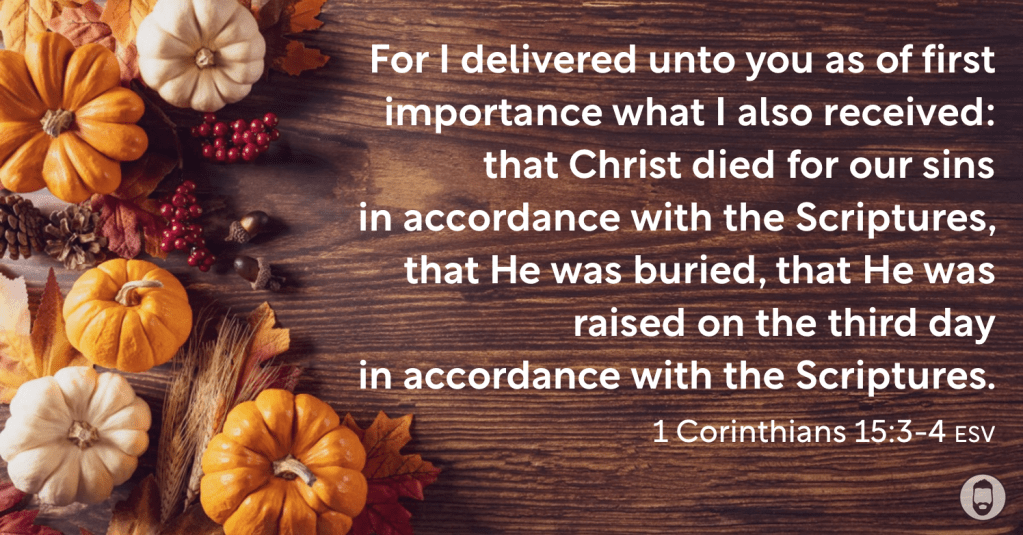
Now I would remind you, brothers, of the gospel I preached to you, which you received, in which you stand, and by which you are being saved, if you hold fast to the word I preached to you — unless you believed in vain. For I delivered to you as of first importance what I also received: that Christ died for our sins in accordance with the Scriptures, that He was buried, that He was raised on the third day in accordance with the Scriptures….
1 Corinthians 15:3-4
Look at the language Paul used there to highlight the importance:
1. He wanted them to be reminded of the gospel (good news) that he had preached to them regarding Jesus and for them to hold fast to that truth (2 Timothy 1:13-14, Jude 3). Putting one’s faith in Jesus is not a one-time-thing but something that believers need to continually do. We trust in Him for salvation, but we continually trust in Him to continue to carry us (Hebrews 10:38-39). Those who believed were saved from the wrath of God toward sin, but as Paul says here, were “being saved” continually by their resurrected — their living — Savior who cares for them (Romans 5:9-10, 1 Corinthians 1:18)!
2. He made sure they knew that what he was preaching was “in accordance with the Scriptures” — something he says twice in v. 4. The gospel of Jesus Christ is not something that popped up new after he lived and died. His death, burial, and resurrection were foretold by the God’s prophets throughout the Old Testament (Luke 24:25-27). The gospel was not something new for someone like Paul who had studied it his whole life; no, it was the fulfillment of all he had studied (Acts 17:2-3).
2. He preached that gospel to them again: “Christ died for our sins in accordance with the Scriptures, …He was buried, …He was raised on the third day in accordance with the Scriptures”. The gospel he preached came from the Scriptures and was all about Jesus, who He is and all He had done and is doing (Acts 26:22-23).
3. He understood that the gospel is of “first importance” because that is what he “also received”. This is not a hypothetical gospel for Paul. Jesus is his hope as well (John 12:32, Romans 15:13, 1 Peter 1:3). His Ph.D. in Judaism wasn’t going to save him. The warrant given to him by when he was Saul of Tarsus the Jerusalem elite to arrest and imprison Christians wasn’t going to save him. His claims as a “Hebrew of Hebrews” and a “Pharisee” weren’t going to save him (Philippians 3:4). No, Paul knew that all of his hope was in Jesus, the same Jesus whom he had previously persecuted, and because Jesus had saved him, he understood that everything that came before was “rubbish” unable to be compared to the “surpassing worth of knowing Christ Jesus” as Lord (Philippians 3:7-8).
Tomorrow, we have the privilege, just as we do every Sunday, to remind ourselves and others of the good news of Jesus Christ and get to share His gospel through preaching, reading the Word, and singing in praise and worship of our resurrected King (Colossians 3:16-17). We will lift Him up “as of first importance” because we know that if we had not “also received” Him, we would have no hope.
Dead saviors can’t save, but our God is not dead — “He is risen as He said” (Matthew 28:6).
Won’t you gather with us as we worship Him?
Here are our Scriptures and songs:
Song | Ain’t No Grave — Scripture Inspiration: John 8:34, Romans 6:6, 1 John 4:8, 1 Chronicles 28:20, 1 Corinthians 15:20-26, 1 Corinthians 15:50-56, John 8:44, 1 Peter 5:8, Revelation 12:9, Genesis 3:15, Ephesians 6:11-18, Isaiah 25:8, Hosea 13:14, 2 Timothy 1:10, Hebrews 2:14, Revelation 5:5, 1 Corinthians 15:3-8
Scripture | 1 Corinthians 15:50-57 —
50I tell you this, brothers: flesh and blood cannot inherit the Kingdom of God, nor does the perishable inherit the imperishable. 51Behold! I tell you a mystery. We shall not all sleep, but we shall all be changed, 52in a moment, in the twinkling of an eye, at the last trumpet. For the trumpet will sound, and the dead will be raised imperishable, and we shall be changed. 53For this perishable body must put on the imperishable, and this mortal body must put on immortality. 54When the perishable puts on the imperishable, and the mortal puts on immortality, then shall come to pass the saying that is written:
“Death is swallowed up in victory.” 55“O death, where is your victory? O death, where is your sting?”
56The sting of death is sin, and the power of sin is the law. 57But thanks be to God, who gives us the victory through our Lord Jesus Christ.
Song | Graves Into Gardens — Scripture Inspiration: Psalm 34:10, Isaiah 55:1-3, Psalm 53:1-3, Luke 15:11-24, Romans 6:23, John 6:26-35, Revelation 7:13-17, Matthew 11:28-30, 1 John 4:8, Psalm 51:10, Jeremiah 24:7, Ezekiel 36:26, Romans 12:2, Psalm 37:4, Exodus 8:10, Deuteronomy 3:24, Jeremiah 10:6, 1 Samuel 2:2, Isaiah 40:18, Romans 5:6-8, Psalm 138:8-9, 1 Kings 8:39, 1 John 3:20, John 15:15, Psalm 139:7-12, Hebrews 4:13, Psalm 30:11, Isaiah 62:2, Galatians 2:19-20, John 14:6, 1 Corinthians 15:20-49, Ezekiel 37:1-14, Exodus 14:1-31
Song | Thank You Jesus for the Blood — Scripture Inspiration: Deuteronomy 6:5, Lamentations 3:22-23, Isaiah 64:8, Psalm 139:16, Deuteronomy 6:7, Psalm 113:3, 2 Timothy 2:13, Psalm 27:13, Psalm 31:19, Psalm 145:9, Psalm 150:6, Psalm 107:1, 1 Kings 19:11-12, Hebrews 1:3, Isaiah 43:1-3, Jeremiah 23:23-24, John 15:14-15, Psalm 23:6, Luke 9:23-24
Scripture | 1 Peter 1:3-5 —
3Blessed be the God and Father of our Lord Jesus Christ! According to His great mercy, He has caused us to be born again to a living hope through the resurrection of Jesus Christ from the dead, 4to an inheritance that is imperishable, undefiled, and unfading, kept in heaven for you, 5who by God’s power are being guarded through faith for a salvation ready to be revealed in the last time.
Song | Living Hope — Scripture Inspiration: Acts 4:8-12, 1 Corinthians 15:3-11, 1 Peter 1:3, Philippians 2:5-8, 2 Corinthians 5:21, Hebrews 9:22, John 1:12-13, Hebrews 9:15, John 8:36, 1 Corinthians 15:54-57, Galatians 5:1, Psalm 107:14-15, John 14:6, Acts 3:15, Revelation 5:5, 1 Peter 1:4-5
Song | Because He Lives — Scripture Inspiration: John 3:16, Isaiah 25:8, Hosea 13:14, 1 Corinthians 15:24-26, 1 Corinthians 15:55-57, 2 Timothy 1:10, Hebrews 2:14, Psalm 28:7-8, Isaiah 40:29-31, 2 Corinthians 12:9-10, John 14:25-27, Romans 8:38-39, 1 Peter 5:6-7, Jeremiah 29:11, Ephesians 2:10, Galatians 2:20, Philippians 4:6-7, Revelation 21:4, 1 Corinthians 11:26
Invitation | In Christ Alone —
Offertory | Yet Not I But Christ in Me — Scripture Inspiration: Genesis 15:6, Psalm 32:1-2, Romans 3:21-24, Romans 5:6-10, Ephesians 2:4-9, Titus 2:11, Isaiah 9:6, Luke 1:26-38, Matthew 1:18-255, John 3:15-16, 1 Thessalonians 1:6, Hebrews 12:2, 2 Corinthians 5:21, Psalm 119:45, Romans 8:1-4, Psalm 17:7, Psalm 36:5-7, Titus 3:4, 1 John 4:8, John 14:27, Romans 5:1, Ephesians 2:14-15, Acts 4:10-12, John 14:6, Galatians 2:20, Romans 8:9-11, Galatians 4:6, Psalm 107:10-16, Psalm 118:7, Hebrews 13:5-6, 2 Corinthians 12:9, John 10:11-18, 2 Samuel 22:3-4, Nahum 1:7, 1 John 5:18, Psalm 23:4, Matthew 20:28, John 1:29, Acts 20:28, Colossians 2:14, Titus 2:14, 1 Peter 1:17-21, 1 John 2:1-2, Revelation 5:9-13, Acts 4:33, 1 Corinthians 15:55-57, Hebrews 2:14, Revelation 21:3-4, Hebrews 13:6, Psalm 116:16, Romans 6:20, Galatians 5:1, Luke 21:33, Revelation 6:14, Psalm 51:10, Ezekiel 36:26, 2 Corinthians 5:17, Philippians 1:9-11, John 10:30
1 In those days a decree went out from Caesar Augustus that all the world should be registered. 2 This was the first registration when Quirinius was governor of Syria. 3 And all went to be registered, each to his own town. 4 And Joseph also went up from Galilee, from the town of Nazareth, to Judea, to the city of David, which is called Bethlehem, because he was of the house and lineage of David, 5 to be registered with Mary, his betrothed, who was with child. 6 And while they were there, the time came for her to give birth. 7 And she gave birth to her firstborn son and wrapped him in swaddling cloths and laid him in a manger, because there was no place for them in the inn.
8 And in the same region there were shepherds out in the field, keeping watch over their flock by night. 9 And an angel of the Lord appeared to them, and the glory of the Lord shone around them, and they were filled with great fear. 10 And the angel said to them, “Fear not, for behold, I bring you good news of great joy that will be for all the people. 11 For unto you is born this day in the city of David a Savior, who is Christ the Lord. 12 And this will be a sign for you: you will find a baby wrapped in swaddling cloths and lying in a manger.”[1]
Luke 2:1-12
Merry Christmas, Sojourners!
Here we are just a few days before Christmas, and I find myself thinking on the scene into which God became flesh (John 1:14) and the happenings of the world during that time. If you will forgive the pun, it really was a Dickens of a time – the best of times and the worst of times. From a worldly perspective, Israel was in a tight spot, feeling the pressure of the Roman Empire bearing down on it.
A few centuries after being ruled by a foreign king in their own exile they found themselves ruled by one who seemed a world away. Those centuries between Babylon and the Roman Empire (with the Greeks whooping up on them somewhere in the middle) were silent in the sense that there was no “Thus saith the Lord” from a prophet. Even bad news or warning would be a comfort over silence. Their lives were loud with cries of help and hope in the coming Messiah, but God was silent – purposefully so. He had said all He needed to say. Messiah was coming. The Promised One was going to come and save His people. But in the meantime, there was waiting. And there was silence.
How do you do in silence and waiting? I am sure that there have been times in your life, just like in mine and in all the people I know, when trouble and trials and tribulations and terror have besieged you. Your world felt small and scary. Hope for the future was dim. And in waiting for help that seemed never to come, the silence and the waiting was rough.
Depending on the trouble you faced, there are those who would step in and want you to believe they are coming for your aid but are really coming to take advantage of you. There are other promises that, while they are not necessarily coming to take advantage of you are not working for your good, also try and convince you help is on the way. All you have to do is turn on your television and every other commercial is for a class action lawsuit going after big ___ to help people – you or your loved ones, they say – get help from their oppressors or benefits from whatever may have caused their unfortunate situation. If you flip to one of the news networks, you have political pundits representing both ends of the spectrum against the middle who are promising that their candidate is what is best, and the other is the oppressor. If your phone rings, it is likely that the person on the other end is offering you some kind of help if you pay money or bring a gift card to a certain location or offering to extend your car’s extended warranty for a nominal fee. Maybe you are in debt and people are promising rescue if you just turn your finances over to them. Or flip on over to the religious programming – labeled “Christian” oftentimes, and you can give a faith donation to support the starving millionaire “pastor” in his attempt to usher in the end times and mail you a prayer handkerchief that will heal you or save you.
Does any of this sound familiar?
Aside from television and modern situations, this is similar to what God’s people were hearing during that period of silence. Never mind that He had told them Messiah would come. He prophesied their deliverance. Their present circumstances, however, made listening to the other voices seem necessary. And those voices sounded so good, especially when the distant emperor proclaimed that his birth and existence were the beginning of good news for the world[2] and that he Himself was a son of Zeus come to be the savior of Rome and its empire[3].
In the absence of the promised Messiah amid divine silence, the turmoil of the times can make it easy to believe that there is help from somewhere else – even if that somewhere else is the Rome that is crushing the life out of your people and your homeland.
So, today, I want us to look at a tale of two Saviors – well, really the tale of the only Savior despite all the fake and the foolish that proclaim themselves to be Him.
Caesar Augustus and the Not-So-Good News (vv. 1-5)
Most of the time that I have spent looking at and studying the beginning of Luke 2 has been focused on trying to determine the real birth date of Jesus. Spoiler alert: it cannot be definitely known[4]. I am not a huge fan of history, but I do not want to be doomed to repeat it. Most of the history I, willingly, study is biblical and church history. Christianity is, after all, a historical religion not based on the present but on the God who has always been and all He has done in and for all that He created. Having said all that, I do not want this to seem like a history lesson. I want us to see the fingerprint of the one who proclaimed himself savior and lied about it: Caesar Augustus.
Caesar Augustus’s role in the story of Jesus began on the ides of March – remember Shakespeare’s Julius Caesar? Et tu, Brute? Anyone? Long story short, he – originally known as Octavian – was the nephew and only heir to Julius Caesar. When Roman senators conspired and murdered Julius Caesar (44BC), Octavian and Julius Caesar’s right-hand-man Mark Antony joined forces and waged a brutal civil war from Rome all the way to Philippi where they finally avenged Caesar’s death and, well, murdered his murderers in 42BC. Octavian rose to greater power and eventually turned on his ally Mark Antony and Cleopatra, defeating them in 31BC. Around thirty years later, all those events put Caesar Augustus in a position for God to move him about and use him to set the stage for His entrance into the world.
One thing that people who amass great wealth and power cannot help but do is counting and logging all they have. Such was the case with Caesar Augustus. He decreed that a census be taken throughout “all the world” (Luke 2:1). At his mere command, every household throughout the Roman Empire was immediately upturned. They had to return to their hometowns to be registered (Luke 2:3). Think of the power that displays: entire regions and people groups dropped everything at his command.
But what of his promises of his birth heralding the beginning of good news? What of his promises that he was born of Zeus and would be the savior of the world? Well, Caesar Augustus died in AD14. He is still dead today. Rome was not saved or safe under his rule. In fact, the Roman Empire is dead, too. The proof is in the pudding, or in the prophecy in this case. Caesar promised people peace and prosperity and got all the peace and prosperity he had himself by squeezing it out of the lands conquered and kept conquered throughout his empire. Yes, he could get them to move about at the drop of a hat, but once he dropped dead, he dropped out of the position of savior.
Looking at how God used him to move things about is cool, though. Jesus was prophesied to be born in Bethlehem (Micah 5:2), and Joseph’s hometown was Bethlehem. In a way, Caesar Augustus was right about one thing: good news began at his birth. God set things into motion through his life that inaugurated the coming of the Messiah. Now, that is the good news.
Jesus and the Good News of Great Joy (vv. 6-12)
Augustus was boastful and proud. He inherited a kingdom and made it his own. He built it up in his mind that the entire world belonged to him. But to whom did Augustus belong?
Jesus’s humble birth is the opposite of Augustus in nearly every way. Augustus was loud and boastful, proclaiming truths after his own birth to make it seem of consequence. Jesus’s birth was humble and quiet, fulfilling prophesies made all the way back to the beginning (Genesis 3:15). Jesus’s birth was heralded from the heavens (Luke 2:9-14). Jesus was God – God made flesh and dwelling among men to be the true Savior of the world (John 1:1, 14; Matthew 1:21; John 4:42).
Think about the difference this makes. Jesus did not lie about His father being divine and sending Him to rule and conquer. No, God became flesh and dwelt among us. He laid aside His throne and humbled Himself to become a man, lived a sinless life despite facing all the same temptations we face (Hebrews 4:15), and He died the death we deserve on the cross due to our sinfulness (Romans 6:23, 2 Corinthians 5:21). No one would make up that story. No one wanted to trade lives with Jesus. No palace, no riches, no fame. But, oh, what a King He is!
Jesus’s good news was better that Augustus’s, too. Augustus merely said his birth was the beginning of the good news. He merely heralded himself and proclaimed his own greatness. No one had to agree. No one would have believed it anyway. Rest assured that those who had been conquered did not recognize him as good news any more than they did Nebuchadnezzar and the Babylonians. Augustus was worthy to be feared, but Jesus is worthy of our faith. The angels proclaimed this to the shepherds in the field that night and to us today. We do not have to fear because “behold” there is “good news of great joy that will be for all people”; that “unto you is born this day in the city of David a Savior, who is Christ the Lord” (Luke 2:10-11). Good news. Of great joy. For all people. The Savior is born. The Messiah has come.
The truth of the prophecies of old were coming true. Light was shining into the darkness (Isaiah 9:2, John 1:4-5). Joy had come because there was One greater than Augustus, greater than the Greeks, greater than the Medes and Persians, greater than the Babylonians (Isaiah 9:3). Rather than oppressing, He was lifting up (Isaiah 9:4, Matthew 11:28-30). He was bringing peace through His finished work and retiring the weapons of His adversaries (Isaiah 9:5, Colossians 1:19-20). He was born, swaddled, and lying in a manger, but He did not stay in that manger. He grew up. He lived. He loved. He lifted the downtrodden, healed the sick, touched the untouchable, saved the most wicked of sinners, and died for them all. And everyone – every one – who calls upon Him, confesses Him as Lord and puts their faith and trust in Him – will be saved (Romans 10:9, 13). That is good news!
Wrapping Up
I started off our devotion today talking about how many things, how many voices, are trying to get us to believe in something temporary or something fake. It is easy to be jaded and look at how the world is getting and feel like God is not talking to us because the other voices are so loud. We want immediate relief from debt, pain, sorrow, and suffering, but that just is not reality – it is just not how this sinful, fallen world works. And every voice that is vying to be heard louder than the others cannot offer lasting help because they are products of this fallen world, too. But hear this, Sojourner, God is not being quiet.
From the moment that the silence between the Old and New Testament was broken by the cry of baby Jesus to the time when the trumpet sounds and He returns is not a time of silence. He is the Word (John 1:1-14), and He has given us His Word (2 Timothy 3:16-17) just as He did for His people. They interpreted it as silence because He had not said what they wanted to hear. He told them He was coming. He has told us the very same thing.
You see, Jesus is a better Savior than Augustus (or the Republicans or Democrats or whoever you think is waiting in the wings to rescue this country or this world). Augustus died. He is still dead. Whatever he was going to do for Rome, he did. All our leaders, good and bad, throughout history are dead. They saved and helped who they could, or they hurt and oppressed who they could. Either way, they are either dead and gone or will be. But God is a better Savior because He is alive. Death could not stop His love. Death could not stop Him from saving. Death is a victim of His victory! The death He died was for our sake – to save us, rescue us, and redeem us! It just did not keep because He is God.
This Christmas, amid the hustle and the bustle, the noise, and the activity, listen. Listen to the words of Hebrews 10:23-25 and hear the heart of our Savior for us:
Let us hold fast the confession of our hope without wavering, for He who promised is faithful. And let us consider how to stir up one another to love and good works, not neglecting to meet together as is the habit of some, but encouraging one another, and all the more as you see the Day drawing near.
That is good news! He who promised is faithful, and His Day is drawing near! When all around you seems to be giving way and there seems to be more hopeless than hope or help, look around you and see what He has for you. Do not turn to the easy slick promises of the world but trust in the divine hope, peace, joy, and love of the Savior who loves you and lives for you. You do not need a Sams Choice savior like Augustus or any of the other voices barking for your attention. Jesus is the genuine article.
The hope of Christmas is not in the nearness of family, the fullness of bellies, or the gratification of giving or receiving the perfect gift. Plans are going to go awry. Packages will be lost. Or the holiday will represent an entirely different perspective. It may be as miserable a time as you imagine. You may be facing a holiday that will remind you of a loss that is easy to suppress on regular days and are not ready for all the feelings that will arise. December 25 may be just another workday or weekday for you. You may even find yourself alone. No, the hope of Christmas is the same good news of great joy that the angel army proclaimed to those dirty shepherds on that hillside. It is the good news of great joy that proclaims to all people that the Savior has been born, that His name is Jesus, that His birth, death, resurrection, and return have been promised. And He who promised is faithful. Sojourner, know that I am praying for you this Christmas and as often as I can. May this good news of great joy cheer you on and cheer you up as you see that Jesus has come and is coming again.
[2] This is based on an inscription found at Priene dating back to 9bc stating that Caesar Augustus’s “birthday signaled the beginning of good news for the world”. The inscription was found by German archaeologists and can be found in Berlin. | Deissmann, Light from the Ancient East, 366-67.
[3] This is based on an inscription from Halicarnassus preserved in the British Museum. | H. Kleinknecht, Pantheon: Religiose Texte des Griechentums (Tubingen: Mohr Siebeck, 1959), 40.
[4] While it cannot be known, there are a few interesting tidbits that I have found helpful in forming my own opinions. 1)The original language translated “governor of Syria” in the ESV can also be translated “governing in Syria”, which could mean ruling in some form or fashion. 2)Jesus’s birth had to be prior to 4bc because Herod the Great died that year. So, happy hunting should you want to research this on your own!