John begins with wonder: the Father has loved us so greatly that we are called His children — and that is truly what we are (1 John 3:1). The world does not understand believers because it did not know Jesus either (1 John 3:1). But our identity is not just future; it is present. We are God’s children now, even though the fullness of what we will become has not yet been revealed (1 John 3:2). One day, when Christ appears, believers will be like Him in glory, purity, and freedom from sin, because we shall see Him as He is (1 John 3:2; cf. Phil. 3:20–21). This hope is not meant to make us passive. It moves us to pursue holiness now. Those who truly hope in Christ seek to be pure because He is pure (1 John 3:3).
John then draws a sharp contrast between the children of God and the children of the devil. Sin is not small or harmless; it is lawlessness, rebellion against God (1 John 3:4). Jesus appeared to take away sins, and in Him there is no sin at all (1 John 3:5). Therefore, no one who truly abides in Christ can make a settled pattern of sinning (1 John 3:6, 9). John is not saying Christians never sin (cf. 1 John 1:8–2:1), but that a life marked by ongoing, unrepentant sin shows a person does not truly know Christ. By contrast, those born of God practice righteousness because God’s seed abides in them (1 John 3:7–10). Jesus came not only to forgive sin but to destroy the works of the devil (1 John 3:8). That means belonging to Christ changes how a person lives.
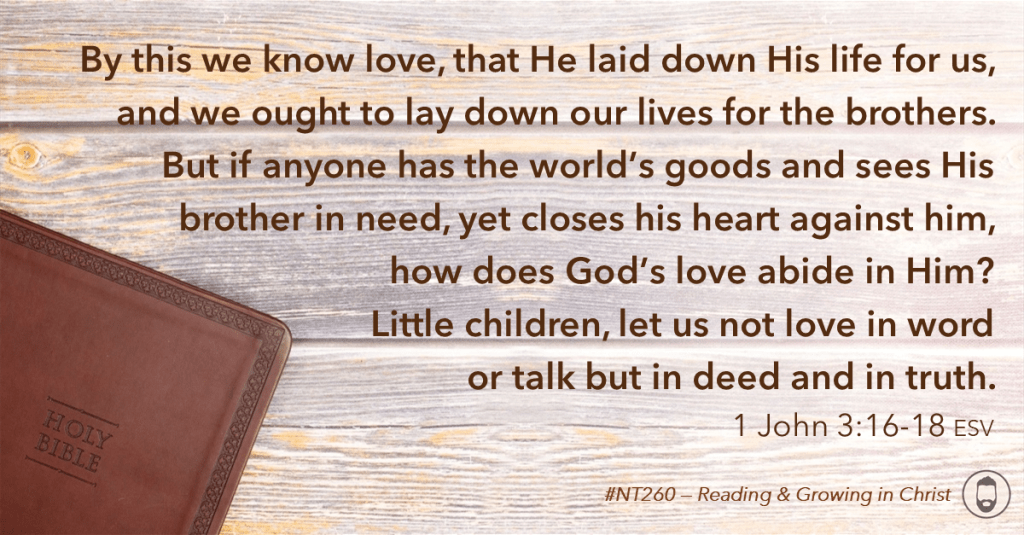
John then returns to one of his major themes: love for fellow believers. This is not a new idea but the message Christians have heard from the beginning — that we should love one another (1 John 3:11). Cain becomes the warning example. He hated his brother Abel because Abel’s deeds were righteous and his own were evil (1 John 3:12). In the same way, the world still hates those who belong to God (1 John 3:13). But believers know they have passed from death to life because they love the brothers (1 John 3:14). Hatred is not a minor issue; John says it is the heart of murder (1 John 3:15; cf. Matt. 5:21–22). Real love is seen most clearly in Jesus, who laid down His life for us (1 John 3:16). So Christian love must move beyond words into action. If someone sees a brother in need and refuses to help, John asks how God’s love can truly abide in that person (1 John 3:17–18).
John closes the chapter by showing that loving obedience brings assurance. When believers love in deed and truth, they can know they belong to the truth and can quiet their hearts before God (1 John 3:18–19). Even when our hearts trouble us, God is greater than our hearts and knows everything fully (1 John 3:20). As believers walk in obedient faith, they gain confidence before God in prayer (1 John 3:21–22). John summarizes God’s command simply and clearly: believe in the name of His Son Jesus Christ and love one another (1 John 3:23). Faith in Christ and love for His people belong together. Those who keep His commandments abide in Him, and His abiding presence is confirmed by the Holy Spirit whom He has given us (1 John 3:24).
🌀 Reflection: Is your hope in Christ’s return making you more like Jesus now? John shows that real assurance is not found in empty claims but in a life shaped by righteousness, repentance, and practical love for others.
💬 Mission Challenge: Look for one tangible way to love a brother or sister in Christ today — meet a need, give encouragement, or make a sacrifice that reflects the self-giving love of Jesus.
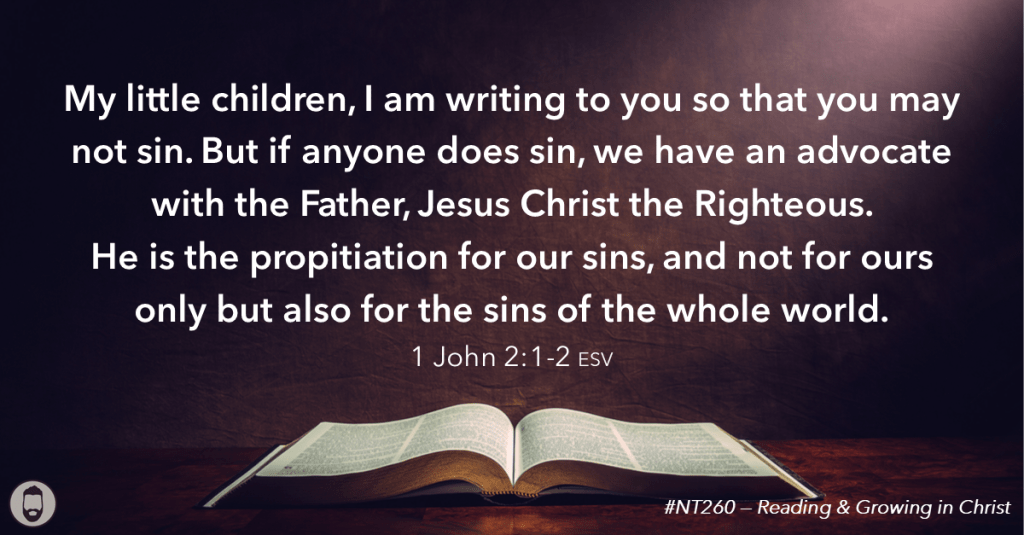
John begins this chapter by reminding believers both of God’s call to holiness and of the grace provided when we fail. He writes so that believers may not sin, yet he also acknowledges that sin still occurs. When it does, Christians are not left without hope: “we have an advocate with the Father, Jesus Christ the righteous” (1 John 2:1). Jesus speaks on behalf of His people before the Father, and His work on the cross is the basis of that defense. John says that Christ is the propitiation for our sins (1 John 2:2) — the sacrifice that satisfied God’s righteous judgment and turned His wrath into favor. This sacrifice is sufficient for the whole world, offered to people everywhere, though it is received only through faith in Christ (cf. John 3:16, 18). Because of Jesus’ work, believers can face their sin honestly while resting in the mercy of God.
John then explains that genuine knowledge of God produces a transformed life. Those who claim to know God but refuse to keep His commands are deceiving themselves (1 John 2:3–4). Obedience does not earn salvation, but it does reveal that someone truly belongs to Christ. Those who abide in Him will seek to walk as Jesus walked (1 John 2:5–6). Central to that obedience is the command to love one another. John calls it both an old commandment — rooted in the message believers heard from the beginning — and a new commandment — made fresh through the life and love of Jesus Himself (1 John 2:7–8; cf. John 13:34). Anyone who claims to live in the light while hating a brother or sister is still in darkness, but those who love their fellow believers walk in the light and avoid stumbling (1 John 2:9–11).
John pauses to encourage his readers by reminding them who they are in Christ: their sins are forgiven, they know the Father, and they have overcome the evil one through the word of God (1 John 2:12–14). Because of this identity, they must guard their hearts from loving the world. John is not speaking of the created world or the people in it, but the sinful system that opposes God. The desires of the flesh, the desires of the eyes, and the pride of life all pull people away from the Father (1 John 2:15–16). Yet this world is temporary and passing away, while those who do the will of God will abide forever (1 John 2:17).
Finally, John warns his readers about false teachers, whom he calls “antichrists.” These individuals had left the church and denied that Jesus is the Christ, revealing that they were never truly part of God’s people (1 John 2:18–19, 22). In contrast, believers have been anointed by the Holy Spirit, who helps them recognize the truth and resist deception (1 John 2:20–21, 27). John urges them to hold fast to the message they heard from the beginning and to abide in Christ so that they may stand confidently when He appears (1 John 2:24–28). Those who truly know the righteous Christ will show it by practicing righteousness, because they have been born of Him (1 John 2:29).
🌀 Reflection: When you think about your relationship with God, do you lean more toward ignoring sin or toward despair because of it? John calls believers to neither extreme. We are called to pursue holiness, yet when we fail, we look to our Advocate — Jesus Christ the righteous.
💬 Mission Challenge: Encourage another believer today by reminding them that Jesus not only died for their sins but now speaks for them before the Father as their Advocate.
John begins this letter by grounding everything in the real, historical Jesus Christ. He is not passing along rumors, theories, or private spiritual ideas. He says they heard Him, saw Him, looked upon Him, and even touched Him with their hands (1 John 1:1). The One he proclaims is “the word of life,” the eternal Son who was with the Father and was made manifest to us (1 John 1:1–2; cf. John 1:1, 14). This matters because our faith is built on the true Christ who really came in the flesh, really lived among His people, and really made the Father known. John writes so that his readers may share in fellowship with the apostles — and even more, fellowship with the Father and with His Son Jesus Christ (1 John 1:3). Christianity is not merely knowing facts about Jesus. It is being brought into real communion with God through the Son, and that fellowship leads to full joy (1 John 1:4; cf. John 15:11).
John then gives the message that shapes the rest of the letter: “God is light, and in him is no darkness at all” (1 John 1:5). God is perfectly holy, perfectly true, and perfectly pure. That means no one can honestly claim to know Him while continuing to walk in darkness (1 John 1:6). A life marked by hidden sin, falsehood, and rebellion contradicts a profession of fellowship with God. But John does not call believers to pretend sin is absent. Instead, he says that those who walk in the light have fellowship with one another, and the blood of Jesus His Son cleanses them from all sin (1 John 1:7). Walking in the light does not mean sinless perfection. It means living openly before God, agreeing with His truth, and resting in the cleansing that comes only through Jesus’ atoning blood.
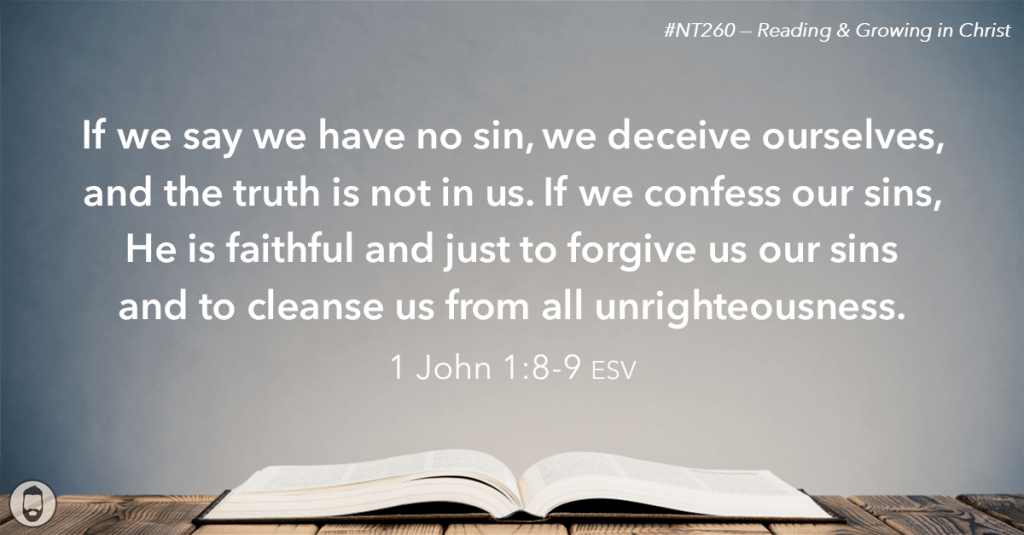
That is why John strongly warns against denying sin. If we say we have no sin, we deceive ourselves, and if we say we have not sinned, we make God a liar (1 John 1:8, 10; cf. Rom. 3:23). The mark of genuine faith is not claiming to be beyond sin, but confessing sin honestly before God. And here is the sweet hope of the gospel: “If we confess our sins, he is faithful and just to forgive us our sins and to cleanse us from all unrighteousness” (1 John 1:9). God does not forgive because sin is small, but because Jesus is sufficient. He is faithful to His promises and just because Christ has paid for sin. So 1 John 1 calls us to live in the open — honest about our sin, confident in Christ, and joyful in fellowship with God.
🌀 Reflection: Are you more tempted to hide your sin, minimize it, or excuse it? Walking in the light means bringing your sin honestly before God and trusting that the blood of Jesus is enough to cleanse you completely.
💬 Mission Challenge: Be honest with God today about a specific sin you have been tempted to hide, and then encourage another believer with the hope that in Christ there is real forgiveness and cleansing.
We’re back in our study of Revelation called The KING is Coming, where we’re taking a verse-by-verse approach to see what the book truly reveals—Jesus Christ Himself. As always, I’m joined by Jamie Harrison, and I’m thankful for the opportunity to walk through this study together. Today, we’ll be moving out of the letters from Jesus to the churches and into the rest of the Revelation of Jesus Christ with Revelation 4:
4 After this I looked, and behold, a door standing open in heaven! And the first voice, which I had heard speaking to me like a trumpet, said, “Come up here, and I will show you what must take place after this.” 2 At once I was in the Spirit, and behold, a throne stood in heaven, with one seated on the throne. 3 And he who sat there had the appearance of jasper and carnelian, and around the throne was a rainbow that had the appearance of an emerald. 4 Around the throne were twenty-four thrones, and seated on the thrones were twenty-four elders, clothed in white garments, with golden crowns on their heads. 5 From the throne came flashes of lightning, and rumblings and peals of thunder, and before the throne were burning seven torches of fire, which are the seven spirits of God, 6 and before the throne there was as it were a sea of glass, like crystal. And around the throne, on each side of the throne, are four living creatures, full of eyes in front and behind: 7 the first living creature like a lion, the second living creature like an ox, the third living creature with the face of a man, and the fourth living creature like an eagle in flight. 8 And the four living creatures, each of them with six wings, are full of eyes all around and within, and day and night they never cease to say, “Holy, holy, holy, is the Lord God Almighty, who was and is and is to come!”
9 And whenever the living creatures give glory and honor and thanks to him who is seated on the throne, who lives forever and ever, 10 the twenty-four elders fall down before him who is seated on the throne and worship him who lives forever and ever. They cast their crowns before the throne, saying,
11 “Worthy are you, our Lord and God, to receive glory and honor and power, for you created all things, and by your will they existed and were created.”[1]
Keith Harris: Greetings, sojourners. We have a lot to dive into today, and frankly I am excited. I’m beside myself — and also beside Jamie. Jamie, talk to us about Revelation 4. Yes, yes — threw you off with that.
Jamie Harrison: Yes, yes you did. So we have here — just to get started — to remind you the timeline of Revelation from this point forward. So we finished the seven letters to the churches, and from here on out we have to understand that the timeline is what John saw next. So does this mean historically this is what did happen or will happen, or whatever is happening right now? No. It’s just what John saw next.
Keith: So does it mean it’s not?
Jamie: No — it’s just what John saw next.
And so it starts by[2], “After this I looked, and there in heaven was an open door.” And we learned just a couple of weeks back that Jesus is the one who opens doors. So Jesus opens this door, and the first voice that I had heard speaking to me like a trumpet — now we know that that first voice he heard was Jesus way back in chapter 1, verse 10 — and he speaks to him again in a voice sounding like a trumpet. And he says, “Come up here, and I will show you what must take place after this.”
And so again, what John saw next — this is what’s going to take place after this. After what? We don’t know. We have no idea. But what we do know is what’s going to take place next — right, at some point.
And so just to hit real quick on the trumpet deal — because of what’s coming up in Revelation — the idea of a trumpet in the Bible, especially in the Old Testament, would have been something that was used to signal a warning. Like a warning that maybe there was an enemy approaching and a war was about to happen. Sometimes they would blow a trumpet to signify that the Lord had delivered a message, and then they would deliver the message.
Keith: And so I know those are both really negative sounds, and this isn’t necessarily one of those, but it kind of makes me think about in today’s time like a tornado siren or the sound your phone makes when an emergency alert comes through. And again, I’m not saying that it’s exactly that — those are very negative in our minds — but they get your attention.
You know, when you hear those, stop what you’re doing. Listen.
Jamie: That’s right. And so that’s the idea here. And again, in every single letter that we read — all seven letters — it was “For those who have ears to hear, listen to what the Spirit says to the churches.”
And so here again Jesus is saying — voice like a trumpet — you better listen. I’m trying to tell you.
And so immediately John is in the Spirit, and there’s a throne in heaven and someone was seated on it. So he is taken to the throne room, which is pretty awesome — somewhere that I look forward to seeing one day, whatever that’s going to look like. Jesus will be there. I’ll be there. It’s going to be pretty awesome.
And so what we do know is that from here on out the focal point of the book of Revelation is the throne room. Every time something happens we’re going to be taken back to the throne room. Something will happen — we’ll be taken back to the throne room.
Fourteen times in chapters 4 or 5 — fourteen times in just chapters 4 and 5 — the throne room is talked about. In the rest of the book of Revelation, forty-six times the throne room is mentioned, with God the Father of course being the one sitting on the throne.
And so again, just to help you understand that: what is the setting of the rest of this book of Revelation? It’s the throne room. It’s centered around the Godhead.
Keith: And one thing, just as you were describing that — you know a lot of times in literature or movies, if you’ve got a king and a battle is going to be waged, the throne room is kind of like that last resort, like a place of safety. But we also know the throne room is at risk.
None of those times in the book of Revelation is the Godhead in the throne room hiding. Nothing’s — there’s no catapult of hell, so to speak, in danger of reaching them. God is so high and lifted up and unapproachable.
And so God — this is a place of safety and security beyond our greatest fears. God’s in no danger whatsoever. And so in that case, even despite worldly danger, that tells us the things in here that frighten us — we’re safe in the arms of Christ.
Jamie: And so John goes into a description of what he sees. And again, so many times in Revelation we get descriptions of things, and it’s just the best John could do to describe what he saw. I think some of these things he probably didn’t have words for, and so this is the best thing he could compare it to.
And so he tells us that the one seated on the throne — verse 3 — had the appearance of jasper and carnelian stone, and a rainbow that had the appearance of an emerald surrounded the throne.
And so the jasper and carnelian stone of course were in the breastplate of the high priest back in Exodus 28 — you can see that. Jasper being a crystal-clear gem, diamond-looking, reflects all — refracts all — the colors of the spectrum in wonder. It’s brilliant.
So just think about that for a second — refracting all of these colors of the spectrum in this brilliance is what it looks like to him.
Keith: So more shiny and shining than the shiniest, brightest thing we can come up with.
Jamie: That’s right. And carnelian stone — or sardius stone — which is a fiery, bright ruby-looking red stone. So you put all that together, and so far that’s the description we have of what he sees when he looks at God.
And then you get this rainbow that has the appearance of an emerald — of course an emerald being like this cool green hue — dominates the rainbow that he sees that is surrounding the throne.
And remember that a rainbow back in Genesis is the sign of God’s faithfulness to keep His word and His promise that He gave to us then. And so I want to just kind of stop there for a minute and point out that what he’s seeing here is God’s glory. He is seeing the glory of God and describing it the best way that he possibly can.
But you have this rainbow that surrounds the throne. It’s not a half rainbow like we see — this is the full rainbow. This is the complete promise of God. This is the complete fulfillment. This is His mercy even in judgment. This is all of these things completed around Him.
And I’ve got Keith who’s going to read this cool deal from the Jesus Storybook Bible. And if you want to kind of talk about it and then read it.
Keith: Yeah. The Jesus Storybook Bible is not a translation of the Bible, but it’s where Sally Lloyd-Jones has tried to communicate through all the parts of the Bible to children who God is in Christ. And so this is from the chapter on the flood.
“The first thing Noah did was to thank God for rescuing them, just as He had promised. “And the first thing God did was to make another promise. ‘I won’t ever destroy the world again.’ And like a warrior who puts away his bow at the end of a great battle. God said, ‘See, I have hung up my bow in the clouds.’ “And there, in the clouds – just where the storm meets the sun – was a beautiful bow made of light. “It was a new beginning in God’s world. “It wasn’t long before everything went wrong again, but God wasn’t surprised; He knew this would happen. That’s why, before the beginning of time, He had another plan – a better plan. A plan not to destroy the world but to rescue it – a plan to one day send His own Son, the Rescuer. “God’s strong anger against hate and sadness and death would come down once more – but not on His people, or His world. No, God’s war bow was not pointing down at His people. “It was pointing up, into the heart of Heaven.”[3]
Jamie: So again, that rainbow signifying that promise — Jesus took the wrath for us so that we could be saved. And this is what we are seeing in the throne room — His complete promise, His glory.
So again, that rainbow signifying that promise — Jesus took the wrath for us so that we could be saved. And this is what we are seeing in the throne room: His complete promise, His glory.
And I want to read a little excerpt from a book by Paul David Tripp called Do You Believe? This is from pages 69 and 70. I think that covers us on copyright stuff. Is that accurate?
Keith: Yes. And then write this stuff — we’re quoting it.
Jamie: This is quotation marks.
“Glory is not a thing like a shoe, a steak, a candle, or a cottage. Those are particular physical things that can be carefully described by words so that you would immediately have an accurate picture in your mind of what is being talked about. One could draw a picture or take a photograph of a shoe, and you could see it and know what it was, but glory is not like that. No single picture could ever capture glory. Glory simply cannot be photographed. Glory is not so much a thing as it is a description of a thing. Glory is not a part of God; it is all that God is. Every aspect of who God is and every part of what God does is glorious. But that’s not even enough of a description of God’s glory. Not only is He glorious in every way, but His glory is glorious. “Scripture does, however, put the hugeness of the glory of God into the smallness of human language so that we can at least get some sense of what it’s like. For example, the prophet Isaiah, under the inspiration of the Holy Spirit in Isaiah 40, stretches human language in order to give us a little glimpse of God’s glory. ‘Who has measured the water in the hollow of his hand?’ Imagine how much water you could hold in the palm of your hand, then consider that God could hold all of the liquid in the universe in His hand and not spill a drop! ‘Who has…weighed the mountains in scales? … Behold, the nations are like a drop from a bucket [to God]. … He spreads [the heavens] like a tent to dwell in’ (Isa. 40:12, 15, 22). Isaiah is employing incalculably huge word pictures to help us to have even a twinge of understanding of how glorious God is. Yet even these very picturesque and helpful descriptions fall miserably short of capturing the awesome glory of God. “We cannot gain a full understanding of the glory of God from a few passages, because the reason glory is glory is because it lives above and beyond that kind of description and definition. You can say for sure that God is glorious, because your Bible declares He is, but you cannot accurately and fully describe in words the glory that Scripture declares. Perhaps the only workable path 9into some understanding of the grandeur of the glory of God is to read the entire Word of God again and again, looking for divine glory. Why? Because the glory of God isn’t hidden in His Word; no, His glory is so grand that it splashes across every page of His book.”[4]
Keith: One thing’s for sure — there’s awe in everything John writes. Like, this is John, good friend to Jesus on earth. And he’s not saying, “Hey, that’s my buddy.” That’s my God. That’s the throne. That’s — it’s amazing, glorious.
And again, there’s nothing we can say that’s going to do it justice.
Jamie: That’s right. And you can go to Revelation 21:9–27 and look at New Jerusalem. That’s what heaven will be — what it will look like. And it talks about God’s glory and how glorious it is.
But again, it’s something that is indescribable — or undescribable? Is that the — it’s both of them.
Keith: It’s both of them.
Jamie: Yes, it is. I wasn’t sure if that was even a word until just then. So John moves on and he says in verse 4:
“Around the throne were twenty-four thrones, and on the thrones sat twenty-four elders dressed in white clothes with golden crowns on their heads.”
And these twenty-four elders throw a lot of people off. You know — who are they? What are they? What do they represent? Are they really twenty-four people?
And the answer is: we don’t know. Because it doesn’t tell us.
You know, I can tell you that in Revelation 21:12–14 the Bible talks about the twelve tribes of Israel and the twelve apostles. And it could be that these twenty-four elders are literally those people. It could be that they’re representation of those people. It could be that they represent the fact that every human being — despite race, despite ethnicity, despite whatever you want to fill in the blank with — will be in heaven if they have a relationship with Christ.
It could represent that — so to speak — the complete church.
Keith: It could be representatives from the twelve tribes and the twelve apostles.
Jamie: That’s right.
Keith: If you’ve got that many “could be’s,” then we need to look at what can we know for sure.
Jamie: That’s right.
Keith: That’s the big deal with the study of Revelation — or any sort of prophetic book like this. We want to find our favorite preacher guys or writers to tell us definitively, because we get comfort from it.
I get comfort from having a God who’s so big that He doesn’t need me to know everything. That kind of tells me in some cases — if you’ve got something that’s completely explainable by the mind of man, some dude made it up, right?
And this is so otherworldly that, like Jamie said, John’s doing the best he can.
Jamie: The absolute best he can.
And now on that thought, we do know in Daniel chapter 7 and verse 9 where God sits down on His throne, and you look around — there’s other empty thrones around Him in Daniel. And now when John sees them, there are twenty-four people sitting on them.
Keith: So what was empty is, at this point, going to be full.
Jamie: That’s right.
Keith: Now full with who?
Jamie: Again, we don’t know. And I think that’s okay.
Keith: Well — and well, I know that’s okay.
When you look at this, the point of them — just like when you see angels in Scripture — they’re very quick to say, “Hey, don’t worship me. I worship the One worthy of worship.”
Their whole everything is to say, “Look — look to the throne. Look to Jesus.” They’re not in any sense saying, “Hey, we’ve arrived. Look at how good we are.” They lay their crowns down. They are continually in worship of the One.
So who the twenty-four are — they would say very clearly, “We point to Him.”
Jamie: That’s right.
Keith: And so I think that’s enough for me.
Jamie: And when we see them, we see that they lay their crowns down before the throne.
Keith: That’s exactly right — which the only reason we know they have crowns is because it tells us they have them.
Jamie: That’s right.
Keith: And then it tells us they lay them down.
Jamie: That’s right.
And so it goes on from there in verse 5: flashes of lightning and rumblings and peals of thunder came from the throne.
And this reminds me of Exodus 19 and Exodus 20 where God speaks through the thunder right before He gives the laws and punishments. So kind of another idea of God speaking here.
Flashes of lightning, rumblings, and peals of thunder come from the throne. And then if you look further in Revelation — Revelation 8:5, 11:19, and 16:18 — that lightning and thunder is a sign of the fury of the judgment to come.
So it’s kind of like God is about to speak, or God is speaking through this to help us understand, to get ready for the fact that His judgment is coming. His judgment is going to be complete, and it is going to be furious.
And we’ll get there in a few chapters. But it is — it’s intense, I think may be the best word I can think of.
And it goes on — same verse, verse 5 — seven fiery torches were burning before the throne, which are the seven Spirits of God. And we know that to be the Holy Spirit, as we’ve talked about before.
Something like a sea of glass, similar to crystal, was also before the throne.
And notice he says “something like a sea of glass.” So is it a sea of glass? No, it’s not. It’s something like that — meaning that it’s some type of crystal-clear pavement that’s around God’s throne that looks like some kind of glistening sea.
A lot of the commentaries that you read say that this is a symbol of God’s holiness. And I’m — you know — I’ll go with those guys. They’re a lot smarter than me.
But we do know that Revelation 15:2 and 21:1 say there’s no sea in heaven. So it’s not a literal sea, but it is some type of idea of His holiness and that it’s around His throne.
But again, I think it just goes to the fact that there are these things that are indescribable that John’s doing the best he can to describe.
Keith: Well, and employing language that we use — and again this is an English translation of the Greek — but that’s the language we use when we don’t know how to describe something. We use similes.
And he says, “as it were a sea of glass like crystal.” He’s literally trying to describe this.
But again he keeps making a beeline back to the throne, back to God, back to the praises — because a lot of the stuff that we very easily get caught up on are trappings, wall hangings, adornments, decorations. Jesus is the main thing.
Jamie: That’s exactly right. And so he goes on again in verse 6 to talk about four living creatures covered with eyes in front and in back, and they’re around the throne on each side. And that’s kind of a freaky—
Keith: Yeah.
Jamie: —I wouldn’t think about these as Precious Moments cherubim. And then he describes the four living creatures. And now remember, before we go into this, that we’ve already got the rainbow surrounding the throne, which is going to be your Noahic covenant.
And now here we go. The first living creature was like a lion, the second living creature was like an ox, the third living creature had a face like a man, and the fourth living creature was like a flying eagle.
Now if you’ve got your Bible with us, turn to Genesis 9 — going almost all the way back to the beginning here — Genesis chapter 9. And we look at verses 8 through 11 and it says:
8 Then God said to Noah and his sons with him, 9 “Understand that I am establishing my covenant with you and your descendants after you, 10 and with every living creature that is with you—birds, livestock, and all wildlife of the earth that are with you—all the animals of the earth that came out of the ark. 11 I establish my covenant with you that never again will every creature be wiped out by floodwaters; there will never again be a flood to destroy the earth.”
And you notice every single thing that is listed here is exactly who these four living creatures appear to be in Revelation. So it tells us in Revelation that one looked like a lion, and this covenant is with the beast of the earth — or the wildlife of the earth. In Revelation it says one looks like a calf. Well here you have that — it tells us livestock or cattle. And in Revelation it says the face of a man. Well it tells us that with you, Noah, and your descendants after you — that’s man. And then you have like a flying eagle, and it tells us with the birds or the fowl.
And so it appears as though these four living creatures would be representative of this Noahic covenant. In other words, His promises that He is not going to flood the earth again. In fact, He’s going to send His Son to die on a cross, to be raised again three days later so that we could be saved.
And so all of this again going back to Jesus — every bit of it. Did you have something you wanted to add there?
Keith: No, just a thought — or take away. I thought of a phrase from Scripture. I don’t have the address right off the top of my head, but it says, “The whole earth is full of His glory.” He’s not going to flood in wrath anymore, but instead with His glory.
And we’ve already said that it’s incalculable, indescribable. But at this point we just see Him better. Again, if you can look in Revelation 4 and go back and see ties to Genesis, there’s a reason God does that — and it’s to show us He’s got this.
He knows what He’s doing. He’s not saying stuff by accident. He’s got a definite plan that has already been fulfilled and victorious while we’re waiting for it to pan out. He’s 100% sure on it. He sat down, right?
If we’re looking at creation — seventh day is a day of rest. We’re reading about Revelation wondering what’s going to happen this day, that day, this year, that year. God’s already said it and sat down.It’s finished.
Jamie: And I think on that note it’s cool to point out — which I feel like this is related here — but in the temple, the Holy of Holies, all of these things that they built in the Old Testament and performed sacrifices in… what’s the one piece of furniture that wasn’t there?
Keith: Nothing to sit on — except for the mercy seat.
Jamie: That’s right. There’s no chair for the priest — the high priest — because those sacrifices were never ending. They continued on and on and on. But once Jesus raises again three days later, what does He do?
Keith: Sits down.
Jamie: Sits down.
Keith: Well, I know this doesn’t directly tie, but thinking about who’s sitting on those twenty-four thrones — we ain’t got to worry about it. We don’t need to be looking for a place to sit down. It’s occupied.
Jamie: That’s accurate. And so what are these four living creatures doing while they’re in heaven? Verse 8 says each of the four living creatures has six wings. They’re covered with eyes around and inside. Day and night they never stop saying:
Each of the four living creatures had six wings; they were covered with eyes around and inside. Day and night they never stop, saying,
Holy, holy, holy,
Lord God, the Almighty,
who was, who is, and who is to come.
Keith: And that’s the address I was looking for earlier — Isaiah 6. That’s what the angels there are saying in the throne room.
And one called to another and said:
“Holy, holy, holy is the Lord of hosts;
the whole earth is full of his glory!”
Jamie: And to what Keith spoke about earlier, the next couple of verses say that whenever the living creatures give glory, honor, and thanks to the One seated on the throne — the One who lives forever and ever — which we know is day and night, they never stop saying it.
It says the twenty-four elders fall down before the One seated on the throne and worship the One who lives forever and ever. And they cast their crowns before the throne and say:
10 …the twenty-four elders fall down before the one seated on the throne and worship the one who lives forever and ever. They cast their crowns before the throne and say,
11 Our Lord and God,
you are worthy to receive
glory and honor and power,
because you have created all things,
and by your will
they exist and were created.
And so I think it’s just awesome to think about heaven for a second, right? This throne room — you’ve got these four living creatures constantly crying out to the Lord. You’ve got these twenty-four elders constantly crying out to the Lord and worshiping the Lord and praising the Lord. And His glory and His brilliance is there, and this rainbow is there. Just how awesome it’s going to be if we have a relationship with Him.
Keith: And again that’s the kicker. When we look at these things, a lot of time is spent in the world today — more “Christian” books written on the end times than any other particular subject — because people want to know what Jesus says cannot be known. He doesn’t know the day or the hour. And if Jesus isn’t read in on it, there’s not a soul on the earth who’s going to be like, “You know…”
Because here’s the thing: what we can know is Jesus is worthy. Jesus is God. And when we see these descriptions we should be moved, at the very least, to be like Isaiah in his vision of the throne room:
And I said: “Woe is me! For I am lost; for I am a man of unclean lips, and I dwell in the midst of a people of unclean lips; for my eyes have seen the King, the Lord of hosts!”
When we look at these we need to be moved to worship. It should drive us to our faces. It should drive us toward His throne. It should drive us — for all the things that we think we have that are of worth, which is nothing comparable to a crown of an elder with a throne around His throne — to focus on the worthiness of Him.
When we move forward in Revelation that is a consistent theme: the glory of God on full display. Him being God, being all powerful, not being in danger. War being made against Him and Him being able to fell all the forces of evil with a word. It’s not going to be a battle. It’s not going to be a fight. We’ve got a toothless lion seeking to devour and destroy. But as we’ll see next week, seated on the throne—
Jamie: —Is the Lion.
And I want to just say this before we close out, kind of to piggyback on what Keith said. I think it’s important to note that these elders and these living creatures aren’t worshiping God because of what He did for them. They’re not worshiping Him because of what He can offer. They’re not worshiping Him because He filled their bank accounts up or He did this or did that or whatever. A lot of times as believers — I’m not going to say a lot of times — sometimes we get caught up in that. “Well, God blessed me with this,” or “God’s given me that.” But we worship Him because He is who He is.
Keith: And the Bible does describe being thankful and grateful in our worship to Him for what He’s done — yes. But if He had done nothing for us, He’s still worthy.
Earlier we mentioned Philippians 2 — that because Jesus is who He is and He’s done what He’s done, God has bestowed on Him the name that is above every name.
9 Therefore God has highly exalted him and bestowed on him the name that is above every name, 10 so that at the name of Jesus every knee should bow, in heaven and on earth and under the earth, 11 and every tongue confess that Jesus Christ is Lord, to the glory of God the Father.
These are people who didn’t want Jesus, don’t want to fool with Him, aren’t bowing in worship — they’re bowing in submission and subjection because He is the King. And when it’s time to bow, you bow.
So whether it be like the elders casting their crowns before the throne, or those under the earth bowing in subjection — Jesus is Lord. Jesus is God. He lives forever and ever. He is worthy to receive glory, honor, and power. He created everything. It’s by His will they exist. It’s by His will that we were created. By the word of His power that it’s all held together.
And He is thrice holy. Holy, holy, holy.
How will you stand — or kneel — in response to the King?
We’re back in our study of Revelation called The KING is Coming, where we’re taking a verse-by-verse approach to see what the book truly reveals—Jesus Christ Himself. As always, I’m joined by Jamie Harrison, and I’m thankful for the opportunity to walk through this study together. Today, we’ll be looking at the last of Jesus’s letters to the churches, this time turning to the church in Laodicea. This week’s passage is Revelation 3:14-22:
14 “And to the angel of the church in Laodicea write: ‘The words of the Amen, the faithful and true witness, the beginning of God’s creation.
15 “ ‘I know your works: you are neither cold nor hot. Would that you were either cold or hot! 16 So, because you are lukewarm, and neither hot nor cold, I will spit you out of my mouth. 17 For you say, “I am rich, I have prospered, and I need nothing,” not realizing that you are wretched, pitiable, poor, blind, and naked. 18 I counsel you to buy from me gold refined by fire, so that you may be rich, and white garments so that you may clothe yourself and the shame of your nakedness may not be seen, and salve to anoint your eyes, so that you may see. 19 Those whom I love, I reprove and discipline, so be zealous and repent. 20 Behold, I stand at the door and knock. If anyone hears my voice and opens the door, I will come in to him and eat with him, and he with me. 21 The one who conquers, I will grant him to sit with me on my throne, as I also conquered and sat down with my Father on his throne. 22 He who has an ear, let him hear what the Spirit says to the churches.’ ”[1]
Keith Harris: Welcome to this week’s Refresh & Restore Bible study. We are in our The King Is Coming study of the book of Revelation, and today we’re closing out the section on Jesus’s letters to the churches with what’s probably the best known of those — Jesus’s letter to the church in Laodicea.
Today, just as we have been recently, we are here with Jamie Harrison. Hey, Jamie.
Jamie Harrison: Hey Keith. Good to be here with you today doing this Bible study. I feel as though we’ve never left.
Keith: Well, sometimes it can just feel like we’ve recorded two or three of these right in a row.
Jamie: Again, it can feel just like that.
Keith: Sometimes it is that. Before we get into too much banter, let’s dive into the letter to Laodicea. What have you got for us today?
Jamie: Hopefully the Bible has stuff for us and not me.
Keith: Amen. Amen.
Jamie: So the letter to Laodicea — Laodicea, Laodicea — yes, yes — is the toughest letter of all the seven letters to the churches. With Sardis, which was a tough letter — you have Him saying, you know, Jesus says that you’re dead, right? You’re living on a reputation, but you’re dead. But He even gives them a little bit of praise where He says, “Hey, you’ve got some who are still keeping My word.” But with this letter to Laodicea, there is none of that right there. There is no praise at all.
Keith: There’s opportunity, that’s right — but no praise. And for context — we talked about this a little while ago — for context, the church in Laodicea and the church of the Colossians, thirty years prior to this, twenty years prior to this, Paul talked about them in unison. That, you know, you read this person’s letter, y’all read this one. He talked about them well. But here we are a generation or so later, and Jesus says a lot of tough stuff to them.
Jamie: And so, of course, the letter starts off just as the other ones have — with that salutation of “Write to the angel of the church in Laodicea,” which again, the angel — the pastor. And then He gives attributes of Himself. “Thus says the Amen, the faithful and true witness, the originator of God’s creation.” So you get the idea here. The Amen is certainty. Veracity. Christ has the final word, so to speak. The faithful and true witness — He is completely trustworthy. He’s a perfectly accurate witness to the truth of God, so to speak. And the originator of God’s creation — so there’s this heresy that was going on in Laodicea and Colossae that Christ was a created being. And you can look back at Colossians 1:15–19 for that.
Keith: And heresy — that’s a word that means it has been clearly established and understood to be not biblical. And it’s really and truthfully meant to be not biblical — to throw people off, right? And so I just wanted to clarify that. It’s not a word we hear often, because we live in a very permissive society where some people — even pastors — will have sort of a laissez-faire, hands-off, anything-goes attitude. Jesus especially didn’t when He came to the church at Colossae, because He corrected that, like Jamie’s about to do here.
Jamie: And so the originator of God’s creation is — I’ve been here since the beginning. I’m not a created being. I was here at the beginning. “In the beginning was the Word, and the Word was with God, and the Word was God.” And even back in Genesis — it’s “Let us make man.” It’s plural. We were here from the beginning. We created the heavens and the earth. We did those things. And so Jesus corrects this: I’ve been here from the beginning, and what I’m about to say is truth — and has always been — and it is the final word. So He jumps right into it and He says: “I know your works. You are neither cold nor hot. I wish that you were cold or hot.” So in all these letters, you’ll notice that Jesus is personal with these churches. He points out different things that would have been personal to them. Last week we talked about the church in Philadelphia and the earthquakes they had — and being called pillars, something that would not fall apart when the earthquake hits. So it’s very personal to them. And here He gets personal right off the bat. He says, “I know that you’re neither cold nor hot.” What you need to know about Laodicea is that they didn’t have a water source there. They had all of their water piped in through underground aqueducts. And as you can imagine, by the time the water got to them, it was very lukewarm. It wasn’t cold, it wasn’t hot — but in fact, it was dirty and lukewarm.
Keith: In lots of places at the time — if you think about it in the context of the era in which this was written, where this church existed — if they had hot springs, they were renowned for that. People would come to those hot springs. If they had cool, clear water, people would come from miles around to get some of this cool, clear water. But by the time it got to them, it wasn’t either of the valuable water sources, right?
Jamie: Meaning it wasn’t useful, right? And so, of course, the people that live there — you know, you get used to it after a while. I guess your stomach builds up a tolerance to it, whatever the case may be. I don’t know how that works. I’m not a doctor or scientist by any stretch of the imagination or anything like that. But what we do know is that especially with visitors — when they would come to the city — if they would take a drink of the water, they would immediately puke it out. Because of the lukewarmness, because of the dirt and stuff that was in it, it would cause an immediate reaction from the body to puke. Or throw up. Or spit out. Whatever you want to say. And so don’t get lost in the fact that Jesus is being very personal with this church. “Hey, you guys are like this water. You’re not useful.” And because you’re not useful, He goes on in verse 16: “Because you are lukewarm and neither cold nor hot, I am going to vomit you — or spit you — or puke you — whatever you want to call it — out of My mouth.” So again — very, very personal. You guys are not useful to Me. You are something that needs to be thrown up and gotten rid of.
Keith: And the tense of that word in Greek is almost like a snapshot — like a Polaroid. He’s wanting them to get this picture, get this image, and realize — you know, sometimes when we see a spit take or something like that, we might find it humorous in today’s time. But if you’re the one who’s taking something into your mouth that is not what you wanted, not what you were going for — it’s not a pleasant experience. You want to expel it. You don’t want to deal with it. It’s an instantaneous reaction. And Jesus is saying, the way y’all are right now — this is what it will be if it continues. That’s a big deal.
Jamie: And again, He identified Himself as the originator of God’s creation. So this is the Creator of the world saying to you —
Keith: “You’re useless.”
Jamie: Right. And so as we move forward here — a couple more things about Laodicea that will help us put this in context and make sense. They were a very, very wealthy city. They trusted in themselves a lot because of this wealth — as oftentimes happens. And they had three main industries. One of those industries was banking. One of those industries was wool. And one of those industries was medicine. Specifically salve for eyes. Very specifically, they had created this tablet and they would crush it up and put it on the eyes and supposedly it would help you with stuff. And I’m sure it did. I don’t know. I didn’t live back then. But I’m sure it worked to some extent.
Keith: I mean, if you’re famous for something — it’s not like they could go to a market and buy it back then. If people are coming to buy it —
Jamie: Must have worked, right? And so with the wool — obviously you think garments. Banking — you think money. And so again, Jesus being very, very personal with this church, as He goes forward He says in verse 17: “For you say, ‘I am rich. I have become wealthy and need nothing.’” So He gives one side of the coin. You’re rich. I need nothing. I’ve got everything I need. here’s your banking industry. And then He turns around and gives the spiritual counterpart to that. He says, “But you don’t realize that you are wretched, pitiful, poor, blind, and naked.” So He’s going to hit every single industry on this one. You’re poor. You’re blind. And you’re naked.
Keith: And rather than being respected, people are going to pity you. And you just can’t see it.
Jamie: That’s right. And so He goes forward to say: “I advise you to buy from Me gold refined in the fire so that you may be rich.” And I think back to 1 Peter 1:5–7 there, that tells us that fire proves the purity of gold. We know that. But what Peter tells us there in chapter 1 is that it proves the character of our faith. So what is Jesus saying here? “I advise you to buy from Me gold refined in the fire so that you may be rich.” In other words — you live for Me. You have a relationship with Me. You do the things that I’ve called you to do and asked you to do. And when you’re put through the fire of testing, through the fire of trials, through the fire of persecution — you’ll come out on the other side and be with Me for eternity.
Keith: Versus thinking you’re fine by yourself.
Jamie: That’s right.
Keith: And I mean, that’s the case. You think about it — pure gold. He’s giving something of higher value. If you’re in a banking industry, that’s something you’re going to understand. Hey, you’ve got gold — sure. But this is pure, refined gold. This is a higher carat weight, so to speak. So He’s basically saying, “You think you’ve got all this — but I’ve got the real thing.”
Jamie: And think about right now — the time that we live in. January of 2025. Think about the inflation that’s been going on the last few years and how much everything costs. You know how much it’s worth, right? So I think of — just say me personally — financially, every month my wife and I get a check from the school where we work. We know how much we’re going to get paid. We have a budget. We pay the bills. We have X amount for food and things like that. When this inflation hit — it wasn’t the case anymore. All of a sudden, I talked to a lot of people during these last couple of years who have been like, “Man, with the interest rates going up, with the food prices going up, the gas prices going up — I just don’t know what to do. I can’t afford to live anymore. What am I supposed to do?” And it reminds me of this letter. You get to the point where you’re comfortable and you depend on yourself to pay the bills, to get the food that you need — instead of, even when times are good, knowing where it comes from.
Keith: “I am rich. I have prospered. I need nothing.” You get a shift in verb tenses there. “I am currently rich because I have prospered in the past.” And essentially when we get to that point — and it’s much more difficult to seek Christ when things are going well, because you forget how needy you are. And they did.
Jamie: And I think back to — you know — whoever the richest person in the world is right now. I don’t know who it is today. It seems to change from day to day.
Keith: Not us.
Jamie: Definitely not us. But the fact is — according to the Word — you can be the richest man in the world and have nothing if you don’t have Jesus. I think of that song: “I’d rather have Jesus than anything.” You know, “I’d rather have Jesus than silver or gold.” That’s it. And so that’s the idea that Jesus is getting at here. And so He goes on to say, “I advise you to buy from Me gold refined in the fire so that you may be rich, white clothes so that you may be dressed and your shameful nakedness not be exposed.” Now He’s hitting that second industry — that wool industry. Those garments. They had very nice clothes. Because of the wool they produced, the dark wool, the dyed garments. So they thought, “Look at how clothed I am. Look at how nice I look. Look at me. Look at me.” You watch some of those award shows — I don’t think anybody watches anymore — and they come in with their dresses and suits. “Who are you wearing?”
Keith: Walmart.
Jamie: That’s right. Walmart. Whichever one’s on sale. Amazon. China. We don’t care. Just something cheap. But their idea was: “Look at me.” And Jesus says, “But you need to ask Me for white clothes so that you may be dressed and your shameful nakedness not be exposed.” In other words — you don’t even realize you’re naked. I think back to Adam and Eve in Genesis. They didn’t realize they were naked. They were clothed with God’s righteousness in the beginning. They were pure. Without sin. That’s that idea of white. Then in Genesis 3 they sin, and the shame forces them to go get itchy, scratchy leaves and put them on to cover themselves up because their nakedness has been exposed. It’s the exact same idea. Isaiah 20:1–4 gives that same idea of shame for nakedness. Ezekiel 23:29 — two immoral sisters. Revelation 16:15 — another example you can look at.
Keith: There’s something John and I were talking about a couple of weeks ago. It kind of reminds me of Hebrews 4:12–13. You know, a lot of times we talk about the Word of God being living and active, sharper than any two-edged sword, dividing even soul and spirit, joints and marrow, discerning the thoughts and intentions of the heart. A lot of times we talk about that as being the written Word of God. But we were looking at it the other day — in the direct context of Hebrews 4, it’s not talking about the written word. It’s talking about Jesus — the Word. And so He’s already told them in this letter — and again, I never put it together like this — He is the beginning of God’s creation, the originator of it. He’s the Word that was spoken in which everything is made. Everything is held together by the word of His power. And now the church at Laodicea is laid before Him — their sin being naked and exposed, like Hebrews 4:13. He knows the thoughts and intentions of their heart. They need to listen to Him. Because they’re in danger.
Jamie: Yeah. That’s right. And so He tells them — you need these white clothes that come from Me. In Revelation 19:8 it says — this is talking about the church, the bride of Christ: “She was given fine linen to wear, bright and pure, for the fine linen represents the righteous acts of the saints.” These believers — the church — the bride of Christ — will be dressed with God’s grace, with God’s righteousness when we get to heaven and spend eternity with Him. So what do they need? They need His grace. And what do we need now? His grace. And so He goes from there and He’s going to hit that third industry. He says not only do you need white garments, but you need ointment to spread on your eyes so that you may see. So He’s hitting this church hard. You guys sell all this stuff. You think it’s awesome because it fixes your eyes and you’re not blind anymore and you can see better. But no — you’re blind. Even with yourself. You’re blind. He says you need ointment that can only come from Me. In 2 Peter 1:5–9 it says: “For this very reason, make every effort to supplement your faith with goodness, goodness with knowledge, knowledge with self-control, self-control with endurance, endurance with godliness, godliness with brotherly affection, and brotherly affection with love. For if you possess these qualities in increasing measure, they will keep you from being useless or unfruitful in the knowledge of our Lord Jesus Christ. The person who lacks these things is blind and short-sighted and has forgotten the cleansing from his past sins.” So you talk about a direct correlation here. The Word literally says that if you don’t have these things, you’re blind and short-sighted and you’ve forgotten that you’ve been cleansed from your sins.
Keith: Twenty, thirty years ago everything was fine. But now things were fine for so long they forgot. They needed the Lord.
Jamie: And so then He doubles down here — I don’t know if “doubles down” is the right word — but in verse 19 He says: “As many as I love, I rebuke and discipline.” Okay, so in other words — look guys, I know I’m coming down hard on you. I’m speaking the truth to you. But it’s because I love you. It’s because I love you. Now hear that. Because some people will listen to this and say, “Look, there’s God. He’s such a dictator. All He does is bash people.” And I’ve told on this podcast before — my vision of God when I was growing up was a dude sitting on a throne with a pitchfork waiting to throw me into hell the first time I messed up. And then if I got saved and messed up, I had to get saved again and again and again and again and again and again and again — because He was going to throw me into hell every time that I sinned. And He was waiting for it. Like He was literally sitting — you know how you picture a guy crouched down in a video game and he’s waiting on you to come around the corner and then he pounces on you? That’s how I pictured God.
Keith: Like He’s trying to keep you from some fulfillment you were going to get.
Jamie: That’s right. And instead it says: Look — as bad as you guys are — I want to puke you out of My mouth. But in verse 19: “As many as I love, I rebuke and discipline.” So He doubles down on the rebuke. He doubles down on the discipline. But He explains why. It’s because I love you. It’s because I care about you. It’s because I want you to spend eternity with Me. And then He tells them what to do: “So be zealous and repent.” So if you notice, that repent word keeps coming up over and over and over and over in this study.
Keith: The whole Bible, really.
Jamie: And so I think before we move on, it’s imperative to say here — Look guys. And I heard a guy say this one time and it freaked me out when he said it, but now I understand it. He said, “It doesn’t matter what you do. God loves you.” And I was like, whoa. Hold on just a minute. That’s not true. But here’s what he meant. No matter what we’ve done — if we repent, confess Jesus as Lord, believe in our heart beyond a shadow of a doubt that He was raised from the dead — then we’ll be saved. No matter what we’ve done. No matter how bad it is. There’s not much that shocks me anymore being a middle school principal. I hear lots and lots of stories and things that have happened to kids — and things that just make you stare at the wall at night. Keep you up. But all of that stuff I’ve heard that’s been done — if those people ask for forgiveness, Jesus will forgive them.
Keith: And just as it was with the church at Laodicea — He knows the heart. It’s more than words. It’s more than religion. This is genuinely looking at the love God has. And even when it seems like He’s excitable here in His wrath and judgment — He wants to puke them from His mouth — He’s tempered by His love. And they need to get excitable. They need to warm up. They need to be heated — heated to repentance. He’s not saying this trying to scare people into some words. He’s not trying to get an emotional response. He’s trying to remind people that the God who loves them has made a way for them in Jesus. And that if they don’t respond in faith, they’re going to get what He’s promised. It’s not a threat. It’s a reality. He is the way.
Jamie: And that brings the question up that a lot of people ask: “If God is so loving, then why do people go to hell?” If God is so loving — all these things. Here’s the fact: If God didn’t love us, He would not be as patient as He is with us. Everything we’re about to read for the rest of this book of Revelation could happen real quick and in a hurry. Why hasn’t it happened yet? Because He’s still giving us a chance to repent. Right? And so to go along with verse 19 there — “be zealous and repent” — Hebrews 12:5–6 says: “My son, do not take the Lord’s discipline lightly or lose heart when you are reproved by Him, for the Lord disciplines the one He loves and punishes every son He receives.” In other words, the Lord is going to discipline us to get us where we need to be. Sometimes we will go through times of trial. We will go through things in our lives where you go, “Lord, where are You in all this?” But we’re going to grow through it if we remain faithful to Him. We’re going to draw closer to Him through it if we remain faithful. And so the idea there is — repent.
Keith: Sounds kind of silly in the context, but I watched a clip yesterday from an old video where Mr. Rogers — sweater, cardigan, PBS Mr. Rogers — was sitting and listening and talking to a group of parents way back when. Had to be at least the ’80s. As they’re sitting there talking, he’s asking these parents, you know, “Are there some times when you’re raising your kids that you disciplined in a way that you wish you hadn’t?” And these parents are sharing with Mr. Rogers. And you’re expecting him — because he’s always this chill, calm, caring presence — I mean, he epitomizes care in my mind. But he described a time when his boys were young — one who was very boisterous — and there’d be times when he would be so angry at the kid because of something he had done or was doing. But rather than responding in kind in his discipline, he just wrapped his arms around the kid and hugged him up. And I remember sitting there thinking — first off, I can’t imagine Mr. Rogers getting angry in the first place. He literally said he was furious. So I’m like, wow. That’s kind of scary. I think I would be frightened by angry Mr. Rogers. But what he said — just as Jamie was talking about the love and the discipline that comes with the love of God — he said he wrapped his arms around his son because his son’s arms weren’t enough. And so we can’t course-correct on our own. We’re not going to repent if left to our own devices. Left to our own — period. God wraps us up in His love. And sometimes that love He wraps us up in is discipline. But it’s because our arms aren’t enough. His are. And so when you look at this — again, like Jamie said — we get the image of God as this dictator who’s trying to keep us from the fun we want to have or the life we think would be fulfilling. He didn’t have to tell them they were lukewarm. He didn’t have to tell them He wanted to puke them from His mouth. He didn’t have to make Adam and Eve better clothing to cover their shame. He didn’t have to expel them from the garden and let them live. But in love — He did. It’s so important to see there that yes, He’s telling you to repent. Yes, that means you’ve done wrong. He’s telling you out of a heart of love. Because He knows what works best. And He’s trying to keep you from hurting yourself — and others.
Jamie: So the end of this letter here — verse 20 — says: “See, I stand at the door and knock. If anyone hears My voice and opens the door, I will come in to him and eat with him, and he with Me.” And I don’t think there’s much more intimate of a setting than to eat with somebody. It’s a pretty cool thought. You think of the marriage supper of the Lamb and that we’ll all be sitting with Jesus eating that meal together. So that’s the idea. He is standing at the door of this church — which is us believers. He’s knocking. He’s not banging. He’s not forcing the door open. He’s just knocking. And if we’ll open that door, then He’ll come in and we can have a relationship with Him. And guys — that’s powerful. It’s very, very powerful. And again He goes to: “To the one who conquers I will give the right to sit with Me on My throne, just as I also conquered and sat down with My Father on His throne.” In other words — we’ll spend eternity with Him if we conquer. 1 John 5:4–5 — we keep going back to that — who is the one who conquers? It’s the one who is saved. The one who has a relationship with Him. And of course the letter ends the same way the rest have: “Let anyone who has ears to hear listen to what the Spirit says to the churches.” And I think what the Spirit seems to be saying to the churches is: One — if you don’t know Me, it’s time. Two — if you do know Me but you’ve become spiritually lukewarm, spiritually cold, spiritually distant — then it’s time to get right. It’s time to respond. Big John preached again last Sunday — January 5, 2025 — if you want to go back and look at that. His point was every member of the body has a function. Even the appendix has a function — because if it bursts, the whole body goes away. So whether you think you’re the appendix or the kidney — we all have to be doing our job as Christ has called us to do. The idea I get through these seven letters is this: What I think being a Christian is, and what Jesus says being a Christian is, might be two different things. So I need to step back and reflect. What has Jesus called me to do? What am I missing because I’m not listening? And again — if I don’t know Jesus — that’s where we have to start.
Keith: Yeah. And the idea here — and we’re not trying to be cheesy.
Jamie: I’m not a big cheese guy anyway.
Keith: Not trying to do some invitation where music’s playing softly and somebody’s saying—
Jamie: “I surrender all…”
Keith: Definitely not that. But here’s the deal. We’ve got to be clear on the invitation. And I think, you know, out of all the letters to the churches, the church at Ephesus was meant to be written first. The church at Laodicea was meant to be written last. The idea is — He has offered this invitation. He wants to eat with you. He wants to dwell with you. He wants you to confess Him as Lord. It is His desire that all people be saved — but not at the expense of His holiness. He says it’s His desire that all should be saved and come to a knowledge of the truth. He is the faithful and true witness. He is God. And as He offers this — He’s knocking. Not forcing Himself upon you. As one of my FCA kiddos said a while back — “Jesus is a gentleman.” He’s not forcing Himself on anybody. As He stands there at the door and knocks and you hear His voice — understand this: Nothing Jamie and I say in teaching has any lasting power. It’s the Bible that we point you to. If you’ve heard the Bible read here today — If you read it written — You’ve heard His voice. Are you going to open to Him?
And ultimately, as we go through the rest of this book, you can get caught up in end-times stuff. You can seek to have your questions answered. Know who the 144,000 are. When the millennium is. When this is. When that is. But ultimately — if you look for the Revelation and you miss Jesus — Then you had an ear. You had the opportunity to hear. And you left the door closed.
Sojourner — it’s up to you. Jesus is knocking. Are you going to open?
John 21 shows that the risen Jesus is still present with His disciples, still providing for them, and still calling them to follow Him. Back in Galilee, several disciples go fishing, but after a whole night of work they catch nothing (John 21:1–3). At daybreak Jesus stands on the shore, though they do not recognize Him at first, and tells them where to cast the net (John 21:4–6). The result is a huge catch of fish, and John realizes, “It is the Lord!” (John 21:7). This scene reminds us that apart from Jesus they can do nothing (cf. John 15:5). The risen Christ is not absent from their ordinary lives. He still rules over their work, their needs, and their mission. On the shore He has already prepared a charcoal fire, fish, and bread for them (John 21:9, 12–13). The Lord who died and rose again is still the One who graciously serves His people.
The heart of the chapter is Jesus’ restoration of Peter. Around another charcoal fire — the kind that must have reminded Peter of the place where he denied Jesus three times (John 18:18, 25–27) — Jesus now asks Peter three times, “Do you love me?” (John 21:15–17). Peter had failed badly, but Jesus does not discard him. He restores him and recommissions him: “Feed my lambs,” “Tend my sheep,” and “Feed my sheep” (John 21:15–17). Love for Jesus must lead to faithful care for Jesus’ people. Peter’s calling would not be easy, because Jesus also tells him that one day he will glorify God in death (John 21:18–19). Still, the command is simple and clear: “Follow me” (John 21:19). The Christian life is not built on pretending we have never failed. It is built on the grace of the risen Christ, who forgives, restores, and calls us forward in obedience.
The chapter closes by reminding Peter not to compare his calling with John’s (John 21:20–23). Peter wants to know what will happen to the other disciple, but Jesus turns the focus back where it belongs: “What is that to you? You follow me!” (John 21:22). That is a needed word for all of us. We often want to measure our lives against someone else’s path, gifts, or future, but Jesus calls each disciple to personal faithfulness. John then confirms that this Gospel is true testimony from an eyewitness (John 21:24), and he ends by saying that Jesus did many other things that could never all be written down (John 21:25). In other words, this Gospel ends with wonder. We have been given enough to truly know Jesus, but we will never reach the end of His greatness.
🌀 Reflection: It is easy to get distracted by your failures behind you or by other people beside you. But Jesus meets His people with grace and calls them to faithful obedience right where they are. Are you spending more time comparing your path to someone else’s than simply following Jesus yourself?
💬 Mission Challenge: Encourage another believer today who feels disqualified by failure, and remind them that the risen Jesus restores His people and still says, “Follow me.”
John 20 opens with sorrow and confusion, but it quickly turns into joy and faith. Early on the first day of the week, Mary Magdalene comes to the tomb and finds the stone taken away (John 20:1). She assumes someone has moved Jesus’ body, not that He has risen (John 20:2). Peter and the beloved disciple run to the tomb and find the linen cloths lying there, with the face cloth folded separately (John 20:3–8). These details matter. This was not grave robbery or hurried removal. The empty tomb and the grave clothes quietly testify that Jesus truly rose from the dead (John 20:6–8). John says the disciples still did not yet understand from the Scriptures that Jesus must rise (John 20:9), which reminds us that the resurrection was not something they expected and invented. It was something God did that they had to come to understand.
Then Jesus reveals Himself personally. Mary stays near the tomb weeping until the risen Jesus speaks her name, and everything changes (John 20:11–16). The Shepherd’s sheep know His voice (cf. John 10:3–4), and Mary moves from grief to joyful witness: “I have seen the Lord” (John 20:18). That same day Jesus appears to the disciples behind locked doors and greets them with peace (John 20:19). He shows them His hands and His side, proving that the crucified One is now alive (John 20:20). Then He commissions them: “As the Father has sent me, even so I am sending you” (John 20:21). The risen Christ does not only comfort His people; He sends them out with His message of forgiveness in His name (John 20:21–23). Resurrection peace becomes resurrection mission.
The chapter then narrows in on Thomas, who refuses to believe unless he sees and touches for himself (John 20:24–25). When Jesus appears again, He meets Thomas in mercy, not scorn, and calls him to believe (John 20:26–27). Thomas answers with one of the clearest confessions in all Scripture: “My Lord and my God!” (John 20:28). John ends by telling us why he wrote this Gospel: so that we may believe that Jesus is the Christ, the Son of God, and that by believing we may have life in His name (John 20:30–31). John 20 is not just about an empty tomb in the past. It is about the living Christ who still calls people from unbelief to faith, from fear to peace, and from death to life.
🌀 Reflection: The resurrection of Jesus is not an added detail to the gospel; it is the proof that Jesus is who He said He is and that His saving work is complete. Where are you tempted to live like hope is gone, like Mary at the tomb or Thomas in his doubt? Let John 20 call you again to believe that Jesus is alive and that life is found in Him alone.
💬 Mission Challenge: Tell someone today why the resurrection of Jesus matters, and use John 20:31 to explain that eternal life is found by believing in His name.
John 19 brings us to the cross and shows both the guilt of man and the glory of Jesus. Pilate knows Jesus is innocent and says again that he finds no guilt in Him, yet he still gives Him over to be crucified under pressure from the crowd and the chief priests (John 19:4, 6, 12, 16). The soldiers mock Jesus with a crown of thorns and a purple robe, but in John’s deep irony they are mocking the very King He truly is (John 19:2–3, 14–15, 19). The Jewish leaders reject their own Messiah so completely that they say, “We have no king but Caesar” (John 19:15). In this chapter, everyone seems to think they are judging Jesus, yet the One standing before them is the true King and Judge. Even in suffering, Jesus is not helpless. Pilate’s authority is only “given… from above,” and Jesus goes to the cross in obedience to the Father’s will (John 19:11; cf. John 10:17–18).
At Golgotha, Jesus is crucified between two others, bearing shame, pain, and the curse that sinners deserve (John 19:17–18; cf. Deut. 21:23; Gal. 3:13). John keeps showing that this is not a tragic accident but the fulfillment of Scripture and the plan of God (John 19:24, 28, 36–37). The soldiers divide His garments (John 19:23–24; Ps. 22:18), He is given sour wine in His thirst (John 19:28–29; Ps. 69:21), none of His bones are broken like the Passover lamb (John 19:33, 36; Ex. 12:46), and His pierced body fulfills the word of Zechariah (John 19:34, 37; Zech. 12:10). John wants us to see that Jesus is the true Passover Lamb who takes away the sin of the world (John 1:29; cf. 1 Cor. 5:7). When Jesus cries, “It is finished,” He is not speaking in defeat but in victory (John 19:30). The work the Father gave Him to do has been completed. The debt of sin has been paid in full.
Even in His final moments, Jesus continues to love and care for others. He entrusts His mother to the beloved disciple (John 19:26–27), and after His death, Joseph of Arimathea and Nicodemus step forward to honor Him openly in burial (John 19:38–42). The One the world rejected is the One heaven delights in. The chapter closes not with Jesus abandoned to shame, but laid carefully in a new tomb, with the quiet sense that God’s story is not over. John 19 is heavy with sorrow, but it is also full of hope, because the crucified Christ has finished the work of redemption.
🌀 Reflection: Jesus did not merely suffer as an example of love; He suffered to accomplish salvation. John 19 calls us to look at the cross and see both the ugliness of our sin and the greatness of Christ’s mercy. Do you live as though His work is unfinished, trying to earn what Jesus has already accomplished? Rest today in the finished work of your crucified King.
💬 Mission Challenge: Share with someone today what Jesus meant when He said, “It is finished,” and point them to the hope that forgiveness and peace with God are found only through His completed work on the cross.
John 18 shows Jesus moving steadily toward the cross, but not as a helpless victim. He goes with His disciples into the garden, fully knowing what is about to happen (John 18:1–4). When the soldiers and officers come looking for Him, Jesus steps forward and identifies Himself, and they fall backward to the ground at His word (John 18:5–6). Even in His arrest, Jesus is in control. He protects His disciples, fulfilling His promise that He would lose none the Father had given Him (John 18:8–9; cf. John 6:39; 17:12). When Peter tries to defend Jesus with a sword, Jesus stops him and speaks of drinking the cup the Father has given Him (John 18:10–11). Jesus will not avoid the suffering appointed for Him. He will willingly bear the cup of God’s wrath so His people can be saved.
The chapter then contrasts Jesus’ faithfulness with Peter’s weakness. Jesus is questioned before Annas and remains calm, truthful, and righteous under unjust treatment (John 18:19–23). Peter, however, denies three times that he knows Jesus, and the rooster crows just as Jesus had said (John 18:17, 25–27; cf. John 13:38). John places these scenes side by side so we can feel the difference: Jesus stands firm while Peter falls apart. Yet even here, Peter’s failure is not the end of his story. John wants us to see that our hope does not rest in our courage but in Christ’s obedience. Where we fail, Jesus stands. Where we deny, Jesus remains true.
The final part of the chapter centers on Jesus before Pilate. The Jewish leaders want Him executed, but Pilate repeatedly finds no guilt in Him (John 18:28–29, 38). Jesus makes clear that He is indeed a King, but His kingdom is “not of this world” (John 18:36). He did not come to build an earthly political movement by force, but to bear witness to the truth and lay down His life (John 18:36–37). In bitter irony, the crowd rejects the innocent Son of the Father and asks for Barabbas, a robber and insurrectionist, to be released instead (John 18:39–40). The sinless King is condemned while the guilty man goes free. That exchange points us to the heart of the gospel: Jesus takes the place of sinners so that the guilty may be released.
🌀 Reflection: John 18 reminds us that Jesus was never trapped by events. He chose the path of obedience all the way to the cross. At the same time, Peter’s denials remind us how weak we really are apart from grace. Are you trusting more in your own strength, loyalty, or resolve than in the faithfulness of Christ? Let this chapter humble you, but also comfort you: your salvation rests in the obedient King who stood firm when everyone else failed.
💬 Mission Challenge: Encourage someone today who feels ashamed of failure by pointing them to Jesus in John 18 — especially the One who stood firm for weak disciples and went to the cross for guilty people.
John 17 records Jesus’ great prayer to the Father just before the cross. He first prays for Himself, asking the Father to glorify Him so that He may glorify the Father (John 17:1–5). In John’s Gospel, that glory is tied especially to the cross, resurrection, and return to the Father (John 12:23; 13:31–32). Jesus speaks as the eternal Son who shared glory with the Father before the world existed (John 17:5). He also defines eternal life in deeply personal terms: not merely endless existence, but knowing “the only true God, and Jesus Christ whom you have sent” (John 17:3). Jesus has finished the work the Father gave Him to do in revealing the Father’s name and preparing to lay down His life for His people (John 17:4, 6; cf. John 1:18).
Then Jesus prays for His disciples, those whom the Father had given Him out of the world (John 17:6–19). He says they have received His words and believed that He came from the Father (John 17:8). Because Jesus is about to leave them in the world, He asks the Father to keep them, guard them, fill them with His joy, and protect them from the evil one (John 17:11–15). He does not pray that they would be taken out of the world, but that they would be preserved in the midst of it (John 17:15). They are not of the world, just as Jesus is not of the world (John 17:14, 16). So He asks the Father, “Sanctify them in the truth; your word is truth” (John 17:17). God’s word sets His people apart, shapes them in holiness, and sends them on mission. Just as the Father sent the Son, the Son now sends His people into the world (John 17:18).
Finally, Jesus prays not only for the eleven, but for all who will believe through their word — including us (John 17:20). He prays for the unity of His church, not a shallow unity built on ignoring truth, but a deep, living unity grounded in the Father and the Son (John 17:21–23). This kind of unity becomes a witness to the world that Jesus truly was sent by the Father (John 17:21, 23). Jesus also prays that His people will one day be with Him and see His glory (John 17:24). The prayer ends with love: Jesus has made the Father known and will continue to do so, “that the love with which you have loved me may be in them, and I in them” (John 17:26). This chapter reminds us that our salvation, security, sanctification, unity, mission, and future glory are all held in the loving prayer of Jesus.
🌀 Reflection: It is a comfort beyond words to realize that before going to the cross, Jesus prayed for His people — and not only for the disciples in that room, but for all who would later believe through their witness. Do you think of eternal life mainly as something future, or as a present relationship of knowing God through Jesus Christ? Let this chapter remind you that to belong to Jesus is to be deeply loved, carefully kept, and purposefully sent.
💬 Mission Challenge: Pray John 17:17–21 for your church, your family, or a few fellow believers by name, asking God to grow you all in truth, holiness, and Christ-centered unity so the world may better see Jesus.