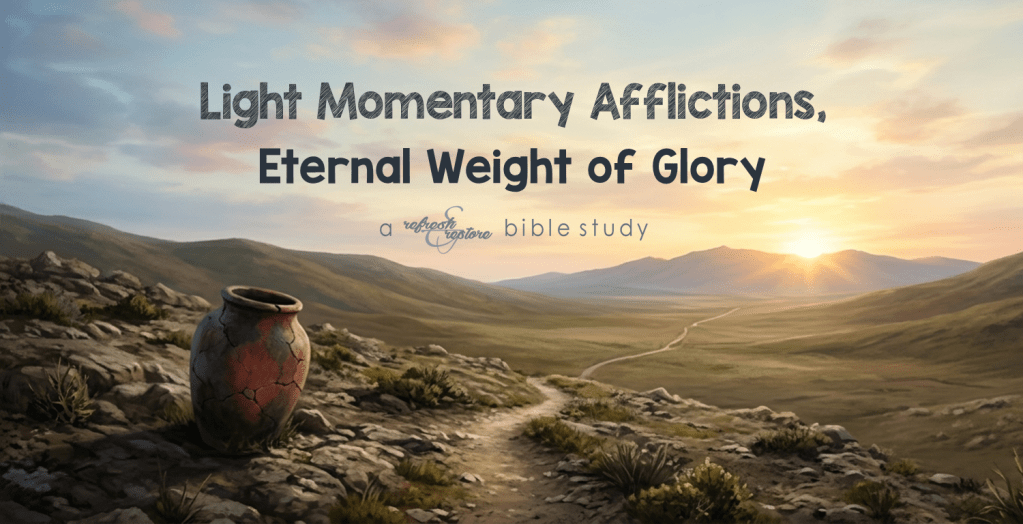
“Light Momentary Afflictions, Eternal Weight of Glory” — a Refresh & Restore Bible Study

Hebrews 12:1-2 –
Therefore, since we are surrounded by so great a cloud of witnesses, let us also lay aside every weight, and sin which clings so closely, and let us run with endurance the race that is set before us, looking to Jesus, the founder and perfecter of our faith, who for the joy that was set before him endured the cross, despising the shame, and is seated at the right hand of the throne of God.

Philippians 4:10-13 –
10 I rejoiced in the Lord greatly that now at length you have revived your concern for me. You were indeed concerned for me, but you had no opportunity. 11 Not that I am speaking of being in need, for I have learned, in whatever situation I am, to be content. 12 I know how to be brought low, and I know how to abound. In any and every circumstance, I have learned the secret of facing plenty and hunger, abundance and need. 13 I can do all things through him who strengthens me.

2 Corinthians 4:7-18 –
But we have this treasure in jars of clay, to show that the surpassing power belongs to God and not to us. We are afflicted in every way, but not crushed; perplexed, but not driven to despair; persecuted, but not forsaken; struck down, but not destroyed; 10 always carrying in the body the death of Jesus, so that the life of Jesus also may be manifested in our bodies. 11 For we who live are always being given over to death for Jesus’ sake, so that the life of Jesus also may be manifested in our mortal flesh. 12 So death is at work in us, but life in you.
13 Since we have the same spirit of faith according to what has been written, “I believed, and so I spoke,” we also believe, and so we also speak, 14 knowing that he who raised the Lord Jesus will raise us also with Jesus and bring us with you into his presence. 15 For it is all for your sake, so that as grace extends to more and more people it may increase thanksgiving, to the glory of God.
16 So we do not lose heart. Though our outer self is wasting away, our inner self is being renewed day by day. 17 For this light momentary affliction is preparing for us an eternal weight of glory beyond all comparison, 18 as we look not to the things that are seen but to the things that are unseen. For the things that are seen are transient, but the things that are unseen are eternal.[1]


Greetings Sojourners!

It has been a while since I’ve gotten to write, and it’s long overdue. A friend asked me a few weeks back if he’d been removed from my list to send out Bible studies. I assured him that I hadn’t and that I had been working on so many different avenues. His response hit me pretty hard after I listed out the litany of said avenues; he said, “You’ve got to make time for things that are important to you.” Well, this ministry is important to me – not for the opportunity to write and publish but to share God’s Word and help people make sense of it and apply it in their lives. That has to begin with me, though.

It seems like this past year has been such a weight. Not to rehash or bore you with repetition, but the ordeal of losing the ability to walk, spending a month in the hospital, and working to be able to, well, be able to do everything again has been taxing – more taxing than either I’m willing to admit or than I even fully realize. I sat in counseling earlier today in the office of a friend who is trying to help me process the past year and its toll, reminding me that it’s not fragile or weak to struggle through things that are immensely difficult and that what I perceive as failure is sometimes just life. At the end of the session, I said, “This too shall pass”, and he said, “That sounds good to say, but it’s harder than that.” I knew as soon as I said it that I didn’t believe it. I understand it intellectually. I believe it fundamentally. But practically? No, that’s not how I am living.

I find myself living in the tension of the last line of one of my favorite novels, The Great Gatsby by F. Scott Fitzgerald:

“So we beat on, boats against the current, borne ceaselessly into the past.”

The tension is that I have to row against the currents bearing me pastward while lifting my eyes “to the hills”, to where my help comes from – “from the Lord, who made heaven and earth” (Psalm 121:1-2). The same Lord who held me through the past year – through the past forty years – is still my “keeper” (Psalm 121:5) and can surely “keep [me] from all evil”, “keep [my] going out and [my] coming in”, as He has kept my life (Psalm 121:7-8). The One who holds all of my tomorrows can hold me from being carried by the currents of life because He is the God who calms storms, both literal and figurative.

The reality is that difficulties happen. Ordeals overwhelm. Bodies fail. Plans fall apart. A year goes by, and it brings mixed emotions of pride at making it through and the recognition that there are some things one cannot make it through unscathed. So, here I sit in my office, hoping that these thoughts I have been struggling to put down will be helpful to you.

So, dear Sojourner, let’s walk through this bit together.

Do you ever feel that there just isn’t enough time in a day? Or a week, month, or year? Just me?

Of course, I’m not the only one to feel this pressure or tension, trying to fit all the things that must be done alongside the things that need to be done – and even fit a few select items on my to-do list that I merely want to do. I’m a husband, father, brother, son, uncle, teacher, pastor (and try to fit as much friendship/fellowship and writing as I can).

I try to be a good steward of my time and to use it as best I can to live the life I am called to live. This isn’t merely careful scheduling but growing to understand that I only have so much bandwidth to be the man I was born again to be. I am reminded constantly that I can only do what I can do, and I find I identify more with Paul in Philippians 4:13 – “I can do all things through Him who strengthens me” – in context, of course. What I mean is that I am learning more and more that I “know how to be brought low” and “how to abound”, understanding that “plenty, hunger, abundance, and need” are just a part of life. So, in saying I can only do what I can do, I realize with each new limitation placed on my life that I can only do what the Spirit of Christ enables me to do – or moves things around to let me do.

Now, when I talk about limitations, let it be known that I am not a fan. However, limitations are the norm. We are limited by our humanity – our fallen-world flesh. Just as the fall of man into sin brought death into the world, we have been, in a sense, dying since we began living. That probably sounds morbid to you; rest assured, it does to me, too. But, then again, I am 40 years old in a body that is aging more rapidly than I would like, learning realities like arthritis and mysteriously crippling autoimmune responses. But as the song based on Job 1:20-22, “Blessed Be Your Name”, says, God is still good and life is still a blessing whether the “land is plentiful” and “the sun’s shining down on me” or if “I’m found in the desert place” or “the road marked with suffering; in all of life, any strength I have comes from the Lord – “Blessed be the name of the Lord!” – because the strength I have within myself is surely not enough.

Maybe you feel that you are not enough. Or you may feel that when everything you want to do and everything that is required is set before you, you just don’t stack up – you don’t measure up to the task(s) at hand. Just me?

Just like I’m not the only one to feel the pressure or tension of not being able to get all the things that need to be done or that I want to be done completed, I’m also not the only one who feels like he doesn’t measure up – that the task(s) at hand are too much for me. No matter how much my ability or knowledge grows, my mind and body age daily. Things that should be simple sometimes become hard. Sometimes, my get-up-and-go has simply gone-off-and-went, and I find myself identifying with the Preacher of Ecclesiastes:

Remember also your Creator in the days of your youth, before evil days come and the years draw near of which you will say, ‘I have no pleasure in them’…and the dust returns to the earth as it was, and the spirit returns to God who gave it. Vanity of vanities, says the Preacher; all is vanity. (Ecclesiastes 12:1, 7-8)

Well, maybe I don’t quite identify fully with the Preacher there, because, Lord willing, I’m not headed out to pasture or returning to dust and crossing over into glory just yet.

I realize that, as I said earlier, this likely sounds morbid – and probably depressing, but this ain’t that kind of Bible study.

The longer I live and the further I get into middle age, the more I see the beauty in life despite its troubles and the amazing grace found in the reality that this world is not all that there is. The farther we get from the Fall and the effects of sin and death reigning on the earth, things break down more and more, and it becomes especially important for us to remember that this world is not our home, we’re just passing through. We need to remember that our hope, if it’s founded only in this world, has an expiration date. Hope in Jesus has no expiration date because it’s fixed on Him and grows out of His grace to us – grace that carries us fully through suffering in such a way that endures, produces character, and builds that hope into our lives (Romans 5:2-5).

So, let’s look at a few passages in the New Testament that help fix our eyes on Jesus and the eternal hope that can be found only in Him.

There is a Race Set Before You (Hebrews 12:1-2)

At Christ Community and The Foundry, we’re currently walking through Hebrews 11 on Sunday mornings and looking at those men and women “who have faith and preserve their souls” (Hebrews 10:39), the “people of old” whose faith in God saw “commendation” from God for being assured of “things hoped for”, being convicted “of things not seen” (Hebrews 11:1-2). We have looked at the faith of Abel, Enoch, Noah, Abraham, Sarah, Isaac, Jacob, Joseph, and Moses – with more in the coming weeks. Hebrews 12, obviously, comes out of that context as it talks about being “surrounded by so great a cloud of witnesses” (Hebrews 12:1).

Similarly to how I said earlier that the God who had faithfully carried me through my life thus far could surely carry me for the rest of my life, we are called to look at the faith this “cloud of witnesses” put in Jesus – how even though they were living in the Old Testament, they trusted God and held to His promises, knowing that “He who promised is faithful” (Hebrews 10:23) without needing to see the fulfillment of the promise. We look to these witnesses, not to see how we stack up against these mighty heroes of old but to see that the same God who worked through Moses is the same God who works in His people today – realizing that Moses did not serve God because he was great but that the great God worked mightily in Moses (a testimony I am sure Moses would wholeheartedly agree with). Looking at the testimonies of faith in the lives of these men and women frees us to “lay aside every weight, and sin which clings so closely, and let us run with endurance the race that is set before us” (Hebrews 12:1). Let’s unpack that.

Our sin weighs on us and holds us back, that much is clear. What is less clear is how we fail, time and again, to realize that the sin we cherish is seeking to kill us. In church life, too often we act like we do not enjoy the sin that we constantly return to, and I believe that is our undoing. It would do us well to look to the wisdom of the Proverbs when we draw our sin up to us closely as if it were a blanket offering warmth, not realizing we are being burned:

“Can a man carry fire next to his chest and his clothes not be burned? Or can one walk on hot coals and his feet not be scorched? So is he who goes in to his neighbor’s wife; none who touches her will go unpunished.” (Proverbs 6:27-29)

The sin that clings to us needs to be cast aside before we get burned. We need to fix our eyes on Christ and look to Him for comfort, peace, and rest, understanding that He knows best and has a plan for our lives that does not include the damage from sin that we refuse to see.

Now, I realize that even before last summer my athleticism was nothing to brag about, but if I were to have to run a race, even I know that I don’t need to do it with my backpack and heavy work boots on. I would need to cast all of that off. Believe it or not, I’ve actually run a race (and didn’t come in last place). I ran in the 5K portion of the races benefiting St. Jude a few years back. Those races take place in December, and it was cold. I tried running in a coat while practicing, and it was more than a little aggravating swish, swish, swishing along and eventually having to take it off and carry it before the end. I tried running in the old-fashioned long johns that I had grown up with, but the fabric was too thick and made it hard for my legs to move and bend as they should while literally chafing against me in the second and third miles. I had to cast those things aside and gird myself for the race at hand. So it is in “the race that is set before us” (Hebrews 12:1). Saying God has a plan for your life is not something to take lightly. He has prepared a course for all those He has saved (Ephesians 2:10). It is for us to recognize what needs to be taken off so as not to be held back as we run to Him.

Too often, we are mournful about what has to be taken off, and that is because we are suffering from having our eyes on the wrong things. While the men and women of Hebrews 11 are truly a “great…cloud of witnesses”, looking to Jesus is the key for understanding this. Hebrews 12:2 says we are to look to Jesus “who for the joy that was set before Him endured the cross, despising the shame, and is seated at the right hand of the throne of God” – don’t miss this: “for the joy that was set before Him”. We get caught up on the excruciating nature of the cross and the sin and shame He bore and hypothesize how He must have felt; this is because we are worldly and pain and suffering distract us from the joy set before us. The sin that we allow to cling to us pales in comparison to the joy set before us in Christ. He is to be our joy more than heaven is to be our finish line.

When I was in the rehab for physical and occupational therapy, no one could have prepared me for how hard it would be. But on day one, I asked them what I would have to do in order to be released and go home to Candice, Keri, and Xander; I had to be able to pass a test to get in and out of a car unassisted, be able to walk a certain distance, and be able to climb more steps than are at the entrance of my house. I had to be able to endure at least an hour and a half of physical therapy and then turn around and do at least another hour and a half of occupational therapy. It was grueling. I sweated. I cried. I had to endure the humiliation of being lapped by a 90-year-old man with a hip replacement and having to be watched in the shower to ensure I could care for myself. I had joy set before me, though. I wanted to go home; no, more than that, I wanted to walk up to Candice and the kiddos and wrap my arms around them while standing in our house. I ran the race that was set before me.

Now, I realize that was only one leg of the race God has set before me. I constantly have sin trying to cling to me and weigh me down, and I have to consistently look to Jesus as the joy set before me and tear the sin away and cast it aside. How about you? What sin is clinging to you and weighing you down? Where are you on the course God has set before you? Rest assured, dear Sojourner, and look to Jesus. He’s worth it all.

We are Clay in the Hands of the Potter (2 Corinthians 4:7-18)

All my life I have sought to be independent and resilient. I wanted to be a strong man who could carry the load of others. I wanted no one to have to help me or carry my burdens. Part of that is noble, but that last part was pure foolishness. That’s not how life works. Most importantly, that’s not how God intended for life to work for His people. He didn’t tell us only to bear the burdens of the weak but reminds us that we are all in need of burden-bearing when He said,

“Bear one another’s burdens, and so fulfill the law of Christ. For if anyone thinks he is something, when he is nothing, he deceives himself.” (Galatians 6:2-3)

I had deceived myself. Thankfully, God in His divine providence put me in a position to see just how foolish I was (and still reminds me on an as-needed basis when my view of burden-bearing gets out of whack).

We’ve already talked about how we get weighed down with sin when we take an earthly perspective instead of an eternal perspective, so we won’t rehash that here. The crux of 2 Corinthians 4:7-18 is that “we have this treasure in jars of clay, to show that the surpassing power belongs to God and not to us” – the treasure being “the light of the knowledge of the glory of God in the face of Jesus Christ” from 2 Corinthians 4:6. I’ll make this simple. I don’t want to be a jar of clay. I want to be something sturdier. I want to be, as I said, resilient. But remember, I also said I can be a fool.

There are many verses in the Bible that use the imagery of God being the potter and His people being His clay (Isaiah 64:8, Jeremiah 18:1-6, Romans 9:20-21, 2 Timothy 2:20-21 and so on). The Bible also shows us the foolishness of the clay talking back to God in Romans 9:20b-21a: “Will what is molded say to its molder, ‘Why have you made me like this?’ Has the potter no right over the clay…?’” Suffice to say, I have talked back to the Potter more than I should and made my case for being more than a jar of clay, but in His grace and wisdom, His answer through His Word has been clear and reminds me that it is best to “be a vessel for honorable use, set apart as holy, useful to the master of the house, ready for every good work” (2 Timothy 2:21). It is better to be clay in the hands of the Potter than any other substance for any other purpose. In the same way the Lord has set a race before me, He has molded me for the purpose He has for my life – and the same with you.

The earthly perspective sees clay as weak and breakable. The eternal perspective reminds us that we jars of clay are “afflicted in every way, but not crushed; perplexed, but not driven to despair; persecuted, but not forsaken; struck down, but not destroyed” and that “death is at work” but “life” through Christ (2 Corinthians 4:8-9, 12). The value of the jar of clay is not in its resilience or strength but in the Potter. Think of the McCarty and Peter’s pottery in Mississippi. To some it looks like brown containers, but to those who know the skill and talent of McCarty or Peter it has value beyond its use.

Over the past year, I have lamented the way that my body has seemingly betrayed me. I have lamented with other brothers and sisters whose mitosis went haywire in their bodies to create cancer cells instead of normal healthy cells. I have lamented with brothers and sisters whose brains and memories are degrading leaving seemingly less than they thought they were. Ultimately, that’s what I lament in my own life: being less than I thought I was. That’s an earthly perspective. The eternal perspective is that I was “bought with a price” and am not my own (1 Corinthians 6:19-20) – that I have been ransomed from sin and death and the “futile ways inherited from [my] forefathers, not with perishable things such as silver or gold, but with the precious blood of Christ” (1 Peter 1:18-19). The eternal perspective tears down the foolishly short-sighted earthly one in that I cannot see what His plans are fully at this time but I know that “He who promised is faithful” (Hebrews 10:23) – I “know whom I have believed, and am convinced that He is able to guard until that day what has been entrusted to me” (2 Timothy 1:12) – and I know that it is useless to try and worry too much over this jar of clay when “to live is Christ, and to die is gain” (Philippians 1:21).

This is the beauty of this passage. Look at the clarity of 2 Corinthians 4:16-18, as God’s Word says it more clearly than I could hope to expound it:

“So we do not lose heart. Though our outer self is wasting away, our inner self is being renewed day by day. For this light momentary affliction is preparing for us an eternal weight of glory beyond all comparison, as we look not to the things that are seen but to the things that are unseen. For the things that are seen as transient, but the things that are unseen are eternal.”

This world is not all that there is. This body is not all that there is. The troubles we experience are not all that there is. No, all of the trials and sufferings this life can throw at us are light momentary afflictions that will be forgotten as easily as a mother forgets labor once her baby is laid in her arms. When I fall on my face at the feet of Jesus once this life is over, I won’t remember I was a jar of clay because I won’t shatter when I fall in front of Him. I won’t shatter because the nail-scarred hand that wipes the last tear from my eyes will lift me up because He cares for me (Revelation 21:4, 1 Peter 5:6-7). And here’s the beauty, dear Sojourner, it is that same strong hand that keeps us from shattering in our jars of clay in the present. How about you? Do you long to be more or are you satisfied with being His? Do you take an eternal perspective with your eyes lifted to the hills, looking for help and fixed on Jesus, or are you letting every weight of sin drag you down as if this world were all there was?

May we fix our eyes on Christ!

Wrapping Up

I don’t know if all this makes sense or if it’s just cathartic rambling on my part. That’s not for me to know. I reckon that’s above my pay grade.

My mind has been so frazzled and I’ve struggled to get my thoughts down for so long that this may not make a lick of sense. But praise God, His Word doesn’t return void. I hope some of this helps you. More than that, I hope something in here points you to the hope found in Jesus and lifts Him up as worthy of worship and worth living for.

All I know is that I am thankful that He has provided me brothers and sisters to help bear my burdens (and that they’re persistent even and especially when I’m too hardheaded or willfully ignorant to see that I need the help). I’m thankful that despite my failings and flaws He has set a race before me. And I’m thankful for this jar of clay because, without it, I may think that I could do this on my own, unable to realize that “the surpassing power belongs to God and not to us” (2 Corinthians 4:7).

I think that’s my prayer for you, too, dear Sojourner – not that you’ll suffer or struggle but that you would set Jesus as joy before you so that whatever the world is throwing at you, it pales in comparison to the glory and worth of Jesus – that whatever light momentary affliction you face would be seen as such, and, as the hymn, “Turn Your Eyes Upon Jesus”, says “the things of earth will grow strangely dim, in the light of His glory and grace”. Amen.


[1] The Holy Bible: English Standard Version (Wheaton, IL: Crossway Bibles, 2025), Heb. 12:1-2, Phil. 4:10-13, 2 Cor, 4:7–18.

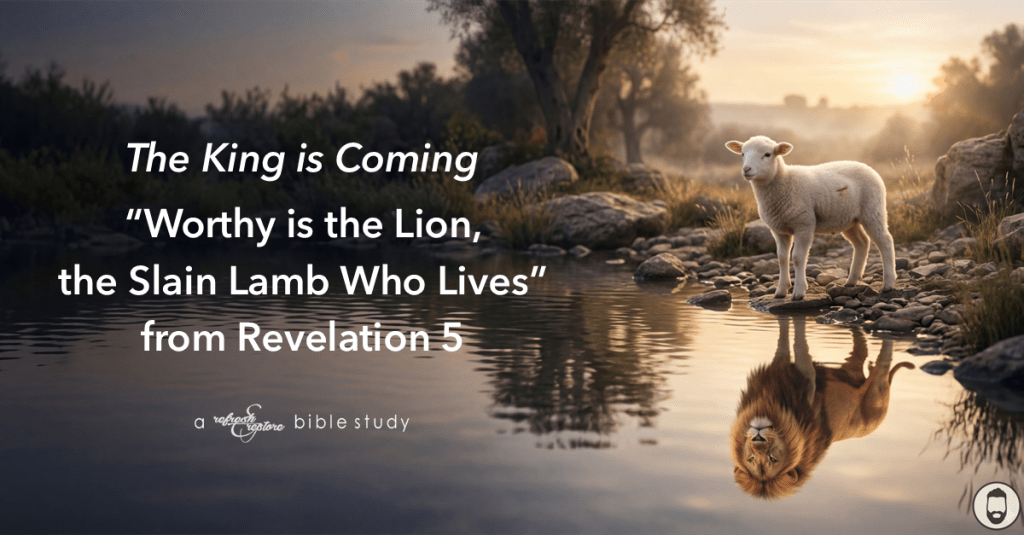
“Worthy Is the Lion, the Slain Lamb Who Lives” from Revelation 5 — a Refresh & Restore Bible Study

We’re back in our study of Revelation called The KING is Coming, where we’re taking a verse-by-verse approach to see what the book truly reveals—Jesus Christ Himself. As always, I’m joined by Jamie Harrison, and I’m thankful for the opportunity to walk through this study together. Today, we’ll be in a passage that is probably quite familiar if you’re a member or regular-attender of Christ Community Church as we read it in worship fairly often – Revelation 5:

Then I saw in the right hand of him who was seated on the throne a scroll written within and on the back, sealed with seven seals. And I saw a mighty angel proclaiming with a loud voice, “Who is worthy to open the scroll and break its seals?” And no one in heaven or on earth or under the earth was able to open the scroll or to look into it, and I began to weep loudly because no one was found worthy to open the scroll or to look into it. And one of the elders said to me, “Weep no more; behold, the Lion of the tribe of Judah, the Root of David, has conquered, so that he can open the scroll and its seven seals.”
And between the throne and the four living creatures and among the elders I saw a Lamb standing, as though it had been slain, with seven horns and with seven eyes, which are the seven spirits of God sent out into all the earth. And he went and took the scroll from the right hand of him who was seated on the throne. And when he had taken the scroll, the four living creatures and the twenty-four elders fell down before the Lamb, each holding a harp, and golden bowls full of incense, which are the prayers of the saints. And they sang a new song, saying,

“Worthy are you to take the scroll
     and to open its seals,for you were slain,
and by your blood you ransomed people for God
     from every tribe and language and people and nation,
10 and you have made them a kingdom and priests to our God,
     and they shall reign on the earth.”
11 Then I looked, and I heard around the throne and the living creatures and the elders the voice of many angels, numbering myriads of myriads and thousands of thousands, 12 saying with a loud voice,
“Worthy is the Lamb who was slain,
      to receive power and wealth and wisdom and might
      and honor and glory and blessing!”
13 And I heard every creature in heaven and on earth and under the earth and in the sea, and all that is in them, saying,
      “To him who sits on the throne and to the Lamb
      be blessing and honor and glory and might forever and ever!”
14 And the four living creatures said, “Amen!” and the elders fell down and worshiped.[1]


Keith Harris:     
Greetings, sojourners. We have a lot to dive into today, so, Jamie, let’s go ahead and dive in.

Jamie Harrison:
All right, so for real, let’s dive in, man, because this really is like — this is it. This is the big climactic scene in heaven. We mentioned in chapter 4 that the throne room is going to be the setting for the remainder of Revelation, and it’s mentioned over and over and over — the throne room, the throne room. And we know that the One seated on the throne is God the Father. And we know that Jesus is going to come and He’s going to sit at His right hand, and the Holy Spirit is there — we’ll see in just a second. And so it starts with this scroll that’s got writing on both sides and sealed with seven seals there in verse 1. And back in Roman times we know that a will or a title deed would be sealed with seven seals. And basically what they would do is they would roll it, seal it, roll it, seal it, roll it, seal it — and again there would be seven seals. And nobody was able to open that scroll except the appointed heir.

Keith:                  
Is there a significance to the seven in Roman Empire days, or is that just — you think — significant biblically here?

Jamie:                 
I would say biblically significant. I know people try to read a lot into a lot of different things, but there’s — obviously there’s seven churches, so people say one seal for each church, right? Those kinds of things. You know what I think is that it’s just biblically significant — the number seven in and of itself. And so no necessary hidden meaning per se, but it’s completely sealed — it’s locked down.

Keith:                  
Correct. Gotcha. As the number seven being the number of completion..

Jamie:                 
Amen. So this thing is sealed up. And in verse 2 we see the angel ask, “Who is worthy to open the scroll and break its seals?” And this angel is a mighty angel. And you would think if anybody could, you know, it’d be this really mighty angel — but he’s not worthy to open it. And then in verse 3 it says no one in heaven or on earth or under the earth was able to open the scroll or even to look in it. Now understand, when it says no one in heaven or on earth or under the earth, that’s everybody that has ever been.

Keith:                  
All the places to be.

Jamie:                 
Correct, right? So that is covering everybody, and nobody is able to open the scroll.

Keith:                  
And I think that’s an interesting wording there. The question is “who is worthy,” not “who is able.” So we’re covering strength here, but worthiness is the question. Excuse you.

Jamie:                 
Thank you.

Keith:                  
So talk to me — take a sip — the difference with worthiness and ability here is not about strength. You mentioned the mighty angel. You mentioned everybody who is. What’s the deal here?

Jamie:                 
It kind of goes back to — who was it? Was it King Arthur that pulled Excalibur out of the stone?

Keith:                  
Allegedly.

Jamie:                 
Right — yeah, that’s a myth. And so the idea of that story being all these strong guys came up and tried to get it out and couldn’t — only the one who was worthy. And so I want to limit — let’s get to that in a second.

Keith:                  
All right.

Jamie:                 
Let’s not get ahead of ourselves.

Keith:                  
We’ll put a pin in it.

Jamie:                 
Yes, put a pin in it — but not too hard, that will hurt. All right, so I’m going to jump over to Hebrews chapter 1, verses 1 through 3 real quick, because this is going to help us as we move forward. I’m going to jump over to Hebrews chapter 1, verses 1 through 3 real quick, because this is going to help us as we move forward.

1 Long ago God spoke  to the fathers by the prophets  at different times and in different ways.  In these last days,  He has spoken to us by His Son. God has appointed Him heir of all things  and made the universe  g through Him. The Son is the radiance  of God’s glory and the exact expression  of His nature,  sustaining all things by His powerful word.  After making purification for sins,  He sat down at the right hand of the Majesty on high.[2]                 

And that’s a really cool Scripture there because it tells us who is the heir — Jesus. Jesus is the heir. And the Son is the radiance of God’s glory, the exact expression of His nature, sustaining all things by His powerful word. After He makes purification for sins — not His sins, for sins — He sat down at the right hand of the Majesty on high. And that’s going to answer your question about who’s worthy, but we’re still not going to jump ahead.

Keith:                  
Well, and also — who’s able to atone for sins? Not us. Not those on earth or under the earth, for sure.

Jamie:                 
It’s kind of like Big John says all the time — that if Jesus did 99% of the forgiving and we did the one, all we would brag about is the one.

Keith:                  
But clearly here we got the none.

Jamie:                 
That’s correct — definitely the none. Not to be confused with nuns — this is N-O-N-E, none. Okay, so now we can move forward, because nobody is able to open the scroll. And then John begins to weep. It says, “I wept and wept because no one was found worthy to open the scroll or even to look at it.” Can you imagine — like you see this scroll in the right hand of the Father, and I don’t know at that point if John necessarily knew what it was or not. I mean, he doesn’t say he knows what it is. But obviously he was alive during that time, so if it’s sealed with seven seals his mind probably went straight to some type of title deed or a will or something like that as well. And so can you imagine this climactic moment where you see this scroll and then nobody is worthy to open it?

Keith:                  
I wonder too — just thinking about the vision that he’s seeing there — it kind of puts me… it reminds me of Isaiah 6, the vision that Isaiah got in the year that King Uzziah died. Like thinking about worthiness — you’re sitting there, you can see the throne. And we talked about this back in Revelation 1 — like in my mind, seeing the throne, you’re not looking at it alone. When we say “high and lifted up,” He literally was high and lifted up. I mean, think Ezekiel — the visions he had of the throne. Like he’s looking at the soles of His feet from way down. And when you ask who is worthy — I know when I am confronted with the holiness and worthiness of God, my first thoughts turn to my unworthiness and why I’m unworthy. Like — gotta be feeling some guilt, gotta be feeling overwhelmed in the first place. This disciple whom Jesus loved, outliving all the rest of the apostles — more than likely in his late 80s, early 90s at this point — like he’s feeling some stuff. He’s well acquainted with his unworthiness, and his friend, the worthy One — the Lamb of God — that’s how his gospel describes Him — died. He knows He rose, but still at the same time, that’s a lot to process.

Jamie:                 
And so he weeps and weeps because nobody is worthy to open the scroll or even to look in it. And then in verse 5 — here we go — one of the elders says to me… which we talked about in chapter 4, you know, what the elders might represent. And it says, “Do not weep. Look.” Now the word’s important — he says, “Look.” “The Lion from the tribe of Judah, the Root of David, has conquered, so that He can open the scroll and its seven seals.” So the Lion from the tribe of Judah — let’s talk about that for a second. Way back in Genesis chapter 49, verses 8 through 10, these are Jacob’s last words. He gives the scepter over to the tribe of Judah, meaning the kings will come from that tribe, obviously starting with David there. But we know that he also references that Shiloh will come — and that’s an idea that someday the King is going to come and He’s going to take over and He’s going to reign for eternity. That’s talking about Jesus again. And so the Lion from the tribe of Judah is like the King of kings.

Keith:                  
In the wording of the prophecy all the way back pre-king — hence that — what does it say? The Root of David, correct? And it’s a big deal.

Jamie:                 
And the Root of David goes back to Isaiah 11. Hey — I’m turning to Isaiah 11… maybe I should have used the digital Bible instead, because these pages—

Keith:                  
Well, this is where the preacher wants to say, “I still hear pages turning — we’ll wait.”

Jamie:                 
That’s going to be Isaiah 11 — the eleventh chapter of Isaiah. That’s what preachers do, in case you were wondering — it’s because they’re trying to find it themselves. Isaiah 11, verses 1 through 10:

11 Then a shoot will grow from the stump of Jesse,
and a branch  from his roots will bear fruit.
The Spirit of the Lord will rest on Him —
a Spirit of wisdom and understanding,
a Spirit of counsel and strength,
a Spirit of knowledge and of the fear of the Lord.
His delight will be in the fear of the Lord.
He will not judge
by what He sees with His eyes,
He will not execute justice
by what He hears with His ears,
but He will judge the poor righteously
and execute justice for the oppressed of the land.
He will strike the land
with discipline  from His mouth,
and He will kill the wicked
with a command  from His lips.
Righteousness will be a belt around His loins;
faithfulness will be a belt around His waist.
The wolf will live with the lamb,
and the leopard will lie down with the goat.
The calf, the young lion, and the fatling will be together,
and a child will lead them.
The cow and the bear will graze,
their young ones will lie down together,
and the lion will eat straw like the ox.
An infant will play beside the cobra’s pit,
and a toddler will put his hand into a snake’s den.
None will harm or destroy another
on My entire holy mountain,
for the land will be as full
of the knowledge of the Lord
as the sea is filled with water.
10 On that day the root of Jesse
will stand as a banner for the peoples.
The nations will seek Him,
and His resting place will be glorious.

I understand, again — this is a prophecy of Jesus that is going — He’s going to come. At this point this is obviously before He has come. And so this is who the Jews were looking for — this conquering king, okay? Now that’s very important, because they were looking for a conquering king. But when Jesus came, He did not conquer, so to speak, the way they thought He was going to in that moment — thinking He was going to free them from Roman oppression, right? And so here’s where it gets really exciting, because this conquering king — remember, “the Root of David has conquered,” is what it says in Revelation 5. And so when you read this, you’re like, “Okay, I see the Lion from the tribe of Judah. I hear you saying the Root of David, and it says that He’s conquered.” Well, how has He conquered? Because He came and He died, and then He rose again — and the Romans are still in control. They’re still in control. Still in control at this point. Now remember, they told him to turn and look. And when you turn and look, it says “the Lion from the tribe of Judah.” But when he turns and looks — in verse 6 — he sees One like a slaughtered Lamb standing in the midst of the throne. He does not see the Lion from the tribe of Judah, so to speak, like you would think you would turn and literally see some type of very strong, mighty force standing there.

Keith:                  
Like Aslan in The Chronicles of Narnia, right? Kind of a Mufasa — that’s right — big old lion.

Jamie:                 
Lion, lion — right. And instead he turns and he sees One like a slaughtered Lamb standing in the midst of the throne. Now just picture this for a minute — you’re John. You’ve lived with Jesus, you’ve walked with Jesus, you’ve seen Jesus. And then you turn expecting to see this lion, and instead you see One like a slaughtered Lamb. You see the scars in His hands. You see the scars in His feet. You see the scars in His side. And the idea you get kind of takes us back to the Passover lamb — you know, put the blood on your doorpost and it will cover you, and we’ll spare you from death.

Keith:                  
So — and I think too — it’s got to draw him back to what the Holy Spirit led him to write down by his own hands. “Behold the Lamb who takes away the sins of the world.” That’s what he wrote down in John 1:29 — the words of John the Baptist. Like, I think this is a huge perspective change, because if anybody should have known the answer to “who is worthy” and not been so bereft that he’s crying, it’d be the disciple whom Jesus loved, right? But here he turns around and — I don’t know — it’s almost liberating. If John can forget, maybe it’s a little more understandable — sometimes not excusable, but at least understandable. If John, standing there in heaven, doesn’t immediately think, “Jesus is worthy,” — remember Him? — yeah, we need that reminder too. But I mean, he’s looking for this archetypal Lion of the tribe of Judah, this conquering leader. Maybe you think some kind of warrior angel is fit to come out and put a whooping on—I mean, he’s having this vision from a prison island in his 90s. He’s needing a little liberation, no doubt. But liberation theology doesn’t match up to the beauty of the Lamb standing as though slain.

Jamie:                 
And that’s key — what you just said — is that He’s standing. How many slaughtered lambs do you know that are standing?

Keith:                  
None.

Jamie:                 
None. That is the whole idea of slaughtering. But Jesus is standing. He isn’t timid, He isn’t laying down, He isn’t dead — He’s alive.

Keith:                  
And I think, going back to your — and I guess this is probably what you’re getting into — like things that are showing that He’s standing, He’s not propped up. He has seven horns — that fullness of strength. Seven eyes — that fullness of clarity and sight and knowledge and all of that representing the seven Spirits of God sent out into all the earth. That the second person of the Godhead — still fully God, still fully man — fully alive and fully eternal. Because full death did nothing to stop Him.

Jamie:                 
Correct.

Keith:                  
That’ll preach — that’s what they say.

Jamie:                 
I can tell you want to do it, man.

Keith:                  
I’m trying to hold him back. It’s okay — saving a little bit for Sunday.

Jamie:                 
He turns — he sees Jesus standing in the midst of the throne, One like a slaughtered Lamb, but He’s standing to receive the scroll. The scroll that nobody has been found worthy to open at this point. But Jesus comes over, and at that moment when He takes that scroll, He identifies Himself as our kinsman-redeemer — the One that is worthy to open the scroll. The Root of David. The Lion of the tribe of Judah. The all-conquering King. The all-prevailing Lord. The King of kings. The Lord of lords. I know you want to go, man. I know you want to go. Take it away.

Keith:                  
I mean — He’s the answer to the question. And you look at this, and I’m not trying to get ahead, but what’s so beautiful to me in the response of the elders and the myriads standing around the throne and all of the creatures there is their worship. Just like in the Old Testament, going all the way back to that praise song written by Moses — “the horse and the rider were thrown into the sea.” It’s in response to what they see there. Like they literally, spontaneously — Holy Spirit-led — sing a song about Him being worthy to take and open the scroll. And not just take it — to open it. He’s not worthy to hold it — it’s not a baton being passed on in some marathon race of faithfulness. He’s worthy to take it, to open it, because He was slain. And His blood ransomed people for God from every tribe and language and people and nation. And did what God said all the way back when He’s talking to Abraham, when He’s talking to Moses, when He’s talking to His people throughout the millennia — to make them a kingdom and priests to our God, and they shall reign on the earth. This is the fulfillment of all these earthly things — and even it points to the ways that evil has tried to fight against the kingdom of God, but it can’t. It literally killed Jesus — God in flesh — and He didn’t stay dead. It didn’t take. Was it Peter who says in Acts chapter 3 that the pangs of death were unable to keep Him? You’ve got the beautiful resurrection chapter in 1 Corinthians 15 where Paul talks about the hope and glory that is in the resurrection. That we are saved by His finished work on the cross, but we’re kept and we get this eternal life through His resurrection. This is a huge deal right here, because nobody else can do that — which is why He alone is worthy. He’s singular. He’s holy. He’s unique. He’s God. And it’s just beautiful — beautiful.

Jamie:                 
Some of the commentaries I read through say that this is the greatest act in all of human history. And I think it’s fitting to look at it that way — that this is the culmination, this is the completion. And I know — I hate to even have to clarify this almost — but I do know there will be people listening to this that don’t know Christ. And in the next episode, Jesus is going to open the scroll — and when He opens the scroll, bad stuff is going to start happening, right? And so the idea would be, “You’re really excited about this scroll that’s bringing bad stuff about?” You know — what it’s bringing about is our inheritance, because we’re heirs with God and co-heirs with Christ, according to Paul in Romans chapter 8. And so I get where the idea could come from — “Well, you’re excited bad things are going to happen.” No, no, no, no, no. Understand this — throughout all of this, salvation is available. Salvation is available when these seals start breaking. Salvation is available later on in chapter 9, where it’s going to say, in essence, that this huge demonic army kills all these people, and then the people continue to worship the demons that were just killing them. So it’s still a choice. There’s still the opportunity to come to know Christ and repent here. So is it bringing about bad stuff? No. It’s bringing about what we deserve, which is God’s judgment.

Keith:                  
Kind of along the lines that you’re talking here — it’s not for us to be excited or terrified for what He’s going to bring about. We’re excited that it’s in His hands. That none of this stuff that happens is out of His control, outside the realm of His sovereignty. And it’s kind of like — and we’ve quoted Big John several times today — but his answer when people want to ask about the problem of evil: “Where is this good God in the midst of all this evil?” How can God still be good in the midst of the things we’re going to read about in the next chapter? If it wasn’t for this good God, there would be no goodness at all. It would just be the evil and wickedness that honestly we ourselves are no less capable of than the ones we would deem more wicked or more evil. The difference is what our good God does with it. And that’s the thing — it’s all in His hands now. He’s not playing with sin. He’s not playing with feelings. This is — I mean, when He came the first time, we got the Lamb. This time, we get the Lion. And that’s no light thing. It’s kind of like — y’all know I’m a nerd — in The Chronicles of Narnia, where Aslan is meant to be a picture of Jesus. One of the kids — I think it’s Lucy — asks, “Is he a safe lion?” And I think it’s the beaver who responds, “A safe lion? He’s a lion.” Like — ain’t nothing safe about a lion. Safety came when He came as the Lamb, taking away the sins of the world. Sins of the world have been taken away. He has conquered. Now you get the teeth.

Jamie:                 
Yep — that’s a good word.

Keith:                  
Sound effect — onomatopoeia.

Jamie:                 
Yep, that. So I don’t want to just keep harping on the same point over and over, because we could — I mean definitely this is very exciting. It’s very exciting to know how — not that one day I’ll get to go to heaven and have a big mansion and see streets of gold — but one day I’ll get to see the King of kings and Lord of lords who is worthy to open the scroll. Face to face.

Keith:                  
There’s no scenery even described in a lot of these places. When you’re in the presence of Jesus, in the presence of the throne, they’re not talking about all the things that sometimes we would sing about. All the rest of it pales in comparison to Him. When the Lamb stands as though slain, the eyes are on Him — not the floor.

Jamie:                 
And when we get to Revelation 21 we’ll talk a lot more about that. But we know there will be no sun or moon in the New Jerusalem, because the Trinity will be the light. There will be no shadows. There will be no dark corners. There will be no dark anything. They will be the light. We know there’s no temple because they’re there — there’s no need of a temple. And so yeah — it’s like all eyes on Him.

Keith:                  
Well, and Hebrews says all these things are shadows pointing to Christ — like that’s figurative shadows. But there will be no figurative nor literal shadows, right? Because all is light.

Jamie:                 
And I think — I almost feel like that’s a good place to stop. You know, we could continue on and talk about some little things here and there. But when you look at the song — that song — and then the second one, what they say — not a song again, it’s a recitation. Is that the right word?

Keith:                  
Yeah — well, I mean it says, “And they sang a new song, saying…” So it’s not about the musical aspect of it as much as it kind of reminds me of church traditions that’ll get to talking about shouting. Sometimes they’re singing — there’s a melodic thing to it — but it’s more about the substance than the song.

Jamie:                 
And that’s it. And the substance here is Jesus. You died for us. You were slaughtered. You purchased people by Your blood — not just a certain group of people, but people from every tribe and language and people and nation. And now because of that we can be saved. We can have a relationship with Christ. We can one day spend eternity with Him.

And in the second one — it’s every creature in heaven and on earth and under the earth and in the sea and everything in them — this is like everybody, everything that he’s seeing here. They say, “Blessing and honor and glory and power be to the One seated on the throne and to the Lamb forever and ever.” And then they fall down and worship. And I think when we begin to really dive into the book of Revelation and the rest of the Bible, that should be our response — to fall down in worship. And this is something I’m guilty of a lot of times — I’ll read just for the sake of reading, to do my reading for the day. But is there ever a moment during that reading where I stop and I just begin to worship the Lord because of what I read, because of who He is, because of what He did for me — because He’s worthy?

Keith:                  
And I mean, like Jamie said, this is a good time to segue into a close. That’s why we’re studying the book of Revelation like this. We’re not trying to answer every unanswerable question. We’re not trying to sweep out the nooks and crannies of prophecy. We’re not trying to convince anyone of our own wisdom or knowledge. We’re trying to point people to the Lamb. And so that’s what we close with today.

As we get ready next week to move into Revelation 6 and see what’s in the scroll, right now we leave you in the hands of Him holding the scroll — who’s worthy not only to hold it but able to open it. The Lion of the tribe of Judah. The Lamb of God who has taken away the sins of the world. He is mighty. He’s high and lifted up. But He’s approachable.

I think Hebrews 4:15-16 is a good passage to end on — and again, if you’re listening and you’re part of Christ Community Church or The Foundry, we’ve been in the book of Hebrews for most of this year. I think it’s a good time to look at the approachable nature of our great God and King.

15 For we do not have a high priest who is unable to sympathize with our weaknesses, but one who in every respect has been tempted as we are, yet without sin. 16 Let us then with confidence draw near to the throne of grace, that we may receive mercy and find grace to help in time of need.

When you look at this, we see John moved by the presence of the Lamb in literally the shadow of the throne. He’s approachable. He is available for us.

Jamie talked about how we look at this — that while all this is going on, there’s still opportunity to be saved. It says multiple times in the Bible — I know in Isaiah — “Seek the Lord while He may be found.”

Well, sojourner, we have presented you the Lion, the Lamb, the King — our great God and Savior, Jesus Christ.

What are you going to do with Him today?

He’s approachable.

He can be found.

Why don’t you seek Him?


[1] The Holy Bible: English Standard Version (Wheaton, IL: Crossway Bibles, 2025), Re 5:1–14.

[2] When Jamie reads from his Bible, it’s from the CSB (The Holy Bible: Holman Christian Standard Version. (Nashville: Holman Bible Publishers, 2009)).

Revelation 22 on 4/17 | The Finale to the NT260 Reading Plan

Click here for Revelation 22 audio:


Read it. Pray it. Share it. Live it.

Today’s post represents more than the finish of a Bible reading plan — it helps us see that the Bible ends on the Person of Christ, the same place it starts and is consistently centered upon.

If you read to check a box off a to-do list or out of some sense of religious obligation, you’re missing out. Look at the beauty of Revelation 22. There is audio above, but look at it in a paper Bible and see the red letters. Jesus is alive. He has promised that He is coming again. And He who promised is faithful (Hebrews 10:23).

Look upon Him. Look for His coming. Come, Lord Jesus!


Chapter Overview:
Revelation 22 completes the vision of the new creation, showing a restored Eden where the river of life flows from God’s throne and the tree of life brings continual blessing and healing (vv. 1–2). The curse is gone, and God’s people dwell with Him, seeing His face and reigning forever in His light (vv. 3–5). The chapter then closes with a final call to respond: the message is trustworthy, Jesus is coming soon, and blessing is promised to those who keep His Word (vv. 6–7). There is both invitation and warning – an open call for all who are thirsty to come and receive life, and a serious warning not to reject or distort God’s Word (vv. 17–19). The book ends with the promise of Christ’s return and the prayer of His people: “Come, Lord Jesus!” (v. 20).

Seeing Jesus in This Chapter:
Revelation 22 reveals Jesus as the living source of eternal life and the returning King who brings all things to completion. From His throne flows the water of life, satisfying His people forever (vv. 1, 17). He is the One who has removed the curse, restoring what was lost and bringing His people into perfect fellowship with God (vv. 3–4). He is both the Root and the Descendant of David, fully God and fully man, the promised King who fulfills all of Scripture (v. 16). And He is the One who is coming soon – bringing reward, justice, and the fullness of His kingdom (vv. 12, 20). Jesus stands at both the beginning and the end – the Alpha and the Omega – and He invites all who are thirsty to come to Him and live. The story of Scripture ends not just with a promise, but with a Person – Jesus Himself.

🌀 Reflection:
Jesus promises that He is coming soon. Are you living with that expectation – longing for His return and remaining faithful until He comes?

💬 Mission Challenge:
Live today in light of Jesus’ return, and invite someone to come to Him and receive the gift of life.


Thanks for joining us in the NT260 readings! It is our prayer that the time in God’s Word has led your heart to worship Jesus and grow close to Him.

Join us for our next reading plan from the Old Testament where we see Jesus revealed from the very beginning!


Revelation 21 on 4/16 | NT260 — Reading & Growing in Christ

Click here for Revelation 21 audio:


Read it. Pray it. Share it. Live it.

Today’s post includes a brief overview of the chapter and a focused look at what it reveals about Jesus (Rev. 1:1) — so our eyes stay fixed on Him.


Chapter Overview:
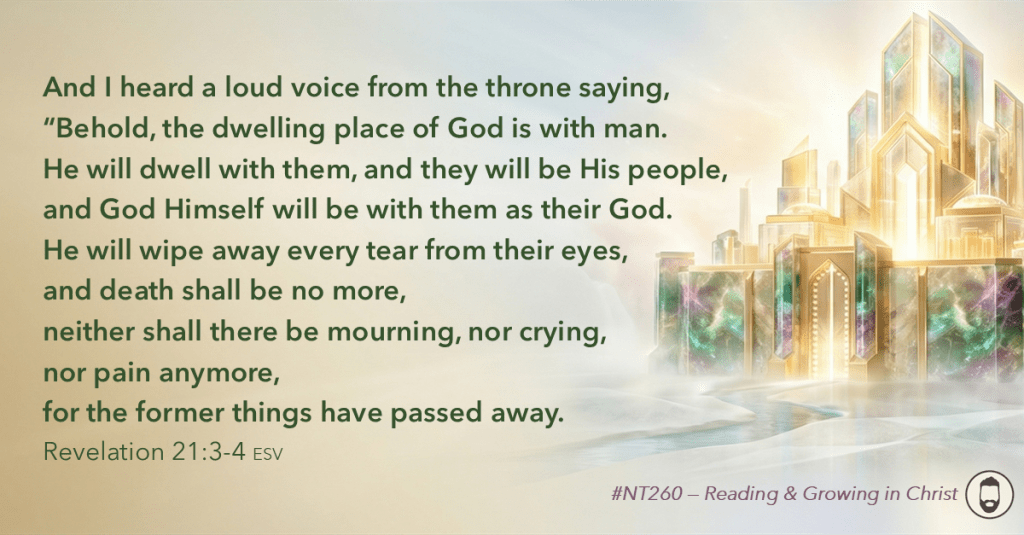
Revelation 21 reveals the final renewal of all things as John sees a new heaven and a new earth, where sin, death, and suffering are gone forever (vv. 1–4). God declares that He is making all things new and invites those who are thirsty to receive life freely (vv. 5–6). The new Jerusalem descends as a beautiful bride, representing God’s redeemed people, where He dwells fully with them in perfect relationship (vv. 2–3). The city is described in breathtaking detail – secure, radiant, and filled with God’s glory – where there is no temple because God Himself is present, and no darkness because His glory is its light (vv. 22–23). Only those whose names are written in the Lamb’s book of life enter this eternal city (v. 27).

Seeing Jesus in This Chapter:
Revelation 21 reveals Jesus as the Lamb who makes all things new and brings His people into eternal life with God. He is the One through whom redemption is complete, bringing an end to sin, death, and sorrow forever (vv. 4–5). As the Bridegroom, He welcomes His people – the bride – into perfect, unbroken relationship, fulfilling God’s promise to dwell with His people (vv. 2–3). He is the source of living water, freely giving eternal life to those who come to Him (v. 6). And in the new creation, His presence replaces every need – the Lamb is the light of the city, the center of all joy, and the reason His people will dwell in glory forever (v. 23). Jesus is not only the One who saves us from judgment – He is the One who brings us home.

🌀 Reflection:
Jesus doesn’t just rescue us from sin – He restores everything. How does the promise of a new creation shape the way you live and hope today?

💬 Mission Challenge:
Live today with eternity in mind, and share with someone the hope that Jesus makes all things new.


Continue reading in our NT260 plan in the rest of Phase 4 — That You May Believe.


Revelation 20 on 4/15 | NT260 — Reading & Growing in Christ

Click here for Revelation 20 audio:


Read it. Pray it. Share it. Live it.

Today’s post includes a brief overview of the chapter and a focused look at what it reveals about Jesus (Rev. 1:1) — so our eyes stay fixed on Him.


Chapter Overview:
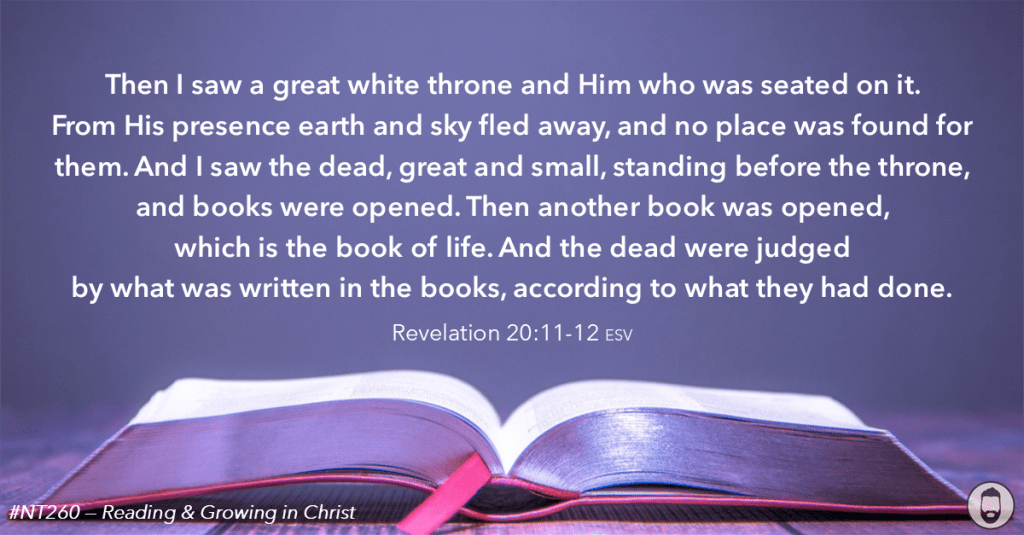
Revelation 20 describes the binding of Satan, the reign of Christ, and the final judgment (vv. 1–15). Satan is bound and prevented from deceiving the nations for a thousand years, while believers reign with Christ and share in the first resurrection (vv. 1–6). After this period, Satan is released for a final rebellion, but it is quickly defeated, and he is thrown into the lake of fire forever (vv. 7–10). The chapter ends with the great white throne judgment, where all the dead are raised and judged according to their deeds, and those not found in the book of life are cast into the lake of fire (vv. 11–15).

Seeing Jesus in This Chapter:
Revelation 20 reveals Jesus as the sovereign King and final Judge who defeats evil completely and reigns forever. He has authority over Satan, who is bound and ultimately destroyed under His rule (vv. 1–3, 10). He shares His reign with His people, giving them life, victory, and the privilege of ruling with Him (vv. 4–6). And He is the One seated on the throne of judgment, before whom all people must stand – perfectly just, seeing every deed, and rendering a final, righteous verdict (vv. 11–13). Yet for those whose names are written in the book of life, there is no fear of the second death (v. 15). Jesus is both the King who reigns with His people and the Judge who brings all things to their final and just end.

🌀 Reflection:
Every person will stand before Jesus as Judge. Are you trusting in Him as your Savior now, knowing that your only hope is to have your name written in the book of life?

💬 Mission Challenge:
Take time today to thank Jesus for saving you, and share the urgency of that truth with someone who needs to hear it.


Continue reading in our NT260 plan in the rest of Phase 4 — That You May Believe.


Revelation 19 on 4/14 | NT260 — Reading & Growing in Christ

Click here for Revelation 19 audio:


Read it. Pray it. Share it. Live it.

Today’s post includes a brief overview of the chapter and a focused look at what it reveals about Jesus (Rev. 1:1) — so our eyes stay fixed on Him.


Chapter Overview:
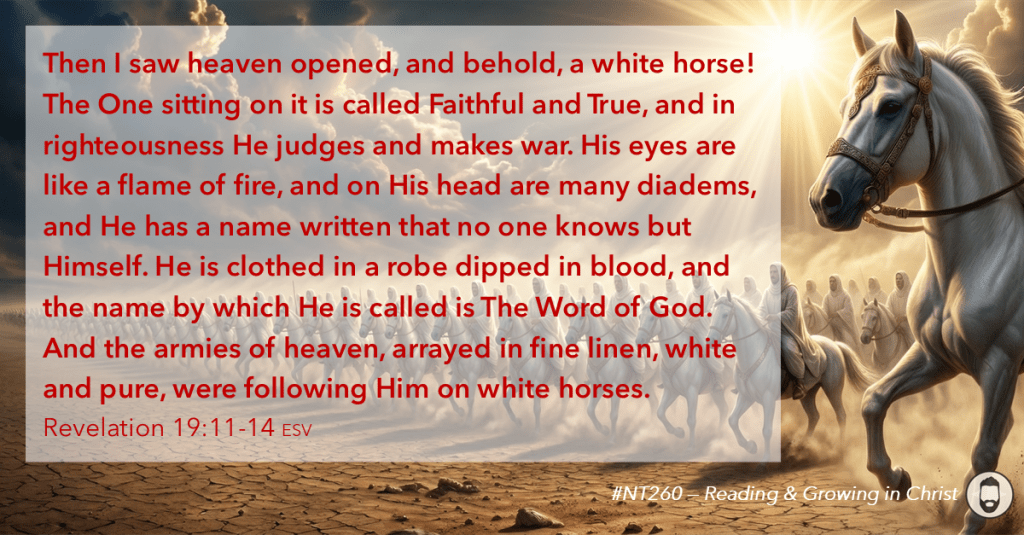
Revelation 19 celebrates God’s victory over Babylon and prepares for the return of Christ (vv. 1–21). Heaven erupts in praise, declaring that God’s judgments are true and just and that He has avenged His people (vv. 1–5). The scene then shifts to the marriage supper of the Lamb, where God’s people are united with Him in joy and purity (vv. 6–10). Finally, heaven opens, and Jesus returns as the conquering King – riding on a white horse, defeating the beast and the false prophet, and establishing His authority over all (vv. 11–21).

Seeing Jesus in This Chapter:
Revelation 19 reveals Jesus as the glorious Bridegroom and victorious King who comes to judge and reign. He is the Lamb whose people are made ready for Him, clothed in righteousness and welcomed into eternal joy at the marriage supper (vv. 7–9). At the same time, He is the rider on the white horse – called Faithful and True – who comes in righteousness to judge and make war against evil (vv. 11). His eyes see all, His word carries absolute authority, and His rule is unmatched as “King of kings and Lord of lords” (vv. 12–16). He defeats His enemies completely (and by Himself), showing that no power can stand against Him (vv. 19–21). Jesus is both the One who saves His people into joy and the One who brings final justice – His victory is total, and His reign is forever.

🌀 Reflection:
Jesus is not only the Savior who invites us into joy, but the King who will return in power. Are you living in a way that reflects both your hope in Him and your readiness for His return?

💬 Mission Challenge:
Live today in light of Jesus’ return, and share with someone the hope of the King who is coming again.


Continue reading in our NT260 plan in the rest of Phase 4 — That You May Believe.


Revelation 18 on 4/13 | NT260 — Reading & Growing in Christ

Click here for Revelation 18 audio:


Read it. Pray it. Share it. Live it.

Today’s post includes a brief overview of the chapter and a focused look at what it reveals about Jesus (Rev. 1:1) — so our eyes stay fixed on Him.


Chapter Overview:
Revelation 18 announces and describes the complete fall of Babylon, the corrupt system that seduced the nations through wealth, power, and immorality (vv. 1–3). God calls His people to separate from her so they do not share in her sins or judgment (vv. 4–5). Her destruction comes swiftly and decisively, repaying her for her arrogance and evil (vv. 6–8). The kings, merchants, and sailors who profited from her mourn her sudden collapse, grieving the loss of their wealth and influence (vv. 9–19). In contrast, heaven rejoices because God has judged her and vindicated His people (v. 20). The chapter ends with a powerful image of Babylon’s final and irreversible destruction – never to rise again (vv. 21–24).

Seeing Jesus in This Chapter:
Revelation 18 reveals Jesus as the righteous Judge who brings down every system built on sin and self-glory. Babylon appeared strong, wealthy, and untouchable, but her fall comes suddenly because God’s justice cannot be delayed forever (vv. 8, 10). Jesus sees the pride, greed, and injustice that the world often celebrates, and He will bring it all to account (vv. 5–7). His judgment is not unjust – it is a fitting response to the harm done to His people and the rebellion against His rule (vv. 6, 24). At the same time, He calls His people to come out and live differently, refusing to be shaped by the values of a fallen world (v. 4). Jesus is both the One who judges and the One who rescues, calling His people to faithfulness now and promising that all evil will one day be brought to an end.

🌀 Reflection:
The world’s systems can look powerful and appealing, but they will not last. Are you living shaped more by the values of this world or by the kingdom of Christ?

💬 Mission Challenge:
Identify one area where the world’s values are influencing you and choose today to live differently in obedience to Jesus.


Continue reading in our NT260 plan in the rest of Phase 4 — That You May Believe.


Revelation 17 on 4/12 | NT260 — Reading & Growing in Christ

Click here for Revelation 17 audio:


Read it. Pray it. Share it. Live it.

Today’s post includes a brief overview of the chapter and a focused look at what it reveals about Jesus (Rev. 1:1) — so our eyes stay fixed on Him.


Chapter Overview:
Revelation 17 gives a detailed vision of Babylon, pictured as a great prostitute sitting on a beast, representing a powerful, corrupt system that influences the nations through wealth, immorality, and false worship (vv. 1–6). She is adorned in luxury but is filled with evil and is responsible for the persecution of God’s people (vv. 4–6). The angel then explains the symbolism of the woman and the beast, showing the temporary nature of their power and their ultimate destruction (vv. 7–13). Though they unite in opposition to God, their rebellion is short-lived, as they will make war against the Lamb – and be defeated (v. 14). In the end, even the forces that support Babylon will turn against her, fulfilling God’s sovereign purposes (vv. 16–17).

Seeing Jesus in This Chapter:
Revelation 17 reveals Jesus as the victorious King over every corrupt and counterfeit system of the world. Though Babylon appears powerful – seducing nations, influencing kings, and opposing God’s people – her power is temporary and ultimately under God’s control (vv. 1–2, 17). The beast and its allies gather to make war against Jesus, but the outcome is never in doubt: “the Lamb will conquer them” because He is “Lord of lords and King of kings” (v. 14). His authority surpasses every earthly ruler, and His kingdom will outlast every system built on rebellion, greed, and idolatry. Those who belong to Him are described as “called and chosen and faithful,” reminding us that our security is not in the world’s systems, but in Christ alone. No matter how strong evil appears, Jesus reigns, and His victory is certain.

🌀 Reflection:
The world often looks powerful and appealing, but it will not last. Are you placing your hope in what is temporary, or in the King who reigns forever?

💬 Mission Challenge:
Reject the pull of worldly compromise today and live as someone who belongs fully to Jesus, the true King.


Continue reading in our NT260 plan in the rest of Phase 4 — That You May Believe.


Revelation 16 on 4/11 | NT260 — Reading & Growing in Christ

Click here for Revelation 16 audio:


Read it. Pray it. Share it. Live it.

Today’s post includes a brief overview of the chapter and a focused look at what it reveals about Jesus (Rev. 1:1) — so our eyes stay fixed on Him.


Chapter Overview:
Revelation 16 describes the pouring out of the seven bowls of God’s wrath, completing His judgment on a rebellious world (vv. 1–21). These judgments affect the earth, sea, rivers, sun, and the beast’s kingdom, bringing sores, blood, scorching heat, darkness, and devastation (vv. 2–11). Despite the severity, many still refuse to repent and instead curse God (vv. 9, 11). The sixth bowl prepares the nations for the final battle at Armageddon (vv. 12–16). With the seventh bowl, a voice from heaven declares, “It is done!” as a great earthquake and catastrophic destruction bring the collapse of human systems opposed to God (vv. 17–21).

Seeing Jesus in This Chapter:
Revelation 16 reveals Jesus as the righteous Judge whose justice is complete and undeniable. Every bowl poured out shows that His judgment is not random but deserved – He gives people what their rebellion has earned, and heaven declares that His judgments are “true and just” (vv. 5–7). He is fully sovereign over creation, using even the natural world to carry out His purposes (vv. 8–9). Yet even in judgment, His call to repentance remains clear, though many continue to harden their hearts (vv. 9, 11). Jesus also warns His people to stay ready – “Behold, I am coming like a thief” – calling them to live with watchfulness and faithfulness (v. 15). When the final declaration comes – “It is done!” – it marks the completion of God’s plan and the certainty that evil will be fully judged and removed. Jesus is both the One who warns and the One who will bring history to its appointed end.

🌀 Reflection:
God’s judgment is just, even when it is severe. Do you trust His justice, and are you living ready for His return?

💬 Mission Challenge:
Live with urgency today – turn fully to Jesus and encourage someone else to be ready for His return.


Continue reading in our NT260 plan in the rest of Phase 4 — That You May Believe.


Revelation 14 on 4/9 | NT260 — Reading & Growing in Christ

Click here for Revelation 14 audio:


Read it. Pray it. Share it. Live it.

Today’s post includes a brief overview of the chapter and a focused look at what it reveals about Jesus (Rev. 1:1) — so our eyes stay fixed on Him.


Chapter Overview:
Revelation 14 contrasts those who belong to the Lamb with those who follow the beast and announces what is coming (vv. 1–20). John sees the Lamb standing with His redeemed people, marked as His own and singing a new song of redemption (vv. 1–5). Three angels then proclaim a final call to worship God, announce the fall of Babylon, and warn of the coming judgment on those who follow the beast (vv. 6–11). Believers are called to endure faithfully, with the promise of rest and blessing (vv. 12–13). The chapter ends with a vision of harvest – one gathering of God’s people and another depicting the judgment of the wicked (vv. 14–20).

Seeing Jesus in This Chapter:
Revelation 14 reveals Jesus as the Lamb who redeems, the Lord who calls, and the Judge who will return. He stands victorious with His people, who belong to Him and follow Him wherever He leads (vv. 1, 4). He is the One who has redeemed them by His blood, making them pure and blameless before God (vv. 4–5). At the same time, He calls all people to turn from false worship and give glory to God before judgment comes (vv. 6–7). And as the Son of Man, He is the One who will return to reap the earth – gathering His people to Himself and executing righteous judgment on sin (vv. 14–16). Jesus is both Savior and Judge, offering salvation now but ensuring justice in the end.

🌀 Reflection:
Following Jesus requires endurance, especially in a world that pulls us toward compromise. What does it look like for you to remain faithful to Him today?

💬 Mission Challenge:
Choose to follow Jesus faithfully today, even in small decisions, showing that your life belongs to Him.


Continue reading in our NT260 plan in the rest of Phase 4 — That You May Believe.