After eleven chapters of gospel mercy, Paul turns to gospel living: “present your bodies as a living sacrifice” (v. 1). Because God has saved us by sheer mercy (11:30–32), the fitting response is not a one-time offering but an all-of-life worship—our whole selves, in the real world, for God’s glory (v. 1; cf. 6:13). That means resisting the pressure of “this age” and being transformed from the inside out as God renews our minds—so we can actually discern and practice what pleases Him (v. 2; cf. Eph. 4:23). Paul’s point is not “look for special signs,” but let Scripture-shaped thinking produce Scripture-shaped living (v. 2).
That renewed mind shows up immediately in humility and service. Paul tells believers not to inflate themselves, but to think with sober judgment—recognizing that every Christian is gifted by grace, and no one is the whole body (vv. 3–5; cf. 1 Cor. 12:12–27). The church is “one body in Christ,” made up of different members with different functions, which means we belong to one another and need one another (vv. 4–5). So Paul calls us to actually use our gifts—whether serving, teaching, exhorting, giving, leading, or showing mercy—and to do it in a way that fits the grace God has given (vv. 6–8).
Then Paul paints what genuine love looks like when it’s Spirit-made and gospel-rooted. Love hates evil and clings to good (v. 9), honors others rather than competing for attention (v. 10), and serves the Lord with sincere zeal (v. 11). Love rejoices in hope, stays patient in suffering, and keeps praying (v. 12). It opens hands and homes to the saints (v. 13), blesses persecutors instead of cursing them (v. 14; cf. Matt. 5:44), and enters other people’s joys and sorrows (v. 15). It refuses pride, seeks peace when possible, and won’t repay evil for evil (vv. 16–18). Instead of taking revenge, it leaves justice with God (v. 19; cf. Deut. 32:35) and does active good even to enemies—because the gospel teaches us to overcome evil with good (vv. 20–21; cf. Prov. 25:21–22).
🌀 Reflection: Where do you feel the strongest pull to “fit the pattern” of this age—your thinking, your speech, your habits, your reactions? Romans 12 reminds us that real change starts when God reshapes the mind through His Word, and it shows up in humble service and sincere love—even toward people who don’t deserve it (vv. 2, 9–10, 17–21).
🎆 New Year Reflection: As this year closes, Romans 12 reminds us that the Christian life isn’t restarted with resolutions but renewed through mercy. God doesn’t ask for a perfect plan for the year ahead—He calls for a surrendered life today. As you step into a new year, offer yourself again to the Lord, trusting Him to do the transforming work as you live, love, and serve in response to His grace (vv. 1–2).
💬 Mission Challenge: Bless one person this week in a concrete way—especially someone hard to love: pray for them, speak honor over them, serve them, or meet a need. Do it intentionally as an act of worship, asking God to use your kindness to display Jesus (vv. 1, 14, 20–21).
Paul asks the question many would be afraid to ask: Has God rejected his people Israel? His answer is immediate and emphatic—“By no means!” (v. 1). Paul points to himself as living proof that God is still saving Jews (v. 1), and he reaches back to Elijah’s day, when it seemed like faithfulness had vanished—yet God had quietly preserved a remnant for Himself (vv. 3–4). In the same way, Paul says, there is “at the present time… a remnant, chosen by grace” (v. 5). And grace and works cannot be mixed: if salvation is by grace, it cannot be earned—otherwise grace would no longer be grace (v. 6; cf. 4:4–5). Many in Israel were hardened in unbelief, just as the Scriptures foretold (vv. 7–10), but that hardening is not the end of the story.
Paul then explains that Israel’s stumbling was not so that they would fall forever. God, in His wise providence, has used Israel’s trespass to bring salvation to the Gentiles—and even this is meant to stir Israel to jealousy, so that many will turn and be saved (vv. 11–14; cf. 10:19). Using the picture of an olive tree, Paul warns Gentile believers not to become proud: they were “grafted in” by faith, while some Jewish branches were broken off because of unbelief (vv. 17–20). The root supports them, not the other way around, so arrogance has no place in the church (v. 18). Paul calls them to a humble, persevering faith that remembers both the kindness and severity of God—kindness toward those who continue in faith, severity toward unbelief (v. 22). And the door of hope remains open: God is able to graft the natural branches back in again (vv. 23–24).
Finally, Paul reveals a “mystery”: Israel’s hardening is partial and temporary, lasting “until the fullness of the Gentiles has come in” (v. 25). In God’s saving plan, “all Israel will be saved” in the way He has ordained—through the Deliverer who takes away sins (vv. 26–27). Even now, Israel may stand as “enemies” regarding the gospel, yet they are still “beloved” regarding election, because God’s gifts and calling are irrevocable (vv. 28–29). God is weaving mercy through human disobedience—first mercy to Gentiles, and mercy also to Jews—so that no one can boast, and all salvation shines as mercy alone (vv. 30–32). Paul can only end one way: worship. “Oh, the depth of the riches and wisdom and knowledge of God!” (vv. 33–36).
🌀 Reflection: Romans 11 humbles us. We didn’t get “grafted in” because we were better, smarter, or more deserving—we stand by faith, supported by grace (v. 20; cf. Eph. 2:8–9). And it gives us hope: God is never done, never surprised, and never unfaithful to His promises—even when His ways are deeper than we can trace.
💬 Mission Challenge: Pray for someone you think is “too far gone,” and then reach out with a simple act of gospel kindness—an invitation, a conversation, or a Scripture shared—trusting that the God who grafts in outsiders can also bring the hardened to faith (v. 23).
Paul continues with a pastoral ache for Israel: “my heart’s desire and prayer… is that they may be saved” (v. 1). Many of his fellow Jews are sincere and zealous, but their zeal is misdirected because it isn’t shaped by the truth of God’s saving plan (v. 2). Instead of submitting to God’s righteousness—His way of making sinners right through Christ—they tried to establish their own righteousness through law-keeping (v. 3; cf. Phil. 3:9). But Christ is the goal and culmination of the law, and He also marks the end of using the law as a pathway to righteousness. Right standing with God belongs to “everyone who believes” (v. 4).
Paul then contrasts the way of works with the way of faith using the Old Testament itself. Leviticus shows that law-righteousness demands doing—and doing perfectly (v. 5; cf. Gal. 3:10). But Deuteronomy shows the nearness and accessibility of God’s saving word, now fulfilled in Christ who has come down from heaven and been raised from the dead (vv. 6–8). The gospel is simple and clear: confess with your mouth that Jesus is Lord and believe in your heart that God raised Him from the dead, and you will be saved (vv. 9–10). This promise is for all people—Jew and Gentile alike—because the same Lord bestows His riches on all who call on Him (vv. 11–13).
And if people can call on the Lord and be saved, then the message must be carried to them. Paul traces the “chain” of salvation backwards—calling, believing, hearing, preaching, sending—and celebrates the beauty of those who bring good news (vv. 14–15). Yet he also grieves: hearing is necessary, but hearing alone is not enough—many in Israel did not “obey” the gospel by believing it (v. 16). Even so, Israel cannot claim ignorance; the Scriptures foretold both Gentile inclusion and Israel’s resistance (vv. 18–21). The chapter ends with a stunning picture of God’s patience: He is still holding out His hands to a disobedient people (v. 21).
🌀 Reflection: Romans 10 presses two truths into our hearts at the same time: salvation is truly near—Christ is accessible by faith—and salvation is urgently personal—you must believe, confess, and call on Him. Zeal and sincerity aren’t enough if we refuse to submit to God’s righteousness in Jesus.
💬 Mission Challenge: Share Romans 10:9–13 with someone this week (in a conversation, a text, or a post), and invite them to respond to Jesus—not by trying harder, but by calling on the Lord who saves.
Romans 9 begins with Paul’s deep anguish over Israel. Though he has just celebrated the unbreakable security believers have in Christ (8:31–39), his heart is heavy because so many of his fellow Israelites have rejected the Messiah (v. 1–3). This sorrow is intensified by Israel’s unique privileges: adoption, glory, covenants, the law, worship, promises, the patriarchs—and even the human lineage of Christ Himself, who is “God over all” (vv. 4–5). Yet Paul insists that Israel’s unbelief does not mean God’s word has failed. From the beginning, God’s promises were never based on mere physical descent but on His gracious promise and calling (vv. 6–8).
Paul shows this from Israel’s own story. God chose Isaac, not Ishmael, and Jacob, not Esau—choices made before birth and apart from works—so that God’s purpose of election would stand (vv. 9–13). Salvation has always depended on God’s merciful call, not human effort or entitlement. When this raises the question of fairness, Paul answers plainly: God is never unjust (v. 14). Mercy, by definition, is undeserved (vv. 15–16). Using Moses, Pharaoh, and the image of the potter and the clay, Paul affirms both God’s sovereignty and humanity’s responsibility without trying to reduce the mystery (vv. 17–23).
The Old Testament itself foretold what Paul’s readers were witnessing: God would call a people from the Gentiles and preserve only a remnant from Israel (vv. 24–29). The real issue, Paul concludes, is not God’s faithfulness but the way righteousness is pursued. Gentiles received righteousness by faith, while many in Israel stumbled by seeking it through works (vv. 30–32). Christ stands at the center of it all—the promised stone. To some He is a stumbling block; to those who believe, He is a sure foundation who will never put them to shame (v. 33).
🌀 Reflection: Romans 9 humbles us. Salvation is not something we earn, inherit, or control—it is a gift of mercy. Instead of arguing with God’s ways, we are invited to trust His character, grieve for the lost as Paul did, and cling to Christ as our only hope.
💬 Mission Challenge: Pray specifically for someone who has heard the gospel but continues to resist it. Ask God to soften hearts, and look for an opportunity this week to speak about Jesus—not with pride, but with compassion and humility.
Romans 8 opens with one of the clearest and most hope-filled declarations in all of Scripture: “There is therefore now no condemnation for those who are in Christ Jesus” (v. 1). Because of Jesus’s saving work, believers are no longer trapped under the power of sin and death but have been set free by the law of the Spirit of life (v. 2). What God’s law could not do—because it was weakened by human sinfulness—God accomplished by sending His own Son as a sin offering, condemning sin in the flesh so that the righteous requirement of the law might be fulfilled in us (vv. 3–4). Life in Christ is marked by a new mindset and a new direction: those who belong to Christ are no longer defined by the flesh but by the indwelling Spirit, who brings life and peace (vv. 5–11).
Because the Spirit lives in us, believers are no longer debtors to the flesh. Instead, we are empowered to put sin to death and live as God’s sons and daughters (vv. 12–14). This life is not driven by fear or slavery but by adoption. Through the Spirit, we cry out to God as our Father—“Abba!”—with confidence and intimacy (v. 15). The Spirit Himself assures us that we belong to God and that we are heirs with Christ, sharing not only in His glory but also, for now, in His sufferings (vv. 16–17).
Paul then lifts our eyes beyond the present moment. The sufferings of this world, though real, are temporary and are not worth comparing with the glory that is coming (v. 18). Creation itself groans, longing for renewal, just as believers groan while waiting for the redemption of our bodies (vv. 19–23). In the meantime, the Spirit helps us in our weakness, even interceding for us when we don’t know how to pray (vv. 26–27). And we rest in the unshakable promise that God works all things together for good—not random good or easy good, but the good of shaping us into the image of His Son and bringing us safely to glory (vv. 28–30).
The chapter closes with a triumphant assurance. If God is for us, no accusation can stand, and no enemy can prevail (vv. 31–34). Christ has died, been raised, reigns at God’s right hand, and even now intercedes for us. Because of that, nothing—no suffering, power, fear, or circumstance—can ever separate us from the love of God in Christ Jesus our Lord (vv. 35–39).
🌀 Reflection: Romans 8 reminds us that the Christian life is lived between groaning and glory. We still struggle, suffer, and wait—but we do so with confidence. The Spirit lives in us, prays for us, and assures us that we belong to God. How does knowing you are truly secure in Christ change the way you face hardship today?
💬 Mission Challenge: Encourage someone who is hurting or discouraged by sharing Romans 8:18 or 8:38–39. Point them to the hope, security, and unbreakable love that are found only in Jesus.
Tomorrow is the Lord’s day, and as Advent draws to a close, our focus remains right where it belongs — on JESUS!
We’ll still sing about the incarnation tomorrow morning, even with December 25 behind us, because God taking on flesh and dwelling among us isn’t something we celebrate for a season and then move on from. There’s no Good Friday or Easter without Christmas. There’s no second coming without the first. The Child born in Bethlehem is the God who saves, reigns, and will come again.
As we light the Christ candle, we’re reminded that Jesus is the center of the gospel Story and our salvation — every season, every Sunday, every day. So, take a few moments to read the Scriptures for tomorrow and listen through the songs. Let them help prepare your heart as we gather to make much of Jesus.
We’d love for you to join us tomorrow as we sing, hear God’s Word preached, and praise the Savior who has come and is coming again — and all the more as the Day draws near (Hebrews 10:25).
Everyone is welcome!
Here is our Advent reading and our Scriptures and songs:
Advent Reading | CHRIST —
The Christ candle stands at the center of Advent, just as Jesus stands at the center of the gospel Story and our salvation. Hebrews opens by telling us that God has spoken fully and finally through His Son – the radiance of His glory and the exact imprint of His nature (Hebrews 1:1-3). The Child born in Bethlehem is the eternal Son who upholds the universe by the word of his power and who made purification for sin before sitting down at the right hand of God. Although December 25th has passed, we don’t stop celebrating what God has done. We continue to rejoice that God put on flesh and dwelt among us – entering our world to save us. His birth led to His cross, His cross to His resurrection, and His resurrection to His unending reign. Even now, He lives to intercede for His people, and He is able to save completely those who draw near to God through Him (Hebrews 7:25). And as we look back with gratitude on Jesus’s first coming, we also look forward with confidence to His return. Jesus Christ is the same yesterday and today and forever (Hebrews 13:8), and the God who was faithful to send His Son will be faithful to bring His promises to completion. As we light the Christ candle, let us celebrate the Savior who has come, trust the Savior who reigns, and hold fast to our hope in the Savior who will come again – for He who promised is faithful (Hebrews 10:23).
Scripture | Hebrews 1:1-4 —
1 Long ago, at many times and in many ways, God spoke to our fathers by the prophets, 2 but in these last days he has spoken to us by his Son, whom he appointed the heir of all things, through whom also he created the world. 3 He is the radiance of the glory of God and the exact imprint of his nature, and he upholds the universe by the word of his power. After making purification for sins, he sat down at the right hand of the Majesty on high, 4 having become as much superior to angels as the name he has inherited is more excellent than theirs.
1 In the beginning was the Word, and the Word was with God, and the Word was God. 2 He was in the beginning with God. 3 All things were made through him, and without him was not any thing made that was made. 4 In him was life, and the life was the light of men. 5 The light shines in the darkness, and the darkness has not overcome it…. 9 The true light, which gives light to everyone, was coming into the world. 10 He was in the world, and the world was made through him, yet the world did not know him. 11 He came to his own, and his own people did not receive him. 12 But to all who did receive him, who believed in his name, he gave the right to become children of God, 13 who were born, not of blood nor of the will of the flesh nor of the will of man, but of God. 14 And the Word became flesh and dwelt among us, and we have seen his glory, glory as of the only Son from the Father, full of grace and truth.
16 “For God so loved the world, that he gave his only Son, that whoever believes in him should not perish but have eternal life. 17 For God did not send his Son into the world to condemn the world, but in order that the world might be saved through him.[2]
9 In this the love of God was made manifest among us, that God sent his only Son into the world, so that we might live through him. 10 In this is love, not that we have loved God but that he loved us and sent his Son to be the propitiation for our sins.[3]
Merry Christmas Adam, Sojourners!
Why Christmas Adam, you ask? Well, Adam came before Eve, right? Ba-dum-cha!
I’m somewhat sorry to start with a dad joke, but I am who I am. And even a light moment like this can remind us that Christmas meets us in ordinary, human places before leading us to eternal truths. So, with that smile (hopefully) in place, let’s turn our hearts to deeper things.
As we move toward the culmination of Advent and stand on the threshold of Christmas, we pause once more to reflect on the gifts God has given us in the coming of His Son. Over the past few weeks, we’ve traced the steady unfolding of the gospel through hope, peace, and joy. We’ve seen that our hope rests not in circumstances but in the faithful God who keeps His promises. We’ve seen that true peace was secured when Jesus entered our darkness to reconcile us to God. And we’ve seen that real joy is not manufactured by emotion or ease but springs up where God’s mercy is received and trusted. And if this season finds you carrying grief, sorrow, disappointment, or weariness, there is room for that here. The coming of Jesus doesn’t require us to pretend, perform, or put on a happy face. It invites us to come to Him honestly – needy, heavy-laden, and real – and to find that He meets us with mercy (Matthew 11:28-30, Psalm 34:18, Hebrews 4:15-16).
Now, all of those gifts converge in the love of God.
Christmas is the declaration that God’s love is neither distant nor abstract. It took on flesh (John 1:14). The incarnation is not merely the arrival of a baby in Bethlehem; it is the greatest gift ever given – the Son of God sent for sinners like us. Hope, peace, and joy all find their source and fulfillment in Him because they flow from God’s love revealed in Jesus. Without God’s love, there would be no promise kept, no peace secured, and no joy that lasts. Christmas tells us that love has come near (Hebrews 2:14-18).
In this final study in our Christ Has Come series, we’ll consider how Scripture defines that love – not as sentiment, but as saving action. We’ll briefly walk through three key passages that together give us a clear and faithful picture of the love of God revealed in Christmas: Romans 5:8, where God demonstrates His love for sinners; John 3:16-17, where God gives His Son so the world might be saved; and 1 John 4:9-10, where love is defined – not by our response to God but by God’s initiative toward us. As we do, it’s my prayer that we’ll see that Christmas proclaims this staggeringly simple and gloriously true gospel message: God loves, God gives, and God saves.
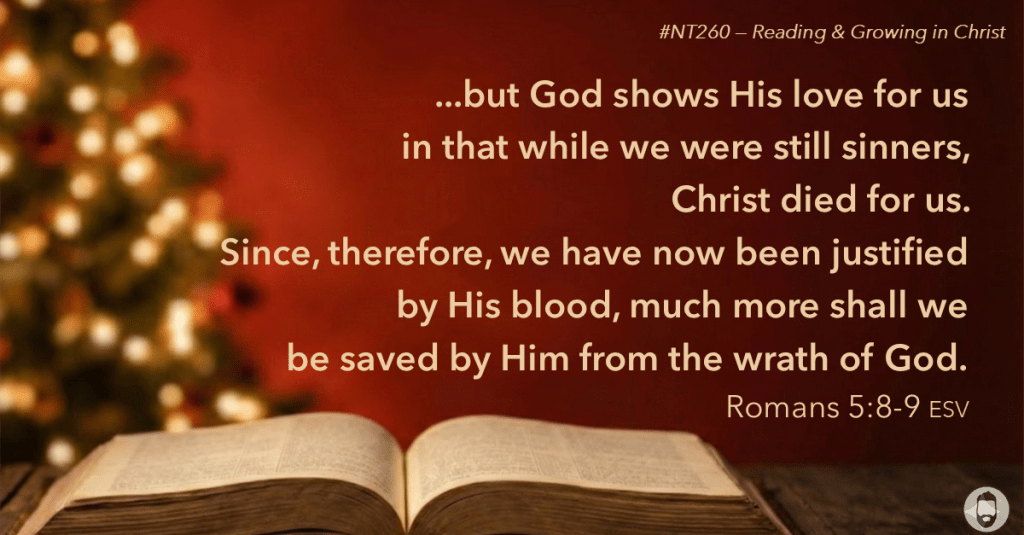
God Demonstrates His Love (Romans 5:8) …but God shows His love for us in that while we were still sinners, Christ died for us.
This verse doesn’t merely tell us that God loves – it shows us how He loves. His love is not theoretical. It’s not conditional. It’s demonstrated, proven, and displayed throughout history through the death of Jesus (1 John 3:16).
What makes this love so staggering is when it was shown. Paul explains that Jesus didn’t die for good, righteous people or folks who had earned God’s favor. He died for sinners – ungodly people living in rebellion and enmity against God (Romans 5:6-10). Human love, at its best, may sacrifice for someone we feel is worthy, but God’s love belongs to an entirely different category. While we were still estranged, still guilty, still God’s enemies, still unable to fix or save ourselves, God acted. He moved first in love (1 John 4:19).
And it’s important to see that this wasn’t only the love of the Son for us but also the love of the Father. You see, the cross wasn’t a tragic accident or a reluctant sacrifice – it was God’s loving plan of redemption. God demonstrated His love by sending His Son to die in our place (Romans 8:32). The justice and righteousness of God required that sin be dealt with, and Romans 5:9 reminds us why the cross was necessary: “Since, therefore, we have now been justified by His blood, much more shall we be saved by Him from the wrath of God.” God’s love doesn’t ignore sin or minimize judgment. Rather, love moved God to place His righteous wrath against sin upon His own Son, so that sinners like us could be forgiven, justified, and reconciled to Him.
Romans 5:8 teaches us that God’s love isn’t measured by how we feel in a given moment or how well life is going. It’s anchored in an unchanging historical reality: Jesus died for us. Christmas, then, isn’t sentimental but sacrificial. It points us to the cross, where God’s love is demonstrated fully, finally, and forever.
God Gives His Son (John 3:16-17) For God so loved the world, that He gave His only Son, that whoever believes in Him should not perish but have eternal life. For God did not send His Son into the world to condemn the world, but in order that the world might be saved through Him.
If Romans 5:8 shows us how God demonstrates His love, John 3:16-17 helps us understand why – and to what end. The cross doesn’t stand alone as an isolated act of love but flows out of the eternal, gracious heart of the Father. Long before nails pierced flesh, love was already moving. God loved, and so God gave.
“For God so loved the world, that He gave His only begotten Son….” These are probably the most familiar words in all of Scripture, but they lose none of their weight or strength with repetition. They magnify this God-sized love, a love not measured by the size or goodness of the world but in the costliness of the gift He gives. Scripture is clear: God’s love for the world is astonishing not because the world was worthy, but because it was fallen, rebellious, and broken. The wonder of John 3:16 isn’t that God loved something lovable—which would make sense—but that He loved sinners and gave His Son so that they might be saved through Him. That is grace. That is mercy.
And this love isn’t vague. It’s not sentimental. God’s love takes action. He gave His Son – He sent Him into the world to take on flesh, dwell among us, and ultimately to bear the penalty for our sin. The incarnation – Christmas – is an act of love. Christmas tells us that love came near to us, and as we said before, Christmas leads us to the cross, God giving Himself so that sinners might live.
John 3:17 presses this even further because Jesus didn’t enter a morally neutral world awaiting judgment; He entered a world already condemned by sin (John 3:18, 3:36). His first coming wasn’t to add condemnation but to offer rescue (John 12:47). Love sent the Son on a mission of salvation – not ignoring sin but dealing with it fully and finally.
This helps us see the way Christmas and the cross are woven together in God’s redemptive plan. God’s love doesn’t deny judgment but provides salvation from it. The same love that sent Jesus into the world is the love that led Him to lay down His life. And the promise attached to that love is breathtakingly simple: “whoever believes in Him should not perish but have eternal life.” God’s love invites trust. It calls for faith. And it offers life – real, eternal life – to all who believe in Him.
If Romans 5:8 shows us that God loved us while we were still sinners, John 3:16-17 shows us that this love has always been purposeful, redemptive, and saving. Love gives. Love sends. Love saves.
God Defines Love (1 John 4:9-10) In this the love of God was made manifest among us, that God sent His only Son into the world, so that we might live through Him. In this is love, not that we have loved God but that He loved us and sent His Son to be the propitiation for our sins.
If Romans 5:8 shows us when God loved us and John 3:16-17 shows us why He loved us, 1 John 4:9-10 tells us what love truly is. Scripture doesn’t leave love to our imagination or interpretation. It defines it for us. And it does so by pointing, once again, to God’s action in sending His Son.
John tells us that God’s love was “made manifest” – made visible, made known, made unmistakable. Love didn’t remain hidden in God’s heart or vague in His intentions. It was revealed when God sent His only Son into the world so that we, who were dead in our trespasses and sins, might live through Him (Ephesians 2:1-5). Love isn’t about how we feel toward God but about what God has done for us. “In this is love,” John writes, “Not that we have loved but that God has loved us.” Love begins with God. Love moves toward sinners. Love takes the initiative.
This is where Christmas love often gets misunderstood. We tend to think of love primarily in human terms like affection, warmth, or generosity, but Scripture presses us deeper. God’s love is not only demonstrated in sending His Son – it’s defined by His purpose for sending Him: “to be the propitiation for our sins”[4]. That word matters. Propitiation means that Jesus bore the righteous wrath of God against sin, as we discussed earlier, but it also means that He fully satisfied the demands of God’s holy justice (Romans 3:25-26, Isaiah 53:5-6, 2 Corinthians 5:21). Love didn’t ignore our sin. It didn’t excuse our rebellion against God. Love dealt with sin fully and finally by placing its penalty on a sinless substitute.
This is also why no human comparison or analogy could fully capture what God has done – though it can help us feel the weight of it. As a father – as a daddy, I cannot imagine loving anyone enough to give one of my children in their place. My love for my kids outweighs any value anyone else could ever have in my eyes. And even if I could somehow bring myself to offer such a sacrifice, it wouldn’t do any good. My kiddos, like their daddy, are sinners. They couldn’t atone for anyone’s sin. They couldn’t bear God’s righteous wrath. They, like me, can’t even save themselves. We didn’t need a better example or a more inspiring human being—we needed God’s Son. We needed God to put on flesh and dwell among us, live the sinless life we are incapable of living, and die the death we deserve because of our sin. Only a sinless Savior could stand in the place of sinners (Hebrews 4:15, 1 Peter 3:18). Only Jesus could be the propitiation our sins require.
This is the love Christmas proclaims. God didn’t send His Son because we were lovable. He sent Him because we were lost. He didn’t wait for our love but acted in love first. And He didn’t merely show us affection – He provided atonement. Christmas tells us that love came down, took on flesh, and willingly walked toward the cross so that we might live through Him.
Wrapping Up
As this study comes to a close – and Christmas itself arrives – we’re reminded that the love we’ve been considering isn’t something to admire. It’s something to receive. Christmas isn’t only a message to be believed but a Savior to be trusted. And coming to Jesus doesn’t require you to feel “merry”, to force a smile, or to pretend the season isn’t heavy. There is room in Christ for grief, sorrow, anxiety, and whatever burdens you’re carrying (Psalm 34:18, 1 Peter 5:7). He meets us where we are – and He loves us too much to leave us as we are (Hebrews 4:15-16).
For some, this invitation is especially clear. If you find yourself among the lowly – aware of your need, burdened by guilt, weary from sin, or conscious that you can’t save yourself – Christmas holds out real hope. The love of God has come near to sinners in Jesus, near enough to take hold of. And Scripture tells us plainly how to do that: “if you confess with your mouth that Jesus is Lord and believe in your heart that God raised Him from the dead, you will be saved” (Romans 10:9). It really is that simple – and that profound. Look away from yourself and toward Jesus and what He has done. Put your trust – your faith – in Him. And if you do, God’s promise stands firm: “Everyone who calls on the name of the Lord will be saved” (Romans 10:13). What better time to receive Him—and the love that’s been given?
For others, this season is a call not to come for the first time but to remember again. Many of us have been lifted by grace – saved, forgiven, reconciled to God through Christ. And yet even the redeemed can grow weary, distracted, or dulled by the noise of the season. Christmas gently calls us back to the gospel we first believed. It invites us to remember what the Lord has done and to ask Him to remind us again – day by day – of His steadfast love. The love of God in Christ that saved you is the same love that sustains you, comforts you, and carries you forward.
This is the good news Christmas proclaims. Love has come. Love has taken on flesh. Love has walked toward the cross. And love calls sinners to come, believers to remember, and all to rest in Christ – because He is love. So wherever you find yourself this Christmas, lowly or lifted, weary or rejoicing – fix your eyes once more on Jesus. The Promised King has come. And in Him, the greatest gift of love has been given.
[4]Propitiation means that Jesus bore the righteous wrath of God against sin and fully satisfied the demands of God’s holy justice (Romans 3:25–26; Isaiah 53:5–6). At the cross, God did not ignore sin or lower His standard; He dealt with sin completely by placing its penalty on His own Son. Because Jesus satisfied God’s justice, all who trust in Him are justified—declared righteous before God, not because of their works, but because Christ’s righteousness is credited to them (Romans 5:1, 5:9; 2 Corinthians 5:21). This means that God’s love and God’s justice are not in conflict at the cross. In love, God provided what His justice required. Propitiation shows us that salvation is not God choosing between love and holiness, but God expressing both perfectly in Jesus.
Paul explains what it means that believers are “not under law but under grace” (6:14). Using a marriage illustration, he reminds us that law has authority over someone only while they live (vv. 1–3). In the same way, believers have died to the law through the body of Christ so we can “belong to another”—to the risen Jesus—in order to bear fruit for God (v. 4). Before Christ, the law interacted with our sinful flesh in a way that stirred up rebellion and produced “fruit for death” (v. 5). But now, in Christ, we are released from the law’s condemning hold so we can serve in the new way of the Spirit, not merely in the old way of written code (v. 6; cf. 2 Cor. 3:6).
That raises a hard question: if the law can stir up sin, does that mean the law is bad? Paul’s answer is just as strong as in chapter 6: By no means! (v. 7). The law is not sin; it reveals sin. Paul uses the tenth commandment—“You shall not covet” (Ex. 20:17)—to show how sin can seize God’s good command and turn it into an opportunity for more desire, more rebellion, and ultimately death (vv. 7–11). The problem is not God’s law; the problem is sin’s power working in us. So Paul concludes with a clear affirmation: “the law is holy, and the commandment is holy and righteous and good” (v. 12).
In the second half of the chapter, Paul presses the point further: the good law is not the cause of death—sin is (v. 13). He describes the painful reality of the human condition: the law is spiritual and good, but we are weak and still battling indwelling sin (vv. 14–23). Whether Paul is mainly describing the experience of a person under the law or the ongoing struggle of a believer, the message lands in the same place: we cannot rescue ourselves by effort or moral performance. The struggle exposes our need and drives us to the only true deliverer. Paul’s cry becomes our hope: “Who will deliver me…?” And the answer comes immediately: “Thanks be to God through Jesus Christ our Lord!” (vv. 24–25; cf. Gal. 5:17, 1 John 1:8–9). Romans 8 is about to show how that deliverance is lived out by the Spirit.
🌀 Reflection: When you feel the tug-of-war—wanting to obey God, yet sensing sin “close at hand” (v. 21)—don’t let it drive you to shame or self-salvation projects. Let it drive you to Jesus. The struggle is real, but so is the Savior who rescues, forgives, and trains you to walk by the Spirit (v. 25; 8:1–4).
💬 Mission Challenge: Encourage someone who feels stuck in spiritual frustration. Share Romans 7:24–25 and remind them that Christianity isn’t “try harder”—it’s deliverance in Christ, and new power by the Spirit (v. 6; 8:2).
After saying that grace abounds where sin increases (5:20), Paul answers the obvious objection: “So should we keep sinning?” His response is strong and clear: By no means! (vv. 1–2). Grace isn’t permission to stay the same—it’s power to live new. Believers have died to sin in the sense that sin no longer has absolute rule over us (vv. 2, 6, 14). Paul points to our union with Christ: we were baptized into Christ’s death and buried with Him, so that just as Christ was raised, we too might walk in newness of life (vv. 3–4). Our “old self” (who we were in Adam) was crucified with Christ so we would no longer be enslaved to sin (v. 6; cf. Gal. 2:20).
Because Christ has been raised and will never die again, His victory is permanent—and our union with Him changes everything (vv. 8–10). That’s why Paul tells us to consider ourselves dead to sin and alive to God in Christ Jesus (v. 11). Then he calls for action: don’t let sin reign in your mortal body, and don’t offer yourself to sin as an instrument for unrighteousness. Instead, present yourself to God as someone brought from death to life, and offer your life to Him for righteousness (vv. 12–13). The promise underneath the command is hope-giving: sin will have no dominion over you, because you are not under law but under grace (v. 14; cf. Ezek. 36:25–27).
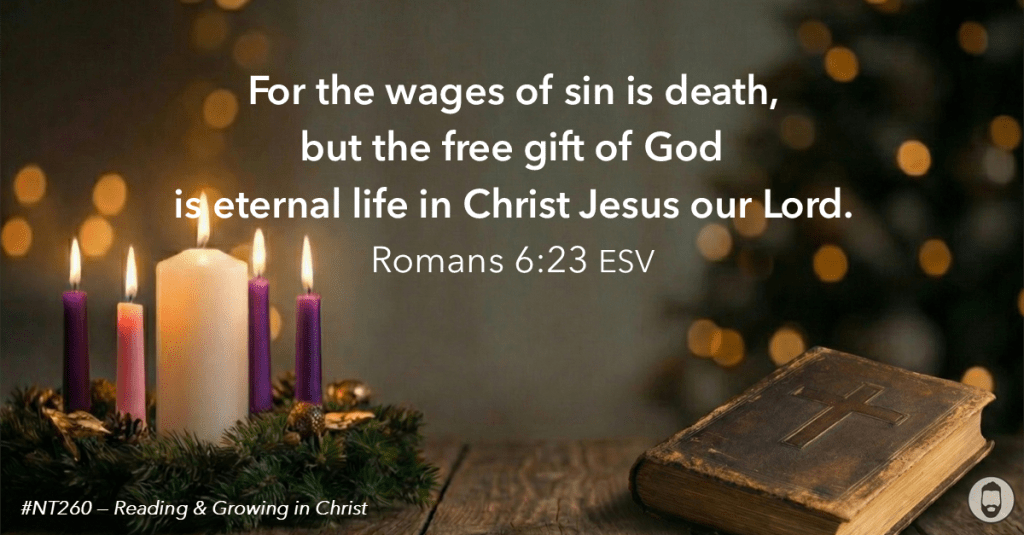
Paul pushes the point further: being “under grace” does not mean we can casually sin (v. 15). Everyone is serving a master—either sin (which leads to death) or obedience (which leads to righteousness) (v. 16). But Christians have been changed from the inside out. We were slaves to sin, but God has made us obedient from the heart to the gospel-shaped pattern of teaching, and we’ve been set free to become slaves of righteousness (vv. 17–18). Sin’s path produces shame and ends in death, but serving God bears fruit that leads to sanctification, and its end is eternal life (v. 21–22). Paul ends with a famous contrast: sin pays wages—death—but God gives a gift—eternal life in Christ Jesus our Lord (v. 23; cf. Eph. 2:8–9).
🌀 Reflection: Where do you feel sin trying to “reign” again—your thoughts, temper, habits, secret compromises (v. 12)? Don’t argue with it like it’s your master. In Christ, you’ve died and risen to a new life—so start today by believing what God says is true: you are alive to Him (v. 11).
🎄 Christmas Reflection: Christmas celebrates more than Jesus coming into the world—it celebrates why He came. The Son of God was born so that we could die to sin and live to God. The manger points forward to a cross and an empty tomb, where Jesus breaks sin’s power and gives new life to all who are united to Him. Because Christ has come, grace doesn’t just forgive us—it raises us to walk in newness of life (vv. 4, 11).
💬 Mission Challenge: Tell someone this week that grace doesn’t just forgive—it frees. Share Romans 6:23 and explain the difference between what sin pays (“wages”) and what God gives (“free gift”), and invite them to trust Christ for new life (v. 23, 5:8–9).
Because we have been justified by faith, we now have peace with God through Jesus—not just a calm feeling, but a real change in our relationship with God where the hostility of sin is ended (vv. 1, 10–11). Through Christ we have access into grace and a secure place to stand, and that security produces hope—the certain expectation that we will share in the glory God has promised (v. 2). Even our sufferings aren’t meaningless for the believer. God uses them to form endurance, proven character, and deeper hope (vv. 3–4). And this hope will not put us to shame on the day of judgment, because God has already poured His love into our hearts through the Holy Spirit (v. 5; cf. Eph. 1:13–14).
Paul grounds that inner assurance in a rock-solid, historical proof: Christ died for us while we were still weak, ungodly, and sinners (vv. 6–8). Human love might rarely die for someone “good,” but God’s love is in a category all its own—Jesus died for enemies (v. 10). That’s why Paul argues “much more”: if God has already justified us by Christ’s blood and reconciled us through His death, we can be confident He will finish what He started—saving us from wrath and keeping us by Christ’s resurrected life (vv. 9–10; cf. 4:25). So our boasting isn’t in ourselves; it’s in God, because we have received reconciliation through our Lord Jesus Christ (v. 11).
Then Paul widens the lens to show why this hope is so sure: everyone is either in Adam or in Christ. Through Adam, sin entered the world and death spread to all (vv. 12, 14). Adam’s one trespass brought condemnation, and the law later highlighted and even multiplied our trespasses by exposing sin more clearly (vv. 16, 20). But Christ is the “second Adam”—and His gift is not like Adam’s trespass. Where Adam’s one act brought death’s reign, Christ’s one act of righteousness and obedience brings an abundance of grace, justification, and life to all who receive Him by faith (vv. 15–19). Sin once reigned in death, but grace now reigns through righteousness leading to eternal life through Jesus Christ our Lord (v. 21).
🌀 Reflection: Where do you feel most “weak” right now—tired, tempted, anxious, discouraged? Romans 5 doesn’t tell you to prove yourself to God; it tells you to look at the cross. If God loved you when you were His enemy, you don’t have to wonder whether He’ll hold you now as His child (vv. 8–10).
🎄 Christmas Reflection: On Christmas Eve, we remember that God’s love did not begin at the cross—it moved toward the cross through the cradle. The child born in Bethlehem came for the weak, the ungodly, and the undeserving. Christmas proclaims that God did not wait for us to love Him first; He came near while we were still sinners, to make peace and give us hope that will never put us to shame (vv. 6–8).
💬 Mission Challenge: Share Romans 5:8 with someone today and put it in plain words: “God didn’t wait for me to get better—Jesus came for me when I was still a sinner.” Invite them to receive the free gift of grace and life found in Christ (vv. 15–17, 21).





 Just Keith Harris