Paul reminds the Thessalonians how he and his team ministered with courage after being mistreated in Philippi—preaching the gospel “in the midst of much conflict” (vv. 1–2). Their message wasn’t built on error, impure motives, or trickery; they spoke as those approved by God, seeking to please Him who tests our hearts (vv. 3–4). They didn’t use flattery, chase money, or demand honor, even though as apostles they could have (vv. 5–6). Instead, they were gentle like a nursing mother, sharing not only the gospel but their very lives, and they worked night and day so as not to burden the church (vv. 7–9). They lived holy, righteous, and blameless among them, urging them like a father to walk worthy of God, who calls us into His kingdom and glory (vv. 10–12).
The church’s response confirmed God’s work: they received the preached word “not as the word of men but… the word of God,” which keeps working in believers (v. 13). Like the Judean churches, they suffered from their own neighbors for following Jesus (v. 14). Paul explains his sudden absence: he was torn away and repeatedly tried to return, but Satan hindered him (vv. 17–18). Still, his hope, joy, and crown of boasting at Jesus’s coming will be the Thessalonian believers themselves—his dearly loved spiritual family (vv. 19–20).
🌀 Reflection: Where might God be inviting you to serve others not for praise or gain, but with a mother’s gentleness and a father’s faithful urging (vv. 7–12)? How can you welcome the Scriptures this week as God’s living word that keeps working in you (v. 13)?
💬 Mission Challenge: Write a short note (text or card) to someone who helped you grow in Christ. Thank them for sharing “the gospel of God” and their life (v. 8), and tell them one way the word is still at work in you today (v. 13).
Paul, with Silvanus and Timothy, greets the church and thanks God for the clear marks of new life among them—faith, love, and hope—seen in their work of faith, labor of love, and steadfastness of hope in our Lord Jesus Christ (vv. 1–3). He’s confident they are loved and chosen by God because the gospel came to them not only in word, but also in power and in the Holy Spirit and with full conviction, and because they saw the missionaries’ sincere lives (vv. 4–5).
The Thessalonians imitated Paul and the Lord, receiving the word in much affliction with the joy of the Holy Spirit, and they became an example to believers throughout Macedonia and Achaia (vv. 6–7). The news of their faith sounded forth everywhere: they turned to God from idols to serve the living and true God and to wait for His Son from heaven, Jesus, whom God raised from the dead, the One who delivers us from the wrath to come (vv. 8–10).
🌀 Reflection: What “idol” (habit, approval, control, comfort) do you need to turn from today so you can more freely serve the living and true God and wait for His Son (vv. 9–10)?
💬 Mission Challenge: Let your faith sound forth (v. 8): share a brief testimony with someone today—how Jesus met you in a hard season with the joy of the Holy Spirit (v. 6)—and invite them to read 1 Thessalonians with you.
It’s been a minute since I’ve gotten to write one of these because I’ve gotten to preach. On that note, I want to pause to say thank you, Christ Community Church.
I’ve had the joy and privilege of preaching this past month — a brief series on the new life in Christ as well as one back in our Hebrews series. It’s not every church that would listen to someone other than their primary pastor for several weeks in a row, let alone a month, and I’m so thankful that Christ Community is that kind of church. Not because I feel I’m worth listening to, but because you prioritize the Word being preached over the personality preaching it. It has blessed my heart to open the Word with you — to study, worship, and grow together in the grace of Jesus. I am thankful to John for the opportunity.
Candice, Keri, Xander, and I are deeply grateful to have found a church home where we are welcomed, loved, and get to be part of what God is doing here.
Now, on to the business at hand: preparing our hearts and minds to gather together in worship this Sunday.
Sunday at Christ Community, we will remember, rejoice, and rest in the mercy of God in Jesus Christ our Savior. As per usual, we will read from the Word and sing from it, and this week we will also partake of the Lord’s Supper together. The two passages we’ll read together in worship (Lamentations 3:19-24 and 1 Peter 1:17-19) will help us prepare for that by showing both the depth of our need and the greatness of Jesus’s mercy and grace.
Lamentations 3:19-20 says, “Remember my affliction and my wanderings, the wormwood and the gall! My soul continually remembers it and is bowed down within me.” In these verses, Jeremiah’s grief runs deep in this passage as he remembers the weight of suffering and sin. Yet, even in the depths of lament, he turns to the Lord. This serves as a powerful example for us. When we gather, we’re not pretending the world isn’t fallen or broken, or that our hearts aren’t weary; we bring all of that to the God who heals, restores, and saves.
Lamentations 3:21-23 says, “But this I call to mind, and therefore I have hope: The steadfast love of the LORD never ceases; his mercies never come to an end; they are new every morning; great is your faithfulness.” This is the turning point in Jeremiah’s lament — remembering gives way to hope. God’s mercies are never exhausted by our sin. Even when we fail (and we will), His mercy remains new, steady, and sure. This is reflected in the words we will sing and celebrate with in “His Mercy is More” — that though our sins be many His mercy is always greater. We’ll also rejoice in His mercy and grace as we sing “Amazing Grace (My Chains are Gone)”, rejoicing that mercy doesn’t merely comfort — it redeems!
Lamentations 3:24 says, “‘The LORD is my portion,’ says my soul, ‘therefore I will hope in Him.'” This verse caps off the section by giving us the foundation of our worship: our hope is not found within ourselves but in Christ — in GOD — alone! He alone is our portion, our satisfaction, our salvation. And that truth leads us to the cross, where mercy and justice meet and grace flows freely.
1 Peter 1:18-19 tell us that we “were ransomed … not with perishable things such as silver or gold, but with the precious blood of Christ, like that of a lamb without blemish or spot.” The mercy and grace God so lavishly bestows on His people are not cheap but purchased at a cost — the blood of Jesus. He is the spotless Lamb of God who takes away the sin of the world, our perfect substitute. As we sing to Him of what He’s done for us in “At the Cross (Love Ran Red)” and “O the Blood”, we will be able to look back on the hope Jeremiah spoke of and rejoice that it comes to us fully today and for all time in Jesus!
And that mercy — that grace — that love — leads us to the Table together at the end of our worship gathering.
19Remember my affliction and my wanderings, the wormwood and the gall! 20My soul continually remembers it and is bowed down within me. 21But this I call to mind, and therefore I have hope: 22The steadfast love of the LORD never ceases; His mercies never come to an end; 23they are new every morning; great is Your faithfulness. 24“The LORD is my portion,” says my soul, “therefore I will hope in Him.”
17And if you call on him as Father who judges impartially according to each one’s deeds, conduct yourselves with fear throughout the time of your exile, 18knowing that you were ransomed from the futile ways inherited from your forefathers, not with perishable things such as silver or gold, 19but with the precious blood of Christ, like that of a lamb without blemish or spot.
Paul shows what life in the Spirit looks like in real relationships. When someone is caught in sin, those who are spiritual should restore him in a spirit of gentleness, watching themselves (v. 1). We’re called to bear one another’s burdens and so fulfill the law of Christ—love (v. 2). Each believer should examine his own work, carrying his own load while avoiding comparison (vv. 4–5). Churches should share all good things with those who teach the Word (v. 6). God is not mocked: we reap what we sow—sowing to the flesh leads to corruption, but sowing to the Spirit leads to eternal life (vv. 7–8). So don’t grow weary; in due season we will reap if we don’t give up. Do good to everyone, especially the household of faith (vv. 9–10).
Paul closes in big letters, warning against teachers who boast in outward signs to avoid persecution (vv. 11–13). He will boast only in the cross of Christ—through it, the world is crucified to him and he to the world (v. 14). What counts is not circumcision but being a new creation (v. 15). Peace and mercy rest on those who follow this rule, the true people of God (v. 16). Paul bears the marks of Jesus in his body and ends with a blessing of grace (vv. 17–18).
🌀 Reflection: Whose burden can you help carry this week (v. 2)? And where do you need to shift your “boast” from self—wins, work, or worry—to the cross of Christ (v. 14)?
💬 Mission Challenge: Sow to the Spirit today (v. 8): reach out and gently restore a struggling friend (v. 1), support a gospel teacher with a tangible gift or note (v. 6), and do one concrete good for a church member (v. 10).
Paul urges the church to stand firm in the freedom Christ gives and not trade it for a yoke of slavery by making circumcision (or any work) a requirement for being right with God (vv. 1–6). If you choose law-keeping for justification, you’re obligated to keep all of it—and you cut yourself off from the grace of Christ (vv. 3–4). The Christian hope rests not in what we do, but in grace through faith in Jesus alone working through love (vv. 5:6, 11–12).
Freedom isn’t a license to sin; it’s power to love and serve one another, which fulfills the law (vv. 13–14). The battle is real: the flesh desires against the Spirit, but the way forward is to walk by the Spirit so you will not gratify the flesh (vv. 16–18). The works of the flesh are obvious—sexual sin, idolatry, divisiveness, envy, drunkenness—and those who make a practice of such things will not inherit the kingdom of God (vv. 19–21). In contrast, the Spirit grows love, joy, peace, patience, kindness, goodness, faithfulness, gentleness, self-control in us; against such things there is no law (vv. 22–23). Belonging to Jesus means we have crucified the flesh and now keep in step with the Spirit (vv. 24–26).
🌀 Reflection: Where are you tempted to earn God’s approval or to indulge the flesh? Ask the Spirit to help you “keep in step” today, and pick one fruit of the Spirit to practice intentionally (vv. 16, 22–25).
💬 Mission Challenge: Serve someone in love this week—meet a practical need, reconcile a strained relationship, or encourage a weary friend—so that your faith works through love (vv. 6, 13–14).
Paul explains that before Christ came, God’s people were like heirs who were still minors—no different from slaves under guardians (vv. 1–3). But when the fullness of time had come, God sent His Son, born of a woman and born under the law, to redeem those under the law so we might receive adoption as sons (vv. 4–5). Because we are sons, God sent the Spirit of His Son into our hearts so we cry, “Abba! Father!” and are no longer slaves but heirs through God (vv. 6–7).
Paul warns the Galatians not to turn back to the old “elementary principles” by keeping special days, months, seasons, and years as if they were required (vv. 9–11). He appeals to their past love for him when he first preached to them through weakness/illness, contrasting his sincere care with the flattery of the false teachers (vv. 12–18). With pains of childbirth, he longs for Christ to be formed in them (vv. 19–20).
Using Hagar and Sarah, Paul shows that seeking righteousness by the law leads to slavery, while trusting God’s promise brings freedom (vv. 21–31). Believers are like Isaac—children of promise, belonging to the Jerusalem above and called to cast out the enslaving message of works-righteousness (vv. 28–31).
🌀 Reflection: Where are you tempted to slip back into rule-keeping to feel accepted by God? Remember—you are adopted, indwelt by the Spirit, and free to call God “Abba, Father” (vv. 6–7).
💬 Mission Challenge: Encourage someone who feels like a spiritual slave. Share Galatians 4:4–7 and remind them of the gift of adoption and the Spirit’s witness in our hearts.
Paul calls the Galatians “foolish” for turning from the gospel of grace to the works of the law (v. 1). They had received the Spirit by hearing with faith, not by keeping rules (vv. 2–5). To make his point, Paul reminds them of Abraham, who was counted righteous by faith long before the law was given (vv. 6–9). True children of Abraham, whether Jew or Gentile, are those who believe as he did.
But those who rely on the law’s works are under a curse, since no one can keep it perfectly (vv. 10–12). The good news is that Christ redeemed us from the curse by becoming a curse for us—He bore our sin on the cross so that the blessing of Abraham and the gift of the Spirit might come to all nations through faith (vv. 13–14). The promise given to Abraham came long before the law, and the law did not cancel it (vv. 15–18). Instead, the law was given to reveal sin and to lead us to Christ, the true “offspring” of Abraham (vv. 19–22).
Through faith in Jesus, believers are no longer under a guardian but have become sons and daughters of God (vv. 23–26). All who are baptized into Christ have put on Christ—their identity is now found in Him. In God’s family, there is neither Jew nor Greek, slave nor free, male nor female, for all are one in Christ Jesus (vv. 27–28). And if we belong to Christ, then we are Abraham’s offspring and heirs according to promise (v. 29).
🌀 Reflection: Are you resting in God’s promise or striving to earn His approval? Remember—your righteousness and acceptance come by faith alone in Christ who redeemed you.
💬 Mission Challenge: Remind someone today that the gospel is not about what we do for God, but what Christ has done for us—share Galatians 3:13–14 as good news of freedom and grace.
Paul recalls a visit to Jerusalem where the leaders recognized his gospel and mission. Even with Titus (a Gentile) present, they did not require circumcision, showing that Gentiles are received by grace, not by law (vv. 1–5). James, Peter (Cephas), and John gave Paul and Barnabas the right hand of fellowship, agreeing that Paul would go to the Gentiles while they focused on the Jews—only asking them to remember the poor (vv. 6–10).
Later in Antioch, Paul opposed Peter for withdrawing from table fellowship with Gentile believers under pressure from the “circumcision” group (vv. 11–14). Such behavior denied the truth of the gospel. Paul states the heart of it: a person is not justified by works of the law but through faith in Jesus Christ (vv. 15–16). Believers have died to the law and now live to God—“I have been crucified with Christ… and the life I now live… I live by faith in the Son of God” (vv. 19–20). If righteousness could come by the law, Christ died for no purpose (v. 21).
🌀 Reflection: Ask the Lord to expose any ways you lean on performance for acceptance with God. Rest in Christ’s finished work, and live by faith in the One who loved you and gave Himself for you (v. 20).
💬 Mission Challenge: Encourage a believer who feels like a “second-class Christian.” Share Galatians 2:16 or 2:20 and remind them that in Christ, they are fully accepted by grace.
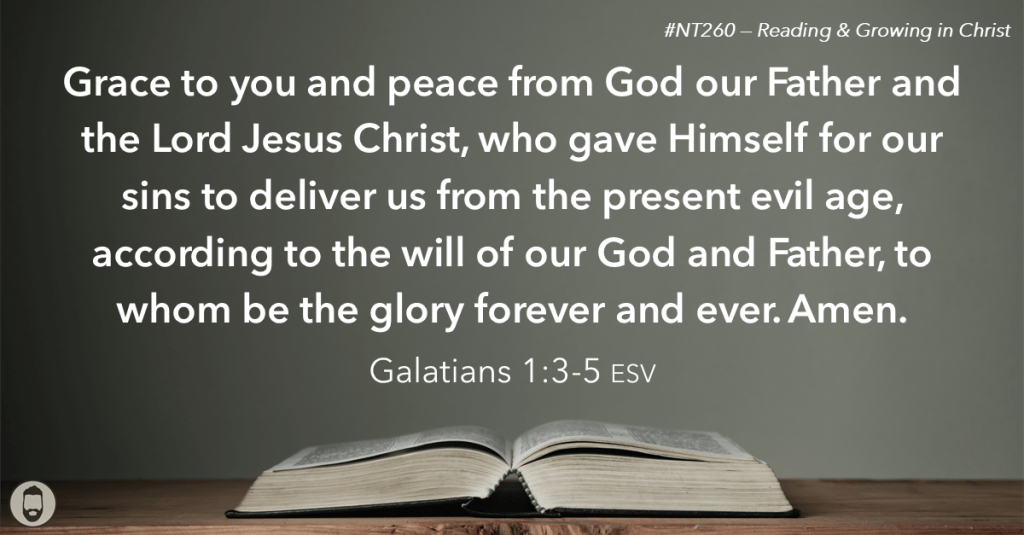
Paul opens by reminding the Galatians that his apostleship comes not from men but through Jesus Christ and God the Father (v. 1). He greets them with grace and peace, pointing immediately to the gospel—that Jesus gave Himself for our sins to deliver us from the present evil age, all according to God’s will and for His glory (vv. 3–5). His authority and his message both come directly from the risen Lord, not through human instruction (vv. 11–12).
But Paul is astonished that the Galatians are so quickly deserting the grace of Christ for a different gospel that is not the good news about Jesus at all (vv. 6–7). He warns that the message of salvation through Christ alone cannot be altered, and that anyone—whether an apostle or even an angel—who preaches another gospel stands under God’s curse (vv. 8–9). Paul’s concern is not to please people but to remain a faithful servant of Christ (v. 10).
🌀 Reflection: Where are you tempted to care more about human approval than about the truth of the gospel? Ask the Lord to help you stand firm in His grace.
💬 Mission Challenge: Share with someone this week what makes the gospel “good news”—that Jesus gave Himself to rescue us from sin and bring us peace with God.
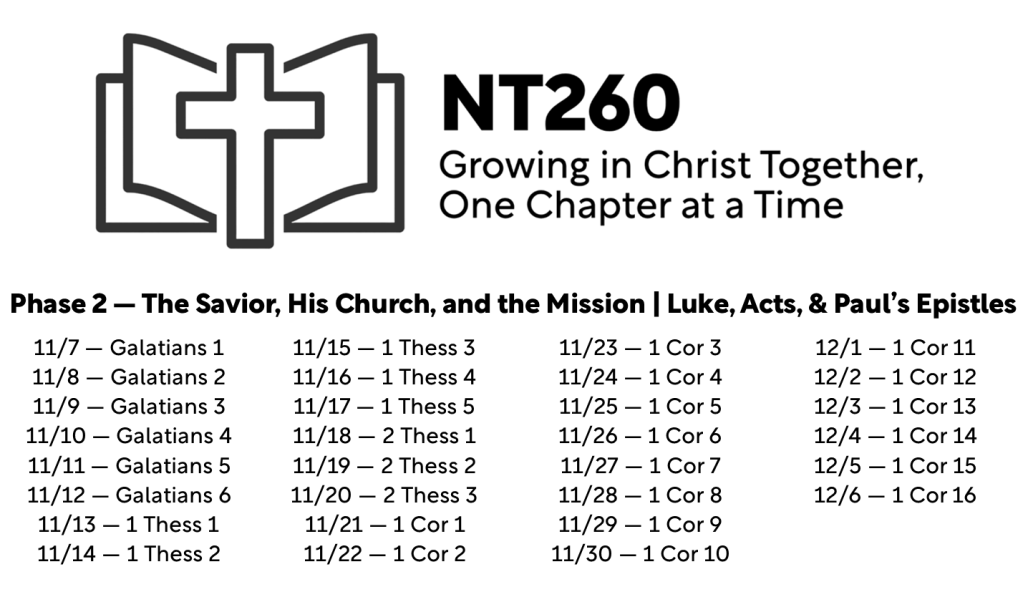
This phase will have us reading about Jesus’s life in the gospel of Luke, the formation of the Church in Acts, and walk through the theology found in Paul’s letters that the Church needs to know about and live out the eternal life given by grace through faith in Jesus.
Below, you’ll find brief synopses of each book in this phase to help you understand the scope of the book and most importantly, how it fits into the full Story of the Bible.
When you click on each day’s link, you will find a link to audio, a summary of the chapter, a key verse from the chapter, and opportunities for reflection and outreach.
We’re moving into Paul’s epistles, which we’ll go through chronologically rather than in the order they appear in our Bibles.
Galatians
The letter to the Galatians (check out this cool visual summary from the Bible Project) was written by Paul to churches in the Roman province of Galatia who were facing a spiritual crisis. After Paul preached the gospel of grace, other teachers arrived saying Gentile believers had to be circumcised and keep parts of the Mosaic law to belong to God’s people. Paul writes with urgency to defend the true gospel and his apostolic message, warning that any “different gospel” is no gospel at all (Galatians 1:6–9). His aim is pastoral and clear: believers are made right with God not by works of the law but by faith in Jesus Christ (Galatians 2:15–16).
Galatians shows how Christ’s cross brings a new era of freedom and life. Jesus bore the curse of the law so that blessing might come to the nations and the Spirit be given through faith (Galatians 3:13–14). Paul explains the law’s temporary role—it guarded and pointed to Christ—but now that Christ has come, we are God’s children by faith and clothed with Christ (Galatians 3:24–27). This freedom is not for selfishness but for love: “through love serve one another” (Galatians 5:13–14). The Christian life is life in the Spirit, where the desires of the flesh are put to death and the Spirit produces his good fruit—love, joy, peace, and more (Galatians 5:16–25). At the center stands the cross, which reshapes our identity and boasts (Galatians 2:20, 6:14).
In the story of salvation, Galatians declares that the promise to Abraham is fulfilled in Christ: Jew and Gentile are one family, justified by faith and adopted as sons through the Son (Genesis 12:3; Galatians 3:8, 3:26–29, 4:4–7). The gospel does not add law to Christ; it gives Christ alone by grace, and with him the Spirit who makes us new. Because Jesus has set us free, we stand firm in that freedom, walking by the Spirit and bearing one another’s burdens until the day of glory (Galatians 5:1, 5:16, 6:2).
Paul writes 1 Thessalonians to a young church he planted in a strategic, bustling city and had to leave sooner than he wanted (Acts 17:1–10). After sending Timothy to check on them, Paul hears a mostly good report—but also real concerns: grief over believers who had died, questions about the day of the Lord, ongoing persecution, and a few idle members refusing to work (1 Thessalonians 3:1–6, 4:13, 5:1–11, 4:9–12). With a warm pastoral tone, he defends the integrity of the gospel workers (1 Thessalonians 2), thanks God for their evident faith, love, and hope (1 Thessalonians 1:2–3), and urges them to keep growing in holiness, especially in sexual purity and brotherly love (1 Thessalonians 4:1–8, 9–12).
A major theme is Christ’s return—the “coming” of Jesus appears in every chapter (1 Thessalonians 1:10, 2:19, 3:13, 4:13–18, 5:23). Paul comforts grieving believers: those who have died “in Christ” will rise first, and together with the living they will be caught up to meet the Lord—and “so we will always be with the Lord” (1 Thessalonians 4:14–17). He reassures them that the day of the Lord will not overtake them like a thief because they belong to the day, not the night (1 Thessalonians 5:1–5, 9–10). In light of this hope, he calls the church to a steady, everyday obedience—respecting leaders, helping the weak, rejecting idleness, praying constantly, and testing everything by God’s Word (1 Thessalonians 5:12–22).
In the story of salvation, 1 Thessalonians looks back to Jesus’ death and resurrection as the ground of our hope and forward to His coming as the goal of our hope (1 Thessalonians 4:14, 5:9–10). The God who chose and called them is faithful; He Himself will sanctify them completely and keep them blameless at the coming of the Lord Jesus (1 Thessalonians 1:4, 5:23–24). Until that day, the church waits with active faith, steadfast love, and durable hope—turning from idols to serve the living and true God and to wait for His Son from heaven (1 Thessalonians 1:3, 9–10).
Paul’s second letter to the Thessalonians comes soon after the first and meets a church still under pressure. Persecution had not let up, and a false claim had spread that “the day of the Lord” had already come, leaving some shaken and afraid (2 Thessalonians 1:4, 2:1–2). Paul reassures them: when Jesus returns, He will bring justice—rest for His people and judgment on those who oppose the gospel (2 Thessalonians 1:5–10). He prays that God would make them worthy of their calling and glorify the name of Jesus in them, even as they suffer (2 Thessalonians 1:11–12).
Building on 1 Thessalonians, Paul clarifies what must happen before the Lord’s coming: a rebellion and the revealing of “the man of lawlessness,” whom Jesus will overthrow by the breath of His mouth at His appearing (2 Thessalonians 2:3–8; cf. 1 Thessalonians 4:13–18, 5:1–11). Until that day, the church must “stand firm and hold to the traditions” taught by the apostles, trusting the Lord to comfort and strengthen their hearts (2 Thessalonians 2:15–17). Paul also addresses a practical problem—idleness—commanding believers to work quietly and earn their own living, and instructing the church to correct those who refuse to obey (2 Thessalonians 3:6–12, 14–15). In the story of salvation, 2 Thessalonians keeps our eyes fixed on Christ’s certain return and calls us to steady, holy, hope-filled lives while we wait (2 Thessalonians 3:5, 13).
Paul writes 1 Corinthians to a gifted but divided church in a major port city shaped by status, rhetoric, and idolatry (Acts 18:1–11). After hearing troubling reports and receiving their questions, he calls them back to the gospel—to humble unity and holy living (1 Corinthians 1:10–13, 5:1–2, 7:1, 11:18). From the start, Paul centers everything on “Christ crucified,” God’s wisdom and power, not human show (1 Corinthians 1:18–25, 2:1–2). Because they belong to Jesus, they must stop boasting in leaders, flee sexual sin, and remember they are God’s temple where the Spirit dwells (1 Corinthians 3:16–17, 5:1–13, 6:18–20). Love—not pride or personal rights—must shape their life together (1 Corinthians 8:9–13, 13:1–7).
Paul also answers practical questions about marriage and singleness (1 Corinthians 7), food and idolatry (1 Corinthians 8–10), and gathered worship (1 Corinthians 11–14). He urges them to build up the church: take the Lord’s Supper in a worthy way, honor one another, and use spiritual gifts for the common good, not for display (1 Corinthians 11:23–26; 12:4–7; 14:12, 26). The famous “love chapter” shows that without love, even the greatest gifts amount to nothing (1 Corinthians 13:1–3). Above all, Paul insists on the bodily resurrection of Jesus and its hope for believers; because Christ is raised, our faith is not empty, our labor is not in vain, and we will be raised imperishable (1 Corinthians 15:3–4, 20–22, 51–58).
In the story of salvation, 1 Corinthians shows the gospel forming a holy people in a worldly place. The church is God’s family, Christ’s body, and the Spirit’s temple—set apart to reflect His character (1 Corinthians 1:2, 3:16, 12:12–27). So we lay down our rights for the weak (1 Corinthians 8:11), pursue love (1 Corinthians 14:1), and do all to the glory of God (1 Corinthians 10:31). Standing on the sure foundation—Jesus Christ our Lord—we work together for the advance of the gospel until He comes (1 Corinthians 3:11; 16:13–14, 22–24).




 Just Keith Harris