I’m Thankful for the FREE GIFT of Eternal Life — Gratitude & Hope Challenge | November 14

I’m thankful for the FREE GIFT of Eternal Life!

If you are reading this, I have good news for you: Jesus Saves! I hope that you’ll read on and see what it means to receive the FREE GIFT He offers us in salvation. If you’ve already received the gift, keep on reading anyway and be reminded of what you’ve been given.

Let’s look at what it means to be saved, why we need to be saved, and how you can be saved.

What It Means to Be Saved

Imagine someone swimming who has gone out over their head and is drowning. They cry out for a lifeguard to help. Thankfully, the lifeguard hears them and is able to rush to their rescue, pulling them to safety on the shore. That person has been saved from drowning.

This could also apply to someone who has been stuck in a burning building and fallen unconscious from inhaling all the smoke. Firefighters are called to the building and discover them. The firefighter picks up this totally helpless individual, carries them out of the building, and gets them to the paramedics. The firefighter and paramedics have saved this person from certain death.

In the same way, God provided Jesus to save or rescue every sinner who puts their trust in Him. No matter what we have done or who we are, Jesus can save us. Through Jesus, we find salvation by and eternal life by putting our faith and trust in Him.

The Bible describes this in John 3:16

“For God so loved the world, that He gave His only Son, that whoever believes in Him should not perish but have eternal life.”

Why We NEED to Be Saved

You might be thinking: well, it makes sense for someone drowning or trapped in a burning building to need to be saved, but what about me?

The Bible teaches us that all of us have sinned. Sin is an archery term that describes missing the bullseye. The bullseye is perfection and goodness. We might try to do right and good, but we fail at that. God is right and good, and our missing the mark or failing in this way separates us from Him.

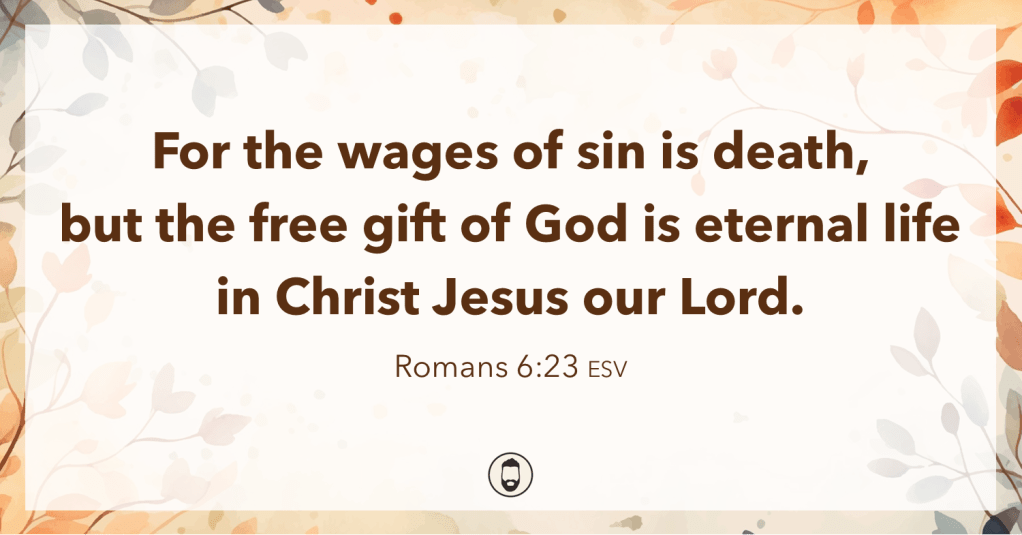
Romans 6:23 tells us that the “wages of sin is death”. This means that our sin has earned us death and that there is nothing we can do to earn our way out of it. Thankfully, that is not the end of Romans 6:23; check out the full verse: “For the wages of sin is death, but the free gift of God is eternal life in Christ Jesus our Lord.” God has made a way for us! Just as John 3:16 tells us above, Jesus paid the penalty for our sin. He died in our place and offers us life instead. That’s good news!

How You Can Be Saved

The only way for us to be saved is to turn from our sins (and the punishment we deserve because of them) to Jesus and put our faith and trust in Him. We turn from our sin because we realize that we are in trouble and deserve death because of them. We turn to Jesus because we realize that, just like the person who was drowning or trapped in the burning building, we cannot save ourselves. 

To put our faith and trust in Him means that we believe that Jesus fully paid the penalty for our sins and offers us forgiveness. The Bible teaches us that Jesus “Himself bore our sins in His body on the tree (the cross)” (1 Peter 2:24). Here is how the Bible tells us we can be saved:

“if you confess with your mouth that Jesus is Lord and believe in your heart that God raised Him from the dead, you will be saved. For with the heart one believes and is justified, and with the mouth one confesses and is saved.” (Romans 10:9-10)

This is what it means when we say put our faith and trust in Jesus; we confess Him as Lord and give our lives over to Him, trusting that He knows best and acknowledge He is God, asking Him to take charge of our lives. We tell Him that we believe He is who the Bible says He is: the Savior who died for our sins and rose again. If we do this, not just saying some magic words but genuinely believing and seeking Him, the Bible tells us that we are saved!


Lord, thank you for offering salvation that is free to all who believe but cost so much at the cost of Your Son. Thank You for raising again and offering that life to all who believe and confess You as Lord. Thank You.

All through the month of November, our Christ Community Church family is focusing on what we are thankful for and expressing our thanks to our “great God and Savior Jesus Christ, who gave Himself for us to redeem us” (Titus 2:13-14).

This, like the #DailyWisdomChallenge we went through in October, is a challenge from our pastor John Goldwater — the #GRATITUDEandHOPEchallenge — where we have the opportunity to post Bible passages that move us to thanksgiving or in which we find hope. May this lead you to be grateful and find your hope in Jesus!

I’m Thankful for God’s Forgiveness — Gratitude & Hope Challenge | November 12

These verses are a beautiful picture of God’s forgiveness and are good reminders for those who are saved to see what the “free gift of eternal life” is in light of the “wages of [our] sin” (Romans 6:23). We are going to briefly unpack these verses, and Lord willing, you will be moved to be thankful as well.

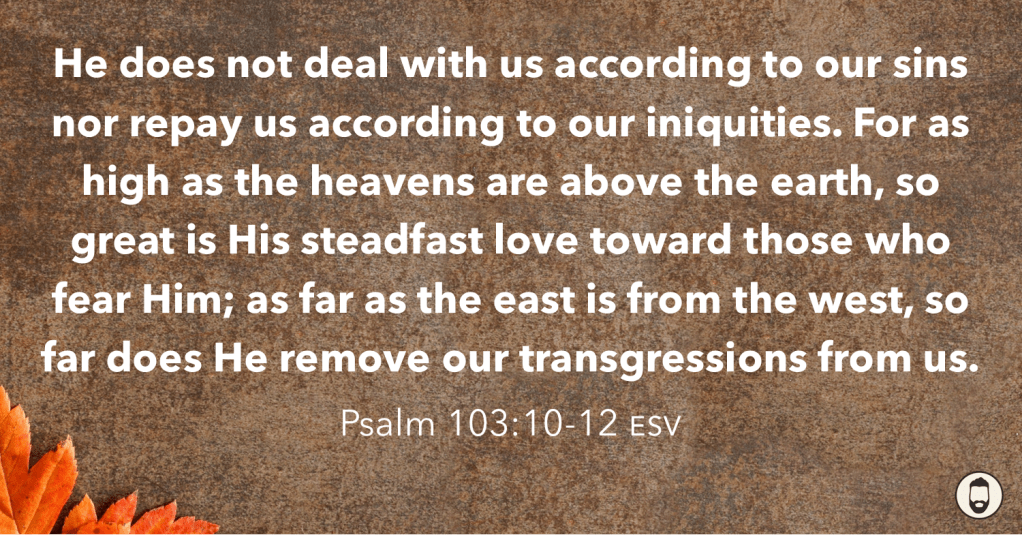
“He does not deal with us according to our sins nor repay us according to our iniquities.” This is a beautiful example of the otherness of God. I know that term sounds weird, but when we talk about God, it is important to remember that He is not like us. This otherness is really linked to His holiness, meaning that He is entirely set apart and above us in His worth, splender, and perfection. God is God, and we are not. 

Human beings deal with each other according to their sin and iniquity. If someone has wronged us or someone close to us, it is likely that we will forever treat them differently because of it. Even if we forgive, we are quick to let folks know we won’t forget. If we catch someone in a lie, they will forever be defined as a liar (even though we have been guilty of the same). The sin is a defining point for us because we don’t want to fall victim of it again. Yet God does not deal with US that way. 

That “us” is very important here because it is a distinction from how others are dealt with. This is not the us v. them where we make ourselves to be righteous (Romans 3:10-12). No, this is referencing the difference between those who have believed and put their faith in God and have been saved by grace through faith in Jesus (Ephesians 2:8-9) and those who have not (John 3:18). He does not deal with “us” according to our sin because Jesus has paid for our sin (1 Peter 2:24). Our sin does not define us because He defines us based on our relationship with Jesus (2 Corinthians 5:17, 21; Romans 8:1). 

“For as high as the heavens are above the earth, so great is His steadfast love toward those who fear Him….” Here we see the otherness of God again. This is literally the 6,000 mile view, one that God sees easily from His vantage point that we might struggle with from ours. 6,214 miles above our vantage point is when the earth stops being the earth; that’s literally how high the heavens are above the earth. God’s steadfast love – His never-stopping, never-failing, never-giving-up, everlasting love – is astronomically greater than our human hearts can fathom or feature (Isaiah 55:8-9). 

This qualifies the “us” from the last section because the “us” is made up of those who fear the Lord – those who follow and worship Him, those who have been saved by Him (Psalm 25:12-14). It also builds on the last section specifically because it shows that God not only has decided not to “deal with us according to our sins or repay us according to our iniquities” because He has paid the penalty for them (2 Corinthians 5:21) but did this because He loves us (John 3:16, Ephesians 2:4-5). This love is foreign to us because in our sinfulness we want to repay evil with evil, sin with sin (Matthew 5:44-45, 1 Peter 3:9). God is different. He loved us and saved us from our sin when we were still in it – when we still deserved death and hell; that “demonstrates” how much higher His love is than ours (Romans 5:8).

“…[A]s far as the east is from the west, so far does He remove our transgressions from us.” I love the contrast of imagery between the atmospheric levels of love in the last section and the global stretch of His forgiveness in this one. It is really cool to see how God specifically created the earth in such a way that it illustrates this, too. If His love requires a 6,000 foot view, His forgiveness requires understanding of what infinity is. You see, if you set out westward here on earth, you will go infinitely west. West will never start being east, and vice versa. God infinitely removes our sin from us. It is gone. Period. Finito. Over with. It is finished.

When Jesus forgives, He can allow Himself to forget because when He saves us He will not lose us. The eternal life He gives is, well, eternal. The change He produces in people’s lives is continual because it stems from His love and faithfulness, not ours. So, He doesn’t have to deal with us “according to our sins” because they have been infinitely removed. They have been paid for and we cannot repossess them. He has the receipt and is not taking returns. 

This is good news. It is nearly incomprehensible for us because we know the weight and evil nature of our sin (Psalm 51:3-5, Jeremiah 17:9). Yet He loved us and became the propitiation (wrath bearing sacrifice that trades the punishment due our sin for the favor due His Son) for our sin (Romans 3:23-25; 1 John 2:1-2, 4:10). 

What about you? Have you experienced the forgiveness of God? Will you stand before Him and have Him see Jesus’s blood and righteousness or stand before Him in your sin? 


Thank You, Lord, for offering forgiveness and salvation through Your Son Jesus.

Thank You, Lord, for Your astronomical love and the way you help us to see what You have done for us.

All through the month of November, our Christ Community Church family is focusing on what we are thankful for and expressing our thanks to our “great God and Savior Jesus Christ, who gave Himself for us to redeem us” (Titus 2:13-14).

This, like the #DailyWisdomChallenge we went through in October, is a challenge from our pastor John Goldwater — the #GRATITUDEandHOPEchallenge — where we have the opportunity to post Bible passages that move us to thanksgiving or in which we find hope. May this lead you to be grateful and find your hope in Jesus!

I’m Thankful for the Gospel — Gratitude & Hope Challenge | November 1

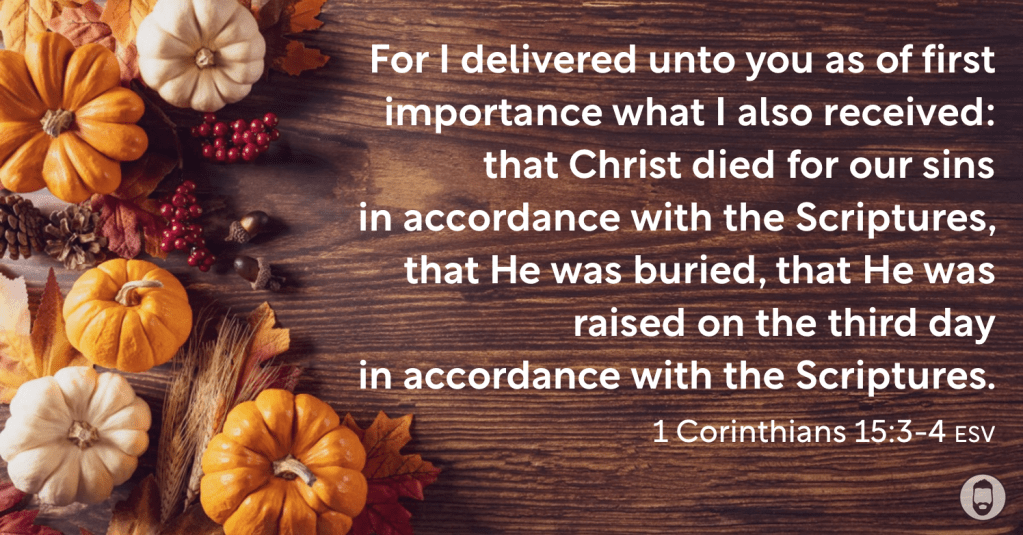
I’m thankful for the gospel — the good news of Jesus Christ — that tells us that He died for our sins on the cross we deserved, was buried, and rose from the dead defeating death, hell, and the grave.

That’s good news!

Literally, that’s what the word “gospel” means: good news!


Lord, thank you for the good news that we do not have to remain dead in our sins. Thank you for being willing to send Your Son to die in our place and giving the opportunity to come to You by grace through faith in Jesus and be made alive in Him.

All through the month of November, our Christ Community Church family is focusing on what we are thankful for and expressing our thanks to our “great God and Savior Jesus Christ, who gave Himself for us to redeem us” (Titus 2:13-14).

This, like the #DailyWisdomChallenge we went through in October, is a challenge from our pastor John Goldwater — the #GRATITUDEandHOPEchallenge — where we have the opportunity to post Bible passages that move us to thanksgiving or in which we find hope. May this lead you to be grateful and find your hope in Jesus!

Daily Wisdom Challenge — Proverbs 31

Here we are FINALLY finished with the #DailyWisdomChallenge! What took some 31 days, only took me 56. But this challenge is not about an amount of time or some mark we check off, is it? No, it is about getting God’s Word in us and through us — Him producing results and us giving Him our time, minds, and lives to spend time with Him in His Word and share it with other. I have enjoyed spending this time with Him and sharing Him and His Word with you.

This last proverb is one that has been on my mind. I have typed and retyped this post because I just couldn’t seem to articulate it — to get my words right. Today, it is what it is and ain’t what it ain’t. Let’s dive in.

Much of Proverbs 31 (vv. 10-31) is about the virtuous wife/woman. I was tempted to pick some verses from that section and speak well of my wife, which I do as often as I can because she is amazing. But Proverbs 31:8-9 is about using our voices — in this case, my voice and platform — to speak for those who have no one to speak for them. I will always speak up and advocate for Candice, but what of those who have no advocate?

It might help to understand what it means to advocate for someone. Let’s break it down. There are two forms of the word, both spelled the same; one is a verb (meaning to support or speak in for — or in favor of — someone or something) and a noun (meaning one who supports or speaks for someone or something). To use both in a sentence: an advocate advocates for people or issues. That’s the English teacher take on it, but we need a more pastoral perspective here.

In 1 John 2:1-2 give us a good picture of Jesus as our Advocate (the ESV even using that exact word):

My little children, I am writing these things to you so that you may not sin. But if anyone does sin, we have an advocate with the Father, Jesus Christ the righteous. He is the propitiation for our sins, and not for ours only but also for the sins of the whole world.

In this brief passage, we see Jesus almost as an advocate or defense attorney in courtroom. We know that Satan is known as the “accuser” in Revelation 12:10 and is “day and night” putting our sin in the form of an accusation or case against us “before our God”. Satan wants God to look at our sin and cast us out as he was so long ago. He wants to hurt God by showing Him how His children sin against Him and others. He also wants to hurt us and see us destroyed (1 Peter 5:8). We really don’t need an accuser to understand this because just like our great-great-great-great-uncle Cain, our sin cries out like Abel’s shed blood (Genesis 4:10), and God knows it, too.

Who would stand as an advocate for one who is clearly guilty? How many courtroom dramas have feature hot shot defense attorneys remarking that only a fool would ask their client if they are guilty. In this case, we know we are guilty. All have sinned (Romans 3:23) and none stand before God as righteous in their own standing (Romans 3:10). Yet John clearly says that those who are in Christ who sin (which includes any and everyone who has ever and will ever be saved) has an advocate: Jesus Christ the righteous.

Jesus stands for us when our sin cries out against us, reminding the Father that He has cast our sin as far as the east is from the west (Psalm 103:12).

Jesus stands for us when the accuser comes before the Father and reminds him that He has exchanged our sin and shame for His righteousness and standing as a son (1 Corinthians 5:21).

He speaks for us when the recollection of our sin silences us and shuts the mouth of accuser, reminding us that He has saved us and him that his doom is sure.

What a joy it is to have someone speak for you when you are in trouble (Psalm 34:17)! What a relief it is to have someone advocate for you to receive help in your time of trouble (Psalm 46:1)!

That’s the point of our final proverb together: use the voice and platform God has given us to be an advocate for those in need and in trouble, people who do not have anyone to speak for them. Worldly wisdom says mind your business and stay in your lane when it comes for helping folks in precarious situations. God’s wisdom says speak up for those who have no one to speak up for them (“the destitute”) and no voice of their own (“the mute”). God’s wisdom says that we are to “defend the rights of the poor and needy” — to make sure that people can get the help they need.

Now, the argument that comes up here is always something like “What about those who are misusing the help they receive?” or some citing of something like 2 Thessalonians 3:10 and some variation of “if you don’t work, you don’t eat”. Remember this is not a blanket statement of foolishness or reckless speech; it says “judge righteously” right here in the proverb. But we are to err on the side of help rather than stinginess — advocating for help rather than silence.

So, what about you? Are you silent for the suffering or speaking for them to receive help? Does Jesus the righteous advocate for you and yet you remain silent for others?

This is the culmination, not only of the #DailyWisdomChallenge for me, but the pinnacle of the challenge of whether I will yield to God’s wisdom or roll with the world’s. John has challenged us to speak and share God’s Word with others. Now, God in His Word has challenged us to speak and share God’s Word FOR others, too.

Won’t you join me?

For the month of October (and finally finished 25 days into November), we are answering the challenge John Goldwater, pastor of Christ Community Church in Grenada, MS, laid out — the #DailyWisdomChallenge. Each day, we are going to read through a chapter of Proverbs corresponding to the day of the month.

This fits with what we have studied in Colossians, specifically Colossians 3:1-2, namely that we should seek “the things that are above, where Christ is” and set our minds like a thermostat “on things that are above, not on things that are on earth”. Imagine what a month meditating on God’s Word daily can do for us.

Won’t you join us on this #DailyWisdomChallenge and set your minds on Christ?

Daily Wisdom Challenge — Proverbs 28

This #DailyWisdomChallenge has been convicting for me. As I have walked through these proverbs, God’s wisdom has outshone the anti-wisdom of the world – the anti-wisdom that lures us to sin instead of illuminating our understanding that there is a God who loves us and made a way for us to come to Him. Proverb 28:13 is a good example of this. 

Human beings mess up. A lot. When we mess up and our actions go against God’s righteous standard and expectation, going directly against what God has said, this is called sin. We all do it. First and foremost, we sin against God (Psalm 51:4). This is the case even when we are sinning against other people as well, which is the second point here. This is important to know because sometimes we like to subscribe to the idea that our sin only affects us. It doesn’t. The consequences of our sin affects others, especially when there are people who receive some of the sin we commit.

If we lie, we have sinned against God and the person we lied to. If the lie is about someone else, that adds to it.

If we murder, we have sinned against God. Clearly, we have sinned against the victim, but the sin extends to his or her family, friends, and so on. The toll can be catastrophic in some circles.

If we sin, we sin against God and others. Period.

The reality of sin is that judgment and condemnation is deserved. A holy God created this world and has the authority to say what is right and wrong, holy and righteous. We might not like it. We might wish He had decided that our pet sins were ok or to let something slide, but He is holy and cannot abide with sin. If He did, He would not be holy – definitely not righteous. The good news is that God has made a way for us to be reconciled to Him and not receive that wrath that is due for our sin (Romans 6:23, 1 Corinthians 15:16-21).

The word “reconcile” is helpful here in our understanding of sin. You see, when people talk about sin deserving death, they balk and try to explain how their sin does not warrant such a penalty. But reconcile does not leave room for that. Because we have sinned against God, we are in need of reconciliation because the relationship has been damaged. Sinning against Him puts enmity between us (Romans 5:10). Things need to be put right.

Our proverb today says that the only way for things to be made right between people, where one has done wrong and the other been wronged, is for the transgression to be confessed. Concealing it only allows it to fester – think along the lines of a boil beneath one’s skin. Reconciliation cannot happen unless the transgression is confessed and dealt with. This is essentially the message that Paul shared with the church at Corinth when he shared with them about how God through Christ offers opportunity to be reconciled to Him where He does not count “their trespasses against them” (2 Corinthians 5:19). And He explains this in one of the most beautifully succinct examples of the gospel – the good news of Jesus – in 2 Corinthians 5:21: “For our sake He made Him to be sin who knew no sin, so that in Him we might become the righteousness of God.”

Just as it happens between people, reconciliation means confession needs to be made. 2 Corinthians 5:21 gives us a picture of the God we have sinned against putting His perfect, sinless Son forward in our place to bear the punishment of sin. Those who believe in Him exchange their sin and the debt due for it for Jesus’s righteousness and favor. Jesus, the God we sinned against, puts forth the offering that makes our relationship right. He trades our sin debt for His eternal riches of grace, mercy, and love. He trades our rightful wages of death with a gracious portion of His eternal life. He trades our rap sheet for His righteousness. 

Concealing our sin and acting like it does not exist only delays the inevitable. Confessing it – confessing Jesus as Lord and believing He rose from the grave (Romans 10:9) – gives opportunity for reconciliation and salvation. One side leads to death and the other to life. 

The advice of Proverbs 28:13 points us toward God’s wisdom and counting all we have as loss for the “surpassing worth of knowing Christ Jesus” (Philippians 3:8) and forsaking the anti-wisdom of the world that leads us to think there is no consequence for sin. 


Lord, thank you for offering reconciliation when we don’t deserve it – when no one else in the world would. Reconciliation is hard to come by, but it reflects Your heart toward those who turn to you. Help me to confess my sin to you instead of concealing it. Help me to do the same for others I sin against as well. Amen.

For the month of October (and *hopefully* the early part of November), we are answering the challenge John Goldwater, pastor of Christ Community Church in Grenada, MS, laid out — the #DailyWisdomChallenge. Each day, we are going to read through a chapter of Proverbs corresponding to the day of the month.

This fits with what we have studied in Colossians, specifically Colossians 3:1-2, namely that we should seek “the things that are above, where Christ is” and set our minds like a thermostat “on things that are above, not on things that are on earth”. Imagine what a month meditating on God’s Word daily can do for us.

Won’t you join us on this #DailyWisdomChallenge and set your minds on Christ?

Daily Wisdom Challenge — Proverbs 19

For the month of October, we are answering the challenge John Goldwater, pastor of Christ Community Church in Grenada, MS, laid out — the #DailyWisdomChallenge. Each day, we are going to read through a chapter of Proverbs corresponding to the day of the month.

This fits with what we have studied in Colossians, specifically Colossians 3:1-2, namely that we should seek “the things that are above, where Christ is” and set our minds like a thermostat “on things that are above, not on things that are on earth”. Imagine what a month meditating on God’s Word daily can do for us.

Won’t you join us on this #DailyWisdomChallenge and set your minds on Christ?

I love this proverb because it shows hope in a couple of ways that I think we really need to see in this day and age.

First, there is hope to be found in Jesus that is greater than any darkness or depression or depravity. Hope in Jesus is not hypothetical hope, but it is instead fixed and sure, resting on the foundation of what Jesus has done, is doing, and will surely do. His victory transcends everything that remains unknown because He has already “overcome the world” (John 16:33). 

In the context of Proverbs 19:18, there is obvious reference to trouble. Why else would there be need to discipline one’s son? Whatever trouble is pointed to here, it must be bad or represents the sum total of the bad a kid can get into because God in His wisdom advises the parent not “set [their] heart on putting him to death”. Kids, just like their parents, get sideways in sin sometimes. All of them, just like all parents, do. But when you are in the midst of having to discipline this child that you have raised and tried to point in the right direction, some trouble seems like it leaves no room for hope. 

The Jesus-hope this proverb’s God-wisdom points to is pictured well in Romans 5:1-5:
“Therefore, since we have been justified by faith, we have peace with God through our Lord Jesus Christ. Through Him we have also obtained access by faith into this grace in which we stand, and we rejoice in the hope of the glory of God. Not only that, but we rejoice in our sufferings, knowing that suffering produces endurance, and endurance produces character, and character produces hope, and hope does not put us to shame, because God’s love has been poured out in our hearts through the Holy Spirit who has been given to us.”

This sort of hope – hope only found by those who have been “justified by faith”, those who have received “peace” from God stemming from standing in His grace – works differently than worldly hope. Wordly hope is hypothetical and fails when suffering hits. Jesus-hope starts with suffering and grows as God’s Spirit gives endurance. That endurance produces fruit of the Spirit that defines one’s character. And once God has worked Himself into and out through your character, hope is a way of life. It is a byproduct of the eternal life He gives those who believe in Him.

The second hope is one that many do not agree with: as long as a child lives, I believe there is hope. Are there troubles and sins and crimes that have longlasting consequences? Absolutely. Are there things that can happen and be committed that can forever alter the life of a child? Yes. But the hope shown above is for sinners. It is hope for the ones who messed up. It is hope for those whose works earn death. It is hope for children like me – and children like you. 

I find myself having to remind myself of this often as I work with students. 

I find myself having to remind myself of this often as I parent my kiddos.

I find myself having to remind myself of this often because of my parent’s oldest kid (and to a lesser degree my inlaws youngest).

So, if you find yourself in the rough times of parenting and you wonder whether its worth keeping on keeping on with your kiddo, it is. God tells us here in His wisdom that there is hope in bearing with them in discipline. Things may look hopeless from your vantage point, but from the throne of the King of kings, He sees what we can’t. He sees and tells us to hope. And as He told us in Romans, hope will not put us to shame.

Daily Wisdom Challenge — Proverbs 17

For the month of October, we are answering the challenge John Goldwater, pastor of Christ Community Church in Grenada, MS, laid out — the #DailyWisdomChallenge. Each day, we are going to read through a chapter of Proverbs corresponding to the day of the month.

This fits with what we have studied in Colossians, specifically Colossians 3:1-2, namely that we should seek “the things that are above, where Christ is” and set our minds like a thermostat “on things that are above, not on things that are on earth”. Imagine what a month meditating on God’s Word daily can do for us.

Won’t you join us on this #DailyWisdomChallenge and set your minds on Christ?

This proverb his my right square in my heart.

I spent the bulk of my childhood being the butt of many jokes, and made fun of quite mercilessly. I was beat up and often bullied. The bruises faded and broken glasses were replaced, but the scars — physical and emotional — remain.

This is one of the reasons I wanted to become a teacher. Throughout those years of being bullied, there were a handful that took notice, but most, for whatever reason, were oblivious or chalked it up to that’s just the way kids are. If you have never been treated like this (or were on the giving side of these sorts of encounters rather than the receiving), you do not know what a relief it is when someone notices and helps you. Carrie Mack and Linda Bumpers at Willa Wilson Elementary were blessings from God that helped me see my value despite the efforts of bus riders and drivers who were glad to see it stomped out. These ladies still to this day look for and out for me and are encouragements in my life. Seeing either of them today fills my heart with joy and encouragement and reminds me of light in the midst of darkness.

In middle school, I know teachers saw me being bullied. The example that first comes to mind is Mike Miles. He knew what I was going through without being told. He went and had my schedule changed so that I would be out of the study hall where my misery was always the subject of study to his study hall. He taught me how to play chess. He encouraged me to read books if that’s what I liked to do. In fact, that was the gist of what he taught me (other than the math he was tasked with): he taught me to be who God had made me to be and not let others diminish that. When I see him even today, I never hesitate to tell him how thankful I am that God used him to save my life — that when others worked to convince me my life had no value, God used him to remind me who and Whose I was.

There was one particular memory that came to mind when I read this verse that convicts me still to this day. When I think of this particular memory, I am filled with nauseating guilt even though it has been over twenty years ago.

In sixth grade, Carolyn Swanson saw that I had been bullied and mistreated as well. She also noticed other students who endured the same. Sixth grade back then meant mandatory PE a few days a week (some days library or music). For me, that was like painting a giant bullseye because that meant either getting picked last for teams or not at all (this was the 1990s; participation was not mandatory, and exclusion/mockery were allowed). Even though I did not want to be picked because that would mean I could go up into the stands and read rather than embarrassing myself athletically in a very public way, I really wanted to be picked. Well, I really wanted to belong.

One particular day, a group of the more popular guys approached me and pointed out one of my classmates. Me and this other guy were basically tied for least popular in the sixth grade as well as in who could be made fun of more. Neither of us were athletic. Neither of us came from families with much money. Both of us were quiet and clothed differently than others. The guys convinced me that the surest way to be one of them — to get picked for teams and get to hang out with them — was to make fun of the other guy. He had just gotten some new boots that he was proud of and had worn them to school. It made me sick to my stomach to think of doing that to someone else, but this could have meant that I got bumped up a level and got a reprieve from being made fun of. So, right there in the middle school gym, I let the other guy have it. I was ugly. It was shameful. He cried. And then the other guys started in — on me.

Their plan all along was to embarrass me and show that I was fake. They knew I professed to be a Christian and saw this as an opportunity to cast aspersions on that profession of faith. They gave me every bit of what I gave the other guy and worse. I cried, too, but not so much for what I was receiving but that I had allowed myself to do to the other guy what I knew was terrible.

Mrs. Swanson somehow found out about this, and I can remember what she said to me about it like it was yesterday. She told me that it was worse for me to do that than the others because I truly knew what it felt like to be treated like that. This was not a means for her to belittle me but to invest in me. She fussed at me, and I deserved it. She told me that she expected more out of me and knew that I would learn from this and grow into the man she knew I could be — despite my failure and because I would learn from it.

I am ashamed to say that it took months for me to get the courage to apologize to the other guy, and before I could, he moved away. It took nearly twenty years to get in contact with him again. I won’t tell you a story of apology and reconciliation here because I do not want to paint myself as a good guy for any of this. I want to help you understand Proverbs 17:5.

Everyone you come into contact with is made in the image of God. He created them and formed them in their mother’s womb. Each of us is unique, with unique features and personalities. Some of us, like myself, are more different than societal norms than others. And it is all too easy to make fun rather than to show care and respect.

This is not wrong merely for the human life you did not respect. It is a slap in the face of their “Maker”.

If someone is going through a tough time — some “calamity” — whether it is their fault, someone else’s fault, or nobody’s fault, it is not a time for mockery. Even if you think someone is getting the “calamity” they deserve, it is not a time to mock and make fun; we sure don’t enjoy it when calamities of our own making find us.

I guess this is really a plea to be kind to others and recognize that the same God who made you made them. There is never a time to mock or insult. There is always time to show love and care.

For me, this drove me to become a teacher. The examples of those who took up for me influence how I interact with kids — all of them I have and all that I can — on a daily basis. The example of the one who saw me becoming like the others and intervened has a daily impact, too, on the man God made me to be as well as in ways that I can watch out for others as well. I pray that this little bit of testimony helps you along the way, whether you are the bully, the bullied, or the bystander. Let us look out for others and look to God for how He would have us to treat folks.

Daily Wisdom Challenge — Proverbs 16

For the month of October, we are answering the challenge John Goldwater, pastor of Christ Community Church in Grenada, MS, laid out — the #DailyWisdomChallenge. Each day, we are going to read through a chapter of Proverbs corresponding to the day of the month.

This fits with what we have studied in Colossians, specifically Colossians 3:1-2, namely that we should seek “the things that are above, where Christ is” and set our minds like a thermostat “on things that are above, not on things that are on earth”. Imagine what a month meditating on God’s Word daily can do for us.

Won’t you join us on this #DailyWisdomChallenge and set your minds on Christ?

Today’s proverb is another example of how we can see the gospel clearly pictured in the proverbs. This shows the beauty of God’s wisdom showing us how to come to Him and the danger of the anti-wisdom of the world that leads us away from Him.

We have looked at the “fear of the LORD” in most every chapter of Proverbs so far. To understand the “fear of the LORD” in the context of the gospel is especially important in present-day America when many preachers use fear as a means for convincing people to walk an aisle and make a decision for Jesus. This sort of fear-driven invitation time leads can lead to confusion and false conversion — and people wanting to be “re-saved” every time they sin and find themselves afraid of God’s wrath. When it comes to Biblical “fear of the LORD”, this definitely ain’t that!

The “fear of the LORD” described in the Bible (Proverbs 1:29, 2:4-6, 3:7, 8:13, 9:10, 14:26-27, 15:33, 16:6; Job 28:28; Psalm 34:11; Ecclesiastes 12:13; Acts 9:31) is best described as having deep respect, admiration, and awe for God. It is the basis for truly understanding and knowing Him and comes from having a relationship with Him because He saved and redeemed you. It changes your life and is fueled by having His Spirit within you and seeing Him influence your desires, attitudes, choices, feelings, actions, and goals. Knowing Him this way understands that He has a frightening level of power and wrath, but you do not have to live in fear of Him because He cares for you and His Son bore His wrath on your behalf.

This “fear of the LORD” gives us a desire to turn “away from evil” because you see Him and “the surpassing worth of knowing Christ Jesus [as] Lord” (Philippians 3:8). This “fear of the LORD” is fueled by His “steadfast love and faithfulness” despite our “iniquity”, knowing that He atones for sin for those He saves.

For those who do not turn to Him, those who reject Him and put their trust in themselves, there is much to fear, in the traditional, literal sense of fear, but this fear does not see people turn from their sin. People may curb their behaviors or hide their desires because of fear, but no real change happens. The change God brings in people through His steadfast love and faithful salvation brings real change, from the inside out.

What about you?

Do you fear the Lord in the Biblical sense, or are you merely scared of His wrath?

Is He the God of the universe or some vengeful and distant deity?

One is the God who saves as presented in the Bible. His name is Jesus.

It is my prayer that you see Him for who He is, confess Him as Lord, and believe in Him.

Daily Wisdom Challenge — Proverbs 14

For the month of October, we are answering the challenge John Goldwater, pastor of Christ Community Church in Grenada, MS, laid out — the #DailyWisdomChallenge. Each day, we are going to read through a chapter of Proverbs corresponding to the day of the month.

This fits with what we have studied in Colossians, specifically Colossians 3:1-2, namely that we should seek “the things that are above, where Christ is” and set our minds like a thermostat “on things that are above, not on things that are on earth”. Imagine what a month meditating on God’s Word daily can do for us.

Won’t you join us on this #DailyWisdomChallenge and set your minds on Christ?

Today’s proverb is such a beautiful picture of what what Paul describes as being found in Christ, “not having a righteousness of [our] own that comes from the law, but that which comes through faith in Christ, the righteousness from God that depends on faith” (Philippians 3:9).

So often, talk of the righteousness and wickedness fuels complaints about religious people thinking they are better than others or even fuels the self-righteousness of some church folks. I wish I could say this never has applied to me, but as I wrote in the #DailyWisdomChallenge post for Proverb 11, it is too easy to forget we are all sinners — all wicked, as many of the Proverbs say.

If it were not for Jesus saving me, I would have no righteousness to speak of (Romans 3:10); all I would have is my sin and the death that my sin has earned (Romans 6:23). To clarify, I am not a righteous man. My heart is wicked. And, well, not to be a downer, but yours is too. All of us sin and “fall short of the glory of God” (Romans 3:23). He is righteous. He is perfect. He is sinless. The rest of us are not.

There will come a day when I will stand before this righteous, perfect, sinless God and be faced with my wickedness and sin. Everything I have ever done will be evidence of that. Everything I have ever said will make the case for my guilt. The Bible tells us that Satan is the Accuser — one who accuses us day and night “before our God” (Revelation 12:10). He is bringing to God’s attention, and not having to lie despite his great knack for deception, our sin and failures. And, scarier still, none of this is news to God, because He knew all that we would do and all that we would say before the foundation of the world.

For those who have been saved, however, a “guilt offering” has been made on our behalf. Those who confess Jesus as Lord and believe in His resurrection are saved (Romans 10:9), and God places our sin and guilt on Jesus, His sinless Son, in order that we can be made righteous (2 Corinthians 5:21). Jesus paid our sin debt “by cancelling the record…that stood against us with its legal demands” by “nailing it to the cross” — by allowing the sinless Savior to be nailed to the cross that we deserved (Colossians 2:14).

That’s good news!

What’s more is that God did not merely satisfy some legal demand. He did not issue some writ or declaration that can be passed to the accuser who is trying to prosecute us and shame God with our failures. No, the Bible tells us that we have an “advocate” who has taken our case, and his name and credentials are “Jesus Christ the Righteous” (1 John 2:1)! Think of every dramatic courtroom drama you have ever watched or read about, and know that they pale in comparison to the rich finality with which Jesus handles the case of those He has saved. When the accuser taunts and mocks, reminding us of sin and failure, Jesus answers with His own righteousness! He declares that by His blood and sacrifice — and the fact that He died and is now living and interceding on our behalf (Hebrews 7:25, Romans 8:34) — our sin has been removed “as far as the east is from the west” (Psalm 103:12) and “cast…into the depths of the sea” (Micah 7:19)!

Before the Accuser can plead his case any further, God smacks the gavel with finality and declares innocent based on the righteousness of Christ!

Proverbs say that fools “mock the guilt offering”. One thing I can surely testify to here today is that I “enjoy” God’s “acceptance” BECAUSE I know how serious my sin is and how eternally grateful I am that He would save a wretch such as me.

How about you?

Do you see Jesus’s death and resurrection as necessary, or do you find it silly and unnecessary?

Do you think you will stand before God and have acceptance through any other means — wealth, prosperity, good works?

Let me plead with you today to look to Jesus to save you!

And, if you have, rejoice in the acceptance that will never be taken away, and do not fear the accuser. He knows “his time is short” and is lashing out in anger, trying to hurt those God has saved and thereby hurt Him (Revelation 12:12). Be encouraged and fear not, because the same proclamation that brings news of the accuser also proclaims God’s victory and Satan’s doom:

“Now the salvation and the power and the Kingdom of our God and the authority of His Christ have come, for the accuser of our brothers HAS BEEN THROWN DOWN, who accuses them day and night before our God. And they have CONQUERED him BY THE BLOOD OF THE LAMB and the word of their testimony, for they loved not their lives even unto death.” (Revelation 12:10-11)

Hallelujah! Worthy is the Lamb!

Daily Wisdom Challenge — Proverbs 10

For the month of October, we are answering the challenge John Goldwater, pastor of Christ Community Church in Grenada, MS, laid out — the #DailyWisdomChallenge. Each day, we are going to read through a chapter of Proverbs corresponding to the day of the month.

This fits with what we have studied in Colossians, specifically Colossians 3:1-2, namely that we should seek “the things that are above, where Christ is” and set our minds like a thermostat “on things that are above, not on things that are on earth”. Imagine what a month meditating on God’s Word daily can do for us.

Won’t you join us on this #DailyWisdomChallenge and set your minds on Christ?

Today’s passage, like yesterday’s, gives us two contrasting groups. In Proverbs 9:8, we looked at the scoffers and the wise. Today, we have a comparison of the righteous and the wicked.

We need to make an important distinction here so that I can make sure we are on the same page: “none is righteous, no not one” (Psalm 14:3, 53:3; Romans 3:10). Any discussion of the righteous and the wicked needs the understanding — almost like a disclaimer — that none of us are righteous outside of “faith in Christ”, “the righteousness from God that depends on faith” (Philippians 3:9).

Sometimes we get sideways on this and talk about righteous as if we are inherently good. The Bible makes it clear that all of us are sinners (Romans 3:23). The sin that plagues our lives cannot be blamed solely on outside forces, either; our temptations often come from within when we are “lured and enticed by [our] own desire” (James 1:14). So, any appeal of an us v. them argument on this puts our “us” on the side of the wicked — and makes it an us v. HIM (Jesus Christ the Righteous — 1 John 2:1)!

The only way we can be made righteous is to trust in Jesus. I love the clarity of 2 Corinthians 5:21 on this subject. We’ll break it down phrase by phrase to help us get it (or as I tell my school kiddos, to pick up what I’m laying down).

For our sake. Jesus offers salvation because we need it. We are sinners, as we have seen above, and He is the only Savior. Sometimes we are offended when confronted with this truth, but it is good news — the God who stands holy and righteous offers an opportunity to be saved by grace through faith in His Son Jesus rather than having to receive His wrath reserved for sin.

He (God the Father) made Him (Jesus) to be sin who knew no sin. We deserve the wrath of God because He is the righteous and perfect Creator, and we have gone against His standard. This is not a popular view point. But, here’s the good news: Jesus becoming sin for us means that He willingly took the wrath of God for those He saves! Jesus, the only sinless One — God’s righteous standard in human flesh, pays the sin debt of those who trust in Him by grace through faith by the price of His own blood (Colossians 2:14; 1 Peter 1:18-19, 2:24).

So that in Him (Jesus) we might become the righteousness of God. The only way for us — sinners or “wicked” “evildoers” as Proverbs 10:27-29 puts it — to be righteous before God is to have Jesus’s righteous covering our sin. 2 Corinthians 5:21 shows us a glimpse of this great exchange between Jesus and those He saves where He takes their sin and exchanges it for His righteousness. 1 John 2:1-2 gives the picture a little clearer: Jesus Christ the righteous is our advocate and stands before God as our atoning sacrifice, His blood paying for our sin and covering us with His righteousness.

That’s good news! It’s tough and raw and infinitely unfair, but it is a picture of God’s love for His people in Jesus. It’s a picture of grace. It’s a picture of mercy. It’s a picture of Proverbs 10:27-29.

Biblical wisdom is knowing that we can do nothing to prolong our life and being well-aquainted with the reality of the wages of our sin being death (Romans 6:23). The hope of those who fear the LORD is Jesus, and from Him and the life He gives there is joy (Proverbs 10:28); any expectation other than what we can have in Jesus perishes when we do.

And, don’t miss this, Jesus came to seek and save the lost — to give His life as a ransom for the wicked, for people like me who confess Him as LORD and believe in Him. That’s good news for me and all who put their faith in Him. That news represents the “stronghold” I have in Him — not that I am “blameless” but that He is, but that news represents “destruction to evildoers” who do not put their faith in Him (Proverbs 10:29).

What about you? Where do you stand in the great exchange? Has Jesus taken your sin and counted you blameless, or are you banking on your own righteousness?