Psalm 3 is written after one of the most terrible moments of King David’s life — when he was on the run from his son Absalom, who was trying to remove him from power. This is a psalm of lament (letting out one’s feelings of grief or sadness) to be sure, but it is also a psalm of trust and hope in the Lord, offering us an example of turning to God in the midst of overwhelming circumstances.
The Crisis of Many
David begins by describing his specific circumstances: his enemies are many, their accusations are relentless, and their mockery sharp, saying that “There is no salvation for [David] in God” (v. 2). To say that David would not find salvation in his God strikes at David’s identity as God’s anointed king, but their mocking did not change the truth. David’s response to them reminds us that turning to the truth of God’s promises is the only place to go when doubt and despair set in.
The Confidence in God
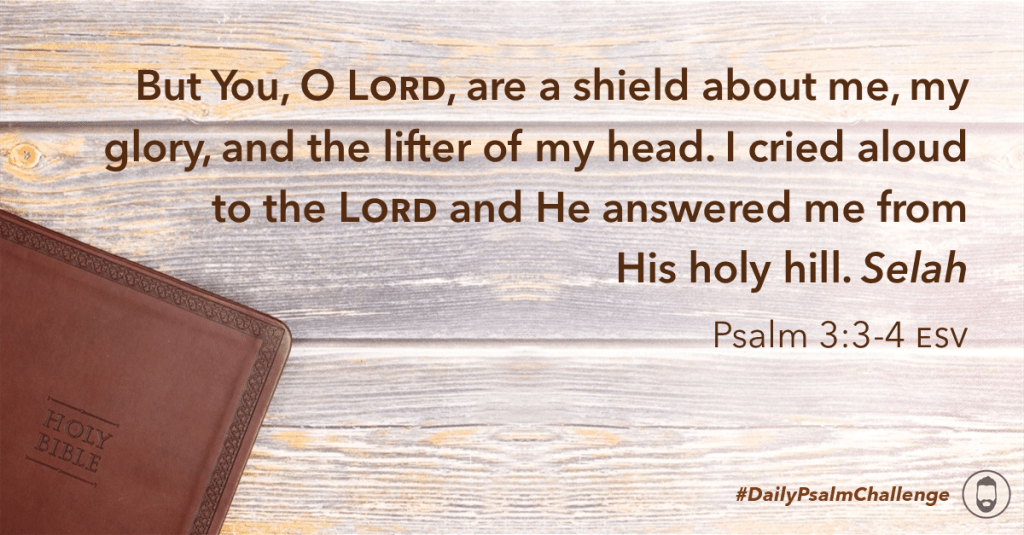
David shifts his focus from his circumstances by declaring to the Lord that He is “a shield about [him], [his] glory, and the lifter of [his] head” (v. 3). His confidence is built on God’s steadfast character and strength rather than what is going on around him. He trusts that his Lord not only hears his cry but that He will answer him from His holy hill (v. 4).
The Calm in the Chaos
It would be understandable for David to be distraught, but we see God providing him with peace. How many of us find it difficult to sleep when we are in the midst of trials and tribulations? Because of his faith in God, David could say, “I lay down and slept; I woke again, for the Lord sustain me” (v. 5). This highlights his faith and teaches us that God watches over His people, especially in times of turmoil and insurmountable circumstances.
The Cry for Deliverance
We see David cry out to the Lord for help and relief: “Arise, O Lord! Save me, O my God!” (v. 7). This echoes the cries of God’s people past and future, asking God to intervene against a powerful foe. David trusts that God will deal justly with the wicked — even if that means Absalom, while affirming that “salvation belongs to the Lord” and asks that His blessing be on His people” (v. 8).
Seeing Jesus in Psalm 3
David’s experience crying out to the Lord in the midst of trial and finding help points forward to the ultimate son of David, Jesus. He faced all that David did and worse — rejection, betrayal, mockery, brutal torture, execution. Jesus bore the full weight of our sin and death on the cross and cried out to His Father. Though surrounded by enemies and taunts like we have never seen, Jesus rested in His Father’s will and the confident assurance in His prophesied resurrection. Jesus’s victory over sin and death ensures that all of us who trust in Him can truly echo David’s cry that “Salvation belongs to the Lord”.
Reflection
Psalm 3 teaches us to bring our fears and burdens to God, recognizing that He can shield us from trouble and sustain us through trials. Jesus is not a distant, detached King; He knows our struggles because He experienced them. He has already overcome them (John 16:33). Whatever troubles you face today, cry out to Him and rest in the assurance that salvation belongs to Him.
The #dailyPSALMSchallenge gives us the opportunity to start 2025 in God’s Word by digging into a psalm a day. Each day will identify a key passage for us to meditate on as well as seeking to help us see Jesus in the psalm and reflect on what we have read.
6“As for me, I have set my King on Zion, my holy hill.”
7I will tell of the decree: The LORD said to me, “You are my Son; today I have begotten you.
Psalm 2:6-7
Psalm 2 reminds me of the line in the hymn “Joy to the World”: “Let Earth receive her king”. This psalm proclaims the reign of God’s anointed King, Jesus, who is set over all creation. Though the nations rebel, Psalm 2 reveals that true peace and joy come only by receiving and submitting to this King. His authority is certain, and His rule is good.
The Rebellion of the Nations
Psalm 2 begins with the nations raging and plotting in vain against God and His Anointed (vv. 1-3). In their pride, they reject God’s authority by choosing to skewing it as oppressive and restrictive, yet their rebellion reflects the condition of sinful humanity — desiring to rule ourselves rather than submitting to our Creator and King.
God’s Response
God does not respond in fear or by some kneejerk reaction but with laughter (v. 4). He clearly declares His plan: “I have set my King on Zion, my holy hill” (v. 6). This King, the Son of God, has been appointed to rule all nations. How? Well, as God created everything and appoints the rise and fall of nations, it is His divine prerogative! The New Testament affirms that this King is Jesus, the Messiah — the Christ — who was divinely declared to be this Son at His baptism and resurrection (Matthew 3:17, Acts 13:33).
God’s plan is unshakable. The King of kings is enthroned. His reign is certain.
The Universal Reign of the King
God promises His Anointed authority over all nations, to the ends of the earth (v. 8). He will bring justice and restore order, breaking down opposition like shattering pottery (v. 9). His rule is both powerful and righteous, ensuring that evil will not (and cannot) prevail.
A Call to Submission and Joy
The call for earth is clear: receive your rightful King and rejoice in His rule. This is seen in the way Psalm 2 closes with a warning and an invitation: “Serve the LORD with fear, and rejoice with trembling. Kiss the Son” (vv. 11-12). To “kiss the Son” is to honor Him, recognizing His authority and submitting to His reign. Though His wrath and power are real, His invitation is filled with grace and “blessed are all who take refuge in Him” (v. 12). True joy is not found in rebellion but in embracing Jesus as King — as Lord (Romans 10:9).
Seeing Jesus in Psalm 2
Psalm 2 make this pretty clear and explicit. Jesus is the King.
Reflection
Psalm 2 calls us to reflect on whether we will receive or resist Jesus. The nations rage, but we are invited to rejoice under His rule. To receive Him is to put our faith, hope, and trust in Him, finding refuge and joy.
Let earth — and each of us — receive the King.
The #dailyPSALMSchallenge gives us the opportunity to start 2025 in God’s Word by digging into a psalm a day. Each day will identify a key passage for us to meditate on as well as seeking to help us see Jesus in the psalm and reflect on what we have read.
3 For I passed on to you as of first importance what I also received, that Christ died for our sins according to the scriptures, 4 and that he was buried, and that he was raised up on the third day according to the scriptures, 5 and that he appeared to Cephas, then to the twelve, 6 then he appeared to more than five hundred brothers at once, the majority of whom remain until now, but some have fallen asleep.
1 Corinthians 15:3-6
He made the one who did not know sin to be sin on our behalf, in order that we could become the righteousness of God in him.
2 Corinthians 5:21
8 But what does it say? “The word is near to you, in your mouth and in your heart” (that is, the word of faith that we proclaim), 9 that if you confess with your mouth “Jesus is Lord” and believe in your heart that God raised him from the dead, you will be saved. 10 For with the heart one believes, resulting in righteousness, and with the mouth one confesses, resulting in salvation. 11 For the scripture says, “Everyone who believes in him will not be put to shame.” 12 For there is no distinction between Jew and Greek, for the same Lord is Lord of all, who is rich to all who call upon him. 13 For “everyone who calls upon the name of the Lord will be saved.”
📖 Revelation 3:7–13We’re back!After a few months off, The King is Coming returns in 2026 with one of the most encouraging letters in Revelation — Jesus’s message to the faithful church in Philadelphia. In a world filled with opposition and weakness, Jesus opens a door no one can shut.In this episode, Keith Harris and Jamie Harrison explore:✔️ Jesus’s identity as the Holy One, the True One — God Himself✔️ What the “key of David” means and how Jesus alone opens and shuts✔️ The debated phrase “I will keep you from the hour of trial” — and how to read it biblically✔️ Why “little power” doesn’t disqualify faithfulness✔️ How being kept through the trial glorifies Christ’s strength in us✔️ What it means to be a pillar in God’s presence foreverThis church had no rebuke — only encouragement. And Jesus’s call still stands today: “Hold fast what you have, so that no one may seize your crown.” (Revelation 3:11, ESV)🔗 Missed earlier episodes in the series? You can click here to catch up and listen from the beginning.✍️ If you’d like to see a written version of this podcast, complete with footnotes and cross-references, you can find it here.
We have spent a good bit of time the past few weeks at Christ Community in Luke 2:10 and the verses around it. The declaration of the angels to those poor and frightened shepherds should about be memorized at this point: “Do not be afraid, for behold, I bring good news to you of great joy which will be for all the people”. Good news. Great joy. For all people.
The word translated “good news” is often translated gospel, and the message that the angels proclaimed on that hillside 2,000 years ago is a beautiful and succinct picture of the gospel. They preached that the Savior “who is Christ the Lord” was born for them – for those dirty, stinky shepherds – and that He could be found that very day in Bethlehem. It was news that would and could change the trajectory of their lives. They just needed to believe in Him and receive the salvation He had to offer – they would receive grace by faith through Him.
Now, I know that on the day they heard that gospel message Jesus was still laying in the feeding trough, still an infant, and was decades away from His death, burial, and resurrection. But the babe in the manger was still “the Word [become] flesh” (John 1:14). He was still the Lamb slain “before the foundation of the world” (Ephesians 1:4).
We sometimes want to overcomplicate things. We know the whole story and want to add and fill in the gaps in the angels’ proclamation that day, but the “good news of great joy” is still just as simple. In fact, Paul gives very succinct proclamations of the gospel, too. The first can be found in 1 Corinthians 15 where he tells the church at Corinth that he is passing on to them the most important message he had to offer – the very same message that he received himself: Jesus died for our sins according to the way that the Bible said He would, He was buried, and He rose from the dead on the third day exactly as the Bible and His own preaching said He would. That’s good news!
Paul’s second succinct gospel summary comes in his next letter to the church at Corinth in 2 Corinthians 5:21. In one complex little sentence, he shares that God put the sins of those who would be saved on Jesus. Jesus had never sinned and did not deserve any condemnation, but He willingly bore our sin on our behalf. Those who trust in Him no longer are under the condemnation and shame due to their sin; Jesus bore that (Colossians 2:13-14). In a great exchange, Jesus traded His righteousness for our sin. He bore the wrath of God and exchanged that for God’s favor. Basically, He traded His extravagantly full bank account for our bankrupt one so that when God looks upon those who Jesus has saved, He does not see their sinfulness but Jesus’ righteousness! That’s good news!
The gospel is good news, but there is also bad news. Those who do not confess Jesus as Lord and believe He died for their sins and rose again to not receive part in that great exchange. They remain in their sin. Their condemnation remains their own. It does not have to be that way. All who call out to Jesus in faith will be saved. Anyone who believes in Him will not be but to shame, but not believing leaves the shame where it belongs – on the sinner.
Long lay the world in sin and error pining Till He appeared and the soul felt its worth A thrill of hope, the weary world rejoices For yonder breaks a new and glorious morn Fall on your knees!
Those who are without Jesus are still in their sin and “pining” after the wrong things, sinful things. But everyone – all people – have the opportunity to fall on their knees, believe in Him – confess Him as Lord, and repent of their sin. And those who do will not only have heard the good news of great joy but also to have believed it and received the salvation Jesus offers.
I love the phrase “good news of great joy” because 1) it is straight from the Bible, and 2) it captures what Jesus offers. But I also love the way the writer of “O Holy Night” captured what it is to be a sinner and receive Christ: “a weary world rejoices”. If you have been reading with us over these past two weeks, you have read snippets of the “good news of great joy”, but have you received it? Have you believed on Jesus, or are you still on the fence? If you haven’t, I urge you: fall on your knees, believe what the Bible says about Him, confess Him as Lord, and rejoice in the salvation He brings!
Luke 24 concludes with the hope and joy of Jesus’ resurrection and ascension, a fitting reflection on Christmas Eve as we prepare to celebrate His birth tomorrow. This chapter invites us to marvel at the completeness of God’s redemptive plan, which began in a humble manger and was fulfilled in an empty tomb.
A New Beginning: The resurrection marks the triumph of life over death, just as Jesus’ birth ushered in light to a dark world. As you reflect on the empty tomb, remember that Christmas celebrates the beginning of this miraculous story.
Hope Fulfilled: The disciples on the road to Emmaus moved from despair to joy as Jesus opened their eyes to God’s promises. This Christmas, let your heart burn with hope as you trust the One who fulfilled every prophecy.
Peace and Assurance: Jesus brought peace to His disciples, proving His resurrection by showing His scars and eating with them. He offers us the same assurance—our Savior lives, and His peace is for all who believe.
A Call to Worship and Witness: The disciples responded to the risen Christ with worship and proclamation. As we celebrate His birth tomorrow, let our joy overflow in worship and bold witness, sharing the good news that Christ has come, died, and risen for us.
On this Christmas Eve, look forward to tomorrow with awe and wonder, knowing that the child born in Bethlehem is the risen Lord who reigns in heaven. May your celebration of His birth be filled with the same joy and hope that the disciples experienced as they worshiped the resurrected Savior. Merry Christmas!
📖 Revelation 3:7–13We’re back!After a few months off, The King is Coming returns in 2026 with one of the most encouraging letters in Revelation — Jesus’s message to the faithful church in Philadelphia. In a world filled with opposition and weakness, Jesus opens a door no one can shut.In this episode, Keith Harris and Jamie Harrison explore:✔️ Jesus’s identity as the Holy One, the True One — God Himself✔️ What the “key of David” means and how Jesus alone opens and shuts✔️ The debated phrase “I will keep you from the hour of trial” — and how to read it biblically✔️ Why “little power” doesn’t disqualify faithfulness✔️ How being kept through the trial glorifies Christ’s strength in us✔️ What it means to be a pillar in God’s presence foreverThis church had no rebuke — only encouragement. And Jesus’s call still stands today: “Hold fast what you have, so that no one may seize your crown.” (Revelation 3:11, ESV)🔗 Missed earlier episodes in the series? You can click here to catch up and listen from the beginning.✍️ If you’d like to see a written version of this podcast, complete with footnotes and cross-references, you can find it here.
But on the first day of the week, at early dawn, they went to the tomb, taking the spices they had prepared. 2 And they found the stone rolled away from the tomb, 3 but when they went in they did not find the body of the Lord Jesus. 4 While they were perplexed about this, behold, two men stood by them in dazzling apparel. 5 And as they were frightened and bowed their faces to the ground, the men said to them, “Why do you seek the living among the dead? 6 He is not here, but has risen. Remember how he told you, while he was still in Galilee, 7 that the Son of Man must be delivered into the hands of sinful men and be crucified and on the third day rise.” 8 And they remembered his words, 9 and returning from the tomb they told all these things to the eleven and to all the rest. 10 Now it was Mary Magdalene and Joanna and Mary the mother of James and the other women with them who told these things to the apostles, 11 but these words seemed to them an idle tale, and they did not believe them. 12 But Peter rose and ran to the tomb; stooping and looking in, he saw the linen cloths by themselves; and he went home marveling at what had happened.
13 That very day two of them were going to a village named Emmaus, about seven miles from Jerusalem, 14 and they were talking with each other about all these things that had happened. 15 While they were talking and discussing together, Jesus himself drew near and went with them. 16 But their eyes were kept from recognizing him. 17 And he said to them, “What is this conversation that you are holding with each other as you walk?” And they stood still, looking sad. 18 Then one of them, named Cleopas, answered him, “Are you the only visitor to Jerusalem who does not know the things that have happened there in these days?” 19 And he said to them, “What things?” And they said to him, “Concerning Jesus of Nazareth, a man who was a prophet mighty in deed and word before God and all the people, 20 and how our chief priests and rulers delivered him up to be condemned to death, and crucified him. 21 But we had hoped that he was the one to redeem Israel. Yes, and besides all this, it is now the third day since these things happened. 22 Moreover, some women of our company amazed us. They were at the tomb early in the morning, 23 and when they did not find his body, they came back saying that they had even seen a vision of angels, who said that he was alive. 24 Some of those who were with us went to the tomb and found it just as the women had said, but him they did not see.” 25 And he said to them, “O foolish ones, and slow of heart to believe all that the prophets have spoken! 26 Was it not necessary that the Christ should suffer these things and enter into his glory?” 27 And beginning with Moses and all the Prophets, he interpreted to them in all the Scriptures the things concerning himself.
28 So they drew near to the village to which they were going. He acted as if he were going farther, 29 but they urged him strongly, saying, “Stay with us, for it is toward evening and the day is now far spent.” So he went in to stay with them. 30 When he was at table with them, he took the bread and blessed and broke it and gave it to them. 31 And their eyes were opened, and they recognized him. And he vanished from their sight. 32 They said to each other, “Did not our hearts burn within us while he talked to us on the road, while he opened to us the Scriptures?” 33 And they rose that same hour and returned to Jerusalem. And they found the eleven and those who were with them gathered together, 34 saying, “The Lord has risen indeed, and has appeared to Simon!” 35 Then they told what had happened on the road, and how he was known to them in the breaking of the bread.
36 As they were talking about these things, Jesus himself stood among them, and said to them, “Peace to you!” 37 But they were startled and frightened and thought they saw a spirit. 38 And he said to them, “Why are you troubled, and why do doubts arise in your hearts? 39 See my hands and my feet, that it is I myself. Touch me, and see. For a spirit does not have flesh and bones as you see that I have.” 40 And when he had said this, he showed them his hands and his feet. 41 And while they still disbelieved for joy and were marveling, he said to them, “Have you anything here to eat?” 42 They gave him a piece of broiled fish, 43 and he took it and ate before them.
44 Then he said to them, “These are my words that I spoke to you while I was still with you, that everything written about me in the Law of Moses and the Prophets and the Psalms must be fulfilled.” 45 Then he opened their minds to understand the Scriptures, 46 and said to them, “Thus it is written, that the Christ should suffer and on the third day rise from the dead, 47 and that repentance for the forgiveness of sins should be proclaimed in his name to all nations, beginning from Jerusalem. 48 You are witnesses of these things. 49 And behold, I am sending the promise of my Father upon you. But stay in the city until you are clothed with power from on high.”
50 And he led them out as far as Bethany, and lifting up his hands he blessed them. 51 While he blessed them, he parted from them and was carried up into heaven. 52 And they worshiped him and returned to Jerusalem with great joy, 53 and were continually in the temple blessing God.
[1] On the first day of the week, women arrived at Jesus’ tomb with spices but found the stone rolled away and the tomb empty. Two angels appeared, reminding them of Jesus’ words that He would rise on the third day. They reported this to the apostles, but their testimony was met with disbelief. Peter ran to the tomb, saw the linen cloths, and marveled.
[2] Two disciples, one named Cleopas, walked to Emmaus, discussing the events of Jesus’ death. A stranger joined them, explaining how Scripture foretold the Messiah’s suffering and glory. At dinner, their eyes were opened, and they recognized the stranger as Jesus, who then vanished. Filled with joy, they returned to Jerusalem to share the news.
[3] Jesus appeared to His disciples, offering peace and proof of His physical resurrection by showing His hands and feet and eating with them. He explained that His death and resurrection fulfilled Scripture and commissioned them to proclaim repentance and forgiveness to all nations, beginning in Jerusalem. He promised the Holy Spirit would empower them.
[4] Leading the disciples to Bethany, Jesus blessed them and ascended into heaven. Overwhelmed with joy, they returned to Jerusalem, worshiping Him and continually praising God in the temple.
Matthew 1:1-17 — 1 The book of the genealogy of Jesus Christ, the son of David, the son of Abraham.
2 Abraham was the father of Isaac, and Isaac the father of Jacob, and Jacob the father of Judah and his brothers, 3 and Judah the father of Perez and Zerah by Tamar, and Perez the father of Hezron, and Hezron the father of Ram, 4 and Ram the father of Amminadab, and Amminadab the father of Nahshon, and Nahshon the father of Salmon, 5 and Salmon the father of Boaz by Rahab, and Boaz the father of Obed by Ruth, and Obed the father of Jesse, 6 and Jesse the father of David the king.
And David was the father of Solomon by the wife of Uriah, 7 and Solomon the father of Rehoboam, and Rehoboam the father of Abijah, and Abijah the father of Asaph, 8 and Asaph the father of Jehoshaphat, and Jehoshaphat the father of Joram, and Joram the father of Uzziah, 9 and Uzziah the father of Jotham, and Jotham the father of Ahaz, and Ahaz the father of Hezekiah, 10 and Hezekiah the father of Manasseh, and Manasseh the father of Amos, and Amos the father of Josiah, 11 and Josiah the father of Jeconiah and his brothers, at the time of the deportation to Babylon.
12 And after the deportation to Babylon: Jechoniah was the father of Shealtiel, and Shealtiel the father of Zerubbabel, 13 and Zerubbabel the father of Abiud, and Abiud the father of Eliakim, and Eliakim the father of Azor, 14 and Azor the father of Zadok, and Zadok the father of Achim, and Achim the father of Eliud, 15 and Eliud the father of Eleazar, and Eleazar the father of Matthan, and Matthan the father of Jacob, 16 and Jacob the father of Joseph the husband of Mary, of whom Jesus was born, who is called Christ.[1]
📖 Revelation 3:7–13We’re back!After a few months off, The King is Coming returns in 2026 with one of the most encouraging letters in Revelation — Jesus’s message to the faithful church in Philadelphia. In a world filled with opposition and weakness, Jesus opens a door no one can shut.In this episode, Keith Harris and Jamie Harrison explore:✔️ Jesus’s identity as the Holy One, the True One — God Himself✔️ What the “key of David” means and how Jesus alone opens and shuts✔️ The debated phrase “I will keep you from the hour of trial” — and how to read it biblically✔️ Why “little power” doesn’t disqualify faithfulness✔️ How being kept through the trial glorifies Christ’s strength in us✔️ What it means to be a pillar in God’s presence foreverThis church had no rebuke — only encouragement. And Jesus’s call still stands today: “Hold fast what you have, so that no one may seize your crown.” (Revelation 3:11, ESV)🔗 Missed earlier episodes in the series? You can click here to catch up and listen from the beginning.✍️ If you’d like to see a written version of this podcast, complete with footnotes and cross-references, you can find it here.
One thing that I love about Christmas is that people are abnormally willing to be open to talk about Jesus. Much of the year, people’s attitudes toward Scripture or gospel can be very Scrooge-like, very “Bah! Humbug!” But for a few weeks in one month out of the year, people’s hearts swell like the Grinch’s after encountering Cindy-Lou-Who.
Another thing I love about Christmas is the way this season produces stories. As I type, The Polar Express is on in the background, a narrative of a young boy regaining the childlike sense of wonder and hope. I will no doubt watch It’s a Wonderful Life on Christmas day, a fairly new tradition at the Harris household, and follow good old George Bailey finding that his life has more blessings than curses and realizing the value and impact a single life can have. I’ll even watch one of my favorite Christmas stories chronicling John McClain’s daring rescue during the hijacking of Nakatomi Corporation’s Christmas party. More than those fictional stories, though, I love the stories that come from real life, from real people.
Christmas is a time of joy and celebration, but for many, it is a time of mourning, grieving, and faking-it-till-you-make-it. As I have talked with folks about this in recent years, I find that the thing that bridges the gap between those two groups – the joyful and the weary – is their stories. Even those who are mourning have stories and memories of bygone traditions. There are funny and happy memories, and yes, sad ones, too, that come out during this season. Those memories can kind of weave together into the tapestry of who we are. They become part of our story.
Jesus’s story is not different in that aspect because part of becoming flesh and dwelling among us (John 1:14) is the sin and death we need rescuing from. His Story is of the perfect and sinless Savior deigning to live among – to live for and on behalf of – those He came to save. In order for Isaiah’s prophecy that “those who dwelt in a land of deep darkness, on them has light shone” (Isaiah 9:2), Jesus needed to come and shine in the darkness, and we need to be reminded that the “darkness has not overcome” Him (John 1:4)!
So today, let’s take a moment and look at Jesus’s Story, specifically the Story of the lineage God chose to make Jesus a part of. Sometimes we look at stories in the Bible and feel inadequate. Rest assured that Jesus’s lineage as seen in Matthew 1:1-17 is full of people just like us – people who needed a Savior like Him!
Once upon a time, there was a great and powerful King. He was foretold of old to be a hero who would come from His far away country to redeem and win back His lost love. His Story is one of romance as He left His palace to rescue His Bride. His lineage hailed back to other…great…well, um….
One of the things I love about God’s Word is how it does not fall into the temptation of prettying things up or rewriting them to be more acceptable to folks’ sensibilities. Yes, Jesus is the great King – the King of kings who was prophesied for centuries to come from heaven and rescue His people. Yes, Jesus’s Story is one of romance, where He left His throne on high and traded it for a lowly manger in a tumble-down stable. But His lineage? It wasn’t filled with kings and queens, although there were a few sprinkled in toward the middle. It wasn’t filled with flawless heroes – the flaws are many. No, Jesus’s family tree was filled with regular sinners with real sin and problems – people like me and you.
This Bible study will look at the women emphasized in Jesus’s family tree who point us to Him in specific ways. We won’t go into their full stories, but I will give you the cross-references so you can check them out directly from Scripture.
Tamar (v. 3) …and Judah the father of Perez and Zerah by Tamar….
The first woman mentioned is Tamar (v. 3), and her story is found in Genesis 38. Tamar was Judah’s – you know, Judah as in the lion of the tribe of – she was his daughter-in-law. Originally, she was married to Judah’s oldest son, Er, until “the Lord put him to death” because he was “wicked in the sight of the Lord” (Genesis 38:7). By levirate marriage customs, it became the responsibility of Judah’s second son, Onan, to father children on behalf of his deceased big brother. But Onan was selfish and wicked, refusing to fulfill his duty; the Lord put him to death as well (Genesis 38:10). Judah promised his youngest son, Shelah, to Tamar when he came of age but had no intention of ever fulfilling that promise. Tamar, left without hope of bearing children, took matters into her own hands. Disguised as a prostitute, she tricked Judah into sleeping with her. Her actions were scandalous – and so were Judah’s.
So, why is Tamar mentioned in Jesus’s genealogy? Her story shows us God’s providence and mercy in bringing about His purposes despite human sin. Tamar’s inclusion reminds us that God can use even the most broken situations to fulfill His promises. Judah’s declaration, “She is more righteous than I” (Genesis 38:26), points to her determination to preserve the family line, a role God used in the lineage of Jesus. Her child that would be Jesus’s earthly ancestor was marked by a scarlet string around his foot. It brings to mind the way that God used her story and the stories of people like her almost like a scarlet thread of salvation running through His Story.
Rahab (v. 5) …and Salmon the father of Boaz by Rahab….
The second woman is Rahab (v. 5), whose story is found in Joshua 2:1-21, 6:17, and 6:22-25, with further mentions in Hebrews 11:31 and James 2:25. Rahab wasn’t one of God’s chosen people. She was a Canaanite from Jericho, known for her sinful profession. But she had heard of the God of Israel and believed in His power. She protected His spies, siding with the Lord and marking her house with a scarlet cord as a sign of her faith and obedience. When Jericho’s mighty walls fell by the power of God and the city was taken, Rahab and her family were spared.
Why would someone like Rahab be included in Jesus’s official lineage? Her faith in God is the answer. Rahab’s faith stood out like a scarlet cord, demonstrating that salvation is not about where you come from but about the one you put your faith in – in the God you trust. Her inclusion reminds us of God’s grace and His power to redeem and use anyone for His glory. Rahab’s life became part of the story of salvation history, pointing us to the greater salvation found in Jesus, who rescues all who place their faith in Him.
Ruth (vv. 5-6) …and Salmon the father of Boaz by Rahab, and Boaz the father of Obed by Ruth, and Obed the father of Jesse, and Jesse the father of David the king.
The third woman is Ruth (v. 5), whose story is told in the book of the Bible bearing her name. Like Rahab, Ruth wasn’t one of God’s chosen people. She was a Moabite, descended from incest between Lot and his daughter (Genesis 19:30-37). When famine struck Israel, Ruth’s husband Mahlon and his family came to Moab for refuge, but tragedy followed. Ruth’s father-in-law, brother-in-law, and husband all died, leaving Ruth and her mother-in-law in dire straits. Despite her own loss, Ruth chose to return to Israel with Naomi, declaring, “Your people shall be my people, and your God my God” (Ruth 1:16). She returned with Naomi to Bethlehem – yes, the Christmas Bethlehem – and met Boaz, a kinsman-redeemer who married her and restored their family’s inheritance.
Why is Ruth mentioned in Jesus’s genealogy? Ruth’s story is one of God’s grace extending beyond Israel to include the nations. Her faith and devotion to God stand as a testament to His redeeming love. Her role as David’s great-grandmother and an ancestor of Jesus reminds us that God’s plan of salvation always included people from every nation.
The Wife of Uriah (vv. 6-7) … and Jesse the father of David the king. And David was the father of Solomon by the wife of Uriah….
The fourth woman is not named directly but is referred to as “the wife of Uriah” (v. 6). Her story is found in 2 Samuel 11:1-25. Her name was Bathsheba, and she was the wife of Uriah the Hittite, one of David’s mighty men. King David, in a moment of temptation and sin, saw Bathsheba bathing on her roof and had her brought to him so that he could sleep with her. She became pregnant, and David attempted to cover his sin by arranging Uriah’s murder. His actions were heinous, and the wages of his sin brought tragedy to his family and others.
Why is Bathsheba included in Jesus’s genealogy? The mention of her as “the wife of Uriah” highlights David’s sin and the brokenness of humanity. Jesus being a descendent of David and rightful king as his heir is meant to be a good and special thing, but “by the wife of Uriah” highlights David’s sin. Yet God’s promises are unshaken. Through Bathsheba came Solomon, the king who would build the temple, pointing forward to the great King, Jesus – who everyone, all who sin, need as Savior. That includes kings. Bathsheba’s inclusion reminds us of God’s power to bring beauty from ashes and fulfill His covenant despite human failure.
Mary (v. 16) …and Jacob the father of Joseph the husband of Mary, of whom Jesus was born, who is called Christ.
The fifth and final woman is Mary (v. 16). Her story is found in Luke 1:26-38 and Matthew 1:18-25. Mary was a young woman of humble means, betrothed (like engaged but more intentional and binding) to Joseph. When the angel Gabriel announced to her that she would conceive by the Holy Spirit, she responded in faith and submission: “Behold, I am the servant of the Lord; let it be to me according to your word” (Luke 1:38). The fact that she was a virgin fulfilled the prophecy of Isaiah 7:14, demonstrating that Jesus’s conception was a miraculous act of God.
Why is Mary included in Jesus’s genealogy? Well, first how can one be born without a mother? God could have chosen to come and save in any way He wanted, but to come as the baby of a mother is one of the oldest promises in the Book. Genesis 3:15 promises victory of the “seed” of woman over the serpent, over Satan. Victory over our sin comes from her seed as well. Furthermore, Mary’s role here points to God’s grace. She bore the Savior of the world, yet she also needed Him as her Savior (Luke 1:47). Her inclusion highlights the miracle of the incarnation: God becoming flesh to dwell among us (John 1:14). Mary’s life, from the miraculous conception to standing at the foot of Jesus’s cross during his crucifixion (John 19:25), consistently points us to Jesus, to the Savior, and the fulfillment of God’s promises.
Wrapping Up
Why does the Bible recognize the sins and sinners in Jesus’s lineage? Simply put: because it all really happened. Sin happens. All people “have sinned and fall short of the glory of God” (Romans 3:23). None of us – not a single person in the history or future of the world – deserve to be in Jesus’s family tree, not even the great King David. But faith in God, trusting in Him, His work, and His steadfast love, is woven through that lineage like a scarlet cord. Looking at the sin and faith in Jesus’s genealogy reminds us that none are worthy of saving. That’s why He came. Jesus Himself said He came to “seek and save the lost” (Luke 19:10).
So, as you gather with family and friends and notice some rough-looking fruit in your family tree – or whether you notice the same by looking in your own mirror – realize that Jesus is more than the reason for the season. He’s more than a holiday. He’s the King. He’s the Savior. He’s the Christ. He is God. And He came to save sinners like me and you.
While Jesus is more than a holiday, He offers His salvation to us as a gift. There is no season like this one that highlights something important about gift giving: it’s no good if the gift is not received.
Won’t you receive Him?
The Bible tells us that “all who…receive Him,” who believe in His name, He gives “the right to become children of God” (John 1:12). The Bible also shows us what that belief looks like. In Romans 10:9, it says, “if you confess with your mouth that Jesus is Lord and believe in your heart that God raised Him from the dead, you will be saved.” This goes beyond mere words or understanding the concept of who He is – it’s giving Him your life, ceding control to Him as Lord and trusting that His death on the cross paid the penalty for your sin and His resurrection gives you eternal life in Him.
That’s good news.
That’s a wonderful gift, freely given but not cheap. Won’t you receive it – receive Him? Merry Christmas, dear Sojourner, and I pray that God blesses you and yours this season — not necessarily with the traditional holiday trappings but absolutely by seeing Him for who He is in your lives.
Luke 15 reveals the heart of God toward sinners—a heart full of compassion, mercy, and rejoicing. As we prepare for Christmas, these parables remind us of God’s relentless pursuit of the lost and His joy when they return to Him. The shepherd, the woman, and the father represent God’s care for every sinner, no matter how far they have strayed.
📖 Revelation 3:7–13We’re back!After a few months off, The King is Coming returns in 2026 with one of the most encouraging letters in Revelation — Jesus’s message to the faithful church in Philadelphia. In a world filled with opposition and weakness, Jesus opens a door no one can shut.In this episode, Keith Harris and Jamie Harrison explore:✔️ Jesus’s identity as the Holy One, the True One — God Himself✔️ What the “key of David” means and how Jesus alone opens and shuts✔️ The debated phrase “I will keep you from the hour of trial” — and how to read it biblically✔️ Why “little power” doesn’t disqualify faithfulness✔️ How being kept through the trial glorifies Christ’s strength in us✔️ What it means to be a pillar in God’s presence foreverThis church had no rebuke — only encouragement. And Jesus’s call still stands today: “Hold fast what you have, so that no one may seize your crown.” (Revelation 3:11, ESV)🔗 Missed earlier episodes in the series? You can click here to catch up and listen from the beginning.✍️ If you’d like to see a written version of this podcast, complete with footnotes and cross-references, you can find it here.
Now the tax collectors and sinners were all drawing near to hear him. 2 And the Pharisees and the scribes grumbled, saying, “This man receives sinners and eats with them.”
3 So he told them this parable: 4 “What man of you, having a hundred sheep, if he has lost one of them, does not leave the ninety-nine in the open country, and go after the one that is lost, until he finds it? 5 And when he has found it, he lays it on his shoulders, rejoicing. 6 And when he comes home, he calls together his friends and his neighbors, saying to them, ‘Rejoice with me, for I have found my sheep that was lost.’ 7 Just so, I tell you, there will be more joy in heaven over one sinner who repents than over ninety-nine righteous persons who need no repentance.
8 “Or what woman, having ten silver coins, if she loses one coin, does not light a lamp and sweep the house and seek diligently until she finds it? 9 And when she has found it, she calls together her friends and neighbors, saying, ‘Rejoice with me, for I have found the coin that I had lost.’ 10 Just so, I tell you, there is joy before the angels of God over one sinner who repents.”
11 And he said, “There was a man who had two sons. 12 And the younger of them said to his father, ‘Father, give me the share of property that is coming to me.’ And he divided his property between them. 13 Not many days later, the younger son gathered all he had and took a journey into a far country, and there he squandered his property in reckless living. 14 And when he had spent everything, a severe famine arose in that country, and he began to be in need. 15 So he went and hired himself out to one of the citizens of that country, who sent him into his fields to feed pigs. 16 And he was longing to be fed with the pods that the pigs ate, and no one gave him anything.
17 “But when he came to himself, he said, ‘How many of my father’s hired servants have more than enough bread, but I perish here with hunger! 18 I will arise and go to my father, and I will say to him, “Father, I have sinned against heaven and before you. 19 I am no longer worthy to be called your son. Treat me as one of your hired servants.” ’ 20 And he arose and came to his father. But while he was still a long way off, his father saw him and felt compassion, and ran and embraced him and kissed him. 21 And the son said to him, ‘Father, I have sinned against heaven and before you. I am no longer worthy to be called your son.’ 22 But the father said to his servants, ‘Bring quickly the best robe, and put it on him, and put a ring on his hand, and shoes on his feet. 23 And bring the fattened calf and kill it, and let us eat and celebrate. 24 For this my son was dead, and is alive again; he was lost, and is found.’ And they began to celebrate.
25 “Now his older son was in the field, and as he came and drew near to the house, he heard music and dancing. 26 And he called one of the servants and asked what these things meant. 27 And he said to him, ‘Your brother has come, and your father has killed the fattened calf, because he has received him back safe and sound.’ 28 But he was angry and refused to go in. His father came out and entreated him, 29 but he answered his father, ‘Look, these many years I have served you, and I never disobeyed your command, yet you never gave me a young goat, that I might celebrate with my friends. 30 But when this son of yours came, who has devoured your property with prostitutes, you killed the fattened calf for him!’ 31 And he said to him, ‘Son, you are always with me, and all that is mine is yours. 32 It was fitting to celebrate and be glad, for this your brother was dead, and is alive; he was lost, and is found.’ ”
[1] Tax collectors and sinners drew near to hear Jesus, but the Pharisees and scribes grumbled because He welcomed them. In response, Jesus told three parables, starting with the lost sheep. A shepherd leaves 99 sheep to search for one that is lost, and when he finds it, he rejoices greatly. Jesus explains that there is more joy in heaven over one sinner who repents than over 99 who think they need no repentance.
[2] A woman loses one of her ten silver coins and diligently searches for it, lighting a lamp and sweeping her house. When she finds it, she calls her friends and neighbors to rejoice with her. Jesus emphasizes that the same joy occurs among the angels of God over one sinner who repents.
[3] A father has two sons. The younger demands his inheritance, leaves home, and squanders it in reckless living. Reduced to feeding pigs and longing to eat their food, he comes to his senses and decides to return to his father, confessing his sin. The father, seeing him from afar, runs to embrace him, clothes him with a robe, places a ring on his finger, and celebrates his return with a feast.
The older son, however, becomes angry, refusing to join the celebration. He protests that he has always been faithful but was never given such a feast. The father gently reminds him that all he has belongs to him, but it is right to celebrate because the lost son has been found.
Luke 14 reminds us of God’s gracious invitation to His Kingdom and the humility and sacrifice required to follow Christ. The parable of the banquet is a picture of the generosity of God, who welcomes the outcast and undeserving to His table. As we prepare for Christmas, may we reflect on the cost of discipleship and respond to God’s call with humble hearts, knowing that Christ humbled Himself to bring us salvation. Let us invite others to share in the joy of the Kingdom and commit ourselves fully to the One who gave everything for us!
📖 Revelation 3:7–13We’re back!After a few months off, The King is Coming returns in 2026 with one of the most encouraging letters in Revelation — Jesus’s message to the faithful church in Philadelphia. In a world filled with opposition and weakness, Jesus opens a door no one can shut.In this episode, Keith Harris and Jamie Harrison explore:✔️ Jesus’s identity as the Holy One, the True One — God Himself✔️ What the “key of David” means and how Jesus alone opens and shuts✔️ The debated phrase “I will keep you from the hour of trial” — and how to read it biblically✔️ Why “little power” doesn’t disqualify faithfulness✔️ How being kept through the trial glorifies Christ’s strength in us✔️ What it means to be a pillar in God’s presence foreverThis church had no rebuke — only encouragement. And Jesus’s call still stands today: “Hold fast what you have, so that no one may seize your crown.” (Revelation 3:11, ESV)🔗 Missed earlier episodes in the series? You can click here to catch up and listen from the beginning.✍️ If you’d like to see a written version of this podcast, complete with footnotes and cross-references, you can find it here.
One Sabbath, when he went to dine at the house of a ruler of the Pharisees, they were watching him carefully. 2 And behold, there was a man before him who had dropsy. 3 And Jesus responded to the lawyers and Pharisees, saying, “Is it lawful to heal on the Sabbath, or not?” 4 But they remained silent. Then he took him and healed him and sent him away. 5 And he said to them, “Which of you, having a son or an ox that has fallen into a well on a Sabbath day, will not immediately pull him out?” 6 And they could not reply to these things.
7 Now he told a parable to those who were invited, when he noticed how they chose the places of honor, saying to them, 8 “When you are invited by someone to a wedding feast, do not sit down in a place of honor, lest someone more distinguished than you be invited by him, 9 and he who invited you both will come and say to you, ‘Give your place to this person,’ and then you will begin with shame to take the lowest place. 10 But when you are invited, go and sit in the lowest place, so that when your host comes he may say to you, ‘Friend, move up higher.’ Then you will be honored in the presence of all who sit at table with you. 11 For everyone who exalts himself will be humbled, and he who humbles himself will be exalted.”
12 He said also to the man who had invited him, “When you give a dinner or a banquet, do not invite your friends or your brothers or your relatives or rich neighbors, lest they also invite you in return and you be repaid. 13 But when you give a feast, invite the poor, the crippled, the lame, the blind, 14 and you will be blessed, because they cannot repay you. For you will be repaid at the resurrection of the just.”
15 When one of those who reclined at table with him heard these things, he said to him, “Blessed is everyone who will eat bread in the kingdom of God!” 16 But he said to him, “A man once gave a great banquet and invited many. 17 And at the time for the banquet he sent his servant to say to those who had been invited, ‘Come, for everything is now ready.’ 18 But they all alike began to make excuses. The first said to him, ‘I have bought a field, and I must go out and see it. Please have me excused.’ 19 And another said, ‘I have bought five yoke of oxen, and I go to examine them. Please have me excused.’ 20 And another said, ‘I have married a wife, and therefore I cannot come.’ 21 So the servant came and reported these things to his master. Then the master of the house became angry and said to his servant, ‘Go out quickly to the streets and lanes of the city, and bring in the poor and crippled and blind and lame.’ 22 And the servant said, ‘Sir, what you commanded has been done, and still there is room.’ 23 And the master said to the servant, ‘Go out to the highways and hedges and compel people to come in, that my house may be filled. 24 For I tell you, none of those men who were invited shall taste my banquet.’ ”
25 Now great crowds accompanied him, and he turned and said to them, 26 “If anyone comes to me and does not hate his own father and mother and wife and children and brothers and sisters, yes, and even his own life, he cannot be my disciple. 27 Whoever does not bear his own cross and come after me cannot be my disciple. 28 For which of you, desiring to build a tower, does not first sit down and count the cost, whether he has enough to complete it? 29 Otherwise, when he has laid a foundation and is not able to finish, all who see it begin to mock him, 30 saying, ‘This man began to build and was not able to finish.’ 31 Or what king, going out to encounter another king in war, will not sit down first and deliberate whether he is able with ten thousand to meet him who comes against him with twenty thousand? 32 And if not, while the other is yet a great way off, he sends a delegation and asks for terms of peace. 33 So therefore, any one of you who does not renounce all that he has cannot be my disciple.
34 “Salt is good, but if salt has lost its taste, how shall its saltiness be restored? 35 It is of no use either for the soil or for the manure pile. It is thrown away. He who has ears to hear, let him hear.”
[1] Jesus is invited to dine at a Pharisee’s house on the Sabbath, where He heals a man suffering from dropsy (edema, where the body retains fluid). Anticipating objections, Jesus asks the religious leaders whether it is lawful to heal on the Sabbath. When they remain silent, He uses an example of rescuing an animal on the Sabbath to highlight their hypocrisy and to affirm the value of showing mercy.
[2] Jesus notices guests vying for prominent seats and shares a parable about choosing the lowest place at a banquet. He emphasizes humility, stating, “For everyone who exalts himself will be humbled, and he who humbles himself will be exalted” (v. 11).
[3] Jesus encourages His host to invite the poor, crippled, lame, and blind rather than friends and wealthy neighbors, who can repay the favor. He then shares a parable about a man hosting a great banquet. When the invited guests offer excuses, the host invites the outcasts and even those in distant places to fill his house, illustrating God’s generous invitation to all, including Gentiles, to enter His Kingdom.
[4] As large crowds follow Him, Jesus challenges them with the cost of discipleship. He calls His followers to love Him more than family and even their own lives. True disciples must carry their cross and count the cost of following Him. Using parables about building a tower and going to war, Jesus warns against making half-hearted commitments.
[5] Jesus concludes with a metaphor about salt losing its taste, symbolizing disciples who fail to live up to their calling. Such salt is worthless, emphasizing the seriousness of wholehearted devotion to Him.
Luke 9 challenges us to examine the cost of following Jesus. Discipleship requires humility, dependence on God, and a willingness to sacrifice. The Transfiguration reminds us that Jesus is God, while the feeding of the five thousand shows His power to provide for every need. As we prepare our hearts during Advent, may we reflect on what it means to take up our cross daily and follow the One who is both Savior and King. Let us trust in His sufficiency and walk in faith and obedience.
Luke 9:51 is an important verse in Luke’s narrative because it shows that Jesus never wavered in His purpose for being on earth. While it seems like Jerusalem and His crucifixion are a long way off at this point in Luke, we see here that Jesus “set His face” to go there. From this point to Luke 19, the cross was set in Jesus’s gaze and was not only where He was headed but where He purposefully headed toward. As we journey there with Him over these next weeks, let us set our face toward Him.
📖 Revelation 3:7–13We’re back!After a few months off, The King is Coming returns in 2026 with one of the most encouraging letters in Revelation — Jesus’s message to the faithful church in Philadelphia. In a world filled with opposition and weakness, Jesus opens a door no one can shut.In this episode, Keith Harris and Jamie Harrison explore:✔️ Jesus’s identity as the Holy One, the True One — God Himself✔️ What the “key of David” means and how Jesus alone opens and shuts✔️ The debated phrase “I will keep you from the hour of trial” — and how to read it biblically✔️ Why “little power” doesn’t disqualify faithfulness✔️ How being kept through the trial glorifies Christ’s strength in us✔️ What it means to be a pillar in God’s presence foreverThis church had no rebuke — only encouragement. And Jesus’s call still stands today: “Hold fast what you have, so that no one may seize your crown.” (Revelation 3:11, ESV)🔗 Missed earlier episodes in the series? You can click here to catch up and listen from the beginning.✍️ If you’d like to see a written version of this podcast, complete with footnotes and cross-references, you can find it here.
1 And he called the twelve together and gave them power and authority over all demons and to cure diseases, 2 and he sent them out to proclaim the kingdom of God and to heal. 3 And he said to them, “Take nothing for your journey, no staff, nor bag, nor bread, nor money; and do not have two tunics. 4 And whatever house you enter, stay there, and from there depart. 5 And wherever they do not receive you, when you leave that town shake off the dust from your feet as a testimony against them.” 6 And they departed and went through the villages, preaching the gospel and healing everywhere.
7 Now Herod the tetrarch heard about all that was happening, and he was perplexed, because it was said by some that John had been raised from the dead, 8 by some that Elijah had appeared, and by others that one of the prophets of old had risen. 9 Herod said, “John I beheaded, but who is this about whom I hear such things?” And he sought to see him.
10 On their return the apostles told him all that they had done. And he took them and withdrew apart to a town called Bethsaida. 11 When the crowds learned it, they followed him, and he welcomed them and spoke to them of the kingdom of God and cured those who had need of healing. 12 Now the day began to wear away, and the twelve came and said to him, “Send the crowd away to go into the surrounding villages and countryside to find lodging and get provisions, for we are here in a desolate place.” 13 But he said to them, “You give them something to eat.” They said, “We have no more than five loaves and two fish—unless we are to go and buy food for all these people.” 14 For there were about five thousand men. And he said to his disciples, “Have them sit down in groups of about fifty each.” 15 And they did so, and had them all sit down. 16 And taking the five loaves and the two fish, he looked up to heaven and said a blessing over them. Then he broke the loaves and gave them to the disciples to set before the crowd. 17 And they all ate and were satisfied. And what was left over was picked up, twelve baskets of broken pieces.
Peter’s Confession and Jesus’s Transfiguration (9:18-36)[3]
18 Now it happened that as he was praying alone, the disciples were with him. And he asked them, “Who do the crowds say that I am?” 19 And they answered, “John the Baptist. But others say, Elijah, and others, that one of the prophets of old has risen.” 20 Then he said to them, “But who do you say that I am?” And Peter answered, “The Christ of God.”
21 And he strictly charged and commanded them to tell this to no one, 22 saying, “The Son of Man must suffer many things and be rejected by the elders and chief priests and scribes, and be killed, and on the third day be raised.”
23 And he said to all, “If anyone would come after me, let him deny himself and take up his cross daily and follow me. 24 For whoever would save his life will lose it, but whoever loses his life for my sake will save it. 25 For what does it profit a man if he gains the whole world and loses or forfeits himself? 26 For whoever is ashamed of me and of my words, of him will the Son of Man be ashamed when he comes in his glory and the glory of the Father and of the holy angels. 27 But I tell you truly, there are some standing here who will not taste death until they see the kingdom of God.”
28 Now about eight days after these sayings he took with him Peter and John and James and went up on the mountain to pray. 29 And as he was praying, the appearance of his face was altered, and his clothing became dazzling white. 30 And behold, two men were talking with him, Moses and Elijah, 31 who appeared in glory and spoke of his departure, which he was about to accomplish at Jerusalem. 32 Now Peter and those who were with him were heavy with sleep, but when they became fully awake they saw his glory and the two men who stood with him. 33 And as the men were parting from him, Peter said to Jesus, “Master, it is good that we are here. Let us make three tents, one for you and one for Moses and one for Elijah”—not knowing what he said. 34 As he was saying these things, a cloud came and overshadowed them, and they were afraid as they entered the cloud. 35 And a voice came out of the cloud, saying, “This is my Son, my Chosen One; listen to him!” 36 And when the voice had spoken, Jesus was found alone. And they kept silent and told no one in those days anything of what they had seen.
Healing the Boy with an Unclean Spirit (9:37-45)[4]
37 On the next day, when they had come down from the mountain, a great crowd met him. 38 And behold, a man from the crowd cried out, “Teacher, I beg you to look at my son, for he is my only child. 39 And behold, a spirit seizes him, and he suddenly cries out. It convulses him so that he foams at the mouth, and shatters him, and will hardly leave him. 40 And I begged your disciples to cast it out, but they could not.” 41 Jesus answered, “O faithless and twisted generation, how long am I to be with you and bear with you? Bring your son here.” 42 While he was coming, the demon threw him to the ground and convulsed him. But Jesus rebuked the unclean spirit and healed the boy, and gave him back to his father. 43 And all were astonished at the majesty of God.
But while they were all marveling at everything he was doing, Jesus said to his disciples, 44 “Let these words sink into your ears: The Son of Man is about to be delivered into the hands of men.” 45 But they did not understand this saying, and it was concealed from them, so that they might not perceive it. And they were afraid to ask him about this saying.
46 An argument arose among them as to which of them was the greatest. 47 But Jesus, knowing the reasoning of their hearts, took a child and put him by his side 48 and said to them, “Whoever receives this child in my name receives me, and whoever receives me receives him who sent me. For he who is least among you all is the one who is great.”
49 John answered, “Master, we saw someone casting out demons in your name, and we tried to stop him, because he does not follow with us.” 50 But Jesus said to him, “Do not stop him, for the one who is not against you is for you.”
51 When the days drew near for him to be taken up, he set his face to go to Jerusalem. 52 And he sent messengers ahead of him, who went and entered a village of the Samaritans, to make preparations for him. 53 But the people did not receive him, because his face was set toward Jerusalem. 54 And when his disciples James and John saw it, they said, “Lord, do you want us to tell fire to come down from heaven and consume them?” 55 But he turned and rebuked them. 56 And they went on to another village. 57 As they were going along the road, someone said to him, “I will follow you wherever you go.” 58 And Jesus said to him, “Foxes have holes, and birds of the air have nests, but the Son of Man has nowhere to lay his head.” 59 To another he said, “Follow me.” But he said, “Lord, let me first go and bury my father.” 60 And Jesus said to him, “Leave the dead to bury their own dead. But as for you, go and proclaim the kingdom of God.” 61 Yet another said, “I will follow you, Lord, but let me first say farewell to those at my home.” 62 Jesus said to him, “No one who puts his hand to the plow and looks back is fit for the kingdom of God.”
[1] Jesus sends His twelve disciples to preach the gospel of the Kingdom of God and heal the sick. He gives them power and authority over demons and diseases and instructs them to travel lightly, relying on God’s provision. They obey His commands and go from village to village, proclaiming the good news and performing miracles, demonstrating that the power comes from Jesus alone.
[2] When the apostles return, Jesus takes them to a quiet place, but a crowd follows. Moved with compassion, Jesus teaches them and heals their sick. The disciples urge Jesus to send the crowd away for food, but He tells them, “You give them something to eat” (v. 13). With five loaves and two fish from a boy’s sack lunch, Jesus miraculously feeds the crowd of about five thousand men, producing twelve baskets of leftovers. This miracle highlights Jesus’ sufficiency and His ability to meet every need.
[3] Jesus asks His disciples who people say He is, and Peter declares, “The Christ of God” (v. 20). Jesus then predicts His suffering, death, and resurrection, emphasizing the cost of following Him: taking up one’s cross daily. Shortly after, Jesus takes Peter, James, and John up a mountain, where He is transfigured. His face and clothes shine with glory as Moses and Elijah appear, discussing His upcoming departure. God’s voice affirms Jesus, saying, “This is my Son, my Chosen One; listen to him!” (v. 35). This moment strengthens the disciples’ understanding of Jesus’ divine identity and mission.
[4] Upon returning from the mountain, Jesus encounters a father pleading for help for his demon-possessed son. The disciples are unable to cast out the demon, but Jesus rebukes it and the boy is healed instantly. This event reveals the disciples’ lack of faith and their need to depend on Jesus fully. Jesus again foretells His death, but the disciples fail to grasp its significance.
[5] The disciples argue about who is the greatest, but Jesus teaches that true greatness comes through humility and service. He rebukes their need and desire to be the greatest. When a Samaritan village rejects Jesus, He discourages retaliation, calling His followers to mercy. Finally, Jesus challenges those who want to follow Him to prioritize the Kingdom of God above all else, demonstrating the sacrificial nature of discipleship.
I usually start off with “Sunday’s coming, and I’m excited”, but I’m not always excited. I don’t want to be disingenuous or depressing. The reality of that phrase “Sunday’s coming” is rooted in Jesus’s resurrection and His return. The reality of this fallen world is that there is sorrow and terror and unspeakable things; so I look to the hope that comes from Jesus’s resurrection, the expectation of peace that comes with His return, and echo my earlier sentiment: I’m ready. I need it.
This week’s Advent theme is peace.
If there was ever a week that I longed for peace, it has been this one. It seems that there are more pieces and shambles than peace. My heart has cried out, “Come, Lord Jesus” (Revelation 22:20), more in the past few days than in some time. I have prayed and pleaded with Him, seeking to intercede for folks I love, asking Him to pick up the broken pieces and mend mournful and sorrowful hearts giving His indescribable peace numerous times (1 Timothy 2:1, Psalm 147:3, Isaiah 61:1, Philippians 4:7, John 14:27). I pray it even now.
Peace is in short supply here on Earth, but it is in overflowing abundance in heaven where Christ is!
Look at the way Colossians 1:19-20 describes the peace of our Lord Jesus Christ:
For in Him all the fullness of God was pleased to dwell, and through Him to reconcile to Himself all things, whether on earth or in heaven, making peace by the blood of His cross.
Read that last part again: “making peace by the blood of His cross”.
Isaiah gave us a picture of this centuries before Jesus’s life, His crucifixion:
But He was pierced for our transgressions; He was crushed for our iniquities; upon Him was the chastisement that brought us peace, and with His wounds we are healed.
Read the part about peace again: “upon Him was the chastisement that brought us peace”.
Jesus makes peace. Jesus bears the sin, shame, and sorrows that we have a brings peace instead. Jesus is the Prince of Peace and gives peace to His people (Isaiah 9:6-7, Luke 2:14).
This is the reason I have been pleading with Him on behalf of hurting people (2 Corinthians 1:3-4, Philippians 4:6-7). This is the reason I come to Him in prayer. Peace is His (John 14:27). It is in short supply in our broken, sinful, fallen world — in this world of death and destruction (Romans 8:22), but in Jesus is Light (John 8:12), in Jesus is Love (1 John 4:9-10), in Jesus is Salvation (Acts 4:12, John 14:6), in Jesus there is peace (John 16:33). He manufactures it. He holds the trademark and copyright. Peace belongs to Him. Peace comes from Him. Peace is part of who He is (Ephesians 2:14, Isaiah 9:6).
When I think about how people desire peace in the world today, I am reminded of the reason that comic books were so great a draw for me as a kid. There was nothing like seeing someone in their most desperate moment have the hero swoop down in between them and danger. Superman was always my favorite. You could have a train bearing down on you, and he could fly down, take the impact of the train, and never even slide toward you. He could catch bullets with his hands. He could do, well, whatever danger and come out unscathed and unhurt. But Superman isn’t real. Comic book rescues are make believe, barely a genre away from fairy tales and nursery stories.
There is danger in this world. There is destruction. There is death. There is no caped crusader swooping in to save the day, and even if there was, he or she can only save some. They are limited. Regardless, the fact that they are fictional limits them altogether.
Jesus, however, is real. He did not swoop in and come out unscathed. He came and lived the life we couldn’t live — remaining sinless through it all (Hebrews 4:15, 2 Corinthians 5:21). God put on flesh and lived here on the earth with us (John 1:14) and then bore our sin and shame on the cross (1 Peter 2:24, Isaiah 53:5-6), taking the full brunt of God’s wrath due our sin, and paying the ultimate price for the wages of our sin (Romans 3:23-25, 6:23). We deserve death, and Jesus did that for us (Romans 5:8, 1 Peter 3:18).
One of the coolest, most awe-inspiring hero scenes in a movie comes at the end of The Passion of the Christ. This is just a movie’s representation, but it points to the awesome reality and real life event of Jesus’s resurrection. Check it out here:
Whatever troubles and sorrows plague you now have an expiration date. Jesus is alive. Jesus is coming. Jesus has made a way for us to have peace in Him and is the only One who can give it.
Won’t you look to Him in your time of need?
That’s why we are singing about how we are in awe of Him tomorrow. We don’t sing to and praise Him out of some religious obligation; no, we have just never seen anything like Him. We have never experienced anything like Him. This world has troubles and tribulations, but He has already overcome this world (John 16:33).
So, tomorrow, we at Christ Community invite you to come and seek the Prince of Peace with us. We invite you to come and read from His Word. We invite you to come and hear His Word sung — and to lift your own voice to sing as well. We invite you to sit under the preaching of His Word. We invite you, more than anything, to come to Him. His is worthy. He is willing to save. And what’s better news than that?
Here are our Scriptures and songs:
Advent Reading | Peace —
As the second candle of peace shines, consider the profound peace brought by Jesus, the Prince of Peace, mentioned in Isaiah 9:6-7 and Luke 2:14. His birth signifies reconciliation between God and humanity, offering a deep, lasting peace found only in a personal relationship with Christ. His teachings guide us towards peace with God, ourselves, and others. Let this candle inspire a desire for reconciliation and peacemaking in a divided world.
This portion of Advent also draws attention to Bethlehem. Reflecting on Bethlehem’s seemingly insignificant setting reminds us of God’s penchant for using ordinary places for extraordinary purposes. In this portion of Advent, amidst feelings of insignificance, remember that God loves you dearly. Take a moment to pause, acknowledging how God specializes in using the small and insignificant for His glory. Pray that God uses you for His purpose—to bring peace and reconciliation to those around you, to bring people to Him.
5 Have this mind among yourselves, which is yours in Christ Jesus, 6 who, though he was in the form of God, did not count equality with God a thing to be grasped, 7 but emptied himself, by taking the form of a servant, being born in the likeness of men. 8 And being found in human form, he humbled himself by becoming obedient to the point of death, even death on a cross. 9 Therefore God has highly exalted him and bestowed on him the name that is above every name, 10 so that at the name of Jesus every knee should bow, in heaven and on earth and under the earth, 11 and every tongue confess that Jesus Christ is Lord, to the glory of God the Father.
1 I will extol You, my God and King, and bless Your name forever and ever. 2 Every day I will bless You and praise Your name forever and ever. 3 Great is the LORD, and greatly to be praised, and His greatness is unsearchable.
📖 Revelation 3:7–13We’re back!After a few months off, The King is Coming returns in 2026 with one of the most encouraging letters in Revelation — Jesus’s message to the faithful church in Philadelphia. In a world filled with opposition and weakness, Jesus opens a door no one can shut.In this episode, Keith Harris and Jamie Harrison explore:✔️ Jesus’s identity as the Holy One, the True One — God Himself✔️ What the “key of David” means and how Jesus alone opens and shuts✔️ The debated phrase “I will keep you from the hour of trial” — and how to read it biblically✔️ Why “little power” doesn’t disqualify faithfulness✔️ How being kept through the trial glorifies Christ’s strength in us✔️ What it means to be a pillar in God’s presence foreverThis church had no rebuke — only encouragement. And Jesus’s call still stands today: “Hold fast what you have, so that no one may seize your crown.” (Revelation 3:11, ESV)🔗 Missed earlier episodes in the series? You can click here to catch up and listen from the beginning.✍️ If you’d like to see a written version of this podcast, complete with footnotes and cross-references, you can find it here.
Luke 8 highlights the transformative power of God’s Word and the necessity of faith. Jesus shows His authority over nature, demons, sickness, and death, calling us to trust Him in all circumstances. As Advent draws near, let us cultivate hearts like good soil—ready to receive God’s Word, bear fruit, and live by faith. May this season remind us that Jesus brings hope, healing, and new life to all who believe.
📖 Revelation 3:7–13We’re back!After a few months off, The King is Coming returns in 2026 with one of the most encouraging letters in Revelation — Jesus’s message to the faithful church in Philadelphia. In a world filled with opposition and weakness, Jesus opens a door no one can shut.In this episode, Keith Harris and Jamie Harrison explore:✔️ Jesus’s identity as the Holy One, the True One — God Himself✔️ What the “key of David” means and how Jesus alone opens and shuts✔️ The debated phrase “I will keep you from the hour of trial” — and how to read it biblically✔️ Why “little power” doesn’t disqualify faithfulness✔️ How being kept through the trial glorifies Christ’s strength in us✔️ What it means to be a pillar in God’s presence foreverThis church had no rebuke — only encouragement. And Jesus’s call still stands today: “Hold fast what you have, so that no one may seize your crown.” (Revelation 3:11, ESV)🔗 Missed earlier episodes in the series? You can click here to catch up and listen from the beginning.✍️ If you’d like to see a written version of this podcast, complete with footnotes and cross-references, you can find it here.
1 Soon afterward he went on through cities and villages, proclaiming and bringing the good news of the kingdom of God. And the twelve were with him, 2 and also some women who had been healed of evil spirits and infirmities: Mary, called Magdalene, from whom seven demons had gone out, 3 and Joanna, the wife of Chuza, Herod’s household manager, and Susanna, and many others, who provided for them out of their means.
4 And when a great crowd was gathering and people from town after town came to him, he said in a parable, 5 “A sower went out to sow his seed. And as he sowed, some fell along the path and was trampled underfoot, and the birds of the air devoured it. 6 And some fell on the rock, and as it grew up, it withered away, because it had no moisture. 7 And some fell among thorns, and the thorns grew up with it and choked it. 8 And some fell into good soil and grew and yielded a hundredfold.” As he said these things, he called out, “He who has ears to hear, let him hear.”
9 And when his disciples asked him what this parable meant, 10 he said, “To you it has been given to know the secrets of the kingdom of God, but for others they are in parables, so that ‘seeing they may not see, and hearing they may not understand.’ 11 Now the parable is this: The seed is the word of God. 12 The ones along the path are those who have heard; then the devil comes and takes away the word from their hearts, so that they may not believe and be saved. 13 And the ones on the rock are those who, when they hear the word, receive it with joy. But these have no root; they believe for a while, and in time of testing fall away. 14 And as for what fell among the thorns, they are those who hear, but as they go on their way they are choked by the cares and riches and pleasures of life, and their fruit does not mature. 15 As for that in the good soil, they are those who, hearing the word, hold it fast in an honest and good heart, and bear fruit with patience.
16 “No one after lighting a lamp covers it with a jar or puts it under a bed, but puts it on a stand, so that those who enter may see the light. 17 For nothing is hidden that will not be made manifest, nor is anything secret that will not be known and come to light. 18 Take care then how you hear, for to the one who has, more will be given, and from the one who has not, even what he thinks that he has will be taken away.”
19 Then his mother and his brothers came to him, but they could not reach him because of the crowd. 20 And he was told, “Your mother and your brothers are standing outside, desiring to see you.” 21 But he answered them, “My mother and my brothers are those who hear the word of God and do it.”
22 One day he got into a boat with his disciples, and he said to them, “Let us go across to the other side of the lake.” So they set out, 23 and as they sailed he fell asleep. And a windstorm came down on the lake, and they were filling with water and were in danger. 24 And they went and woke him, saying, “Master, Master, we are perishing!” And he awoke and rebuked the wind and the raging waves, and they ceased, and there was a calm. 25 He said to them, “Where is your faith?” And they were afraid, and they marveled, saying to one another, “Who then is this, that he commands even winds and water, and they obey him?”
26 Then they sailed to the country of the Gerasenes, which is opposite Galilee. 27 When Jesus had stepped out on land, there met him a man from the city who had demons. For a long time he had worn no clothes, and he had not lived in a house but among the tombs. 28 When he saw Jesus, he cried out and fell down before him and said with a loud voice, “What have you to do with me, Jesus, Son of the Most High God? I beg you, do not torment me.” 29 For he had commanded the unclean spirit to come out of the man. (For many a time it had seized him. He was kept under guard and bound with chains and shackles, but he would break the bonds and be driven by the demon into the desert.) 30 Jesus then asked him, “What is your name?” And he said, “Legion,” for many demons had entered him. 31 And they begged him not to command them to depart into the abyss. 32 Now a large herd of pigs was feeding there on the hillside, and they begged him to let them enter these. So he gave them permission. 33 Then the demons came out of the man and entered the pigs, and the herd rushed down the steep bank into the lake and drowned.
34 When the herdsmen saw what had happened, they fled and told it in the city and in the country. 35 Then people went out to see what had happened, and they came to Jesus and found the man from whom the demons had gone, sitting at the feet of Jesus, clothed and in his right mind, and they were afraid. 36 And those who had seen it told them how the demon-possessed man had been healed. 37 Then all the people of the surrounding country of the Gerasenes asked him to depart from them, for they were seized with great fear. So he got into the boat and returned. 38 The man from whom the demons had gone begged that he might be with him, but Jesus sent him away, saying, 39 “Return to your home, and declare how much God has done for you.” And he went away, proclaiming throughout the whole city how much Jesus had done for him.
The Healing of the Woman and Raising of Jairus’s Daughter (8:40-56)[4]
40 Now when Jesus returned, the crowd welcomed him, for they were all waiting for him. 41 And there came a man named Jairus, who was a ruler of the synagogue. And falling at Jesus’ feet, he implored him to come to his house, 42 for he had an only daughter, about twelve years of age, and she was dying.
As Jesus went, the people pressed around him. 43 And there was a woman who had had a discharge of blood for twelve years, and though she had spent all her living on physicians, she could not be healed by anyone. 44 She came up behind him and touched the fringe of his garment, and immediately her discharge of blood ceased. 45 And Jesus said, “Who was it that touched me?” When all denied it, Peter said, “Master, the crowds surround you and are pressing in on you!” 46 But Jesus said, “Someone touched me, for I perceive that power has gone out from me.” 47 And when the woman saw that she was not hidden, she came trembling, and falling down before him declared in the presence of all the people why she had touched him, and how she had been immediately healed. 48 And he said to her, “Daughter, your faith has made you well; go in peace.”
49 While he was still speaking, someone from the ruler’s house came and said, “Your daughter is dead; do not trouble the Teacher any more.” 50 But Jesus on hearing this answered him, “Do not fear; only believe, and she will be well.” 51 And when he came to the house, he allowed no one to enter with him, except Peter and John and James, and the father and mother of the child. 52 And all were weeping and mourning for her, but he said, “Do not weep, for she is not dead but sleeping.” 53 And they laughed at him, knowing that she was dead. 54 But taking her by the hand he called, saying, “Child, arise.” 55 And her spirit returned, and she got up at once. And he directed that something should be given her to eat. 56 And her parents were amazed, but he charged them to tell no one what had happened.
[1] Jesus teaches about the varied responses to God’s Word through the parable of the sower. The seed symbolizes God’s Word, and the soils represent different hearts: some reject it, others fall away under trials, and some are distracted by life’s worries. Only good soil—those who hear, retain, and obey the Word—bears fruit (v. 15). Jesus also compares His Word to a lamp, meant to shine and transform lives. He concludes that His true family are those who hear and obey the Word.
[2] While crossing the Sea of Galilee with His disciples, Jesus calms a fierce storm with a simple command, revealing His authority over nature. The disciples, amazed and fearful, ask, “Who then is this, that he commands even winds and water, and they obey him?” (v. 25). This miracle shows Jesus as God, the Lord of Creation, as even the weather obeys Him.
[3] Jesus heals a man possessed by a legion of demons in the region of the Gerasenes (or Gadarenes). The demons recognize Jesus as “Son of the Most High God” (v. 28) and beg not to be sent into the abyss and instead enter a herd of pigs, which rush into the sea and drown. The man, now healed and in his right mind, becomes a witness to Jesus’ power and grace. Despite this miracle, the townspeople, frightened by what has happened, ask Jesus to leave their region.
[4] A desperate father, Jairus, pleads with Jesus to heal his dying daughter. On the way, a woman suffering from a long-term illness touches the fringe of Jesus’ garment and is healed instantly. Jesus tells her, “Daughter, your faith has made you well; go in peace” (v. 48). Shortly after, Jairus’s daughter dies, but Jesus tells him, “Do not fear; only believe” (v. 50). His healing of the woman and raising of Jairus’s daughter demonstrates His power over both disease and death.