My God, my God, why have You forsaken me? Why are You so far from saving me, from the words of my groaning?
Psalm 22:1
Psalm 22 begins with a heart-wrenching cry: “My God, my God, why have You forsaken me?” (v. 1). David voices the raw emotions that come from feeling abandoned by God in amid intense suffering. He pleads for God’s presence, wrestling with the seeming silence of heaven even as he cries out day and night (vv. 1-2). This tension between despair and trust is central to the psalm.
While David feels forsaken, he also remembers the holiness and faithfulness of God: “In You our father’s trusted; they trusted, and You delivered them” (v. 4). He clings to this hope even as his circumstances overwhelm him.
David, in his agony, describes himself as “a worm and not a man”, scorned and mocked by those around him (vv. 6-7). His enemies taunt him, twisting his trust in God into mockery and ridicule: “He trusts in the Lord; let Him deliver him” (v. 8). At this point, David has become physically weak and broken – his strength dried up, his bones out of joint, and his hands and feet pierced (vv. 14-16). Even his garments are divided among his enemies (v. 18). This striking imagery paints a picture of unparalleled suffering that goes far beyond David’s personal struggles and points prophetically to the suffering Savior, Jesus.
Despite the suffering and feelings of abandonment, Psalm 22 doesn’t end in defeat. In v. 22, there is a sudden shift: “I will tell of Your name to my brothers; in the midst of the congregation I will praise You.” Those feelings of abandonment are replaced with David rejoicing in God’s faithfulness. As in many other psalms, we see David finding hope in the consistent nature of God’s character. Because of that, he knows that God has not despised or ignored him (v. 24). This praise expands beyond Israel to include “all the families of the nations”, who will remember and worship the Lord (v. 27) and concludes with the assurance that God’s righteousness will be proclaimed to future generations, declaring “He has done it” (v. 31).
Seeing Jesus in Psalm 22
Psalm 22 is tied to Jesus’s crucifixion as Jesus cried out the opening words from the cross: “My God, my God, why have You forsaken me?” (Matthew 27:46). Additionally, the vivid descriptions of pierced hands and feet (v. 16), divided garments (v. 18), and mocking enemies (vv. 7-8) are fulfilled in stunning detail and accuracy at Calvary. These connections reveal that David’s suffering pointed to Christ’s ultimate suffering, but Psalm 22 doesn’t end at the cross.
David’s shift from lament to praise reflects the resurrection, as Jesus declares, “I will tell of your name to my brothers” (v. 22, Hebrews 2:12). Through His death and resurrection, Jesus brings the nations ot worship God, fulfilling the psalms vision of the praise of the nations and eternal life (vv. 27-31). All in all, Psalm 22 reminds us that Jesus was truly forsaken so that we never have to be, and His victory ensures our hope.
Reflection
Psalm 22 invites us to honestly bring our pain to God, just as David and Jesus did. When we feel abandoned or overwhelmed, we can cry out to the Lord, trusting that He hears us even in His silence. At the same time, we are called to fix our eyes on God’s faithfulness – His deliverance in the past, His presence in the present, and His promises for the future.
Because Jesus bore the ultimate forsakenness on our behalf, we can trust that God is always with us, even in our darkest moments. As we meditate today on Christ’s suffering and victory, may we join David in proclaiming, “He has done it” (v. 31)!
The #dailyPSALMSchallenge gives us the opportunity to start 2025 in God’s Word by digging into a psalm a day. Each day will identify a key passage for us to meditate on as well as seeking to help us see Jesus in the psalm and reflect on what we have read.
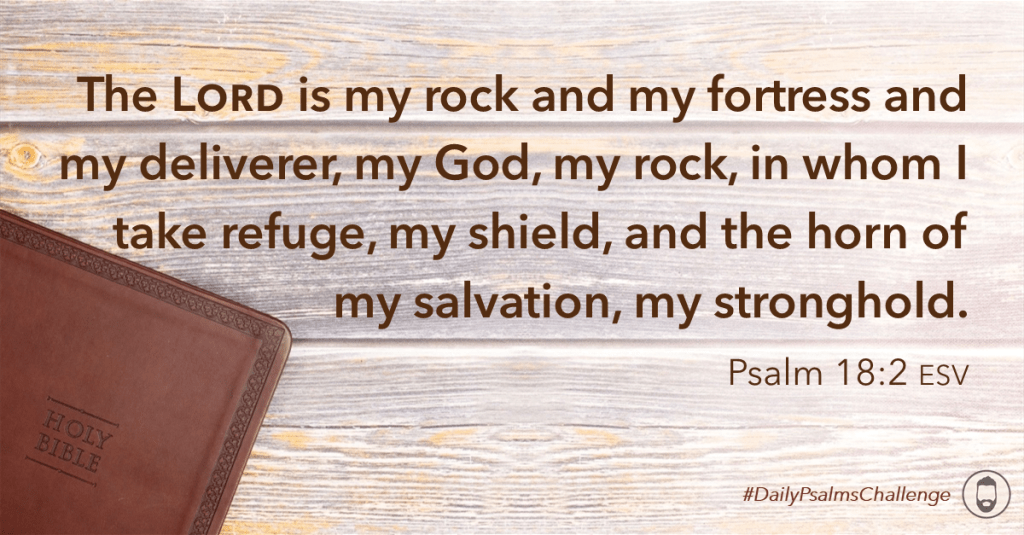
The LORD is my rock and my fortress and my deliverer, my God, my rock, in whom I take refuge, my shield, and the horn of my salvation, my stronghold.
Psalm 18:2
Psalm 18 is a song of triumph and thanksgiving from David to the Lord, celebrating God’s deliverance from King Saul. It is important to note that Psalm 18 is nearly identical to David’s song of praise in 2 Samuel 22 – the differences likely being Psalm 18 is adapted from David’s specific situation to be sung by the people (the Psalms is the songbook/hymnal of the Bible, remember). As such, this is not only a personal expression of David’s gratitude and praise but also a testimony to God’s faithfulness to His anointed king and His people. This psalm resonates with themes of refuge, rescue, and victory, ultimately pointing, as we’ll see later, to Jesus.
David opens with a declaration of love for the Lord, describing Him as his strength, rock, fortress, deliverer, and refuge (vv. 1-3). These metaphors emphasize God’s power, protection, and faithfulness. David’s words remind us that God is not some distant, uninvolved deity but a personal Savior who genuinely cares for His people.
The central part of the psalm recounts God’s dramatic intervention on David’s behalf (vv. 4-19). When David faced overwhelming danger, he cried out to the Lord, and God responded with awesome power. The imagery of the earth trembling, smoke rising, and hailstones falling paints a vivid picture of God as a divine Warrior, fighting for His anointed one. This points back all the way to the Lord’s deliverance of Israel from Egypt in the Exodus and points forward to His ultimate victory through Jesus.
David attributes his deliverance to his righteousness and integrity (vv. 20-24), not meaning that David was sinless but that he walked faithfully with God and sought to obey His commands. In the last part of the psalm, David praises God for equipping him for battle and giving him the victory (vv. 31-45) showing that he understood his victory was ultimately in the Lord’s goodness rather than his own. In fact, he acknowledges that every success of his was achieved as a result of God’s strength, guidance, and provision.
Psalm 18 concludes with a declaration of God’s faithfulness, not just toward David but also toward His people (vv. 46-50). David praises the Lord as his rock and Savior, again acknowledging that his victories are part of God’s covenant commitment to him and his descendants. Ultimately, this covenant finds fulfillment in Jesus, the eternal King and descendant of David, who brings salvation to all nations (Romans 15:9).
Seeing Jesus in Psalm 18
Psalm 18 foreshadows Jesus, the greater David. We can truly sing v. 46 in the context of Jesus: “The LORD lives, and blessed be my rock, and exalted be the God of my salvation”! The dramatic imagery of God’s intervention in David’s situation in this psalm reflects the power of the resurrection, where Jesus – the LORD – lives, defeating the ultimate enemies of sin and death (1 Corinthians 14:25-27).
Paul quotes v. 49 in Romans 15:9, showing that the salvation described in Psalm 18 is extended to the Gentiles through Jesus, who is the fulfillment of God’s promise to David – Jesus, who is the King who reigns forever and brings salvation to the ends of the earth.
Reflection
Psalm 18 invites us to rejoice in God’s faithfulness, to trust in His strength, and to find our ultimate hope in our eternal King, Jesus.
As you reflect on Psalm 18, ask yourself how you can apply the imagery of God as rock, fortress, and shield to your current circumstances. Have there been times when He has delivered you? If so, how did that strengthen your faith?
Pray or sing Psalm 18 and rejoice in the God of your salvation!
The #dailyPSALMSchallenge gives us the opportunity to start 2025 in God’s Word by digging into a psalm a day. Each day will identify a key passage for us to meditate on as well as seeking to help us see Jesus in the psalm and reflect on what we have read.
Keep me as the apple of Your eye; hide me in the shadow of Your wings….
Psalm 17:8
Psalm 17 is David’s heartfelt prayer for God to protect and vindicate him in the face of relentless enemies. This prayer reveals David’s perseverance in faith as he appeals to God on the basis of his innocence, God’s covenant love, and his ultimate hope in seeing God’s face.
David begins by asserting his innocence, inviting God to examine his heart, words, and actions (vv. 1-5). He is confident that God will find no wrongdoing. This doesn’t imply that David was sinlessly perfect but rather his sincere commitment to walk in God’s ways and avoid the paths of the wicked.
In the middle, David shifts his focus to God’s steadfast covenant love. He calls upon the LORD to demonstrate His love and loyalty, describing Him as the Savior of those who seek refuge (vv. 6-9). David prays using imagery to reflect his desire to be kept as the “apple of [God’s] eye” and hidden “in the shadow of [His] wings”, evoking a clear image of God’s tender care and protection (v. 8).
Psalm 17 then describes David’s enemies as ferocious, comparing them to a lion lying in wait for prey (vv. 10-12). David asks God to intervene and protect him from danger, entrusting his future and his enemies justice to the Lord. He contrasts his enemies, who find their portion in this life only, with his own hope in the eternal presence of God (vv. 13-15).
David concludes with a powerful declaration of his confidence in the Lord: “As for me, I shall behold your face in righteousness; when I awake, I shall be satisfied with Your likeness” (v. 15). His ultimate hope is not in earthly justice but in the joy of seeing God face-to-face, a longing that points us to eternal life.
Seeing Jesus in Psalm 17
Psalm 17 finds its ultimate fulfillment in Jesus. As David appeals to God for justice and vindication, we see a foreshadowing of the sinless Savior who fully trusted the Father’s will. Jesus, like David, faced accusations and violent enemies, yet He entrusted Himself to God’s righteous judgment (1 Peter 2:23).
Jesus also perfectly embodies the hope expressed in v. 15. Through His death and resurrection, He made it possible for us to behold God’s face in righteousness and enjoy eternal life in His presence (Revelation 22:3-4).
Reflection
Pray Psalm 17 and be reminded of Jesus’s faithfulness. Put your hope in Him. Know that God still hears, protects, and promises joy in His presence forevermore.
Be confident in God’s justice rather than seek your own revenge. Rest in God’s care, finding comfort in His wings and know that you are His delight, the apple of His eye. And seek to have a perspective grounded in the eternal life He gives and the hope we can have in Him rather than focusing on trials and suffering.
The #dailyPSALMSchallenge gives us the opportunity to start 2025 in God’s Word by digging into a psalm a day. Each day will identify a key passage for us to meditate on as well as seeking to help us see Jesus in the psalm and reflect on what we have read.
Every Sunday the Lord blesses us with is an opportunity to gather together and celebrate Jesus’s resurrection and anchor our heats in the hope of His return!
As we gather, we are reminded that the power of sin and death has been broken, and we rejoice in the steadfast love of the Lord, which turns mourning to dancing and sorrow into joy. This is illustrated in the passages we will read together Sunday morning.
The first passage is Psalm 30:8-12, and it beautifully captures this truth:
8To You, O LORD, I cry, and to the Lord I plead for mercy: 9“What profit is there in my death, if I go down to the pit? Will the dust praise You? Will it tell of Your faithfulness? 10Hear, O LORD, and be merciful to me! O LORD, be my helper!”
11You have turned for me my mourning into dancing; You have loosed my sackcloth and clothed me with gladness, 12that my glory may sing Your praise and not be silent. O LORD my God, I will give thanks to you forever!
In Psalm 30, David cries out to the LORD in his distress, and God answers, turning his mourning into dancing and clothing him with gladness (Psalm 30:11). This is the testimony of all who belong to Christ — to all who are rescued by Him from the sting of death and brought into everlasting life! This doesn’t mean that everything is always (or ever) hunky-dory or that we will never feel the sting of death here on earth. What this means is that death has an expiration date and that, if we are His, it is only temporary!
This victorious theme continues in our second passage for Sunday morning, 1 Corinthians 15:50-58:
50I tell you this, brothers: flesh and blood cannot inherit the Kingdom of God, nor does the perishable inherit the imperishable. 51Behold! I tell you a mystery. We shall not all sleep, but we shall all be changed, 52in a moment, in the twinkling of an eye, at the last trumpet. For the trumpet will sound, and the dead will be raised imperishable, and we shall be changed. 53For this perishable body must put on the imperishable, and this mortal body must put on immortality. 54When the perishable puts on the imperishable, and the mortal puts on immortality, then shall come to pass the saying that is written:
“Death is swallowed up in victory.” 55“O death, where is your victory? O death, where is your sting?”
56The sting of death is sin, and the power of sin is the law. 57But thanks be to God, who gives us the victory through our Lord Jesus Christ.
58Therefore, my beloved brothers, be steadfast, immovable, always abounding in the work of the Lord, knowing that in the Lord your labor is not in vain.
Throughout 1 Corinthians 15, Paul declares the certainty of Jesus’s resurrection and in 1 Corinthians 15:50-58, he calls us to steadfastness and hope in that certainty. Because Jesus has conquered death, our lives are filled with purpose. Every note we sing, every word we speak, every moment of worship is not in vain because our Savior — our GOD — is alive and not dead! It is part of God’s story of redemption because, if we are in Christ, we have been made alive in Him!
This Sunday (and honestly every Sunday at Christ Community), our hearts are fixed on Christ and excited by His resurrection. The songs we sing are about Him bearing our sin on the cross and giving life through His life when He exited His borrowed tomb. We will sing of it over and over again — as we should — because Jesus is alive and well, and we will do it all the more as we await His return!
John will open the Word and point us to Jesus.
We will lift our voices together, reading and singing, pointing each other to Jesus.
8To You, O LORD, I cry, and to the Lord I plead for mercy: 9“What profit is there in my death, if I go down to the pit? Will the dust praise You? Will it tell of Your faithfulness? 10Hear, O LORD, and be merciful to me! O LORD, be my helper!”
11You have turned for me my mourning into dancing; You have loosed my sackcloth and clothed me with gladness, 12that my glory may sing Your praise and not be silent. O LORD my God, I will give thanks to you forever!
50I tell you this, brothers: flesh and blood cannot inherit the Kingdom of God, nor does the perishable inherit the imperishable. 51Behold! I tell you a mystery. We shall not all sleep, but we shall all be changed, 52in a moment, in the twinkling of an eye, at the last trumpet. For the trumpet will sound, and the dead will be raised imperishable, and we shall be changed. 53For this perishable body must put on the imperishable, and this mortal body must put on immortality. 54When the perishable puts on the imperishable, and the mortal puts on immortality, then shall come to pass the saying that is written:
“Death is swallowed up in victory.” 55“O death, where is your victory? O death, where is your sting?”
56The sting of death is sin, and the power of sin is the law. 57But thanks be to God, who gives us the victory through our Lord Jesus Christ.
58Therefore, my beloved brothers, be steadfast, immovable, always abounding in the work of the Lord, knowing that in the Lord your labor is not in vain.
You make known to me the path of life; in Your presence there is fullness of joy; at Your right hand are pleasures forevermore.
Psalm 16:11
Psalm 16 begins with a petition of preservation but quickly turns to psalm of trust and contentment, a song of the confidence inspired by God’s faithful care. David declares his exclusive dependence on the Lord, acknowledging that God is the only good He has (v. 2).
David contrasts the joy of trusting in God with the fruitless sorrows of idolatry (vv. 3-4). His delight is the saints, God’s people, but he refuses to even speak the names of other/false Gods. The Lord Himself is David’s inheritance and portion, a reminder of God’s personal care and provision (vv. 5-6).
In vv. 7-8, David praises God for His guidance and presence, describing the stability and confidence that come from setting the Lord always before him. This unshakable confidence culminates in the hope of resurrection and eternal joy. David affirms that God will not abandon him to Sheol or let His “holy one” see corruption (v. 10), a prophecy fulfilled in the resurrection of Jesus (Acts 2:25-32, 13:35-37).
Psalm 16 concludes with a vision of eternal joy and life in God’s presence. For David, the path of life leads not only through this life but also to an everlasting relationship with God, where there is fullness of joy and eternal pleasures (v. 11).
Seeing Jesus in Psalm 16
Psalm 16 finds its ultimate fulfillment in Jesus. Peter and Paul both preached Jesus’s resurrection using this exact psalm, emphasizing that David’s words about not seeing corruption could not apply to David but pointed forward to Jesus (Acts 2:27-31, 13:35-37). Jesus is the true “holy one” who was not abandoned to the grave, and His resurrection is the foundation of our hope for eternal life.
As believers, we share in Christ’s victory over death. Jesus rose from the dead and will raise those who are saved by grace through faith in Him. In Christ, we have confidence that death is not the end and that eternal joy awaits us in God’s presence.
Reflection
Through Psalm 16, we are invited to rest in God’s care, rejoice in His guidance, and look forward with confidence to the fullness of joy that awaits in His presence forevermore.
Trust in God. Are you finding your security in the Lord, or are you tempted to chase after fleeting joys? Reflect on how God has been your refuge and portion.
Delight in God’s people. Do you take joy in fellowship with God’s people? Consider ways you can grow in love for and encouragement of the saints.
Rejoice in Jesus’s resurrection. How does it shape your views on life, death, and eternity? Meditate on the eternal pleasures promised in God’s presence.
The #dailyPSALMSchallenge gives us the opportunity to start 2025 in God’s Word by digging into a psalm a day. Each day will identify a key passage for us to meditate on as well as seeking to help us see Jesus in the psalm and reflect on what we have read.
When I say that, I’m not talking about some sort or religious obligation for attending church or anything like that. My mind is drawn to my need for Jesus and the fact that He would deign to accept one like me.
There were times in my life when thinking of Sunday was more religious than relationship, but the older I get and the more I think about all that Jesus has done (and is doing and will do), the more I think of Sunday like the imagery in Hebrews 4:14-16.
The writer of Hebrews begins this section talking about Jesus as the “great high priest”. That phrase can definitely be acquainted with religious ideas and temple life and sacrifices, but Jesus is something different.
High priests are typically “chosen from among men” and “appointed to act on behalf of men in relation to God” (Hebrews 5:1). Jesus is different. He is God become man to be the sacrifice for men to be able to come to God.
High priests would typically need to “offer sacrifice” for their own sins “fust as [they do] for those of the people” (Hebrews 5:3). Jesus is different. He has no sins to sacrifice for because He “has been tempted as we are, yet without sin” (Hebrews 4:15). He is the Lamb of God bearing our sin.
High priests worked and worked and worked on behalf of the people before God, but all of their work was just a shadow of what was to come. Jesus is different. Jesus is all substance, and no shadow, being Himself “the source of eternal salvation to all who obey Him, being designated by God a high priest after the order of Melchizedek” (Hebrews 5:9-10).
Because Jesus is different, we are not limited to showing up for some religious observances over and over again, dwelling only in the suburbs of God’s grace and partaking only of shadows. Because Jesus is our high priest, He has made a way for us not just to be in relation to God but for us to be able to approach Him — to go directly to “the throne of grace” (Hebrews 4:16).
For those bringing their animals for the high priest to slaughter and make atonement for their sins, the idea of approaching God’s throne would be a frightening thing. Think of Isaiah’s “woe is me” talk when he had a vision of the holy, holy, holy God seated on His throne; he knew he was unclean and unworthy to look upon “the King, the LORD of hosts” (Isaiah 6:1-5)! The King of kings seated on the throne is still holy, holy, holy and we are still sinners. the King of kings seated on the throne is the divine word who discerns “the thoughts and intentions” of our hearts, laying us bare — “naked and exposed to the eyes of Him to whom we must give an account” (Hebrews 4:12-13).
Yes, Jesus is the King of kings.
Yes, Jesus is holy, holy, holy.
Yes, Jesus is Lord.
No, we are not any of those things and neither worthy nor holy. We are not God, and most of us could not stand even alongside Isaiah to state our “woe” in God’s presence. But Jesus is also our high priest! He has made atonement for our sins! He has made a way for us to come before Him (John 14:6, 2 Corinthians 5:21, 1 John 2:1-2)!
This is why the imagery of Hebrews 4:14-16 is so heavy on my mind. I have the opportunity and privilege to approach the throne of grace in my time of need. Because I have confessed Jesus as Lord and believed upon Him — but my trust in Him to save me, I have assurance to be able to approach Him without fear of death and punishment because He Himself has “bore [my] sins in His body on the tree, that [I] might die to sin and live to righteousness” (1 Peter 2:24). I don’t have to say “woe is me” because He put Himself through woes on my behalf.
Because of this, I can approach His throne with the confidence of a child waking a parent in the middle of the night for a drink of water. I can turn to Him with the assurance that I not only may approach Him for help but be confident that I will “receive mercy and find grace to help in time of need” (Hebrews 4:16).
That’s good news!
But it’s not just good news for me. It is good news for all who trust in Him, all who are saved by grace through faith in Him.
So, Sunday’s coming, and we have the opportunity to gather together on the first day of the week — the Lord’s day — and remember His death, burial, and resurrection. We have the opportunity to gather with brothers and sisters who have been saved by grace through faith and approach the throne of our Lord together, confident that His grace and mercy are enough, sufficient, and eternally flowing toward those He loves.
If this doesn’t describe you, know that there is good news and grace enough for you, too. Your sin can be forgiven. You can be saved. There is grace enough and room enough and good news enough for you and all who call on His name.
You won’t find anything relgiously impressive. You won’t find impressive priests or practices. You won’t find perfect people. You will find a bunch of sinners — and hypocrites — whose only hope is Jesus. He is who will will read about. He is who we will sing about. He is who we will preach about. And that’s because He’s our only hope. He’s our King. He’s our God. He made a way for us and there is no place we’d rather be than gathered around His throne in a small picture of how we will get to be when this world passes away and He gathers His people to Himself.
14Since then we have a great high priest who has passed through the heavens, Jesus, the Son of God, let us hold fast our confession. 15For we do not have a high priest who is unable to sympathize with our weaknesses, but One who in every respect has been tempted as we are, yet without sin. 16Let us then with confidence draw near to the throne of grace, that we may receive mercy and find grace to help in time of need.
4We were buried therefore with Him by baptism into death, in order that, just as Christ was raised from the dead by the glory of the Father, we too might walk in newness of life. 5For if we have been united with Him in a death like His, we shall certainly be united with him in a resurrection like His. 6We know that our old self was crucified with Him in order that the body of sin might be brought to nothing, so that we would no longer be enslaved to sin. 7For one who has died has been set free from sin.
The LORD is a stronghold for the oppressed, a stronghold in times of trouble.
Psalm 9:9
Psalm 9 is a celebration of God’s justice, faithfulness, and salvation. David opens with a powerful declaration of praise to God: “I will give thanks to the LORD with my whole heart; I will recount all of Your wonderful deeds” (v. 1). Throughout Psalm 9, he does just that: recounting God’s past acts of deliverance and expressing praise through trusting in His eternal reign.
David reflects on God’s role as judge. God is able to both rebuke the nations and destroy the wicked, blotting out their names forever (vv. 5-6). This righteous judgment reminds us that God’s justice is not limited by time; He is enthroned forever, ruling with fairness and protecting the oppressed (vv. 7-9). For those who trust in Him — in His name, God offers refuge and security as a mighty stronghold, never forsaking His people (v. 10).
Psalm 9 also highlights God’s concern and care for the weak and afflicted. He remembers their cries and avenges their suffering (v. 12). David pleads for deliverance himself, trusting that God is able and will lift him from the “gates of death” so he can praise God in the “gates of the daughters of Zion” (vv. 13-14). The reversal from near-death to rejoicing is a powerful testimony to God’s power and grace.
God’s justice is clear in Psalm 9. The wicked often fall into the traps that they have set for others (v. 15), yet ultimate justice belongs to the Lord, who will one day judge the world completely in His righteousness. Until then, the needy and poor can take comfort in the knowledge that He has not forgotten them — and that hope in Him will not perish (v. 18)!
Seeing Jesus in Psalm 9
Psalm 9 anticipates Jesus’s reign as the righteous Judge of all nations. As Paul declared in Acts 17:31, God has “fixed a day on which He will judge the world in righteousness by a man whom He has appointed” — Jesus is the appointed Judge as well as our assurance because of His resurrection.
In His first coming, Jesus brought hope to the oppressed and salvation to the lost. When He returns, He will bring final justice and an end to all evil.
David’s plea for deliverance also foreshadows Jesus and His gospel. Just as David was able to rejoice in God saving him from the “gates of death”, we can rejoice that Jesus conquered death itself through His resurrection. Through Him, believers are delivered from sin and eternal death and transferred into His Kingdom to rejoice in Him forevermore (Colossians 1:13-14)!
Reflection
Psalm 9 gives an example of David worshiping the Lord out of a grateful heart. Take time today to thank God for His faithfulness in your own life. Consider His acts of justice and salvation — both in the world around you and through Jesus. Follow David’s example and recount His wonderful deeds and sing His praises so that those around you can hear about Jesus.
The #dailyPSALMSchallenge gives us the opportunity to start 2025 in God’s Word by digging into a psalm a day. Each day will identify a key passage for us to meditate on as well as seeking to help us see Jesus in the psalm and reflect on what we have read.
3 For I passed on to you as of first importance what I also received, that Christ died for our sins according to the scriptures, 4 and that he was buried, and that he was raised up on the third day according to the scriptures, 5 and that he appeared to Cephas, then to the twelve, 6 then he appeared to more than five hundred brothers at once, the majority of whom remain until now, but some have fallen asleep.
1 Corinthians 15:3-6
He made the one who did not know sin to be sin on our behalf, in order that we could become the righteousness of God in him.
2 Corinthians 5:21
8 But what does it say? “The word is near to you, in your mouth and in your heart” (that is, the word of faith that we proclaim), 9 that if you confess with your mouth “Jesus is Lord” and believe in your heart that God raised him from the dead, you will be saved. 10 For with the heart one believes, resulting in righteousness, and with the mouth one confesses, resulting in salvation. 11 For the scripture says, “Everyone who believes in him will not be put to shame.” 12 For there is no distinction between Jew and Greek, for the same Lord is Lord of all, who is rich to all who call upon him. 13 For “everyone who calls upon the name of the Lord will be saved.”
📖 Revelation 4:1–11In this episode of The King is Coming, Keith Harris and Jamie Harrison move beyond Jesus’s letters to the churches and into the next part of John’s vision. In Revelation 4, John is invited through an open door into heaven—and what he sees is the throne room of God.At the center of everything is a throne, and seated on it is the Lord in all His glory. From this point forward in Revelation, the throne becomes the focal point of the entire book.John describes the scene the best way he can: the brilliance of precious stones, a rainbow surrounding the throne, flashes of lightning and thunder, and a crystal-like sea before it. Surrounding the throne are twenty-four elders and four living creatures who never cease to worship the Lord.Together, Keith and Jamie discuss:✔️ Why Revelation 4 marks a shift from the letters to the churches to John’s heavenly vision✔️ What the throne room reveals about God’s authority and security over all things✔️ Why John uses comparisons (“like” and “as”) to describe the glory he sees✔️ The mystery of the twenty-four elders and what we can—and cannot—know✔️ The constant worship of the living creatures crying “Holy, holy, holy”✔️ Why heaven’s worship centers on God simply because He is worthyIn the throne room, everything points to one truth: God alone is worthy of worship.“Worthy are you, our Lord and God, to receive glory and honor and power, for you created all things, and by your will they existed and were created.” (Revelation 4:11)🔗 If you would like to see a written version of this podcast, complete with footnotes and cross-references, you can find it here.
We have spent a good bit of time the past few weeks at Christ Community in Luke 2:10 and the verses around it. The declaration of the angels to those poor and frightened shepherds should about be memorized at this point: “Do not be afraid, for behold, I bring good news to you of great joy which will be for all the people”. Good news. Great joy. For all people.
The word translated “good news” is often translated gospel, and the message that the angels proclaimed on that hillside 2,000 years ago is a beautiful and succinct picture of the gospel. They preached that the Savior “who is Christ the Lord” was born for them – for those dirty, stinky shepherds – and that He could be found that very day in Bethlehem. It was news that would and could change the trajectory of their lives. They just needed to believe in Him and receive the salvation He had to offer – they would receive grace by faith through Him.
Now, I know that on the day they heard that gospel message Jesus was still laying in the feeding trough, still an infant, and was decades away from His death, burial, and resurrection. But the babe in the manger was still “the Word [become] flesh” (John 1:14). He was still the Lamb slain “before the foundation of the world” (Ephesians 1:4).
We sometimes want to overcomplicate things. We know the whole story and want to add and fill in the gaps in the angels’ proclamation that day, but the “good news of great joy” is still just as simple. In fact, Paul gives very succinct proclamations of the gospel, too. The first can be found in 1 Corinthians 15 where he tells the church at Corinth that he is passing on to them the most important message he had to offer – the very same message that he received himself: Jesus died for our sins according to the way that the Bible said He would, He was buried, and He rose from the dead on the third day exactly as the Bible and His own preaching said He would. That’s good news!
Paul’s second succinct gospel summary comes in his next letter to the church at Corinth in 2 Corinthians 5:21. In one complex little sentence, he shares that God put the sins of those who would be saved on Jesus. Jesus had never sinned and did not deserve any condemnation, but He willingly bore our sin on our behalf. Those who trust in Him no longer are under the condemnation and shame due to their sin; Jesus bore that (Colossians 2:13-14). In a great exchange, Jesus traded His righteousness for our sin. He bore the wrath of God and exchanged that for God’s favor. Basically, He traded His extravagantly full bank account for our bankrupt one so that when God looks upon those who Jesus has saved, He does not see their sinfulness but Jesus’ righteousness! That’s good news!
The gospel is good news, but there is also bad news. Those who do not confess Jesus as Lord and believe He died for their sins and rose again to not receive part in that great exchange. They remain in their sin. Their condemnation remains their own. It does not have to be that way. All who call out to Jesus in faith will be saved. Anyone who believes in Him will not be but to shame, but not believing leaves the shame where it belongs – on the sinner.
Long lay the world in sin and error pining Till He appeared and the soul felt its worth A thrill of hope, the weary world rejoices For yonder breaks a new and glorious morn Fall on your knees!
Those who are without Jesus are still in their sin and “pining” after the wrong things, sinful things. But everyone – all people – have the opportunity to fall on their knees, believe in Him – confess Him as Lord, and repent of their sin. And those who do will not only have heard the good news of great joy but also to have believed it and received the salvation Jesus offers.
I love the phrase “good news of great joy” because 1) it is straight from the Bible, and 2) it captures what Jesus offers. But I also love the way the writer of “O Holy Night” captured what it is to be a sinner and receive Christ: “a weary world rejoices”. If you have been reading with us over these past two weeks, you have read snippets of the “good news of great joy”, but have you received it? Have you believed on Jesus, or are you still on the fence? If you haven’t, I urge you: fall on your knees, believe what the Bible says about Him, confess Him as Lord, and rejoice in the salvation He brings!
Luke 24 concludes with the hope and joy of Jesus’ resurrection and ascension, a fitting reflection on Christmas Eve as we prepare to celebrate His birth tomorrow. This chapter invites us to marvel at the completeness of God’s redemptive plan, which began in a humble manger and was fulfilled in an empty tomb.
A New Beginning: The resurrection marks the triumph of life over death, just as Jesus’ birth ushered in light to a dark world. As you reflect on the empty tomb, remember that Christmas celebrates the beginning of this miraculous story.
Hope Fulfilled: The disciples on the road to Emmaus moved from despair to joy as Jesus opened their eyes to God’s promises. This Christmas, let your heart burn with hope as you trust the One who fulfilled every prophecy.
Peace and Assurance: Jesus brought peace to His disciples, proving His resurrection by showing His scars and eating with them. He offers us the same assurance—our Savior lives, and His peace is for all who believe.
A Call to Worship and Witness: The disciples responded to the risen Christ with worship and proclamation. As we celebrate His birth tomorrow, let our joy overflow in worship and bold witness, sharing the good news that Christ has come, died, and risen for us.
On this Christmas Eve, look forward to tomorrow with awe and wonder, knowing that the child born in Bethlehem is the risen Lord who reigns in heaven. May your celebration of His birth be filled with the same joy and hope that the disciples experienced as they worshiped the resurrected Savior. Merry Christmas!
📖 Revelation 4:1–11In this episode of The King is Coming, Keith Harris and Jamie Harrison move beyond Jesus’s letters to the churches and into the next part of John’s vision. In Revelation 4, John is invited through an open door into heaven—and what he sees is the throne room of God.At the center of everything is a throne, and seated on it is the Lord in all His glory. From this point forward in Revelation, the throne becomes the focal point of the entire book.John describes the scene the best way he can: the brilliance of precious stones, a rainbow surrounding the throne, flashes of lightning and thunder, and a crystal-like sea before it. Surrounding the throne are twenty-four elders and four living creatures who never cease to worship the Lord.Together, Keith and Jamie discuss:✔️ Why Revelation 4 marks a shift from the letters to the churches to John’s heavenly vision✔️ What the throne room reveals about God’s authority and security over all things✔️ Why John uses comparisons (“like” and “as”) to describe the glory he sees✔️ The mystery of the twenty-four elders and what we can—and cannot—know✔️ The constant worship of the living creatures crying “Holy, holy, holy”✔️ Why heaven’s worship centers on God simply because He is worthyIn the throne room, everything points to one truth: God alone is worthy of worship.“Worthy are you, our Lord and God, to receive glory and honor and power, for you created all things, and by your will they existed and were created.” (Revelation 4:11)🔗 If you would like to see a written version of this podcast, complete with footnotes and cross-references, you can find it here.
But on the first day of the week, at early dawn, they went to the tomb, taking the spices they had prepared. 2 And they found the stone rolled away from the tomb, 3 but when they went in they did not find the body of the Lord Jesus. 4 While they were perplexed about this, behold, two men stood by them in dazzling apparel. 5 And as they were frightened and bowed their faces to the ground, the men said to them, “Why do you seek the living among the dead? 6 He is not here, but has risen. Remember how he told you, while he was still in Galilee, 7 that the Son of Man must be delivered into the hands of sinful men and be crucified and on the third day rise.” 8 And they remembered his words, 9 and returning from the tomb they told all these things to the eleven and to all the rest. 10 Now it was Mary Magdalene and Joanna and Mary the mother of James and the other women with them who told these things to the apostles, 11 but these words seemed to them an idle tale, and they did not believe them. 12 But Peter rose and ran to the tomb; stooping and looking in, he saw the linen cloths by themselves; and he went home marveling at what had happened.
13 That very day two of them were going to a village named Emmaus, about seven miles from Jerusalem, 14 and they were talking with each other about all these things that had happened. 15 While they were talking and discussing together, Jesus himself drew near and went with them. 16 But their eyes were kept from recognizing him. 17 And he said to them, “What is this conversation that you are holding with each other as you walk?” And they stood still, looking sad. 18 Then one of them, named Cleopas, answered him, “Are you the only visitor to Jerusalem who does not know the things that have happened there in these days?” 19 And he said to them, “What things?” And they said to him, “Concerning Jesus of Nazareth, a man who was a prophet mighty in deed and word before God and all the people, 20 and how our chief priests and rulers delivered him up to be condemned to death, and crucified him. 21 But we had hoped that he was the one to redeem Israel. Yes, and besides all this, it is now the third day since these things happened. 22 Moreover, some women of our company amazed us. They were at the tomb early in the morning, 23 and when they did not find his body, they came back saying that they had even seen a vision of angels, who said that he was alive. 24 Some of those who were with us went to the tomb and found it just as the women had said, but him they did not see.” 25 And he said to them, “O foolish ones, and slow of heart to believe all that the prophets have spoken! 26 Was it not necessary that the Christ should suffer these things and enter into his glory?” 27 And beginning with Moses and all the Prophets, he interpreted to them in all the Scriptures the things concerning himself.
28 So they drew near to the village to which they were going. He acted as if he were going farther, 29 but they urged him strongly, saying, “Stay with us, for it is toward evening and the day is now far spent.” So he went in to stay with them. 30 When he was at table with them, he took the bread and blessed and broke it and gave it to them. 31 And their eyes were opened, and they recognized him. And he vanished from their sight. 32 They said to each other, “Did not our hearts burn within us while he talked to us on the road, while he opened to us the Scriptures?” 33 And they rose that same hour and returned to Jerusalem. And they found the eleven and those who were with them gathered together, 34 saying, “The Lord has risen indeed, and has appeared to Simon!” 35 Then they told what had happened on the road, and how he was known to them in the breaking of the bread.
36 As they were talking about these things, Jesus himself stood among them, and said to them, “Peace to you!” 37 But they were startled and frightened and thought they saw a spirit. 38 And he said to them, “Why are you troubled, and why do doubts arise in your hearts? 39 See my hands and my feet, that it is I myself. Touch me, and see. For a spirit does not have flesh and bones as you see that I have.” 40 And when he had said this, he showed them his hands and his feet. 41 And while they still disbelieved for joy and were marveling, he said to them, “Have you anything here to eat?” 42 They gave him a piece of broiled fish, 43 and he took it and ate before them.
44 Then he said to them, “These are my words that I spoke to you while I was still with you, that everything written about me in the Law of Moses and the Prophets and the Psalms must be fulfilled.” 45 Then he opened their minds to understand the Scriptures, 46 and said to them, “Thus it is written, that the Christ should suffer and on the third day rise from the dead, 47 and that repentance for the forgiveness of sins should be proclaimed in his name to all nations, beginning from Jerusalem. 48 You are witnesses of these things. 49 And behold, I am sending the promise of my Father upon you. But stay in the city until you are clothed with power from on high.”
50 And he led them out as far as Bethany, and lifting up his hands he blessed them. 51 While he blessed them, he parted from them and was carried up into heaven. 52 And they worshiped him and returned to Jerusalem with great joy, 53 and were continually in the temple blessing God.
[1] On the first day of the week, women arrived at Jesus’ tomb with spices but found the stone rolled away and the tomb empty. Two angels appeared, reminding them of Jesus’ words that He would rise on the third day. They reported this to the apostles, but their testimony was met with disbelief. Peter ran to the tomb, saw the linen cloths, and marveled.
[2] Two disciples, one named Cleopas, walked to Emmaus, discussing the events of Jesus’ death. A stranger joined them, explaining how Scripture foretold the Messiah’s suffering and glory. At dinner, their eyes were opened, and they recognized the stranger as Jesus, who then vanished. Filled with joy, they returned to Jerusalem to share the news.
[3] Jesus appeared to His disciples, offering peace and proof of His physical resurrection by showing His hands and feet and eating with them. He explained that His death and resurrection fulfilled Scripture and commissioned them to proclaim repentance and forgiveness to all nations, beginning in Jerusalem. He promised the Holy Spirit would empower them.
[4] Leading the disciples to Bethany, Jesus blessed them and ascended into heaven. Overwhelmed with joy, they returned to Jerusalem, worshiping Him and continually praising God in the temple.
I usually start off with “Sunday’s coming, and I’m excited”, but I’m not always excited. I don’t want to be disingenuous or depressing. The reality of that phrase “Sunday’s coming” is rooted in Jesus’s resurrection and His return. The reality of this fallen world is that there is sorrow and terror and unspeakable things; so I look to the hope that comes from Jesus’s resurrection, the expectation of peace that comes with His return, and echo my earlier sentiment: I’m ready. I need it.
This week’s Advent theme is peace.
If there was ever a week that I longed for peace, it has been this one. It seems that there are more pieces and shambles than peace. My heart has cried out, “Come, Lord Jesus” (Revelation 22:20), more in the past few days than in some time. I have prayed and pleaded with Him, seeking to intercede for folks I love, asking Him to pick up the broken pieces and mend mournful and sorrowful hearts giving His indescribable peace numerous times (1 Timothy 2:1, Psalm 147:3, Isaiah 61:1, Philippians 4:7, John 14:27). I pray it even now.
Peace is in short supply here on Earth, but it is in overflowing abundance in heaven where Christ is!
Look at the way Colossians 1:19-20 describes the peace of our Lord Jesus Christ:
For in Him all the fullness of God was pleased to dwell, and through Him to reconcile to Himself all things, whether on earth or in heaven, making peace by the blood of His cross.
Read that last part again: “making peace by the blood of His cross”.
Isaiah gave us a picture of this centuries before Jesus’s life, His crucifixion:
But He was pierced for our transgressions; He was crushed for our iniquities; upon Him was the chastisement that brought us peace, and with His wounds we are healed.
Read the part about peace again: “upon Him was the chastisement that brought us peace”.
Jesus makes peace. Jesus bears the sin, shame, and sorrows that we have a brings peace instead. Jesus is the Prince of Peace and gives peace to His people (Isaiah 9:6-7, Luke 2:14).
This is the reason I have been pleading with Him on behalf of hurting people (2 Corinthians 1:3-4, Philippians 4:6-7). This is the reason I come to Him in prayer. Peace is His (John 14:27). It is in short supply in our broken, sinful, fallen world — in this world of death and destruction (Romans 8:22), but in Jesus is Light (John 8:12), in Jesus is Love (1 John 4:9-10), in Jesus is Salvation (Acts 4:12, John 14:6), in Jesus there is peace (John 16:33). He manufactures it. He holds the trademark and copyright. Peace belongs to Him. Peace comes from Him. Peace is part of who He is (Ephesians 2:14, Isaiah 9:6).
When I think about how people desire peace in the world today, I am reminded of the reason that comic books were so great a draw for me as a kid. There was nothing like seeing someone in their most desperate moment have the hero swoop down in between them and danger. Superman was always my favorite. You could have a train bearing down on you, and he could fly down, take the impact of the train, and never even slide toward you. He could catch bullets with his hands. He could do, well, whatever danger and come out unscathed and unhurt. But Superman isn’t real. Comic book rescues are make believe, barely a genre away from fairy tales and nursery stories.
There is danger in this world. There is destruction. There is death. There is no caped crusader swooping in to save the day, and even if there was, he or she can only save some. They are limited. Regardless, the fact that they are fictional limits them altogether.
Jesus, however, is real. He did not swoop in and come out unscathed. He came and lived the life we couldn’t live — remaining sinless through it all (Hebrews 4:15, 2 Corinthians 5:21). God put on flesh and lived here on the earth with us (John 1:14) and then bore our sin and shame on the cross (1 Peter 2:24, Isaiah 53:5-6), taking the full brunt of God’s wrath due our sin, and paying the ultimate price for the wages of our sin (Romans 3:23-25, 6:23). We deserve death, and Jesus did that for us (Romans 5:8, 1 Peter 3:18).
One of the coolest, most awe-inspiring hero scenes in a movie comes at the end of The Passion of the Christ. This is just a movie’s representation, but it points to the awesome reality and real life event of Jesus’s resurrection. Check it out here:
Whatever troubles and sorrows plague you now have an expiration date. Jesus is alive. Jesus is coming. Jesus has made a way for us to have peace in Him and is the only One who can give it.
Won’t you look to Him in your time of need?
That’s why we are singing about how we are in awe of Him tomorrow. We don’t sing to and praise Him out of some religious obligation; no, we have just never seen anything like Him. We have never experienced anything like Him. This world has troubles and tribulations, but He has already overcome this world (John 16:33).
So, tomorrow, we at Christ Community invite you to come and seek the Prince of Peace with us. We invite you to come and read from His Word. We invite you to come and hear His Word sung — and to lift your own voice to sing as well. We invite you to sit under the preaching of His Word. We invite you, more than anything, to come to Him. His is worthy. He is willing to save. And what’s better news than that?
Here are our Scriptures and songs:
Advent Reading | Peace —
As the second candle of peace shines, consider the profound peace brought by Jesus, the Prince of Peace, mentioned in Isaiah 9:6-7 and Luke 2:14. His birth signifies reconciliation between God and humanity, offering a deep, lasting peace found only in a personal relationship with Christ. His teachings guide us towards peace with God, ourselves, and others. Let this candle inspire a desire for reconciliation and peacemaking in a divided world.
This portion of Advent also draws attention to Bethlehem. Reflecting on Bethlehem’s seemingly insignificant setting reminds us of God’s penchant for using ordinary places for extraordinary purposes. In this portion of Advent, amidst feelings of insignificance, remember that God loves you dearly. Take a moment to pause, acknowledging how God specializes in using the small and insignificant for His glory. Pray that God uses you for His purpose—to bring peace and reconciliation to those around you, to bring people to Him.
5 Have this mind among yourselves, which is yours in Christ Jesus, 6 who, though he was in the form of God, did not count equality with God a thing to be grasped, 7 but emptied himself, by taking the form of a servant, being born in the likeness of men. 8 And being found in human form, he humbled himself by becoming obedient to the point of death, even death on a cross. 9 Therefore God has highly exalted him and bestowed on him the name that is above every name, 10 so that at the name of Jesus every knee should bow, in heaven and on earth and under the earth, 11 and every tongue confess that Jesus Christ is Lord, to the glory of God the Father.
1 I will extol You, my God and King, and bless Your name forever and ever. 2 Every day I will bless You and praise Your name forever and ever. 3 Great is the LORD, and greatly to be praised, and His greatness is unsearchable.
📖 Revelation 4:1–11In this episode of The King is Coming, Keith Harris and Jamie Harrison move beyond Jesus’s letters to the churches and into the next part of John’s vision. In Revelation 4, John is invited through an open door into heaven—and what he sees is the throne room of God.At the center of everything is a throne, and seated on it is the Lord in all His glory. From this point forward in Revelation, the throne becomes the focal point of the entire book.John describes the scene the best way he can: the brilliance of precious stones, a rainbow surrounding the throne, flashes of lightning and thunder, and a crystal-like sea before it. Surrounding the throne are twenty-four elders and four living creatures who never cease to worship the Lord.Together, Keith and Jamie discuss:✔️ Why Revelation 4 marks a shift from the letters to the churches to John’s heavenly vision✔️ What the throne room reveals about God’s authority and security over all things✔️ Why John uses comparisons (“like” and “as”) to describe the glory he sees✔️ The mystery of the twenty-four elders and what we can—and cannot—know✔️ The constant worship of the living creatures crying “Holy, holy, holy”✔️ Why heaven’s worship centers on God simply because He is worthyIn the throne room, everything points to one truth: God alone is worthy of worship.“Worthy are you, our Lord and God, to receive glory and honor and power, for you created all things, and by your will they existed and were created.” (Revelation 4:11)🔗 If you would like to see a written version of this podcast, complete with footnotes and cross-references, you can find it here.







 Just Keith Harris