3 He was despised and rejected by men, a man of sorrows and acquainted with grief; and as one from whom men hide their faces he was despised, and we esteemed him not.
4 Surely he has borne our griefs and carried our sorrows; yet we esteemed him stricken, smitten by God, and afflicted. 5 But he was pierced for our transgressions; he was crushed for our iniquities; upon him was the chastisement that brought us peace, and with his wounds we are healed. 6 All we like sheep have gone astray; we have turned—every one—to his own way; and the LORD has laid on him the iniquity of us all.
The Original Context
Isaiah 53 is one of the clearest prophecies in the Old Testament about the coming of a Suffering Servant – One who would be rejected, bear sorrow, and ultimately carry the guilt of others. Verses 3-6 portray this Servant as misunderstood and mistreated. The people saw His suffering and assumed it was punishment from God for His own sins, but Isaiah pulls back the curtain: the Servant wasn’t suffering for His own wrongs – He was bearing the griefs, sorrows, transgressions, and iniquities of others.
This wasn’t punishment for failure. It was substitution. God laid the guilt of His people on this Servant. He was pierced, crushed, chastised – not because of what He had done but because of what we have done. It’s the language of atonement. It is one life being laid down to bring peace and healing to many.
Fulfillment in Jesus
Jesus is the Suffering Servant who Isaiah foretold. He was despised and rejected by His own people. He wept over the unbelief in Jerusalem (Luke 19:41), was betrayed by a friend (Luke 22:47-48), and was abandoned by His disciples (Matthew 26:56). He was beaten, mocked, and crucified – pierced by nails and crushed under the weight of humanity’s sin and the wrath of God against that sin.
But this was neither accidental nor tragic. Jesus didn’t die a victim of injustice but as a willing substitute, the Lamb of God who takes away the sin of the world (John 1:29). It was the purpose for which He came: “Christ died for our sins in accordance with the Scriptures” (1 Corinthians 15:3). At the cross, Jesus bore our griefs and carried our sorrows. Our rebellion against God became His burden. The punishment that brought us peace was laid upon Him. And by His wounds, we are healed – not just physically or emotionally, but spiritually and eternally.
Hope for Today
Good Friday is not a tragedy – it is a triumph through sacrifice.
Good Friday reminds us that salvation isn’t something we earn but something we receive. The weight of our guilt was laid on Jesus. Our wandering hearts find a home in Him who died that we may live.
We are all like sheep – wayward, distracted, self-reliant (or trying to be), but the Shepherd became the Lamb and was led to the slaughter for our sake. If today feels heavy, let it. The cross was no small thing. But don’t stop at sorrow – look through it to see the love of God on full display.
If you have ever felt too sinful to be forgiven, too broken to be loved, or too far gone to be reached – Isaiah 53 is for you. Your sin is not too much for the Savior. The Servant of Isaiah 53 – Jesus Christ – came for sinners just like me and you.
You are not alone in your brokenness and sin. You are not stuck in your guilt. You are not without hope. Jesus was pierced for you. And those who put their faith in Him are forgiven, healed, and brought near.
So come and behold the Lamb – despised and rejected yet full of mercy and grace. Let your heart rest in the peace He purchased with His blood.
Come to the cross.
Let your heart be pierced by His mercy.
Marvel that God would do this for you.
And remember: while Good Friday ended in death, it opened the door to life because Sunday’s coming!
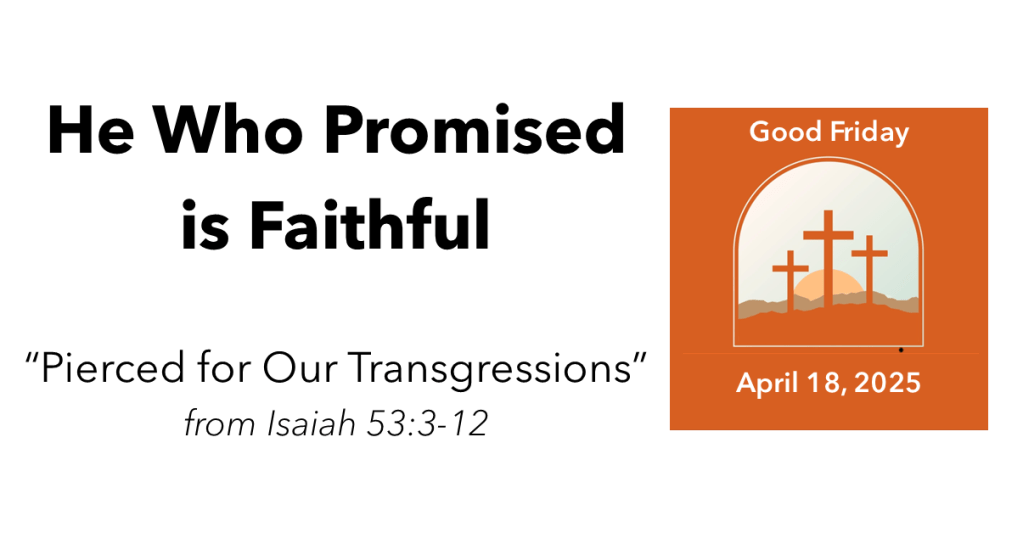
As we walk together through Holy Week, I invite you to journey not only through the events that led to the cross and the empty tomb, but also through the ancient promises and prophecies that pointed us there long before Jesus ever entered Jerusalem. This devotional booklet is titled He Who Promised is Faithful because that simple truth, drawn from Hebrews 10:23, is an anchor for our hope in Jesus:
Let us hold fast the confession of our hope without wavering, for He who promised is faithful.
The Scriptures you’ll find in these pages are not just poetic and prophetic – they are promises kept. Each Old Testament passage reveals something about God’s heart, His holiness, and His plan. And every one of them finds its “Yes” and “Amen” in Jesus (2 Corinthians 1:20). The writers of the New Testament didn’t treat the Old Testament as merely background noise – they believed it testified to the coming Messiah, fulfilled in Jesus, and still speaks to us today.
These brief devotions are here to help explain and illuminate those texts, like the leaders in Nehemiah 8:8 did when “they read from the book, from the Law of God, clearly, and…gave the sense, so that the people understood the reading.”
My prayer is that you will not stop at the devotions, though, but be drawn into God’s Word and asking His Spirit to open your eyes to the beauty of Jesus in all of Scripture. And as you do, remember what this Holy Week ultimately points us to: not just events of the past but the glorious promise of what is to come – of Who is coming again.
So open your Bible. Read slowly. Marvel at God’s goodness. Let the promises fulfilled in Christ strengthen your faith and stir your worship as we prepare to celebrate the resurrection and long for His return.
You can click the links for each day’s podcast episode or devotion or download a copy below:
📖 Revelation 4:1–11In this episode of The King is Coming, Keith Harris and Jamie Harrison move beyond Jesus’s letters to the churches and into the next part of John’s vision. In Revelation 4, John is invited through an open door into heaven—and what he sees is the throne room of God.At the center of everything is a throne, and seated on it is the Lord in all His glory. From this point forward in Revelation, the throne becomes the focal point of the entire book.John describes the scene the best way he can: the brilliance of precious stones, a rainbow surrounding the throne, flashes of lightning and thunder, and a crystal-like sea before it. Surrounding the throne are twenty-four elders and four living creatures who never cease to worship the Lord.Together, Keith and Jamie discuss:✔️ Why Revelation 4 marks a shift from the letters to the churches to John’s heavenly vision✔️ What the throne room reveals about God’s authority and security over all things✔️ Why John uses comparisons (“like” and “as”) to describe the glory he sees✔️ The mystery of the twenty-four elders and what we can—and cannot—know✔️ The constant worship of the living creatures crying “Holy, holy, holy”✔️ Why heaven’s worship centers on God simply because He is worthyIn the throne room, everything points to one truth: God alone is worthy of worship.“Worthy are you, our Lord and God, to receive glory and honor and power, for you created all things, and by your will they existed and were created.” (Revelation 4:11)🔗 If you would like to see a written version of this podcast, complete with footnotes and cross-references, you can find it here.
Sunday’s coming — the LORD’s day, and I’m excited!
Every Sunday is a celebration of the goodness and grace of God, reminding us that He not only died for us but that He raised from the dead and LIVES for us! This Sunday at Christ community, we are going to sing about His goodness and grace and remember His mercy and how He saves.
In Titus 3:4-5a, Paul gives us one of the clearest, richest summaries of the gospel:
“But when the goodness and loving kindness of God our Savior appeared, He saved us, not because of works done by us in righteousness, but according to His own mercy….”
Let’s break that down and take it to heart:
“But….”
This is a very important conjunction. It takes everything before, cancelling it in favor of what comes after. In the context of Titus 3, what came before is what we once were: “once foolish, disobedient, led astray, slaves to various passions and pleasures, passing out days in envy, hated by others and hating one another” (Titus 3:3). BUT Jesus cancels that out in favor of His salvation.
“But when the goodness and loving kindness of God our Savior appeared….”
Paul is reminding us that salvation starts with GOD — not with us, not with our efforts or any righteousness of our own. The word “appeared” points us directly to Jesus’s first coming — God in flesh. He didn’t send a proxy or representative. He didn’t send salvation. God showed up Himself.
Jesus is the visible expression of God’s goodness and loving kindness, because He Himself is God being good and loving. He didn’t wait for us to climb up to Him (which we can’t do — remember, not with our efforts); He came down to us. His goodness and light broke into our sin and darkness.
“…He saved us….”
These three words change everything. God didn’t tell us what we could be doing better. He didn’t merely advise or improve us — He SAVED us. That speaks of our reality and need. we were lost, helpless, and dead in our sin, but HE acted. He rescued. He redeemed. These three words are a beautiful reminder that salvation is not self-help but divine deliverance!
“…not because of works done by us in righteousness….”
This part humbles us. There is no room for pride or patting oneself on the back in the gospel. We can’t earn our salvation by cleaning up our act or doing good deeds. There are no scales that we can balance by heaping service and good deeds; in fact, if there is a scale, our sin has it solidly weighted down unless Jesus acts upon the other side. We can’t impress God into loving us. All our best works can’t bridge the gap between our sin and His holy, holy, holiness.
“…BUT according to His own mercy….”
There’s another “but” here. It takes the false hope of our own righteousness and cancels it out with the hope of God’s own mercy. This gets at the heart of the gospel: God saved us because He is merciful. That’s who He is. Mercy means that He does not treat us as our sins deserve. Instead, He pours out grace through Jesus — grace that cleanses, restores, and makes us new.
That’s good news!
And that good news — that gospel — no, “our great God and Savior Jesus Christ” is who we are going to read, sing, and preach about this Sunday. We’re going to sing of His mercy.
Songs like “Holy Water” and “Washed Clean” will remind us that Jesus’s grace is what refreshes our hearts and keeps us coming back to Him in gratitude and worship. Then, we’ll read Philippians 2:5-11 and lift our eyes to Jesus, declaring His beautiful and powerful name — the name that is above every other. We’ll sing “Your Great Name” and “What a Beautiful Name” as a response to the Savior who stooped low to save us and is now exalted on high at the right hand of the Father.
If you have been saved by Jesus in His mercy, come ready to rejoice!
And if you haven’t yet trusted in Jesus, know this: His goodness and loving kindness have appeared. He is still saving. He is still merciful. Come lay your burdens on Him. Come and receive the mercy that never runs dry. Come to Him.
4But when the goodness and loving kindness of God our Savior appeared, 5He saved us, not because of works done by us in righteousness, but according to His own mercy, by the washing and regeneration and renewal of the Holy Spirit, 6whom He poured out on us richly through Jesus Christ our Savior, 7so that being justified by His grace we might become heirs according to the hope of eternal life.
5Have this mind among yourselves, which is yours in Christ Jesus, 6who, though He was in the form of God, did not count equality with God a thing to be grasped, 7but emptied Himself, by taking the form of a servant, being born in the likeness of men. 8And being found in human form, He humbled Himself by becoming obedient to the point of death, even death on a cross. 9Therefore God has highly exalted Him and bestowed on Him the name that is above every name, 10so that at the name of Jesus every knee should bow, in heaven and on earth and under the earth, 11and every tongue confess that Jesus Christ is Lord, to the glory of God the Father.
Every week, our faith family gathers because of all that Jesus has done for us — His life, His death, His resurrection, His work even now, and His imminent return. We don’t gather to impress each other or prove ourselves on the basis of religion or attendance. We come because we need Jesus — and because He has made a way for sinners (like us) to be made right with a holy, holy, holy God.
This Sunday at Christ Community, we will spend time in worship reading 1 John 1:5-2:2. It’s a beautiful and powerful reminder that God is light, and that in Him there is no darkness at all (1 John 1:5). That’s both comforting and confronting. It comforts us because it means that God is pure, holy, trustworthy, and sinless (everything we aren’t), but it also confronts us because when we step into His light, our sin is exposed. So, we don’t get to walk in darkness and claim to have fellowship with the God who is light (1 John 1:6).
That sounds like bad news if we were to stop there, but praise GOD, the good news is coming in 1 John 1:7: “If we walk in the light, as He is in the light, we have fellowship with one another, and the blood of Jesus His Son cleanses us from all sin.”
The blood of Jesus. That’s our hope. He is our hope. Our sins — real, serious, and shameful though they are — can be cleansed by His blood. Y’all, that’s not just a line from some hymn but the truth of the gospel.
That gospel saturates every part of our worship gatherings. We read it together from the Word. We sing it. John opens the Word and preaches it. And we have the opportunity to hear it from our own voices and the voices of our brothers and sisters, reminding us that Jesus doesn’t wait for us to clean ourselves up to come to Him — He came to save us while we were still sinners, and He did it because He loves us (Romans 5:8)!
As 1 John 2:1-2 says, when we do sin (and we do), we have an advocate with the Father, Jesus Christ the Righteous! He is the propitiation for our sins. He bore the wrath of God due for our sin, took our place on the cross we deserve, made peace by the blood of His cross, and gives the LIFE He has and the favor of God He deserves to those who put their trust in Him — for those who confess Him as Lord.
If you need to be reminded that God is still gracious and Jesus still saves, come on (Titus 3:4-7, Hebrews 7:25).
You won’t be out of place because our gathering is full of sinners in need of grace (Luke 5:31-32, 1 Timothy 1:15). The only difference is that many of us sinners have been saved by grace through faith in Jesus (Ephesians 2:8-9). You’ll hear us pour our hearts out singing “Thank You, Jesus, for the blood applied…. Thank You, Jesus, You have saved my life!” You’ll hear us sing “O the blood, it is my victory!” You’ll hear us sing because we haven’t moved past our need for grace. We’ve just come to the One who gives it freely (Romans 3:23-25, John 1:16, Revelation 22:17).
5 This is the message we have heard from him and proclaim to you, that God is light, and in him is no darkness at all. 6 If we say we have fellowship with him while we walk in darkness, we lie and do not practice the truth. 7 But if we walk in the light, as he is in the light, we have fellowship with one another, and the blood of Jesus his Son cleanses us from all sin. 8 If we say we have no sin, we deceive ourselves, and the truth is not in us. 9 If we confess our sins, he is faithful and just to forgive us our sins and to cleanse us from all unrighteousness. 10 If we say we have not sinned, we make him a liar, and his word is not in us.
1 My little children, I am writing these things to you so that you may not sin. But if anyone does sin, we have an advocate with the Father, Jesus Christ the righteous. 2 He is the propitiation for our sins, and not for ours only but also for the sins of the whole world.
Tomorrow is the Lord’s Day — Sunday, and I’m excited!
Every week at Christ Community, we gather because the gospel — the good news about Jesus — is true: He really lived, died, and rose again to save sinners and bring us into life eternally with Him. You see, we don’t gather to prove ourselves, check some religious attendance box, or pretend we have it all together. No, we gather because we need Jesus.
There’s more good news: He came to save. This is clearly seen in some of the verses we will read together in worship.
16For God so loved the world, that He gave His only Son, that whoever believes in Him should not perish but have eternal life. 17For God did not send His Son into the world to condemn the world, but in order that the world might be saved through Him.
And how did He do that? The apostle Paul puts it plainly, saying it is the most important message, in 1 Corinthians 15:3-4:
…Christ died for our sins in accordance with the Scriptures, …He was buried, …He was raised on the third day in accordance with the Scriptures….
This is the most important news, the good news we call the gospel. It is what we proclaim with our mouths and our lives. It is at the heart of everything we sing, read, pray, and preach. Jesus gave Himself for us — not when we are all cleaned up and put together but while we were lost, guilty, and broken.
One of the songs we will sing, “God So Loved”, takes the message of John 3:16 and other passages to give an invitation to come to Jesus. Ponder these words:
Bring all your failures Bring your addictions Come lay them down at the foot of the cross Jesus is waiting there with open arms God so loved the world
If you have never trusted in Jesus as Savior — confessed Him as Lord and believed that God raised Him from the dead (Romans 10:9), we pray that you consider these words today. This is the more important invitation, to come to Him more than coming to church.
We would also like to invite you to gather with us where you will hear this gospel again and again. Even if you have trusted in Him, we invite you to gather with us, praying that your heart might be stirred again by the wonder of His gospel — His love, grace, mercy, and salvation — and respond with fresh joy, worship, and devotion to Him.
This gospel will saturate our songs. When John opens the book of Hebrews, this gospel is at the heart of the book and the sermon. We will read the good news together.
16“For God so loved the world, that he gave his only Son, that whoever believes in him should not perish but have eternal life. 17For God did not send his Son into the world to condemn the world, but in order that the world might be saved through him. 18Whoever believes in him is not condemned, but whoever does not believe is condemned already, because he has not believed in the name of the only Son of God. 19And this is the judgment: the light has come into the world, and people loved the darkness rather than the light because their works were evil. 20For everyone who does wicked things hates the light and does not come to the light, lest his works should be exposed. 21But whoever does what is true comes to the light, so that it may be clearly seen that his works have been carried out in God.”
3For I delivered to you as of first importance what I also received: that Christ died for our sins in accordance with the Scriptures, 4that he was buried, that he was raised on the third day in accordance with the Scriptures, 5and that he appeared to Cephas, then to the twelve.
We’re continuing in our study of Revelation called The KING is Coming. Today, we will be diving into the context of Jesus’s letters to the seven churches (and to us). Once again, I am thankful for Jamie Harrison and the opportunity to do this study together. This weeks passage is Revelation 1:9-20:
9 I, John, your brother and partner in the tribulation and the kingdom and the patient endurance that are in Jesus, was on the island called Patmos on account of the word of God and the testimony of Jesus. 10 I was in the Spirit on the Lord’s day, and I heard behind me a loud voice like a trumpet 11 saying, “Write what you see in a book and send it to the seven churches, to Ephesus and to Smyrna and to Pergamum and to Thyatira and to Sardis and to Philadelphia and to Laodicea.” 12 Then I turned to see the voice that was speaking to me, and on turning I saw seven golden lampstands, 13 and in the midst of the lampstands one like a son of man, clothed with a long robe and with a golden sash around his chest. 14 The hairs of his head were white, like white wool, like snow. His eyes were like a flame of fire, 15 his feet were like burnished bronze, refined in a furnace, and his voice was like the roar of many waters. 16 In his right hand he held seven stars, from his mouth came a sharp two-edged sword, and his face was like the sun shining in full strength. 17 When I saw him, I fell at his feet as though dead. But he laid his right hand on me, saying, “Fear not, I am the first and the last, 18 and the living one. I died, and behold I am alive forevermore, and I have the keys of Death and Hades. 19 Write therefore the things that you have seen, those that are and those that are to take place after this. 20 As for the mystery of the seven stars that you saw in my right hand, and the seven golden lampstands, the seven stars are the angels of the seven churches, and the seven lampstands are the seven churches.[1]
Keith Harris: Greetings, Sojourners, We’re about to dive into the meat of the book of Revelation, looking here at the background. The cool thing about this, Jamie, that I like is there are places in Revelation that you have wonder Does this symbolize something? or Is this ___?, but if you look at this in a Bible with red letters for the words of Jesus, you notice that in this section Jesus Himself explains what elements like the lamp stands and stars are – He tells us here what they symbolize so we don’t have to wonder.
That’s good news for us because Jesus gave these letters to specific churches – and they even may apply to us today.
Jamie, take it away!
Jamie Harrison: Alright. Last week, I did say at one point that we were about to pray, and I never did. So I apologize for that and want to start with prayer before we jump in:
Lord, thank You. Thank You for being our Father. Thank You for loving us. We just give You praise. We give You honor. And, Lord, we pray that You would open Your Word to us as we read today and discuss. We pray that it would be only truth that comes out, not conjecture. God, I pray that if anybody is listening and they don’t know You that through Your Word and Your Word only they would come to know You. Lord, we just thank You and give You praise. In Jesus’s name, Amen.
So, let’s start in v. 9. We won’t really discuss v. 9 too terribly much; I just think it’s interesting that v. 9 is one of several verses in the Bible that show that the prosperity gospel[2] is incorrect. It says,[3] “I, John, your brother and partner in the affliction, Kingdom, and endurance that are in Jesus…” and then goes on to explain where he (John) is because of the “testimony” of Christ. That he’s on an island, and he’s doing backbreaking work everyday.
Keith: …exiled, imprisoned….
Jamie: …completely. And an island meaning it’s surrounded by water so there’s nowhere to go except death. He’s there because of this testimony.
I just want to point out, y’all, that if you’re listening to people preach or whatever, and they’re telling you that if you’re not doing this and you’re not doing that you must not be right with God [regarding your health or your financial status or how prosperous you are on earth]…know that’s dumb.
Keith: Right. This is John, the gospel writer, the disciple whom Jesus loved. You would think that if there is a prosperity track, he’d be on it. But considering how this is so different, like you said, from the prosperity gospel, how he is in this place that no one would sanely want to be in and he received this treasure, these visions. It’s such a cool thing.
Jamie: That’s how it starts there. And then it goes into (v. 10) “I was in the Spirit on the Lord’s day, and I heard a loud voice behind me like a trumpet….” And I do think that’s cool. Again, I won’t spend a whole lot of time [on trumpets right now], we will moving forward…, but trumpets were used back in the Old Testament for like a warning, a call to war, and things like that, right?
Keith: And heralds.
Jamie: So, this is like a voice saying, hey, you better listen up.
Keith: It obviously got his attention.
Jamie: Right. So, here, Jesus gets his attention telling him to write down what he sees and send it to the seven churches, specifically naming them. The seven churches, you know, people try to make some kind of symbolic thing about them being seven of them and this and that, but this really is a logistical thing. These cities were not too terribly far apart. They were all along kind of the main routes where people would travel.
The churches at that time, I guess you could say that they were really the center point of the dissemination of information. Information kind of went from these hubs out to the rest of the world.
Keith: And you know Laodicea was a sister church of Colossae, and so on.
Jamie: Right, right. Notice when it says when John looks (in v. 12). This is one of those things – “Then I turned to see whose voice it was that spoke to me” – that reminds us that the timeline of Revelation is what John saw next. He hears the voice, turns, and sees (vv. 12-13) “seven golden lampstands, and among the lampstands was one like the Son of Man”. Then he goes on to give a description.
At first you look at it and think, well, there’s seven lampstands; what in the world are those seven lampstands? Again, it’s like Keith said earlier, it’s really cool because the Bible always is going to confirm what the Bible says. It’s going to give us the answer if we’re meant to know the answer.
Keith: If we are meant to know.
Jamie: That’s correct. And right there in v. 20 of Revelation 1, the second half there, it says, “The seven stars are the angels of the seven churches, and the seven lampstands are the seven churches.” So, literally, when he turned, what he was the seven churches – the seven golden lampstands. And then he sees Jesus. He’s dressed in a robe with a golden sash….
Keith: That’s the part that really hits me. In this, as Jesus is walking in the midst of them…. We know that Adam and Eve had a very special thing that was squandered there in the garden where God came and walked in the garden with them in the cool of the day, but when Jesus before His ascension says, “and, lo, I am with you always” (Matthew 28:20), He is in the midst of His churches – in the midst of the presence of His bride here on earth.
It kind of makes me think He’s disseminating information, like you say, but He had something specific to say to these churches. It’s to us all generically, but to Ephesus, to Smyrna, to all those specifically, He had a word that He wanted those churches, those local congregations to hear.
Jamie: That’s right. And that being said, I think it begs the question: is Jesus walking through our churches today? I think that’s something to think about. If he’s not the center of the body, then we’ve stepped wrong somewhere.
Keith: Well, that question kind of builds into: is your church His – or yours?
Jamie: Yeah, that’s tough.
I saw a clip of a guy preaching the other day, and he said [to his congregation] that he had asked them for a watch a year ago and that they hadn’t bought him that watch yet. He asked why they were still broke and poor and busted – busted, that’s his word, what he said. That’s false gospel and has nothing to do with the Bible. That has nothing to do with anything. It’s supposed to all be about Jesus, and He isn’t at the center, then we really got to do something different.
Keith: That’s got me thinking about the way that some of these foolish false preachers – the way they talk to their church. That’s not how Jesus talks to His Bride. We’re going to get into these letters and see some tough stuff that He says to them – and thereby us – but, man, it’s for a purpose.
The guy you spoke of called them broke, busted, ignorant, all these things. Jesus – He says to the church at Laodicea (in Revelation 3:17) that they thought they were rich, that they thought they were prospering. He tells them they aren’t looking for Him and that they’re really wretched, pitiable, poor, blind, and naked. Jesus isn’t trying to bust them down and get a namebrand watch – not trying to get rich off them. The church is rich because of Christ. Or it’s poor and bankrupt without Him.
Jamie: Amen.
So, let’s jump into the description of Christ here. It says He’s dressed in a robe with a golden sash around His chest – that’s kind of like a high priest, or someone with authority. Jesus is the high priest. So, that’s the idea there.
And then, his hair (v. 14) – the hair of his head was as white as wool, white as snow. His eyes like a fiery flame. That’s a little scary, almost. I mean we know the white represents purity, holiness, wisdom, all these things. But that flame of fire, you know, His eyes like a fiery flame, that one should kind of set us down a little bit – the omniscience of God, He’s all knowing, all seeing. Hebrews 4:13 would be a good verse to look at.
But think about it like this when it talks about these eyes like a fiery flame. What we’re seeing is…. Picture this person that you’ve come into contact with in life that just has the look. You know the parent look, the coach look that has….
Keith: …gravitas….
Jamie: That’s it. They just have this look, and it seems to literally reach into the depths of your soul and you feel like you’ve got to look away. You can’t look at them. Jesus’s look here is like that on steroids.
Keith: I read where a preach said that’s why you should wear a suit and tie. It gives gravitas. Jesus didn’t get His gravitas in this scene because of the sash around His chest or His hair. It’s who He is. It’s His presence.
Jamie: That’s it. And it is not only gazing into the depths of our soul, but think about it bigger picture: it’s this penetrating gaze into the depths of His church, which is us as individuals but joined together. I think it’s important to bring that out that He is looking at His bride. He is looking at His church like we were discussing earlier. And He’s looking and going, well, they’re doing really great in these areas…look at that endurance…and look at these people what they’re doing for Me…. Then, (as in the case of the letter to Ephesus) He’s like but you’ve lost your first love.
This gaze is extremely uncomfortable and should make us step back and rethink things and lead us to repentance.
Keith: That’s the thing: lead us to repentance. He’s not tearing them down. He’s not tearing them up. He’s building them up because His people will recant. His people will change and follow Him. If not, then you get the other things He promises….
Jamie: Right, right – which is nothing good.
So, in v. 15: “His feet were like fine bronze as it is fired in a furnace, and His voice like the sound of cascading waters.” Just kind of think about that for a second – that fine bronze. The alter of burnt offering (in the tabernacle and temple in the Old Testament) are covered with bronze, and it’s this divine judgment idea. This divine judgment on the church.
And His voice like the sound of “cascading waters” – think about that for a second. Everybody knows what that sounds like. Like you’re at a waterfall or something and hear that water. Think about it from John’s perspective. He’s on an island. These waves are crashing into the rocks of the island. That’s kind of his background noise all day long. That’s the idea here. This is what it sounds like.
It says in v. 16 that “He had seven stars in His right hand; a sharp double-edged sword came from His mouth, and His face was shining like the sun at full strength.” Which…let me back up and not get too far ahead of myself. So, we’re going to find out in just a minute that the “seven stars in His right hand” – He tells us in v. 20 – those are the angels of the seven churches, those are the pastors. The right hand of course is considered the hand of might, power, and strength.
Keith: The word “angel” there (in v. 20) means messenger (and can refer to people as well as heavenly beings – context helping you see the difference). So it’s not saying that these people who have been adopted into the family of God and charged by Him to care for a local congregation have been demoted to angelic beings. He’s saying that they are His messengers.
That’s something to consider, again, when asking whether Jesus is walking in the midst of your church. Is your pastor giving the information from the Word of God that Jesus – the Word of God – has give for His church, or is he giving some other message? That’s a tough question.
Jamie: It is. To hit on that for a minute, I know when I started preaching I thought I had to have all the right words and say all the right things to get people to come to know Christ – and almost like a play on emotions type of thing, you know? Set the mood just right. All that stuff, right? What I’ve learned as I’ve grown in Christ is, first off, I need to ask forgiveness from some people for some people for some of the stuff I said and did as a “young” preacher, but the fact is that the Word saves (Romans 10:17), you know? If we’re preaching and people aren’t hearing more from the Word than from us, we’ve got it backwards. The Word speaks for itself. The Word builds up.
Keith: Which is the purpose of having pastors if you look at Ephesians 4.
Jamie: So, I just challenge you guys as you’re listening: surround yourself with people who are in the Word. Make sure you are in a Bible-believing, Bible-preaching church. Not a manipulative thing.
Keith: And if you listen to this and you’re a pastor. I think that the way our lead pastor at Christ Community (John Goldwater) put it when we were talking a couple weeks ago is that if you win someone with an argument, you’ve got to keep them with an argument. You win somebody with emotion, you’ve got to keep them with emotion. But if you see someone won to Christ, then He will keep them.
So, when we see here that He’s got these stars, these pastors, who He’s got.
Jamie: That’s it. So, after it tells us about the pastors (stars) being in His right hand, it says that this “double-edged sword” came from His mouth, which we will actually get to later in Revelation when we discuss the final battle. We have a few cross-references for it Ephesians 6:17 and Revelation 19:15. Check those out. But that sword is the Word of God in His judgement, and it’s going to be the Word of God…
Keith: …Hebrews 4:12-13….
Jamie: …and that is how He is going to pronounce His final judgment with that double-edged sword – with the Word – coming from His mouth. Again, we don’t want to get ahead of ourselves. We’ll get there.
It says His face is shining like the sun at full strength. Now, we can’t even fathom this and imagine this because we can’t look into the sun for too long because we’ll go blind.
Keith: Let us clarify. Disclaimer: don’t look into the sun.
Jamie: That is correct. Please don’t try it. I tried when I was younger. That’s probably why I squint when I look at things now. Or it just could be that I’m getting old – not as old as Keith, but I am getting old. He is definitely older than I am.
So, looking into His face there, shining like the sun at full strength. Think about this magnificent glory of God – this magnificent brilliance and radiance that’s so glorious it can’t be concealed. It’s shining like nothing you’ve ever seen before. Think Matthew 17:1-13 at [Jesus’s] Transfiguration and what they saw, but this is that on…I don’t even know, right?
Keith: In person. In it’s fullness.
Jamie: I always go back to Moses in Exodus 34:29-35 where, you know, he sees the glory of God. But he only sees Him from His back. After seeing Him, though, [Moses’s] face is so bright the Israelites make him put a veil over his face because they can’t handle [the brightness of Moses’s face after his even glimpsing God]. We can’t look on the glory of God. It would kill us. It would legitimately kill us. We can’t handle that.
Keith: And so to this extent, the Moses example is the moon. Jesus here in Revelation 1 shows the real source of the light on his face. Jesus is light.
Jamie: And we say all that to say this: when you’re looking at somebody like this – which again we can’t fathom – the One who is about to speak has 100% authority. We know that it’s Jesus who is about to speak. When John sees Him, his immediate reaction is to fall at His feet like a dead man.
Keith: This is different when you see people in the Bible encounter angels. They cower in fear, but John just fell as if dead. His entire living faculties fail him.
Jamie: I think it’s the expression. When we look at, you know, our wife or I’m going to specify here: if you’re a husband looking at your wife or a wife looking at your husband. When you say, oh, they took my breath away. [Seeing Jesus like this] took his breath.
Keith: All of it. Here’s the deal, too, though. John knows Him, right? So, the husband/wife analogy is so much clearer because this isn’t John seeing some amazing creature and being afraid. He’s looking face-to-face at Him who died and said “behold, I am alive forevermore” (v. 18). This is a huge deal, especially for John late in his life, outliving most, if not all, the apostles, and now he sees his friend. He sees his Lord. That’s huge.
Jamie: That’s exactly it. Jesus looks at John and is like, hey, don’t be afraid; I’m the first and the last, the living One.
Check out Isaiah 41:4, 44:6, 48:12, but again, some of these things it’s hard to even talk about. The first, the last, the living One. The last time a lot of people that were around and saw Jesus, He was dying on a cross. Not everybody saw Him after He was resurrected.
Keith: Many did, but not all.
Jamie: So, He’s declaring Himself [as] the living One. I was dead, but look, I’m alive forever and ever. I hold the keys to death and Hades. You could have a whole conversation on [these keys]; if anyone ever tells you they have [these keys or any like them], they’re a liar. Jesus has the keys to death and Hades. Jesus has the keys to the house of David (which we’re going to see later on in Revelation).
Keith: If anyone claims to have something that belongs to Jesus only they are not one of the stars (pastors) of the church. They’re definitely false teachers. They’re wolves who are in sheep’s clothing, trying to look like a pastor but leading to the devil whose goal it is to steal and kill and destroy. So, in the context of this conversation [and looking at the description of who Jesus is and the power He alone claims], any who claim what Jesus alone has is dangerous. They are of their father, the devil, and are a liar like him. They are not to be trusted. They are to be avoided at all costs.
That’s a tough statement to make because when you have conversations like this, people want to say, well, you can’t judge. Well, you judge not lest you be judged. Jesus Himself said they are ravenous wolves in sheep’s clothing. The devil is prowling like a roaring lion, seeking whom he can devour, who he can destroy…. You want to avoid what Jesus says avoid, what the Bible says avoid.
Jamie: You’re supposed to test the spirit by the Spirit. I think that’s where a lot of people – like the video I mentioned a little while ago, the pastor was saying y’all want to buy me a watch. The really disturbing thing about this video – and the dude points it out – there’re people in the background going, “Amen”, “Come on”, “Preach it”, like…get out. If you’re saying “Amen” to that, the spirit that is within you is not the spirit of God, it’s the spirit of man. And that’s what Keith’s saying: we are supposed to test the spirit by the Spirit; we are supposed to look at the fruit that’s coming off the tree.
Look, if somebody’s supposed to be your spiritual leader…. So many are supposedly spiritual leaders who are beating their spouse and doing crazy stuff – like, how can you lead me if you’re not following Christ yourself?The Bible specifically tells us that’s how it’s supposed to be.
I know we were going to go through (and it was actually my idea to try to get through) the letter to Ephesus, but we’re probably at a good place to stop in just a second.
Keith: I think we are at a good place to stop. And not because we don’t want to get to the letter to Ephesus, but because there’s a reason this part of Revelation 1 is here. It’s not just exposition to help you understand the rest of it. It’s part of the revelation – part of understanding whose the churches are, whose the pastors are – or whose they aren’t.
Jamie: A good place to end this today is going to be those last three verses [in Revelation 1]. Where we’re starting at the end of v. 17 where Jesus says,
“Don’t be afraid. I am the First and the Last, and the Living One. I was dead, but look – I am alive forever and ever, and I hold the keys of death and Hades. Therefore write what you have seen, what is, and what will take place after this. The mystery of the seven stars you saw in my right hand and of the seven golden lampstands is this: The seven stars are the angels of the seven churches, and the seven lampstands are the seven churches.”
We’ve discussed that already, but I want to go back to the way Jesus describes Himself: “I am the First and the Last, and the Living One. I was dead, but look – I am alive forever and ever, and I hold the keys of death and Hades.” Philippians 2:9-11 say:
“For this reason God highly exalted him and gave him the name that is above every name, so that at the name of Jesus every knee will bow—in heaven and on earth and under the earth—and every tongue will confess that Jesus Christ is Lord, to the glory of God the Father.”
I really want to press this home. This whole revelation is about Jesus Christ. This whole revelation is supposed to make us look towards Jesus Christ, and if it makes you look anywhere else, then we’ve got to start over from the beginning. Jesus’s name is the name that is above every name. It is the name. And at His name every knee will bow, every tongue will confess that Jesus is Lord.
Watch this, now, this is important; we’re going to go to Romans 10:9-13. This is our favorite verse at Christ Community. We make sure we say it every time that we’re gathered together. People often ask and say that they’d like to have a relationship with Christ – how does that happen? Romans 10:9-13 tells us how:
“If you confess with your mouth, ‘Jesus is Lord,’ and believe in your heart that God raised him from the dead, you will be saved. One believes with the heart, resulting in righteousness, and one confesses with the mouth, resulting in salvation. For the Scripture says, Everyone who believes on him will not be put to shame,, since there is no distinction between Jew and Greek, because the same Lord of all richly blesses all who call on him. For everyone who calls on the name of the Lord will be saved.”
Now, let’s put all this together from what we just read in Revelation where Jesus says He’s the first and the last, the living One. In other words, He’s saying I was dead but I’ve come back to life now. That’s the key to salvation. If you confess with your mouth “Jesus is Lord” and believe in your heart God raised Him from the dead – without this there is no Christianity. Without the resurrection it’s pointless – a waste of our time.
Here’s what I want to point out to everybody listening, ok? Whether you want to or not, at some point in your life, you are going to confess that Jesus is Lord. You are going to confess that He was raised from the dead and He’s alive forevermore.
Keith: …because you are going to be faced with Him – irrefutable face-to-face evidence
Jamie: That’s exactly right. And that’s what Philippians 2 tells us. It doesn’t say every believer will confess. It says everyone. Everyone.
Keith: …on the earth and under it….
Jamie: And that’s everybody who is, who was, and who ever will be. So, I challenge you to look at these verses, Confess with your mouth that Jesus is Lord – which means giving everything over to Him, trusting in Him completely to lead, guide, and direct you in the right way. To say that you’re going to trust Him with every little thing that’s going on in your life. And that you believe in your heart that God raised Him from the dead. That’s how to be saved.
Keith: That’s the faith we talked about – that trust.
Jamie: That’s it. And, honestly, it’s one of two choices. You can say it because you want to or….
Keith: …because you have to and it’s out of subjection that the King has come.
Jamie: And He is coming.
Keith: I think that’s a good place to stop. I urge you to check out…the Scripture references for yourself, and as we prepare to look at these letters to the churches over the next few weeks, be prepared to examine your own heart – not to be critical but to be biblical.
And we’ll catch you with the letter to the church at Ephesus next week! Thank you and God bless!
Tomorrow is the Lord’s day — Sunday, and I’m excited!
A lot of people just think of Sunday as the first day of the week, but for those who Jesus has saved, it reminds us of that Sunday millennia ago when Jesus rose from the dead. That day secured our salvation and gave us an unshakeable hope. As we gather to worship Jesus tomorrow, that unshakeable hope in Jesus alone is what we are going to sing about!
One of the passages we will be reading in worship, Psalm 62:5-8, reminds us of that hope:
5For God alone, O my soul, wait in silence, for my hope is from Him. 6He only is my rock and my salvation, my fortress; I shall not be shaken. 7On God rests my salvation and my glory; my mighty rock, my refuge is God.
8Trust in Him at all times, O people; pour out your heart before Him; God is a refuge for us.
David’s words here from Psalm 62 are a powerful reminder to us that, no matter what uncertainties we face, God is our refuge and firm foundation. In a world that is as changing as shifting sand, Jesus alone us unmovable and unshakeable. Our salvation, security, peace, and hope rest in Him. We can trust Him and pour out our hearts to Him always and at all times.
Tomorrow, as we gather at Christ Community, we will lift our voices in songs that proclaim this beautiful truth. We will sing of the steadfast hope we have in Jesus — hope that is not fragile, not fleeting — but firm and eternal. We will raise our voices and encourage one another to trust in Jesus alone. As always, John will open God’s Word and point us to Jesus.
Won’t you gather with us?
Here are our Scripture and songs:
Scripture | Psalm 103:8-14 —
8The LORD is merciful and gracious, slow to anger and abounding in steadfast love. 9He will not always chide, nor will He keep His anger forever. 10He does not deal with us according to our sins, nor repay us according to our iniquities. 11For as high as the heavens are above the earth, so great is His steadfast love toward those who fear Him; 12as far as the east is from the west, so far does He remove our transgressions from us. 13As a father shows compassion to his children, so the LORD shows compassion to those who fear Him. 14For He knows our frame; He remembers that we are dust.
5For God alone, O my soul, wait in silence, for my hope is from Him. 6He only is my rock and my salvation, my fortress; I shall not be shaken. 7On God rests my salvation and my glory; my mighty rock, my refuge is God.
8Trust in Him at all times, O people; pour out your heart before Him; God is a refuge for us.
*Sometimes we see the need to changing the wording of a song for doctrinal reasons (meaning the lyrics contain theological inaccuracies or fail to align with clear biblical teaching).
In the case of “The Truth”, look at the original lyrics for the chorus:
The truth is I am my Father’s child I make Him proud and I make Him smile I was made in the image of a perfect King He looks at me and wouldn’t change a thing The truth is I am truly loved By a God who’s good when I’m not good enough I don’t belong to the lies I belong to You — that’s the truth
Here are the lyrics as we have changed them:
The truth is I am my Father’s child I make Him proud and I make Him smile I am made in the image of a perfect King He saved me and changed everything The truth is I am truly loved By a God who’s good when I’m not good enough I don’t belong to the lies I belong to You — that’s the truth
While the sentiment of the original lyrics is that we come to God just as we are, it is inaccurate to say that He wouldn’t change anything about us. He takes us just as we are, but if He saves us, He transforms us (2 Corinthians 5:17, Romans 12:2) from His enemies to His friends (Romans 5:10, John 15:15), from far off from Him to brought near (Ephesians 2:12-13), from dead in our trespasses and sins to alive in Christ by grace through faith (Ephesians 2:1-8). He takes sinners and gives them new life in Him (Colossians 2:13-14), and — as the lyrics just before it say, “I am made in the image of a perfect King”, we recognize that if God has saved us — again, transforming us from lost in sin to saved by and through Him — He takes the image of God married by sin (Genesis 1:27, Romans 3:23) and makes us new, creating us “after the likeness of God” (Ephesians 4:24) by conforming us “to the image of His Son” (Romans 8:29)!
If we don’t want to “belong to the lies” and know what it is to belong to Christ, we need to realize that we need Him to change us — that the beauty of Him being willing to accept us in our sin is that He loves us enough not to leave us in it. That’s the truth, and that’s good news!
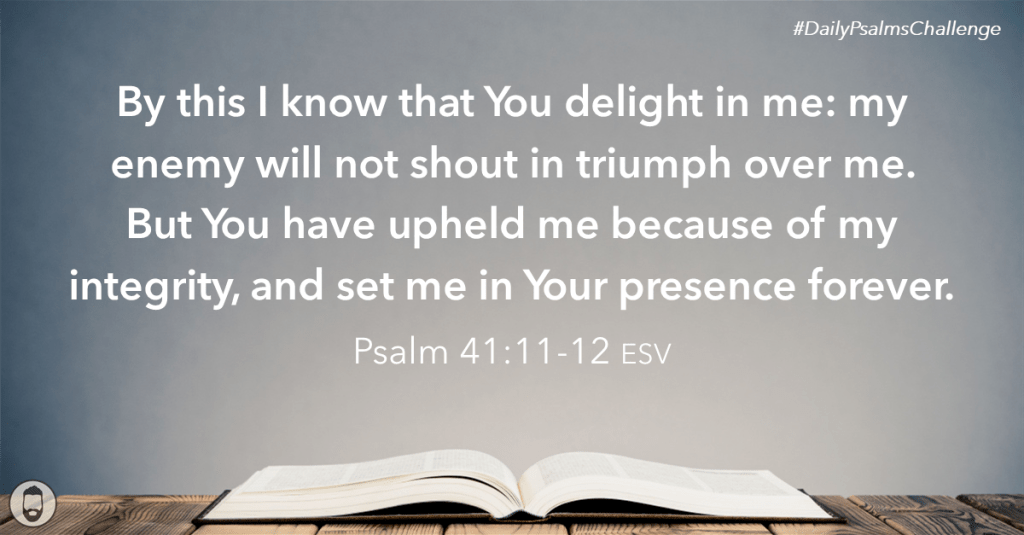
By this I know that You delight in me: my enemy will not shout in triumph over me. But You have upheld me because of my integrity, and set me in Your presence forever.
Psalm 41:11-12
Psalm 41 is a psalm of both confidence and lament, showing David’s trust in God even as he faces sickness, slander, and betrayal. It begins with a blessing on the “one who considers the poor” because the Lord will deliver him in “the day of trouble” (v. 1). David knows that God sees and cares for those who show mercy, and he clings to this truth as he cries out to God for grace and healing (v. 4).
David’s suffering at the hands of his enemies is worsened by the betrayal of a “close” and “trusted” friend, one who he once shared meals with (v. 9). His foes whisper in the shadows about his downfall, waiting for him to die and be forgotten (vv. 5-8). In his distress, David prays, “O Lord, be gracious to me, and raise me up, that i may repay them!” (v. 10). His hope doesn’t rest in his strength as he clearly has none and cannot overcome his foes on his own. His only hope is in God’s strength and faithfulness; he trusts that the Lord will uphold him and not allow his enemies to triumph over him (vv. 11-12).
The psalm ends with a beautiful doxology (formula for praising the Lord) that we can echo today: “Blessed be the LORD, the God of Israel, from everlasting to everlasting! Amen and amen.” (v. 13) This shows that, despite his suffering, David praises the Lord and exalts His name and that no matter what, God’s justice and mercy will prevail.
Seeing Jesus in Psalm 41
Psalm 41 finds its ultimate fulfillment in Jesus, the true and greater King. David’s words about the betrayal of a close friend in v. 9 are quoted by Jesus in reference to Judas Iscariot (John 13:18). Judas, who had walked with Jesus and shared meals with Him, turned against Him and handed Him over to His enemies.
Like David, Jesus was surrounded by those who whispered against Him, mocked Him, and plotted His demise (vv. 5-8, Matthew 26:3-4). Yet, unlike David, Jesus did not pray for deliverance from death but submitted to His Father’s will and plan by willingly enduring betrayal, suffering, and the cross for our salvation. Though His enemies thought they had triumphed, God raised Him up in victory (v. 10), exalting Him to His rightful place at the Father’s right hand (Philippians 2:9-11). And through His resurrection, Jesus secured ultimate healing, restoration, and vindication for all who have faith in Him.
Reflection
For those who have faced betrayal, affliction, or opposition, Psalm 41 offers a reminder that God sees, sustains, and vindicates His people. It is tempting to try and vindicate ourselves or to give up in the face of overwhelming circumstances, but Jesus has made a way for us. He endured so that we may have eternal life, leaving us with the reminder that this world is not all there is. For those who have confessed Him as Lord and believed He is risen from the dead (Romans 10:9), He saves not only from our sin but forevermore!
Even when we are afflicted, betrayed, or opposed, God remains faithful. He will sustain us. Follow the example of David in Psalm 41, and trust that the Lord delights in His people – that He delights in saving us.
The #dailyPSALMSchallenge gives us the opportunity to start 2025 in God’s Word by digging into a psalm a day. Each day will identify a key passage for us to meditate on as well as seeking to help us see Jesus in the psalm and reflect on what we have read.
I waited patiently for the LORD; He inclined to me and heard my cry. He drew me up from the pit of destruction, out of the miry bog, and set my feet upon a rock, making my steps secure.
Psalm 40:1-2
Psalm 40 is a testimony of God’s faithfulness in deliverance in David’s past and a plea for help in his present troubles. David recalls how the Lord rescued him from the pit of destruction – which he describes as a miry bog (think quicksand) – and placed his feet on a rock, giving him a new song of praise (vv. 1-3). But even as he celebrates God’s faithfulness, he finds himself once again in need of God’s delivance.
This psalm teaches us a powerful truth about living out the new life we have in Christ: it is a cycle of waiting, deliverance, and renewed dependence on the Lord. We live these out over and over, and God is faithful over and over. David is not relying on God’s past deliverance alone, though; he continually puts his trust in the Lord rather than in earthly sources (v. 4). He recognizes that God’s plans for him and His wonders are beyond measure (v. 5) and that true obedience is worth more than religious sacrifices (vv. 6-8).
David’s worship is more than religion, too. He says that in the “scroll of [God’s] book” will be written that he delights to do the will of God and that His law is “within [his] heart” (vv. 7-8). He has not held back in telling people “the glad news of deliverance” and God’s righteousness (v. 9). He has not been silent about God’s faithfulness or His salvation, especially being vocal about His steadfast love (v. 10). And because of this, David is confident that God will not hold back when it comes to His mercy, steadfast love, or faithfulness (v. 11) in the midst of his current troubles from his own sin (v. 12) and his enemies (vv. 13-15).
Even in the midst of trials, David ends with confidence: “You are my help and my deliverer; do not delay, O my God!” (v. 17). God did not delay to deliver and was not about to start then. Like David, we can hold fast to the Lord because “He who promised is faithful” (Hebrews 10:23)!
Seeing Jesus in Psalm 40
David’s words in Psalm 40 foreshadow and point to Jesus. The writer of Hebrews 10:5-7 applies vv. 6-8 to Jesus, showing that He is the true fulfillment of this psalm. He came to do the will of His Father, offering Himself as the perfect sacrifice for our sins.
And because of Jesus’s resurrection, our hearts should be consistently bursting with “new song” (v. 3) to give testimony for how Jesus saving us and giving us new life – His consistent track record of deliverance, even from death, moving our hearts to praise Him!
Reflection
We can trust, as David did here in Psalm 40, that God hears our cries, rescues us in His perfect timing, and will never forsake those who put their trust and hope in Him. Consider the following questions to help you see where you need to trust the Lord:
Are you in a season of waiting on the Lord? What have you seen in Psalm 40 and in your own life that helps you trust His timing?
How have you experienced God’s faithfulness in the past? How does remembering it give you confidence in Him today?
Look to the Lord. Cry out to Him from whatever miry bog of despair you find yourself in, and trust that He will put you firmly on Jesus, our rock and our redeemer (Psalm 19:14)!
Here’s a praise song to help you apply and praise the Lord with Psalm 40:
The #dailyPSALMSchallenge gives us the opportunity to start 2025 in God’s Word by digging into a psalm a day. Each day will identify a key passage for us to meditate on as well as seeking to help us see Jesus in the psalm and reflect on what we have read.
For His anger is but for a moment, and His favor is for a lifetime. Weeping may tarry for the night, but joy comes with the morning.
Psalm 30:5
Psalm 30 is a psalm of thanksgiving written for the dedication of the temple – a temple that would not be built until after his lifetime (1 Kings 8:63). The psalm is rich with imagery of deliverance, restoration, and eternal praise, offering both personal testimony from David about God’s faithfulness and invitation for everyone to worship the Lord.
David begins by praising the Lord for rescuing him from the brink of death, declaring, “O Lord my God, I cried to You for help, and You have healed me” (v. 2). This cry for deliverance illustrates God’s power to lift His people from the depths of despair – whether that be death or the grip of overwhelming circumstances.
This psalm reveals the beautiful truth that God’s anger is not everlasting but that His favor is (v. 5). In this, David reminds us that God’s discipline is never without purpose but leading us to restoration and joy. Even when we endure hardship, we can trust in the hope of morning’s light – a symbol of God’s faithful presence and renewed mercies.
David’s journey through pride and self-reliance is also highlighted (v. 6). Yet, when God hid His face, David was dismayed, recognizing his complete dependence on God’s sustaining hand and presence (v. 7). This moment of discipline humbled David, leading him to plead for mercy and restoration (vv. 8-10). Psalm 30 ends with a profound series of reversals: mourning turned into dancing, sackcloth exchanged for gladness, and silence replaced with eternal praise (vv. 11-12).
Seeing Jesus in Psalm 30
Psalm 30 finds its ultimate fulfillment in Jesus. The imagery of the resurrection in vv. 3 and 5 anticipates Jesus’s resurrection, who was brought out of the grace and now lives eternally. He endured the momentary wrath of God on the cross, bearing the penalty for sin, so that we might experience God’s favor and eternal joy. As David wrote, “Weeping may tarry for the night, but joy comes with the morning” (v. 5) – a hope fully realized in Christ’s victory over death on Resurrection Sunday morning.
Moreover, Jesus described His own body as a temple (John 2:19-21), making His death and resurrection the ultimate act of dedication. His suffering and exaltation enable us to approach God with boldness, clothed not in mourning, but in the gladness of salvation.
Reflection
Psalm 30 reminds us to praise God in every season – through grief and joy, discipline and restoration. How has God turned your mourning into dancing? In what ways can you use your own personal story of deliverance to encourage others to join in the praise of God’s holy name?
Take time today to reflect on the promise that “joy comes with the morning” (v. 5) and meditate on how the hope of Jesus’s resurrection shapes your perspective on suffering and the trials that you face.
The #dailyPSALMSchallenge gives us the opportunity to start 2025 in God’s Word by digging into a psalm a day. Each day will identify a key passage for us to meditate on as well as seeking to help us see Jesus in the psalm and reflect on what we have read.







 Just Keith Harris