“Adorned with the Word: Preaching” — a Refresh & Restore Bible Study

15 And let the peace of Christ rule in your hearts, to which indeed you were called in one body. And be thankful. 16 Let the word of Christ dwell in you richly, teaching and admonishing one another in all wisdom, singing psalms and hymns and spiritual songs, with thankfulness in your hearts to God. 17 And whatever you do, in word or deed, do everything in the name of the Lord Jesus, giving thanks to God the Father through him.[1]


Greetings Sojourners!

As I said in our last Bible study, this is a passage that I interact with regularly. It is a part of my life as a pastor. This leads us to look at something unique about interacting with God’s Word that is different from interacting with literature or other writings: God’s Word is “living and active” (Hebrews 4:12) and, most importantly, is interacting with us.

This is something that Christians sometimes take for granted. We do not have a holy book that merely contains rules and guidelines. No, we have a holy God who breathed out the words of Scripture (2 Timothy 3:16) – a God who rules and gives guidance Himself through His Spirit and written word!

This is different than mere literature. I interact with literature every day in my job as an English teacher, but the literature does not interact with me. There are aspects of good literature that affect my life. There may even be times where something that I read has a functional impact on how I live my life or show compassion or think about certain issues, but the author is not interacting with me – the text is just words. God’s Word is different. To illustrate this more clearly, look at how Paul David Tripp explains it:

“Not only do we have the gift of God’s Word, but we also have the gift of the Holy Spirit, who guides us, teaches us, and illumines the Word for us so that we can know, understand, confess, and repent. I not only need the content of God’s Word, but I also need the help of the Holy Spirit to enable me to understand it, to assist me to apply it, to empower me to live it, and to equip me to take its message to others. God rescues me from my foolishness not just by handing me a book, but also by giving me Himself to open the wisdom of that book to me. I don’t do this as an author. I write a book and move on. It is then up to the reader to make sense of what I have written. I don’t travel to reader after reader, sitting with them as long as it takes, shining light on the things I have written, making sure they understand, and helping them to apply the content of the book to their everyday lives. But that is exactly what God does. He goes everywhere His Word goes. He patiently sits with readers every time they open His book.”[2]

God’s Word is something else!

When we take today’s passage in its correct context, it is good that God’s Word is so special – so powerfully and providentially given to us – and alive. We are still in the portion of Colossians where Paul is teaching the Colossian church (and us in our churches today) to put on Christ, to be adorned by Him in our real lives.

If God’s Word is not living and active, we have merely memorized some facts or learned some literature. Trust me that, as one who has memorized a lot of facts and read/taught a lot of literature, facts and stories are not enough to change people’s lives. More is needed. And more is exactly what we are given in God’s Word. The Bible is more than a book. It contains everything that can be known about God. Look at how Wayne Grudem explains the necessity of Scripture for the Christian Life:

“It is not only true that all things necessary to become a Christian, live as a Christian, and grow as a Christian are clearly presented in the Bible. It is also true that without the Bible we could not know these things. The necessity of Scripture means that it is necessary to read the Bible or have someone tell us what is in the Bible if we are going to know God personally, have our sins forgiven, and know with certainty what God wants us to do.”[3]

I will say it again: God’s Word is something else!

So, let us dive into Colossians 3:16 and see what it means for our churches to be adorned – dressed in, wearing – the Word of God.

The Word of God is Foundational to Christian Worship (v. 16)

It should be able to go without saying that God’s Word is part of the foundation of our worship, but throughout the millennia that Christianity has existed – and the examples from the millennia of God’s people in the Old Testament hearing “Thus saith the Lord” – it is clear that people are foolish and often do the opposite of what they should. Sometimes, sinful people – even sinful pastors (or “pastors”) – just want to teach what they want to teach, whether it is in the Bible or not. Sometimes, ignorance of what the Bible says leads to teaching wrongly. One of those is malicious, and the other is woefully dangerous, but the fact of the matter is that stepping off the foundation of God’s Word leads to trouble. We get off track. Our following Jesus is replaced too easily by personal sin and idolatry. God’s Word illumined by God’s Spirit prevents that.

As we said in our last Bible study, Colossians 3:15-17 telling us what our local churches are to be adorned in – what they are to be wearing. Just as the attributes of sin listed in Colossians 3:5-9 are treated as filthy garments that need to be taken off and the attributes of faith listed in Colossians 3:10, 12-15 are treated as clean garments that should be worn, peace, gratitude, the Word of God, and praise are garments that should adorn our churches. One could say that, rather than worrying about what folks are wearing to church, we should be worried about what our churches are wearing. One should be able to see peace, gratitude, the Word of God, and praise so clearly that it marks us like camouflage fatigues do a soldier.

Paul tells the Colossian church to let “the Word of Christ dwell in you richly”. This goes deeper than merely being clothed in the Word; we are talking about being saturated with the Word. That word that the ESV translates as “richly” can be translated “richly furnished”, describing the way a house or a room is filled or covered. It can be translated “in large amount” or “in abundance” meaning that there is a fullness or surplus. It can be translated “in full measure” meaning that there is a certain measurement that is to be given and that all of it should be put out. The Word of God is not supposed to be a mere decoration or the prooftext of a talk or what the music we like is loosely based on; it is supposed to extravagantly and abundantly saturate our churches and worship gatherings to the point where it consumes all else.

Visitors should be able to leave our gatherings and say that we only want to talk, sing, and proclaim the Word of God, pointing them to Jesus. People who want to “play church” or merely masquerade as a Christian should be so disgusted by the reality presented in God’s Word that they have to take their ball and play elsewhere. The measure of God’s Word in our preaching and singing should be such that we leave hungering for no less in our daily walk with Christ. To paraphrase an old church joke, the Word of God should be so prominent in our worship – dwell in us so richly – that if a mosquito were to bite us in the parking lot after church, it would have to sing “There’s Power in the Blood”!

The Colossian church needed to hear this because they had false teachers coming in and trying to supplement God’s Word with what is “really” needed. In truth, they were trying to replace the Word with the supplement. The gospel was all their pastor Epaphras had to offer. False teachers cried for gospel+, but Paul is calling for the Colossians to understand that the gospel of Jesus Christ is sufficient on its own!

If false teaching is to have no more place in our gatherings than Epaphras or Paul wanted in the Colossian church, the Word must be central – and not just on Sundays or Wednesdays. It needs to be central in our daily lives. If we are to long for God as a deer, exhausted from being hunted, pants for streams of water (Psalm 42:1), we should desire to hear from Him, which is what happens when we seek Him in His Word. The Spirit takes the words He breathed out and penned through human hands and lights our path (Psalm 119:105, Proverbs 6:23), convicts our hearts (John 8:46, John 16:8-9), and declare the Word in our hearts and minds (John 16:13-15, Psalm 25:5).

But, just as the Ethiopian eunuch responded to Phillip’s question of whether he understood what he was reading (Acts 8:30-31), we must ask, “How can we unless someone guides us?” We should echo Paul’s question to the church in Rome, as well: How are we to hear unless someone preaches?

Let us look and see what God’s Word says about preaching so that we can ensure we are seeking to be adorned with God’s Word and dwell in it richly in our worship gatherings.

The Word of God Tells Us What Preaching is Supposed to Be

As we look at this, we need to understand that almost no church or Christian preacher (or “preacher”) is going to really come out and say that God’s Word is not enough. In fact, I encounter people posting on social media or putting out church-related content that calls for folks to get back to preaching the whole Bible and what they are calling for is how the Bible was preached when their generation was growing up or what their denomination stands/once stood for or Republican values or Democratic values or this or that. It is rare that any cry for returning to Bible preaching hails from the Bible (which should really tell us something). The question we must ask ourselves today is whether the Bible, being sufficient, shows within its pages what it is to have the Bible central in our worship gatherings – not just the preaching, but especially in the preaching – to have it dwell in us richly.

Good news, sojourner: the Bible does tell us. So, let us briefly look at a few passages of Scripture – Old Testament and New – that show us how to have the Bible central in our worship gatherings and preaching.


1 Timothy 4:13 – Until I come, devote yourself to the public reading of Scripture, to exhortation, to teaching.

This is something that challenged us a few years ago at Christ Community. The pastors were reading a book and diving into God’s Word together and found ourselves convicted by this command from Paul to a young pastor named Timothy. We planned and discussed how to get the practice of being devoted to “public reading” of Scripture to be something that was natural and did not seem weird or like some kind of religious exercise. We came up empty and prayed for God to make this clear for us. He did! One Sunday, we were going to read Psalm 51 as part of our musical worship. When we said, “Let’s read”, the congregation took us literally and all began reading the passage aloud together. It has become one of my favorite parts of our worship gathering, and we have seen people begin to be as excited – clapping hands and cheering, even – when we read powerful sections of Scripture that make much of Jesus!

All that to say, do not overthink this. If you want the Word to dwell in you richly, read it. Read it aloud in your worship gatherings. Have one person read it, or all read it together. I have been in some churches where they read from a Psalm or portion of a Psalm every week. It is beautiful. It is good for us. It points us away from the world and exalts God. Do it.


Nehemiah 8:8They read from the book, from the Law of God, clearly, and they gave the sense, so that the people understood the reading.

This passage takes place after the Israelite exiles return from Babylon to a war-ravaged Jerusalem. The temple is gone with nothing but the foundations left. They have been gone for seventy years, and some of them had never heard the Word – in their case, the Law or the Torah (Genesis, Exodus, Leviticus, Numbers, and Deuteronomy). Ezra gathered up all the people and “opened the book in the sight of all the people” with them standing, and he blessed God and simply read it to them (Nehemiah 8:5-6). Listen to that again, he read them the first five books of the Bible with them standing there the whole time. Church folks would run a preacher out! But look at the hunger they had – the devotion! Wow! Not only did they read it, but Ezra and a number of others listed in Nehemiah 8:7 took the time and “helped the people understand the Law, while the people remained in their places”. Imagine a sermon on the first five books of the Bible. Again, church folks would run a preacher out (or would have already run out themselves)!

Ezra and company did more here than simply translate the Hebrew Scripture for people who spoke Aramaic or to relay what the book said; they broke it down for them. They made an “exposition or explanation of the meaning”.[4] This reflected Ezra’s heart and commitment to not only be impacted by the Scriptures himself (Ezra 7:10) but to share the Word with the people he had been called to serve.

This is a beautiful picture of what preaching – at its most simple and pure center – should be: a model for all who teach and preach the Word of God”.[5] We should read the Word – as much or as little as the Spirit prompts. We should read it clearly. If God lays a chapter on the pastor’s heart, he should not rush through it. It is the centerpiece. It is the meat at the meal. And he should give the sense. The sermon should seek to help people understand what is read and see Jesus in it! Understand that I am not talking about a lecture or a mere lesson. This is not a class – it is the Christ! There should be a passionate plea for people to look to Christ. There should be a fire inside the bones of the preacher (Jeremiah 20:9) to point people to the Lord!


Luke 24:25-27 – And He said to them, “O foolish ones, and slow of heart to believe all that the prophets have spoken! Was it necessary that the Christ should suffer these things and enter into His glory?” And beginning with Moses and all the Prophets, He interpreted to them in all the Scriptures the things concerning Himself.

If there was ever a sermon I wished I could have been present for, this is it. Jesus, after His resurrection, met some men who were walking to Emmaus. They had no idea He was the Christ, and they were telling Him about what had just happened to Him on the cross. He sharply rebuked them, but what He did next is a beautiful picture of grace and the importance of Scripture. Jesus took the time with these guys and went through the Law and the Prophets to show them Him. Imagine having the Word interpret the Word for you! Remember: that is what the Spirit still does for us today!

If we want the Word to dwell richly in us, we must be content to soak in the Word – to have it drench our worship, both personal and corporate.


2 Timothy 2:15Do your best to present yourself to God as one approved, a worker who has no need to be ashamed, rightly handling the word of truth.

As you know, I am a high school English teacher as well as a pastor. I can assure you that no one truly enjoys studying, at least not all the time. But think about this differently. When a young man begins courting his love, does he not study her? Does he not spend time getting to know her likes and dislikes? Does he not try to learn the desires of her heart, especially as they pertain to him? Now, think about how the level of study goes down once he passes the test and wins his bride. He should still study, but the yearning and desire has waned. It should not be so for those called to handle the Word of truth.

Study should be done to ensure that the preacher has been faithful to the Word – that it has been read clearly and the sense clearly given. Care should be taken so that God’s intentions are carried out and not man’s. To clarify, rightly handling the word of truth is to handle it correctly and straightforwardly, “not in a way that is shifty or shady” but in such a way that upholds the truth it contains.[6]


Acts 17:10-11 – The brothers immediately sent Paul and Silas away by night to Berea, and when they arrived they went into the Jewish synagogue. Now these Jews were more noble than those in Thessalonica; they received the Word with all eagerness, examining the Scriptures daily to see if these things were so.

Studying God’s Word is not limited to preachers and pastors. The Berean Christians set an example that was sorely needed during that time so that they could weed out the false teachers. It is needed even more today. TikTok theology and Facebook farces masquerading as preaching need to be evaluated by the Word of God. We need to be testing all preaching we hear by the Word – not because we should not be able to trust our pastors, but because we know God is trustworthy and infallible. You should be testing what you read in our Bible studies here.

Is this work? Yes. Is it worth it? He is worth it. Jesus is worth it. Just as we could judge the lazy husbands in the illustration above for waning in their wooing of their wives once they won them, we should take steps to ensure that our love for Christ, the bridegroom of the Church, is not waning, too! The way that Luke described the Bereans makes it clear that their interest was not waning. They were enthusiastic in receiving the Word. They simply were not going to let their enthusiasm get the better of them. The Spirit gives this example of “searching the Scriptures as a pattern for all believers” and supports the “idea that the Bible can be understood rightly, not only by scholars but also by ordinary people who read it eagerly and diligently, with conscious dependence on God for help”![7]

Wrapping Up

There was a time when God’s Word was kept out of reach for everyday people. Before the printing press, it was almost impossible for people to have or to even contemplate affording a copy of God’s Word for themselves. Hand copied scrolls in the Old Testament era and copies of letters in the era of the New Testament were accessible in major areas, but not to be held in one’s own hands outside of a synagogue, church, or library. Then, there were those throughout the medieval period who sought to keep the Word of God even out of people’s mouths. Whereas Ezra made sure a clear sense was given, priests preached in Latin and were able to make the sense whatever they wanted. But there were those, men like Jon Huss and John Wycliffe, who put their lives on the line to get the Word of God in Bohemian or English so that their flock could have access to the Scriptures.

Why is it that in the times and places where God’s Word is forbidden that people are willing to risk life and limb to have the Word dwell richly in them? Why is it that in 2024 the Word dwells more richly in churches in countries where, if the powers-that-be find them with even a page or section of Scripture (which may be all they have), believers face jail or death?

Well, firstly, we who think we are serving Christ in peacetime are fools. There is no peacetime. The war is waging all around the world (1 Peter 5:8-10, Ephesians 6:10-20). We are all too distracted by the symptoms of the Fall than in Him who has come and is going to crush the head of the ruler of this world (Genesis 3:15). And do you know why we are distracted? Sadly, it is because we do not allow the Word of Christ to dwell in us richly. It does not affect the way we teach and admonish one another. Thankfully, there is time for repentance to begin – “time for judgment to begin at the household of God” (1 Peter 4:17).

So, just as we illustrated what the Word dwelling richly in our churches with Scripture. We close with three passages.

Isaiah 28:13a – And the Word of the Lord will be to them precept upon precept…, line upon line….

Acts 20:27 – …for I did not shrink from declaring to you the whole counsel of God.

2 Timothy 3:16-4:4 – All Scripture is breathed out by God and profitable for teaching, for reproof, for correction, and for training in righteousness, that the man of God may be complete, equipped for every good work.

I charge you in the presence of God and of Christ Jesus, who is to judge the living and the dead, and by His appearing and His Kingdom; preach the Word; be ready in season and out of season; reprove, rebuke, and exhort, with complete patience and teaching. For the time is coming when people will not endure sound teaching, but having itching ears they will accumulate for themselves teachers to suit their own passions, and will turn away from listening to the truth and wander off into myths.

Dear sojourner, let it be that we find ourselves part of a local church that longs to have the Word dwell richly. Let it be that we find ourselves part of a local church that makes much of Jesus by preaching His Word faithfully. The world and the sinful bent of our idol-producing hearts gives us a longing to have our feelings and egos caressed rather than having God’s Word lay us out bare before a holy God (Hebrews 4:13), but God has more for us.

Find a church that is committed to preaching the whole counsel of God – literally, not just saying it but taking it “line upon line” and “precept upon precept”. You will not have to worry about worldly relevance because we are not made for this world. It is not our home (Philippians 3:20). God’s Word shows us His Kingdom and His ways. Our sinful heart’s desire to have someone make us feel better, but what we need is for Christ give us new life. We do not need our hearts lifted; we need them replaced with a heart of flesh (Ezekiel 36:26)!

And when we get in the Word together and see the world for what it is, may the Lord grant us repentance and get us busy in His Kingdom agenda rather than distracted by the world. May He give us the noble mind of the Bereans and the passion of Ezra to see our communities reached with the gospel. Oh, that our local churches would have the Word dwell so richly in them that it spills out into our streets, communities, towns, states, nation, and the world. Because, praise be to God, when the “gospel of the Kingdom” is “proclaimed throughout the whole world as a testimony to all nations, then the end will come” (Matthew 24:14) – then, our King will come!

If you find yourself in a local church that does not center on Jesus and His Word – or if you are not in a local church at all, it is my prayer that God will move upon your heart and move you to a place where much is made of Jesus, the Jesus of the Bible, and that He would help His Word to dwell in you richly and not to be satisfied with less. May we be adorned with God’s Word. May it take the lion’s share of our worship gatherings. May it abundantly, extravagantly, and in full measure be our focus and our driving force. May it point us to our King!


[1] The Holy Bible: English Standard Version (Wheaton, IL: Crossway Bibles, 2016), Col 3:15–17.

[2] Paul David Tripp, Do You Believe? 12 Historic Doctrines to Change Your Everyday Life (Wheaton, IL: Crossway, 2021), 37-38.

[3] Wayne A. Grudem, Christian Beliefs: Twenty Basics Every Christian Should Know, ed. Elliot Grudem (Grand Rapids, MI: Zondervan, 2005), 17.

[4] John F. MacArthur Jr., The MacArthur Study Bible: New American Standard Bible. (Nashville, TN: Thomas Nelson Publishers, 2006), Ne 8:8.

[5] D. A. Carson, ed., NIV Biblical Theology Study Bible (Grand Rapids, MI: Zondervan, 2018), 779.

[6] Douglas J. Moo, “The Letters and Revelation,” in NIV Biblical Theology Study Bible, ed. D. A. Carson (Grand Rapids, MI: Zondervan, 2018), 2181.

[7] Crossway Bibles, The ESV Study Bible (Wheaton, IL: Crossway Bibles, 2008), 2121.

“Good News of Great Joy” or “The Weary World Rejoices” — Advent Reading for December 24

For I passed on to you as of first importance what I also received, that Christ died for our sins according to the scriptures, and that he was buried, and that he was raised up on the third day according to the scriptures, and that he appeared to Cephas, then to the twelve, then he appeared to more than five hundred brothers at once, the majority of whom remain until now, but some have fallen asleep.

1 Corinthians 15:3-6

He made the one who did not know sin to be sin on our behalf, in order that we could become the righteousness of God in him.

2 Corinthians 5:21

But what does it say? “The word is near to you, in your mouth and in your heart” (that is, the word of faith that we proclaim), that if you confess with your mouth “Jesus is Lord” and believe in your heart that God raised him from the dead, you will be saved. 10 For with the heart one believes, resulting in righteousness, and with the mouth one confesses, resulting in salvation. 11 For the scripture says, “Everyone who believes in him will not be put to shame.” 12 For there is no distinction between Jew and Greek, for the same Lord is Lord of all, who is rich to all who call upon him. 13 For “everyone who calls upon the name of the Lord will be saved.”

Romans 10:8-13


“Good News of Great Joy”
or
“The Weary World Rejoices”

We have spent a good bit of time this week in Luke 2:10 and the verses around it. The declaration of the angels to those poor and frightened shepherds should just about be memorized at this point: “Do not be afraid, for behold, I bring good news to you of great joy which will be for all the people”. Good news. Great joy. For all people.

The word translated “good news” is often translated gospel, and the message that the angels proclaimed on that hillside 2,000 years ago is a beautiful and succinct picture of the gospel. They preached that the Savior “who is Christ the Lord” was born for them – for those dirty, stinky shepherds – and that He could be found that very day in Bethlehem. It was news that would and could change the trajectory of their lives. They just needed to believe in Him and receive the salvation He had to offer – they would receive grace by faith through Him.

Now, I know that on the day they heard that gospel message Jesus was still laying in the feeding trough, still an infant, and was decades away from His death, burial, and resurrection. But the babe in the manger was still “the Word [become] flesh” (John 1:14). He was still the Lamb slain “before the foundation of the world” (Ephesians 1:4).

We sometimes want to overcomplicate things. We know the whole story and want to add and fill in the gaps in the angels’ proclamation that day, but the “good news of great joy” is still just as simple. In fact, Paul gives very succinct proclamations of the gospel, too. The first can be found in 1 Corinthians 15 where he tells the church at Corinth that he is passing on to them the most important message he had to offer – the very same message that he received himself: Jesus died for our sins according to the way that the Bible said He would, He was buried, and He rose from the dead on the third day exactly as the Bible and His own preaching said He would. That’s good news!

Paul’s second succinct gospel summary comes in his next letter to the church at Corinth in 2 Corinthians 5:21. In one complex little sentence, he shares that God put the sins of those who would be saved on Jesus. Jesus had never sinned and did not deserve any condemnation, but He willingly bore our sin on our behalf. Those who trust in Him no longer are under the condemnation and shame due to their sin; Jesus bore that (Colossians 2:13-14). In a great exchange, Jesus traded His righteousness for our sin. He bore the wrath of God and exchanged that for God’s favor. Basically, He traded His extravagantly full bank account for our bankrupt one so that when God looks upon those who Jesus has saved, He does not see their sinfulness but Jesus’ righteousness! That’s good news!

The gospel is good news, but there is also bad news. Those who do not confess Jesus as Lord and believe He died for their sins and rose again to not receive part in that great exchange. They remain in their sin. Their condemnation remains their own. It does not have to be that way. All who call out to Jesus in faith will be saved. Anyone who believes in Him will not be but to shame, but not believing leaves the shame where it belongs – on the sinner.

Look at how the Christmas hymn “O Holy Night” puts it:

Long lay the world in sin and error pining
Till He appeared and the soul felt its worth
A thrill of hope, the weary world rejoices
For yonder breaks a new and glorious morn
Fall on your knees!

Those who are without Jesus are still in their sin and “pining” after the wrong things, sinful things. But everyone – all people – have the opportunity to fall on their knees, believe in Him – confess Him as Lord, and repent of their sin. And those who do will not only have heard the good news of great joy but also to have believed it and received the salvation Jesus offers.

I love the phrase “good news of great joy” because 1) it is straight from the Bible, and 2) it captures what Jesus offers. But I also love the way the writer of “O Holy Night” captured what it is to be a sinner and receive Christ: “a weary world rejoices”. If you have been reading with us over these past two weeks, you have read snippets of the “good news of great joy”, but have you received it? Have you believed on Jesus, or are you still on the fence? If you haven’t, I urge you: fall on your knees, believe what the Bible says about Him, confess Him as Lord, and rejoice in the salvation He brings!

Reflection Questions:

  1. This devotion emphasizes different outcomes for those who believe in Jesus and those who do not. How does this reality influence your understanding of the urgency of sharing the gospel with others?
  2. There is an earnest call to embrace Jesus and rejoice in the salvation He brings in today’s devotion. How does this challenge you to examine your own beliefs and relationship with Jesus? What steps can you take to deepen your faith in Jesus?

"Kept Through the Trial: Jesus's Letter to the Church at Philadelphia" (The KING is Coming) Refresh & Restore | A JustKeithHarris.com Podcast

📖 Revelation 3:7–13We’re back!After a few months off, The King is Coming returns in 2026 with one of the most encouraging letters in Revelation — Jesus’s message to the faithful church in Philadelphia. In a world filled with opposition and weakness, Jesus opens a door no one can shut.In this episode, Keith Harris and Jamie Harrison explore:✔️ Jesus’s identity as the Holy One, the True One — God Himself✔️ What the “key of David” means and how Jesus alone opens and shuts✔️ The debated phrase “I will keep you from the hour of trial” — and how to read it biblically✔️ Why “little power” doesn’t disqualify faithfulness✔️ How being kept through the trial glorifies Christ’s strength in us✔️ What it means to be a pillar in God’s presence foreverThis church had no rebuke — only encouragement. And Jesus’s call still stands today: “Hold fast what you have, so that no one may seize your crown.” (Revelation 3:11, ESV)🔗 Missed earlier episodes in the series? You can click here to catch up and listen from the beginning.✍️ If you’d like to see a written version of this podcast, complete with footnotes and cross-references, you can find it here.
  1. "Kept Through the Trial: Jesus's Letter to the Church at Philadelphia" (The KING is Coming)
  2. Christ Has Come: The Promised King & His Gift of Love" (Advent 2025)
  3. Christ Has Come: The Promised King & His Gift of Peace (Advent 2025)
  4. Christ Has Come: The Promised King & His Gift of PEACE (Advent 2025)
  5. Christ Has Come: The Promised King & His Gift of HOPE (Advent 2025)

Who are You? Part 2 — a Refresh & Restore Bible Study

Do not lie to one another, seeing that you have put off the old self with its practices 10 and have put on the new self, which is being renewed in knowledge after the image of its creator. 11 Here there is not Greek and Jew, circumcised and uncircumcised, barbarian, Scythian, slave, free; but Christ is all, and in all.

12 Put on then, as God’s chosen ones, holy and beloved….[1]

Colossians 3:9-12a

"Kept Through the Trial: Jesus's Letter to the Church at Philadelphia" (The KING is Coming) Refresh & Restore | A JustKeithHarris.com Podcast

📖 Revelation 3:7–13We’re back!After a few months off, The King is Coming returns in 2026 with one of the most encouraging letters in Revelation — Jesus’s message to the faithful church in Philadelphia. In a world filled with opposition and weakness, Jesus opens a door no one can shut.In this episode, Keith Harris and Jamie Harrison explore:✔️ Jesus’s identity as the Holy One, the True One — God Himself✔️ What the “key of David” means and how Jesus alone opens and shuts✔️ The debated phrase “I will keep you from the hour of trial” — and how to read it biblically✔️ Why “little power” doesn’t disqualify faithfulness✔️ How being kept through the trial glorifies Christ’s strength in us✔️ What it means to be a pillar in God’s presence foreverThis church had no rebuke — only encouragement. And Jesus’s call still stands today: “Hold fast what you have, so that no one may seize your crown.” (Revelation 3:11, ESV)🔗 Missed earlier episodes in the series? You can click here to catch up and listen from the beginning.✍️ If you’d like to see a written version of this podcast, complete with footnotes and cross-references, you can find it here.
  1. "Kept Through the Trial: Jesus's Letter to the Church at Philadelphia" (The KING is Coming)
  2. Christ Has Come: The Promised King & His Gift of Love" (Advent 2025)
  3. Christ Has Come: The Promised King & His Gift of Peace (Advent 2025)
  4. Christ Has Come: The Promised King & His Gift of PEACE (Advent 2025)
  5. Christ Has Come: The Promised King & His Gift of HOPE (Advent 2025)

Greetings Sojourners!

It’s been a few weeks since we’ve last opened the Word together, and I am excited to continue in this section of Colossians. As I said in our last study together, this section between the what-to-take-off (sin – Colossians 3:5-9) passage and the what-to-put-on (Christ – Colossians 3:12-14) passage helps us to see who we are in Christ – and make sure whose we are.

These past few weeks have really made me look hard at both who and whose I am. You see, as I write these devotions, they affect me as well. Sometimes that’s more enjoyable than others. I remember being a teenager and looking forward to the days when the choices would be easier, and I wouldn’t have to make principled stands or decisions so regularly. I had no idea. The older I get and the longer I walk with Christ the closer I grow to Him (not in perfection but in dependence and worship). The closer I grow to Him the less I can adapt to the world or to others because I just don’t fit in here. My friend Shane Viner tells me that a lot of what causes me anxiety boils down to an incompatibility of my worldview – that is getting more “rooted and built up in [Christ] and established in the faith, just as [I was] taught” (Colossians 2:7) – with the fallen world around me. I am learning that what God has for me is better than what the world offers. I am learning to be satisfied with Him and what He has for me rather than the fleeting pleasures of sin and the world. I am learning that because His is who I am. But notice I said learning.

This takes us back to our last Bible study and an important point I want to make sure I reiterate here today: the Christian life is impossible apart from being in Christ (born again, saved). This is why I am so thankful for this little passage in between the take-off and put-on passages in Colossians 3. It is too tempting sometimes to try and stop certain behaviors under our own strength or to think that stopping behaviors means that we do not need salvation. By the same token, it is also tempting to try and do good things under our own strength and equate that with not needing salvation. The more I study the book of Colossians, the more I realize – the more I am learning that it is God’s Spirit and Word that convict me of sin and where I find the desire to stop sinning at all (John 16:7-8). And it is through the prompting of the Spirit through the Word that gives me the desire to do good, too (Ephesians 2:10).

Our last Bible study’s focus was making sure we know what it is to be a new creation – making sure we understand that it is only by Jesus meeting us where we were, dead in our trespasses and sins, and making us alive in Him by giving us new life that only He can give. Just like Ephesians 2:10 follows Ephesians 2:1-9, good works come out of the new life in Jesus and are accomplished by His strength. Salvation comes by grace through faith so that we cannot boast in ourselves. Good works are fruit of His Spirit working inside of us so that we cannot boast in ourselves. It’s not about us.

That’s why the focus of this particular section is the question “Who are you?” and “Whose are you?” The answer to these questions matters. Just as we stated in the last Bible study’s introduction, who and whose you are is answered clearly in Colossians 3:9-11. Just like a hinge makes the working of a door possible, who we are in Christ and whether we belong to Him matters. We have already looked at Colossians 3:9-10 and how those who are in Christ have a “new self” made “after the image of its creator”. Today, we will screw in the other two hinges by seeing who we are not as a lens for whose we are (Colossians 3:11) and realizing that all those who are in Christ are “God’s chosen ones, holy and beloved” (Colossians 3:12).

I Am Not Who I Was (v. 11)

How do you feel about your past self?

I have talked to many people over the years who struggle with feeling as if they are always judged by what they did in their past – of people remembering and defining them by past sins. Their testimony of Jesus changing their life by saving them and making them a new creation always seems to be minimized by the shadows of their past, or at least it seems that way sometimes or to some people. Praise the Lord, it is not that way in Christ.

In Colossians 3:11, Paul tells the church at Colossae, who if you remember had false teachers convincing them they needed Jesus plus Judaism, that their past selves (essentially, who they were before they came to Christ) are no longer their identity. Those who were dead in their trespasses and sins are now alive in Christ if they have been saved by grace through faith in Him. What could be a more drastic change than that? For the members of the church at Colossae, it did not matter whether their former heritage was Jewish or Gentile – what mattered was whether they had been saved. The focus was whether they were a new creation by Jesus rather than if they had been circumcised.

He was reminding this church that consisted of people from various cultures, regions, or sides and statuses in society regarding their new and lasting reality in Christ. If you think your church is made up of a motley crew, look at the Colossian church. Some of them were considered “barbarians” because they lacked the learning and culture that only true Greeks possessed.[2] Some were Scythians, people who lived along the Black Sea and were known for their uncultured, uneducated, and sometimes unruly ways of life.[3] Some lived lives of slavery – indentured servitude because they had debts they could not pay or were paying the penalty for crimes they had committed. Some were free and had people pay the debt owed them through the slavery and servitude we just mentioned. The whole list, basically their entire membership roll – Greek, Jew, barbarian, Scythian, slave, and free – was made up of people who had been labeled by categories that ostracized rather than welcomed.

Paul makes it clear that no such divisions exist in Christ’s church. That’s good news! You see, the Church is Christ’s bride! No, the divisions come from us, and all such divisions exist to elevate some and insult others. To put this in modern language speaking against the cultural, religious, and ethnic divisions people set up in churches today: Here there is not black and white, mainstream denomination or non-denominational, not raised in church culture, rough around the edges, struggling with clinging sins, or raised in a family that genuinely reads the Bible and prays together; but Christ is all, and in all.

I do not want to be cliché or lax here. This is serious because the true division is whether one is saved or lost, alive in Christ or dead in sin, new creation or not. This is not a means of saying we need to just go along and get along. It is saying that the Church is made up of those saved by grace through faith in Jesus Christ. It is saying that those who once were “separated from Christ, alienated from the commonwealth of Israel and strangers to the covenants of promise, having no hope” have been “brought near by the blood of Christ” which broke down “the dividing wall of hostility” between Jewish Christians and Gentile Christians (Ephesians 2:12-14)! It is saying that “there is no distinction between Jew and Greek; for the same Lord is Lord of all, bestowing His riches on all who call on Him” (Romans 10:12).

Being in Christ is bigger than that. His blood paid the adoption price by which we were redeemed and adopted as children of God (Galatians 4:4-5). His blood cleanses from sin and presents His Bride – the Church – to Himself without spot or blemish (Ephesians 5:27).

Praise God, we are not who we were if we are in Christ. And there is opportunity to come to Him rather than remaining dead in our sin.

Who are you? Whose are you?

I Am Chosen, Set Apart, and Loved by God (v. 12)

Those who have been saved by grace through faith in Christ alone are made new creations. I know I have said that often, especially as of late, but it needs to be said and said often! The old self and the death that comes with it has been cast aside, behold the new has come through the indwelling and work of the Holy Spirit. But sometimes, we just do not feel that way.

For Israel in the Old Testament, at least from the outside looking in, it seemed easy. They messed up repeatedly, and they repented repeatedly. Through God speaking to them by the mouths of prophets, they were warned ahead of time what the punishment for sin and rebellion against God would be. Through their own life experiences and the stories of what God had done in the lives of their ancestors, they knew that what God warned would actually come to pass. But they knew beyond the shadow of a doubt that when God’s people humbled themselves and repented that God would take them back. They knew this because He had “set His heart in love” on them and “chose…them…above all peoples” (Deuteronomy 10:15). They knew that God had set them apart from all others to be “a people holy to the Lord [their] God” and that they were “His treasured possession, out of all the peoples who are on the face of the earth” (Deuteronomy 7:6). They knew God was their Father and that He would give them “a heritage most beautiful of all nations” (Jeremiah 3:19).

But what about the Christians, especially those of Greek, barbarian, or Scythian heritage? This language would seem foreign to them. It might even seem to exclude them from being chosen, set apart, or loved by God – which is exactly what the false teachers were trying to get them to believe to add their fruitless religious practices.

This is why it is important to know who you are. This is why it is important to know whose you are.

There is something to be said for knowing that you have a Father who loves you – a God who set His affection on you and set you apart. This is the point of taking off sin – not to keep us from doing things we enjoy but to help us receive all that He has for us. If you are in Christ, He died for you – you specifically – and has known you since before the foundation of the world. He loved you and gave Himself for you despite the sins you would commit – sins He knew you would commit (Romans 5:8). Not only did He set His affections on you and loves you, but He set you apart to be different and live for Him – to excitedly and willingly serve Him and be His hands and feet in the world!

The language in these verses – chosen, set apart, loved by God – are all terms that God used to describe His people in the Old Testament, but they are the exact same terms He uses for His people in the New Testament. These three terms “are transferred from the Old Covenant to the New, from the Israel after the flesh to the Israel after the Spirit”[4] and help us to remember that we are God’s people, that He has set His affection on us, that He has adopted us into His family. The assurance that Israel had in their wanderings and wayward times is the same assurance we can have today. If we are in Christ, we know that we have a good Father who loves us and cares for us. Of course, there is discipline when we sin, but it is through God’s chastening and discipline that we can know we are His children (Hebrews 12:5-8)! He chooses us because He loves us. He sets us apart because He loves us. He. Loves. His. Children.

This is such a beautifully humbling truth. God did not choose, set apart, and love us based on our wisdom or strength – nor is it dependent upon our ethnicity (1 Corinthians 1:26). No – and I speak from personal experience here that is evidence of what the Bible says, God chose me despite my lack of wisdom, strength, and worthy or noble heritage so that people will boast in what Jesus did and does in me (1 Corinthians 1:27-31). This does not bother me. I know I am a sinner. I know that apart from the grace and mercy of Jesus that I would hopelessly continue in the wages of my sin (Romans 6:23). I am humbled that God would choose to love one such as me. But I am much more thankful that I get to know who I am because of whose I am.

It is my prayer that you know that, too.

Wrapping Up

Sometimes, when people act foolishly, they get asked “Who do you think you are?!” It is meant as a call to think about what you are doing and how you think you get to act that way. It is often directed toward people who are showing out in a bad way or placing their own desires above the people around them or those in charge. In the context of today’s passage, I ask you, dear Sojourner, who you think you are considering Christ.

If you claim to be saved, are you living in new life in Christ or are you still walking as dead people in your trespasses and sins? Do you claim Christ and live like Hell? Does your life bear the imprint of His choosing you, loving you, or setting you apart?

These are tough questions and not meant to make you doubt. They are tough questions that we should be asking ourselves because this is something we want to be sure of. Before we get into what aspects of Christ the new life puts on, we need to understand that these are not works that earn salvation but imprints of salvation.

I do not know your heart, but you do – and God does. But I do know this: it changes one’s life to be chosen by God, set apart by Him, and loved by Him. It is a game changer to understand that it is a beautiful thing to be adopted by Him into His family despite whatever sinful past we bring to the table. And there is no greater status change than going from death to life.

All of that comes only from Him. It is my prayer that, if you are in Christ, you are encouraged to live the life He offers – to be different – to have Him seen in you so that you are recognized as little Christs. But, if you are not in Christ, it is my prayer that you are not able to operate as if you were. I do not want to be so clever as to mask the reality that eternal hope lies only in Christ and the Bible makes it clear what being in Christ looks like – and what it does not look like. I pray the same thing for my faith family at Christ Community. I pray the same thing for my family. I pray for the same thing for me. May God make His presence in our lives clear, or may He save us and draw us near if we do not know Him.

Hallelujah. Amen.


[1] The Holy Bible: English Standard Version (Wheaton, IL: Crossway Bibles, 2016), Col 3:9–12.

[2] John F. MacArthur Jr., The MacArthur Study Bible: New American Standard Bible. (Nashville, TN: Thomas Nelson Publishers, 2006), Ro 1:14.

[3] Crossway Bibles, The ESV Study Bible (Wheaton, IL: Crossway Bibles, 2008), 2298–2299.

[4] Joseph Barber Lightfoot, Saint Paul’s Epistles to the Colossians and to Philemon, 8th ed., Classic Commentaries on the Greek New Testament (London; New York: Macmillan and Co., 1886), 219.

“There’s No Such Thing as Imitation Fruit” — a Refresh & Restore Bible Study

Put to death therefore what is earthly in you: sexual immorality, impurity, passion, evil desire, and covetousness, which is idolatry. On account of these the wrath of God is coming. In these you too once walked, when you were living in them. But now you must put them all away: anger, wrath, malice, slander, and obscene talk from your mouth. Do not lie to one another, seeing that you have put off the old self with its practices 10 and have put on the new self, which is being renewed in knowledge after the image of its creator. 11 Here there is not Greek and Jew, circumcised and uncircumcised, barbarian, Scythian, slave, free; but Christ is all, and in all.[1]


Greetings Sojourners!

I usually begin with a little banter, but my battling a migraine necessitates jumping right into the meat of today’s study. Please check out last week’s Bible study for the context (because context is key!).

Just like the pain in my head, sin lingers and clings to us. For the past two Bible studies in our Jesus Over All study (June 29 and July 13), we have been diving into the way Paul approaches the subject of sin in his letter to the Colossian church and how they (us, too) were taught the importance of putting it to death and taking it off and out of their lives. It seems like these past two weeks are negatively focused – and they were if you are looking at the dire circumstances and wages of sin, but part of what makes the gospel good news is what Jesus does with the bad news. Sin produces death. Jesus gives life. To a certain extent, knowing the fragility of life and the existence of death can make one’s life precious. Knowing that Jesus has saved us from the wrath of God our sin was due makes eternal life more precious. So, stick with me as we move through the last of what we need to take off (negative) to walk with Christ so that next week, when we look at what we need to put on (positive), our study can lead to worship in our lives!

As we did with verses 5-7, we are going to rely on a single lexicon/dictionary (Spiros Zodhiates’ The Complete Word Study Dictionary: New Testament[2]) and lay out the definition and verses that contain the same word so that we get the full picture and context and avoid the temptation to cherry-pick definitions to suit bias. Also, remember that while this – as with vv. 5-7 – appears to be a list of sins, it is neither exhaustive (meaning these lists are all the sins there are) nor is the inclusion of any of these sins because of Paul’s or my dislike of certain behaviors. Each sin included in these lists needs to be put to death or taken off because God’s Spirit chose for these to be written here, “breathed out” by God through Paul’s writing, and “profitable for teaching, for reproof, for correction, and for training in righteousness” (2 Timothy 3:16). If offended – as I have been in studying Colossians 3:5-11 and writing these Bible studies, ask yourself what God is trying to teach you – or what correction do you need in your beliefs to square them with the Bible – or what training is God’s Spirit applying to your life that you may be righteous – or what course-correction does your lifestyle need in order to be in step with God rather than your own desires?

Now You Must Put Them All Away (v.8)

As in verses 5-7, these lists are specific sins that were plaguing the church at Colossae (and likely its sister church Laodicea), but the list in verse 8 seems to be more focused with sins within oneself, as in one’s heart-set and mind-set, than in specific actions (as in v. 5). This list shows more of what is going on within a person rather than the specific sins that make them visible in one’s life. Also, these are the sins Paul says are sins in which we “too once walked” and lived in but have no place in the new life in Jesus Christ. Think of it like this: we are sin-sick and have gone to the Great Physician to see what treatment needs to occur. Last week’s sins (vv. 5-7) are seen through the physical examination and may even appear on an x-ray. They are symptoms that are observable. But our Physician is thorough and because “no creature is hidden from His sight” and all “must give an account” to Him who is “living and active” and discerns “the thoughts and intentions of the heart” (Hebrews 4:12-13), we have a deeper view, akin to an MRI or PET scan. The sin in verse 8 is malignant within us and festers within our hearts before its symptoms are seen in our lives. These sins can be hidden to all but God and need treatment by God’s Spirit so that those who are in Christ are being and have been brought from dead in their trespasses and sins – again “in which [we] once walked” (Ephesians 2:1-2) – to “made alive…in Christ Jesus” (Ephesians 2:4-5).

Those who believe in Christ and confess Him as their Lord and Savior (Romans 10:9-10) are saved from their sin and the wrath that accompanies it. But this is not a new or a New Testament phenomenon; it goes all the way back to how God showed it would work back in the Old Testament prophecies (Ezekiel 36:26-27):

And I will give you a new heart, and a new spirit I will put within you. And I will remove the heart of stone from your flesh and give you a heart of flesh. And I will put my Spirit within you and cause you to walk in my statutes and be careful to obey my rules.

It was made abundantly clear – and continues to be made clear through God’s Word – that one’s life matches one’s spiritual standing. For those who are dead in their trespasses and sins, that death is eventually apparent – those sins do not stay hidden within one’s nature because one’s nature always exhibits itself. Jesus Himself clarified this in Matthew 15:18 when He said that “what comes out of the mouth proceeds from the heart, and this defiles a person”. What is inside will come out! In the same way that one’s sin goes from nature to behavior, those who are in Christ and have His Spirit dwelling within them will bear fruit of that relationship. The fruit – “love, joy, peace, patience, kindness, goodness, faithfulness, gentleness, self-control” (Galatians 5:22-23) – will be visible – will come out – because the life that comes from believing and learning Jesus (Ephesians 4:20-21) is not a learned set of skills and cannot be faked. It will do what Paul prayed for the Colossian church in chapter 1:10: bear “fruit in every good work” exhibiting that we have increased “in the knowledge of God”! Notice that I did not say those good works earn the life; they are results of the life! Think about how one assesses whether someone is alive or dead. How can you tell the difference? Easy! The living person has life, and there is no life in a corpse. Like Ezekiel wrote in the verse we read earlier: God puts His Spirit in His people, His Spirit causes His people to walk in His ways, and even the desire to do good comes from Him.

Let me repeat some of that to make sure that we do not miss it. Being in Christ is not a learned set of skills and cannot be faked. It is a state of being. We are. Or we ain’t.

So often the world tells us to “fake it ‘till you make it.” Well, dear Sojourner, that just will not cut it with the Christian life because what God does is the genuine article. Just as sure as turkey does not make tasty bacon and tofu will never satisfy like a ribeye, only the divine power of God by grace through faith in the finished work of Jesus Christ will produce the genuine article. Christ alone brings the dead to life (Ephesians 2:4-5). And we need to be sure that if we are not taking off these sins Paul shows us here and are content to live in them, we need to understand that, even if we fool the whole world, Jesus will recognize us as either the genuine article or imitation because He will recognize us by our fruits (Matthew 7:20).

Note that the way I illustrated that could be seen as humor above, but it is not. It is heavy – eternally heavy. It is not meant to make something serious a joke but is what is known as satire – to show how ridiculous it would be to believe that one is in Christ all the while wearing every fixture and tapestry of sin. It cannot be so. No one ordering and paying for a steak would be satisfied with a soybean gelatin mold that looks like and smells like beef. One taste will tell the truth. You can fool your congregation, your pastor, or your grandmama, but imitation will not stand the test on the day of judgment but will hear some of the most chilling words found in all of Scripture: “I never knew you; depart from me you workers of lawlessness” (Matthew 7:23).

So, taking these sins off is important. We cannot continue to try and be satisfied by the imitation joy and empty pleasure that sin offers, even within our hearts and minds. The world wants us to think that as long as we do not say it or do it there is no danger, but God knows best. He knows what we need (Him) and what we do not need (sin). With that in mind, here are those things that the Holy Spirit (through Paul) is telling us do not belong in our lives – that which needs to be taken off and put away from us.

  • “anger” ὀργή (orgḗ) — We all know what anger is, just like we know when anger is appropriate or not. In the context of Colossians 3:8, this is an enduring state of mind. Aristotle defined this particular Greek word for anger as “desire with grief”.

    For me, this is the type of anger that seems like it is going to produce relief in me by blowing off steam but ends by immediately making me feel horribly guilty.
    • Mark 3:5 – And He looked at them with anger grieved at their hardness of heart, and said to the man, “Stretch out your hand.” He stretched it out and was restored.
    • Romans 12:19 – Beloved, never avenge yourselves, but leave it to the wrath of God, for it is written, “Vengeance is mine, I will repay says the Lord.”
    • Ephesians 4:31 – Let all bitterness and wrath and anger and clamor and slander be put away from you, along with malice.

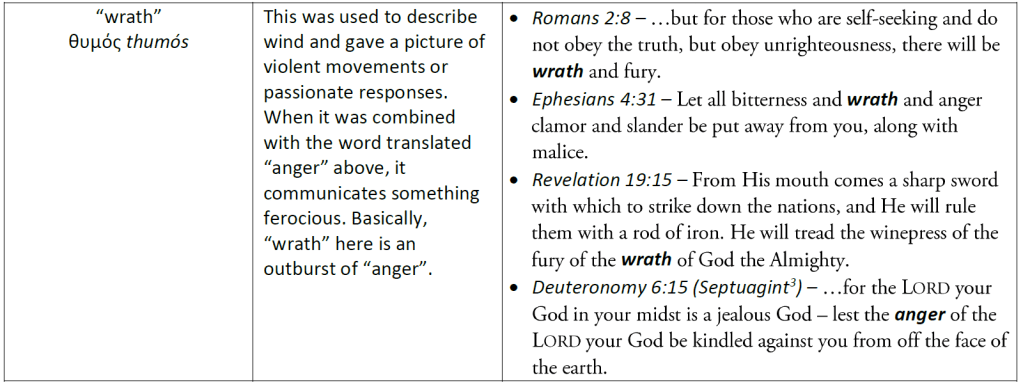
  • “wrath” θυμός thumós — This was used to describe wind and gave a picture of violent movements or passionate responses. When it was combined with the word translated “anger” above, it communicates something ferocious. Basically, “wrath” here is an outburst of “anger”.
    • Romans 2:8 – …but for those who are self-seeking and do not obey the truth, but obey unrighteousness, there will be wrath and fury.
    • Ephesians 4:31 – Let all bitterness and wrath and anger clamor and slander be put away from you, along with malice.
    • Revelation 19:15 – From His mouth comes a sharp sword with which to strike down the nations, and He will rule them with a rod of iron. He will tread the winepress of the fury of the wrath of God the Almighty.
    • Deuteronomy 6:15 (Septuagint[3]) – …for the Lord your God in your midst is a jealous God – lest the anger of the Lord your God be kindled against you from off the face of the earth.

  • “malice” κακία kakía — This word describes a wickedness that occurs simply because it is a habit in the minds of evil people. It is used to describe people who want to do evil and comes from those who are genuinely wicked (and who enjoy doing evil).
    • Ephesians 4:31 – Let all bitterness and wrath and anger clamor and slander be put away from you, along with malice.
    • Titus 3:3 – For we ourselves were once foolish, disobedient, led astray, slaves to various passions and pleasures, passing our days in malice and envy, hated by others and hating one another.
    • 1 Peter 2:1 – So put away all malice and all deceit and hypocrisy and envy and all slander.
    • Proverbs 1:16 (Septuagint) – …for their feet run to evil and they make haste to shed blood.

  • “slander” βλασφημία blasphēmía — This word is often grouped together with the sin of false witness (like lying but much more purposeful and pointed). It is damaging someone’s reputation by saying or reporting things that wickedly seek to hurt or wound.
    • Matthew 15:19 (also Mark 7:22) – For out of the heart come evil thoughts, murder, adultery, sexual immorality, theft, false witness, slander.
    • 1 Timothy 6:4 – …he is puffed up with conceit and understands nothing. He has an unhealthy craving for controversy and for quarrels about words, which produce envy, dissension, slander, evil suspicions….
    • Ephesians 4:31 – Let all bitterness and wrath and anger clamor and slander be put away from you, along with malice.

The last in this list is “obscene talk” which essentially goes back to what Jesus said in Matthew 15:18 – what comes out of our mouths evidences what is really in our hearts. And, ultimately, it is the heart that matters. Works do prove faith (James 2:17), but there are those who appear to do good works that fall away.

Wrapping Up

There was a man named Demas whom Paul mentions at the end of Colossians. In Colossians 4:14, he tells the church at Colossae that Demas “greets” them just like Luke did. In Philemon (which was mailed with the letter to the Colossians), Paul calls him one of his “fellow workers” (Philemon 24). Yet in 2 Timothy 4:10 when Paul was in his final years and a prisoner in Rome, he reported that Demas, “in love with this present world”, deserted him and went to Thessalonica.

There is a saying in contemporary America that is used to justify whatever a person wants to do, especially things that someone might call sinful: “The heart wants what the heart wants.” It is the verbal equivalent to shrugged shoulders and communicates that people cannot help what they want to do. This is right and wrong. For those who do not know Christ, it is right. They want what they want and can do what they want. One cannot get more lost. Those who are dead in their sin are dead and cannot get dead-er. But the Bible does not leave room for those who profess Christ to take that path.

Demas was able to act like a Christian convincingly. He even convinced Paul and Luke! But he could not hide his heart – eventually he did not want to hide it anymore. 1 John 2:19 tells us that the enduring mark of faith in Christ is whether we continue in the faith – that those who “went out from us” were not “of us” because those who are in Christ continue in the faith until the end. Pretend does not endure. Acting does not endure. But what Jesus does on the inside is long lasting. So, Sojourner, we have some soul-searching to do.

As you read this, you may be tempted to work or try to earn our way out of any of these sins that are present in our lives because seeing the reality of our sin can be overwhelming. That will not work. Remember, the wages of sin is death. Our hope is not in what we can do – which amounts to our sin, but in the grace given to us in Christ. We need His work.

We need to fix our eyes on Jesus and repent, trusting in His Spirit to give us what He promised back in Ezekiel 36 – to see His fruit bear in our lives.

Let Psalm 139:23-24 be our prayer as we look at our own lives and seek to take off these sins – as we desire to love and follow Jesus and not allow our love for our sins draw us away like Demas:

23 Search me, O God, and know my heart! Try me and know my thoughts! 24 And see if there be any grievous way in me, and lead me in the way everlasting!

I am praying for you as always and want you to know that you are not alone in the struggle against sin. Sometimes it seems harder to take certain sins off than others but know this: Jesus has paid the penalty for our sin and made a way – the only Way (John 14:6) out of death and into His eternal life. Will you trust Him or continue in sins? Do you love Jesus, or are you in love with this present world? I pray He helps you see which and draws you to Himself.


[1] The Holy Bible: English Standard Version (Wheaton, IL: Crossway Bibles, 2016), Col 3:5–11.

[2] Spiros Zodhiates, The Complete Word Study Dictionary: New Testament (Chattanooga, TN: AMG Publishers, 2000).

[3] The Septuagint is a Greek translation of the Old Testament in the 3rd-2nd centuries BC by Jewish scholars who understood Hebrew (and Greek) better than anyone who has lived in the last 1,800 years.


Go back

Your message has been sent

Warning
Warning
Warning
Warning.

Sermon: “A Life of Repentance” from Psalm 51


Introduction

Reinforcing the Necessary Pre-suppositions:

  1. The Bible is what it claims to be (2 Timothy 3:16-17). It is God’s Word. It is true. It contains everything that can be known about God and is sufficient to bring us to Him.
  2. There is a difference in the lives of those who know Christ – are saved/born again – and those who are not – lost/dead in their sin (Ephesians 2:1-10, 4:20-24).
  3. God has authority over His creation. What He intended to be right is right, and what He calls sin is sin (Isaiah 5:20). He is the supreme authority of such (John 1:1-5).
  4. Salvation is by grace through faith in Jesus Christ alone (Ephesians 2:8), “not a result of works, so that no one may boast” (Ephesians 2:9).
  5. If one is in Christ, His surpassing worthiness changes one’s life to the point that the things of this world pale in comparison to knowing Him (Philippians 3:7-11) and God’s Spirit produces change – or fruit (Galatians 5:16-26) – that is evident in real life.

Repentance is, per Wayne Grudem, “a heartfelt sorrow for sin, a renouncing of it, and a sincere commitment to forsake it and walk in obedience to Christ”.[1]


Breakdown of Psalm 51:

Repentance Means Seeking God’s Grace and Mercy (vv. 1-2)

  • God’s forgiveness is fueled by His “steadfast love” and “abundant mercy” (v. 1).
  • God’s forgiveness cleanses us from our sin and covers it by the blood of Christ (vv. 1b-2).

Repentance Requires Us to Own Up to Our Sin (vv. 3-6)

  • If we are in Christ and are filled with His Spirit, we know what we have done and are convicted of its wrongness (v. 3).

  • If we are in Christ, we understand that He is holy and worthy and that sin is against and opposed to Him – and that His righteous judgment is fair/final and His grace is good (v. 4).

  • If we are in Christ, we recognize that sin is part of our nature and causes consistent struggles (v. 5).

  • If we are in Christ, we are loved by God despite our failings and can trust that God delights in hearts changed by Him through salvation (v. 6).

      Repentance Desires Restoration and Renewal (vv. 7-12)

      • Sin damages and dirties, requiring us to need purging, cleansing, and restoration (v. 7).

      • The process of repentance can be painful, but even the scars produce worship in the end (v. 8).

      • Repentance is a beautiful picture of a restored relationship with God – from death to life, lost to saved, being distant from the Father to drawn into His embrace (vv. 9-10).

      • Repentance means turning from sin and seeking God even if the consequences of sin never allow things to return to what they once were (v. 11).

      • By God’s grace and mercy, joy returns and, by the power of His Spirit, He upholds us and carries us through (v. 12).

      Repentance Produces Worship and Worshipful Service (vv. 13-17)

      • Sin stops service to God. Repentance begins the restart. (v. 13)

      • Worship is the only fitting response to being delivered from sin and is a result of repentance, which is worship (vv. 14-15).

      • Repentance is not religion. It is a response to God’s Spirit who gives us “a broken and contrite heart” refining our lives to be holy and acceptable to Him. (vv. 16-17).

      Repentance Strengthens the Body of Christ (vv. 18-19)

      • Individual repentance produces lives that impact the part of the world where God has us, meaning the Spirit of God is active in those who follow Christ and produces fruit in the real world (vv. 18-19).

      Application – Bear Fruit in Keeping with Repentance

      1. How does your life fit with a lifestyle of repentance?
      2. Is your repentance bearing fruit?
      3. Where is your hope?


      [1] Wayne A. Grudem, Systematic Theology: An Introduction to Biblical Doctrine (Leicester, England; Grand Rapids, MI: Inter-Varsity Press; Zondervan Pub. House, 2004), 713.


      “Be Killing Sin” — a Refresh & Restore Bible Study

      Put to death therefore what is earthly in you: sexual immorality, impurity, passion, evil desire, and covetousness, which is idolatry. On account of these the wrath of God is coming. In these you too once walked, when you were living in them. But now you must put them all away: anger, wrath, malice, slander, and obscene talk from your mouth. Do not lie to one another, seeing that you have put off the old self with its practices 10 and have put on the new self, which is being renewed in knowledge after the image of its creator. 11 Here there is not Greek and Jew, circumcised and uncircumcised, barbarian, Scythian, slave, free; but Christ is all, and in all.[1]

      Colossians 3:5-11

      "Kept Through the Trial: Jesus's Letter to the Church at Philadelphia" (The KING is Coming) Refresh & Restore | A JustKeithHarris.com Podcast

      📖 Revelation 3:7–13We’re back!After a few months off, The King is Coming returns in 2026 with one of the most encouraging letters in Revelation — Jesus’s message to the faithful church in Philadelphia. In a world filled with opposition and weakness, Jesus opens a door no one can shut.In this episode, Keith Harris and Jamie Harrison explore:✔️ Jesus’s identity as the Holy One, the True One — God Himself✔️ What the “key of David” means and how Jesus alone opens and shuts✔️ The debated phrase “I will keep you from the hour of trial” — and how to read it biblically✔️ Why “little power” doesn’t disqualify faithfulness✔️ How being kept through the trial glorifies Christ’s strength in us✔️ What it means to be a pillar in God’s presence foreverThis church had no rebuke — only encouragement. And Jesus’s call still stands today: “Hold fast what you have, so that no one may seize your crown.” (Revelation 3:11, ESV)🔗 Missed earlier episodes in the series? You can click here to catch up and listen from the beginning.✍️ If you’d like to see a written version of this podcast, complete with footnotes and cross-references, you can find it here.
      1. "Kept Through the Trial: Jesus's Letter to the Church at Philadelphia" (The KING is Coming)
      2. Christ Has Come: The Promised King & His Gift of Love" (Advent 2025)
      3. Christ Has Come: The Promised King & His Gift of Peace (Advent 2025)
      4. Christ Has Come: The Promised King & His Gift of PEACE (Advent 2025)
      5. Christ Has Come: The Promised King & His Gift of HOPE (Advent 2025)

      Greetings Sojourners!

      I hope those of you reading this in the US had a good and relaxing 4th last week – and that y’all reading it elsewhere are well, too! As I reflected on the idea of independence and freedom, I found myself thinking of a verse again and again that reminded me of something really beautiful regarding today’s passage. The verse has been Galatians 5:1:

      For freedom Christ has set us free; stand firm therefore, and do not submit again to a yoke of slavery.

      This verse reminds me that there is beautiful freedom in Christ that does not come from sin. He is not keeping us from joy or happiness by telling us that the sin we want to commit is sin; He is freeing us from the bondage we do not know accompanies sin.

      This comforts me as I ponder my own life and sin (which, if you read or listened to last week’s Bible study was the challenge). I am about to turn 38 at the end of this month, and reflecting is kind of what I do now.

      When I was younger, I had plans for where I thought I would be by this point in my life. At 7, I wanted to be a “singing-preacher” (what I thought a minister of music was). At 17, my plans included teaching for a few years, getting my master’s degree, becoming a principal, and having a doctorate by 35 years old. At 27, I wanted to overcome the burnout and depression I was experiencing. I had burned out and quit ministry a few weeks before my 30th birthday in 2015 and moved back home.

      If someone had told 2015-me that I would have the contentment and peace I have today in my walk with Christ and in my home life, I would have laughed in their face and probably told them they were full of something. I spent so long wanting to be something that I lost track of who I was. My identity became wrapped up in my job. That is a very modern way of putting the situation. Biblically, workaholism is a form of the sin of pride. Burnout, for me, was when my prideful pursuit of being somebody turned into the realization that work or status could never give me what I was looking for – was never intended to provide the feelings and validation I craved (really, coveted, which is sinful itself).

      That sounds really negative (it definitely felt negative), but as I have learned by reflecting, God has blessed me and fulfilled me over the past seven years in ways I never could have imagined. The first blessing was finding Him in His Word and in prayer and realizing that He had never moved. The second blessing is realizing how amazing and beautiful a life God had built me by giving me Candice and the kiddos. There were more blessings than I can possibly list here, but ultimately, finding my identity in Christ helped me see which aspects of my life needed to removed – or put to death. Work had to have its place. Success and recognition had to have theirs, too. Eventually, after a lot of repenting, life rearrangement, correction through the Word, and more than a little training from Candice, I found joy in pastoral ministry that I never had in the years prior to burning out.

      I do not want you to miss this: the issue that burned me out was sin. Pride is a dangerous thing. It is like the carbon monoxide of sinfulness – tasteless, odorless, and deadly. It crept in subtly and slyly. It began with a mix of not getting the recognition I felt I deserved. People told me that. Church folks, even. Then, I got a taste of recognition. Humility left quickly. I wanted more. The idea that I could become something quickly overtook my ministerial life. The fulfillment that came from compliments and attaboys was fleeting. The larger my pride became, the smaller my satisfaction. I just wanted to quit – and did! But pride tainted that, too. I faked a sabbatical so I would not have to live with the reality of failure, intending to extend it until I could bear the reality that I was spent.

      As I said, there were things in my life that needed to be killed – that needed to be dead to me. There were areas of my life that had to be pruned, cutting away some of the weeds and thorns that were keeping me from growing. And in that is freedom. Christ had set me free from the bondage created by my own sin. Hear that: my own sin. I am not discounting the powers and principalities that are at work in the world – satanic and demonic (Ephesians 6:11-12). I am simply owning how my own sinful desires were leading toward bondage and foolishness I am thankful not to have fully experienced (Jeremiah 17:6, James 1:13-15).

      That is what Paul is talking about in this section of Colossians. In the midst of their dealing with false teachers, they had sin of their own that needed to be taken off as well as aspects of being like Christ that they needed to put on. This was not Paul molding the Colossian church in his image but an opportunity to show them what it looks like to set their minds on Christ rather than this world (Colossians 3:1-2). This was, as Paul said in Romans 12:2, an opportunity “not [to] be conformed to this world, but be transformed by the renewal of [their] mind”. We, like the Colossian church, need to be active in putting to death the sin in our lives and taking it off so that we can live the life we have in Christ.

      Put to Death (vv. 3-7)

      There is a famous quote from the puritan pastor John Owen: “Do you mortify; do you make it your daily work; be always at it whilst you live; cease not a day from this work; be killing sin or it will be killing you.”[2] Really, the last part of that quote – “be killing sin or it will be killing you” – is the most commonly quoted and most apropos to our study today. In that quote, he describes a daily process of examining one’s life in order to kill – mortify, as he calls it – sin before it kills you. If you compare that to the way we talk about sin today, Owen sounds a bit crazy. How can he take something so seriously that obviously is not taken seriously anymore? Either he is wrong, or the modern view of sin is. Which one lines up with the Bible? Owen, obviously.

      We talked last week about how there is a lot of anxiety surrounding calling sin sinful. I have read or heard no fewer than a dozen people – in the last month, mind you – who talked about how things that used to be a sin or actions that people used to consider sin are sins no longer. This is related to the necessary presuppositions we have been talking about. If you believe the Bible really is the Word of God (2 Timothy 3:16-17), then what it calls sin is sin. If you believe that those who are saved are different, as taught in the Bible (Ephesians 4:20-24), then what is taught to be sin in the Bible should no longer be a part of our lives. God knows what we need and how we need to live – and not live. The “wages of sin is death” (Romans 6:23), but our God specializes in taking those dead in their trespasses and sins and making them alive in Christ (Ephesians 2:1-5)!

      So, before we dive into what appears to be the first of two lists of sins, we need to ask ourselves a question: if sin really is as deadly as the Bible says it is (Romans 6:23, James 1:14-15), why would someone want to convince us otherwise?

      Really take a second and consider that question. Why would someone want to convince us that what is deadly is safe, and how evil and hateful would that individual have to be?

      It reminds me of the difference in the way people talk about cigarettes now versus how they did thirty years ago. Thirty years ago, the Marlboro Man and Joe Camel were cool (or Kool?) culturally and iconic. Then, the dadgum surgeon general decided to attack the tobacco industry and act like cigarettes could cause lung cancer. I remember seeing commercials in the 90s talking about why “big tobacco” wanted to downplay the cancer risk of smoking: they wanted to sell cigarettes. Who would take advantage of us like that in regarding sin?

      Ultimately, Satan! Look at the way he is described in Revelation 12:12: “But woe to you, O earth and sea, for the devil has come down to you in great wrath, because he knows that his time is short!” Satan “prowls around like a roaring lion, seeking someone to devour” (1 Peter 5:8). His agenda is to “steal and kill and destroy” (John 10:10). He is dangerous in that since “he knows his time is short” he is like a predator backed into a corner. But understand this: he is not looking for minions to rule over in hell. He is not going to be in charge there. He is going to be an inmate. And he is spitefully evil and wants to see as many people misled as he can.

      Now, we need to acknowledge a few things about these lists of sins – only one of which we will cover today, almost like a referee before a big fight, but instead of prohibiting kidney punches, we need to clarify what is and is not a low blow when it comes to discussing sin. First, God’s Spirit gave the list, not Paul. These were not pet peeves that Paul had and wanted to get rid of or to pick on. We need to be careful and guard against calling “evil good and good evil” (Isaiah 5:20). Second, we must be careful to present it as it is in the Bible. There is always a temptation to emphasize sins that we hate while making light of sins we either commit ourselves or that we just do not think are a big deal. God alone gets to set the agenda regarding His righteous standard and sin. We must guard against letting our own agendas try to steer the text of Scripture.

      I have thought a lot about how to present this information and have decided to list it out in a chart format. I have used the same lexicon and Greek dictionary on all the words to present their definitions fairly and not whitling the context to fit any agenda. Even when there are not quotations in the definitions, the information comes from Spiros Zodhiates’ The Complete Word Study Dictionary: New Testament[3]. More importantly, I looked at every verse in the New Testament and a few from the Septuagint (Greek translation of the Old Testament, circa 3rd century b.c.) that contained these words. This may seem like a boring way to present the information, but I want to make sure you can see what the information is and keep it as objective and free from bias as I can. Take notice of some of the passages that are used multiple times as it shows that those particular sins were affecting multiple places, people groups, and churches.

      These are the sins Paul says we need to put to death – things that are “earthly” rather than godly:

      • “sexual immorality” πορνεία (porneía) — This is a catch-all term that describes anything sexual that deviates from the intimacy between husband and wife. The WSNTDICT uses “fornication” as a part of the definition, which means any sex outside of marriage, emphasizing that the sin is not merely an issue of timing (like calling it premarital sex) but emphasizing that marriage between a husband and wife is God’s plan for sex. And, for clarity’s sake, every bit of lust or sex outside of that is sin.
        • 1 Corinthians 6:13 “Food is meant for the stomach and the stomach for food” – and God will destroy both one and the other. The body is not meant for sexual immorality, but for the Lord, and the Lord for the body.
        • 1 Corinthians 6:18 Flee from sexual immorality. Every other sin a person commits is outside the body, but the sexually immoral person sins against his own body.
        • 1 Corinthians 7:2 But because of the temptation to sexual immorality, each man should have his own wife and each woman her own husband.
        • 2 Corinthians 12:21 I fear that when my God may humble me before you, and I may have to mourn over many of those who sinned earlier and have not repented of the impurity, sexual immorality, and sensuality that they have practiced.
        • Galatians 5:19 Now the works of the flesh are evident: sexual immorality, impurity, sensuality….
        • Ephesians 5:3 But sexual immorality and all impurity or covetousness must not even be named among you, as is proper among saints.
        • 1 Thessalonians 4:3For this is the will of God, your sanctification: that you abstain from sexual immorality….
        • Revelation 9:21 …nor did they repent of their murders or their sorceries or their sexual immorality or their thefts.

      • “impurity” ἀκαθαρσία akatharsía — This basically means unclean, but it not as clear cut as the idea of being unclean in the OT. This means that something has been tainted by sin and gives a connotation of being rotten. This sort of sin can be by oneself or with others.
        • Romans 1:24Therefore God gave them up in the lusts of their hearts to impurity, to the dishonoring of their bodies among themselves.
        • Galatians 5:19Now the works of the flesh are evident: sexual immorality, impurity, sensuality….
        • 1 Thessalonians 2:3 For our appeal does not spring from error or impurity or any attempt to deceive….
        • Matthew 23:27 – “Woe to you, scribes and Pharisees, hypocrites! For you are like whitewashed tombs, which outwardly appear beautiful, but within are full of dead people’s bones and all uncleanness.

      • “passion” πάθος páthos — This word is only used three times in the NT. Our passage and the one from 1 Thessalonians imply or include lust while the Romans usage is accompanied by “dishonorable”. The understanding is that these particular passions negatively affect those who participate in them.
        • Romans 1:26For this reason God gave them up to dishonorable passions. For their women exchanged natural relations for those that are contrary to nature….
        • 1 Thessalonians 4:5…not in the passions of lust like the Gentiles who do not know God….
        • The word “pathos” does not always reference sin. Note how “dishonorable” and “lust” clarify the context. Passion is good. It can be beautiful. But only in fitting with God’s plan and intent. We must ask the questions of Proverbs 6:27-28: “Can a man carry fire next to his chest and his clothes not be burned? Or can one walk on hot coals and his feet not be scorched?”

      • “evil desire” ἐπιθυμία epithumía — This word is stronger than the English portrays. There is a longing – almost lustfully so – that accompanies this desire. It is like an appetite that needs to be satisfied. Think about the context of some of the instances of this word being translated as “passions” and consider the connotation of passionate hunger.
        • 1 Timothy 6:9But those who desire to be rich fall into temptation, into a snare, into many senseless and harmful desires that plunge people into ruin and destruction….
        • 2 Timothy 3:6For among them are those who creep into households and capture weak women, burdened with sins and lead astray by various passions….
        • 2 Timothy 4:3For the time has come when people will not endure sound teaching, but having itching ears they will accumulate for themselves teachers to suit their own passions….
        • Titus 3:3For we ourselves were once foolish, disobedient, led astray, slaves to various passions and pleasures, passing our days in malice and envy, hated by others and hating one another.
        • James 1:14-15But each person is tempted when he is lured and enticed by his own desire. Then desire when it has conceived gives birth to sin, and sin when it is fully grown brings forth death.
        • 1 Peter 1:14As obedient children, do not be conformed to the passions of your former ignorance….
        • 1 Peter 4:2-3…so as to live for the rest of the time in the flesh no longer for human passions but for the will of God. For the time that is past suffices for doing what the Gentiles want to do, living in sensualities, passions, drunkenness, orgies, drinking parties, and lawless idolatry.
        • 2 Peter 1:4…by which He has granted to us His precious and very great promises, so that through them you may become partakers of the divine nature, having escaped from the corruption that is in the world because of sinful desire.
        • 2 Peter 3:3…knowing this first of all, that scoffers will come in the last days with scoffing, following their own sinful desires.
        • Jude 16-18 – There are grumblers, malcontents, following their own sinful desires, they are loud-mouthed boasters, showing favoritism to gain advantage.
          But you must remember, beloved, the predictions of the apostles of our Lord Jesus Christ. They said to you, “In the last time there will be scoffers, following their own ungodly passions.”

      • covetousness, which is idolatry” πλεονεξία pleonexía — It means covetousness or greediness, but it has a kind of inherent meaning of being the root of other sins – like greediness that sparks a desire to do other sins. Or wanting something that belongs to another with a twinge of bitter rivalry that believes they don’t deserve to have it as much as we would. It is idolatry because it seeks to forsake God as the object of worship by being filled or satisfied by things of earth.
        • Romans 1:29They were filled with all manner of unrighteousness, evil, covetousness, malice. They are full of envy, murder, strife, deceit, maliciousness. They are gossips….
        • Ephesians 5:3-5But sexual immorality and all impurity or covetousness must not even be named among you, as is proper among the saints. Let there be no filthiness nor foolish talk nor crude joking, which are out of place, but instead let there be thanksgiving. For you may be sure of this that everyone who is sexually immoral or impure, or who is covetous (that is, an idolater), has no inheritance in the Kingdom of Christ and God.
        • Luke 12:15And He said to them, “Take care, and be on your guard against all covetousness, for one’s life does not consist in the abundance of his possessions.”

      Wrapping Up

      He follows this list saying that “on account” of these sins “the wrath of God is coming” (v. 6). The wrath of God is not to be taken lightly. It describes the attitude of God toward sin. He hates it (Psalm 5:4). That hatred drives His wrathfulness toward sin. That sounds harsh, doesn’t it? How could a God who is literally love (1 John 4:16) hate? Isn’t that contradictory? If you have a loved one beset by some sickness, do you love it? I want to be careful in my wording here because God does show love toward sinners in salvation, but I also want us to understand what the Bible says. Those He shows love toward in grace and mercy – those who have confessed Him as Lord and believed in their hearts that Jesus has risen from the dead (Romans 10:9) have been, in love, “saved by Him from the wrath of God” (Romans 5:9).

      I mentioned earlier how we need to be careful not to over-emphasize or de-emphasize sin but rather to look at it the way it is presented in the Word. There are many preachers who use sin and fear of God’s wrath (which is an appropriate fear) to, in a sense, scare the hell out of people – to motivate them to follow Christ out of a fear of God’s wrath and eternal damnation.

      What I want you to see here is that, for those who put their faith in Jesus, He bore the wrath of God our sins deserve on the cross (Colossians 2:13-14, 2 Corinthians 5:21, Hebrews 9:26, Isaiah 53:10-11). We are all of the things represented – all of the wickedness – in the lists above. Jesus is none of those things. But “while we were yet sinners Christ died for us” (Romans 5:8).

      Love is a much better motivator than fear, which brings us full circle to consider the beauty of Galatians 5:1! Christ has set us free for freedom – not in bondage to sin. John Donne was an English poet and pastor from the turn of the late 1500s and early 1600s. He wrote a poem[4] that describes God seeing us in our sin as captives in a labor camp built out of a conquered town. In this poem, we have Stockholm syndrome – we have grown to love our captor and embrace the labor camp as life when it is our death and demise. Donne writes of God coming in and busting down the doors to bring His bride home to Him, essentially saying to Hell with Death because He will never leave or forsake His bride. What a beautiful image! God coming to earth to redeem His Bride from this world of sin. Amen!

      So, if you read through those sins and looked at the verses that show them for what they truly are – that show us sinners who we are, you can either decide to ignore what you know about the wrath of God or you can embrace the offer of love and forgiveness. You can choose to sit in the squalor of the labor camp or embrace the conquering King!

      I do not sit here and type this in judgment. There is no ulterior motive of condemnation. I am a sinner, too. The difference is that I have put my trust in Jesus – what He has done on the cross, His resurrection, and what He is doing and going to do. I have given my life to Him. And little by little, day by day, year by year, He makes me more like Him. The sin that I clung to so closely becomes distasteful. And He appears more lovely and dear and brings freedom (2 Corinthians 3:17)!

      Will you take an honest assessment of your life? I hope that in doing so you realize your need for Him.

      If you would like to talk to someone, reach out; I would love to help you. If you realize that you have become distant from Him, repent and turn back; He has not moved. Remember the warning from John Owen: you better be killing the sin in your life because it is surely killing you.

      But Jesus…. He offers life.


      [1] The Holy Bible: English Standard Version (Wheaton, IL: Crossway Bibles, 2016), Col 3:5–11.

      [2] John Owen, The Works of John Owen, ed. William H. Goold, vol. 6 (Edinburgh: T&T Clark, n.d.), 9.

      [3] Spiros Zodhiates, The Complete Word Study Dictionary: New Testament (Chattanooga, TN: AMG Publishers, 2000).

      [4] The poem is one of Donne’s “Holy Sonnets”. Here is the text with / marking the end of a line: “Batter my heart, three-person’d God, for you / As yet but knock, breathe, shine, and seek to mend; / That I may rise and stand, o’erthrow me, and bend / Your force to break, blow, burn, and make me new. / I, like a usurp’d town to another due, / Labor to admit you, but oh, to no end; / Reason, your viceroy in me, me should defend, / But is captiv’d, and proves weak or untrue. / Yet dearly I love you, and would be lov’d fain, / But am betroth’d unto your enemy; / Divorce me, untie or break that knot again, / Take me to you, imprison me, for I, / Except you entrall me, never shall be free, / Nor ever chaste, except you ravish me.”

      “The Tough Love of Colossians 3” — a Refresh & Restore Bible Study

      Put to death therefore what is earthly in you: sexual immorality, impurity, passion, evil desire, and covetousness, which is idolatry. On account of these the wrath of God is coming. In these you too once walked, when you were living in them. But now you must put them all away: anger, wrath, malice, slander, and obscene talk from your mouth. Do not lie to one another, seeing that you have put off the old self with its practices 10 and have put on the new self, which is being renewed in knowledge after the image of its creator. 11 Here there is not Greek and Jew, circumcised and uncircumcised, barbarian, Scythian, slave, free; but Christ is all, and in all.[1]

      Colossians 3:5-11


      Greetings Sojourners!

      I cannot speak for you, but it has been an interesting week trying to set my mind on Christ. It almost seems like the more I try to make Him my focus 1) the more distractions arise, and 2) the more opportunities to serve Him are noticeable. It has been a challenge for me, and – as bad as this is going to sound, I hope it has been challenging for you, too! It is, after all, my hope that our time spent studying the Bible has an impact on your life.

      That being said, we are continuing farther into Colossians 3. If you have been on this journey with us in this study, you know that I thoroughly enjoy this epistle. I do. I love to read it, study it, write about it, preach from it. But this book can be tough – it is meant to be, yet it is loving in its toughness. The section we are beginning to look at today, though…. I am not particularly excited to write on it. Why? It deals with sin.

      Oftentimes, if asked, church folks would remark that sin is a constant topic in sermons they hear. And it may be in some places. I am reminded of an episode of The Andy Griffith Show that features Barney Fife, sitting right on the front row, sleeping through the sermon of a prestigious visiting preacher. As they were filing out of the church, Aunt Bee, Andy, and Barney stop to talk to their pastor and the visiting preacher:

      The studio audience’s laughter follows as does Andy’s embarrassment, but this reveals something about the nature of people’s attitudes toward preaching and studying the Bible – especially within the church. There is a hellfire-and-brimstone view that has left many callous toward talking about sin, in some cases injured by a misuse of talking about sin, or ignorant of it because some pastors refuse to talk about it at all.

      When we talk about sin, read about it in the Bible, or listen to sermons from passages that deal with sin, what do we say, understand, or hear about it? If asked, most who are part of a local church would say that they believe the Bible is true and what it says is necessary to live, but what about when we get out into the world? What about our lives and the lives of those around us? When the rubber hits the road, the majority of us would definitely disagree with Barney and feel that we have had enough talking about sin.

      Before we get into this passage, I believe we need to have a brief reminder of the presuppositions – “basic beliefs that are essential for a particular type of study to be conducted”[2] – that we have stated to be necessary to study the Bible.

      1. The Bible is what it claims to be (2 Timothy 3:16-17). It is God’s Word. It is true. It contains everything that can be known about God and is sufficient to bring us to Him.
        • Notice what I did and did not say. I did not say that the Bible contains God’s Word. That is a different view entirely that invites people to say that some parts of the Bible are true and others are open to individual interpretation.
        • The presupposition I am presenting here is that the Bible is exactly what God intended it to be. It teaches what He wants taught. It means what He meant. It is more than a book; it is “living and active”, discerns “the thoughts and intentions of the heart”, and all of one’s life is exposed by it (Hebrews 4:12-13).
      2. There is a difference in the lives of those who know Christ – are saved/born again – and those who do not – are lost/dead in their sins (Ephesians 2:1-10, 4:20-24).
        • Again, notice what I did and did not say. I did not say “There is supposed to be a difference in the lives of those who know Christ and those who do not”, giving the impression that one could be a Christian and not bear fruit (John 15:4-6, Galatians 5:19-24). Read the references listed on this point, and the Bible is clear and plain on this.
        • The presupposition I am presenting here is that there is a difference between when one was dead in their trespasses and sins and when they “walk in newness of life” (Romans 6:4) as a “new creation” (2 Corinthians 5:17, 21). Are those who are in Christ perfect? Unfortunately, no. Romans 7:15-25 describes the struggle between the spirit and our sinful flesh. While we understand we are not perfect, though, those who are in Christ grow to be more like Him because “those who live according to the Spirit set their minds on the things of the Spirit” instead of “the things of the flesh” (Romans 8:5, cf. Romans 8:1-11). Setting one’s mind should sound familiar. It is directly related to the context of this section of Colossians!

      Today, we add to those presuppositions the fact that God has authority over creation, which He Himself created. What He intended to be right is right, and what He intended to be wrong is wrong. What He says (see presupposition one) goes. That means He has the authority to declare what sin is. Again, most church folks would say they agree with those statements, but what about when His Word declares an activity you enjoy as a sin? What if it was your family, friends, or kids?

      What happens when one of your presuppositions or your world view is challenged by something you come across in the Bible? I am quick to say that, when confronted with this in theory, my beliefs will change if I find they are contradictory to God’s Word. That is theory; what about when that theory intersects real life? You see, I am not uncomfortable writing about sin because I am worried about offending you; I am uncomfortable because my own heart is exposed and laid bare when I study the Word (Hebrews 4:13). I am uncomfortable because I am confronted with the reality of my own sin.

      This is why the pre- part of our two presuppositions is extremely important. These beliefs need to be nailed down before the rubber hits the road. Look at people in the Bible who we would call “heroes” whose beliefs before their trials and tribulations made the difference in how they made it through.

      • Joseph survived his brothers faking his death, selling him into slavery (Genesis 37:12-28), being slandered by his master’s wife (Genesis 39:1-21), and ending up forgotten in Pharaoh’s dungeon (Genesis 40). Yet he was faithful throughout all of those trials because of the beliefs that came before, and he could say to the very brothers whose jealousy set all those terrible events in motion – that led to Joseph being exalted by Pharaoh: “Do not fear, for am I in the place of God? As for you, you meant evil against me, but God meant it for good, to bring it about that many people should be kept alive, as they are today” (Genesis 50:19-20).
      • Job’s worship of God was tested in ways we never hope to experience. God Himself described him as being unlike any other person on earth – “a blameless and upright man” (Job 1:8, 2:3). Satan took his children. Job’s great material wealth was brought to nothing. Satan asked even to be able to attack his health because if one were to “stretch out [their] hand and touch his bone and his flesh, and he will curse You to Your face” (Job 2:5). In that vein, Satan made it so their were sores from the tip top of Job’s head to the soles of his feet (Job 2:7). Yet despite all the loss and pain – including three knot-headed friends and a disparaging wife – Job never recants his faith in God.
      • Daniel, Hananiah (Shadrach), Mishael (Meshach), and Azariah (Abednego) were taken from their homes, imprisoned, indoctrinated, and made into eunuchs (Daniel 1). Their names that spoke of Yahweh were traded for names proclaiming gods of Babylon (Daniel 1:7). Yet they continued the faith in Babylon as they “had done previously” (Daniel 6:10) and saw God strengthen their bodies (Daniel 1:8-21), answer their prayers (Daniel 2:17-18), give interpretation to dreams (Daniel 2:19-45, 4:19-27), stand with them in the midst of the fiery furnace (Daniel 3:16-26), and shut the mouths of lions (Daniel 6:16-24).

      The faith and beliefs that comes before matters when it comes time to live it out.

      For that reason, today’s Bible study will serve as a reminder of what the Bible teaches about sin and why Paul wrote Colossians 3:5-11.

      How Sin Works (James 1:13-15)

      Most of the time when we talk about sin, we talk about it generically, but Colossians 3:5-11 does not leave that as an option. If you or I have ever done anything sexually immoral, impure, driven by our own passions and desires for evil, or if we have ever coveted anything, these verses are talking to us. I cannot speak for you, but as I wrote this Bible study and studied these verses, the reality of my sin in those categories came to my mind. As if the first list in v. 5 was not enough, it is expanded in vv. 8-9 to include “anger, wrath, malice, slander, …obscene talk”, or lying – we are all covered in at least one of those categories. But while we would like to deny our own sinfulness, if asked in church who is a sinner, we are quick to remark that “all have sinned and fall short of the glory of God” (Romans 3:23).

      At Christ Community, if one of our pastors asks the congregation what the “wages of sin” is, there is a resounding “death” (Romans 6:23). But that is generic. That is hypothetical sin. What about when it gets personal like when we consider our own lives compared to the lists in vv. 5, 8-9? We see it in other people’s lives and are well-acquainted with their sins. But, when it comes to recognizing it in ourselves, we are like the hypocrite Jesus describes in Matthew 7:1-5; we have a giant log stuck in our eye (unconfessed sin we are willfully ignorant of) while trying to point out the sawdust in the eye of another (sin we would rather recognize).

      We know how sin works in the lives of others, but all too often fail to recognize it – and repent of it – in our own lives. It is important for us to know and understand how the Bible talks about sin and let our lives – “assuming that you have heard about [Jesus] and were taught in Him, as the truth is” (Ephesians 4:21).

      If we were to describe the workings of one’s life, we call it the life cycle. James 1:13-15 clearly defines the cycle of sin from temptation to death:

      13 Let no one say when he is tempted, “I am being tempted by God,” for God cannot be tempted with evil, and he himself tempts no one. 14 But each person is tempted when he is lured and enticed by his own desire. 15 Then desire when it has conceived gives birth to sin, and sin when it is fully grown brings forth death.[3]

      In this brief passage, we see three things that are necessary for our understanding of sin.

      First, we see that sin does not come from God. To see it one needs only to look back to the Fall in Genesis 3 and the first sin ever to be committed. God told Adam what was right. He gave Him the idyllic garden of Eden and every tree in the garden for food – except one. God told Adam that to eat of that tree, the tree of the knowledge of good and evil, would cause him to “surely die” (Genesis 2:16). There has been debate as long as there has been a Bible as to who made whom sin: Adam, Eve, or the Serpent. The serpent had his role, to be sure, but Adam and Eve each made their own decisions to disobey the commandment of God. But, as we said in our third presupposition above, God has the right and authority as Creator to declare what is right in His creation – and to command against going against that as sin. Adam, who heard the command from God Himself, willingly disobeyed. And every one of his descendants from the beginning until the return of Jesus has dealt with the repercussions and struggles that come from their own sin (Romans 5:12).

      Second, we get a picture of what exactly temptation is. Temptation originates in our “own desire”. James gives a fishing analogy. Temptation is like a lure attached to a fishing pole. Fishing lures are designed to look like the most appetizing food for certain types of fish. When a fish sees the lure moving through the water, it cannot help but bite it. Then, the hook hidden within the lure is set, and it is too late for the fish. They are reeled into the real-life consequences of biting onto the lure.

      For humans, it is not a shiny lure attached to nearly invisible fishing line but be assured: there is a lure. It looks like what we desire most – what we want that we either know we should not have, or our wants wrapped in a way we should not have them. Do not be mistaken; the sins we desire are attractive to us. So often the struggle one has with sin is because of the great desire they have to commit that sin. Think of the time spent thinking or fantasizing about sinning – not planning to commit said sin, of course, just looking.

      Think about King David. He could have easily made the list of “heroes” above as Joseph, Job, Daniel, Hananiah, Azariah, and Mishael were all sinners, but David gives a better example of what it looks like to be hooked. David was described as a man after God’s own heart (1 Samuel 13:14, Acts 13:22). David’s lure was lust and desiring sexual sin.

      Early on in David’s narrative, he married Saul’s daughter Michal (1 Samuel 18:27). Later, he met Abigail who was described as “discerning and beautiful” (1 Samuel 25:3). She helped keep him from making mistakes due to her husband Nabal’s treachery, and Nabal’s death happened to coincide with Michal marrying another (1 Samuel 25:44 – though 2 Samuel 3:13-14 shows David never stopped considering her his wife). It would make sense if David simply married Abigail, yet David married her and a woman named Ahinoam at the same time (1 Samuel 25:43). God never supported polygamy but intended marriage to be between a husband and wife (Genesis 2:24-25). David obviously wanted three wives to support his appetites.

      Fast forward to 2 Samuel 11, and we see David chose to stay home rather than be where he should be – at war with his soldiers, on his roof with a clear view of a naked woman – Bathsheba, wife of Uriah, and his sending of his servants to take her (2 Samuel 11:1-4). In 2 Samuel 11:2, it says “It happened, late one afternoon”. What happened? Sin. His looking gave way to taking. David’s sin had him hook, line, and sinker. And what he thought would be casual sex – that 2 Samuel 11:4 seems to say he thought could not result in conception – produced live evidence of their union.

      That is a good segue into the third thing James 1:13-15 teaches us about sin. The fishing analogy gives way to the analogy of conception and birth. That desire that lures in verse 14 is compared to conception – to human biology. Conception is when a man’s sperm fertilizes a woman’s egg. Lust does not do this. Sex does. Conception is supposed to lead to birth. The baby has a life. But sin is about death. The conception of sinful desire in the mind and heart ultimately leads to committing the sin. It is rarely enough to just enjoy the guilty pleasure of sin once. The behavior grows into a lifestyle. And sin, “when it is fully grown” brings forth death. That life of sin earns – remember “the wages of sin” (Romans 6:23) – death.

      Wrapping Up

      When we look at sin, it is tempting to question all this talk of sin producing death and doubt and whether a good and loving God would allow such – whether He would really let the consequences of sin be death. To that, I would remind you 1) of the existence of death, and 2) what our good and loving God did for sin was to give Himself as a sacrifice to bear the death we deserve on the cross, not ignore it.

      In our next Bible study, we are going to dive into the specifics of Colossians 3:5-11. The sheer volume and span of the lists (there are two, remember) of sins will hit us all more than once. It will not be enjoyable. It will be uncomfortable. You may even be mad at me before it is over. I promise you that I have been mad at me in studying this, too.

      I want to give you some homework in the meantime. Consider what we have studied regarding the two necessary presuppositions and what the Bible teaches regarding sin in passages like James 1:13-15. Meditate on that passage an on Colossians 3:1-11. As you do, consider the Holy Spirit’s motives for giving such a passage to the church at Colossae and to us today. Why would He take the time to tell us here – and again and again throughout Scripture – what we should be putting to death in us (Colossians 3:5) and what we should be taking off as if it were a filthy garment (Colossians 3:8)? Does He just not want us to get to do what we want to do and be happy? Or does He just know more than us?

      God is the Creator. He knows how He designed life to work best. He knows what truly brings happiness – following Him, and He knows what brings death and sorrow – sin. He knows how to take lost sinners who are dead in their trespasses and sins and make them alive together by grace through faith in Jesus (Ephesians 2:1-10).

      So, I pray that God grants repentance for you where you need it. I pray the same thing for me. And I ask God to help us learn to pray like David in Psalm 139:23-24:

      23  Search me, O God, and know my heart! Try me and know my thoughts! 24 And see if there be any grievous way in me, and lead me in the way everlasting!


      [1] The Holy Bible: English Standard Version (Wheaton, IL: Crossway Bibles, 2016), Col 3:5–11.

      [2] F. Leroy Forlines, Biblical Systematics: A Study of the Christian System of Life and Thought (Nashville, TN: Randall House Publications, 1975), 5.

      [3] ESV, Jas 1:13–15.

      Advent 2022 — December 15


      For I passed on to you as of first importance what I also received, that Christ died for our sins according to the scriptures, and that he was buried, and that he was raised up on the third day according to the scriptures, and that he appeared to Cephas, then to the twelve, then he appeared to more than five hundred brothers at once, the majority of whom remain until now, but some have fallen asleep.

      1 Corinthians 15;3-6

      21 He made the one who did not know sin to be sin on our behalf, in order that we could become the righteousness of God in him.

      2 Corinthians 5:21

      But what does it say? “The word is near to you, in your mouth and in your heart” (that is, the word of faith that we proclaim), that if you confess with your mouth “Jesus is Lord” and believe in your heart that God raised him from the dead, you will be saved. 10 For with the heart one believes, resulting in righteousness, and with the mouth one confesses, resulting in salvation. 11 For the scripture says, “Everyone who believes in him will not be put to shame.” 12 For there is no distinction between Jew and Greek, for the same Lord is Lord of all, who is rich to all who call upon him. 13 For “everyone who calls upon the name of the Lord will be saved.”

      Romans 10:8-13


      “Good News of Great Joy, or A Weary World Rejoices

      We have spent a good bit of time this week in Luke 2:10 and the verses around it. The declaration of the angels to those poor and frightened shepherds should just about be memorized at this point: “Do not be afraid, for behold, I bring good news to you of great joy which will be for all the people”. Good news. Great joy. For all people.

      The word translated “good news” is often translated gospel, and the message that the angels proclaimed on that hillside 2,000 years ago is a beautiful and succinct picture of the gospel. They preached that the Savior “who is Christ the Lord” was born for them – for those dirty, stinky shepherds – and that He could be found that very day in Bethlehem. It was news that would and could change the trajectory of their lives. They just needed to believe in Him and receive the salvation He had to offer – they would receive grace by faith through Him.

      Now, I know that on the day they heard that gospel message Jesus was still laying in the feeding trough, still an infant, and was decades away from His death, burial, and resurrection. But the babe in the manger was still “the Word [become] flesh” (John 1:14). He was still the Lamb slain “before the foundation of the world” (Ephesians 1:4).

      We sometimes want to overcomplicate things. We know the whole story and want to add and fill in the gaps in the angels’ proclamation that day, but the “good news of great joy” is still just as simple. In fact, Paul gives very succinct proclamations of the gospel, too. The first can be found in 1 Corinthians 15 where he tells the church at Corinth that he is passing on to them the most important message he had to offer – the very same message that he received himself: Jesus died for our sins according to the way that the Bible said He would, He was buried, and He rose from the dead on the third day exactly as the Bible and Jesus’ own preaching said He would. That’s good news!

      Paul’s second succinct gospel summary comes in his next letter to the church at Corinth in 2 Corinthians 5:21. In one little complex sentence, he shares that God put the sins of those who would be saved on Jesus. Jesus had never sinned and did not deserve any condemnation, but He willingly bore our sin on our behalf. Those who trust in Him no longer are under the condemnation and shame due to their sin; Jesus bore that (Colossians 2:13-14). In a great exchange, Jesus traded His righteousness for our sin. He bore the wrath of God and exchanged it for God’s favor. Basically, He traded His extravagantly full bank account for our bankrupt one so that when God looks upon those who Jesus has saved, He does not see their sinfulness but Jesus’ righteousness! That’s good news!

      The gospel is good news, but there is also bad news. Those who do not confess Jesus as Lord and believe He died for their sins and rose again do not receive part in that great exchange. They remain in their sin. Their condemnation remains their own. It does not have to be that way. All who call out to Jesus in faith will be saved. Anyone who believes in Him will not be but to shame (Romans 5:5), but not believing leaves the shame where it belongs – on the sinner (John 3:18).

      Look at how the Christmas hymn “O Holy Night” puts it:

                  Long lay the world in sin and error pining
                  Till He appeared and the soul felt its worth
                  A thrill of hope, the weary world rejoices
                  For yonder breaks a new and glorious morn
                  Fall on your knees!

      Those who are without Jesus are still in their sin and “pining” after the wrong things, sinful things. But everyone – all people – have the opportunity to fall on their knees, believe in Him – confess Him as Lord, and repent of their sin. And those who do will not only have heard the good news of great joy but also to have believed it and received the salvation Jesus offers.

      I love the phrase “good news of great joy” because 1) it is straight from the Bible, and 2) it captures what Jesus offers. But I also love the way the writer of “O Holy Night” captured what it is to be a sinner and receive Christ: “a weary world rejoices”. If you have been reading with us over these past two weeks, you have read snippets of the “good news of great joy”, but have you received it? Have you believed on Jesus, or are you still on the fence? If you haven’t, I urge you: fall on your knees, believe what the Bible says about Him, confess Him as Lord, and rejoice in the salvation He brings!

      Refresh & Restore — September 8, 2022

      Do not lie to one another, seeing that you have put off the old self with its practices 10 and have put on the new self, which is being renewed in knowledge after the image of its creator. 11 Here there is not Greek and Jew, circumcised and uncircumcised, barbarian, Scythian, slave, free; but Christ is all, and in all.[1]

      Colossians 3:9-11


      Greetings Sojourners!

      When we first started in these devotions a few years ago, all we had was an opportunity to help people dive more deeply into God’s Word and a desire to make that possible. We have, for the most part, been able to keep that going on a weekly basis, but for the next little while that will not be possible. Our desire has not changed. We still want to give opportunity to help people study God’s Word. The study that makes it possible sometimes requires a bit more time than life offers.

      Part of that study will be completed in May. As I have mentioned before, I am getting to be part of a Master of Theology program at William Carey University. I began this past February and am thankful for all I have learned, am learning, and will learn before it is over (as well as continue to learn as these skills are applicable for the rest of my life). But that level of study, especially as a husband, father, teacher, pastor, and aspiring writer, takes time – time that takes me away from writing Bible studies like these, but time that also better equips me to write them.

      Please, do not take this as complaining. I am thankful to get to do everything God allows! However, I am definitely learning my own limitations as He grows me more into who He is making me to be.

      Having said all that, I am glad to be back in our study of Colossians, especially as we transition out of what we once were in our trespasses and sins (dead) and into looking at what new life in Christ is meant to look like.

      When a person comes to Christ, more happens than simply joining a church or walking an aisle. Everyone who is not in Christ is dead in their sin (Colossians 2:13, Ephesians 2:1-2) no matter their religious affliliation. So for us to say that we have new life in Christ recognizes 1) that the old has gone/died and 2) there should be a marked difference in the new because that which was dead now lives through Christ (Ephesians 2:4-5)! When Paul transitions in our passage today from taking off the sins of the old life to putting on Christ, he is doing more than talking about behaviors; he is showing the Colossians what the new life in Christ is supposed to be like (and what it is not).

      Seeing That You Have Put Off the Old Self with Its Practices (vv. 9-10)

      The last of the sins Paul told the Colossian believers to “put…away” in verse 8 was to put away “obscene talk from [their mouths]”. In verse 9, he tells them not to “lie to one another, seeing that [they] have put off the old self with its practices” (emphasis added). You can see here that this is more than morality and the monitoring and modifying of behavior – it is about the “new self” (v. 10).

      Too often, Christians and church-folks[2] put either too much or a wrong emphasis on behavior, so, for us to understand what Paul is talking to them about, it may be helpful for us to first clarify what we are not talking about.

      Church-folks worry a lot about the way behaviors look. They hurry up and stop arguing as they pull in the church parking lot. They have expectations about the way that people carry themselves while at church, too. They think no cussing should occur in the church building; no obscene talk in there. If a lost person comes into the building, they want them to learn how to act and behave because the image of being sanctified or reverent or holy is more important than being sanctified, reverent, or holy. They are a caricature of Jesus said the Pharisees were like: “whitewashed tombs, which outwardly appear beautiful, but within are full of dead people’s bones and all uncleanness” (Matthew 23:27). Basically, they want to look like they have been changed by Jesus – look like they have new life – when they are actually still dead in their trespasses and sins (Ephesians 2:1-2, Colossians 2:13).

      If they were to repent of their sins and seek Jesus, everyone would know that they are not perfect. Everyone would know they are sinners. If this describes you, I hate to tell you, but people already know. Church-folks ain’t fooling anyone.

      What Paul is telling the Colossians when he says “you have put off the old self with its practices” (v. 9) is a reminder that they have encountered Jesus. It is a reminder that they do not have to live like dead men and women because Jesus has made them alive! That would be like Jesus coming back to Bethany to visit Lazarus after he had been raised (John 11, 12:1) and finding him hanging out back at the tomb. That would be foolish, right? No, after Lazarus had been called out of death and hopped out of the tomb, Jesus found him in the house reclining at the dinner table (John 12:2). He was eating and hanging out. He was alive and no longer dead because Jesus made him alive (John 11:43-44, Ephesians 2:4-5)!

      What about you?

      Has Jesus made you alive, or are you still dead in your sins? Are you trying to convince others that you are not a sinner or yourself?

      Paul wanted the Colossians to be reminded that they have “put on the new self” – that who they are after coming to Christ is “being renewed in knowledge after the image of its creator” (v. 10). Everything that sin has done, is doing, and will do since the Fall (Genesis 3) has effectively marred how man bears God’s image (Genesis 1:26-27). When Jesus saves us – when He brings us from death to eternal life in Him, He begins correcting that image. We go from looking like the world, little-by-little and day-by-day, to looking like Him again. The longer we walk with Him the more significant the change!

      That’s good news!

      Here There is Not…. (v. 11)

      Think about all of the categories and labels that Paul lists in verse 11 and how that compares to the image of God: Greek, Jew, circumcised, uncircumcised, barbarian, Scythian, slave, free. Each of those words was a worldly description of somebody in the church at Colossae. Some of those categories were even Biblical or are part of the unique and beautiful way that God created that person. Others came from the way that other men had labeled them to either belittle or marginalize them. But none of them compare to what it is to be in Christ!

      Those who are in Christ are His (1 Corinthians 6:19-20, Titus 2:14). They have been adopted into His family (Romans 8:15, Galatians 4:5). The labels and categories that are so emphasized here on earth just cannot compare to belonging to Him – to being alive in Him. That is why Paul tells them that their ethnicity, their religious affiliation and practices, their nationality, or even whether they are free or owned by another person pales in comparison to “Christ [being] all, and in all” (v. 11).

      There will not be a gate for entrance into heaven for American Christians, Evangelical Christians, Catholics, or Protestants. Their will not be gates per ethnicity or culture. Those are qualifications sinful people make up to either lift themselves up, tear others down, or some mixture thereof. No, in heaven there will be none of that foolishness! I love the beautiful picture from John’s vision of heaven in Revelation 7:

      “After this I looked, and behold, a great multitude that no one could number, from every nation, from all tribes and peoples and languages, standing before the throne and before the Lamb, clothed in white robes, with palm branches in their hands, and crying out with a loud voice, ‘Salvation belongs to our God who sits on the throne, and to the Lamb!’”

      Revelation 7:9-10

      Everyone will be together. All those who are in Christ will stand before His throne. He will be the focus. Amen!

      He is either “all, and in all” – or He ain’t. To paraphrase Ricky Bobby: if Jesus ain’t first, He’s last.

      Wrapping Up

       Since today’s verses are transitioning from our last passage to what comes next, I am afraid that this might have come across a bit disjointed, so I want to clear things up a bit. To do so, there are two statements my pastor John Goldwater has made at Christ Community Church recently that stand out in my mind as I write this. Let me paraphrase them for you:

      1. There was a Sunday a while back where we had a noticeably large group of visitors. During the announcements, he told them that if they had come to Christ Community looking to see their social status raised by attending or are looking for some sort of worldly benefit they had come to the wrong place. He told them all we had to offer was Jesus and His gospel and that those looking for social capital would never find it with us.
      2. He is preaching through Matthew and was going through the passage where the Pharisees were angry at Jesus for healing a man on the Sabbath day (Matthew 12:1-14). As he talked about how the morally-elite and religiously-superior Pharisees were lecturing God Himself on what He should and should not have done, he reminded us that we do not have time to teach people how to act in church because that is all they will learn (acting). No, he reminded us that if we point them to Jesus – if we share His gospel with them, they can learn Christ, be saved, and Jesus will change their lives. All acting will do is teach lost, dead sinners how to hide how dead they are.

      What Paul was doing for the Colossian church, and for believers today, is helping them to see that there is supposed to be a difference between those who have been saved – those who are in Christ – those who have been made alive by grace through faith in Christ alone – and those who are still dead. I hope you can see, beloved Sojourner, that there should not even be a comparison here much less confusion. We should be able to easily tell the difference between death and life. We should not be satisfied going back to the cemetery when Jesus is preparing a room for us in the Father’s house (John 14:1-6)!

      But, sadly, we allow ourselves to be. “But that is not the way you learned Christ!” (Ephesians 4:20)

      If someone taught you to act like a Christian but you have not been born again (John 3), you are dead in your trespasses. No amount of service or behavior or the Academy Award quality acting that even has your grandmama fooled will get you through the gate. Those who are not in Christ will not hear, “Well done my good and faithful servant” (Matthew 25:21) because they are not His servant. They will cry out that they had preached in the name of Jesus, done mighty works in the name of Jesus, and had even cast out demons in the name of Jesus (Matthew 7:22), but they had never believed in Jesus (Acts 4:12, Romans 10:9-10) – they had never called upon His name to save them (Romans 10:13). No, all acting will get is this declaration from Him: “I never knew you; depart from me, you workers of lawlessness” (Matthew 7:23).

      On the other hand, there are those who have called upon Him and have been saved. They have been convicted in their hearts of their sins (Psalm 73:21), repented (Psalm 51), and confessed Jesus as Lord (Romans 10:9). They were dead, but Jesus made them alive.

      They may not always act right, but Jesus is still working on and in them. They need to be reminded like their Colossian brothers and sisters of old to stop doing the sins of the old self and put on Christ and His new life. They need to be reminded to get out of the cemetery and come to the table. They need to be reminded that Jesus has more for them than this world. He has given life and His Spirit to help them live it.

      Which describes you?

      John was right. No amount of social capital can compare with an encounter with Jesus. And no amount of acting will earn heaven when the credits roll.

      I am reminded of my son Xander when he got saved about a month ago. He had asked questions for months and months. He understood that everyone is a sinner and that those who die without believing in Christ go to hell. He knew lots of information and details. The more he asked, the worse he acted. There were times where he was so worried over acting this way or that – over trying to seem like he did not sin at all – that his behavior was worse than it had ever been before. He seesawed between trying to earn salvation and acting like hell until he finally changed his question. Mid-sermon one Sunday morning, he turned around and, instead of asking how to be saved, he asked, “How do you know God will save you?” He was shocked at how simple the answer was: “You do what the Bible says to do to be saved, and you trust God will do what He promised for them.”

      He was relieved. None of it depended on him. It all depended on Jesus. I imagine the Colossian church was relieved, too. They did not need to be circumcised because they had been saved. They did not need to act this way or that, or celebrate this religious festival or another, because they had been saved. All they needed was Jesus. And, dear Sojourner, that is all you need as well. If you do not know Him, I would be glad to talk to you or help you find a pastor or believer where you live to sit down with you. If you are part of a church that gives acting lessons over the gospel, I would love to help you find one where the Word of God is open and His gospel offered freely. As always, know that I am praying for you and thankful that the Spirit works through His Word!


      [1] The Holy Bible: English Standard Version (Wheaton, IL: Crossway Bibles, 2016), Col 3:9–11.

      [2] When I say church-folks, I mean religious people who go to church who use the name Christian without actually having been saved. The area of the southeastern United States where I live is inundated with church-folks. Even within my denomination, Southern Baptist, which prides itself on regenerate church membership (fancy seminary term for you must be saved to join the church), there are people who are allowed to join the church for what they bring to the table – for their gifts, talents, or, sadly, the size of their bank account – instead of having been made alive in Christ. This is important to clarify because, despite how it looks to the outside world, a church building full of dead people is not a church. It can’t be because the church is a people not a building or organization. Christ’s church is made up of those He has made alive. Church-folks are something else entirely.

      Refresh & Restore — August 18, 2022

      Put to death therefore what is earthly in you: sexual immorality, impurity, passion, evil desire, and covetousness, which is idolatry. On account of these the wrath of God is coming. In these you too once walked, when you were living in them. But now you must put them all away: anger, wrath, malice, slander, and obscene talk from your mouth. Do not lie to one another, seeing that you have put off the old self with its practices 10 and have put on the new self, which is being renewed in knowledge after the image of its creator. 11 Here there is not Greek and Jew, circumcised and uncircumcised, barbarian, Scythian, slave, free; but Christ is all, and in all.[1]

      Colossians 3:5-11


      Greetings Sojourners!

      What a whirlwind year this has been. I guess it has really been whirlwind season for the past two years! So much has changed – but so much remains the same. Some things have gotten worse, others better, and a whole lot of things have gone from worse to better and back! One thing is certain, the Fall (Genesis 3) is still falling, and those who belong to Christ (Nahum 1:7, Galatians 4:4-5) are feeling the pains and crying out that this world is not our home (Philippians 3:20) and “Come, Lord Jesus” (Revelation 22:20)!

      For all that changes in our lives, unfortunately sin still lingers. For the past two Bible studies in our Jesus Over All study (July 21 and July 28), we have been dealing with the subject of sin and how the Bible teaches that we are to put it to death and take it off. I know that this is not a popular subject, but, if we profess to believe that what the Bible says is true, we need to know what it says and especially know what we do not want to hear from it. Stick with me as we move from today looking at what we need to take off (negative) to walk with Christ to next week when we look at what we need to put on (positive) to be the Church!

      We had our introduction to this in the last study, so we will just dive on in today.

      As with verses 5-7, we are going to rely on a single lexicon/dictionary (Spiros Zodhiates’ The Complete Word Study Dictionary: New Testament[2]) and lay out the definition and verses that contain the same word so that we get the full picture and context.

      Now You Must Put Them All Away (v.8)

      In verses 5-7, there are specific sins listed that were plaguing the church at Colossae (and likely its sister church Laodicea), but the sin in verse 8 seems to be more of a heart-set and mind-set than specific actions. Each of these things can lead to sins like those listed in vv. 5-7 but evidence more of what is going on within a person rather than what is visible in their lives. Also, these are the sins Paul says are sins in which we “too once walked” and lived in but have no place in the new life in Jesus Christ. This is because those who are in Christ have been brought from being dead in their trespasses and sins – again “in which [we] once walked” (Ephesians 2:1-2) – to being “made alive…in Christ Jesus” (Ephesians 2:4-5).

      Those who believe in Christ and confess Him as their Lord and Savior (Romans 10:9-10) are saved from their sin and the wrath that accompanies it. But it is not a new or a New Testament phenomenon; it goes all the way back to how God showed it would work back in the Old Testament prophecies (Ezekiel 36:26-27):

      And I will give you a new heart, and a new spirit I will put within you. And I will remove the heart of stone from your flesh and give you a heart of flesh. And I will put my Spirit within you and cause you to walk in my statutes and be careful to obey my rules.

      It was made abundantly clear – and continues to be made clear through God’s Word – that one’s life matches one’s spiritual standing. Those who are dead in their trespasses and sins live that out. Jesus Himself clarified in Matthew 15:18 that “what comes out of the mouth proceeds from the heart, and this defiles a person”. What is inside will come out! It will come out because the life that comes from believing and learning Jesus (Ephesians 4:20-21) is not a learned set of skills and cannot be faked. Like Ezekiel said above, God puts His Spirit in His people. His Spirit causes His people to walk in His ways. Even the desire to do good comes from Him.

      So often the world says, “Fake it ‘till you make it.” Well, dear Sojourner, that just will not cut it with the Christian life because what God does is the genuine article. Just as sure as turkey does not make tasty bacon and tofu will never satisfy like a ribeye, only the divine power of God by grace through faith in the finished work of Jesus Christ will produce the genuine article. And we need to be sure that if we are not taking off these things that Paul talks about here and are content to live in them, we are more likely to make a convincing turkey than being a child of God.

      Here are those things that the Holy Spirit (through Paul) is telling us does not belong in our lives.

      The last in this list is “obscene talk” which essentially goes back to what Jesus said in Matthew 15:18 – what comes out of our mouths evidences what is really in our hearts. And, ultimately, it is the heart that matters. Works do prove faith (James 2:17), but there are those who appear to do good works that fall away.

      Wrapping Up

      There was a man named Demas who Paul mentions at the end of Colossians. In Colossians 4:14, he tells the church at Colossae that Demas “greets” them just like Luke did. In Philemon (which was mailed with the letter to the Colossians), Paul calls him one of his “fellow workers” (Philemon 24). Yet in 2 Timothy 4:10 when Paul was in his final years and a prisoner in Rome, he reported that Demas, “in love with this present world”, deserted him and went to Thessalonica.

      There is a saying in contemporary America that is used to justify whatever a person wants to do, especially things that someone might call sinful: “The heart wants what the heart wants.” It is the verbal equivalent to shrugged shoulders and communicates that people cannot help what they want to do. This is right and wrong. For those who do not know Christ, it is right. They want what they want and can do what they want. One cannot get more lost. Those who are dead in their sin are dead and cannot get dead-er. But the Bible does not leave room for those who profess Christ to take that path.

      Demas was able to act like a Christian convincingly. He even convinced Paul and Luke! But he could not hide his heart – eventually he did not want to hide it. 1 John 2:19 tells us that the enduring mark of faith in Christ is whether we continue in the faith – that those who “went out from us” were not “of us” because those who are in Christ continue in the faith until the end. Pretend does not endure. Acting does not endure. But what Jesus does on the inside is long lasting.

      So, Sojourner, we have some soul-searching to do.

      Jamie Harrison has been teaching through the book of Revelation at Christ Community, and right now we are in the letters from Jesus to the seven churches. One thing that Jamie has done consistently through this section is remind us that Jesus is speaking to us and our churches by His Spirit through the reading and hearing of His Word. And He points to where the Bible gives us application. That is fitting here because we may be tempted to work our way out of any of these sins that are present in our lives. That will not work. We need to fix our eyes on Jesus and repent, trusting in His Spirit to give us what He promised back in Ezekiel 36.

      Let Psalm 139:23-24 be our prayer as we look at our own lives and seek to take off these sins – as we desire to love and follow Jesus and not allow our love for our sins draw us away like Demas:

      23 Search me, O God, and know my heart!
      Try me and know my thoughts!
      24 And see if there be any grievous way in me,
      and lead me in the way everlasting!

      I am praying for you as always and want you to know that you are not alone in the struggle against sin. Sometimes it seems harder to take certain sins off than others but know this: Jesus has paid the penalty for our sin and made a way – the only Way (John 14:6) out of death and into His eternal life. Will you trust Him or continue in sins? Do you love Jesus, or are you in love with this present world? I pray He helps you see which and draws you to Himself.


      [1] The Holy Bible: English Standard Version (Wheaton, IL: Crossway Bibles, 2016), Col 3:5–11.

      [2] Spiros Zodhiates, The Complete Word Study Dictionary: New Testament (Chattanooga, TN: AMG Publishers, 2000).

      [3] The Septuagint is a Greek translation of the Old Testament in the 3rd-2nd centuries BC by Jewish scholars who understood Hebrew (and Greek) better than anyone who has lived in the last 1,800 years.