It’s been a minute since I’ve gotten to write one of these because I’ve gotten to preach. On that note, I want to pause to say thank you, Christ Community Church.
I’ve had the joy and privilege of preaching this past month — a brief series on the new life in Christ as well as one back in our Hebrews series. It’s not every church that would listen to someone other than their primary pastor for several weeks in a row, let alone a month, and I’m so thankful that Christ Community is that kind of church. Not because I feel I’m worth listening to, but because you prioritize the Word being preached over the personality preaching it. It has blessed my heart to open the Word with you — to study, worship, and grow together in the grace of Jesus. I am thankful to John for the opportunity.
Candice, Keri, Xander, and I are deeply grateful to have found a church home where we are welcomed, loved, and get to be part of what God is doing here.
Now, on to the business at hand: preparing our hearts and minds to gather together in worship this Sunday.
Sunday at Christ Community, we will remember, rejoice, and rest in the mercy of God in Jesus Christ our Savior. As per usual, we will read from the Word and sing from it, and this week we will also partake of the Lord’s Supper together. The two passages we’ll read together in worship (Lamentations 3:19-24 and 1 Peter 1:17-19) will help us prepare for that by showing both the depth of our need and the greatness of Jesus’s mercy and grace.
Lamentations 3:19-20 says, “Remember my affliction and my wanderings, the wormwood and the gall! My soul continually remembers it and is bowed down within me.” In these verses, Jeremiah’s grief runs deep in this passage as he remembers the weight of suffering and sin. Yet, even in the depths of lament, he turns to the Lord. This serves as a powerful example for us. When we gather, we’re not pretending the world isn’t fallen or broken, or that our hearts aren’t weary; we bring all of that to the God who heals, restores, and saves.
Lamentations 3:21-23 says, “But this I call to mind, and therefore I have hope: The steadfast love of the LORD never ceases; his mercies never come to an end; they are new every morning; great is your faithfulness.” This is the turning point in Jeremiah’s lament — remembering gives way to hope. God’s mercies are never exhausted by our sin. Even when we fail (and we will), His mercy remains new, steady, and sure. This is reflected in the words we will sing and celebrate with in “His Mercy is More” — that though our sins be many His mercy is always greater. We’ll also rejoice in His mercy and grace as we sing “Amazing Grace (My Chains are Gone)”, rejoicing that mercy doesn’t merely comfort — it redeems!
Lamentations 3:24 says, “‘The LORD is my portion,’ says my soul, ‘therefore I will hope in Him.'” This verse caps off the section by giving us the foundation of our worship: our hope is not found within ourselves but in Christ — in GOD — alone! He alone is our portion, our satisfaction, our salvation. And that truth leads us to the cross, where mercy and justice meet and grace flows freely.
1 Peter 1:18-19 tell us that we “were ransomed … not with perishable things such as silver or gold, but with the precious blood of Christ, like that of a lamb without blemish or spot.” The mercy and grace God so lavishly bestows on His people are not cheap but purchased at a cost — the blood of Jesus. He is the spotless Lamb of God who takes away the sin of the world, our perfect substitute. As we sing to Him of what He’s done for us in “At the Cross (Love Ran Red)” and “O the Blood”, we will be able to look back on the hope Jeremiah spoke of and rejoice that it comes to us fully today and for all time in Jesus!
And that mercy — that grace — that love — leads us to the Table together at the end of our worship gathering.
19Remember my affliction and my wanderings, the wormwood and the gall! 20My soul continually remembers it and is bowed down within me. 21But this I call to mind, and therefore I have hope: 22The steadfast love of the LORD never ceases; His mercies never come to an end; 23they are new every morning; great is Your faithfulness. 24“The LORD is my portion,” says my soul, “therefore I will hope in Him.”
17And if you call on him as Father who judges impartially according to each one’s deeds, conduct yourselves with fear throughout the time of your exile, 18knowing that you were ransomed from the futile ways inherited from your forefathers, not with perishable things such as silver or gold, 19but with the precious blood of Christ, like that of a lamb without blemish or spot.
We’re continuing in our study of Revelation called The KING is Coming. Today, we will be diving into the context of Jesus’s letters to the seven churches (and to us). Once again, I am thankful for Jamie Harrison and the opportunity to do this study together. This weeks passage is Revelation 1:9-20:
9 I, John, your brother and partner in the tribulation and the kingdom and the patient endurance that are in Jesus, was on the island called Patmos on account of the word of God and the testimony of Jesus. 10 I was in the Spirit on the Lord’s day, and I heard behind me a loud voice like a trumpet 11 saying, “Write what you see in a book and send it to the seven churches, to Ephesus and to Smyrna and to Pergamum and to Thyatira and to Sardis and to Philadelphia and to Laodicea.” 12 Then I turned to see the voice that was speaking to me, and on turning I saw seven golden lampstands, 13 and in the midst of the lampstands one like a son of man, clothed with a long robe and with a golden sash around his chest. 14 The hairs of his head were white, like white wool, like snow. His eyes were like a flame of fire, 15 his feet were like burnished bronze, refined in a furnace, and his voice was like the roar of many waters. 16 In his right hand he held seven stars, from his mouth came a sharp two-edged sword, and his face was like the sun shining in full strength. 17 When I saw him, I fell at his feet as though dead. But he laid his right hand on me, saying, “Fear not, I am the first and the last, 18 and the living one. I died, and behold I am alive forevermore, and I have the keys of Death and Hades. 19 Write therefore the things that you have seen, those that are and those that are to take place after this. 20 As for the mystery of the seven stars that you saw in my right hand, and the seven golden lampstands, the seven stars are the angels of the seven churches, and the seven lampstands are the seven churches.[1]
Keith Harris: Greetings, Sojourners, We’re about to dive into the meat of the book of Revelation, looking here at the background. The cool thing about this, Jamie, that I like is there are places in Revelation that you have wonder Does this symbolize something? or Is this ___?, but if you look at this in a Bible with red letters for the words of Jesus, you notice that in this section Jesus Himself explains what elements like the lamp stands and stars are – He tells us here what they symbolize so we don’t have to wonder.
That’s good news for us because Jesus gave these letters to specific churches – and they even may apply to us today.
Jamie, take it away!
Jamie Harrison: Alright. Last week, I did say at one point that we were about to pray, and I never did. So I apologize for that and want to start with prayer before we jump in:
Lord, thank You. Thank You for being our Father. Thank You for loving us. We just give You praise. We give You honor. And, Lord, we pray that You would open Your Word to us as we read today and discuss. We pray that it would be only truth that comes out, not conjecture. God, I pray that if anybody is listening and they don’t know You that through Your Word and Your Word only they would come to know You. Lord, we just thank You and give You praise. In Jesus’s name, Amen.
So, let’s start in v. 9. We won’t really discuss v. 9 too terribly much; I just think it’s interesting that v. 9 is one of several verses in the Bible that show that the prosperity gospel[2] is incorrect. It says,[3] “I, John, your brother and partner in the affliction, Kingdom, and endurance that are in Jesus…” and then goes on to explain where he (John) is because of the “testimony” of Christ. That he’s on an island, and he’s doing backbreaking work everyday.
Keith: …exiled, imprisoned….
Jamie: …completely. And an island meaning it’s surrounded by water so there’s nowhere to go except death. He’s there because of this testimony.
I just want to point out, y’all, that if you’re listening to people preach or whatever, and they’re telling you that if you’re not doing this and you’re not doing that you must not be right with God [regarding your health or your financial status or how prosperous you are on earth]…know that’s dumb.
Keith: Right. This is John, the gospel writer, the disciple whom Jesus loved. You would think that if there is a prosperity track, he’d be on it. But considering how this is so different, like you said, from the prosperity gospel, how he is in this place that no one would sanely want to be in and he received this treasure, these visions. It’s such a cool thing.
Jamie: That’s how it starts there. And then it goes into (v. 10) “I was in the Spirit on the Lord’s day, and I heard a loud voice behind me like a trumpet….” And I do think that’s cool. Again, I won’t spend a whole lot of time [on trumpets right now], we will moving forward…, but trumpets were used back in the Old Testament for like a warning, a call to war, and things like that, right?
Keith: And heralds.
Jamie: So, this is like a voice saying, hey, you better listen up.
Keith: It obviously got his attention.
Jamie: Right. So, here, Jesus gets his attention telling him to write down what he sees and send it to the seven churches, specifically naming them. The seven churches, you know, people try to make some kind of symbolic thing about them being seven of them and this and that, but this really is a logistical thing. These cities were not too terribly far apart. They were all along kind of the main routes where people would travel.
The churches at that time, I guess you could say that they were really the center point of the dissemination of information. Information kind of went from these hubs out to the rest of the world.
Keith: And you know Laodicea was a sister church of Colossae, and so on.
Jamie: Right, right. Notice when it says when John looks (in v. 12). This is one of those things – “Then I turned to see whose voice it was that spoke to me” – that reminds us that the timeline of Revelation is what John saw next. He hears the voice, turns, and sees (vv. 12-13) “seven golden lampstands, and among the lampstands was one like the Son of Man”. Then he goes on to give a description.
At first you look at it and think, well, there’s seven lampstands; what in the world are those seven lampstands? Again, it’s like Keith said earlier, it’s really cool because the Bible always is going to confirm what the Bible says. It’s going to give us the answer if we’re meant to know the answer.
Keith: If we are meant to know.
Jamie: That’s correct. And right there in v. 20 of Revelation 1, the second half there, it says, “The seven stars are the angels of the seven churches, and the seven lampstands are the seven churches.” So, literally, when he turned, what he was the seven churches – the seven golden lampstands. And then he sees Jesus. He’s dressed in a robe with a golden sash….
Keith: That’s the part that really hits me. In this, as Jesus is walking in the midst of them…. We know that Adam and Eve had a very special thing that was squandered there in the garden where God came and walked in the garden with them in the cool of the day, but when Jesus before His ascension says, “and, lo, I am with you always” (Matthew 28:20), He is in the midst of His churches – in the midst of the presence of His bride here on earth.
It kind of makes me think He’s disseminating information, like you say, but He had something specific to say to these churches. It’s to us all generically, but to Ephesus, to Smyrna, to all those specifically, He had a word that He wanted those churches, those local congregations to hear.
Jamie: That’s right. And that being said, I think it begs the question: is Jesus walking through our churches today? I think that’s something to think about. If he’s not the center of the body, then we’ve stepped wrong somewhere.
Keith: Well, that question kind of builds into: is your church His – or yours?
Jamie: Yeah, that’s tough.
I saw a clip of a guy preaching the other day, and he said [to his congregation] that he had asked them for a watch a year ago and that they hadn’t bought him that watch yet. He asked why they were still broke and poor and busted – busted, that’s his word, what he said. That’s false gospel and has nothing to do with the Bible. That has nothing to do with anything. It’s supposed to all be about Jesus, and He isn’t at the center, then we really got to do something different.
Keith: That’s got me thinking about the way that some of these foolish false preachers – the way they talk to their church. That’s not how Jesus talks to His Bride. We’re going to get into these letters and see some tough stuff that He says to them – and thereby us – but, man, it’s for a purpose.
The guy you spoke of called them broke, busted, ignorant, all these things. Jesus – He says to the church at Laodicea (in Revelation 3:17) that they thought they were rich, that they thought they were prospering. He tells them they aren’t looking for Him and that they’re really wretched, pitiable, poor, blind, and naked. Jesus isn’t trying to bust them down and get a namebrand watch – not trying to get rich off them. The church is rich because of Christ. Or it’s poor and bankrupt without Him.
Jamie: Amen.
So, let’s jump into the description of Christ here. It says He’s dressed in a robe with a golden sash around His chest – that’s kind of like a high priest, or someone with authority. Jesus is the high priest. So, that’s the idea there.
And then, his hair (v. 14) – the hair of his head was as white as wool, white as snow. His eyes like a fiery flame. That’s a little scary, almost. I mean we know the white represents purity, holiness, wisdom, all these things. But that flame of fire, you know, His eyes like a fiery flame, that one should kind of set us down a little bit – the omniscience of God, He’s all knowing, all seeing. Hebrews 4:13 would be a good verse to look at.
But think about it like this when it talks about these eyes like a fiery flame. What we’re seeing is…. Picture this person that you’ve come into contact with in life that just has the look. You know the parent look, the coach look that has….
Keith: …gravitas….
Jamie: That’s it. They just have this look, and it seems to literally reach into the depths of your soul and you feel like you’ve got to look away. You can’t look at them. Jesus’s look here is like that on steroids.
Keith: I read where a preach said that’s why you should wear a suit and tie. It gives gravitas. Jesus didn’t get His gravitas in this scene because of the sash around His chest or His hair. It’s who He is. It’s His presence.
Jamie: That’s it. And it is not only gazing into the depths of our soul, but think about it bigger picture: it’s this penetrating gaze into the depths of His church, which is us as individuals but joined together. I think it’s important to bring that out that He is looking at His bride. He is looking at His church like we were discussing earlier. And He’s looking and going, well, they’re doing really great in these areas…look at that endurance…and look at these people what they’re doing for Me…. Then, (as in the case of the letter to Ephesus) He’s like but you’ve lost your first love.
This gaze is extremely uncomfortable and should make us step back and rethink things and lead us to repentance.
Keith: That’s the thing: lead us to repentance. He’s not tearing them down. He’s not tearing them up. He’s building them up because His people will recant. His people will change and follow Him. If not, then you get the other things He promises….
Jamie: Right, right – which is nothing good.
So, in v. 15: “His feet were like fine bronze as it is fired in a furnace, and His voice like the sound of cascading waters.” Just kind of think about that for a second – that fine bronze. The alter of burnt offering (in the tabernacle and temple in the Old Testament) are covered with bronze, and it’s this divine judgment idea. This divine judgment on the church.
And His voice like the sound of “cascading waters” – think about that for a second. Everybody knows what that sounds like. Like you’re at a waterfall or something and hear that water. Think about it from John’s perspective. He’s on an island. These waves are crashing into the rocks of the island. That’s kind of his background noise all day long. That’s the idea here. This is what it sounds like.
It says in v. 16 that “He had seven stars in His right hand; a sharp double-edged sword came from His mouth, and His face was shining like the sun at full strength.” Which…let me back up and not get too far ahead of myself. So, we’re going to find out in just a minute that the “seven stars in His right hand” – He tells us in v. 20 – those are the angels of the seven churches, those are the pastors. The right hand of course is considered the hand of might, power, and strength.
Keith: The word “angel” there (in v. 20) means messenger (and can refer to people as well as heavenly beings – context helping you see the difference). So it’s not saying that these people who have been adopted into the family of God and charged by Him to care for a local congregation have been demoted to angelic beings. He’s saying that they are His messengers.
That’s something to consider, again, when asking whether Jesus is walking in the midst of your church. Is your pastor giving the information from the Word of God that Jesus – the Word of God – has give for His church, or is he giving some other message? That’s a tough question.
Jamie: It is. To hit on that for a minute, I know when I started preaching I thought I had to have all the right words and say all the right things to get people to come to know Christ – and almost like a play on emotions type of thing, you know? Set the mood just right. All that stuff, right? What I’ve learned as I’ve grown in Christ is, first off, I need to ask forgiveness from some people for some people for some of the stuff I said and did as a “young” preacher, but the fact is that the Word saves (Romans 10:17), you know? If we’re preaching and people aren’t hearing more from the Word than from us, we’ve got it backwards. The Word speaks for itself. The Word builds up.
Keith: Which is the purpose of having pastors if you look at Ephesians 4.
Jamie: So, I just challenge you guys as you’re listening: surround yourself with people who are in the Word. Make sure you are in a Bible-believing, Bible-preaching church. Not a manipulative thing.
Keith: And if you listen to this and you’re a pastor. I think that the way our lead pastor at Christ Community (John Goldwater) put it when we were talking a couple weeks ago is that if you win someone with an argument, you’ve got to keep them with an argument. You win somebody with emotion, you’ve got to keep them with emotion. But if you see someone won to Christ, then He will keep them.
So, when we see here that He’s got these stars, these pastors, who He’s got.
Jamie: That’s it. So, after it tells us about the pastors (stars) being in His right hand, it says that this “double-edged sword” came from His mouth, which we will actually get to later in Revelation when we discuss the final battle. We have a few cross-references for it Ephesians 6:17 and Revelation 19:15. Check those out. But that sword is the Word of God in His judgement, and it’s going to be the Word of God…
Keith: …Hebrews 4:12-13….
Jamie: …and that is how He is going to pronounce His final judgment with that double-edged sword – with the Word – coming from His mouth. Again, we don’t want to get ahead of ourselves. We’ll get there.
It says His face is shining like the sun at full strength. Now, we can’t even fathom this and imagine this because we can’t look into the sun for too long because we’ll go blind.
Keith: Let us clarify. Disclaimer: don’t look into the sun.
Jamie: That is correct. Please don’t try it. I tried when I was younger. That’s probably why I squint when I look at things now. Or it just could be that I’m getting old – not as old as Keith, but I am getting old. He is definitely older than I am.
So, looking into His face there, shining like the sun at full strength. Think about this magnificent glory of God – this magnificent brilliance and radiance that’s so glorious it can’t be concealed. It’s shining like nothing you’ve ever seen before. Think Matthew 17:1-13 at [Jesus’s] Transfiguration and what they saw, but this is that on…I don’t even know, right?
Keith: In person. In it’s fullness.
Jamie: I always go back to Moses in Exodus 34:29-35 where, you know, he sees the glory of God. But he only sees Him from His back. After seeing Him, though, [Moses’s] face is so bright the Israelites make him put a veil over his face because they can’t handle [the brightness of Moses’s face after his even glimpsing God]. We can’t look on the glory of God. It would kill us. It would legitimately kill us. We can’t handle that.
Keith: And so to this extent, the Moses example is the moon. Jesus here in Revelation 1 shows the real source of the light on his face. Jesus is light.
Jamie: And we say all that to say this: when you’re looking at somebody like this – which again we can’t fathom – the One who is about to speak has 100% authority. We know that it’s Jesus who is about to speak. When John sees Him, his immediate reaction is to fall at His feet like a dead man.
Keith: This is different when you see people in the Bible encounter angels. They cower in fear, but John just fell as if dead. His entire living faculties fail him.
Jamie: I think it’s the expression. When we look at, you know, our wife or I’m going to specify here: if you’re a husband looking at your wife or a wife looking at your husband. When you say, oh, they took my breath away. [Seeing Jesus like this] took his breath.
Keith: All of it. Here’s the deal, too, though. John knows Him, right? So, the husband/wife analogy is so much clearer because this isn’t John seeing some amazing creature and being afraid. He’s looking face-to-face at Him who died and said “behold, I am alive forevermore” (v. 18). This is a huge deal, especially for John late in his life, outliving most, if not all, the apostles, and now he sees his friend. He sees his Lord. That’s huge.
Jamie: That’s exactly it. Jesus looks at John and is like, hey, don’t be afraid; I’m the first and the last, the living One.
Check out Isaiah 41:4, 44:6, 48:12, but again, some of these things it’s hard to even talk about. The first, the last, the living One. The last time a lot of people that were around and saw Jesus, He was dying on a cross. Not everybody saw Him after He was resurrected.
Keith: Many did, but not all.
Jamie: So, He’s declaring Himself [as] the living One. I was dead, but look, I’m alive forever and ever. I hold the keys to death and Hades. You could have a whole conversation on [these keys]; if anyone ever tells you they have [these keys or any like them], they’re a liar. Jesus has the keys to death and Hades. Jesus has the keys to the house of David (which we’re going to see later on in Revelation).
Keith: If anyone claims to have something that belongs to Jesus only they are not one of the stars (pastors) of the church. They’re definitely false teachers. They’re wolves who are in sheep’s clothing, trying to look like a pastor but leading to the devil whose goal it is to steal and kill and destroy. So, in the context of this conversation [and looking at the description of who Jesus is and the power He alone claims], any who claim what Jesus alone has is dangerous. They are of their father, the devil, and are a liar like him. They are not to be trusted. They are to be avoided at all costs.
That’s a tough statement to make because when you have conversations like this, people want to say, well, you can’t judge. Well, you judge not lest you be judged. Jesus Himself said they are ravenous wolves in sheep’s clothing. The devil is prowling like a roaring lion, seeking whom he can devour, who he can destroy…. You want to avoid what Jesus says avoid, what the Bible says avoid.
Jamie: You’re supposed to test the spirit by the Spirit. I think that’s where a lot of people – like the video I mentioned a little while ago, the pastor was saying y’all want to buy me a watch. The really disturbing thing about this video – and the dude points it out – there’re people in the background going, “Amen”, “Come on”, “Preach it”, like…get out. If you’re saying “Amen” to that, the spirit that is within you is not the spirit of God, it’s the spirit of man. And that’s what Keith’s saying: we are supposed to test the spirit by the Spirit; we are supposed to look at the fruit that’s coming off the tree.
Look, if somebody’s supposed to be your spiritual leader…. So many are supposedly spiritual leaders who are beating their spouse and doing crazy stuff – like, how can you lead me if you’re not following Christ yourself?The Bible specifically tells us that’s how it’s supposed to be.
I know we were going to go through (and it was actually my idea to try to get through) the letter to Ephesus, but we’re probably at a good place to stop in just a second.
Keith: I think we are at a good place to stop. And not because we don’t want to get to the letter to Ephesus, but because there’s a reason this part of Revelation 1 is here. It’s not just exposition to help you understand the rest of it. It’s part of the revelation – part of understanding whose the churches are, whose the pastors are – or whose they aren’t.
Jamie: A good place to end this today is going to be those last three verses [in Revelation 1]. Where we’re starting at the end of v. 17 where Jesus says,
“Don’t be afraid. I am the First and the Last, and the Living One. I was dead, but look – I am alive forever and ever, and I hold the keys of death and Hades. Therefore write what you have seen, what is, and what will take place after this. The mystery of the seven stars you saw in my right hand and of the seven golden lampstands is this: The seven stars are the angels of the seven churches, and the seven lampstands are the seven churches.”
We’ve discussed that already, but I want to go back to the way Jesus describes Himself: “I am the First and the Last, and the Living One. I was dead, but look – I am alive forever and ever, and I hold the keys of death and Hades.” Philippians 2:9-11 say:
“For this reason God highly exalted him and gave him the name that is above every name, so that at the name of Jesus every knee will bow—in heaven and on earth and under the earth—and every tongue will confess that Jesus Christ is Lord, to the glory of God the Father.”
I really want to press this home. This whole revelation is about Jesus Christ. This whole revelation is supposed to make us look towards Jesus Christ, and if it makes you look anywhere else, then we’ve got to start over from the beginning. Jesus’s name is the name that is above every name. It is the name. And at His name every knee will bow, every tongue will confess that Jesus is Lord.
Watch this, now, this is important; we’re going to go to Romans 10:9-13. This is our favorite verse at Christ Community. We make sure we say it every time that we’re gathered together. People often ask and say that they’d like to have a relationship with Christ – how does that happen? Romans 10:9-13 tells us how:
“If you confess with your mouth, ‘Jesus is Lord,’ and believe in your heart that God raised him from the dead, you will be saved. One believes with the heart, resulting in righteousness, and one confesses with the mouth, resulting in salvation. For the Scripture says, Everyone who believes on him will not be put to shame,, since there is no distinction between Jew and Greek, because the same Lord of all richly blesses all who call on him. For everyone who calls on the name of the Lord will be saved.”
Now, let’s put all this together from what we just read in Revelation where Jesus says He’s the first and the last, the living One. In other words, He’s saying I was dead but I’ve come back to life now. That’s the key to salvation. If you confess with your mouth “Jesus is Lord” and believe in your heart God raised Him from the dead – without this there is no Christianity. Without the resurrection it’s pointless – a waste of our time.
Here’s what I want to point out to everybody listening, ok? Whether you want to or not, at some point in your life, you are going to confess that Jesus is Lord. You are going to confess that He was raised from the dead and He’s alive forevermore.
Keith: …because you are going to be faced with Him – irrefutable face-to-face evidence
Jamie: That’s exactly right. And that’s what Philippians 2 tells us. It doesn’t say every believer will confess. It says everyone. Everyone.
Keith: …on the earth and under it….
Jamie: And that’s everybody who is, who was, and who ever will be. So, I challenge you to look at these verses, Confess with your mouth that Jesus is Lord – which means giving everything over to Him, trusting in Him completely to lead, guide, and direct you in the right way. To say that you’re going to trust Him with every little thing that’s going on in your life. And that you believe in your heart that God raised Him from the dead. That’s how to be saved.
Keith: That’s the faith we talked about – that trust.
Jamie: That’s it. And, honestly, it’s one of two choices. You can say it because you want to or….
Keith: …because you have to and it’s out of subjection that the King has come.
Jamie: And He is coming.
Keith: I think that’s a good place to stop. I urge you to check out…the Scripture references for yourself, and as we prepare to look at these letters to the churches over the next few weeks, be prepared to examine your own heart – not to be critical but to be biblical.
And we’ll catch you with the letter to the church at Ephesus next week! Thank you and God bless!
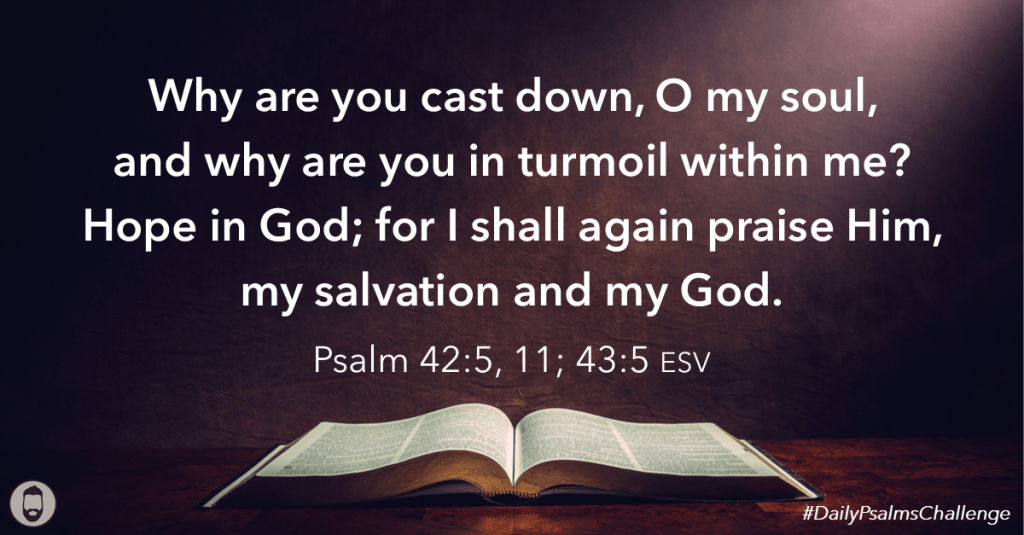
Why are you cast down, O my soul, and why are you in turmoil within me? Hope in God; for I shall again praise Him, my salvation and my God.
Psalm 42:5-6a, 11; 43:5
Psalm 42 and Psalm 43 are deeply connected, forming a single lament that expresses the struggle of a soul longing for God in the midst of despair.
Psalm 42 opens with vivid imagery: “As a deer pants for flowing streams, so pants my soul for you, O God” (v. 42:1). There is a beautiful hymn based on this image, but for those who are crying out to the Lord, it is often anything but beautiful. Picture a deer being hunted, running from a hunter or predator, panting and out of breath and seeking a cool stream to provide sustenance and relief. Such is the plight of the sons of Korah in these psalms. They are spiritually thirsty, longing for the presence of the living God (v. 42:2), yet instead of refreshment, they find themselves overwhelmed by sorrow, being fed by tears (v. 42:3) and haunted by the taunts of people mocking their faith by asking “Where is your God?” (vv. 42:3, 10)
This spiritual turmoil is compounded by distance from the place of worship or from the joy accompanying better times of leading God’s people in His praise and worship (v. 42:4). They remember what it was to joyously lead God’s people in worship at His tabernacle but now feel cut off and alone. The lament deepens as they describe being overwhelmed by waves of suffering, described a waves of the sea crashing over them (v. 42:7). Yet, even in their distress, they cling to this foundational truth: “By day the Lord commands His steadfast love, and at night His song is with me” (v. 42:8).
Psalm 43 continues their cry for deliverance, shifting from lament to pray to God for vindication. They plead for God to “send out [His] light and…truth” to lead them back to worship at His altar, where they may rejoice in Him again (vv. 43:3-4). But there is beautiful solace to be found in their refrain found in vv. 42:5, 11 and 43:5 that not only asks their own souls “why” they are “cast down” and “in turmoil” within themselves but points to the refreshment they know their panting souls will receive by saying, “Hope in God; for I shall again praise Him, my salvation and my God.”
This refrain teaches us the discipline of preaching the truth to ourselves in the face of despair. Instead of passively listening to their own troubled thoughts, they preach to their own souls, reminding themselves of who God is and where their hope must rest. This does not change their circumstances but points them to the God who provides hope in the midst of circumstances. He is faithful. He provides rest. He provides solace. He IS their hope.
Seeing Jesus in Psalms 42 & 43
These psalms find their fulfillment in Jesus, who fully experienced the anguish of a downcast soul. In the Garden of Gethsemane, Jesus echoed the sons of Korah when He said, “My soul is very sorrowful, even unto death” (Matthew 26:38). On the cross, He endured the mockery of His enemies jsut as they did (vv. 42:3, 10; Matthew 27:39-43). Yet, even in His suffering, Jesus fully entrusted Himself to His Father’s will and endured the full weight of God’s wrath against sin – our sin – that we might never be truly abandoned.
The sons of Korah longed for God’s presence, and through Jesus, that longing is ultimately fulfilled. Jesus Himself is the “light and truth” that leads us to God (v. 43:3; John 8:12, 14:6). He is Emmanuel, God with us, who will never leave nor forsake His people. And because of His resurrection and promised return, we can confidently hope in God, knowing that no matter our circumstances we too will “again praise Him” (v. 43:5).
Reflection
Can you identify with the sorrow and despair found in Psalms 42 and 43? If so, I hope you see the promise of hope and relief found in Jesus. He bore our shame and sin and adopts us into His family.
There is coming a day when the tears that flow ever so easily here in this fallen world will be wiped away for the last time by His nail-scarred hand when He comes to dwell with His people – where death will be nothing more than a fading memory – where there shall be no more “mourning, nor crying, nor pain anymore, for the former things have passed away” (Revelation 21:3-4).
In the meantime between that promise and its fulfillment, there is a lot of despair and downcast souls and pain and sorrow. There is a lot of panting for streams of relief. But, oh, there is so much hope to be found. May we not be left in the question of why our souls are downcast but let us preach the beautiful truth of the psalmists refrain: “Hope in God; for I shall again praise Him, my salvation and my God”!
Here’s a song inspired by Psalm 42:
The #dailyPSALMSchallenge gives us the opportunity to start 2025 in God’s Word by digging into a psalm a day. Each day will identify a key passage for us to meditate on as well as seeking to help us see Jesus in the psalm and reflect on what we have read.
2Continue steadfastly in prayer, being watchful in it with thanksgiving. 3At the same time, pray also for us, that God may open to us a door for the Word, to declare the mystery of Christ, on account of which I am in prison — 4that I may make it clear, which is how I ought to speak. 5Walk in wisdom toward outsiders, making the best use of the time. 6Let your speech always be gracious, seasoned with salt, so that you may know how you ought to answer each person.[1]
📖 Revelation 4:1–11In this episode of The King is Coming, Keith Harris and Jamie Harrison move beyond Jesus’s letters to the churches and into the next part of John’s vision. In Revelation 4, John is invited through an open door into heaven—and what he sees is the throne room of God.At the center of everything is a throne, and seated on it is the Lord in all His glory. From this point forward in Revelation, the throne becomes the focal point of the entire book.John describes the scene the best way he can: the brilliance of precious stones, a rainbow surrounding the throne, flashes of lightning and thunder, and a crystal-like sea before it. Surrounding the throne are twenty-four elders and four living creatures who never cease to worship the Lord.Together, Keith and Jamie discuss:✔️ Why Revelation 4 marks a shift from the letters to the churches to John’s heavenly vision✔️ What the throne room reveals about God’s authority and security over all things✔️ Why John uses comparisons (“like” and “as”) to describe the glory he sees✔️ The mystery of the twenty-four elders and what we can—and cannot—know✔️ The constant worship of the living creatures crying “Holy, holy, holy”✔️ Why heaven’s worship centers on God simply because He is worthyIn the throne room, everything points to one truth: God alone is worthy of worship.“Worthy are you, our Lord and God, to receive glory and honor and power, for you created all things, and by your will they existed and were created.” (Revelation 4:11)🔗 If you would like to see a written version of this podcast, complete with footnotes and cross-references, you can find it here.
I don’t know about y’all, but last fall and early winter were so busy. We’ve been traipsing back and forth across the South following my daughter and the high school band, writing this past year’s Advent guide (hopefully you got to follow along with the “Good News of Great Joy” readings in Luke), preaching a revival, serving the Lord at Christ Community and wherever else opportunity has arisen, started writing the #dailyPSALMSchallenge posts, and managed to work teaching school, too. Busy, busy, busy. It had been my intention to be finished with our Colossians study by now, but I am finding the older I get that things get done when they are done. Additionally, things worth doing well are worth working on until they are ready (even if I was ready to get it done before it was complete).
This closing exhortation (Bible word that is a mixture of warning, encouragement, and coming alongside someone to help them) of Paul’s here in Colossians 4:2-6 has been working on me throughout my busyness. The way I study these days – whether to write or preach or teach or whatever – is to work through the cross-references for a passage in my notebook, and I carry that notebook with me most places. I study and ponder on the passage and the verses throughout Scripture that give its context. I dwell with the passage. I meditate on it. Really, it is not as academic or spiritual as that sounds but more like the action of a crockpot where I simmer in the passage and its connecting verses until it’s done and ready to serve. I said Colossians 4:2-6 has been working on me; maybe the better way to say it is God has been working it into my life.
To understand this closing exhortation, you need to think of it in the context of the whole letter of Colossians. The first two chapters focus on doctrine, teachings about Jesus, His gospel, and the eternal life He gives, that the church at Colossae was missing. False teachers were coming in, taking advantage of the gaps in their knowledge and seeking to fill them with dangerous teachings and practices meant to lead them away from Christ. The last two chapters focus on putting that doctrine into practice. The church at Colossae needed to learn what it is to put our focus on Christ, namely taking off and putting to death the sin that belonged to their old life and putting on Christ, being adorned in and with Him, and living as His Spirit and Word direct. The biggest part of that application is where Paul helps the church at Colossae – and us – to be adorned in Christ in all areas of our lives, marriages, families, vocations, and so on. This exhortation fits at the tail end of how to be adorned in Christ in all areas of our lives.
As I said earlier, an exhortation is a kind of like coming alongside someone to help them. Picture being on a battlefield and your brother or sister soldier injures their leg and cannot walk on their own. You don’t just leave them there and save yourself. No, you reach down, grab their arm and put it across your shoulder, and you become a leg for them. They cannot walk, but y’all together can. This is recognition that in this spiritual battle, those who belong to the Kingdom of God lift one another up. In this case, Paul is writing to them from his place on the battle field in prison to lift them up and encourage them to keep the faith as they go through life and to lift up one another.
You might read this and be startled by the imagery of battle, but that is the reality of living in Christ for His Kingdom while we still live among the kingdoms of this world. Much of Paul’s letter to Ephesus mirrors aspects of the letter to Colossae. Where we have the exhortation in Colossians 4:2-6, this portion of Ephesians describes the need for putting on the “whole armor of God, that you may be able to stand against the schemes of the devil” (Ephesians 6:11) and recognizes that we are wrestling – literally fighting – against an enemy that is not of this world – not “against flesh and blood, but against the rulers and authorities, against the cosmic powers over this present darkness, against the spiritual forces of evil in the heavenly places” (Ephesians 6:12).
We will walk through three ways in which we can lift one another up as we are on the Church’s mission, through prayer, preaching, and practice.
Prayer is Imperative to the Mission (vv. 2-4)
Prayer is literally the most we can do. A lot of times folks are willing to neglect prayer so that they can do something or make something – like praying or serving or whatever, but when you really get down and think about it, what more can you do than take your petitions to the almighty God of the universe?
That’s not a rhetorical question: what more can you do than take things in prayer to God Most High? The obvious and only answer is a resounding “no”.
Look at the way the author of Hebrews describes prayer in Hebrews 4:16:
Let us then with confidence draw near to the throne of grace, that we may receive mercy and find grace to help in time of need….
Consequently, He is able to save to the uttermost those who draw near to God through Him, since He always lives to make intercession for them.
Prayer is an opportunity to approach the throne of God with the same level of confidence of a toddler approaching a parent’s bed in the middle of the night, scared from some lurking shadow or bad dream. That baby knows they will not experience reproach even though they rouse the sleeping parent in the middle of the night. They know they will find mercy and grace, love and peace. We get to approach God’s throne knowing He will not reprove or rebuke but dispense the mercy and grace in our “time of need”.
Furthermore, Jesus not only meets our needs but saves “to the uttermost those who draw near to God through Him”. Read that again – “to the uttermost”, meaning completely and at all times. Also, if we aren’t careful, we can miss that last part of Hebrews 7:25; Jesus “always lives” – ALWAYS LIVES – “to make intercession” for His people, “those who draw near to God through Him”. That phrase “make intercession” means that Jesus is appealing to the Father on our behalf, to give us mercy and grace in our time of need.
That’s what Paul is telling the Colossian church – and us to do: “Continue steadfastly in prayer”. It is clear that Paul wants them, and us, to pray for each other and him, but he is specific in how he wants them to do it.
First, he tells them to be “watchful” in prayer “with thanksgiving”. The idea of being watchful there reflects Ephesians 6:18 and his command to the church at Ephesus to “keep alert [in prayer] with all perseverance, making supplication for all the saints”; to be “watchful” or “keep alert” in “perseverance” in prayer means to be alert to the needs of people around you and to lift them up specifically to God rather than being vague and unfocused. Sometimes we are tempted to almost have a prayer genealogy of be with so and so and be with this one and be with that one, never pleading with God (supplication) for what they need or seeking God on their behalf (intercession) in their time of need or even peril. We should be aware of what’s going on in our brothers’ and sisters’ lives – or at least aware something is going on – and approaching the “throne of grace” for them. This should be done “with thanksgiving” because 1)we can already be thankful that we have a place to go where we can be confident to receive help and 2)that we know God wants to dispense mercy and grace in the time of need.
Second, Paul asks them to pray for him and gives a specific prayer request. Keep in mind that Paul penned this letter from prison. He could have easily asked them to pray that he be released or that God would supernaturally get him out of prison; many of the apostles and early church folks experienced all of that. But Paul didn’t. He was confident that he was right where God had him. His prayer request was for God to “open…a door for the Word, to declare the mystery of Christ, on account of which [he was] in prison”; he wanted God to provide an opportunity for preaching the gospel where he was.
This is a big deal because it differs from how we pray sometimes. We often pray to be delivered from our trying times – and there is nothing inherently wrong with that. As I said, Paul could have prayed for that as well. He didn’t though, and that reveals something to us that reflects how Jesus told us to pray in His model prayer in Matthew 6:10 – “Your Kingdom come, Your will be done, on earth as it is in heaven.” While we pray to be delivered, as Paul obviously desired in Philemon 22, let us pray, like Paul, to have an opportunity for the gospel in the midst of the situation we are in, right where God has us. And Paul is also specific to his desire for this gospel opportunity: that he “may make it clear”. He wanted them not only to pray that the gospel would be preached but that it be preached clearly and people understand it (Nehemiah 8:8). Just as we should be “watchful” in prayer, attentive and not vague, for our brothers and sisters in Christ, we should be specific in our prayer for people to hear the gospel – that God would save specific people through the preaching of His Word. If we pray for specific people to hear the gospel and get saved, it’s possible we will finally be alert to the fact that God may have placed them on our minds and us in their lives that we may be the one to share the gospel with them, which leads us to our next point.
Preaching is Imperative to the Mission (vv. 3-4)
Preaching is important. You might have heard this quote (falsely attributed to St. Francis of Assisi), “Preach the gospel wherever you go, and – if necessary – use words.” Well, if being clear with the gospel is how Paul says he “ought to speak”, words are definitely necessary. Paul’s language here reminds me of Nehemiah 8:8, the verse that drives how I seek to write about or preach/teach the Word:
They read from the book, from the Law of God, clearly, and they gave the sense, so that the people understood the reading.
At this point in Nehemiah, the captives had returned home after Babylonian captivity and had to rebuild walls, houses, and essentially their lives as a people. They had just brought out the “book”, the Law of God, and read it in one sitting. They could have called it a day and thought that they had accomplished something, but they didn’t. Ezra had a group of guys ready to help the people understand “the reading”.
This is important in understanding the sort of preaching and teaching Paul was asking to get to do. This was not one-off revival preaching where you show up and visit a place, preaching a few times or even once and going on your way. This was not a Sunday morning proclamation that can be heard and promptly discarded to take up our real lives when we leave. No, this is discipleship. This is answering the call of the Great Commission to “make disciples” (Matthew 28:19). Paul is wanting God to open a door for the Word to be taught, people to be saved, and for opportunity to be given to teach them similarly to what Paul is doing in the letter to the Colossian church. Remember what Paul prayed for the Colossian church in Colossians 1:9-10?
And so, from the day we heard, we have not ceased to pray for you, asking that you may be filled with the knowledge of His will in all spiritual wisdom and understanding, so as to walk in a manner worthy of the Lord, fully pleasing to Him: bearing fruit in every good work and increasing in the knowledge of God….
He had prayed that for them, and now, as part of bearing fruit of the life of Christ, they are to live out their faith and pray for others in the same way, which takes us to the practical, real nature of our last point.
Practicing Our Faith in Real Life is Imperative to the Mission (vv. 5-6)
This last exhortation is meant to be practical and affect the way they live their lives in Colossae. We have talked many times about how easy it is to do these things within our local churches but that it is another thing entirely to carry them out in the real world. It is Paul’s intent here to help them see that they were never meant to keep it within their local church family but to carry it out, that making disciples was never meant to stay where we are or where we are comfortable but to be for “all nations” (Matthew 28:19) – all people everywhere, wherever we are going (Matthew 28:18). To do that, we need to be careful how we carry ourselves and use our time wisely.
I want you to notice how carefully I am being in my wording here. I said be careful how we carry ourselves and not act right. This is not about acting right or acting at all; it’s about living the life that Christ has given you. It’s about all of life being adorned in Christ. Just as we looked at in the last few studies in Colossians, we do not only need to be adorned in Christ in our marriages, in our families, and in our vocations; we need our lives to be adorned in Christ when we go out into the world. Just as we would not walk out into public naked but rather adorned in an appropriate level of clothing, we need not walk out unadorned of Christ.
As I said, this is not an act. We are to walk “in wisdom”, meaning we live the life God has called us to how He called us to live it. The proverbs are extremely helpful for this. In our time in the Daily Wisdom Challenge back in October, we talked about that a lot, and much of what we looked at in Proverbs was concerned with, just as Paul is here, our speech. Here are a few practical applications for how we can use our words and conversations to point people to Jesus:
“making the best use of the time” – Be mindful of the time you have. Sometimes we waste time talking about unimportant things because we are unwilling to make an awkward transition in a conversation or because we might be afraid to broach a subject folks might be uncomfortable talking about (namely the gospel and even mentioning Jesus). We do not, however, have unlimited time to wait for whatever we think the right moment is. I read an anonymous quote on social media a while back that has plagued my thoughts and impacted my life in big ways: “Time is the only currency we spend without ever knowing the balance.” If God has put you in a position to share Him with others and put folks on your heart to share His gospel with, the time is now. We are not guaranteed another opportunity and tomorrow is not promised. Let’s get busy living in and for Him.
“Let your speech always be gracious” – Our speech should be characterized with grace. Now, this is the part where folks begin excusing their ugly talk by explaining that folks deserve this or that. I will agree that there are times when harsher speech is necessary, but God considered this when He chose the words Paul would use here. He said “gracious” meaning that the content and intent and substance of our speech, in the context here to “outsiders” but also to our church family, should be grace – undeserved favor. This should not be something we are unfamiliar with because if we are in Christ we have received grace. We have also just talked about how when we go to Him in prayer He has grace in our time of need. Here he reminds us of the grace we have received and tells us to extend it to others in how we talk to them.
“Let your speech…be…seasoned with salt, so that you may know how you ought to answer each person.” Salt doesn’t mean the same thing for us today as it did to Paul’s original audience. Salt is a preservative. It could be used to keep meat from spoiling. The idea here is that our speech should be a benefit – a blessing – to others and be used of God for good, echoing Jesus’s teaching in the Sermon on the Mount that we are to be the “salt of the earth” (Matthew 5:13). In the context of Jesus’s teaching, salt that has lost its “saltiness” is to be thrown out and trampled underfoot, meaning that speech that is not good and edifying is worthless and once again echoes Ephesians, specifically Ephesians 4:29 that tells us not to let “unwholesome talk” come from our mouths but only speech that is “helpful for building others up according to their needs”.
How we talk matters. Elementary kiddos are often taught the adage about sticks and stones being able to damage but “words can never hurt me”. By the time we are adults, we realize that is a lie. Words hurt. They wound us deeply. Furthermore, we often mean our words to be mean. But this is a deeper issue than conversation or its substance. It’s a bigger deal than merely being willing to talk about good, gospel things or to be nice when speaking. The content of our speech ultimately reveals whether or not we are in Christ or of the world. Jesus Himself said “out of the abundance of the heart the mouth speaks” (Matthew 12:34, Luke 6:45) to reference that speech is fruit that reveals whether we are good trees (saved; in Christ) or bad trees (lost; of the world).
Wrapping Up
This little section seems like it is light and simply a final exhortation, but when you take it in context, Paul is getting real with them. The Christian life goes beyond religion and definitely beyond the fringes of our lives, relegated to weekends and some evenings of our weeks. When he taught them, and us, that we are to put on Christ and have our lives adorned with Him – our whole lives, he wanted us to see how Christ as Lord commands our life and desires to see us minister to the lost world around us as well as to each other.
Paul wrote this letter from prison and sought to exhort, to come alongside and help, the Colossian church. He wanted to reach out and disciple them, and us, so that we not be hoodwinked by false teaching that replaces relationship with Christ with religious distractions and busyness. At the same time, he sought to be ministered to by them, asking them to pray for him to be able to live the life Jesus had called him to in his own time of need. How about us?
If you are a member of a local church (if you are saved, you are meant to be), your relationship with Christ is to impact your real, everyday life and the lives of your brothers and sisters in your faith family are meant to intersect and interact with one another. We are not meant to do this alone. We are Sojourners, but rather than being a heavenly hobo traipsing through this world alone we are pilgrims journeying together and making disciples as we go.
Consider how you can pray specifically for your brothers and sisters in Christ. Pray for your pastors and church leaders. Pray for the lost you know. Pray for someone to have the opportunity to share the gospel with them and for the Spirit of God to work on their hearts and help them understand. Pray that if God has called you to share the gospel with them that he will open a door for the Word and give you words seasoned with salt rather than merely salty speech.
Consider how you can be a beacon of God’s Word where God has planted you.
Consider how the teachings of God’s Word are (or are not) showing up in your real, everyday lives and repent where necessary. Consider this exhortation from Paul and exhortation from me as well. I may be one of your pastors if you are a member of Christ Community, but whether I am or not, let me come alongside you and help lift you up. Be encouraged by the counsel in this Bible study and not beat down. If you recognize that there are things in God’s Word that need to be changed in your life, consider that an opportunity to grow closer to Him. Know this, dear Sojourner, that I am praying for you as specifically as I can and have hope that God is not done working on us.




 Just Keith Harris