Good Friday | “Pierced for Our Transgressions”

Isaiah 53:3-6

He was despised and rejected by men,
a man of sorrows and acquainted with grief;
and as one from whom men hide their faces
he was despised, and we esteemed him not.

Surely he has borne our griefs
and carried our sorrows;
yet we esteemed him stricken,
smitten by God, and afflicted.
But he was pierced for our transgressions;
he was crushed for our iniquities;
upon him was the chastisement that brought us peace,
and with his wounds we are healed.
All we like sheep have gone astray;
we have turned—every one—to his own way;
and the LORD has laid on him
the iniquity of us all.

The Original Context

Isaiah 53 is one of the clearest prophecies in the Old Testament about the coming of a Suffering Servant – One who would be rejected, bear sorrow, and ultimately carry the guilt of others. Verses 3-6 portray this Servant as misunderstood and mistreated. The people saw His suffering and assumed it was punishment from God for His own sins, but Isaiah pulls back the curtain: the Servant wasn’t suffering for His own wrongs – He was bearing the griefs, sorrows, transgressions, and iniquities of others. 

This wasn’t punishment for failure. It was substitution. God laid the guilt of His people on this Servant. He was pierced, crushed, chastised – not because of what He had done but because of what we have done. It’s the language of atonement. It is one life being laid down to bring peace and healing to many.

Fulfillment in Jesus

Jesus is the Suffering Servant who Isaiah foretold. He was despised and rejected by His own people. He wept over the unbelief in Jerusalem (Luke 19:41), was betrayed by a friend (Luke 22:47-48), and was abandoned by His disciples (Matthew 26:56). He was beaten, mocked, and crucified – pierced by nails and crushed under the weight of humanity’s sin and the wrath of God against that sin.

But this was neither accidental nor tragic. Jesus didn’t die a victim of injustice but as a willing substitute, the Lamb of God who takes away the sin of the world (John 1:29). It was the purpose for which He came: “Christ died for our sins in accordance with the Scriptures” (1 Corinthians 15:3). At the cross, Jesus bore our griefs and carried our sorrows. Our rebellion against God became His burden. The punishment that brought us peace was laid upon Him. And by His wounds, we are healed – not just physically or emotionally, but spiritually and eternally.

Hope for Today

Good Friday is not a tragedy – it is a triumph through sacrifice.

Good Friday reminds us that salvation isn’t something we earn but something we receive. The weight of our guilt was laid on Jesus. Our wandering hearts find a home in Him who died that we may live.

We are all like sheep – wayward, distracted, self-reliant (or trying to be), but the Shepherd became the Lamb and was led to the slaughter for our sake. If today feels heavy, let it. The cross was no small thing. But don’t stop at sorrow – look through it to see the love of God on full display.

If you have ever felt too sinful to be forgiven, too broken to be loved, or too far gone to be reached – Isaiah 53 is for you. Your sin is not too much for the Savior. The Servant of Isaiah 53 – Jesus Christ – came for sinners just like me and you. 

You are not alone in your brokenness and sin. You are not stuck in your guilt. You are not without hope. Jesus was pierced for you. And those who put their faith in Him are forgiven, healed, and brought near.

So come and behold the Lamb – despised and rejected yet full of mercy and grace. Let your heart rest in the peace He purchased with His blood.

Come to the cross.

Let your heart be pierced by His mercy.

Marvel that God would do this for you.

And remember: while Good Friday ended in death, it opened the door to life because Sunday’s coming!


Songs for Sunday, April 6, 2025 @ Christ Community Church

Sunday’s coming — the LORD’s day, and I’m excited!

Every Sunday is a celebration of the goodness and grace of God, reminding us that He not only died for us but that He raised from the dead and LIVES for us! This Sunday at Christ community, we are going to sing about His goodness and grace and remember His mercy and how He saves.

In Titus 3:4-5a, Paul gives us one of the clearest, richest summaries of the gospel:

“But when the goodness and loving kindness of God our Savior appeared, He saved us, not because of works done by us in righteousness, but according to His own mercy….”

Let’s break that down and take it to heart:

“But….”

This is a very important conjunction. It takes everything before, cancelling it in favor of what comes after. In the context of Titus 3, what came before is what we once were: “once foolish, disobedient, led astray, slaves to various passions and pleasures, passing out days in envy, hated by others and hating one another” (Titus 3:3). BUT Jesus cancels that out in favor of His salvation.

“But when the goodness and loving kindness of God our Savior appeared….”

Paul is reminding us that salvation starts with GOD — not with us, not with our efforts or any righteousness of our own. The word “appeared” points us directly to Jesus’s first coming — God in flesh. He didn’t send a proxy or representative. He didn’t send salvation. God showed up Himself.

Jesus is the visible expression of God’s goodness and loving kindness, because He Himself is God being good and loving. He didn’t wait for us to climb up to Him (which we can’t do — remember, not with our efforts); He came down to us. His goodness and light broke into our sin and darkness.

“…He saved us….”

These three words change everything. God didn’t tell us what we could be doing better. He didn’t merely advise or improve us — He SAVED us. That speaks of our reality and need. we were lost, helpless, and dead in our sin, but HE acted. He rescued. He redeemed. These three words are a beautiful reminder that salvation is not self-help but divine deliverance!

“…not because of works done by us in righteousness….”

This part humbles us. There is no room for pride or patting oneself on the back in the gospel. We can’t earn our salvation by cleaning up our act or doing good deeds. There are no scales that we can balance by heaping service and good deeds; in fact, if there is a scale, our sin has it solidly weighted down unless Jesus acts upon the other side. We can’t impress God into loving us. All our best works can’t bridge the gap between our sin and His holy, holy, holiness.

“…BUT according to His own mercy….”

There’s another “but” here. It takes the false hope of our own righteousness and cancels it out with the hope of God’s own mercy. This gets at the heart of the gospel: God saved us because He is merciful. That’s who He is. Mercy means that He does not treat us as our sins deserve. Instead, He pours out grace through Jesus — grace that cleanses, restores, and makes us new.

That’s good news!

And that good news — that gospel — no, “our great God and Savior Jesus Christ” is who we are going to read, sing, and preach about this Sunday. We’re going to sing of His mercy.

Songs like “Holy Water” and “Washed Clean” will remind us that Jesus’s grace is what refreshes our hearts and keeps us coming back to Him in gratitude and worship. Then, we’ll read Philippians 2:5-11 and lift our eyes to Jesus, declaring His beautiful and powerful name — the name that is above every other. We’ll sing “Your Great Name” and “What a Beautiful Name” as a response to the Savior who stooped low to save us and is now exalted on high at the right hand of the Father.

If you have been saved by Jesus in His mercy, come ready to rejoice!

And if you haven’t yet trusted in Jesus, know this: His goodness and loving kindness have appeared. He is still saving. He is still merciful. Come lay your burdens on Him. Come and receive the mercy that never runs dry. Come to Him.

Won’t you join us?


Here are our Scriptures and songs:

4But when the goodness and loving kindness of God our Savior appeared, 5He saved us, not because of works done by us in righteousness, but according to His own mercy, by the washing and regeneration and renewal of the Holy Spirit, 6whom He poured out on us richly through Jesus Christ our Savior, 7so that being justified by His grace we might become heirs according to the hope of eternal life.


5Have this mind among yourselves, which is yours in Christ Jesus, 6who, though He was in the form of God, did not count equality with God a thing to be grasped, 7but emptied Himself, by taking the form of a servant, being born in the likeness of men. 8And being found in human form, He humbled Himself by becoming obedient to the point of death, even death on a cross. 9Therefore God has highly exalted Him and bestowed on Him the name that is above every name, 10so that at the name of Jesus every knee should bow, in heaven and on earth and under the earth, 11and every tongue confess that Jesus Christ is Lord, to the glory of God the Father.


Songs for Sunday, March 2, 2025 @ Christ Community Church

Tomorrow is the Lord’s day — Sunday, and I’m excited!

A lot of people just think of Sunday as the first day of the week, but for those who Jesus has saved, it reminds us of that Sunday millennia ago when Jesus rose from the dead. That day secured our salvation and gave us an unshakeable hope. As we gather to worship Jesus tomorrow, that unshakeable hope in Jesus alone is what we are going to sing about!

One of the passages we will be reading in worship, Psalm 62:5-8, reminds us of that hope:

5For God alone, O my soul, wait in silence, for my hope is from Him. 6He only is my rock and my salvation, my fortress; I shall not be shaken. 7On God rests my salvation and my glory; my mighty rock, my refuge is God.

8Trust in Him at all times, O people; pour out your heart before Him; God is a refuge for us.

David’s words here from Psalm 62 are a powerful reminder to us that, no matter what uncertainties we face, God is our refuge and firm foundation. In a world that is as changing as shifting sand, Jesus alone us unmovable and unshakeable. Our salvation, security, peace, and hope rest in Him. We can trust Him and pour out our hearts to Him always and at all times.

Tomorrow, as we gather at Christ Community, we will lift our voices in songs that proclaim this beautiful truth. We will sing of the steadfast hope we have in Jesus — hope that is not fragile, not fleeting — but firm and eternal. We will raise our voices and encourage one another to trust in Jesus alone. As always, John will open God’s Word and point us to Jesus.

Won’t you gather with us?


Here are our Scripture and songs:

  • Scripture | Psalm 103:8-14

8The LORD is merciful and gracious, slow to anger and abounding in steadfast love. 9He will not always chide, nor will He keep His anger forever. 10He does not deal with us according to our sins, nor repay us according to our iniquities. 11For as high as the heavens are above the earth, so great is His steadfast love toward those who fear Him; 12as far as the east is from the west, so far does He remove our transgressions from us. 13As a father shows compassion to his children, so the LORD shows compassion to those who fear Him. 14For He knows our frame; He remembers that we are dust.


  • Scripture | Psalm 62:5-8

5For God alone, O my soul, wait in silence, for my hope is from Him. 6He only is my rock and my salvation, my fortress; I shall not be shaken. 7On God rests my salvation and my glory; my mighty rock, my refuge is God.

8Trust in Him at all times, O people; pour out your heart before Him; God is a refuge for us.


*Sometimes we see the need to changing the wording of a song for doctrinal reasons (meaning the lyrics contain theological inaccuracies or fail to align with clear biblical teaching).

In the case of “The Truth”, look at the original lyrics for the chorus:

The truth is I am my Father’s child
I make Him proud and I make Him smile
I was made in the image of a perfect King
He looks at me and wouldn’t change a thing
The truth is I am truly loved
By a God who’s good when I’m not good enough
I don’t belong to the lies
I belong to You — that’s the truth

Here are the lyrics as we have changed them:

The truth is I am my Father’s child
I make Him proud and I make Him smile
I am made in the image of a perfect King
He saved me and changed everything
The truth is I am truly loved
By a God who’s good when I’m not good enough
I don’t belong to the lies
I belong to You — that’s the truth

While the sentiment of the original lyrics is that we come to God just as we are, it is inaccurate to say that He wouldn’t change anything about us. He takes us just as we are, but if He saves us, He transforms us (2 Corinthians 5:17, Romans 12:2) from His enemies to His friends (Romans 5:10, John 15:15), from far off from Him to brought near (Ephesians 2:12-13), from dead in our trespasses and sins to alive in Christ by grace through faith (Ephesians 2:1-8). He takes sinners and gives them new life in Him (Colossians 2:13-14), and — as the lyrics just before it say, “I am made in the image of a perfect King”, we recognize that if God has saved us — again, transforming us from lost in sin to saved by and through Him — He takes the image of God married by sin (Genesis 1:27, Romans 3:23) and makes us new, creating us “after the likeness of God” (Ephesians 4:24) by conforming us “to the image of His Son” (Romans 8:29)!

If we don’t want to “belong to the lies” and know what it is to belong to Christ, we need to realize that we need Him to change us — that the beauty of Him being willing to accept us in our sin is that He loves us enough not to leave us in it. That’s the truth, and that’s good news!


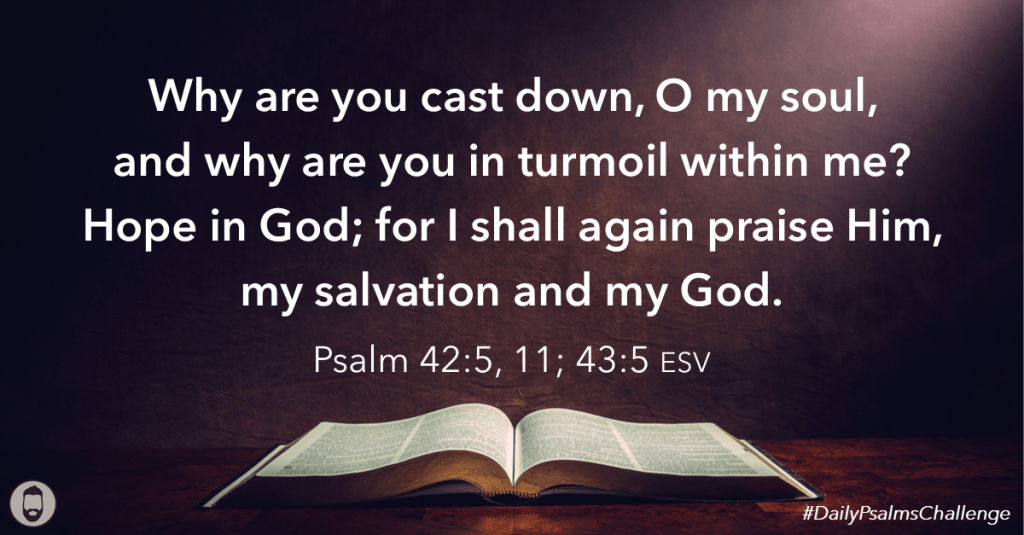
“Preaching Truth to Yourself When Your Soul is Downcast” from Psalms 42 & 43 (#dailyPSALMSchallenge)

Why are you cast down, O my soul, and why are you in turmoil within me? Hope in God; for I shall again praise Him, my salvation and my God.

Psalm 42:5-6a, 11; 43:5

Psalm 42 and Psalm 43 are deeply connected, forming a single lament that expresses the struggle of a soul longing for God in the midst of despair. 

Psalm 42 opens with vivid imagery: “As a deer pants for flowing streams, so pants my soul for you, O God” (v. 42:1). There is a beautiful hymn based on this image, but for those who are crying out to the Lord, it is often anything but beautiful. Picture a deer being hunted, running from a hunter or predator, panting and out of breath and seeking a cool stream to provide sustenance and relief. Such is the plight of the sons of Korah in these psalms. They are spiritually thirsty, longing for the presence of the living God (v. 42:2), yet instead of refreshment, they find themselves overwhelmed by sorrow, being fed by tears (v. 42:3) and haunted by the taunts of people mocking their faith by asking “Where is your God?” (vv. 42:3, 10)

This spiritual turmoil is compounded by distance from the place of worship or from the joy accompanying better times of leading God’s people in His praise and worship (v. 42:4). They remember what it was to joyously lead God’s people in worship at His tabernacle but now feel cut off and alone. The lament deepens as they describe being overwhelmed by waves of suffering, described a waves of the sea crashing over them (v. 42:7). Yet, even in their distress, they cling to this foundational truth: “By day the Lord commands His steadfast love, and at night His song is with me” (v. 42:8).

Psalm 43 continues their cry for deliverance, shifting from lament to pray to God for vindication. They plead for God to “send out [His] light and…truth” to lead them back to worship at His altar, where they may rejoice in Him again (vv. 43:3-4). But there is beautiful solace to be found in their refrain found in vv. 42:5, 11 and 43:5 that not only asks their own souls “why” they are “cast down” and “in turmoil” within themselves but points to the refreshment they know their panting souls will receive by saying, “Hope in God; for I shall again praise Him, my salvation and my God.”

This refrain teaches us the discipline of preaching the truth to ourselves in the face of despair. Instead of passively listening to their own troubled thoughts, they preach to their own souls, reminding themselves of who God is and where their hope must rest. This does not change their circumstances but points them to the God who provides hope in the midst of circumstances. He is faithful. He provides rest. He provides solace. He IS their hope.

Seeing Jesus in Psalms 42 & 43

These psalms find their fulfillment in Jesus, who fully experienced the anguish of a downcast soul. In the Garden of Gethsemane, Jesus echoed the sons of Korah when He said, “My soul is very sorrowful, even unto death” (Matthew 26:38). On the cross, He endured the mockery of His enemies jsut as they did (vv. 42:3, 10; Matthew 27:39-43). Yet, even in His suffering, Jesus fully entrusted Himself to His Father’s will and endured the full weight of God’s wrath against sin – our sin – that we might never be truly abandoned.

The sons of Korah longed for God’s presence, and through Jesus, that longing is ultimately fulfilled. Jesus Himself is the “light and truth” that leads us to God (v. 43:3; John 8:12, 14:6). He is Emmanuel, God with us, who will never leave nor forsake His people. And because of His resurrection and promised return, we can confidently hope in God, knowing that no matter our circumstances we too will “again praise Him” (v. 43:5).

Reflection

Can you identify with the sorrow and despair found in Psalms 42 and 43? If so, I hope you see the promise of hope and relief found in Jesus. He bore our shame and sin and adopts us into His family.

There is coming a day when the tears that flow ever so easily here in this fallen world will be wiped away for the last time by His nail-scarred hand when He comes to dwell with His people – where death will be nothing more than a fading memory – where there shall be no more “mourning, nor crying, nor pain anymore, for the former things have passed away” (Revelation 21:3-4).

In the meantime between that promise and its fulfillment, there is a lot of despair and downcast souls and pain and sorrow. There is a lot of panting for streams of relief. But, oh, there is so much hope to be found. May we not be left in the question of why our souls are downcast but let us preach the beautiful truth of the psalmists refrain: “Hope in God; for I shall again praise Him, my salvation and my God”!


Here’s a song inspired by Psalm 42:


The #dailyPSALMSchallenge gives us the opportunity to start 2025 in God’s Word by digging into a psalm a day. Each day will identify a key passage for us to meditate on as well as seeking to help us see Jesus in the psalm and reflect on what we have read.

Won’t you take the challenge?

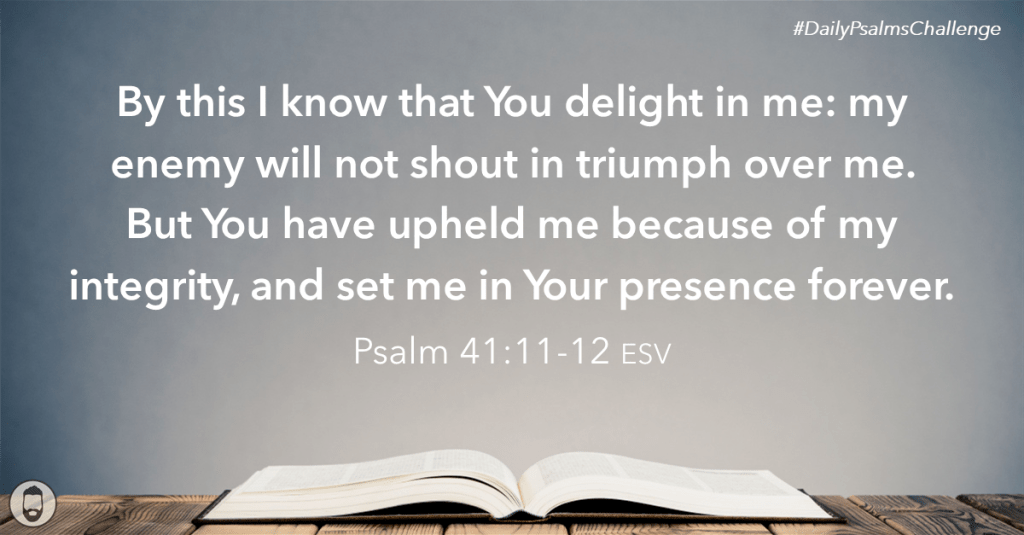
“From Betrayal to Blessing” from Psalm 41 (#dailyPSALMSchallenge)

By this I know that You delight in me: my enemy will not shout in triumph over me. But You have upheld me because of my integrity, and set me in Your presence forever.

Psalm 41:11-12

Psalm 41 is a psalm of both confidence and lament, showing David’s trust in God even as he faces sickness, slander, and betrayal. It begins with a blessing on the “one who considers the poor” because the Lord will deliver him in “the day of trouble” (v. 1). David knows that God sees and cares for those who show mercy, and he clings to this truth as he cries out to God for grace and healing (v. 4).

David’s suffering at the hands of his enemies is worsened by the betrayal of a “close” and “trusted” friend, one who he once shared meals with (v. 9). His foes whisper in the shadows about his downfall, waiting for him to die and be forgotten (vv. 5-8). In his distress, David prays, “O Lord, be gracious to me, and raise me up, that i may repay them!” (v. 10). His hope doesn’t rest in his strength as he clearly has none and cannot overcome his foes on his own. His only hope is in God’s strength and faithfulness; he trusts that the Lord will uphold him and not allow his enemies to triumph over him (vv. 11-12). 

The psalm ends with a beautiful doxology (formula for praising the Lord) that we can echo today: “Blessed be the LORD, the God of Israel, from everlasting to everlasting! Amen and amen.” (v. 13) This shows that, despite his suffering, David praises the Lord and exalts His name and that no matter what, God’s justice and mercy will prevail.

Seeing Jesus in Psalm 41

Psalm 41 finds its ultimate fulfillment in Jesus, the true and greater King. David’s words about the betrayal of a close friend in v. 9 are quoted by Jesus in reference to Judas Iscariot (John 13:18). Judas, who had walked with Jesus and shared meals with Him, turned against Him and handed Him over to His enemies. 

Like David, Jesus was surrounded by those who whispered against Him, mocked Him, and plotted His demise (vv. 5-8, Matthew 26:3-4). Yet, unlike David, Jesus did not pray for deliverance from death but submitted to His Father’s will and plan by willingly enduring betrayal, suffering, and the cross for our salvation. Though His enemies thought they had triumphed, God raised Him up in victory (v. 10), exalting Him to His rightful place at the Father’s right hand (Philippians 2:9-11). And through His resurrection, Jesus secured ultimate healing, restoration, and vindication for all who have faith in Him.

Reflection

For those who have faced betrayal, affliction, or opposition, Psalm 41 offers a reminder that God sees, sustains, and vindicates His people. It is tempting to try and vindicate ourselves or to give up in the face of overwhelming circumstances, but Jesus has made a way for us. He endured so that we may have eternal life, leaving us with the reminder that this world is not all there is. For those who have confessed Him as Lord and believed He is risen from the dead (Romans 10:9), He saves not only from our sin but forevermore!

Even when we are afflicted, betrayed, or opposed, God remains faithful. He will sustain us. Follow the example of David in Psalm 41, and trust that the Lord delights in His people – that He delights in saving us.

The #dailyPSALMSchallenge gives us the opportunity to start 2025 in God’s Word by digging into a psalm a day. Each day will identify a key passage for us to meditate on as well as seeking to help us see Jesus in the psalm and reflect on what we have read.

Won’t you take the challenge?

“Set Upon the Rock: Confidence in God’s Salvation” from Psalm 40 (#dailyPSALMSchallenge)

I waited patiently for the LORD; He inclined to me and heard my cry. He drew me up from the pit of destruction, out of the miry bog, and set my feet upon a rock, making my steps secure.

Psalm 40:1-2

Psalm 40 is a testimony of God’s faithfulness in deliverance in David’s past and a plea for help in his present troubles. David recalls how the Lord rescued him from the pit of destruction – which he describes as a miry bog (think quicksand) – and placed his feet on a rock, giving him a new song of praise (vv. 1-3). But even as he celebrates God’s faithfulness, he finds himself once again in need of God’s delivance.

This psalm teaches us a powerful truth about living out the new life we have in Christ: it is a cycle of waiting, deliverance, and renewed dependence on the Lord. We live these out over and over, and God is faithful over and over. David is not relying on God’s past deliverance alone, though; he continually puts his trust in the Lord rather than in earthly sources (v. 4).  He recognizes that God’s plans for him and His wonders are beyond measure (v. 5) and that true obedience is worth more than religious sacrifices (vv. 6-8).

David’s worship is more than religion, too. He says that in the “scroll of [God’s] book” will be written that he delights to do the will of God and that His law is “within [his] heart” (vv. 7-8). He has not held back in telling people “the glad news of deliverance” and God’s righteousness (v. 9). He has not been silent about God’s faithfulness or His salvation, especially being vocal about His steadfast love (v. 10). And because of this, David is confident that God will not hold back when it comes to His mercy, steadfast love, or faithfulness (v. 11) in the midst of his current troubles from his own sin (v. 12) and his enemies (vv. 13-15).

Even in the midst of trials, David ends with confidence: “You are my help and my deliverer; do not delay, O my God!” (v. 17). God did not delay to deliver and was not about to start then. Like David, we can hold fast to the Lord because “He who promised is faithful” (Hebrews 10:23)!

Seeing Jesus in Psalm 40

David’s words in Psalm 40 foreshadow and point to Jesus. The writer of Hebrews 10:5-7 applies vv. 6-8 to Jesus, showing that He is the true fulfillment of this psalm. He came to do the will of His Father, offering Himself as the perfect sacrifice for our sins. 

And because of Jesus’s resurrection, our hearts should be consistently bursting with “new song” (v. 3) to give testimony for how Jesus saving us and giving us new life – His consistent track record of deliverance, even from death, moving our hearts to praise Him!

Reflection

We can trust, as David did here in Psalm 40, that God hears our cries, rescues us in His perfect timing, and will never forsake those who put their trust and hope in Him. Consider the following questions to help you see where you need to trust the Lord:

Are you in a season of waiting on the Lord? What have you seen in Psalm 40 and in your own life that helps you trust His timing?

How have you experienced God’s faithfulness in the past? How does remembering it give you confidence in Him today?

Look to the Lord. Cry out to Him from whatever miry bog of despair you find yourself in, and trust that He will put you firmly on Jesus, our rock and our redeemer (Psalm 19:14)!


Here’s a praise song to help you apply and praise the Lord with Psalm 40:


The #dailyPSALMSchallenge gives us the opportunity to start 2025 in God’s Word by digging into a psalm a day. Each day will identify a key passage for us to meditate on as well as seeking to help us see Jesus in the psalm and reflect on what we have read.

Won’t you take the challenge?

“Finding Hope in God’s Justice” from Psalm 10 (#dailyPSALMSchallenge

O LORD, You hear the desire of the afflicted; You will strengthen their heart; You will incline Your ear to do justice to the fatherless and the oppressed, so that man who is of the earth may strike terror no more.

Psalm 10:17-18

Psalm 10 opens with a heartfelt cry, “Why, O LORD, do you stand far away/ Why do You hide Yourself in times of trouble?” (v. 1). This lament resonates deeply with anyone who has ever tried to reconcile what may look like God being silent toward the rampant injustice in the world.

The psalmist (no one is specifically named as the writer of Psalm 10) paints a vivid picture of the wicked — arrogant, oppressive, and violent — preying upon the helpless with no fear of accountability (vv. 2-11). Their hearts are full of pride, and they make the bold proclamation that “There is no God” (v. 4).

The wicked seem to prosper — seem. Their prosperity is only temporary because their ways are deceptive and cruel. They lurk in ambush like predators, exploiting the vulnerable like their prey and doing so with what seems to be no punishment or repercussions. The psalmist pleads with GOd to respond — to rise up, defend the afflicted, and bring the wicked to account (vv. 12-15). These cries are not expressions of doubt but of trust that God is just and able to intervene.

Psalm 10 concludes with renewed confidence (rather than disappointment) in the Lord, who is “King forever and ever” (v. 16). The wicked may seem to prevail, but the power is fleeting. God hears the cries of the afflicted, strengthens their hearts, and ensures justice for the fatherless and the oppressed (vv. 17-18). This is the assurance that while human justice is rampant, divine justice will ultimately prevail.

Seeing Jesus in Psalm 10

Jesus embodies the heart of Psalm 10. He demonstrated God’s care for the afflicted and oppressed during His earthly ministry — healing the sick, comforting the grieving, and extending grace to the outcasts. On the cross, Jesus bore the ultimate injustice — dying for sins He did not commit — so that justice and mercy could be perfectly reconciled in Him.

When Jesus returns to establish His eternal Kingdom of justice and peace, He will fulfill the psalmist’s cry that “man who is of the earth may strike terror no more” (v. 18).

Reflect

Psalm 10 reminds us that even when God seems distant, He is neither unaware nor indifferent to injustice.

Are you wrestling with situations where the wicked appear to prosper? Bring your concerns — and even your laments — to the Lord, trusting that He sees, hears, and will act.

Consider ways you might be able to defend the weak, care for the vulnerable, and trust in His ultimate plan to right every wrong. May Psalm 10 strength your faith as you learn to wait on the Lord.

The #dailyPSALMSchallenge gives us the opportunity to start 2025 in God’s Word by digging into a psalm a day. Each day will identify a key passage for us to meditate on as well as seeking to help us see Jesus in the psalm and reflect on what we have read.

Won’t you take the challenge?

Songs for Sunday, January 12, 2025 @ Christ Community Church

Sunday’s coming, and I’m excited!

When I say that, I’m not talking about some sort or religious obligation for attending church or anything like that. My mind is drawn to my need for Jesus and the fact that He would deign to accept one like me.

There were times in my life when thinking of Sunday was more religious than relationship, but the older I get and the more I think about all that Jesus has done (and is doing and will do), the more I think of Sunday like the imagery in Hebrews 4:14-16.

The writer of Hebrews begins this section talking about Jesus as the “great high priest”. That phrase can definitely be acquainted with religious ideas and temple life and sacrifices, but Jesus is something different.

High priests are typically “chosen from among men” and “appointed to act on behalf of men in relation to God” (Hebrews 5:1). Jesus is different. He is God become man to be the sacrifice for men to be able to come to God.

High priests would typically need to “offer sacrifice” for their own sins “fust as [they do] for those of the people” (Hebrews 5:3). Jesus is different. He has no sins to sacrifice for because He “has been tempted as we are, yet without sin” (Hebrews 4:15). He is the Lamb of God bearing our sin.

High priests worked and worked and worked on behalf of the people before God, but all of their work was just a shadow of what was to come. Jesus is different. Jesus is all substance, and no shadow, being Himself “the source of eternal salvation to all who obey Him, being designated by God a high priest after the order of Melchizedek” (Hebrews 5:9-10).

Because Jesus is different, we are not limited to showing up for some religious observances over and over again, dwelling only in the suburbs of God’s grace and partaking only of shadows. Because Jesus is our high priest, He has made a way for us not just to be in relation to God but for us to be able to approach Him — to go directly to “the throne of grace” (Hebrews 4:16).

For those bringing their animals for the high priest to slaughter and make atonement for their sins, the idea of approaching God’s throne would be a frightening thing. Think of Isaiah’s “woe is me” talk when he had a vision of the holy, holy, holy God seated on His throne; he knew he was unclean and unworthy to look upon “the King, the LORD of hosts” (Isaiah 6:1-5)! The King of kings seated on the throne is still holy, holy, holy and we are still sinners. the King of kings seated on the throne is the divine word who discerns “the thoughts and intentions” of our hearts, laying us bare — “naked and exposed to the eyes of Him to whom we must give an account” (Hebrews 4:12-13).

Yes, Jesus is the King of kings.

Yes, Jesus is holy, holy, holy.

Yes, Jesus is Lord.

No, we are not any of those things and neither worthy nor holy. We are not God, and most of us could not stand even alongside Isaiah to state our “woe” in God’s presence. But Jesus is also our high priest! He has made atonement for our sins! He has made a way for us to come before Him (John 14:6, 2 Corinthians 5:21, 1 John 2:1-2)!

This is why the imagery of Hebrews 4:14-16 is so heavy on my mind. I have the opportunity and privilege to approach the throne of grace in my time of need. Because I have confessed Jesus as Lord and believed upon Him — but my trust in Him to save me, I have assurance to be able to approach Him without fear of death and punishment because He Himself has “bore [my] sins in His body on the tree, that [I] might die to sin and live to righteousness” (1 Peter 2:24). I don’t have to say “woe is me” because He put Himself through woes on my behalf.

Because of this, I can approach His throne with the confidence of a child waking a parent in the middle of the night for a drink of water. I can turn to Him with the assurance that I not only may approach Him for help but be confident that I will “receive mercy and find grace to help in time of need” (Hebrews 4:16).

That’s good news!

But it’s not just good news for me. It is good news for all who trust in Him, all who are saved by grace through faith in Him.

So, Sunday’s coming, and we have the opportunity to gather together on the first day of the week — the Lord’s day — and remember His death, burial, and resurrection. We have the opportunity to gather with brothers and sisters who have been saved by grace through faith and approach the throne of our Lord together, confident that His grace and mercy are enough, sufficient, and eternally flowing toward those He loves.

If this doesn’t describe you, know that there is good news and grace enough for you, too. Your sin can be forgiven. You can be saved. There is grace enough and room enough and good news enough for you and all who call on His name.

You won’t find anything relgiously impressive. You won’t find impressive priests or practices. You won’t find perfect people. You will find a bunch of sinners — and hypocrites — whose only hope is Jesus. He is who will will read about. He is who we will sing about. He is who we will preach about. And that’s because He’s our only hope. He’s our King. He’s our God. He made a way for us and there is no place we’d rather be than gathered around His throne in a small picture of how we will get to be when this world passes away and He gathers His people to Himself.

Won’t you join us?


Here are our Scriptures and songs:

14Since then we have a great high priest who has passed through the heavens, Jesus, the Son of God, let us hold fast our confession. 15For we do not have a high priest who is unable to sympathize with our weaknesses, but One who in every respect has been tempted as we are, yet without sin. 16Let us then with confidence draw near to the throne of grace, that we may receive mercy and find grace to help in time of need.


4We were buried therefore with Him by baptism into death, in order that, just as Christ was raised from the dead by the glory of the Father, we too might walk in newness of life.
5For if we have been united with Him in a death like His, we shall certainly be united with him in a resurrection like His. 6We know that our old self was crucified with Him in order that the body of sin might be brought to nothing, so that we would no longer be enslaved to sin. 7For one who has died has been set free from sin.


“A Righteous Refuge” from Psalm 7 (#dailyPSALMSchallenge)

My shield is with God, who saves the upright in heart.

Psalm 7:10

Psalm 7 offers a vivid picture of David’s reliance on God in the midst of slander and false accusations. Faced with an attack from Cush, a Benjamite likely allied with Saul, David turns to God as his refuge (v. 1). He describes his pursuers as lions ready to tear him apart (v. 2), yet, instead of seeking personal revenge or justifying himself to others, David brings his case before the ultimate Judge.

David’s prayer begins with self-examination. In vv. 3-5, he acknowledges the possibility of wrongdoing (because he knows he is a sinner) and invites God to judge him if he is guilty. This humble request reveals David’s heart toward God, seeking to be the man God called him to be rather than be vindicated. His appeal for justice (v. 8) is grounded in his trust that God is a righteous judge who sees all hearts and minds (v. 9).

When he talks about the pit and hole in vv. 14-16, he paints a striking illustration of how sin traps people. This sort of poetic justice reminds us that God’s judgment is perfect, but it is also active. Despite his situation, David concludes Psalm 7 with confident praise in his God: “I will give to the LORD the thanks due to His righteousness” (v. 17).

Seeing Jesus in Psalm 7

David’s plea for justice and his willingness to entrust himself to God foreshadows Jesus who endured what David did and more. Jesus was reviled and slandered but “continued trusting Himself to Him who judges justly” (1 Peter 2:23) — to the Father. Unlike David, though, Jesus was (and is) sinless leaving no doubt to His righteousness.

When David talks about God’s bow being “bend and readied” toward those who don’t repent in v. 12, we are reminded of the reality of what our sin deserves. We need to be reminded that God hung His bow in the clouds a long time ago, reminded that for those who trust in God for salvation His bow is pointed toward heaven — toward His Son Jesus — instead.

Reflection

Psalm 7 invites us to bring our hurts and accusations to God and let Him sort them out rather than seeking personal revenge.

Are you carrying such a burden today?

Lay it before the righteous Judge who knows every heart. His justice may not be immediate, but it is certain.

Let this psalm inspire you to trust in God as your refuge, examine your own heart, and rest in the assurance that God’s justice — and, thankfully, His mercy — will prevail.

The #dailyPSALMSchallenge gives us the opportunity to start 2025 in God’s Word by digging into a psalm a day. Each day will identify a key passage for us to meditate on as well as seeking to help us see Jesus in the psalm and reflect on what we have read.

Won’t you take the challenge?

“Trusting God’s Steadfast Love in Sorrow” from Psalm 6 (#dailyPSALMSchallenge)

Turn, O LORD, deliver my life; save me for the sake of Your steadfast love.

Psalm 6:4

Psalm 6 is a cry of deep lament (which we defined in Psalm 3 as letting out one’s feelings of grief or sadness) as David is overwhelmed by distress and the apparent silence of God. This is the first of the penitential psalms (meaning Psalms of confession and repentance — including Psalms 32, 38, 51, 130, and 143). Here, rather than confessing specific sins, David cries out to God about his experiences with God’s discipline and his enemies’ torment.

David starts off with an urgent plea: “O Lord, rebuke me not in Your anger, nor discipline me in Your wrath” (v. 1). He feels the weight of God’s discipline but asks for God’s mercy instead of wrath. If God’s grace is giving His undeserved favor, His mercy is withholding punishment or wrath that we DO deserve. David’s plea for mercy is because his distress is affecting him physically and longs to know from the Lord how long the discipline will last (vv. 2-3).

The turning point in Psalm 6 comes when David appeals to God’s steadfast love (Hebrew: chesed) and sees that love as the basis for his hope. He has experienced God’s steadfast love in the past and trusts that God will not be angry with him forever and will move to rescue and save him (v. 4). David understands that God is just and does not dispute whether the discipline is warranted; knowing God loves him, though, he pleads for mercy.

What began as lament turns to worship with David pouring out his soul before the Lord. While he initially remarked that he felt God was being silent toward him, He had faith that God had heard his prayer (v. 9). This assurance fuels his boldness to call out his enemies, knowing that God is not done with him and will vindicate him.

Seeing Jesus in Psalm 6

This psalm points forward to Jesus, the Man of sorrows (Isaiah 53:3). Like David, Jesus experienced deep anguish as He prayed in the garden of Gethsemane (Luke 22:44). On the cross, He bore the full weight of God’s wrath and punishment for our sin — not His, but ours — so that we might be delivered and experience His steadfast love.

Jesus also fulfills David’s confidence that God hears the cries of the afflicted. In Him, have assurance that our prayers are heard and that our salvation is sure. More than that, Jesus’s resurrection turns our weeping to joy, proving that not even death can separate us from God’s love.

Reflection

Psalm 6 invites us to bring our deepest sorrows and fears to God, trusting in His steadfast love even when we are being disciplined (and our troubles stem from our own sin). When God seems silent, David’s faith and words in Psalm 6 can help us see that God’s mercy is greater than His discipline and that His salvation is certain for those who trust in Him.

The #dailyPSALMSchallenge gives us the opportunity to start 2025 in God’s Word by digging into a psalm a day. Each day will identify a key passage for us to meditate on as well as seeking to help us see Jesus in the psalm and reflect on what we have read.

Won’t you take the challenge?