This phase will have us reading about Jesus’s life in the gospel of Luke, the formation of the Church in Acts, and walk through the theology found in Paul’s letters that the Church needs to know about and live out the eternal life given by grace through faith in Jesus.
Below, you’ll find brief synopses of each book in this phase to help you understand the scope of the book and most importantly, how it fits into the full Story of the Bible.
When you click on each day’s link, you will find a link to audio, a summary of the chapter, a key verse from the chapter, and opportunities for reflection and outreach.
We’re moving into Paul’s epistles, which we’ll go through chronologically rather than in the order they appear in our Bibles.
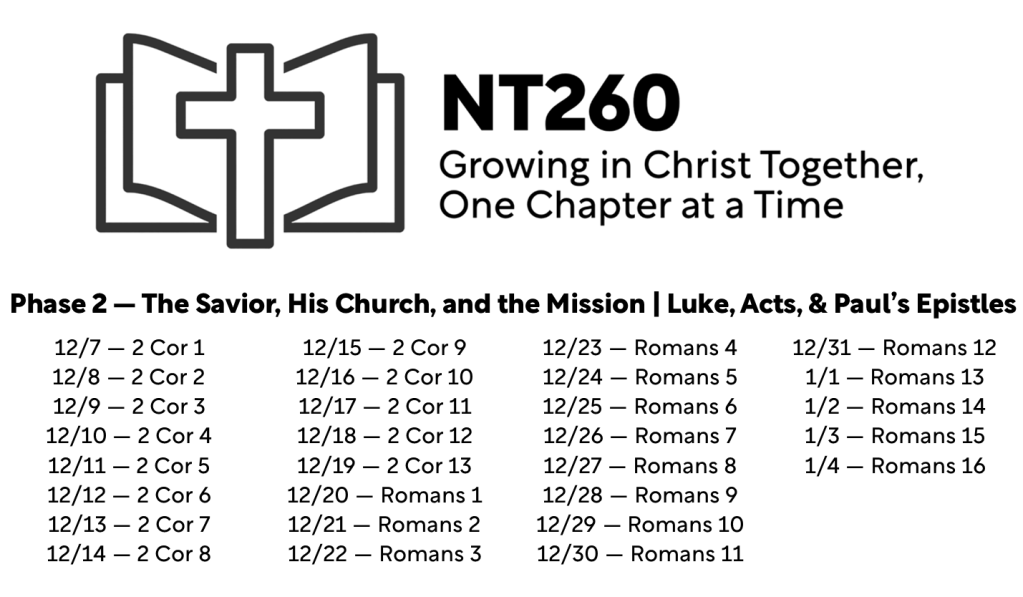
2 Corinthians
Paul writes 2 Corinthians after a painful season with the church in Corinth. Some had challenged his integrity and authority, and the church was divided. When Titus brought news that many had repented, Paul responded with this deeply personal letter (2 Corinthians 7:5–16). He defends his ministry not by boasting in strength but by pointing to his suffering and God’s comfort: “the Father of mercies and God of all comfort” meets us in affliction so we can comfort others (2 Corinthians 1:3–7). Paul explains that his trials don’t disprove his calling—they display Christ’s life in a fragile jar of clay (2 Corinthians 4:7–12, 12:9–10).
The letter moves through pastoral appeals and rich teaching. Paul announces the glory of the new covenant, where the Spirit gives life and transforms believers into Christ’s image (2 Corinthians 3:6, 17–18). He proclaims reconciliation: in Christ, God makes us new and entrusts to us the message of reconciliation—“be reconciled to God” (2 Corinthians 5:17–21). He urges holiness and wholehearted devotion to the Lord (2 Corinthians 6:14–7:1), calls the church to forgive and restore the repentant (2 Corinthians 2:5–8), and encourages generous giving for the saints in need (2 Corinthians 8–9). In the closing chapters, he confronts false apostles and “boasts” in his weaknesses so that Christ’s power might be seen (2 Corinthians 11:23–30, 12:9).
In the story of salvation, 2 Corinthians shows how God’s strength shines through human weakness. The crucified and risen Christ brings a new creation, writes His law on our hearts by the Spirit, and sends us as ambassadors of His grace (2 Corinthians 3:3, 5:17–20). Until we stand before Christ’s judgment seat, we live by faith—not by sight—seeking to please Him, comfort His people, and spread the aroma of His gospel in the world (2 Corinthians 5:7–10, 2:14–17).
Paul wrote Romans around A.D. 57 while he was in Corinth, near the end of his third missionary journey (Romans 16:1–2, 23; Acts 20:2–3). He addressed the letter to believers in Rome—a church he had not yet visited but deeply desired to see (Romans 1:10–13). The Roman church was made up of both Jews and Gentiles, and tensions had developed over how God’s law, faith, and daily Christian living fit together (Romans 14:1–15:7). Paul wrote to explain the gospel clearly, to unite the church around that gospel, and to prepare them to partner with him in future mission work, especially his planned journey to Spain (Romans 15:22–24).
At the heart of Romans is the gospel—the good news that God’s righteousness is revealed through Jesus Christ (Romans 1:16–17). Paul shows that all people, without exception, are sinners in need of salvation—both Jews under the law and Gentiles without it (Romans 1:18–3:20). No one is made right with God by works; instead, sinners are justified by grace through faith in Christ alone (Romans 3:21–26, 4:16). Using Abraham as an example, Paul explains that God’s promise has always been received by faith, not earned by obedience (Romans 4:1–5, 23–25). Jesus’s death and resurrection stand at the very center of God’s saving plan (Romans 5:6–11).
Romans also explains what the gospel accomplishes in the life of the believer. Those who are united to Christ are no longer slaves to sin but are given new life through the Holy Spirit (Romans 6:4–14, 8:1–11). Believers now live with peace with God, assurance of salvation, and a certain hope of future glory—even in suffering (Romans 5:1–5, 8:18–39). Paul addresses the difficult question of Israel’s place in God’s plan, showing that God is faithful to His promises and sovereign in salvation, working all things according to His mercy and wisdom (Romans 9–11).
In the story of salvation, Romans shows how God’s Old Testament promises are fulfilled in Jesus and how the gospel creates one new people—Jew and Gentile together—united by faith (Genesis 12:3, Romans 15:8–13). This gospel does not merely save; it transforms. Because of God’s mercy, believers are called to live holy lives marked by humility, love, service, and hope (Romans 12:1–2, 13:8–10). Romans helps us understand both what the gospel is and how to live it out, all for the glory of God among the nations (Romans 11:33–36, 15:5–6).
1:1 The book of the genealogy of Jesus Christ, the son of David, the son of Abraham. 2 Abraham was the father of Isaac, and Isaac the father of Jacob, and Jacob the father of Judah and his brothers, 3 and Judah the father of Perez and Zerah by Tamar, and Perez the father of Hezron, and Hezron the father of Ram, 4 and Ram the father of Amminadab, and Amminadab the father of Nahshon, and Nahshon the father of Salmon, 5 and Salmon the father of Boaz by Rahab, and Boaz the father of Obed by Ruth, and Obed the father of Jesse, 6 and Jesse the father of David the king. And David was the father of Solomon by the wife of Uriah…. 16 …and Jacob the father of Joseph the husband of Mary, of whom Jesus was born, who is called Christ. [1]
Matthew 1:1-6, 16
Merry Christmas, Sojourners!
This is one of my favorite times of the year. The weather is crisp and cool (or cold, depending on the Mississippi weather). Lights and decorations abound. There’s more than enough to do – following our kiddos around, gathering for extra worship times, a few opportunities to pause and reflect on a year spent, and finding that people are more willing to listen or even talk about Jesus than in other seasons.
Over the past few years at Christ Community, I’ve begun to think of this more in terms of Advent than just the Christmas season – not out of some sense of religious tradition or necessity but out of a sense of expectation and hope. The word Advent comes from the Latin word adventus, meaning “coming” or “arrival”. It, of course, represents Jesus’s first coming (hence the Christmas aspect) and His arrival as God made flesh and dwelling among us (John 1:1, 14), but it also reminds us that He is coming again and that arrival in the clouds is on the horizon (1 Thessalonians 4:16-17), maybe even in our lifetime. Advent trains our hearts to wait with hope (Romans 8:23-25, Titus 2:11-13).
Now, this isn’t the sort of hope that we’re used to – some sort of vague wish that we want to come about. That sort of hope leads to disappointment and anxiety. For example, I hear my school kiddos say things like, “I hope I do good on this test.” While there’s a certain anxiety that all too often accompanies the tests, the hope can be more sure than wishful thinking. I remind my students in those moments of all they’ve studied and all they’ve learned. My class is the culmination of all of the English classes they have taken since third grade. Getting to my class means they’ve successfully made it from third grade all the way to ninth or tenth grade. Most of my tenth grade students had me for ninth, so I can remind them also of what they’ve learned, studied, and succeeded at in order to get to the end of the class. Their anxiety flowed from feelings of inadequacy and felt thin because it had nothing solid beneath it.
Biblical hope is different. It isn’t rooted in our effort, our performance, or our feelings. It has substance. It is established on something solid – the promises of God (2 Corinthians 1:20).
The hope Jesus offers – the hope we are reminded of through Advent leading up to Christmas – is based in a more substantial substance than our mere life experience and accomplishments; it’s based out of Jesus’s life and His accomplishments on the cross and through the empty tomb. We can “hold fast the confession of our hope without wavering” because “He who promised is faithful” (Hebrews 10:23). He has a flawless record of keeping His promises – promises no human could make and see fulfilled much less fulfill them alone (see “Appendix: OT Messianic Prophecies Fulfilled Through JESUS in the Gospels”). And we can find hope in His faithfulness because He is the One who promised to come and did (Galatians 4:4-5), so when He promises to return, we can rest in the hope that He will (Revelation 22:12, 20).
Hopefully you took the time to look at the OT Messianic Prophecies Fulfilled Through JESUS in the Gospels appendix, taking a look at the fifty-five examples offered there. Today, though, we’re going to find hope not only in prophecy but in how God worked in the real, messy lives of real, sinful people. We will see that He who promised to redeem and save those who call on Him – confess Him as Lord and believe He raised from the dead (Romans 10:9, 13) – is faithful to do that. Their stories show that the God who speaks His promises is the God who brings those promises to fruition through ordinary sinners like us (1 Corinthians 1:26-31).
So, where do we find these people? We find them – these four women – in Jesus’s genealogy in Matthew 1.
Before we look at any of their stories, it’s worth noting something remarkable: women weren’t usually included in genealogies in the ancient world. Genealogies traced the line through the fathers, generation to generation, name to name. Yet Matthew, under the inspiration of the Holy Spirit, intentionally highlights four women – and not women we might expect. Their stories are messy. Their pasts are complicated. Their situations were soaked in sin, sorrow, scandal, and suffering. And still the Holy Spirit saw fit to weave their names into the family line of Jesus. Why? Because the gospel isn’t a story for the polished but for the broken (Mark 2:17). Their presence in Jesus’s genealogy serves as the Spirit’s way of holding up the gift of hope – hope that God’s grace reaches further than our failures, hope that His mercy is deeper than our mess, and hope that the promised King truly came to save sinners (1 Timothy 1:15).
These women point us forward to the One who would come from their line – Jesus the Christ, Emmanuel, “God with us” (Matthew 1:23) – the Savior who brings hope to people just like them…and just like us.
Tamar – Hope in God’s Faithfulness Despite Human Sin (v. 3, Genesis 38)
The first woman is Tamar (v. 3), and her story is found in Genesis 38.
Tamar was Judah’s – as in lion of the tribe of Judah (Genesis 49:8-10), the original – daughter-in-law. She was originally married to Judah’s oldest son Er until “the Lord put him to death” because Er was “wicked in the sight of the Lord” (Genesis 38:7). In those days[2], when the elder son died, it was the role of his younger brother to take his place and father children in his name. This fell to second-born, Onan, but Onan was more sinful and selfish than his big brother, doing what was “wicked in the sight of the Lord” and being “put…to death, also” (Genesis 38:10).
Poor Tamar. Her only hope at bearing children would fall on Judah’s youngest, and last remaining son, Shelah. But Judah lied and had no intention of taking care of or continuing with Tamar. What did she do? She decided to be wicked herself. She tricked Judah and tempted him. How did he respond? He decided to be wicked himself. Judah and Tamar committed sin together, her posing as a prostitute and him partaking in sin with her – honestly sinning against her similarly to his late-son Onan.
Scripture doesn’t hide this, and because of that, we begin to see hope shining through the darkness.
Paul reminds us that “where sin increased, grace abounded all the more” (Romans 5:20), and Tamar’s story is living proof of that. Despite Judah’s sin, despite Tamar’s sin, despite a situation that looked like a generational dead end, God preserved the family line through which the Messiah would come (Genesis 38:27-30). And when faced with evidence of his sin, Judah himself would later confess that Tamar was “more righteous” than him (Genesis 38:26), not because she was righteous in herself, but because God used a broken situation to move His promise and purpose forward.
Tamar’s presence in Jesus’s genealogy shows us that the promised King comes through broken, sinful people to give hope to broken, sinful people.
Rahab – Hope for Outsiders, Sinners, and the Unlikely (v. 5; Joshua 2, 6:17, 22-25)
Rahab wasn’t an Israelite, so she wasn’t one of God’s chosen people ethnically, and before the Hebrew spies came to her house in Jericho, she was known for her sinful profession as a prostitute, except unlike Tamar, she was not merely posing as one. Yet she exhibited faith in the God of Israel because she had heard of the mighty work He had done with and for His people (Joshua 2:9-11). She chose to side with God’s people rather than her own and hid the Hebrews spies to keep them safe.
And this is what Scripture emphasizes – not the sinfulness of her past but the sincerity of her faith. We see in the book of Hebrews that “by faith Rahab the prostitute did not perish” (Hebrews 11:31), and James says her works proved her faith (James 2:25). Despite her people[3], her background, and her own history, God rescued her by letting her put a scarlet cord in her window to mark her safe when Jericho fell under His judgment (Joshua 2:18-21).
Why a scarlet cord? Some scholarly preacher folks see in it the foreshadowing of the blood of Jesus – God marking the saved safe through a covering only He can provide. For Rahab, it just represented the promise of the mighty God she had begun serving.
What about the fact that she was a prostitute? Why would someone like her be included in Jesus’s official lineage – in the Bible no less? Because Jesus came to save sinners, outsiders, and the unlikeliest of folks – people like Rahab, people like me and you (Luke 5:31-32). Her inclusion in Jesus’s family tree declares that the hope of the promised King is for all nations and all sinners who take refuge in Him (Psalm 2:12).
Ruth – Hope for the Hopeless and the Gentile (v. 5; the book of Ruth)
The third woman is actually related to Rahab by marriage as she ended up marrying Rahab’s son Boaz. Her name is Ruth (v. 5), and her story is told in the book of the Bible bearing her name.
Like her mother-in-law, Ruth wasn’t one of God’s chosen people. She was from the land of Moab (a people group started out of a sinful union and messy situation way back in Genesis 19:30-37). Her husband Mahlon came to Moab with his family while trying to escape the Lord’s judgment through a famine, seeking help and relief from their own strength and ingenuity rather than from the Lord (Ruth 1:1-2).
While they were in Moab, her father-in-law, husband, and brother-in-law all died. She could have gone back to her father’s house and been right and righteous in doing so, but she decided to accompany her mother-in-law Naomi back to Israel (Ruth 1:16-17). God blessed that decision and relationship and took care of Ruth and Naomi. Part of the way God took care of them was through Rahab’s son Boaz, first providing food and grain for them and ultimately through him taking on the role of kinsman-redeemer[4], marrying Ruth.
This is the beauty of Ruth’s story because providing a redeemer for them was more than just a husband; being called a kinsman-redeemer (Ruth 2:20, 3:9, 4:14-15) is a picture pointing forward to Jesus Himself. Ruth, the foreigner and outsider, the one with no earthly hope, found refuge “under the wings of the Lord” (Ruth 2:12). Her story that began with such sorrow and grief had a happy ending, especially considering Ruth would be King David’s great-grandmother (Ruth 4:17), but doesn’t Jesus deserve a more presentable bloodline?
No, God delighted in bringing hope out of hopelessness and writing His redemption story through those the world would overlook so that those who are overlooked could find hope in Him (1 Corinthians 1:27-29). Ruth’s inclusion in Jesus’s lineage shows that the Messiah is the Redeemer of all who take refuge in Him.
“The Wife of Uriah” – Hope through God’s Mercy to the Deeply Fallen (v. 6, 2 Samuel 11-12)
The fourth woman isn’t even listed in the genealogy by her name, but how she is listed tells the sadness and sin surrounding her: “And David was the father of Solomon by the wife of Uriah” (v. 6). This is not a slight to her but recognition of King David’s sin with her. Yes, David, the king who is most often heralded as a hero and worshiper of the Lord is also a sinner.
The man who slew Goliath and wrote a big chunk of the Bible’s songbook committed particularly heinous sins: murder and adultery (2 Samuel 11:1-5). David stayed behind when he was supposed to be with his troops and gazed upon the “wife of Uriah” from his roof as she took a bath. He, even though he was married to multiple women already and she was married to one of his mighty men, decided that he wanted to make her his. The resulting union led to a child between them. Rather than owning up and confessing his sin – to the Lord, to his wives, to Uriah, to Israel, David undertook a massive cover-up that ended in his arranging Uriah’s murder (2 Samuel 11:14-17). He stole this man’s wife. He took his life.
It looks good to have a giant-killing worshiper of the Lord in your lineage, but why associate Jesus instead with David’s sin and wickedness (and the same or worse from many of the kings listed after him in the family tree)? Because this gets to the very heart of the gospel.
Bathsheba’s story contains much sin and sorrow, but it doesn’t end that way. God confronted David through the prophet Nathan (2 Samuel 12:1-3). Their baby died (2 Samuel 12:15-18). David repented (Psalm 51). And God, in astonishing mercy, allowed David and Bathsheba to become the parents of another child, Solomon – the next link in the chain leading to Christ (2 Samuel 12:24-25).
Where sin is great, God’s grace is greater still (Romans 5:20). Bathsheba – the wife of Uriah – being included in this genealogy reminds us that the promised King didn’t come to hide human sin but to seek and save sinners (Luke 19:10).
Wrapping Up
Each section walking us through these women’s stories included rhetorical questions meant to make us meditate on what God was doing in and through them: why include these women and take honest looks at their stories?
In short, there really are answers to those questions. Why would the Bible recognize and record those sins and sinners in Jesus’s lineage? Why would the Holy Spirit shine a spotlight on the stories of Tamar, Rahab, Ruth, and Bathsheba? Because they all really happened. Sin happens. Every one of them was a real person with a real story marked by real brokenness. And the truth is that all people “have sinned and fall short of the glory of God” (Romans 3:23). None of us – not a single person in the history of the world other than Jesus – deserve to be anywhere near His lineage. But faith in God – trusting in His work, His steadfast love, His kindness, His promises, and in Him – is woven through that lineage like a scarlet cord of grace, like that cord hanging from Rahab’s window, marking those who He saves as safe (Ephesians 2:8-9).
When we look at the mixture of their sin and God’s faithfulness, their failures and His mercy, their weakness and His strength, we are reminded that noneof us are worthy of salvation. But that is exactly why He came. Jesus Himself said that He came to “seek and to save the lost” (Luke 19:10). That coming to seek and save is remembered in Christmas – the incarnation – God coming, taking on flesh and dwelling among us (John 1:14). Hope came as God Himself entered the world with a real genealogy filled with real sinners so He could redeem real sinners like us (Philippians 2:5-8).
The stories of these four women aren’t in Matthew 1 to embarrass them or Jesus. They’re there to announce Him! They testify that the promised King comes through stories soaked in sin, sorrow, scandal, and suffering so that He can bring hope where hope seems impossible. Their lives preach to us that no one is too far gone, no past is too messy, no family tree too twisted, no heart too broken or sin too deep for the Redeemer who came from their line (Hebrews 7:25).
So, as you gather with family and friends this Christmas – and maybe as you glance around at some rough-looking fruit on your own family tree – or whether the roughest branch you see is staring back to you in the mirror of God’s Word, remember this: Jesus is more than the reason for the season. He is the gift of hope for sinners. He came through a broken lineage to step into our brokenness. He came to seek and save people like Tamar, Rahab, Ruth, Bathsheba, and David – people like you and people like me (Romans 5:8).
If you haven’t before, won’t you ask Him to save you?
Call on Him. Trust Him. Let the promised King fill your heart with the gift of hope – real hope, lasting hope, the hope that only Jesus can give (1 Peter 1:3-5). If Jesus has saved you, take heart in this beautiful truth: the same King who came to seek and save you is the One who holds you fast. Your hope still isn’t in your performance but in Him and in His promises. And “He who promised is faithful” (Hebrews 10:23). He has redeemed you (Ephesians 1:7), He is with you (Matthew 28:20), and He will come again for you (John 14:3). So fix your eyes on Him this Christmas. Rest in what He’s done. Rejoice in what He’s doing. And let the hope of our Promised King steady your heart now and in every season to come.
[2] This was known as a levirate marriage. TheLexham Cultural Ontology Glossary defines levirate marriage as:
“A law and custom in ancient Israel that if a man died without sons his brother would take the widow for a wife in order to provide male offspring for his dead brother. The children then would be heirs of their dead father’s land and possessions and the family line would not be broken.”
[3] For clarification, saying “her people” here is not referencing her ethnicity but the fact that God commanded Jericho marked for destruction as punishment for sin.
[4] The IVP Bible Background Commentary: Old Testament defines kinsman redeemer thusly:
“The kinsman-redeemer’s role was to help recover the tribes losses, whether those loses were human (in which case he hunted down the killer), judicial (in which case he assisted in lawsuits) or economic (in which case he recovered the property of a family member). Since Yahweh had granted the land to the Israelites as tenants, they could not sell it…. In this way the land remained with extended family as a sign of its membership in the covenantal community.”
This describes the way Boaz married Ruth so that Naomi would have access and provision from the land of her husband and family. There was a more closely related person who could have done this, but Boaz chose to take up the mantle of Ruth’s husband in order to give them the care they needed.
Sunday’s coming, and I’m excited — really, it’s the season that has me excited this week, thinking back on Jesus’s first coming and longing for His return.
Some call this the holiday season, referencing the ever growing plethora of holidays ranging from late November to early January. Others call it the Christmas season, stemming from their clear desire to make sure folks know that Jesus is the reason for the season. The older I get, the more I think of the season leading up to the celebration of Jesus’s birth at Christmas as Advent.
The Church has called this season Advent for centuries (stemming from the Latin word adventus, meaning “coming” or “arriving”), meditating on the coming and arrival of Jesus. And that’s the heartbeat of these weeks leading up to Christmas: Jesus has come, and He will come again.
Advent has a way of slowing us down just enough to remember what matters most. It invites us to look back with gratitude and forward with expectation — back to God becoming flesh and dwelling among us, back to when God kept His promise and sent His Son, and forward to the day when the very same Jesus will come again in glory.
In recent years, we’ve marked these weeks with the lighting of candles to help us focus on Jesus’s past and future advents. The first one — the candle of hope — reminds us that the hope with have in Jesus isn’t some vague wish but an expectation anchored in God’s faithfulness and eternal nature.
All of our readings this year will be based out of the book of Hebrews that we’ve been studying together this year. Hebrews tells us that God confirmed His promise with an oath “so that we who have fled for refuge might have strong encouragement to hold fast to the hope set before us” (Hebrews 6:18). The hope He gives is “a sure and steadfast anchor of the soul” (Hebrews 6:19) because it doesn’t rest on us at all but entirely on God’s strength and faithfulness.
As we ponder on the hope we have in Jesus in this Advent season, we are reminded that God keeps His promises. Every prophecy, every shadow, every longing of the Old Testament finds “yes and amen” in the first coming of Jesus (2 Corinthians 1:20). And because God proved Himself faithful in that first coming, we can trust Him with every promise whose fulfillment still lays ahead.
Earlier, I remarked about the differences in the way some people refer to the season; a lot of that is driven by sentimentality. The hope we celebrate in Advent isn’t sentimental. It’s not rooted in changing seasons or circumstances but in the unchanging character of our promise-keeping God. Because He sent His Son just as He promised for millennia, we can “hold fast the confession of our hope without wavering, for He who promised is faithful” (Hebrews 10:23).
This is the good, gospel news Advent holds out to weary people: Emmanuel (God with us) has come. And Emmanuel will come again. The One who fulfilled every word of prophecy in HIs first coming will do the same at His return. That’s why our hearts can sing with confidence the longing woven into “O Come, O Come, Emmanuel”:
“Rejoice! Rejoice! Emmanuel…shall come again with us to dwell!”
What began in Bethlehem will end in glory. The God who came near has promised to come again and make all things new. And in these early weeks of Advent at Christ Community, as we worship, pray, and sing together, we do so with the steady, joyful hope that the King who came once will surely come again — because He who promised is faithful.
Since this is true — and it is — we need to understand that Advent isn’t just a season to observe but a season pointing to the Savior we can come to ourselves. The same Jesus who came once in humility and will come again in glory invites you now to draw near to Him in faith.
If you are weary, come to Him.
If you feel the weight of sin or sorrow, come to Him.
If you’re longing for something more solid than the shifting foundations of this world, come to Him.
The anchor of hope that Hebrews tells about is not an idea but a Person, and His name is Jesus. He’s strong enough, faithful enough, and near enough to hold you fast. I want to invite you to seek Him this Advent season. Bring your questions, your needs, your joys, your burdens. He’s a truer hope than anything this world can offer, and He delights to meet His people when they come to Him.
And I also want to invite you to gather with us this Sunday at Christ Community. There’s something uniquely beautiful about joining our voices together, singing the hope of the gospel, praying with expectation, and sitting under John’s faithful preaching when He opens the Scriptures and points us to Jesus — our living hope, our faithful High Priest, our soon-coming King.
So, come.
Come behold the One who came for us, who is with us, and who will come again for His people.
Here are our Scriptures, songs, and Advent readings:
Advent Reading | Hope —
Lighting the first candle of Advent reminds us that our hope is not a vague wish or a fragile feeling—it is anchored in the unchanging promises of God. Hebrews tells us that God “guaranteed” His promise with an oath so that we might have strong encouragement to hold fast to the hope set before us (Hebrews 6:17–18). This hope is “a sure and steadfast anchor of the soul,” firm because it rests on who God is and what He has already done for us in Jesus Christ.
Advent reminds us that God kept His promises in sending His Son. Everything He foretold in Scripture—every shadow, every prophecy, every longing—was fulfilled in Christ. Because God proved Himself faithful in Christ’s first coming, we can trust Him with every promise still ahead. As we enter this season, let us cling to the confession of our hope without wavering, for “He who promised is faithful” (Hebrews 10:23).
17So when God desired to show more convincingly to the heirs of the promise the unchangeable character of his purpose, he guaranteed it with an oath, 18so that by two unchangeable things, in which it is impossible for God to lie, we who have fled for refuge might have strong encouragement to hold fast to the hope set before us. 19We have this as a sure and steadfast anchor of the soul, a hope that enters into the inner place behind the curtain, 20where Jesus has gone as a forerunner on our behalf, having become a high priest forever after the order of Melchizedek.
12 So teach us to number our days that we may get a heart of wisdom. 13 Return, O Lord! How long? Have pity on your servants! 14 Satisfy us in the morning with your steadfast love, that we may rejoice and be glad all our days. 15 Make us glad for as many days as you have afflicted us, and for as many years as we have seen evil. 16 Let your work be shown to your servants, and your glorious power to their children. 17 Let the favor of the Lord our God be upon us, and establish the work of our hands upon us; yes, establish the work of our hands![1]
Psalm 90
Greetings Sojourners!
It’s been a while since we’ve had one of these, but as I am learning, I’m glad to get to do what I get to do when I get to do it. 2025 has been a year of learning for me. I was not glad to be in this class, so to speak, back in the health struggles of June and the months of recuperation, but now, as of today, I can honestly say that I am thankful.
The reason I think about the experiences of the past six months as a class is attributed to my pastor, John Goldwater. On a particularly low evening in the hospital, I FaceTimed him to ask for prayer and receive counsel. I was supposed to be where he was, on a mission trip with Christ Community’s youth group in New Mexico; at the very least, I was just not supposed to be where I was, laid up in a hospital bed with the weight of a mysterious illness and not being able to walk or really even use my arms and hands. My spirits were low, and my attitude was bordering on poor. John gave the pastoral counsel I needed. He reminded me that while I wasn’t on the mission I had planned to be, I was still on mission – the mission God had given me. That hit hard. Then, he told me with his characteristic wit: even though I didn’t sign up for this class, make sure I learned whatever the Lord would have me learn the first time because I sure didn’t want to have to take it again.
That perspective helped me immensely. Even though whatever was wrong had all of the doctors puzzled and befuddled, God Almighty was not puzzled nor was He out of control. I was no less His in those weeks of pain, struggle, and fear. He was no less sovereign. His plan was not thwarted by medical mystery even if that plan seemed shrouded from my perspective.
Some of the things I learned can be summed up quickly:
When we read in Scripture that the Lord is our help in trouble and the true source of strength for those who are saved – those who are His, this is more than a theological truth; it is a genuine truth meant to be lived out.
Marriage is a picture of the gospel. This picture is not fully illustrated through the good and easy times. I have never been served or cared for like Candice did for me in the hospital and since. Her love shown to me is a picture of how the Church should love Christ.
I am thankful to get to do ministry, but I am not necessary. Don’t get me wrong, I know God called me to be where he wants me to be and that He has given me what I need to be equipped to do what He has called me to do. He is who is necessary. Christ Community kept right on going, the praise team did not miss a beat, my Sunday School small group kept right on studying the Word, and every single thing I was involved in prior to June kept right on going because the work of the Lord is powered by His Spirit and not contingent upon my involvement. I’m glad to be back, but it’s such a relief to be reminded my place in all of this, more importantly the Lord’s primacy.
Finally, and I am still learning this, the Lord is teaching me to number my days – which is the subject of our Bible study from Psalm 90 (specifically verse 12) today.
The Context of Psalm 90 – A Prayer of Moses, the Man of God
The attribution of this psalm makes it stand out – “A Prayer of Moses, the Man of God”. This marks him by his relationship with the Lord and helps this psalm invite us to listen in to this prayer, and understand the context being the experiences of a man who walked closely with the Lord and carrying the weight of leading God’s people. Since most Bible scholars date this psalm late in the wilderness years, this prayer hits different when this “Man of God” is leading the people at a time when the older generation who had left Egypt were dying off as a consequence of their sin. This was a period marked by God’s judgment on sin. That sets a rather somber tone.
Moses begins Psalm 90 by lifting our eyes to the eternal God who has been the “dwelling place” of His people in every generation, then and forevermore. Before the mountains were formed, before Creation, God has been God and nothing will or can change that truth. In fact, the eternal nature of God is the basis of this psalm and a powerful part of the contrast with our temporal nature. God is God always and forever. Man returns to dust, our years passing quickly and the strongest and longest lives being brief in comparison to eternity. Sometimes we talk about this as a natural part of life because that’s part of our human experience, but the context here is tied to sin and the curse given in Eden when God declared that humanity would return to the dust (Genesis 3:19). Moses had lived and led long enough to have experienced this up close and personal.
But Psalm 90 isn’t simply a reflection on humanity and time but is instead a community lament, a prayer offered by Moses on behalf of God’s people as they faced affliction and death, asking God to show compassion, turn from His anger, and renew their joy. Psalm 90 traces a pattern: God’s eternal nature (vv. 1-2), man’s mortality (vv. 3-6), God’s righteous anger toward sin (vv. 7-12), and a plea for God to bless His people with steadfast love, purpose, and lasting fruit (vv. 13-17). And woven into the prayer is the reality of time – days, years, generations – because Moses wants the people to recognize that God’s mercy and guidance gives their lives enduring value.
This context makes v. 12 the hinge on which the whole psalm turns: “So teach us to number our days that we may get a heart of wisdom.” This isn’t about counting birthdays or marking the passage of time. Moses here is asking God to help us weigh our days – to see how few they are, how quickly they pass, and how desperately we need God to guide us if we want to use the time we are given well. This is how a lament can turn to hope by vv. 13-17 when Moses asks God to “return” to His people with compassion, to satisfy them each morning with His unfailing love, to replace their long years of affliction with joy, and to let their work matter and endure – that the Lord will establish their work in light of His eternal purposes.
This is the world Psalm 90 speaks into – a world where our days are short, our strength is limited, and our lives are fragile but God Himself is eternal, faithful, compassionate, and near. To number our days is not morbid but wise. It’s a call to live intentionally following Christ, seeking His mercy, and resting in Him, the God who has been His people’s dwelling place in every generation.
Learning to Number My Days
As I sat with Psalm 90 in these months of recovery, Moses’s prayer didn’t feel like some poetry from an ancient text but the vocabulary Jesus was teaching me in my own heart. The context of the psalm helped me see something beautiful. Moses was leading a people who were painfully aware that life was short, that sin was serious, and that every day they were given was God’s mercy. That’s heavy! Yet in that heaviness, Moses didn’t get stuck in lament but asked God to teach His people how to live wisely, joyfully, and purposefully in the time they’ve been given.
That’s where this really hit me.
Yes, I felt sorry for myself. Yes, I was scared. Rehab was hard. Learning how to walk again was as scary as it was difficult. Every step I took was pain for months. I thought I nothing would ever return to normal. Hospital bills and insurance conversations brought anxiety. Having everyone in my life treat me like a box that says “Fragile! Handle with care!” was frustrating at times, and knowing that I needed their help was a constant weight of guilt and, if I’m honest, shame at times. But I found that with every new step, every new growth, every little gain brought thankfulness – thankfulness to God for carrying me through and sustaining.
When you’ve experienced the reality that life is fragile and our bodies fail us, you begin to understand that every day is a gift. Numbering my days isn’t about counting how many I’ve accumulated over the decades but asking God to shape all the ones He chooses to give me as He wills and works for His glory and my good!
That brings me to the final part of Moses’s prayer in Psalm 90. After asking the Lord to teach them to number their days, he asks God for His compassion, steadfast love, joy, and favor to fill those days (vv. 13-17). Wisdom isn’t just knowing intellectually that life is short; wisdom is knowing that a short life held by God is a life full of meaning.
So, when I ask the Lord to teach me to number my days, I’m really asking Him to do what He promised in those last verses of Psalm 90 – to satisfy me with His steadfast love every morning, to give joy that outlasts and outshines every affliction, and to establish the work of my hands – the work He has called me to – so that nothing done for His glory is wasted. That kind of wisdom doesn’t lead to despair; it leads to gratitude. I wish I could say that I have this wisdom locked down. I don’t. But my heart is moved to give thanks to my God – not for perfect circumstances but for His faithfulness carrying me through this season of life, and thanking Him for the gift of today.
Wrapping Up
As I look back on this year, I can testify that Jesus is faithful. He’s been teaching me to number my days – not by making me afraid of losing them but by making me grateful for each one He gives. Today, Thanksgiving Day, I am thankful to the God who has been and is my refuge. I’m thankful for Candice who has loved me with Christ-like love. I’m thankful for Keri and Xander reminding me daily that God’s kindness is real. I’m thankful for my family serving me and doing what I couldn’t (and can’t) because they love me with no thought to whether it’s deserved – just giving. I’m thankful for a faith family at Christ Community (and the Foundry Church) who carried on faithfully because the work belongs to the Lord, not me. And I’m thankful for the simple grace of waking up this morning with enough strength provided to live today for the glory of God.
Psalm 90:14 says, “Satisfy us in the morning with your steadfast love, that we may rejoice and be glad all our days.” That’s my prayer – not to have more and more days but to have days filled with the steadfast love of the Lord. And for as many days as He chooses to give, I want to live in gratitude to Him, with purpose, and with the wisdom that comes from knowing all my days are in His hands.
So, today, I’m giving thanks – not merely because it’s Thanksgiving, not for the comfort of recovery – but for the God who walks with me through every valley, sustains me in all my weakness, and teaches me to live the life He’s given. He’s my dwelling place. How about you?
Plus, it’s baptism Sunday at Christ Community tomorrow — a day when we celebrate a visible proclamation of faith and the public confession of our hope: JESUS is LORD! And while we get to watch this, we are reminded that baptism itself doesn’t save us but instead illustrates the saving work of Jesus in the lives of those He saves.
Paul gives us a clear picture of this in Romans 6:4:
We were buried therefore with Him by baptism into death, in order that, just as Christ was raised from the dead by the glory of the Father, we too might walk in newness of life.
Baptism is a symbol of union with Christ — we go under the water as a picture of His death and burial and rise out of the water as a picture of His resurrection. When a believer participates in baptism, he or she procaims that “Jesus died for me, Jesus rose for me, and by faith in Him, I now walk in newness of life!” It’s a public testimony that Jesus saves and that He has brought us from dead in our sins to alive in Christ (Ephesians 2:1-5).
Watching these new believers being baptized will give us a picture of the gospel. We will also read a presentation of the gospel in our worship time in Titus 3:3-7:
3For we ourselves were once foolish, disobedient, led astray, slaves to various passions and pleasures, passing our days in malice and envy, hated by others and hating one another. 4But when the goodness and loving kindness of God our Savior appeared, 5He saved us, not because of works done by us in righteousness, but according to His own mercy, by the washing of regeneration and renewal of the Holy Spirit, 6whom He poured out on us richly through Jesus Christ our Savior, 7so that being justified by His grace we might become heirs according to the hope of eternal life.
This passage shows both who we are and what God has done:
Who we are: sinners enslaved, lost, angry, guilty, unable to save ourselves
What God did: “He saved us” — not because of our goodness, effort, or religious zeal and “not because of works done by us in righteousness
How He saves: “according to His own mercy”, giving us new birth and new life through His Holy Spirit
Who we are after salvation: “justified by His grace” — declared righteous — and “heirs according to the hope of eternal life”
And we’ll see this gospel a third way as John opens up Hebrews and points us to Jesus in the preaching of His Word.
So, come tomorrow.
Come rejoice with those being baptized.
Come remember the mercy of God.
Come sing of His grace and see His salvation on display.
And make sure above all you come to Jesus.
Here are our Scriptures and songs:
Scripture | Titus 3:3-7 —
3For we ourselves were once foolish, disobedient, led astray, slaves to various passions and pleasures, passing our days in malice and envy, hated by others and hating one another. 4But when the goodness and loving kindness of God our Savior appeared, 5He saved us, not because of works done by us in righteousness, but according to His own mercy, by the washing of regeneration and renewal of the Holy Spirit, 6whom He poured out on us richly through Jesus Christ our Savior, 7so that being justified by His grace we might become heirs according to the hope of eternal life.
3Do you not know that all of us who have been baptized into Christ Jesus were baptized into His death? 4We were buried therefore with Him by baptism into death, in order that, just as Christ was raised from the dead by the glory of the Father, we too might walk in newness of life.
It’s been a minute since I’ve gotten to write one of these because I’ve gotten to preach. On that note, I want to pause to say thank you, Christ Community Church.
I’ve had the joy and privilege of preaching this past month — a brief series on the new life in Christ as well as one back in our Hebrews series. It’s not every church that would listen to someone other than their primary pastor for several weeks in a row, let alone a month, and I’m so thankful that Christ Community is that kind of church. Not because I feel I’m worth listening to, but because you prioritize the Word being preached over the personality preaching it. It has blessed my heart to open the Word with you — to study, worship, and grow together in the grace of Jesus. I am thankful to John for the opportunity.
Candice, Keri, Xander, and I are deeply grateful to have found a church home where we are welcomed, loved, and get to be part of what God is doing here.
Now, on to the business at hand: preparing our hearts and minds to gather together in worship this Sunday.
Sunday at Christ Community, we will remember, rejoice, and rest in the mercy of God in Jesus Christ our Savior. As per usual, we will read from the Word and sing from it, and this week we will also partake of the Lord’s Supper together. The two passages we’ll read together in worship (Lamentations 3:19-24 and 1 Peter 1:17-19) will help us prepare for that by showing both the depth of our need and the greatness of Jesus’s mercy and grace.
Lamentations 3:19-20 says, “Remember my affliction and my wanderings, the wormwood and the gall! My soul continually remembers it and is bowed down within me.” In these verses, Jeremiah’s grief runs deep in this passage as he remembers the weight of suffering and sin. Yet, even in the depths of lament, he turns to the Lord. This serves as a powerful example for us. When we gather, we’re not pretending the world isn’t fallen or broken, or that our hearts aren’t weary; we bring all of that to the God who heals, restores, and saves.
Lamentations 3:21-23 says, “But this I call to mind, and therefore I have hope: The steadfast love of the LORD never ceases; his mercies never come to an end; they are new every morning; great is your faithfulness.” This is the turning point in Jeremiah’s lament — remembering gives way to hope. God’s mercies are never exhausted by our sin. Even when we fail (and we will), His mercy remains new, steady, and sure. This is reflected in the words we will sing and celebrate with in “His Mercy is More” — that though our sins be many His mercy is always greater. We’ll also rejoice in His mercy and grace as we sing “Amazing Grace (My Chains are Gone)”, rejoicing that mercy doesn’t merely comfort — it redeems!
Lamentations 3:24 says, “‘The LORD is my portion,’ says my soul, ‘therefore I will hope in Him.'” This verse caps off the section by giving us the foundation of our worship: our hope is not found within ourselves but in Christ — in GOD — alone! He alone is our portion, our satisfaction, our salvation. And that truth leads us to the cross, where mercy and justice meet and grace flows freely.
1 Peter 1:18-19 tell us that we “were ransomed … not with perishable things such as silver or gold, but with the precious blood of Christ, like that of a lamb without blemish or spot.” The mercy and grace God so lavishly bestows on His people are not cheap but purchased at a cost — the blood of Jesus. He is the spotless Lamb of God who takes away the sin of the world, our perfect substitute. As we sing to Him of what He’s done for us in “At the Cross (Love Ran Red)” and “O the Blood”, we will be able to look back on the hope Jeremiah spoke of and rejoice that it comes to us fully today and for all time in Jesus!
And that mercy — that grace — that love — leads us to the Table together at the end of our worship gathering.
19Remember my affliction and my wanderings, the wormwood and the gall! 20My soul continually remembers it and is bowed down within me. 21But this I call to mind, and therefore I have hope: 22The steadfast love of the LORD never ceases; His mercies never come to an end; 23they are new every morning; great is Your faithfulness. 24“The LORD is my portion,” says my soul, “therefore I will hope in Him.”
17And if you call on him as Father who judges impartially according to each one’s deeds, conduct yourselves with fear throughout the time of your exile, 18knowing that you were ransomed from the futile ways inherited from your forefathers, not with perishable things such as silver or gold, 19but with the precious blood of Christ, like that of a lamb without blemish or spot.
This phase will have us reading about Jesus’s life in the gospel of Luke, the formation of the Church in Acts, and walk through the theology found in Paul’s letters that the Church needs to know about and live out the eternal life given by grace through faith in Jesus.
Below, you’ll find brief synopses of each book in this phase to help you understand the scope of the book and most importantly, how it fits into the full Story of the Bible.
When you click on each day’s link, you will find a link to audio, a summary of the chapter, a key verse from the chapter, and opportunities for reflection and outreach.
We’re moving into Paul’s epistles, which we’ll go through chronologically rather than in the order they appear in our Bibles.
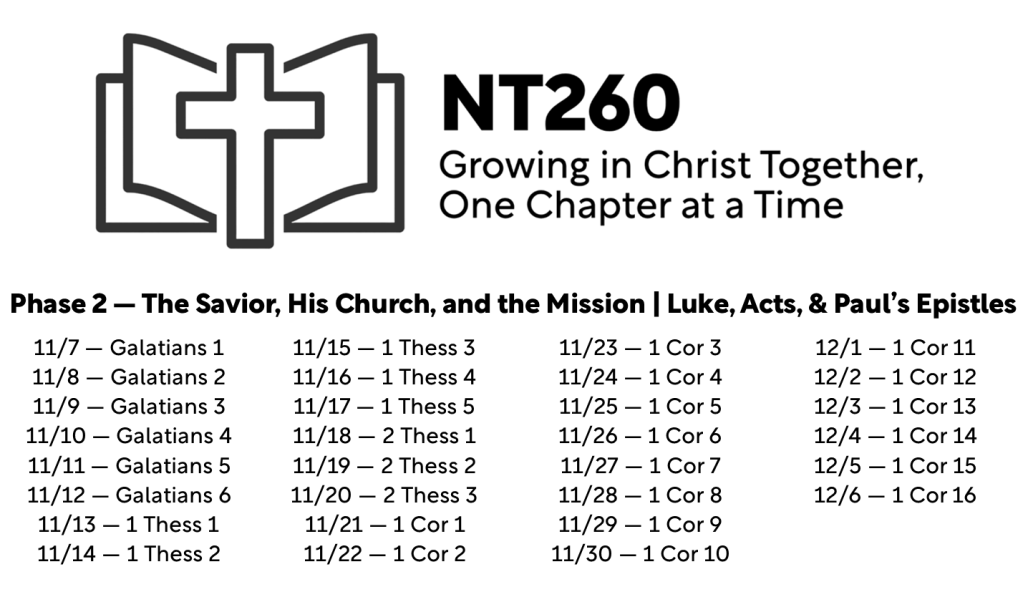
Galatians
The letter to the Galatians (check out this cool visual summary from the Bible Project) was written by Paul to churches in the Roman province of Galatia who were facing a spiritual crisis. After Paul preached the gospel of grace, other teachers arrived saying Gentile believers had to be circumcised and keep parts of the Mosaic law to belong to God’s people. Paul writes with urgency to defend the true gospel and his apostolic message, warning that any “different gospel” is no gospel at all (Galatians 1:6–9). His aim is pastoral and clear: believers are made right with God not by works of the law but by faith in Jesus Christ (Galatians 2:15–16).
Galatians shows how Christ’s cross brings a new era of freedom and life. Jesus bore the curse of the law so that blessing might come to the nations and the Spirit be given through faith (Galatians 3:13–14). Paul explains the law’s temporary role—it guarded and pointed to Christ—but now that Christ has come, we are God’s children by faith and clothed with Christ (Galatians 3:24–27). This freedom is not for selfishness but for love: “through love serve one another” (Galatians 5:13–14). The Christian life is life in the Spirit, where the desires of the flesh are put to death and the Spirit produces his good fruit—love, joy, peace, and more (Galatians 5:16–25). At the center stands the cross, which reshapes our identity and boasts (Galatians 2:20, 6:14).
In the story of salvation, Galatians declares that the promise to Abraham is fulfilled in Christ: Jew and Gentile are one family, justified by faith and adopted as sons through the Son (Genesis 12:3; Galatians 3:8, 3:26–29, 4:4–7). The gospel does not add law to Christ; it gives Christ alone by grace, and with him the Spirit who makes us new. Because Jesus has set us free, we stand firm in that freedom, walking by the Spirit and bearing one another’s burdens until the day of glory (Galatians 5:1, 5:16, 6:2).
Paul writes 1 Thessalonians to a young church he planted in a strategic, bustling city and had to leave sooner than he wanted (Acts 17:1–10). After sending Timothy to check on them, Paul hears a mostly good report—but also real concerns: grief over believers who had died, questions about the day of the Lord, ongoing persecution, and a few idle members refusing to work (1 Thessalonians 3:1–6, 4:13, 5:1–11, 4:9–12). With a warm pastoral tone, he defends the integrity of the gospel workers (1 Thessalonians 2), thanks God for their evident faith, love, and hope (1 Thessalonians 1:2–3), and urges them to keep growing in holiness, especially in sexual purity and brotherly love (1 Thessalonians 4:1–8, 9–12).
A major theme is Christ’s return—the “coming” of Jesus appears in every chapter (1 Thessalonians 1:10, 2:19, 3:13, 4:13–18, 5:23). Paul comforts grieving believers: those who have died “in Christ” will rise first, and together with the living they will be caught up to meet the Lord—and “so we will always be with the Lord” (1 Thessalonians 4:14–17). He reassures them that the day of the Lord will not overtake them like a thief because they belong to the day, not the night (1 Thessalonians 5:1–5, 9–10). In light of this hope, he calls the church to a steady, everyday obedience—respecting leaders, helping the weak, rejecting idleness, praying constantly, and testing everything by God’s Word (1 Thessalonians 5:12–22).
In the story of salvation, 1 Thessalonians looks back to Jesus’ death and resurrection as the ground of our hope and forward to His coming as the goal of our hope (1 Thessalonians 4:14, 5:9–10). The God who chose and called them is faithful; He Himself will sanctify them completely and keep them blameless at the coming of the Lord Jesus (1 Thessalonians 1:4, 5:23–24). Until that day, the church waits with active faith, steadfast love, and durable hope—turning from idols to serve the living and true God and to wait for His Son from heaven (1 Thessalonians 1:3, 9–10).
Paul’s second letter to the Thessalonians comes soon after the first and meets a church still under pressure. Persecution had not let up, and a false claim had spread that “the day of the Lord” had already come, leaving some shaken and afraid (2 Thessalonians 1:4, 2:1–2). Paul reassures them: when Jesus returns, He will bring justice—rest for His people and judgment on those who oppose the gospel (2 Thessalonians 1:5–10). He prays that God would make them worthy of their calling and glorify the name of Jesus in them, even as they suffer (2 Thessalonians 1:11–12).
Building on 1 Thessalonians, Paul clarifies what must happen before the Lord’s coming: a rebellion and the revealing of “the man of lawlessness,” whom Jesus will overthrow by the breath of His mouth at His appearing (2 Thessalonians 2:3–8; cf. 1 Thessalonians 4:13–18, 5:1–11). Until that day, the church must “stand firm and hold to the traditions” taught by the apostles, trusting the Lord to comfort and strengthen their hearts (2 Thessalonians 2:15–17). Paul also addresses a practical problem—idleness—commanding believers to work quietly and earn their own living, and instructing the church to correct those who refuse to obey (2 Thessalonians 3:6–12, 14–15). In the story of salvation, 2 Thessalonians keeps our eyes fixed on Christ’s certain return and calls us to steady, holy, hope-filled lives while we wait (2 Thessalonians 3:5, 13).
Paul writes 1 Corinthians to a gifted but divided church in a major port city shaped by status, rhetoric, and idolatry (Acts 18:1–11). After hearing troubling reports and receiving their questions, he calls them back to the gospel—to humble unity and holy living (1 Corinthians 1:10–13, 5:1–2, 7:1, 11:18). From the start, Paul centers everything on “Christ crucified,” God’s wisdom and power, not human show (1 Corinthians 1:18–25, 2:1–2). Because they belong to Jesus, they must stop boasting in leaders, flee sexual sin, and remember they are God’s temple where the Spirit dwells (1 Corinthians 3:16–17, 5:1–13, 6:18–20). Love—not pride or personal rights—must shape their life together (1 Corinthians 8:9–13, 13:1–7).
Paul also answers practical questions about marriage and singleness (1 Corinthians 7), food and idolatry (1 Corinthians 8–10), and gathered worship (1 Corinthians 11–14). He urges them to build up the church: take the Lord’s Supper in a worthy way, honor one another, and use spiritual gifts for the common good, not for display (1 Corinthians 11:23–26; 12:4–7; 14:12, 26). The famous “love chapter” shows that without love, even the greatest gifts amount to nothing (1 Corinthians 13:1–3). Above all, Paul insists on the bodily resurrection of Jesus and its hope for believers; because Christ is raised, our faith is not empty, our labor is not in vain, and we will be raised imperishable (1 Corinthians 15:3–4, 20–22, 51–58).
In the story of salvation, 1 Corinthians shows the gospel forming a holy people in a worldly place. The church is God’s family, Christ’s body, and the Spirit’s temple—set apart to reflect His character (1 Corinthians 1:2, 3:16, 12:12–27). So we lay down our rights for the weak (1 Corinthians 8:11), pursue love (1 Corinthians 14:1), and do all to the glory of God (1 Corinthians 10:31). Standing on the sure foundation—Jesus Christ our Lord—we work together for the advance of the gospel until He comes (1 Corinthians 3:11; 16:13–14, 22–24).
Sunday’s coming, and I’m especially thankful this week.
Not only do we get to gather again as the people of God, but we also get to celebrate 27 years of God’s faithfulness to and through Christ Community Church. That’s no small thing. The local church is one of God’s greatest gifts to His people — where the gospel is proclaimed, disciples are made, and the love of Jesus is lived out in community.
I want to say how personally thankful I am that God has allowed me and my family to be a part of Christ Community. I’ve had the privilege of serving in churches for two decades, but this church has become the church home and faith family we had always hoped for. Candice, Keri, Xander, and I are genuinely grateful — not only to serve here, but to belong here. Christ Community is a gift, and we thank God for it.
That’s exactly the sentiment Paul had in Colossians 1:3-6 when he was opening his letter to the church at Colossae: sharing his gratitude for a gospel-shaped church.
Paul began in v. 3 by saying, “We always thank God, the Father of our Lord Jesus Christ, when we pray for you.” He’s not flattering them but pointing to God as the source of their growth and faithfulness. Every local church that stands firm in Christ is a reason to give thanks.
In v. 4, he reflects on what he’s heard about them: their “faith in Jesus” and the love they have “for all the saints”. These aren’t vague religious concepts. Their faith was real, anchored in Jesus. Their love was visible, expressed toward one another. This kind of gospel life is evidence of Christ working.
But where does that kind of faith and love come from? The answer is in v. 5: “because of the hope laid up for you in heaven”. Their faith and love are rooted in something eternal — not wishful thinking, but a secure hope. Their faith and love are rooted in something objective, already laid up, already theirs. That’s our shared hope, too: an imperishable inheritance kept in heaven (1 Peter 1:4), secured not by our own goodness but in Jesus’s blood and resurrection (1 Peter 1:18-21).
Then in vv. 5-6, Paul shifts the spotlight to the gospel itself, “the Word of the truth…which has come to you, as indeed in the whole world it is bearing fruit and increasing…”. You see, the gospel isn’t merely information. It’s power. Wherever it goes — when it’s understood and received by grace through faith in Jesus — it grows, it bears fruit, it transforms lives. That’s what God has done at Christ Community for 27 years, and that’s what we’re asking Him to keep on doing until Jesus returns.
When we gather Sunday, we’ll celebrate that very gospel in song. We’ll sing “Holy Water” thanking God for washing away our sin in His grace and mercy. We’ll sing “Graves Into Gardens” proclaiming the power of Jesus to bring life where there was death. We’ll sing “In Christ Alone” declaring our firm hope rooted in Jesus’s death and resurrection. We’ll sing “Thank You Jesus for the Blood” remembering the precious price He paid to redeem us.
We’ll be reminded of that gospel in our Scripture readings, as in Titus 3:4-7 where we’ll clearly see that our salvation is not in our works but Jesus’s, not in our righteousness (which we don’t have) but His mercy.
We’ll be reminded of that gospel and the Savior it proclaims as John opens up the Word of God and shows us the King of kings, unpacking the value and depth of His sacrifice for sinners like us and the salvation that comes only by grace through faith in Jesus alone.
So, let’s gather together.
Let’s gather on the Lord’s day — on Sunday — not just to mark an anniversary but to lift high the name of Jesus, the One who saved us, who brought us together as a church family, and who is still working in and through us for His glory and our good.
The gospel has borne fruit here, and we pray it continues to do so for generations to come — until Jesus comes.
4But when the goodness and loving kindness of God our Savior appeared, 5He saved us, not because of works done by us in righteousness, but according to His own mercy, by the washing of regeneration and renewal of the Holy Spirit, 6whom He poured out on us richly through Jesus Christ our Savior, 7so that being justified by His grace we might become heirs according to the hope of eternal life.
18…knowing that you were ransomed from the futile ways inherited from your forefathers, not with perishable things such as silver or gold, 19but with the precious blood of Christ, like that of a lamb without blemish or spot. 20He was foreknown before the foundation of the world but was made manifest in the last times for the sake of you 21who through Him are believers in God, who raised Him from the dead and gave him glory, so that your faith and hope are in God.
This phase will have us reading about Jesus’s life in the gospel of Luke, the formation of the Church in Acts, and walk through the theology found in Paul’s letters that the Church needs to know about and live out the eternal life given by grace through faith in Jesus.
Below, you’ll find brief synopses of each book in this phase to help you understand the scope of the book and most importantly, how it fits into the full Story of the Bible.
When you click on each day’s link, you will find a link to audio, a summary of the chapter, a key verse from the chapter, and opportunities for reflection and outreach.
Luke
Luke is the first part of a two-volume story (with Acts) written to give believers confidence about Jesus and the good news (Luke 1:1–4; Acts 1:1–2). Early Christians understood the author to be Luke, a physician and coworker of Paul (Col. 4:14; 2 Tim. 4:11). He writes to Theophilus—and to a wider audience—to show that Jesus is the promised Savior for all people: Jews and Gentiles, the poor and the powerful, the outcast and the insider (Luke 2:10–11; 4:18–19; 19:10). Big themes include prayer, the Holy Spirit, costly discipleship, warnings about riches, and God’s grace that lifts the lowly (Luke 1:52–53; 3:21–22; 6:20–26; 11:1–4; 12:32–34).
As a Gospel, Luke reads like an ancient biography centered on Jesus’ public ministry, death, and resurrection. It moves from the temple in Jerusalem to Galilee and back again, with a long “journey to Jerusalem” where Jesus heads to the cross (Luke 9:51). Luke’s style is vivid and orderly, weaving in songs, parables unique to him (e.g., the Good Samaritan; the Prodigal Son), and many scenes of table fellowship that show who belongs in God’s family (Luke 7:36–50; 10:25–37; 15:1–32). Throughout, Jesus is the Spirit-anointed Son of Man who teaches, heals, forgives, and welcomes sinners (Luke 4:1, 14, 18; 5:20–32).
In the big story of the Bible, Luke shows God keeping his promises to Israel and opening salvation to the nations. Jesus fulfills the Scriptures, suffers, rises, and sends his followers out with the Spirit’s power (Luke 24:44–49; Acts 1:8). The kingdom has arrived in Jesus’ words and works, yet we still wait for its fullness—so we live awake, generous, prayerful, and bold in witness until he returns (Luke 11:2; 12:32–40; 21:34–36).
The book of Acts is Luke’s sequel to his Gospel, written to Theophilus and to a broader audience of early Christians (Acts 1:1; Luke 1:3). Tradition and internal evidence identify Luke, the beloved physician and companion of Paul (Col. 4:14; 2 Tim. 4:11; Philem. 24), as the author. He carefully investigated eyewitness testimony and recorded an orderly account of the risen Christ’s work through His apostles (Luke 1:2–3; Acts 1:21–22). Most likely written in the early 60s A.D., Acts gives believers certainty that the gospel is true and that Christianity is the fulfillment of God’s promises, not a new or dangerous sect (Luke 24:44–47; Acts 24:14–15).
At its heart, Acts shows how the ascended Jesus continues His mission by sending the Holy Spirit to empower His church. The book’s key verse, Acts 1:8, provides its outline: the gospel spreads from Jerusalem (Acts 2:1–47), into Judea and Samaria (Acts 8:4–25), and then outward to the ends of the earth, symbolized by Paul’s ministry in Rome (Acts 28:30–31). Along the way, Luke highlights miracles (Acts 3:1–10; 19:11–12), persecution (Acts 4:1–22; 7:54–60), and the unstoppable advance of God’s Word (Acts 12:24; 19:20). Through it all, Acts demonstrates that nothing—not prison, plots, or shipwrecks—can hinder the spread of the gospel (Acts 5:41–42; 27:23–25).
Acts emphasizes both continuity and fulfillment. Jesus’ death and resurrection fulfill the Scriptures (Acts 2:25–36; 13:32–33), and His exaltation confirms Him as both Lord and Christ (Acts 2:36). The Holy Spirit marks the arrival of the new age of salvation (Acts 2:16–21; Joel 2:28–32) and unites Jews and Gentiles into one people of God (Acts 10:44–48; 15:7–11). Like Jesus in Luke’s Gospel, His followers perform miracles, face opposition, and walk in obedience to God’s plan (Luke 4:18–19; Acts 3:6–8; 14:8–10; Luke 23:4; Acts 26:31–32). The church’s mission is shown to be both ancient—rooted in God’s promises to Israel (Acts 3:25–26)—and worldwide, extending to “all who are far off” (Acts 2:39).
In the Story of the Bible, Acts is the bridge between Christ’s finished work and the church’s Spirit-empowered witness. It records the first thirty years of gospel proclamation, showing how God’s plan of salvation moves from Jerusalem to Rome and beyond (Acts 1:8; 9:15; 13:47). Acts assures us that the risen Christ still reigns, His Spirit still empowers, and His mission still advances until the day He returns (Acts 2:33; 7:55–56; 28:28). The same Spirit who emboldened Peter, Stephen, and Paul continues to strengthen the church today to proclaim Jesus Christ as Lord to the ends of the earth (Acts 4:31; 20:24; 28:31).
Every week at Christ Community Church, we gather and lift our voices in worship of Jesus by reading Scripture together and singing to and about Him. The Scriptures we are reading this week remind us of who God is and what He has done. Psalm 103:8-13 is one of the most beautiful descriptions of the LORD’s mercy in the Bible, and when we look at it alongside the picture of redemption that is found in Christ in Colossians 1:13-14, it calls us to worship Him with grateful hearts.
Take a second and look at these passages and catch a glimpse of our great God and Savior Jesus Christ: — Psalm 103:8 — “The LORD is merciful and gracious, slow to anger and abounding in steadfast love.” This echoes how God introduced Himself in Exodus 34:6, the foundational confession of His character. He is not quick to flare up in wrath but abounds in His deep covenant love for His people. — Psalm 103:9 — “He will not always chide, nor will He keep His anger forever.” Like Psalm 30:5 and Micah 7:18, this shows that while God’s anger against sin is real, His mercy outlasts His anger for those who belong to Him. His justice is perfect but not greater than His grace. — Psalm 103:10 — “He does not deal with us according to our sins, nor repay us according to our iniquities.” If God gave us exactly what our sin deserved, none could stand (Ezra 9:13, Romans 6:23), but He shows mercy in judgment, forgiving sin, iniquity, and transgressions just as He promised in Exodus 34:7. — Psalm 103:11 — “For as high as the heavens are above the earth, so great is His steadfast love toward those who fear Him….” The psalmist piles up comparisons here to show the depth and height of God’s kindness, as abundantly immeasurable as the heavens, decisively removing our sin, and enduring like a father’s compassion toward his children. God’s love is higher than we can measure and deeper than we can comprehend (Psalm 36:5). — Psalm 103:12 — “…as far as the east is from the west, so far does He remove our transgressions from us.” East and west never meet. That’s how completely God forgives in Christ — our sins are gone, removed to never return (Micah 7:18-20, 2 Corinthians 5:21). — Psalm 103:13 — “As a father shows compassion to His children, so the LORD shows compassion to those who fear Him.” Unlike the gods of the nations who are apathetic and hostile, the LORD relates to His people as a true Father — compassionate, tender, and faithful. Jesus Himself taught us that we can approach God in this way (Matthew 6:9, Mark 14:36).
And how has this mercy been most clearly revealed to us? In Jesus! — Colossians 1:13-14 — He has delivered us from the domain of darkness and transferred us to the Kingdom of His beloved Son, in whom we have redemption, the forgiveness of sins. — Just as God rescued Israel from Egypt (Exodus 6:6, 14:30), He has rescued us from a greater slavery: the domain of darkness, the power of Satan and sin (Acts 26:18, Ephesians 5:8). Through JESUS, we have been drawn out of the shadows and placed into the Kingdom of His beloved Son. That’s redemption — the ransom paid through His blood, freeing us from bondage to sin and granting us forgiveness once and for all (Ephesians 1:7, 1 Peter 1:18-19).
This is the gospel. The mercy described in Psalm 103 is fulfilled in Jesus. Our sin is removed. Our debt is cancelled. And we are safely in Him.
That’s why tomorrow we can lift our voices and read these Scriptures. It’s why we can lift our voices to our holy, holy, holy God and sing that His mercy is more and we have hope in Christ alone. Every verse and lyric will remind us of who God is and what He has done for us in Jesus. Every verse preached will point us to Him and give opportunity to see Him more clearly.
So come on out and gather with us tomorrow. Come with gratitude, come with hope, come ready to worship the God who shows compassion like a Father and saves by the blood of His Son.
8The LORD is merciful and gracious, slow to anger and abounding in steadfast love. 9 He will not always chide, nor will He keep His anger forever. 10He does not deal with us according to our sins, nor repay us according to our iniquities. 11For as high as the heavens are above the earth, so great is His steadfast love toward those who fear Him; 12as far as the east is from the west, so far does He remove our transgressions from us. 13As a father shows compassion to his children, so the LORD shows compassion to those who fear Him.
13 He has delivered us from the domain of darkness and transferred us to the kingdom of his beloved Son, 14 in whom we have redemption, the forgiveness of sins.









 Just Keith Harris