3 For I passed on to you as of first importance what I also received, that Christ died for our sins according to the scriptures, 4 and that he was buried, and that he was raised up on the third day according to the scriptures, 5 and that he appeared to Cephas, then to the twelve, 6 then he appeared to more than five hundred brothers at once, the majority of whom remain until now, but some have fallen asleep.
1 Corinthians 15:3-6
He made the one who did not know sin to be sin on our behalf, in order that we could become the righteousness of God in him.
2 Corinthians 5:21
8 But what does it say? “The word is near to you, in your mouth and in your heart” (that is, the word of faith that we proclaim), 9 that if you confess with your mouth “Jesus is Lord” and believe in your heart that God raised him from the dead, you will be saved. 10 For with the heart one believes, resulting in righteousness, and with the mouth one confesses, resulting in salvation. 11 For the scripture says, “Everyone who believes in him will not be put to shame.” 12 For there is no distinction between Jew and Greek, for the same Lord is Lord of all, who is rich to all who call upon him. 13 For “everyone who calls upon the name of the Lord will be saved.”
📖 Revelation 3:7–13We’re back!After a few months off, The King is Coming returns in 2026 with one of the most encouraging letters in Revelation — Jesus’s message to the faithful church in Philadelphia. In a world filled with opposition and weakness, Jesus opens a door no one can shut.In this episode, Keith Harris and Jamie Harrison explore:✔️ Jesus’s identity as the Holy One, the True One — God Himself✔️ What the “key of David” means and how Jesus alone opens and shuts✔️ The debated phrase “I will keep you from the hour of trial” — and how to read it biblically✔️ Why “little power” doesn’t disqualify faithfulness✔️ How being kept through the trial glorifies Christ’s strength in us✔️ What it means to be a pillar in God’s presence foreverThis church had no rebuke — only encouragement. And Jesus’s call still stands today: “Hold fast what you have, so that no one may seize your crown.” (Revelation 3:11, ESV)🔗 Missed earlier episodes in the series? You can click here to catch up and listen from the beginning.✍️ If you’d like to see a written version of this podcast, complete with footnotes and cross-references, you can find it here.
We have spent a good bit of time the past few weeks at Christ Community in Luke 2:10 and the verses around it. The declaration of the angels to those poor and frightened shepherds should about be memorized at this point: “Do not be afraid, for behold, I bring good news to you of great joy which will be for all the people”. Good news. Great joy. For all people.
The word translated “good news” is often translated gospel, and the message that the angels proclaimed on that hillside 2,000 years ago is a beautiful and succinct picture of the gospel. They preached that the Savior “who is Christ the Lord” was born for them – for those dirty, stinky shepherds – and that He could be found that very day in Bethlehem. It was news that would and could change the trajectory of their lives. They just needed to believe in Him and receive the salvation He had to offer – they would receive grace by faith through Him.
Now, I know that on the day they heard that gospel message Jesus was still laying in the feeding trough, still an infant, and was decades away from His death, burial, and resurrection. But the babe in the manger was still “the Word [become] flesh” (John 1:14). He was still the Lamb slain “before the foundation of the world” (Ephesians 1:4).
We sometimes want to overcomplicate things. We know the whole story and want to add and fill in the gaps in the angels’ proclamation that day, but the “good news of great joy” is still just as simple. In fact, Paul gives very succinct proclamations of the gospel, too. The first can be found in 1 Corinthians 15 where he tells the church at Corinth that he is passing on to them the most important message he had to offer – the very same message that he received himself: Jesus died for our sins according to the way that the Bible said He would, He was buried, and He rose from the dead on the third day exactly as the Bible and His own preaching said He would. That’s good news!
Paul’s second succinct gospel summary comes in his next letter to the church at Corinth in 2 Corinthians 5:21. In one complex little sentence, he shares that God put the sins of those who would be saved on Jesus. Jesus had never sinned and did not deserve any condemnation, but He willingly bore our sin on our behalf. Those who trust in Him no longer are under the condemnation and shame due to their sin; Jesus bore that (Colossians 2:13-14). In a great exchange, Jesus traded His righteousness for our sin. He bore the wrath of God and exchanged that for God’s favor. Basically, He traded His extravagantly full bank account for our bankrupt one so that when God looks upon those who Jesus has saved, He does not see their sinfulness but Jesus’ righteousness! That’s good news!
The gospel is good news, but there is also bad news. Those who do not confess Jesus as Lord and believe He died for their sins and rose again to not receive part in that great exchange. They remain in their sin. Their condemnation remains their own. It does not have to be that way. All who call out to Jesus in faith will be saved. Anyone who believes in Him will not be but to shame, but not believing leaves the shame where it belongs – on the sinner.
Long lay the world in sin and error pining Till He appeared and the soul felt its worth A thrill of hope, the weary world rejoices For yonder breaks a new and glorious morn Fall on your knees!
Those who are without Jesus are still in their sin and “pining” after the wrong things, sinful things. But everyone – all people – have the opportunity to fall on their knees, believe in Him – confess Him as Lord, and repent of their sin. And those who do will not only have heard the good news of great joy but also to have believed it and received the salvation Jesus offers.
I love the phrase “good news of great joy” because 1) it is straight from the Bible, and 2) it captures what Jesus offers. But I also love the way the writer of “O Holy Night” captured what it is to be a sinner and receive Christ: “a weary world rejoices”. If you have been reading with us over these past two weeks, you have read snippets of the “good news of great joy”, but have you received it? Have you believed on Jesus, or are you still on the fence? If you haven’t, I urge you: fall on your knees, believe what the Bible says about Him, confess Him as Lord, and rejoice in the salvation He brings!
Matthew 1:1-17 — 1 The book of the genealogy of Jesus Christ, the son of David, the son of Abraham.
2 Abraham was the father of Isaac, and Isaac the father of Jacob, and Jacob the father of Judah and his brothers, 3 and Judah the father of Perez and Zerah by Tamar, and Perez the father of Hezron, and Hezron the father of Ram, 4 and Ram the father of Amminadab, and Amminadab the father of Nahshon, and Nahshon the father of Salmon, 5 and Salmon the father of Boaz by Rahab, and Boaz the father of Obed by Ruth, and Obed the father of Jesse, 6 and Jesse the father of David the king.
And David was the father of Solomon by the wife of Uriah, 7 and Solomon the father of Rehoboam, and Rehoboam the father of Abijah, and Abijah the father of Asaph, 8 and Asaph the father of Jehoshaphat, and Jehoshaphat the father of Joram, and Joram the father of Uzziah, 9 and Uzziah the father of Jotham, and Jotham the father of Ahaz, and Ahaz the father of Hezekiah, 10 and Hezekiah the father of Manasseh, and Manasseh the father of Amos, and Amos the father of Josiah, 11 and Josiah the father of Jeconiah and his brothers, at the time of the deportation to Babylon.
12 And after the deportation to Babylon: Jechoniah was the father of Shealtiel, and Shealtiel the father of Zerubbabel, 13 and Zerubbabel the father of Abiud, and Abiud the father of Eliakim, and Eliakim the father of Azor, 14 and Azor the father of Zadok, and Zadok the father of Achim, and Achim the father of Eliud, 15 and Eliud the father of Eleazar, and Eleazar the father of Matthan, and Matthan the father of Jacob, 16 and Jacob the father of Joseph the husband of Mary, of whom Jesus was born, who is called Christ.[1]
📖 Revelation 3:7–13We’re back!After a few months off, The King is Coming returns in 2026 with one of the most encouraging letters in Revelation — Jesus’s message to the faithful church in Philadelphia. In a world filled with opposition and weakness, Jesus opens a door no one can shut.In this episode, Keith Harris and Jamie Harrison explore:✔️ Jesus’s identity as the Holy One, the True One — God Himself✔️ What the “key of David” means and how Jesus alone opens and shuts✔️ The debated phrase “I will keep you from the hour of trial” — and how to read it biblically✔️ Why “little power” doesn’t disqualify faithfulness✔️ How being kept through the trial glorifies Christ’s strength in us✔️ What it means to be a pillar in God’s presence foreverThis church had no rebuke — only encouragement. And Jesus’s call still stands today: “Hold fast what you have, so that no one may seize your crown.” (Revelation 3:11, ESV)🔗 Missed earlier episodes in the series? You can click here to catch up and listen from the beginning.✍️ If you’d like to see a written version of this podcast, complete with footnotes and cross-references, you can find it here.
One thing that I love about Christmas is that people are abnormally willing to be open to talk about Jesus. Much of the year, people’s attitudes toward Scripture or gospel can be very Scrooge-like, very “Bah! Humbug!” But for a few weeks in one month out of the year, people’s hearts swell like the Grinch’s after encountering Cindy-Lou-Who.
Another thing I love about Christmas is the way this season produces stories. As I type, The Polar Express is on in the background, a narrative of a young boy regaining the childlike sense of wonder and hope. I will no doubt watch It’s a Wonderful Life on Christmas day, a fairly new tradition at the Harris household, and follow good old George Bailey finding that his life has more blessings than curses and realizing the value and impact a single life can have. I’ll even watch one of my favorite Christmas stories chronicling John McClain’s daring rescue during the hijacking of Nakatomi Corporation’s Christmas party. More than those fictional stories, though, I love the stories that come from real life, from real people.
Christmas is a time of joy and celebration, but for many, it is a time of mourning, grieving, and faking-it-till-you-make-it. As I have talked with folks about this in recent years, I find that the thing that bridges the gap between those two groups – the joyful and the weary – is their stories. Even those who are mourning have stories and memories of bygone traditions. There are funny and happy memories, and yes, sad ones, too, that come out during this season. Those memories can kind of weave together into the tapestry of who we are. They become part of our story.
Jesus’s story is not different in that aspect because part of becoming flesh and dwelling among us (John 1:14) is the sin and death we need rescuing from. His Story is of the perfect and sinless Savior deigning to live among – to live for and on behalf of – those He came to save. In order for Isaiah’s prophecy that “those who dwelt in a land of deep darkness, on them has light shone” (Isaiah 9:2), Jesus needed to come and shine in the darkness, and we need to be reminded that the “darkness has not overcome” Him (John 1:4)!
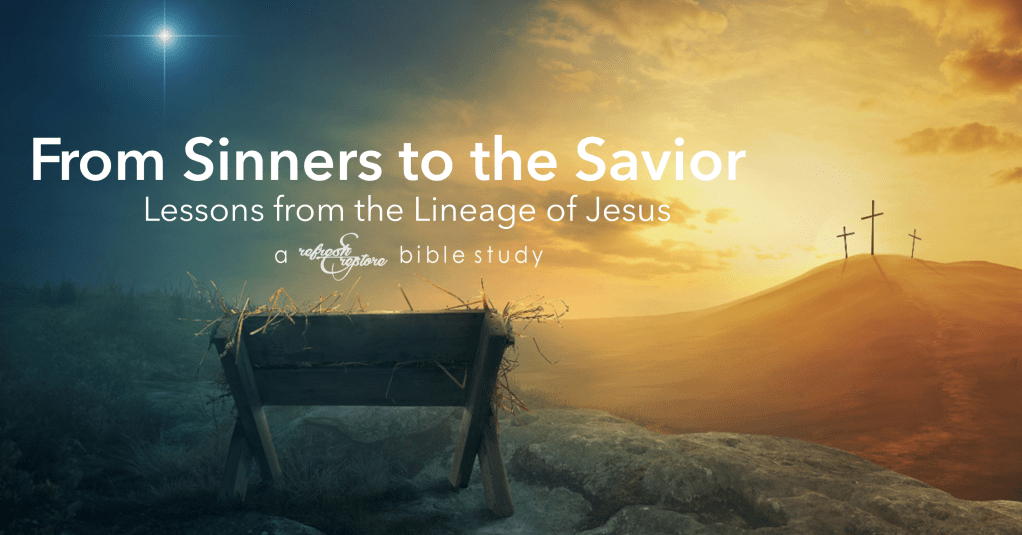
So today, let’s take a moment and look at Jesus’s Story, specifically the Story of the lineage God chose to make Jesus a part of. Sometimes we look at stories in the Bible and feel inadequate. Rest assured that Jesus’s lineage as seen in Matthew 1:1-17 is full of people just like us – people who needed a Savior like Him!
Once upon a time, there was a great and powerful King. He was foretold of old to be a hero who would come from His far away country to redeem and win back His lost love. His Story is one of romance as He left His palace to rescue His Bride. His lineage hailed back to other…great…well, um….
One of the things I love about God’s Word is how it does not fall into the temptation of prettying things up or rewriting them to be more acceptable to folks’ sensibilities. Yes, Jesus is the great King – the King of kings who was prophesied for centuries to come from heaven and rescue His people. Yes, Jesus’s Story is one of romance, where He left His throne on high and traded it for a lowly manger in a tumble-down stable. But His lineage? It wasn’t filled with kings and queens, although there were a few sprinkled in toward the middle. It wasn’t filled with flawless heroes – the flaws are many. No, Jesus’s family tree was filled with regular sinners with real sin and problems – people like me and you.
This Bible study will look at the women emphasized in Jesus’s family tree who point us to Him in specific ways. We won’t go into their full stories, but I will give you the cross-references so you can check them out directly from Scripture.
Tamar (v. 3) …and Judah the father of Perez and Zerah by Tamar….
The first woman mentioned is Tamar (v. 3), and her story is found in Genesis 38. Tamar was Judah’s – you know, Judah as in the lion of the tribe of – she was his daughter-in-law. Originally, she was married to Judah’s oldest son, Er, until “the Lord put him to death” because he was “wicked in the sight of the Lord” (Genesis 38:7). By levirate marriage customs, it became the responsibility of Judah’s second son, Onan, to father children on behalf of his deceased big brother. But Onan was selfish and wicked, refusing to fulfill his duty; the Lord put him to death as well (Genesis 38:10). Judah promised his youngest son, Shelah, to Tamar when he came of age but had no intention of ever fulfilling that promise. Tamar, left without hope of bearing children, took matters into her own hands. Disguised as a prostitute, she tricked Judah into sleeping with her. Her actions were scandalous – and so were Judah’s.
So, why is Tamar mentioned in Jesus’s genealogy? Her story shows us God’s providence and mercy in bringing about His purposes despite human sin. Tamar’s inclusion reminds us that God can use even the most broken situations to fulfill His promises. Judah’s declaration, “She is more righteous than I” (Genesis 38:26), points to her determination to preserve the family line, a role God used in the lineage of Jesus. Her child that would be Jesus’s earthly ancestor was marked by a scarlet string around his foot. It brings to mind the way that God used her story and the stories of people like her almost like a scarlet thread of salvation running through His Story.
Rahab (v. 5) …and Salmon the father of Boaz by Rahab….
The second woman is Rahab (v. 5), whose story is found in Joshua 2:1-21, 6:17, and 6:22-25, with further mentions in Hebrews 11:31 and James 2:25. Rahab wasn’t one of God’s chosen people. She was a Canaanite from Jericho, known for her sinful profession. But she had heard of the God of Israel and believed in His power. She protected His spies, siding with the Lord and marking her house with a scarlet cord as a sign of her faith and obedience. When Jericho’s mighty walls fell by the power of God and the city was taken, Rahab and her family were spared.
Why would someone like Rahab be included in Jesus’s official lineage? Her faith in God is the answer. Rahab’s faith stood out like a scarlet cord, demonstrating that salvation is not about where you come from but about the one you put your faith in – in the God you trust. Her inclusion reminds us of God’s grace and His power to redeem and use anyone for His glory. Rahab’s life became part of the story of salvation history, pointing us to the greater salvation found in Jesus, who rescues all who place their faith in Him.
Ruth (vv. 5-6) …and Salmon the father of Boaz by Rahab, and Boaz the father of Obed by Ruth, and Obed the father of Jesse, and Jesse the father of David the king.
The third woman is Ruth (v. 5), whose story is told in the book of the Bible bearing her name. Like Rahab, Ruth wasn’t one of God’s chosen people. She was a Moabite, descended from incest between Lot and his daughter (Genesis 19:30-37). When famine struck Israel, Ruth’s husband Mahlon and his family came to Moab for refuge, but tragedy followed. Ruth’s father-in-law, brother-in-law, and husband all died, leaving Ruth and her mother-in-law in dire straits. Despite her own loss, Ruth chose to return to Israel with Naomi, declaring, “Your people shall be my people, and your God my God” (Ruth 1:16). She returned with Naomi to Bethlehem – yes, the Christmas Bethlehem – and met Boaz, a kinsman-redeemer who married her and restored their family’s inheritance.
Why is Ruth mentioned in Jesus’s genealogy? Ruth’s story is one of God’s grace extending beyond Israel to include the nations. Her faith and devotion to God stand as a testament to His redeeming love. Her role as David’s great-grandmother and an ancestor of Jesus reminds us that God’s plan of salvation always included people from every nation.
The Wife of Uriah (vv. 6-7) … and Jesse the father of David the king. And David was the father of Solomon by the wife of Uriah….
The fourth woman is not named directly but is referred to as “the wife of Uriah” (v. 6). Her story is found in 2 Samuel 11:1-25. Her name was Bathsheba, and she was the wife of Uriah the Hittite, one of David’s mighty men. King David, in a moment of temptation and sin, saw Bathsheba bathing on her roof and had her brought to him so that he could sleep with her. She became pregnant, and David attempted to cover his sin by arranging Uriah’s murder. His actions were heinous, and the wages of his sin brought tragedy to his family and others.
Why is Bathsheba included in Jesus’s genealogy? The mention of her as “the wife of Uriah” highlights David’s sin and the brokenness of humanity. Jesus being a descendent of David and rightful king as his heir is meant to be a good and special thing, but “by the wife of Uriah” highlights David’s sin. Yet God’s promises are unshaken. Through Bathsheba came Solomon, the king who would build the temple, pointing forward to the great King, Jesus – who everyone, all who sin, need as Savior. That includes kings. Bathsheba’s inclusion reminds us of God’s power to bring beauty from ashes and fulfill His covenant despite human failure.
Mary (v. 16) …and Jacob the father of Joseph the husband of Mary, of whom Jesus was born, who is called Christ.
The fifth and final woman is Mary (v. 16). Her story is found in Luke 1:26-38 and Matthew 1:18-25. Mary was a young woman of humble means, betrothed (like engaged but more intentional and binding) to Joseph. When the angel Gabriel announced to her that she would conceive by the Holy Spirit, she responded in faith and submission: “Behold, I am the servant of the Lord; let it be to me according to your word” (Luke 1:38). The fact that she was a virgin fulfilled the prophecy of Isaiah 7:14, demonstrating that Jesus’s conception was a miraculous act of God.
Why is Mary included in Jesus’s genealogy? Well, first how can one be born without a mother? God could have chosen to come and save in any way He wanted, but to come as the baby of a mother is one of the oldest promises in the Book. Genesis 3:15 promises victory of the “seed” of woman over the serpent, over Satan. Victory over our sin comes from her seed as well. Furthermore, Mary’s role here points to God’s grace. She bore the Savior of the world, yet she also needed Him as her Savior (Luke 1:47). Her inclusion highlights the miracle of the incarnation: God becoming flesh to dwell among us (John 1:14). Mary’s life, from the miraculous conception to standing at the foot of Jesus’s cross during his crucifixion (John 19:25), consistently points us to Jesus, to the Savior, and the fulfillment of God’s promises.
Wrapping Up
Why does the Bible recognize the sins and sinners in Jesus’s lineage? Simply put: because it all really happened. Sin happens. All people “have sinned and fall short of the glory of God” (Romans 3:23). None of us – not a single person in the history or future of the world – deserve to be in Jesus’s family tree, not even the great King David. But faith in God, trusting in Him, His work, and His steadfast love, is woven through that lineage like a scarlet cord. Looking at the sin and faith in Jesus’s genealogy reminds us that none are worthy of saving. That’s why He came. Jesus Himself said He came to “seek and save the lost” (Luke 19:10).
So, as you gather with family and friends and notice some rough-looking fruit in your family tree – or whether you notice the same by looking in your own mirror – realize that Jesus is more than the reason for the season. He’s more than a holiday. He’s the King. He’s the Savior. He’s the Christ. He is God. And He came to save sinners like me and you.
While Jesus is more than a holiday, He offers His salvation to us as a gift. There is no season like this one that highlights something important about gift giving: it’s no good if the gift is not received.
Won’t you receive Him?
The Bible tells us that “all who…receive Him,” who believe in His name, He gives “the right to become children of God” (John 1:12). The Bible also shows us what that belief looks like. In Romans 10:9, it says, “if you confess with your mouth that Jesus is Lord and believe in your heart that God raised Him from the dead, you will be saved.” This goes beyond mere words or understanding the concept of who He is – it’s giving Him your life, ceding control to Him as Lord and trusting that His death on the cross paid the penalty for your sin and His resurrection gives you eternal life in Him.
That’s good news.
That’s a wonderful gift, freely given but not cheap. Won’t you receive it – receive Him? Merry Christmas, dear Sojourner, and I pray that God blesses you and yours this season — not necessarily with the traditional holiday trappings but absolutely by seeing Him for who He is in your lives.
I touched on the subject of Jesus as our Advocate in the last entry in the #DailyWisdomChallenge, so I guess this has been on my mind and heart for a few weeks now.
Sin brings guilt, shame, and condemnation. our enemy, Satan, is quick to accuse us, pointing out our failures and declaring us unworthy before God (Revelation 12:10). But in 1 John 2:1-2, we are reminded of the incredible hope we have in Jesus as our Advocate. An advocate is someone who pleads on behalf of another, and Jesus does this perfectly for us. When we sin, He intercedes for us before the Father — not by minimizing our sin but by pointing to His finished work on the cross!
Jesus is described as “the righteous”, the One who lived a sinless life and was perfectly obedient to the Father. Because of His righteousness, He could offer Himself as the perfect sacrifice for our sins. John tells us that Jesus is the “propitiation for our sins” — a wrath-bearing atonement. On the cross, Jesus took upon Himself the punish our sins deserved, fully satisfying God’s justice and turning away His righteous wrath (Romans 3:25-26). His blood covers us, and through Him, we are forgiven and cleansed (1 John 1:7).
Now, when God looks at us, He sees us through the righteousness of His Son. Jesus speaks on our behalf, declaring that our debt has been paid in full and that we belong to Him. Because of Jesus, God does not deal with us according to our sin but according to His grace and mercy (Psalm 103:10-12).
Today, I am thankful that I don’t have to stand before God in my own strength or righteousness. When I fail, Jesus is my Advocate, reminding me that my sin has been dealt with once and for all.
If you are in Christ, this is true for you, too. Let this truth silence the voice of guilt and shame — the voice of our accuser, and fill your heart with gratitude to the Savior who stood in our place.
If you are not in Christ, understand that you stand before God as judge and represent yourself. There’s more than enough evidence of our sin to convict. Turn your life over to Jesus, confess Him as Lord and put your trust in Him. He will save all who call on Him (Romans 10:9-10, 13)!
That’s good news!
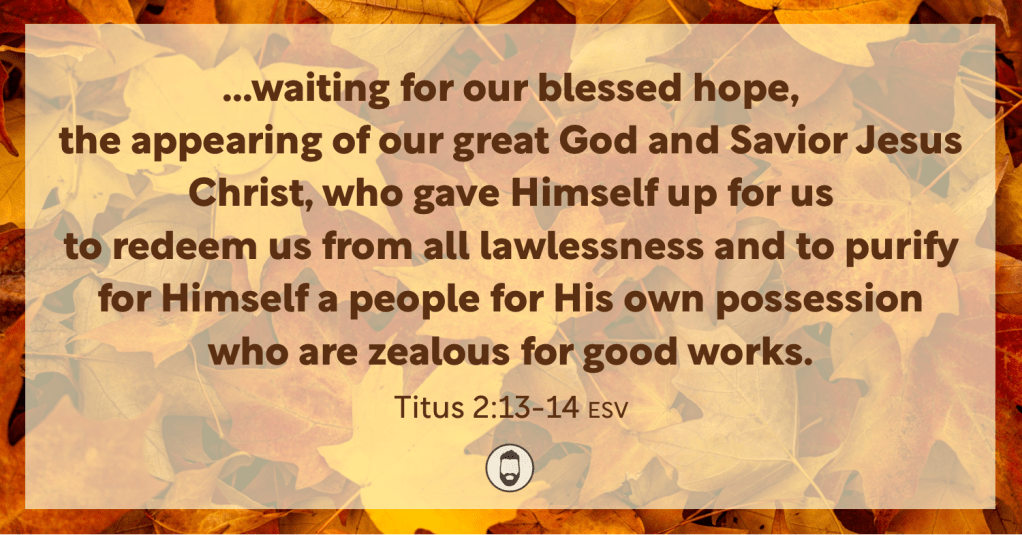
All through the month of November, our Christ Community Church family is focusing on what we are thankful for and expressing our thanks to our “great God and Savior Jesus Christ, who gave Himself for us to redeem us” (Titus 2:13-14).
This, like the #DailyWisdomChallenge we went through in October, is a challenge from our pastor John Goldwater — the #GRATITUDEandHOPEchallenge — where we have the opportunity to post Bible passages that move us to thanksgiving or in which we find hope. May this lead you to be grateful and find your hope in Jesus!
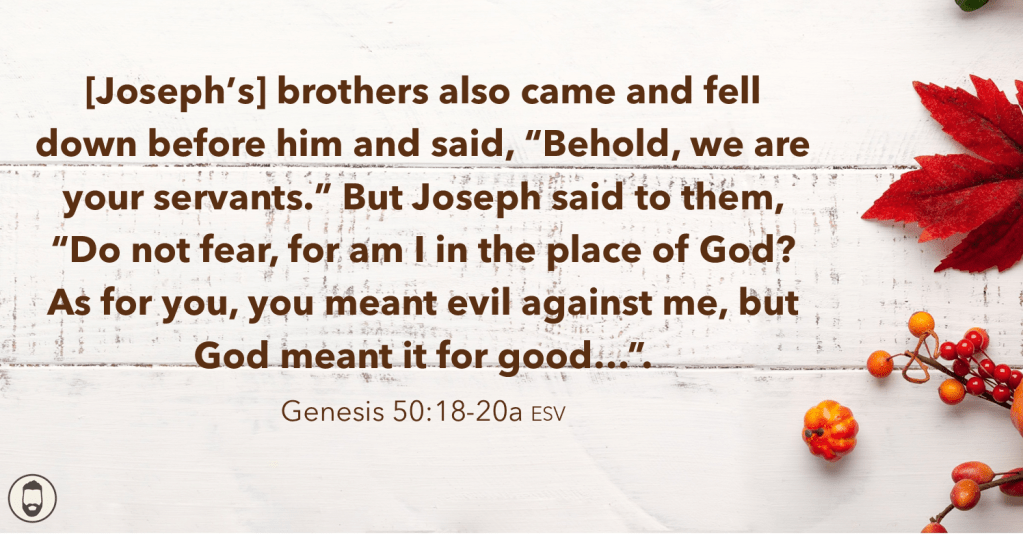
I’m thankful evil meant against me can be turned for good!
Joseph’s story is one of God’s sovereign grace working through even the darkest circumstances. As a young man, Joseph was betrayed by his brothers who sold him into slavery out of jealousy (Genesis 37:28). He was taken to Egypt where he endured years of hardship, including false accusations and imprisonment (Genesis 39:20). Yet, through it all, God was with him, blessing him with favor and wisdom.
This is not a health, wealth, prosperity gospel sort of story. Joseph was a slave and a prisoner through all of this blessing. No, this is God blessing Joseph despite the circumstances his brothers and Potiphar’s wife put him in. Over time, because of God blessing, Joseph rose to a position of great power in Egypt, ultimately saving countless lives — including his own family — by preparing for a severe famine (Genesis 41:39-41, 45:5-7).
When Joseph’s brothers feared his vengeance after their father’s death, Joseph responded with mercy and a profound trust in God’s purposes. He acknowledged the evil intent behind their actions but pointed to God’s greater plan: “You meant evil against me, but God meant it for good.” What his brothers intended for harm, God used to save lives and fulfill His promises.
This truth reminds us that God is sovereign over every situation. Even when others act with malice, God can take what is meant for evil and use it to accomplish His good purposes (Romans 8:28). Joseph’s story points us to the ultimate example of this: Jesus. The cross, intended as a tool of destruction, death, and shame, was the means of salvation for all who trust in Him (Acts 2:23-24).
Today, I’m thankful for a God who is always at work, even in the most painful and unjust situations. He is faithful to bring good from what seems hopeless. How might God be using the challenges in your life to accomplish His purposes, both for your good and His glory?
Trust Him. He’s got a plan for your life (and your troubles)!
Lord, thank you for taking care of us even when others mean us harm. Thank you for the example of Your working in Joseph’s life and the reminder You gave us in Your Word of Your faithfulness. Help us to see that this is not a story of how to get blessed but a means for us to give You glory with our lives. Help us to be like Joseph and look to You in times of hardship and then respond to those who did us wrong like Joseph did — like You did on the cross when You asked the Father to forgive them. Amen.
All through the month of November, our Christ Community Church family is focusing on what we are thankful for and expressing our thanks to our “great God and Savior Jesus Christ, who gave Himself for us to redeem us” (Titus 2:13-14).
This, like the #DailyWisdomChallenge we went through in October, is a challenge from our pastor John Goldwater — the #GRATITUDEandHOPEchallenge — where we have the opportunity to post Bible passages that move us to thanksgiving or in which we find hope. May this lead you to be grateful and find your hope in Jesus!
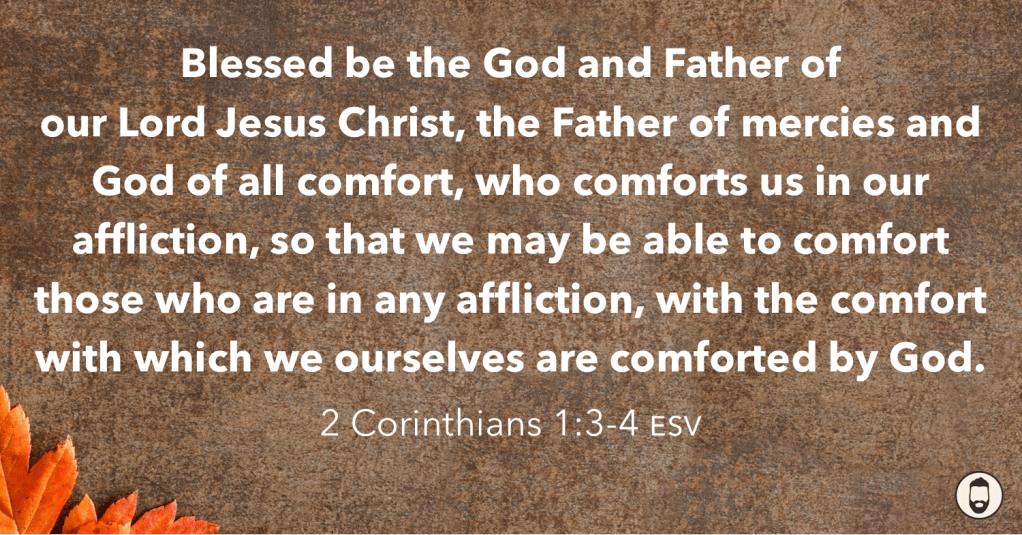
I’m thankful for the Father of Mercies and the God of All Comfort!
In 2 Corinthians 1:3-4, Paul invited the church at Corinth (and us today) to praise God for who He is — the source of mercy and comfort. God, in His great love, shows compassion to us in our pain and suffering. He doesn’t stand far off or push us away but instead draws near, meeting us in our affliction with His presence, peace, and sustaining grace. Whether we face sorrow or loss, trials or tribulations, we can cling to the promise that the “God of all comfort” is with us, strengthening and reminding us that we are never alone.
But God’s comfort doesn’t end with only Him comforting us. Paul emphasized here that as we receive mercy and comfort from the Lord, we are called to extend it to others. God often works through His people, the Church, to show His love and care to those in need. When we have experienced God’s mercy, we are uniquely equipped to share it with others and minister to them. Our struggles and the comfort we received become tools in His hands, allowing us to walk alongside those who are hurting, offering hope and encouragement.
As His Church, we are His hands and feet, bringing His comfort and gospel to a broken and lost world. This is a beautiful picture of God’s redemption, even in the midst of our suffering. He uses the suffering and trials we experience to shape us, sanctify us, draw us closer to Him, and equip us to serve others for His glory.
Today, I am thankful for the mercy and comfort God has shown me, and I’m challenged to share that same mercy and comfort with those around me.
How can you reflect the heart of the “Father of Mercies” in someone’s life today? Consider those around you who are hurting and mourning as we enter the holiday season. Not everyone is ready or willing to be holly and jolly because or real hurts and hangups in their lives. Think of how Jesus has brought you through your own hurts and hangups and extend His love to others in the midst of theirs.
Lord, I thank you for being the Father of mercies and God of all comfort. Thank You for never leaving me alone when all the world has and adopting me into your family. There is nothing like the comfort of a loving Father, and I thank You for allowing your people to reflect that love and comfort to others. Help us to notice those who need to be comforted by You. Amen.
All through the month of November, our Christ Community Church family is focusing on what we are thankful for and expressing our thanks to our “great God and Savior Jesus Christ, who gave Himself for us to redeem us” (Titus 2:13-14).
This, like the #DailyWisdomChallenge we went through in October, is a challenge from our pastor John Goldwater — the #GRATITUDEandHOPEchallenge — where we have the opportunity to post Bible passages that move us to thanksgiving or in which we find hope. May this lead you to be grateful and find your hope in Jesus!
I’m thankful for salvation in Christ alone by grace alone through faith alone!
What makes grace so amazing? It’s that God saves us not because of who we are or what we’ve done but because of who He is. In our sin, we are spiritually dead, unable to save ourselves. But God, rich in His mercy and overflowing with His love, makes us alive through Jesus. Salvation is not something we can earn; it is a gift of God’s grace that must be received through faith in Jesus (alone).
This means that our works, our goodness, or even our religious or church activities cannot save us. No one can ever be good enough to meet God’s perfect standard (Romans 3:10, 23) but Jesus (1 John 2:1-2). He lived the sinless life we couldn’t live, died the death we deserved on the cross, and rose again to offer us new life. When we trust in Jesus — put our faith in Him believing that He is enough and that He died and rose again, we are forgiven, made alive, and welcomed into God’s family through adoption (John 1:12, Romans 10:9-10).
Faith is not about trying harder to fix ourselves but about turning to Jesus and trusting Him fully.
Grace means that God does what we cannot do. Jesus makes the dead alive, the lost found, and the broken whole. That’s good news!
Today, if you’ve not experienced this grace, I invite you to put your faith and trust in Jesus. if you’ve already trusted in Christ, let your heart overflow with thankfulness for the gift that you did not earn but He gave freely — salvation by grace alone through faith alone in Christ alone!
This is why I’m thankful, and this is why I have hope. What about you?
All through the month of November, our Christ Community Church family is focusing on what we are thankful for and expressing our thanks to our “great God and Savior Jesus Christ, who gave Himself for us to redeem us” (Titus 2:13-14).
This, like the #DailyWisdomChallenge we went through in October, is a challenge from our pastor John Goldwater — the #GRATITUDEandHOPEchallenge — where we have the opportunity to post Bible passages that move us to thanksgiving or in which we find hope. May this lead you to be grateful and find your hope in Jesus!
I love that phrase that Paul uses to describe the second coming of Christ in Titus 2:13: “blessed hope”. It is unique and very clearly and carefully describes what those who are in Christ have in Him and how they are able to live in this world with the expectation of Him coming again.
First, to see why I am so thankful, we need to know what Paul meant by “hope”. That word in the original language meant being able to desire something good and expect to obtain it. This is different from the way the word “hope” is used in modern English where it operates closer to a wish. My school kiddos might say something like, “I hope I make a good grade on this test”, but if they stay up until the middle of the night on their phone, fall asleep in the middle of the test, and/or zone out while reading passages, their will fail it. They hoped or wished, maybe merely even wanted, to make a good grade, but there was no real expectation or reason to expect doing well.
Biblical hope is different from that, and primarily because it is not left up to us but left up to Jesus. We can desire His coming and expect to experience it because He has already come, meaning we can trust He will again. We can desire His coming and expect to experience it because He is “our great God and Savior” with the strength and wherewithal to make anything happen. In fact, everything that exists has happened because of Him. His track record is proven and proof.
Second, that word “blessed” adds a whole other level to “hope”. The word translated “blessed” here is the same word that we see in the beatitudes at the beginning of the Sermon on the Mount (Matthew 5:3-12). People have been tempted to translate that word as happy, but happy in English has the connotation of good luck because hap- refers to circumstances. Think about the difference between happy and joyful. Happiness is fleeting and changes based on, well, circumstances. This word “blessed” is not circumstantial but Christ-produced. It is marked by God’s favor and that fullness/satisfaction that comes His Spirit within us.
Blessed hope, then, is the expectation of Jesus, our Redeemer, coming again that has been produced in our heart by God Himself. Blessed hope is saturated in the favor of God because it is a grace-gift to know that the One who redeemed us, purchased us by paying our sin debt with His blood on the cross, is coming to take possession of us. Blessed hope satisfies even in the not yet of life now because God’s very Spirit is already with us now, giving us more than a hypothetical happenstance because of His sure ever-presence.
I know that is a long and nerdy way of saying this, but “blessed hope” is really something else and only exists through Jesus. This world is constantly changing and getting worse the farther we get from the Fall, and if we’re not careful, we can fall into despondency and despair. We need the Holy Spirit reminder that this world is not all there is. We need to be able to trust in something and know that everything will be good eventually. But looking at the world gives us none of that, and the hypothetical hopes fail and hurt us.
We need something better than this world. We need something out of this world. We need Jesus. He’s coming. Our “blessed hope” is coming. And we are waiting for His appearance.
Lord, thank You for being our blessed hope and giving us reason to hope for the future. Thank You for being the God we can trust and know that Your promises will come to pass. Help us to be the people You are redeeming us to be. Help us to live as Your people. Help us to live in the expectation that Your coming will be soon. Amen.
All through the month of November, our Christ Community Church family is focusing on what we are thankful for and expressing our thanks to our “great God and Savior Jesus Christ, who gave Himself for us to redeem us” (Titus 2:13-14).
This, like the #DailyWisdomChallenge we went through in October, is a challenge from our pastor John Goldwater — the #GRATITUDEandHOPEchallenge — where we have the opportunity to post Bible passages that move us to thanksgiving or in which we find hope. May this lead you to be grateful and find your hope in Jesus!
As I sit here and see the way I worded that statement, it makes it sound like I’m thankful for ministry — like preaching ministry. I am, but that is not what I am talking about. What I’m saying here is that I am thankful for the way the Word of God ministers TO us and THROUGH us — for the way the Spirit of God moves through His Word.
Colossians 3:16 is a passage that I think about multiple times a week as I am planning worship services and/or preparing to preach. This verse comes at the end of the section of Colossians where Paul has just taught that we are to take off the old self, putting to death the sins that plague our lives, and putting on the new self “which is being renewed after the image of its Creator” (Colossians 3:10).
Colossians 3:16 flows out of that new life in Christ as much as compassion, kindness, humility, meekness, patience, forgiveness, and love do. Letting the Word of Christ dwell in us richly is part of that new life because God uses His Word to teach us how to live and correct sin, to teach us what to believe and correct heresy, to equip us for His work or rebuke our deviations from His plan for us (2 Timothy 3:16-17). This shows that the place of the Word is more than a 15 minute devotion in the morning or at night and a couple hours on Sunday mornings. It is meant to be integral to the lives of the individual members of Christ’s church and the substance of the gathering when the members come together as a local church.
In those gatherings, the Word informs our faith and practice. That’s good news! Too often folks try to twist and turn the Word to make it work for them, but God has given us everything we need to know about Him and how to live in His Word. For example, in Colossians 3:16 alone, we find the substance of what we are to sing and in what mind and heart-set we should sing it. I’m thankful for that because this means we give God what He wants and do not have to wonder whether what we are doing fits that plan.
Furthermore, “the Word” is the term John uses to describe Jesus in John 1:1-14. It does, of course, refer to the written Word, the Scriptures, and to the words of Christ recorded in the gospels, but to John, the Word was/is God. That’s good news for us, too, because we are not being led by some dusty old religious book but instead by the “living and active” Word of God (Hebrews 4:12) — by God Himself by extension.
I’m thankful for the Word of God because I know that I am hearing from Him when I read or listen to it (2 Timothy 3:16-17, Hebrews 4:12). I’m thankful because I am not at the mercy of some religious official leading me one way or the other because God Himself is leading me — literally speaking to me — through His Word by His Spirit (John 16:13, 1 Corinthians 2:12-13). I’m thankful because God Himself has promised in His Word that He is our teacher (John 14:26, Psalm 32:8). No other religious words, no other religion, works like that. No other God is so powerful and insightful, yet personal and inviting (Isaiah 40:13-14, Psalm 145:18-19).
Lord, thank You for Your written Word. Thank You for revealing Yourself to us through it. Thank You for being the Word and making sure we know how to be saved. Thank You for teaching, correcting, training, and rebuking us. Thank You for ministering to us Yourself and telling us what You want from us and how You want us to interact with You and each other. Amen.
All through the month of November, our Christ Community Church family is focusing on what we are thankful for and expressing our thanks to our “great God and Savior Jesus Christ, who gave Himself for us to redeem us” (Titus 2:13-14).
This, like the #DailyWisdomChallenge we went through in October, is a challenge from our pastor John Goldwater — the #GRATITUDEandHOPEchallenge — where we have the opportunity to post Bible passages that move us to thanksgiving or in which we find hope. May this lead you to be grateful and find your hope in Jesus!
There’s no way I can think of saying this that doesn’t make this sound as if I have some strength or worthiness. I am weak and cannot save myself, nor do I have the strength or fortitude to walk with Christ under my own power.
Paul’s words to the church at Corinth are enough to clarify why I am thankful — and why I am learning to be content with my weaknesses.
Lord, thank You for being strong. Thank You for reminding me that my weakness does not inhibit or hinder You — that You did not choose me because I am worthy, strong, capable, or talented by, rather, You saved me because I was lost and You love me. That’s enough for me. Amen.
All through the month of November, our Christ Community Church family is focusing on what we are thankful for and expressing our thanks to our “great God and Savior Jesus Christ, who gave Himself for us to redeem us” (Titus 2:13-14).
This, like the #DailyWisdomChallenge we went through in October, is a challenge from our pastor John Goldwater — the #GRATITUDEandHOPEchallenge — where we have the opportunity to post Bible passages that move us to thanksgiving or in which we find hope. May this lead you to be grateful and find your hope in Jesus!
I’m thankful to God for being VERY present help in trouble!
Years ago, I learned a valuable lesson about helping people while being ministered to by one of the first pastors I served under, Bro. Travis Gray.
It was April 1, 2005 and one of the hardest days of my life. I had been serving the Lord and ministering at Duck Hill Baptist since the previous November and was at my office on Friday, my only day off from college at that time. Bro. Travis was in his office that morning, too. We happened to be conversing when the phone rang. He answered, and there was a noticeable change in his voice, made more noticeable by the way he kept glancing up at me with a sudden seriousness in his eyes.
While he was hanging up the phone, he told me that had been my mom on the phone and that my cousin had just been in a terrible car accident and was being taken to the emergency room. He relayed Mama’s pleading that I drive carefully and resist the urge to speed in the hazardous road conditions, reminding me that one tragedy was bad but two would be worse. He said all of this in a pastoral calmness that was more felt than heard, and he concluded with: “I know you want to rush up there, but before you do, I’m going to pray for you and your family.”
I can feel the emotions from that conversation even as I sit here and type today even though it’s been nineteen years. As he prayed, I felt lost and confused and afraid and angry and sad — and scared in a way that I had never before.
I, of course, did the opposite of what my mom and Bro. Travis had warned, speeding the whole way to the hospital, as if there was something that could be solved by my haste. I knew as soon as I walked into the ER that Chris had passed. It was written on all of the faces. Mama and Daddy walked over and hugged me as I barely held back my emotions. I remember being allowed back to see my aunt and uncle who were with my cousin. My uncle wanted us to see and understand — still one of my most vivid memories.
Walking out of that room, I was in a daze. Sounds were like distant echoes, ringing out eyes, perceived yet not heard. There were embraces with every family member present. We were all crying, myself no longer able to hold back. As I allowed the tears to begin to flow, all of the feelings, all of the anguish and sadness flooded over me. I remember hitting my knees, devastated, when a hand was on my shoulder.
Bro. Travis had come on to the hospital right behind me and was there to comfort me. He didn’t say anything. He was just there. He didn’t try to find words because there were none. He just showed up and was present, reminding me of the God we serve and His Word, reminding me that there was help and grace and love when I was ready for it. He was present and strong when I was at my lowest and weakest.
That pastoral moment impressed upon me the beauty of God’s presence in our trouble. The difference is God’s presence is continual. The tears in the night — and the tears on this couch right now as I write this — were faced alone from human perspective, but I was not and am not left alone by my God because He is Emmanuel — God with us, God with me, God residing in me and closer than anyone else (Matthew 1:23, John 14:16-17).
More than that, God is not just with us, He is our refuge — a fortress we can come to and hide within (Psalm 91:1-2). He is a hiding place that can protect from everything natural and supernatural (Psalm 32:7).
All those years ago, a pastoral hand on my shoulder taught me this and made it real — helped me recognize that there is a more mighty hand in the midst of trouble (1 Peter 5:6-7). Nothing I have ever faced has been alone, God has been present — VERY present (Deuteronomy 31:8). Nothing I will ever face will be alone because my God will always be VERY present (Joshua 1:9). From the womb to the tomb and when I enter into God’s presence, I will have always been in His presence (Psalm 139:7-10, Revelation 21:3).
That’s good news, and a needed reminder.
Lord, thank You for always being there. I know that too often I take this for granted and act like I can do this on my own. You know I can’t and take care of me despite my foolishness. You are there in my trouble even when I am the cause of it.
Lord, thank You for Bro. Travis and the other pastors I have served with and serve with now. Thank You for being present with us and for us when we get to be present with the flocks You have allowed us to shepherd. Thank You for the strength of Your greater and more mighty hand while we lay our weak hands on hurting people we get to love.
Lord, thank You for being VERY present and allowing us to hide and be held by You.
Amen.
All through the month of November, our Christ Community Church family is focusing on what we are thankful for and expressing our thanks to our “great God and Savior Jesus Christ, who gave Himself for us to redeem us” (Titus 2:13-14).
This, like the #DailyWisdomChallenge we went through in October, is a challenge from our pastor John Goldwater — the #GRATITUDEandHOPEchallenge — where we have the opportunity to post Bible passages that move us to thanksgiving or in which we find hope. May this lead you to be grateful and find your hope in Jesus!








 Just Keith Harris