This phase will have us reading about Jesus’s life in the gospel of Luke, the formation of the Church in Acts, and walk through the theology found in Paul’s letters that the Church needs to know about and live out the eternal life given by grace through faith in Jesus.
Below, you’ll find brief synopses of each book in this phase to help you understand the scope of the book and most importantly, how it fits into the full Story of the Bible.
When you click on each day’s link, you will find a link to audio, a summary of the chapter, a key verse from the chapter, and opportunities for reflection and outreach.
Luke
Luke is the first part of a two-volume story (with Acts) written to give believers confidence about Jesus and the good news (Luke 1:1–4; Acts 1:1–2). Early Christians understood the author to be Luke, a physician and coworker of Paul (Col. 4:14; 2 Tim. 4:11). He writes to Theophilus—and to a wider audience—to show that Jesus is the promised Savior for all people: Jews and Gentiles, the poor and the powerful, the outcast and the insider (Luke 2:10–11; 4:18–19; 19:10). Big themes include prayer, the Holy Spirit, costly discipleship, warnings about riches, and God’s grace that lifts the lowly (Luke 1:52–53; 3:21–22; 6:20–26; 11:1–4; 12:32–34).
As a Gospel, Luke reads like an ancient biography centered on Jesus’ public ministry, death, and resurrection. It moves from the temple in Jerusalem to Galilee and back again, with a long “journey to Jerusalem” where Jesus heads to the cross (Luke 9:51). Luke’s style is vivid and orderly, weaving in songs, parables unique to him (e.g., the Good Samaritan; the Prodigal Son), and many scenes of table fellowship that show who belongs in God’s family (Luke 7:36–50; 10:25–37; 15:1–32). Throughout, Jesus is the Spirit-anointed Son of Man who teaches, heals, forgives, and welcomes sinners (Luke 4:1, 14, 18; 5:20–32).
In the big story of the Bible, Luke shows God keeping his promises to Israel and opening salvation to the nations. Jesus fulfills the Scriptures, suffers, rises, and sends his followers out with the Spirit’s power (Luke 24:44–49; Acts 1:8). The kingdom has arrived in Jesus’ words and works, yet we still wait for its fullness—so we live awake, generous, prayerful, and bold in witness until he returns (Luke 11:2; 12:32–40; 21:34–36).
The book of Acts is Luke’s sequel to his Gospel, written to Theophilus and to a broader audience of early Christians (Acts 1:1; Luke 1:3). Tradition and internal evidence identify Luke, the beloved physician and companion of Paul (Col. 4:14; 2 Tim. 4:11; Philem. 24), as the author. He carefully investigated eyewitness testimony and recorded an orderly account of the risen Christ’s work through His apostles (Luke 1:2–3; Acts 1:21–22). Most likely written in the early 60s A.D., Acts gives believers certainty that the gospel is true and that Christianity is the fulfillment of God’s promises, not a new or dangerous sect (Luke 24:44–47; Acts 24:14–15).
At its heart, Acts shows how the ascended Jesus continues His mission by sending the Holy Spirit to empower His church. The book’s key verse, Acts 1:8, provides its outline: the gospel spreads from Jerusalem (Acts 2:1–47), into Judea and Samaria (Acts 8:4–25), and then outward to the ends of the earth, symbolized by Paul’s ministry in Rome (Acts 28:30–31). Along the way, Luke highlights miracles (Acts 3:1–10; 19:11–12), persecution (Acts 4:1–22; 7:54–60), and the unstoppable advance of God’s Word (Acts 12:24; 19:20). Through it all, Acts demonstrates that nothing—not prison, plots, or shipwrecks—can hinder the spread of the gospel (Acts 5:41–42; 27:23–25).
Acts emphasizes both continuity and fulfillment. Jesus’ death and resurrection fulfill the Scriptures (Acts 2:25–36; 13:32–33), and His exaltation confirms Him as both Lord and Christ (Acts 2:36). The Holy Spirit marks the arrival of the new age of salvation (Acts 2:16–21; Joel 2:28–32) and unites Jews and Gentiles into one people of God (Acts 10:44–48; 15:7–11). Like Jesus in Luke’s Gospel, His followers perform miracles, face opposition, and walk in obedience to God’s plan (Luke 4:18–19; Acts 3:6–8; 14:8–10; Luke 23:4; Acts 26:31–32). The church’s mission is shown to be both ancient—rooted in God’s promises to Israel (Acts 3:25–26)—and worldwide, extending to “all who are far off” (Acts 2:39).
In the Story of the Bible, Acts is the bridge between Christ’s finished work and the church’s Spirit-empowered witness. It records the first thirty years of gospel proclamation, showing how God’s plan of salvation moves from Jerusalem to Rome and beyond (Acts 1:8; 9:15; 13:47). Acts assures us that the risen Christ still reigns, His Spirit still empowers, and His mission still advances until the day He returns (Acts 2:33; 7:55–56; 28:28). The same Spirit who emboldened Peter, Stephen, and Paul continues to strengthen the church today to proclaim Jesus Christ as Lord to the ends of the earth (Acts 4:31; 20:24; 28:31).
Every Sunday, our faith family at Christ Community gathers for one reason: to worship and glorify our resurrected King, Jesus Christ. We don’t meet out of routine or ritual or religion but in response to the good news that Jesus lived, died, rose again, and reigns forever!
This Sunday (like every Sunday), the songs we sing and Scriptures we read will walk us through the gospel story. Let’s take a look and prepare our hearts to gather and worship.
The Mind and Majesty of Jesus (Philippians 2:5-11) Paul tells the Philippians — and us — to adopt the mindset of Jesus (v. 5). This isn’t some moral challenge but a call to reflect the heart of our Savior. Though He was truly God (v. 6), Jesus didn’t grasp at His heavenly privilege but rather chose the path of humility.
He made Himself nothing — not by ceasing to be God, but by becoming human and taking on the nature of a servant (v .7). God Himself put on flesh and stepped down into our broken world (John 1:14). He lived a perfect, sinless life, obeying the Father perfectly, even to the point of death — “even death on a cross” (v. 8). This crucifixion was not just excruciating; it was humiliating and degrading, the lowest form of execution reserved for criminals. But Jesus bore it willingly for us.
Because of His humility and obedience, “God has highly exalted Him and given Him the name that is above every name” (v. 9). One day, every knee will bow and every tongue will confess Him as Lord, all to the glory of God the Father (vv. 10-11). The One who stooped low to serve and to save now reigns on high as King of kings and Lord of lords.
But if we stop there, we might miss the full weight of what happened on the cross. That’s why Isaiah 53, written hundreds of years before God became flesh and dwelt among us, speaks so powerfully into what Jesus endured.
The Suffering Savior (Isaiah 53:3-6) Isaiah paints a vivid picture of the Servant who would come — not with power and acclaim but with sorrow and rejection (v. 3). Jesus wouldn’t just brush up against human suffering but enter into it fully, yet while people dismissed Him, thinking He was being punished by God (v. 4), Isaiah prophesies an important truth for us to understand today: when Jesus was “pierced”, it was for “our transgressions” — when He was “crushed”, it was for “our iniquities” (v. 5).
Jesus didn’t suffer for His sins because He had none. He suffered for ours. And His “punishment…brought us peace”, and “His wounds” brought us healing (v. 5). The wrath of God fell on His spotless Son so that mercy could be poured out on us.
Just as we’ve read in Philippians 2:5-11, the cross wasn’t an accident. It wasn’t injustice. It was God’s plan to redeem sinners through the willing sacrifice of His Son. And that’s good news for sinners like us.
That’s why we can sing “King of Kings”, the story of Jesus’s humility, crucifixion, resurrection, and glory. It’s why we can sing “Man of Sorrows” and “Jesus Paid It All”, recognizing that Jesus endured sorrow, pain, and death to pay the price for our sin. It’s why we can sing “What a Beautiful Name” — because He is the One who has been given a name above all names and exalted above everything that is.
That’s why we sing. That’s why we gather. Jesus is God, and He is worthy. He bore our griefs, carried our sin, paid our debt with His life, rose from the grave, and now reigns forevermore, seated at the right hand of the Majesty on high.
This is the Jesus we gather to worship.
This is the gospel — the good news — we proclaim and rejoice in.
5 Have this mind among yourselves, which is yours in Christ Jesus, 6 who, though he was in the form of God, did not count equality with God a thing to be grasped, 7 but emptied himself, by taking the form of a servant, being born in the likeness of men. 8 And being found in human form, he humbled himself by becoming obedient to the point of death, even death on a cross. 9 Therefore God has highly exalted him and bestowed on him the name that is above every name, 10 so that at the name of Jesus every knee should bow, in heaven and on earth and under the earth, 11 and every tongue confess that Jesus Christ is Lord, to the glory of God the Father.
3He was despised and rejected by men, a man of sorrows and acquainted with grief; and as one from whom men hide their faces he was despised, and we esteemed him not.
4Surely he has borne our griefs and carried our sorrows; yet we esteemed him stricken, smitten by God, and afflicted. 5But he was pierced for our transgressions; he was crushed for our iniquities; upon him was the chastisement that brought us peace, and with his wounds we are healed. 6All we like sheep have gone astray; we have turned—every one—to his own way; and the Lord has laid on him the iniquity of us all.
Every week at Christ Community Church, we gather and lift our voices in worship of Jesus by reading Scripture together and singing to and about Him. The Scriptures we are reading this week remind us of who God is and what He has done. Psalm 103:8-13 is one of the most beautiful descriptions of the LORD’s mercy in the Bible, and when we look at it alongside the picture of redemption that is found in Christ in Colossians 1:13-14, it calls us to worship Him with grateful hearts.
Take a second and look at these passages and catch a glimpse of our great God and Savior Jesus Christ: — Psalm 103:8 — “The LORD is merciful and gracious, slow to anger and abounding in steadfast love.” This echoes how God introduced Himself in Exodus 34:6, the foundational confession of His character. He is not quick to flare up in wrath but abounds in His deep covenant love for His people. — Psalm 103:9 — “He will not always chide, nor will He keep His anger forever.” Like Psalm 30:5 and Micah 7:18, this shows that while God’s anger against sin is real, His mercy outlasts His anger for those who belong to Him. His justice is perfect but not greater than His grace. — Psalm 103:10 — “He does not deal with us according to our sins, nor repay us according to our iniquities.” If God gave us exactly what our sin deserved, none could stand (Ezra 9:13, Romans 6:23), but He shows mercy in judgment, forgiving sin, iniquity, and transgressions just as He promised in Exodus 34:7. — Psalm 103:11 — “For as high as the heavens are above the earth, so great is His steadfast love toward those who fear Him….” The psalmist piles up comparisons here to show the depth and height of God’s kindness, as abundantly immeasurable as the heavens, decisively removing our sin, and enduring like a father’s compassion toward his children. God’s love is higher than we can measure and deeper than we can comprehend (Psalm 36:5). — Psalm 103:12 — “…as far as the east is from the west, so far does He remove our transgressions from us.” East and west never meet. That’s how completely God forgives in Christ — our sins are gone, removed to never return (Micah 7:18-20, 2 Corinthians 5:21). — Psalm 103:13 — “As a father shows compassion to His children, so the LORD shows compassion to those who fear Him.” Unlike the gods of the nations who are apathetic and hostile, the LORD relates to His people as a true Father — compassionate, tender, and faithful. Jesus Himself taught us that we can approach God in this way (Matthew 6:9, Mark 14:36).
And how has this mercy been most clearly revealed to us? In Jesus! — Colossians 1:13-14 — He has delivered us from the domain of darkness and transferred us to the Kingdom of His beloved Son, in whom we have redemption, the forgiveness of sins. — Just as God rescued Israel from Egypt (Exodus 6:6, 14:30), He has rescued us from a greater slavery: the domain of darkness, the power of Satan and sin (Acts 26:18, Ephesians 5:8). Through JESUS, we have been drawn out of the shadows and placed into the Kingdom of His beloved Son. That’s redemption — the ransom paid through His blood, freeing us from bondage to sin and granting us forgiveness once and for all (Ephesians 1:7, 1 Peter 1:18-19).
This is the gospel. The mercy described in Psalm 103 is fulfilled in Jesus. Our sin is removed. Our debt is cancelled. And we are safely in Him.
That’s why tomorrow we can lift our voices and read these Scriptures. It’s why we can lift our voices to our holy, holy, holy God and sing that His mercy is more and we have hope in Christ alone. Every verse and lyric will remind us of who God is and what He has done for us in Jesus. Every verse preached will point us to Him and give opportunity to see Him more clearly.
So come on out and gather with us tomorrow. Come with gratitude, come with hope, come ready to worship the God who shows compassion like a Father and saves by the blood of His Son.
8The LORD is merciful and gracious, slow to anger and abounding in steadfast love. 9 He will not always chide, nor will He keep His anger forever. 10He does not deal with us according to our sins, nor repay us according to our iniquities. 11For as high as the heavens are above the earth, so great is His steadfast love toward those who fear Him; 12as far as the east is from the west, so far does He remove our transgressions from us. 13As a father shows compassion to his children, so the LORD shows compassion to those who fear Him.
13 He has delivered us from the domain of darkness and transferred us to the kingdom of his beloved Son, 14 in whom we have redemption, the forgiveness of sins.
This phase will have us reading Matthew, Luke, and Hebrews. These books were written for Jewish-background believers and help us see Jesus as the promised King and fulfillment of the Old Testament. Matthew presents Jesus as the Son of David. James gives wisdom for living out our faith. And Hebrews explains how Jesus completes the story of God’s covenant people.
Below, you’ll find brief synopses of each book in this phase to help you understand the scope of the book and most importantly, how it fits into the full Story of the Bible.
When you click on each day’s link, you will find a link to audio, a summary of the chapter, a key verse from the chapter, and opportunities for reflection and outreach.
Matthew
The Gospel of Matthew is the first book in the New Testament and helps us see that Jesus is the promised Savior. Matthew, one of Jesus’ twelve disciples and a former tax collector, likely wrote this account to help his fellow Jews see that Jesus is the Messiah. He uses many Old Testament references to show how Jesus fulfilled God’s promises, and he points to Jesus as the Son of David and rightful King.
Matthew’s Gospel is filled with both what Jesus did and what He taught (Matthew 4:23). It includes well-known passages like the Sermon on the Mount (Matthew 5–7), the parables of the kingdom (Matthew 13), and the Great Commission (Matthew 28:18–20). As we read, we see Jesus healing, forgiving, teaching, and confronting the religious leaders. Though rejected by many, Jesus is shown to be the King who came to save—not just Israel, but the whole world.
This Gospel reminds us that Jesus is Immanuel—God with us—from beginning to end (Matthew 1:23, 28:20). It shows how Jesus brings God’s kingdom near and calls us to follow Him. Matthew connects the Old Testament to the New and invites us to believe in the One who died for our sins and rose again in victory. The story of Jesus is good news for all people, and His mission continues through us today.
The letter of James was written by James the Just, the half-brother of Jesus (Matt. 13:55) and a leader in the church at Jerusalem (Acts 15:13). Once an unbeliever (John 7:5), James came to faith after the risen Christ appeared to him (1 Cor. 15:7). Known for his wisdom and integrity, James wrote to Jewish Christians scattered outside Israel, likely due to persecution (Acts 11:19). This makes James one of the earliest New Testament writings, probably in the mid-40s AD—just a few years after Jesus’ resurrection. The letter is filled with strong, practical teaching for believers who were suffering trials, facing poverty, and struggling with division.
James’s main message is clear: real faith is shown by real obedience. He urges his readers not just to hear God’s Word but to do it (ch. 1:22–25). Like the wisdom books of the Old Testament—especially Proverbs—James is full of vivid pictures, direct commands, and memorable sayings. He addresses the power of the tongue (ch. 3:1–12), the danger of favoritism (ch. 2:1–7), the need for patient endurance (ch. 5:7–11), and the call to care for the poor (ch. 1:27; 2:14–17). Throughout, James points believers to seek “wisdom from above” (ch. 3:17), to pray with faith (ch. 5:13–18), and to live with humility before God (ch. 4:6–10).
In the story of the Bible, James calls God’s people to live out the new life they have received in Christ. His letter echoes the teaching of Jesus, especially the Sermon on the Mount (Matt. 5–7), and reminds the church that faith and works are not enemies but friends—true faith always produces the fruit of obedience (ch. 2:17, 26). James urges believers to endure trials with hope, resist the pull of the world, and show mercy, because the Judge is standing at the door (ch. 5:9). Until Christ returns, we are to live as wise, wholehearted disciples whose lives point others to the mercy and power of our Savior.
Hebrews
Hebrews is a Spirit-breathed sermon turned letter, written to weary believers to lift their eyes to Jesus. Its author remains unknown—Origen famously concluded, “only God knows.” What we do know is that the book’s majesty is unmistakable. As Wayne Grudem observes, “The majestic glory of Christ shines forth from the pages of the epistle to the Hebrews so brightly that no believer who reads it should ever want to question its place in the canon.” Indeed, there is no other book in Holy Scripture more clearly breathed out by God’s Spirit. The Spirit’s fingerprints are evident in every line as the writer draws deeply from the Old Testament to show that Jesus is the final and complete Word from God.
Written to Christians—likely from a Jewish background—facing discouragement, pressure, and even persecution, Hebrews urges them to persevere (ch. 10:32-36). They were tempted to drift back toward familiar religious traditions (ch. 2:1, 3:12), but the writer shows them a better way. Jesus is better than angels (ch. 1:4), better than Moses (ch. 3:3), and the better High Priest (ch. 4:14-15). He mediates a better covenant through His once-for-all sacrifice (ch. 8:6, 9:11-14, 10:10). Through rich exposition, urgent warnings, and heartfelt encouragements, Hebrews calls the church to “hold fast” (ch. 10:19-22)and to draw near to God with confidence, because Jesus Himself is our anchor (ch. 6:19-20).
In the New Testament, Hebrews is a “word of exhortation” (Heb. 13:22)—what we might call a pastoral sermon—full of both deep theology and practical application. It moves in a rhythm: teaching about Christ’s supremacy, then urging believers to respond with endurance and faith (ch. 12:1-2). The letter’s structure reflects its purpose: to strengthen believers by fixing their hope firmly on Christ (ch. 3:6, 10:23) and calling them to live faithfully until the end (ch. 3:14, 12:28). Along the way, it uses powerful Old Testament imagery—priests, sacrifices, covenants, and the tabernacle—to show that all of Scripture points to Jesus (ch. 9:23-28).
In the Story of the Bible, Hebrews ties the threads together. God spoke through the prophets in many ways, but now He has spoken definitively through His Son (Heb. 1:1–2). Jesus is the final Word (ch. 1:3), the great High Priest (ch. 7:23-25), and the perfect Sacrifice who has opened the way into God’s presence (ch. 10:19-20). By His death and resurrection, we have a cleansed conscience (ch. 9:14), a new covenant (ch. 8:10-12), and a living hope (ch. 6:19). Hebrews calls us to run the race with endurance (ch. 12:1), to keep our eyes fixed on Jesus (ch. 12:2), and to encourage one another until He returns in glory (ch. 10:24-25).
As Paul closes his letter, he gives a sobering warning to watch out for those who cause division and promote teachings that go against sound doctrine (v. 17). These individuals, driven by selfish appetites, use smooth talk and flattery to deceive the naive (v. 18). But Paul urges the church to be wise in what is good and innocent in what is evil, confident that God will soon crush Satan under their feet (vv. 19–20; cf. Gen. 3:15).
A brief set of greetings from Paul’s companions (vv. 21–23), including Timothy and Tertius (Paul’s scribe), reminds us that Paul ministered within a community of believers. Finally, Paul ends with a beautiful doxology, praising the God who strengthens His people through the gospel, the mystery once hidden but now revealed to the nations through Scripture to bring about the obedience of faith (vv. 25–26). All glory belongs to the only wise God, forever through Jesus Christ (v. 27).
🎯 Theme: Be alert to division and deception, cling to the gospel, and glorify the God who saves through Christ.
🌀 Reflection: The gospel that began with God’s promise in Genesis ends here with a shout of praise. Are your eyes open to falsehood, and is your heart anchored in the glory of Christ?
💬 Mission Challenge: Ask God to show you someone who may be spiritually naive or wavering, and gently guide them back to the truth of the gospel (v. 18; Gal. 6:1). Boldly declare Romans 16:27 in your own words to someone today.
Paul ends his letter by commending and greeting a diverse group of believers who have labored faithfully for the gospel. He introduces Phoebe, a servant of the church and a generous supporter of many, likely the one delivering this letter (vv. 1–2). He honors Priscilla and Aquila, who risked their lives for him, and acknowledges house churches, early converts like Epaenetus, hard workers like Mary and Persis, and fellow prisoners Andronicus and Junia, who were in Christ before Paul (vv. 3–13).
Many names reflect a wide range of backgrounds—men and women, Jews and Gentiles, slaves and free—showcasing the unity of the church in Christ. Paul’s repeated affirmations (“beloved,” “fellow worker,” “approved in Christ”) highlight how gospel faithfulness is measured not by status but by service (vv. 8–12). He ends with a call to greet one another with a holy kiss and reminds them of the love of the wider church (vv. 16).🎯 Theme: Christian fellowship crosses every barrier—social, ethnic, and geographic. Gospel relationships are not merely friendships but partnerships in the mission of Christ.
🎯 Theme: Christian fellowship crosses every barrier—social, ethnic, and geographic. Gospel relationships are not merely friendships but partnerships in the mission of Christ.
🌀 Reflection: How are you investing in gospel friendships? Who in your life could you thank or encourage today for their partnership in the Lord?
💬 Mission Challenge: Choose one person from your church or community who has been faithfully serving behind the scenes. Write them a note of thanks for their service in Christ—and include a gospel tract or invite them to join you in reaching others with the good news.
Paul closes the main body of his letter by affirming the Roman believers’ spiritual maturity—commending their goodness, knowledge, and ability to instruct one another (v. 14). Still, he reminds them boldly of their shared calling, especially his own unique role as a minister to the Gentiles (vv. 15–16). Describing his ministry in priestly terms, Paul presents the Gentiles as an offering made holy by the Spirit (v. 16). He boasts only in what Christ has accomplished through him—by word, deed, miraculous signs, and the Spirit’s power—as he preached from Jerusalem all the way to Illyricum (vv. 18–19).
Paul’s aim has always been to preach the gospel where Christ is not yet known (v. 20; cf. Isa. 52:15), which explains why he had not yet visited Rome (v. 22). Now, with his work in the east complete, he hopes to visit them on his way to Spain (vv. 23–24, 28). But first, he must carry a financial gift from the Gentile churches in Macedonia and Achaia to the poor believers in Jerusalem—an offering of unity and gratitude (vv. 25–27). Paul asks for prayer: for protection from hostile unbelievers, for the offering to be received well, and for the joy of finally visiting the Romans in the blessing of Christ (vv. 30–32). He ends with a word of peace (v. 33).
🎯 Theme: Gospel ministry requires partnership, boldness, and sacrifice—and the unity of believers across cultural and geographic lines is part of God’s plan for His glory.
🌀 Reflection: How might God use your life as an offering for His glory—set apart and sanctified for gospel purposes? What are you holding back that might be used for His mission?
💬 Mission Challenge: Identify a missionary or church planter who is actively reaching unreached people. This week, write them a note of encouragement, pray fervently for their work, and consider giving to support the advance of the gospel.
Paul calls on the “strong” to bear with the “weak” (v. 1), urging believers to imitate Christ, who did not please Himself but bore our reproach for the glory of God (v. 3). Rather than demanding our own way, we are called to build up others (v. 2), to live in harmony (v. 5), and to welcome one another as Christ welcomed us (v. 7). The Scriptures were given to instruct us, and through them God brings endurance, encouragement, and hope (v. 4).
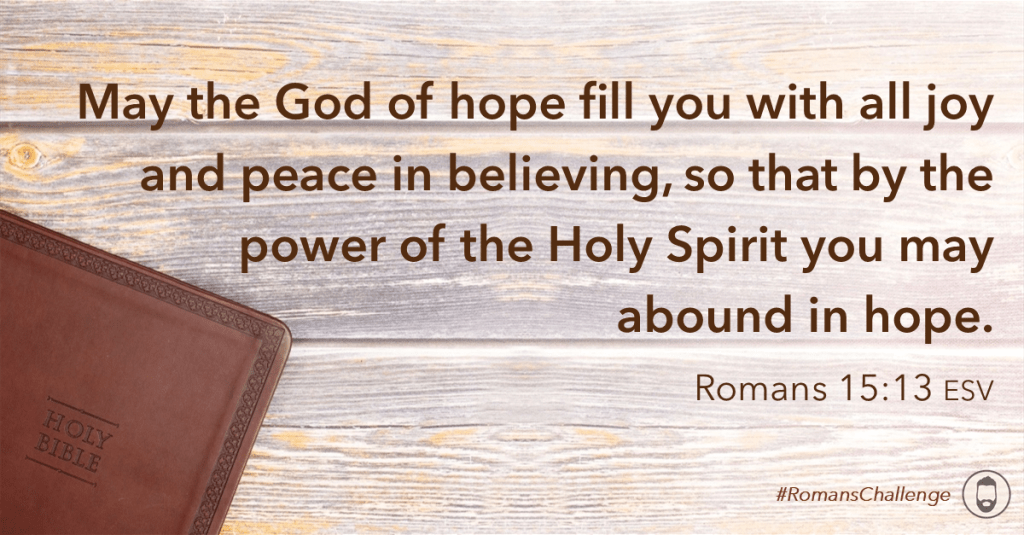
Christ came as a servant to the Jews to fulfill God’s promises and to bring salvation to the Gentiles, so that all people might glorify God (vv. 8–9). Paul strings together Old Testament passages (vv. 9–12) showing that this inclusion was always God’s plan. He ends with a prayer: that the God of hope would fill believers with joy, peace, and overflowing hope by the power of the Holy Spirit (v. 13).
🎯 Theme: Christ’s example calls us to selfless unity, mutual encouragement, and a shared hope in God.
🌀 Reflection: If Jesus bore reproach for us and welcomed us into God’s family, how can we withhold love or unity from fellow believers? True Christian strength shows itself in humility and a desire to build others up.
💬 Mission Challenge: Reach out this week to someone outside your cultural, racial, or generational circle—share a meal, a prayer, or your testimony—and demonstrate the unifying hope of the gospel.
It’s been a month since I’ve been able to write one of these, and my heart is full looking forward to gathering with my faith family this Sunday. The Scriptures we will read and the songs we will sing declare what the weary world — and our own weary hearts — need to hear: GOD is with us.
I know it’s not Christmas (and it’s hard to even think about it in the midst of a Mississippi summer), but I am reminded of what the prophet Isaiah said about Jesus’s coming — He would come and be the Light that would pierce the darkness:
“The people who walked in darkness have seen a great light…. For to us a child is born, to us a Son is given….” (Isaiah 9:2,6)
Jesus is that Son, the promised Emmanuel (which means God with us). He isn’t distant or disinterested. No, Jesus is the God who stepped into our world, entered our pain, and walked among sinners. He bore the weight of our sin and carried our sorrows. But even more than being with us, Jesus is also for us.
“But if anyone does sin, we have an advocate with the Father, Jesus Christ the righteous. He is the propitiation for our sins, and not for ours only but also for the sins of the whole world.”
That word advocate means someone who speaks on your behalf, who stands beside you when you have no defense of your own. One day, we’ll stand before the Holy God of the universe to answer for our works — for our sin. It’s hard to imagine the crushing weight of the volume of our sin or how we could ever bear it (Psalm 38:4, Romans 3:23). But before we can be under that crushing weight, our advocate steps up. When our Judge asks how we plead, our advocate speaks up, but He doesn’t just plead for us — He points to His own finished work on the cross (John 19:30, Hebrews 10:12-14) — to His blood that covers and blots out our sin (Isaiah 1:18, Colossians 2:13-14, Revelation 1:5). He doesn’t speak up to ask God to forgive or overlook; He says He’s already paid for our sin — paid in full (Romans 8:1, 33-34; 2 Corinthians 5:21).
Those who are saved know that Jesus is our righteousness. He is our covering. And He is our confidence before the Father. As we’ll read in Colossians 2:13-15 this Sunday, we’ll find that the very same God who is our advocate and defends us is the same God who died for us.
That’s why we can sing “O Come, O Come Emmanuel” — because we need Him and can know He’s returning just as He’s already come to us. We can sing “Great I Am” because Jesus is not merely the babe in the manger but God Almighty come to us. We can sing “Jesus Paid It All (O Praise the One)” because our sins, not in part but the whole, were nailed to the cross and the debt of our sin paid in full. And we can sing “Thank You Jesus for the Blood” because His blood wasn’t a mere payment for sin committed but the means by which we are brought near to God.
So, this Sunday come with hope. Come with need. Come with thanksgiving. And come ready to worship the One who is God with us, our Advocate, and our Savior. We will read from God’s Word together (1 Timothy 4:13) and lift our voices to proclaim the gospel to one another as we offer praise to God (Colossians 3:16). We will sit under the teaching of God’s Word as John points us to Jesus (John 20:31). We will have the opportunity for a few hours to get a brief glimpse into the glory that awaits when we find our faith becoming sight (1 Peter 1:8-9, 2 Corinthians 4:17-18) when we come at last to be with Jesus for eternity (Revelation 21:3-4).
2The people who walked in darkness have seen a great light; those who dwelt in a land of deep darkness, on them has light shone. 3You have multiplied the nation; you have increased its joy; they rejoice before you as with joy at the harvest, as they are glad when they divide the spoil. 4For the yoke of His burden, and the staff for His shoulder, the rod of His oppressor, you have broken as on the day of Midian. 5For every boot of the tramping warrior in battle tumult and every garment rolled in blood will be burned as fuel for the fire. 6For to us a child is born, to us a son is given; and the government shall be upon His shoulder, and His name shall be called Wonderful Counselor, Mighty God, Everlasting Father, Prince of Peace. 7Of the increase of His government and of peace there will be no end, on the throne of David and over His Kingdom, to establish it and to uphold it with justice and with righteousness from this time forth and forevermore. The zeal of the LORD of hosts will do this.
13And you, who were dead in your trespasses and the uncircumcision of your flesh, God made alive together with Him, having forgiven us all our trespasses, 14by canceling the record of debt that stood against us with its legal demands. This He set aside, nailing it to the cross. 15He disarmed the rulers and authorities and put them to open shame, by triumphing over them in Him.
We’re continuing in our study of Revelation called The KING is Coming, where we’re taking a verse-by-verse approach to see what the book truly reveals—Jesus Christ Himself. As always, I’m joined by Jamie Harrison, and I’m thankful for the opportunity to walk through this study together. Today, we’ll be looking at another of Jesus’s letters to the churches, this time turning to the church in Sardis. This week’s passage is Revelation 3:1–6:
1 “And to the angel of the church in Sardis write: ‘The words of him who has the seven spirits of God and the seven stars. “ ‘I know your works. You have the reputation of being alive, but you are dead. 2 Wake up, and strengthen what remains and is about to die, for I have not found your works complete in the sight of my God. 3 Remember, then, what you received and heard. Keep it, and repent. If you will not wake up, I will come like a thief, and you will not know at what hour I will come against you. 4 Yet you have still a few names in Sardis, people who have not soiled their garments, and they will walk with me in white, for they are worthy. 5 The one who conquers will be clothed thus in white garments, and I will never blot his name out of the book of life. I will confess his name before my Father and before his angels. 6 He who has an ear, let him hear what the Spirit says to the churches.’[1]
Keith Harris: Greetings, Sojourners,
Jamie, are you ready to dive into our study of the letter to the church at Sardis?
Jamie Harrison: Man, I’m ready. Are you ready?
Keith: I don’t think I could be any more ready than I am right now. Not at all. I’m full go, full tilt…. I praise the Lord. I was reborn ready…. So, as we go through this, we’ll give a little bit of witty banter.
Jamie: You’re not going to think it’s funny, but we do.
Keith: And that’s because we’re dads.
Jamie: We are.
Keith: And that’s what we bring to the table. We can study the Bible and make dad jokes.
Jamie: That’s accurate.
Keith: Alright, Jamie, talk to us about the letter to the church in Sardis.
Jamie: So just to get started, kind of a reminder of how each letter is set up—it follows the same general format. You start with the salutation, “To the angel of the church in Sardis.”[2] Each letter starts that way, and each one gives some type of attribute of Jesus.
This one says in verse 1, “Thus says the one who has the seven spirits of God and the seven stars.” That’s a correlation back to chapter 1, verse 4, and chapter 1, verse 16. Of course, the seven spirits of God—talking about the Holy Spirit there, the perfect Spirit of God. The seven stars represent the pastors of the churches.
Then He says to them, “I know your works. You have a reputation for being alive, but you’re dead.” And just to hit on that for a minute, He doesn’t praise them at all. He doesn’t say anything about their good works, which He has done with other churches.
Keith: So are you saying that Jesus isn’t going to tell us something good and positive if it’s not true?
Jamie: Correct…. That’s how He rolls.
So when Jesus jumps right into it, He says the word “reputation”—“You have a reputation for being alive, but you’re dead.” This always reminds me of how our pastor, Big John [Goldwater, pastor of Christ Community Church], always says, you know, a lot of people think they’re going to make it to heaven because their uncle was a Baptist preacher, or their grandmother was in church every Sunday, or that kind of thing.
So it’s this reputation—it’s something people thought you had at some point, but you don’t anymore. That’s what Jesus is getting at. You have a reputation for being alive. Your reputation is that you have good works. Your reputation is that you do things for the Lord—but you don’t. You’re dead.
Keith: And that word for reputation there is literally “name.”
Jamie: Yes.
Keith: So we know that if you have been made alive in Christ, your name is written in the Lamb’s Book of Life. If you have life, your name is there. It’s not going to matter—what is it, Matthew 7:21-23—where Jesus says, “Many of you are going to say, ‘Lord, I’ve done this,’ and, ‘Lord, I’ve done that,’” and He’s going to say, “Depart from me. I never knew you.”
So the idea here, like you’re saying with reputation, it’s not about works. It’s whether or not He has made you alive.
Jamie: That’s right. That’s exactly right.
And so He goes on from there and says, “Be alert, and strengthen what remains, which is about to die. For I have not found your works complete before my God.”
So again, He reiterates—look, y’all do have a little bit left. There’s something there. There’s a little fire to work with. But it’s about to die. And if you don’t strengthen it, it’s going to go away as well. Now, does He mean that whole church [at Sardis] is going to cease to exist? Does He mean that those believers are going to cease to exist? I don’t know the answer to that. I think it’s more of a “Hey, you better get yourselves right with Me.”
Keith: And they would’ve known, right?
Jamie: Right. He goes on in verse 3: “Remember, then, what you have received and heard. Keep it, and repent. If you’re not alert, I will come like a thief, and you have no idea what hour I will come upon you.”
So look—what have they received and heard?
Keith: The gospel.
Jamie: Right.
Keith: And that’s consistent language across the New Testament—gospels, epistles, and here in Revelation with Jesus Himself saying it. You’ve received it. You’ve heard it. It’s consistent—it’s the gospel. And we know that through the preaching of the gospel is how God awakens us, saves us. And when we confess Him as Lord, He makes us alive.
Jamie: That’s right.
Keith: And so the things in this that are very clear are clear to us and our churches today as well.
Jamie: Accurate.
So I find it… I’m not going to use the word interesting here—I’m not sure what word I’d be looking for—but He says, “If you’re not alert, I’m going to come like a thief, and you have no idea what hour I will come upon you.” Well, if you knew when the thief was coming, you’d be prepared for it. So don’t misconstrue this—Jesus is not saying He is a thief. What He’s saying is that He’s going to come when we least expect it.
And so they’d better repent. There’s that word—repent—again, right? And I want to read the definition of the word repent:
To change one’s way of life as a result of a complete change of thought and attitude with regard to sin and righteousness—to repent, to change one’s way.[3]
So in other words, to repent is not lip service. It’s not just saying, “Lord, I repent.” It’s life service. It’s a complete change. Again, to change one’s way of life. Not an easy thing to do—because we all have things we’d like to hold onto. Things we’d rather not get rid of.
We’ve all got that one little… you know, I think of—what was that homeboy’s name in Lord of the Rings? That’s like, “My precious…”
Jamie: My cousin Gollum. That’s him. And his one thing that he just couldn’t get his mind off of was the ring.
And so we all have that thing—that thing we just don’t want to let go of, that thing we hold onto. Jesus is [essentially] saying, “You’ve got to repent. You’ve got to turn away from it. To change your entire life—a complete change in attitude with regard to sin.”
Keith: Which, in this context, is keeping with what you’ve heard—keeping with the gospel.
Jamie: That’s correct. And in James chapter 2, verses 14 through 26—I’m not going to read that whole section—but this is that “faith and works” section that James talks about. And he goes through and basically says, you know, if you look at people who don’t have clothes or daily food, and you say, “Stay warm and be well fed,” what have you really done to help them?
Keith: Right.
Jamie: That’s right—you’ve done nothing.
Well, the gospel teaches us that we are supposed to act. We are supposed to have works. Those works will prove our faith. They will prove that we love Jesus, that we have a relationship with Him. And if we don’t have those works, then we should repent—to show our faith.
So I think that’s a real good correlation to what He’s talking about here because He tells them, “I know your works. You have a reputation, but you’re dead. You’re not doing anything.” Which is what James is talking about—you’re spiritually dead. And I think about churches I’ve been to before where so many people in the church would say to me, “Well, it’s your turn to do such and such. I’ve done my time.” To which my response was always, “I don’t think you have—’cause you’re still alive.”
Keith: Right.
Jamie: You probably would be physically dead.
Keith: There’s no retirement from being saved.
Jamie: Right.
Keith: Part of that is…what is it L.G. [Schmitz] says? “God has a plan for your life.” And he cites—and I find it interesting that this comes at the end of that section in Ephesians 2:1-10 – that section dealing with how we were dead in our trespasses and sins (Ephesians 2:1-2)?
You get to Ephesians 2:4—“But God…” made you alive in Christ. At the end of that, you have Ephesians 2:10: “For we are His workmanship, created in Christ Jesus for good works, which He prepared beforehand.” They’re not our works earning salvation, but rather fruit proving the salvation that He has given. He’s put the life in you—you live it as long as you have it.
Jamie: That’s right. Amen.
And so, to go on there—verse 4: “But you have a few people in Sardis who have not defiled their clothes, and they will walk with Me in white because they are worthy.” So there are some people there who are dressed in white. Which, again—I know we’ve hit on it already—but that’s purity, that’s holiness.
As we look at glimpses into heaven further in Revelation, you see the saints clothed in white, right? That’s the idea here. So they’re still doing what Jesus has called them to do. And He says, “In the same way, the one who conquers will be dressed in white clothes.”
And that’s, again, back to the setup of the letters—we had the salutation, we had the attributes of Jesus, we’ve just talked about the works, praise, and admonition to the church—or in this case, the lack of works and the lack of praise. You get the universal admonition: “Let anyone who has ears to hear listen to what the Spirit says to the churches.” And then you get this final promise, which is where we are now. And that final promise is that “the one who conquers…”—1 John 5:4–5 tells us that the one who conquers is the one who is saved, who has a relationship with Jesus.
So how are you a conqueror? You’re saved. You have a relationship with Him. And that relationship is going to lead to good works. It’s going to lead to doing things for Christ.
Now, are those things always going to be… pleasant at the end of the day? Are things going to happen to us if we step out for Jesus? Probably.
Will people say stuff about us or to us? Probably.
Are people going to scrutinize our lives? Yeah—for sure.
Because that’s how people are when they’re being convicted of sin and they don’t like it. But our job is to follow Him—in works, in faith—to do what He asks us to do, to be led by Him.
And then He says we’ll be conquerors, we’ll be dressed in white clothes, and “I’ll never erase your name from the Book of Life, but I’ll acknowledge your name before My Father and before His angels.” And so you get this really cool ending to this letter, where He says, “Look guys, if you all will repent—change your attitude, change your lifestyle, come to Me, do the things I’ve asked you to do—then your name will be in My Book of Life, and you will spend eternity with Me.” So I think the question, looking at this letter—each of these letters should lead us to ask ourselves a question. And I think the letter to Sardis leads me to ask myself: Do I have a relationship with Christ?
When you look at this, when you think about this, you go—am I leaning back on a reputation I had? Because I used to be a good Sunday School teacher… or I used to be a good pastor… or I used to be a good van driver… or I used to be a good garbage picker-upper… or whatever it is that you used to do.
Or are you still doing things for Christ? Do I have a relationship with Christ?
If you have a relationship with Christ, but the works haven’t been there, then it’s time to repent.
It’s time to do what He’s telling us to do—and that’s repent.
Big John [Goldwater] preached a message last Sunday—which, of course, I don’t know when this podcast will be put out—so that would’ve been January the…
Keith: 5th.
Jamie: January the fifth. And you can go find that on his Facebook page, I’m sure. Or the….
Jamie: Yeah, either one. And that’s not a shout-out like, “Hey, come to Christ Community Church, we’re the best thing since sliced bread”—which, of course, I think we are; that’s why I go there.
But the message was on point. It was about doing what Christ has asked us to do, growing in our faith with Christ. And I’m gonna tell you—it convicted the… the—I don’t even know what word to say. I started to say “pee,” but that’s probably inappropriate….
Keith: In the context of repentance: the sin out of you.
Jamie: Yes, it did. And so I’ve been honestly struggling with that all week long. But that’s the idea there.
Now, the other thing is, if you realize, “You know what? I don’t even have a relationship with Christ”—the good news is, you can. I was talking to somebody just yesterday about this—somebody who’s close family. They said, “I’m not sure I’m asking God the right questions. How do I know if I’m asking Him the right questions?” And so I started praying about it, and I was led to kind of our verse at Christ Community—it’s Romans 10:9. And in that verse, it tells us how to be saved. And the first part of that is to confess with your mouth that Jesus is Lord. And the issue with that—that most people have—is they’re like, “Yeah, I don’t have a problem confessing Jesus is Lord. I can say ‘Jesus is Lord’ all day long.” But the definition of the word Lord is like—a master or an owner, the possessor of someone or something. It’s the kind of word that’s even spoken of a husband. Which, of course, we know that Jesus is referred to as the groom—the husband. And so, someone that has absolute authority over whatever it is. And so when you think about those things, you go, “Man—confessing Jesus as Lord means I have to give everything over to Him. All of it. My whole life over to Him.”
Now, what I told the guy I was talking to was—when we confess Jesus as Lord and we grow in our relationship with Him, the Holy Spirit begins to answer the questions through His Word.
So maybe it’s not as much a matter of What questions do I ask?—as it is: Have I submitted to the Lord? Have I given Him my everything? Is He my Lord and Savior?
And so, guys—at the end of the day, if you don’t have a relationship with Him… and we always say it’s really simple… well, it’s simple to say the words, but—surrender yourself to the Lord. Believe in your heart that God raised Him from the dead—which is faith—and you will be saved.
So I think that’s a good place to kind of finish today.
Keith: Yeah. And as we wrap—just, each of these…
Jamie: I really can’t rap. That is, um… Tupac, Eminem—those guys.
Keith: W-R-A-P. My bad.
Jamie: Right.
Keith: “He who has an ear, let him hear what the Spirit says to the churches.”
As you look at this—if you have confessed Him as Lord and He’s saved you—the works are proof of that. They don’t produce that. And Jesus says He will never blot a name out of His Book of Life. If you are saved, you are saved.
Jamie: That’s right.
Keith: Because He accomplishes it—not something you can lose. And so if you look at this and start thinking about it—that you haven’t been consistent—there’s no “losing” of one’s salvation. You may have only been doing lip service.
Jesus talked to the Pharisees—who were the religious who’s who—and they thought they were already dressed in white. They thought they were religiously perfect. And He told them they were whitewashed tombs.
John the Baptist even told the Pharisees to bear fruit in keeping with repentance. If you’re not, you haven’t lost your salvation. This may be that initial repentance—where, like Jamie said, you need to confess Jesus as Lord, have faith in Him, and then He will save you. You’re not getting re-saved, saved again, saved 2.0.
You either are, or you aren’t.
You’re either dead, or you’re alive.
And so, if you read this or listen to this today and realize that you aren’t alive—you can be made alive in Christ today. And that’s our hope and prayer.
Jamie: Mm-hmm.
Keith: Well, this one has been relatively short—as these go. And so, as Big John says, “No one complains about a short sermon.”
Jamie: Amen.
Keith: God bless. Thank y’all—and we look forward to hearing from y’all soon.
[3] Walter Bauer, A Greek-English Lexicon of the New Testament and Other Early Christian Literature, 3rd ed., rev. and ed. by Frederick William Danker (Chicago: University of Chicago Press, 2000), s.v. “μετανοέω.”
[4] Smeagol (also called Gollum) is a character from The Lord of the Rings books and movies. He becomes so obsessed with a magical ring that he calls it “my precious” and can’t let it go. Jamie uses this as an example of how we can get stuck holding on to sin instead of letting it go and turning to Jesus.








 Just Keith Harris