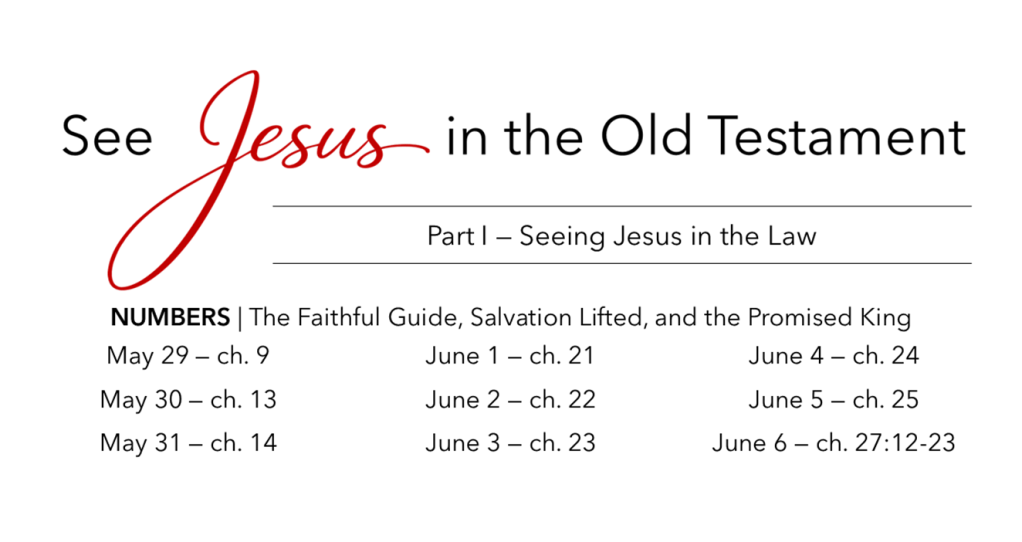
The Faithful Guide, Salvation Lifted, and the Promised King
Numbers follows Israel’s journey from Mt. Sinai to the edge of the Promised Land, revealing both God’s faithfulness and His people’s repeated unbelief. Though God visibly guides Israel by His present and remains faithful to His covenant promises, the people continually grumble, rebel, and refuse to trust Him (ch. 9:15-23; 13-14). Their unbelief delays their entrance into the land and brings God’s judgment upon an entire generation. Yet even in the wilderness, God doesn’t abandon them. He instead preserves them, provides for them, and continues leading them to the inheritance promised to Abraham, Isaac, and Jacob.
This book points to Jesus in several remarkable ways. The LORD’s faithful guidance of Israel anticipates Jesus, the Good Shepherd who leads HIs people through the wilderness of this world (John 10:11-18). When God instructs Moses to lift up the bronze serpent so that those who look upon it may live (ch. 21:4-9), Jesus declares that this event forshadowed His own crucifixion: “As Moses lifted up the servant in the wilderness, so must the Son of Man be lifted up” (John 3:14-15). Numbers also contains one of the clearest messianic promises in the Law when Balaam foretells that “a star shall come out of Jacob, and a scepter shall rise out of Israel” (ch. 24:17), pointing forward to the coming King who will reign over God’s people.
While not every chapter of Numbers is included, these readings have been carefully selected to highlight the faithful guide, salvation lifted, and the promised King. You’ll see God’s presence leading His people (ch. 9), Israel’s tragic unbelief at the border of Canaan (ch. 13-14), God’s provision of salvation through the bronze serpent (ch. 21), His sovereign blessing through Balaam’s prophecies despite his attempts to curse Israel (ch. 22-24), and the commissioning of Joshua as Israel prepares to enter the land (ch. 27:12-23). Together, these passages remind us that God remains faithful even when His people fail, that salvation comes through looking in faith to His provision, and that all of God’s promises ultimately find their fulfillment in Jesus Christ, the greater Joshua and the promised King!
Let’s dive in together and see Jesus in Numbers!
May 29 — ch. 9 God calls His people to keep the Passover and faithfully guides them by His presence, pointing to Jesus, our Passover Lamb and Savior.
May 30 — ch. 13 God’s people see the promised land but doubt God’s promise, responding in fear instead of faith.
May 31 — ch. 14 God’s people rebel against Him, but through Moses’s intercession God shows mercy even as He brings judgment.
June 1 — ch. 21 God provides salvation from judgment through the lifted serpent, pointing to Jesus who was lifted so that whoever believes may have eternal life.
June 2 — ch. 22 God shows that His Word stands and His people cannot be cursed because He alone determines blessing and judgment.
June 3 — ch. 23 God declares His unchanging Word, showing that He does not lie and His blessing cannot be revoked.
June 4 — ch. 24 God reveals the coming King from Jacob, a star and scepter who will rule and reign over all.
June 5 — ch. 25 God judges His people’s sin, but atonement through a faithful priest turns away His wrath, pointing to Jesus, the high priest of a greater atonement.
June 6 — ch. 27:12-23 God appoints Joshua to lead His people after Moses so they are not without a shepherd, pointing to Jesus who is greater than Moses or Joshua.
Hebrews 12:1-2 – 1 Therefore, since we are surrounded by so great a cloud of witnesses, let us also lay aside every weight, and sin which clings so closely, and let us run with endurance the race that is set before us, 2 looking to Jesus, the founder and perfecter of our faith, who for the joy that was set before him endured the cross, despising the shame, and is seated at the right hand of the throne of God.
Philippians 4:10-13 – 10 I rejoiced in the Lord greatly that now at length you have revived your concern for me. You were indeed concerned for me, but you had no opportunity. 11 Not that I am speaking of being in need, for I have learned, in whatever situation I am, to be content. 12 I know how to be brought low, and I know how to abound. In any and every circumstance, I have learned the secret of facing plenty and hunger, abundance and need. 13 I can do all things through him who strengthens me.
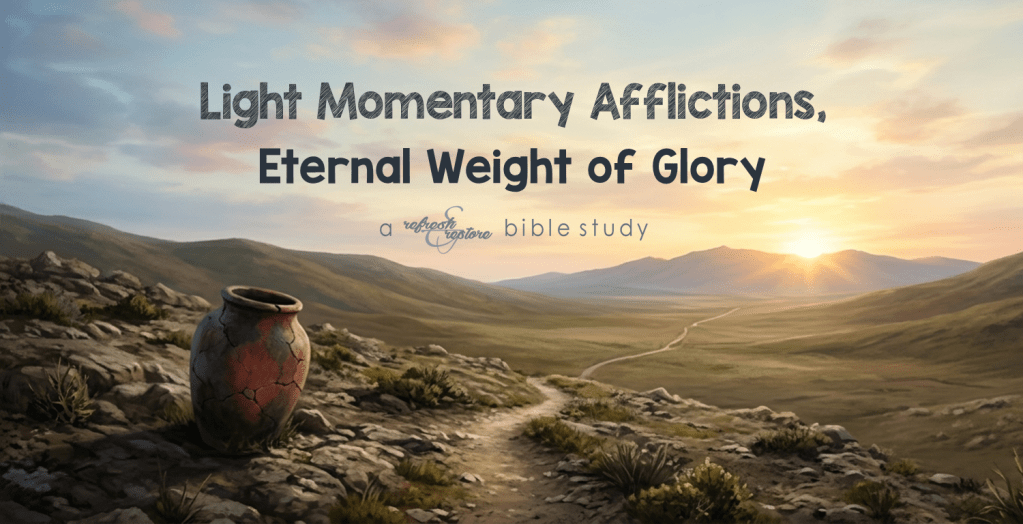
2 Corinthians 4:7-18 – 7 But we have this treasure in jars of clay, to show that the surpassing power belongs to God and not to us. 8 We are afflicted in every way, but not crushed; perplexed, but not driven to despair; 9 persecuted, but not forsaken; struck down, but not destroyed; 10 always carrying in the body the death of Jesus, so that the life of Jesus also may be manifested in our bodies. 11 For we who live are always being given over to death for Jesus’ sake, so that the life of Jesus also may be manifested in our mortal flesh. 12 So death is at work in us, but life in you. 13 Since we have the same spirit of faith according to what has been written, “I believed, and so I spoke,” we also believe, and so we also speak, 14 knowing that he who raised the Lord Jesus will raise us also with Jesus and bring us with you into his presence. 15 For it is all for your sake, so that as grace extends to more and more people it may increase thanksgiving, to the glory of God. 16 So we do not lose heart. Though our outer self is wasting away, our inner self is being renewed day by day. 17 For this light momentary affliction is preparing for us an eternal weight of glory beyond all comparison, 18 as we look not to the things that are seen but to the things that are unseen. For the things that are seen are transient, but the things that are unseen are eternal.[1]
Greetings Sojourners!
It has been a while since I’ve gotten to write, and it’s long overdue. A friend asked me a few weeks back if he’d been removed from my list to send out Bible studies. I assured him that I hadn’t and that I had been working on so many different avenues. His response hit me pretty hard after I listed out the litany of said avenues; he said, “You’ve got to make time for things that are important to you.” Well, this ministry is important to me – not for the opportunity to write and publish but to share God’s Word and help people make sense of it and apply it in their lives. That has to begin with me, though.
It seems like this past year has been such a weight. Not to rehash or bore you with repetition, but the ordeal of losing the ability to walk, spending a month in the hospital, and working to be able to, well, be able to do everything again has been taxing – more taxing than either I’m willing to admit or than I even fully realize. I sat in counseling earlier today in the office of a friend who is trying to help me process the past year and its toll, reminding me that it’s not fragile or weak to struggle through things that are immensely difficult and that what I perceive as failure is sometimes just life. At the end of the session, I said, “This too shall pass”, and he said, “That sounds good to say, but it’s harder than that.” I knew as soon as I said it that I didn’t believe it. I understand it intellectually. I believe it fundamentally. But practically? No, that’s not how I am living.
I find myself living in the tension of the last line of one of my favorite novels, The Great Gatsby by F. Scott Fitzgerald:
“So we beat on, boats against the current, borne ceaselessly into the past.”
The tension is that I have to row against the currents bearing me pastward while lifting my eyes “to the hills”, to where my help comes from – “from the Lord, who made heaven and earth” (Psalm 121:1-2). The same Lord who held me through the past year – through the past forty years – is still my “keeper” (Psalm 121:5) and can surely “keep [me] from all evil”, “keep [my] going out and [my] coming in”, as He has kept my life (Psalm 121:7-8). The One who holds all of my tomorrows can hold me from being carried by the currents of life because He is the God who calms storms, both literal and figurative.
The reality is that difficulties happen. Ordeals overwhelm. Bodies fail. Plans fall apart. A year goes by, and it brings mixed emotions of pride at making it through and the recognition that there are some things one cannot make it through unscathed. So, here I sit in my office, hoping that these thoughts I have been struggling to put down will be helpful to you.
So, dear Sojourner, let’s walk through this bit together.
—
Do you ever feel that there just isn’t enough time in a day? Or a week, month, or year? Just me?
Of course, I’m not the only one to feel this pressure or tension, trying to fit all the things that must be done alongside the things that need to be done – and even fit a few select items on my to-do list that I merely want to do. I’m a husband, father, brother, son, uncle, teacher, pastor (and try to fit as much friendship/fellowship and writing as I can).
I try to be a good steward of my time and to use it as best I can to live the life I am called to live. This isn’t merely careful scheduling but growing to understand that I only have so much bandwidth to be the man I was born again to be. I am reminded constantly that I can only do what I can do, and I find I identify more with Paul in Philippians 4:13 – “I can do all things through Him who strengthens me” – in context, of course. What I mean is that I am learning more and more that I “know how to be brought low” and “how to abound”, understanding that “plenty, hunger, abundance, and need” are just a part of life. So, in saying I can only do what I can do, I realize with each new limitation placed on my life that I can only do what the Spirit of Christ enables me to do – or moves things around to let me do.
Now, when I talk about limitations, let it be known that I am not a fan. However, limitations are the norm. We are limited by our humanity – our fallen-world flesh. Just as the fall of man into sin brought death into the world, we have been, in a sense, dying since we began living. That probably sounds morbid to you; rest assured, it does to me, too. But, then again, I am 40 years old in a body that is aging more rapidly than I would like, learning realities like arthritis and mysteriously crippling autoimmune responses. But as the song based on Job 1:20-22, “Blessed Be Your Name”, says, God is still good and life is still a blessing whether the “land is plentiful” and “the sun’s shining down on me” or if “I’m found in the desert place” or “the road marked with suffering; in all of life, any strength I have comes from the Lord – “Blessed be the name of the Lord!” – because the strength I have within myself is surely not enough.
Maybe you feel that you are not enough. Or you may feel that when everything you want to do and everything that is required is set before you, you just don’t stack up – you don’t measure up to the task(s) at hand. Just me?
Just like I’m not the only one to feel the pressure or tension of not being able to get all the things that need to be done or that I want to be done completed, I’m also not the only one who feels like he doesn’t measure up – that the task(s) at hand are too much for me. No matter how much my ability or knowledge grows, my mind and body age daily. Things that should be simple sometimes become hard. Sometimes, my get-up-and-go has simply gone-off-and-went, and I find myself identifying with the Preacher of Ecclesiastes:
Remember also your Creator in the days of your youth, before evil days come and the years draw near of which you will say, ‘I have no pleasure in them’…and the dust returns to the earth as it was, and the spirit returns to God who gave it. Vanity of vanities, says the Preacher; all is vanity. (Ecclesiastes 12:1, 7-8)
Well, maybe I don’t quite identify fully with the Preacher there, because, Lord willing, I’m not headed out to pasture or returning to dust and crossing over into glory just yet.
I realize that, as I said earlier, this likely sounds morbid – and probably depressing, but this ain’t that kind of Bible study.
The longer I live and the further I get into middle age, the more I see the beauty in life despite its troubles and the amazing grace found in the reality that this world is not all that there is. The farther we get from the Fall and the effects of sin and death reigning on the earth, things break down more and more, and it becomes especially important for us to remember that this world is not our home, we’re just passing through. We need to remember that our hope, if it’s founded only in this world, has an expiration date. Hope in Jesus has no expiration date because it’s fixed on Him and grows out of His grace to us – grace that carries us fully through suffering in such a way that endures, produces character, and builds that hope into our lives (Romans 5:2-5).
So, let’s look at a few passages in the New Testament that help fix our eyes on Jesus and the eternal hope that can be found only in Him.
There is a Race Set Before You (Hebrews 12:1-2)
At Christ Community and The Foundry, we’re currently walking through Hebrews 11 on Sunday mornings and looking at those men and women “who have faith and preserve their souls” (Hebrews 10:39), the “people of old” whose faith in God saw “commendation” from God for being assured of “things hoped for”, being convicted “of things not seen” (Hebrews 11:1-2). We have looked at the faith of Abel, Enoch, Noah, Abraham, Sarah, Isaac, Jacob, Joseph, and Moses – with more in the coming weeks. Hebrews 12, obviously, comes out of that context as it talks about being “surrounded by so great a cloud of witnesses” (Hebrews 12:1).
Similarly to how I said earlier that the God who had faithfully carried me through my life thus far could surely carry me for the rest of my life, we are called to look at the faith this “cloud of witnesses” put in Jesus – how even though they were living in the Old Testament, they trusted God and held to His promises, knowing that “He who promised is faithful” (Hebrews 10:23) without needing to see the fulfillment of the promise. We look to these witnesses, not to see how we stack up against these mighty heroes of old but to see that the same God who worked through Moses is the same God who works in His people today – realizing that Moses did not serve God because he was great but that the great God worked mightily in Moses (a testimony I am sure Moses would wholeheartedly agree with). Looking at the testimonies of faith in the lives of these men and women frees us to “lay aside every weight, and sin which clings so closely, and let us run with endurance the race that is set before us” (Hebrews 12:1). Let’s unpack that.
Our sin weighs on us and holds us back, that much is clear. What is less clear is how we fail, time and again, to realize that the sin we cherish is seeking to kill us. In church life, too often we act like we do not enjoy the sin that we constantly return to, and I believe that is our undoing. It would do us well to look to the wisdom of the Proverbs when we draw our sin up to us closely as if it were a blanket offering warmth, not realizing we are being burned:
“Can a man carry fire next to his chest and his clothes not be burned? Or can one walk on hot coals and his feet not be scorched? So is he who goes in to his neighbor’s wife; none who touches her will go unpunished.” (Proverbs 6:27-29)
The sin that clings to us needs to be cast aside before we get burned. We need to fix our eyes on Christ and look to Him for comfort, peace, and rest, understanding that He knows best and has a plan for our lives that does not include the damage from sin that we refuse to see.
Now, I realize that even before last summer my athleticism was nothing to brag about, but if I were to have to run a race, even I know that I don’t need to do it with my backpack and heavy work boots on. I would need to cast all of that off. Believe it or not, I’ve actually run a race (and didn’t come in last place). I ran in the 5K portion of the races benefiting St. Jude a few years back. Those races take place in December, and it was cold. I tried running in a coat while practicing, and it was more than a little aggravating swish, swish, swishing along and eventually having to take it off and carry it before the end. I tried running in the old-fashioned long johns that I had grown up with, but the fabric was too thick and made it hard for my legs to move and bend as they should while literally chafing against me in the second and third miles. I had to cast those things aside and gird myself for the race at hand. So it is in “the race that is set before us” (Hebrews 12:1). Saying God has a plan for your life is not something to take lightly. He has prepared a course for all those He has saved (Ephesians 2:10). It is for us to recognize what needs to be taken off so as not to be held back as we run to Him.
Too often, we are mournful about what has to be taken off, and that is because we are suffering from having our eyes on the wrong things. While the men and women of Hebrews 11 are truly a “great…cloud of witnesses”, looking to Jesus is the key for understanding this. Hebrews 12:2 says we are to look to Jesus “who for the joy that was set before Him endured the cross, despising the shame, and is seated at the right hand of the throne of God” – don’t miss this: “for the joy that was set before Him”. We get caught up on the excruciating nature of the cross and the sin and shame He bore and hypothesize how He must have felt; this is because we are worldly and pain and suffering distract us from the joy set before us. The sin that we allow to cling to us pales in comparison to the joy set before us in Christ. He is to be our joy more than heaven is to be our finish line.
When I was in the rehab for physical and occupational therapy, no one could have prepared me for how hard it would be. But on day one, I asked them what I would have to do in order to be released and go home to Candice, Keri, and Xander; I had to be able to pass a test to get in and out of a car unassisted, be able to walk a certain distance, and be able to climb more steps than are at the entrance of my house. I had to be able to endure at least an hour and a half of physical therapy and then turn around and do at least another hour and a half of occupational therapy. It was grueling. I sweated. I cried. I had to endure the humiliation of being lapped by a 90-year-old man with a hip replacement and having to be watched in the shower to ensure I could care for myself. I had joy set before me, though. I wanted to go home; no, more than that, I wanted to walk up to Candice and the kiddos and wrap my arms around them while standing in our house. I ran the race that was set before me.
Now, I realize that was only one leg of the race God has set before me. I constantly have sin trying to cling to me and weigh me down, and I have to consistently look to Jesus as the joy set before me and tear the sin away and cast it aside. How about you? What sin is clinging to you and weighing you down? Where are you on the course God has set before you? Rest assured, dear Sojourner, and look to Jesus. He’s worth it all.
We are Clay in the Hands of the Potter (2 Corinthians 4:7-18)
All my life I have sought to be independent and resilient. I wanted to be a strong man who could carry the load of others. I wanted no one to have to help me or carry my burdens. Part of that is noble, but that last part was pure foolishness. That’s not how life works. Most importantly, that’s not how God intended for life to work for His people. He didn’t tell us only to bear the burdens of the weak but reminds us that we are all in need of burden-bearing when He said,
“Bear one another’s burdens, and so fulfill the law of Christ. For if anyone thinks he is something, when he is nothing, he deceives himself.” (Galatians 6:2-3)
I had deceived myself. Thankfully, God in His divine providence put me in a position to see just how foolish I was (and still reminds me on an as-needed basis when my view of burden-bearing gets out of whack).
We’ve already talked about how we get weighed down with sin when we take an earthly perspective instead of an eternal perspective, so we won’t rehash that here. The crux of 2 Corinthians 4:7-18 is that “we have this treasure in jars of clay, to show that the surpassing power belongs to God and not to us” – the treasure being “the light of the knowledge of the glory of God in the face of Jesus Christ” from 2 Corinthians 4:6. I’ll make this simple. I don’t want to be a jar of clay. I want to be something sturdier. I want to be, as I said, resilient. But remember, I also said I can be a fool.
There are many verses in the Bible that use the imagery of God being the potter and His people being His clay (Isaiah 64:8, Jeremiah 18:1-6, Romans 9:20-21, 2 Timothy 2:20-21 and so on). The Bible also shows us the foolishness of the clay talking back to God in Romans 9:20b-21a: “Will what is molded say to its molder, ‘Why have you made me like this?’ Has the potter no right over the clay…?’” Suffice to say, I have talked back to the Potter more than I should and made my case for being more than a jar of clay, but in His grace and wisdom, His answer through His Word has been clear and reminds me that it is best to “be a vessel for honorable use, set apart as holy, useful to the master of the house, ready for every good work” (2 Timothy 2:21). It is better to be clay in the hands of the Potter than any other substance for any other purpose. In the same way the Lord has set a race before me, He has molded me for the purpose He has for my life – and the same with you.
The earthly perspective sees clay as weak and breakable. The eternal perspective reminds us that we jars of clay are “afflicted in every way, but not crushed; perplexed, but not driven to despair; persecuted, but not forsaken; struck down, but not destroyed” and that “death is at work” but “life” through Christ (2 Corinthians 4:8-9, 12). The value of the jar of clay is not in its resilience or strength but in the Potter. Think of the McCarty and Peter’s pottery in Mississippi. To some it looks like brown containers, but to those who know the skill and talent of McCarty or Peter it has value beyond its use.
Over the past year, I have lamented the way that my body has seemingly betrayed me. I have lamented with other brothers and sisters whose mitosis went haywire in their bodies to create cancer cells instead of normal healthy cells. I have lamented with brothers and sisters whose brains and memories are degrading leaving seemingly less than they thought they were. Ultimately, that’s what I lament in my own life: being less than I thought I was. That’s an earthly perspective. The eternal perspective is that I was “bought with a price” and am not my own (1 Corinthians 6:19-20) – that I have been ransomed from sin and death and the “futile ways inherited from [my] forefathers, not with perishable things such as silver or gold, but with the precious blood of Christ” (1 Peter 1:18-19). The eternal perspective tears down the foolishly short-sighted earthly one in that I cannot see what His plans are fully at this time but I know that “He who promised is faithful” (Hebrews 10:23) – I “know whom I have believed, and am convinced that He is able to guard until that day what has been entrusted to me” (2 Timothy 1:12) – and I know that it is useless to try and worry too much over this jar of clay when “to live is Christ, and to die is gain” (Philippians 1:21).
This is the beauty of this passage. Look at the clarity of 2 Corinthians 4:16-18, as God’s Word says it more clearly than I could hope to expound it:
“So we do not lose heart. Though our outer self is wasting away, our inner self is being renewed day by day. For this light momentary affliction is preparing for us an eternal weight of glory beyond all comparison, as we look not to the things that are seen but to the things that are unseen. For the things that are seen as transient, but the things that are unseen are eternal.”
This world is not all that there is. This body is not all that there is. The troubles we experience are not all that there is. No, all of the trials and sufferings this life can throw at us are light momentary afflictions that will be forgotten as easily as a mother forgets labor once her baby is laid in her arms. When I fall on my face at the feet of Jesus once this life is over, I won’t remember I was a jar of clay because I won’t shatter when I fall in front of Him. I won’t shatter because the nail-scarred hand that wipes the last tear from my eyes will lift me up because He cares for me (Revelation 21:4, 1 Peter 5:6-7). And here’s the beauty, dear Sojourner, it is that same strong hand that keeps us from shattering in our jars of clay in the present. How about you? Do you long to be more or are you satisfied with being His? Do you take an eternal perspective with your eyes lifted to the hills, looking for help and fixed on Jesus, or are you letting every weight of sin drag you down as if this world were all there was?
May we fix our eyes on Christ!
Wrapping Up
I don’t know if all this makes sense or if it’s just cathartic rambling on my part. That’s not for me to know. I reckon that’s above my pay grade.
My mind has been so frazzled and I’ve struggled to get my thoughts down for so long that this may not make a lick of sense. But praise God, His Word doesn’t return void. I hope some of this helps you. More than that, I hope something in here points you to the hope found in Jesus and lifts Him up as worthy of worship and worth living for.
All I know is that I am thankful that He has provided me brothers and sisters to help bear my burdens (and that they’re persistent even and especially when I’m too hardheaded or willfully ignorant to see that I need the help). I’m thankful that despite my failings and flaws He has set a race before me. And I’m thankful for this jar of clay because, without it, I may think that I could do this on my own, unable to realize that “the surpassing power belongs to God and not to us” (2 Corinthians 4:7).
I think that’s my prayer for you, too, dear Sojourner – not that you’ll suffer or struggle but that you would set Jesus as joy before you so that whatever the world is throwing at you, it pales in comparison to the glory and worth of Jesus – that whatever light momentary affliction you face would be seen as such, and, as the hymn, “Turn Your Eyes Upon Jesus”, says “the things of earth will grow strangely dim, in the light of His glory and grace”. Amen.
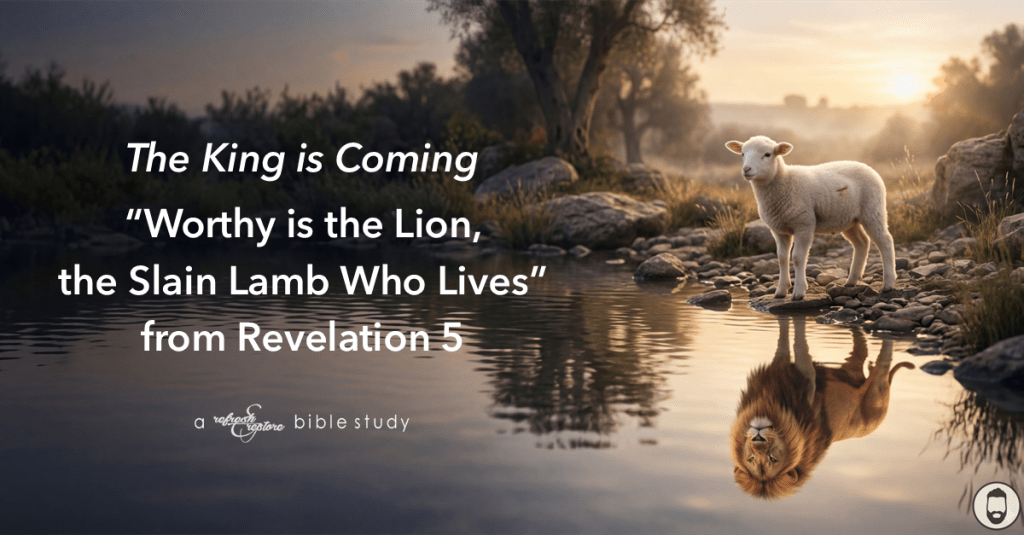
We’re back in our study of Revelation called The KING is Coming, where we’re taking a verse-by-verse approach to see what the book truly reveals—Jesus Christ Himself. As always, I’m joined by Jamie Harrison, and I’m thankful for the opportunity to walk through this study together. Today, we’ll be in a passage that is probably quite familiar if you’re a member or regular-attender of Christ Community Church as we read it in worship fairly often – Revelation 5:
5 Then I saw in the right hand of him who was seated on the throne a scroll written within and on the back, sealed with seven seals. 2 And I saw a mighty angel proclaiming with a loud voice, “Who is worthy to open the scroll and break its seals?” 3 And no one in heaven or on earth or under the earth was able to open the scroll or to look into it, 4 and I began to weep loudly because no one was found worthy to open the scroll or to look into it. 5 And one of the elders said to me, “Weep no more; behold, the Lion of the tribe of Judah, the Root of David, has conquered, so that he can open the scroll and its seven seals.” 6 And between the throne and the four living creatures and among the elders I saw a Lamb standing, as though it had been slain, with seven horns and with seven eyes, which are the seven spirits of God sent out into all the earth. 7 And he went and took the scroll from the right hand of him who was seated on the throne. 8 And when he had taken the scroll, the four living creatures and the twenty-four elders fell down before the Lamb, each holding a harp, and golden bowls full of incense, which are the prayers of the saints. 9 And they sang a new song, saying,
“Worthy are you to take the scroll and to open its seals,for you were slain, and by your blood you ransomed people for God from every tribe and language and people and nation, 10 and you have made them a kingdom and priests to our God, and they shall reign on the earth.” 11 Then I looked, and I heard around the throne and the living creatures and the elders the voice of many angels, numbering myriads of myriads and thousands of thousands, 12 saying with a loud voice, “Worthy is the Lamb who was slain, to receive power and wealth and wisdom and might and honor and glory and blessing!” 13 And I heard every creature in heaven and on earth and under the earth and in the sea, and all that is in them, saying, “To him who sits on the throne and to the Lamb be blessing and honor and glory and might forever and ever!” 14 And the four living creatures said, “Amen!” and the elders fell down and worshiped.[1]
Keith Harris: Greetings, sojourners. We have a lot to dive into today, so, Jamie, let’s go ahead and dive in.
Jamie Harrison: All right, so for real, let’s dive in, man, because this really is like — this is it. This is the big climactic scene in heaven. We mentioned in chapter 4 that the throne room is going to be the setting for the remainder of Revelation, and it’s mentioned over and over and over — the throne room, the throne room. And we know that the One seated on the throne is God the Father. And we know that Jesus is going to come and He’s going to sit at His right hand, and the Holy Spirit is there — we’ll see in just a second. And so it starts with this scroll that’s got writing on both sides and sealed with seven seals there in verse 1. And back in Roman times we know that a will or a title deed would be sealed with seven seals. And basically what they would do is they would roll it, seal it, roll it, seal it, roll it, seal it — and again there would be seven seals. And nobody was able to open that scroll except the appointed heir.
Keith: Is there a significance to the seven in Roman Empire days, or is that just — you think — significant biblically here?
Jamie: I would say biblically significant. I know people try to read a lot into a lot of different things, but there’s — obviously there’s seven churches, so people say one seal for each church, right? Those kinds of things. You know what I think is that it’s just biblically significant — the number seven in and of itself. And so no necessary hidden meaning per se, but it’s completely sealed — it’s locked down.
Keith: Correct. Gotcha. As the number seven being the number of completion..
Jamie: Amen. So this thing is sealed up. And in verse 2 we see the angel ask, “Who is worthy to open the scroll and break its seals?” And this angel is a mighty angel. And you would think if anybody could, you know, it’d be this really mighty angel — but he’s not worthy to open it. And then in verse 3 it says no one in heaven or on earth or under the earth was able to open the scroll or even to look in it. Now understand, when it says no one in heaven or on earth or under the earth, that’s everybody that has ever been.
Keith: All the places to be.
Jamie: Correct, right? So that is covering everybody, and nobody is able to open the scroll.
Keith: And I think that’s an interesting wording there. The question is “who is worthy,” not “who is able.” So we’re covering strength here, but worthiness is the question. Excuse you.
Jamie: Thank you.
Keith: So talk to me — take a sip — the difference with worthiness and ability here is not about strength. You mentioned the mighty angel. You mentioned everybody who is. What’s the deal here?
Jamie: It kind of goes back to — who was it? Was it King Arthur that pulled Excalibur out of the stone?
Keith: Allegedly.
Jamie: Right — yeah, that’s a myth. And so the idea of that story being all these strong guys came up and tried to get it out and couldn’t — only the one who was worthy. And so I want to limit — let’s get to that in a second.
Keith: All right.
Jamie: Let’s not get ahead of ourselves.
Keith: We’ll put a pin in it.
Jamie: Yes, put a pin in it — but not too hard, that will hurt. All right, so I’m going to jump over to Hebrews chapter 1, verses 1 through 3 real quick, because this is going to help us as we move forward. I’m going to jump over to Hebrews chapter 1, verses 1 through 3 real quick, because this is going to help us as we move forward.
1 Long ago God spoke to the fathers by the prophets at different times and in different ways. 2 In these last days, He has spoken to us by His Son. God has appointed Him heir of all things and made the universe g through Him. 3 The Son is the radiance of God’s glory and the exact expression of His nature, sustaining all things by His powerful word. After making purification for sins, He sat down at the right hand of the Majesty on high.[2]
And that’s a really cool Scripture there because it tells us who is the heir — Jesus. Jesus is the heir. And the Son is the radiance of God’s glory, the exact expression of His nature, sustaining all things by His powerful word. After He makes purification for sins — not His sins, for sins — He sat down at the right hand of the Majesty on high. And that’s going to answer your question about who’s worthy, but we’re still not going to jump ahead.
Keith: Well, and also — who’s able to atone for sins? Not us. Not those on earth or under the earth, for sure.
Jamie: It’s kind of like Big John says all the time — that if Jesus did 99% of the forgiving and we did the one, all we would brag about is the one.
Keith: But clearly here we got the none.
Jamie: That’s correct — definitely the none. Not to be confused with nuns — this is N-O-N-E, none. Okay, so now we can move forward, because nobody is able to open the scroll. And then John begins to weep. It says, “I wept and wept because no one was found worthy to open the scroll or even to look at it.” Can you imagine — like you see this scroll in the right hand of the Father, and I don’t know at that point if John necessarily knew what it was or not. I mean, he doesn’t say he knows what it is. But obviously he was alive during that time, so if it’s sealed with seven seals his mind probably went straight to some type of title deed or a will or something like that as well. And so can you imagine this climactic moment where you see this scroll and then nobody is worthy to open it?
Keith: I wonder too — just thinking about the vision that he’s seeing there — it kind of puts me… it reminds me of Isaiah 6, the vision that Isaiah got in the year that King Uzziah died. Like thinking about worthiness — you’re sitting there, you can see the throne. And we talked about this back in Revelation 1 — like in my mind, seeing the throne, you’re not looking at it alone. When we say “high and lifted up,” He literally was high and lifted up. I mean, think Ezekiel — the visions he had of the throne. Like he’s looking at the soles of His feet from way down. And when you ask who is worthy — I know when I am confronted with the holiness and worthiness of God, my first thoughts turn to my unworthiness and why I’m unworthy. Like — gotta be feeling some guilt, gotta be feeling overwhelmed in the first place. This disciple whom Jesus loved, outliving all the rest of the apostles — more than likely in his late 80s, early 90s at this point — like he’s feeling some stuff. He’s well acquainted with his unworthiness, and his friend, the worthy One — the Lamb of God — that’s how his gospel describes Him — died. He knows He rose, but still at the same time, that’s a lot to process.
Jamie: And so he weeps and weeps because nobody is worthy to open the scroll or even to look in it. And then in verse 5 — here we go — one of the elders says to me… which we talked about in chapter 4, you know, what the elders might represent. And it says, “Do not weep. Look.” Now the word’s important — he says, “Look.” “The Lion from the tribe of Judah, the Root of David, has conquered, so that He can open the scroll and its seven seals.” So the Lion from the tribe of Judah — let’s talk about that for a second. Way back in Genesis chapter 49, verses 8 through 10, these are Jacob’s last words. He gives the scepter over to the tribe of Judah, meaning the kings will come from that tribe, obviously starting with David there. But we know that he also references that Shiloh will come — and that’s an idea that someday the King is going to come and He’s going to take over and He’s going to reign for eternity. That’s talking about Jesus again. And so the Lion from the tribe of Judah is like the King of kings.
Keith: In the wording of the prophecy all the way back pre-king — hence that — what does it say? The Root of David, correct? And it’s a big deal.
Jamie: And the Root of David goes back to Isaiah 11. Hey — I’m turning to Isaiah 11… maybe I should have used the digital Bible instead, because these pages—
Keith: Well, this is where the preacher wants to say, “I still hear pages turning — we’ll wait.”
Jamie: That’s going to be Isaiah 11 — the eleventh chapter of Isaiah. That’s what preachers do, in case you were wondering — it’s because they’re trying to find it themselves. Isaiah 11, verses 1 through 10:
11 Then a shoot will grow from the stump of Jesse, and a branch from his roots will bear fruit. 2 The Spirit of the Lord will rest on Him — a Spirit of wisdom and understanding, a Spirit of counsel and strength, a Spirit of knowledge and of the fear of the Lord. 3 His delight will be in the fear of the Lord. He will not judge by what He sees with His eyes, He will not execute justice by what He hears with His ears, 4 but He will judge the poor righteously and execute justice for the oppressed of the land. He will strike the land with discipline from His mouth, and He will kill the wicked with a command from His lips. 5 Righteousness will be a belt around His loins; faithfulness will be a belt around His waist. 6 The wolf will live with the lamb, and the leopard will lie down with the goat. The calf, the young lion, and the fatling will be together, and a child will lead them. 7 The cow and the bear will graze, their young ones will lie down together, and the lion will eat straw like the ox. 8 An infant will play beside the cobra’s pit, and a toddler will put his hand into a snake’s den. 9 None will harm or destroy another on My entire holy mountain, for the land will be as full of the knowledge of the Lord as the sea is filled with water. 10 On that day the root of Jesse will stand as a banner for the peoples. The nations will seek Him, and His resting place will be glorious.
I understand, again — this is a prophecy of Jesus that is going — He’s going to come. At this point this is obviously before He has come. And so this is who the Jews were looking for — this conquering king, okay? Now that’s very important, because they were looking for a conquering king. But when Jesus came, He did not conquer, so to speak, the way they thought He was going to in that moment — thinking He was going to free them from Roman oppression, right? And so here’s where it gets really exciting, because this conquering king — remember, “the Root of David has conquered,” is what it says in Revelation 5. And so when you read this, you’re like, “Okay, I see the Lion from the tribe of Judah. I hear you saying the Root of David, and it says that He’s conquered.” Well, how has He conquered? Because He came and He died, and then He rose again — and the Romans are still in control. They’re still in control. Still in control at this point. Now remember, they told him to turn and look. And when you turn and look, it says “the Lion from the tribe of Judah.” But when he turns and looks — in verse 6 — he sees One like a slaughtered Lamb standing in the midst of the throne. He does not see the Lion from the tribe of Judah, so to speak, like you would think you would turn and literally see some type of very strong, mighty force standing there.
Keith: Like Aslan in The Chronicles of Narnia, right? Kind of a Mufasa — that’s right — big old lion.
Jamie: Lion, lion — right. And instead he turns and he sees One like a slaughtered Lamb standing in the midst of the throne. Now just picture this for a minute — you’re John. You’ve lived with Jesus, you’ve walked with Jesus, you’ve seen Jesus. And then you turn expecting to see this lion, and instead you see One like a slaughtered Lamb. You see the scars in His hands. You see the scars in His feet. You see the scars in His side. And the idea you get kind of takes us back to the Passover lamb — you know, put the blood on your doorpost and it will cover you, and we’ll spare you from death.
Keith: So — and I think too — it’s got to draw him back to what the Holy Spirit led him to write down by his own hands. “Behold the Lamb who takes away the sins of the world.” That’s what he wrote down in John 1:29 — the words of John the Baptist. Like, I think this is a huge perspective change, because if anybody should have known the answer to “who is worthy” and not been so bereft that he’s crying, it’d be the disciple whom Jesus loved, right? But here he turns around and — I don’t know — it’s almost liberating. If John can forget, maybe it’s a little more understandable — sometimes not excusable, but at least understandable. If John, standing there in heaven, doesn’t immediately think, “Jesus is worthy,” — remember Him? — yeah, we need that reminder too. But I mean, he’s looking for this archetypal Lion of the tribe of Judah, this conquering leader. Maybe you think some kind of warrior angel is fit to come out and put a whooping on—I mean, he’s having this vision from a prison island in his 90s. He’s needing a little liberation, no doubt. But liberation theology doesn’t match up to the beauty of the Lamb standing as though slain.
Jamie: And that’s key — what you just said — is that He’s standing. How many slaughtered lambs do you know that are standing?
Keith: None.
Jamie: None. That is the whole idea of slaughtering. But Jesus is standing. He isn’t timid, He isn’t laying down, He isn’t dead — He’s alive.
Keith: And I think, going back to your — and I guess this is probably what you’re getting into — like things that are showing that He’s standing, He’s not propped up. He has seven horns — that fullness of strength. Seven eyes — that fullness of clarity and sight and knowledge and all of that representing the seven Spirits of God sent out into all the earth. That the second person of the Godhead — still fully God, still fully man — fully alive and fully eternal. Because full death did nothing to stop Him.
Jamie: Correct.
Keith: That’ll preach — that’s what they say.
Jamie: I can tell you want to do it, man.
Keith: I’m trying to hold him back. It’s okay — saving a little bit for Sunday.
Jamie: He turns — he sees Jesus standing in the midst of the throne, One like a slaughtered Lamb, but He’s standing to receive the scroll. The scroll that nobody has been found worthy to open at this point. But Jesus comes over, and at that moment when He takes that scroll, He identifies Himself as our kinsman-redeemer — the One that is worthy to open the scroll. The Root of David. The Lion of the tribe of Judah. The all-conquering King. The all-prevailing Lord. The King of kings. The Lord of lords. I know you want to go, man. I know you want to go. Take it away.
Keith: I mean — He’s the answer to the question. And you look at this, and I’m not trying to get ahead, but what’s so beautiful to me in the response of the elders and the myriads standing around the throne and all of the creatures there is their worship. Just like in the Old Testament, going all the way back to that praise song written by Moses — “the horse and the rider were thrown into the sea.” It’s in response to what they see there. Like they literally, spontaneously — Holy Spirit-led — sing a song about Him being worthy to take and open the scroll. And not just take it — to open it. He’s not worthy to hold it — it’s not a baton being passed on in some marathon race of faithfulness. He’s worthy to take it, to open it, because He was slain. And His blood ransomed people for God from every tribe and language and people and nation. And did what God said all the way back when He’s talking to Abraham, when He’s talking to Moses, when He’s talking to His people throughout the millennia — to make them a kingdom and priests to our God, and they shall reign on the earth. This is the fulfillment of all these earthly things — and even it points to the ways that evil has tried to fight against the kingdom of God, but it can’t. It literally killed Jesus — God in flesh — and He didn’t stay dead. It didn’t take. Was it Peter who says in Acts chapter 3 that the pangs of death were unable to keep Him? You’ve got the beautiful resurrection chapter in 1 Corinthians 15 where Paul talks about the hope and glory that is in the resurrection. That we are saved by His finished work on the cross, but we’re kept and we get this eternal life through His resurrection. This is a huge deal right here, because nobody else can do that — which is why He alone is worthy. He’s singular. He’s holy. He’s unique. He’s God. And it’s just beautiful — beautiful.
Jamie: Some of the commentaries I read through say that this is the greatest act in all of human history. And I think it’s fitting to look at it that way — that this is the culmination, this is the completion. And I know — I hate to even have to clarify this almost — but I do know there will be people listening to this that don’t know Christ. And in the next episode, Jesus is going to open the scroll — and when He opens the scroll, bad stuff is going to start happening, right? And so the idea would be, “You’re really excited about this scroll that’s bringing bad stuff about?” You know — what it’s bringing about is our inheritance, because we’re heirs with God and co-heirs with Christ, according to Paul in Romans chapter 8. And so I get where the idea could come from — “Well, you’re excited bad things are going to happen.” No, no, no, no, no. Understand this — throughout all of this, salvation is available. Salvation is available when these seals start breaking. Salvation is available later on in chapter 9, where it’s going to say, in essence, that this huge demonic army kills all these people, and then the people continue to worship the demons that were just killing them. So it’s still a choice. There’s still the opportunity to come to know Christ and repent here. So is it bringing about bad stuff? No. It’s bringing about what we deserve, which is God’s judgment.
Keith: Kind of along the lines that you’re talking here — it’s not for us to be excited or terrified for what He’s going to bring about. We’re excited that it’s in His hands. That none of this stuff that happens is out of His control, outside the realm of His sovereignty. And it’s kind of like — and we’ve quoted Big John several times today — but his answer when people want to ask about the problem of evil: “Where is this good God in the midst of all this evil?” How can God still be good in the midst of the things we’re going to read about in the next chapter? If it wasn’t for this good God, there would be no goodness at all. It would just be the evil and wickedness that honestly we ourselves are no less capable of than the ones we would deem more wicked or more evil. The difference is what our good God does with it. And that’s the thing — it’s all in His hands now. He’s not playing with sin. He’s not playing with feelings. This is — I mean, when He came the first time, we got the Lamb. This time, we get the Lion. And that’s no light thing. It’s kind of like — y’all know I’m a nerd — in The Chronicles of Narnia, where Aslan is meant to be a picture of Jesus. One of the kids — I think it’s Lucy — asks, “Is he a safe lion?” And I think it’s the beaver who responds, “A safe lion? He’s a lion.” Like — ain’t nothing safe about a lion. Safety came when He came as the Lamb, taking away the sins of the world. Sins of the world have been taken away. He has conquered. Now you get the teeth.
Jamie: Yep — that’s a good word.
Keith: Sound effect — onomatopoeia.
Jamie: Yep, that. So I don’t want to just keep harping on the same point over and over, because we could — I mean definitely this is very exciting. It’s very exciting to know how — not that one day I’ll get to go to heaven and have a big mansion and see streets of gold — but one day I’ll get to see the King of kings and Lord of lords who is worthy to open the scroll. Face to face.
Keith: There’s no scenery even described in a lot of these places. When you’re in the presence of Jesus, in the presence of the throne, they’re not talking about all the things that sometimes we would sing about. All the rest of it pales in comparison to Him. When the Lamb stands as though slain, the eyes are on Him — not the floor.
Jamie: And when we get to Revelation 21 we’ll talk a lot more about that. But we know there will be no sun or moon in the New Jerusalem, because the Trinity will be the light. There will be no shadows. There will be no dark corners. There will be no dark anything. They will be the light. We know there’s no temple because they’re there — there’s no need of a temple. And so yeah — it’s like all eyes on Him.
Keith: Well, and Hebrews says all these things are shadows pointing to Christ — like that’s figurative shadows. But there will be no figurative nor literal shadows, right? Because all is light.
Jamie: And I think — I almost feel like that’s a good place to stop. You know, we could continue on and talk about some little things here and there. But when you look at the song — that song — and then the second one, what they say — not a song again, it’s a recitation. Is that the right word?
Keith: Yeah — well, I mean it says, “And they sang a new song, saying…” So it’s not about the musical aspect of it as much as it kind of reminds me of church traditions that’ll get to talking about shouting. Sometimes they’re singing — there’s a melodic thing to it — but it’s more about the substance than the song.
Jamie: And that’s it. And the substance here is Jesus. You died for us. You were slaughtered. You purchased people by Your blood — not just a certain group of people, but people from every tribe and language and people and nation. And now because of that we can be saved. We can have a relationship with Christ. We can one day spend eternity with Him.
And in the second one — it’s every creature in heaven and on earth and under the earth and in the sea and everything in them — this is like everybody, everything that he’s seeing here. They say, “Blessing and honor and glory and power be to the One seated on the throne and to the Lamb forever and ever.” And then they fall down and worship. And I think when we begin to really dive into the book of Revelation and the rest of the Bible, that should be our response — to fall down in worship. And this is something I’m guilty of a lot of times — I’ll read just for the sake of reading, to do my reading for the day. But is there ever a moment during that reading where I stop and I just begin to worship the Lord because of what I read, because of who He is, because of what He did for me — because He’s worthy?
Keith: And I mean, like Jamie said, this is a good time to segue into a close. That’s why we’re studying the book of Revelation like this. We’re not trying to answer every unanswerable question. We’re not trying to sweep out the nooks and crannies of prophecy. We’re not trying to convince anyone of our own wisdom or knowledge. We’re trying to point people to the Lamb. And so that’s what we close with today.
As we get ready next week to move into Revelation 6 and see what’s in the scroll, right now we leave you in the hands of Him holding the scroll — who’s worthy not only to hold it but able to open it. The Lion of the tribe of Judah. The Lamb of God who has taken away the sins of the world. He is mighty. He’s high and lifted up. But He’s approachable.
I think Hebrews 4:15-16 is a good passage to end on — and again, if you’re listening and you’re part of Christ Community Church or The Foundry, we’ve been in the book of Hebrews for most of this year. I think it’s a good time to look at the approachable nature of our great God and King.
15 For we do not have a high priest who is unable to sympathize with our weaknesses, but one who in every respect has been tempted as we are, yet without sin. 16 Let us then with confidence draw near to the throne of grace, that we may receive mercy and find grace to help in time of need.
When you look at this, we see John moved by the presence of the Lamb in literally the shadow of the throne. He’s approachable. He is available for us.
Jamie talked about how we look at this — that while all this is going on, there’s still opportunity to be saved. It says multiple times in the Bible — I know in Isaiah — “Seek the Lord while He may be found.”
Well, sojourner, we have presented you the Lion, the Lamb, the King — our great God and Savior, Jesus Christ.
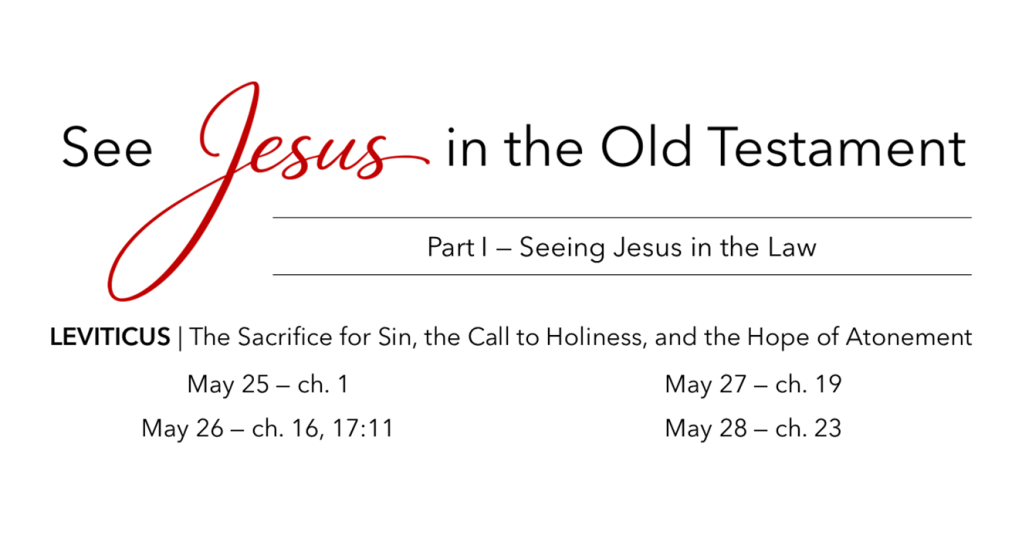
The Sacrifice for Sin, the Call to Holiness, and the Hope of Atonement
Leviticus picks up right where Exodus leaves off, with God’s glory dwelling among His people in the tabernacle (Exodus 40:34-35, ch. 1:1). This raises a crucial question: how can a sinful people live in the presence of holy God? Leviticus answers by giving instructions for sacrifice, worship, and daily life, showing that sin must be dealt with and that God’s people are called to be holy as He is holy (ch. 17:11, 19:2). Through these laws, God graciously provides a way for Israel to approach Him, remain in fellowship with Him, and live as His set-apart people.
These sacrifices and rituals point beyond themselves to Jesus Christ. The offerings in Leviticus show that atonement requires the shedding of blood (ch. 17:11), but they had to be repeated again and again. Jesus fulfills this as the once-for-all sacrifice for sin (Hebrews 9:11-14, 10:1-14), making a way for full and final forgiveness. He is both the perfect sacrifice and the true High Priest, and through Him we are made clean and brought near to God. The call to holiness in Leviticus is also fulfilled in Jesus, who makes His people holy and calls them to live in that holiness (1 Peter 1:15-16).
While only a few chapters are selected, these readings have been carefully chosen to reflect the heart of Leviticus as we see it point to Jesus. You’ll see the necessity of sacrifice (ch. 1), the depth of atonement and the role of blood (ch. 16, 17:11), the call to live as God’s holy people (ch. 19), and the rhythms of worship that shape life around God’s presence (ch. 23). Together, they trace the way to holiness and the hope of atonement, showing both the problem of sin and God’s gracious provision. These passages not only prepare us to understand the work of Jesus but also call us to live as a people made holy through Him.
Let’s dive in together and see Jesus in Leviticus!
May 25 — ch. 1 God provides the burnt offering to atone for sin through a spotless substitute, pointing to Jesus, the Lamb of God without blemish or sin.
May 26 — ch. 16, 17:11 God introduces the Day of Atonement, where a sin-bearing substitute and the life blood deal with sin, pointing to Jesus whose blood cleanses all sin.
May 27 — ch. 19 God calls His people to be holy as He is holy and to love their neighbor as themselves, pointing to Jesus who is holy, holy, holy.
May 28 — ch. 23 God appoints feasts for His people to remember His saving works and worship Him, pointing to their fulfillment in Jesus.
Continue in the See JESUS in the Old Testament readings as we begin Numbers!
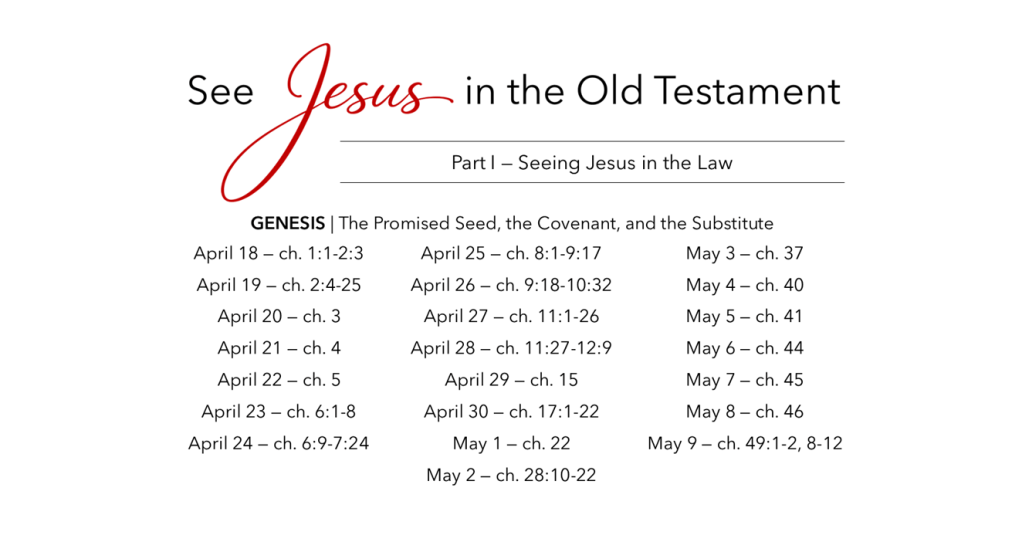
The Promised Seed, the Covenant, and the Substitute
Genesis begins God’s Story by showing Him as Creator of all things, making a world that was “very good” (ch. 1:31), yet sin quickly enters through Adam and Eve’s disobedience (ch. 3:1-7). Sin’s effects spread through every part of life — violence, corruption, and rebellion against God (ch. 6:5, 11:1-9). Even in judgment, though, God shows mercy and grace, preserving Noah through the flood and making a covenant with him (ch. 9:8-17). As Genesis unfolds, the focus narrows from all humanity to one family, as God calls Abraham and promises to bless all nations through him (ch. 12:1-3). This shift reveals that God is not abandoning His world but is working out His plan to redeem it.
From the beginning, Genesis points forward to Jesus. God promises that the seed of woman will defeat the serpent (ch. 3:15), a promise ultimately fulfilled in Christ (Galatians 3:16, 1 John 3:8). Through Abraham, God establishes a covenant of blessing for all nations (ch. 12:1-3, 15:1-6, 17:1-8), which finds its fulfillment in Jesus and the new covenant in His blood (Luke 22:20, Galatians 3:8). When Abraham is called to offer Isaac, God provides a substitute in his place (ch. 22:13), pointing to Jesus as the Lamb of God who takes away the sin of the world (John 1:29, Romans 8:32). Even as the Story progresses, the promise of a coming King emerges through Judah’s line (ch. 49:10), ultimately fulfilled in Jesus Christ, the Son of Abraham and and Son of David (Matthew 1:1).
While not every chapter of Genesis is included, these readings have been carefully suggested to help trace this gospel thread clearly for Christ Community and The Foundry. You’ll move from creation to the fall to the flood and God’s covenant with Noah, then to Abraham and the promises that shape the rest of Scripture. Key moments — like God’s covenant in Genesis 15 and 17, the substitute in Genesis 22, the reaffirmation of God’s promise in Genesis 28, God’s providential saving work through Joseph in Genesis 50, and the promise of the coming King in Genesis 49 — highlight The Promised Seed, the Covenant, and the Substitute. Some passages point directly to Jesus, while others build the foundation we need to understand Him and to understand later chapters in later books of the Old Testament, too. By the end of Genesis, God’s people are in Egypt, waiting for deliverance, and setting the stage for what comes next.
Let’s dive in together and see Jesus in Genesis!
April 18 — ch. 1:1-23 God creates a good and ordered world by His Word, pointing to Jesus, the Word of God through whom all things were made and hold together.
April 19 — ch. 2:4-25 God forms man from the dust and establishes marriage, pointing to Jesus, the Bridegroom of the Church who gives life and restores the lost.
April 20 — ch. 3 Sin enters the world through Adam, but God promises the coming Seed who will crush the serpent and atone for sin.
April 21 — ch. 4 Sin spreads through Cain, but God preserves the promised offspring through whom people call on His name.
April 22 — ch. 5 Death reigns through Adam’s line, yet God preserves the promised offspring.
April 23 — ch. 6:1-8 Humanity’s sin grows great and fills the earth, yet Noah find favor by God’s grace.
April 24 — ch. 6:9-7:24 God judges sin through the flood but provides the ark, pointing to Jesus as the only way to be saved from the wrath of God.
April 25 — ch. 8:1-9:17 God delivers Noah through the flood and establishes His covenant, pointing to mercy after judgment.
April 26 — ch. 9:18-10:32 The nations are birthed and spread from Noah’s sons, with God preserving the promised line through Shem.
April 27 — ch. 11:1-26 God scatters the nations at Babel yet preserves the promised line through Shem to Abram (Abraham).
April 28 — ch. 11:27-12:9 God calls Abram and promises to bless all nations through his offspring — which, according to Galatians 3:16 is a reference to Jesus.
April 29 — ch. 15 God confirms His covenant with Abram, promising offspring and counting his faith as righteousness.
April 30 — ch. 17:1-22 God establishes His covenant with Abraham through Isaac, pointing to Jesus, the promised Offspring.
May 1 — ch. 22 God provides a ram as a substitute for Isaac, pointing to Jesus, the Lamb of God who would die as our Substitute.
May 2 — ch. 28:10-22 God confirms His promise to Jacob and reveals a ladder to heaven, pointing to Jesus as the only Way to the Father.
May 3 — ch. 37 Joseph is rejected and sold by his brothers, yet God already has a plan to raise him up.
May 4 — ch. 40 God gifts Joseph with the ability to interpret dreams, bringing life to one and judgment to another.
May 5 — ch. 41 God raises Joseph from the pit to rule and provide bread in a time of famine, preparing the way to preserve His people.
May 6 — ch. 44 Judah offers himself in place of Benjamin, showing a heart of sacrifice and responsibility.
May 7 — ch. 45 Joseph reveals himself to his brothers, showing God preserving His people and the promised line despite their sin.
May 8 — ch. 46 God brings Jacob and his family to Egypt, not only preserving the promised line but fulfilling His promise that they would become a nation.
May 9 — ch. 49:1-2, 8-12 Jacob blesses his sons before his death, prophesying a coming King from Judah — Jesus — to whom all nations will bow.
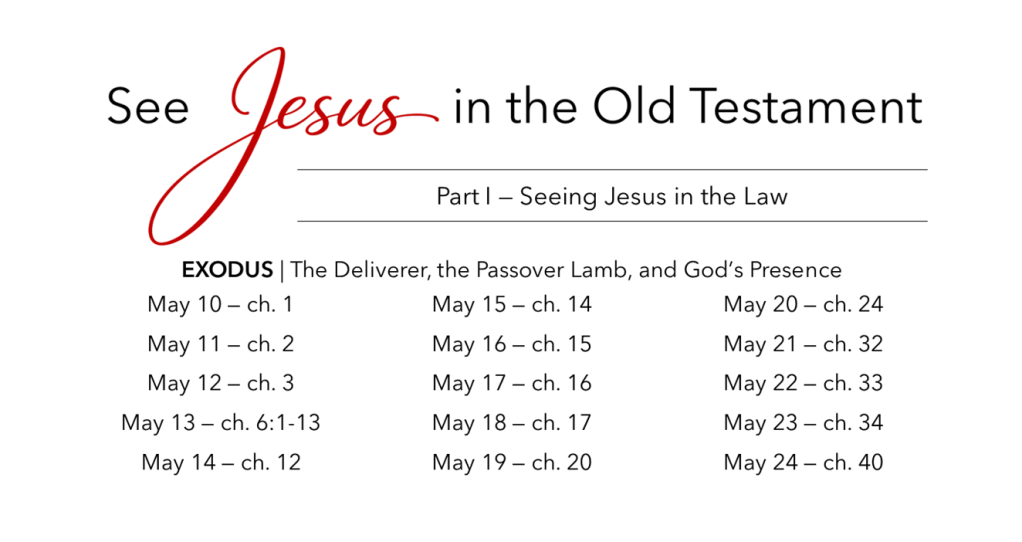
The Deliverer, the Passover Lamb, and God’s Presence
Exodus continues God’s Story as His people, now multiplied in Egypt, are enslaved and oppressed (ch. 1:8-14). Though it may seem to some that God’s presence seems hidden at first, He hears His people’s cries, remembers His covenant with Abraham, and raises up Moses as their deliverer (ch. 2:23-25, 3:7-10). God reveals His power of Egypt through mighty acts of judgment and brings His people out of slavery, making it clear that He alone is the Lord (ch. 6:6-7). He leads them through the Red Sea on dry ground, defeats their enemies, and provides for them in the wilderness, showing both His power to save and His faithfulness to sustain (ch. 14:13-14, 16:12). At Mount Sinai, God establishes His covenant with Israel, giving His Law and calling them to be His people (ch. 20:2-3, 24:7-8).
Exodus points to clearly to Jesus as the greater fulfillment of these events. God raises up Moses as their deliverer, but Jesus is the greater Deliverer who rescues His people — not from Pharaoh but from sin and death (John 8:34-36). The Passover, where the blood of the lamb saves God’s people from judgment (ch. 12:13), points to Jesus, the true Passover Lamb whose blood brings redemption (John 1:29, 1 Corinthians 5:7, 1 Peter 1:18-19). The covenant established at Sinai (ch. 24:8) anticipates the new covenant in Christ’s blood (Luke 22:20). And just as God dwelt among His people in the tabernacle (ch. 40:34-38), so in Jesus, God “tabernacled” among us in the flesh (John 1:14), securing forever His presence with His people.
While not ever chapter of Exodus is included, these readings have been carefully selected to help trace this gospel thread clearly. You’ll follow the story from Israel’s bondage (chs. 1-3) to God’s promise of deliverance (ch. 6:1-13), the Passover (ch. 12), and the salvation at the Red Sea (chs. 14-15). Along the way, God provides for His people (chs. 16-17), establishes His covenant (chs. 20, 24), and reveals both His holiness and mercy when the covenant is broken and renewed (chs. 32-34). The book culminates with God’s presence filling the tabernacle (ch. 40), highlighting The Deliverer, the Passover Lamb, and God’s Presence. Some passages directly point to Jesus, while others build the foundation needed to understand Him, showing that the God who saves also dwells with His people.
Let’s dive in together and see Jesus in Exodus!
May 10 — ch. 1 God multiplies His people in Egypt according to His promise, even as they are oppressed.
May 11 — ch. 2 God hears the cries of His people, remembers His covenant with them, and preserves Moses, preparing to raise him up to deliver them.
May 12 — ch. 3 God reveals Himself as I AM and calls Moses, promising to be with him to deliver His people.
May 13 — ch. 6:1-13 God reaffirms His covenant and promises to redeem His people with a mighty hand.
May 14 — ch. 12 God delivers His people through the blood of the Passover lamb, pointing to Jesus, the Lamb who takes away the sin of the world.
May 15 — ch. 14 God parts the Red Sea, delivering His people as they walk across on dry land, and defe3ats their enemy with the waters to save them.
May 16 — ch. 15 God’s people praise Him as their salvation and Redeemer, pointing to Jesus, the eternal King who saves, redeems, and reigns forever.
May 17 — ch. 16 God provides bread from heaven (manna) to sustain His people in the wilderness, pointing to Jesus, the Bread of Life.
May 18 — ch. 17 God provides water from the rock and victory over their enemies, pointing to the life given and the ultimate victory over every enemy in Him.
May 19 — ch. 20 God gives His Law, revealing His holiness, our inability to keep the Law, and our need for Him to rescue us from our sin.
May 20 — ch. 24 God confirms His covenant with His people through the blood of sacrifice, pointing to a new and greater covenant in the blood of Jesus.
May 21 — ch. 32 God’s people break the covenant through idolatry, and Moses intercedes for them, reminding us our our need for Jesus as our Advocate when we sin.
May 22 — ch. 33 God promises His presence to dwell among His people through the tent of meeting, pointing to the presence of God dwelling in the person of Jesus.
May 23 — ch. 34 God renews His covenant with His people and reveals His steadfast love, mercy, and grace, pointing to their fullness in Jesus.
May 24 — ch. 40 God fills the tabernacle with His glory, representing Him dwelling among His people and pointing us to Jesus taking on flesh and dwelling with us.
The Promised Seed, the Covenant, and the Substitute
Genesis begins God’s Story by showing Him as Creator of all things, making a world that was “very good” (ch. 1:31), yet sin quickly enters through Adam and Eve’s disobedience (ch. 3:1-7). Sin’s effects spread through every part of life — violence, corruption, and rebellion against God (ch. 6:5, 11:1-9). Even in judgment, though, God shows mercy and grace, preserving Noah through the flood and making a covenant with him (ch. 9:8-17). As Genesis unfolds, the focus narrows from all humanity to one family, as God calls Abraham and promises to bless all nations through him (ch. 12:1-3). This shift reveals that God is not abandoning His world but is working out His plan to redeem it.
From the beginning, Genesis points forward to Jesus. God promises that the seed of woman will defeat the serpent (ch. 3:15), a promise ultimately fulfilled in Christ (Galatians 3:16, 1 John 3:8). Through Abraham, God establishes a covenant of blessing for all nations (ch. 12:1-3, 15:1-6, 17:1-8), which finds its fulfillment in Jesus and the new covenant in His blood (Luke 22:20, Galatians 3:8). When Abraham is called to offer Isaac, God provides a substitute in his place (ch. 22:13), pointing to Jesus as the Lamb of God who takes away the sin of the world (John 1:29, Romans 8:32). Even as the Story progresses, the promise of a coming King emerges through Judah’s line (ch. 49:10), ultimately fulfilled in Jesus Christ, the Son of Abraham and and Son of David (Matthew 1:1).
While not every chapter of Genesis is included, these readings have been carefully suggested to help trace this gospel thread clearly for Christ Community and The Foundry. You’ll move from creation to the fall to the flood and God’s covenant with Noah, then to Abraham and the promises that shape the rest of Scripture. Key moments — like God’s covenant in Genesis 15 and 17, the substitute in Genesis 22, the reaffirmation of God’s promise in Genesis 28, God’s providential saving work through Joseph in Genesis 50, and the promise of the coming King in Genesis 49 — highlight The Promised Seed, the Covenant, and the Substitute. Some passages point directly to Jesus, while others build the foundation we need to understand Him and to understand later chapters in later books of the Old Testament, too. By the end of Genesis, God’s people are in Egypt, waiting for deliverance, and setting the stage for what comes next.
Let’s dive in together and see Jesus in Genesis!
April 18 — ch. 1:1-23 God creates a good and ordered world by His Word, pointing to Jesus, the Word of God through whom all things were made and hold together.
April 19 — ch. 2:4-25 God forms man from the dust and establishes marriage, pointing to Jesus, the Bridegroom of the Church who gives life and restores the lost.
April 20 — ch. 3 Sin enters the world through Adam, but God promises the coming Seed who will crush the serpent and atone for sin.
April 21 — ch. 4 Sin spreads through Cain, but God preserves the promised offspring through whom people call on His name.
April 22 — ch. 5 Death reigns through Adam’s line, yet God preserves the promised offspring.
April 23 — ch. 6:1-8 Humanity’s sin grows great and fills the earth, yet Noah find favor by God’s grace.
April 24 — ch. 6:9-7:24 God judges sin through the flood but provides the ark, pointing to Jesus as the only way to be saved from the wrath of God.
April 25 — ch. 8:1-9:17 God delivers Noah through the flood and establishes His covenant, pointing to mercy after judgment.
April 26 — ch. 9:18-10:32 The nations are birthed and spread from Noah’s sons, with God preserving the promised line through Shem.
April 27 — ch. 11:1-26 God scatters the nations at Babel yet preserves the promised line through Shem to Abram (Abraham).
April 28 — ch. 11:27-12:9 God calls Abram and promises to bless all nations through his offspring — which, according to Galatians 3:16 is a reference to Jesus.
April 29 — ch. 15 God confirms His covenant with Abram, promising offspring and counting his faith as righteousness.
April 30 — ch. 17:1-22 God establishes His covenant with Abraham through Isaac, pointing to Jesus, the promised Offspring.
May 1 — ch. 22 God provides a ram as a substitute for Isaac, pointing to Jesus, the Lamb of God who would die as our Substitute.
May 2 — ch. 28:10-22 God confirms His promise to Jacob and reveals a ladder to heaven, pointing to Jesus as the only Way to the Father.
May 3 — ch. 37 Joseph is rejected and sold by his brothers, yet God already has a plan to raise him up.
May 4 — ch. 40 God gifts Joseph with the ability to interpret dreams, bringing life to one and judgment to another.
May 5 — ch. 41 God raises Joseph from the pit to rule and provide bread in a time of famine, preparing the way to preserve His people.
May 6 — ch. 44 Judah offers himself in place of Benjamin, showing a heart of sacrifice and responsibility.
May 7 — ch. 45 Joseph reveals himself to his brothers, showing God preserving His people and the promised line despite their sin.
May 8 — ch. 46 God brings Jacob and his family to Egypt, not only preserving the promised line but fulfilling His promise that they would become a nation.
May 9 — ch. 49:1-2, 8-12 Jacob blesses his sons before his death, prophesying a coming King from Judah — Jesus — to whom all nations will bow.
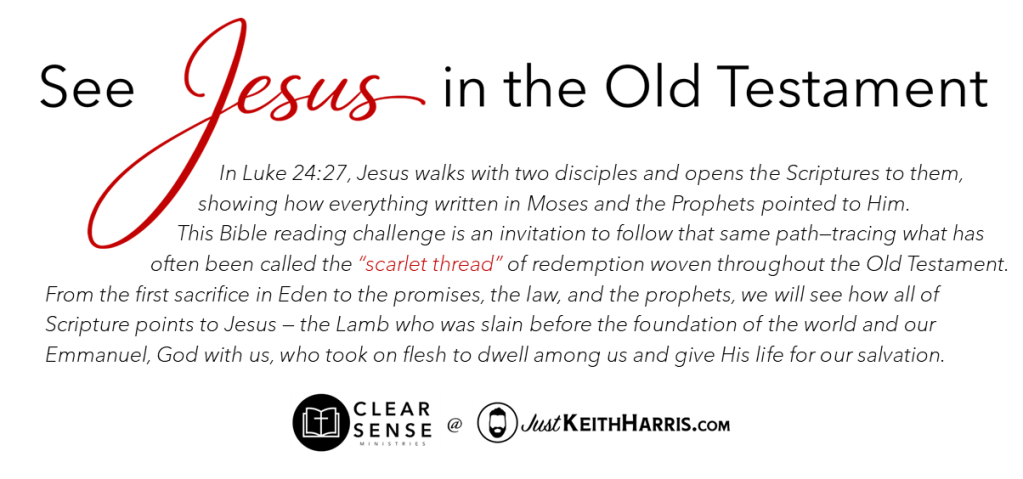
For about a year and a half at Christ Community Church (Grenada, MS) and The Foundry Church (Winona, MS), we’ve been involved in various Bible reading plans to help us get into the Word of God for the purpose of growing in and closer to Jesus.
We’ve read through various books of the Bible like Proverbs and the Psalms, and we just completed 260 days reading through the New Testament a chapter a day. We now turn our focus to the Old Testament, but we aren’t changing our focus — we’re reading selected passages in each Old Testament book looking at how Jesus shows up from before “In the beginning, God….” all the way to His incarnation in the gospels.
You don’t have to be a member of either Christ Community or The Foundry; you are welcome to join us in the readings and grow in Christ together!
Below, you’ll find links to go to the digital versions of each section of our reading plan as well as places to download a pdf of each section.
But about 1,993 years ago today, the outlook seemed bleak.
For those living through the original Holy Week in the time depicted in the gospels, Saturday morning must have been a sad and scary time. They had lived through Jesus’s arrest – they had seen Him taken away, beaten, mocked, scourged (Matthew 26:47-68, 27:26-31). I can’t imagine how terrible the cries of “Crucify Him!” and “Behold your king!” had been (Luke 23:21, John 19:14-15).
Then, all of the times that Jesus had prophesied His death had come true (Mark 8:31, 9:31, 10:33-34). He had walked out of Pilate’s compound carrying His cross (John 19:16-17), a crown of thorns ripping into His scalp and forehead (John 19:2-3), bloody and bowed while struggling under the weight. Imagine seeing Him walk the road to the place of the Skull (Luke 23:26, 33), laying the cross down and being laid down on it.
Could they watch as His arms were stretched wide and the nails were hammered into His hands and feet? Could they look upon Him as He was pierced for our transgressions (Isaiah 53:5) – as the cross was lifted and plunked in a hole as it was stood up?
He had told them all of this time and again. Didn’t He tell them of His conversation with Nicodemus when He said that He would be lifted up so that all who look upon Him may believe in Him and have eternal life (John 3:14-15)? Oh, how that prophesy must’ve seemed thin at that moment as His life drew to an end.
But Sunday was coming….
The spectators of His crucifixion would have heard Him cry out, “It is finished” (John 19:30). It must have sure seemed so to see His body taken down, carried to the cemetery, and laid in Joseph of Arimathea’s tomb (Matthew 27:57-60). Think of the finality of the heavy stone rolled by multiple men into place (Matthew 27:60).
So, as Saturday dawned the next day, I don’t imagine it was a scene of celebration. The Bible doesn’t tell Saturday’s story, but we know that the powers-that-be who were used of Satan thought they had won. They had sealed the tomb and set a guard because they thought Jesus’s followers would try to steal the body (Matthew 27:62-66). But His followers were not a political or religious movement. His followers were His friends – those whose lives had been changed by Him, those who had believed and received life in His name (John 1:12). They were in mourning because the Teacher was dead. They were in mourning that they had doubted or denied Him (Luke 22:61-62). They were afraid because, if the powers-that-be had been able to kill Him, there’s no limit to what could be done to them (John 20:19). So, they huddled in the upper room with the table where they had their last supper with Him (Luke 22:14-20, John 20:19).
But Sunday was coming.
I cannot begin to explain what happened – that’s above my pay grade, so to speak, but think of all we know of life and death: it came untrue! The lifeless body of Jesus, truly dead and laid in the tomb, began to live again! The decay of His corpse reversed. Synapses in His brain fired. His bloodless heart pumped fresh. The torn and ripped skin on His back healed. The lungs that breathed the breath of life into Adam filled once more. The Lamb of God, looking as if He had been slain – because He had, stood of His own power (Revelation 5:6, John 10:18). The nail pierced hands took the grave clothes, folded them carefully, and laid them at the foot of the bier (John 20:6-7). Then, the maker of the stone willed it to move aside, needing no help because He was no mere mortal man. God who put on flesh and dwelt among us (John 1:14) – who had died in our place (1 Peter 2:24) – rose again in power (Romans 6:9, Acts 2:24), putting off mortality so that those who put their faith in Him could put on His immortality (1 Corinthians 15:53-54).
It was Sunday, and Jesus had risen as He had said (Matthew 28:6).
The stone rolled away, light blinded and incapacitated the feeble guards keeping watch over His tomb (Matthew 28:2-4). The Author of Life and inventor of humanity could not be held by death because it wasn’t for Him (Acts 3:15, 2:24). The Lion of Judah had laid down His life as the Lamb of God (Revelation 5:5-6, John 1:29), and now walks forth in victory, every step announcing defeat – defeat of death and hell and putting Satan to open shame because His work was finished (Colossians 2:15, Hebrews 2:14).
Sunday came!
For the last 1,993 years, every Sunday has been a celebration and reminder that the tomb is empty and Jesus is alive. Every, single Sunday His followers have gathered in worship of Him, looking for His return (Acts 20:7, 1 Corinthians 16:2). In that sense, Sunday is coming again because we have the hope that He who came to save us by dying for our sin in accordance with the Scriptures (1 Corinthians 15:3-4) is He who could not be held by death. And if He can’t be stopped by death, He must surely be able to return as He has said (Acts 1:11). He who promised is faithful (Hebrews 10:23).
That’s why we gather. That’s why we celebrate.
So, tomorrow, we will lift our voices in worship because He is risen as He said. John will open the Scriptures and point us to Jesus – who He is and what He has done. We have the opportunity to celebrate that He who is alive offers life eternal to those who trust in Him (John 11:25-26). And YOU are invited to gather with us.
3For I delivered to you as of first importance what I also received: that Christ died for our sins in accordance with the Scriptures, 4that he was buried, that he was raised on the third day in accordance with the Scriptures….
9After this I looked, and behold, a great multitude that no one could number, from every nation, from all tribes and peoples and languages, standing before the throne and before the Lamb, clothed in white robes, with palm branches in their hands, 10and crying out with a loud voice, “Salvation belongs to our God who sits on the throne, and to the Lamb!” 11And all the angels were standing around the throne and around the elders and the four living creatures, and they fell on their faces before the throne and worshiped God, 12saying, “Amen! Blessing and glory and wisdom and thanksgiving and honor and power and might be to our God forever and ever! Amen.”
51 Behold! I tell you a mystery. We shall not all sleep, but we shall all be changed, 52 in a moment, in the twinkling of an eye, at the last trumpet. For the trumpet will sound, and the dead will be raised imperishable, and we shall be changed. 53 For this perishable body must put on the imperishable, and this mortal body must put on immortality. 54 When the perishable puts on the imperishable, and the mortal puts on immortality, then shall come to pass the saying that is written: “Death is swallowed up in victory.” 55 “O death, where is your victory? O death, where is your sting?” 56 The sting of death is sin, and the power of sin is the law. 57 But thanks be to God, who gives us the victory through our Lord Jesus Christ.
Sunday’s coming, and I’m excited. And on this Palm Sunday, we remember our King.
Psalm 118:19-29 gives us the language of a people longing for salvation and rejoicing in the One who brings it: “Blessed is He who comes in the name of the LORD!” (Psalm 118:26). It’s a song/psalm of victory, rescue, and the steadfast love of God that endures forever.
The people cried out “Hosanna!” to Jesus, which is the Hebrew word used in Psalm 118:25 that is translated, “Save us, we pray”. In the time between Psalm 118 being written and Jesus’s Triumphal Entry, “hosanna” had shifted from “Save us, we pray” to a cry of praise to the Lord who had saved them time and again and whose track record led them to believe He would and could save them in their time of need.
While they were crying out “Hosanna”, they also quoted Psalm 118:26: “Blessed is He who comes in the name of the Lord!” They laid down palm branches and their own cloaks as they cried out to Jesus with joy, welcoming Him as King. What Psalm 118 anticipated, Jesus was fulfilling right before their eyes (Luke 24:44).
But something even greater was happening.
Psalm 118 speaks of the festal sacrifice being bound with cords to the horns of the altar (Psalm 118:27). Yet when Jesus came, He wasn’t bound or forced. He came willingly, submitting to His Father’s redemptive plan. He is the true and better sacrifice — the Lamb of God who would take away the sin of the world (John 1:29), the propitiation, atoning sacrifice, to bear the wrath of God on behalf of those He saves (1 John 2:1-2, Romans 3:25). The King they proclaimed was riding into Jerusalem to be the Savior they needed on the cross (Luke 19:10).
Essentially, this is why we gather in worship — not just to remember or commemorate a moment but to respond to Jesus (Romans 12:1). He came to seek and save the lost, to bear our sin, and to make a way for us who are far off to be brought near (1 Peter 2:24, Ephesians 2:13). We get to fix our eyes on our King (Hebrews 12:2) and cry out “Hosanna!”, praising God for saving us by grace through faith in Jesus (Ephesians 2:8-9)! Palm Sunday is not a mere holiday (or holy day) but a reminder of who Jesus is, what He has done, and call us to faith in Him (John 20:31).
That’s also why these “Songs of Sunday” posts exist — to help us prepare our hearts to gather in worship. As we read, reflect, and sing ahead of time, we’re asking the Lord to ready our hearts to worship, to receive His Word, and to respond with faith and joy.
Sunday’s coming.
Jesus is coming again.
Let’s be ready to welcome our King, not just with our lips but with our lives, trusting, rejoicing, and worshiping.
Come and gather with us. Lift your voice and sing out to the Lord. Listen as John points us to Jesus in the Word. Let’s make much of Jesus together.
19 Open to me the gates of righteousness, that I may enter through them and give thanks to the LORD. 20 This is the gate of the LORD; the righteous shall enter through it. 21 I thank you that You have answered me and have become my salvation. 22 The stone that the builders rejected has become the Cornerstone. 23 This is the LORD’s doing; it is marvelous in our eyes. 24 This is the day that the LORD has made; let us rejoice and be glad in it.
25 Save us, we pray, O LORD! O Lord, we pray, give us success!
26 Blessed is He who comes in the name of the LORD! We bless you from the house of the LORD. 27 The LORD is God, and He has made His light to shine upon us. Bind the festal sacrifice with cords, up to the horns of the altar!
28 You are my God, and I will give thanks to You; You are my God; I will extol You. 29 Oh give thanks to the LORD, for He is good; for His steadfast love endures forever!
32 So those who were sent went away and found it just as he had told them. 33 And as they were untying the colt, its owners said to them, “Why are you untying the colt?” 34 And they said, “The Lord has need of it.” 35 And they brought it to Jesus, and throwing their cloaks on the colt, they set Jesus on it. 36 And as he rode along, they spread their cloaks on the road. 37 As he was drawing near—already on the way down the Mount of Olives—the whole multitude of his disciples began to rejoice and praise God with a loud voice for all the mighty works that they had seen, 38 saying, “Blessed is the King who comes in the name of the Lord! Peace in heaven and glory in the highest!” 39 And some of the Pharisees in the crowd said to him, “Teacher, rebuke your disciples.” 40 He answered, “I tell you, if these were silent, the very stones would cry out.”