My God, my God, why have You forsaken me? Why are You so far from saving me, from the words of my groaning?
Psalm 22:1
Psalm 22 begins with a heart-wrenching cry: “My God, my God, why have You forsaken me?” (v. 1). David voices the raw emotions that come from feeling abandoned by God in amid intense suffering. He pleads for God’s presence, wrestling with the seeming silence of heaven even as he cries out day and night (vv. 1-2). This tension between despair and trust is central to the psalm.
While David feels forsaken, he also remembers the holiness and faithfulness of God: “In You our father’s trusted; they trusted, and You delivered them” (v. 4). He clings to this hope even as his circumstances overwhelm him.
David, in his agony, describes himself as “a worm and not a man”, scorned and mocked by those around him (vv. 6-7). His enemies taunt him, twisting his trust in God into mockery and ridicule: “He trusts in the Lord; let Him deliver him” (v. 8). At this point, David has become physically weak and broken – his strength dried up, his bones out of joint, and his hands and feet pierced (vv. 14-16). Even his garments are divided among his enemies (v. 18). This striking imagery paints a picture of unparalleled suffering that goes far beyond David’s personal struggles and points prophetically to the suffering Savior, Jesus.
Despite the suffering and feelings of abandonment, Psalm 22 doesn’t end in defeat. In v. 22, there is a sudden shift: “I will tell of Your name to my brothers; in the midst of the congregation I will praise You.” Those feelings of abandonment are replaced with David rejoicing in God’s faithfulness. As in many other psalms, we see David finding hope in the consistent nature of God’s character. Because of that, he knows that God has not despised or ignored him (v. 24). This praise expands beyond Israel to include “all the families of the nations”, who will remember and worship the Lord (v. 27) and concludes with the assurance that God’s righteousness will be proclaimed to future generations, declaring “He has done it” (v. 31).
Seeing Jesus in Psalm 22
Psalm 22 is tied to Jesus’s crucifixion as Jesus cried out the opening words from the cross: “My God, my God, why have You forsaken me?” (Matthew 27:46). Additionally, the vivid descriptions of pierced hands and feet (v. 16), divided garments (v. 18), and mocking enemies (vv. 7-8) are fulfilled in stunning detail and accuracy at Calvary. These connections reveal that David’s suffering pointed to Christ’s ultimate suffering, but Psalm 22 doesn’t end at the cross.
David’s shift from lament to praise reflects the resurrection, as Jesus declares, “I will tell of your name to my brothers” (v. 22, Hebrews 2:12). Through His death and resurrection, Jesus brings the nations ot worship God, fulfilling the psalms vision of the praise of the nations and eternal life (vv. 27-31). All in all, Psalm 22 reminds us that Jesus was truly forsaken so that we never have to be, and His victory ensures our hope.
Reflection
Psalm 22 invites us to honestly bring our pain to God, just as David and Jesus did. When we feel abandoned or overwhelmed, we can cry out to the Lord, trusting that He hears us even in His silence. At the same time, we are called to fix our eyes on God’s faithfulness – His deliverance in the past, His presence in the present, and His promises for the future.
Because Jesus bore the ultimate forsakenness on our behalf, we can trust that God is always with us, even in our darkest moments. As we meditate today on Christ’s suffering and victory, may we join David in proclaiming, “He has done it” (v. 31)!
The #dailyPSALMSchallenge gives us the opportunity to start 2025 in God’s Word by digging into a psalm a day. Each day will identify a key passage for us to meditate on as well as seeking to help us see Jesus in the psalm and reflect on what we have read.
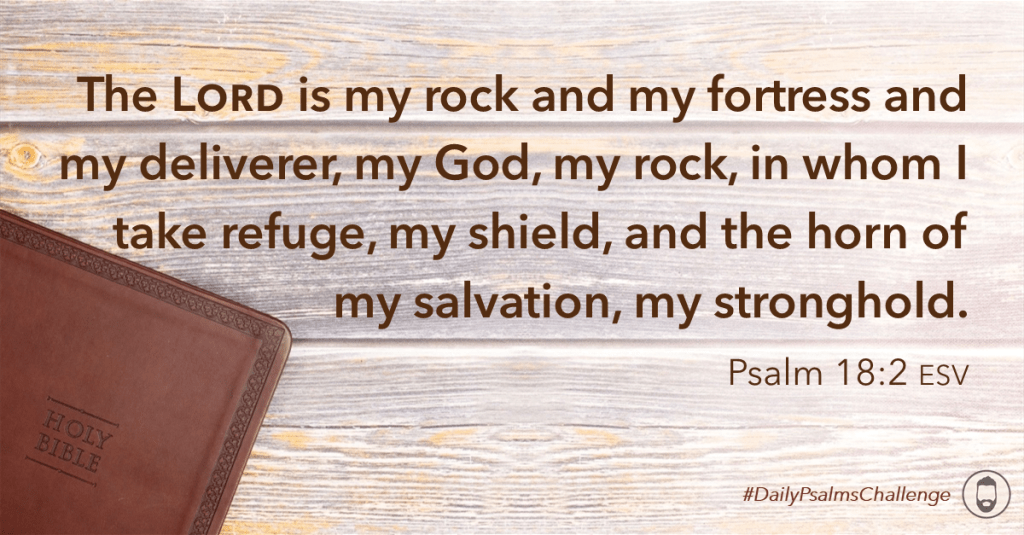
The LORD is my rock and my fortress and my deliverer, my God, my rock, in whom I take refuge, my shield, and the horn of my salvation, my stronghold.
Psalm 18:2
Psalm 18 is a song of triumph and thanksgiving from David to the Lord, celebrating God’s deliverance from King Saul. It is important to note that Psalm 18 is nearly identical to David’s song of praise in 2 Samuel 22 – the differences likely being Psalm 18 is adapted from David’s specific situation to be sung by the people (the Psalms is the songbook/hymnal of the Bible, remember). As such, this is not only a personal expression of David’s gratitude and praise but also a testimony to God’s faithfulness to His anointed king and His people. This psalm resonates with themes of refuge, rescue, and victory, ultimately pointing, as we’ll see later, to Jesus.
David opens with a declaration of love for the Lord, describing Him as his strength, rock, fortress, deliverer, and refuge (vv. 1-3). These metaphors emphasize God’s power, protection, and faithfulness. David’s words remind us that God is not some distant, uninvolved deity but a personal Savior who genuinely cares for His people.
The central part of the psalm recounts God’s dramatic intervention on David’s behalf (vv. 4-19). When David faced overwhelming danger, he cried out to the Lord, and God responded with awesome power. The imagery of the earth trembling, smoke rising, and hailstones falling paints a vivid picture of God as a divine Warrior, fighting for His anointed one. This points back all the way to the Lord’s deliverance of Israel from Egypt in the Exodus and points forward to His ultimate victory through Jesus.
David attributes his deliverance to his righteousness and integrity (vv. 20-24), not meaning that David was sinless but that he walked faithfully with God and sought to obey His commands. In the last part of the psalm, David praises God for equipping him for battle and giving him the victory (vv. 31-45) showing that he understood his victory was ultimately in the Lord’s goodness rather than his own. In fact, he acknowledges that every success of his was achieved as a result of God’s strength, guidance, and provision.
Psalm 18 concludes with a declaration of God’s faithfulness, not just toward David but also toward His people (vv. 46-50). David praises the Lord as his rock and Savior, again acknowledging that his victories are part of God’s covenant commitment to him and his descendants. Ultimately, this covenant finds fulfillment in Jesus, the eternal King and descendant of David, who brings salvation to all nations (Romans 15:9).
Seeing Jesus in Psalm 18
Psalm 18 foreshadows Jesus, the greater David. We can truly sing v. 46 in the context of Jesus: “The LORD lives, and blessed be my rock, and exalted be the God of my salvation”! The dramatic imagery of God’s intervention in David’s situation in this psalm reflects the power of the resurrection, where Jesus – the LORD – lives, defeating the ultimate enemies of sin and death (1 Corinthians 14:25-27).
Paul quotes v. 49 in Romans 15:9, showing that the salvation described in Psalm 18 is extended to the Gentiles through Jesus, who is the fulfillment of God’s promise to David – Jesus, who is the King who reigns forever and brings salvation to the ends of the earth.
Reflection
Psalm 18 invites us to rejoice in God’s faithfulness, to trust in His strength, and to find our ultimate hope in our eternal King, Jesus.
As you reflect on Psalm 18, ask yourself how you can apply the imagery of God as rock, fortress, and shield to your current circumstances. Have there been times when He has delivered you? If so, how did that strengthen your faith?
Pray or sing Psalm 18 and rejoice in the God of your salvation!
The #dailyPSALMSchallenge gives us the opportunity to start 2025 in God’s Word by digging into a psalm a day. Each day will identify a key passage for us to meditate on as well as seeking to help us see Jesus in the psalm and reflect on what we have read.
Every Sunday the Lord blesses us with is an opportunity to gather together and celebrate Jesus’s resurrection and anchor our heats in the hope of His return!
As we gather, we are reminded that the power of sin and death has been broken, and we rejoice in the steadfast love of the Lord, which turns mourning to dancing and sorrow into joy. This is illustrated in the passages we will read together Sunday morning.
The first passage is Psalm 30:8-12, and it beautifully captures this truth:
8To You, O LORD, I cry, and to the Lord I plead for mercy: 9“What profit is there in my death, if I go down to the pit? Will the dust praise You? Will it tell of Your faithfulness? 10Hear, O LORD, and be merciful to me! O LORD, be my helper!”
11You have turned for me my mourning into dancing; You have loosed my sackcloth and clothed me with gladness, 12that my glory may sing Your praise and not be silent. O LORD my God, I will give thanks to you forever!
In Psalm 30, David cries out to the LORD in his distress, and God answers, turning his mourning into dancing and clothing him with gladness (Psalm 30:11). This is the testimony of all who belong to Christ — to all who are rescued by Him from the sting of death and brought into everlasting life! This doesn’t mean that everything is always (or ever) hunky-dory or that we will never feel the sting of death here on earth. What this means is that death has an expiration date and that, if we are His, it is only temporary!
This victorious theme continues in our second passage for Sunday morning, 1 Corinthians 15:50-58:
50I tell you this, brothers: flesh and blood cannot inherit the Kingdom of God, nor does the perishable inherit the imperishable. 51Behold! I tell you a mystery. We shall not all sleep, but we shall all be changed, 52in a moment, in the twinkling of an eye, at the last trumpet. For the trumpet will sound, and the dead will be raised imperishable, and we shall be changed. 53For this perishable body must put on the imperishable, and this mortal body must put on immortality. 54When the perishable puts on the imperishable, and the mortal puts on immortality, then shall come to pass the saying that is written:
“Death is swallowed up in victory.” 55“O death, where is your victory? O death, where is your sting?”
56The sting of death is sin, and the power of sin is the law. 57But thanks be to God, who gives us the victory through our Lord Jesus Christ.
58Therefore, my beloved brothers, be steadfast, immovable, always abounding in the work of the Lord, knowing that in the Lord your labor is not in vain.
Throughout 1 Corinthians 15, Paul declares the certainty of Jesus’s resurrection and in 1 Corinthians 15:50-58, he calls us to steadfastness and hope in that certainty. Because Jesus has conquered death, our lives are filled with purpose. Every note we sing, every word we speak, every moment of worship is not in vain because our Savior — our GOD — is alive and not dead! It is part of God’s story of redemption because, if we are in Christ, we have been made alive in Him!
This Sunday (and honestly every Sunday at Christ Community), our hearts are fixed on Christ and excited by His resurrection. The songs we sing are about Him bearing our sin on the cross and giving life through His life when He exited His borrowed tomb. We will sing of it over and over again — as we should — because Jesus is alive and well, and we will do it all the more as we await His return!
John will open the Word and point us to Jesus.
We will lift our voices together, reading and singing, pointing each other to Jesus.
8To You, O LORD, I cry, and to the Lord I plead for mercy: 9“What profit is there in my death, if I go down to the pit? Will the dust praise You? Will it tell of Your faithfulness? 10Hear, O LORD, and be merciful to me! O LORD, be my helper!”
11You have turned for me my mourning into dancing; You have loosed my sackcloth and clothed me with gladness, 12that my glory may sing Your praise and not be silent. O LORD my God, I will give thanks to you forever!
50I tell you this, brothers: flesh and blood cannot inherit the Kingdom of God, nor does the perishable inherit the imperishable. 51Behold! I tell you a mystery. We shall not all sleep, but we shall all be changed, 52in a moment, in the twinkling of an eye, at the last trumpet. For the trumpet will sound, and the dead will be raised imperishable, and we shall be changed. 53For this perishable body must put on the imperishable, and this mortal body must put on immortality. 54When the perishable puts on the imperishable, and the mortal puts on immortality, then shall come to pass the saying that is written:
“Death is swallowed up in victory.” 55“O death, where is your victory? O death, where is your sting?”
56The sting of death is sin, and the power of sin is the law. 57But thanks be to God, who gives us the victory through our Lord Jesus Christ.
58Therefore, my beloved brothers, be steadfast, immovable, always abounding in the work of the Lord, knowing that in the Lord your labor is not in vain.
You make known to me the path of life; in Your presence there is fullness of joy; at Your right hand are pleasures forevermore.
Psalm 16:11
Psalm 16 begins with a petition of preservation but quickly turns to psalm of trust and contentment, a song of the confidence inspired by God’s faithful care. David declares his exclusive dependence on the Lord, acknowledging that God is the only good He has (v. 2).
David contrasts the joy of trusting in God with the fruitless sorrows of idolatry (vv. 3-4). His delight is the saints, God’s people, but he refuses to even speak the names of other/false Gods. The Lord Himself is David’s inheritance and portion, a reminder of God’s personal care and provision (vv. 5-6).
In vv. 7-8, David praises God for His guidance and presence, describing the stability and confidence that come from setting the Lord always before him. This unshakable confidence culminates in the hope of resurrection and eternal joy. David affirms that God will not abandon him to Sheol or let His “holy one” see corruption (v. 10), a prophecy fulfilled in the resurrection of Jesus (Acts 2:25-32, 13:35-37).
Psalm 16 concludes with a vision of eternal joy and life in God’s presence. For David, the path of life leads not only through this life but also to an everlasting relationship with God, where there is fullness of joy and eternal pleasures (v. 11).
Seeing Jesus in Psalm 16
Psalm 16 finds its ultimate fulfillment in Jesus. Peter and Paul both preached Jesus’s resurrection using this exact psalm, emphasizing that David’s words about not seeing corruption could not apply to David but pointed forward to Jesus (Acts 2:27-31, 13:35-37). Jesus is the true “holy one” who was not abandoned to the grave, and His resurrection is the foundation of our hope for eternal life.
As believers, we share in Christ’s victory over death. Jesus rose from the dead and will raise those who are saved by grace through faith in Him. In Christ, we have confidence that death is not the end and that eternal joy awaits us in God’s presence.
Reflection
Through Psalm 16, we are invited to rest in God’s care, rejoice in His guidance, and look forward with confidence to the fullness of joy that awaits in His presence forevermore.
Trust in God. Are you finding your security in the Lord, or are you tempted to chase after fleeting joys? Reflect on how God has been your refuge and portion.
Delight in God’s people. Do you take joy in fellowship with God’s people? Consider ways you can grow in love for and encouragement of the saints.
Rejoice in Jesus’s resurrection. How does it shape your views on life, death, and eternity? Meditate on the eternal pleasures promised in God’s presence.
The #dailyPSALMSchallenge gives us the opportunity to start 2025 in God’s Word by digging into a psalm a day. Each day will identify a key passage for us to meditate on as well as seeking to help us see Jesus in the psalm and reflect on what we have read.
2Continue steadfastly in prayer, being watchful in it with thanksgiving. 3At the same time, pray also for us, that God may open to us a door for the Word, to declare the mystery of Christ, on account of which I am in prison — 4that I may make it clear, which is how I ought to speak. 5Walk in wisdom toward outsiders, making the best use of the time. 6Let your speech always be gracious, seasoned with salt, so that you may know how you ought to answer each person.[1]
📖 Revelation 4:1–11In this episode of The King is Coming, Keith Harris and Jamie Harrison move beyond Jesus’s letters to the churches and into the next part of John’s vision. In Revelation 4, John is invited through an open door into heaven—and what he sees is the throne room of God.At the center of everything is a throne, and seated on it is the Lord in all His glory. From this point forward in Revelation, the throne becomes the focal point of the entire book.John describes the scene the best way he can: the brilliance of precious stones, a rainbow surrounding the throne, flashes of lightning and thunder, and a crystal-like sea before it. Surrounding the throne are twenty-four elders and four living creatures who never cease to worship the Lord.Together, Keith and Jamie discuss:✔️ Why Revelation 4 marks a shift from the letters to the churches to John’s heavenly vision✔️ What the throne room reveals about God’s authority and security over all things✔️ Why John uses comparisons (“like” and “as”) to describe the glory he sees✔️ The mystery of the twenty-four elders and what we can—and cannot—know✔️ The constant worship of the living creatures crying “Holy, holy, holy”✔️ Why heaven’s worship centers on God simply because He is worthyIn the throne room, everything points to one truth: God alone is worthy of worship.“Worthy are you, our Lord and God, to receive glory and honor and power, for you created all things, and by your will they existed and were created.” (Revelation 4:11)🔗 If you would like to see a written version of this podcast, complete with footnotes and cross-references, you can find it here.
I don’t know about y’all, but last fall and early winter were so busy. We’ve been traipsing back and forth across the South following my daughter and the high school band, writing this past year’s Advent guide (hopefully you got to follow along with the “Good News of Great Joy” readings in Luke), preaching a revival, serving the Lord at Christ Community and wherever else opportunity has arisen, started writing the #dailyPSALMSchallenge posts, and managed to work teaching school, too. Busy, busy, busy. It had been my intention to be finished with our Colossians study by now, but I am finding the older I get that things get done when they are done. Additionally, things worth doing well are worth working on until they are ready (even if I was ready to get it done before it was complete).
This closing exhortation (Bible word that is a mixture of warning, encouragement, and coming alongside someone to help them) of Paul’s here in Colossians 4:2-6 has been working on me throughout my busyness. The way I study these days – whether to write or preach or teach or whatever – is to work through the cross-references for a passage in my notebook, and I carry that notebook with me most places. I study and ponder on the passage and the verses throughout Scripture that give its context. I dwell with the passage. I meditate on it. Really, it is not as academic or spiritual as that sounds but more like the action of a crockpot where I simmer in the passage and its connecting verses until it’s done and ready to serve. I said Colossians 4:2-6 has been working on me; maybe the better way to say it is God has been working it into my life.
To understand this closing exhortation, you need to think of it in the context of the whole letter of Colossians. The first two chapters focus on doctrine, teachings about Jesus, His gospel, and the eternal life He gives, that the church at Colossae was missing. False teachers were coming in, taking advantage of the gaps in their knowledge and seeking to fill them with dangerous teachings and practices meant to lead them away from Christ. The last two chapters focus on putting that doctrine into practice. The church at Colossae needed to learn what it is to put our focus on Christ, namely taking off and putting to death the sin that belonged to their old life and putting on Christ, being adorned in and with Him, and living as His Spirit and Word direct. The biggest part of that application is where Paul helps the church at Colossae – and us – to be adorned in Christ in all areas of our lives, marriages, families, vocations, and so on. This exhortation fits at the tail end of how to be adorned in Christ in all areas of our lives.
As I said earlier, an exhortation is a kind of like coming alongside someone to help them. Picture being on a battlefield and your brother or sister soldier injures their leg and cannot walk on their own. You don’t just leave them there and save yourself. No, you reach down, grab their arm and put it across your shoulder, and you become a leg for them. They cannot walk, but y’all together can. This is recognition that in this spiritual battle, those who belong to the Kingdom of God lift one another up. In this case, Paul is writing to them from his place on the battle field in prison to lift them up and encourage them to keep the faith as they go through life and to lift up one another.
You might read this and be startled by the imagery of battle, but that is the reality of living in Christ for His Kingdom while we still live among the kingdoms of this world. Much of Paul’s letter to Ephesus mirrors aspects of the letter to Colossae. Where we have the exhortation in Colossians 4:2-6, this portion of Ephesians describes the need for putting on the “whole armor of God, that you may be able to stand against the schemes of the devil” (Ephesians 6:11) and recognizes that we are wrestling – literally fighting – against an enemy that is not of this world – not “against flesh and blood, but against the rulers and authorities, against the cosmic powers over this present darkness, against the spiritual forces of evil in the heavenly places” (Ephesians 6:12).
We will walk through three ways in which we can lift one another up as we are on the Church’s mission, through prayer, preaching, and practice.
Prayer is Imperative to the Mission (vv. 2-4)
Prayer is literally the most we can do. A lot of times folks are willing to neglect prayer so that they can do something or make something – like praying or serving or whatever, but when you really get down and think about it, what more can you do than take your petitions to the almighty God of the universe?
That’s not a rhetorical question: what more can you do than take things in prayer to God Most High? The obvious and only answer is a resounding “no”.
Look at the way the author of Hebrews describes prayer in Hebrews 4:16:
Let us then with confidence draw near to the throne of grace, that we may receive mercy and find grace to help in time of need….
Consequently, He is able to save to the uttermost those who draw near to God through Him, since He always lives to make intercession for them.
Prayer is an opportunity to approach the throne of God with the same level of confidence of a toddler approaching a parent’s bed in the middle of the night, scared from some lurking shadow or bad dream. That baby knows they will not experience reproach even though they rouse the sleeping parent in the middle of the night. They know they will find mercy and grace, love and peace. We get to approach God’s throne knowing He will not reprove or rebuke but dispense the mercy and grace in our “time of need”.
Furthermore, Jesus not only meets our needs but saves “to the uttermost those who draw near to God through Him”. Read that again – “to the uttermost”, meaning completely and at all times. Also, if we aren’t careful, we can miss that last part of Hebrews 7:25; Jesus “always lives” – ALWAYS LIVES – “to make intercession” for His people, “those who draw near to God through Him”. That phrase “make intercession” means that Jesus is appealing to the Father on our behalf, to give us mercy and grace in our time of need.
That’s what Paul is telling the Colossian church – and us to do: “Continue steadfastly in prayer”. It is clear that Paul wants them, and us, to pray for each other and him, but he is specific in how he wants them to do it.
First, he tells them to be “watchful” in prayer “with thanksgiving”. The idea of being watchful there reflects Ephesians 6:18 and his command to the church at Ephesus to “keep alert [in prayer] with all perseverance, making supplication for all the saints”; to be “watchful” or “keep alert” in “perseverance” in prayer means to be alert to the needs of people around you and to lift them up specifically to God rather than being vague and unfocused. Sometimes we are tempted to almost have a prayer genealogy of be with so and so and be with this one and be with that one, never pleading with God (supplication) for what they need or seeking God on their behalf (intercession) in their time of need or even peril. We should be aware of what’s going on in our brothers’ and sisters’ lives – or at least aware something is going on – and approaching the “throne of grace” for them. This should be done “with thanksgiving” because 1)we can already be thankful that we have a place to go where we can be confident to receive help and 2)that we know God wants to dispense mercy and grace in the time of need.
Second, Paul asks them to pray for him and gives a specific prayer request. Keep in mind that Paul penned this letter from prison. He could have easily asked them to pray that he be released or that God would supernaturally get him out of prison; many of the apostles and early church folks experienced all of that. But Paul didn’t. He was confident that he was right where God had him. His prayer request was for God to “open…a door for the Word, to declare the mystery of Christ, on account of which [he was] in prison”; he wanted God to provide an opportunity for preaching the gospel where he was.
This is a big deal because it differs from how we pray sometimes. We often pray to be delivered from our trying times – and there is nothing inherently wrong with that. As I said, Paul could have prayed for that as well. He didn’t though, and that reveals something to us that reflects how Jesus told us to pray in His model prayer in Matthew 6:10 – “Your Kingdom come, Your will be done, on earth as it is in heaven.” While we pray to be delivered, as Paul obviously desired in Philemon 22, let us pray, like Paul, to have an opportunity for the gospel in the midst of the situation we are in, right where God has us. And Paul is also specific to his desire for this gospel opportunity: that he “may make it clear”. He wanted them not only to pray that the gospel would be preached but that it be preached clearly and people understand it (Nehemiah 8:8). Just as we should be “watchful” in prayer, attentive and not vague, for our brothers and sisters in Christ, we should be specific in our prayer for people to hear the gospel – that God would save specific people through the preaching of His Word. If we pray for specific people to hear the gospel and get saved, it’s possible we will finally be alert to the fact that God may have placed them on our minds and us in their lives that we may be the one to share the gospel with them, which leads us to our next point.
Preaching is Imperative to the Mission (vv. 3-4)
Preaching is important. You might have heard this quote (falsely attributed to St. Francis of Assisi), “Preach the gospel wherever you go, and – if necessary – use words.” Well, if being clear with the gospel is how Paul says he “ought to speak”, words are definitely necessary. Paul’s language here reminds me of Nehemiah 8:8, the verse that drives how I seek to write about or preach/teach the Word:
They read from the book, from the Law of God, clearly, and they gave the sense, so that the people understood the reading.
At this point in Nehemiah, the captives had returned home after Babylonian captivity and had to rebuild walls, houses, and essentially their lives as a people. They had just brought out the “book”, the Law of God, and read it in one sitting. They could have called it a day and thought that they had accomplished something, but they didn’t. Ezra had a group of guys ready to help the people understand “the reading”.
This is important in understanding the sort of preaching and teaching Paul was asking to get to do. This was not one-off revival preaching where you show up and visit a place, preaching a few times or even once and going on your way. This was not a Sunday morning proclamation that can be heard and promptly discarded to take up our real lives when we leave. No, this is discipleship. This is answering the call of the Great Commission to “make disciples” (Matthew 28:19). Paul is wanting God to open a door for the Word to be taught, people to be saved, and for opportunity to be given to teach them similarly to what Paul is doing in the letter to the Colossian church. Remember what Paul prayed for the Colossian church in Colossians 1:9-10?
And so, from the day we heard, we have not ceased to pray for you, asking that you may be filled with the knowledge of His will in all spiritual wisdom and understanding, so as to walk in a manner worthy of the Lord, fully pleasing to Him: bearing fruit in every good work and increasing in the knowledge of God….
He had prayed that for them, and now, as part of bearing fruit of the life of Christ, they are to live out their faith and pray for others in the same way, which takes us to the practical, real nature of our last point.
Practicing Our Faith in Real Life is Imperative to the Mission (vv. 5-6)
This last exhortation is meant to be practical and affect the way they live their lives in Colossae. We have talked many times about how easy it is to do these things within our local churches but that it is another thing entirely to carry them out in the real world. It is Paul’s intent here to help them see that they were never meant to keep it within their local church family but to carry it out, that making disciples was never meant to stay where we are or where we are comfortable but to be for “all nations” (Matthew 28:19) – all people everywhere, wherever we are going (Matthew 28:18). To do that, we need to be careful how we carry ourselves and use our time wisely.
I want you to notice how carefully I am being in my wording here. I said be careful how we carry ourselves and not act right. This is not about acting right or acting at all; it’s about living the life that Christ has given you. It’s about all of life being adorned in Christ. Just as we looked at in the last few studies in Colossians, we do not only need to be adorned in Christ in our marriages, in our families, and in our vocations; we need our lives to be adorned in Christ when we go out into the world. Just as we would not walk out into public naked but rather adorned in an appropriate level of clothing, we need not walk out unadorned of Christ.
As I said, this is not an act. We are to walk “in wisdom”, meaning we live the life God has called us to how He called us to live it. The proverbs are extremely helpful for this. In our time in the Daily Wisdom Challenge back in October, we talked about that a lot, and much of what we looked at in Proverbs was concerned with, just as Paul is here, our speech. Here are a few practical applications for how we can use our words and conversations to point people to Jesus:
“making the best use of the time” – Be mindful of the time you have. Sometimes we waste time talking about unimportant things because we are unwilling to make an awkward transition in a conversation or because we might be afraid to broach a subject folks might be uncomfortable talking about (namely the gospel and even mentioning Jesus). We do not, however, have unlimited time to wait for whatever we think the right moment is. I read an anonymous quote on social media a while back that has plagued my thoughts and impacted my life in big ways: “Time is the only currency we spend without ever knowing the balance.” If God has put you in a position to share Him with others and put folks on your heart to share His gospel with, the time is now. We are not guaranteed another opportunity and tomorrow is not promised. Let’s get busy living in and for Him.
“Let your speech always be gracious” – Our speech should be characterized with grace. Now, this is the part where folks begin excusing their ugly talk by explaining that folks deserve this or that. I will agree that there are times when harsher speech is necessary, but God considered this when He chose the words Paul would use here. He said “gracious” meaning that the content and intent and substance of our speech, in the context here to “outsiders” but also to our church family, should be grace – undeserved favor. This should not be something we are unfamiliar with because if we are in Christ we have received grace. We have also just talked about how when we go to Him in prayer He has grace in our time of need. Here he reminds us of the grace we have received and tells us to extend it to others in how we talk to them.
“Let your speech…be…seasoned with salt, so that you may know how you ought to answer each person.” Salt doesn’t mean the same thing for us today as it did to Paul’s original audience. Salt is a preservative. It could be used to keep meat from spoiling. The idea here is that our speech should be a benefit – a blessing – to others and be used of God for good, echoing Jesus’s teaching in the Sermon on the Mount that we are to be the “salt of the earth” (Matthew 5:13). In the context of Jesus’s teaching, salt that has lost its “saltiness” is to be thrown out and trampled underfoot, meaning that speech that is not good and edifying is worthless and once again echoes Ephesians, specifically Ephesians 4:29 that tells us not to let “unwholesome talk” come from our mouths but only speech that is “helpful for building others up according to their needs”.
How we talk matters. Elementary kiddos are often taught the adage about sticks and stones being able to damage but “words can never hurt me”. By the time we are adults, we realize that is a lie. Words hurt. They wound us deeply. Furthermore, we often mean our words to be mean. But this is a deeper issue than conversation or its substance. It’s a bigger deal than merely being willing to talk about good, gospel things or to be nice when speaking. The content of our speech ultimately reveals whether or not we are in Christ or of the world. Jesus Himself said “out of the abundance of the heart the mouth speaks” (Matthew 12:34, Luke 6:45) to reference that speech is fruit that reveals whether we are good trees (saved; in Christ) or bad trees (lost; of the world).
Wrapping Up
This little section seems like it is light and simply a final exhortation, but when you take it in context, Paul is getting real with them. The Christian life goes beyond religion and definitely beyond the fringes of our lives, relegated to weekends and some evenings of our weeks. When he taught them, and us, that we are to put on Christ and have our lives adorned with Him – our whole lives, he wanted us to see how Christ as Lord commands our life and desires to see us minister to the lost world around us as well as to each other.
Paul wrote this letter from prison and sought to exhort, to come alongside and help, the Colossian church. He wanted to reach out and disciple them, and us, so that we not be hoodwinked by false teaching that replaces relationship with Christ with religious distractions and busyness. At the same time, he sought to be ministered to by them, asking them to pray for him to be able to live the life Jesus had called him to in his own time of need. How about us?
If you are a member of a local church (if you are saved, you are meant to be), your relationship with Christ is to impact your real, everyday life and the lives of your brothers and sisters in your faith family are meant to intersect and interact with one another. We are not meant to do this alone. We are Sojourners, but rather than being a heavenly hobo traipsing through this world alone we are pilgrims journeying together and making disciples as we go.
Consider how you can pray specifically for your brothers and sisters in Christ. Pray for your pastors and church leaders. Pray for the lost you know. Pray for someone to have the opportunity to share the gospel with them and for the Spirit of God to work on their hearts and help them understand. Pray that if God has called you to share the gospel with them that he will open a door for the Word and give you words seasoned with salt rather than merely salty speech.
Consider how you can be a beacon of God’s Word where God has planted you.
Consider how the teachings of God’s Word are (or are not) showing up in your real, everyday lives and repent where necessary. Consider this exhortation from Paul and exhortation from me as well. I may be one of your pastors if you are a member of Christ Community, but whether I am or not, let me come alongside you and help lift you up. Be encouraged by the counsel in this Bible study and not beat down. If you recognize that there are things in God’s Word that need to be changed in your life, consider that an opportunity to grow closer to Him. Know this, dear Sojourner, that I am praying for you as specifically as I can and have hope that God is not done working on us.
When I say that, I’m not talking about some sort or religious obligation for attending church or anything like that. My mind is drawn to my need for Jesus and the fact that He would deign to accept one like me.
There were times in my life when thinking of Sunday was more religious than relationship, but the older I get and the more I think about all that Jesus has done (and is doing and will do), the more I think of Sunday like the imagery in Hebrews 4:14-16.
The writer of Hebrews begins this section talking about Jesus as the “great high priest”. That phrase can definitely be acquainted with religious ideas and temple life and sacrifices, but Jesus is something different.
High priests are typically “chosen from among men” and “appointed to act on behalf of men in relation to God” (Hebrews 5:1). Jesus is different. He is God become man to be the sacrifice for men to be able to come to God.
High priests would typically need to “offer sacrifice” for their own sins “fust as [they do] for those of the people” (Hebrews 5:3). Jesus is different. He has no sins to sacrifice for because He “has been tempted as we are, yet without sin” (Hebrews 4:15). He is the Lamb of God bearing our sin.
High priests worked and worked and worked on behalf of the people before God, but all of their work was just a shadow of what was to come. Jesus is different. Jesus is all substance, and no shadow, being Himself “the source of eternal salvation to all who obey Him, being designated by God a high priest after the order of Melchizedek” (Hebrews 5:9-10).
Because Jesus is different, we are not limited to showing up for some religious observances over and over again, dwelling only in the suburbs of God’s grace and partaking only of shadows. Because Jesus is our high priest, He has made a way for us not just to be in relation to God but for us to be able to approach Him — to go directly to “the throne of grace” (Hebrews 4:16).
For those bringing their animals for the high priest to slaughter and make atonement for their sins, the idea of approaching God’s throne would be a frightening thing. Think of Isaiah’s “woe is me” talk when he had a vision of the holy, holy, holy God seated on His throne; he knew he was unclean and unworthy to look upon “the King, the LORD of hosts” (Isaiah 6:1-5)! The King of kings seated on the throne is still holy, holy, holy and we are still sinners. the King of kings seated on the throne is the divine word who discerns “the thoughts and intentions” of our hearts, laying us bare — “naked and exposed to the eyes of Him to whom we must give an account” (Hebrews 4:12-13).
Yes, Jesus is the King of kings.
Yes, Jesus is holy, holy, holy.
Yes, Jesus is Lord.
No, we are not any of those things and neither worthy nor holy. We are not God, and most of us could not stand even alongside Isaiah to state our “woe” in God’s presence. But Jesus is also our high priest! He has made atonement for our sins! He has made a way for us to come before Him (John 14:6, 2 Corinthians 5:21, 1 John 2:1-2)!
This is why the imagery of Hebrews 4:14-16 is so heavy on my mind. I have the opportunity and privilege to approach the throne of grace in my time of need. Because I have confessed Jesus as Lord and believed upon Him — but my trust in Him to save me, I have assurance to be able to approach Him without fear of death and punishment because He Himself has “bore [my] sins in His body on the tree, that [I] might die to sin and live to righteousness” (1 Peter 2:24). I don’t have to say “woe is me” because He put Himself through woes on my behalf.
Because of this, I can approach His throne with the confidence of a child waking a parent in the middle of the night for a drink of water. I can turn to Him with the assurance that I not only may approach Him for help but be confident that I will “receive mercy and find grace to help in time of need” (Hebrews 4:16).
That’s good news!
But it’s not just good news for me. It is good news for all who trust in Him, all who are saved by grace through faith in Him.
So, Sunday’s coming, and we have the opportunity to gather together on the first day of the week — the Lord’s day — and remember His death, burial, and resurrection. We have the opportunity to gather with brothers and sisters who have been saved by grace through faith and approach the throne of our Lord together, confident that His grace and mercy are enough, sufficient, and eternally flowing toward those He loves.
If this doesn’t describe you, know that there is good news and grace enough for you, too. Your sin can be forgiven. You can be saved. There is grace enough and room enough and good news enough for you and all who call on His name.
You won’t find anything relgiously impressive. You won’t find impressive priests or practices. You won’t find perfect people. You will find a bunch of sinners — and hypocrites — whose only hope is Jesus. He is who will will read about. He is who we will sing about. He is who we will preach about. And that’s because He’s our only hope. He’s our King. He’s our God. He made a way for us and there is no place we’d rather be than gathered around His throne in a small picture of how we will get to be when this world passes away and He gathers His people to Himself.
14Since then we have a great high priest who has passed through the heavens, Jesus, the Son of God, let us hold fast our confession. 15For we do not have a high priest who is unable to sympathize with our weaknesses, but One who in every respect has been tempted as we are, yet without sin. 16Let us then with confidence draw near to the throne of grace, that we may receive mercy and find grace to help in time of need.
4We were buried therefore with Him by baptism into death, in order that, just as Christ was raised from the dead by the glory of the Father, we too might walk in newness of life. 5For if we have been united with Him in a death like His, we shall certainly be united with him in a resurrection like His. 6We know that our old self was crucified with Him in order that the body of sin might be brought to nothing, so that we would no longer be enslaved to sin. 7For one who has died has been set free from sin.
The LORD is a stronghold for the oppressed, a stronghold in times of trouble.
Psalm 9:9
Psalm 9 is a celebration of God’s justice, faithfulness, and salvation. David opens with a powerful declaration of praise to God: “I will give thanks to the LORD with my whole heart; I will recount all of Your wonderful deeds” (v. 1). Throughout Psalm 9, he does just that: recounting God’s past acts of deliverance and expressing praise through trusting in His eternal reign.
David reflects on God’s role as judge. God is able to both rebuke the nations and destroy the wicked, blotting out their names forever (vv. 5-6). This righteous judgment reminds us that God’s justice is not limited by time; He is enthroned forever, ruling with fairness and protecting the oppressed (vv. 7-9). For those who trust in Him — in His name, God offers refuge and security as a mighty stronghold, never forsaking His people (v. 10).
Psalm 9 also highlights God’s concern and care for the weak and afflicted. He remembers their cries and avenges their suffering (v. 12). David pleads for deliverance himself, trusting that God is able and will lift him from the “gates of death” so he can praise God in the “gates of the daughters of Zion” (vv. 13-14). The reversal from near-death to rejoicing is a powerful testimony to God’s power and grace.
God’s justice is clear in Psalm 9. The wicked often fall into the traps that they have set for others (v. 15), yet ultimate justice belongs to the Lord, who will one day judge the world completely in His righteousness. Until then, the needy and poor can take comfort in the knowledge that He has not forgotten them — and that hope in Him will not perish (v. 18)!
Seeing Jesus in Psalm 9
Psalm 9 anticipates Jesus’s reign as the righteous Judge of all nations. As Paul declared in Acts 17:31, God has “fixed a day on which He will judge the world in righteousness by a man whom He has appointed” — Jesus is the appointed Judge as well as our assurance because of His resurrection.
In His first coming, Jesus brought hope to the oppressed and salvation to the lost. When He returns, He will bring final justice and an end to all evil.
David’s plea for deliverance also foreshadows Jesus and His gospel. Just as David was able to rejoice in God saving him from the “gates of death”, we can rejoice that Jesus conquered death itself through His resurrection. Through Him, believers are delivered from sin and eternal death and transferred into His Kingdom to rejoice in Him forevermore (Colossians 1:13-14)!
Reflection
Psalm 9 gives an example of David worshiping the Lord out of a grateful heart. Take time today to thank God for His faithfulness in your own life. Consider His acts of justice and salvation — both in the world around you and through Jesus. Follow David’s example and recount His wonderful deeds and sing His praises so that those around you can hear about Jesus.
The #dailyPSALMSchallenge gives us the opportunity to start 2025 in God’s Word by digging into a psalm a day. Each day will identify a key passage for us to meditate on as well as seeking to help us see Jesus in the psalm and reflect on what we have read.
I know, I know. Christmas was last week, really last year at this point. But it is still on my mind.
As I type this, Christmas break is coming to an end for me and my family. Candice is taking down the tree and putting away Christmas decorations. But there was one song that we just couldn’t get around to or get to work during our time of Christmas songs at Christ Community: “Joy to the World (Joyful, Joyful)”.
I know that we have sung other versions of “Joy to the World” which were lifted up with much enthusiasm and joy, but this other version that we will be singing this week gets to the heart of why Isaac Watts wrote it in the first place (which is even more fitting considering our #dailyPSALMSchallenge).
Watts originally published “Joy to the World” in a collection of poems and hymns called The Psalms of David Imitated in the Language of the New Testament and Applied to the Christian State and Worship. This was a publication taking the song/prayer book of the Psalms and translating it forward in light of Jesus’s birth, life, death, and resurrection. This tells us that “Joy to the World” points back to Jesus’s first coming (Christmas) in order to point us toward His imminent return!
That, in essence, is the substance of our weekly worship gatherings. We worship on the first day of the week in remembrance of Jesus raising from the dead on the first day of the week AND in recognizing and reminding that He is coming again!
We lift our voices in song not in memorial but in honor and directly to our resurrected King!
We read and preach and listen to God’s Word not as a holy book of a bygone era but as a representation of our living and active Savior who died, rose, and is coming again — who is actively at work in the world today!
So, while Christmas is over until, Lord willing, December 2025, we can and should still sing “Joy to the World”.
Joy! The Lord is coming. Let earth — and our own hearts — prepare to receive the King.
Joy! Lift your voice in song and repeat the joy in all areas of your life.
Joy! Sin and sorrow has an expiration date. Thorns and trials do, too. As far as the curse of sin reigns, Jesus has become curse for us to end it!
Joy! No matter the state of world affairs and terror of wicked rulers, Jesus is the King of kings and Lord of lords — fully in control and coming to crush the Serpent’s head under His heel!
Joy!
This Sunday, we will be singing “Joy to the World” in light of Jesus’s imminent return. We will be singing to and about what He has done for us on the cross and the beautiful hope that comes from His empty, borrowed tomb. We will be singing about the hope that comes from the surpassing worth of knowing Him and being His. John will open up God’s Word and share the gospel — the good news — of Jesus to us. May God prepare our hearts to listen and sing and look forward to Jesus’s return!
Won’t you join us?
Here are our Scriptures & songs:
Scripture | Psalm 150 —
1Praise the LORD! Praise God in His sanctuary; praise Him in His mighty heavens! 2Praise Him for His mighty deeds; praise Him according to His excellent greatness!
3Praise Him with trumpet sound; praise Him with lute and harp! 4Praise Him with tambourine and dance; praise Him with strings and pipe! 5Praise Him with sounding cymbals; praise Him with loud clashing cymbals! 6Let everything that has breath praise the LORD! Praise the LORD!
3Blessed be the God and Father of our Lord Jesus Christ! According to His great mercy, He has caused us to be born again to a living hope through the resurrection of Jesus Christ from the dead, 4to an inheritance that is imperishable, undefiled, and unfading, kept in heaven for you, 5who by God’s power are being guarded through faith for a salvation ready to be revealed in the last time.
6“As for me, I have set my King on Zion, my holy hill.”
7I will tell of the decree: The LORD said to me, “You are my Son; today I have begotten you.
Psalm 2:6-7
Psalm 2 reminds me of the line in the hymn “Joy to the World”: “Let Earth receive her king”. This psalm proclaims the reign of God’s anointed King, Jesus, who is set over all creation. Though the nations rebel, Psalm 2 reveals that true peace and joy come only by receiving and submitting to this King. His authority is certain, and His rule is good.
The Rebellion of the Nations
Psalm 2 begins with the nations raging and plotting in vain against God and His Anointed (vv. 1-3). In their pride, they reject God’s authority by choosing to skewing it as oppressive and restrictive, yet their rebellion reflects the condition of sinful humanity — desiring to rule ourselves rather than submitting to our Creator and King.
God’s Response
God does not respond in fear or by some kneejerk reaction but with laughter (v. 4). He clearly declares His plan: “I have set my King on Zion, my holy hill” (v. 6). This King, the Son of God, has been appointed to rule all nations. How? Well, as God created everything and appoints the rise and fall of nations, it is His divine prerogative! The New Testament affirms that this King is Jesus, the Messiah — the Christ — who was divinely declared to be this Son at His baptism and resurrection (Matthew 3:17, Acts 13:33).
God’s plan is unshakable. The King of kings is enthroned. His reign is certain.
The Universal Reign of the King
God promises His Anointed authority over all nations, to the ends of the earth (v. 8). He will bring justice and restore order, breaking down opposition like shattering pottery (v. 9). His rule is both powerful and righteous, ensuring that evil will not (and cannot) prevail.
A Call to Submission and Joy
The call for earth is clear: receive your rightful King and rejoice in His rule. This is seen in the way Psalm 2 closes with a warning and an invitation: “Serve the LORD with fear, and rejoice with trembling. Kiss the Son” (vv. 11-12). To “kiss the Son” is to honor Him, recognizing His authority and submitting to His reign. Though His wrath and power are real, His invitation is filled with grace and “blessed are all who take refuge in Him” (v. 12). True joy is not found in rebellion but in embracing Jesus as King — as Lord (Romans 10:9).
Seeing Jesus in Psalm 2
Psalm 2 make this pretty clear and explicit. Jesus is the King.
Reflection
Psalm 2 calls us to reflect on whether we will receive or resist Jesus. The nations rage, but we are invited to rejoice under His rule. To receive Him is to put our faith, hope, and trust in Him, finding refuge and joy.
Let earth — and each of us — receive the King.
The #dailyPSALMSchallenge gives us the opportunity to start 2025 in God’s Word by digging into a psalm a day. Each day will identify a key passage for us to meditate on as well as seeking to help us see Jesus in the psalm and reflect on what we have read.
For our Christmas Day reading, we wanted to look at the incarnation – the arrival of God in flesh, Emmanuel – through the eyes of a child. There is something wondrous that is lost as we grow older and become more and more jaded. Faith is easy for children because they are full of hope. Sometimes, we try and explain why hope is so hard to come by as adults, but, just as Paul reminds us in Romans 5, our God produces hope out of suffering “and hope does not put us to shame, because God’s love has been poured out into our hearts through the Holy Spirit who has been given to us” (Romans 5:5).
What better reminder could we have at Christmas than the hope that comes only from Jesus? Throughout our readings we have mentioned that Jesus is and is more than the reason for the season. We want you to see Him as the Bible presents Him. We do not want you to see a commercialized or sanitized Jesus. We want you to see God setting His affection on His people, laying aside His glory, and coming to Earth to seek and save them (Luke 19:10). We want you to see that there in the tumbledown stable in the manger is God – a God who loved us so much that He paid the price for our sin when He died on the cross, a God who loved us enough that even death could not keep Him from living for us. That’s good news!
Today’s reading is good for you whether you have children or not. Look in wonder and worship as you see the Christmas Story laid out simply. But, if you have children or grandchildren, consider how you can weave these readings into your Christmas tradition. It is split into two sections, so it can be read all at once or divided to be used twice throughout the day to keep Jesus central at His birthday celebration.
📖 Revelation 4:1–11In this episode of The King is Coming, Keith Harris and Jamie Harrison move beyond Jesus’s letters to the churches and into the next part of John’s vision. In Revelation 4, John is invited through an open door into heaven—and what he sees is the throne room of God.At the center of everything is a throne, and seated on it is the Lord in all His glory. From this point forward in Revelation, the throne becomes the focal point of the entire book.John describes the scene the best way he can: the brilliance of precious stones, a rainbow surrounding the throne, flashes of lightning and thunder, and a crystal-like sea before it. Surrounding the throne are twenty-four elders and four living creatures who never cease to worship the Lord.Together, Keith and Jamie discuss:✔️ Why Revelation 4 marks a shift from the letters to the churches to John’s heavenly vision✔️ What the throne room reveals about God’s authority and security over all things✔️ Why John uses comparisons (“like” and “as”) to describe the glory he sees✔️ The mystery of the twenty-four elders and what we can—and cannot—know✔️ The constant worship of the living creatures crying “Holy, holy, holy”✔️ Why heaven’s worship centers on God simply because He is worthyIn the throne room, everything points to one truth: God alone is worthy of worship.“Worthy are you, our Lord and God, to receive glory and honor and power, for you created all things, and by your will they existed and were created.” (Revelation 4:11)🔗 If you would like to see a written version of this podcast, complete with footnotes and cross-references, you can find it here.
This Christmas reading comes from The Jesus Storybook Bible.
“He’s Here”
Everything was ready. The moment God had been waiting for was here at last! God was coming to help His people, just as He promised in the beginning.
But how would He come? What would He be like? What would He do?
Mountains would have bowed down. Seas would have roared. Trees would have clapped their hands. But the earth held its breath. As silent as snow falling, He came in. And when no one was looking, in the darkness, He came.
There was a young girl who was engaged to a man named Joseph. (Joseph was the great-great-great-great-great grandson of King David.)
One morning, this girl was minding her own business when, suddenly, a great warrior of light appeared – right there, in her bedroom. He was Gabriel and he was an angel, a special messenger from heaven.
When she saw the tall shining man standing there, Mary was frightened.
“You don’t need to be scared,” Gabriel said. “God is very happy with you!”
Mary looked around to see if perhaps he was talking to someone else.
“Mary,” Gabriel said, and he laughed with such gladness that Mary’s eyes filled with sudden tears.
“Mary, you’re going to have a baby. A little boy. You will call Him Jesus. He is God’s own Son. He’s the One! He’s the Rescuer!”
The God who flung planets into space and kept them whirling around and around, the God who made the universe with just a word, the One who could do anything at all – was making Himself small. And coming down…as a baby.
Wait. God was sending a baby to rescue the world?
“But it’s too wonderful!” Mary said and felt her heart beating hard. “How can it be true?”
“Is anything too wonderful for God?” Gabriel asked.
So, Mary trusted God more than what her eyes could see. And she believed. “I am God’s servant,” she said. “Whatever God says, I will do.”
Sure enough, it was just as the angel had said. Nine months later, Mary was almost ready to have her baby.
Now, Mary and Joseph had to take a trip to Bethlehem, the town King David was from. But when they reached the little town, they found every room was full. Every bed was taken.
“Go away!” the innkeepers told them. “There isn’t any place for you.”
Where would they stay? Soon Mary’s baby would come.
They couldn’t find anywhere except an old, tumbledown stable. So they stayed where the cows and the donkeys and the horses stayed.
And there, in a stable, amongst the chickens and the donkeys and the cows, in the quiet of the night, God gave the world His wonderful gift. The baby that would change the world was born. His baby Son.
Mary and Joseph wrapped Him up to keep Him warm. They made a soft bed of straw and used the animals’ feeding trough as His cradle. And they gazed in wonder at God’s Great Gift, wrapped in swaddling clothes, and lying in a manger.
Mary and Joseph named Him Jesus, “Emmanuel” – which means “God has come to live with us.”
Because, of course, He had.
“The Light of the Whole World”
That same night, in amongst the other stars, suddenly a bright new star appeared. Of all the stars in the dark vaulted heavens, this one shone clearer. It blazed in the night and made the other stars look pale beside it.
God put it there when His baby Son was born – to be like a spotlight. Shining on Him. Lighting up the darkness. Showing people the way to Him.
You see, God was like a new daddy – He couldn’t keep the good news to Himself. He’d been waiting all these long years for this moment, and now He wanted to tell everyone.
So He pulled out all the stops. He’d sent an angel to tell Mary the good news. He’d put a special star in the sky to show where His boy was. And now He was going to send a big choir of angels to sing His happy song to the world: He’s here! He’s come! Go and see Him. My Son!
Now where would you send your splendid choir? To a big concert hall maybe? Or a palace perhaps? God sent His to a little hillside, outside a little town, in the middle of the night. He sent all those angels to sing for a raggedy old bunch of shepherds watching their sheep outside Bethlehem.
In those days, remember, people used to laugh at shepherds and say they were smelly and call them other rude names (which I can’t possibly mention here). You see, people thought shepherds were nobodies, just scruffy old riff-raff.
But God must have thought shepherds were very important indeed, because they’re the ones He chose to tell the good news to first.
That night some shepherds were out in the open fields, warming themselves by a campfire, when suddenly the sheep darted. They were frightened by something. The olive trees rustled. What was that…?
They turned around. Standing in front of them was a huge warrior of light, blazing in the darkness. “Don’t be afraid of me!” the bright shining man said. “I haven’t come to hurt you. I’ve come to bring you happy news for everyone everywhere. Today, in David’s town, Bethlehem, God’s Son has been born! You can go and see Him. He is sleeping in a manger.”
Behind the angel they saw a strange glowing cloud – except it wasn’t a cloud, it was angels…troops and troops of angels, armed with light! And they were singing a beautiful song: “Glory to God! To God be Fame and Honor and all of our Hoorays!”
Then as quickly as they appeared, the angels left.
The shepherds stamped out their fire, left their sheep, raced down the grassy hill, through the gates of Bethlehem, down the narrow cobble streets, through a courtyard, down some step, step, steps, past an inn, round a corner, through a hedge, until, at last, they reached…a tumbledown stable.
They caught their breath. Then quietly, they tiptoed inside.
They knelt on the dirt floor. They had heard about this Promised Child and now He was here. Heaven’s Son. The Maker of the Stars. A baby sleeping in His mother’s arms.
This baby would be like that bright star shining in the sky that night. A Light to light up the whole world. Chasing away darkness. Helping people to see.
And the darker the night gets, the brighter Jesus – the Light of the world – shines.
📖 Revelation 4:1–11In this episode of The King is Coming, Keith Harris and Jamie Harrison move beyond Jesus’s letters to the churches and into the next part of John’s vision. In Revelation 4, John is invited through an open door into heaven—and what he sees is the throne room of God.At the center of everything is a throne, and seated on it is the Lord in all His glory. From this point forward in Revelation, the throne becomes the focal point of the entire book.John describes the scene the best way he can: the brilliance of precious stones, a rainbow surrounding the throne, flashes of lightning and thunder, and a crystal-like sea before it. Surrounding the throne are twenty-four elders and four living creatures who never cease to worship the Lord.Together, Keith and Jamie discuss:✔️ Why Revelation 4 marks a shift from the letters to the churches to John’s heavenly vision✔️ What the throne room reveals about God’s authority and security over all things✔️ Why John uses comparisons (“like” and “as”) to describe the glory he sees✔️ The mystery of the twenty-four elders and what we can—and cannot—know✔️ The constant worship of the living creatures crying “Holy, holy, holy”✔️ Why heaven’s worship centers on God simply because He is worthyIn the throne room, everything points to one truth: God alone is worthy of worship.“Worthy are you, our Lord and God, to receive glory and honor and power, for you created all things, and by your will they existed and were created.” (Revelation 4:11)🔗 If you would like to see a written version of this podcast, complete with footnotes and cross-references, you can find it here.







 Just Keith Harris