As I sit and write today, thinking about Sunday morning, I find my mind on Luke 15 where Jesus tells a story many of us know as the parable of the prodigal son. But if you look closely, Jesus begins that story not by focusing on either son but by saying, “There was a man who had two sons” (Luke 15:11). The main character is neither the prodigal nor the faithful son; it’s the father. Jesus is painting a picture of God the Father, whose mercy and love extend freely to the rebellious and the self-righteous alike.
The younger son demands his share of the inheritance — an insult in itself — and leaves home to squander it all in reckless living (Luke 15:13). When famine hits, he finds himself feeding pigs and wishing he could eat their slop (Luke 15:16), utterly broken and alone. But “when he came to himself” (Luke 15:17), he decided to return home, but not to try and reclaim his place as a son. He planned to appeal to his father to be hired on as a servant.
While he was still a long way off, his father saw him, ran to him, and embraced him with compassion (Luke 15:20). He could have shamed him and railed at him, but he didn’t. He rejoiced that his “son was dead, and is alive again; he was lost, and is found” (Luke 15:24) instead of scolding. What a powerful picture of grace and mercy!
But Jesus doesn’t stop there.
The older son, who never left home and worked for the father through all of his brother’s foolishness, came in from working and heard a celebration. When he found out it was celebrating his prodigal brother, he became angry and bitter that his brother was receiving what he thinks should have been his (Luke 15:28-30). Yet again, the father seeks out his child: “Son, you are always with me, and all that is mine is yours”, and “It was fitting to celebrate…for your brother was dead, and is alive; he was lost, and is found” (Luke 15:31-32).
In both cases, the father goes out to meet his sons. One ran off and returned in shame. The other stayed home but harbored resentment. The father invites both of them to come in — to the same house, no less — to repent, to be restored, and to rejoice in his love.
This is the heart of our God and Father. He is slow to anger, abounding in steadfast love, and He is inviting sinners to come to Him.
We see this invitation echoed throughout Scripture:
“Come to me, all who labor and are heavy laden, and I will give you rest.”
That’s the same invitation we offer every Sunday at Christ Community. Not a mere invitation to come to a gathering or event but an invitation to come to the father. Whether you are running in from rambunctious revelries in sin or have been standing off on your own in self-righteousness, the Father is waiting and watching, ready to embrace with open arms — not because we’ve earned it or are worthy but because He is full of grace.
The chorus of our invitation song sums this up well:
I run to the Father, I fall into grace I’m done with the hiding, no reason to wait My heart needs a surgeon, my soul needs a friend So, I’ll run to the Father again and again and again and again
If you’re weary, run to the Father.
If you’re guilty, come to Him.
If you need forgiveness, healing, or hope — come to the Father through His Son Jesus.
Romans 10:9-13 reminds us that everyone who comes to Him and calls upon Him will be saved. This is the message we preach, the hope we hold, and the reason we sing and live.
And once we’ve tasted His grace, how can we not respond in praise? That’s what we plan to do when we gather Sunday because He is mighty to save, His cross and empty tomb have made a way for us, and all who have confessed Him as Lord, believed that He is risen from the dead, and put their trust in Him have been saved by His grace.
Won’t you gather with us?
Here are our Scriptures and songs for Sunday:
Scripture | Romans 10:9-13 —
9…because, if you confess with your mouth that Jesus is Lord and believe in your heart that God raised him from the dead, you will be saved. 10For with the heart one believes and is justified, and with the mouth one confesses and is saved. 11For the Scripture says, “Everyone who believes in him will not be put to shame.” 12For there is no distinction between Jew and Greek; for the same Lord is Lord of all, bestowing his riches on all who call on him. 13For “everyone who calls on the name of the Lord will be saved.”
1Praise the LORD, all nations! Extol Him, all peoples! 2For great is his steadfast love toward us, and the faithfulness of the LORD endures forever. Praise the LORD!
We’re continuing in our study of Revelation called The KING is Coming. We took a break for our He Who Promised is Faithful readings during Holy Week but are glad to be back at it. Today, we will be diving into Jesus’s letter to the church at Smyrna. Once again, I am thankful for Jamie Harrison and the opportunity to do this study together.
8 “And to the angel of the church in Smyrna write: ‘The words of the first and the last, who died and came to life. 9 “ ‘I know your tribulation and your poverty (but you are rich) and the slander of those who say that they are Jews and are not, but are a synagogue of Satan. 10 Do not fear what you are about to suffer. Behold, the devil is about to throw some of you into prison, that you may be tested, and for ten days you will have tribulation. Be faithful unto death, and I will give you the crown of life. 11 He who has an ear, let him hear what the Spirit says to the churches. The one who conquers will not be hurt by the second death.’[1]
Keith Harris: Greetings, Sojourners,
We are in the letter to the church in Smyrna, continuing our study of Revelation. Jamie, why don’t you remind us as you did in our last Bible study about the form of these letters – the five things that show up in each one.
Jamie Harrison: Yes, that is correct. Each letter is going to have a salutation. In this letter, “Write to the angel of the church of Smyrna” (Revelation 2:8)[2] – the angel being, of course, the pastor, the messenger, the person delivering them the Word. Then, you’re going to have where Jesus will say something about Himself – His attributes. Then, there will be something about their works, some praise and admonition. Except in this church – Smyrna is one of two churches that does not have an admonition (correction, something to fix). Then, you’re going to have a universal admonition which is to anyone who hears, who has ears to hear – to listen to what the Spirit says to the churches. Finally, each letter will contain a final promise.
Keith: Alright, talk to us about Smyrna. What does Jesus tell us about Himself here?
Jamie: He starts off by saying, “Thus says the First and the Last, the one who was dead and came to life” (Revelation 2:8). The letter to Ephesus referenced back to the description of Jesus in Revelation 1, and so does this one. In Revelation 1:17, Jesus says, “Don’t be afraid. I am the First and the Last…”; He continues to say, “I was dead, but look – I am alive forever and ever, and I hold the keys to death and Hades.” It’s really cool that Jesus keeps going back to what He’s already said – to almost repeat for emphasis.
Keith: He’s doing it on purpose.
Jamie: Correct. He’s is the First and the Last which, like I said in Revelation 1, is a claim that He is God. He was there in the beginning as we know. “In the beginning was the Word, and the Word was with God, and the Word was God” (John 1:1). So He was the First, and He will be the Last.
It’s also important to note that He points out again that He is the one who was dead and has now came to life because all of Christianity is a complete waste of time if He didn’t raise from the dead (1 Corinthians 15:14-17). There’s a lot of dead people, but He’s the only one….
Keith: What is it that John Goldwater says? “Dead saviors can’t save.”
Jamie: That’s correct. You know, I was talking to someone the other day and – I apologize if this bothers anybody, but you know where people are like, You know that my dead relative was looking down on me today, or I was talking to them and they clearly gave me an answer. I know this is going to bother some people, but if you’re expecting some dead relative to help you with something, you’re [in a pickle]. I’m sorry, but when you take your last breath, you’re done. So, it’s important that we make a decision for Jesus before that happens….
Keith: …because He was dead and came to life – not was brought to life. He just stopped being dead (Revelation 2:8, John 10:17-18). Like Jamie was saying on the part of our relatives, it may seem to have someone we care about look from what we would describe as an afterlife, but we have something better than that: we have the God of the universe who was there at the beginning, pre-existed the beginning (John 1:1-3, Colossians 1:17) – He’s going to be there at the end and continue eternally. He is the God who saves, the God who looks after (Zephaniah 3:17, Psalm 121:3-5). He’s Emmanuel – God with us (Matthew 1:23). We shouldn’t be satisfied with lesser things (Psalm 119:37). Jesus is clearly superior to everybody and everything (Hebrews 1:3-4, Philippians 2:9-11).
Jamie: That’s right.
After Jesus says this, He goes into telling them some things about themselves. He says, “I know your affliction and poverty, but you are rich. I know the slander of those who say they are Jews and are not, but are a synagogue of Satan” (Revelation 2:9). Let’s touch on that real quick. When He says, “I know your affliction and poverty.” History tells us that Smyrna was a very wealthy town – very well-to-do. Why would the Christians there experience “affliction and poverty”? It’s simple when you look at it.
In order to work, you had to join a guild, which is like what we would call a labor union, right? Each one of those guilds back during that time, would have been represented by some god or goddess. In order to join, you had to worship that god or goddess. So as a Christian….
Keith: …almost like your dues….
Jamie: As a Christian, I’m not going to worship this god or goddess because that’s a false god. I’m not going to be able to join a guild, which means I’m not going to work because I can’t get a job. It wasn’t laziness – they couldn’t get a job. A lot of Christians ended up begging for food and things like that, but it’s because they were willing to suffer that affliction to follow Christ.
So, we ask ourselves the question of if someone comes to you at work and asks you to do something immoral (or whatever the case may be), are you going to do it to keep your job or say “no” and that whatever happens happens? Are you going to compromise your relationship with Christ to advance at the workplace? Or are you going to put Him first? These Christians here at Smyrna put Him first.
Then He tells them that He knows the slander of “those who say they are Jews and aren’t but are a synagogue of Satan”. He tells [the believers there] that they are about to suffer – that the devil is going to throw some of them in prison to test them, and they’ll “experience affliction for ten days”; He tells them, “Be faithful to the point of death, and I will give you the crown of life” (Revelation 2:10).
He kind of tells them exactly what’s about to happen. There’s this synagogue of “Jewish” people who are claiming to be Jews but in the biblical sense, they’re not.
Keith: Ethnically, they are, right? But just as Jesus told the Pharisees on more than one occasion – you’re talking about your father Abraham but you’re of your father the devil. The fruit of your life is showing what you are more than your ethnicity is.
Jamie: Mmmm…. This was happening. This synagogue was slandering them. They would be jailed normally about ten days. They experienced, obviously, persecution and things like that while in prison – sometimes to the point of death. But Jesus says, “Be faithful to the point of death and I will give you the crown of life.” So, what is the crown of life talking about? I think we probably know the answer to that, but let’s look at James 1:12. Again, we always want the Bible to speak for itself. James 1:12 says, “Blessed is the one who endures trials, because when he has stood the test he will receive the crown of life that God has promised to those who love Him.” So, it’s eternal life with Jesus.
You notice, you know, this book of Revelation a lot of times – when we look at it, we think it’s just a sign of what’s going to happen and all these different things and how bad things are going to be – and it is, but it’s not at the same time. The revelation is of Jesus Christ (Revelation 1:1). It’s about Jesus Christ. It’s to lead us to Jesus Christ (Revelation 1:17-18, 5:9-10). The whole central setting of Revelation is the throne room (Revelation 4:2-6). Everything centers around the throne room where God – the Father, the Son, the Holy Spirit – is present with multitudes around them worshiping Him, praising Him (Revelation 4:8-11, 5:11-13). Right? As all of these things are going on.
There’s no admonition in this letter to Smyrna. There’s no this is what you’re doing wrong. They have it. They get it. They have a relationship with Jesus, and because of that relationship, they are putting off these other things and are following after Him. Because of that they’ll receive the crown of life.
Keith: I mean, just that idea in and of itself: be faithful unto death. If you’re living in an area of the world where following Jesus means certain death, you’re going to be in less need of an admonition because if you’re know that following Jesus means certain death here on earth, you’ve counted the cost like Jesus said in Luke 14:27-28.
The idea there that “be faithful unto death, and I’ll give you the crown of life”, He doesn’t say when you die in prison in ten days or when you die in the tribulation; it’s for all of life. If you’re like John, who’s on the island of Patmos in probably his 80s or 90s – that just because he didn’t get martyred, he’s no less faithful unto death. He’s faithful until the time that God calls him home. That crown of life isn’t just for martyrs; it’s for those who are saved for all of life.
Jamie: You know, you’re talking about people who are being persecuted even to the point of death today…. Was it Richard Wurmbrand in that book we read[3]? They put him in a room – in a closet, basically smaller than a closet, and all four walls were nails. There was just enough room for you to stand. If you moved at all, you were going into these nails. They had him in that room for days on end. No food. No water. Nothing like that. Eventually, they would open the door and he would just collapse to the ground. They would defecate and make him eat it – urinate in his mouth, things like that….
Keith: …beat his feet so much that he could never wear shoes again the rest of his life….
Jamie: Right. And not once did he waver. Not once did his relationship with Christ come into question. He continued to tell the guards about Jesus the whole time he was there. And eventually did get out. But what it did was it strengthened his faith. So, if there was any point, to all of these trials is that it strengthens our faith in God.
Keith: Speaking of, I had forgotten about this, but while you were talking…there was a guy named Polycarp. He was a pastor in Smyrna and a disciple of the apostle John. And at [Polycarp’s] martyrdom, when he’s about to be executed for Christianity, they gave him an opportunity to recant. We talked last week where Jesus gave the church at Ephesus to repent and remember the love they had at first – those who were going to execute Polycarp gave him an opportunity to repent and remember his love for the powers-that-be, His love for Jesus was more. He says,
“For eighty and six years I have been his servant, and he has done me no wrong. And how can I now blaspheme my king who saved me?”
They killed him for that, but Jesus’s own words here – and I don’t think that’s an accident – I mean, it’s more than ten days later, but I don’t think it’s an accident that Jesus told Smyrna this knowing full well that Polycarp and those in the immediate context living in the same situation as Polycarp – that they were faithful unto death.
Polycarp has a crown of life. John has a crown of life. And if we, in our churches today, are faithful unto death, then we’ll receive that crown of life. The proof’s in the pudding, so to speak.
Jamie: It is. That pudding’s pretty good stuff…..
Just to finish this out real quick…. I always say real quick, and it always takes forever. I take that back.
Keith: It takes the time it takes.
Jamie: Just to finish this out, we have Jesus with a universal admonition, which in a word, you know, is let anyone who has ears to hear, listen to what the Spirit says to the churches. What is the Spirit saying to us? He says, “To the one who conquers”. Remember 1 John 5:4-5 here. This is those who are saved, those who have a relationship with Jesus will never be harmed by the second death.
11 Then I saw a great white throne and one seated on it. Earth and heaven fled from his presence, and no place was found for them. 12 I also saw the dead, the great and the small, standing before the throne, and books were opened. Another book was opened, which is the book of life, and the dead were judged according to their works by what was written in the books. 13 Then the sea gave up the dead that were in it, and death and Hades gave up the dead that were in them; each one was judged according to their works. 14 Death and Hades were thrown into the lake of fire. This is the second death, the lake of fire. 15 And anyone whose name was not found written in the book of life was thrown into the lake of fire.
This is not a scare tactic by any stretch of the imagination. It’s explaining what the second death is. You might have died here on earth, but the second death is the one – it’s the one. If you have a relationship with Christ, you won’t experience the second death (John 3:16, 5:24). You will have a life everlasting with God the Father (John 17:3). If you don’t have a relationship with Christ, you will experience that second death, which – even with all of the lake of fire and all that – the punishment of hell is an eternal separation from God (2 Thessalonians 1:8-9; Matthew 25:41, 46). You’re never with Him again. You’re eternally separated from your Creator.
Keith: And the ever-presence of His wrath.
Jamie: That’s right, but I think the people who are there will still blame Him – will still be angry with Him. So imagine living in eternal punishment, being angry the entire time. That’s the feeling it’s going to be. I can’t describe it. We’ve never been there. We don’t understand it. We don’t want to be there.
Sometimes, like right now, people will be like, now, let me invite you to come to know Jesus, but I don’t want you to come to know Jesus because you’re scared to go to hell. If you come to know Jesus, it needs to be because you were convicted by His Word and want to have a relationship with Him – and you want to love Him.
Keith: How does Paul say it in Philippians 3:8? The surpassing worth of knowing Christ. That’s a far cry from the surpassing worth of not wanting to go to hell.
You think about different people you’ve heard talk. Well, I got married to so-and-so because they were the only person in my community or if I didn’t marry this person I’d have to marry that person. That’s not love. … The idea that you’re just pursuing one thing because you don’t want the other, that’s not it.
That’s not the image you get in Matthew 13:44-46 where Jesus is giving the parables of the man who is walking through a field and finds a treasure worth more than any treasure he’s ever seen. He immediately goes back to his house, cashes out all of his assets, and buys the field. He’s not willing for anyone else to find this treasure. The pearl merchant who, upon finding the pearl of great price, doesn’t haggle – doesn’t negotiate – he cashes out everything he has to buy this one pearl.
Jamie: And that’s what these people in Smyrna did. They were willing to give up their jobs – the opportunity to own their house, purchase food for their family, things of that nature – for the sake of Christ.
Keith: That’s one of the things that I wonder here, and I’m not trying to speculate. But He’s talking to them about how they were rich before Christ in a worldly sense. Now in a worldly sense they’re in poverty. Jesus reminds them that they are rich – that their life is in danger but they have Life. I would imagine some of them were in definite danger – not necessarily of martyrdom or execution but just in the ability to sustain themselves and live.
As we look at this to close it out, think about how we talked about Polycarp and Richard Wurmbrand. It reminds me of the perspective here – “the one who conquers will not be hurt by the second death” (Revelation 2:11) – the idea that the closest to hell believers will ever experience is what they experience here on earth. That’s the greatest threat the world can give us – that it’s going to kill us, leads us to our greatest reward (Philippians 1:21-23, Revelation 21:4-5).
This reminds me of Dietrich Bonhoeffer.I’ve been reading through his Letters and Papers from Prison[4]…. There are times where he’d be aggravated that he had opportunities for the gospel and he’d repent and minister to this or that person. Everyone who was thrown into the concentration camps wasn’t Jewish ethnically. They weren’t even necessarily for the cause. If they Nazis wanted to just get someone out of the way, they had the camps for this.
Bonhoeffer, on the last day of his life, got up and preached. There was a guy there as a witness – a British intelligence officer kind of kept the Nazi guards at bay to let him finish his sermon. Then Bonhoeffer willing went with them – walked to his execution almost consoling the guards because – you know, you’d have to feel some kind of way when somebody’s looking at you and talking about the love of Christ, preaching the gospel and you’re going to be the one to kill him. And what he told those guards right before they took his life was: “This is the end, but for me, it is the beginning.”
Where so many face the second death, those believers in Smyrna, they face the beginning.
The tears they had for persecution were wiped away by the nail-scarred hands of their Savior whom they served unto death.
That’s good news.
Jamie: Amen.
Keith: Well, Jamie, that about wraps it up for Smyrna. Sojourners, we’ve enjoyed our time with you today. Check with us next time as we look at the letter to the church at Pergamum.
1 The Lord said to Moses and Aaron in the land of Egypt, 2 “This month shall be for you the beginning of months. It shall be the first month of the year for you. 3 Tell all the congregation of Israel that on the tenth day of this month every man shall take a lamb according to their fathers’ houses, a lamb for a household. 4 And if the household is too small for a lamb, then he and his nearest neighbor shall take according to the number of persons; according to what each can eat you shall make your count for the lamb. 5 Your lamb shall be without blemish, a male a year old. You may take it from the sheep or from the goats, 6 and you shall keep it until the fourteenth day of this month, when the whole assembly of the congregation of Israel shall kill their lambs at twilight. 7 “Then they shall take some of the blood and put it on the two doorposts and the lintel of the houses in which they eat it. 8 They shall eat the flesh that night, roasted on the fire; with unleavened bread and bitter herbs they shall eat it. 9 Do not eat any of it raw or boiled in water, but roasted, its head with its legs and its inner parts. 10 And you shall let none of it remain until the morning; anything that remains until the morning you shall burn. 11 In this manner you shall eat it: with your belt fastened, your sandals on your feet, and your staff in your hand. And you shall eat it in haste. It is the Lord’s Passover. 12 For I will pass through the land of Egypt that night, and I will strike all the firstborn in the land of Egypt, both man and beast; and on all the gods of Egypt I will execute judgments: I am the Lord. 13 The blood shall be a sign for you, on the houses where you are. And when I see the blood, I will pass over you, and no plague will befall you to destroy you, when I strike the land of Egypt. 14 “This day shall be for you a memorial day, and you shall keep it as a feast to the Lord; throughout your generations, as a statute forever, you shall keep it as a feast.
The Original Context
Exodus 12 tells the story of the first Passover – the night when God delivered His people from slavery in Egypt. Each household was to sacrifice a lamb without blemish and spread its blood on their doorposts. When the Lord passed through Egypt to strike down the firstborn, He would “pass over” the homes marked by the blood. It was a night of both judgment and mercy, death and deliverance.
This event became central to Israel’s identity. Every year after that night in Egypt, they celebrated Passover to remember how God saved them by the blood of a lamb. The Passover meal – the lamb, the unleavened bread, and the bitter herbs – became symbols of God’s redemption and a foreshadowing of something greater to come.
Fulfillment in Jesus
The night before His crucifixion, Jesus gathered His disciples to celebrate the Passover one final time (Luke 22:15). But He transformed the meal. Instead of focusing on the lamb on the table, Jesus pointed to Himself: “This is my body…. This is my blood…poured out for many” (Mark 14:22-24).
Paul makes it clear in 1 Corinthians 5:7: “Christ, our Passover Lamb, has been sacrificed.” Jesus is the true Lamb without blemish, slain for our deliverance. His blood does not merely cover a door – it cleanses our hearts. His death does not rescue us from one night of judgment but an eternal separation from God.
And just as God instructed His people to remember the Passover forever, Jesus commanded us to remember His sacrifice through the Lord’s Supper until He returns.
Hope for Today
Maundy Thursday reminds us that Jesus went to the cross with full knowledge and purpose. He chose to be the Lamb. He prepared the table. He washed the feet of His disciples (and betrayer). He gave His body and blood to establish a new covenant of grace.
As we remember the Last Supper, let us not rush past it. Jesus wanted us to remember that night – to remember His love, His blood, His sacrifice.
So today, receive the Lamb. Rest in His finished work on the cross. And give thanks that the wrath of God due our sin has passed over us because the blood of Jesus has covered us. This is truly the Lord’s Passover.
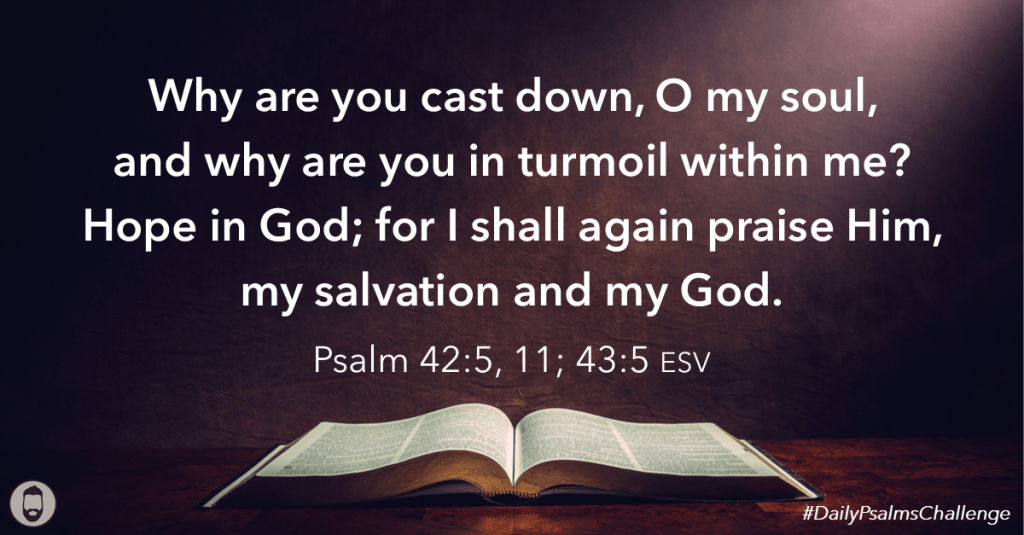
Why are you cast down, O my soul, and why are you in turmoil within me? Hope in God; for I shall again praise Him, my salvation and my God.
Psalm 42:5-6a, 11; 43:5
Psalm 42 and Psalm 43 are deeply connected, forming a single lament that expresses the struggle of a soul longing for God in the midst of despair.
Psalm 42 opens with vivid imagery: “As a deer pants for flowing streams, so pants my soul for you, O God” (v. 42:1). There is a beautiful hymn based on this image, but for those who are crying out to the Lord, it is often anything but beautiful. Picture a deer being hunted, running from a hunter or predator, panting and out of breath and seeking a cool stream to provide sustenance and relief. Such is the plight of the sons of Korah in these psalms. They are spiritually thirsty, longing for the presence of the living God (v. 42:2), yet instead of refreshment, they find themselves overwhelmed by sorrow, being fed by tears (v. 42:3) and haunted by the taunts of people mocking their faith by asking “Where is your God?” (vv. 42:3, 10)
This spiritual turmoil is compounded by distance from the place of worship or from the joy accompanying better times of leading God’s people in His praise and worship (v. 42:4). They remember what it was to joyously lead God’s people in worship at His tabernacle but now feel cut off and alone. The lament deepens as they describe being overwhelmed by waves of suffering, described a waves of the sea crashing over them (v. 42:7). Yet, even in their distress, they cling to this foundational truth: “By day the Lord commands His steadfast love, and at night His song is with me” (v. 42:8).
Psalm 43 continues their cry for deliverance, shifting from lament to pray to God for vindication. They plead for God to “send out [His] light and…truth” to lead them back to worship at His altar, where they may rejoice in Him again (vv. 43:3-4). But there is beautiful solace to be found in their refrain found in vv. 42:5, 11 and 43:5 that not only asks their own souls “why” they are “cast down” and “in turmoil” within themselves but points to the refreshment they know their panting souls will receive by saying, “Hope in God; for I shall again praise Him, my salvation and my God.”
This refrain teaches us the discipline of preaching the truth to ourselves in the face of despair. Instead of passively listening to their own troubled thoughts, they preach to their own souls, reminding themselves of who God is and where their hope must rest. This does not change their circumstances but points them to the God who provides hope in the midst of circumstances. He is faithful. He provides rest. He provides solace. He IS their hope.
Seeing Jesus in Psalms 42 & 43
These psalms find their fulfillment in Jesus, who fully experienced the anguish of a downcast soul. In the Garden of Gethsemane, Jesus echoed the sons of Korah when He said, “My soul is very sorrowful, even unto death” (Matthew 26:38). On the cross, He endured the mockery of His enemies jsut as they did (vv. 42:3, 10; Matthew 27:39-43). Yet, even in His suffering, Jesus fully entrusted Himself to His Father’s will and endured the full weight of God’s wrath against sin – our sin – that we might never be truly abandoned.
The sons of Korah longed for God’s presence, and through Jesus, that longing is ultimately fulfilled. Jesus Himself is the “light and truth” that leads us to God (v. 43:3; John 8:12, 14:6). He is Emmanuel, God with us, who will never leave nor forsake His people. And because of His resurrection and promised return, we can confidently hope in God, knowing that no matter our circumstances we too will “again praise Him” (v. 43:5).
Reflection
Can you identify with the sorrow and despair found in Psalms 42 and 43? If so, I hope you see the promise of hope and relief found in Jesus. He bore our shame and sin and adopts us into His family.
There is coming a day when the tears that flow ever so easily here in this fallen world will be wiped away for the last time by His nail-scarred hand when He comes to dwell with His people – where death will be nothing more than a fading memory – where there shall be no more “mourning, nor crying, nor pain anymore, for the former things have passed away” (Revelation 21:3-4).
In the meantime between that promise and its fulfillment, there is a lot of despair and downcast souls and pain and sorrow. There is a lot of panting for streams of relief. But, oh, there is so much hope to be found. May we not be left in the question of why our souls are downcast but let us preach the beautiful truth of the psalmists refrain: “Hope in God; for I shall again praise Him, my salvation and my God”!
Here’s a song inspired by Psalm 42:
The #dailyPSALMSchallenge gives us the opportunity to start 2025 in God’s Word by digging into a psalm a day. Each day will identify a key passage for us to meditate on as well as seeking to help us see Jesus in the psalm and reflect on what we have read.
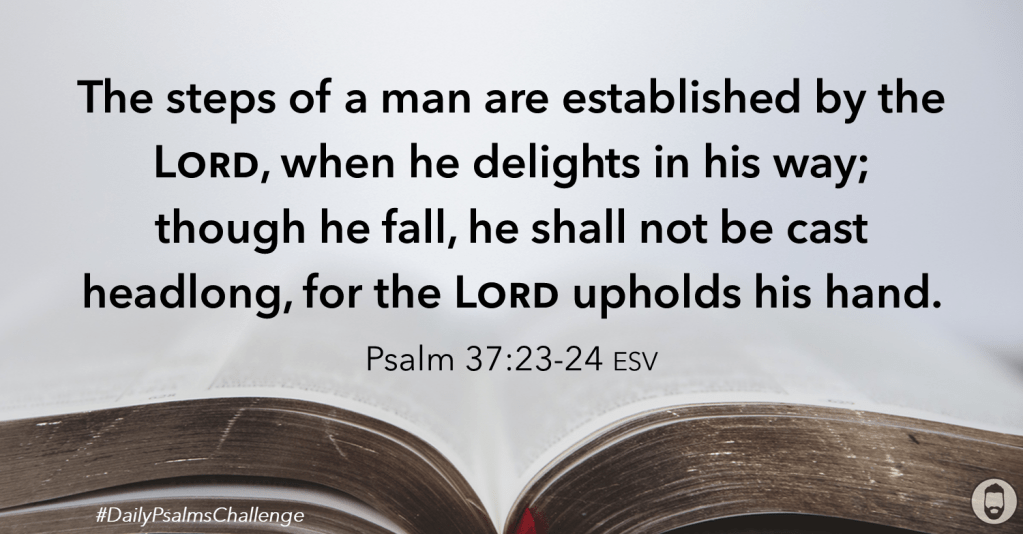
The steps of a man are established by the LORD, when he delights in his way; though he fall, he shall not be cast headlong, for the LORD upholds his hand.
Psalm 37:23-24
Psalm 37 is David’s wisdom-filed encouragement to God’s people who struggle when they see the wicked prosper while the righteous suffer. He urges believers to trust in God’s justice, wait on His timing, and pursue faithfulness rather than being envious or anxious about worldly success.
He begins with a direct command to “fret not yourself because of evildoers” (v. 1). When we see those who reject God thriving, it’s tempting to envy them or question God’s justice, but David reminds us that whatever success the wicked has is temporary as the wicked will “soon fade like the grass and wither like the green herb” (v. 2). In contrast, those who wait for the Lord will inherit the land (vv. 9, 11, 29).
Instead of worrying, believers are called to delight in the Lord (v. 4), trust in Him to do good (v. 3), and commit their ways to Him (v. 5). These are active faith responses that shape our desires and keep us aligned with God’s will. He never promised instant gratification, but He assures us that righteousness will be vindicated in His time (v. 6).
The second half of Psalm 37 emphasizes God’s care for His people: He upholds them (vv. 17, 24), He provides for them (vv. 19, 25-26), and He preserves them forever (v. 28). This shows us that God, in His justice, will ultimately remove the wicked and establish the righteous in their eternal inheritance with Him.
David’s final exhortation (a Bible word that is a mix of encouragement and warning) is for believers to wait for the Lord and keep His way (v. 34). Justice will come in His timing. The wicked may seem to be deeply rooted in the moment (v. 35), but in the end the wicked will pass away and be “no more” (v. 36). The future is reserved for those who trust in the Lord.
Seeing Jesus in Psalm 37
Jesus echoes this psalm in His Sermon on the Mount when He said, “Blessed are the meek, for they shall inherit the earth” (Matthew 5:5).
Jesus Himself was the perfect example of one who trusted His Father rather than fighting for (or against) worldly power. Though He suffered, God exalted Him (Philippians 2:6-11).
And through Jesus believers will receive an eternal inheritance – a greater “land” than David imagined (1 Peter 1:3-4).
Reflection
It is easy to be tempted to envy those who reject God because they seem to prosper, but Psalm 37 gives us a better, more eternal perspective. We need to ask ourselves a few questions to test whether our perspective is formed from earthly things or from the Word.
Do you truly delight in the Lord, or do your desires focus on temporary things?
What would it look like for you to trust, commit to, and wait on the Lord?
God is faithful. Learn to trust Him and rest in the beautiful truth that He has established your steps!
How precious is Your steadfast love, O God! The children of mankind take refuge in the shadow of Your wings.
Psalm 36:7
Psalm 36 presents a striking contrast between the wickedness of sinful man and the steadfast love of God. David opens the psalm with a sobering description of human sinfulness (which describes every one of us at some point). The wicked are deceived by their own arrogance (v. 2). Their words bring trouble and deceit (v.3). And they “do not reject evil” (v. 4).
What is at the root of all of this sin? David clarified that back in v. 1: “There is no fear of God before [the wicked’s] eyes”. Sin speaks to the hearts of the wicked because they do not fear the Lord and leads them further and further into wickedness and darkness.
But, in contrast to the darkness, the love of God shines brilliantly! David exalts God’s steadfast love, faithfulness, righteousness, and justice (vv. 5-6). These attributes of God are described in magnificently limitless terms in v. 5: “ Your steadfast love, O LORD, extends to the heavens, Your faithfulness to the clouds.” God’s righteousness is described as firm as mountain, and His judgments as deep as the oceans (v. 6).
This steadfast love is at the root of His covenant with His people, leading Him to offer abundant blessings to those who trust in Him. Those who trust in Him “feast on the abundance of [His] house” and drink deeply from “the river of [His] delights” (v. 8). This is a picture of deep satisfaction found only in relationship and refuge in the Lord. He Himself is the “fountain of life” (v. 9), the source of all true joy, meaning, and fulfillment.
David closes Psalm 36 with a prayer for God’s continued love and protection for His people (vv. 10-12). He asks that pride and wickedness – that he understood was a danger to his own sinsick heart – would not overtake him and that God’s enemies would ultimately fall.
This leaves all reading Psalm 36 with a clear choice: will we walk in the way of the wicked, or will we seek shelter under the wings of a loving God?
Seeing Jesus in Psalm 36
Jesus is not only the fulfillment of Psalm 36 but the perfect embodiment and demonstration of God’s steadfast love. The apostle John showed this clearly in 1 John 4:9-10 – that in Jesus the love of God is illustrated, illuminated, and literally embodied:
“In this the love of God was made manifest among us, that God sent His only Son into the world, so that we might live through Him. In this is love, not that we have loved God but that He loved us and sent His Son to be the propitiation of our sins.”
Not only does Jesus encapsulate the love of God, but He is the fullest expression of the way God’s love was shown throughout Psalm 36. He is the Good Shepherd (John 10:11), the Bread of Life (John 6:35), the Fountain of Living Water (John 7:37-38), and the Light of the World (John 8:12). It is in Jesus alone that we experience the inexhaustible and ever-present satisfaction that David spoke of in his deepest longings.
Refection
What David prayed for, we can know fully in Jesus. The world offers temporary pleasures, but Jesus not only embodies David’s longings but offers His fulfillment of them to all who trust in Him. That’s good news!
As you meditate on the beauty of God’s love in Christ, consider the following questions:
Do you recognize the voice of sin whispering in your own heart? How can you guard against it?
What does it mean to take refuge in God’s steadfast love? Where are you seeking satisfaction apart from Him?
The world offers fleeting joys, but true and lasting joy is found in His presence – presence that we can experience through His Spirit within us.
Run to Him.
Take refuge under His wings.
Rest in the promise of His never-stopping, never-failing, never-giving-up steadfast love.
Here’s a song inspired by Psalm 36:
The #dailyPSALMSchallenge gives us the opportunity to start 2025 in God’s Word by digging into a psalm a day. Each day will identify a key passage for us to meditate on as well as seeking to help us see Jesus in the psalm and reflect on what we have read.
Let those who delight in my righteousness shout for joy and be glad and say evermore, “Great is the LORD, who delights in the welfare of His servant!”
Psalm 35:27
Psalm 35 is a cry for justice and protection. David pleads with God to rise up as his defender against people who were seeking to destroy him. He begins with a desperate call on the Lord to “contend…with those who contend with [him]” and to “fight against those who fight against [him]” (v. 1). He is asking God to take up weapons of war on his behalf.
At the heart of the psalm is the reality of unjust and undeserved suffering. David is being pursued, falsely accused, and mistreated. His enemies are deceitful and malicious (v. 11), repaying the kindness he has shown them with hatred (v. 12). When they mourned, David mourned with them (v. 14), yet they now rejoice at his downfall (v. 15). This deeply distresses David, prompting him to call out and ask, “How long, O LORD, will You look on?” (v. 17). This is a question that everyone familiar with anguish and feelings of being abandoned in suffering has felt – and likely asked themselves.
Yet, Psalm 35 is not only pleading with God for justice – it is David declaring faith in God’s righteousness, knowing that God has not abandoned or forsaken him. David knows that God will be glorified “according to [His] righteousness” when He vindicates him (v. 24). This faith means that David does not have to take these matters into his own hands but entrusts his cause to the Lord, knowing that His justice and righteousness will prevail and leading David to end the psalm with joyful praise: “Great is the LORD, who delights in the welfare of His servant!” (v. 27). Neither his enemies nor his suffering will have the final word because God’s justice and goodness will triumph.
Seeing Jesus in Psalm 35
Jesus directly quoted Psalm 35:19 in John 15:25: “They hated me without a cause.” Like David, Jesus knew what it was to be falsely accused, mistreated, and hated – except for Jesus it wasn’t merely those He had mourned with but those He came to save.
David sought vindication and protection, but Jesus is greater than David. He prayed that those who were responsible for arresting, mocking, torturing, and even crucifying Him would be forgiven rather than condemned or taken out by God’s righteous wrath (Luke 23:34). Furthermore, Jesus bore the full weight of injustice on the cross so that all who trust in Him – including those who were formerly His enemies (Romans 5:10) – might be saved through Him. And yet, as David prayed, Jesus will return as the righteous Judge who will one day set all things – all injustice and wrongdoing – right (Revelation 19:11-16).
Reflection
If you are reading this and feel as David did in the beginning of Psalm 35 – that God might not see his trials and suffering, know this: God sees your pain. He fights for His people. And His righteousness will win out.
He exhibits this clearly in His care for His people throughout the ages. You can trust Him. You can take refuge in Him. When you put your trust in Him, you can truly cry out as David did: “Great is the LORD, who delights in the welfare of His servant!”
The #dailyPSALMSchallenge gives us the opportunity to start 2025 in God’s Word by digging into a psalm a day. Each day will identify a key passage for us to meditate on as well as seeking to help us see Jesus in the psalm and reflect on what we have read.
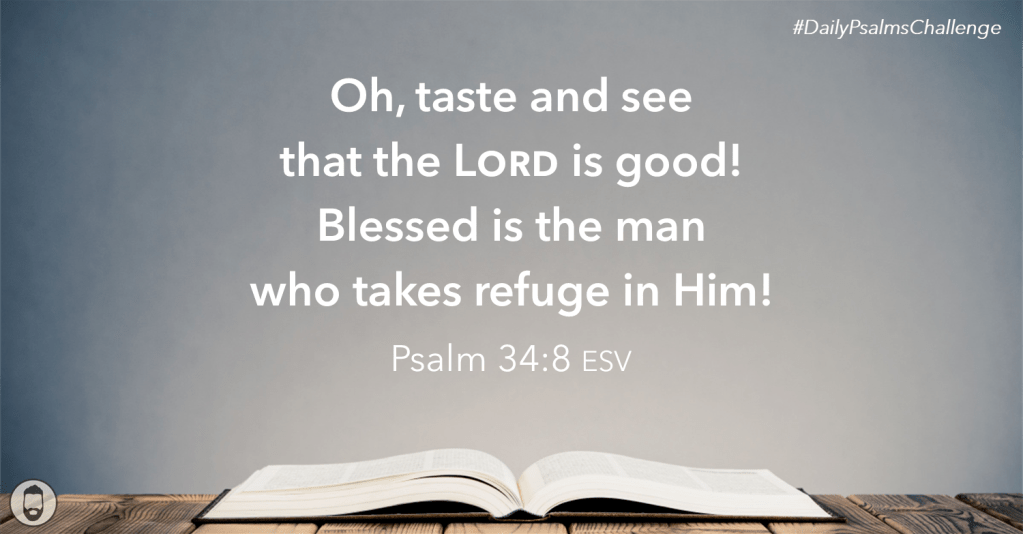
Oh, taste and see that the LORD is good! Blessed is the man who takes refuge in Him!
Psalm 34:8
Psalm 34 is an invitation for joyful trust in the Lord. This psalm was written by David after God delivered him from the king of Gath in 1 Samuel 21:10-15 when he, as the inscription says “changed his behavior”, pretended to be out of his mind (1 Samuel 21:13). These events obviously had a profound impact on David’s life as the result is this overflow of his gratitude and praise.
David begins with a commitment to continual worship: “I will bless the Lord at all times; His praise shall continually be in my mouth” (v. 1). He doesn’t stop at his own personal prayer, though; he calls others to join him and “magnify the Lord” with him and “exalt” the name of the Lord “together” (v. 3). Worship is meant to be shared communally, and our joy in God is deepened when we proclaim His goodness with others who have experienced it firsthand.
David shares his testimony from that event: “I sought the Lord, and He answered me and delivered me from all my fears” (v. 4). God’s faithfulness is not theoretical for him but proven by his experience with God. It is also proven in David’s life as he says that those who trust the Lord “are radiant” (v. 5), reflecting His light and joy even in the midst of difficult circumstances.
One of the most well-known verses comes next in this psalm (v. 8): “Oh, taste and see that the Lord is good!” This is more than an intellectual acknowledgment of God’s goodness but a call to come and experience it firsthand. Just as tasting food gives direct knowledge of its flavor, trusting the Lord allows us to personally experience His faithfulness and provision.
Speaking of firsthand experience, David confidently assures us that those who fear the Lord will lack nothing they truly need (vv. 9-10). Fear of the Lord is a common theme in Scripture and means having a reverence for Him, obeying Him, and trusting in His wisdom and care over our own. God is trustworthy. He watches over His people and hears their cries (v. 15), being “near to the brokenhearted” and saving “the crushed in spirit” (v. 18). Even and especially in affliction, God is present and faithful in “the afflictions of the righteous” and “delivers” them “out of them all” (v. 19).
Psalm 34 concludes with the reminder that God is His people’s redeemer (v. 22). None – not a single one – of “those who take refuge in Him will be condemned (v. 22). That’s good news for those who take refuge in Him.
Seeing Jesus in Psalm 34
Psalm 34 finds its ultimate fulfillment in Jesus, the One who fully tasted human suffering, yet remained without sin (Hebrews 4:15). John applies v. 20 (“He keeps all His bones; not one of them is broken”) to Jesus on the cross, showing Him as the righteous One who suffered on our behalf.
Furthermore, part of tasting and seeing that the Lord is good for those who are saved is knowing that no one who takes refuge in Jesus Christ, our Redeemer, will face condemnation (Romans 8:1). That’s good news!
Reflection
Have you personally tasted and seen the goodness of God in your life?
How have you been delivered from trials and suffering by the mighty hand of God?
Let Psalm 34 be an encouragement for you to experience the goodness of God firsthand. Take refuge in Him. Trust Him. Find comfort in His goodness and care.
The #dailyPSALMSchallenge gives us the opportunity to start 2025 in God’s Word by digging into a psalm a day. Each day will identify a key passage for us to meditate on as well as seeking to help us see Jesus in the psalm and reflect on what we have read.
The LORD is my light and my salvation; whom shall I fear? The LORD is the stronghold of my life; of whom shall I be afraid?
Psalm 27:1
Psalm 27 reflects confident trust in the Lord, even in the face of fear, opposition, and uncertainty. David declares that God is his light, salvation, and stronghold, assuring him ultimate safety and peace. This psalm is a beautiful and powerful tapestry of praise, prayer, and hope.
David begins by proclaiming unshakable confidence in God (vv. 1-3). He asks twice, “whom shall I fear?” (v. 1). He describes God as his light and salvation but also as his stronghold – a fortress in whom he can find refuge when his enemies rise up against him. He trusts God to protect him as well as causing his enemies to stumble and fall.
David’s heart’s desire is revealed in v. 4: “One thing I have asked of the Lord…that I may dwell in the house of the Lord all the days of my life.” He longs for uninterrupted communion with God – eternally dwelling with him rather than seeking temporary shelter. For him, being in God’s presence – gazing upon His beauty and inquiring of His temple – is the ultimate source of joy and security.
David rejoices in the protective care of God who hides him in His shelter and also lifts him high upon a rock (vv. 5-6). David’s response to God’s care is to praise Him with shouts of joy and songs.
In vv. 7-12, the psalm takes an intimate turn as David cries out to God for continued grace and deliverance. He pleads with Him not to hide His face or abandon Him, expressing a deep dependence on God as his help and salvation. Even when forsaken by all others, David has confidence that “The Lord will take [him] in” (v. 10).
Psalm 27 concludes with a bold statement and encouragement to wait on the Lord: “I believe that I shall look upon the goodness of the Lord in the land of the living!” (v. 13). The way the KJV translates v. 13 is helpful: “I had fainted, unless I had believed to see the goodness of the Lord in the land of the living”, meaning that David knew that he would have despaired and been hopeless without his belief and faith in God, faith that knew and trusted that he would see God’s goodness in the world and not as something he would have to wait on in heaven. Because of that he could encourage people to “Wait for the Lord; be strong, and let your heart take courage” (v. 14).
Seeing Jesus in Psalm 27
Psalm 27 points to Jesus as the ultimate fulfillment of David’s longing for light, salvation, and communion with God. Jesus declared that He was “the Light of the World” (John 8:12). He is the true light who dispels the darkness of sin and death, bringing salvation to all who believe in Him. Jesus is also our stronghold, the One who secures our place in the presence of God. Through His death and resurrection, He opened the way to His heavenly sanctuary, where we can dwell with God forever (Hebrews 10:19-22).
David’s desire to “dwell in the house of the Lord” (v. 4) finds its fulfillment in Jesus, who enables believers to experience God’s presence through His Holy Spirit. In eternity, we will gaze upon the beauty of the Lord and worship Him face-to-face (Revelation 22:4).
When David cries, “My father and my mother have forsaken me, but the Lord will take me in” (v. 10), we are reminded of Jesus’s promise to never leave or forsake His people (Matthew 28:20, Hebrews 13:5). He is the faithful Savior who sustains us through every trial and assures us of eternal life in His presence.
Reflection
Psalm 27 invites us to trust God in every circumstance, finding confidence, joy, and peace in His presence. Consider the following questions to help you reflect on what you’ve read.
How can you remind yourself of God’s light and salvation in times of fear and certainty?
Do you, like David, have a desire to dwell in the presence of God? What steps can you take to cultivate this desire?
In what ways has God demonstrated His faithfulness to you, even when others have let you down?
Take time today to praise God for being your light and salvation. Ask Him to increase your confidence in His care and help you wait patiently for His perfect will to unfold. Let the truth of this psalm strengthen your heart and encourage your soul as you continue to trust in Him!
The #dailyPSALMSchallenge gives us the opportunity to start 2025 in God’s Word by digging into a psalm a day. Each day will identify a key passage for us to meditate on as well as seeking to help us see Jesus in the psalm and reflect on what we have read.






 Just Keith Harris