We are glad to get to offer free water, but we want to share something much better that will last much longer. We offer the good news that Jesus saves!
This might produce a few questions. Why Jesus? Saves from what? These are good, valid questions.
What It Means to Be Saved
Imagine someone swimming who has gone out over their head and is drowning. They cry out for a lifeguard to help. Thankfully, the lifeguard hears them and is able to rush to their rescue, pulling them to safety on the shore. That person has been saved from drowning.
This could also apply to someone who has been stuck in a burning building and fallen unconscious from inhaling all the smoke. Firefighters are called to the building and discover them. The firefighter picks up this totally helpless individual, carries them out of the building, and gets them to the paramedics. The firefighter and paramedics have saved this person from certain death.
In the same way, God provided Jesus to save or rescue every sinner who puts their trust in Him. No matter what we have done or who we are, Jesus can save us. Through Jesus, we find salvation by and eternal life by putting our faith and trust in Him.
The Bible describes this in John 3:16 –
“For God so loved the world, that He gave His only Son, that whoever believes in Him should not perish but have eternal life.”
Why We NEED to Be Saved
You might be thinking: well, it makes sense for someone drowning or trapped in a burning building to need to be saved, but what about me?
The Bible teaches us that all of us have sinned. Sin is an archery term that describes missing the bullseye. The bullseye is perfection and goodness. We might try to do right and good, but we fail at that. God is right and good, and our missing the mark or failing in this way separates us from Him.
Romans 6:23 tells us that the “wages of sin is death”. This means that our sin has earned us death and that there is nothing we can do to earn our way out of it. Thankfully, that is not the end of Romans 6:23; check out the full verse: “For the wages of sin is death, but the free gift of God is eternal life in Christ Jesus our Lord.” God has made a way for us! Just as John 3:16 tells us above, Jesus paid the penalty for our sin. He died in our place and offers us life instead. That’s good news!
How You Can Be Saved
The only way for us to be saved is to turn from our sins (and the punishment we deserve because of them) to Jesus and put our faith and trust in Him. We turn from our sin because we realize that we are in trouble and deserve death because of them. We turn to Jesus because we realize that, just like the person who was drowning or trapped in the burning building, we cannot save ourselves.
To put our faith and trust in Him means that we believe that Jesus fully paid the penalty for our sins and offers us forgiveness. The Bible teaches us that Jesus “Himself bore our sins in His body on the tree (the cross)” (1 Peter 2:24). Here is how the Bible tells us we can be saved:
“if you confess with your mouth that Jesus is Lord and believe in your heart that God raised Him from the dead, you will be saved. For with the heart one believes and is justified, and with the mouth one confesses and is saved.” (Romans 10:9-10)
This is what it means when we say put our faith and trust in Jesus; we confess Him as Lord and give our lives over to Him, trusting that He knows best and acknowledge He is God, asking Him to take charge of our lives. We tell Him that we believe He is who the Bible says He is: the Savior who died for our sins and rose again. If we do this, not just saying some magic words but genuinely believing and seeking Him, the Bible tells us that we are saved!
We would love to pray with you and help you if you have any questions, and especially to help you find a church where you live. If you would like to contact us, use the form below:
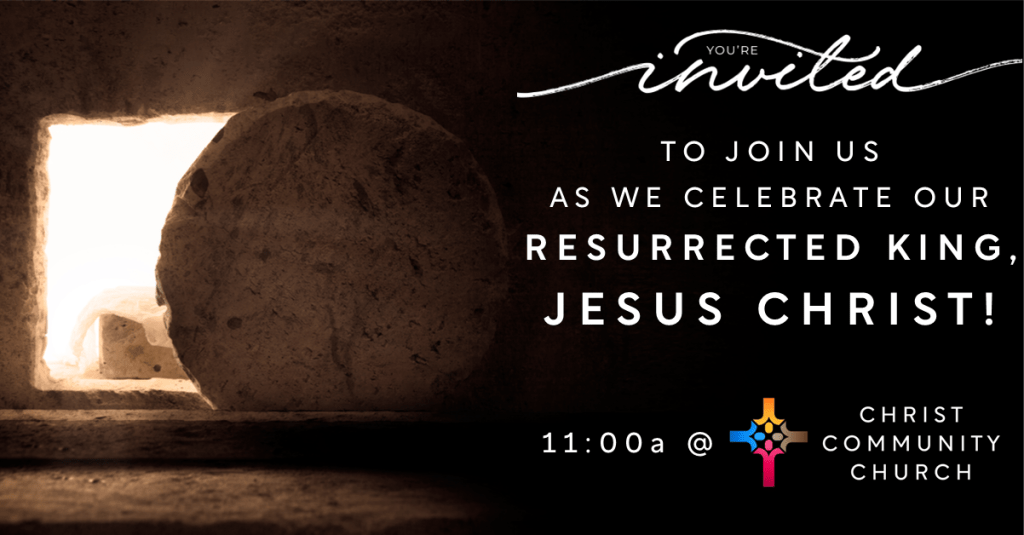
Tomorrow is Sunday — RESURRECTION SUNDAY, and I am excited.
Sometimes, there can be a temptation to try and make holiday Sundays bigger, brighter, and, well, just to try and make it seem special by pulling out all the stops. As John said last week, we celebrate Resurrection Sunday every Sunday because our hope comes from Jesus’s resurrection — dead Saviors can’t save!
Every god or holy man or people who put themselves out there to say they are saviors either has or will die. Muhammed is dead. Buddha is dead. All of the false prophets who have claimed to be the messiah, both before and after Jesus, have died or will die. This isn’t an attack on other religions; it’s a clarification that religion can’t save because their founders don’t last. Jesus is something else entirely.
No, at Christ Community tomorrow, we are going to do our best to do what we always strive do: point people to Jesus!
Look at how Paul pointed the church at Corinth to Jesus in 1 Corinthians 15 — a chapter that beautifully proclaims the gospel and the importance of Jesus’s resurrection:
Now I would remind you, brothers, of the gospel I preached to you, which you received, in which you stand, and by which you are being saved, if you hold fast to the word I preached to you — unless you believed in vain. For I delivered to you as of first importance what I also received: that Christ died for our sins in accordance with the Scriptures, that He was buried, that He was raised on the third day in accordance with the Scriptures….
1 Corinthians 15:3-4
Look at the language Paul used there to highlight the importance:
1. He wanted them to be reminded of the gospel (good news) that he had preached to them regarding Jesus and for them to hold fast to that truth (2 Timothy 1:13-14, Jude 3). Putting one’s faith in Jesus is not a one-time-thing but something that believers need to continually do. We trust in Him for salvation, but we continually trust in Him to continue to carry us (Hebrews 10:38-39). Those who believed were saved from the wrath of God toward sin, but as Paul says here, were “being saved” continually by their resurrected — their living — Savior who cares for them (Romans 5:9-10, 1 Corinthians 1:18)!
2. He made sure they knew that what he was preaching was “in accordance with the Scriptures” — something he says twice in v. 4. The gospel of Jesus Christ is not something that popped up new after he lived and died. His death, burial, and resurrection were foretold by the God’s prophets throughout the Old Testament (Luke 24:25-27). The gospel was not something new for someone like Paul who had studied it his whole life; no, it was the fulfillment of all he had studied (Acts 17:2-3).
2. He preached that gospel to them again: “Christ died for our sins in accordance with the Scriptures, …He was buried, …He was raised on the third day in accordance with the Scriptures”. The gospel he preached came from the Scriptures and was all about Jesus, who He is and all He had done and is doing (Acts 26:22-23).
3. He understood that the gospel is of “first importance” because that is what he “also received”. This is not a hypothetical gospel for Paul. Jesus is his hope as well (John 12:32, Romans 15:13, 1 Peter 1:3). His Ph.D. in Judaism wasn’t going to save him. The warrant given to him by when he was Saul of Tarsus the Jerusalem elite to arrest and imprison Christians wasn’t going to save him. His claims as a “Hebrew of Hebrews” and a “Pharisee” weren’t going to save him (Philippians 3:4). No, Paul knew that all of his hope was in Jesus, the same Jesus whom he had previously persecuted, and because Jesus had saved him, he understood that everything that came before was “rubbish” unable to be compared to the “surpassing worth of knowing Christ Jesus” as Lord (Philippians 3:7-8).
Tomorrow, we have the privilege, just as we do every Sunday, to remind ourselves and others of the good news of Jesus Christ and get to share His gospel through preaching, reading the Word, and singing in praise and worship of our resurrected King (Colossians 3:16-17). We will lift Him up “as of first importance” because we know that if we had not “also received” Him, we would have no hope.
Dead saviors can’t save, but our God is not dead — “He is risen as He said” (Matthew 28:6).
Won’t you gather with us as we worship Him?
Here are our Scriptures and songs:
Song | Ain’t No Grave — Scripture Inspiration: John 8:34, Romans 6:6, 1 John 4:8, 1 Chronicles 28:20, 1 Corinthians 15:20-26, 1 Corinthians 15:50-56, John 8:44, 1 Peter 5:8, Revelation 12:9, Genesis 3:15, Ephesians 6:11-18, Isaiah 25:8, Hosea 13:14, 2 Timothy 1:10, Hebrews 2:14, Revelation 5:5, 1 Corinthians 15:3-8
Scripture | 1 Corinthians 15:50-57 —
50I tell you this, brothers: flesh and blood cannot inherit the Kingdom of God, nor does the perishable inherit the imperishable. 51Behold! I tell you a mystery. We shall not all sleep, but we shall all be changed, 52in a moment, in the twinkling of an eye, at the last trumpet. For the trumpet will sound, and the dead will be raised imperishable, and we shall be changed. 53For this perishable body must put on the imperishable, and this mortal body must put on immortality. 54When the perishable puts on the imperishable, and the mortal puts on immortality, then shall come to pass the saying that is written:
“Death is swallowed up in victory.” 55“O death, where is your victory? O death, where is your sting?”
56The sting of death is sin, and the power of sin is the law. 57But thanks be to God, who gives us the victory through our Lord Jesus Christ.
Song | Graves Into Gardens — Scripture Inspiration: Psalm 34:10, Isaiah 55:1-3, Psalm 53:1-3, Luke 15:11-24, Romans 6:23, John 6:26-35, Revelation 7:13-17, Matthew 11:28-30, 1 John 4:8, Psalm 51:10, Jeremiah 24:7, Ezekiel 36:26, Romans 12:2, Psalm 37:4, Exodus 8:10, Deuteronomy 3:24, Jeremiah 10:6, 1 Samuel 2:2, Isaiah 40:18, Romans 5:6-8, Psalm 138:8-9, 1 Kings 8:39, 1 John 3:20, John 15:15, Psalm 139:7-12, Hebrews 4:13, Psalm 30:11, Isaiah 62:2, Galatians 2:19-20, John 14:6, 1 Corinthians 15:20-49, Ezekiel 37:1-14, Exodus 14:1-31
Song | Thank You Jesus for the Blood — Scripture Inspiration: Deuteronomy 6:5, Lamentations 3:22-23, Isaiah 64:8, Psalm 139:16, Deuteronomy 6:7, Psalm 113:3, 2 Timothy 2:13, Psalm 27:13, Psalm 31:19, Psalm 145:9, Psalm 150:6, Psalm 107:1, 1 Kings 19:11-12, Hebrews 1:3, Isaiah 43:1-3, Jeremiah 23:23-24, John 15:14-15, Psalm 23:6, Luke 9:23-24
Scripture | 1 Peter 1:3-5 —
3Blessed be the God and Father of our Lord Jesus Christ! According to His great mercy, He has caused us to be born again to a living hope through the resurrection of Jesus Christ from the dead, 4to an inheritance that is imperishable, undefiled, and unfading, kept in heaven for you, 5who by God’s power are being guarded through faith for a salvation ready to be revealed in the last time.
Song | Living Hope — Scripture Inspiration: Acts 4:8-12, 1 Corinthians 15:3-11, 1 Peter 1:3, Philippians 2:5-8, 2 Corinthians 5:21, Hebrews 9:22, John 1:12-13, Hebrews 9:15, John 8:36, 1 Corinthians 15:54-57, Galatians 5:1, Psalm 107:14-15, John 14:6, Acts 3:15, Revelation 5:5, 1 Peter 1:4-5
Song | Because He Lives — Scripture Inspiration: John 3:16, Isaiah 25:8, Hosea 13:14, 1 Corinthians 15:24-26, 1 Corinthians 15:55-57, 2 Timothy 1:10, Hebrews 2:14, Psalm 28:7-8, Isaiah 40:29-31, 2 Corinthians 12:9-10, John 14:25-27, Romans 8:38-39, 1 Peter 5:6-7, Jeremiah 29:11, Ephesians 2:10, Galatians 2:20, Philippians 4:6-7, Revelation 21:4, 1 Corinthians 11:26
Invitation | In Christ Alone —
Offertory | Yet Not I But Christ in Me — Scripture Inspiration: Genesis 15:6, Psalm 32:1-2, Romans 3:21-24, Romans 5:6-10, Ephesians 2:4-9, Titus 2:11, Isaiah 9:6, Luke 1:26-38, Matthew 1:18-255, John 3:15-16, 1 Thessalonians 1:6, Hebrews 12:2, 2 Corinthians 5:21, Psalm 119:45, Romans 8:1-4, Psalm 17:7, Psalm 36:5-7, Titus 3:4, 1 John 4:8, John 14:27, Romans 5:1, Ephesians 2:14-15, Acts 4:10-12, John 14:6, Galatians 2:20, Romans 8:9-11, Galatians 4:6, Psalm 107:10-16, Psalm 118:7, Hebrews 13:5-6, 2 Corinthians 12:9, John 10:11-18, 2 Samuel 22:3-4, Nahum 1:7, 1 John 5:18, Psalm 23:4, Matthew 20:28, John 1:29, Acts 20:28, Colossians 2:14, Titus 2:14, 1 Peter 1:17-21, 1 John 2:1-2, Revelation 5:9-13, Acts 4:33, 1 Corinthians 15:55-57, Hebrews 2:14, Revelation 21:3-4, Hebrews 13:6, Psalm 116:16, Romans 6:20, Galatians 5:1, Luke 21:33, Revelation 6:14, Psalm 51:10, Ezekiel 36:26, 2 Corinthians 5:17, Philippians 1:9-11, John 10:30
Nearly 2,000 years ago on that Sunday — the first day of the week before Passover, Jesus rode into Jerusalem on a colt to cries of “Hosanna!” (Matthew 21:9, Mark 11:10, John 12:13) and “Blessed is the King who comes in the name of the Lord!” (Luke 19:38)
Over the past few weeks at Christ Community, we have been singing songs that mirror those cries, hoping to help us see Jesus as who He is — the King of kings, Emmanuel, our God who has come and is coming again. We lifted our voices together singing “O Come, O Come, Emmanuel”, yearning for Jesus to return. We lifted our voices together singing the words of the songs from Revelation 4, 5 and 7, wanting to sing the songs of Heaven dedicated to the Lion of the tribe of Judah, the Lamb standing on the throne as though slain. And tomorrow, Lord willing, we will sing songs that mirror the cries heard along the streets of Jerusalem when the King came to town — as we also sing songs that look forward to the end of that week when Jesus was crucified and the beginning of the next when He rose from the grave!
One of the things I love about being able to sing these songs is that they are not merely commemorative. They are not icons pointing to a merely historic moment. They are not idols to a dead god. No, our God is alive and well — death could not keep Him! We sing these songs, and they are prophetic because Jesus has done all He promised and will coming again as He promised. We can sing “Hosanna!” (save us, O Lord — we praise You, O Lord) with the knowledge that He hears our praises just as He did the voices of those on that Jerusalem street! We can sing “Blessed is the King who comes in the name of the Lord!” because He is coming in the name of the Lord again!
These are not idle words (or idol words). Jesus IS King. Jesus IS alive. Jesus REALLY saves. He REALLY lives. All of this REALLY does MATTER!
Last week fired me up for Palm Sunday in a way I had not considered. Again, what we do in worship is not merely commemorative — it is active and prophetic and a present offer of praise to “our blessed hope…our great God and Savior Jesus Christ” (Titus 2:13)! You see, last week we lifted our voices together and read about a time when palm branches will be lifted in worship of the King (Revelation 7:9-12). 2,000 years ago, some of those voices lining the streets were sure to be some who also cried “Crucify Him!” a few days later. These voices in Revelation 7 will be those who have had their cries of “Hosanna!”, their cries for the Lord to save them and praising His name, those cries will have been answered. No, this lifting of palms will be from an uncountable “great multitude” of people saved by grace through faith in Jesus “from every nation, from all tribes and peoples and languages”; they will be standing “before the throne” — standing “before the Lamb”! And with palm branches in their hands and white robes on their bodies, they will cry out at the top of their voices, “Salvation belongs to our God who sits on the throne, and to the Lamb!”
Let’s do that tomorrow!
Let’s gather in worship of the Lamb!
Let’s gather in anticipation of the coming of the King!
Let’s lift our voices and declare to our God who saves that He is worthy and acknowledge that salvation comes from Him alone!
Let’s gather and singing “Hosanna!” and “Blessed is the King who comes in the name of the Lord!”
Let’s sit under the teaching of His Word and have His Spirit move our hearts to worship Him all of our days and not just for an hour or so on Sunday.
Let’s proclaim to the world that we have a God that death could not keep down and that He offers life to all who call upon Him and confess Him as Lord!
Won’t you gather with us?
Here are our Scriptures and songs:
Scripture | Luke 19:28-40 —
28And when He had said these things, He went on ahead, going up to Jerusalem. 29When He drew near to Bethphage and Bethany, at the mount that is called Olivet, He sent two of His disciples 30saying, “Go into the village in front of you, where on entering you will find a colt tied, on which no one has ever yet sat. Untie it and bring it here. 31If anyone asks you, ‘Why are you untying it?’ you shall say this: ‘The Lord has need of it.'” 32So those who were sent went away and found it just as He had told them. 33And as they were untying the colt, its owners said to them, “Why are you untying the colt?” 34And they said, “The Lord has need of it.” 35And they brought it to Jesus, throwing their cloaks on the colt, they set Jesus on it. 36And as He rode along, they spread their cloaks on the road. 37As He was drawing near — already on the way down the Mount of Olives — the whole multitude of His disciples began to rejoice and praise God with a loud voice for all the mighty works that they had seen, 38saying, “Blessed is the King who comes in the name of the Lord! Peace in heaven and glory in the highest!” 39And some of the Pharisees in the crowd said to Him, “Teacher, rebuke your disciples.” 40He answered, “I tell you, if these were silent, the very stones would cry out.”
37″O Jerusalem, Jerusalem, the city that kills the prophets and stones those who are sent to it! How often would I have gathered your children together as a hen gathers her brood under her wings, and you were not willing! 38See, your house is left to you desolate. 39For I tell you, you will not see me again, until you say, ‘Blessed is He who comes in the name of the Lord.'”
Scripture | Psalm 118:25-26 —
25Save us, we pray, O LORD! O LORD, we pray, give us success!
26Blessed is He who comes in the name of the LORD! We bless you from the house of the LORD!
1 In those days a decree went out from Caesar Augustus that all the world should be registered. 2 This was the first registration when Quirinius was governor of Syria. 3 And all went to be registered, each to his own town. 4 And Joseph also went up from Galilee, from the town of Nazareth, to Judea, to the city of David, which is called Bethlehem, because he was of the house and lineage of David, 5 to be registered with Mary, his betrothed, who was with child. 6 And while they were there, the time came for her to give birth. 7 And she gave birth to her firstborn son and wrapped him in swaddling cloths and laid him in a manger, because there was no place for them in the inn.
8 And in the same region there were shepherds out in the field, keeping watch over their flock by night. 9 And an angel of the Lord appeared to them, and the glory of the Lord shone around them, and they were filled with great fear. 10 And the angel said to them, “Fear not, for behold, I bring you good news of great joy that will be for all the people. 11 For unto you is born this day in the city of David a Savior, who is Christ the Lord. 12 And this will be a sign for you: you will find a baby wrapped in swaddling cloths and lying in a manger.”[1]
Luke 2:1-12
Merry Christmas, Sojourners!
Here we are just a few days before Christmas, and I find myself thinking on the scene into which God became flesh (John 1:14) and the happenings of the world during that time. If you will forgive the pun, it really was a Dickens of a time – the best of times and the worst of times. From a worldly perspective, Israel was in a tight spot, feeling the pressure of the Roman Empire bearing down on it.
A few centuries after being ruled by a foreign king in their own exile they found themselves ruled by one who seemed a world away. Those centuries between Babylon and the Roman Empire (with the Greeks whooping up on them somewhere in the middle) were silent in the sense that there was no “Thus saith the Lord” from a prophet. Even bad news or warning would be a comfort over silence. Their lives were loud with cries of help and hope in the coming Messiah, but God was silent – purposefully so. He had said all He needed to say. Messiah was coming. The Promised One was going to come and save His people. But in the meantime, there was waiting. And there was silence.
How do you do in silence and waiting? I am sure that there have been times in your life, just like in mine and in all the people I know, when trouble and trials and tribulations and terror have besieged you. Your world felt small and scary. Hope for the future was dim. And in waiting for help that seemed never to come, the silence and the waiting was rough.
Depending on the trouble you faced, there are those who would step in and want you to believe they are coming for your aid but are really coming to take advantage of you. There are other promises that, while they are not necessarily coming to take advantage of you are not working for your good, also try and convince you help is on the way. All you have to do is turn on your television and every other commercial is for a class action lawsuit going after big ___ to help people – you or your loved ones, they say – get help from their oppressors or benefits from whatever may have caused their unfortunate situation. If you flip to one of the news networks, you have political pundits representing both ends of the spectrum against the middle who are promising that their candidate is what is best, and the other is the oppressor. If your phone rings, it is likely that the person on the other end is offering you some kind of help if you pay money or bring a gift card to a certain location or offering to extend your car’s extended warranty for a nominal fee. Maybe you are in debt and people are promising rescue if you just turn your finances over to them. Or flip on over to the religious programming – labeled “Christian” oftentimes, and you can give a faith donation to support the starving millionaire “pastor” in his attempt to usher in the end times and mail you a prayer handkerchief that will heal you or save you.
Does any of this sound familiar?
Aside from television and modern situations, this is similar to what God’s people were hearing during that period of silence. Never mind that He had told them Messiah would come. He prophesied their deliverance. Their present circumstances, however, made listening to the other voices seem necessary. And those voices sounded so good, especially when the distant emperor proclaimed that his birth and existence were the beginning of good news for the world[2] and that he Himself was a son of Zeus come to be the savior of Rome and its empire[3].
In the absence of the promised Messiah amid divine silence, the turmoil of the times can make it easy to believe that there is help from somewhere else – even if that somewhere else is the Rome that is crushing the life out of your people and your homeland.
So, today, I want us to look at a tale of two Saviors – well, really the tale of the only Savior despite all the fake and the foolish that proclaim themselves to be Him.
Caesar Augustus and the Not-So-Good News (vv. 1-5)
Most of the time that I have spent looking at and studying the beginning of Luke 2 has been focused on trying to determine the real birth date of Jesus. Spoiler alert: it cannot be definitely known[4]. I am not a huge fan of history, but I do not want to be doomed to repeat it. Most of the history I, willingly, study is biblical and church history. Christianity is, after all, a historical religion not based on the present but on the God who has always been and all He has done in and for all that He created. Having said all that, I do not want this to seem like a history lesson. I want us to see the fingerprint of the one who proclaimed himself savior and lied about it: Caesar Augustus.
Caesar Augustus’s role in the story of Jesus began on the ides of March – remember Shakespeare’s Julius Caesar? Et tu, Brute? Anyone? Long story short, he – originally known as Octavian – was the nephew and only heir to Julius Caesar. When Roman senators conspired and murdered Julius Caesar (44BC), Octavian and Julius Caesar’s right-hand-man Mark Antony joined forces and waged a brutal civil war from Rome all the way to Philippi where they finally avenged Caesar’s death and, well, murdered his murderers in 42BC. Octavian rose to greater power and eventually turned on his ally Mark Antony and Cleopatra, defeating them in 31BC. Around thirty years later, all those events put Caesar Augustus in a position for God to move him about and use him to set the stage for His entrance into the world.
One thing that people who amass great wealth and power cannot help but do is counting and logging all they have. Such was the case with Caesar Augustus. He decreed that a census be taken throughout “all the world” (Luke 2:1). At his mere command, every household throughout the Roman Empire was immediately upturned. They had to return to their hometowns to be registered (Luke 2:3). Think of the power that displays: entire regions and people groups dropped everything at his command.
But what of his promises of his birth heralding the beginning of good news? What of his promises that he was born of Zeus and would be the savior of the world? Well, Caesar Augustus died in AD14. He is still dead today. Rome was not saved or safe under his rule. In fact, the Roman Empire is dead, too. The proof is in the pudding, or in the prophecy in this case. Caesar promised people peace and prosperity and got all the peace and prosperity he had himself by squeezing it out of the lands conquered and kept conquered throughout his empire. Yes, he could get them to move about at the drop of a hat, but once he dropped dead, he dropped out of the position of savior.
Looking at how God used him to move things about is cool, though. Jesus was prophesied to be born in Bethlehem (Micah 5:2), and Joseph’s hometown was Bethlehem. In a way, Caesar Augustus was right about one thing: good news began at his birth. God set things into motion through his life that inaugurated the coming of the Messiah. Now, that is the good news.
Jesus and the Good News of Great Joy (vv. 6-12)
Augustus was boastful and proud. He inherited a kingdom and made it his own. He built it up in his mind that the entire world belonged to him. But to whom did Augustus belong?
Jesus’s humble birth is the opposite of Augustus in nearly every way. Augustus was loud and boastful, proclaiming truths after his own birth to make it seem of consequence. Jesus’s birth was humble and quiet, fulfilling prophesies made all the way back to the beginning (Genesis 3:15). Jesus’s birth was heralded from the heavens (Luke 2:9-14). Jesus was God – God made flesh and dwelling among men to be the true Savior of the world (John 1:1, 14; Matthew 1:21; John 4:42).
Think about the difference this makes. Jesus did not lie about His father being divine and sending Him to rule and conquer. No, God became flesh and dwelt among us. He laid aside His throne and humbled Himself to become a man, lived a sinless life despite facing all the same temptations we face (Hebrews 4:15), and He died the death we deserve on the cross due to our sinfulness (Romans 6:23, 2 Corinthians 5:21). No one would make up that story. No one wanted to trade lives with Jesus. No palace, no riches, no fame. But, oh, what a King He is!
Jesus’s good news was better that Augustus’s, too. Augustus merely said his birth was the beginning of the good news. He merely heralded himself and proclaimed his own greatness. No one had to agree. No one would have believed it anyway. Rest assured that those who had been conquered did not recognize him as good news any more than they did Nebuchadnezzar and the Babylonians. Augustus was worthy to be feared, but Jesus is worthy of our faith. The angels proclaimed this to the shepherds in the field that night and to us today. We do not have to fear because “behold” there is “good news of great joy that will be for all people”; that “unto you is born this day in the city of David a Savior, who is Christ the Lord” (Luke 2:10-11). Good news. Of great joy. For all people. The Savior is born. The Messiah has come.
The truth of the prophecies of old were coming true. Light was shining into the darkness (Isaiah 9:2, John 1:4-5). Joy had come because there was One greater than Augustus, greater than the Greeks, greater than the Medes and Persians, greater than the Babylonians (Isaiah 9:3). Rather than oppressing, He was lifting up (Isaiah 9:4, Matthew 11:28-30). He was bringing peace through His finished work and retiring the weapons of His adversaries (Isaiah 9:5, Colossians 1:19-20). He was born, swaddled, and lying in a manger, but He did not stay in that manger. He grew up. He lived. He loved. He lifted the downtrodden, healed the sick, touched the untouchable, saved the most wicked of sinners, and died for them all. And everyone – every one – who calls upon Him, confesses Him as Lord and puts their faith and trust in Him – will be saved (Romans 10:9, 13). That is good news!
Wrapping Up
I started off our devotion today talking about how many things, how many voices, are trying to get us to believe in something temporary or something fake. It is easy to be jaded and look at how the world is getting and feel like God is not talking to us because the other voices are so loud. We want immediate relief from debt, pain, sorrow, and suffering, but that just is not reality – it is just not how this sinful, fallen world works. And every voice that is vying to be heard louder than the others cannot offer lasting help because they are products of this fallen world, too. But hear this, Sojourner, God is not being quiet.
From the moment that the silence between the Old and New Testament was broken by the cry of baby Jesus to the time when the trumpet sounds and He returns is not a time of silence. He is the Word (John 1:1-14), and He has given us His Word (2 Timothy 3:16-17) just as He did for His people. They interpreted it as silence because He had not said what they wanted to hear. He told them He was coming. He has told us the very same thing.
You see, Jesus is a better Savior than Augustus (or the Republicans or Democrats or whoever you think is waiting in the wings to rescue this country or this world). Augustus died. He is still dead. Whatever he was going to do for Rome, he did. All our leaders, good and bad, throughout history are dead. They saved and helped who they could, or they hurt and oppressed who they could. Either way, they are either dead and gone or will be. But God is a better Savior because He is alive. Death could not stop His love. Death could not stop Him from saving. Death is a victim of His victory! The death He died was for our sake – to save us, rescue us, and redeem us! It just did not keep because He is God.
This Christmas, amid the hustle and the bustle, the noise, and the activity, listen. Listen to the words of Hebrews 10:23-25 and hear the heart of our Savior for us:
Let us hold fast the confession of our hope without wavering, for He who promised is faithful. And let us consider how to stir up one another to love and good works, not neglecting to meet together as is the habit of some, but encouraging one another, and all the more as you see the Day drawing near.
That is good news! He who promised is faithful, and His Day is drawing near! When all around you seems to be giving way and there seems to be more hopeless than hope or help, look around you and see what He has for you. Do not turn to the easy slick promises of the world but trust in the divine hope, peace, joy, and love of the Savior who loves you and lives for you. You do not need a Sams Choice savior like Augustus or any of the other voices barking for your attention. Jesus is the genuine article.
The hope of Christmas is not in the nearness of family, the fullness of bellies, or the gratification of giving or receiving the perfect gift. Plans are going to go awry. Packages will be lost. Or the holiday will represent an entirely different perspective. It may be as miserable a time as you imagine. You may be facing a holiday that will remind you of a loss that is easy to suppress on regular days and are not ready for all the feelings that will arise. December 25 may be just another workday or weekday for you. You may even find yourself alone. No, the hope of Christmas is the same good news of great joy that the angel army proclaimed to those dirty shepherds on that hillside. It is the good news of great joy that proclaims to all people that the Savior has been born, that His name is Jesus, that His birth, death, resurrection, and return have been promised. And He who promised is faithful. Sojourner, know that I am praying for you this Christmas and as often as I can. May this good news of great joy cheer you on and cheer you up as you see that Jesus has come and is coming again.
[2] This is based on an inscription found at Priene dating back to 9bc stating that Caesar Augustus’s “birthday signaled the beginning of good news for the world”. The inscription was found by German archaeologists and can be found in Berlin. | Deissmann, Light from the Ancient East, 366-67.
[3] This is based on an inscription from Halicarnassus preserved in the British Museum. | H. Kleinknecht, Pantheon: Religiose Texte des Griechentums (Tubingen: Mohr Siebeck, 1959), 40.
[4] While it cannot be known, there are a few interesting tidbits that I have found helpful in forming my own opinions. 1)The original language translated “governor of Syria” in the ESV can also be translated “governing in Syria”, which could mean ruling in some form or fashion. 2)Jesus’s birth had to be prior to 4bc because Herod the Great died that year. So, happy hunting should you want to research this on your own!
3 For I passed on to you as of first importance what I also received, that Christ died for our sins according to the scriptures, 4 and that he was buried, and that he was raised up on the third day according to the scriptures, 5 and that he appeared to Cephas, then to the twelve, 6 then he appeared to more than five hundred brothers at once, the majority of whom remain until now, but some have fallen asleep.
1 Corinthians 15:3-6
He made the one who did not know sin to be sin on our behalf, in order that we could become the righteousness of God in him.
2 Corinthians 5:21
8 But what does it say? “The word is near to you, in your mouth and in your heart” (that is, the word of faith that we proclaim), 9 that if you confess with your mouth “Jesus is Lord” and believe in your heart that God raised him from the dead, you will be saved. 10 For with the heart one believes, resulting in righteousness, and with the mouth one confesses, resulting in salvation. 11 For the scripture says, “Everyone who believes in him will not be put to shame.” 12 For there is no distinction between Jew and Greek, for the same Lord is Lord of all, who is rich to all who call upon him. 13 For “everyone who calls upon the name of the Lord will be saved.”
Romans 10:8-13
“Good News of Great Joy” or “The Weary World Rejoices”
We have spent a good bit of time this week in Luke 2:10 and the verses around it. The declaration of the angels to those poor and frightened shepherds should just about be memorized at this point: “Do not be afraid, for behold, I bring good news to you of great joy which will be for all the people”. Good news. Great joy. For all people.
The word translated “good news” is often translated gospel, and the message that the angels proclaimed on that hillside 2,000 years ago is a beautiful and succinct picture of the gospel. They preached that the Savior “who is Christ the Lord” was born for them – for those dirty, stinky shepherds – and that He could be found that very day in Bethlehem. It was news that would and could change the trajectory of their lives. They just needed to believe in Him and receive the salvation He had to offer – they would receive grace by faith through Him.
Now, I know that on the day they heard that gospel message Jesus was still laying in the feeding trough, still an infant, and was decades away from His death, burial, and resurrection. But the babe in the manger was still “the Word [become] flesh” (John 1:14). He was still the Lamb slain “before the foundation of the world” (Ephesians 1:4).
We sometimes want to overcomplicate things. We know the whole story and want to add and fill in the gaps in the angels’ proclamation that day, but the “good news of great joy” is still just as simple. In fact, Paul gives very succinct proclamations of the gospel, too. The first can be found in 1 Corinthians 15 where he tells the church at Corinth that he is passing on to them the most important message he had to offer – the very same message that he received himself: Jesus died for our sins according to the way that the Bible said He would, He was buried, and He rose from the dead on the third day exactly as the Bible and His own preaching said He would. That’s good news!
Paul’s second succinct gospel summary comes in his next letter to the church at Corinth in 2 Corinthians 5:21. In one complex little sentence, he shares that God put the sins of those who would be saved on Jesus. Jesus had never sinned and did not deserve any condemnation, but He willingly bore our sin on our behalf. Those who trust in Him no longer are under the condemnation and shame due to their sin; Jesus bore that (Colossians 2:13-14). In a great exchange, Jesus traded His righteousness for our sin. He bore the wrath of God and exchanged that for God’s favor. Basically, He traded His extravagantly full bank account for our bankrupt one so that when God looks upon those who Jesus has saved, He does not see their sinfulness but Jesus’ righteousness! That’s good news!
The gospel is good news, but there is also bad news. Those who do not confess Jesus as Lord and believe He died for their sins and rose again to not receive part in that great exchange. They remain in their sin. Their condemnation remains their own. It does not have to be that way. All who call out to Jesus in faith will be saved. Anyone who believes in Him will not be but to shame, but not believing leaves the shame where it belongs – on the sinner.
Look at how the Christmas hymn “O Holy Night” puts it:
Long lay the world in sin and error pining Till He appeared and the soul felt its worth A thrill of hope, the weary world rejoices For yonder breaks a new and glorious morn Fall on your knees!
Those who are without Jesus are still in their sin and “pining” after the wrong things, sinful things. But everyone – all people – have the opportunity to fall on their knees, believe in Him – confess Him as Lord, and repent of their sin. And those who do will not only have heard the good news of great joy but also to have believed it and received the salvation Jesus offers.
I love the phrase “good news of great joy” because 1) it is straight from the Bible, and 2) it captures what Jesus offers. But I also love the way the writer of “O Holy Night” captured what it is to be a sinner and receive Christ: “a weary world rejoices”. If you have been reading with us over these past two weeks, you have read snippets of the “good news of great joy”, but have you received it? Have you believed on Jesus, or are you still on the fence? If you haven’t, I urge you: fall on your knees, believe what the Bible says about Him, confess Him as Lord, and rejoice in the salvation He brings!
Reflection Questions:
This devotion emphasizes different outcomes for those who believe in Jesus and those who do not. How does this reality influence your understanding of the urgency of sharing the gospel with others?
There is an earnest call to embrace Jesus and rejoice in the salvation He brings in today’s devotion. How does this challenge you to examine your own beliefs and relationship with Jesus? What steps can you take to deepen your faith in Jesus?
📖 Revelation 4:1–11In this episode of The King is Coming, Keith Harris and Jamie Harrison move beyond Jesus’s letters to the churches and into the next part of John’s vision. In Revelation 4, John is invited through an open door into heaven—and what he sees is the throne room of God.At the center of everything is a throne, and seated on it is the Lord in all His glory. From this point forward in Revelation, the throne becomes the focal point of the entire book.John describes the scene the best way he can: the brilliance of precious stones, a rainbow surrounding the throne, flashes of lightning and thunder, and a crystal-like sea before it. Surrounding the throne are twenty-four elders and four living creatures who never cease to worship the Lord.Together, Keith and Jamie discuss:✔️ Why Revelation 4 marks a shift from the letters to the churches to John’s heavenly vision✔️ What the throne room reveals about God’s authority and security over all things✔️ Why John uses comparisons (“like” and “as”) to describe the glory he sees✔️ The mystery of the twenty-four elders and what we can—and cannot—know✔️ The constant worship of the living creatures crying “Holy, holy, holy”✔️ Why heaven’s worship centers on God simply because He is worthyIn the throne room, everything points to one truth: God alone is worthy of worship.“Worthy are you, our Lord and God, to receive glory and honor and power, for you created all things, and by your will they existed and were created.” (Revelation 4:11)🔗 If you would like to see a written version of this podcast, complete with footnotes and cross-references, you can find it here.
4 But when the fullness of time had come, God sent forth His Son, born of woman, born under the law, 5 to redeem those who were under the law, so that we might receive adoption as sons.
Galatians 4:4-5
“From Slavery to Sonship: Embracing the Gift of Adoption” by Jamie Harrison
Wow! What a Story! Jesus gave up all the glory of heaven to come to earth for you and me!
He came at exactly the right time according to Galatians 4:4. The Roman Empire ruled most of the world, and people were ready for someone to save them from their oppression. Some estimate the number of slaves during this period was upwards of 70 million. Can you imagine living under an oppressive government who might enslave you at any moment? Can you imagine a life that devoid of hope?
Enter Jesus.
Jesus came to “redeem those under the law, so that we might receive adoption as sons (Galatians 4:5). Take a minute and think about the hope found in this verse for so many during that period. Now, take a moment and think about how this provides hope for you and me. Jesus came to make us sons and daughters of God Almighty!
“And because you are sons, God sent the Spirit of His Son into our hearts, crying, ‘Abba, Father!’ So, you are no longer a slave but a son, and if a son, then God has made you an heir.” (Galatians 4:6-7)
This was good news then, and it is good news now!
The fact is, we are all slaves to sin: “For all have sinned and fallen short of the glory of God” (Romans 3:23). Because we are slaves to sin, we receive death: “The wages of sin is death” (Romans 6:23). What these verses tell us about sin is bad news, but there is a huge but coming in the next part of Romans 6:23 – the but of all buts: “…but the free gift of God is eternal life through Jesus Christ our Lord”! That’s right, Jesus came to earth to give us a way to become a child of God! We are no longer a slave but adopted as a son! But if we are a son and an heir with Christ, what does that mean?
Being a son and heir means we will be able to spend all of eternity in the presence of our Creator, our Savior, our Lord! The best news for us today is that we do not have to wonder how this will come to be. Romans 10:9 tells us, “If you confess with your mouth that Jesus is Lord and believe in your heart that God raised Him from the dead you will be saved.” If you do not know Him as Lord, it is time. If you are certain He rose from the grave, confess Him as Lord of your life. Give yourself over to Him – right here and right now. It is time to be adopted into His family. It is time to receive the love only a perfect Father can give. Allow Him to give you the greatest gift of all today: JESUS!
Reflection Questions:
Consider the idea of being adopted as sons and daughters of God through Jesus. How does this promise of adoption offer hope both in the context of the Galatians passage and in your personal walk with Christ?
Today’s devotion touches on how we are all initially slaves to sin and the consequences of that bondage. How does the promise of eternal life through Jesus’s contrast with this reality and impact our understanding of salvation?
📖 Revelation 4:1–11In this episode of The King is Coming, Keith Harris and Jamie Harrison move beyond Jesus’s letters to the churches and into the next part of John’s vision. In Revelation 4, John is invited through an open door into heaven—and what he sees is the throne room of God.At the center of everything is a throne, and seated on it is the Lord in all His glory. From this point forward in Revelation, the throne becomes the focal point of the entire book.John describes the scene the best way he can: the brilliance of precious stones, a rainbow surrounding the throne, flashes of lightning and thunder, and a crystal-like sea before it. Surrounding the throne are twenty-four elders and four living creatures who never cease to worship the Lord.Together, Keith and Jamie discuss:✔️ Why Revelation 4 marks a shift from the letters to the churches to John’s heavenly vision✔️ What the throne room reveals about God’s authority and security over all things✔️ Why John uses comparisons (“like” and “as”) to describe the glory he sees✔️ The mystery of the twenty-four elders and what we can—and cannot—know✔️ The constant worship of the living creatures crying “Holy, holy, holy”✔️ Why heaven’s worship centers on God simply because He is worthyIn the throne room, everything points to one truth: God alone is worthy of worship.“Worthy are you, our Lord and God, to receive glory and honor and power, for you created all things, and by your will they existed and were created.” (Revelation 4:11)🔗 If you would like to see a written version of this podcast, complete with footnotes and cross-references, you can find it here.
36 And there was a prophetess, Anna, the daughter of Phanuel, of the tribe of Asher. She was advanced in years, having lived with her husband seven years from when she was a virgin, 37 and then as a widow until she was eighty-four. She did not depart from the temple, worshiping with fasting and prayer night and day. 38 And coming up at the very hour she began to give thanks to God and to speak of Him to all who were waiting for the redemption of Jerusalem.
Luke 2:36-40
“Anna: A Prophetess for Jesus” by Sarah Reeves
In Luke 2:36-40, we meet Anna who was a prophetess at a time when there were no prophets. Anna was Jewish, from the tribe of Asher. She was eighty-four years old and was widowed without any children. She had slowly watched as God stripped everything away from her, but she remained faithful. Anna believed the teachings from her childhood that one day the Messiah was coming, so she waited. She rarely left the temple as she prayed God would let her live to see the Messiah. Every day she worshiped at the temple and asked in her heart, “Will today be the day He comes?”
The long-awaited day finally came. Joseph and Mary brought their eight-day old son Jesus to the temple for His circumcision. Anna and her friend Simeon, who had also been waiting a long time for the Messiah, were overjoyed that God had let them recognize Him!
This touching story is such a reminder for us to never give up. We all face sorrows, tragedies, and heartaches in this life. We all lose our beloved family and friends. We ourselves have illnesses and pain. We all get discouraged, heartbroken, and sometimes bitter and mad at God for allowing those things to happen. There are broken homes and broken hearts. But in the middle of all these things there is one thing that has never changed: God is still on His throne!
He still loves you so much He sent His only Son to die for you (John 3:16)! So, let’s be like Anna and trust Him and know He is coming back just as He promised!
Reflection Questions:
Anna’s life was marked by patience, faithfulness, and hope – devoted to God’s promise – despite experiencing immense loss personally. How does her perseverance challenge your understanding of faithfulness amid personal struggle and hardships?
Anna’s unwavering faith allowed her to recognize Jesus for who He truly is – the Messiah. How can her story serve as an example for us in the world today?
In today’s devotion, Ms. Sarah characterized Anna with the question: “Will today be the day Jesus comes?” How can living our lives with the expectant hope of Anna, asking ourselves, “Will today be the day Jesus comes back?”
📖 Revelation 4:1–11In this episode of The King is Coming, Keith Harris and Jamie Harrison move beyond Jesus’s letters to the churches and into the next part of John’s vision. In Revelation 4, John is invited through an open door into heaven—and what he sees is the throne room of God.At the center of everything is a throne, and seated on it is the Lord in all His glory. From this point forward in Revelation, the throne becomes the focal point of the entire book.John describes the scene the best way he can: the brilliance of precious stones, a rainbow surrounding the throne, flashes of lightning and thunder, and a crystal-like sea before it. Surrounding the throne are twenty-four elders and four living creatures who never cease to worship the Lord.Together, Keith and Jamie discuss:✔️ Why Revelation 4 marks a shift from the letters to the churches to John’s heavenly vision✔️ What the throne room reveals about God’s authority and security over all things✔️ Why John uses comparisons (“like” and “as”) to describe the glory he sees✔️ The mystery of the twenty-four elders and what we can—and cannot—know✔️ The constant worship of the living creatures crying “Holy, holy, holy”✔️ Why heaven’s worship centers on God simply because He is worthyIn the throne room, everything points to one truth: God alone is worthy of worship.“Worthy are you, our Lord and God, to receive glory and honor and power, for you created all things, and by your will they existed and were created.” (Revelation 4:11)🔗 If you would like to see a written version of this podcast, complete with footnotes and cross-references, you can find it here.
I love Christmas, but over recent years, I have grown to especially love Advent at Christ Community. It’s not about lighting the candles or tradition or, well, anything I can really put into words. It’s just been special – and is special.
Tomorrow, our Advent focus will be on Joy and Love.
In thinking of joy, it seems that this season – festivities and the hustle-and-bustle nature of our calendars – really shows how much people seek after joy amid life’s challenges. This is a season for some where joy seems to be out of place, or at least out of reach. It never will be in reach if we only seek joy here on earth.
Jesus’s birth was heralded by an angel army choir as “good news of great joy for all people” (Luke 2:10) to a group who understood difficult circumstances. I mean, not many of us will be camped out on a hillside working with a bunch of dumb sheep this Christmas. But this is exactly who Jesus came for – people like those shepherds, in fact those specific shepherds: people who need Him, sinners in need of a Savior. Amid our flaws and sins, the good news of great joy stands – a Savior born to rescue sinners from sin and death was born that day in Bethlehem, and even though He died on the cross to save us from our sins (Romans 5:8), He is alive and on His throne today (1 Corinthians 15:3-4)! That’s good news – of great joy!
In our world that seems to be plunging more and more quickly into the darkness, we sometimes let that joy be eclipsed. But just as the moon (that looks big to us but is infinitesimally smaller than our sun) cannot completely block out the light of our sun, darkness cannot block out the Light – Jesus. One thing that helps that Light shine so brightly is the power of His love. Just as darkness cannot withstand the flame of a single candle, the hatred and darkness of sin cannot stand in the light of His love (1 John 1:5).
The love of God in Christ offers hope amid chaos! And that love is truly a gift, epitomized by John 3:16, showing that God loved the world in such a way that He gave His only Son. The good news that brings great joy is that there is a Savior for sinners. God became flesh to live the life we cannot live (sinless) and die the death due our sin in our place (Romans 6:23, 2 Corinthians 5:21). And anyone – all people – who confess Him as Lord and believe in Him shall be saved (Romans 10:9, 13) – those shall not perish but have eternal life (John 3:16).
If you seek joy and love from the glitz and glamour of the lights and presents around a Christmas tree, you will come up empty. No amount of gifts and trappings found on earth can satisfy – none can save. But Jesus can. He wants to save. So, amid the hustle and the bustle and the gifts and the goings, remember the gift of Christ – the Son of God offered for our salvation. May our hearts rejoice in His presence more than in presents. For Emmanuel – God with us – dispels the darkness, saves souls, produces joy, and freely gives of His love!
And if you need someone to talk to or to just listen to you or pray with you, we at Christ Community would love to point you to the One who can meet your needs. We would love to point you to Jesus (Matthew 11:28-30).
Won’t you gather with us and make much of Him?
Here are our Scriptures & songs:
Advent Reading | JOY
Scripture | Luke 2:8-12 —
8 And in the same region there were shepherds out in the field, keeping watch over their flock by night. 9 And an angel of the Lord appeared to them, and the glory of the Lord shone around them, and they were filled with great fear. 10 And the angel said to them, “Fear not, for behold, I bring you good news of great joy that will be for all the people. 11 For unto you is born this day in the city of David a Savior, who is Christ the Lord. 12 And this will be a sign for you: you will find a baby wrapped in swaddling cloths and lying in a manger.”
1 Therefore, since we have been justified by faith, we have peace with God through our Lord Jesus Christ. 2 Through him we have also obtained access by faith into this grace in which we stand, and we rejoice in hope of the glory of God. 3 Not only that, but we rejoice in our sufferings, knowing that suffering produces endurance, 4 and endurance produces character, and character produces hope, 5 and hope does not put us to shame, because God’s love has been poured into our hearts through the Holy Spirit who has been given to us. 6 For while we were still weak, at the right time Christ died for the ungodly. 7 For one will scarcely die for a righteous person—though perhaps for a good person one would dare even to die— 8 but God shows his love for us in that while we were still sinners, Christ died for us.
📖 Revelation 4:1–11In this episode of The King is Coming, Keith Harris and Jamie Harrison move beyond Jesus’s letters to the churches and into the next part of John’s vision. In Revelation 4, John is invited through an open door into heaven—and what he sees is the throne room of God.At the center of everything is a throne, and seated on it is the Lord in all His glory. From this point forward in Revelation, the throne becomes the focal point of the entire book.John describes the scene the best way he can: the brilliance of precious stones, a rainbow surrounding the throne, flashes of lightning and thunder, and a crystal-like sea before it. Surrounding the throne are twenty-four elders and four living creatures who never cease to worship the Lord.Together, Keith and Jamie discuss:✔️ Why Revelation 4 marks a shift from the letters to the churches to John’s heavenly vision✔️ What the throne room reveals about God’s authority and security over all things✔️ Why John uses comparisons (“like” and “as”) to describe the glory he sees✔️ The mystery of the twenty-four elders and what we can—and cannot—know✔️ The constant worship of the living creatures crying “Holy, holy, holy”✔️ Why heaven’s worship centers on God simply because He is worthyIn the throne room, everything points to one truth: God alone is worthy of worship.“Worthy are you, our Lord and God, to receive glory and honor and power, for you created all things, and by your will they existed and were created.” (Revelation 4:11)🔗 If you would like to see a written version of this podcast, complete with footnotes and cross-references, you can find it here.
8 And in the same region there were shepherds out in the field, keeping watch over their flock by night. 9 And an angel of the Lord appeared to them, and the glory of the Lord shone around them, and they were filled with great fear. 10 And the angel said to them, “Fear not, for behold, I bring you good news of great joy that will be for all the people. 11 For unto you is born this day in the city of David a Savior, who is Christ the Lord. 12 And this will be a sign for you: you will find a baby wrapped in swaddling cloths and lying in a manger.” 13 And suddenly there was with the angel a multitude of the heavenly host praising God and saying,
14 “Glory to God in the highest, and on earth peace among those with whom he is pleased!”
15 When the angels went away from them into heaven, the shepherds said to one another, “Let us go over to Bethlehem and see this thing that has happened, which the Lord has made known to us.” 16 And they went with haste and found Mary and Joseph, and the baby lying in a manger. 17 And when they saw it, they made known the saying that had been told them concerning this child. 18 And all who heard it wondered at what the shepherds told them. 19 But Mary treasured up all these things, pondering them in her heart. 20 And the shepherds returned, glorifying and praising God for all they had heard and seen, as it had been told them.
Luke 2:8-20
“Good News of Great Joy”
In our journey with Jesus, we often hear the refrain: in Him, we are new creations – born again (2 Corinthians 5:17, John 3:1-16). It’s a reminder that our old self is transformed by the Holy Spirit into something fresh and beautiful (Ephesians 4:22-24). But at times, this transformation might seem distant, especially when life’s challenges cloud our perspective.
Consider Israel in the Old Testament—a cycle of mistakes, repentance, and the certainty of God’s welcome upon repentance (Isaiah 55:7). They felt secure in God’s love, knowing they were chosen, set apart, and deeply cherished by Him (Deuteronomy 7:6; Jeremiah 31:3). But for those outside God’s chosen people, Gentiles, this language might feel alienating (Ephesians 2:11-13).
Understanding our identity in God’s eyes—realizing whose we are—is crucial (1 John 3:1). It means recognizing that we belong to a loving Father who chose and set us apart (1 Peter 2:9). When Jesus died, He knew us intimately—flaws and all (Romans 5:8). He not only chose us but transformed us to be His ambassadors (Ephesians 2:10). The terms used for God’s people—chosen, set apart, loved—are rooted in the Old Testament but remain equally true for us today (1 Peter 2:9). Like Israel, even amidst our failings, we can rest in God’s enduring love (Psalm 103:13-14). His correction is a sign of His care for us as beloved children (Hebrews 12:6).
This profound truth isn’t about our abilities or origins; it’s about God’s unwavering love, choosing us despite our imperfections (Romans 8:28-30). Personally, I’ve experienced this—I’m chosen not for my merit but to showcase what Jesus can accomplish in someone like me (Ephesians 2:8-9). Embracing this truth means embracing the Gospel—the good news of great joy (Luke 2:10). It’s about recognizing that God’s love, shown through Jesus’ sacrifice, offers us a new life (John 3:16). It’s an invitation for you, too, to experience this transformative love that surpasses our flaws and backgrounds (Romans 10:9-10).
Reflecting on the shepherds’ encounter in Luke 2:8-20 sheds light on this transformative message. Shepherds were often disregarded, yet they were the first witnesses to the Savior’s birth. The heavenly host announced His arrival to these practical men, not the religious elite, emphasizing God’s grace toward all humanity. Their encounter wasn’t just a revelation; it was a call to action. They responded by seeking the newborn Messiah and spreading the good news, glorifying and praising God. These humble shepherds, disregarded by society, became bearers of the greatest news—the arrival of the long-awaited Savior.
Just like these shepherds, we’re invited to embrace and share this good news—the gospel of Christ. Let’s join in proclaiming this good news to the world and find our purpose in embracing the Savior who came for us all.
Reflection Questions:
How does the encounter with between the shepherds and the angels demonstrate God’s choice to reveal His transformative love to those often overlooked in society?
Today’s devotion mentions how our identity in Christ is not determined by our abilities or background but by Him. How does this truth shape your perception of what God does for us in salvation? How does it impact our call to continue to share good news of great joy — the gospel – with all people?
📖 Revelation 4:1–11In this episode of The King is Coming, Keith Harris and Jamie Harrison move beyond Jesus’s letters to the churches and into the next part of John’s vision. In Revelation 4, John is invited through an open door into heaven—and what he sees is the throne room of God.At the center of everything is a throne, and seated on it is the Lord in all His glory. From this point forward in Revelation, the throne becomes the focal point of the entire book.John describes the scene the best way he can: the brilliance of precious stones, a rainbow surrounding the throne, flashes of lightning and thunder, and a crystal-like sea before it. Surrounding the throne are twenty-four elders and four living creatures who never cease to worship the Lord.Together, Keith and Jamie discuss:✔️ Why Revelation 4 marks a shift from the letters to the churches to John’s heavenly vision✔️ What the throne room reveals about God’s authority and security over all things✔️ Why John uses comparisons (“like” and “as”) to describe the glory he sees✔️ The mystery of the twenty-four elders and what we can—and cannot—know✔️ The constant worship of the living creatures crying “Holy, holy, holy”✔️ Why heaven’s worship centers on God simply because He is worthyIn the throne room, everything points to one truth: God alone is worthy of worship.“Worthy are you, our Lord and God, to receive glory and honor and power, for you created all things, and by your will they existed and were created.” (Revelation 4:11)🔗 If you would like to see a written version of this podcast, complete with footnotes and cross-references, you can find it here.
1 The book of the genealogy of Jesus Christ, the son of David, the son of Abraham. 2 Abraham was the father of Isaac, and Isaac the father of Jacob, and Jacob the father of Judah and his brothers, 3 and Judah the father of Perez and Zerah by Tamar, and Perez the father of Hezron, and Hezron the father of Ram, 4 and Ram the father of Amminadab, and Amminadab the father of Nahshon, and Nahshon the father of Salmon, 5 and Salmon the father of Boaz by Rahab, and Boaz the father of Obed by Ruth, and Obed the father of Jesse, 6 and Jesse the father of David the king. And David was the father of Soloman by the wife of Uriah, 7 and Solomon the father of Rehoboam, and Rehoboam the father of Abijah, and Abijah the father of Asaph, 8 and Asaph the father of Jehoshaphat, and Jehoshaphat the father of Joram, and Joram the father of Uzziah, 9 and Uzziah the father of Jotham, and Jotham the father of Ahaz, and Ahaz the father of Hezekiah, 10 and Hezekiah the father of Manasseh, and Manasseh the father of Amos, and Amos the father of Josiah, 11 and Josiah the father of Jechoniah and his brothers, at the time of the deportation to Babylon. 12 And after the deportation to Babylon: Jechoniah was the father of Shealtiel, and Shealtiel the father of Zerubbabel, 13 and Zerubbabel the father of Abiud, and Abiud the father of Eliakim, and Eliakim the father of Azor, 14 and Azor the father of Zadok, and Zadok the father of Achim, and Achim the father of Eliud, 15 and Eliud the father of Eleazar, and Eleazar the father of Matthan, and Matthan the father of Jacob, 16 and Jacob the father of Joseph the husband of Mary, of whom Jesus was born, who is called Christ. 17 So all the generations from Abraham to David were fourteen generations, and from David to the deportation to Babylon fourteen generations, and from the deportation to Babylon to the Christ fourteen generations.
Matthew 1:1-17
“Unlikely Lineage: Sin and Redemption in Jesus’s Family Tree” by Keith Harris
Once upon a time, there was a great King. He was foretold of old to be a great hero who would come from His faraway country to win back His lost love. His story is one of romance as He left His palace to rescue His Bride. His lineage hailed back to other…great…well, um….
One of the things I love about God’s Word is how it does not fall into the temptation to pretty things up or rewrite/remix them to be more acceptable. Yes, Jesus is the great King – the King of kings who was prophesied for centuries to come from heaven and rescue His people. Yes, Jesus’s Story is one of romance where He left His throne on high and traded it for a lowly manger in a tumble-down stable. But His lineage? It was not filled with kings and queens, although there are a few sprinkled in toward the middle. It was not filled with great heroes with tragic flaws; well, the tragic flaws are many. No, Jesus’s family tree was filled with regular old sinners with real sin and problems – people like me and you.
This Bible study will look at some women emphasized in Jesus’s family tree in Matthew who point us to Jesus in very specific ways. We do not have time to go fully into their stories today, so I will give you the cross-reference so you can check it out directly from Scripture.
The first woman is Tamar (v. 3), and her story is found in Genesis 38. Tamar was Judah’s – as in lion of the tribe of Judah, the original – daughter-in-law. She was originally married to Judah’s oldest son Er until “the Lord put him to death” because Er was “wicked in the sight of the Lord” (Genesis 38:7). In those days, when the elder son died, it was the role of his younger brother to take his place and father children in his name. This fell to second-born son, Onan, but Onan was more sinful and selfish than his big brother, doing what was “wicked in the sight of the Lord” and being “put…to death, also” (Genesis 38:10). Poor Tamar. Her only hope at bearing children would fall on Judah’s youngest son Shelah. But Judah lied and had no intention of continuing with Tamar. What did she do? She decided to be wicked herself. She tricked Judah and tempted him. How did he respond but by being wicked himself? Judah and Tamar committed sin together that is so heinous that I won’t write on it here. So, why would they be included in Jesus’s official lineage – in the Bible no less?
The second woman is Rahab (v. 5), and her story is found throughout the Bible in Joshua 2:1-21, 6:17, 6:22-25; Hebrews 11:31; and James 2:25. Rahab wasn’t one of God’s chosen people, and before the Hebrew spies came to her house in Jordan, she was known for her sinful profession, a profession that, like Tamar isn’t something I am writing down here. Yet she had faith in the God she had heard of because of the mighty work He had done with His people. She kept the Hebrew spies safe by hiding them from her own people. She sided with the Lord. Despite her people and her own history, God rescued her by letting her put a scarlet cord in her window to mark her safe. But what about that earlier profession? Why would someone like her be included in Jesus’s official lineage – in the Bible no less?
The third woman is actually somewhat related to Rahab – she ended up marrying Rahab’s son Boaz. Her name is Ruth, and her story is told in the book of the Bible bearing her name. Like her mother-in-law, she wasn’t one of God’s chosen people. She was from the land of Moab (a people group started by a whole bunch of mess way back in Genesis 19:30-37). Her husband Mahlon came to Moab with his family during a famine in Israel, seeking help from their own strength and ingenuity rather than from the Lord. While they were in Moab, her father-in-law, husband, and brother-in-law all died. She alone decided to go back to Israel with her mother-in-law Naomi. God blessed her while she was there and took care of Ruth and Naomi. Eventually, she – not one of God’s chosen people – would be blessed to marry Boaz, Rahab’s son. This story has a happy ending, especially considering Ruth would be David’s great-grandmother, but doesn’t King Jesus deserve a more presentable bloodline?
The fourth woman isn’t even called by her name, but how she is listed tells the sadness and sin surrounding her: “And David was the father of Solomon by the wife of Uriah” (v. 6, 2 Samuel 11:1-25). King David is heralded as a hero but mainly for his worship of the Lord. He is also known as a sinner. Yes, the man who slew Goliath and wrote a good chunk of the psalms committed some of the most heinous sins: murder and adultery. David saw “the wife of Uriah”, a woman named Bathsheba, and decided that he wanted to make her his. His decisions led to a child between them. Rather than owning up and confessing his sin – to the Lord, to his wives, to Uriah, to Israel, David undertook a massive cover-up that ended in his arranging Uriah’s murder. He stole a man’s wife. He took a man’s life. It looks good to have a man who killed a giant who worshiped the Lord in your lineage, but why associate King Jesus with the wickedness of King David (and the same or worse from many of the kings listed after him in the family tree)?
In short, there are answers to those questions. Why would the Bible recognize all those sins and sinners in Jesus’s lineage? They all really happened. Sin happens. All people “have sinned and fall short of the glory of God” (Romans 3:23). None of us – not a single person in the history or future of the world – deserve to be in Jesus’s lineage, but faith in God – trusting in His work and His steadfast love and kindness – is woven through that lineage, marking like a scarlet cord those who are saved by trusting in Him. Looking at their sin and faith in Him reminds us that none of us are worthy of saving. But that is why He came. Jesus Himself said that He came to “seek and save the lost” (Luke 19:10). And how did He come to seek and to save? Christmas. The incarnation of God becoming flesh and dwelling among us (John 1:14). He came to earth to provide a way for people like Tamar, Rahab, David, you, and me to be saved – by grace through faith in Him alone.
So, as you gather with family and friends and notice some rough looking fruit in your family tree – or whether you notice the same by looking in your own mirror, realize that Jesus is more than the reason for the season – He came to seek and save sinners like you and me. Won’t you ask Him to save you?
Reflection Questions:
By God including Tamar, Rahab, Ruth, and David in Jesus’s family line, how do you see God’s grace and mercy at work despite their sins? How can that remind us of God’s redemption?
Consider the phrase Jesus used in Luke 19:10, that He came “to seek and save the lost”. How does that impact you personally?
📖 Revelation 4:1–11In this episode of The King is Coming, Keith Harris and Jamie Harrison move beyond Jesus’s letters to the churches and into the next part of John’s vision. In Revelation 4, John is invited through an open door into heaven—and what he sees is the throne room of God.At the center of everything is a throne, and seated on it is the Lord in all His glory. From this point forward in Revelation, the throne becomes the focal point of the entire book.John describes the scene the best way he can: the brilliance of precious stones, a rainbow surrounding the throne, flashes of lightning and thunder, and a crystal-like sea before it. Surrounding the throne are twenty-four elders and four living creatures who never cease to worship the Lord.Together, Keith and Jamie discuss:✔️ Why Revelation 4 marks a shift from the letters to the churches to John’s heavenly vision✔️ What the throne room reveals about God’s authority and security over all things✔️ Why John uses comparisons (“like” and “as”) to describe the glory he sees✔️ The mystery of the twenty-four elders and what we can—and cannot—know✔️ The constant worship of the living creatures crying “Holy, holy, holy”✔️ Why heaven’s worship centers on God simply because He is worthyIn the throne room, everything points to one truth: God alone is worthy of worship.“Worthy are you, our Lord and God, to receive glory and honor and power, for you created all things, and by your will they existed and were created.” (Revelation 4:11)🔗 If you would like to see a written version of this podcast, complete with footnotes and cross-references, you can find it here.





 Just Keith Harris