6“As for me, I have set my King on Zion, my holy hill.”
7I will tell of the decree: The LORD said to me, “You are my Son; today I have begotten you.
Psalm 2:6-7
Psalm 2 reminds me of the line in the hymn “Joy to the World”: “Let Earth receive her king”. This psalm proclaims the reign of God’s anointed King, Jesus, who is set over all creation. Though the nations rebel, Psalm 2 reveals that true peace and joy come only by receiving and submitting to this King. His authority is certain, and His rule is good.
The Rebellion of the Nations
Psalm 2 begins with the nations raging and plotting in vain against God and His Anointed (vv. 1-3). In their pride, they reject God’s authority by choosing to skewing it as oppressive and restrictive, yet their rebellion reflects the condition of sinful humanity — desiring to rule ourselves rather than submitting to our Creator and King.
God’s Response
God does not respond in fear or by some kneejerk reaction but with laughter (v. 4). He clearly declares His plan: “I have set my King on Zion, my holy hill” (v. 6). This King, the Son of God, has been appointed to rule all nations. How? Well, as God created everything and appoints the rise and fall of nations, it is His divine prerogative! The New Testament affirms that this King is Jesus, the Messiah — the Christ — who was divinely declared to be this Son at His baptism and resurrection (Matthew 3:17, Acts 13:33).
God’s plan is unshakable. The King of kings is enthroned. His reign is certain.
The Universal Reign of the King
God promises His Anointed authority over all nations, to the ends of the earth (v. 8). He will bring justice and restore order, breaking down opposition like shattering pottery (v. 9). His rule is both powerful and righteous, ensuring that evil will not (and cannot) prevail.
A Call to Submission and Joy
The call for earth is clear: receive your rightful King and rejoice in His rule. This is seen in the way Psalm 2 closes with a warning and an invitation: “Serve the LORD with fear, and rejoice with trembling. Kiss the Son” (vv. 11-12). To “kiss the Son” is to honor Him, recognizing His authority and submitting to His reign. Though His wrath and power are real, His invitation is filled with grace and “blessed are all who take refuge in Him” (v. 12). True joy is not found in rebellion but in embracing Jesus as King — as Lord (Romans 10:9).
Seeing Jesus in Psalm 2
Psalm 2 make this pretty clear and explicit. Jesus is the King.
Reflection
Psalm 2 calls us to reflect on whether we will receive or resist Jesus. The nations rage, but we are invited to rejoice under His rule. To receive Him is to put our faith, hope, and trust in Him, finding refuge and joy.
Let earth — and each of us — receive the King.
The #dailyPSALMSchallenge gives us the opportunity to start 2025 in God’s Word by digging into a psalm a day. Each day will identify a key passage for us to meditate on as well as seeking to help us see Jesus in the psalm and reflect on what we have read.
1Blessed is the man who walks not in the counsel of the wicked, nor stands in the way of sinners, nor sits in the seat of scoffers; 2but his delight is in the law of the LORD, and on His law he meditates day and night. 3He is like a tree planted by streams of water that yields its fruit in its season, and its leaf does not wither.
Psalm 1 opens the Psalter with a clear choice. There are two ways to live, and both have a drastically different outcome — the way of righteousness that leads to life, those who love God and His Word, and the way of the wicked, those who reject God. Today, we will consider where we’re rooted and what way we are walking in.
The Blessed Life
The psalmist describes the “blessed” man as one who refuses to follow sinful influences. He avoids walking with the wicked, standing with sinners, or sitting with scoffers (v. 1). This isn’t just about avoiding outward sin but about not letting anything other than God shape our lives.
Instead, the “blessed” delights in God’s law and meditates on it day and night (v. 2). “Delight” here suggests joy and deep satisfaction. God’s Word isn’t a burden for the “blessed” but a treasure. When we spend time in Scripture and meditate on it — focusing on the God of the Word, it shapes our hearts and brings us closer to Him.
This life is compared to a tree planted by streams of water (v. 3), well-watered and thriving, bearing fruit and standing firm even in harsh conditions. This “blessed” life is nourished by God’s Word, producing fruit and remaining steadfast through difficulties and trials.
The Peril of the Wicked
In contrast to the tree, the “wicked” are described as chaff — weightless and useless, blown away by wind (v. 4). Their lives lack purpose and stability. They won’t be able to stand in the judgment or belong in the assembly of the righteous (v. 5). The path of the wicked ultimately leads to destruction.
Seeing Jesus in Psalm 1
Ultimately, Jesus is the only One who is truly righteous and perfectly matches the “blessed” man described in Psalm 1. He lived a sinless life, delighted fully in the Word, and bore eternal fruit through His life, death, and resurrection. The only way for us to be counted as righteous is through faith in Him (2 Corinthians 5:21). The only way for us to live the “blessed” life described here is to be filled and empowered by His Spirit.
Reflection
Psalm 1 challenges us to examine where we are headed and in what we find our delight. Ask yourself: are you rooted in God’s Word, drawing life and sustenance from Him and His Word, or is your delight in the futile, fleeting things of the world?
We are called in Psalm 1 to meditate on Scripture, finding nourishment in Christ, the perfect and righteous One. May we find ourselves rooted in His living water, equipped to flourish and bear fruit.
The #dailyPSALMSchallenge gives us the opportunity to start 2025 in God’s Word by digging into a psalm a day. Each day will identify a key passage for us to meditate on as well as seeking to help us see Jesus in the psalm and reflect on what we have read.
3 For I passed on to you as of first importance what I also received, that Christ died for our sins according to the scriptures, 4 and that he was buried, and that he was raised up on the third day according to the scriptures, 5 and that he appeared to Cephas, then to the twelve, 6 then he appeared to more than five hundred brothers at once, the majority of whom remain until now, but some have fallen asleep.
1 Corinthians 15:3-6
He made the one who did not know sin to be sin on our behalf, in order that we could become the righteousness of God in him.
2 Corinthians 5:21
8 But what does it say? “The word is near to you, in your mouth and in your heart” (that is, the word of faith that we proclaim), 9 that if you confess with your mouth “Jesus is Lord” and believe in your heart that God raised him from the dead, you will be saved. 10 For with the heart one believes, resulting in righteousness, and with the mouth one confesses, resulting in salvation. 11 For the scripture says, “Everyone who believes in him will not be put to shame.” 12 For there is no distinction between Jew and Greek, for the same Lord is Lord of all, who is rich to all who call upon him. 13 For “everyone who calls upon the name of the Lord will be saved.”
📖 Revelation 4:1–11In this episode of The King is Coming, Keith Harris and Jamie Harrison move beyond Jesus’s letters to the churches and into the next part of John’s vision. In Revelation 4, John is invited through an open door into heaven—and what he sees is the throne room of God.At the center of everything is a throne, and seated on it is the Lord in all His glory. From this point forward in Revelation, the throne becomes the focal point of the entire book.John describes the scene the best way he can: the brilliance of precious stones, a rainbow surrounding the throne, flashes of lightning and thunder, and a crystal-like sea before it. Surrounding the throne are twenty-four elders and four living creatures who never cease to worship the Lord.Together, Keith and Jamie discuss:✔️ Why Revelation 4 marks a shift from the letters to the churches to John’s heavenly vision✔️ What the throne room reveals about God’s authority and security over all things✔️ Why John uses comparisons (“like” and “as”) to describe the glory he sees✔️ The mystery of the twenty-four elders and what we can—and cannot—know✔️ The constant worship of the living creatures crying “Holy, holy, holy”✔️ Why heaven’s worship centers on God simply because He is worthyIn the throne room, everything points to one truth: God alone is worthy of worship.“Worthy are you, our Lord and God, to receive glory and honor and power, for you created all things, and by your will they existed and were created.” (Revelation 4:11)🔗 If you would like to see a written version of this podcast, complete with footnotes and cross-references, you can find it here.
We have spent a good bit of time the past few weeks at Christ Community in Luke 2:10 and the verses around it. The declaration of the angels to those poor and frightened shepherds should about be memorized at this point: “Do not be afraid, for behold, I bring good news to you of great joy which will be for all the people”. Good news. Great joy. For all people.
The word translated “good news” is often translated gospel, and the message that the angels proclaimed on that hillside 2,000 years ago is a beautiful and succinct picture of the gospel. They preached that the Savior “who is Christ the Lord” was born for them – for those dirty, stinky shepherds – and that He could be found that very day in Bethlehem. It was news that would and could change the trajectory of their lives. They just needed to believe in Him and receive the salvation He had to offer – they would receive grace by faith through Him.
Now, I know that on the day they heard that gospel message Jesus was still laying in the feeding trough, still an infant, and was decades away from His death, burial, and resurrection. But the babe in the manger was still “the Word [become] flesh” (John 1:14). He was still the Lamb slain “before the foundation of the world” (Ephesians 1:4).
We sometimes want to overcomplicate things. We know the whole story and want to add and fill in the gaps in the angels’ proclamation that day, but the “good news of great joy” is still just as simple. In fact, Paul gives very succinct proclamations of the gospel, too. The first can be found in 1 Corinthians 15 where he tells the church at Corinth that he is passing on to them the most important message he had to offer – the very same message that he received himself: Jesus died for our sins according to the way that the Bible said He would, He was buried, and He rose from the dead on the third day exactly as the Bible and His own preaching said He would. That’s good news!
Paul’s second succinct gospel summary comes in his next letter to the church at Corinth in 2 Corinthians 5:21. In one complex little sentence, he shares that God put the sins of those who would be saved on Jesus. Jesus had never sinned and did not deserve any condemnation, but He willingly bore our sin on our behalf. Those who trust in Him no longer are under the condemnation and shame due to their sin; Jesus bore that (Colossians 2:13-14). In a great exchange, Jesus traded His righteousness for our sin. He bore the wrath of God and exchanged that for God’s favor. Basically, He traded His extravagantly full bank account for our bankrupt one so that when God looks upon those who Jesus has saved, He does not see their sinfulness but Jesus’ righteousness! That’s good news!
The gospel is good news, but there is also bad news. Those who do not confess Jesus as Lord and believe He died for their sins and rose again to not receive part in that great exchange. They remain in their sin. Their condemnation remains their own. It does not have to be that way. All who call out to Jesus in faith will be saved. Anyone who believes in Him will not be but to shame, but not believing leaves the shame where it belongs – on the sinner.
Long lay the world in sin and error pining Till He appeared and the soul felt its worth A thrill of hope, the weary world rejoices For yonder breaks a new and glorious morn Fall on your knees!
Those who are without Jesus are still in their sin and “pining” after the wrong things, sinful things. But everyone – all people – have the opportunity to fall on their knees, believe in Him – confess Him as Lord, and repent of their sin. And those who do will not only have heard the good news of great joy but also to have believed it and received the salvation Jesus offers.
I love the phrase “good news of great joy” because 1) it is straight from the Bible, and 2) it captures what Jesus offers. But I also love the way the writer of “O Holy Night” captured what it is to be a sinner and receive Christ: “a weary world rejoices”. If you have been reading with us over these past two weeks, you have read snippets of the “good news of great joy”, but have you received it? Have you believed on Jesus, or are you still on the fence? If you haven’t, I urge you: fall on your knees, believe what the Bible says about Him, confess Him as Lord, and rejoice in the salvation He brings!
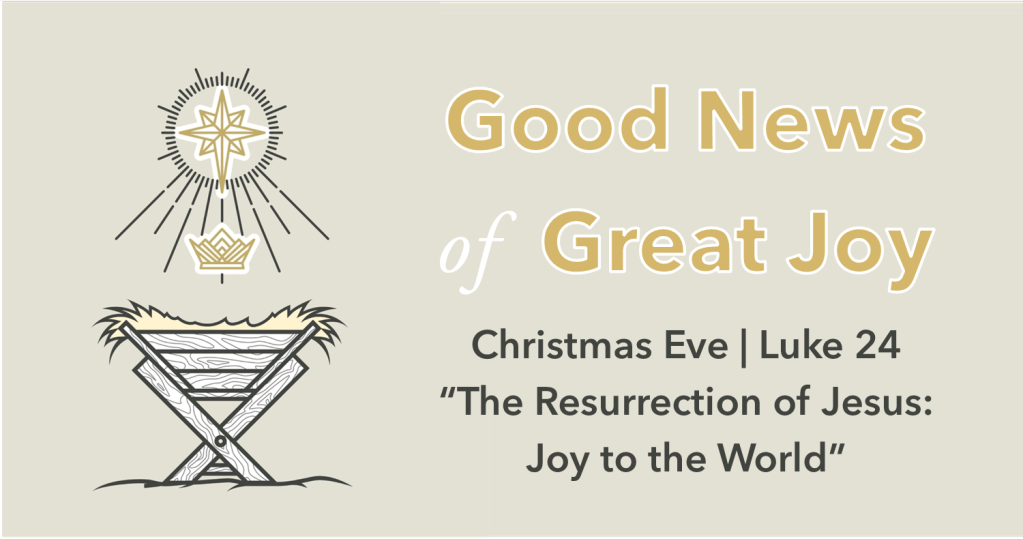
Luke 24 concludes with the hope and joy of Jesus’ resurrection and ascension, a fitting reflection on Christmas Eve as we prepare to celebrate His birth tomorrow. This chapter invites us to marvel at the completeness of God’s redemptive plan, which began in a humble manger and was fulfilled in an empty tomb.
A New Beginning: The resurrection marks the triumph of life over death, just as Jesus’ birth ushered in light to a dark world. As you reflect on the empty tomb, remember that Christmas celebrates the beginning of this miraculous story.
Hope Fulfilled: The disciples on the road to Emmaus moved from despair to joy as Jesus opened their eyes to God’s promises. This Christmas, let your heart burn with hope as you trust the One who fulfilled every prophecy.
Peace and Assurance: Jesus brought peace to His disciples, proving His resurrection by showing His scars and eating with them. He offers us the same assurance—our Savior lives, and His peace is for all who believe.
A Call to Worship and Witness: The disciples responded to the risen Christ with worship and proclamation. As we celebrate His birth tomorrow, let our joy overflow in worship and bold witness, sharing the good news that Christ has come, died, and risen for us.
On this Christmas Eve, look forward to tomorrow with awe and wonder, knowing that the child born in Bethlehem is the risen Lord who reigns in heaven. May your celebration of His birth be filled with the same joy and hope that the disciples experienced as they worshiped the resurrected Savior. Merry Christmas!
📖 Revelation 4:1–11In this episode of The King is Coming, Keith Harris and Jamie Harrison move beyond Jesus’s letters to the churches and into the next part of John’s vision. In Revelation 4, John is invited through an open door into heaven—and what he sees is the throne room of God.At the center of everything is a throne, and seated on it is the Lord in all His glory. From this point forward in Revelation, the throne becomes the focal point of the entire book.John describes the scene the best way he can: the brilliance of precious stones, a rainbow surrounding the throne, flashes of lightning and thunder, and a crystal-like sea before it. Surrounding the throne are twenty-four elders and four living creatures who never cease to worship the Lord.Together, Keith and Jamie discuss:✔️ Why Revelation 4 marks a shift from the letters to the churches to John’s heavenly vision✔️ What the throne room reveals about God’s authority and security over all things✔️ Why John uses comparisons (“like” and “as”) to describe the glory he sees✔️ The mystery of the twenty-four elders and what we can—and cannot—know✔️ The constant worship of the living creatures crying “Holy, holy, holy”✔️ Why heaven’s worship centers on God simply because He is worthyIn the throne room, everything points to one truth: God alone is worthy of worship.“Worthy are you, our Lord and God, to receive glory and honor and power, for you created all things, and by your will they existed and were created.” (Revelation 4:11)🔗 If you would like to see a written version of this podcast, complete with footnotes and cross-references, you can find it here.
But on the first day of the week, at early dawn, they went to the tomb, taking the spices they had prepared. 2 And they found the stone rolled away from the tomb, 3 but when they went in they did not find the body of the Lord Jesus. 4 While they were perplexed about this, behold, two men stood by them in dazzling apparel. 5 And as they were frightened and bowed their faces to the ground, the men said to them, “Why do you seek the living among the dead? 6 He is not here, but has risen. Remember how he told you, while he was still in Galilee, 7 that the Son of Man must be delivered into the hands of sinful men and be crucified and on the third day rise.” 8 And they remembered his words, 9 and returning from the tomb they told all these things to the eleven and to all the rest. 10 Now it was Mary Magdalene and Joanna and Mary the mother of James and the other women with them who told these things to the apostles, 11 but these words seemed to them an idle tale, and they did not believe them. 12 But Peter rose and ran to the tomb; stooping and looking in, he saw the linen cloths by themselves; and he went home marveling at what had happened.
13 That very day two of them were going to a village named Emmaus, about seven miles from Jerusalem, 14 and they were talking with each other about all these things that had happened. 15 While they were talking and discussing together, Jesus himself drew near and went with them. 16 But their eyes were kept from recognizing him. 17 And he said to them, “What is this conversation that you are holding with each other as you walk?” And they stood still, looking sad. 18 Then one of them, named Cleopas, answered him, “Are you the only visitor to Jerusalem who does not know the things that have happened there in these days?” 19 And he said to them, “What things?” And they said to him, “Concerning Jesus of Nazareth, a man who was a prophet mighty in deed and word before God and all the people, 20 and how our chief priests and rulers delivered him up to be condemned to death, and crucified him. 21 But we had hoped that he was the one to redeem Israel. Yes, and besides all this, it is now the third day since these things happened. 22 Moreover, some women of our company amazed us. They were at the tomb early in the morning, 23 and when they did not find his body, they came back saying that they had even seen a vision of angels, who said that he was alive. 24 Some of those who were with us went to the tomb and found it just as the women had said, but him they did not see.” 25 And he said to them, “O foolish ones, and slow of heart to believe all that the prophets have spoken! 26 Was it not necessary that the Christ should suffer these things and enter into his glory?” 27 And beginning with Moses and all the Prophets, he interpreted to them in all the Scriptures the things concerning himself.
28 So they drew near to the village to which they were going. He acted as if he were going farther, 29 but they urged him strongly, saying, “Stay with us, for it is toward evening and the day is now far spent.” So he went in to stay with them. 30 When he was at table with them, he took the bread and blessed and broke it and gave it to them. 31 And their eyes were opened, and they recognized him. And he vanished from their sight. 32 They said to each other, “Did not our hearts burn within us while he talked to us on the road, while he opened to us the Scriptures?” 33 And they rose that same hour and returned to Jerusalem. And they found the eleven and those who were with them gathered together, 34 saying, “The Lord has risen indeed, and has appeared to Simon!” 35 Then they told what had happened on the road, and how he was known to them in the breaking of the bread.
36 As they were talking about these things, Jesus himself stood among them, and said to them, “Peace to you!” 37 But they were startled and frightened and thought they saw a spirit. 38 And he said to them, “Why are you troubled, and why do doubts arise in your hearts? 39 See my hands and my feet, that it is I myself. Touch me, and see. For a spirit does not have flesh and bones as you see that I have.” 40 And when he had said this, he showed them his hands and his feet. 41 And while they still disbelieved for joy and were marveling, he said to them, “Have you anything here to eat?” 42 They gave him a piece of broiled fish, 43 and he took it and ate before them.
44 Then he said to them, “These are my words that I spoke to you while I was still with you, that everything written about me in the Law of Moses and the Prophets and the Psalms must be fulfilled.” 45 Then he opened their minds to understand the Scriptures, 46 and said to them, “Thus it is written, that the Christ should suffer and on the third day rise from the dead, 47 and that repentance for the forgiveness of sins should be proclaimed in his name to all nations, beginning from Jerusalem. 48 You are witnesses of these things. 49 And behold, I am sending the promise of my Father upon you. But stay in the city until you are clothed with power from on high.”
50 And he led them out as far as Bethany, and lifting up his hands he blessed them. 51 While he blessed them, he parted from them and was carried up into heaven. 52 And they worshiped him and returned to Jerusalem with great joy, 53 and were continually in the temple blessing God.
[1] On the first day of the week, women arrived at Jesus’ tomb with spices but found the stone rolled away and the tomb empty. Two angels appeared, reminding them of Jesus’ words that He would rise on the third day. They reported this to the apostles, but their testimony was met with disbelief. Peter ran to the tomb, saw the linen cloths, and marveled.
[2] Two disciples, one named Cleopas, walked to Emmaus, discussing the events of Jesus’ death. A stranger joined them, explaining how Scripture foretold the Messiah’s suffering and glory. At dinner, their eyes were opened, and they recognized the stranger as Jesus, who then vanished. Filled with joy, they returned to Jerusalem to share the news.
[3] Jesus appeared to His disciples, offering peace and proof of His physical resurrection by showing His hands and feet and eating with them. He explained that His death and resurrection fulfilled Scripture and commissioned them to proclaim repentance and forgiveness to all nations, beginning in Jerusalem. He promised the Holy Spirit would empower them.
[4] Leading the disciples to Bethany, Jesus blessed them and ascended into heaven. Overwhelmed with joy, they returned to Jerusalem, worshiping Him and continually praising God in the temple.
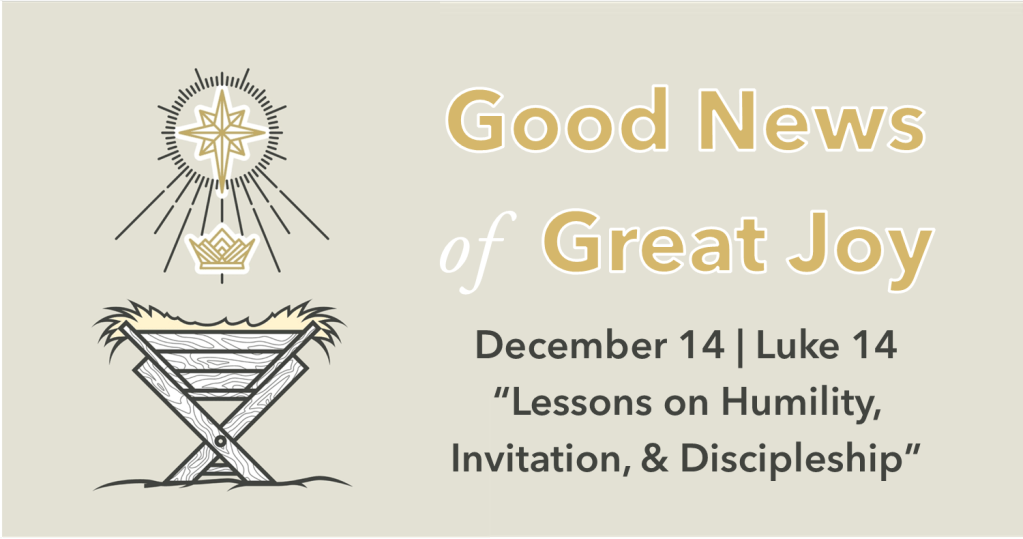
Luke 14 reminds us of God’s gracious invitation to His Kingdom and the humility and sacrifice required to follow Christ. The parable of the banquet is a picture of the generosity of God, who welcomes the outcast and undeserving to His table. As we prepare for Christmas, may we reflect on the cost of discipleship and respond to God’s call with humble hearts, knowing that Christ humbled Himself to bring us salvation. Let us invite others to share in the joy of the Kingdom and commit ourselves fully to the One who gave everything for us!
📖 Revelation 4:1–11In this episode of The King is Coming, Keith Harris and Jamie Harrison move beyond Jesus’s letters to the churches and into the next part of John’s vision. In Revelation 4, John is invited through an open door into heaven—and what he sees is the throne room of God.At the center of everything is a throne, and seated on it is the Lord in all His glory. From this point forward in Revelation, the throne becomes the focal point of the entire book.John describes the scene the best way he can: the brilliance of precious stones, a rainbow surrounding the throne, flashes of lightning and thunder, and a crystal-like sea before it. Surrounding the throne are twenty-four elders and four living creatures who never cease to worship the Lord.Together, Keith and Jamie discuss:✔️ Why Revelation 4 marks a shift from the letters to the churches to John’s heavenly vision✔️ What the throne room reveals about God’s authority and security over all things✔️ Why John uses comparisons (“like” and “as”) to describe the glory he sees✔️ The mystery of the twenty-four elders and what we can—and cannot—know✔️ The constant worship of the living creatures crying “Holy, holy, holy”✔️ Why heaven’s worship centers on God simply because He is worthyIn the throne room, everything points to one truth: God alone is worthy of worship.“Worthy are you, our Lord and God, to receive glory and honor and power, for you created all things, and by your will they existed and were created.” (Revelation 4:11)🔗 If you would like to see a written version of this podcast, complete with footnotes and cross-references, you can find it here.
One Sabbath, when he went to dine at the house of a ruler of the Pharisees, they were watching him carefully. 2 And behold, there was a man before him who had dropsy. 3 And Jesus responded to the lawyers and Pharisees, saying, “Is it lawful to heal on the Sabbath, or not?” 4 But they remained silent. Then he took him and healed him and sent him away. 5 And he said to them, “Which of you, having a son or an ox that has fallen into a well on a Sabbath day, will not immediately pull him out?” 6 And they could not reply to these things.
7 Now he told a parable to those who were invited, when he noticed how they chose the places of honor, saying to them, 8 “When you are invited by someone to a wedding feast, do not sit down in a place of honor, lest someone more distinguished than you be invited by him, 9 and he who invited you both will come and say to you, ‘Give your place to this person,’ and then you will begin with shame to take the lowest place. 10 But when you are invited, go and sit in the lowest place, so that when your host comes he may say to you, ‘Friend, move up higher.’ Then you will be honored in the presence of all who sit at table with you. 11 For everyone who exalts himself will be humbled, and he who humbles himself will be exalted.”
12 He said also to the man who had invited him, “When you give a dinner or a banquet, do not invite your friends or your brothers or your relatives or rich neighbors, lest they also invite you in return and you be repaid. 13 But when you give a feast, invite the poor, the crippled, the lame, the blind, 14 and you will be blessed, because they cannot repay you. For you will be repaid at the resurrection of the just.”
15 When one of those who reclined at table with him heard these things, he said to him, “Blessed is everyone who will eat bread in the kingdom of God!” 16 But he said to him, “A man once gave a great banquet and invited many. 17 And at the time for the banquet he sent his servant to say to those who had been invited, ‘Come, for everything is now ready.’ 18 But they all alike began to make excuses. The first said to him, ‘I have bought a field, and I must go out and see it. Please have me excused.’ 19 And another said, ‘I have bought five yoke of oxen, and I go to examine them. Please have me excused.’ 20 And another said, ‘I have married a wife, and therefore I cannot come.’ 21 So the servant came and reported these things to his master. Then the master of the house became angry and said to his servant, ‘Go out quickly to the streets and lanes of the city, and bring in the poor and crippled and blind and lame.’ 22 And the servant said, ‘Sir, what you commanded has been done, and still there is room.’ 23 And the master said to the servant, ‘Go out to the highways and hedges and compel people to come in, that my house may be filled. 24 For I tell you, none of those men who were invited shall taste my banquet.’ ”
25 Now great crowds accompanied him, and he turned and said to them, 26 “If anyone comes to me and does not hate his own father and mother and wife and children and brothers and sisters, yes, and even his own life, he cannot be my disciple. 27 Whoever does not bear his own cross and come after me cannot be my disciple. 28 For which of you, desiring to build a tower, does not first sit down and count the cost, whether he has enough to complete it? 29 Otherwise, when he has laid a foundation and is not able to finish, all who see it begin to mock him, 30 saying, ‘This man began to build and was not able to finish.’ 31 Or what king, going out to encounter another king in war, will not sit down first and deliberate whether he is able with ten thousand to meet him who comes against him with twenty thousand? 32 And if not, while the other is yet a great way off, he sends a delegation and asks for terms of peace. 33 So therefore, any one of you who does not renounce all that he has cannot be my disciple.
34 “Salt is good, but if salt has lost its taste, how shall its saltiness be restored? 35 It is of no use either for the soil or for the manure pile. It is thrown away. He who has ears to hear, let him hear.”
[1] Jesus is invited to dine at a Pharisee’s house on the Sabbath, where He heals a man suffering from dropsy (edema, where the body retains fluid). Anticipating objections, Jesus asks the religious leaders whether it is lawful to heal on the Sabbath. When they remain silent, He uses an example of rescuing an animal on the Sabbath to highlight their hypocrisy and to affirm the value of showing mercy.
[2] Jesus notices guests vying for prominent seats and shares a parable about choosing the lowest place at a banquet. He emphasizes humility, stating, “For everyone who exalts himself will be humbled, and he who humbles himself will be exalted” (v. 11).
[3] Jesus encourages His host to invite the poor, crippled, lame, and blind rather than friends and wealthy neighbors, who can repay the favor. He then shares a parable about a man hosting a great banquet. When the invited guests offer excuses, the host invites the outcasts and even those in distant places to fill his house, illustrating God’s generous invitation to all, including Gentiles, to enter His Kingdom.
[4] As large crowds follow Him, Jesus challenges them with the cost of discipleship. He calls His followers to love Him more than family and even their own lives. True disciples must carry their cross and count the cost of following Him. Using parables about building a tower and going to war, Jesus warns against making half-hearted commitments.
[5] Jesus concludes with a metaphor about salt losing its taste, symbolizing disciples who fail to live up to their calling. Such salt is worthless, emphasizing the seriousness of wholehearted devotion to Him.
Luke 9 challenges us to examine the cost of following Jesus. Discipleship requires humility, dependence on God, and a willingness to sacrifice. The Transfiguration reminds us that Jesus is God, while the feeding of the five thousand shows His power to provide for every need. As we prepare our hearts during Advent, may we reflect on what it means to take up our cross daily and follow the One who is both Savior and King. Let us trust in His sufficiency and walk in faith and obedience.
Luke 9:51 is an important verse in Luke’s narrative because it shows that Jesus never wavered in His purpose for being on earth. While it seems like Jerusalem and His crucifixion are a long way off at this point in Luke, we see here that Jesus “set His face” to go there. From this point to Luke 19, the cross was set in Jesus’s gaze and was not only where He was headed but where He purposefully headed toward. As we journey there with Him over these next weeks, let us set our face toward Him.
📖 Revelation 4:1–11In this episode of The King is Coming, Keith Harris and Jamie Harrison move beyond Jesus’s letters to the churches and into the next part of John’s vision. In Revelation 4, John is invited through an open door into heaven—and what he sees is the throne room of God.At the center of everything is a throne, and seated on it is the Lord in all His glory. From this point forward in Revelation, the throne becomes the focal point of the entire book.John describes the scene the best way he can: the brilliance of precious stones, a rainbow surrounding the throne, flashes of lightning and thunder, and a crystal-like sea before it. Surrounding the throne are twenty-four elders and four living creatures who never cease to worship the Lord.Together, Keith and Jamie discuss:✔️ Why Revelation 4 marks a shift from the letters to the churches to John’s heavenly vision✔️ What the throne room reveals about God’s authority and security over all things✔️ Why John uses comparisons (“like” and “as”) to describe the glory he sees✔️ The mystery of the twenty-four elders and what we can—and cannot—know✔️ The constant worship of the living creatures crying “Holy, holy, holy”✔️ Why heaven’s worship centers on God simply because He is worthyIn the throne room, everything points to one truth: God alone is worthy of worship.“Worthy are you, our Lord and God, to receive glory and honor and power, for you created all things, and by your will they existed and were created.” (Revelation 4:11)🔗 If you would like to see a written version of this podcast, complete with footnotes and cross-references, you can find it here.
1 And he called the twelve together and gave them power and authority over all demons and to cure diseases, 2 and he sent them out to proclaim the kingdom of God and to heal. 3 And he said to them, “Take nothing for your journey, no staff, nor bag, nor bread, nor money; and do not have two tunics. 4 And whatever house you enter, stay there, and from there depart. 5 And wherever they do not receive you, when you leave that town shake off the dust from your feet as a testimony against them.” 6 And they departed and went through the villages, preaching the gospel and healing everywhere.
7 Now Herod the tetrarch heard about all that was happening, and he was perplexed, because it was said by some that John had been raised from the dead, 8 by some that Elijah had appeared, and by others that one of the prophets of old had risen. 9 Herod said, “John I beheaded, but who is this about whom I hear such things?” And he sought to see him.
10 On their return the apostles told him all that they had done. And he took them and withdrew apart to a town called Bethsaida. 11 When the crowds learned it, they followed him, and he welcomed them and spoke to them of the kingdom of God and cured those who had need of healing. 12 Now the day began to wear away, and the twelve came and said to him, “Send the crowd away to go into the surrounding villages and countryside to find lodging and get provisions, for we are here in a desolate place.” 13 But he said to them, “You give them something to eat.” They said, “We have no more than five loaves and two fish—unless we are to go and buy food for all these people.” 14 For there were about five thousand men. And he said to his disciples, “Have them sit down in groups of about fifty each.” 15 And they did so, and had them all sit down. 16 And taking the five loaves and the two fish, he looked up to heaven and said a blessing over them. Then he broke the loaves and gave them to the disciples to set before the crowd. 17 And they all ate and were satisfied. And what was left over was picked up, twelve baskets of broken pieces.
Peter’s Confession and Jesus’s Transfiguration (9:18-36)[3]
18 Now it happened that as he was praying alone, the disciples were with him. And he asked them, “Who do the crowds say that I am?” 19 And they answered, “John the Baptist. But others say, Elijah, and others, that one of the prophets of old has risen.” 20 Then he said to them, “But who do you say that I am?” And Peter answered, “The Christ of God.”
21 And he strictly charged and commanded them to tell this to no one, 22 saying, “The Son of Man must suffer many things and be rejected by the elders and chief priests and scribes, and be killed, and on the third day be raised.”
23 And he said to all, “If anyone would come after me, let him deny himself and take up his cross daily and follow me. 24 For whoever would save his life will lose it, but whoever loses his life for my sake will save it. 25 For what does it profit a man if he gains the whole world and loses or forfeits himself? 26 For whoever is ashamed of me and of my words, of him will the Son of Man be ashamed when he comes in his glory and the glory of the Father and of the holy angels. 27 But I tell you truly, there are some standing here who will not taste death until they see the kingdom of God.”
28 Now about eight days after these sayings he took with him Peter and John and James and went up on the mountain to pray. 29 And as he was praying, the appearance of his face was altered, and his clothing became dazzling white. 30 And behold, two men were talking with him, Moses and Elijah, 31 who appeared in glory and spoke of his departure, which he was about to accomplish at Jerusalem. 32 Now Peter and those who were with him were heavy with sleep, but when they became fully awake they saw his glory and the two men who stood with him. 33 And as the men were parting from him, Peter said to Jesus, “Master, it is good that we are here. Let us make three tents, one for you and one for Moses and one for Elijah”—not knowing what he said. 34 As he was saying these things, a cloud came and overshadowed them, and they were afraid as they entered the cloud. 35 And a voice came out of the cloud, saying, “This is my Son, my Chosen One; listen to him!” 36 And when the voice had spoken, Jesus was found alone. And they kept silent and told no one in those days anything of what they had seen.
Healing the Boy with an Unclean Spirit (9:37-45)[4]
37 On the next day, when they had come down from the mountain, a great crowd met him. 38 And behold, a man from the crowd cried out, “Teacher, I beg you to look at my son, for he is my only child. 39 And behold, a spirit seizes him, and he suddenly cries out. It convulses him so that he foams at the mouth, and shatters him, and will hardly leave him. 40 And I begged your disciples to cast it out, but they could not.” 41 Jesus answered, “O faithless and twisted generation, how long am I to be with you and bear with you? Bring your son here.” 42 While he was coming, the demon threw him to the ground and convulsed him. But Jesus rebuked the unclean spirit and healed the boy, and gave him back to his father. 43 And all were astonished at the majesty of God.
But while they were all marveling at everything he was doing, Jesus said to his disciples, 44 “Let these words sink into your ears: The Son of Man is about to be delivered into the hands of men.” 45 But they did not understand this saying, and it was concealed from them, so that they might not perceive it. And they were afraid to ask him about this saying.
46 An argument arose among them as to which of them was the greatest. 47 But Jesus, knowing the reasoning of their hearts, took a child and put him by his side 48 and said to them, “Whoever receives this child in my name receives me, and whoever receives me receives him who sent me. For he who is least among you all is the one who is great.”
49 John answered, “Master, we saw someone casting out demons in your name, and we tried to stop him, because he does not follow with us.” 50 But Jesus said to him, “Do not stop him, for the one who is not against you is for you.”
51 When the days drew near for him to be taken up, he set his face to go to Jerusalem. 52 And he sent messengers ahead of him, who went and entered a village of the Samaritans, to make preparations for him. 53 But the people did not receive him, because his face was set toward Jerusalem. 54 And when his disciples James and John saw it, they said, “Lord, do you want us to tell fire to come down from heaven and consume them?” 55 But he turned and rebuked them. 56 And they went on to another village. 57 As they were going along the road, someone said to him, “I will follow you wherever you go.” 58 And Jesus said to him, “Foxes have holes, and birds of the air have nests, but the Son of Man has nowhere to lay his head.” 59 To another he said, “Follow me.” But he said, “Lord, let me first go and bury my father.” 60 And Jesus said to him, “Leave the dead to bury their own dead. But as for you, go and proclaim the kingdom of God.” 61 Yet another said, “I will follow you, Lord, but let me first say farewell to those at my home.” 62 Jesus said to him, “No one who puts his hand to the plow and looks back is fit for the kingdom of God.”
[1] Jesus sends His twelve disciples to preach the gospel of the Kingdom of God and heal the sick. He gives them power and authority over demons and diseases and instructs them to travel lightly, relying on God’s provision. They obey His commands and go from village to village, proclaiming the good news and performing miracles, demonstrating that the power comes from Jesus alone.
[2] When the apostles return, Jesus takes them to a quiet place, but a crowd follows. Moved with compassion, Jesus teaches them and heals their sick. The disciples urge Jesus to send the crowd away for food, but He tells them, “You give them something to eat” (v. 13). With five loaves and two fish from a boy’s sack lunch, Jesus miraculously feeds the crowd of about five thousand men, producing twelve baskets of leftovers. This miracle highlights Jesus’ sufficiency and His ability to meet every need.
[3] Jesus asks His disciples who people say He is, and Peter declares, “The Christ of God” (v. 20). Jesus then predicts His suffering, death, and resurrection, emphasizing the cost of following Him: taking up one’s cross daily. Shortly after, Jesus takes Peter, James, and John up a mountain, where He is transfigured. His face and clothes shine with glory as Moses and Elijah appear, discussing His upcoming departure. God’s voice affirms Jesus, saying, “This is my Son, my Chosen One; listen to him!” (v. 35). This moment strengthens the disciples’ understanding of Jesus’ divine identity and mission.
[4] Upon returning from the mountain, Jesus encounters a father pleading for help for his demon-possessed son. The disciples are unable to cast out the demon, but Jesus rebukes it and the boy is healed instantly. This event reveals the disciples’ lack of faith and their need to depend on Jesus fully. Jesus again foretells His death, but the disciples fail to grasp its significance.
[5] The disciples argue about who is the greatest, but Jesus teaches that true greatness comes through humility and service. He rebukes their need and desire to be the greatest. When a Samaritan village rejects Jesus, He discourages retaliation, calling His followers to mercy. Finally, Jesus challenges those who want to follow Him to prioritize the Kingdom of God above all else, demonstrating the sacrificial nature of discipleship.
As we meditate on Luke 6 during Advent, we see Jesus calling us to a discipleship marked by love, humility, and obedience to God’s will. He challenges us to embrace the values of God’s Kingdom rather than the world’s. The Pharisees’ legalism contrasts sharply with Jesus’ message of grace and compassion. This Advent season, may we embrace the call to follow Jesus, not as a moral teacher, but as the Lord who fulfills the law with love.
📖 Revelation 4:1–11In this episode of The King is Coming, Keith Harris and Jamie Harrison move beyond Jesus’s letters to the churches and into the next part of John’s vision. In Revelation 4, John is invited through an open door into heaven—and what he sees is the throne room of God.At the center of everything is a throne, and seated on it is the Lord in all His glory. From this point forward in Revelation, the throne becomes the focal point of the entire book.John describes the scene the best way he can: the brilliance of precious stones, a rainbow surrounding the throne, flashes of lightning and thunder, and a crystal-like sea before it. Surrounding the throne are twenty-four elders and four living creatures who never cease to worship the Lord.Together, Keith and Jamie discuss:✔️ Why Revelation 4 marks a shift from the letters to the churches to John’s heavenly vision✔️ What the throne room reveals about God’s authority and security over all things✔️ Why John uses comparisons (“like” and “as”) to describe the glory he sees✔️ The mystery of the twenty-four elders and what we can—and cannot—know✔️ The constant worship of the living creatures crying “Holy, holy, holy”✔️ Why heaven’s worship centers on God simply because He is worthyIn the throne room, everything points to one truth: God alone is worthy of worship.“Worthy are you, our Lord and God, to receive glory and honor and power, for you created all things, and by your will they existed and were created.” (Revelation 4:11)🔗 If you would like to see a written version of this podcast, complete with footnotes and cross-references, you can find it here.
1 On a Sabbath, while he was going through the grainfields, his disciples plucked and ate some heads of grain, rubbing them in their hands. 2 But some of the Pharisees said, “Why are you doing what is not lawful to do on the Sabbath?” 3 And Jesus answered them, “Have you not read what David did when he was hungry, he and those who were with him: 4 how he entered the house of God and took and ate the bread of the Presence, which is not lawful for any but the priests to eat, and also gave it to those with him?” 5 And he said to them, “The Son of Man is lord of the Sabbath.”
6 On another Sabbath, he entered the synagogue and was teaching, and a man was there whose right hand was withered. 7 And the scribes and the Pharisees watched him, to see whether he would heal on the Sabbath, so that they might find a reason to accuse him. 8 But he knew their thoughts, and he said to the man with the withered hand, “Come and stand here.” And he rose and stood there. 9 And Jesus said to them, “I ask you, is it lawful on the Sabbath to do good or to do harm, to save life or to destroy it?” 10 And after looking around at them all he said to him, “Stretch out your hand.” And he did so, and his hand was restored. 11 But they were filled with fury and discussed with one another what they might do to Jesus.
12 In these days he went out to the mountain to pray, and all night he continued in prayer to God. 13 And when day came, he called his disciples and chose from them twelve, whom he named apostles: 14 Simon, whom he named Peter, and Andrew his brother, and James and John, and Philip, and Bartholomew, 15 and Matthew, and Thomas, and James the son of Alphaeus, and Simon who was called the Zealot, 16 and Judas the son of James, and Judas Iscariot, who became a traitor.
17 And he came down with them and stood on a level place, with a great crowd of his disciples and a great multitude of people from all Judea and Jerusalem and the seacoast of Tyre and Sidon, 18 who came to hear him and to be healed of their diseases. And those who were troubled with unclean spirits were cured. 19 And all the crowd sought to touch him, for power came out from him and healed them all.
20 And he lifted up his eyes on his disciples, and said:
“Blessed are you who are poor, for yours is the kingdom of God.
21 “Blessed are you who are hungry now, for you shall be satisfied.
“Blessed are you who weep now, for you shall laugh.
22 “Blessed are you when people hate you and when they exclude you and revile you and spurn your name as evil, on account of the Son of Man! 23 Rejoice in that day, and leap for joy, for behold, your reward is great in heaven; for so their fathers did to the prophets.
24 “But woe to you who are rich, for you have received your consolation.
25 “Woe to you who are full now, for you shall be hungry.
“Woe to you who laugh now, for you shall mourn and weep.
26 “Woe to you, when all people speak well of you, for so their fathers did to the false prophets.
27 “But I say to you who hear, Love your enemies, do good to those who hate you, 28 bless those who curse you, pray for those who abuse you. 29 To one who strikes you on the cheek, offer the other also, and from one who takes away your cloak do not withhold your tunic either. 30 Give to everyone who begs from you, and from one who takes away your goods do not demand them back. 31 And as you wish that others would do to you, do so to them.
32 “If you love those who love you, what benefit is that to you? For even sinners love those who love them. 33 And if you do good to those who do good to you, what benefit is that to you? For even sinners do the same. 34 And if you lend to those from whom you expect to receive, what credit is that to you? Even sinners lend to sinners, to get back the same amount. 35 But love your enemies, and do good, and lend, expecting nothing in return, and your reward will be great, and you will be sons of the Most High, for he is kind to the ungrateful and the evil. 36 Be merciful, even as your Father is merciful.
37 j“Judge not, and you will not be judged; condemn not, and you will not be condemned; forgive, and you will be forgiven; 38 give, and it will be given to you. Good measure, pressed down, shaken together, running over, will be put into your lap. For with the measure you use it will be measured back to you.”
39 He also told them a parable: “Can a blind man lead a blind man? Will they not both fall into a pit? 40 A disciple is not above his teacher, but everyone when he is fully trained will be like his teacher. 41 Why do you see the speck that is in your brother’s eye, but do not notice the log that is in your own eye? 42 How can you say to your brother, ‘Brother, let me take out the speck that is in your eye,’ when you yourself do not see the log that is in your own eye? You hypocrite, first take the log out of your own eye, and then you will see clearly to take out the speck that is in your brother’s eye.
43 “For no good tree bears bad fruit, nor again does a bad tree bear good fruit, 44 for each tree is known by its own fruit. For figs are not gathered from thornbushes, nor are grapes picked from a bramble bush. 45 The good person out of the good treasure of his heart produces good, and the evil person out of his evil treasure produces evil, for out of the abundance of the heart his mouth speaks.
46 “Why do you call me ‘Lord, Lord,’ and not do what I tell you? 47 Everyone who comes to me and hears my words and does them, I will show you what he is like: 48 he is like a man building a house, who dug deep and laid the foundation on the rock. And when a flood arose, the stream broke against that house and could not shake it, because it had been well built. 49 But the one who hears and does not do them is like a man who built a house on the ground without a foundation. When the stream broke against it, immediately it fell, and the ruin of that house was great.”
[1] When the Pharisees accuse Jesus’ disciples of breaking the Sabbath by picking grain, Jesus reminds them of David eating consecrated bread and declares, “The Son of Man is lord of the Sabbath” (v. 5). Jesus makes it clear that the Sabbath was made for human benefit, not as a burdensome law to follow rigidly. The question is not, “Is it lawful?” but “Is it loving?” (1 Samuel 21:1-6; Micah 6:8). Jesus’s authority over the Sabbath reveals His intent in the Sabbath as well as His authority as the One who gave and fulfills the Law.
[2] In another confrontation, Jesus heals a man with a withered hand on the Sabbath, exposing the Pharisees’ hypocrisy. Jesus restores the man openly demonstrating that honoring God involves compassion, even on the Sabbath. The Pharisees respond with anger, rejecting His authority.
[3] Before making an important decision, Jesus spends the night in prayer. The next day, He selects twelve disciples from a larger group, designating them as His apostles. This moment marks the beginning of a special commission for the twelve, who will carry forward His mission.
[4] Jesus delivers a teaching that contrasts the values of the Kingdom of God with the ways of the world. He pronounces blessings on the poor, hungry, and persecuted, and woes on the rich, satisfied, and popular (vv. 20-26). These blessings and woes reflect Jesus’s concern for spiritual poverty and a call to discipleship. He calls for love of enemies, forgiveness, and humility, challenging His followers to live out their faith. He concludes with the parable of the wise and foolish builders, urging obedience to His words as the foundation for a faithful life.
I believe that Luke’s words to Theophilus in the beginning of his gospel sum up what we are trying to do with this resource – to present to you “a narrative of the things that have been accomplished among us, just as those who were eyewitnesses and ministers of the Word have delivered to us” (Luke 1:1-2). There are twenty-four chapters in Luke’s narrative, and between December 1st and 24th (Christmas Eve), we have time to look at the full account of Jesus’s life.
We want to give you the opportunity to look at the whole Story of Jesus – not just the divine swaddled baby in the manger, but the young boy who taught the teachers in the temple, the man who served rather than being served, and the Savior who died and rose again “in accordance with the Scriptures” (1 Corinthians 15:3-4).
Luke addressed his gospel to Theophilus, a name combining the words Theos (God) and philos (love) to mean “lover of God”. Some speculate whether or not Theophilus was an individual or just Luke’s name for those who love God, but it is my hope that whether or not you begin this journey through Luke’s gospel a lover of God, you will find yourself on Christmas day enamored and enraptured in love, “waiting for our blessed hope, the appearing of the glory of our great God and Savior Jesus Christ, who gave Himself for us to redeem us” (Titus 2:13-14).
Won’t you join us?
Below, you can find audio for each day’s reading as well as brief commentary if needed for understanding, or you can download a pdf of the entire reading guide here:
📖 Revelation 4:1–11In this episode of The King is Coming, Keith Harris and Jamie Harrison move beyond Jesus’s letters to the churches and into the next part of John’s vision. In Revelation 4, John is invited through an open door into heaven—and what he sees is the throne room of God.At the center of everything is a throne, and seated on it is the Lord in all His glory. From this point forward in Revelation, the throne becomes the focal point of the entire book.John describes the scene the best way he can: the brilliance of precious stones, a rainbow surrounding the throne, flashes of lightning and thunder, and a crystal-like sea before it. Surrounding the throne are twenty-four elders and four living creatures who never cease to worship the Lord.Together, Keith and Jamie discuss:✔️ Why Revelation 4 marks a shift from the letters to the churches to John’s heavenly vision✔️ What the throne room reveals about God’s authority and security over all things✔️ Why John uses comparisons (“like” and “as”) to describe the glory he sees✔️ The mystery of the twenty-four elders and what we can—and cannot—know✔️ The constant worship of the living creatures crying “Holy, holy, holy”✔️ Why heaven’s worship centers on God simply because He is worthyIn the throne room, everything points to one truth: God alone is worthy of worship.“Worthy are you, our Lord and God, to receive glory and honor and power, for you created all things, and by your will they existed and were created.” (Revelation 4:11)🔗 If you would like to see a written version of this podcast, complete with footnotes and cross-references, you can find it here.
I’m thankful for the Father of Mercies and the God of All Comfort!
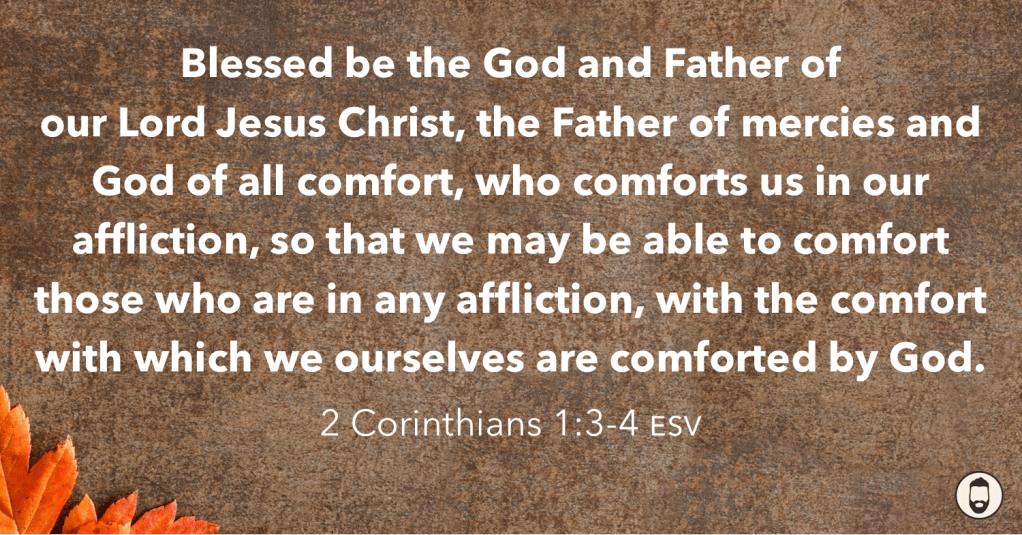
In 2 Corinthians 1:3-4, Paul invited the church at Corinth (and us today) to praise God for who He is — the source of mercy and comfort. God, in His great love, shows compassion to us in our pain and suffering. He doesn’t stand far off or push us away but instead draws near, meeting us in our affliction with His presence, peace, and sustaining grace. Whether we face sorrow or loss, trials or tribulations, we can cling to the promise that the “God of all comfort” is with us, strengthening and reminding us that we are never alone.
But God’s comfort doesn’t end with only Him comforting us. Paul emphasized here that as we receive mercy and comfort from the Lord, we are called to extend it to others. God often works through His people, the Church, to show His love and care to those in need. When we have experienced God’s mercy, we are uniquely equipped to share it with others and minister to them. Our struggles and the comfort we received become tools in His hands, allowing us to walk alongside those who are hurting, offering hope and encouragement.
As His Church, we are His hands and feet, bringing His comfort and gospel to a broken and lost world. This is a beautiful picture of God’s redemption, even in the midst of our suffering. He uses the suffering and trials we experience to shape us, sanctify us, draw us closer to Him, and equip us to serve others for His glory.
Today, I am thankful for the mercy and comfort God has shown me, and I’m challenged to share that same mercy and comfort with those around me.
How can you reflect the heart of the “Father of Mercies” in someone’s life today? Consider those around you who are hurting and mourning as we enter the holiday season. Not everyone is ready or willing to be holly and jolly because or real hurts and hangups in their lives. Think of how Jesus has brought you through your own hurts and hangups and extend His love to others in the midst of theirs.
Lord, I thank you for being the Father of mercies and God of all comfort. Thank You for never leaving me alone when all the world has and adopting me into your family. There is nothing like the comfort of a loving Father, and I thank You for allowing your people to reflect that love and comfort to others. Help us to notice those who need to be comforted by You. Amen.
All through the month of November, our Christ Community Church family is focusing on what we are thankful for and expressing our thanks to our “great God and Savior Jesus Christ, who gave Himself for us to redeem us” (Titus 2:13-14).
This, like the #DailyWisdomChallenge we went through in October, is a challenge from our pastor John Goldwater — the #GRATITUDEandHOPEchallenge — where we have the opportunity to post Bible passages that move us to thanksgiving or in which we find hope. May this lead you to be grateful and find your hope in Jesus!
As I sit here and see the way I worded that statement, it makes it sound like I’m thankful for ministry — like preaching ministry. I am, but that is not what I am talking about. What I’m saying here is that I am thankful for the way the Word of God ministers TO us and THROUGH us — for the way the Spirit of God moves through His Word.
Colossians 3:16 is a passage that I think about multiple times a week as I am planning worship services and/or preparing to preach. This verse comes at the end of the section of Colossians where Paul has just taught that we are to take off the old self, putting to death the sins that plague our lives, and putting on the new self “which is being renewed after the image of its Creator” (Colossians 3:10).
Colossians 3:16 flows out of that new life in Christ as much as compassion, kindness, humility, meekness, patience, forgiveness, and love do. Letting the Word of Christ dwell in us richly is part of that new life because God uses His Word to teach us how to live and correct sin, to teach us what to believe and correct heresy, to equip us for His work or rebuke our deviations from His plan for us (2 Timothy 3:16-17). This shows that the place of the Word is more than a 15 minute devotion in the morning or at night and a couple hours on Sunday mornings. It is meant to be integral to the lives of the individual members of Christ’s church and the substance of the gathering when the members come together as a local church.
In those gatherings, the Word informs our faith and practice. That’s good news! Too often folks try to twist and turn the Word to make it work for them, but God has given us everything we need to know about Him and how to live in His Word. For example, in Colossians 3:16 alone, we find the substance of what we are to sing and in what mind and heart-set we should sing it. I’m thankful for that because this means we give God what He wants and do not have to wonder whether what we are doing fits that plan.
Furthermore, “the Word” is the term John uses to describe Jesus in John 1:1-14. It does, of course, refer to the written Word, the Scriptures, and to the words of Christ recorded in the gospels, but to John, the Word was/is God. That’s good news for us, too, because we are not being led by some dusty old religious book but instead by the “living and active” Word of God (Hebrews 4:12) — by God Himself by extension.
I’m thankful for the Word of God because I know that I am hearing from Him when I read or listen to it (2 Timothy 3:16-17, Hebrews 4:12). I’m thankful because I am not at the mercy of some religious official leading me one way or the other because God Himself is leading me — literally speaking to me — through His Word by His Spirit (John 16:13, 1 Corinthians 2:12-13). I’m thankful because God Himself has promised in His Word that He is our teacher (John 14:26, Psalm 32:8). No other religious words, no other religion, works like that. No other God is so powerful and insightful, yet personal and inviting (Isaiah 40:13-14, Psalm 145:18-19).
Lord, thank You for Your written Word. Thank You for revealing Yourself to us through it. Thank You for being the Word and making sure we know how to be saved. Thank You for teaching, correcting, training, and rebuking us. Thank You for ministering to us Yourself and telling us what You want from us and how You want us to interact with You and each other. Amen.
All through the month of November, our Christ Community Church family is focusing on what we are thankful for and expressing our thanks to our “great God and Savior Jesus Christ, who gave Himself for us to redeem us” (Titus 2:13-14).
This, like the #DailyWisdomChallenge we went through in October, is a challenge from our pastor John Goldwater — the #GRATITUDEandHOPEchallenge — where we have the opportunity to post Bible passages that move us to thanksgiving or in which we find hope. May this lead you to be grateful and find your hope in Jesus!






 Just Keith Harris