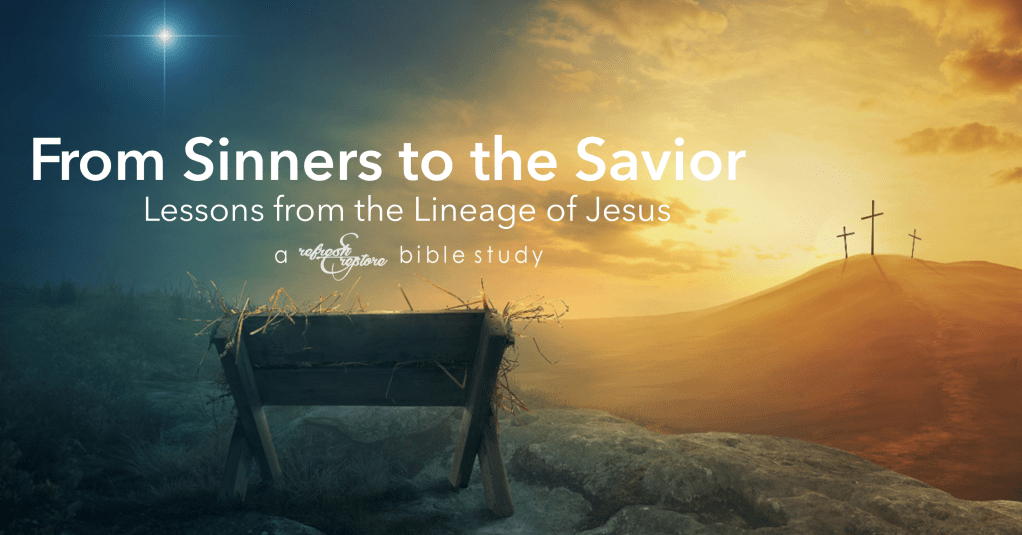
“From Sinners to the Savior: Lessons from the Lineage of Jesus” — a Refresh & Restore Bible Study

Matthew 1:1-17 —
1 The book of the genealogy of Jesus Christ, the son of David, the son of Abraham.

2 Abraham was the father of Isaac, and Isaac the father of Jacob, and Jacob the father of Judah and his brothers, 3 and Judah the father of Perez and Zerah by Tamar, and Perez the father of Hezron, and Hezron the father of Ram, 4 and Ram the father of Amminadab, and Amminadab the father of Nahshon, and Nahshon the father of Salmon, 5 and Salmon the father of Boaz by Rahab, and Boaz the father of Obed by Ruth, and Obed the father of Jesse, 6 and Jesse the father of David the king.

And David was the father of Solomon by the wife of Uriah, 7 and Solomon the father of Rehoboam, and Rehoboam the father of Abijah, and Abijah the father of Asaph, 8 and Asaph the father of Jehoshaphat, and Jehoshaphat the father of Joram, and Joram the father of Uzziah, 9 and Uzziah the father of Jotham, and Jotham the father of Ahaz, and Ahaz the father of Hezekiah, 10 and Hezekiah the father of Manasseh, and Manasseh the father of Amos, and Amos the father of Josiah, 11 and Josiah the father of Jeconiah and his brothers, at the time of the deportation to Babylon.

12 And after the deportation to Babylon: Jechoniah was the father of Shealtiel, and Shealtiel the father of Zerubbabel, 13 and Zerubbabel the father of Abiud, and Abiud the father of Eliakim, and Eliakim the father of Azor, 14 and Azor the father of Zadok, and Zadok the father of Achim, and Achim the father of Eliud, 15 and Eliud the father of Eleazar, and Eleazar the father of Matthan, and Matthan the father of Jacob, 16 and Jacob the father of Joseph the husband of Mary, of whom Jesus was born, who is called Christ.[1]


"The Lamb Who is Our Shepherd" from Revelation 7 (The KING is Coming) – Refresh & Restore | A JustKeithHarris.com Podcast

📖 Revelation 7After the terrifying events of Revelation 6, John is given a breathtaking glimpse of hope. Before judgment continues, God reveals that His people are known, sealed, and secure in Christ. The chapter culminates with one of Revelation's most beautiful pictures: the Lamb who was slain is also the Shepherd who leads His people forever.In this episode, Keith Harris and Jamie Harrison discuss:✔️ Why Revelation 7 is an interlude between the sixth and seventh seals✔️ What it means for God's servants to be sealed✔️ The two primary views of the 144,000—and why faithful Christians differ✔️ How John's pattern of hearing one thing and seeing another helps interpret the chapter✔️ The innumerable multitude worshiping before the throne✔️ Why Jesus, the Lamb, is also our Shepherd who leads us to living waterThis chapter reminds us that our greatest hope isn't solving every prophetic question—it's belonging to Christ. Those who trust Him are safe in Him, and one day He will wipe away every tear from their eyes.📖 "For the Lamb in the midst of the throne will be their shepherd, and he will guide them to springs of living water, and God will wipe away every tear from their eyes." (Revelation 7:17, ESV)🔗 If you'd like to see a written version of this podcast, complete with footnotes and cross-references, you can find it here.
  1. "The Lamb Who is Our Shepherd" from Revelation 7 (The KING is Coming)
  2. "Who Can Stand Under the Wrath of God?" from Revelation 6 (The KING is Coming)
  3. "Musings on Marriage, Missions, and My Walk with Christ" (Refresh & Restore)

Merry Christmas, Sojourners!

One thing that I love about Christmas is that people are abnormally willing to be open to talk about Jesus. Much of the year, people’s attitudes toward Scripture or gospel can be very Scrooge-like, very “Bah! Humbug!” But for a few weeks in one month out of the year, people’s hearts swell like the Grinch’s after encountering Cindy-Lou-Who.

Another thing I love about Christmas is the way this season produces stories. As I type, The Polar Express is on in the background, a narrative of a young boy regaining the childlike sense of wonder and hope. I will no doubt watch It’s a Wonderful Life on Christmas day, a fairly new tradition at the Harris household, and follow good old George Bailey finding that his life has more blessings than curses and realizing the value and impact a single life can have. I’ll even watch one of my favorite Christmas stories chronicling John McClain’s daring rescue during the hijacking of Nakatomi Corporation’s Christmas party. More than those fictional stories, though, I love the stories that come from real life, from real people.

Christmas is a time of joy and celebration, but for many, it is a time of mourning, grieving, and faking-it-till-you-make-it. As I have talked with folks about this in recent years, I find that the thing that bridges the gap between those two groups – the joyful and the weary – is their stories. Even those who are mourning have stories and memories of bygone traditions. There are funny and happy memories, and yes, sad ones, too, that come out during this season. Those memories can kind of weave together into the tapestry of who we are. They become part of our story.

Jesus’s story is not different in that aspect because part of becoming flesh and dwelling among us (John 1:14) is the sin and death we need rescuing from. His Story is of the perfect and sinless Savior deigning to live among – to live for and on behalf of – those He came to save. In order for Isaiah’s prophecy that “those who dwelt in a land of deep darkness, on them has light shone” (Isaiah 9:2), Jesus needed to come and shine in the darkness, and we need to be reminded that the “darkness has not overcome” Him (John 1:4)!

So today, let’s take a moment and look at Jesus’s Story, specifically the Story of the lineage God chose to make Jesus a part of. Sometimes we look at stories in the Bible and feel inadequate. Rest assured that Jesus’s lineage as seen in Matthew 1:1-17 is full of people just like us – people who needed a Savior like Him!

Once upon a time, there was a great and powerful King. He was foretold of old to be a hero who would come from His far away country to redeem and win back His lost love. His Story is one of romance as He left His palace to rescue His Bride. His lineage hailed back to other…great…well, um….

One of the things I love about God’s Word is how it does not fall into the temptation of prettying things up or rewriting them to be more acceptable to folks’ sensibilities. Yes, Jesus is the great King – the King of kings who was prophesied for centuries to come from heaven and rescue His people. Yes, Jesus’s Story is one of romance, where He left His throne on high and traded it for a lowly manger in a tumble-down stable. But His lineage? It wasn’t filled with kings and queens, although there were a few sprinkled in toward the middle. It wasn’t filled with flawless heroes – the flaws are many. No, Jesus’s family tree was filled with regular sinners with real sin and problems – people like me and you.

This Bible study will look at the women emphasized in Jesus’s family tree who point us to Him in specific ways. We won’t go into their full stories, but I will give you the cross-references so you can check them out directly from Scripture.

Tamar (v. 3)
…and Judah the father of Perez and Zerah by Tamar….

The first woman mentioned is Tamar (v. 3), and her story is found in Genesis 38. Tamar was Judah’s – you know, Judah as in the lion of the tribe of – she was his daughter-in-law. Originally, she was married to Judah’s oldest son, Er, until “the Lord put him to death” because he was “wicked in the sight of the Lord” (Genesis 38:7). By levirate marriage customs, it became the responsibility of Judah’s second son, Onan, to father children on behalf of his deceased big brother. But Onan was selfish and wicked, refusing to fulfill his duty; the Lord put him to death as well (Genesis 38:10). Judah promised his youngest son, Shelah, to Tamar when he came of age but had no intention of ever fulfilling that promise. Tamar, left without hope of bearing children, took matters into her own hands. Disguised as a prostitute, she tricked Judah into sleeping with her. Her actions were scandalous – and so were Judah’s.

 So, why is Tamar mentioned in Jesus’s genealogy? Her story shows us God’s providence and mercy in bringing about His purposes despite human sin. Tamar’s inclusion reminds us that God can use even the most broken situations to fulfill His promises. Judah’s declaration, “She is more righteous than I” (Genesis 38:26), points to her determination to preserve the family line, a role God used in the lineage of Jesus. Her child that would be Jesus’s earthly ancestor was marked by a scarlet string around his foot. It brings to mind the way that God used her story and the stories of people like her almost like a scarlet thread of salvation running through His Story.

Rahab (v. 5)
…and Salmon the father of Boaz by Rahab….

The second woman is Rahab (v. 5), whose story is found in Joshua 2:1-21, 6:17, and 6:22-25, with further mentions in Hebrews 11:31 and James 2:25. Rahab wasn’t one of God’s chosen people. She was a Canaanite from Jericho, known for her sinful profession. But she had heard of the God of Israel and believed in His power. She protected His spies, siding with the Lord and marking her house with a scarlet cord as a sign of her faith and obedience. When Jericho’s mighty walls fell by the power of God and the city was taken, Rahab and her family were spared.

Why would someone like Rahab be included in Jesus’s official lineage? Her faith in God is the answer. Rahab’s faith stood out like a scarlet cord, demonstrating that salvation is not about where you come from but about the one you put your faith in – in the God you trust. Her inclusion reminds us of God’s grace and His power to redeem and use anyone for His glory. Rahab’s life became part of the story of salvation history, pointing us to the greater salvation found in Jesus, who rescues all who place their faith in Him.

Ruth (vv. 5-6)
…and Salmon the father of Boaz by Rahab,
and Boaz the father of Obed by Ruth,
and Obed the father of Jesse,
and Jesse the father of David the king.

The third woman is Ruth (v. 5), whose story is told in the book of the Bible bearing her name. Like Rahab, Ruth wasn’t one of God’s chosen people. She was a Moabite, descended from incest between Lot and his daughter (Genesis 19:30-37). When famine struck Israel, Ruth’s husband Mahlon and his family came to Moab for refuge, but tragedy followed. Ruth’s father-in-law, brother-in-law, and husband all died, leaving Ruth and her mother-in-law in dire straits. Despite her own loss, Ruth chose to return to Israel with Naomi, declaring, “Your people shall be my people, and your God my God” (Ruth 1:16). She returned with Naomi to Bethlehem – yes, the Christmas Bethlehem – and met Boaz, a kinsman-redeemer who married her and restored their family’s inheritance.

Why is Ruth mentioned in Jesus’s genealogy? Ruth’s story is one of God’s grace extending beyond Israel to include the nations. Her faith and devotion to God stand as a testament to His redeeming love. Her role as David’s great-grandmother and an ancestor of Jesus reminds us that God’s plan of salvation always included people from every nation.

The Wife of Uriah (vv. 6-7)
… and Jesse the father of David the king.
And David was the father of Solomon by the wife of Uriah….

The fourth woman is not named directly but is referred to as “the wife of Uriah” (v. 6). Her story is found in 2 Samuel 11:1-25. Her name was Bathsheba, and she was the wife of Uriah the Hittite, one of David’s mighty men. King David, in a moment of temptation and sin, saw Bathsheba bathing on her roof and had her brought to him so that he could sleep with her. She became pregnant, and David attempted to cover his sin by arranging Uriah’s murder. His actions were heinous, and the wages of his sin brought tragedy to his family and others.

Why is Bathsheba included in Jesus’s genealogy? The mention of her as “the wife of Uriah” highlights David’s sin and the brokenness of humanity. Jesus being a descendent of David and rightful king as his heir is meant to be a good and special thing, but “by the wife of Uriah” highlights David’s sin. Yet God’s promises are unshaken. Through Bathsheba came Solomon, the king who would build the temple, pointing forward to the great King, Jesus – who everyone, all who sin, need as Savior. That includes kings. Bathsheba’s inclusion reminds us of God’s power to bring beauty from ashes and fulfill His covenant despite human failure.

Mary (v. 16)
…and Jacob the father of Joseph the husband of Mary,
of whom Jesus was born, who is called Christ.

The fifth and final woman is Mary (v. 16). Her story is found in Luke 1:26-38 and Matthew 1:18-25. Mary was a young woman of humble means, betrothed (like engaged but more intentional and binding) to Joseph. When the angel Gabriel announced to her that she would conceive by the Holy Spirit, she responded in faith and submission: “Behold, I am the servant of the Lord; let it be to me according to your word” (Luke 1:38). The fact that she was a virgin fulfilled the prophecy of Isaiah 7:14, demonstrating that Jesus’s conception was a miraculous act of God.

Why is Mary included in Jesus’s genealogy? Well, first how can one be born without a mother? God could have chosen to come and save in any way He wanted, but to come as the baby of a mother is one of the oldest promises in the Book. Genesis 3:15 promises victory of the “seed” of woman over the serpent, over Satan. Victory over our sin comes from her seed as well. Furthermore, Mary’s role here points to God’s grace. She bore the Savior of the world, yet she also needed Him as her Savior (Luke 1:47). Her inclusion highlights the miracle of the incarnation: God becoming flesh to dwell among us (John 1:14). Mary’s life, from the miraculous conception to standing at the foot of Jesus’s cross during his crucifixion (John 19:25), consistently points us to Jesus, to the Savior, and the fulfillment of God’s promises.

Wrapping Up

Why does the Bible recognize the sins and sinners in Jesus’s lineage? Simply put: because it all really happened. Sin happens. All people “have sinned and fall short of the glory of God” (Romans 3:23). None of us – not a single person in the history or future of the world – deserve to be in Jesus’s family tree, not even the great King David. But faith in God, trusting in Him, His work, and His steadfast love, is woven through that lineage like a scarlet cord. Looking at the sin and faith in Jesus’s genealogy reminds us that none are worthy of saving. That’s why He came. Jesus Himself said He came to “seek and save the lost” (Luke 19:10).

So, as you gather with family and friends and notice some rough-looking fruit in your family tree – or whether you notice the same by looking in your own mirror – realize that Jesus is more than the reason for the season. He’s more than a holiday. He’s the King. He’s the Savior. He’s the Christ. He is God. And He came to save sinners like me and you.

While Jesus is more than a holiday, He offers His salvation to us as a gift. There is no season like this one that highlights something important about gift giving: it’s no good if the gift is not received.

Won’t you receive Him?

The Bible tells us that “all who…receive Him,” who believe in His name, He gives “the right to become children of God” (John 1:12). The Bible also shows us what that belief looks like. In Romans 10:9, it says, “if you confess with your mouth that Jesus is Lord and believe in your heart that God raised Him from the dead, you will be saved.” This goes beyond mere words or understanding the concept of who He is – it’s giving Him your life, ceding control to Him as Lord and trusting that His death on the cross paid the penalty for your sin and His resurrection gives you eternal life in Him.

That’s good news.

That’s a wonderful gift, freely given but not cheap. Won’t you receive it – receive Him? Merry Christmas, dear Sojourner, and I pray that God blesses you and yours this season — not necessarily with the traditional holiday trappings but absolutely by seeing Him for who He is in your lives.


[1] The Holy Bible: English Standard Version (Wheaton, IL: Crossway Bibles, 2016), Matthew 1:1-17.

Good News of Great Joy | December 17 — “Faith, Forgiveness, & Readiness for the Kingdom”

Luke 17 challenges us to live with faith, humility, and readiness for Christ’s return. During Advent, as we await the celebration of Christ’s first coming and look forward to His second, we are reminded to extend forgiveness, grow in faith, and remain steadfast in our service to Him. The healing of the ten lepers encourages us to cultivate gratitude, recognizing that every blessing is a gift from God. Like the Samaritan, let us return to Christ with thankful hearts.

Finally, Jesus’ teaching on the Kingdom of God calls us to examine our priorities and live expectantly for His return. This Advent season, may we keep our eyes fixed on Christ, ready for His Kingdom, and faithful in every good work He has entrusted to us.

"The Lamb Who is Our Shepherd" from Revelation 7 (The KING is Coming) – Refresh & Restore | A JustKeithHarris.com Podcast

📖 Revelation 7After the terrifying events of Revelation 6, John is given a breathtaking glimpse of hope. Before judgment continues, God reveals that His people are known, sealed, and secure in Christ. The chapter culminates with one of Revelation's most beautiful pictures: the Lamb who was slain is also the Shepherd who leads His people forever.In this episode, Keith Harris and Jamie Harrison discuss:✔️ Why Revelation 7 is an interlude between the sixth and seventh seals✔️ What it means for God's servants to be sealed✔️ The two primary views of the 144,000—and why faithful Christians differ✔️ How John's pattern of hearing one thing and seeing another helps interpret the chapter✔️ The innumerable multitude worshiping before the throne✔️ Why Jesus, the Lamb, is also our Shepherd who leads us to living waterThis chapter reminds us that our greatest hope isn't solving every prophetic question—it's belonging to Christ. Those who trust Him are safe in Him, and one day He will wipe away every tear from their eyes.📖 "For the Lamb in the midst of the throne will be their shepherd, and he will guide them to springs of living water, and God will wipe away every tear from their eyes." (Revelation 7:17, ESV)🔗 If you'd like to see a written version of this podcast, complete with footnotes and cross-references, you can find it here.
  1. "The Lamb Who is Our Shepherd" from Revelation 7 (The KING is Coming)
  2. "Who Can Stand Under the Wrath of God?" from Revelation 6 (The KING is Coming)
  3. "Musings on Marriage, Missions, and My Walk with Christ" (Refresh & Restore)
  4. "Light Momentary Afflictions, Eternal Weight of Glory" (Refresh & Restore)
  5. "Worthy is the Lion, the Slain Lamb Who Lives" from Revelation 5 (The KING is Coming)

Jesus Teaches on Forgiveness and Faith (17:1-10)[1]

And he said to his disciples, “Temptations to sin are sure to come, but woe to the one through whom they come! 2 It would be better for him if a millstone were hung around his neck and he were cast into the sea than that he should cause one of these little ones to sin. 3 Pay attention to yourselves! If your brother sins, rebuke him, and if he repents, forgive him, 4 and if he sins against you seven times in the day, and turns to you seven times, saying, ‘I repent,’ you must forgive him.”

5 The apostles said to the Lord, “Increase our faith!” 6 And the Lord said, “If you had faith like a grain of mustard seed, you could say to this mulberry tree, ‘Be uprooted and planted in the sea,’ and it would obey you.

7 “Will any one of you who has a servant plowing or keeping sheep say to him when he has come in from the field, ‘Come at once and recline at table’? 8 Will he not rather say to him, ‘Prepare supper for me, and dress properly, and serve me while I eat and drink, and afterward you will eat and drink’? 9 Does he thank the servant because he did what was commanded? 10 So you also, when you have done all that you were commanded, say, ‘We are unworthy servants; we have only done what was our duty.’ ”

Jesus Heals Ten Lepers (17:11-19)[2]

11 On the way to Jerusalem he was passing along between Samaria and Galilee. 12 And as he entered a village, he was met by ten lepers, who stood at a distance 13 and lifted up their voices, saying, “Jesus, Master, have mercy on us.” 14 When he saw them he said to them, “Go and show yourselves to the priests.” And as they went they were cleansed. 15 Then one of them, when he saw that he was healed, turned back, praising God with a loud voice; 16 and he fell on his face at Jesus’ feet, giving him thanks. Now he was a Samaritan. 17 Then Jesus answered, “Were not ten cleansed? Where are the nine? 18 Was no one found to return and give praise to God except this foreigner?” 19 And he said to him, “Rise and go your way; your faith has made you well.”

The Coming of the Kingdom of God (17:20-37)[3]

20 Being asked by the Pharisees when the kingdom of God would come, he answered them, “The kingdom of God is not coming in ways that can be observed, 21 nor will they say, ‘Look, here it is!’ or ‘There!’ for behold, the kingdom of God is in the midst of you.”

22 And he said to the disciples, “The days are coming when you will desire to see one of the days of the Son of Man, and you will not see it. 23 And they will say to you, ‘Look, there!’ or ‘Look, here!’ Do not go out or follow them. 24 For as the lightning flashes and lights up the sky from one side to the other, so will the Son of Man be in his day. 25 But first he must suffer many things and be rejected by this generation. 26 Just as it was in the days of Noah, so will it be in the days of the Son of Man. 27 They were eating and drinking and marrying and being given in marriage, until the day when Noah entered the ark, and the flood came and destroyed them all. 28 Likewise, just as it was in the days of Lot—they were eating and drinking, buying and selling, planting and building, 29 but on the day when Lot went out from Sodom, fire and sulfur rained from heaven and destroyed them all— 30 so will it be on the day when the Son of Man is revealed. 31 On that day, let the one who is on the housetop, with his goods in the house, not come down to take them away, and likewise let the one who is in the field not turn back. 32 Remember Lot’s wife. 33 Whoever seeks to preserve his life will lose it, but whoever loses his life will keep it. 34 I tell you, in that night there will be two in one bed. One will be taken and the other left. 35 There will be two women grinding together. One will be taken and the other left.” 37 And they said to him, “Where, Lord?” He said to them, “Where the corpse is, there the vultures will gather.”


[1] Jesus warned His disciples about the inevitability of stumbling blocks but emphasized the seriousness of causing others to sin. He taught that forgiveness must be extended even if a person sins against you repeatedly. When the disciples asked for greater faith, Jesus explained that even faith as small as a mustard seed can accomplish great things. Using a parable, He reminded them that obedience to God is their duty, and they should not expect rewards for doing what is required.

[2] As Jesus traveled to Jerusalem, ten lepers called out to Him for mercy. He told them to go and show themselves to the priests, and as they went, they were healed. Only one, a Samaritan, returned to thank Jesus. Jesus commended his faith and declared that it had saved him, highlighting the importance of gratitude and recognition of God’s work in our lives.

[3] When the Pharisees asked Jesus when the Kingdom of God would come, He explained that it is not something that can be observed externally because it is already among them. Turning to His disciples, Jesus spoke about the future return of the Son of Man, which will come unexpectedly, like the days of Noah and Lot. He warned them not to cling to worldly things but to be ready for His return. Jesus described a sudden separation that would occur at His coming, emphasizing the urgency of being prepared.

Songs for Sunday, December 8, 2024 @ Christ Community Church

Sunday’s coming, and I’m ready. I need it.

I usually start off with “Sunday’s coming, and I’m excited”, but I’m not always excited. I don’t want to be disingenuous or depressing. The reality of that phrase “Sunday’s coming” is rooted in Jesus’s resurrection and His return. The reality of this fallen world is that there is sorrow and terror and unspeakable things; so I look to the hope that comes from Jesus’s resurrection, the expectation of peace that comes with His return, and echo my earlier sentiment: I’m ready. I need it.

This week’s Advent theme is peace.

If there was ever a week that I longed for peace, it has been this one. It seems that there are more pieces and shambles than peace. My heart has cried out, “Come, Lord Jesus” (Revelation 22:20), more in the past few days than in some time. I have prayed and pleaded with Him, seeking to intercede for folks I love, asking Him to pick up the broken pieces and mend mournful and sorrowful hearts giving His indescribable peace numerous times (1 Timothy 2:1, Psalm 147:3, Isaiah 61:1, Philippians 4:7, John 14:27). I pray it even now.

Peace is in short supply here on Earth, but it is in overflowing abundance in heaven where Christ is!

Look at the way Colossians 1:19-20 describes the peace of our Lord Jesus Christ:

For in Him all the fullness of God was pleased to dwell, and through Him to reconcile to Himself all things, whether on earth or in heaven, making peace by the blood of His cross.

Read that last part again: “making peace by the blood of His cross”.

Isaiah gave us a picture of this centuries before Jesus’s life, His crucifixion:

But He was pierced for our transgressions; He was crushed for our iniquities; upon Him was the chastisement that brought us peace, and with His wounds we are healed.

Isaiah 53:5

Read the part about peace again: “upon Him was the chastisement that brought us peace”.

Jesus makes peace. Jesus bears the sin, shame, and sorrows that we have a brings peace instead. Jesus is the Prince of Peace and gives peace to His people (Isaiah 9:6-7, Luke 2:14).

This is the reason I have been pleading with Him on behalf of hurting people (2 Corinthians 1:3-4, Philippians 4:6-7). This is the reason I come to Him in prayer. Peace is His (John 14:27). It is in short supply in our broken, sinful, fallen world — in this world of death and destruction (Romans 8:22), but in Jesus is Light (John 8:12), in Jesus is Love (1 John 4:9-10), in Jesus is Salvation (Acts 4:12, John 14:6), in Jesus there is peace (John 16:33). He manufactures it. He holds the trademark and copyright. Peace belongs to Him. Peace comes from Him. Peace is part of who He is (Ephesians 2:14, Isaiah 9:6).

When I think about how people desire peace in the world today, I am reminded of the reason that comic books were so great a draw for me as a kid. There was nothing like seeing someone in their most desperate moment have the hero swoop down in between them and danger. Superman was always my favorite. You could have a train bearing down on you, and he could fly down, take the impact of the train, and never even slide toward you. He could catch bullets with his hands. He could do, well, whatever danger and come out unscathed and unhurt. But Superman isn’t real. Comic book rescues are make believe, barely a genre away from fairy tales and nursery stories.

There is danger in this world. There is destruction. There is death. There is no caped crusader swooping in to save the day, and even if there was, he or she can only save some. They are limited. Regardless, the fact that they are fictional limits them altogether.

Jesus, however, is real. He did not swoop in and come out unscathed. He came and lived the life we couldn’t live — remaining sinless through it all (Hebrews 4:15, 2 Corinthians 5:21). God put on flesh and lived here on the earth with us (John 1:14) and then bore our sin and shame on the cross (1 Peter 2:24, Isaiah 53:5-6), taking the full brunt of God’s wrath due our sin, and paying the ultimate price for the wages of our sin (Romans 3:23-25, 6:23). We deserve death, and Jesus did that for us (Romans 5:8, 1 Peter 3:18).

In comic books, like in soap operas, death is just a momentary hindrance. A few strokes of the pen can come up with some cavalier and clever explanation for why the hero wasn’t really dead. Not Jesus, though. He really died (John 19:30, 34; Mark 15:37). He was buried (Mark 15:46). But, praise be to God, He rose from the dead (Matthew 28:5-6, 1 Corinthians 15:3-4)! We have looked at passages above that show how He made our peace and brings us peace by His chastisement and cross (Isaiah 53:5, Colossians 1:19-20, Romans 5:1), but He keeps that peace because He is alive (Romans 8:34, Hebrews 7:25, Revelation 1:18).

One of the coolest, most awe-inspiring hero scenes in a movie comes at the end of The Passion of the Christ. This is just a movie’s representation, but it points to the awesome reality and real life event of Jesus’s resurrection. Check it out here:

Whatever troubles and sorrows plague you now have an expiration date. Jesus is alive. Jesus is coming. Jesus has made a way for us to have peace in Him and is the only One who can give it.

Won’t you look to Him in your time of need?

That’s why we are singing about how we are in awe of Him tomorrow. We don’t sing to and praise Him out of some religious obligation; no, we have just never seen anything like Him. We have never experienced anything like Him. This world has troubles and tribulations, but He has already overcome this world (John 16:33).

So, tomorrow, we at Christ Community invite you to come and seek the Prince of Peace with us. We invite you to come and read from His Word. We invite you to come and hear His Word sung — and to lift your own voice to sing as well. We invite you to sit under the preaching of His Word. We invite you, more than anything, to come to Him. His is worthy. He is willing to save. And what’s better news than that?


Here are our Scriptures and songs:

  • Advent Reading | Peace —

As the second candle of peace shines, consider the profound peace brought by Jesus, the Prince of Peace, mentioned in Isaiah 9:6-7 and Luke 2:14. His birth signifies reconciliation between God and humanity, offering a deep, lasting peace found only in a personal relationship with Christ. His teachings guide us towards peace with God, ourselves, and others. Let this candle inspire a desire for reconciliation and peacemaking in a divided world.

This portion of Advent also draws attention to Bethlehem. Reflecting on Bethlehem’s seemingly insignificant setting reminds us of God’s penchant for using ordinary places for extraordinary purposes. In this portion of Advent, amidst feelings of insignificance, remember that God loves you dearly. Take a moment to pause, acknowledging how God specializes in using the small and insignificant for His glory. Pray that God uses you for His purpose—to bring peace and reconciliation to those around you, to bring people to Him.


5 Have this mind among yourselves, which is yours in Christ Jesus, 6 who, though he was in the form of God, did not count equality with God a thing to be grasped, 7 but emptied himself, by taking the form of a servant, being born in the likeness of men. 8 And being found in human form, he humbled himself by becoming obedient to the point of death, even death on a cross. 9 Therefore God has highly exalted him and bestowed on him the name that is above every name, 10 so that at the name of Jesus every knee should bow, in heaven and on earth and under the earth, 11 and every tongue confess that Jesus Christ is Lord, to the glory of God the Father.


1 I will extol You, my God and King, and bless Your name forever and ever. 2 Every day I will bless You and praise Your name forever and ever. 3 Great is the LORD, and greatly to be praised, and His greatness is unsearchable.


Join us in our Good News of Great Joy advent readings:

"The Lamb Who is Our Shepherd" from Revelation 7 (The KING is Coming) – Refresh & Restore | A JustKeithHarris.com Podcast

📖 Revelation 7After the terrifying events of Revelation 6, John is given a breathtaking glimpse of hope. Before judgment continues, God reveals that His people are known, sealed, and secure in Christ. The chapter culminates with one of Revelation's most beautiful pictures: the Lamb who was slain is also the Shepherd who leads His people forever.In this episode, Keith Harris and Jamie Harrison discuss:✔️ Why Revelation 7 is an interlude between the sixth and seventh seals✔️ What it means for God's servants to be sealed✔️ The two primary views of the 144,000—and why faithful Christians differ✔️ How John's pattern of hearing one thing and seeing another helps interpret the chapter✔️ The innumerable multitude worshiping before the throne✔️ Why Jesus, the Lamb, is also our Shepherd who leads us to living waterThis chapter reminds us that our greatest hope isn't solving every prophetic question—it's belonging to Christ. Those who trust Him are safe in Him, and one day He will wipe away every tear from their eyes.📖 "For the Lamb in the midst of the throne will be their shepherd, and he will guide them to springs of living water, and God will wipe away every tear from their eyes." (Revelation 7:17, ESV)🔗 If you'd like to see a written version of this podcast, complete with footnotes and cross-references, you can find it here.
  1. "The Lamb Who is Our Shepherd" from Revelation 7 (The KING is Coming)
  2. "Who Can Stand Under the Wrath of God?" from Revelation 6 (The KING is Coming)
  3. "Musings on Marriage, Missions, and My Walk with Christ" (Refresh & Restore)
  4. "Light Momentary Afflictions, Eternal Weight of Glory" (Refresh & Restore)
  5. "Worthy is the Lion, the Slain Lamb Who Lives" from Revelation 5 (The KING is Coming)

Good News of Great Joy | December 8 — “Faith Comes by Hearing”

Luke 8 highlights the transformative power of God’s Word and the necessity of faith. Jesus shows His authority over nature, demons, sickness, and death, calling us to trust Him in all circumstances. As Advent draws near, let us cultivate hearts like good soil—ready to receive God’s Word, bear fruit, and live by faith. May this season remind us that Jesus brings hope, healing, and new life to all who believe.

"The Lamb Who is Our Shepherd" from Revelation 7 (The KING is Coming) – Refresh & Restore | A JustKeithHarris.com Podcast

📖 Revelation 7After the terrifying events of Revelation 6, John is given a breathtaking glimpse of hope. Before judgment continues, God reveals that His people are known, sealed, and secure in Christ. The chapter culminates with one of Revelation's most beautiful pictures: the Lamb who was slain is also the Shepherd who leads His people forever.In this episode, Keith Harris and Jamie Harrison discuss:✔️ Why Revelation 7 is an interlude between the sixth and seventh seals✔️ What it means for God's servants to be sealed✔️ The two primary views of the 144,000—and why faithful Christians differ✔️ How John's pattern of hearing one thing and seeing another helps interpret the chapter✔️ The innumerable multitude worshiping before the throne✔️ Why Jesus, the Lamb, is also our Shepherd who leads us to living waterThis chapter reminds us that our greatest hope isn't solving every prophetic question—it's belonging to Christ. Those who trust Him are safe in Him, and one day He will wipe away every tear from their eyes.📖 "For the Lamb in the midst of the throne will be their shepherd, and he will guide them to springs of living water, and God will wipe away every tear from their eyes." (Revelation 7:17, ESV)🔗 If you'd like to see a written version of this podcast, complete with footnotes and cross-references, you can find it here.
  1. "The Lamb Who is Our Shepherd" from Revelation 7 (The KING is Coming)
  2. "Who Can Stand Under the Wrath of God?" from Revelation 6 (The KING is Coming)
  3. "Musings on Marriage, Missions, and My Walk with Christ" (Refresh & Restore)
  4. "Light Momentary Afflictions, Eternal Weight of Glory" (Refresh & Restore)

The Parable of the Sower and the Lamp (8:1-21)[1]

1 Soon afterward he went on through cities and villages, proclaiming and bringing the good news of the kingdom of God. And the twelve were with him, 2 and also some women who had been healed of evil spirits and infirmities: Mary, called Magdalene, from whom seven demons had gone out, 3 and Joanna, the wife of Chuza, Herod’s household manager, and Susanna, and many others, who provided for them out of their means.

4 And when a great crowd was gathering and people from town after town came to him, he said in a parable, 5 “A sower went out to sow his seed. And as he sowed, some fell along the path and was trampled underfoot, and the birds of the air devoured it. 6 And some fell on the rock, and as it grew up, it withered away, because it had no moisture. 7 And some fell among thorns, and the thorns grew up with it and choked it. 8 And some fell into good soil and grew and yielded a hundredfold.” As he said these things, he called out, “He who has ears to hear, let him hear.”

9 And when his disciples asked him what this parable meant, 10 he said, “To you it has been given to know the secrets of the kingdom of God, but for others they are in parables, so that ‘seeing they may not see, and hearing they may not understand.’ 11 Now the parable is this: The seed is the word of God. 12 The ones along the path are those who have heard; then the devil comes and takes away the word from their hearts, so that they may not believe and be saved. 13 And the ones on the rock are those who, when they hear the word, receive it with joy. But these have no root; they believe for a while, and in time of testing fall away. 14 And as for what fell among the thorns, they are those who hear, but as they go on their way they are choked by the cares and riches and pleasures of life, and their fruit does not mature. 15 As for that in the good soil, they are those who, hearing the word, hold it fast in an honest and good heart, and bear fruit with patience.

16 “No one after lighting a lamp covers it with a jar or puts it under a bed, but puts it on a stand, so that those who enter may see the light. 17 For nothing is hidden that will not be made manifest, nor is anything secret that will not be known and come to light. 18 Take care then how you hear, for to the one who has, more will be given, and from the one who has not, even what he thinks that he has will be taken away.”

19 Then his mother and his brothers came to him, but they could not reach him because of the crowd. 20 And he was told, “Your mother and your brothers are standing outside, desiring to see you.” 21 But he answered them, “My mother and my brothers are those who hear the word of God and do it.”

Jesus Calms the Storm (8:22-25)[2]

22 One day he got into a boat with his disciples, and he said to them, “Let us go across to the other side of the lake.” So they set out, 23 and as they sailed he fell asleep. And a windstorm came down on the lake, and they were filling with water and were in danger. 24 And they went and woke him, saying, “Master, Master, we are perishing!” And he awoke and rebuked the wind and the raging waves, and they ceased, and there was a calm. 25 He said to them, “Where is your faith?” And they were afraid, and they marveled, saying to one another, “Who then is this, that he commands even winds and water, and they obey him?”

The Healing of the Demoniac (8:26-39)[3]

26 Then they sailed to the country of the Gerasenes, which is opposite Galilee. 27 When Jesus had stepped out on land, there met him a man from the city who had demons. For a long time he had worn no clothes, and he had not lived in a house but among the tombs. 28 When he saw Jesus, he cried out and fell down before him and said with a loud voice, “What have you to do with me, Jesus, Son of the Most High God? I beg you, do not torment me.” 29 For he had commanded the unclean spirit to come out of the man. (For many a time it had seized him. He was kept under guard and bound with chains and shackles, but he would break the bonds and be driven by the demon into the desert.) 30 Jesus then asked him, “What is your name?” And he said, “Legion,” for many demons had entered him. 31 And they begged him not to command them to depart into the abyss. 32 Now a large herd of pigs was feeding there on the hillside, and they begged him to let them enter these. So he gave them permission. 33 Then the demons came out of the man and entered the pigs, and the herd rushed down the steep bank into the lake and drowned.

34 When the herdsmen saw what had happened, they fled and told it in the city and in the country. 35 Then people went out to see what had happened, and they came to Jesus and found the man from whom the demons had gone, sitting at the feet of Jesus, clothed and in his right mind, and they were afraid. 36 And those who had seen it told them how the demon-possessed man had been healed. 37 Then all the people of the surrounding country of the Gerasenes asked him to depart from them, for they were seized with great fear. So he got into the boat and returned. 38 The man from whom the demons had gone begged that he might be with him, but Jesus sent him away, saying, 39 “Return to your home, and declare how much God has done for you.” And he went away, proclaiming throughout the whole city how much Jesus had done for him.

The Healing of the Woman and Raising of Jairus’s Daughter (8:40-56)[4]

40 Now when Jesus returned, the crowd welcomed him, for they were all waiting for him. 41 And there came a man named Jairus, who was a ruler of the synagogue. And falling at Jesus’ feet, he implored him to come to his house, 42 for he had an only daughter, about twelve years of age, and she was dying.

As Jesus went, the people pressed around him. 43 And there was a woman who had had a discharge of blood for twelve years, and though she had spent all her living on physicians, she could not be healed by anyone. 44 She came up behind him and touched the fringe of his garment, and immediately her discharge of blood ceased. 45 And Jesus said, “Who was it that touched me?” When all denied it, Peter said, “Master, the crowds surround you and are pressing in on you!” 46 But Jesus said, “Someone touched me, for I perceive that power has gone out from me.” 47 And when the woman saw that she was not hidden, she came trembling, and falling down before him declared in the presence of all the people why she had touched him, and how she had been immediately healed. 48 And he said to her, “Daughter, your faith has made you well; go in peace.”

49 While he was still speaking, someone from the ruler’s house came and said, “Your daughter is dead; do not trouble the Teacher any more.” 50 But Jesus on hearing this answered him, “Do not fear; only believe, and she will be well.” 51 And when he came to the house, he allowed no one to enter with him, except Peter and John and James, and the father and mother of the child. 52 And all were weeping and mourning for her, but he said, “Do not weep, for she is not dead but sleeping.” 53 And they laughed at him, knowing that she was dead. 54 But taking her by the hand he called, saying, “Child, arise.” 55 And her spirit returned, and she got up at once. And he directed that something should be given her to eat. 56 And her parents were amazed, but he charged them to tell no one what had happened.


[1] Jesus teaches about the varied responses to God’s Word through the parable of the sower. The seed symbolizes God’s Word, and the soils represent different hearts: some reject it, others fall away under trials, and some are distracted by life’s worries. Only good soil—those who hear, retain, and obey the Word—bears fruit (v. 15). Jesus also compares His Word to a lamp, meant to shine and transform lives. He concludes that His true family are those who hear and obey the Word.

[2] While crossing the Sea of Galilee with His disciples, Jesus calms a fierce storm with a simple command, revealing His authority over nature. The disciples, amazed and fearful, ask, “Who then is this, that he commands even winds and water, and they obey him?” (v. 25). This miracle shows Jesus as God, the Lord of Creation, as even the weather obeys Him.

[3] Jesus heals a man possessed by a legion of demons in the region of the Gerasenes (or Gadarenes). The demons recognize Jesus as “Son of the Most High God” (v. 28) and beg not to be sent into the abyss and instead enter a herd of pigs, which rush into the sea and drown. The man, now healed and in his right mind, becomes a witness to Jesus’ power and grace. Despite this miracle, the townspeople, frightened by what has happened, ask Jesus to leave their region.

[4] A desperate father, Jairus, pleads with Jesus to heal his dying daughter. On the way, a woman suffering from a long-term illness touches the fringe of Jesus’ garment and is healed instantly. Jesus tells her, “Daughter, your faith has made you well; go in peace” (v. 48). Shortly after, Jairus’s daughter dies, but Jesus tells him, “Do not fear; only believe” (v. 50). His healing of the woman and raising of Jairus’s daughter demonstrates His power over both disease and death.

Good News of Great Joy | December 6 — “Jesus Teaches About True Discipleship”

As we meditate on Luke 6 during Advent, we see Jesus calling us to a discipleship marked by love, humility, and obedience to God’s will. He challenges us to embrace the values of God’s Kingdom rather than the world’s. The Pharisees’ legalism contrasts sharply with Jesus’ message of grace and compassion. This Advent season, may we embrace the call to follow Jesus, not as a moral teacher, but as the Lord who fulfills the law with love.

"The Lamb Who is Our Shepherd" from Revelation 7 (The KING is Coming) – Refresh & Restore | A JustKeithHarris.com Podcast

📖 Revelation 7After the terrifying events of Revelation 6, John is given a breathtaking glimpse of hope. Before judgment continues, God reveals that His people are known, sealed, and secure in Christ. The chapter culminates with one of Revelation's most beautiful pictures: the Lamb who was slain is also the Shepherd who leads His people forever.In this episode, Keith Harris and Jamie Harrison discuss:✔️ Why Revelation 7 is an interlude between the sixth and seventh seals✔️ What it means for God's servants to be sealed✔️ The two primary views of the 144,000—and why faithful Christians differ✔️ How John's pattern of hearing one thing and seeing another helps interpret the chapter✔️ The innumerable multitude worshiping before the throne✔️ Why Jesus, the Lamb, is also our Shepherd who leads us to living waterThis chapter reminds us that our greatest hope isn't solving every prophetic question—it's belonging to Christ. Those who trust Him are safe in Him, and one day He will wipe away every tear from their eyes.📖 "For the Lamb in the midst of the throne will be their shepherd, and he will guide them to springs of living water, and God will wipe away every tear from their eyes." (Revelation 7:17, ESV)🔗 If you'd like to see a written version of this podcast, complete with footnotes and cross-references, you can find it here.
  1. "The Lamb Who is Our Shepherd" from Revelation 7 (The KING is Coming)
  2. "Who Can Stand Under the Wrath of God?" from Revelation 6 (The KING is Coming)
  3. "Musings on Marriage, Missions, and My Walk with Christ" (Refresh & Restore)
  4. "Light Momentary Afflictions, Eternal Weight of Glory" (Refresh & Restore)
  5. "Worthy is the Lion, the Slain Lamb Who Lives" from Revelation 5 (The KING is Coming)

Jesus is Lord of the Sabbath (vv. 1-5)[1]

1 On a Sabbath, while he was going through the grainfields, his disciples plucked and ate some heads of grain, rubbing them in their hands. 2 But some of the Pharisees said, “Why are you doing what is not lawful to do on the Sabbath?” 3 And Jesus answered them, “Have you not read what David did when he was hungry, he and those who were with him: 4 how he entered the house of God and took and ate the bread of the Presence, which is not lawful for any but the priests to eat, and also gave it to those with him?” 5 And he said to them, “The Son of Man is lord of the Sabbath.”

Healing on the Sabbath (vv. 6-11)[2]

6 On another Sabbath, he entered the synagogue and was teaching, and a man was there whose right hand was withered. 7 And the scribes and the Pharisees watched him, to see whether he would heal on the Sabbath, so that they might find a reason to accuse him. 8 But he knew their thoughts, and he said to the man with the withered hand, “Come and stand here.” And he rose and stood there. 9 And Jesus said to them, “I ask you, is it lawful on the Sabbath to do good or to do harm, to save life or to destroy it?” 10 And after looking around at them all he said to him, “Stretch out your hand.” And he did so, and his hand was restored. 11 But they were filled with fury and discussed with one another what they might do to Jesus.

Jesus Chooses the Twelve Apostles (vv. 12-16)[3]

12 In these days he went out to the mountain to pray, and all night he continued in prayer to God. 13 And when day came, he called his disciples and chose from them twelve, whom he named apostles: 14 Simon, whom he named Peter, and Andrew his brother, and James and John, and Philip, and Bartholomew, 15 and Matthew, and Thomas, and James the son of Alphaeus, and Simon who was called the Zealot, 16 and Judas the son of James, and Judas Iscariot, who became a traitor.

The Sermon on the Plain (vv. 17-49)[4]

17 And he came down with them and stood on a level place, with a great crowd of his disciples and a great multitude of people from all Judea and Jerusalem and the seacoast of Tyre and Sidon, 18 who came to hear him and to be healed of their diseases. And those who were troubled with unclean spirits were cured. 19 And all the crowd sought to touch him, for power came out from him and healed them all.

20 And he lifted up his eyes on his disciples, and said:

“Blessed are you who are poor, for yours is the kingdom of God.

21 “Blessed are you who are hungry now, for you shall be satisfied.

“Blessed are you who weep now, for you shall laugh.

22 “Blessed are you when people hate you and when they exclude you and revile you and spurn your name as evil, on account of the Son of Man! 23 Rejoice in that day, and leap for joy, for behold, your reward is great in heaven; for so their fathers did to the prophets.

24 “But woe to you who are rich, for you have received your consolation.

25 “Woe to you who are full now, for you shall be hungry.

“Woe to you who laugh now, for you shall mourn and weep.

26 “Woe to you, when all people speak well of you, for so their fathers did to the false prophets.

27 “But I say to you who hear, Love your enemies, do good to those who hate you, 28 bless those who curse you, pray for those who abuse you. 29 To one who strikes you on the cheek, offer the other also, and from one who takes away your cloak do not withhold your tunic either. 30 Give to everyone who begs from you, and from one who takes away your goods do not demand them back. 31 And as you wish that others would do to you, do so to them.

32 “If you love those who love you, what benefit is that to you? For even sinners love those who love them. 33 And if you do good to those who do good to you, what benefit is that to you? For even sinners do the same. 34 And if you lend to those from whom you expect to receive, what credit is that to you? Even sinners lend to sinners, to get back the same amount. 35 But love your enemies, and do good, and lend, expecting nothing in return, and your reward will be great, and you will be sons of the Most High, for he is kind to the ungrateful and the evil. 36 Be merciful, even as your Father is merciful.

37 j“Judge not, and you will not be judged; condemn not, and you will not be condemned; forgive, and you will be forgiven; 38 give, and it will be given to you. Good measure, pressed down, shaken together, running over, will be put into your lap. For with the measure you use it will be measured back to you.”

39 He also told them a parable: “Can a blind man lead a blind man? Will they not both fall into a pit? 40 A disciple is not above his teacher, but everyone when he is fully trained will be like his teacher. 41 Why do you see the speck that is in your brother’s eye, but do not notice the log that is in your own eye? 42 How can you say to your brother, ‘Brother, let me take out the speck that is in your eye,’ when you yourself do not see the log that is in your own eye? You hypocrite, first take the log out of your own eye, and then you will see clearly to take out the speck that is in your brother’s eye.

43 “For no good tree bears bad fruit, nor again does a bad tree bear good fruit, 44 for each tree is known by its own fruit. For figs are not gathered from thornbushes, nor are grapes picked from a bramble bush. 45 The good person out of the good treasure of his heart produces good, and the evil person out of his evil treasure produces evil, for out of the abundance of the heart his mouth speaks.

46 “Why do you call me ‘Lord, Lord,’ and not do what I tell you? 47 Everyone who comes to me and hears my words and does them, I will show you what he is like: 48 he is like a man building a house, who dug deep and laid the foundation on the rock. And when a flood arose, the stream broke against that house and could not shake it, because it had been well built. 49 But the one who hears and does not do them is like a man who built a house on the ground without a foundation. When the stream broke against it, immediately it fell, and the ruin of that house was great.”


[1] When the Pharisees accuse Jesus’ disciples of breaking the Sabbath by picking grain, Jesus reminds them of David eating consecrated bread and declares, “The Son of Man is lord of the Sabbath” (v. 5). Jesus makes it clear that the Sabbath was made for human benefit, not as a burdensome law to follow rigidly. The question is not, “Is it lawful?” but “Is it loving?” (1 Samuel 21:1-6; Micah 6:8). Jesus’s authority over the Sabbath reveals His intent in the Sabbath as well as His authority as the One who gave and fulfills the Law.

[2] In another confrontation, Jesus heals a man with a withered hand on the Sabbath, exposing the Pharisees’ hypocrisy. Jesus restores the man openly demonstrating that honoring God involves compassion, even on the Sabbath. The Pharisees respond with anger, rejecting His authority.

[3] Before making an important decision, Jesus spends the night in prayer. The next day, He selects twelve disciples from a larger group, designating them as His apostles. This moment marks the beginning of a special commission for the twelve, who will carry forward His mission.

[4] Jesus delivers a teaching that contrasts the values of the Kingdom of God with the ways of the world. He pronounces blessings on the poor, hungry, and persecuted, and woes on the rich, satisfied, and popular (vv. 20-26). These blessings and woes reflect Jesus’s concern for spiritual poverty and a call to discipleship. He calls for love of enemies, forgiveness, and humility, challenging His followers to live out their faith. He concludes with the parable of the wise and foolish builders, urging obedience to His words as the foundation for a faithful life.

I’m Thankful to Jesus for Being My Advocate — Gratitude & Hope Challenge | November 22

I’m thankful to Jesus for being my Advocate!

I touched on the subject of Jesus as our Advocate in the last entry in the #DailyWisdomChallenge, so I guess this has been on my mind and heart for a few weeks now.

Sin brings guilt, shame, and condemnation. our enemy, Satan, is quick to accuse us, pointing out our failures and declaring us unworthy before God (Revelation 12:10). But in 1 John 2:1-2, we are reminded of the incredible hope we have in Jesus as our Advocate. An advocate is someone who pleads on behalf of another, and Jesus does this perfectly for us. When we sin, He intercedes for us before the Father — not by minimizing our sin but by pointing to His finished work on the cross!

Jesus is described as “the righteous”, the One who lived a sinless life and was perfectly obedient to the Father. Because of His righteousness, He could offer Himself as the perfect sacrifice for our sins. John tells us that Jesus is the “propitiation for our sins” — a wrath-bearing atonement. On the cross, Jesus took upon Himself the punish our sins deserved, fully satisfying God’s justice and turning away His righteous wrath (Romans 3:25-26). His blood covers us, and through Him, we are forgiven and cleansed (1 John 1:7).

Now, when God looks at us, He sees us through the righteousness of His Son. Jesus speaks on our behalf, declaring that our debt has been paid in full and that we belong to Him. Because of Jesus, God does not deal with us according to our sin but according to His grace and mercy (Psalm 103:10-12).

Today, I am thankful that I don’t have to stand before God in my own strength or righteousness. When I fail, Jesus is my Advocate, reminding me that my sin has been dealt with once and for all.

If you are in Christ, this is true for you, too. Let this truth silence the voice of guilt and shame — the voice of our accuser, and fill your heart with gratitude to the Savior who stood in our place.

If you are not in Christ, understand that you stand before God as judge and represent yourself. There’s more than enough evidence of our sin to convict. Turn your life over to Jesus, confess Him as Lord and put your trust in Him. He will save all who call on Him (Romans 10:9-10, 13)!

That’s good news!

All through the month of November, our Christ Community Church family is focusing on what we are thankful for and expressing our thanks to our “great God and Savior Jesus Christ, who gave Himself for us to redeem us” (Titus 2:13-14).

This, like the #DailyWisdomChallenge we went through in October, is a challenge from our pastor John Goldwater — the #GRATITUDEandHOPEchallenge — where we have the opportunity to post Bible passages that move us to thanksgiving or in which we find hope. May this lead you to be grateful and find your hope in Jesus!

I’m Thankful Evil Meant Against Me Can Be Turned for Good — Gratitude & Hope Challenge | November 21

I’m thankful evil meant against me can be turned for good!

Joseph’s story is one of God’s sovereign grace working through even the darkest circumstances. As a young man, Joseph was betrayed by his brothers who sold him into slavery out of jealousy (Genesis 37:28). He was taken to Egypt where he endured years of hardship, including false accusations and imprisonment (Genesis 39:20). Yet, through it all, God was with him, blessing him with favor and wisdom.

This is not a health, wealth, prosperity gospel sort of story. Joseph was a slave and a prisoner through all of this blessing. No, this is God blessing Joseph despite the circumstances his brothers and Potiphar’s wife put him in. Over time, because of God blessing, Joseph rose to a position of great power in Egypt, ultimately saving countless lives — including his own family — by preparing for a severe famine (Genesis 41:39-41, 45:5-7).

When Joseph’s brothers feared his vengeance after their father’s death, Joseph responded with mercy and a profound trust in God’s purposes. He acknowledged the evil intent behind their actions but pointed to God’s greater plan: “You meant evil against me, but God meant it for good.” What his brothers intended for harm, God used to save lives and fulfill His promises.

This truth reminds us that God is sovereign over every situation. Even when others act with malice, God can take what is meant for evil and use it to accomplish His good purposes (Romans 8:28). Joseph’s story points us to the ultimate example of this: Jesus. The cross, intended as a tool of destruction, death, and shame, was the means of salvation for all who trust in Him (Acts 2:23-24).

Today, I’m thankful for a God who is always at work, even in the most painful and unjust situations. He is faithful to bring good from what seems hopeless. How might God be using the challenges in your life to accomplish His purposes, both for your good and His glory?

Trust Him. He’s got a plan for your life (and your troubles)!


Lord, thank you for taking care of us even when others mean us harm. Thank you for the example of Your working in Joseph’s life and the reminder You gave us in Your Word of Your faithfulness. Help us to see that this is not a story of how to get blessed but a means for us to give You glory with our lives. Help us to be like Joseph and look to You in times of hardship and then respond to those who did us wrong like Joseph did — like You did on the cross when You asked the Father to forgive them. Amen.

All through the month of November, our Christ Community Church family is focusing on what we are thankful for and expressing our thanks to our “great God and Savior Jesus Christ, who gave Himself for us to redeem us” (Titus 2:13-14).

This, like the #DailyWisdomChallenge we went through in October, is a challenge from our pastor John Goldwater — the #GRATITUDEandHOPEchallenge — where we have the opportunity to post Bible passages that move us to thanksgiving or in which we find hope. May this lead you to be grateful and find your hope in Jesus!

I’m Thankful for the Father of Mercies and the God of All Comfort — Gratitude & Hope Challenge | November 20

I’m thankful for the Father of Mercies and the God of All Comfort!

In 2 Corinthians 1:3-4, Paul invited the church at Corinth (and us today) to praise God for who He is — the source of mercy and comfort. God, in His great love, shows compassion to us in our pain and suffering. He doesn’t stand far off or push us away but instead draws near, meeting us in our affliction with His presence, peace, and sustaining grace. Whether we face sorrow or loss, trials or tribulations, we can cling to the promise that the “God of all comfort” is with us, strengthening and reminding us that we are never alone.

But God’s comfort doesn’t end with only Him comforting us. Paul emphasized here that as we receive mercy and comfort from the Lord, we are called to extend it to others. God often works through His people, the Church, to show His love and care to those in need. When we have experienced God’s mercy, we are uniquely equipped to share it with others and minister to them. Our struggles and the comfort we received become tools in His hands, allowing us to walk alongside those who are hurting, offering hope and encouragement.

As His Church, we are His hands and feet, bringing His comfort and gospel to a broken and lost world. This is a beautiful picture of God’s redemption, even in the midst of our suffering. He uses the suffering and trials we experience to shape us, sanctify us, draw us closer to Him, and equip us to serve others for His glory.

Today, I am thankful for the mercy and comfort God has shown me, and I’m challenged to share that same mercy and comfort with those around me.

How can you reflect the heart of the “Father of Mercies” in someone’s life today? Consider those around you who are hurting and mourning as we enter the holiday season. Not everyone is ready or willing to be holly and jolly because or real hurts and hangups in their lives. Think of how Jesus has brought you through your own hurts and hangups and extend His love to others in the midst of theirs.

Lord, I thank you for being the Father of mercies and God of all comfort. Thank You for never leaving me alone when all the world has and adopting me into your family. There is nothing like the comfort of a loving Father, and I thank You for allowing your people to reflect that love and comfort to others. Help us to notice those who need to be comforted by You. Amen.

All through the month of November, our Christ Community Church family is focusing on what we are thankful for and expressing our thanks to our “great God and Savior Jesus Christ, who gave Himself for us to redeem us” (Titus 2:13-14).

This, like the #DailyWisdomChallenge we went through in October, is a challenge from our pastor John Goldwater — the #GRATITUDEandHOPEchallenge — where we have the opportunity to post Bible passages that move us to thanksgiving or in which we find hope. May this lead you to be grateful and find your hope in Jesus!

I’m Thankful for Salvation in Christ Alone by Grace Alone through Faith Alone — Gratitude & Hope Challenge | November 19

I’m thankful for salvation in Christ alone by grace alone through faith alone!

What makes grace so amazing? It’s that God saves us not because of who we are or what we’ve done but because of who He is. In our sin, we are spiritually dead, unable to save ourselves. But God, rich in His mercy and overflowing with His love, makes us alive through Jesus. Salvation is not something we can earn; it is a gift of God’s grace that must be received through faith in Jesus (alone).

This means that our works, our goodness, or even our religious or church activities cannot save us. No one can ever be good enough to meet God’s perfect standard (Romans 3:10, 23) but Jesus (1 John 2:1-2). He lived the sinless life we couldn’t live, died the death we deserved on the cross, and rose again to offer us new life. When we trust in Jesus — put our faith in Him believing that He is enough and that He died and rose again, we are forgiven, made alive, and welcomed into God’s family through adoption (John 1:12, Romans 10:9-10).

Faith is not about trying harder to fix ourselves but about turning to Jesus and trusting Him fully.

Grace means that God does what we cannot do. Jesus makes the dead alive, the lost found, and the broken whole. That’s good news!

Today, if you’ve not experienced this grace, I invite you to put your faith and trust in Jesus. if you’ve already trusted in Christ, let your heart overflow with thankfulness for the gift that you did not earn but He gave freely — salvation by grace alone through faith alone in Christ alone!

This is why I’m thankful, and this is why I have hope. What about you?

All through the month of November, our Christ Community Church family is focusing on what we are thankful for and expressing our thanks to our “great God and Savior Jesus Christ, who gave Himself for us to redeem us” (Titus 2:13-14).

This, like the #DailyWisdomChallenge we went through in October, is a challenge from our pastor John Goldwater — the #GRATITUDEandHOPEchallenge — where we have the opportunity to post Bible passages that move us to thanksgiving or in which we find hope. May this lead you to be grateful and find your hope in Jesus!

I’m Thankful for the Blessed Hope of My Redeemer — Gratitude & Hope Challenge | November 18

I’m thankful for the blessed hope of my Redeemer.

I love that phrase that Paul uses to describe the second coming of Christ in Titus 2:13: “blessed hope”. It is unique and very clearly and carefully describes what those who are in Christ have in Him and how they are able to live in this world with the expectation of Him coming again.

First, to see why I am so thankful, we need to know what Paul meant by “hope”. That word in the original language meant being able to desire something good and expect to obtain it. This is different from the way the word “hope” is used in modern English where it operates closer to a wish. My school kiddos might say something like, “I hope I make a good grade on this test”, but if they stay up until the middle of the night on their phone, fall asleep in the middle of the test, and/or zone out while reading passages, their will fail it. They hoped or wished, maybe merely even wanted, to make a good grade, but there was no real expectation or reason to expect doing well.

Biblical hope is different from that, and primarily because it is not left up to us but left up to Jesus. We can desire His coming and expect to experience it because He has already come, meaning we can trust He will again. We can desire His coming and expect to experience it because He is “our great God and Savior” with the strength and wherewithal to make anything happen. In fact, everything that exists has happened because of Him. His track record is proven and proof.

Second, that word “blessed” adds a whole other level to “hope”. The word translated “blessed” here is the same word that we see in the beatitudes at the beginning of the Sermon on the Mount (Matthew 5:3-12). People have been tempted to translate that word as happy, but happy in English has the connotation of good luck because hap- refers to circumstances. Think about the difference between happy and joyful. Happiness is fleeting and changes based on, well, circumstances. This word “blessed” is not circumstantial but Christ-produced. It is marked by God’s favor and that fullness/satisfaction that comes His Spirit within us.

Blessed hope, then, is the expectation of Jesus, our Redeemer, coming again that has been produced in our heart by God Himself. Blessed hope is saturated in the favor of God because it is a grace-gift to know that the One who redeemed us, purchased us by paying our sin debt with His blood on the cross, is coming to take possession of us. Blessed hope satisfies even in the not yet of life now because God’s very Spirit is already with us now, giving us more than a hypothetical happenstance because of His sure ever-presence.

I know that is a long and nerdy way of saying this, but “blessed hope” is really something else and only exists through Jesus. This world is constantly changing and getting worse the farther we get from the Fall, and if we’re not careful, we can fall into despondency and despair. We need the Holy Spirit reminder that this world is not all there is. We need to be able to trust in something and know that everything will be good eventually. But looking at the world gives us none of that, and the hypothetical hopes fail and hurt us.

We need something better than this world. We need something out of this world. We need Jesus. He’s coming. Our “blessed hope” is coming. And we are waiting for His appearance.


Lord, thank You for being our blessed hope and giving us reason to hope for the future. Thank You for being the God we can trust and know that Your promises will come to pass. Help us to be the people You are redeeming us to be. Help us to live as Your people. Help us to live in the expectation that Your coming will be soon. Amen.

All through the month of November, our Christ Community Church family is focusing on what we are thankful for and expressing our thanks to our “great God and Savior Jesus Christ, who gave Himself for us to redeem us” (Titus 2:13-14).

This, like the #DailyWisdomChallenge we went through in October, is a challenge from our pastor John Goldwater — the #GRATITUDEandHOPEchallenge — where we have the opportunity to post Bible passages that move us to thanksgiving or in which we find hope. May this lead you to be grateful and find your hope in Jesus!