Paul opens this chapter with a “godly jealousy” for the Corinthians, like a father who has promised his daughter in marriage and longs to present her as a pure bride to Christ (v. 2). He fears that, just as the serpent deceived Eve, their minds may be led astray from simple, pure devotion to Jesus by teachers who preach “another Jesus,” bring a “different spirit,” and offer “a different gospel” (vv. 3–4). Out of love, Paul reminds them that he is not inferior to these so-called “super-apostles,” even if he is not a polished speaker, because he has true knowledge of the gospel (vv. 5–6). He also defends his choice to preach the gospel “free of charge,” supported by other churches, so that the Corinthians would see the difference between his sincere ministry and the greed of the false apostles (vv. 7–12). These men are not true servants of Christ but “false apostles,” disguising themselves as messengers of light just as Satan does (vv. 13–15).
Because the Corinthians have tolerated these deceivers, Paul reluctantly engages in “foolish” boasting to show the contrast between himself and his opponents (vv. 16–21). He matches their claims of heritage—Hebrews, Israelites, offspring of Abraham—and then goes far beyond them in the things that truly mark a servant of Christ (vv. 22–23). Instead of boasting in power and comfort, Paul lists his many sufferings: floggings, beatings, shipwrecks, dangers on the road, sleepless nights, hunger and thirst, exposure, and continual anxiety for all the churches (vv. 24–28). On top of these, he recalls his humiliating escape from Damascus in a basket as one more example of his weakness (vv. 32–33). Paul concludes that if he must boast, he will boast “of the things that show my weakness,” because it is in that weakness that God’s strength and grace shine most clearly (v. 30).
🌀 Reflection: Paul’s love for the churches shows up not in comfort or applause but in costly concern, daily prayer, and a willingness to suffer for their good (vv. 23–29). Where might God be calling you to a deeper, more sacrificial love for His people—even when it is unseen, misunderstood, or hard?
💬 Mission Challenge: Pray by name today for at least three fellow believers (or church leaders) who are struggling, and send one of them a short message or note of encouragement that points them back to Jesus.
Paul shifts his focus to the rebellious minority in Corinth, appealing to them “by the meekness and gentleness of Christ” even as he prepares to confront ongoing disobedience (vv. 1–2). Some accuse him of being weak in person but strong only in his letters, yet Paul explains that his ministry is a spiritual battle, not fought with worldly tactics but with God’s powerful weapons that tear down strongholds, demolish arguments, and take thoughts captive to obey Christ (vv. 3–6). His authority, though often questioned, was given by the Lord to build up the church, not to tear it down (vv. 8–11).
Paul then exposes the folly of his opponents who commend themselves and measure their success by comparing themselves with one another (v. 12). In contrast, Paul refuses to boast beyond the limits of the ministry God assigned him, reminding the Corinthians that they themselves are proof that he truly was sent by God to them in the first place (vv. 13–14). His desire is to see their faith grow so that his mission can extend to “regions beyond” where Christ has not yet been named, and he closes by insisting that true boasting is only in the Lord and that real commendation comes from God, not from self-promotion (vv. 15–18).
🌀 Reflection: Paul reminds us that real spiritual warfare is fought with truth, prayer, and obedience, not with image management or human cleverness (vv. 3–5). Where are you believing “lofty opinions” that oppose God’s Word, and what would it look like to bring those thoughts under Christ’s authority today?
💬 Mission Challenge: Identify one lie or false narrative you’ve been believing, write down a specific Scripture that counters it, and pray that God would help you take that thought captive to obey Christ this week.
Paul continues talking about the collection for the believers in Jerusalem and explains why he sent brothers ahead of him. He doesn’t want his earlier boasting about the Corinthians’ eagerness to give to prove empty, so he wants their gift to be ready as a willing offering, not something squeezed out of them at the last minute (vv. 1–5). Their readiness matters, because their generosity is both a proof of God’s grace at work in them and a public witness to others (vv. 3–5).
Then Paul gives a powerful picture: whoever sows sparingly will also reap sparingly, and whoever sows bountifully will also reap bountifully (v. 6). Each believer should give as they have decided in their heart—not reluctantly or under pressure—for God loves a cheerful giver (v. 7). God is able to make all grace abound so that they will have what they need and can abound in every good work (v. 8). Using the image of seed and harvest, Paul says that God supplies seed to the sower and bread for food, and He will also supply and multiply their resources and increase the harvest of their righteousness (v. 10). As they are enriched in every way, they can be generous in every way, and this generosity will produce thanksgiving to God (v. 11). The result of this gift is twofold: it meets real needs among the saints and overflows in many thanksgivings to God, as believers praise Him for the obedience and generosity of the Corinthian church (vv. 12–13). Those who receive the gift will glorify God and pray for them, seeing the “surpassing grace of God” in their lives, and Paul ends with a doxology: “Thanks be to God for his inexpressible gift!” (vv. 14–15).
🌀 Reflection: Paul reminds us that giving is an act of trust—one that shows whether we believe God will supply what we need (vv. 8–10). When we give cheerfully, we not only meet needs but also cause others to thank and glorify God (vv. 11–12). Ask yourself: Does my generosity reflect confidence in God’s grace?
💬 Mission Challenge: Prayerfully choose one specific way to give generously this week—whether to a person in need, your church, or a gospel ministry—and do it deliberately, cheerfully, and in faith that God will use it to stir up thanksgiving and glory to Him (vv. 7–12).
Paul turns to the collection for the struggling believers in Jerusalem and calls the Corinthians to finish what they started (vv. 1–6; cf. 1 Corinthians 16:1–4). He first points to the churches in Macedonia as an example: even in “severe test of affliction” and “extreme poverty,” they overflowed in rich generosity because God’s grace was at work in them (vv. 1–2). They gave “according to their means” and even “beyond their means,” entirely of their own accord, begging for the privilege of sharing in this ministry to the saints (vv. 3–4). Before they gave their money, they first gave themselves to the Lord and then to Paul and his team, showing that generous giving flows out of a heart fully surrendered to God (v. 5).
Paul urges the Corinthians—who already excel in faith, speech, knowledge, earnestness, and love—to also excel in this grace of giving (v. 7). He doesn’t command them but tests the sincerity of their love, grounding everything in the grace of Jesus: though He was rich, yet for our sake He became poor, so that by His poverty we might become rich in salvation and every spiritual blessing (vv. 8–9). Since they were eager to begin this collection a year ago, Paul now urges them to finish it, giving willingly according to what they have, not what they do not have (vv. 10–12). His goal is not to burden them, but that there would be a fair sharing—those who have more now can supply the needs of others, just as God supplied manna so that no one had too much and no one too little (vv. 13–15; cf. Exodus 16:18). Finally, Paul commends Titus and the other trusted brothers who will help carry the gift; everything is arranged in a way that honors the Lord and avoids any hint of mishandling, because they “aim at what is honorable not only in the Lord’s sight but also in the sight of man” (vv. 16–23, 21).
🌀 Reflection: When you think about generosity, do you mainly think in terms of extra money—or in terms of grace? Paul shows that real giving starts when we “first” give ourselves to the Lord (v. 5). The Macedonians gave joyfully in hard times because they were captured by Christ’s grace, and Paul wants the Corinthians (and us) to see that our giving is one way we reflect the self-giving heart of Jesus (vv. 2–4, 9). Ask the Lord to show you where your heart might be holding back—whether in money, time, or attention—and to make your generosity an overflow of joy in what Christ has already given you.
💬 Mission Challenge: Identify one concrete way this week to share your resources with a believer in need or with gospel ministry—then do it intentionally, “according to what you have,” and as an act of worship, not pressure (vv. 11–12).
Paul begins by calling believers to respond to God’s promises with holiness: since God has said He will dwell with His people and be their Father, they must cleanse themselves from every defilement of body and spirit, bringing holiness to completion in the fear of God (v. 1; cf. 6:16–18). He then urges the Corinthians again to “make room” in their hearts for him, reminding them that he has not wronged, corrupted, or taken advantage of anyone (vv. 2–3). Even in all his troubles and fears, Paul says he has great boldness and overflowing joy because of what God is doing in them (vv. 4–5).
Paul describes how deeply discouraged he was when he came to Macedonia—“fighting without and fear within”—until God comforted him through the arrival of Titus and the good report Titus brought (vv. 5–6). Paul had sent a severe letter that grieved them, and for a while he wondered if he had been too harsh (v. 8). But Titus reported that their sorrow led to real repentance, a change that showed they truly belonged to the Lord and still loved Paul (vv. 7–9). Paul explains the difference between godly grief, which produces repentance that leads to salvation without regret, and worldly grief, which leads to death (v. 10). Their godly grief showed up in eagerness, indignation over sin, fear of God, longing, zeal, and a desire for justice (vv. 11–12). Because of this, Paul is deeply comforted and rejoices; he is glad he boasted to Titus about them, and now he can say with confidence, “I rejoice, because I have complete confidence in you” (vv. 13–16).
🌀 Reflection: Think about how you respond when God confronts your sin—through Scripture, a sermon, or even a hard conversation with a friend. Do you tend to feel embarrassed because you got caught (worldly grief), or broken over how your sin grieves God and harms others (godly grief) (vv. 9–10)? Ask the Lord to use sorrow over sin to draw you nearer to Him, producing eagerness, reverence, and renewed obedience rather than shame and retreat (v. 11).
💬 Mission Challenge: If someone in your life has spoken hard truth to you for your spiritual good, reach out to them this week. Thank them for caring enough to confront you, and encourage them with how God has used that “godly grief” to grow repentance and holiness in your life (vv. 8–9, 13).
Paul pleads with the Corinthians not to receive God’s grace “in vain,” reminding them that now is the favorable time and now is the day of salvation (vv. 1–2). As a minister of reconciliation, he works hard to give no obstacle to the gospel, commending himself not by comfort or success but by patient endurance through afflictions, hardships, beatings, imprisonments, and sleepless nights (vv. 3–5). At the same time, his life is marked by purity, knowledge, patience, kindness, the Holy Spirit, sincere love, truthful speech, and the power of God (vv. 6–7). He holds together sorrow and joy, poverty and spiritual riches, being treated as nothing and yet known and loved by God (vv. 8–10). All of this is Paul saying, “You can trust my heart and my message—I am suffering for your good.”
Because of this, Paul tells them that his heart is wide open toward them and urges them to “widen” their hearts in return (vv. 11–13). Then he calls them to holy separation: they must not be unequally yoked with unbelievers in ways that compromise their loyalty to Christ, because righteousness and lawlessness, light and darkness, Christ and Belial, God’s temple and idols simply do not belong together (vv. 14–16). Paul reminds them that they are the temple of the living God, and God Himself has promised to dwell among them, walk with them, receive them, and be a Father to them, making them His sons and daughters (vv. 16–18). The grace that saves also calls God’s people to live distinctly for Him in the middle of a watching world.
🌀 Reflection: Are there places in your life where you might be “receiving the grace of God in vain” (v. 1)—enjoying gospel words but resisting gospel change? Ask the Lord to show you where your heart needs to “widen” toward Him and His people (vv. 11–13), and where you may need to come out from unhealthy, spiritually shaping influences so you can live more clearly as His beloved son or daughter (vv. 16–18).
💬 Mission Challenge: Examine one close relationship, habit, or partnership this week and honestly ask: “Is this helping me follow Jesus, or pulling me away?” If it’s pulling you away, take one concrete step—have a hard conversation, set a boundary, or make a change—so that your life more clearly reflects that you are God’s temple.
It’s Friday, but Sunday’s coming — and that’s reason to rejoice!
As we move deeper into the Advent season, this week joy is our focus. This joy was first announced by the angels on the night of Jesus’s birth as “good news of great joy” (Luke 2:10). From the beginning, Christmas joy has never been about circumstances — it has always been about the Savior.
The book of Hebrews helps us see just how deep that joy runs. We are told in Hebrews 12:2 to fix our eyes on Jesus, “who for the joy that was set before Him endured the cross, despising the shame, and is seated at the right hand of the throne of God.” Advent joy is rooted in the finished work of Jesus — the King who came, suffered, and now reigns. It’s a joy that is stead and secure because it rests on what Jesus has already accomplished.
Earlier today, our pastor, John Goldwater, shared his excitement about preaching this Sunday and encouraged us to read Hebrews 10:1-18 to prepare our hearts. That passage reminds us that Jesus is the true and final sacrifice — the King whose once-for-all offering truly cleanses us and brings us near to God. So, let’s read it and meditate on it, preparing our hearts to gather and worship JESUS:
1For the law, having a shadow of the good things to come, and not the very image of the things, can never with these same sacrifices, which they offer continually year by year, make those who approach perfect. 2For then would they not have ceased to be offered? For the worshipers, once purified, would have had no more consciousness of sins. 3But in those sacrifices there is a reminder of sins every year. 4For it is not possible that the blood of bulls and goats could take away sins. 5Therefore, when He came into the world, He said: “Sacrifice and offering You did not desire,But a body You have prepared for Me. 6In burnt offerings and sacrifices for sin You had no pleasure. 7Then I said, ‘Behold, I have come—In the volume of the book it is written of Me—To do Your will, O God.’” 8Previously saying, “Sacrifice and offering, burnt offerings, and offerings for sin You did not desire, nor had pleasure in them” (which are offered according to the law), 9then He said, “Behold, I have come to do Your will,O God.” He takes away the first that He may establish the second. 10By that will we have been sanctified through the offering of the body of Jesus Christ once for all. 11And every priest stands ministering daily and offering repeatedly the same sacrifices, which can never take away sins. 12But this Man, after He had offered one sacrifice for sins forever, sat down at the right hand of God, 13from that time waiting till His enemies are made His footstool. 14For by one offering He has perfected forever those who are being sanctified. 15But the Holy Spirit also witnesses to us; for after He had said before, 16“This is the covenant that I will make with them after those days, says the Lord: I will put My laws into their hearts, and in their minds I will write them,” 17then He adds, “Their sins and their lawless deeds I will remember no more.”18Now where there is remission of these, there is no longer an offering for sin.
This sort of preparation gets at the heart of these “Songs for Sunday” posts. We share them to help Christ Community folks prepare — to read the Scriptures ahead of time, to become familiar with the songs we’ll sing, and to come ready to worship together. Lord willing, we’ll gather as a people prepared — full of joy, fixed on Christ, and eager to make much of Jesus the King, the One who has come and who is coming again!
We’d love for you to gather with us this Sunday at Christ Community as we sing, read God’s Word, hear God’s Word opened in preaching, and rejoice together in Jesus.
Won’t you come?
Here are our Scriptures, songs, and Advent readings:
Advent Reading | Joy —
The candle of joy reminds us of the angels’ announcement of “good news of great joy” at Jesus’s birth (Luke 2:10), and we see in Hebrews that the fullness of that joy is found in Jesus. We are told in Hebrews 12:2 to fix our eyes on Jesus “who for the joy that was set before Him endured the cross, despising the shame”, and who is now “seated at the right hand of the throne of God”. The joy of Christmas is rooted in the finished work of Jesus, the God who saves. In a world of temporary happiness and shifting circumstances, the joy found in Jesus is steady and secure. His birth, His life, His death, and His resurrection inspire and instill a joy that no situation can take away. As this candle shines, let us turn our eyes from things that fade and fix our eyes on Jesus and find joy in His salvation.
4And Joseph also went up from Galilee, from the town of Nazareth, to Judea, to the city of David, which is called Bethlehem, because he was of the house and lineage of David, 5to be registered with Mary, his betrothed, who was with child. 6And while they were there, the time came for her to give birth. 7And she gave birth to her firstborn son and wrapped him in swaddling cloths and laid him in a manger, because there was no place for them in the inn. 8And in the same region there were shepherds out in the field, keeping watch over their flock by night. 9And an angel of the Lord appeared to them, and the glory of the Lord shone around them, and they were filled with great fear. 10And the angel said to them, “Fear not, for behold, I bring you good news of great joy that will be for all the people. 11For unto you is born this day in the city of David a Savior, who is Christ the Lord. 12And this will be a sign for you: you will find a baby wrapped in swaddling cloths and lying in a manger.”
1Therefore, since we are surrounded by so great a cloud of witnesses, let us also lay aside every weight, and sin which clings so closely, and let us run with endurance the race that is set before us, 2looking to Jesus, the founder and perfecter of our faith, who for the joy that was set before him endured the cross, despising the shame, and is seated at the right hand of the throne of God.
9:1 But there will be no gloom for her who was in anguish. In the former time he brought into contempt the land of Zebulun and the land of Naphtali, but in the latter time he has made glorious the way of the sea, the land beyond the Jordan, Galilee of the nations.
2The people who walked in darkness have seen a great light; those who dwelt in a land of deep darkness, on them has light shone. 3You have multiplied the nation; you have increased its joy; they rejoice before you as with joy at the harvest, as they are glad when they divide the spoil. 4For the yoke of his burden, and the staff for his shoulder, the rod of his oppressor, you have broken as on the day of Midian. 5For every boot of the tramping warrior in battle tumult and every garment rolled in blood will be burned as fuel for the fire. 6For to us a child is born, to us a son is given; and the government shall be upon his shoulder, and his name shall be called Wonderful Counselor, Mighty God, Everlasting Father, Prince of Peace. 7Of the increase of his government and of peace there will be no end, on the throne of David and over his kingdom, to establish it and to uphold it with justice and with righteousness from this time forth and forevermore. The zeal of the LORD of hosts will do this.[1]
This week, we turn from hope to peace. And just like with hope, the peace God gives isn’t thin or sentimental. It isn’t the quiet that comes when life stops spinning, nor is it the fragile feeling we try to hold on to when things seem manageable for a moment. The world can offer distraction, comfort, and brief periods of calm in our chaos – but none of it lasts. We’re all acquainted with this truth all too well. Our hearts get restless. Our minds get loud. The world around us trembles with conflict and fear. And even when we long for peace, we can’t seem to create it or find it on our own.
The peace God gives is different. It doesn’t come from escaping the brokenness of the world but from the presence of the One who entered it. Scripture tells us that the eternal Son took on flesh and blood so He could break the power of death and free us from fear (Hebrews 2:14-15). He is the One who “became flesh and dwelt among us” (John 1:14), stepping into our weakness and struggle so He could reconcile us to God and give us the kind of peace nothing in the world can (or even wants) to imitate – a lasting, perfect peace, a peace secured by His own life, death, and resurrection.
This is what we need to remember: peace isn’t found in our circumstances but in Christ Himself. Peace is not a feeling. Peace is a Person. And He has come.
Isaiah 9:1-7, a familiar reading at Christmas time, points us to this truth beautifully. Isaiah brought these words into a land covered in deep darkness, a people crushed by the weight of fear, oppression, and uncertainty. Yet into that darkness, God spoke through Isaiah to promise light, joy, freedom, and rest – all bound up in the coming of a Child who would be King. All of those familiar titles – Wonderful Counselor, Mighty God, Everlasting Father, Prince of Peace – push our gaze toward Jesus. He is the Wonderful Counselor whose wisdom never fails. He is the Mighty God whose strength and divinity never wavers. He is the Everlasting Father who cares for His people with perfect compassion. And He, Jesus, is the Prince of Peace whose reign brings an end to the turmoil within and around us.
Today, as we dive into this passage together, we’re going to see the darkness of Isaiah’s day (and ours), the brilliance of God’s promise, and the fullness of its fulfillment in Jesus. And, Lord willing, we’re going to see why the peace of Jesus isn’t temporary or fragile but strong enough to steady our lives in every season – even and especially the one we’re in. Let’s get in the Word together and behold the Promised King who brings peace to His people.
Original Context: The Darkness & the Promise (Isaiah 8-9)
When Isaiah first spoke these words, he was preaching to a people standing on the edge of collapse. The northern tribes of Zebulun and Naphtali had already felt the crushing weight of the Assyrian Empire — their homes were devastated, their land seized (2 Kings 15:29), and their hope draining. Spiritually, the nation was in bad shape, too. Instead of turning to the Lord, they turned to anything but Him – mediums, whispers of the dead, worldly wisdom, and their own fearful imaginations (Isaiah 8:19-22). The result was exactly what God told them it would be: deeper darkness, heavier gloom, and a people walking without direction or peace (Isaiah 8:22).
This is the backdrop for Isaiah 9:1-7: darkness, suffering, and a people who cannot save themselves. But it’s into this darkness that God shines a light and speaks hope: “But there will be no gloom for her who was in anguish” (v. 1).
The places hit the hardest – Zebulun, Naphtali, and Galilee – would be very the places where God’s salvation would first appear. In other words, the lowest places would become the brightest. The lands most humiliated by Assyria would become the launch point for God’s redeeming work. Matthew later tells us that this is where Jesus’s public ministry began here, fulfilling Isaiah’s prophecy (Matthew 4:12-16)[2]. The people who walked in darkness saw a great light because the Light Himself arrived.
The language of this prophecy was specifically given so that Israel would understand. He spoke of light breaking in, joy overflowing, burdens snapped, and oppression shattered so that they’d know the God who broke Egypt at the Red Sea (Exodus 14:13-31) and crushed Midian under Gideon (Judges 7:19-25) would step in again and fight for His people. Only this time, the battle would look different. Israel needed more than physical and political rescue – they needed peace, real, lasting peace. Their true enemy was bigger than Assyria, the darkness thicker than invading armies, the oppression heavier than military threat. They needed God Himself to step in and help them. And that’s when Isaiah says something entirely unexpected – something that would have sounded unbelievable to anyone relying on human strength: God’s victory would not come through a general or a warrior or a king but through a Child.
This would be no ordinary child but a Child who is also the Son – fully human (“a child is born”) and fully divine (“a son is given”), a reality affirmed throughout Scripture (John 1:1, Colossians 2:9). He would be their Wonderful Counselor, providing wisdom beyond their understanding. He would come as their Mighty God, the Warrior who cannot be defeated, even by death. He would come as their Everlasting Father, faithfully loving and protecting His own. And He would come as their Prince of Peace, the only One able to end the conflict around and within them. His government wouldn’t rise and fall like the kingdoms of the world. His reign would not waver. The peace He brings will never end. And Isaiah ends the prophecy with the foundation of this promise: “The zeal of the LORD of hosts will do this” (v. 7).
This is the same hope given then and now – not a hope in human effort, political strength, or temporary solutions, but in the God who Himself brings peace through His promised King.
Prophecy Fulfilled in the Child Who is King (vv. 2-6)
When Isaiah gave the stunning announcement of this coming Child with all these divine titles, it should have definitely had the reader or hearer’s attention. In the midst of darkness, God promised a King whose wisdom, strength, care, and peace would outshine every failed ruler before Him. And everything in that promise – every title, every hope, every glimpse of light – points us straight to Jesus.
We’ve already seen how Matthew tells us that Jesus intentionally began His public ministry in the region Isaiah talked about in Isaiah 9, but Isaiah’s prophecy wasn’t simply to predict where the Messiah would appear – it was ultimately to reveal who the Messiah would be. Every title He spoke was like a window opening toward Bethlehem, Nazareth, Calvary, and the empty tomb. Every title anticipated a Messiah far greater than any king Judah (or Israel) had ever known.
Isaiah said the Child would be our Wonderful Counselor, one whose wisdom far surpasses human understanding. In Jesus, that promise becomes flesh. He’s not offering good advice but embodying the very wisdom of God (Isaiah 11:2, Colossians 2:3). When He speaks, storms still, demons flee, and blind (and confused) people finally see clearly. He’s the Counselor whose plans never fail and whose guidance leads to life.
Isaiah called Him Mighty God – a title Isaiah later uses for the LORD Himself (Isaiah 10:21). In Jesus, we see that divine strength fully displayed. He is the Warrior who breaks the real yoke of oppression – sin, death, and the devil – freeing His people in a way no earthly deliverer ever could (Hebrews 2:14-15). His miracles weren’t’ mere spectacles but signs revealing His true identity: Emmanuel, God with us (Matthew 1:23).
Isaiah called Him Everlasting Father, the King whose rule is marked by faithful, fatherly care for His people. Jesus embodies this perfectly as the Shepherd who knows His sheep, protects them, provides for them, and never abandons them (John 10:11-15). Unlike the kings Judah had known – even the best ones, His compassion never falters, His reign doesn’t waver, and His care doesn’t end.
And Isaiah proclaimed that Jesus would be the Prince of Peace – the ruler who establishes true wholeness and reconciliation. Jesus fulfills this not by silencing earthly conflict but by reconciling sinners to God (Colossians 1:19-20). His peace is not fragile or temporary but the deep, restoring peace of being made right with God and living under the reign of a King who does not rise or fall with the shifting tides of history (John 18:36).
Isaiah finishes by saying that the increase of this King’s government and peace will never end, and that it will be accomplished by the “zeal of the LORD” Himself (v. 7). And that is exactly what we see in Jesus. His Kingdom does not come through human effort or political force but through the unstoppable, sovereign purpose of God. His reign expands not by military conquest but by changing hearts, rescuing sinners, and bringing people from every tribe and tongue into His eternal peace (Revelation 7:9-10).
In Jesus, every thread of Isaiah’s prophecy is woven into a perfect tapestry. The Child who was promised is the King who has come – and the King who is coming again.
When Isaiah announced that the coming King would be the Prince of Peace, he wasn’t offering Israel kind words or a soothing sentiment. He was announcing a peace that they were incapable of creating and their enemies couldn’t steal. Israel’s history had been chock full of conflict, fear, and instability – more than they could recount. Assyria was looming over them, their leaders had failed them, their hearts condemned them. What they needed, though, wasn’t calmer days or different politics or religious outcomes but a different kind of King – One whose very presence brings the peace our hearts were made for.
That’s what Jesus gives. When He entered the world, He didn’t arrive into a quiet nursery but into a world trembling with the same darkness Isaiah described. From the very beginning of His life, peace came not by avoiding brokenness but by stepping right into the middle of it. Scripture tells us that Jesus “made peace by the blood of His cross” (Colossians 1:20), offering reconciliation no earthly leader could ever achieve. The conflict between sinners and holy God is the deepest unrest in the universe, and Jesus made a way for it to be resolved once and for all.
But His peace doesn’t stop at reconciliation. Isaiah promised a peace that would increase without end (v. 7), and that is the very peace Jesus continues to give His people today. He speaks peace into fearful hearts: “Let not your hearts be troubled, neither let them be afraid” (John 14:27). He breathes peace into weary disciples who don’t know where to turn (John 20:19). He offers rest to those crushed by their own sin and striving: “Come to me…and I will give you rest” (Matthew 11:28). His peace isn’t the result of everything around us settling down – it’s the result of Jesus Himself holding us fast!
And here is the miracle Isaiah got a glimpse of centuries before: the government of this peace rests on His shoulders, not ours. Its increase depends on His power, not our performance. He is the Wonderful Counselor who guides us when we’re confused, the Mighty God who keeps us when we’re weak, the Everlasting Father who comforts us when we’re hurting, and the Prince of peace who steadies us when the world shakes beneath us. If our peace depended on us, it would crumble. But, no, it depends solely on Him – His character, His reign, His finished work. That is why this peace can guard our hearts and minds even “in Christ Jesus” (Philippians 4:7).
His peace isn’t fragile; it’s not seasonal; it’s not momentary. It is strong enough for the real world – for doctor visits and financial strain, for family tension and anxious nights, for wandering thoughts and restless souls. It is a peace that shines into our darkest valleys the same way it shone in Galilee’s gloom 2,000 years ago – a peace that doesn’t deny the darkness but breaks it – a peace that will one day fill the whole earth when the King returns and makes all things new (Isaiah 43:18-19; Revelation 21:5).
Wrapping Up
Isaiah 9 doesn’t give us a fairy tale to escape into; it gives us a Savior to anchor ourselves in. The Promised King has come, and the peace He brings is as real today as it was on the night the angels sang, “Glory to God in the highest, and on earth among those with whom He is pleased!” (Luke 2:14) That peace is for you – not someday, not theoretically, but right now, in the very places where your heart feels most restless. And the reason this peace is possible is because the Prince of Peace has come – and the same Jesus who entered our darkness then is One who promises to be with us always (Matthew 28:20).
This is what Advent keeps teaching us: peace isn’t found in the stillness of circumstances but in the nearest of Christ. The government of peace rests on His shoulders, not ours. Its increase depends on His power, not our performance. If you’ve never trusted Him – if peace has always felt out of reach – hear the good news Scripture gives: Jesus has come to seek and save the lost. He is approachable. Call on Him. Trust Him. Let Him bring His peace. And if Jesus has saved you, take heart in the beautiful truth that His peace is anchored in His unchanging presence and unfailing promises. And “He who promised is faithful” (Hebrews 10:23). He has redeemed you, He is with you, and He will come again for you. So, fix your eyes on Him. Rest in what He’s done. Rejoice in what He’s doing. And let the peace of our Promised King steady your heart now and in every season to come.
[2] Matthew records Jesus quoting Isaiah 9:1-2, showing that region to be where the Light of the world began His ministry and illustrating how God was reversing Israel’s story in Christ and honoring the place once brought low (just as He said He would).
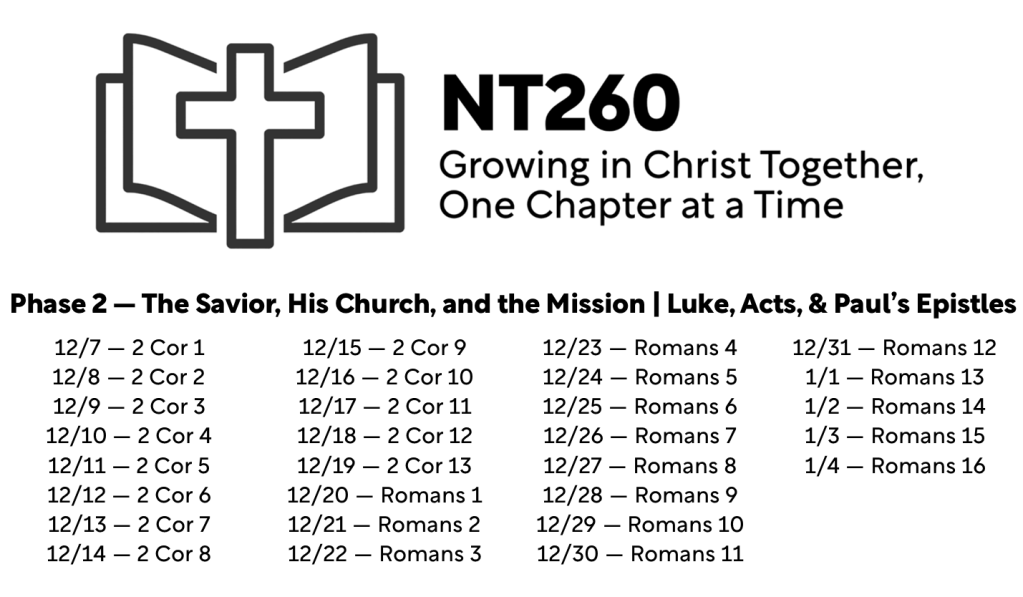
This phase will have us reading about Jesus’s life in the gospel of Luke, the formation of the Church in Acts, and walk through the theology found in Paul’s letters that the Church needs to know about and live out the eternal life given by grace through faith in Jesus.
Below, you’ll find brief synopses of each book in this phase to help you understand the scope of the book and most importantly, how it fits into the full Story of the Bible.
When you click on each day’s link, you will find a link to audio, a summary of the chapter, a key verse from the chapter, and opportunities for reflection and outreach.
We’re moving into Paul’s epistles, which we’ll go through chronologically rather than in the order they appear in our Bibles.
2 Corinthians
Paul writes 2 Corinthians after a painful season with the church in Corinth. Some had challenged his integrity and authority, and the church was divided. When Titus brought news that many had repented, Paul responded with this deeply personal letter (2 Corinthians 7:5–16). He defends his ministry not by boasting in strength but by pointing to his suffering and God’s comfort: “the Father of mercies and God of all comfort” meets us in affliction so we can comfort others (2 Corinthians 1:3–7). Paul explains that his trials don’t disprove his calling—they display Christ’s life in a fragile jar of clay (2 Corinthians 4:7–12, 12:9–10).
The letter moves through pastoral appeals and rich teaching. Paul announces the glory of the new covenant, where the Spirit gives life and transforms believers into Christ’s image (2 Corinthians 3:6, 17–18). He proclaims reconciliation: in Christ, God makes us new and entrusts to us the message of reconciliation—“be reconciled to God” (2 Corinthians 5:17–21). He urges holiness and wholehearted devotion to the Lord (2 Corinthians 6:14–7:1), calls the church to forgive and restore the repentant (2 Corinthians 2:5–8), and encourages generous giving for the saints in need (2 Corinthians 8–9). In the closing chapters, he confronts false apostles and “boasts” in his weaknesses so that Christ’s power might be seen (2 Corinthians 11:23–30, 12:9).
In the story of salvation, 2 Corinthians shows how God’s strength shines through human weakness. The crucified and risen Christ brings a new creation, writes His law on our hearts by the Spirit, and sends us as ambassadors of His grace (2 Corinthians 3:3, 5:17–20). Until we stand before Christ’s judgment seat, we live by faith—not by sight—seeking to please Him, comfort His people, and spread the aroma of His gospel in the world (2 Corinthians 5:7–10, 2:14–17).
Paul wrote Romans around A.D. 57 while he was in Corinth, near the end of his third missionary journey (Romans 16:1–2, 23; Acts 20:2–3). He addressed the letter to believers in Rome—a church he had not yet visited but deeply desired to see (Romans 1:10–13). The Roman church was made up of both Jews and Gentiles, and tensions had developed over how God’s law, faith, and daily Christian living fit together (Romans 14:1–15:7). Paul wrote to explain the gospel clearly, to unite the church around that gospel, and to prepare them to partner with him in future mission work, especially his planned journey to Spain (Romans 15:22–24).
At the heart of Romans is the gospel—the good news that God’s righteousness is revealed through Jesus Christ (Romans 1:16–17). Paul shows that all people, without exception, are sinners in need of salvation—both Jews under the law and Gentiles without it (Romans 1:18–3:20). No one is made right with God by works; instead, sinners are justified by grace through faith in Christ alone (Romans 3:21–26, 4:16). Using Abraham as an example, Paul explains that God’s promise has always been received by faith, not earned by obedience (Romans 4:1–5, 23–25). Jesus’s death and resurrection stand at the very center of God’s saving plan (Romans 5:6–11).
Romans also explains what the gospel accomplishes in the life of the believer. Those who are united to Christ are no longer slaves to sin but are given new life through the Holy Spirit (Romans 6:4–14, 8:1–11). Believers now live with peace with God, assurance of salvation, and a certain hope of future glory—even in suffering (Romans 5:1–5, 8:18–39). Paul addresses the difficult question of Israel’s place in God’s plan, showing that God is faithful to His promises and sovereign in salvation, working all things according to His mercy and wisdom (Romans 9–11).
In the story of salvation, Romans shows how God’s Old Testament promises are fulfilled in Jesus and how the gospel creates one new people—Jew and Gentile together—united by faith (Genesis 12:3, Romans 15:8–13). This gospel does not merely save; it transforms. Because of God’s mercy, believers are called to live holy lives marked by humility, love, service, and hope (Romans 12:1–2, 13:8–10). Romans helps us understand both what the gospel is and how to live it out, all for the glory of God among the nations (Romans 11:33–36, 15:5–6).
Paul looks honestly at life, death, and eternity. Our bodies are like fragile “tents” that will one day be taken down, but believers have the sure promise of a permanent, resurrection “building from God” that is eternal and secure (vv. 1–4). Because God has given us the Spirit as a guarantee, we can be confident—even as we groan in weakness now—that to be away from the body is to be at home with the Lord (vv. 5–8). This future hope shapes our present purpose: whether we are here or with Him, our aim is to please Christ, knowing that we will all appear before His judgment seat to receive what is due for what we have done, whether good or evil (vv. 9–10).
This leads straight into Paul’s description of the gospel and our mission. The “fear of the Lord” and the love of Christ together drive him to serve and persuade others (vv. 11, 14). Because Christ died and was raised, those who belong to Him no longer live for themselves but for Him (vv. 14–15). In Christ, we are a new creation—the old has passed away and the new has come (v. 17). God has reconciled us to Himself through Christ and entrusted to us the ministry and message of reconciliation, so that we now serve as ambassadors for Christ, pleading with the world: “Be reconciled to God” (vv. 18–20). At the heart of this message is the staggering truth that God made Him who knew no sin to be sin for us, so that in Him we might become the righteousness of God (v. 21).
🌀 Reflection: Where do you feel the “groaning” of life in your earthly tent right now (vv. 2–4)? Bring that place honestly to Jesus, and ask Him to help you live today with two things in view: the aim of pleasing Him (v. 9) and the privilege of representing Him as His reconciled, new-creation ambassador (vv. 17–20).
💬 Mission Challenge: Initiate one gospel-shaped conversation this week—share with someone (briefly and in your own words) what it means that God is reconciling sinners to Himself through Christ, and use 2 Corinthians 5:21 as the verse that anchors what you say.