But as for me, I shall walk in my integrity; redeem me, and be gracious to me. My foot stands on level ground; in the great assembly I will bless the LORD.
Psalm 26:11-12
Psalm 26 is a prayer of confidence and commitment to walking in integrity before God. David appeals to God for vindication, affirming his trust and faithfulness in the midst of a corrupt world. His prayer reflects a heart committed to holiness, worship, and reliance on God’s steadfast love and faithfulness (without which neither David nor us would be able to be holy or stand before God).
David begins with a declaration of his integrity and trust (v. 1). His pleas that follow are not self-righteous boasting but again a plea to God based on God’s consistent character and faithfulness. David knows God and understands how God had worked and was currently working in his life. This is why David openly invited God to test his heart and mind, knowing that God’s steadfast love and faithfulness are ever before him (vv. 2-3).
In vv. 4-5, Psalm 26 transitions to a rejection of worldly wickedness and hypocrisy (similar to the contrast in Psalm 1). He refuses to associate with evildoers and hypocrites, distancing himself from their schemes. His separation of sin is paired with his love for worshiping the Lord. His heart is set on the “habitation of God’s house” and the glory of God’s presence (vv. 6-8). He declares his innocence symbolically through the washing of his hands and offering thanksgiving to God.
David also expresses his confidence in God’s justice, asking to be separated from sinners in judgment (vv. 9-10). His trust in God leads him to reaffirm his commitment to walk in integrity. He concludes with further confidence that his feet stand on level ground and that he will bless the Lord in the great assembly (vv. 11-12).
Seeing Jesus in Psalm 26
Psalm 26 ultimately points to Jesus as the true Man of integrity. While David’s integrity was obviously imperfect, Jesus perfectly fulfilled God’s standard of holiness and righteousness. He lived without sin, fully trusting in His Father and walking blamelessly.
Jesus also fulfills David’s longing for the “habituation of God’s house” and the “place where [His] glory dwells” (v. 8). In Christ – Emmanuel (God with us), we have access to the presence of God, believers becoming the temple where His Spirit dwells (Ephesians 2:22).
Reflection
As followers of Jesus, we are called to live lives of integrity, not on our own merits or abilities but empowered by His Spirit. Our confidence is not in our own righteousness but in the perfect righteousness of Christ, who enables us to walk faithfully before God.
Psalm 26 challenges us to live that life of integrity. Ask yourself the following questions and reflect on them.
Are you willing to invite God to examine your heart and mind as David did?
Do you distance yourself from sin while pursuing the joy of worship and fellowship with God’s people?
How does the integrity of Jesus encourage and empower you to walk faithfully before God?
Take time to pray, asking God to test your heart, deepen your love for Him, and guide you in integrity. Rejoice in Jesus’s righteousness, which covers and sustains you as you bless the Lord in the assembly of His people.
The #dailyPSALMSchallenge gives us the opportunity to start 2025 in God’s Word by digging into a psalm a day. Each day will identify a key passage for us to meditate on as well as seeking to help us see Jesus in the psalm and reflect on what we have read.
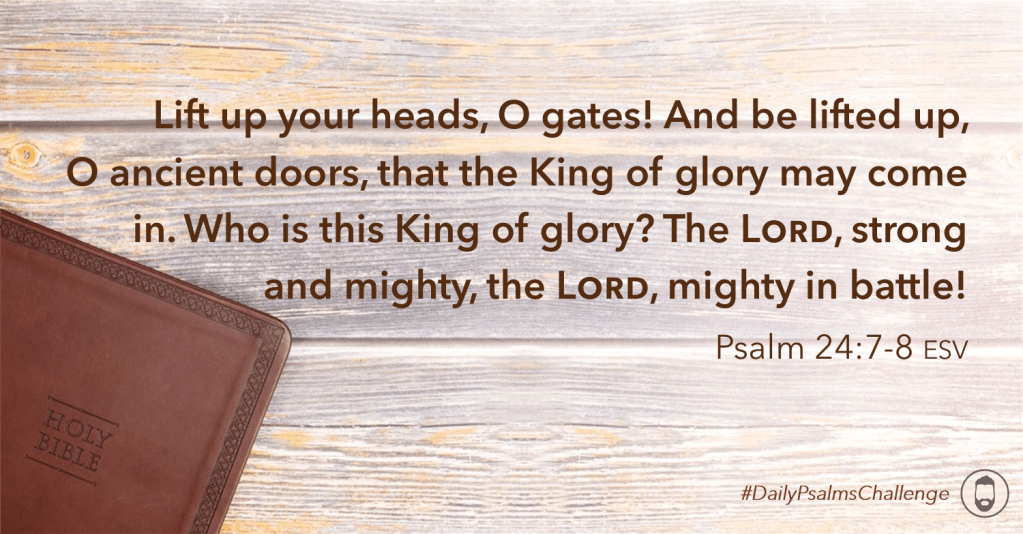
Lift up your heads, O gates! And be lifted up, O ancient doors, that the King of glory may come in. Who is this King of glory? The LORD, strong and mighty, the LORD, mighty in battle!
Psalm 24:7-8
Psalm 24 is a majestic declaration of God’s greatness, His rightful place as ruler over all creation, and the glory of His presence. Traditionally, this psalm is connected to the Ark of the Covenant arriving in Jerusalem in 2 Samuel 6. The Ark of the Covenant symbolized God’s presence among His people (especially the Mercy Seat on its top), but this psalm transcends the Ark and Israel because we know the answer to Psalm 24’s question of “Who is this King of Glory?” – His name is Jesus!
David begins Psalm 24 by asserting that the earth and everything in it belongs to the Lord because He founded and established it (vv. 1-2). He is the Creator and therefore the rightful owner of everything that is, including every person. This foundational truth reminds us that our lives are not our own; we belong to God who made us for His purposes.
In vv. 3-6, David asks an important question: “Who shall ascend the hill of the LORD? And who shall stand in His holy presence?” (v. 3). Then, David promptly answers by saying that only those with “clean hands” and a “pure heart” may enter into God’s holy presence (v. 4). These qualifications reveal two things: 1)God is immensely holy, pure, and perfect, and 2)humanity is immensely, well, not. It is impossible for sinful humanity to stand before God on our own merit. Clean hands refers to righteous actions and deeds, and a pure heart references cleanliness in our motives and minds. Religion cannot produce this; only a life fully devoted to God in truth and righteousness.
Psalm 24 then crescendos in vv. 7-10 with a triumphant call to open the gates for the King of Glory. The repetition of the question referenced above – “Who is this King of Glory?” – underscores His unmatched majesty. He is “the LORD, strong and mighty, the LORD, mighty in battle” (v. 8). This imagery celebrates God as the victorious Warrior-King who reigns supreme over all creation. Ultimately, this points to Jesus, the King of Glory.
Seeing Jesus in Psalm 24
As stated multiple times above, this psalm very clearly points to Jesus. He is the Creator through whom all things were made (John 1:1-3). He is the sinless Son of God who alone has clean hands and a pure heart. He not only can ascend the hill of the Lord but descended down to where we are, making Himself like us so that He can carry us up the hill – which is essential for us to understand because He is the only Way we will make it (John 1:14, 14:6)!
Potentially the most important connection in Psalm 24 is its ties to the Ark of the Covenant entering the city. The Ark was never meant to be more than a representation of God’s presence going before them and being among them. Jesus is the better Ark. After His victory over sin, Jesus entered the heavenly sanctuary – ascended the holy hill – as the victorious King (Hebrews 9:24). More than that, Jesus Himself IS the mercy seat!
The mercy seat was where the priest sprinkled the blood on Yom Kippur, the day of atonement. The word the author of Hebrews used in Hebrews 9:5 for mercy seat is the exact same word Paul used in Romans 3:25 for propitiation – atoning sacrifice. Jesus is the better Ark because He is not a shadow or symbol but the substance; His sacrifice was once for all (Hebrews 7:27, 10:10). He is the King of Glory! He is the atoning sacrifice for our sins! He is God! And He is good!
The gates of heaven open wide for Him, and He now reigns as the exalted Lord. Revelation 19:11-16 vividly portrays Jesus as the rider on the white horse, leading the armies of heaven in final victory. When He returns, the King of Glory will bring the fullness of His kingdom to earth, and every knee will bow before Him!
Reflection
Psalm 24 challenges us to examine our hearts and lives. Are our hands clean and our hearts pure before God? On our own, we fall short of His holy standard. But the gospel assures us that through Jesus, we can be washed clean and made new.
As you reflect on this psalm, consider these question. Are you living as though your life belongs to God? Are you seeking His presence daily with a heart devoted to Him?
Take time to marvel at Jesus’s majesty, the King of Glory who reigns in power and grace. Lift up your heart in worship, for He is worthy. Let the gates of your life be opened wide to welcome Him in.
The King of Glory has come, and He is coming again. Are you ready to meet Him?
Here’s a good song to help you meditate on Jesus, the “King of Glory”:
The LORD is my shepherd; I shall not want…. Surely goodness and mercy shall follow me all the days of my life, and I shall dwell in the house of the LORD forever.
Psalm 23:1, 6
Psalm 23 is among the most beloved and often quoted passages of Scripture, offering profound comfort and hope. It uses two main illustrations: the Lord as Shepherd (vv. 1-4) and the Lord as Host (vv. 5-6). These metaphors vividly illustrate God’s care, guidance, protection, and provision for His people.
David begins with the declaration that “The Lord is [his] shepherd” and that because He is he “shall not want” (v. 1). This is not just a statement of confidence but more of a deep personal affirmation of David’s trust in his Lord. In the ancient world, kings were often compared to shepherds, tasked with providing for and protecting their people. Here, David, Israel’s literal shepherd-king, acknowledges that he himself is a sheep under the care of the Chief Shepherd.
God provides abundantly for His flock. The “green pastures” and “still waters” (v. 2) symbolize rest, nourishment, and peace. The Shepherd knows what His sheep need and leads them accordingly. Even in “the valley of the shadow of death” (v. 4), the darkest and most dangerous of places, the sheep are secure. Why? Because the Shepherd is there. His rod (used for protection) and His staff (used for guidance) bring comfort and assurance.
Psalm 23 then shifts from the image of a shepherd to that of a host preparing a large and lavish banquet. The phrase “You prepare a table before me in the presence of my enemies” (v. 5) speaks of victory, provision, and honor. In the face of opposition and perceived danger, God sustains and blesses His people. Anointing the head with oil was a sign of hospitality and joy, and the overflowing cup reflects the abundance of God’s blessings.
It concludes with the confidence that God’s goodness and mercy (His steadfast love, His chesed) will pursue His people all the days of their lives, culminating in their dwelling with Him forever (v. 6), when He will no longer pursue because we will be safe in His presence.
Seeing Jesus in Psalm 23
Jesus is the fulfillment of Psalm 23. He is the Good Shepherd who laid down His life for His sheep (John 10:11). Just as David declared, “He restores my soul” (v. 3), Jesus restores the lives of those He saves, leading them on paths of righteousness for His name’s sake.
In the New Testament, Jesus embodies both Shepherd and Host. He leads His followers through the trials and dangers of life, offering His constant presence and peace as Emmanuel (God with us). Through His death and resurrection, He conquered the ultimate valley of death, not merely its shadow (v. 4), ensuring that His sheep will never be abandoned or forsaken.
The table prepared “in the presence of…enemies” (v. 5) points forward to the victory banquet (marriage supper) of the Lamb (Revelation 19:9), where Jesus invites His people to eternal fellowship with Him, dwelling in His house forever and His goodness and mercy will no longer follow but be the ambiance of God’s glory in His house forevermore (v. 6)!
Reflection
Psalm 23 invites us to rest in the care of the Good Shepherd. Are you weary, burdened, or fearful? Remember that Jesus not only walks you through life’s green pastures but also through its darkest valleys. His presence and protection are enough.
Take time today to reflect on God’s abundant provision and steadfast love in your life. Trust Him to lead, sustain, and guide you – even when the path ahead seems uncertain or fraught with danger or death. He is a Shepherd who never leaves His sheep, a Host who welcomes His people with joy, and a King who reigns with goodness and mercy.
Are you following the Shepherd’s voice today? Rest in the assurance that you are His, and He will guide you safely home.
The #dailyPSALMSchallenge gives us the opportunity to start 2025 in God’s Word by digging into a psalm a day. Each day will identify a key passage for us to meditate on as well as seeking to help us see Jesus in the psalm and reflect on what we have read.
Have y’all ever gotten something stuck in your mind that you just couldn’t get unstuck? Of course you have – everyone has experienced this at some point and time. For me, it is the key verse from John’s sermon last week, Romans 12:15:
Rejoice with those who rejoice, weep with those who weep.
It’s simple. Straightforward. Clear. As John explained to us, this verse is really only four words in the Greek, essentially “rejoice — rejoicers, weep — weepers”. We, those of us who are saved and have been adopted into God’s family and grafted into His church, are to be there for our brothers and sisters, hurting when they hurt. That’s what family does, right? It should especially be so in the family of God.
As I have pondered on that verse (really simmered or stewed like a crockpot), it has had me thinking on why it is to be this way. And essentially, I have arrived at the conclusion that it stems from us extending grace to others as Jesus has extended grace to us.
One Scripture that came to mind is from the Sermon on the Mount right after Jesus gave us what we call “The Lord’s Prayer”. Look at Matthew 6:14-15:
For if you forgive others their trespasses, your heavenly Father will also forgive you, but if you do not forgive others their trespasses, neither will your Father forgive your trespasses.
This is not saying that we earn God’s forgiveness by forgiving others. If that were the case, we’d have no hope because humanity as a whole is not a forgiving people but rather quite selfish and self-serving. No, what Jesus is saying here is that the way we forgive is based on how we have been forgiven. If we understand that our sin put us at odds and enmity with Jesus and that He reconciled us to Himself and showed us love while we were still sinners, we will have an appreciation for that love and forgiveness that will show in how we forgive others.
This isn’t some theory on my part or some great epiphany. Jesus explained it similarly to Simon the Pharisee after the woman came in and washed Jesus’s feet with her tears, dried them with her hair, and anointed them with costly perfume. When Simon (and Jesus’s own disciples) were critical of the woman’s wastefulness with pouring out very expensive perfume on Jesus’s feet, Jesus told them that the woman’s sins “which are many” had been forgiven which was why she “loved much”, and He clarified that the one who has been “forgiven little, loves little” (Luke 7:47).
If you are saved, you know that you have been forgiven MUCH because your sin — no matter how the world might view it — is a LOT, and definitely more than our sinless Savior should’ve had to bear on the cross. We deserve the cross, not Jesus. We deserve death, not Jesus. But because of His great love and richness in grace and mercy, He forgave much, loved much, and gave much. That kind of forgiveness, love, and grace changes folks’ lives. If you are saved, you have received this from Jesus and cannot help but extend it to others.
Simon didn’t get it. He thought he had some earthly status as a Pharisee. But when you look at the other gospels, you get, as Paul Harvey would’ve said, the rest of the story. Matthew 26:6 doesn’t call Simon a Pharisee; there he is referred to as “Simon the leper”. You don’t have to read a lot of the Bible to know that folks typically kept their distance from lepers. They were considered unclean. Folks would walk on the opposite side of the road to keep from touching one. They surely wouldn’t touch one, much less go to his house for supper. Long story short, Jesus wasn’t at Simon’s house to honor him but because Jesus had compassion on those no one else did. Jesus was a friend to sinners. He ate with tax collectors. He showed compassionate care to those the world had thrown away. No one was lining up at Simon’s door because Simon was unclean, untouchable, and unmistakably ostracized from society. Yet he looked at that poor woman weeping at Jesus’s feet and had the audacity to remark how pitiful it is that Jesus would let her touch Him (when anyone passing by could’ve remarked how pitiful it was for Jesus to go in Simon the leper’s house).
Simon didn’t get it.
Do we?
That woman had received a lot of grace because she’d committed a lot of sin.
That woman had experienced greater love from God who not only forgave her sin but would go on to die on the cross her sin deserved.
That woman had reason to weep sorrowfully over her sin against a holy God but had more reason to weep out of rejoicing that her sin was wholly forgiven by God and show love to Him in return.
What about us? Do we get it?
Look at how Paul put it in 2 Corinthians 1:3-4:
Blessed be the God and Father of our Lord Jesus Christ, the Father of mercies and God of all comfort, who comforts us in our affliction, so that we may be able to comfort those who are in any affliction, with the comfort which we ourselves are comforted by God.
God has shown us grace and comfort because He loves us. We have the opportunity to show that grace and comfort to others. And this is sorely needed in a world today that seems like the rejoicing is getting more seldom and weeping is ever increasing.
Thankfully, Sunday’s coming. There is a coming Day when Jesus will return and gather His people to Him. The last tears of sorrow will be cried and wiped away by His nail-pierced hand. Death will be abolished. The sad things of this earth will come untrue. As the old hymn says, “What a Day — glorious Day — that will be!”
Until that day, we will gather and read God’s Word, sing God’s Word, and hear God’s Word preached. That’s what we’re singing about this Sunday: telling what Jesus has done for us. And as we do so, we will have brothers and sisters who are rejoicing about this or that. Rejoice with them. Assuredly there will be those with much to weep about. Weep with them. You have been given much grace and love. Christ Community family, it’s time to extend that grace and love to others.
Won’t you gather with us?
Here are our Scriptures & songs:
Scripture | Titus 3:1-7 —
1Remind them to be submissive to rulers and authorities, to be obedient, to be ready for every good work, 2to speak evil of no one, to avoid quarreling, to be gentle, and to show perfect courtesy toward all people. 3For we ourselves were once foolish, disobedient, led astray, slaves to various passions and pleasures, passing our days in malice and envy, hated by others and hating one another. 4But when the goodness and loving kindness of God our Savior appeared, 5He saved us, not because of works done by us in righteousness, but according to His own mercy, by the washing of regeneration and renewal of the Holy Spirit, 6whom He poured out on us richly through Jesus Christ our Savior, 7so that being justified by His grace we might become heirs according to the hope of eternal life.
17When I saw Him, I fell at His feet as though dead. But He laid His right hand on me, saying, “Fear not, I am the first and the last, 18and the living one. I died, and behold I am alive forevermore, and I have the keys of Death and Hades.
My God, my God, why have You forsaken me? Why are You so far from saving me, from the words of my groaning?
Psalm 22:1
Psalm 22 begins with a heart-wrenching cry: “My God, my God, why have You forsaken me?” (v. 1). David voices the raw emotions that come from feeling abandoned by God in amid intense suffering. He pleads for God’s presence, wrestling with the seeming silence of heaven even as he cries out day and night (vv. 1-2). This tension between despair and trust is central to the psalm.
While David feels forsaken, he also remembers the holiness and faithfulness of God: “In You our father’s trusted; they trusted, and You delivered them” (v. 4). He clings to this hope even as his circumstances overwhelm him.
David, in his agony, describes himself as “a worm and not a man”, scorned and mocked by those around him (vv. 6-7). His enemies taunt him, twisting his trust in God into mockery and ridicule: “He trusts in the Lord; let Him deliver him” (v. 8). At this point, David has become physically weak and broken – his strength dried up, his bones out of joint, and his hands and feet pierced (vv. 14-16). Even his garments are divided among his enemies (v. 18). This striking imagery paints a picture of unparalleled suffering that goes far beyond David’s personal struggles and points prophetically to the suffering Savior, Jesus.
Despite the suffering and feelings of abandonment, Psalm 22 doesn’t end in defeat. In v. 22, there is a sudden shift: “I will tell of Your name to my brothers; in the midst of the congregation I will praise You.” Those feelings of abandonment are replaced with David rejoicing in God’s faithfulness. As in many other psalms, we see David finding hope in the consistent nature of God’s character. Because of that, he knows that God has not despised or ignored him (v. 24). This praise expands beyond Israel to include “all the families of the nations”, who will remember and worship the Lord (v. 27) and concludes with the assurance that God’s righteousness will be proclaimed to future generations, declaring “He has done it” (v. 31).
Seeing Jesus in Psalm 22
Psalm 22 is tied to Jesus’s crucifixion as Jesus cried out the opening words from the cross: “My God, my God, why have You forsaken me?” (Matthew 27:46). Additionally, the vivid descriptions of pierced hands and feet (v. 16), divided garments (v. 18), and mocking enemies (vv. 7-8) are fulfilled in stunning detail and accuracy at Calvary. These connections reveal that David’s suffering pointed to Christ’s ultimate suffering, but Psalm 22 doesn’t end at the cross.
David’s shift from lament to praise reflects the resurrection, as Jesus declares, “I will tell of your name to my brothers” (v. 22, Hebrews 2:12). Through His death and resurrection, Jesus brings the nations ot worship God, fulfilling the psalms vision of the praise of the nations and eternal life (vv. 27-31). All in all, Psalm 22 reminds us that Jesus was truly forsaken so that we never have to be, and His victory ensures our hope.
Reflection
Psalm 22 invites us to honestly bring our pain to God, just as David and Jesus did. When we feel abandoned or overwhelmed, we can cry out to the Lord, trusting that He hears us even in His silence. At the same time, we are called to fix our eyes on God’s faithfulness – His deliverance in the past, His presence in the present, and His promises for the future.
Because Jesus bore the ultimate forsakenness on our behalf, we can trust that God is always with us, even in our darkest moments. As we meditate today on Christ’s suffering and victory, may we join David in proclaiming, “He has done it” (v. 31)!
The #dailyPSALMSchallenge gives us the opportunity to start 2025 in God’s Word by digging into a psalm a day. Each day will identify a key passage for us to meditate on as well as seeking to help us see Jesus in the psalm and reflect on what we have read.
For the king trusts in the LORD, and through the steadfast love of the Most High he shall not be moved…. Be exalted, O LORD, in Your strength! We will sing and praise Your power.
The Lord’s blessings are described as rich and enduring, granting the king life, glory, and joy in God’s presence (vv. 3-7). In vv. 8-12, the psalm shifts to the defeat of the king’s enemies, emphasizing that their plans will fail because of God’s power, and it concludes with exaltation and praise: “Be exalted, O Lord, in your strength! We will sing and praise Your power” (v. 13).
At its heart, Psalm 21 reminds us that the victory and joy of the king reflect the faithfulness and power of God. David’s trust in the Lord is a model for us as he relies on God’s steadfast love for security and success rather than trusting in his kingly or military strength or prowess (v. 7).
Seeing Jesus in Psalm 21
Psalm 21 points beyond David to Jesus, the ultimate King who fulfills His promises. Jesus trusted His Father perfectly and was crowned with glory through His life, death, and resurrection (v. 3, Philippians 2:8-11). The “length of days forever and ever” (v. 4) finds its true meaning in Jesus, whose resurrection secured eternal life for all who trust in Him and solidifies His eternal victory because His enemies pose no threat to Him or His people.
For believers, the joy of Jesus’s victory is our joy. Just as God’s blessings made David glad, Christ’s followers are blessed with the joy of God’s presence forever (v. 6, Revelation 22:5).
Reflection
What desires of your heart are you bringing before the Lord?
Psalm 21 reminds us that God’s blessings exceed our requests when we trust Him. Consider how Jesus’s victory brings assurance and joy to your life today. Take time to praise Him, exalting His power and faithfulness with the words of v. 13: “Be exalted, O Lord, in Your strength! We will sing and praise Your power.”
The #dailyPSALMSchallenge gives us the opportunity to start 2025 in God’s Word by digging into a psalm a day. Each day will identify a key passage for us to meditate on as well as seeking to help us see Jesus in the psalm and reflect on what we have read.
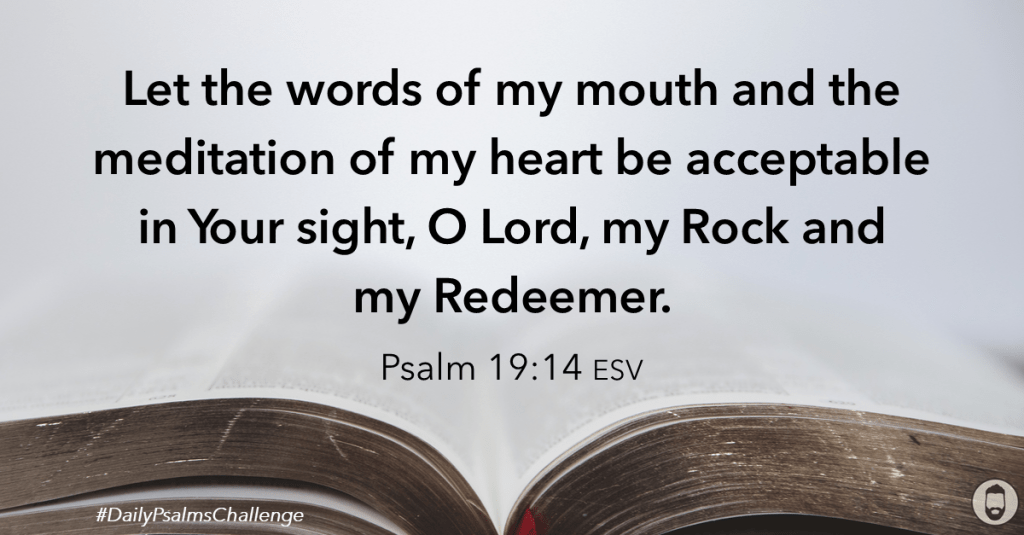
Let the words of my mouth and the meditation of my heart be acceptable in Your sight, O LORD, my Rock and my Redeemer.
Psalm 19:14
Psalm 19 is a celebration of God’s revelation of Himself to the world. These two revelations are known by the terms natural revelation and special revelation and are seen in Psalm 19 through God’s glory displayed in creation (vv. 1-6) and His grace revealed through His Word (vv. 7-14).
The heavens declare God’s majesty so powerfully that no one is able to say that there is no God and is without excuse (vv. 1-4; cf. Romans 1:20). David marvels at how the sun, like a joyous bridegroom or a victorious runner, hurries to proclaim God’s power and order (vv. 4-6). That’s what natural revelation does: proclaim God’s handiwork and point people toward Him. But natural revelation is not enough to bring people to saving knowledge of God. We need a specific introduction – a special revelation.
Psalm 19 transitions to the Word of God and God’s special revelation of Himself through it, which is described as perfect, trustworthy, right, radiant, pure and true (vv. 7-9). These descriptions highlight how Scripture revives the soul, makes the simple wise, rejoices the heart, and provides light for life’s path. As we read through the Psalms, this is what God’s Spirit does in our hearts as we read. Look at how David shows that he treasures God’s Word more than gold and finds it sweeter than honey (v. 10).
The end of Psalm 19 illustrates what an appropriate response to God’s revelation of Himself looks like. In vv. 12-14, David offers a brief and humble prayer for forgiveness, protection from his own sin, and a life pleasing to God. God’s Word – His revealing of Himself – changed David’s life (and can do the same for us).
Seeing Jesus in Psalm 19
Psalm 19 points to Jesus as the ultimate revelation of God (John 1:14, Hebrews 1:1-3) – a literal, incarnate face-to-face introduction of God and man. Jesus perfectly obeyed God’s law and revealed God’s glory in His life, death, and resurrection.
He is the Word made flesh (John 1:1-3, 14), and through Him alone can we be made acceptable in God’s sight, revealing the true and definitive response to David’s prayer (vv. 12-14). David prayed for God’s Word to guide him and protect him from sin; Jesus is the very Rock and Redeemer to perfectly answer his prayer!
Reflection
The skies and the Scriptures both testify to God’s glory and grace. Have you paused today to marvel at God’s creation or His Word? If you have read this far, you’ve spent time in His Word. Have you marveled at the power of God in keeping His Word so that you have it before you these millennia later?
Let David’s prayer in v. 14 be your prayer today: “Let the words of my mouth and the meditation of my heart be acceptable in Your sight, O LORD, my Rock and my Redeemer”, and know that, this is one more opportunity to sing and rejoice as we did in Psalm 18:46: “The LORD lives, and blessed be my Rock, and exalted be the God of my salvation”!
The #dailyPSALMSchallenge gives us the opportunity to start 2025 in God’s Word by digging into a psalm a day. Each day will identify a key passage for us to meditate on as well as seeking to help us see Jesus in the psalm and reflect on what we have read.
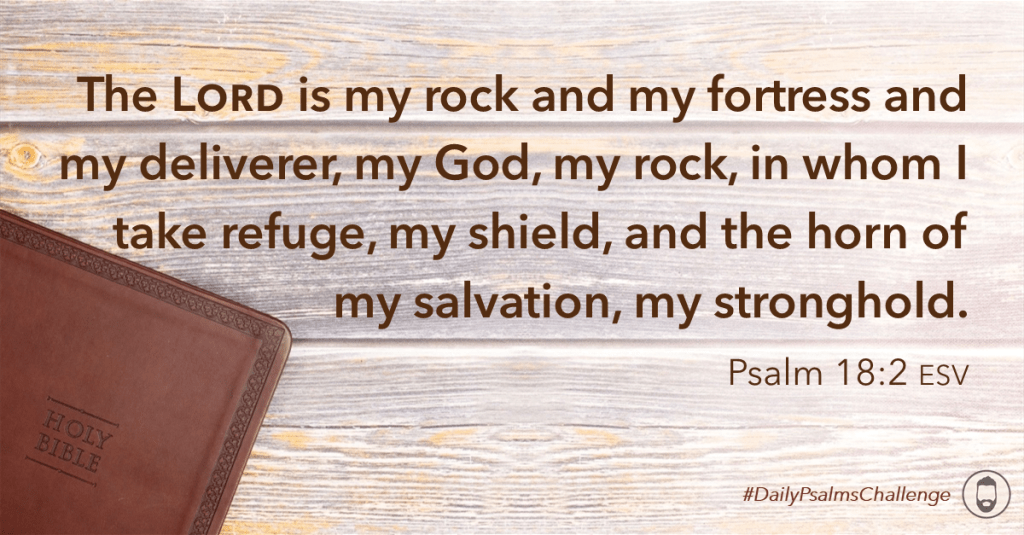
The LORD is my rock and my fortress and my deliverer, my God, my rock, in whom I take refuge, my shield, and the horn of my salvation, my stronghold.
Psalm 18:2
Psalm 18 is a song of triumph and thanksgiving from David to the Lord, celebrating God’s deliverance from King Saul. It is important to note that Psalm 18 is nearly identical to David’s song of praise in 2 Samuel 22 – the differences likely being Psalm 18 is adapted from David’s specific situation to be sung by the people (the Psalms is the songbook/hymnal of the Bible, remember). As such, this is not only a personal expression of David’s gratitude and praise but also a testimony to God’s faithfulness to His anointed king and His people. This psalm resonates with themes of refuge, rescue, and victory, ultimately pointing, as we’ll see later, to Jesus.
David opens with a declaration of love for the Lord, describing Him as his strength, rock, fortress, deliverer, and refuge (vv. 1-3). These metaphors emphasize God’s power, protection, and faithfulness. David’s words remind us that God is not some distant, uninvolved deity but a personal Savior who genuinely cares for His people.
The central part of the psalm recounts God’s dramatic intervention on David’s behalf (vv. 4-19). When David faced overwhelming danger, he cried out to the Lord, and God responded with awesome power. The imagery of the earth trembling, smoke rising, and hailstones falling paints a vivid picture of God as a divine Warrior, fighting for His anointed one. This points back all the way to the Lord’s deliverance of Israel from Egypt in the Exodus and points forward to His ultimate victory through Jesus.
David attributes his deliverance to his righteousness and integrity (vv. 20-24), not meaning that David was sinless but that he walked faithfully with God and sought to obey His commands. In the last part of the psalm, David praises God for equipping him for battle and giving him the victory (vv. 31-45) showing that he understood his victory was ultimately in the Lord’s goodness rather than his own. In fact, he acknowledges that every success of his was achieved as a result of God’s strength, guidance, and provision.
Psalm 18 concludes with a declaration of God’s faithfulness, not just toward David but also toward His people (vv. 46-50). David praises the Lord as his rock and Savior, again acknowledging that his victories are part of God’s covenant commitment to him and his descendants. Ultimately, this covenant finds fulfillment in Jesus, the eternal King and descendant of David, who brings salvation to all nations (Romans 15:9).
Seeing Jesus in Psalm 18
Psalm 18 foreshadows Jesus, the greater David. We can truly sing v. 46 in the context of Jesus: “The LORD lives, and blessed be my rock, and exalted be the God of my salvation”! The dramatic imagery of God’s intervention in David’s situation in this psalm reflects the power of the resurrection, where Jesus – the LORD – lives, defeating the ultimate enemies of sin and death (1 Corinthians 14:25-27).
Paul quotes v. 49 in Romans 15:9, showing that the salvation described in Psalm 18 is extended to the Gentiles through Jesus, who is the fulfillment of God’s promise to David – Jesus, who is the King who reigns forever and brings salvation to the ends of the earth.
Reflection
Psalm 18 invites us to rejoice in God’s faithfulness, to trust in His strength, and to find our ultimate hope in our eternal King, Jesus.
As you reflect on Psalm 18, ask yourself how you can apply the imagery of God as rock, fortress, and shield to your current circumstances. Have there been times when He has delivered you? If so, how did that strengthen your faith?
Pray or sing Psalm 18 and rejoice in the God of your salvation!
The #dailyPSALMSchallenge gives us the opportunity to start 2025 in God’s Word by digging into a psalm a day. Each day will identify a key passage for us to meditate on as well as seeking to help us see Jesus in the psalm and reflect on what we have read.
Every Sunday the Lord blesses us with is an opportunity to gather together and celebrate Jesus’s resurrection and anchor our heats in the hope of His return!
As we gather, we are reminded that the power of sin and death has been broken, and we rejoice in the steadfast love of the Lord, which turns mourning to dancing and sorrow into joy. This is illustrated in the passages we will read together Sunday morning.
The first passage is Psalm 30:8-12, and it beautifully captures this truth:
8To You, O LORD, I cry, and to the Lord I plead for mercy: 9“What profit is there in my death, if I go down to the pit? Will the dust praise You? Will it tell of Your faithfulness? 10Hear, O LORD, and be merciful to me! O LORD, be my helper!”
11You have turned for me my mourning into dancing; You have loosed my sackcloth and clothed me with gladness, 12that my glory may sing Your praise and not be silent. O LORD my God, I will give thanks to you forever!
In Psalm 30, David cries out to the LORD in his distress, and God answers, turning his mourning into dancing and clothing him with gladness (Psalm 30:11). This is the testimony of all who belong to Christ — to all who are rescued by Him from the sting of death and brought into everlasting life! This doesn’t mean that everything is always (or ever) hunky-dory or that we will never feel the sting of death here on earth. What this means is that death has an expiration date and that, if we are His, it is only temporary!
This victorious theme continues in our second passage for Sunday morning, 1 Corinthians 15:50-58:
50I tell you this, brothers: flesh and blood cannot inherit the Kingdom of God, nor does the perishable inherit the imperishable. 51Behold! I tell you a mystery. We shall not all sleep, but we shall all be changed, 52in a moment, in the twinkling of an eye, at the last trumpet. For the trumpet will sound, and the dead will be raised imperishable, and we shall be changed. 53For this perishable body must put on the imperishable, and this mortal body must put on immortality. 54When the perishable puts on the imperishable, and the mortal puts on immortality, then shall come to pass the saying that is written:
“Death is swallowed up in victory.” 55“O death, where is your victory? O death, where is your sting?”
56The sting of death is sin, and the power of sin is the law. 57But thanks be to God, who gives us the victory through our Lord Jesus Christ.
58Therefore, my beloved brothers, be steadfast, immovable, always abounding in the work of the Lord, knowing that in the Lord your labor is not in vain.
Throughout 1 Corinthians 15, Paul declares the certainty of Jesus’s resurrection and in 1 Corinthians 15:50-58, he calls us to steadfastness and hope in that certainty. Because Jesus has conquered death, our lives are filled with purpose. Every note we sing, every word we speak, every moment of worship is not in vain because our Savior — our GOD — is alive and not dead! It is part of God’s story of redemption because, if we are in Christ, we have been made alive in Him!
This Sunday (and honestly every Sunday at Christ Community), our hearts are fixed on Christ and excited by His resurrection. The songs we sing are about Him bearing our sin on the cross and giving life through His life when He exited His borrowed tomb. We will sing of it over and over again — as we should — because Jesus is alive and well, and we will do it all the more as we await His return!
John will open the Word and point us to Jesus.
We will lift our voices together, reading and singing, pointing each other to Jesus.
8To You, O LORD, I cry, and to the Lord I plead for mercy: 9“What profit is there in my death, if I go down to the pit? Will the dust praise You? Will it tell of Your faithfulness? 10Hear, O LORD, and be merciful to me! O LORD, be my helper!”
11You have turned for me my mourning into dancing; You have loosed my sackcloth and clothed me with gladness, 12that my glory may sing Your praise and not be silent. O LORD my God, I will give thanks to you forever!
50I tell you this, brothers: flesh and blood cannot inherit the Kingdom of God, nor does the perishable inherit the imperishable. 51Behold! I tell you a mystery. We shall not all sleep, but we shall all be changed, 52in a moment, in the twinkling of an eye, at the last trumpet. For the trumpet will sound, and the dead will be raised imperishable, and we shall be changed. 53For this perishable body must put on the imperishable, and this mortal body must put on immortality. 54When the perishable puts on the imperishable, and the mortal puts on immortality, then shall come to pass the saying that is written:
“Death is swallowed up in victory.” 55“O death, where is your victory? O death, where is your sting?”
56The sting of death is sin, and the power of sin is the law. 57But thanks be to God, who gives us the victory through our Lord Jesus Christ.
58Therefore, my beloved brothers, be steadfast, immovable, always abounding in the work of the Lord, knowing that in the Lord your labor is not in vain.
You make known to me the path of life; in Your presence there is fullness of joy; at Your right hand are pleasures forevermore.
Psalm 16:11
Psalm 16 begins with a petition of preservation but quickly turns to psalm of trust and contentment, a song of the confidence inspired by God’s faithful care. David declares his exclusive dependence on the Lord, acknowledging that God is the only good He has (v. 2).
David contrasts the joy of trusting in God with the fruitless sorrows of idolatry (vv. 3-4). His delight is the saints, God’s people, but he refuses to even speak the names of other/false Gods. The Lord Himself is David’s inheritance and portion, a reminder of God’s personal care and provision (vv. 5-6).
In vv. 7-8, David praises God for His guidance and presence, describing the stability and confidence that come from setting the Lord always before him. This unshakable confidence culminates in the hope of resurrection and eternal joy. David affirms that God will not abandon him to Sheol or let His “holy one” see corruption (v. 10), a prophecy fulfilled in the resurrection of Jesus (Acts 2:25-32, 13:35-37).
Psalm 16 concludes with a vision of eternal joy and life in God’s presence. For David, the path of life leads not only through this life but also to an everlasting relationship with God, where there is fullness of joy and eternal pleasures (v. 11).
Seeing Jesus in Psalm 16
Psalm 16 finds its ultimate fulfillment in Jesus. Peter and Paul both preached Jesus’s resurrection using this exact psalm, emphasizing that David’s words about not seeing corruption could not apply to David but pointed forward to Jesus (Acts 2:27-31, 13:35-37). Jesus is the true “holy one” who was not abandoned to the grave, and His resurrection is the foundation of our hope for eternal life.
As believers, we share in Christ’s victory over death. Jesus rose from the dead and will raise those who are saved by grace through faith in Him. In Christ, we have confidence that death is not the end and that eternal joy awaits us in God’s presence.
Reflection
Through Psalm 16, we are invited to rest in God’s care, rejoice in His guidance, and look forward with confidence to the fullness of joy that awaits in His presence forevermore.
Trust in God. Are you finding your security in the Lord, or are you tempted to chase after fleeting joys? Reflect on how God has been your refuge and portion.
Delight in God’s people. Do you take joy in fellowship with God’s people? Consider ways you can grow in love for and encouragement of the saints.
Rejoice in Jesus’s resurrection. How does it shape your views on life, death, and eternity? Meditate on the eternal pleasures promised in God’s presence.
The #dailyPSALMSchallenge gives us the opportunity to start 2025 in God’s Word by digging into a psalm a day. Each day will identify a key passage for us to meditate on as well as seeking to help us see Jesus in the psalm and reflect on what we have read.