Paul starts by telling the truth about who we were without Jesus: we were spiritually dead—stuck in trespasses and sins, shaped by the values of this world, pushed along by Satan’s influence, and controlled by the desires of our flesh (vv. 1–3). Even worse, we were “by nature children of wrath,” meaning God’s judgment was not a distant possibility but the verdict hanging over us because we belonged to Adam’s fallen family (v. 3; cf. Romans 5:12). There was no “try harder” solution here; dead people can’t fix themselves.
Then comes one of the greatest turns in the Bible: “But God” (v. 4). Because He is rich in mercy and full of great love, God acted when we could not. He made us alive together with Christ, raised us with Him, and seated us with Him in the heavenly places—so that forever His people would marvel at the riches of His grace and kindness (vv. 4–7; cf. 1:20–21). Salvation is not a paycheck for religious effort; it is a gift: by grace you have been saved through faith, and even that whole rescue—grace, faith, salvation—is not from ourselves (vv. 8–9). Yet grace doesn’t leave us unchanged. God recreates His people as His workmanship—new creations in Christ—so we can “walk” in the good works He prepared for us (v. 10; cf. 2 Corinthians 5:17).
Paul then zooms out from individual salvation to church unity. Gentiles once lived “far off”—cut off from the covenants and promises and without hope (vv. 11–12). But now, in Christ, they have been brought near by His blood (v. 13). Jesus Himself is our peace: by His cross He tore down the dividing wall, set aside what separated Jew and Gentile under the old covenant, and created one new humanity—one people—reconciled both to God and to each other (vv. 14–18; cf. Isaiah 57:19). So Gentile believers are no longer outsiders; they are fellow citizens with the saints and members of God’s household, built together on the foundation of the apostles and prophets, with Christ as the cornerstone (vv. 19–20). The church is now God’s living temple—Jew and Gentile together—where God dwells by His Spirit (vv. 21–22; cf. 1 Corinthians 3:16).
🌀 Reflection: Where do you still think you have to earn God’s welcome—like you’re a “near” person because you’re doing better lately—rather than living like someone who was “far off” but has been brought near only by the blood of Christ (v. 13)?
💬 Mission Challenge: Cross one boundary today. Reach out to a believer you don’t naturally connect with (age, background, personality, history) and take one step toward real unity—invite them to coffee, encourage them, or pray with them—because Jesus didn’t just save you from sin; He made you part of one new people (vv. 14–16).
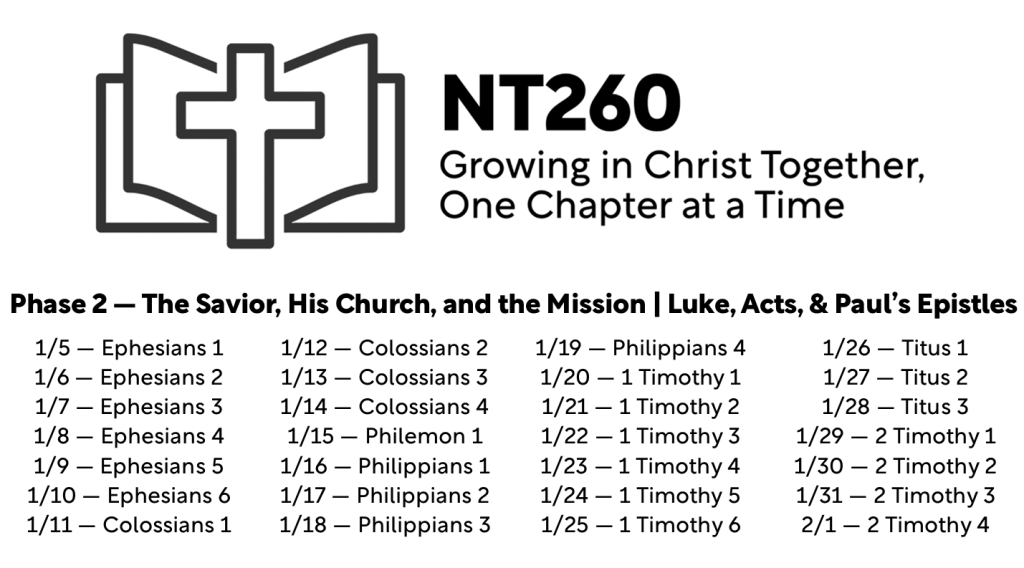
This phase will have us reading about Jesus’s life in the gospel of Luke, the formation of the Church in Acts, and walk through the theology found in Paul’s letters that the Church needs to know about and live out the eternal life given by grace through faith in Jesus.
Below, you’ll find brief synopses of each book in this phase to help you understand the scope of the book and most importantly, how it fits into the full Story of the Bible.
When you click on each day’s link, you will find a link to audio, a summary of the chapter, a key verse from the chapter, and opportunities for reflection and outreach.
We’re moving into Paul’s epistles, which we’ll go through chronologically rather than in the order they appear in our Bibles.
Ephesians
Ephesians is a letter written by the apostle Paul around A.D. 60–62 while he was imprisoned in Rome (Ephesians 3:1, 6:20; Acts 28). Although traditionally addressed “to the Ephesians,” the letter was likely intended as a circular letter for several churches in the region of Asia Minor, with Ephesus as its primary hub (Ephesians 1:1). Paul had spent several years ministering in and around Ephesus (Acts 19:10), but the letter’s broad and impersonal tone suggests he is addressing a wider group of believers. Rather than responding to a specific crisis, Paul writes to remind the church who they are in Christ and how they are to live in light of God’s saving work.
At the heart of Ephesians is the breathtaking truth that God is uniting all things in Christ (Ephesians 1:9–10). Paul begins by praising God for the spiritual blessings believers have received “in Christ,” including election, redemption through Christ’s blood, forgiveness of sins, and the sealing of the Holy Spirit (Ephesians 1:3–14). He then reminds readers of what God has done for them personally: though they were once dead in sin, God made them alive by grace through faith—not by works (Ephesians 2:1–10). This saving grace does more than rescue individuals; it creates a new people. In Christ, Jews and Gentiles who were once divided are now reconciled to God and to one another, forming one new humanity and one household of God (Ephesians 2:11–22).
In the story of the Bible, Ephesians lifts our eyes to the cosmic scope of redemption. What God promised throughout the Old Testament has come to fulfillment in Jesus Christ, and the church now stands at the center of God’s plan to display His wisdom and grace to the world—and even to the heavenly powers (Ephesians 3:10–11). Christ reigns over all authority and power, and the church is His body, filled by Him and united under His headship (Ephesians 1:20–23). This new covenant people exists by grace alone and lives for the glory of God, awaiting the final consummation of all things in Christ.
The second half of Ephesians shows how these glorious truths shape everyday life. Because believers have been called into one body, they are urged to walk in unity, holiness, love, and wisdom (Ephesians 4:1–6, 5:1–2). Paul applies the gospel to relationships in the home, the church, and the world, showing what it looks like to live as those who belong to Christ (Ephesians 5:21–6:9). The letter closes with a call to stand firm in spiritual battle, clothed in the armor God provides, relying on His strength rather than our own (Ephesians 6:10–18). Ephesians reminds us that the church does not create its identity—it receives it from Christ—and then lives it out for His glory until He brings all things to completion.
Colossians is a letter written by the apostle Paul, with Timothy alongside him, to believers in the small city of Colossae (Colossians 1:1). Paul likely wrote during his imprisonment, most commonly connected to his Roman imprisonment, around A.D. 60–62 (Colossians 4:3, 10, 18; Acts 28). The letter was carried by Tychicus, and Onesimus traveled with him (Colossians 4:7–9), linking Colossians closely with Philemon and placing it in the same “Prison Letters” cluster as Ephesians. Paul had not personally visited Colossae (Colossians 2:1). Instead, the church seems to have been founded through the ministry of Epaphras, who likely came to faith during Paul’s years in Ephesus and then returned home to proclaim the gospel (Colossians 1:7, Acts 19:10).
Paul writes because a dangerous teaching was unsettling the church and threatening their confidence in Christ. While scholars debate the exact label for the error, the letter itself makes clear what was happening: voices were pressuring believers to look beyond Jesus for spiritual “fullness,” protection, or maturity—through additional spiritual intermediaries, mystical experiences, and a regimen of rules or ascetic practices (Colossians 2:8, 16–23). There are Jewish elements (festivals, Sabbaths) and spiritual/angelic elements (“worship of angels”), along with the sense that special insight or extra steps were needed to be truly secure (Colossians 2:16–18). Epaphras was so concerned that he sought Paul’s help, and Paul responds by pulling the church back to the center: Christ is enough, and nothing must be allowed to diminish His supremacy or the believer’s identity “in Him” (Colossians 2:9–10).
In the overall story of the Bible, Colossians declares with stunning clarity who Jesus is and what His saving work has accomplished. Christ is the image of the invisible God, the creator and sustainer of all things—visible and invisible—and the One through whom God will reconcile all things to Himself (Colossians 1:15–20). He is not one spiritual option among many; He is Lord over every power and authority, and in Him the fullness of deity dwells bodily (Colossians 2:9–10, 15). Because believers are united to Christ, they share in His death and resurrection life: they have been delivered from darkness, forgiven, and brought into the kingdom of the beloved Son (Colossians 1:13–14, 2:11–14). That means they do not need other mediators, rituals, or spiritual add-ons to make them complete—God has already made them full in Christ (Colossians 2:10).
Colossians also shows how a Christ-centered gospel produces a Christ-shaped life. Since believers have been raised with Christ, they are called to set their minds on the things above, put off the old patterns of sin, and put on the new virtues that reflect the character of Jesus—compassion, kindness, humility, patience, love, and thankful worship (Colossians 3:1–17). Paul brings that transformation into everyday relationships and households, showing that the lordship of Christ reaches into the ordinary places of life (Colossians 3:18–4:1). In the end, Colossians is both a warning and an encouragement: don’t be captured by man-made religion or fear-driven spirituality, but hold fast to Christ—the Head of the church, the Savior who reconciles, and the victorious Lord who is sufficient for His people in every way (Colossians 1:18–20, 2:19).
Philemon is a short, one-chapter personal letter from the apostle Paul (with Timothy named alongside him) to a believer named Philemon, a leader in Colossae whose home hosted a local church (Philemon 1–2). It was written during Paul’s imprisonment, most likely in Rome, around A.D. 60–62, at roughly the same time as Colossians, and it travels with the same delivery team—Tychicus and Onesimus (Colossians 4:7–9). That connection matters: when the church in Colossae gathered to hear Colossians read aloud—Christ’s supremacy, the believer’s new identity “in Him,” and the call to put on love and forgiveness (Colossians 1:15–20, 2:9–14, 3:12–14)—Philemon would have heard those truths first, and then received a second letter that applied them to a real situation in his own home.
The situation centers on Onesimus, who had wronged Philemon in some way (likely by running away and possibly causing financial loss), but who encountered Paul and was converted to Christ (Philemon 10, 18). Paul then sends Onesimus back—not merely to “return property,” but to pursue reconciliation shaped by the gospel. The heart of Paul’s appeal is that the gospel transforms people and relationships: Onesimus, once “useless,” has become truly “useful” (Philemon 11), and Philemon is urged to receive him “no longer as a bondservant but more than a bondservant, as a beloved brother” (Philemon 16). Paul could have commanded, but for love’s sake he appeals, even offering to cover any debt Onesimus owes (Philemon 8–9, 18–19). In the story of redemption, Philemon is a small letter with a big message: because Christ has forgiven and reconciled us to God, believers are called to extend that same grace toward one another—letting Jesus be “over us” not only in doctrine, but in everyday obedience, forgiveness, and restored fellowship (Philemon 15–17; cf. Colossians 3:13).
Philippians is a warm, joy-filled letter written by the apostle Paul to the Christians in Philippi, a Roman colony in Macedonia and the first place in Europe where Paul established a church (Acts 16:12–40). From the beginning, this congregation had a special partnership with Paul: Lydia was the first convert, the Philippian jailer was brought to faith through God’s dramatic deliverance, and the church consistently supported Paul’s gospel work through prayer and generous giving (Acts 16:14–15, 33–34; Philippians 1:5, 4:15–16). Paul writes while imprisoned—most likely in Rome around A.D. 60–62—since he mentions the “praetorium” and “Caesar’s household,” and he speaks as though his case could soon end either in release or death (Philippians 1:13, 20–23; 4:22; cf. Acts 28:16, 30–31). The immediate occasion includes the Philippians’ gift sent through Epaphroditus and Paul’s desire to send news back—especially that Epaphroditus recovered from a serious illness and is returning to them (Philippians 2:25–30, 4:10–18).
Even so, Philippians is far more than a thank-you note. Its heartbeat is encouragement—calling believers to live as citizens of a heavenly kingdom in the middle of a proud Roman culture (Philippians 1:27, 3:20). Paul shows what that looks like through repeated themes of gospel-centered unity, humble service, steady joy, and faithful perseverance even in suffering (Philippians. 1:27–30, 2:1–4, 4:4–7). The centerpiece of the letter is the stunning portrait of Jesus in Philippians 2:5–11: though truly divine, Christ humbled Himself, took the form of a servant, and obeyed to the point of death on a cross—therefore God highly exalted Him so that every knee will bow and every tongue confess that Jesus Christ is Lord (Philippians 2:6–11). That Christ-shaped pattern then becomes the model for the church: Paul points to Christ first, and then to living examples like Timothy and Epaphroditus, urging the Philippians to put others first and to labor together for the gospel (Philippians 2:19–30).
Philippians also makes clear that spiritual growth is not passive. Paul presses the church to keep moving forward—never settling into spiritual complacency—because the gospel is too glorious and the world too dangerous for “coasting” (Philippians 1:25, 3:12–16). He warns them about false teachers who would replace Christ with confidence in the flesh, reminding them that righteousness comes through faith in Christ, not law-keeping or religious status (Philippians 3:2–9). Yet even while calling them to effort—“work out your own salvation with fear and trembling”—Paul anchors their confidence in God’s active grace: “for it is God who works in you, both to will and to work for his good pleasure” (Philippians 2:12–13). In short, Philippians teaches a church how to live with deep joy and deep humility, holding tightly to Christ, standing together in unity, and pressing on until the day when their King is fully revealed (Philippians 1:6, 10; 3:14, 20–21).
First Timothy is a pastoral letter from the apostle Paul to his younger coworker Timothy, whom Paul calls his “true child in the faith” (1 Timothy 1:2). Timothy had traveled and ministered alongside Paul for years (Acts 16:1–3, 19:22; Philippians 1:1), and at the time of this letter Paul had left him in Ephesus to help strengthen the church and confront serious problems there (1 Timothy 1:3). Ephesus was a major and influential city, and Paul had already warned that dangerous teachers would arise and draw people away from the truth (Acts 20:29–30). First Timothy addresses that exact kind of threat: teaching that sounded religious but produced confusion, pride, quarrels, and greed rather than love and godliness (1 Timothy 1:4–7, 6:3–10). Although some modern scholars dispute Paul’s authorship, the letter plainly names Paul as its author (1 Timothy 1:1), reflects a strong personal and autobiographical tone, and was received as Pauline and authoritative very early in the church’s life.
The timing likely fits after Paul’s first Roman imprisonment (Acts 28:16, 30–31). On the traditional understanding, Paul was released, continued mission work, and then later faced a second imprisonment that led to his death. In that window, 1 Timothy would fall in the early-to-mid 60s (often dated around A.D. 62–64), written from an unknown location while Timothy labored in and around Ephesus (1 Timothy 1:3, 3:14–15). Paul hopes to come to Timothy, but he writes so Timothy will know “how one ought to behave in the household of God,” which is the church (1 Timothy 3:14–15). In other words, this is not a detached manual—it’s an urgent, fatherly charge to protect the gospel and shepherd God’s people well (1 Timothy 1:18, 6:20–21).
A key thread through the whole letter is that right doctrine produces real-life change. Paul is not mainly interested in winning arguments; he is concerned that the true gospel leads to love from a pure heart, a good conscience, and sincere faith (1 Timothy 1:5). That’s why he keeps returning to the contrast: false teaching fuels empty speculation and moral collapse, but sound teaching produces visible godliness (1 Timothy 1:3–7, 4:6–16, 6:3–14). Paul anchors this in the message of salvation itself—God’s mercy to sinners in Christ (1 Timothy 1:12–16), the one Mediator who gave Himself as a ransom (1 Timothy 2:5–6), and God’s desire for the gospel to go to all peoples (1 Timothy 2:1–7, 4:10). Because the gospel is true, the church must be shaped by it in worship, leadership, relationships, and everyday conduct.
So Paul gives Timothy practical instructions that flow from the gospel: guard the church’s public worship with prayer, unity, and holiness (1 Timothy 2:1–15); appoint qualified overseers and deacons whose lives display maturity and self-control (1 Timothy 3:1–13); train for godliness and model faithful ministry (1 Timothy 4:6–16); honor and care for people wisely—older and younger, widows, elders, and even slaves—so that love and integrity mark the congregation (1 Timothy 5:1–6:2). He also warns against greed and calls believers to contentment, generosity, and a firm grip on “the faith” (1 Timothy 6:6–19). In the end, 1 Timothy is a clear call to protect the purity of the gospel and to show its power in the day-to-day life of the church—so that God’s household reflects God’s character and Christ’s saving work (1 Timothy 3:15–16).
Titus is a short pastoral letter from the apostle Paul to his trusted coworker Titus (Titus 1:1, 4). Like 1 Timothy, it’s written to a ministry partner who is helping establish and stabilize young churches, and it strongly links sound faith with godly living—belief and behavior belong together (Titus 1:1, 2:11–14). Though some modern scholars question Paul’s authorship, the letter clearly identifies Paul as its author (Titus 1:1), fits well with Paul’s theology, and was received early in the church as a Pauline, authoritative writing.
The letter is typically dated to the early-to-mid 60s (around A.D. 62–64), during the period after Paul’s first Roman imprisonment and before a later imprisonment that ended in his death (cf. Acts 28:30–31). Paul had recently ministered on the island of Crete and left Titus there to “put what remained into order” by appointing elders in the churches (Titus 1:5). Paul plans to meet Titus in Nicopolis (Titus 3:12), but in the meantime he writes with urgency and clarity, giving Titus marching orders for healthy church life.
A key reason for the letter is the presence of false teachers—especially those with a strong Jewish flavor (“the circumcision party”), who traffic in “myths” and distorted teaching while producing ungodly lives (Titus 1:10–16). Paul’s concern is not just their ideas but their fruit: they “profess to know God, but…deny him by their works” (Titus 1:16). In a culture known for disorder and immorality (Titus 1:12), that kind of “religion” would blend right in. Paul expects the gospel to do the opposite: to create a people whose lives make the message believable and beautiful (Titus 2:5, 8, 10).
So Titus gives a portrait of a healthy church. It starts with godly leadership—elders who are above reproach, able to teach what is true, and able to correct what is false (Titus 1:5–9). It includes firm handling of error and divisiveness (Titus 1:10–16, 3:9–11). And it presses the gospel into everyday life for everyone in the church—older and younger, men and women, and even servants—so that the church’s conduct “adorns” the doctrine of God our Savior (Titus 2:1–10).
At the heart of the letter are two gospel-rich summaries that show why Christian ethics matter. God’s grace has appeared in Jesus to save and to train His people to renounce ungodliness and live self-controlled, upright lives while waiting for Christ’s return—“our great God and Savior Jesus Christ” (Titus 2:11–14). And salvation is not earned by works, but comes by God’s mercy through the washing and renewal of the Holy Spirit—so believers devote themselves to good works as the fitting fruit of grace (Titus 3:4–8, 14). In short, Titus shows that the gospel doesn’t only rescue sinners—it reshapes communities, builds healthy churches, and sends believers into the world with a credible, compelling witness.
Second Timothy is Paul’s final and most personal pastoral letter to Timothy (2 Timothy 1:1–2). Like 1 Timothy, it addresses ministry in and around Ephesus and the need to guard the gospel against error, but the tone is different: this is a “farewell” letter written with death in view. Paul is imprisoned in Rome again—this time not in relatively open house arrest (Acts 28:16, 30–31), but “chained like a criminal” and expecting execution (2 Timothy 2:9, 4:6–8). Most date it during Nero’s reign, likely in the mid-to-late 60s (about A.D. 64–67).
The heart of the letter is a bold call to persevere in the gospel despite suffering. Paul urges Timothy not to shrink back in fear, not to be ashamed of Christ or of Paul’s chains, and to be willing to suffer for the gospel by God’s power (2 Timothy 1:7–8, 12). Timothy is to guard “the good deposit” of sound teaching “by the Holy Spirit” (2 Timothy 1:13–14), pass that gospel truth on to faithful men who will teach others (2 Timothy 2:2), and do the steady work of ministry even in a hard season (2 Timothy 2:3–7, 4:5).
Because Paul knows time is short, he speaks with clarity about what will threaten Timothy and the church: people who quarrel about words, drift into irreverent babble, and distort the truth (2 Timothy 2:14–18), and a worsening climate of godlessness and opposition in the “last days” (2 Timothy 3:1–9). The primary safeguard is not novelty but Scripture. Timothy is to continue in what he has learned, because the Scriptures are able to make one wise for salvation through faith in Christ, and because “all Scripture is breathed out by God” and equips the servant of God for every good work (2 Timothy 3:14–17).
The letter culminates in Paul’s solemn charge: “preach the word…in season and out of season” with patience and careful teaching (2 Timothy 4:1–5), because a time is coming when many will not endure sound doctrine (2 Timothy 4:3–4). Then, in one of the most moving moments in the New Testament, Paul reflects on his own finished race and sure hope: he is being “poured out,” but he looks ahead to “the crown of righteousness” that the Lord will give to all who love Christ’s appearing (2 Timothy 4:6–8). Even as friends have scattered and only Luke remains (2 Timothy 4:10–11), Paul’s confidence is steady: the Lord will bring him safely into His heavenly kingdom (2 Timothy 4:18). Second Timothy is, in the end, a last word from a spiritual father: hold fast to Christ, treasure the Scriptures, proclaim the gospel, and endure—because Jesus is worth it, and His coming is sure.
Paul opens Ephesians by reminding believers who they are: “saints” set apart for God, and “faithful” because they are in Christ (vv. 1–2). Then he launches into one long, worshipful sentence that praises God for His rescue plan. The Father chose His people in Christ before the foundation of the world—not because they were worthy, but because He is gracious—so that they would be holy and blameless before Him (vv. 3–6). In love, God predestined believers for adoption, making them His true heirs, and all of it is “to the praise of his glorious grace” (vv. 5–6).
That grace shows up most clearly in Jesus: in Him we have redemption through His blood, the forgiveness of our trespasses, according to the riches of God’s grace (vv. 7–8). And God is not only saving individuals—He is revealing His “mystery,” His long-planned purpose to unite (or “sum up”) all things in Christ—things in heaven and things on earth—when the fullness of time arrives (vv. 9–10; cf. Colossians 1:20). In Christ we have obtained an inheritance, because God works all things according to the counsel of His will, and He will finish what He planned (vv. 11–12; cf. Romans 8:28–30). When the Ephesians heard the word of truth and believed, they were sealed with the promised Holy Spirit—God’s own mark of ownership and protection—and the Spirit is the down payment that guarantees the full redemption still to come (vv. 13–14; cf. 2 Corinthians 1:22).
Paul then thanks God for their faith in Christ and love for the saints, and he prays they would not just know the truths of salvation but feel their weight in the “eyes of their hearts” (vv. 15–18). He asks God to give them spiritual wisdom to grasp their hope, God’s precious inheritance in His people, and the immeasurable greatness of His power toward believers (vv. 17–19). That power is the same power that raised Jesus from the dead and seated Him above every rule and authority—far above every rival power in this age and the age to come (vv. 20–21; cf. Psalm 110:1). God has put all things under Christ’s feet and made Him head over all things for the church, which is His body—His living people who represent His reign in the world (vv. 22–23; cf. Psalm 8:6).
🌀 Reflection: Ephesians 1 trains your heart to start with worship, not worry. If God chose you in Christ, adopted you, redeemed you, and sealed you with His Spirit, what fear or shame are you still carrying like it gets the final word (vv. 4–7, 13–14)?
💬 Mission Challenge: Pray Paul’s prayer for someone in your church today: ask God to open the “eyes of their heart” to hope, inheritance, and power in Christ (vv. 17–19). Then tell them one specific gospel blessing from this chapter that is true of them “in Christ” (vv. 3, 7, 13).
Paul closes Romans with something that feels very personal: gospel relationships. He commends Phoebe, a trusted servant (and likely courier of the letter) from the church at Cenchreae, and urges the Romans to welcome her in the Lord and help her in whatever she needs, since she has been a generous supporter of many believers (vv. 1–2). Then Paul pours out a long list of greetings—Priscilla and Aquila who risked their lives for him, the house church that meets in their home, early converts like Epaenetus, hard workers like Mary, Tryphaena, Tryphosa, and Persis, and dear saints like Rufus and his mother who had cared for Paul (vv. 3–15). The sheer variety of names highlights something beautiful: the church in Rome was made up of men and women, Jews and Gentiles, and people from many social backgrounds, all united in Christ and honored for faithful service rather than status (vv. 6–13). Paul ends this section by calling the church to express genuine family affection—“greet one another with a holy kiss”—and reminds them they are connected to the wider family of churches (v. 16).
But Paul doesn’t only end with warmth—he also ends with vigilance. He warns them to watch out for people who cause divisions and create obstacles contrary to the doctrine they have been taught, and he tells them to avoid such voices (v. 17). These teachers sound appealing, but they are driven by self-interest and use smooth talk to deceive the unsuspecting (v. 18). Paul rejoices that the Romans are known for obedience, and he urges them to be wise about good and innocent about evil (v. 19). Then he gives a striking promise: the God of peace will soon crush Satan under their feet—echoing God’s ancient promise of victory over the serpent (v. 20; cf. Gen. 3:15). After greetings from Paul’s ministry companions (including Timothy) and from Tertius, the scribe who wrote as Paul dictated, Paul ends with a doxology praising God who strengthens His people through the gospel—once hidden but now revealed through Scripture to all nations to bring about the obedience of faith—so that glory belongs forever to the only wise God through Jesus Christ (vv. 21–23, 25–27; cf. 1:5).
🌀 Reflection: Romans ends by reminding us that doctrine is meant to produce devotion and durable relationships. Who has “worked hard in the Lord” around you that you’ve overlooked or taken for granted (vv. 6, 12)? And are you just as intentional to guard unity and truth as you are to enjoy community (vv. 17–19)?
💬 Mission Challenge: Encourage one faithful servant in your church this week—someone who labors quietly like so many in Romans 16 (vv. 6, 12). Then protect unity by refusing to platform gossip, flattery, or divisive voices, and instead point someone back to the gospel that strengthens God’s people (vv. 17–18, 25–27).
Paul finishes his teaching on “the strong and the weak” by making the “strong” own the responsibility: real strength doesn’t insist on its own way—it bears with the failings of the weak and aims to build others up (vv. 1–2). Christ is the model. Jesus did not please Himself; He endured reproach and suffering in order to do the Father’s will and serve others (v. 3; cf. Ps. 69:9). Paul also reminds the church why the Old Testament still matters: what was written before was written for our instruction, so that through endurance and the encouragement of the Scriptures we might have hope (v. 4; cf. 2 Tim. 3:16–17). This leads into Paul’s prayer for unity—harmony that results in one voice glorifying God (vv. 5–6)—and his central command: welcome one another as Christ has welcomed you, for the glory of God (v. 7).
Then Paul lifts their eyes to the bigger story: Jesus became a servant to the Jews to prove God’s truthfulness and confirm His promises to the patriarchs, and He also saved Gentiles so they would glorify God for mercy (vv. 8–9). Paul strings together OT texts from the Law, the Writings, and the Prophets to show this was always God’s plan: Gentiles rejoicing with God’s people, praising the Lord, and hoping in the Root of Jesse—the Messiah who rules the nations (vv. 9–12; cf. Deut. 32:43, Ps. 117:1, Isa. 11:10). Paul ends this section with a prayer that fits the whole point: that the God of hope would fill them with joy and peace in believing, so they overflow with hope by the power of the Holy Spirit (v. 13).
In the rest of the chapter, Paul explains why he wrote so boldly to a church he didn’t plant: God gave him grace to serve as Christ’s minister to the Gentiles, and he sees his gospel work like a priest presenting an offering—Gentile converts made acceptable and sanctified by the Spirit (vv. 15–16). He boasts only in what Christ has done through him—by word, deed, and the Spirit’s power—as he preached from Jerusalem to Illyricum (vv. 18–19). Paul’s ambition has been pioneer mission work, preaching where Christ hasn’t been named (vv. 20–21; cf. Isa. 52:15), which is why he has been hindered from visiting Rome (v. 22). Now he hopes to come to them on his way to Spain and be helped by them (vv. 23–24, 28–29), but first he must deliver a collection from Gentile churches to the poor saints in Jerusalem—an act meant to strengthen unity between Jewish and Gentile believers (vv. 25–27). He closes by urging them to strive with him in prayer—for protection, for the gift to be received well, and for joyful fellowship when he finally arrives (vv. 30–33).
🌀 Reflection: Where do you most feel the pull to “please yourself” instead of building others up? Romans 15 says Christian maturity looks like Jesus—willing to carry burdens, pursue unity, and treat Scripture as a steady source of endurance and hope (vv. 1–4). The church’s unity isn’t a side issue; it is meant to make God’s glory visible as we worship “with one voice” (vv. 6–7).
💬 Mission Challenge: Pray for and support gospel work beyond your normal circle. Choose one missionary, church planter, or local evangelistic effort this week: encourage them with a message, intercede specifically for their protection and fruitfulness (vv. 30–32), and if possible give toward their work as a tangible act of partnership in the mission (vv. 24, 27).
Paul turns to a real-life church problem: believers disagreeing over “disputable matters”—issues Scripture neither clearly commands nor forbids. In Rome, some Christians felt freedom to eat anything and treat all days alike, while others (with more tender consciences, often shaped by Jewish law or pagan backgrounds) avoided certain foods and still honored particular days (vv. 2, 5). Paul’s command is simple but challenging: welcome one another—not to argue and win, but to live in peace as one family (v. 1). The “strong” must not despise the “weak,” and the “weak” must not condemn the “strong,” because God has welcomed them both (v. 3). Ultimately, each believer is the Lord’s servant, and it is before Christ—not one another—that we stand or fall (v. 4).
Paul grounds this unity in the lordship of Jesus. None of us lives to ourselves, and none of us dies to ourselves—we belong to the Lord (vv. 7–8). Christ died and rose again to be Lord of the living and the dead (v. 9). That means judgmental attitudes are out of place: we will all stand before God’s judgment seat and give account of ourselves (vv. 10–12). So instead of “judging” each other, Paul says we should “judge” something else—make a careful decision to avoid putting a stumbling block in a brother’s path (v. 13).
In the second half, Paul clarifies that nothing is unclean in itself (v. 14), yet conscience matters: if someone believes an action is wrong, to do it anyway is sin for them (vv. 14, 23). Love must govern liberty. If your freedom grieves or pressures a fellow believer, you are no longer walking in love (v. 15). The kingdom of God is not about food and drink, but about righteousness, peace, and joy in the Holy Spirit (v. 17). Therefore, we pursue what makes for peace and mutual upbuilding (v. 19), willingly limiting our freedoms when needed so we don’t harm God’s work in others (vv. 20–21). Faithful maturity doesn’t flaunt freedom—it uses freedom to serve.
🌀 Reflection: Are you more passionate about being “right,” or about building up your brother or sister? Romans 14 calls us to hold convictions with humility, to honor conscience, and to measure our “freedom” by love. Real maturity looks like Jesus—strong enough to lay down rights for the good of others (vv. 15, 19).
💬 Mission Challenge: Reach out to a believer whose preferences or convictions differ from yours. Listen without mocking or correcting, and encourage them in what you share in common—Jesus is Lord, and you both belong to Him (vv. 8–9). Then choose one practical way this week to pursue peace and build them up (v. 19).
Paul continues the “gospel-shaped life” he began in Romans 12 by turning to how Christians relate to civil government. Because God is ultimately sovereign, there is no governing authority that exists apart from His permission and providence (v. 1; cf. Dan. 2:21). So believers are called to live as good citizens—submitting to lawful authority, not as people who worship the state, but as people who worship God and recognize His ordering of society (vv. 1–2). Government is meant to restrain evil and promote good, and when it functions as it should, it serves as God’s instrument to uphold justice in a fallen world (vv. 3–4). That’s why Christians should obey not only to avoid consequences, but “for the sake of conscience” (v. 5), paying what is owed and showing respect and honor where it’s due (vv. 6–7; cf. Matt. 22:21).
But Paul also makes clear that our submission has a boundary: God is the highest authority. Scripture shows moments when God’s people must refuse commands that would require disobedience to Him (Acts 5:29). Still, the ordinary posture of the Christian is humble, respectful obedience—paired with a clear conscience before the Lord (vv. 1, 5).
Then Paul returns to the heartbeat of Christian ethics: love. “Owe no one anything, except to love each other” (v. 8). Love is the debt we never finish paying, because love fulfills the law’s commands toward our neighbor—keeping us from harm, dishonor, and selfishness (vv. 9–10; cf. Lev. 19:18). And Paul ends with urgency: we live in a decisive moment of history. The “night” is fading, the “day” is approaching, and Christ’s return draws nearer—so Christians must wake up, throw off the works of darkness, and put on the Lord Jesus Christ (vv. 11–14). Holiness isn’t vague: it means refusing patterns of sin, walking in the light, and refusing to “make provision for the flesh” (vv. 13–14).
🌀 Reflection: Where are you quietly “making provision” for sin—leaving the door cracked, keeping the option open, nursing the appetite? Romans 13 reminds us that grace doesn’t make us sleepy; it wakes us up. Since the day is near, we don’t just avoid darkness—we actively put on Jesus and learn to live like people of the coming kingdom (vv. 11–14).
🎆 New Year Reflection: A new year begins with a call to wake up. Romans 13 reminds us that time matters, eternity is near, and Christ is coming. As you step into this year, don’t drift or delay—put on the Lord Jesus Christ daily. Let this be a year marked not by spiritual complacency, but by watchful hope, obedient love, and lives shaped by the light of the coming King (vv. 11–14).
💬 Mission Challenge: Pray for a governing leader (local, state, or national) by name today, asking God to give wisdom and justice—and then practice honor in one concrete way (vv. 1, 7; cf. 1 Tim. 2:1–2). Let your respect be real, and look for a chance to show that your ultimate hope is not in rulers, but in Christ the King.
After eleven chapters of gospel mercy, Paul turns to gospel living: “present your bodies as a living sacrifice” (v. 1). Because God has saved us by sheer mercy (11:30–32), the fitting response is not a one-time offering but an all-of-life worship—our whole selves, in the real world, for God’s glory (v. 1; cf. 6:13). That means resisting the pressure of “this age” and being transformed from the inside out as God renews our minds—so we can actually discern and practice what pleases Him (v. 2; cf. Eph. 4:23). Paul’s point is not “look for special signs,” but let Scripture-shaped thinking produce Scripture-shaped living (v. 2).
That renewed mind shows up immediately in humility and service. Paul tells believers not to inflate themselves, but to think with sober judgment—recognizing that every Christian is gifted by grace, and no one is the whole body (vv. 3–5; cf. 1 Cor. 12:12–27). The church is “one body in Christ,” made up of different members with different functions, which means we belong to one another and need one another (vv. 4–5). So Paul calls us to actually use our gifts—whether serving, teaching, exhorting, giving, leading, or showing mercy—and to do it in a way that fits the grace God has given (vv. 6–8).
Then Paul paints what genuine love looks like when it’s Spirit-made and gospel-rooted. Love hates evil and clings to good (v. 9), honors others rather than competing for attention (v. 10), and serves the Lord with sincere zeal (v. 11). Love rejoices in hope, stays patient in suffering, and keeps praying (v. 12). It opens hands and homes to the saints (v. 13), blesses persecutors instead of cursing them (v. 14; cf. Matt. 5:44), and enters other people’s joys and sorrows (v. 15). It refuses pride, seeks peace when possible, and won’t repay evil for evil (vv. 16–18). Instead of taking revenge, it leaves justice with God (v. 19; cf. Deut. 32:35) and does active good even to enemies—because the gospel teaches us to overcome evil with good (vv. 20–21; cf. Prov. 25:21–22).
🌀 Reflection: Where do you feel the strongest pull to “fit the pattern” of this age—your thinking, your speech, your habits, your reactions? Romans 12 reminds us that real change starts when God reshapes the mind through His Word, and it shows up in humble service and sincere love—even toward people who don’t deserve it (vv. 2, 9–10, 17–21).
🎆 New Year Reflection: As this year closes, Romans 12 reminds us that the Christian life isn’t restarted with resolutions but renewed through mercy. God doesn’t ask for a perfect plan for the year ahead—He calls for a surrendered life today. As you step into a new year, offer yourself again to the Lord, trusting Him to do the transforming work as you live, love, and serve in response to His grace (vv. 1–2).
💬 Mission Challenge: Bless one person this week in a concrete way—especially someone hard to love: pray for them, speak honor over them, serve them, or meet a need. Do it intentionally as an act of worship, asking God to use your kindness to display Jesus (vv. 1, 14, 20–21).
Paul asks the question many would be afraid to ask: Has God rejected his people Israel? His answer is immediate and emphatic—“By no means!” (v. 1). Paul points to himself as living proof that God is still saving Jews (v. 1), and he reaches back to Elijah’s day, when it seemed like faithfulness had vanished—yet God had quietly preserved a remnant for Himself (vv. 3–4). In the same way, Paul says, there is “at the present time… a remnant, chosen by grace” (v. 5). And grace and works cannot be mixed: if salvation is by grace, it cannot be earned—otherwise grace would no longer be grace (v. 6; cf. 4:4–5). Many in Israel were hardened in unbelief, just as the Scriptures foretold (vv. 7–10), but that hardening is not the end of the story.
Paul then explains that Israel’s stumbling was not so that they would fall forever. God, in His wise providence, has used Israel’s trespass to bring salvation to the Gentiles—and even this is meant to stir Israel to jealousy, so that many will turn and be saved (vv. 11–14; cf. 10:19). Using the picture of an olive tree, Paul warns Gentile believers not to become proud: they were “grafted in” by faith, while some Jewish branches were broken off because of unbelief (vv. 17–20). The root supports them, not the other way around, so arrogance has no place in the church (v. 18). Paul calls them to a humble, persevering faith that remembers both the kindness and severity of God—kindness toward those who continue in faith, severity toward unbelief (v. 22). And the door of hope remains open: God is able to graft the natural branches back in again (vv. 23–24).
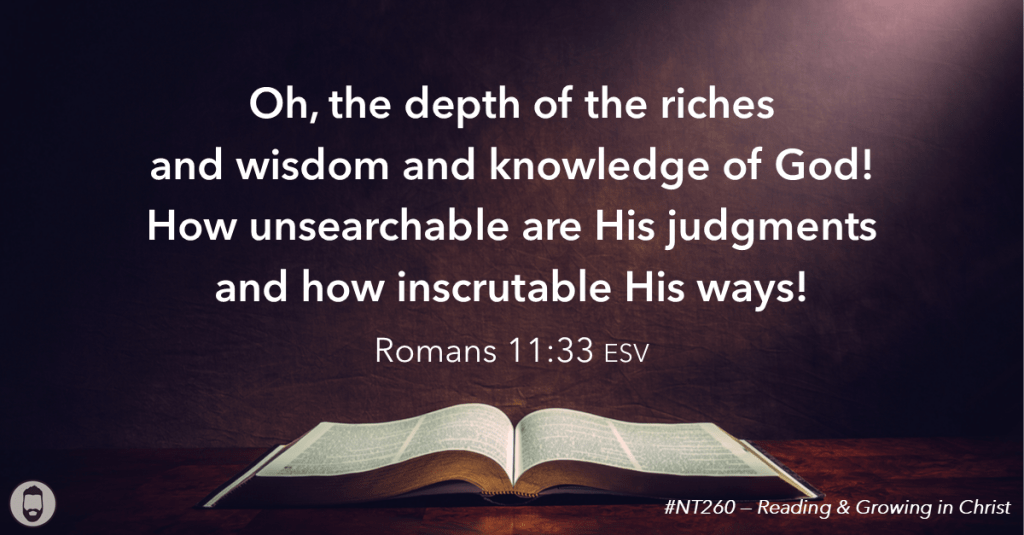
Finally, Paul reveals a “mystery”: Israel’s hardening is partial and temporary, lasting “until the fullness of the Gentiles has come in” (v. 25). In God’s saving plan, “all Israel will be saved” in the way He has ordained—through the Deliverer who takes away sins (vv. 26–27). Even now, Israel may stand as “enemies” regarding the gospel, yet they are still “beloved” regarding election, because God’s gifts and calling are irrevocable (vv. 28–29). God is weaving mercy through human disobedience—first mercy to Gentiles, and mercy also to Jews—so that no one can boast, and all salvation shines as mercy alone (vv. 30–32). Paul can only end one way: worship. “Oh, the depth of the riches and wisdom and knowledge of God!” (vv. 33–36).
🌀 Reflection: Romans 11 humbles us. We didn’t get “grafted in” because we were better, smarter, or more deserving—we stand by faith, supported by grace (v. 20; cf. Eph. 2:8–9). And it gives us hope: God is never done, never surprised, and never unfaithful to His promises—even when His ways are deeper than we can trace.
💬 Mission Challenge: Pray for someone you think is “too far gone,” and then reach out with a simple act of gospel kindness—an invitation, a conversation, or a Scripture shared—trusting that the God who grafts in outsiders can also bring the hardened to faith (v. 23).
Paul continues with a pastoral ache for Israel: “my heart’s desire and prayer… is that they may be saved” (v. 1). Many of his fellow Jews are sincere and zealous, but their zeal is misdirected because it isn’t shaped by the truth of God’s saving plan (v. 2). Instead of submitting to God’s righteousness—His way of making sinners right through Christ—they tried to establish their own righteousness through law-keeping (v. 3; cf. Phil. 3:9). But Christ is the goal and culmination of the law, and He also marks the end of using the law as a pathway to righteousness. Right standing with God belongs to “everyone who believes” (v. 4).
Paul then contrasts the way of works with the way of faith using the Old Testament itself. Leviticus shows that law-righteousness demands doing—and doing perfectly (v. 5; cf. Gal. 3:10). But Deuteronomy shows the nearness and accessibility of God’s saving word, now fulfilled in Christ who has come down from heaven and been raised from the dead (vv. 6–8). The gospel is simple and clear: confess with your mouth that Jesus is Lord and believe in your heart that God raised Him from the dead, and you will be saved (vv. 9–10). This promise is for all people—Jew and Gentile alike—because the same Lord bestows His riches on all who call on Him (vv. 11–13).
And if people can call on the Lord and be saved, then the message must be carried to them. Paul traces the “chain” of salvation backwards—calling, believing, hearing, preaching, sending—and celebrates the beauty of those who bring good news (vv. 14–15). Yet he also grieves: hearing is necessary, but hearing alone is not enough—many in Israel did not “obey” the gospel by believing it (v. 16). Even so, Israel cannot claim ignorance; the Scriptures foretold both Gentile inclusion and Israel’s resistance (vv. 18–21). The chapter ends with a stunning picture of God’s patience: He is still holding out His hands to a disobedient people (v. 21).
🌀 Reflection: Romans 10 presses two truths into our hearts at the same time: salvation is truly near—Christ is accessible by faith—and salvation is urgently personal—you must believe, confess, and call on Him. Zeal and sincerity aren’t enough if we refuse to submit to God’s righteousness in Jesus.
💬 Mission Challenge: Share Romans 10:9–13 with someone this week (in a conversation, a text, or a post), and invite them to respond to Jesus—not by trying harder, but by calling on the Lord who saves.


 Just Keith Harris