John 5 opens with Jesus going to Jerusalem for a feast and coming to the pool of Bethesda, where many suffering people were gathered (John 5:1–3). There He sees a man who had been disabled for thirty-eight years and, in sovereign mercy, chooses to heal him (John 5:5–6). The man does not display strong faith or even seem to know who Jesus is, yet Jesus speaks with authority: “Get up, take up your bed, and walk,” and immediately the man is healed (John 5:8–9). But instead of rejoicing, the Jewish leaders focus on the fact that the man is carrying his bed on the Sabbath (John 5:10). Their traditions had made them blind to the compassion and power of God standing in front of them. Later Jesus warns the healed man, “Sin no more, that nothing worse may happen to you,” reminding us that physical suffering is serious, but judgment is worse (John 5:14).
This healing becomes the setting for one of the clearest declarations of Jesus’ deity in the Gospel. When the Jewish leaders persecute Him for working on the Sabbath, Jesus answers, “My Father is working until now, and I am working” (John 5:16–17). They understand exactly what He means: He is calling God His own Father and making Himself equal with God (John 5:18). Jesus then explains that the Son does what the Father does, gives life as the Father gives life, and judges as the Father judges (John 5:19–22). The Father has given all judgment to the Son “that all may honor the Son, just as they honor the Father” (John 5:23). To refuse Jesus is not to honor God at all. But to hear His word and believe the Father who sent Him is to have eternal life already — to pass from death to life even now (John 5:24–25).
Jesus goes on to say that a day is coming when all who are in the tombs will hear His voice and rise, some to life and some to judgment (John 5:28–29). Then He lays out the witnesses that testify to who He is: John the Baptist, His works, the Father, and the Scriptures themselves (John 5:31–39). Yet the tragedy is that these leaders search the Scriptures while missing the One the Scriptures are about (John 5:39–40). They honor one another, but do not seek the glory that comes from God (John 5:44). Even Moses, in whom they trust, actually accuses them, because Moses wrote about Christ (John 5:45–46). John 5 shows that Jesus is not merely a healer or teacher. He is the divine Son who gives life, executes judgment, fulfills Scripture, and deserves the same honor as the Father.
🌀 Reflection: It is possible to know a great deal about Scripture and still miss Jesus. That is one of the sobering truths of John 5. The goal of reading the Bible is not simply to gather information, but to come to Christ and find life in Him. He alone can heal what is broken, save us from judgment, and bring us from death to life.
💬 Mission Challenge: Read one Old Testament passage today that points to Jesus, then share with someone how all of Scripture ultimately leads us to Him.
John 4 shows Jesus crossing boundaries that most people in His day would have never crossed. On His way from Judea to Galilee, He passes through Samaria and stops at Jacob’s well, where He speaks with a Samaritan woman who had come alone to draw water (John 4:4–9). Jesus begins with an ordinary request for a drink, but quickly turns the conversation to her deepest need by offering her “living water” (John 4:10). At first she misunderstands Him, just as Nicodemus had, thinking only of physical water (John 4:11–15). But Jesus lovingly exposes the truth about her life and shows that He knows her completely (John 4:16–18). What He offers is not temporary relief but eternal life through the Spirit — a gift that satisfies the thirsty soul forever (John 4:13–14; cf. Isa. 55:1–3).
As the conversation continues, Jesus leads her from questions about her sin to the bigger question of true worship (John 4:19–20). The Samaritans and Jews had long disagreed about where God should be worshiped, but Jesus says a new hour has come. True worship will not be tied to Mount Gerizim or Jerusalem, but to the Father Himself, through worship “in spirit and truth” (John 4:21–24). Salvation is from the Jews because God’s saving promises and the Messiah come through them (John 4:22), yet that salvation is not for Jews only. When the woman speaks of the coming Messiah, Jesus plainly tells her, “I who speak to you am he” (John 4:25–26). This is one of the clearest self-revelations in the Gospel so far. The woman leaves her water jar behind, goes into town, and becomes a witness, calling others to “Come, see” (John 4:28–30).
While the townspeople are coming, Jesus teaches His disciples that doing the Father’s will is better than food and that the fields are already white for harvest (John 4:31–38). Many Samaritans believe first because of the woman’s testimony and then because they hear Jesus for themselves (John 4:39–42). They confess that He is not merely a Jewish teacher, but “the Savior of the world” (John 4:42). The chapter ends with Jesus returning to Galilee and healing an official’s son from a distance by His word alone (John 4:46–50). This second sign shows again that Jesus is not limited by place or distance. The official begins with desperate need, but when he sees that Jesus’ word is true, he and his whole household believe (John 4:50–54). John 4 shows that Jesus brings living water to the thirsty, seeks true worshipers, and saves people from every kind of background.
🌀 Reflection: Jesus is not put off by our brokenness, shame, or background. He meets thirsty sinners where they are and offers what nothing else can give — life that truly satisfies. John 4 reminds us that the deepest need in every heart is not better circumstances, but Jesus Himself.
💬 Mission Challenge: Tell someone today what Jesus has done in your life, even simply, like the Samaritan woman did, and invite them to come and see who He is.
John 3 begins with Nicodemus, a respected Pharisee and ruler of the Jews, coming to Jesus by night (John 3:1–2). He knows Jesus must be from God because of the signs He has done, but Jesus goes straight past curiosity and straight to the heart: “unless one is born again he cannot see the kingdom of God” (John 3:3). Nicodemus is confused because he is thinking only in earthly terms, but Jesus explains that this new birth is a work of cleansing and transformation by the Spirit of God (John 3:4–8; cf. Ezek. 36:25–27). Flesh can only produce flesh, but only the Spirit can give spiritual life (John 3:6). In other words, religion, heritage, knowledge, and morality are not enough. Even “the teacher of Israel” needed a new heart (John 3:10).
Jesus then explains how this new life comes. The Son of Man must be “lifted up,” just as Moses lifted up the serpent in the wilderness, so that whoever believes in Him may have eternal life (John 3:14–15; cf. Num. 21:4–9). Then John gives the clearest summary of the gospel in all of Scripture: God loved the world by giving His only Son so that whoever believes in Him will not perish but have eternal life (John 3:16). Jesus was sent into the world to save, not because the world was good, but because it was already condemned and desperately needed rescue (John 3:17–18). The problem is not lack of light, but love for darkness. People cling to sin because they do not want their deeds exposed, but those who come to the light show that God is truly at work in them (John 3:19–21).
The chapter closes with John the Baptist joyfully stepping aside as Jesus’ ministry rises to the forefront (John 3:22–26). John refuses jealousy and embraces his God-given role: he is not the Christ, but the friend of the Bridegroom (John 3:27–29). That is why he can say, “He must increase, but I must decrease” (John 3:30). Jesus is from above, speaks the very words of God, has the Spirit without measure, and has all things placed into His hand by the Father (John 3:31–35). The chapter ends with a clear dividing line: whoever believes in the Son has eternal life, but whoever rejects the Son remains under the wrath of God (John 3:36). John 3 leaves no room for neutral ground. We must be born again, and that new life comes only through faith in Jesus.
🌀 Reflection: John 3 reminds us that Christianity is not mainly about becoming more moral or more religious. It is about being made new. We do not need a little improvement; we need new birth. The good news is that what we cannot produce in ourselves, God gives through His Son. The call is not to trust in our résumé, but to believe in Jesus and come into the light.
💬 Mission Challenge: Share John 3:16 with someone today, then tell them in your own words that Jesus did not come merely to make bad people better, but to give dead sinners new life.
John 2 begins with Jesus’ first sign at a wedding in Cana, where a moment of social embarrassment becomes a display of His glory (John 2:1–3). When the wine ran out, Jesus quietly turned water from the purification jars into an abundance of excellent wine (John 2:6–10). This was more than a miracle of kindness. It was a sign that the long-awaited Messiah had come, and with Him came something better than the old order could provide (John 2:11). The One introduced in John 1 as the eternal Word now reveals Himself as the gracious Bridegroom who brings fullness, joy, and blessing (John 2:9–11; cf. Isa. 25:6; Amos 9:13). His disciples saw this sign and believed in Him (John 2:11).
From Cana, Jesus goes to Jerusalem for Passover and enters the temple courts, where worship had been crowded out by commerce (John 2:13–14). With holy zeal, He drives out the sellers and money-changers and declares, “Do not make my Father’s house a house of trade” (John 2:15–16). Jesus is not being rash or merely angry. He is showing His authority as the Son and His passion for the true worship of God (John 2:16–17; cf. Ps. 69:9). The temple was meant to be a place where people could meet with God, but sinful hearts had turned it into something else. Jesus came not only to cleanse a corrupted place of worship, but to show that He Himself is the true temple where God is made known (John 2:18–21).
That is why Jesus answers the demand for a sign by speaking of His own body: “Destroy this temple, and in three days I will raise it up” (John 2:19). The people misunderstood Him, but after His resurrection the disciples remembered and believed (John 2:20–22). John closes the chapter by reminding us that Jesus sees deeper than outward excitement. Many were impressed by His signs, but Jesus knew what was in man (John 2:23–25). He is not looking for shallow amazement at miracles, but for true faith. John 2 calls us to see Jesus for who He really is: the glorious Son, the true temple, and the One who brings cleansing, joy, and resurrection life.
🌀 Reflection: It is possible to be impressed with Jesus and still not truly trust Him. John 2 reminds us that Jesus is not interested in shallow excitement or outward religion. He wants our hearts. He is the only One who can cleanse what is corrupted in us and fill what is empty with something far better than we could provide for ourselves.
💬 Mission Challenge: Examine one area of your life where worship has been crowded out, then bring that area to Jesus in prayer and share with someone today why He is worthy of more than surface-level belief.
John begins by lifting our eyes higher than Bethlehem, higher than the Jordan, and even higher than creation itself. Before anything was made, Jesus already was. He is the eternal Word, fully with God and fully God, the One through whom all things were made (John 1:1–3). In Him is life, and that life is the light for a dark world that cannot overcome Him (John 1:4–5). John the Baptist was sent to bear witness to that Light, but he was never the Light himself (John 1:6–8). When the true Light came into the world, many did not know Him, and even many of His own people did not receive Him (John 1:9–11). Yet to all who do receive Him and believe in His name, He gives the right to become children of God — not by human effort, family line, or fleshly will, but by God’s saving work (John 1:12–13; cf. John 3:3–8).
Then John gives one of the most staggering truths in all of Scripture: “the Word became flesh and dwelt among us” (John 1:14). Jesus did not stop being God; He took on humanity so that the glory of God could be seen in Him, full of grace and truth (John 1:14, 17–18; cf. Ex. 34:6). The law came through Moses, but in Jesus the fullness of God’s grace and truth has now been revealed (John 1:16–17). No one has ever seen God fully, but the Son has made Him known (John 1:18). John the Baptist makes this clear when he points to Jesus and says, “Behold, the Lamb of God, who takes away the sin of the world!” (John 1:29). Jesus is not only the eternal Word but also the promised Lamb, the Son of God, and the One who baptizes with the Holy Spirit (John 1:29–34; cf. Isa. 53:7; 1 Cor. 5:7).
The rest of the chapter shows what true witness looks like. John points away from himself to Jesus (John 1:35–37). Andrew comes to Jesus and then brings Peter (John 1:40–42). Jesus calls Philip, and Philip goes and tells Nathanael, inviting him to “Come and see” (John 1:43–46). As these first disciples meet Jesus, they begin to confess who He is: Rabbi, Messiah, Son of God, and King of Israel (John 1:38, 41, 49). Jesus promises that they will see even greater things, because He is the true meeting place between heaven and earth, the Son of Man in whom God reveals Himself and brings sinners near (John 1:50–51; cf. Gen. 28:12–17; Dan. 7:13–14).
🌀 Reflection: John 1 asks us the most important question we could ever answer: What will we do with Jesus? It is not enough to admire Him from a distance or speak well of Him in general terms. We must receive Him, believe in His name, and follow where He leads. The eternal Word became flesh so that sinners like us could know God, be forgiven, and become His children.
💬 Mission Challenge: Invite someone to “come and see” Jesus by sharing John 1:29 or John 1:14 with them today and telling them why those verses matter to you.
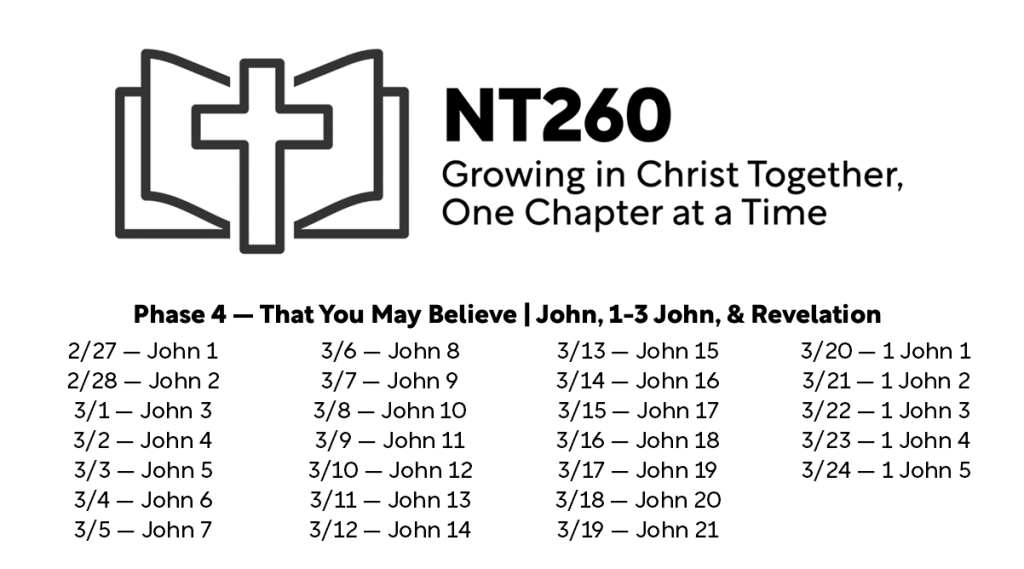
This phase reflects contains the apostle John’s writings. His gospel and letters teach us how to walk in truth in love. Revelation closes the New Testament with a powerful vision of Jesus’s return and eternal reign.
Phase 4 is the embodiment of two passages from the end of John’s gospel, so we’ll let the Holy Spirit through John explain:
John 20:30-31 —
Now Jesus did many other signs in the presence of the disciples, which are not written in this book; but these are written so that you may believe that Jesus is the Christ, the Son of God, and that by believing you may have life in his name.
John 21:24-25 —
This is the disciple who is bearing witness about these things, and who has written these things, and we know that his testimony is true. Now there are also many other things that Jesus did. Were every one of them to be written, I suppose that the world itself could not contain the books that would be written.
These verses not only represent John’s aim when writing as he was “carried along by the Holy Spirit” (2 Peter 1:21); they represent our heart in seeking to get folks into God’s Word — “so that you may believe that Jesus is the Christ, the Son of God, and that by believing you may have life in his name (John 20:31). Our goal isn’t clicks or likes or to give ribbons for finishing a reading plan. We want to see Jesus high and lifted up. And while there are many books written about Him and “the world itself could not contain the books that would be written” (John 21:25) if every moment of His life on earth were recorded, there is no books greater than those of holy Scripture to introduce us God in flesh than the New Testament.
Let’s dig in together and finish well — let us seek and see Jesus together!
Below, you’ll find brief synopses of each book in this phase to help you understand the scope of the book and most importantly, how it fits into the full Story of the Bible.
When you click on each day’s link, you will find a link to audio, a summary of the chapter, a key verse from the chapter, and opportunities for reflection and outreach.
We’re moving into Paul’s epistles, which we’ll go through chronologically rather than in the order they appear in our Bibles.
John
The Gospel of John was written by John the son of Zebedee—one of the twelve apostles — and the author identifies himself as “the disciple whom Jesus loved” (John 13:23, 19:26, 21:24). Early church testimony strongly supports this, and John’s Gospel reads like the work of an eyewitness who carefully chose what to include so readers would see Jesus clearly. John likely wrote from Ephesus in Asia Minor (modern-day Turkey), and the date is commonly placed late in the first century (often around AD 70–100, with many suggesting roughly AD 80–90). John writes with both Jews and Gentiles in mind, often explaining Jewish customs and terms, and he aims for wide circulation beyond one local church setting.
John’s purpose is stated plainly: these things “have been written so that you may believe that Jesus is the Christ, the Son of God, and that by believing you may have life in his name” (John 20:30–31). In the story of salvation, John presents Jesus as God in the flesh—the Word who “became flesh” (John 1:14) — who reveals the Father perfectly (John 14:9) and fulfills the hopes and promises of the Old Testament. John highlights Jesus as the true center of worship and redemption, especially powerful in light of the temple’s destruction, showing that God’s saving presence is found in Jesus himself (John 2:19–21). The climax of that fulfillment comes through Jesus’ crucifixion and resurrection, where the Lamb of God gives His life to save sinners and to bring eternal life to all who believe (John 1:29, 3:16).
John builds his Gospel around powerful “signs” and deep conversations that point beyond miracles to who Jesus truly is. Again and again, Jesus shows that He is not merely a teacher but the divine Savior: the “I Am” who gives light, life, and a sure hope that begins now and lasts forever (John 8:12, 11:25–26, 14:6). John also stresses that believing is not just agreeing with facts — it is trusting Jesus personally, receiving Him, and resting in His saving work (John 1:12, 5:24). The Gospel calls readers to a decision: to come to the Son, to know the Father, and to live—because in Jesus, God has come near to rescue, redeem, and restore.
1 John was written by the apostle John — the “beloved disciple” who witnessed Jesus’ life, death, resurrection, and post-resurrection appearances (1 John 1:1–3; cf. John 13:23; 20:2–10; 21:7, 20). The strong early church testimony and the striking overlap in vocabulary, themes, and tone with John’s Gospel point to the same author, writing with the authority of an elder statesman who is well-known to his readers. John likely wrote from Ephesus to a network of churches in Asia Minor, sometime late in the first century (often dated in the early-to-mid 90s), after the Gospel of John but before the close of John’s life.
John writes to strengthen believers who have been shaken by false teachers and by a painful “going out” from within the church (1 John 2:19). These opponents denied core truths about Jesus — especially that He is the Christ, the Son of God come in the flesh — and their theology spilled into twisted living and broken love (1 John 2:22–23, 4:2–3, 3:10–18). Rather than offering speculation, John calls Christians back to the basics: true doctrine about Christ, obedient living, and sincere love for one another — because “God is light” and “God is love” (1 John 1:5, 4:8). His aim is not to crush tender consciences but to steady them, so they can know they truly belong to God and rejoice in the gospel God has accomplished.
At the heart of 1 John is assurance grounded in what God has done in His Son: Jesus is the atoning sacrifice for our sins and the advocate for believers when we sin (1 John 2:1–2, 4:10). Those who truly know God will not be perfect, but they will be marked over time by walking in the light, confessing sin, obeying Christ’s commands, and loving the brothers and sisters in practical ways (1 John 1:7–9, 2:3–6, 3:16–18). John’s repeated “tests” are not a ladder to earn salvation but a way to recognize real life — because eternal life is found “in his Son,” and John writes “that you may know that you have eternal life” (1 John 5:11–13).
Jude introduces himself simply as a servant of Jesus Christ and a brother of James, writing to believers who are called, loved by God, and kept for Jesus (v. 1). Before he can write the letter he wanted—about “our common salvation”—he says the moment demands something urgent: contend for the faith once for all delivered to the saints (v. 3). Why? Because false teachers have crept in unnoticed, twisting God’s grace into a license for sin and, by their lives and message, denying Jesus as Master and Lord (v. 4; cf. Romans 6:1–2, Titus 1:16).
To show how serious this is, Jude pulls from Scripture’s warning signs. God rescued Israel from Egypt, yet later judged those who refused to believe (v. 5; cf. Numbers 14:29–30). Angels who rebelled did not escape judgment either (v. 6), and Sodom and Gomorrah stand as a public reminder that sexual rebellion and rejection of God’s authority lead to destruction (v. 7; cf. Genesis 19:24–25, Romans 1:26–27). Jude says these intruders follow the same pattern: they defile, reject authority, and speak arrogantly about what they do not understand (vv. 8–10). He calls out their spiritual “lineage”—Cain’s hatred, Balaam’s greed, Korah’s rebellion—and stacks image after image to show how dangerous they are to the church: hidden reefs, shepherds who feed themselves, waterless clouds, fruitless trees, and wandering stars headed for darkness (vv. 11–13). Even Enoch’s ancient warning fits their story: the Lord will come to judge the ungodly and expose their proud, grumbling, self-serving words (vv. 14–16).
But Jude doesn’t leave believers only with alarms—he gives a pathway forward. Remember the apostles’ warnings: scoffers would come, driven by ungodly passions, dividing the church and showing they do not have the Spirit (vv. 17–19; cf. Acts 20:29–30, 2 Peter 3:3). So, build yourselves up in the faith, pray in the Holy Spirit, and keep yourselves in the love of God as you wait for Jesus’ mercy that leads to eternal life (vv. 20–21). And don’t become harsh or careless: show mercy to doubters, rescue those in real danger, and help others with careful fear—hating sin while still aiming for their good (vv. 22–23; cf. Galatians 6:1). Jude ends with hope that steadies everything: God is able to keep you from stumbling and to present you blameless with joy—so give Him glory forever (vv. 24–25; cf. John 10:27–30).
🌀 Reflection: Where have you been tempted to treat grace like a “free pass” instead of a power to live holy? Ask the Lord to make you both steadfast in truth (v. 3) and tender in mercy (vv. 22–23), so you don’t drift into compromise or cynicism.
💬 Mission Challenge: Reach out to one person who seems spiritually shaky—encourage them with Scripture, pray with them, and point them to the God who keeps His people (vv. 20–24).
Peter closes his letter the same way he has written the whole thing: with loving urgency and clear reminders. This is his “second letter,” and his goal is to stir up their sincere minds so they will remember what God already said through the OT prophets and through Jesus’ command carried by the apostles (vv. 1–2). Why? Because “scoffers” will come—people who mock the promise of Jesus’ return, not because they’ve found better truth, but because they want to keep following their sinful desires without facing judgment (vv. 3–4). Their argument is basically, “Nothing ever changes—so why expect Jesus to come back?” (v. 4). Peter answers: they are deliberately overlooking that God has intervened before—He created the world by His word, and He judged the world with the flood by that same powerful word (vv. 5–6; cf. Genesis 1:1–10, chs. 6–8). And the same God who once judged by water will one day bring final judgment—this time with fire—because history is not endless and God is not absent (v. 7).
Then Peter tackles the question underneath the scoffing: “Is God slow?” He says no—God’s timetable is not ours, and what feels like delay is actually patience (vv. 8–9). The Lord is giving time for repentance; His patience is mercy, and it should be seen as salvation opportunity, not weakness (v. 9, 15; cf. Romans 2:4). But the Day of the Lord will still come—sudden and unexpected “like a thief”—and everything will be exposed before God (v. 10; cf. Matthew 24:43, 1 Thessalonians 5:2). Peter’s point isn’t to satisfy curiosity about end-times details; it’s to shape daily life. If this world is headed toward judgment and renewal, then God’s people should live with holiness and godliness, “waiting for and hastening” that day (vv. 11–12). And the Christian hope is not just the end of evil, but the promise of new heavens and a new earth where righteousness dwells (v. 13; cf. Isaiah 65:17, Revelation 21:1–5).
Finally, Peter turns the future into practical marching orders. Since we’re waiting for Jesus, we should be diligent to be found “without spot or blemish, and at peace”—unlike the false teachers who were “blots and blemishes” (v. 14; cf. 2:13). He even points to Paul as a trusted brother and says Paul’s writings are treated like “the other Scriptures,” even though some passages are hard and often twisted by the ignorant and unstable (vv. 15–16). So Peter ends with two steadying commands: don’t be carried away by lawless error, and grow—keep growing in the grace and knowledge of Jesus Christ until the day of eternity (vv. 17–18).
🌀 Reflection: Where do you feel tempted to interpret God’s patience as God’s absence? Ask the Lord to help you see His “delay” as mercy—and let that mercy move you toward repentance, peace, and steady growth instead of spiritual drift (vv. 9, 14, 18).
💬 Mission Challenge: Share the hope of God’s patience this week: tell one person (in a conversation, text, or post) that Jesus’ return is certain—and that today is a gift for turning to Him, not a reason to keep putting Him off (vv. 9–10, 15).
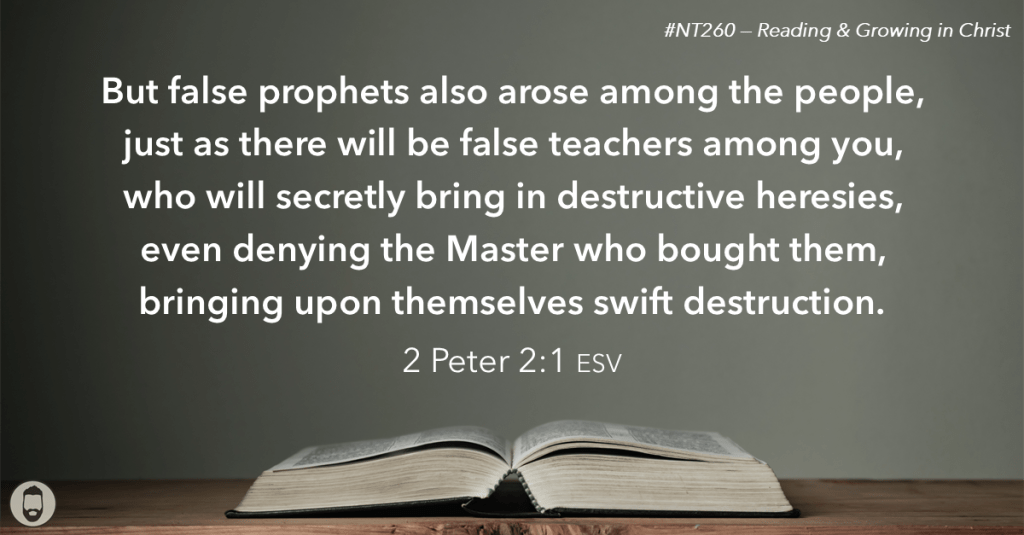
Peter warns the church that the greatest danger isn’t always persecution from the outside—it can be deception from the inside. Just as Israel faced false prophets, the church will face false teachers who slip in “secretly,” bringing destructive lies and even denying the Master they claim to belong to (v. 1). Their teaching doesn’t just confuse people; it destroys. And their lives match their message: they use sensuality to attract followers, and greed to exploit God’s people with “false words” (vv. 2–3). When Christians live and teach this way, “the way of truth” gets mocked and the gospel is blasphemed (v. 2; cf. Titus 1:16).
Then Peter anchors his warning in God’s track record. If God judged sinful angels, the ungodly world in Noah’s day, and Sodom and Gomorrah—yet rescued Noah and righteous Lot—then we can be sure of this: “the Lord knows how to rescue the godly from trials, and to keep the unrighteous under punishment until the day of judgment” (vv. 4–10). In other words, God is not confused, delayed, or powerless. He can protect His people even when they are a minority, and He will hold deceivers accountable—especially those driven by lust and arrogance who despise authority (vv. 5–10; cf. Hebrews 9:27).
After that, Peter describes these teachers plainly so believers will recognize them. They are bold, arrogant, and reckless—talking big about things they don’t understand (vv. 10–12). They treat sin like entertainment, even while they blend in among the church’s gatherings, and they prey on “unsteady souls” with adultery, appetite, and manipulation (vv. 13–14; cf. Ephesians 4:14). Peter compares them to Balaam—religious on the outside, but motivated by profit and willing to bend truth for gain (vv. 15–16). In the end, they promise “freedom” but deliver slavery, because sin always enslaves (v. 19; cf. John 8:34, Romans 6:16). And if someone has been close enough to the truth to “know the way of righteousness” and then turns back, their accountability is even greater (vv. 20–21; cf. Luke 12:47–48). That’s why Peter closes with two graphic proverbs: returning to sin shows an unchanged nature—like a dog going back to vomit and a washed pig going back to mud (v. 22; cf. Proverbs 26:11).
🌀 Reflection: Where are you tempted to believe the lie that sin is “freedom”—or to treat holiness like a burden? Ask the Lord to give you a clearer picture of what sin really does (it enslaves) and what God really gives (rescue, truth, and endurance) (vv. 9, 19).
💬 Mission Challenge: Guard someone newer in the faith this week: reach out, invite them to read Scripture with you, and help them spot the difference between Christlike teaching and “empty boasts” that excuse sin (vv. 1–3, 18; cf. Acts 20:29–31).
Peter opens by reminding believers who they are: people who have been given a faith as precious and “of equal standing” with the apostles, because Jesus is both God and Savior and His righteousness has made us right with God (vv. 1–2; cf. Ephesians 2:8–9). Then Peter grounds godly living in God’s grace: Jesus’ divine power has already provided “all things” we need for life and godliness, and God has given “precious and very great promises” so we can share in God’s holy character and escape the world’s corruption (vv. 3–4; cf. Titus 3:5–7). In other words, growth isn’t earning salvation—it’s living out what God has already given.
Because God supplies what we need, Christians must make every effort to grow. Peter lists a set of Christ-shaped qualities—faith growing into virtue, knowledge, self-control, steadfastness, godliness, brotherly affection, and love (vv. 5–7). These aren’t optional extras; they keep us from becoming spiritually “ineffective” and “unfruitful,” and they help guard us from forgetting the mercy that cleansed us from sin (vv. 8–9). So Peter urges believers to confirm their calling and election by practicing these qualities—because a life that keeps growing gives real assurance and leads to a “rich” welcome into Christ’s eternal kingdom (vv. 10–11; cf. Ephesians 1:4, 1 John 3:2–3).
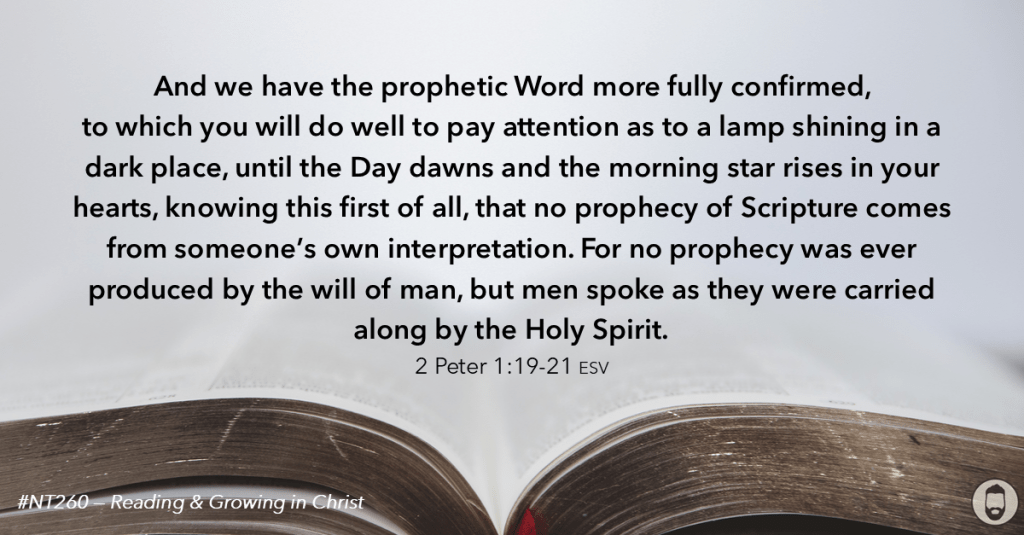
Then the tone sharpens into “last words.” Peter knows his death is near, so he keeps repeating what matters: remember these truths and keep them in front of you (vv. 12–15). Why? Because the gospel hope is not a made-up story. Peter says the apostles were eyewitnesses of Jesus’ majesty at the transfiguration—the Father Himself declared Jesus to be His beloved Son (vv. 16–18; cf. Matthew 17:1–8). And even more, the prophetic word of Scripture is fully reliable—like a lamp in the dark—because prophecy didn’t come from human ideas, but from men speaking as they were carried along by the Holy Spirit (vv. 19–21; cf. Psalm 119:105, 2 Timothy 3:16-17). When false voices rise, Peter points the church back to the surest anchor: Christ’s glory and God’s Word.
🌀 Reflection: Where have you been acting like you don’t have what you need to follow Jesus—praying for “more” while neglecting what God has already provided in His promises and His Word (vv. 3–4, 19)? Ask the Lord to help you take one concrete step of growth today (vv. 5–8).
💬 Mission Challenge: Encourage one believer this week by naming one Christlike quality you see growing in them (vv. 5–8), and then point them to the sure foundation beneath that growth: God’s power and God’s promises in Christ (vv. 3–4).

 Just Keith Harris