Songs for Sunday, January 5, 2025 @ Christ Community Church

Sunday’s coming — Joy to the World!

I know, I know. Christmas was last week, really last year at this point. But it is still on my mind.

As I type this, Christmas break is coming to an end for me and my family. Candice is taking down the tree and putting away Christmas decorations. But there was one song that we just couldn’t get around to or get to work during our time of Christmas songs at Christ Community: “Joy to the World (Joyful, Joyful)”.

I know that we have sung other versions of “Joy to the World” which were lifted up with much enthusiasm and joy, but this other version that we will be singing this week gets to the heart of why Isaac Watts wrote it in the first place (which is even more fitting considering our #dailyPSALMSchallenge).

Watts originally published “Joy to the World” in a collection of poems and hymns called The Psalms of David Imitated in the Language of the New Testament and Applied to the Christian State and Worship. This was a publication taking the song/prayer book of the Psalms and translating it forward in light of Jesus’s birth, life, death, and resurrection. This tells us that “Joy to the World” points back to Jesus’s first coming (Christmas) in order to point us toward His imminent return!

That, in essence, is the substance of our weekly worship gatherings. We worship on the first day of the week in remembrance of Jesus raising from the dead on the first day of the week AND in recognizing and reminding that He is coming again!

We lift our voices in song not in memorial but in honor and directly to our resurrected King!

We read and preach and listen to God’s Word not as a holy book of a bygone era but as a representation of our living and active Savior who died, rose, and is coming again — who is actively at work in the world today!

So, while Christmas is over until, Lord willing, December 2025, we can and should still sing “Joy to the World”.

Joy! The Lord is coming. Let earth — and our own hearts — prepare to receive the King.

Joy! Lift your voice in song and repeat the joy in all areas of your life.

Joy! Sin and sorrow has an expiration date. Thorns and trials do, too. As far as the curse of sin reigns, Jesus has become curse for us to end it!

Joy! No matter the state of world affairs and terror of wicked rulers, Jesus is the King of kings and Lord of lords — fully in control and coming to crush the Serpent’s head under His heel!

Joy!

This Sunday, we will be singing “Joy to the World” in light of Jesus’s imminent return. We will be singing to and about what He has done for us on the cross and the beautiful hope that comes from His empty, borrowed tomb. We will be singing about the hope that comes from the surpassing worth of knowing Him and being His. John will open up God’s Word and share the gospel — the good news — of Jesus to us. May God prepare our hearts to listen and sing and look forward to Jesus’s return!

Won’t you join us?


Here are our Scriptures & songs:

  • Scripture | Psalm 150

1Praise the LORD! Praise God in His sanctuary; praise Him in His mighty heavens! 2Praise Him for His mighty deeds; praise Him according to His excellent greatness!

3Praise Him with trumpet sound; praise Him with lute and harp! 4Praise Him with tambourine and dance; praise Him with strings and pipe! 5Praise Him with sounding cymbals; praise Him with loud clashing cymbals! 6Let everything that has breath praise the LORD! Praise the LORD!


  • Scripture | 1 Peter 1:3-5

3Blessed be the God and Father of our Lord Jesus Christ! According to His great mercy, He has caused us to be born again to a living hope through the resurrection of Jesus Christ from the dead, 4to an inheritance that is imperishable, undefiled, and unfading, kept in heaven for you, 5who by God’s power are being guarded through faith for a salvation ready to be revealed in the last time.


“Trusting God’s Steadfast Love in Sorrow” from Psalm 6 (#dailyPSALMSchallenge)

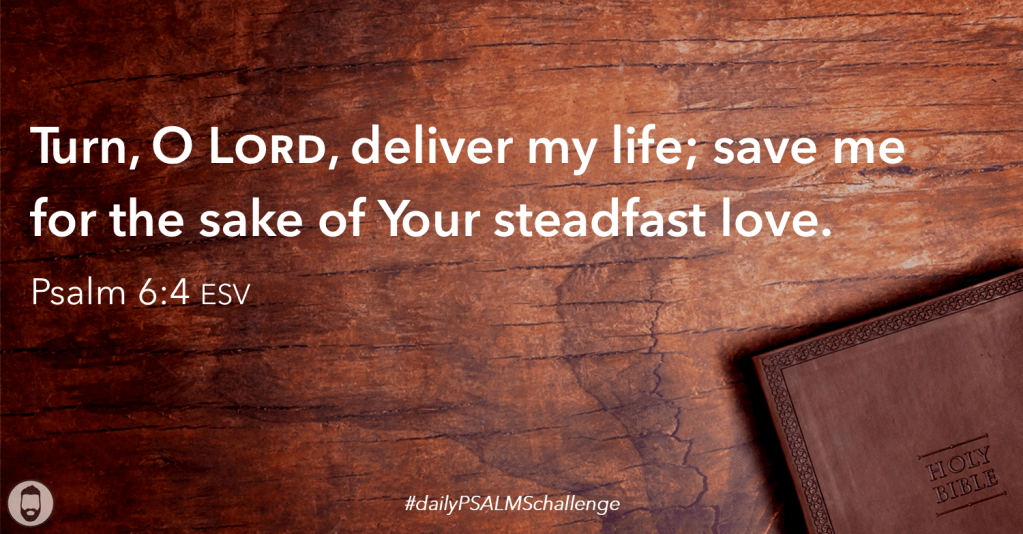
Turn, O LORD, deliver my life; save me for the sake of Your steadfast love.

Psalm 6:4

Psalm 6 is a cry of deep lament (which we defined in Psalm 3 as letting out one’s feelings of grief or sadness) as David is overwhelmed by distress and the apparent silence of God. This is the first of the penitential psalms (meaning Psalms of confession and repentance — including Psalms 32, 38, 51, 130, and 143). Here, rather than confessing specific sins, David cries out to God about his experiences with God’s discipline and his enemies’ torment.

David starts off with an urgent plea: “O Lord, rebuke me not in Your anger, nor discipline me in Your wrath” (v. 1). He feels the weight of God’s discipline but asks for God’s mercy instead of wrath. If God’s grace is giving His undeserved favor, His mercy is withholding punishment or wrath that we DO deserve. David’s plea for mercy is because his distress is affecting him physically and longs to know from the Lord how long the discipline will last (vv. 2-3).

The turning point in Psalm 6 comes when David appeals to God’s steadfast love (Hebrew: chesed) and sees that love as the basis for his hope. He has experienced God’s steadfast love in the past and trusts that God will not be angry with him forever and will move to rescue and save him (v. 4). David understands that God is just and does not dispute whether the discipline is warranted; knowing God loves him, though, he pleads for mercy.

What began as lament turns to worship with David pouring out his soul before the Lord. While he initially remarked that he felt God was being silent toward him, He had faith that God had heard his prayer (v. 9). This assurance fuels his boldness to call out his enemies, knowing that God is not done with him and will vindicate him.

Seeing Jesus in Psalm 6

This psalm points forward to Jesus, the Man of sorrows (Isaiah 53:3). Like David, Jesus experienced deep anguish as He prayed in the garden of Gethsemane (Luke 22:44). On the cross, He bore the full weight of God’s wrath and punishment for our sin — not His, but ours — so that we might be delivered and experience His steadfast love.

Jesus also fulfills David’s confidence that God hears the cries of the afflicted. In Him, have assurance that our prayers are heard and that our salvation is sure. More than that, Jesus’s resurrection turns our weeping to joy, proving that not even death can separate us from God’s love.

Reflection

Psalm 6 invites us to bring our deepest sorrows and fears to God, trusting in His steadfast love even when we are being disciplined (and our troubles stem from our own sin). When God seems silent, David’s faith and words in Psalm 6 can help us see that God’s mercy is greater than His discipline and that His salvation is certain for those who trust in Him.

The #dailyPSALMSchallenge gives us the opportunity to start 2025 in God’s Word by digging into a psalm a day. Each day will identify a key passage for us to meditate on as well as seeking to help us see Jesus in the psalm and reflect on what we have read.

Won’t you take the challenge?

“A Morning Cry to God” from Psalm 5 (#dailyPSALMSchallenge)

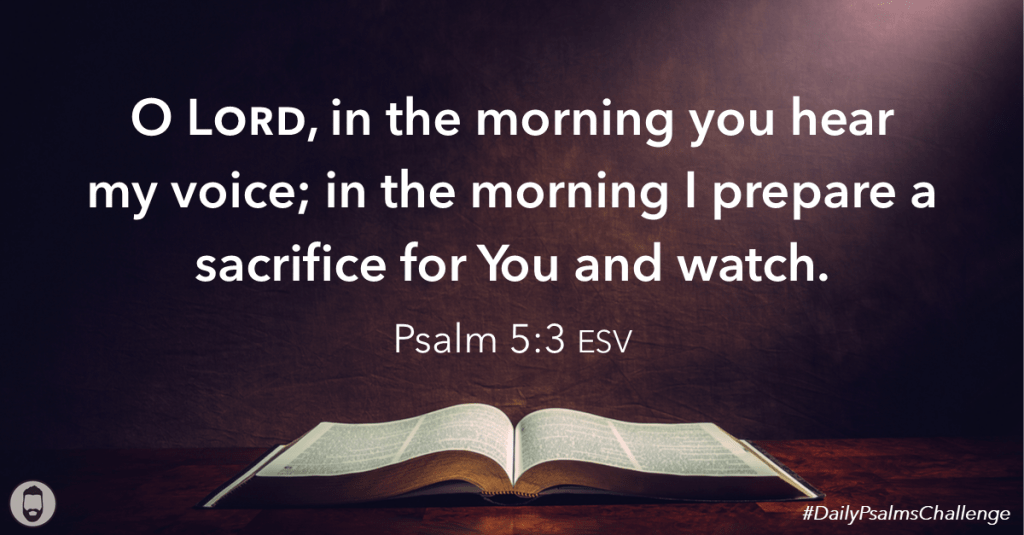
O Lord, in the morning You hear my voice; in the morning I prepare a sacrifice for You and watch.

Psalm 5:3

Psalm 5 is a morning prayer of David where he cries out urgently to the Lord, asking God to lead him in righteousness and bring justice to the wicked. This psalm contrasts the holiness of God and the ways of evildoers, showing both God’s hatred for sin and His steadfast love for those who take refuge in Him.

David’s confidence in God is rooted in God’s character. The Lord does not delight in wickedness, and evil cannot dwell in His presence (v. 4). David is confident he can enter God’s presence — not by his merit but God’s through the abundance of God’s steadfast love (v. 7).

This psalm also highlights the effects of sin. David illustrates the wicked as having no truth in their mouths and calls their throats open graves (v. 9), which is quoted by Paul in Romans 3:13 to show the depths of sin in all people. Left to ourselves and our own desires, we are no different. The difference is taking refuge and finding salvation in Jesus as Lord and Savior.

Seeing Jesus in Psalm 5

David’s prayer finds its ultimate fulfillment in Jesus. Jesus loved us so much that He took the wrath of God due our sin on Himself. Rather than standing before God in our wickedness, we can stand covered by Jesus’s righteousness.

Jesus also illustrated what it looks like to pray like David, rising early to talk to His Father (Mark 1:35). Let’s follow His example.

Reflection

As we meditate on Psalm 5, we are invited to pray like David. Each morning, we can cry out to God for guidance, trusting Him to lead us in righteousness and protect us from sin.

Just as David relied on God’s faithfulness, we can approach God today through Jesus, the perfect representation of God’s steadfast love. Jesus bore the penalty for our sins so that we can come boldly into God’s presence (Hebrews 10:19-22).

The #dailyPSALMSchallenge gives us the opportunity to start 2025 in God’s Word by digging into a psalm a day. Each day will identify a key passage for us to meditate on as well as seeking to help us see Jesus in the psalm and reflect on what we have read.

Won’t you take the challenge?

“Peace in the Night” from Psalm 4 (#dailyPSALMSchallenge)

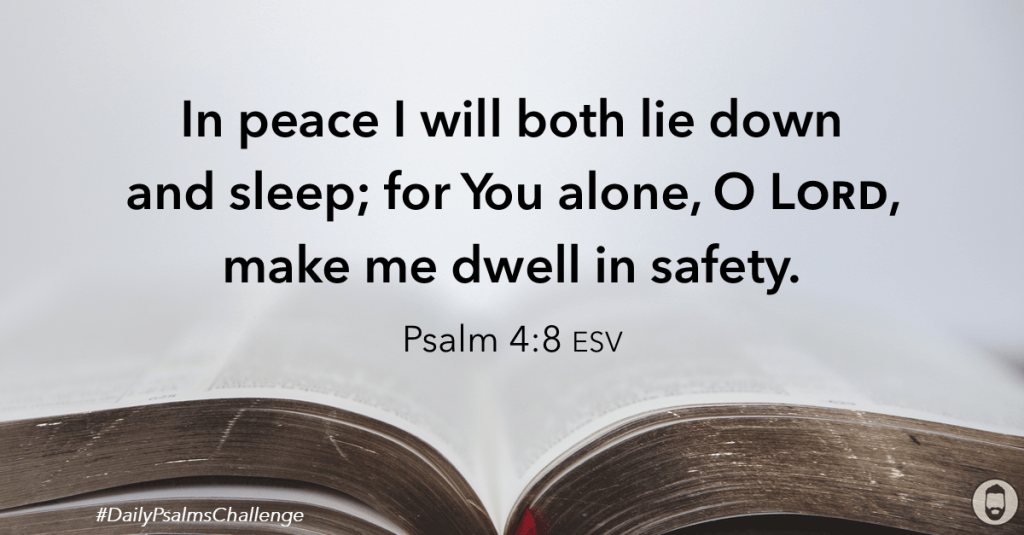
In peace I will both lie down and sleep; for You alone, O LORD, make me dwell in safety.

Psalm 4:8

Psalm 4 shows us more of David’s quiet trust in the Lord in the midst of trials and tribulations. This psalm teaches us how to respond to the anxiety that comes from trials with faith, leading to joy and peace despite circumstances.

A Cry for Help

David begins with an urgent plea to the Lord: “Answer me when I call, O God of my righteousness! You have given me relief when I was in distress. Be gracious to me and hear my prayer!” (v. 1) David can reflect on God’s faithfulness throughout his life and have faith to seek God in new trials. This is a good example for us: turn to the Lord when troubles weigh on us and know that He will be faithful in the present just has He has in the past.

Confidence in God’s Care

Don’t misunderstand and think that there was no trouble or turmoil. David’s opponents were terrible. God is just better and more powerful than they are. David had assurance that God “has set apart the godly for Himself” and hears him when he cries out (v. 3). God faithfully sustains His people, and His presence provides peace.

David’s words in v. 4 — “be angry, and do not sin” — show us the temptation to respond wrongly in times of trials, encouraging self-control and Holy Spirit reliance rather than retaliating or giving in to bitterness. Instead, David exhorts people to “ponder in [their] own hearts on [their] beds, and be silent” (v. 4). There is no need to speak on our own behalf; God has it handled.

Joy Surpasses Circumstance

David’s cry of “Lift up the light of Your face upon us, O Lord” (v. 6) shows the surpassing worth of God’s presence in our plight. Knowing God and having His presence in the midst of troubles brings “more joy…than they have when their grain and wine abound” (v. 7). Seeking God’s face echoes the blessing of Aaron in Numbers 6:24-26, affirming the promise of God’s provident presence.

David trusts God to provide security. That gives Him a peaceful assurance that even allows rest, recognizing that safety lies in the Lord and not in our circumstances.

Seeing Jesus in Psalm 4

Psalm 4 points to the peace that Jesus promised His disciples in John 14:27: “Peace I leave with you; my peace I give to you”. Jesus is the very same God who provided peace, security, joy, and rest to David and provides it still to His people today, no matter the circumstances.

Reflection

Meditate on God’s past faithfulness in your life and ask His Spirit to strengthen your faith in your present trials. His faithfulness and provident care is better than the momentary joy or happiness offered by material things.

May we, like David, learn to cry out to God, rest in His promises, and trust in His provision.

The #dailyPSALMSchallenge gives us the opportunity to start 2025 in God’s Word by digging into a psalm a day. Each day will identify a key passage for us to meditate on as well as seeking to help us see Jesus in the psalm and reflect on what we have read.

Won’t you take the challenge?

“Save Me, O God” from Psalm 3 (#dailyPSALMSchallenge)

3But you, O LORD, are a shield about me, my glory, and the lifter of my head. 4I cried aloud to the LORD, and He answered me from His holy hill. Selah

Psalm 3:3-4

Psalm 3 is written after one of the most terrible moments of King David’s life — when he was on the run from his son Absalom, who was trying to remove him from power. This is a psalm of lament (letting out one’s feelings of grief or sadness) to be sure, but it is also a psalm of trust and hope in the Lord, offering us an example of turning to God in the midst of overwhelming circumstances.

The Crisis of Many

David begins by describing his specific circumstances: his enemies are many, their accusations are relentless, and their mockery sharp, saying that “There is no salvation for [David] in God” (v. 2). To say that David would not find salvation in his God strikes at David’s identity as God’s anointed king, but their mocking did not change the truth. David’s response to them reminds us that turning to the truth of God’s promises is the only place to go when doubt and despair set in.

The Confidence in God

David shifts his focus from his circumstances by declaring to the Lord that He is “a shield about [him], [his] glory, and the lifter of [his] head” (v. 3). His confidence is built on God’s steadfast character and strength rather than what is going on around him. He trusts that his Lord not only hears his cry but that He will answer him from His holy hill (v. 4).

The Calm in the Chaos

It would be understandable for David to be distraught, but we see God providing him with peace. How many of us find it difficult to sleep when we are in the midst of trials and tribulations? Because of his faith in God, David could say, “I lay down and slept; I woke again, for the Lord sustain me” (v. 5). This highlights his faith and teaches us that God watches over His people, especially in times of turmoil and insurmountable circumstances.

The Cry for Deliverance

We see David cry out to the Lord for help and relief: “Arise, O Lord! Save me, O my God!” (v. 7). This echoes the cries of God’s people past and future, asking God to intervene against a powerful foe. David trusts that God will deal justly with the wicked — even if that means Absalom, while affirming that “salvation belongs to the Lord” and asks that His blessing be on His people” (v. 8).

Seeing Jesus in Psalm 3

David’s experience crying out to the Lord in the midst of trial and finding help points forward to the ultimate son of David, Jesus. He faced all that David did and worse — rejection, betrayal, mockery, brutal torture, execution. Jesus bore the full weight of our sin and death on the cross and cried out to His Father. Though surrounded by enemies and taunts like we have never seen, Jesus rested in His Father’s will and the confident assurance in His prophesied resurrection. Jesus’s victory over sin and death ensures that all of us who trust in Him can truly echo David’s cry that “Salvation belongs to the Lord”.

Reflection

Psalm 3 teaches us to bring our fears and burdens to God, recognizing that He can shield us from trouble and sustain us through trials. Jesus is not a distant, detached King; He knows our struggles because He experienced them. He has already overcome them (John 16:33). Whatever troubles you face today, cry out to Him and rest in the assurance that salvation belongs to Him.

The #dailyPSALMSchallenge gives us the opportunity to start 2025 in God’s Word by digging into a psalm a day. Each day will identify a key passage for us to meditate on as well as seeking to help us see Jesus in the psalm and reflect on what we have read.

Won’t you take the challenge?

“Let Earth Receive Her King” from Psalm 2 (#dailyPSALMSchallenge)

6“As for me, I have set my King on Zion, my holy hill.”

7I will tell of the decree: The LORD said to me, “You are my Son; today I have begotten you.

Psalm 2:6-7

Psalm 2 reminds me of the line in the hymn “Joy to the World”: “Let Earth receive her king”. This psalm proclaims the reign of God’s anointed King, Jesus, who is set over all creation. Though the nations rebel, Psalm 2 reveals that true peace and joy come only by receiving and submitting to this King. His authority is certain, and His rule is good.

The Rebellion of the Nations

Psalm 2 begins with the nations raging and plotting in vain against God and His Anointed (vv. 1-3). In their pride, they reject God’s authority by choosing to skewing it as oppressive and restrictive, yet their rebellion reflects the condition of sinful humanity — desiring to rule ourselves rather than submitting to our Creator and King.

God’s Response

God does not respond in fear or by some kneejerk reaction but with laughter (v. 4). He clearly declares His plan: “I have set my King on Zion, my holy hill” (v. 6). This King, the Son of God, has been appointed to rule all nations. How? Well, as God created everything and appoints the rise and fall of nations, it is His divine prerogative! The New Testament affirms that this King is Jesus, the Messiah — the Christ — who was divinely declared to be this Son at His baptism and resurrection (Matthew 3:17, Acts 13:33).

God’s plan is unshakable. The King of kings is enthroned. His reign is certain.

The Universal Reign of the King

God promises His Anointed authority over all nations, to the ends of the earth (v. 8). He will bring justice and restore order, breaking down opposition like shattering pottery (v. 9). His rule is both powerful and righteous, ensuring that evil will not (and cannot) prevail.

A Call to Submission and Joy

The call for earth is clear: receive your rightful King and rejoice in His rule. This is seen in the way Psalm 2 closes with a warning and an invitation: “Serve the LORD with fear, and rejoice with trembling. Kiss the Son” (vv. 11-12). To “kiss the Son” is to honor Him, recognizing His authority and submitting to His reign. Though His wrath and power are real, His invitation is filled with grace and “blessed are all who take refuge in Him” (v. 12). True joy is not found in rebellion but in embracing Jesus as King — as Lord (Romans 10:9).

Seeing Jesus in Psalm 2

Psalm 2 make this pretty clear and explicit. Jesus is the King.

Reflection

Psalm 2 calls us to reflect on whether we will receive or resist Jesus. The nations rage, but we are invited to rejoice under His rule. To receive Him is to put our faith, hope, and trust in Him, finding refuge and joy.

Let earth — and each of us — receive the King.

The #dailyPSALMSchallenge gives us the opportunity to start 2025 in God’s Word by digging into a psalm a day. Each day will identify a key passage for us to meditate on as well as seeking to help us see Jesus in the psalm and reflect on what we have read.

Won’t you take the challenge?

“The Way of the Righteous and the Wicked” from Psalm 1 (#dailyPSALMSchallenge)

1Blessed is the man who walks not in the counsel of the wicked, nor stands in the way of sinners, nor sits in the seat of scoffers; 2but his delight is in the law of the LORD, and on His law he meditates day and night. 3He is like a tree planted by streams of water that yields its fruit in its season, and its leaf does not wither.

Psalm 1:1-3

Psalm 1 opens the Psalter with a clear choice. There are two ways to live, and both have a drastically different outcome — the way of righteousness that leads to life, those who love God and His Word, and the way of the wicked, those who reject God. Today, we will consider where we’re rooted and what way we are walking in.

The Blessed Life

The psalmist describes the “blessed” man as one who refuses to follow sinful influences. He avoids walking with the wicked, standing with sinners, or sitting with scoffers (v. 1). This isn’t just about avoiding outward sin but about not letting anything other than God shape our lives.

Instead, the “blessed” delights in God’s law and meditates on it day and night (v. 2). “Delight” here suggests joy and deep satisfaction. God’s Word isn’t a burden for the “blessed” but a treasure. When we spend time in Scripture and meditate on it — focusing on the God of the Word, it shapes our hearts and brings us closer to Him.

This life is compared to a tree planted by streams of water (v. 3), well-watered and thriving, bearing fruit and standing firm even in harsh conditions. This “blessed” life is nourished by God’s Word, producing fruit and remaining steadfast through difficulties and trials.

The Peril of the Wicked

In contrast to the tree, the “wicked” are described as chaff — weightless and useless, blown away by wind (v. 4). Their lives lack purpose and stability. They won’t be able to stand in the judgment or belong in the assembly of the righteous (v. 5). The path of the wicked ultimately leads to destruction.

Seeing Jesus in Psalm 1

Ultimately, Jesus is the only One who is truly righteous and perfectly matches the “blessed” man described in Psalm 1. He lived a sinless life, delighted fully in the Word, and bore eternal fruit through His life, death, and resurrection. The only way for us to be counted as righteous is through faith in Him (2 Corinthians 5:21). The only way for us to live the “blessed” life described here is to be filled and empowered by His Spirit.

Reflection

Psalm 1 challenges us to examine where we are headed and in what we find our delight. Ask yourself: are you rooted in God’s Word, drawing life and sustenance from Him and His Word, or is your delight in the futile, fleeting things of the world?

We are called in Psalm 1 to meditate on Scripture, finding nourishment in Christ, the perfect and righteous One. May we find ourselves rooted in His living water, equipped to flourish and bear fruit.

The #dailyPSALMSchallenge gives us the opportunity to start 2025 in God’s Word by digging into a psalm a day. Each day will identify a key passage for us to meditate on as well as seeking to help us see Jesus in the psalm and reflect on what we have read.

Won’t you take the challenge?

“The Light of the World is Here!” — a Christmas reading for families with kiddos


For our Christmas Day reading, we wanted to look at the incarnation – the arrival of God in flesh, Emmanuel – through the eyes of a child. There is something wondrous that is lost as we grow older and become more and more jaded. Faith is easy for children because they are full of hope. Sometimes, we try and explain why hope is so hard to come by as adults, but, just as Paul reminds us in Romans 5, our God produces hope out of suffering “and hope does not put us to shame, because God’s love has been poured out into our hearts through the Holy Spirit who has been given to us” (Romans 5:5).

What better reminder could we have at Christmas than the hope that comes only from Jesus? Throughout our readings we have mentioned that Jesus is and is more than the reason for the season. We want you to see Him as the Bible presents Him. We do not want you to see a commercialized or sanitized Jesus. We want you to see God setting His affection on His people, laying aside His glory, and coming to Earth to seek and save them (Luke 19:10). We want you to see that there in the tumbledown stable in the manger is God – a God who loved us so much that He paid the price for our sin when He died on the cross, a God who loved us enough that even death could not keep Him from living for us. That’s good news!

Today’s reading is good for you whether you have children or not. Look in wonder and worship as you see the Christmas Story laid out simply. But, if you have children or grandchildren, consider how you can weave these readings into your Christmas tradition. It is split into two sections, so it can be read all at once or divided to be used twice throughout the day to keep Jesus central at His birthday celebration.


"Musings on Marriage, Missions, and My Walk with Christ" (Refresh & Restore) Refresh & Restore | A JustKeithHarris.com Podcast

Musings on Marriage, Missions, and My Walk with ChristProverbs 30:1–5What do you do when weariness exposes how little you understand?In this episode, Keith Harris reflects on a year marked by weakness, recovery, marriage, mission, church family, and the faithfulness of Jesus. Beginning with Agur’s words in Proverbs 30, Keith looks back on the goodness of God — not because circumstances always felt good, but because God has made Himself known in His Word and proven Himself faithful.In this episode, Keith reflects on:✅ Why Proverbs 30 is a fitting place to begin when we feel weary, weak, and worn out✅ How marriage is deeper than romance and points us to Christ’s covenant love for His bride✅ How missing one mission trip and making it to another revealed that God’s mission is bigger than our strength✅ Why the church is a gift — a blood-bought family where burdens are borne, prayers are lifted, children are loved, the gospel is preached, and weak saints are carried by God’s grace✅ How burnout, calling, and identity remind us that we must pursue Jesus above the things we do for Jesus✅ Why hope in Jesus does not fail, even while we are still learning how to walk forwardThis is a testimony of the trustworthy God — the One whose Word proves true and who is a shield to those who take refuge in Him.“Every word of God proves true; He is a shield to those who take refuge in Him.”Proverbs 30:5Read the written version with Scripture references and links here.
  1. "Musings on Marriage, Missions, and My Walk with Christ" (Refresh & Restore)
  2. "Light Momentary Afflictions, Eternal Weight of Glory" (Refresh & Restore)
  3. "Worthy is the Lion, the Slain Lamb Who Lives" from Revelation 5 (The KING is Coming)
  4. "Before the Throne of God Above" from Revelation 4 (The KING is Coming)
  5. " Lukewarm Yet Not Without Hope: Jesus’s Letter to the Church at Laodicea" (The KING is Coming)

This Christmas reading comes from The Jesus Storybook Bible.

“He’s Here”

Everything was ready. The moment God had been waiting for was here at last! God was coming to help His people, just as He promised in the beginning.

But how would He come? What would He be like? What would He do?

Mountains would have bowed down. Seas would have roared. Trees would have clapped their hands. But the earth held its breath. As silent as snow falling, He came in. And when no one was looking, in the darkness, He came.

There was a young girl who was engaged to a man named Joseph. (Joseph was the great-great-great-great-great grandson of King David.)

One morning, this girl was minding her own business when, suddenly, a great warrior of light appeared – right there, in her bedroom. He was Gabriel and he was an angel, a special messenger from heaven.

When she saw the tall shining man standing there, Mary was frightened.

“You don’t need to be scared,” Gabriel said. “God is very happy with you!”

Mary looked around to see if perhaps he was talking to someone else.

“Mary,” Gabriel said, and he laughed with such gladness that Mary’s eyes filled with sudden tears.

“Mary, you’re going to have a baby. A little boy. You will call Him Jesus. He is God’s own Son. He’s the One! He’s the Rescuer!”

The God who flung planets into space and kept them whirling around and around, the God who made the universe with just a word, the One who could do anything at all – was making Himself small. And coming down…as a baby.

Wait. God was sending a baby to rescue the world?

“But it’s too wonderful!” Mary said and felt her heart beating hard. “How can it be true?”

“Is anything too wonderful for God?” Gabriel asked.

So, Mary trusted God more than what her eyes could see. And she believed. “I am God’s servant,” she said. “Whatever God says, I will do.”

Sure enough, it was just as the angel had said. Nine months later, Mary was almost ready to have her baby.

Now, Mary and Joseph had to take a trip to Bethlehem, the town King David was from. But when they reached the little town, they found every room was full. Every bed was taken.

“Go away!” the innkeepers told them. “There isn’t any place for you.”

Where would they stay? Soon Mary’s baby would come.

They couldn’t find anywhere except an old, tumbledown stable. So they stayed where the cows and the donkeys and the horses stayed.

And there, in a stable, amongst the chickens and the donkeys and the cows, in the quiet of the night, God gave the world His wonderful gift. The baby that would change the world was born. His baby Son.

Mary and Joseph wrapped Him up to keep Him warm. They made a soft bed of straw and used the animals’ feeding trough as His cradle. And they gazed in wonder at God’s Great Gift, wrapped in swaddling clothes, and lying in a manger.

Mary and Joseph named Him Jesus, “Emmanuel” – which means “God has come to live with us.”

Because, of course, He had.

“The Light of the Whole World”

That same night, in amongst the other stars, suddenly a bright new star appeared. Of all the stars in the dark vaulted heavens, this one shone clearer. It blazed in the night and made the other stars look pale beside it.

God put it there when His baby Son was born – to be like a spotlight. Shining on Him. Lighting up the darkness. Showing people the way to Him.

You see, God was like a new daddy – He couldn’t keep the good news to Himself. He’d been waiting all these long years for this moment, and now He wanted to tell everyone.

So He pulled out all the stops. He’d sent an angel to tell Mary the good news. He’d put a special star in the sky to show where His boy was. And now He was going to send a big choir of angels to sing His happy song to the world: He’s here! He’s come! Go and see Him. My Son!

Now where would you send your splendid choir? To a big concert hall maybe? Or a palace perhaps? God sent His to a little hillside, outside a little town, in the middle of the night. He sent all those angels to sing for a raggedy old bunch of shepherds watching their sheep outside Bethlehem.

In those days, remember, people used to laugh at shepherds and say they were smelly and call them other rude names (which I can’t possibly mention here). You see, people thought shepherds were nobodies, just scruffy old riff-raff.

But God must have thought shepherds were very important indeed, because they’re the ones He chose to tell the good news to first.

That night some shepherds were out in the open fields, warming themselves by a campfire, when suddenly the sheep darted. They were frightened by something. The olive trees rustled. What was that…?

They turned around. Standing in front of them was a huge warrior of light, blazing in the darkness. “Don’t be afraid of me!” the bright shining man said. “I haven’t come to hurt you. I’ve come to bring you happy news for everyone everywhere. Today, in David’s town, Bethlehem, God’s Son has been born! You can go and see Him. He is sleeping in a manger.”

Behind the angel they saw a strange glowing cloud – except it wasn’t a cloud, it was angels…troops and troops of angels, armed with light! And they were singing a beautiful song: “Glory to God! To God be Fame and Honor and all of our Hoorays!”

Then as quickly as they appeared, the angels left.

The shepherds stamped out their fire, left their sheep, raced down the grassy hill, through the gates of Bethlehem, down the narrow cobble streets, through a courtyard, down some step, step, steps, past an inn, round a corner, through a hedge, until, at last, they reached…a tumbledown stable.

They caught their breath. Then quietly, they tiptoed inside.

They knelt on the dirt floor. They had heard about this Promised Child and now He was here. Heaven’s Son. The Maker of the Stars. A baby sleeping in His mother’s arms.

This baby would be like that bright star shining in the sky that night. A Light to light up the whole world. Chasing away darkness. Helping people to see.

And the darker the night gets, the brighter Jesus – the Light of the world – shines.


"Musings on Marriage, Missions, and My Walk with Christ" (Refresh & Restore) Refresh & Restore | A JustKeithHarris.com Podcast

Musings on Marriage, Missions, and My Walk with ChristProverbs 30:1–5What do you do when weariness exposes how little you understand?In this episode, Keith Harris reflects on a year marked by weakness, recovery, marriage, mission, church family, and the faithfulness of Jesus. Beginning with Agur’s words in Proverbs 30, Keith looks back on the goodness of God — not because circumstances always felt good, but because God has made Himself known in His Word and proven Himself faithful.In this episode, Keith reflects on:✅ Why Proverbs 30 is a fitting place to begin when we feel weary, weak, and worn out✅ How marriage is deeper than romance and points us to Christ’s covenant love for His bride✅ How missing one mission trip and making it to another revealed that God’s mission is bigger than our strength✅ Why the church is a gift — a blood-bought family where burdens are borne, prayers are lifted, children are loved, the gospel is preached, and weak saints are carried by God’s grace✅ How burnout, calling, and identity remind us that we must pursue Jesus above the things we do for Jesus✅ Why hope in Jesus does not fail, even while we are still learning how to walk forwardThis is a testimony of the trustworthy God — the One whose Word proves true and who is a shield to those who take refuge in Him.“Every word of God proves true; He is a shield to those who take refuge in Him.”Proverbs 30:5Read the written version with Scripture references and links here.
  1. "Musings on Marriage, Missions, and My Walk with Christ" (Refresh & Restore)
  2. "Light Momentary Afflictions, Eternal Weight of Glory" (Refresh & Restore)
  3. "Worthy is the Lion, the Slain Lamb Who Lives" from Revelation 5 (The KING is Coming)
  4. "Before the Throne of God Above" from Revelation 4 (The KING is Coming)
  5. " Lukewarm Yet Not Without Hope: Jesus’s Letter to the Church at Laodicea" (The KING is Coming)

Good News of Great Joy (or The Weary World Rejoices)


For I passed on to you as of first importance what I also received, that Christ died for our sins according to the scriptures, and that he was buried, and that he was raised up on the third day according to the scriptures, and that he appeared to Cephas, then to the twelve, then he appeared to more than five hundred brothers at once, the majority of whom remain until now, but some have fallen asleep.

1 Corinthians 15:3-6

He made the one who did not know sin to be sin on our behalf, in order that we could become the righteousness of God in him.

2 Corinthians 5:21

But what does it say? “The word is near to you, in your mouth and in your heart” (that is, the word of faith that we proclaim), that if you confess with your mouth “Jesus is Lord” and believe in your heart that God raised him from the dead, you will be saved. 10 For with the heart one believes, resulting in righteousness, and with the mouth one confesses, resulting in salvation. 11 For the scripture says, “Everyone who believes in him will not be put to shame.” 12 For there is no distinction between Jew and Greek, for the same Lord is Lord of all, who is rich to all who call upon him. 13 For “everyone who calls upon the name of the Lord will be saved.”

Romans 10:8-13

"Musings on Marriage, Missions, and My Walk with Christ" (Refresh & Restore) Refresh & Restore | A JustKeithHarris.com Podcast

Musings on Marriage, Missions, and My Walk with ChristProverbs 30:1–5What do you do when weariness exposes how little you understand?In this episode, Keith Harris reflects on a year marked by weakness, recovery, marriage, mission, church family, and the faithfulness of Jesus. Beginning with Agur’s words in Proverbs 30, Keith looks back on the goodness of God — not because circumstances always felt good, but because God has made Himself known in His Word and proven Himself faithful.In this episode, Keith reflects on:✅ Why Proverbs 30 is a fitting place to begin when we feel weary, weak, and worn out✅ How marriage is deeper than romance and points us to Christ’s covenant love for His bride✅ How missing one mission trip and making it to another revealed that God’s mission is bigger than our strength✅ Why the church is a gift — a blood-bought family where burdens are borne, prayers are lifted, children are loved, the gospel is preached, and weak saints are carried by God’s grace✅ How burnout, calling, and identity remind us that we must pursue Jesus above the things we do for Jesus✅ Why hope in Jesus does not fail, even while we are still learning how to walk forwardThis is a testimony of the trustworthy God — the One whose Word proves true and who is a shield to those who take refuge in Him.“Every word of God proves true; He is a shield to those who take refuge in Him.”Proverbs 30:5Read the written version with Scripture references and links here.
  1. "Musings on Marriage, Missions, and My Walk with Christ" (Refresh & Restore)
  2. "Light Momentary Afflictions, Eternal Weight of Glory" (Refresh & Restore)
  3. "Worthy is the Lion, the Slain Lamb Who Lives" from Revelation 5 (The KING is Coming)
  4. "Before the Throne of God Above" from Revelation 4 (The KING is Coming)
  5. " Lukewarm Yet Not Without Hope: Jesus’s Letter to the Church at Laodicea" (The KING is Coming)

We have spent a good bit of time the past few weeks at Christ Community in Luke 2:10 and the verses around it. The declaration of the angels to those poor and frightened shepherds should about be memorized at this point: “Do not be afraid, for behold, I bring good news to you of great joy which will be for all the people”. Good news. Great joy. For all people.

The word translated “good news” is often translated gospel, and the message that the angels proclaimed on that hillside 2,000 years ago is a beautiful and succinct picture of the gospel. They preached that the Savior “who is Christ the Lord” was born for them – for those dirty, stinky shepherds – and that He could be found that very day in Bethlehem. It was news that would and could change the trajectory of their lives. They just needed to believe in Him and receive the salvation He had to offer – they would receive grace by faith through Him.

Now, I know that on the day they heard that gospel message Jesus was still laying in the feeding trough, still an infant, and was decades away from His death, burial, and resurrection. But the babe in the manger was still “the Word [become] flesh” (John 1:14). He was still the Lamb slain “before the foundation of the world” (Ephesians 1:4).

We sometimes want to overcomplicate things. We know the whole story and want to add and fill in the gaps in the angels’ proclamation that day, but the “good news of great joy” is still just as simple. In fact, Paul gives very succinct proclamations of the gospel, too. The first can be found in 1 Corinthians 15 where he tells the church at Corinth that he is passing on to them the most important message he had to offer – the very same message that he received himself: Jesus died for our sins according to the way that the Bible said He would, He was buried, and He rose from the dead on the third day exactly as the Bible and His own preaching said He would. That’s good news!

Paul’s second succinct gospel summary comes in his next letter to the church at Corinth in 2 Corinthians 5:21. In one complex little sentence, he shares that God put the sins of those who would be saved on Jesus. Jesus had never sinned and did not deserve any condemnation, but He willingly bore our sin on our behalf. Those who trust in Him no longer are under the condemnation and shame due to their sin; Jesus bore that (Colossians 2:13-14). In a great exchange, Jesus traded His righteousness for our sin. He bore the wrath of God and exchanged that for God’s favor. Basically, He traded His extravagantly full bank account for our bankrupt one so that when God looks upon those who Jesus has saved, He does not see their sinfulness but Jesus’ righteousness! That’s good news!

The gospel is good news, but there is also bad news. Those who do not confess Jesus as Lord and believe He died for their sins and rose again to not receive part in that great exchange. They remain in their sin. Their condemnation remains their own. It does not have to be that way. All who call out to Jesus in faith will be saved. Anyone who believes in Him will not be but to shame, but not believing leaves the shame where it belongs – on the sinner.

Look at how the Christmas hymn “O Holy Night” puts it:

Long lay the world in sin and error pining
Till He appeared and the soul felt its worth
A thrill of hope, the weary world rejoices
For yonder breaks a new and glorious morn
Fall on your knees!

Those who are without Jesus are still in their sin and “pining” after the wrong things, sinful things. But everyone – all people – have the opportunity to fall on their knees, believe in Him – confess Him as Lord, and repent of their sin. And those who do will not only have heard the good news of great joy but also to have believed it and received the salvation Jesus offers.

I love the phrase “good news of great joy” because 1) it is straight from the Bible, and 2) it captures what Jesus offers. But I also love the way the writer of “O Holy Night” captured what it is to be a sinner and receive Christ: “a weary world rejoices”. If you have been reading with us over these past two weeks, you have read snippets of the “good news of great joy”, but have you received it? Have you believed on Jesus, or are you still on the fence? If you haven’t, I urge you: fall on your knees, believe what the Bible says about Him, confess Him as Lord, and rejoice in the salvation He brings!

Good News of Great Joy | Christmas Eve, December 24 — “The Resurrection of Jesus”

Luke 24 concludes with the hope and joy of Jesus’ resurrection and ascension, a fitting reflection on Christmas Eve as we prepare to celebrate His birth tomorrow. This chapter invites us to marvel at the completeness of God’s redemptive plan, which began in a humble manger and was fulfilled in an empty tomb.

  1. A New Beginning: The resurrection marks the triumph of life over death, just as Jesus’ birth ushered in light to a dark world. As you reflect on the empty tomb, remember that Christmas celebrates the beginning of this miraculous story.
  2. Hope Fulfilled: The disciples on the road to Emmaus moved from despair to joy as Jesus opened their eyes to God’s promises. This Christmas, let your heart burn with hope as you trust the One who fulfilled every prophecy.
  3. Peace and Assurance: Jesus brought peace to His disciples, proving His resurrection by showing His scars and eating with them. He offers us the same assurance—our Savior lives, and His peace is for all who believe.
  4. A Call to Worship and Witness: The disciples responded to the risen Christ with worship and proclamation. As we celebrate His birth tomorrow, let our joy overflow in worship and bold witness, sharing the good news that Christ has come, died, and risen for us.

On this Christmas Eve, look forward to tomorrow with awe and wonder, knowing that the child born in Bethlehem is the risen Lord who reigns in heaven. May your celebration of His birth be filled with the same joy and hope that the disciples experienced as they worshiped the resurrected Savior. Merry Christmas!

"Musings on Marriage, Missions, and My Walk with Christ" (Refresh & Restore) Refresh & Restore | A JustKeithHarris.com Podcast

Musings on Marriage, Missions, and My Walk with ChristProverbs 30:1–5What do you do when weariness exposes how little you understand?In this episode, Keith Harris reflects on a year marked by weakness, recovery, marriage, mission, church family, and the faithfulness of Jesus. Beginning with Agur’s words in Proverbs 30, Keith looks back on the goodness of God — not because circumstances always felt good, but because God has made Himself known in His Word and proven Himself faithful.In this episode, Keith reflects on:✅ Why Proverbs 30 is a fitting place to begin when we feel weary, weak, and worn out✅ How marriage is deeper than romance and points us to Christ’s covenant love for His bride✅ How missing one mission trip and making it to another revealed that God’s mission is bigger than our strength✅ Why the church is a gift — a blood-bought family where burdens are borne, prayers are lifted, children are loved, the gospel is preached, and weak saints are carried by God’s grace✅ How burnout, calling, and identity remind us that we must pursue Jesus above the things we do for Jesus✅ Why hope in Jesus does not fail, even while we are still learning how to walk forwardThis is a testimony of the trustworthy God — the One whose Word proves true and who is a shield to those who take refuge in Him.“Every word of God proves true; He is a shield to those who take refuge in Him.”Proverbs 30:5Read the written version with Scripture references and links here.
  1. "Musings on Marriage, Missions, and My Walk with Christ" (Refresh & Restore)
  2. "Light Momentary Afflictions, Eternal Weight of Glory" (Refresh & Restore)
  3. "Worthy is the Lion, the Slain Lamb Who Lives" from Revelation 5 (The KING is Coming)
  4. "Before the Throne of God Above" from Revelation 4 (The KING is Coming)
  5. " Lukewarm Yet Not Without Hope: Jesus’s Letter to the Church at Laodicea" (The KING is Coming)

The Empty Tomb (24:1-12)[1]

But on the first day of the week, at early dawn, they went to the tomb, taking the spices they had prepared. And they found the stone rolled away from the tomb, but when they went in they did not find the body of the Lord Jesus. While they were perplexed about this, behold, two men stood by them in dazzling apparel. And as they were frightened and bowed their faces to the ground, the men said to them, “Why do you seek the living among the dead? He is not here, but has risen. Remember how he told you, while he was still in Galilee, that the Son of Man must be delivered into the hands of sinful men and be crucified and on the third day rise.” And they remembered his words, and returning from the tomb they told all these things to the eleven and to all the rest. 10 Now it was Mary Magdalene and Joanna and Mary the mother of James and the other women with them who told these things to the apostles, 11 but these words seemed to them an idle tale, and they did not believe them. 12 But Peter rose and ran to the tomb; stooping and looking in, he saw the linen cloths by themselves; and he went home marveling at what had happened.

The Road to Emmaus (24:13-35)[2]

13 That very day two of them were going to a village named Emmaus, about seven miles from Jerusalem, 14 and they were talking with each other about all these things that had happened. 15 While they were talking and discussing together, Jesus himself drew near and went with them. 16 But their eyes were kept from recognizing him. 17 And he said to them, “What is this conversation that you are holding with each other as you walk?” And they stood still, looking sad. 18 Then one of them, named Cleopas, answered him, “Are you the only visitor to Jerusalem who does not know the things that have happened there in these days?” 19 And he said to them, “What things?” And they said to him, “Concerning Jesus of Nazareth, a man who was a prophet mighty in deed and word before God and all the people, 20 and how our chief priests and rulers delivered him up to be condemned to death, and crucified him. 21 But we had hoped that he was the one to redeem Israel. Yes, and besides all this, it is now the third day since these things happened. 22 Moreover, some women of our company amazed us. They were at the tomb early in the morning, 23 and when they did not find his body, they came back saying that they had even seen a vision of angels, who said that he was alive. 24 Some of those who were with us went to the tomb and found it just as the women had said, but him they did not see.” 25 And he said to them, “O foolish ones, and slow of heart to believe all that the prophets have spoken! 26 Was it not necessary that the Christ should suffer these things and enter into his glory?” 27 And beginning with Moses and all the Prophets, he interpreted to them in all the Scriptures the things concerning himself.

28 So they drew near to the village to which they were going. He acted as if he were going farther, 29 but they urged him strongly, saying, “Stay with us, for it is toward evening and the day is now far spent.” So he went in to stay with them. 30 When he was at table with them, he took the bread and blessed and broke it and gave it to them. 31 And their eyes were opened, and they recognized him. And he vanished from their sight. 32 They said to each other, “Did not our hearts burn within us while he talked to us on the road, while he opened to us the Scriptures?” 33 And they rose that same hour and returned to Jerusalem. And they found the eleven and those who were with them gathered together, 34 saying, “The Lord has risen indeed, and has appeared to Simon!” 35 Then they told what had happened on the road, and how he was known to them in the breaking of the bread.

Jesus Appears to His Disciples (24:36-49)[3]

36 As they were talking about these things, Jesus himself stood among them, and said to them, “Peace to you!” 37 But they were startled and frightened and thought they saw a spirit. 38 And he said to them, “Why are you troubled, and why do doubts arise in your hearts? 39 See my hands and my feet, that it is I myself. Touch me, and see. For a spirit does not have flesh and bones as you see that I have.” 40 And when he had said this, he showed them his hands and his feet. 41 And while they still disbelieved for joy and were marveling, he said to them, “Have you anything here to eat?” 42 They gave him a piece of broiled fish, 43 and he took it and ate before them.

44 Then he said to them, “These are my words that I spoke to you while I was still with you, that everything written about me in the Law of Moses and the Prophets and the Psalms must be fulfilled.” 45 Then he opened their minds to understand the Scriptures, 46 and said to them, “Thus it is written, that the Christ should suffer and on the third day rise from the dead, 47 and that repentance for the forgiveness of sins should be proclaimed in his name to all nations, beginning from Jerusalem. 48 You are witnesses of these things. 49 And behold, I am sending the promise of my Father upon you. But stay in the city until you are clothed with power from on high.”

The Ascension of Jesus (24:50-53)[4]

50 And he led them out as far as Bethany, and lifting up his hands he blessed them. 51 While he blessed them, he parted from them and was carried up into heaven. 52 And they worshiped him and returned to Jerusalem with great joy, 53 and were continually in the temple blessing God.


[1] On the first day of the week, women arrived at Jesus’ tomb with spices but found the stone rolled away and the tomb empty. Two angels appeared, reminding them of Jesus’ words that He would rise on the third day. They reported this to the apostles, but their testimony was met with disbelief. Peter ran to the tomb, saw the linen cloths, and marveled.

[2] Two disciples, one named Cleopas, walked to Emmaus, discussing the events of Jesus’ death. A stranger joined them, explaining how Scripture foretold the Messiah’s suffering and glory. At dinner, their eyes were opened, and they recognized the stranger as Jesus, who then vanished. Filled with joy, they returned to Jerusalem to share the news.

[3] Jesus appeared to His disciples, offering peace and proof of His physical resurrection by showing His hands and feet and eating with them. He explained that His death and resurrection fulfilled Scripture and commissioned them to proclaim repentance and forgiveness to all nations, beginning in Jerusalem. He promised the Holy Spirit would empower them.

[4] Leading the disciples to Bethany, Jesus blessed them and ascended into heaven. Overwhelmed with joy, they returned to Jerusalem, worshiping Him and continually praising God in the temple.