Sunday’s coming, and I’m excited. And on this Palm Sunday, we remember our King.
Psalm 118:19-29 gives us the language of a people longing for salvation and rejoicing in the One who brings it: “Blessed is He who comes in the name of the LORD!” (Psalm 118:26). It’s a song/psalm of victory, rescue, and the steadfast love of God that endures forever.
The people cried out “Hosanna!” to Jesus, which is the Hebrew word used in Psalm 118:25 that is translated, “Save us, we pray”. In the time between Psalm 118 being written and Jesus’s Triumphal Entry, “hosanna” had shifted from “Save us, we pray” to a cry of praise to the Lord who had saved them time and again and whose track record led them to believe He would and could save them in their time of need.
While they were crying out “Hosanna”, they also quoted Psalm 118:26: “Blessed is He who comes in the name of the Lord!” They laid down palm branches and their own cloaks as they cried out to Jesus with joy, welcoming Him as King. What Psalm 118 anticipated, Jesus was fulfilling right before their eyes (Luke 24:44).
But something even greater was happening.
Psalm 118 speaks of the festal sacrifice being bound with cords to the horns of the altar (Psalm 118:27). Yet when Jesus came, He wasn’t bound or forced. He came willingly, submitting to His Father’s redemptive plan. He is the true and better sacrifice — the Lamb of God who would take away the sin of the world (John 1:29), the propitiation, atoning sacrifice, to bear the wrath of God on behalf of those He saves (1 John 2:1-2, Romans 3:25). The King they proclaimed was riding into Jerusalem to be the Savior they needed on the cross (Luke 19:10).
Essentially, this is why we gather in worship — not just to remember or commemorate a moment but to respond to Jesus (Romans 12:1). He came to seek and save the lost, to bear our sin, and to make a way for us who are far off to be brought near (1 Peter 2:24, Ephesians 2:13). We get to fix our eyes on our King (Hebrews 12:2) and cry out “Hosanna!”, praising God for saving us by grace through faith in Jesus (Ephesians 2:8-9)! Palm Sunday is not a mere holiday (or holy day) but a reminder of who Jesus is, what He has done, and call us to faith in Him (John 20:31).
That’s also why these “Songs of Sunday” posts exist — to help us prepare our hearts to gather in worship. As we read, reflect, and sing ahead of time, we’re asking the Lord to ready our hearts to worship, to receive His Word, and to respond with faith and joy.
Sunday’s coming.
Jesus is coming again.
Let’s be ready to welcome our King, not just with our lips but with our lives, trusting, rejoicing, and worshiping.
Come and gather with us. Lift your voice and sing out to the Lord. Listen as John points us to Jesus in the Word. Let’s make much of Jesus together.
19 Open to me the gates of righteousness, that I may enter through them and give thanks to the LORD. 20 This is the gate of the LORD; the righteous shall enter through it. 21 I thank you that You have answered me and have become my salvation. 22 The stone that the builders rejected has become the Cornerstone. 23 This is the LORD’s doing; it is marvelous in our eyes. 24 This is the day that the LORD has made; let us rejoice and be glad in it.
25 Save us, we pray, O LORD! O Lord, we pray, give us success!
26 Blessed is He who comes in the name of the LORD! We bless you from the house of the LORD. 27 The LORD is God, and He has made His light to shine upon us. Bind the festal sacrifice with cords, up to the horns of the altar!
28 You are my God, and I will give thanks to You; You are my God; I will extol You. 29 Oh give thanks to the LORD, for He is good; for His steadfast love endures forever!
32 So those who were sent went away and found it just as he had told them. 33 And as they were untying the colt, its owners said to them, “Why are you untying the colt?” 34 And they said, “The Lord has need of it.” 35 And they brought it to Jesus, and throwing their cloaks on the colt, they set Jesus on it. 36 And as he rode along, they spread their cloaks on the road. 37 As he was drawing near—already on the way down the Mount of Olives—the whole multitude of his disciples began to rejoice and praise God with a loud voice for all the mighty works that they had seen, 38 saying, “Blessed is the King who comes in the name of the Lord! Peace in heaven and glory in the highest!” 39 And some of the Pharisees in the crowd said to him, “Teacher, rebuke your disciples.” 40 He answered, “I tell you, if these were silent, the very stones would cry out.”
16 “For God so loved the world, that he gave his only Son, that whoever believes in him should not perish but have eternal life. 17 For God did not send his Son into the world to condemn the world, but in order that the world might be saved through him.[2]
9 In this the love of God was made manifest among us, that God sent his only Son into the world, so that we might live through him. 10 In this is love, not that we have loved God but that he loved us and sent his Son to be the propitiation for our sins.[3]
Merry Christmas Adam, Sojourners!
Why Christmas Adam, you ask? Well, Adam came before Eve, right? Ba-dum-cha!
I’m somewhat sorry to start with a dad joke, but I am who I am. And even a light moment like this can remind us that Christmas meets us in ordinary, human places before leading us to eternal truths. So, with that smile (hopefully) in place, let’s turn our hearts to deeper things.
As we move toward the culmination of Advent and stand on the threshold of Christmas, we pause once more to reflect on the gifts God has given us in the coming of His Son. Over the past few weeks, we’ve traced the steady unfolding of the gospel through hope, peace, and joy. We’ve seen that our hope rests not in circumstances but in the faithful God who keeps His promises. We’ve seen that true peace was secured when Jesus entered our darkness to reconcile us to God. And we’ve seen that real joy is not manufactured by emotion or ease but springs up where God’s mercy is received and trusted. And if this season finds you carrying grief, sorrow, disappointment, or weariness, there is room for that here. The coming of Jesus doesn’t require us to pretend, perform, or put on a happy face. It invites us to come to Him honestly – needy, heavy-laden, and real – and to find that He meets us with mercy (Matthew 11:28-30, Psalm 34:18, Hebrews 4:15-16).
Now, all of those gifts converge in the love of God.
Christmas is the declaration that God’s love is neither distant nor abstract. It took on flesh (John 1:14). The incarnation is not merely the arrival of a baby in Bethlehem; it is the greatest gift ever given – the Son of God sent for sinners like us. Hope, peace, and joy all find their source and fulfillment in Him because they flow from God’s love revealed in Jesus. Without God’s love, there would be no promise kept, no peace secured, and no joy that lasts. Christmas tells us that love has come near (Hebrews 2:14-18).
In this final study in our Christ Has Come series, we’ll consider how Scripture defines that love – not as sentiment, but as saving action. We’ll briefly walk through three key passages that together give us a clear and faithful picture of the love of God revealed in Christmas: Romans 5:8, where God demonstrates His love for sinners; John 3:16-17, where God gives His Son so the world might be saved; and 1 John 4:9-10, where love is defined – not by our response to God but by God’s initiative toward us. As we do, it’s my prayer that we’ll see that Christmas proclaims this staggeringly simple and gloriously true gospel message: God loves, God gives, and God saves.
God Demonstrates His Love (Romans 5:8) …but God shows His love for us in that while we were still sinners, Christ died for us.
This verse doesn’t merely tell us that God loves – it shows us how He loves. His love is not theoretical. It’s not conditional. It’s demonstrated, proven, and displayed throughout history through the death of Jesus (1 John 3:16).
What makes this love so staggering is when it was shown. Paul explains that Jesus didn’t die for good, righteous people or folks who had earned God’s favor. He died for sinners – ungodly people living in rebellion and enmity against God (Romans 5:6-10). Human love, at its best, may sacrifice for someone we feel is worthy, but God’s love belongs to an entirely different category. While we were still estranged, still guilty, still God’s enemies, still unable to fix or save ourselves, God acted. He moved first in love (1 John 4:19).
And it’s important to see that this wasn’t only the love of the Son for us but also the love of the Father. You see, the cross wasn’t a tragic accident or a reluctant sacrifice – it was God’s loving plan of redemption. God demonstrated His love by sending His Son to die in our place (Romans 8:32). The justice and righteousness of God required that sin be dealt with, and Romans 5:9 reminds us why the cross was necessary: “Since, therefore, we have now been justified by His blood, much more shall we be saved by Him from the wrath of God.” God’s love doesn’t ignore sin or minimize judgment. Rather, love moved God to place His righteous wrath against sin upon His own Son, so that sinners like us could be forgiven, justified, and reconciled to Him.
Romans 5:8 teaches us that God’s love isn’t measured by how we feel in a given moment or how well life is going. It’s anchored in an unchanging historical reality: Jesus died for us. Christmas, then, isn’t sentimental but sacrificial. It points us to the cross, where God’s love is demonstrated fully, finally, and forever.
God Gives His Son (John 3:16-17) For God so loved the world, that He gave His only Son, that whoever believes in Him should not perish but have eternal life. For God did not send His Son into the world to condemn the world, but in order that the world might be saved through Him.
If Romans 5:8 shows us how God demonstrates His love, John 3:16-17 helps us understand why – and to what end. The cross doesn’t stand alone as an isolated act of love but flows out of the eternal, gracious heart of the Father. Long before nails pierced flesh, love was already moving. God loved, and so God gave.
“For God so loved the world, that He gave His only begotten Son….” These are probably the most familiar words in all of Scripture, but they lose none of their weight or strength with repetition. They magnify this God-sized love, a love not measured by the size or goodness of the world but in the costliness of the gift He gives. Scripture is clear: God’s love for the world is astonishing not because the world was worthy, but because it was fallen, rebellious, and broken. The wonder of John 3:16 isn’t that God loved something lovable—which would make sense—but that He loved sinners and gave His Son so that they might be saved through Him. That is grace. That is mercy.
And this love isn’t vague. It’s not sentimental. God’s love takes action. He gave His Son – He sent Him into the world to take on flesh, dwell among us, and ultimately to bear the penalty for our sin. The incarnation – Christmas – is an act of love. Christmas tells us that love came near to us, and as we said before, Christmas leads us to the cross, God giving Himself so that sinners might live.
John 3:17 presses this even further because Jesus didn’t enter a morally neutral world awaiting judgment; He entered a world already condemned by sin (John 3:18, 3:36). His first coming wasn’t to add condemnation but to offer rescue (John 12:47). Love sent the Son on a mission of salvation – not ignoring sin but dealing with it fully and finally.
This helps us see the way Christmas and the cross are woven together in God’s redemptive plan. God’s love doesn’t deny judgment but provides salvation from it. The same love that sent Jesus into the world is the love that led Him to lay down His life. And the promise attached to that love is breathtakingly simple: “whoever believes in Him should not perish but have eternal life.” God’s love invites trust. It calls for faith. And it offers life – real, eternal life – to all who believe in Him.
If Romans 5:8 shows us that God loved us while we were still sinners, John 3:16-17 shows us that this love has always been purposeful, redemptive, and saving. Love gives. Love sends. Love saves.
God Defines Love (1 John 4:9-10) In this the love of God was made manifest among us, that God sent His only Son into the world, so that we might live through Him. In this is love, not that we have loved God but that He loved us and sent His Son to be the propitiation for our sins.
If Romans 5:8 shows us when God loved us and John 3:16-17 shows us why He loved us, 1 John 4:9-10 tells us what love truly is. Scripture doesn’t leave love to our imagination or interpretation. It defines it for us. And it does so by pointing, once again, to God’s action in sending His Son.
John tells us that God’s love was “made manifest” – made visible, made known, made unmistakable. Love didn’t remain hidden in God’s heart or vague in His intentions. It was revealed when God sent His only Son into the world so that we, who were dead in our trespasses and sins, might live through Him (Ephesians 2:1-5). Love isn’t about how we feel toward God but about what God has done for us. “In this is love,” John writes, “Not that we have loved but that God has loved us.” Love begins with God. Love moves toward sinners. Love takes the initiative.
This is where Christmas love often gets misunderstood. We tend to think of love primarily in human terms like affection, warmth, or generosity, but Scripture presses us deeper. God’s love is not only demonstrated in sending His Son – it’s defined by His purpose for sending Him: “to be the propitiation for our sins”[4]. That word matters. Propitiation means that Jesus bore the righteous wrath of God against sin, as we discussed earlier, but it also means that He fully satisfied the demands of God’s holy justice (Romans 3:25-26, Isaiah 53:5-6, 2 Corinthians 5:21). Love didn’t ignore our sin. It didn’t excuse our rebellion against God. Love dealt with sin fully and finally by placing its penalty on a sinless substitute.
This is also why no human comparison or analogy could fully capture what God has done – though it can help us feel the weight of it. As a father – as a daddy, I cannot imagine loving anyone enough to give one of my children in their place. My love for my kids outweighs any value anyone else could ever have in my eyes. And even if I could somehow bring myself to offer such a sacrifice, it wouldn’t do any good. My kiddos, like their daddy, are sinners. They couldn’t atone for anyone’s sin. They couldn’t bear God’s righteous wrath. They, like me, can’t even save themselves. We didn’t need a better example or a more inspiring human being—we needed God’s Son. We needed God to put on flesh and dwell among us, live the sinless life we are incapable of living, and die the death we deserve because of our sin. Only a sinless Savior could stand in the place of sinners (Hebrews 4:15, 1 Peter 3:18). Only Jesus could be the propitiation our sins require.
This is the love Christmas proclaims. God didn’t send His Son because we were lovable. He sent Him because we were lost. He didn’t wait for our love but acted in love first. And He didn’t merely show us affection – He provided atonement. Christmas tells us that love came down, took on flesh, and willingly walked toward the cross so that we might live through Him.
Wrapping Up
As this study comes to a close – and Christmas itself arrives – we’re reminded that the love we’ve been considering isn’t something to admire. It’s something to receive. Christmas isn’t only a message to be believed but a Savior to be trusted. And coming to Jesus doesn’t require you to feel “merry”, to force a smile, or to pretend the season isn’t heavy. There is room in Christ for grief, sorrow, anxiety, and whatever burdens you’re carrying (Psalm 34:18, 1 Peter 5:7). He meets us where we are – and He loves us too much to leave us as we are (Hebrews 4:15-16).
For some, this invitation is especially clear. If you find yourself among the lowly – aware of your need, burdened by guilt, weary from sin, or conscious that you can’t save yourself – Christmas holds out real hope. The love of God has come near to sinners in Jesus, near enough to take hold of. And Scripture tells us plainly how to do that: “if you confess with your mouth that Jesus is Lord and believe in your heart that God raised Him from the dead, you will be saved” (Romans 10:9). It really is that simple – and that profound. Look away from yourself and toward Jesus and what He has done. Put your trust – your faith – in Him. And if you do, God’s promise stands firm: “Everyone who calls on the name of the Lord will be saved” (Romans 10:13). What better time to receive Him—and the love that’s been given?
For others, this season is a call not to come for the first time but to remember again. Many of us have been lifted by grace – saved, forgiven, reconciled to God through Christ. And yet even the redeemed can grow weary, distracted, or dulled by the noise of the season. Christmas gently calls us back to the gospel we first believed. It invites us to remember what the Lord has done and to ask Him to remind us again – day by day – of His steadfast love. The love of God in Christ that saved you is the same love that sustains you, comforts you, and carries you forward.
This is the good news Christmas proclaims. Love has come. Love has taken on flesh. Love has walked toward the cross. And love calls sinners to come, believers to remember, and all to rest in Christ – because He is love. So wherever you find yourself this Christmas, lowly or lifted, weary or rejoicing – fix your eyes once more on Jesus. The Promised King has come. And in Him, the greatest gift of love has been given.
[4]Propitiation means that Jesus bore the righteous wrath of God against sin and fully satisfied the demands of God’s holy justice (Romans 3:25–26; Isaiah 53:5–6). At the cross, God did not ignore sin or lower His standard; He dealt with sin completely by placing its penalty on His own Son. Because Jesus satisfied God’s justice, all who trust in Him are justified—declared righteous before God, not because of their works, but because Christ’s righteousness is credited to them (Romans 5:1, 5:9; 2 Corinthians 5:21). This means that God’s love and God’s justice are not in conflict at the cross. In love, God provided what His justice required. Propitiation shows us that salvation is not God choosing between love and holiness, but God expressing both perfectly in Jesus.
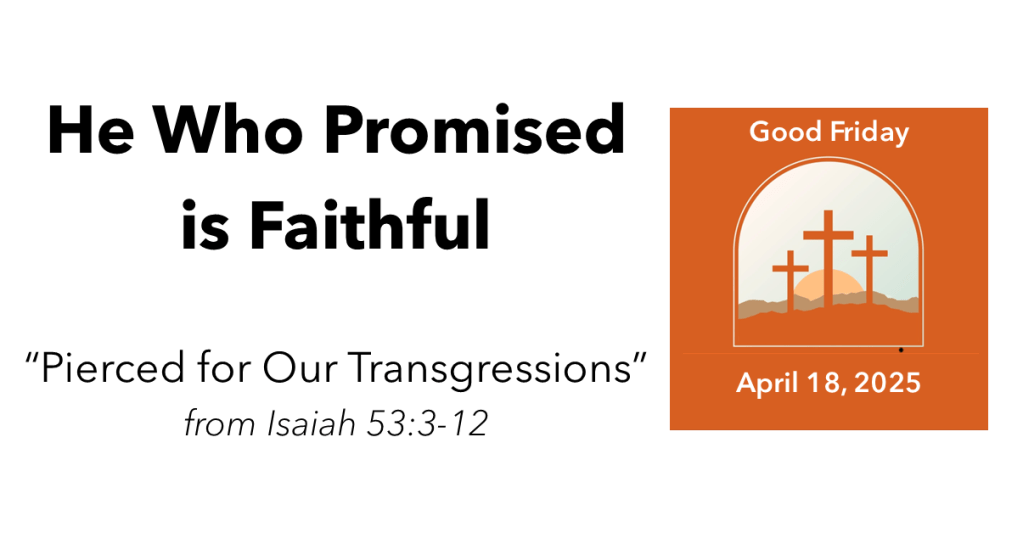
3 He was despised and rejected by men, a man of sorrows and acquainted with grief; and as one from whom men hide their faces he was despised, and we esteemed him not.
4 Surely he has borne our griefs and carried our sorrows; yet we esteemed him stricken, smitten by God, and afflicted. 5 But he was pierced for our transgressions; he was crushed for our iniquities; upon him was the chastisement that brought us peace, and with his wounds we are healed. 6 All we like sheep have gone astray; we have turned—every one—to his own way; and the LORD has laid on him the iniquity of us all.
The Original Context
Isaiah 53 is one of the clearest prophecies in the Old Testament about the coming of a Suffering Servant – One who would be rejected, bear sorrow, and ultimately carry the guilt of others. Verses 3-6 portray this Servant as misunderstood and mistreated. The people saw His suffering and assumed it was punishment from God for His own sins, but Isaiah pulls back the curtain: the Servant wasn’t suffering for His own wrongs – He was bearing the griefs, sorrows, transgressions, and iniquities of others.
This wasn’t punishment for failure. It was substitution. God laid the guilt of His people on this Servant. He was pierced, crushed, chastised – not because of what He had done but because of what we have done. It’s the language of atonement. It is one life being laid down to bring peace and healing to many.
Fulfillment in Jesus
Jesus is the Suffering Servant who Isaiah foretold. He was despised and rejected by His own people. He wept over the unbelief in Jerusalem (Luke 19:41), was betrayed by a friend (Luke 22:47-48), and was abandoned by His disciples (Matthew 26:56). He was beaten, mocked, and crucified – pierced by nails and crushed under the weight of humanity’s sin and the wrath of God against that sin.
But this was neither accidental nor tragic. Jesus didn’t die a victim of injustice but as a willing substitute, the Lamb of God who takes away the sin of the world (John 1:29). It was the purpose for which He came: “Christ died for our sins in accordance with the Scriptures” (1 Corinthians 15:3). At the cross, Jesus bore our griefs and carried our sorrows. Our rebellion against God became His burden. The punishment that brought us peace was laid upon Him. And by His wounds, we are healed – not just physically or emotionally, but spiritually and eternally.
Hope for Today
Good Friday is not a tragedy – it is a triumph through sacrifice.
Good Friday reminds us that salvation isn’t something we earn but something we receive. The weight of our guilt was laid on Jesus. Our wandering hearts find a home in Him who died that we may live.
We are all like sheep – wayward, distracted, self-reliant (or trying to be), but the Shepherd became the Lamb and was led to the slaughter for our sake. If today feels heavy, let it. The cross was no small thing. But don’t stop at sorrow – look through it to see the love of God on full display.
If you have ever felt too sinful to be forgiven, too broken to be loved, or too far gone to be reached – Isaiah 53 is for you. Your sin is not too much for the Savior. The Servant of Isaiah 53 – Jesus Christ – came for sinners just like me and you.
You are not alone in your brokenness and sin. You are not stuck in your guilt. You are not without hope. Jesus was pierced for you. And those who put their faith in Him are forgiven, healed, and brought near.
So come and behold the Lamb – despised and rejected yet full of mercy and grace. Let your heart rest in the peace He purchased with His blood.
Come to the cross.
Let your heart be pierced by His mercy.
Marvel that God would do this for you.
And remember: while Good Friday ended in death, it opened the door to life because Sunday’s coming!
1 My little children, I am writing these things to you so that you may not sin. But if anyone does sin, we have an advocate with the Father, Jesus Christ the righteous. 2 He is the propitiation for our sins, and not for ours only but also for the sins of the whole world.
📖 Revelation 4:1–11In this episode of The King is Coming, Keith Harris and Jamie Harrison move beyond Jesus’s letters to the churches and into the next part of John’s vision. In Revelation 4, John is invited through an open door into heaven—and what he sees is the throne room of God.At the center of everything is a throne, and seated on it is the Lord in all His glory. From this point forward in Revelation, the throne becomes the focal point of the entire book.John describes the scene the best way he can: the brilliance of precious stones, a rainbow surrounding the throne, flashes of lightning and thunder, and a crystal-like sea before it. Surrounding the throne are twenty-four elders and four living creatures who never cease to worship the Lord.Together, Keith and Jamie discuss:✔️ Why Revelation 4 marks a shift from the letters to the churches to John’s heavenly vision✔️ What the throne room reveals about God’s authority and security over all things✔️ Why John uses comparisons (“like” and “as”) to describe the glory he sees✔️ The mystery of the twenty-four elders and what we can—and cannot—know✔️ The constant worship of the living creatures crying “Holy, holy, holy”✔️ Why heaven’s worship centers on God simply because He is worthyIn the throne room, everything points to one truth: God alone is worthy of worship.“Worthy are you, our Lord and God, to receive glory and honor and power, for you created all things, and by your will they existed and were created.” (Revelation 4:11)🔗 If you would like to see a written version of this podcast, complete with footnotes and cross-references, you can find it here.
When I started doing this five years ago, I never intended for it to become an ongoing thing. The pandemic was in full swing, and I became aware that some members of Christ Community—and others in our greater community—were unable to attend church due to health concerns. Some lacked technology or internet access to livestream services and be spiritually fed. So, I began writing Bible studies and sending them out. I even purchased the justKeithHarris.com site to make it easier to share the studies with folks.
As Covid began to settle into a more “normal” part of life and things started moving again, John Goldwater gave us a challenge during a pastors’ meeting. He asked us to think of something God had moved us to do during the pandemic—something extra to reach out—and to consider keeping it going. These Bible studies are what the Lord has continued to stir in me. Now, have I been as consistent over the past year or so as I would like to be? Definitely not. But my heart to encourage people through the Word of God hasn’t changed. That pastor’s heart—God’s call on my life—is what compels me to write this Bible study today.
So many people are hurting right now (and many of you may have burdens I don’t even know about). But God’s Word is “profitable for teaching, for reproof, for correction, and for training in righteousness, that [we] may be complete, equipped for every good work” (2 Timothy 3:16–17). Revelation 2 and Jesus’ letter to the church in Ephesus would certainly be good for us and would build us up. But I can’t get 1 John 2:1–2 off my heart and out of my mind.
I feel a deep burden—and a burning desire—to break open 1 John 2:1–2 with you “clearly,” to give “the sense,” and to help you understand “the reading” (Nehemiah 8:8). I want to help you see whatever it is in this passage that God’s Spirit desires to open up to you. As I write (and truly, I don’t know how this is all going to turn out), there are a few things I want to share before diving into the text:
We – all of us, myself especially – are sinners.
Even if we are saved, there is still a struggle with sin (and unfortunately, we will fall into sin).
When we sin – again, even if we are saved, there are consequences that must be faced.
However, if you are saved and have been adopted into God’s family, you have an advocate, Jesus Christ the Righteous who stands for you when you have fallen into sin and shame. His blood covers sin. He is the God who saves. We never stop needing Him.
If you are reading this and are not saved, He can save you.
Again, my heart is heavy for many of you, and I don’t know exactly how all of this is meant to work together. But I do know this: God’s Word going out is always a good thing. His Word never returns to Him empty; it always accomplishes what He intends (Isaiah 55:11). I may never know how this helps you—but I pray that, according to God’s purpose, it does.
My Little Children (v. 1a)
John opens up this section of 1 John with a term of endearment – a term of love – for these people. By calling them his “little children”, he is not belittling them or making it seem like he sees them as less but rather letting them know that he loves them as a father is supposed to love his children. He is about to tell them some good and bad news and this term of endearment reminds them of their relationship and his love for them.
For me, both at school and at church, I’ve found myself using the word “kiddos” the same way I do with my own children at home. At first, it just slipped out without me thinking, but over the years, it’s become a way to express my care for them—like I consider them mine. It communicates relationship. There’s good news and hard conversations. There’s encouragement, correction, and discipline. They laugh and joke about what’s become my catchphrase at the end of each class—“Good class, kiddos!”—but they always notice if I forget to say it. If I miss it, they’ll ask, “Aren’t you going to say it?” They want to know that, no matter how the class went, I thought it was good. That little phrase reassures them. And even in times when I’ve had to correct them, that word—“kiddo”—still shows up. It reminds both them and me that our relationship remains, through the good and the hard.
Thinking of it that way, I can almost hear John saying with a sigh, “Kiddos, I need you to make sure you’re picking up what I’m laying down: I’m telling you all of this so that you will stop sinning.”
Let that sink in – “so that you may not sin” (v. 1).
How far will you make it with that? How far have you ever made it not sinning?
Yeah, me too.
From a religious standpoint, that might sound like bad news, because we know we can’t do it. The Bible is clear on this. Psalm 14:3 and 53:3 both say, “there is none who does good, not even one,” and the Holy Spirit, through Paul, drives this home in Romans 3:10: “None is righteous, no, not one.” Anyone who honestly looks at their life and compares it to the holy standard of our holy, holy, holy God knows what Isaiah meant when he said, “all our righteous deeds are like a polluted garment” (Isaiah 64:6). Even what we might think of as righteousness is tainted by sin—those “iniquities” that “like the wind, take us away.” That’s why we can’t earn salvation. There’s no amount of scrubbing, trading, or weighing good against bad that can remove sin or make us righteous. It doesn’t work that way. As we’d say in Mississippi, you either are or you ain’t—and, well, we ain’t. The “wages” of our sin give us what we earn—what humanity has earned since Adam—namely death (Romans 6:23).
That’s more than just bad religious news—it’s bad life news.
But praise God, John didn’t stop there! The next word is only three letters in English (and in Greek), but it’s a powerful word for us: “BUT”. That conjunction takes everything that came before it—our sin, our inability to be righteous on our own—and sets it aside to introduce what comes next. John is honest: he tells these spiritual children he loves that he’s writing to them so they “may not sin.” But he knows they will. He knows because he himself didn’t make it far either. John was a sinner too. And how could he not know that? He had walked in the presence of Jesus. How could anyone be in Jesus’ presence and not be fully aware of their sin?
But more than being aware of his sin, John was aware of his Savior. He wrote that they may not sin—but that when they do, they would look to the Savior. Look at the beauty of that second sentence in 1 John 2:1: “But if anyone does sin, we have an advocate with the Father, Jesus Christ the righteous.”
That’s good news! Let me show you why.
We Have an Advocate (v. 1b)
Before we go any further, let’s take a moment to understand what John is saying when he writes that “we have an advocate with the Father, Jesus Christ the righteous.” It’s important to grasp the weight of this biblical truth before we move forward. The word translated “advocate” here is significant. To the native Greek speakers who weren’t writing in a biblical context, this word was used of “a legal advisor, pleader, proxy, or advocate…who comes forward in behalf of and as the representative of another”[1], which carries the idea of a defense attorney today. This was someone who came forward to speak on behalf of another, stepping in to represent and intercede.
But this word also has rich biblical meaning. It’s the same word Jesus used to describe the Holy Spirit, whom He called our “Helper” (John 14:16, 26; 15:26). The Holy Spirit now carries out Jesus’s work in our hearts—He is the One who indwells believers and represents Christ within us. While Jesus ascended to the right hand of the Father, the Holy Spirit fills those who are saved, continuing His ministry as our Helper and Advocate here on earth.
That might sound a bit complex, especially since the idea of a defense attorney already makes sense. But Jesus is so much more than just a spiritual lawyer. Just like the Holy Spirit within us knows we are guilty, Jesus knows it too. He’s not trying to work out a plea deal or pretend we didn’t sin. He doesn’t spin the truth or fudge the facts. Jesus was and is sinless, and He will never lie. But here’s the powerful truth: Jesus knows we’re guilty—and yet He stands in for us anyway.
Jesus doesn’t rely on courtroom tricks to win our case. He is, in a sense, both our advocate and our judge. What He does for those He saves is beyond anything a human defender could do—or would be willing to do. He substitutes Himself on our behalf. He takes our place. And when He stands before the Father, it’s His plea, His righteousness, and ultimately His judgment that matters.
But don’t miss this: when the divine gavel comes down, it’s not on us—it’s on Him. The wrath of God due to our sin falls on Him. That’s how it works.
This is huge—monumental. There’s a theological term that’s been used since the Reformation to describe this: penal substitutionary atonement. It may sound like a mouthful, but it means exactly what it says. “Penal” refers to the penalty our sin deserves. “Substitutionary” means someone is taking someone else’s place. And “atonement” means covering sin and making it right. Put it all together, and it means Jesus took the punishment we deserve for our sin so that we could be forgiven and made right with God.
And that truth is captured in two key words from this passage: “advocate,” which we’ve just unpacked—and the next word we’re turning to now: “propitiation.”
He is the Propitiation for Our Sins (v. 2)
“Propitiation” might sound like what some folks call a fifty-cent word—or a seminary word—but really, it’s just a Bible word. There’s not a single perfect English word that fully captures it, which is why some translations use phrases like “atoning sacrifice” (NIV, CSB) or “sacrifice that atones for our sins” (NLT). But since the Holy Spirit chose to use this word, it’s one we need to understand—not just for head knowledge, but so we can grasp what God is telling us through it. Basically, the word translated “propitiation” in 1 John 2:2 “is the means of putting away sin and establishing righteousness”[2], but let me break it down even further.
At its core, “propitiation” refers to the way Jesus took the punishment for our sins and made peace between us and God. It’s the means by which sin is dealt with and righteousness is established. Jesus didn’t just do something to help us—He is the sacrifice that removes our sin (John 1:29).
In the Old Testament, on the Day of Atonement, the high priest would enter the Holy of Holies and sprinkle the blood of a sacrifice on the mercy seat—the top of the ark of the covenant—to atone for the sins of the people (Leviticus 16:14–15; Hebrews 9:5). But Jesus did something far greater. He was both the perfect High Priest and the perfect sacrifice (Hebrews 10:12–14). His blood wasn’t a symbol on a religious holy day—it was poured out for real, once and for all, on the cross (Hebrews 9:26).
Propitiation doesn’t mean God changed His mind about sin. Jesus, as our Advocate, knows full well the depth of our sin—and we need to understand that Jesus is God. He is holy and has always hated sin. But in His love, God provided the sacrifice Himself (Romans 3:25; 1 John 4:10). He knew we couldn’t save ourselves. He knew we had nothing to offer that could earn forgiveness. The honest and universal plea of humanity is “GUILTY as charged.” Yet through Jesus’ death on the cross—as our substitute—He made a way for us to be forgiven and declared righteous in God’s sight (2 Corinthians 5:21).
This wasn’t just a one-time historical act—it still holds power today. Jesus remains our propitiation. His life, death, resurrection, and ongoing love are what keep us in relationship with God (1 John 3:16; Hebrews 7:25). That matters because Revelation 12:10 tells us that Satan is constantly accusing believers before God “day and night.” Now, Satan is a liar and the father of lies (John 8:44), but speaking from experience, he doesn’t have to make things up to accuse me. My sin is real. God knows it. But I’ve been saved by grace through faith in Jesus (Ephesians 2:8–9).
So when Satan stands before God accusing me, I’m not sitting there alone in shame. I have an Advocate—Jesus Christ the Righteous. I don’t even have to speak in my own defense because Jesus speaks for me. And what He says is powerful and final: I am forgiven. The punishment I deserved has already been carried out—He died in my place. And when the Father looks at me, He doesn’t see my sin. He sees the righteousness of His Son, because I’m covered by His blood.
That’s good news!
Wrapping Up
I hope all of this made sense. All I can really think to say about it is, “Whew! I needed that!” – and that I hope it helps you, dear Sojourner, as well.
One question keeps stirring in my heart as I reflect on everything we’ve seen in this passage: if God loved me enough to do all of that—and to keep doing all of that—for me, won’t He take care of everything else?
The answer to that is easy: a resounding YES.
He loved me enough to save me. He loves me enough to keep me. And He will keep loving me—through my sin, despite my failures, and even in the face of the consequences I bring on myself. Why? Because I belong to Him.
And if you’re reading this and realize that you’re sitting before the divine Judge with no Advocate—if you’re trying to represent yourself—let me gently remind you: it’s unwise to defend yourself in court here on earth, but it’s eternally deadly to try and do it before the holy and all-powerful God of the universe. He already knows the truth: none is righteous, not even one (Romans 3:10). Your sin—any single sin—is enough to condemn you.
So what will it take to convince you to turn to Jesus? What will it take for you to see that He loves you, that He died for you, and that He will save you if you simply bow your knee and confess Him as Lord, believing that He is the risen Savior (Romans 10:9–10)?
I know my words are too weak to convince you. But God’s Word is strong enough. Go back and reread the verses. Click the cross-references. Don’t take my word for it—test it against Scripture. I’m not selling anything. I don’t get a prize if you believe. But if you do put your faith in Jesus, oh what a reward there is for you! Know this: if you need me, I’m here. I’m praying for you. But more than that, I write to you, dear Sojourner that you may not sin. But when you do…there is an advocate. His name is Jesus. He is the Righteous One. He is the propitiation for my sins – and the sins of the whole world.





 Just Keith Harris