Mark 2 opens with a packed house in Capernaum as Jesus “was preaching the Word” (vv. 1–2). Four friends tear open a roof to bring a paralyzed man to Jesus, and Jesus does something shocking first: He forgives the man’s sins (vv. 3–5). The scribes immediately recognize the weight of that claim — only God can forgive sins — so they accuse Jesus of blasphemy in their hearts (vv. 6–7). Jesus answers their unspoken thoughts and then proves His point with a visible miracle: He tells the man to rise and walk, showing that “the Son of Man has authority on earth to forgive sins” (vv. 8–12). The crowd is left amazed, but the bigger issue is now out in the open: Jesus is exercising God’s own authority.
Then the tension grows. Jesus calls Levi (Matthew), a tax collector, and Levi immediately follows (vv. 13–14). Soon Jesus is eating in Levi’s house with “tax collectors and sinners,” which offends the Pharisees and their scribes because table fellowship felt like acceptance (vv. 15–16). Jesus responds with a picture that cuts through religious pretending: doctors go to sick people — He came to call sinners, not the self-assured (v. 17). Next, people challenge Jesus about fasting, but Jesus says His presence is like a wedding — this is a time for joy, though He hints that days are coming when He will be “taken away” (vv. 18–20). His “new cloth/new wine” word pictures make the point: Jesus isn’t a patch on old religion; He brings a new era that can’t be contained by manmade traditions (vv. 21–22).
Finally, the Sabbath controversy surfaces. The disciples pluck grain as they walk, and the Pharisees call it unlawful (vv. 23–24). Jesus points to David eating the bread of the Presence in a moment of real need, showing that God’s Word never meant to treat people like machines (vv. 25–26). Then He declares the heart of Sabbath: it’s a gift for human good, not a crushing burden (v. 27). And He ends with a claim that ties back to the forgiveness scene: “the Son of Man is lord even of the Sabbath” (v. 28). In other words, Jesus isn’t merely interpreting God’s law — He stands over it with divine authority.
🌀 Reflection: It’s possible to be in the room with Jesus and still miss what you most need. The paralytic needed healing, but Jesus went deeper first — forgiveness (v. 5). The scribes knew the right theology (“only God can forgive”), but they refused the right conclusion about Jesus (vv. 7, 10). Ask the Lord for the kind of honest faith that comes to Jesus for the deepest need — not just a better life, but a cleansed heart.
💬 Mission Challenge: Look for one person who feels “too far gone,” “too messy,” or “not church material,” and move toward them with mercy — invite them to coffee, a meal, or simply conversation — so they can see what Mark 2 shows: Jesus welcomes sinners to be made whole (vv. 15–17).
Mark begins fast: this is “the beginning of the gospel of Jesus Christ, the Son of God” (v. 1). John the Baptist arrives as the promised messenger, calling people to repent and be baptized as they confess their sins (vv. 2–5; cf. Isaiah 40:3, Malachi 3:1). John makes it clear that he is not the main point — Someone greater is coming, and He will baptize with the Holy Spirit (vv. 7–8). Then Jesus steps into the story, is baptized, and heaven itself speaks: the Father declares Jesus His beloved Son, and the Spirit descends on Him (vv. 9–11; cf. Psalm 2:7, Isaiah 42:1). Right away, Jesus is driven into the wilderness to be tempted, showing that His mission includes open conflict with Satan — but He is not alone, and He stands firm (vv. 12–13).
After John is arrested, Jesus begins proclaiming “the gospel of God” with a clear call: the Kingdom is near — repent and believe (vv. 14–15). He immediately calls disciples to follow Him and to become “fishers of men,” and they leave everything to go with Him (vv. 16–20). What follows is a rapid set of scenes showing Jesus’ authority: His teaching stuns the synagogue because it carries divine weight, and even unclean spirits must obey Him (vv. 21–28). That authority becomes mercy as He heals Peter’s mother-in-law, then many in the whole town, and He casts out demons — yet He refuses to let the demons define His identity (vv. 29–34). Even with crowds pressing in, Jesus rises early to pray, then keeps moving to preach in other towns, because that is why He came (vv. 35–39). Finally, Jesus touches a man with leprosy — something that would have made others recoil — and His touch cleanses the leper instead of defiling Himself (vv. 40–42). The healed man spreads the news, and the crowds grow even more — yet Mark keeps reminding us: Jesus’ miracles matter, but His primary mission is to proclaim God’s saving reign (vv. 38–39, 45).
🌀 Reflection: Mark 1 doesn’t let us treat Jesus like an inspiring teacher we can take or leave. He is the beloved Son with heaven’s approval (v. 11), the King announcing God’s reign (v. 15), and the Savior with authority over sin, sickness, and darkness (v. 27, 34). The question is simple and searching: am I only amazed by Him, or am I actually following Him (vv. 18, 20)?
💬 Mission Challenge: Pray for one person who needs the hope of the gospel, and then take one step toward them today — send a message, start a conversation, or offer to pray — so your life points to Jesus’ call: “repent and believe” (v. 15).
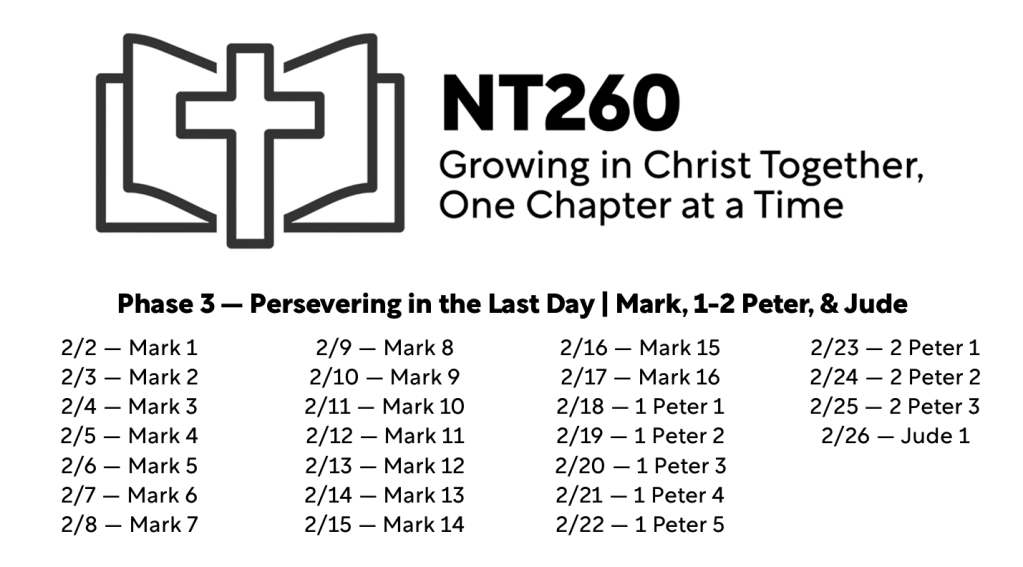
This phase reflects the influence of Peter. The Gospel of Mark is widely understood to preserve Peter’s preaching and eyewitness testimony. Peter’s letters call believers to faithfulness in suffering, holiness in a hostile world, and hope anchored in the return of Christ. Jude echoes those same concerns, warning against false teachers and urging the church to contend for the faith—making it a fitting companion to 2 Peter.
What makes this transition especially meaningful is where Phase 2 ended. Our final reading in Phase 2 was 2 Timothy 4, the ending to Paul’s final letter, written from prison as he awaited martyrdom. In that chapter, Paul asked Timothy to bring John Mark with him, saying, “for he is very useful to me for ministry” (2 Timothy 4:11). That single line carries a beautiful story of restoration. Earlier in Acts, Mark had withdrawn from missionary work, leading to a sharp disagreement between Paul and Barnabas (Acts 13:13, 15:36–40). Yet years later, as Paul’s life and ministry draw to a close, Mark is not only restored — but trusted.
This restoration had already begun. During Paul’s earlier imprisonment, Mark was with him, and Paul instructed the churches to welcome him (Colossians 4:10). By the time Paul writes his final words, Mark is no longer a cautionary tale but a valued coworker.
It is no accident — at least not in the ultimate sense — but neither is it the result of our own brilliant planning. This is one of those quiet God-winks that reminds us the Lord is always telling a bigger story than we realize. As Phase 2 ends with Paul’s final words and his restored confidence in John Mark, Phase 3 begins with Mark’s Gospel. The man once known for faltering becomes the one entrusted with recording Peter’s testimony about Jesus. The gospel that opens this phase is written by a restored servant, shaped by an apostle who knew suffering well, and given to a church learning how to endure faithfully until the end.
Phase 3, then, is not only about persevering in the last days — it is about the God who restores His people, strengthens them through trial, guards them from error, and keeps them faithful until Christ returns.
Below, you’ll find brief synopses of each book in this phase to help you understand the scope of the book and most importantly, how it fits into the full Story of the Bible.
When you click on each day’s link, you will find a link to audio, a summary of the chapter, a key verse from the chapter, and opportunities for reflection and outreach.
We’re moving into Paul’s epistles, which we’ll go through chronologically rather than in the order they appear in our Bibles.
Mark
The Gospel of Mark tells the story of Jesus as the long-promised Savior who has come to bring God’s Kingdom near. From the opening line, Mark moves quickly to show that Jesus is not simply a teacher or miracle worker, but the Son of God who arrives with divine authority (Mark 1:1, 14–15). Rooted deeply in the Old Testament story, Mark presents Jesus as the fulfillment of God’s promises to Israel — One who confronts sin, sickness, demons, and death itself. Yet from the start, Jesus is also misunderstood and opposed, especially by Israel’s leaders, revealing the deep spiritual blindness of the human heart (Mark 2:1–3:6, 4:11–12).
As the story unfolds, Mark emphasizes that Jesus’s identity can only be rightly understood through suffering. Again and again, Jesus reshapes expectations of what the Messiah has come to do. He is the Son of Man with authority, but He is also the suffering Servant who must be rejected, killed, and rise again (Mark 8:31, 10:45). This path to the cross stands at the center of God’s plan of salvation. Jesus triumphs not through power as the world understands it, but through humble obedience, laying down His life as a ransom for many (Mark 14:36, 15:39).
Mark also shows that following Jesus means sharing in this same pattern. True discipleship is not merely believing the right things but living in faithful trust and costly obedience. Those who follow Jesus are called to deny themselves, take up their cross, and follow Him—even in the face of rejection and suffering (Mark 8:34–38). The gospel Mark proclaims climaxes in the crucifixion and resurrection, where Jesus decisively defeats sin and Satan and opens the way for everlasting salvation. In God’s unfolding story, Mark reminds us that the kingdom comes through the cross, and that life is found by following the crucified and risen King.
The letter of 1 Peter was written by the apostle Peter to encourage believers who were suffering because of their faith. From the opening, Peter identifies his readers as God’s chosen people — “exiles” scattered across the provinces of Asia Minor (1 Peter 1:1). Whether that exile language is partly literal or mainly spiritual, the point is clear: Christians live in a world that does not fully welcome them, because their true home and inheritance are with God (1 Peter 1:3–5, 2:11). Peter writes to strengthen weary saints with hope — hope grounded not in easier circumstances, but in the resurrection of Jesus Christ and the sure promise of final salvation when Christ returns (1 Peter 1:3–9, 13).
At the heart of 1 Peter is the pattern of Jesus Himself: suffering now, glory later. Peter reminds believers that their trials do not mean God has abandoned them; rather, suffering for doing good is part of following a crucified and risen Savior (1 Peter 2:21–23, 4:12–13). Jesus’s death is not only an example — it is substitutionary atonement that brings sinners to God (1 Peter 2:24, 3:18). And Jesus’s resurrection and ascension mean evil will not have the final word: Christ has triumphed, and all powers are subject to Him (1 Peter 3:22). Because of what Christ has done, believers have been given new birth into a living hope and are being guarded by God for an inheritance that cannot perish (1 Peter 1:3–5).
That living hope shapes everyday life. Peter calls Christians to holy, love-filled obedience that makes the gospel visible in a hostile culture (1 Peter 1:14–16, 2:11–12). He describes the church as God’s new temple — “living stones” built into a spiritual house — and God’s covenant people: a chosen race, royal priesthood, holy nation, and treasured possession (1 Peter 2:4–10). Then he brings that identity down into the ordinary places where pressure is often felt most — relationships, workplaces, homes, and society — urging believers to do good, to honor authorities rightly, to endure unjust treatment faithfully, and to answer hostility with blessing (1 Peter 2:13–17, 18–20; 3:1–9). In short, 1 Peter teaches Christians how to stand firm in “the true grace of God” (1 Peter 5:12): suffering without losing hope, living holy without becoming harsh, and bearing witness to Jesus while waiting for the day when God will fully vindicate His people.
2 Peter is a final letter written by the apostle Peter near the end of his life, likely from Rome, as he awaited martyrdom (2 Peter 1:12–15). Like his first letter, it is written to believers facing real pressure, but this time the danger comes from within the church rather than from outside persecution. Peter writes as a spiritual father giving last reminders, urging Christians to hold firmly to what they already know and believe. He points them back to the truth they received from the apostles and from Scripture, reminding them that the gospel they trusted is not a clever story but God’s revealed truth (2 Peter 1:16–21).
In the flow of the Bible’s story, 2 Peter helps God’s people live faithfully in the time between Jesus’s first and second coming. Jesus has already accomplished salvation through his death and resurrection, but the church now waits for his return. During this waiting, false teachers arise, twisting grace into an excuse for sin and questioning whether Jesus will really come back (2 Peter 2:1–3, 3:3–4). Peter responds by showing that God’s patience is not weakness but mercy, giving people time to repent before the day of judgment comes (2 Peter 3:8–9). Just as God judged rebellion in the past and rescued the righteous, he will do so again at the end (2 Peter 2:4–9).
2 Peter calls believers to live in light of where the story is headed. Because God has promised a new heaven and a new earth where righteousness dwells, Christians are to grow in holiness, knowledge, and steadfast faith now (2 Peter 1:5–11, 3:11–13). The letter closes by urging believers not to drift or be carried away by error, but to keep growing in the grace and knowledge of Jesus Christ until the day he returns (2 Peter 3:17–18). In this way, 2 Peter strengthens the church to remain faithful to the truth as it waits for the final fulfillment of God’s saving plan.
The book of Jude is a short but urgent letter written by Jude, the brother of James and a half-brother of Jesus (Jude 1, Matthew 13:55). Writing in the mid-60s, Jude addresses believers facing a serious danger from within the church. False teachers had quietly slipped in and were twisting God’s grace into an excuse for sinful living (Jude 4). Jude writes as a servant of Jesus Christ, not appealing to family ties, but calling the church to recognize the seriousness of the moment and to respond with faithfulness and courage.
In the flow of the Bible’s Story, Jude speaks to the life of God’s people after Christ has already accomplished salvation. Because Jesus has secured redemption once for all, believers are now responsible to guard and remain faithful to “the faith that was once for all delivered to the saints” (Jude 3). Jude looks back to God’s past acts of judgment and rescue — from the Exodus to Sodom and Gomorrah — to show that God does not ignore rebellion, even among those who claim to belong to Him (Jude 5–7). These warnings remind the church that rejecting God’s truth always leads to destruction, while trusting Him leads to life.
Jude closes by calling believers to persevere with both truth and mercy. They are to build themselves up in faith, pray in the Holy Spirit, and keep themselves in God’s love as they wait for the return of Jesus Christ (Jude 20–21). At the same time, they are to show mercy to those who are wavering, while refusing to compromise with sin (Jude 22–23). The letter ends with a powerful reminder that God himself is the one who keeps His people from falling and will bring them safely into His presence with great joy (Jude 24–25).
Paul ends this letter with a weighty, end-times charge. Timothy’s ministry happens “in the presence of God and of Christ Jesus,” the coming Judge of all, and under the certainty of Christ’s appearing and kingdom (v. 1). Because of that reality, Timothy must preach the Word — ready when it’s welcome and when it’s not — using Scripture to correct, confront, and encourage with steady patience and careful teaching (v. 2). Paul knows what’s coming (and already happening): many won’t tolerate sound doctrine. Instead, they’ll chase teachers who tell them what they want to hear, swapping truth for myths because their desires are driving the steering wheel (vv. 3–4). So Timothy must stay clear-minded, endure suffering, keep doing gospel work, and finish what God has given him to do (v. 5).
Then Paul explains why the urgency is so intense: he is near the end. He speaks of his life like an offering being poured out, and he says plainly that his “departure” is at hand (v. 6). Looking back, Paul isn’t boasting — he’s testifying to God’s sustaining grace: he fought the good fight, finished the race, and guarded the faith entrusted to him (v. 7; cf. 1:14). Looking ahead, he expects the “crown of righteousness” from the Lord, the righteous Judge — not only for himself, but for all believers who love and long for Christ’s appearing (4:8). In other words: perseverance isn’t for “super-Christians”; it’s what Christ produces in His people as they keep their eyes on His coming kingdom (v. 8).
The final section turns personal, but the themes keep echoing. Paul asks Timothy to come soon, and he names the pain of desertion (Demas loving this present world), the scattering of coworkers to ministry fields, and the comfort of faithful companions like Luke (vv. 9–11). He asks for Mark — proof that past failure doesn’t have to be the final chapter when grace restores (v. 11). Even facing opposition and legal danger, Paul entrusts justice to the Lord (vv. 14–15). And though people abandoned him at his first defense, the Lord did not: Christ stood by him, strengthened him, and kept the gospel moving forward (vv. 16–17). Paul’s confidence is settled: whether by life or by death, the Lord will bring him safely into His heavenly kingdom — so Paul ends where every weary servant needs to end: with worship and grace (vv. 18, 22).
🌀 Reflection: Where are you most tempted right now to “soften” truth to keep peace — or, on the other side, to speak truth without patience — and how does Paul’s charge call you back to both courage and gentleness (vv. 2–5)?
💬 Mission Challenge: Pray for one specific person who seems to be drifting toward “itching ears,” then reach out with a kind, non-combative invitation: offer to read a short passage of Scripture together and ask, “What does this show us about Jesus, and what would it look like to obey it?” (vv. 2–4).
Click here to continue reading in our NT260 plan with Phase 3 — Persevering in the Last Day.
Paul tells Timothy to face reality with open eyes: in “the last days” there will be seasons that feel brutal — times of difficulty marked by people who love themselves, money, and pleasure more than God (vv. 1–4). The danger isn’t only obvious wickedness; it’s religion without repentance — “the appearance of godliness” while denying the transforming power of God (v. 5). These influences don’t just stay “out there.” They infiltrate, manipulate, and keep people trapped in an endless cycle of learning without ever coming to a true knowledge of the truth (vv. 6–7). Like the opponents of Moses, these teachers oppose God’s truth, but Paul promises they won’t win forever — God will expose their folly in time (vv. 8–9).
Then Paul turns and says, “You, however…” — Timothy has seen a different pattern in Paul’s life: faithful teaching, steady character, clear purpose, and love that endures suffering (v. 10). Timothy also knows Paul’s story of persecution in Antioch, Iconium, and Lystra, and how the Lord rescued him — not by removing every hardship, but by preserving him and keeping him faithful through it (v. 11). Paul doesn’t sugarcoat it: everyone who desires to live a godly life in Christ Jesus will face opposition, while evil and deception keep intensifying (vv. 12–13). So Timothy must not drift. He must continue in what he has learned, remembering both who taught him and how God used “the sacred writings” to make him wise for salvation through faith in Christ (vv. 14–15).
Finally, Paul anchors everything in one of the clearest statements in the Bible about Scripture: All Scripture is breathed out by God and is deeply useful — teaching what is true, exposing what is wrong, correcting what has gone crooked, and training us to live rightly (v. 16). God doesn’t give His Word to fill our heads only; He gives it to form us, mature us, and equip us for the good works He calls us to do (v. 17). In difficult times, the church doesn’t survive by trendiness or toughness — it survives by clinging to Christ through His Word (vv. 15–17).
🌀 Reflection: Where do you feel the pressure most right now to settle for “the appearance of godliness” instead of real, Spirit-shaped life — and what is one specific way you can “continue” in Scripture this week rather than drifting (vv. 5, 14–17)?
💬 Mission Challenge: Encourage one person today (a friend, student, family member, or church member) by sharing why God’s Word matters to you, and invite them to read a short passage with you — asking God to use it to teach, correct, and strengthen both of you (vv. 15–17).
Paul calls Timothy to keep going — strong not in his personality or circumstances, but “by the grace that is in Christ Jesus” (v. 1). Then Paul gives a generational mission: Timothy is to pass on what he has received to faithful people who can teach others too (v. 2). This is how the gospel keeps moving when leaders suffer and seasons change. Paul reinforces that ministry will include hardship, and he uses three pictures — soldier, athlete, farmer — to show what faithful service looks like: focused devotion that aims to please the Commander (vv. 3–4), obedience that won’t cut corners (2:5), and steady labor that trusts God for the harvest (vv. 6–7).
At the center of it all, Paul says: Remember Jesus Christ — risen from the dead, the offspring of David (2:8). Paul may be chained, but God’s word is not (v. 9). So he endures everything so that God’s chosen will obtain salvation with eternal glory (v. 10). Then comes a “trustworthy saying” that both comforts and warns: union with Christ means life beyond death (v. 11), endurance leads to reigning with Him (v. 12), denial is deadly serious (v. 12), and even when we are faithless, God remains faithful to His own character (v. 13). The gospel produces perseverance — and perseverance proves the gospel has truly taken root (vv. 11–13).
From there, Paul turns to how Timothy must lead in a confused and argumentative environment. He must warn the church away from word-quarrels that ruin hearers (v. 14) and instead labor to be “approved,” unashamed, and careful with Scripture — handling the word of truth rightly rather than twisting it (v. 15). False teaching is not harmless; it spreads like disease and can overturn shaky faith, as seen in Hymenaeus and Philetus, who claimed the resurrection had already happened (vv. 16–18). Still, God’s foundation stands: He knows who are His, and those who name Him must depart from sin (v. 19). Paul pictures the church as a great house with different vessels, and urges Timothy (and believers) to cleanse themselves from what is dishonorable so they can be useful, holy, and ready for every good work (vv. 20–21). That means fleeing youthful passions, pursuing Christlike character with other believers, avoiding foolish controversies, and correcting opponents with gentleness — because God can grant repentance and rescue people from the devil’s snare (vv. 22–26).
🌀 Reflection: Where are you most tempted right now — distraction, shortcuts, or needless arguing — and what would it look like for you to “remember Jesus Christ” and pursue faithfulness with steady endurance (vv. 8, 14–16, 22–25)?
💬 Mission Challenge: Choose one conversation this week where you would normally “win the argument,” and instead aim to be kind, patient, and gentle while speaking truth clearly — praying that God would use your posture to open a door for repentance (vv. 24–25).
Paul writes to Timothy from prison in this last letter before his martyrdom with the weight of eternity in view. He opens by reminding Timothy that his apostleship — and Timothy’s calling — rests on “the promise of the life that is in Christ Jesus” (v. 1). Though chained and nearing death, Paul expresses deep affection and gratitude for Timothy, recalling his tears, his sincere faith, and the godly heritage passed down through his grandmother Lois and his mother Eunice (vv. 3–5). This faith, Paul insists, is living and active, meant to be stirred and strengthened, not allowed to fade (v. 6).
Paul urges Timothy toward bold endurance. God has not given His people a spirit of fear, but of power, love, and self-control — strength that comes from the Holy Spirit, not personal resolve (v. 7). Because of this, Timothy must not be ashamed of the gospel or of Paul’s imprisonment, but must be willing to suffer for the gospel by God’s power (1:8). Paul grounds this call in the heart of the gospel itself: salvation is rooted in God’s eternal purpose and grace, revealed in Christ, who has broken the power of death and brought life and immortality to light (vv. 9–10). Paul’s own suffering flows from this calling, yet he remains unashamed because he knows whom he has believed and trusts God to guard what has been entrusted to Him until the final day (vv. 11–12).
Paul then charges Timothy to hold firmly to the pattern of sound teaching he has received and to guard the gospel deposit by the Holy Spirit who dwells within believers (vv. 13–14). The chapter closes with real-life examples — some who deserted Paul out of fear, and one faithful servant, Onesiphorus, who courageously sought Paul out and refreshed him without shame (vv. 15–18). Faithfulness, Paul shows, is costly — but it is sustained by God’s power and crowned with mercy on “that day.”
🌀 Reflection: Where might fear, discouragement, or pressure be tempting you to shrink back from faithfulness — and how does God’s promise of power, love, and self-control speak into that place (vv. 6–8)?
💬 Mission Challenge: Encourage a fellow believer who is serving faithfully but unseen — send a message, offer prayer, or show practical support, following the example of Onesiphorus (vv. 16–18).
Paul calls believers to live with a steady, humble witness in the world. Titus is to remind the church to respect authority, be ready to do good, and relate to others with gentleness — refusing slander, avoiding quarrels, and showing real courtesy to all (vv. 1–2). This kind of life stands in sharp contrast to the chaos of false teaching. Where divisive voices stir conflict and prove “unfit for any good work,” Christians are to be known for peaceable, helpful lives that reflect the goodness of the gospel (vv. 1–2, 8; cf. 1:16, 2:14).
Paul then grounds that calling in God’s saving mercy. We were once foolish, enslaved to sinful desires, and marked by hostility (v. 3). But when God’s kindness appeared in Jesus, He saved us — not because of righteous deeds we had done, but by His mercy — cleansing us through the washing of regeneration and renewing us by the Holy Spirit, poured out richly through Christ (vv. 4–6). Justified by grace, believers become heirs with the sure hope of eternal life (v. 7). That’s why Titus must insist on these truths: grace that saves also creates people who are careful to devote themselves to good works for the good of others (v. 8).
Paul closes by warning against fruitless arguments and persistent division. Foolish controversies only distract from the mission, and a person who refuses correction and continues to divide must eventually be separated from the community for the sake of the church’s health (vv. 9–11). Even the closing greetings and travel plans reinforce the letter’s theme: God’s people are to support gospel workers and meet urgent needs so the church will not be unfruitful (vv. 12–15).
🌀 Reflection: How does remembering who you once were — and how God saved you by mercy alone — shape the way you speak to and treat people who are difficult, unbelieving, or opposed to the gospel (vv. 2–7)?
💬 Mission Challenge: Look for one tangible way this week to do good for someone outside your church — serve, encourage, or help meet a real need — so your life quietly points to the grace that saved you (vv. 1, 8, 14).
Paul turns from confronting false teachers to instructing Titus on what faithful gospel living looks like in everyday life. Titus is to teach “what accords with sound doctrine,” showing how the truth shapes real people in real relationships, through discipleship (v. 1). Paul addresses the church by age and role — older men and women, younger men and women, and servants — calling each group to lives marked by self-control, integrity, faith, love, and good works (vv. 2–10). Older believers are to model maturity, younger believers are to learn wisdom, and all are to live in ways that protect the reputation of God’s Word and make the gospel attractive to the watching world (vv. 5, 8, 10).
Paul then grounds these commands in the heart of the gospel itself. The grace of God has appeared in Jesus Christ, bringing salvation and training God’s people to say no to sin and yes to godly living in the present age (vv. 11–12). Christians live this way because they are waiting for their “blessed hope” — the return of Jesus, our great God and Savior (v. 13). Christ gave Himself to redeem and purify a people who belong to Him and are eager to do good works (v. 14). Because this message comes with divine authority, Titus is to teach, encourage, and correct boldly, allowing no one to dismiss the transforming power of grace (v. 15).
🌀 Reflection: How is God’s grace currently training you — not just saving you from sin, but shaping how you live today as you wait for Christ’s return (vv. 11–13)?
💬 Mission Challenge: Look for one practical way this week to “adorn the doctrine of God our Savior” by intentionally living with integrity, kindness, and self-control in your home, work, or community (v. 10).
Then Paul explains Titus’s task in Crete: finish what remains and appoint elders (pastors) in every town (v. 5). These leaders must be above reproach at home and in public—faithful, self-controlled, not greedy or hot-tempered, but hospitable and disciplined (vv. 6–8). Just as important, they must hold firmly to the trustworthy Word so they can teach sound doctrine and rebuke error (v. 9). That’s urgent because false teachers were spreading empty talk for shameful gain, upsetting families, and promoting myths and human commands (vv. 10–11, 14). Paul says Titus must confront this firmly so the church becomes “sound in the faith” (v. 13). The problem isn’t external rules but defiled hearts—some profess God yet deny Him by their works, showing they are unfit for good works (vv. 15–16).
🌀 Reflection: Where do you most need the “truth” of the gospel to shape your everyday choices so your life matches your confession (vv. 1, 16)?
💬 Mission Challenge: Encourage a pastor/leader this week by thanking them for holding to Scripture—and commit to reject “empty talk” by opening the Word with someone instead (vv. 9–11).