Today’s post includes a brief overview of the chapter and a focused look at what it reveals about Jesus (Rev. 1:1) — so our eyes stay fixed on Him.
Chapter Overview: Revelation 3 continues Jesus’ messages to the churches, addressing Sardis, Philadelphia, and Laodicea (vv. 1–22). Sardis has a reputation for being alive but is spiritually dead, and Jesus calls them to wake up, repent, and return to what they received (vv. 1–3). Philadelphia, though weak and persecuted, is commended for faithfulness and promised an open door and secure place in God’s kingdom (vv. 8–12). Laodicea, however, is rebuked for being lukewarm — self-sufficient in appearance but spiritually poor, blind, and needy — and is called to repent and return to true dependence on Christ (vv. 15–18). Across each message, Jesus calls His people to hear, repent, and overcome, promising eternal life and fellowship to those who remain faithful (vv. 5, 12, 21).
Seeing Jesus in This Chapter: In Revelation 3, Jesus is revealed as the holy and true King who sees clearly, rules completely, and calls His people to real faith. He is the One who has the seven spirits and the seven stars, meaning He has full authority and gives true spiritual life (v. 1). He is the holy and true One who holds the key of David — what He opens no one can shut, and what He shuts no one can open (v. 7). He sees beyond appearances, exposing empty reputation in Sardis and lukewarm self-deception in Laodicea, while honoring quiet faithfulness in Philadelphia (vv. 1, 8, 15–17). As the faithful and true witness, His words are trustworthy, even when they confront and correct (v. 14). Yet He is also gracious — loving enough to discipline, calling His people to repentance, and inviting them into fellowship: “I stand at the door and knock” (vv. 19–20). He promises that those who overcome will share in His victory and reign with Him (v. 21). Jesus is not impressed by appearances — He desires true faith, real dependence, and enduring devotion.
🌀 Reflection: Jesus sees what is real, not just what appears to be. Are you relying on reputation or truly walking with Him in faith and dependence?
💬 Mission Challenge: Turn from self-reliance today and intentionally depend on Jesus in one specific area of your life.
Today’s post includes a brief overview of the chapter and a focused look at what it reveals about Jesus (Rev. 1:1) — so our eyes stay fixed on Him.
Chapter Overview Revelation 2 records Jesus’ messages to four churches — Ephesus, Smyrna, Pergamum, and Thyatira — each following a pattern: He knows their condition, speaks truthfully about it, calls them to respond, and promises reward to those who overcome (vv. 1–29). Ephesus is commended for truth and endurance but rebuked for losing their first love and called to repent (vv. 2–5). Smyrna, though suffering and poor, is declared spiritually rich and urged to remain faithful even to death (vv. 9–10). Pergamum is praised for holding fast to Jesus in a hostile place but warned to repent of tolerating false teaching and compromise (vv. 13–16). Thyatira is commended for growing in love and service but rebuked for allowing false teaching and immorality, with a call to hold fast and remain faithful (vv. 19–25).
Seeing Jesus in This Chapter: In Revelation 2, Jesus is revealed as the Lord of His church who knows, searches, and rules over His people. He walks among the churches and holds them in His hand, meaning He is present, attentive, and sovereign over them (v. 1). He declares again and again, “I know” — He sees their works, their suffering, their faithfulness, and their sin (vv. 2, 9, 13, 19). He is the One who died and came to life, giving hope to those who suffer and face death (v. 8). He speaks with the authority of the sharp two-edged sword, confronting false teaching and calling His people to repentance (vv. 12, 16). His eyes are like fire, searching hearts and minds, and He judges rightly according to what is true (vv. 18, 23). Yet He is also gracious — giving time to repent and calling His people to endure, promising life, victory, and fellowship with Him to those who remain faithful (vv. 7, 10, 17, 26–28). Jesus is not distant from His church — He is present, holy, and actively leading His people toward faithfulness.
🌀 Reflection: Jesus sees both what is right and what is lacking in His people. Where might He be calling you to repent or remain faithful today?
💬 Mission Challenge: Examine your life before the Lord today and take one step of obedience in response to what He reveals.
Today’s post includes a brief overview of the chapter and a focused look at what it reveals about Jesus (Rev. 1:1) — so our eyes stay fixed on Him.
Chapter Overview: Revelation opens as “the revelation of Jesus Christ” — a message from God, given to Jesus, delivered through John to the church (vv. 1–2). It promises blessing to those who hear and obey because “the time is near” (v. 3). John greets the churches with grace and peace and points to Jesus, who loves us, freed us from our sins, and made us a kingdom of priests (vv. 4–6). The chapter announces that Jesus is coming again in glory (vv. 7–8) and then records John’s vision of the risen Christ — standing among His churches in power and authority (vv. 12–16). When John falls in fear, Jesus reassures him and declares His victory over death, commissioning him to write what he sees (vv. 17–20).
Seeing Jesus in This Chapter: Revelation 1 shows us Jesus not in humility, but in glory and authority. He is the faithful witness, the firstborn from the dead, and the ruler of kings on earth (v. 5). He is the One who loves us and has freed us from our sins by His blood, making us a kingdom and priests to God (vv. 5–6). He is the coming King who will return with the clouds, and every eye will see Him — both those who trust Him and those who rejected Him (v. 7). As the Son of Man, He stands among His churches — present, watchful, and sovereign — holding His people securely and knowing their true condition (vv. 12–13, 16). His blazing eyes see all, His voice carries authority, and His word brings both judgment and truth (vv. 14–16). Yet this same glorious Jesus comforts His people, saying, “Fear not.” He is the eternal One — “the first and the last” — who died and now lives forever (vv. 17–18). Because He has conquered death and holds its keys, His people can live with confidence, endurance, and hope.
🌀 Reflection: Seeing Jesus in His glory reminds us that He is not only Savior but King. How does that truth shape the way you face fear, uncertainty, or suffering today?
💬 Mission Challenge: Worship Jesus as your risen King today, and share that hope with someone who needs it.
John writes this short letter to a man named Gaius, and it gives us a clear picture of what faithful Christian living looks like in everyday life. John rejoices because Gaius is “walking in the truth,” meaning his life matches the gospel he believes (3 John 3–4). Truth is not just something we say—it shapes how we live. John even prays that Gaius’s physical health would match his strong spiritual condition, showing that faithfulness to Christ is the most important measure of a person’s life.
One of the clearest ways Gaius lives out the truth is through hospitality. He faithfully supports traveling gospel workers, even those he does not personally know (3 John 5–6). In the early church, these workers depended on believers for encouragement and provision, and John says supporting them is a way of partnering in the truth (3 John 7–8). Not everyone is called to go, but everyone is called to play a part in the mission of the gospel. When we support those who are faithfully serving Christ, we share in that work.
In contrast, John warns about a man named Diotrephes, who loves to be first and refuses to welcome others or submit to apostolic authority (3 John 9–10). His pride leads him to oppose faithful believers and even push them out of the church. John tells Gaius not to imitate what is evil, but what is good (3 John 11). Instead, he points to Demetrius as a faithful example—someone whose life and reputation align with the truth (3 John 12). The letter closes with a reminder that Christian relationships are personal and meaningful, rooted in truth and love, not control or selfish ambition (3 John 13–15).
🌀 Reflection: Whose example are you following right now—Gaius, Diotrephes, or Demetrius? Your daily choices reveal whether you are walking in truth or drifting toward pride and self-focus.
💬 Mission Challenge: Support someone who is faithfully serving the Lord—through encouragement, prayer, or practical help—and become a partner with them in the work of the gospel.
John’s short letter brings together two themes that must stay together in the Christian life: truth and love. He rejoices that some in the church are “walking in the truth,” and then urges them to continue loving one another in obedience to Christ’s command (2 John 4–6). Truth is not cold doctrine, and love is not mere sentiment. John shows that real Christian love is shaped by God’s truth, and real Christian truth is lived out in love. Grace, mercy, and peace are found “in truth and love,” and John wants the church to keep walking in both.
But this little letter is also a warning. Many deceivers had gone out into the world, denying that Jesus Christ has come in the flesh (2 John 7). That means this is not a minor disagreement. It is a rejection of the true Christ. John says such a person is “the deceiver and the antichrist,” and he tells the church to watch carefully so they do not lose what they have worked for (2 John 8). Anyone who runs ahead of apostolic truth and does not abide in the teaching of Christ does not have God, but the one who abides in that teaching has both the Father and the Son (2 John 9). Truth must not be traded away for novelty, popularity, or the appearance of kindness.
That is why John gives such strong instruction about hospitality. If traveling teachers come without the true doctrine of Christ, the church must not receive or endorse them, because to support false teaching is to share in its wicked work (2 John 10–11). John is not telling believers to be harsh toward unbelievers in general, but to refuse any partnership that would make it seem like false teaching is acceptable. He closes by saying he hopes to come and speak face to face, because faithful fellowship in truth leads to full joy (2 John 12). This letter reminds us that guarding the gospel is not unloving. It is one of the most loving things we can do for Christ’s church.
🌀 Reflection: Are you holding truth and love together, or are you tempted to separate them? Jesus calls us to love people deeply without compromising the truth about who He is.
💬 Mission Challenge: Encourage another believer to stand firm in the truth about Jesus, and look for one practical way to show Christlike love without surrendering biblical conviction.
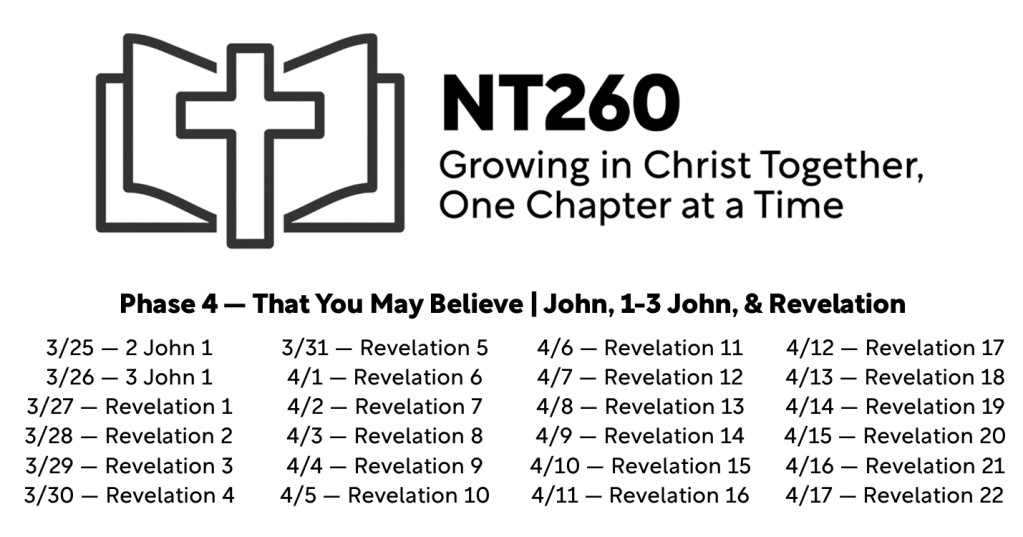
This phase reflects contains the apostle John’s writings. His gospel and letters teach us how to walk in truth in love. Revelation closes the New Testament with a powerful vision of Jesus’s return and eternal reign.
Phase 4 is the embodiment of two passages from the end of John’s gospel, so we’ll let the Holy Spirit through John explain:
John 20:30-31 —
Now Jesus did many other signs in the presence of the disciples, which are not written in this book; but these are written so that you may believe that Jesus is the Christ, the Son of God, and that by believing you may have life in his name.
John 21:24-25 —
This is the disciple who is bearing witness about these things, and who has written these things, and we know that his testimony is true. Now there are also many other things that Jesus did. Were every one of them to be written, I suppose that the world itself could not contain the books that would be written.
These verses not only represent John’s aim when writing as he was “carried along by the Holy Spirit” (2 Peter 1:21); they represent our heart in seeking to get folks into God’s Word — “so that you may believe that Jesus is the Christ, the Son of God, and that by believing you may have life in his name (John 20:31). Our goal isn’t clicks or likes or to give ribbons for finishing a reading plan. We want to see Jesus high and lifted up. And while there are many books written about Him and “the world itself could not contain the books that would be written” (John 21:25) if every moment of His life on earth were recorded, there is no books greater than those of holy Scripture to introduce us God in flesh than the New Testament.
Let’s dig in together and finish well — let us seek and see Jesus together!
Below, you’ll find brief synopses of each book in this phase to help you understand the scope of the book and most importantly, how it fits into the full Story of the Bible.
When you click on each day’s link, you will find a link to audio, a summary of the chapter, a key verse from the chapter, and opportunities for reflection and outreach.
We’re moving into Paul’s epistles, which we’ll go through chronologically rather than in the order they appear in our Bibles.
The book of Revelation opens with these words: “The revelation of Jesus Christ” (Rev. 1:1). This is not first a book about timelines, symbols, or end-times speculation—it is an unveiling of Jesus. Through vivid imagery and powerful visions, Revelation pulls back the curtain to show what is really true: Jesus is risen, reigning, and returning. Much of its language and imagery draw from the Old Testament—especially books like Daniel, Ezekiel, and Zechariah—so that what may seem strange at first is actually deeply rooted in God’s earlier promises. Because of this, Revelation is not always meant to be read in a strictly literal or step-by-step way like other New Testament books. It is a picture-rich, symbol-heavy book meant to reveal truth, not hide it.
At the center of everything Revelation shows us is Jesus Himself. He is the Son of Man walking among His churches (1:12–13), the Lamb who was slain and yet stands victorious (5:6), the King of kings who rules over history (19:16), and the One who will make all things new (21:5). Revelation reminds us that behind the visible world is a greater reality—one where Christ has already secured the victory through His death and resurrection (Col. 2:15), and where every enemy will ultimately be defeated. No matter how chaotic things may appear, Jesus is not absent. He is reigning now, and He will return to judge evil, rescue His people, and establish His kingdom forever.
Revelation was written to real churches facing real pressure—persecution, compromise, and the temptation to give up. Like the Gospel of John, it calls us to believe—but here, that belief is strengthened in the face of suffering and uncertainty. As we read, we are not trying to decode every symbol or map out every detail. Instead, we are looking to see Jesus more clearly, trust Him more fully, and follow Him more faithfully. This book calls us to endure, to remain faithful, and to worship the One who holds all things in His hands. In the end, Revelation is not meant to confuse us, but to anchor us: Jesus wins—and all who belong to Him will share in His victory.
To help, Jamie Harrison and I (Keith) have been walking through Revelation in a series of Bible studies called The KING is Coming; check them out!
Because Revelation is unique, our daily reading helps will look a little different than the rest of NT260. Instead of only summarizing each chapter, each day will include (1) a brief overview of the chapter to help you follow the flow, and (2) a focused paragraph highlighting what that chapter reveals about Jesus. From there, we’ll continue with a key verse, a personal reflection, and a mission challenge just like the rest of the plan. The goal is not to untangle every detail, but to keep our eyes fixed on Christ—to see Him clearly in every chapter and respond in faith, worship, and obedience.
Thanks for joining us in the NT260 readings! It is our prayer that the time in God’s Word has led your heart to worship Jesus and grow close to Him.
Our next Bible reading plan is called See JESUS in the Old Testament — won’t you consider continuing in the Word to worship Jesus and continually grow closer to Him?
John brings faith, love, and obedience together and shows that they cannot be separated. Everyone who believes that Jesus is the Christ has been born of God, and those born of God will love both the Father and His children (1 John 5:1). Love for God is not vague emotion. It is shown by obeying His commandments, and John says those commandments are not burdensome because the new birth changes our hearts (1 John 5:2–3). Those who have been born of God overcome the world — not by personal strength, but by faith in Jesus as the Son of God (1 John 5:4–5). In other words, victory over the world’s lies, pressures, and sinful desires comes through trusting Christ.
John then points to God’s testimony concerning His Son. Jesus came by water and blood, most likely referring to His baptism and His death, and the Spirit also bears witness because the Spirit is truth (1 John 5:6–8). These witnesses agree that Jesus is truly the Son of God. To reject that testimony is not a small matter. It is to call God a liar by refusing what He has plainly said about His Son (1 John 5:9–10). And God’s testimony is wonderfully clear: He has given us eternal life, and that life is found in His Son alone (1 John 5:11). That is why John can speak so plainly: whoever has the Son has life; whoever does not have the Son of God does not have life (1 John 5:12; cf. John 14:6).
John says he wrote so believers may know they have eternal life (1 John 5:13). This assurance is meant to lead to confident prayer. When we ask according to God’s will, He hears us, and we can trust Him with what we have placed before Him (1 John 5:14–15). John also urges believers to pray for a brother or sister caught in sin, showing that real faith cares about the spiritual good of others (1 John 5:16–17). He closes with strong reminders: those born of God do not make a practice of sinning, God protects His people from the evil one, the whole world lies in Satan’s power, and the Son of God has come so that we may know Him who is true (1 John 5:18–20). The final warning, “keep yourselves from idols,” fits the whole letter. Anything false that pulls us away from the true God revealed in Jesus must be rejected (1 John 5:21).
🌀 Reflection: Do you live as though eternal life is uncertain, or do you rest in God’s testimony about His Son? John wants believers to have settled confidence that life is found in Jesus and nowhere else.
💬 Mission Challenge: Encourage someone today with the truth that eternal life is found in Christ alone, and pray specifically for a brother or sister who needs help walking faithfully with Him.
John first tells believers not to be spiritually gullible. Not every message, teacher, or spiritual influence is from God, so Christians must test the spirits (1 John 4:1). The main test is what a person says about Jesus. The Spirit of God leads people to confess that Jesus Christ has come in the flesh, truly God and truly man (1 John 4:2). Any spirit that denies the real Jesus is not from God but is part of the spirit of antichrist already at work in the world (1 John 4:3). That is why sound doctrine matters so much. To deny the Son is not a small mistake. It is to reject the truth about the Savior. Yet John does not leave believers trembling. He reminds them that they are from God and have overcome false teachers, because the Holy Spirit in them is greater than Satan and the spirit of error in the world (1 John 4:4–6).
Then John turns again to love, because right doctrine and real love always belong together. Love comes from God, and everyone who has been born of God will show that family likeness by loving others (1 John 4:7). John says plainly, “God is love,” not meaning love is all that God is, but that love is essential to His character and flows from His very being (1 John 4:8). God showed that love most clearly by sending His only Son into the world so that we might live through Him (1 John 4:9; cf. John 3:16). Love did not begin with us reaching up to God. Love began with God reaching down to us, sending His Son to be the propitiation for our sins — the sacrifice that turns away God’s wrath and brings us forgiveness (1 John 4:10; cf. 1 John 2:2). If God has loved us like that, then believers must love one another in real, costly ways (1 John 4:11–12).
John goes on to show that love also brings assurance. We know that we abide in God and He in us because He has given us His Spirit (1 John 4:13). The apostles testified that the Father sent the Son to be the Savior of the world, and all who confess that Jesus is the Son of God show that God abides in them (1 John 4:14–15). As believers come to know and believe God’s love for them, they grow in confidence before Him (1 John 4:16–17). Perfected love drives out fear, especially fear of final judgment, because those who are in Christ no longer stand under condemnation (1 John 4:18; cf. Rom. 8:1). Our love for God is always a response to His prior love for us (1 John 4:19). That is why anyone who claims to love God while hating a brother or sister is lying (1 John 4:20). Love for the unseen God must be made visible in love for His people (1 John 4:21).
🌀 Reflection: Do you tend to think of God’s love as something you must earn? John reminds us that love starts with God, not with us. The cross is the clearest proof that God has loved us first.
💬 Mission Challenge: Show God’s love in a concrete way to another believer today — encourage them, pray for them, forgive them, or meet a need in a way that points to the love Christ has shown you.
John begins with wonder: the Father has loved us so greatly that we are called His children — and that is truly what we are (1 John 3:1). The world does not understand believers because it did not know Jesus either (1 John 3:1). But our identity is not just future; it is present. We are God’s children now, even though the fullness of what we will become has not yet been revealed (1 John 3:2). One day, when Christ appears, believers will be like Him in glory, purity, and freedom from sin, because we shall see Him as He is (1 John 3:2; cf. Phil. 3:20–21). This hope is not meant to make us passive. It moves us to pursue holiness now. Those who truly hope in Christ seek to be pure because He is pure (1 John 3:3).
John then draws a sharp contrast between the children of God and the children of the devil. Sin is not small or harmless; it is lawlessness, rebellion against God (1 John 3:4). Jesus appeared to take away sins, and in Him there is no sin at all (1 John 3:5). Therefore, no one who truly abides in Christ can make a settled pattern of sinning (1 John 3:6, 9). John is not saying Christians never sin (cf. 1 John 1:8–2:1), but that a life marked by ongoing, unrepentant sin shows a person does not truly know Christ. By contrast, those born of God practice righteousness because God’s seed abides in them (1 John 3:7–10). Jesus came not only to forgive sin but to destroy the works of the devil (1 John 3:8). That means belonging to Christ changes how a person lives.
John then returns to one of his major themes: love for fellow believers. This is not a new idea but the message Christians have heard from the beginning — that we should love one another (1 John 3:11). Cain becomes the warning example. He hated his brother Abel because Abel’s deeds were righteous and his own were evil (1 John 3:12). In the same way, the world still hates those who belong to God (1 John 3:13). But believers know they have passed from death to life because they love the brothers (1 John 3:14). Hatred is not a minor issue; John says it is the heart of murder (1 John 3:15; cf. Matt. 5:21–22). Real love is seen most clearly in Jesus, who laid down His life for us (1 John 3:16). So Christian love must move beyond words into action. If someone sees a brother in need and refuses to help, John asks how God’s love can truly abide in that person (1 John 3:17–18).
John closes the chapter by showing that loving obedience brings assurance. When believers love in deed and truth, they can know they belong to the truth and can quiet their hearts before God (1 John 3:18–19). Even when our hearts trouble us, God is greater than our hearts and knows everything fully (1 John 3:20). As believers walk in obedient faith, they gain confidence before God in prayer (1 John 3:21–22). John summarizes God’s command simply and clearly: believe in the name of His Son Jesus Christ and love one another (1 John 3:23). Faith in Christ and love for His people belong together. Those who keep His commandments abide in Him, and His abiding presence is confirmed by the Holy Spirit whom He has given us (1 John 3:24).
🌀 Reflection: Is your hope in Christ’s return making you more like Jesus now? John shows that real assurance is not found in empty claims but in a life shaped by righteousness, repentance, and practical love for others.
💬 Mission Challenge: Look for one tangible way to love a brother or sister in Christ today — meet a need, give encouragement, or make a sacrifice that reflects the self-giving love of Jesus.
John begins this chapter by reminding believers both of God’s call to holiness and of the grace provided when we fail. He writes so that believers may not sin, yet he also acknowledges that sin still occurs. When it does, Christians are not left without hope: “we have an advocate with the Father, Jesus Christ the righteous” (1 John 2:1). Jesus speaks on behalf of His people before the Father, and His work on the cross is the basis of that defense. John says that Christ is the propitiation for our sins (1 John 2:2) — the sacrifice that satisfied God’s righteous judgment and turned His wrath into favor. This sacrifice is sufficient for the whole world, offered to people everywhere, though it is received only through faith in Christ (cf. John 3:16, 18). Because of Jesus’ work, believers can face their sin honestly while resting in the mercy of God.
John then explains that genuine knowledge of God produces a transformed life. Those who claim to know God but refuse to keep His commands are deceiving themselves (1 John 2:3–4). Obedience does not earn salvation, but it does reveal that someone truly belongs to Christ. Those who abide in Him will seek to walk as Jesus walked (1 John 2:5–6). Central to that obedience is the command to love one another. John calls it both an old commandment — rooted in the message believers heard from the beginning — and a new commandment — made fresh through the life and love of Jesus Himself (1 John 2:7–8; cf. John 13:34). Anyone who claims to live in the light while hating a brother or sister is still in darkness, but those who love their fellow believers walk in the light and avoid stumbling (1 John 2:9–11).
John pauses to encourage his readers by reminding them who they are in Christ: their sins are forgiven, they know the Father, and they have overcome the evil one through the word of God (1 John 2:12–14). Because of this identity, they must guard their hearts from loving the world. John is not speaking of the created world or the people in it, but the sinful system that opposes God. The desires of the flesh, the desires of the eyes, and the pride of life all pull people away from the Father (1 John 2:15–16). Yet this world is temporary and passing away, while those who do the will of God will abide forever (1 John 2:17).
Finally, John warns his readers about false teachers, whom he calls “antichrists.” These individuals had left the church and denied that Jesus is the Christ, revealing that they were never truly part of God’s people (1 John 2:18–19, 22). In contrast, believers have been anointed by the Holy Spirit, who helps them recognize the truth and resist deception (1 John 2:20–21, 27). John urges them to hold fast to the message they heard from the beginning and to abide in Christ so that they may stand confidently when He appears (1 John 2:24–28). Those who truly know the righteous Christ will show it by practicing righteousness, because they have been born of Him (1 John 2:29).
🌀 Reflection: When you think about your relationship with God, do you lean more toward ignoring sin or toward despair because of it? John calls believers to neither extreme. We are called to pursue holiness, yet when we fail, we look to our Advocate — Jesus Christ the righteous.
💬 Mission Challenge: Encourage another believer today by reminding them that Jesus not only died for their sins but now speaks for them before the Father as their Advocate.

 Just Keith Harris