Songs for Sunday, August 17, 2025 @ Christ Community Church

Sunday’s coming, and I’m excited!

Every week at Christ Community Church, we gather and lift our voices in worship of Jesus by reading Scripture together and singing to and about Him. The Scriptures we are reading this week remind us of who God is and what He has done. Psalm 103:8-13 is one of the most beautiful descriptions of the LORD’s mercy in the Bible, and when we look at it alongside the picture of redemption that is found in Christ in Colossians 1:13-14, it calls us to worship Him with grateful hearts.

Take a second and look at these passages and catch a glimpse of our great God and Savior Jesus Christ:
Psalm 103:8“The LORD is merciful and gracious, slow to anger and abounding in steadfast love.” This echoes how God introduced Himself in Exodus 34:6, the foundational confession of His character. He is not quick to flare up in wrath but abounds in His deep covenant love for His people.
Psalm 103:9“He will not always chide, nor will He keep His anger forever.” Like Psalm 30:5 and Micah 7:18, this shows that while God’s anger against sin is real, His mercy outlasts His anger for those who belong to Him. His justice is perfect but not greater than His grace.
Psalm 103:10“He does not deal with us according to our sins, nor repay us according to our iniquities.” If God gave us exactly what our sin deserved, none could stand (Ezra 9:13, Romans 6:23), but He shows mercy in judgment, forgiving sin, iniquity, and transgressions just as He promised in Exodus 34:7.
Psalm 103:11“For as high as the heavens are above the earth, so great is His steadfast love toward those who fear Him….” The psalmist piles up comparisons here to show the depth and height of God’s kindness, as abundantly immeasurable as the heavens, decisively removing our sin, and enduring like a father’s compassion toward his children. God’s love is higher than we can measure and deeper than we can comprehend (Psalm 36:5).
Psalm 103:12“…as far as the east is from the west, so far does He remove our transgressions from us.” East and west never meet. That’s how completely God forgives in Christ — our sins are gone, removed to never return (Micah 7:18-20, 2 Corinthians 5:21).
Psalm 103:13“As a father shows compassion to His children, so the LORD shows compassion to those who fear Him.” Unlike the gods of the nations who are apathetic and hostile, the LORD relates to His people as a true Father — compassionate, tender, and faithful. Jesus Himself taught us that we can approach God in this way (Matthew 6:9, Mark 14:36).

And how has this mercy been most clearly revealed to us? In Jesus!
Colossians 1:13-14He has delivered us from the domain of darkness and transferred us to the Kingdom of His beloved Son, in whom we have redemption, the forgiveness of sins. — Just as God rescued Israel from Egypt (Exodus 6:6, 14:30), He has rescued us from a greater slavery: the domain of darkness, the power of Satan and sin (Acts 26:18, Ephesians 5:8). Through JESUS, we have been drawn out of the shadows and placed into the Kingdom of His beloved Son. That’s redemption — the ransom paid through His blood, freeing us from bondage to sin and granting us forgiveness once and for all (Ephesians 1:7, 1 Peter 1:18-19).

This is the gospel. The mercy described in Psalm 103 is fulfilled in Jesus. Our sin is removed. Our debt is cancelled. And we are safely in Him.

That’s why tomorrow we can lift our voices and read these Scriptures. It’s why we can lift our voices to our holy, holy, holy God and sing that His mercy is more and we have hope in Christ alone. Every verse and lyric will remind us of who God is and what He has done for us in Jesus. Every verse preached will point us to Him and give opportunity to see Him more clearly.

So come on out and gather with us tomorrow. Come with gratitude, come with hope, come ready to worship the God who shows compassion like a Father and saves by the blood of His Son.

Won’t you gather with us?


Here are our Scriptures and songs:

8The LORD is merciful and gracious, slow to anger and abounding in steadfast love. He will not always chide, nor will He keep His anger forever. 10He does not deal with us according to our sins, nor repay us according to our iniquities. 11For as high as the heavens are above the earth, so great is His steadfast love toward those who fear Him; 12as far as the east is from the west, so far does He remove our transgressions from us. 13As a father shows compassion to his children, so the LORD shows compassion to those who fear Him.

13 He has delivered us from the domain of darkness and transferred us to the kingdom of his beloved Son, 14 in whom we have redemption, the forgiveness of sins.


Songs for Sunday, June 29, 2025 @ Christ Community Church

Sunday’s coming, and I’m excited!

Actually, excited is probably an understatement. I’m overjoyed, ecstatic, elated, exhilarated, thrilled, rejoicing, and grateful beyond words to be HOME after 18 days and 19 hours in the hospital and rehab. It has been so sweet to be with Candi and the kiddos and things that feel…normal. Now, I am looking forward to being with my faith family at Christ Community on Sunday.

I find myself a bit overwhelmed as I type this out because there is so much that I want to say. It was the same with praying about and picking the Scripture and music for Sunday; everything seemed right and good and appropriate. Thankfully, there’s just nothing better to sing about than Jesus’s finished work on the cross (Hebrews 10:12), His empty tomb (Luke 24:6-7), and His imminent return (Revelation 22:12, Acts 1:11) — about the living hope we have in Jesus (1 Peter 1:3)!

Concerning that living hope, there is a verse that has been on my heart and mind since I have been sick. It’s the verse I share with people who are going through trials to point them to Jesus, so as I preached to myself, it’s the verse I brought to mind to meditate on and remember. When I got to preach in the rehab unit last Sunday, it’s the verse that I shared with my fellow rehabbers to point them to Jesus. That verse is Nahum 1:7.

The LORD is good, a stronghold in the day of trouble; He knows those who take refuge in Him.

Nahum 1:7

Nahum 1:7 is good news.

“The LORD is good….” That’s who He is, not a mere adjective to describe His actions or tendencies. He cares for His people (1 Peter 5:7). He blesses those who trust in Him (Jeremiah 17:7). He has steadfast love toward His people (Psalm 103:11, Lamentations 3:22-23) and does good to them (Romans 8:28).

“The LORD [is] a stronghold in the day of trouble….” He is a fortress (Psalm 18:2). He is the protector of His people (Psalm 91:1-2). A fortress is a walled structure designed to protect. The specific type the original language references here is a like a mountain stronghold — not walls built out of bricks or blocks by men but the natural relentless strength God built into the mountains when He created them.

In the day of trouble, we can turn to the Lord and know that He’s got us and we are safe (Psalm 46:1). But here’s how strong our God is: He’s strong enough and big enough to keep us in the palm of His hand (John 10:28-29). And even though He’s so strong that no one could ever pluck us from the palm of His hands, He’s gentle and caring enough that by those same mighty hands, He will lift us up because He cares for us (1 Peter 5:6-7, Isaiah 40:11).

“The LORD…knows those who take refuge in Him.” Now, this is beautiful. If you were to be somewhere in Europe or somewhere where the remains (and sometimes ruins) of castles and fortresses exist, those fortresses would not know if you ran into them for refuge. They aren’t alive. And, as I said, some of them are ruins, meaning their ability to provide fortitude has an expiration date. The Lord is different. Those who put their faith and trust in Him are known by Him (2 Timothy 2:19, John 10:14). This is more than knowing about us or knowing who we are; this is intimate knowledge (Psalm 139:1-4). This is deep knowledge of who a person is. Our God is so good that He not only provides refuge but that the refuge provided in our times of deepest trouble comes with Him knowing who we are and comforting us by His very presence and salvation (Psalm 46:1, Psalm 34:18, Zephaniah 3:17, Isaiah 12:2).

This verse hit hard when we had church in the rehab last Sunday. Some were afraid that they’d never regain movement in their body because of a stroke. Some that their broken back might not heal fully or that another injury might mean paralysis. Others were there as caretakers and feeling inadequate about their ability to comfort their loved one while also feeling totally out of control and incapable to do anything to help. But it was good to know that there is a God who saves (Isaiah 45:21, Titus 3:4-6). There is a God who loved them enough to send His Son to die on their behalf (John 3:16, Romans 5:8) and raise from the dead to offer them new life in Him (Romans 6:4-5, 2 Corinthians 5:17).

It was good news to know that if God can save our souls, healing our bodies is small potatoes (Psalm 103:1-5).

It was good news to know that God is good (Psalm 100:5) and that in our times of darkest trials, He is still light (John 1:5, Psalm 27:1) and still God and still good to us in the midst of sorrow and tribulation (Romans 5:3-5, 2 Corinthians 1:3-5, Psalm 34:18-19).

It was good news to know that God never leaves us or forsakes us (Deuteronomy 31:6, Hebrews 13:5) even when we find ourselves more alone than ever before in our lives — that we can take refuge in Him right where we are and know that He knows us, our needs, and how to give us the strength and grace we need (Matthew 6:8, 2 Corinthians 12:9, Isaiah 40:29-31).

And it’s good news for all of us as well. If you have put your trust in God — confessed Jesus as Lord and believed God raised Him from the dead and are saved (Romans 10:9-10), He knows you and cares for you, too (John 10:14, 1 Peter 5:7).

I know I’ve said it at least a dozen times, but y’all, that’s good news! And it’s that good news — the good news of our great God and Savior Jesus Christ that we’re singing, reading, and preaching about Sunday.

So if you’re weary, hurting, searching, or could just use some good news — come. Not just to attend a church service, but to come to Jesus. He is the refuge we come to and the risen King who is our living hope. We’ll gather to worship Him, read and sing of His cross and resurrection, and have John remind us from God’s Word the good news — the gospel — of Jesus.

Won’t you join us?


Here are our Scriptures and songs:

13 He has delivered us from the domain of darkness and transferred us to the kingdom of his beloved Son, 14 in whom we have redemption, the forgiveness of sins.
15 He is the image of the invisible God, the firstborn of all creation. 16 For by him all things were created, in heaven and on earth, visible and invisible, whether thrones or dominions or rulers or authorities—all things were created through him and for him. 17 And he is before all things, and in him all things hold together. 18 And he is the head of the body, the church. He is the beginning, the firstborn from the dead, that in everything he might be preeminent. 19 For in him all the fullness of God was pleased to dwell, 20 and through him to reconcile to himself all things, whether on earth or in heaven, making peace by the blood of his cross.


Blessed be the God and Father of our Lord Jesus Christ! According to his great mercy, he has caused us to be born again to a living hope through the resurrection of Jesus Christ from the dead, to an inheritance that is imperishable, undefiled, and unfading, kept in heaven for you, who by God’s power are being guarded through faith for a salvation ready to be revealed in the last time.


God Hears, God Sees, & God Knows — a Refresh & Restore Bible Study

I’ve had a lot of time to think lately as I’ve been in this hospital room, and I have found myself meditating on Exodus 2:23-25:

23 During those many days the king of Egypt died, and the people of Israel groaned because of their slavery and cried out for help. Their cry for rescue from slavery came up to God. 24 And God heard their groaning, and God remembered his covenant with Abraham, with Isaac, and with Jacob. 25 God saw the people of Israel—and God knew.

This is the passage we closed with in the adult Bible study at Christ Community last Sunday, and the beauty of it has captivated me. For context and to understand the magnitude of these verses, we’ve got to get the lay of the land in Exodus 1-2.

Genesis ends with all of Israel’s family (the person Israel, aka Jacob) in Egypt after God providentially took the evil done to Joseph by his brothers and put him in a position to “preserve life” (Genesis 45:5, cf. Genesis 50:20). God used Joseph and gave him the ability to interpret dreams, which let Egypt enjoy plenty when the world around them faced famine (Genesis 47:13-26). Joseph was second only to Pharaoh, and God preserved Israel (the Hebrews/people group), moving them to the land of Goshen in Egypt (Genesis 47:27).

Now, fast forward many generations there in Egypt and “there arose a new king over Egypt, who did not know Joseph” (Exodus 1:8). This king found himself surrounded by God’s people who He had providentially made to be “fruitful” and “increased greatly”, growing “exceedingly strong, so that the land was filled with them” (Exodus 1:7, cf. Genesis 1:28). This king was worried about the position this great people group could put him in and was afraid of losing his power, so he decided to “set taskmasters over them to afflict them with heavy burdens” (Exodus 1:11). He made God’s people His slaves, but “the more they were oppressed, the more they multiplied and the more they spread abroad” (Exodus 1:12). Even in the midst of turmoil and trial, God was keeping His promise to Abraham that He would make his offspring number like the stars of the heavens (Genesis 15:5) and the sand on the seashore (Genesis 22:17), and bless all the nations of the earth through his offspring (Genesis 18:18, 22:18, cf. Galatians 3:8). In the midst of terrible oppression, He who promised was faithful (Hebrews 10:23, cf. Lamentations 3:22-23).

The trouble in Egypt rose to from oppression to murder and semi-genocide as Pharaoh commanded that baby Hebrew boys be cast into the Nile (Exodus 1:22). The bulk of Exodus 2 is God providentially saving Moses from death in the Nile, using that same river to float him to a life where he would be adopted by Pharaoh’s daughter (Exodus 2:1-10).


It’s an understatement to say that the Israelites were experiencing terrible things. Atrocities. Evil. Wickedness.

Sometimes, we find ourselves in times of trials and troubles when it seems like no relief is coming and that no one sees or notices. We can easily feel isolated and alone. These are the times when people begin to ask the question whether or not God cares or even knows — asking, why won’t He do something? (Psalm 10:1, Habakkuk 1:2-3)

This was surely how Israel felt by the end of Exodus 2. They “groaned because of their slavery and cried out for help” (Exodus 2:23). Just as the load of their taskmasters burdened them, they were burdened with grief and despair. Where was the God who brought them from a land of famine to the land of plenty? Why bring them there if only to leave them and forsake them? But God never leaves nor forsakes His people (Joshua 1:5, Hebrews 13:5, 2 Corinthians 4:9, Deuteronomy 31:6).

Look at what God had for Israel (and has for us) in Exodus 2:23-25.

“Their cry for rescue from slavery came up to God.” (v. 23b)

This wasn’t a formal prayer or some polished religious petition. It was a groan (v. 24) — a raw cry made out of desperation. Yet it came up to God. That is grace (Romans 8:26-27).

Their pain wasn’t lost in transmission or ignored by God. He’s not aloof or distant when His people suffer (Psalm 139:1-2, Exodus 3:7). Look at how David puts it in Psalm 34:17-18:

“When the righteous cry for help, the LORD hears and delivers them out of all their troubles. The LORD is near to the brokenhearted and saves the crushed in spirit.”

The cries of God’s people — His children — always find His ear, even when our words run out and all we have left is a groan (Romans 8:26). We need to know that our cries don’t disappear into silence — they rise to God (1 Peter 3:12, Isaiah 65:24, Psalm 55:17).

“And God heard their groaning….” (v. 24a)

Let me say it again: God hears. He heard them, and He can hear you.

When the Israelites groaned under the weight of slavery, it didn’t go unnoticed. Their pain was not wasted. God isn’t like Pharaoh who heard and ignored. He is a Father who bends low to listen (Psalm 116:1-2, Isaiah 64:4). This should encourage us in prayer because God is never too busy, too disinterested, or too far away (Psalm 145:18, Jeremiah 33:3). He hears the whisper of the wounded and the shout of the desperate (Psalm 10:17).

Even when it feels like no one else is listening, God hears (1 John 5:14, Micah 7:7).

“…and God remembered His covenant with Abraham,
with Isaac, and with Jacob.” (v. 24b)

When it says “remembered” here, it does not mean that God is recalling something He had momentarily forgotten or lost track of. It means God was about to act (Exodus 6:5-6).

To “remember” in the biblical sense here is covenant language. It means God is faithful to what He has promised (Hebrews 10:23). Even after generations of silence, God had not abandoned His people or His Word. He made a covenant to bless them and bring them to the land He had promised (Genesis 15:18-21, Exodus 3:6-8), and He was preparing to fulfill it.

When we feel forgotten, we can rest in this:

“God is not man, that He should lie, or a son of man, that He should change His mind. Has He said, and will He not do it? Or has He spoken, and will He not fulfill it?” (Numbers 23:19)

God made promises to Abraham, to Isaac, and to Jacob. He remembers. He fulfills His promises (Psalm 105:8-10, Luke 1:72-73). Sometimes, we can almost be afraid to hope (maybe I’m speaking from where I am now), but God’s memory is perfect and His promises are sure.

“God saw the people of Israel — and God knew.” (v. 25)

These are some of the most tender words of all. God saw. He didn’t just hear — He saw their suffering, saw them (Genesis 16:13, Psalm 33:13-15). And God knew. He knew their pain, their burdens, their brokenness. This is the kind of knowing that moves the heart of God toward His people. It’s intimate. It’s personal. It’s the same kind of knowing we see in Jesus, who looked at the crowds and had compassion on them (Matthew 9:36, Mark 6:34).

You are not invisible to God. Wait, I need to say that to myself: I am not invisible to God. He sees. He knows. And because of Jesus — our Savior who bore our griefs and carried our sorrows (Isaiah 53:4) — we can be sure that He enters into our suffering with us (Hebrews 4:15).


Exodus 2:23-25 shows us something precious about the heart of God. The Israelites were enslaved, burdened, and groaning under cruel oppression, yet God was not distant. He heard them. He remembered His covenant with them. He saw them. And He knew them.

The ultimate fulfillment of that covenant — the promise to bless all nations through Abraham’s offspring — was Jesus (Galatians 3:16, Genesis 22:18)! He is the same God — the covenant-keeping God who never changes (Hebrews 13:8, Malachi 3:6) — who still hears, still sees, and still knows today.

These past three weeks have been some of the hardest in my life. Pain, immobility, weakness, and unknowns have left me stripped of my independence and strength. I have needed help to do the most basic of things. But what I’ve learned — or perhaps what I’ve been lovingly reminded — is that though I have limits, God does not. Though I am weak, He is strong (2 Corinthians 12:9-10). Though I have groaned, He has heard. Though I have wrestled in the dark, He has seen. And when I’ve felt confused, broken, lost, or even forgotten by doctors and insurance companies these last three days, He has known — not just facts about my situation, but He knows me because I am His (Nahum 1:7, John 10:14).

This is not unique to me. That’s who God is. He invites the weary and the burdened to come — to to a system or religion but to Him:

[Jesus said] “Come to me, all who labor and are heavy laden, and I will give you rest. Take my yoke upon you, and learn from me, for I am gentle and lowly in heart, and you will find rest for your souls. For my yoke is easy, and my burden is light.” (Matthew 11:28-30)

God isn’t merely aware of your pain — He cares (1 Peter 5:6-7, Psalm 55:22). He is not powerless to act — He sent His Son, Jesus Christ, to take on your greatest burden: sin and death. On the cross, Jesus bore our sins and carried our sorrows (Isaiah 53:4). He died to pay for our sins, and He rose again to offer us life — real, eternal, abundant life (John 10:10, Romans 6:4). If God could hear the groans of Israel in Egypt and set in motion their deliverance through Moses, how much more should we see His heart in the Deliverer He sent us — Jesus.

So, what do you do when you find yourself groaning, crying out, and feeling forgotten?

You call upon the name of the Lord:

“For everyone who calls on the name of the LORD will be saved.” (Romans 10:13)

Salvation isn’t about cleaning yourself up or fixing your own problems. It’s about trusting the One who can save despite your need of cleansing and sin. The Bible says:

“If you confess with your mouth that Jesus is Lord and believer in your heart that God raised Him from the dead, you will be saved.” (Romans 10:9)

This isn’t salvation from a mere problem or seeking to be lifted out of a trial. This is taking us and bringing us from dead in sin to alive in Christ (Ephesians 2:1-5). This is taking us from lost to found (Luke 15:24). This is taking us from the darkness and bringing us into His light (1 Peter 2:9, Colossians 1:13-14). If God can do that, what is a little trial or sickness or tribulation (2 Corinthians 4:17-18)?

So, if you’re weary — if you’re burdened — if you’re groaning under the weight of suffering — come to Jesus. He sees, hears, knows, and saves.

And for those who are already in Christ, let this be a fresh reminder: our God is not absent in affliction. He is near to the brokenhearted (Psalm 34:18). His Spirit intercedes with groanings too deep for words (Romans 8:26). He will never leave you nor forsake you (Hebrews 13:5). And one day, He will wipe every tear from your eyes and swallow up death, pain, and sorrow forever (Revelation 21:4, Isaiah 25:8).

Until that day, hold fast and hope in God.

He hears you.

He sees you.

And He knows you.

Reflections on the Goodness of God from My Hospital Bed — a Refresh & Restore Testimony

Greetings Sojourners,

As I write this, I am on my seventh day of my current hospital stay. This hospitalization — or even the illness really — is not the subject of my reflections but merely a backdrop. However, I will give enough details for clarity and hopefully none for complaint.

Many of you most likely do not know that I am in the hospital, and that is because I don’t care for that sort of attention. Outside of the Christ Community prayer group and a few personal messages, I have not shared much. Ultimately, this is pride — not trying to hide things necessarily, but some difficulties are hard to share even when you should (2 Corinthians 12:9). So I’m sharing now.


Two weeks ago (May 29), I woke up with what I thought to be gout flare ups in both feet. This was odd as gout typically manifests in just one, isolated joint. I already knew that I am an atypical sort of guy, so I just was going to roll with the weird. Within an hour, both feet were fully swollen up to the ankle. By lunch, my left wrist and the little finger joint on the right hand had joined in with swelling and pain.

The next morning (May 30) I awoke to walking being nearly impossible because of excruciating pain in both feet. I needed assistance eating because the pain in both hands was nearly as bad. I still managed to walk to the bathroom a few times. Little did I know I would only walk one more time the following day.

The next Monday (June 2), Candice took me to an orthopedic doctor in Oxford. They performed x-rays and examinations that revealed my feet were “full of arthritis”, meaning there was no space in my foot not taken up by inflammation which explained why walking or even standing, and the doctor scheduled a wide array of labs to be run and started me on a steroid pack. The following day (June 3), Kevin took me to Oxford to get the labs run. And the wait began.

Long story short, steroids brought little relief and the lab results were largely inconclusive except to say that wide spread inflammation was occurring in my body. By the end of the week (June 6), the total joints inflamed and in pain expanded to both knees, the right hip, and eventually both shoulders. We went to the hospital that night and ended up staying (and are still here).

Ultimately, there is no official diagnosis, but what is known is:

  1. There was gout involved.
  2. Even though there initially was thought to be some sort of infection, none was found.
  3. My body had an autoimmune response and was fighting against itself causing the wide spread inflammation to all the joints.
  4. God is still seated on His throne, still loves me, still cares for me, can heal me if He so chooses, and — for whatever reason — has me where I need to be even if it’s not where I want to be (Romans 8:28, 2 Corinthians 4:16-17).

The reason I am writing this is because in the midst of the worst two weeks of my life, I have consistently seen and experienced the goodness of God on display (Psalm 27:13) and want to share that. So, with no further ado, let me share with you about the goodness of God.


Reflection #1 — An Excellent Wife I Have Found

10 An excellent wife who can find?
She is far more precious than jewels.
11 The heart of her husband trusts in her,
and he will have no lack of gain.
12 She does him good, and not harm,
all the days of her life.

Proverbs 31:10-12

So far (and for the rest of this), Candice is typing instead of me. I have gained about 95% usage of my left arm and hand back and only about 75% of my right arm and hand (which also has an IV in a less-than-helpful position). This is the first collaboration of this sort Candice and I have ever done, and judging by how much she hates that she’s having to type out a reflection thanking God for her and bragging on her, this may be our last.

Over the last two weeks, Candice has tirelessly (despite exhaustion and being as overwhelmed and scared as I have been) cared for me night and day. She has advocated for me with doctors (even ferociously at times), fed me, bathed me, and loved me through this time. While I was humiliated for being so unable to do for myself, her love humbled me and reminded me that wedding vows spoken by young adults prove out by the deeper-than-romance love that God can foster between a husband and a wife.

This has not been easy for her. She didn’t expect it to be. The love that she has shown me, even as she types this now through her own tears, has preached the gospel of Jesus’s love for His Church more eloquently and effectively than my words ever could (Ephesians 5:32). Her selfless actions and unrelenting care were more than “word or talk”, showing her love “in deed and in truth” (1 John 3:18).

I could not, should I live a thousand years, hope to ever repay or match her show of love and care (although I can’t wait to get to go home and try). She’s more precious than treasure (Proverbs 31:10), has all of my trust, is my favorite person and the love of my life, and has shown real-life love more than I could have ever dreamed of 22 years ago.


Reflection #2 — God Exulted Over Me With Loud Singing

The LORD your God is in your midst,
a mighty One who will save;
He will rejoice over you with gladness;
He will quiet you by His love;
He will exult over you with loud singing.

Zephaniah 3:17

We were supposed to be on a mission trip with our Christ Community youth group in New Mexico right now, but obviously we are not.

I am immensely thankful that God allows me to be one of the pastors at Christ Community, and getting to serve and disciple our kiddos is one of the greatest joys of my life. Needless to say, a large portion of my heart has been in New Mexico while my body has been confined to this hospital bed.

Sara Goldwater worked it out with Candice that they would FaceTime us so that we could participate in some of their nightly worship times. I knew we needed that, but at the time I was so mentally, physically, and emotionally overwhelmed I almost said no. Thankfully, I didn’t because the kiddos and adult leaders who are so dear to my heart ministered to me more that night than I ever have to them.

The time they spent singing and songs they chose were so carefully, lovingly, and thoughtfully arranged that by the end I was ugly crying and raising the only hand I could in worship of God.

The first song they chose was “Battle Belongs“, reminding that God is our fortress, mighty to save, and has already won the only battle that eternally matters through the cross and His empty tomb (Colossians 2:14-15).

The second song was “Firm Foundation (He Won’t)“, reminding me that Jesus is my rock and firm foundation, who has never failed in all of history, will never fail in the time that remains, and will protect and keep me through the storms of this life (Matthew 7:24-25). It brought to mind a quote from Charles Spurgeon (who dealt with debilitating gout and health problems that often left him bedridden for longer than I have been):

I have learned to kiss the waves that throw me up against the Rock of Ages.

After a verse and chorus of “Because He Lives“, and being reminded that I know who holds the future, the mission team humbled me and loved me in a way that was nearly overwhelming. They passed the phone around and one-by-one spoke something meaningful, encouraging, personal, and loving. To say that I was wrecked is a vast understatement. I was reminded of Zephaniah’s words to Israel above about how, even in times of trials and exiles, God was still in their midst, still mighty to save, still rejoicing over them. But it’s the last part of Zephaniah 3:17 that was so poignant and clear to me that night as it describes God Himself quieting His people, those He loves, by exulting over them with loud singing. I experienced God singing over us by His mission team singing over me. That memory will stay with me from here on out.


Reflection #3 — Built Up and Burdens Borne

Therefore encourage one another and build one another up, just as you are doing.

1 Thessalonians 5:11

Bear one another’s burdens, and so fulfill the law of Christ.

Galatians 6:2

We have experienced such a great outpouring of love, concern, care, and prayer from our family, faith family, and friends. Difficult times are often lonely times, but that has not been our experience. I could not begin to recount all of the text messages and phone calls. Family (both biological and church) have come to sit and visit to lift spirits. The days leading up to the hospital stay, Candice did not have to cook as well as care for me because God has people in our life who took care of that, even being so thoughtful as to find out some foods our kiddos would like and sending us to the hospital with our own vending machine stockpile so as to not go without at all.

Sometimes it is not until after tragedy or loss that people step up in this way. I have often wondered why we do not share more freely how we feel with people while they are still with us. However, I do not have to wonder anymore because God has used the kindness and care of our families and friends to show His goodness toward us.

Without hesitation, Katherine and my parents have taken care of Xander for the entirety of the hospital stay, keeping him busy and worry-free while Candice and I were living out the opposite. Candice’s dad wanted to show appreciation for our helping him through similar health difficulties that we may experience the way he felt when cared for. And as far as helping bear our burdens, Kevin got me in and out of the vehicle and wheelchair multiple times, and he and Daddy literally carried me out of the house the day I went to the hospital.

Keri was still able to go with our church on the mission trip, and we did not have to doubt for a second that she would be cared for, looked after, and loved like she was their own (because that’s how our faith family loves). We received many text messages at various times making sure that we knew she was being cared for looked after (while still letting her be the independent young woman she is). We are thankful for the spiritual aunts, uncles, and cousins who have adopted our kiddos and love them.

While tangible shows of care and physical presence are big, nothing has moved me more than the sheer volume of people praying for us. Too often, we treat prayer like the least we can do, but what more can you do than seek God Most High on behalf of someone? I felt like the man in Mark 2:1-12 whose friends carried him on the roof of where Jesus was, removed a section, and lowered their friend to where Jesus could help him. It’s humbling to know that so many were willing to approach the throne of grace and seek mercy from the King on my behalf (Hebrews 4:16). It is the most they could do, and they did it tirelessly.

When you are feeling alone in sickness and pain, it’s too easy to be isolated, but God in His goodness, as reminded us at every turn, that He is with us and has given us family, friends, and a faith family to remind us of that.


Reflection #4 — Lord From Sorrows Deep I Call

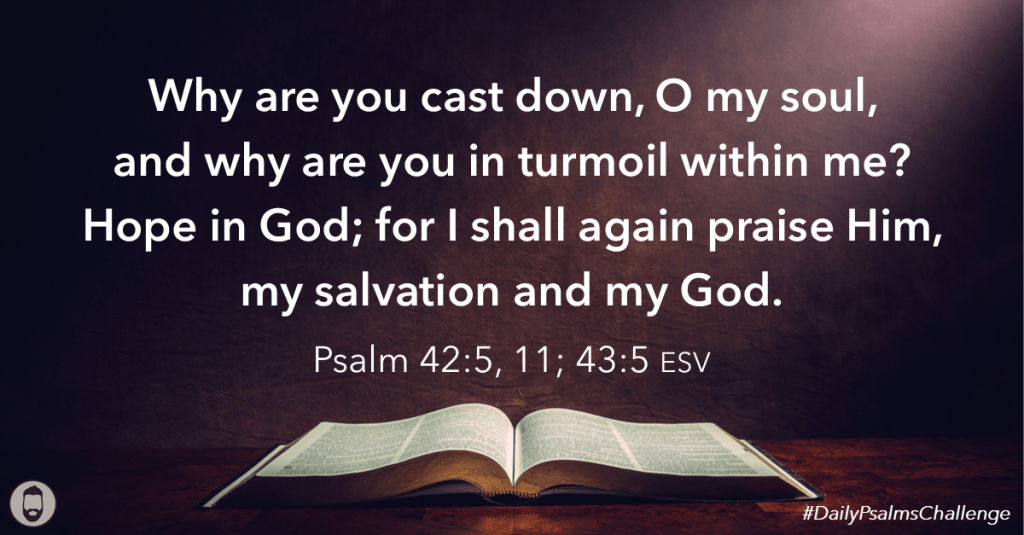
Why are you cast down, O my soul,
and why are you in turmoil within me?
Hope in God; for I shall again praise Him,
my salvation and my God.

Psalm 42:11

Sunday night/the wee hours of Monday morning was probably the longest of my life thus far. I have been avoiding pain medication as much as possible, but should have taken it sooner that night. The pain got to be too much, and coincided with a night requiring multiple lab draws with arms too swollen to find veins. I had just become overwhelmed.

In normal circumstances, I use the Dwell app (an audio Bible/Scripture meditation app) to take my mind off of difficulties or trials, but I could not work my phone or hold a Bible in my hands. My mind was so frantically distracted that I found it difficult to bring Scripture to mind. I laid in the dark, pleading with the Lord, praying for help or relief or whatever.

Now, if you know Candice, sleep has always been very precious to her. If you know hospitals at night, you know sleep is for well people at home. However, Candice stood over my bed for hours, playing various playlists of Scripture verses to help me fix my mind on things above, on Jesus, “not on things that are on earth” (Colossians 3:1-2). She played “psalms and hymns and spiritual songs” to help the “Word of Christ dwell in [me] richly” more than the pain that overwhelmed me physically (Colossians 3:16).

Dark times can cloud our vision. Sometimes hope is eclipsed by temporary trials. But for those who have been saved by grace through faith in our great God and Savior Jesus Christ, “suffering produces endurance”, “endurance produces character”, “character produces hope”, and “hope does not put us to shame, because God’s love has been poured into our hearts through the Holy Spirit who has been given to us” (Romans 5:3-5). My hope remains because it is not fickle, moveable, earthly hope; my hope is a person. My hope’s name is Jesus. And I can cast “all [my] anxieties on Him, because He cares for [me]” (1 Peter 5:7).

One of the clearest evidences of God’s goodness is that He has given us His Word — not only to reveal Himself, but to renew our minds, anchor our hearts, and strengthen us in every season of life. In His mercy, God does not leave us to be shaped by the world around us, but transforms us through the renewal of our minds so that we can discern His will and walk in it (Romans 12:2). His Word brings comfort and life in the midst of affliction, reviving our hearts when they are weary (Psalm 119:50). When our minds are fixed on Him through the promises of Scripture, He surrounds us with perfect peace (Isaiah 26:3). Rather than letting anxiety consume us, He invites us to bring everything to Him in prayer, and as we dwell on what is true and good, His peace guards our hearts and minds in Christ (Philippians 4:6-8). In trials, His Word gives strength and courage, equipping us for every step of obedience (Joshua 1:8-9). Because Scripture is breathed out by God, it thoroughly equips us for every good work — not just in easy seasons, but especially when life is hard (2 Timothy 3:16-17). When we delight in His Word and meditate on it daily, we become like trees planted by water — stable, nourished, and fruitful no matter the conditions around us (Psalm 1:2-3). And as we not only hear His Word but live it out, we experience His blessing and see more clearly who He is (James 1:22-25). In spiritual battle, His Word is our sword (Ephesians 6:17), and even Jesus, in the wilderness of temptation, showed us that we do not live by bread alone, but by every word that comes from the mouth of God (Matthew 4:4).

Every verse is a testimony to His kindness — He has not left us in the dark, but has spoken light and truth to sustain us.

That night, when my body had failed me and there was no strength to attempt to battle for myself, God sustained me with His Word. It was a refreshing reminder of His goodness, goodness I learned of from His Word and experience anew through His Word again and again. Here are some examples of both song and Scripture playlists:

  • Song | “Lord from Sorrows Deep I Call (Psalm 42)”


I do not (we do not) write this seeking sympathy or trying to complain. I am thankful to have a God who does not leave me nor forsake me (Hebrews 13:5, Deuteronomy 31:6) but instead meets me in my darkness with His light (John 1:5, Psalm 18:28).

On the way to the hospital last Friday night, Kevin reminded me of Satan’s words to God when seeking to tear apart Job’s life to make him curse God (Job 1:8-12, 2:3-6). Now, I am far from Job, and I am not saying this is all some elaborate test of my faith. The consequences of the Fall on the world and within human bodies (death, decay, sickness, etc.) is enough. But if you think on Satan’s rationale for needing to hurt Job, his earthly logic seems sound:

Then Satan answered the Lord and said, “Does Job fear God for no reason? 10 Have you not put a hedge around him and his house and all that he has, on every side? You have blessed the work of his hands, and his possessions have increased in the land. 11 But stretch out your hand and touch all that he has, and he will curse you to your face.”

Job 1:9-11

and,

And the LORD said to Satan, “Have you considered my servant Job, that there is none like him on the earth, a blameless and upright man, who fears God and turns away from evil? He still holds fast his integrity, although you incited me against him to destroy him without reason.” Then Satan answered the Lord and said, “Skin for skin! All that a man has he will give for his life. But stretch out your hand and touch his bone and his flesh, and he will curse you to your face.”

job 2:3-5

Kevin reminded me that Satan knew that by attacking Job’s health it could fundamentally affect how he lived and thought. So Satan was right — insomuch as the things of this earth being all that there are. His logic, at face value, was sound. However, what Satan discounted — what he always overlooks in his passion and sinful pride — is that the LORD is not of this world. The Creator of all that is, the King of kings and Lord of lords is not bound by the logic of a being He created because He Himself is Truth.

When He saves people, He fundamentally changes them from the inside out, making them new creations not religious converts (2 Corinthians 5:17). His change in those He saves is not a mere change of mind but truly a change from death to life, delivering them from “the domain of darkness” to the “kingdom of His beloved Son, in whom we have redemption, the forgiveness of sins” (Colossians 1:13-14).

I am not Job. But I have been saved by grace through faith in Jesus (Ephesians 2:8-9). My faith has wavered at times these last two weeks, I have forgotten who and whose I am, but praise God when all else is stripped away and I find myself at rock bottom, Jesus is the Rock (Psalm 18:2, 1 Corinthians 10:4).

I have to remind myself that God is no more or less good if He chooses to heal me immediately and/or completely or if whatever purpose He allows this to go on. He is good because that is who He is.

God is good all the time.

And all the time God is good.

As difficult as this period is (and seems to continue to be), I can rejoice that in the midst of sickness and pain I have seen the goodness of God and can see more clearly the sweetness and beauty of Jesus’s return when He will dwell with His people, wiping away their last tears with His nail-scarred hand as well as wiping away death, mourning, crying, and pain (Revelation 21:3-4). All of those things have an expiration date that is set and sure.

The goodness of God has no expiration date.

We are thankful to have the opportunity to share with you and would appreciate your prayers. If anything has helped you, lifted your spirits, or helped you see the goodness of God in Christ, then I’m glad to be where I am. And I am learning to be content that whatever season I find myself in I am not alone for He is with me.

Thank you and God bless.

Songs for Sunday, April 27, 2025 @ Christ Community Church

Sunday’s coming, and I’m excited!

As I sit and write today, thinking about Sunday morning, I find my mind on Luke 15 where Jesus tells a story many of us know as the parable of the prodigal son. But if you look closely, Jesus begins that story not by focusing on either son but by saying, “There was a man who had two sons” (Luke 15:11). The main character is neither the prodigal nor the faithful son; it’s the father. Jesus is painting a picture of God the Father, whose mercy and love extend freely to the rebellious and the self-righteous alike.

The younger son demands his share of the inheritance — an insult in itself — and leaves home to squander it all in reckless living (Luke 15:13). When famine hits, he finds himself feeding pigs and wishing he could eat their slop (Luke 15:16), utterly broken and alone. But “when he came to himself” (Luke 15:17), he decided to return home, but not to try and reclaim his place as a son. He planned to appeal to his father to be hired on as a servant.

While he was still a long way off, his father saw him, ran to him, and embraced him with compassion (Luke 15:20). He could have shamed him and railed at him, but he didn’t. He rejoiced that his “son was dead, and is alive again; he was lost, and is found” (Luke 15:24) instead of scolding. What a powerful picture of grace and mercy!

But Jesus doesn’t stop there.

The older son, who never left home and worked for the father through all of his brother’s foolishness, came in from working and heard a celebration. When he found out it was celebrating his prodigal brother, he became angry and bitter that his brother was receiving what he thinks should have been his (Luke 15:28-30). Yet again, the father seeks out his child: “Son, you are always with me, and all that is mine is yours”, and “It was fitting to celebrate…for your brother was dead, and is alive; he was lost, and is found” (Luke 15:31-32).

In both cases, the father goes out to meet his sons. One ran off and returned in shame. The other stayed home but harbored resentment. The father invites both of them to come in — to the same house, no less — to repent, to be restored, and to rejoice in his love.

This is the heart of our God and Father. He is slow to anger, abounding in steadfast love, and He is inviting sinners to come to Him.

We see this invitation echoed throughout Scripture:

“Come to me, all who labor and are heavy laden, and I will give you rest.”

Matthew 11:28

and

“Let us then with confidence draw near to the throne of grace, that we may receive mercy and find grace to help in time of need.”

Hebrews 4:16

That’s the same invitation we offer every Sunday at Christ Community. Not a mere invitation to come to a gathering or event but an invitation to come to the father. Whether you are running in from rambunctious revelries in sin or have been standing off on your own in self-righteousness, the Father is waiting and watching, ready to embrace with open arms — not because we’ve earned it or are worthy but because He is full of grace.

The chorus of our invitation song sums this up well:

I run to the Father, I fall into grace
I’m done with the hiding, no reason to wait
My heart needs a surgeon, my soul needs a friend
So, I’ll run to the Father again and again and again and again

If you’re weary, run to the Father.

If you’re guilty, come to Him.

If you need forgiveness, healing, or hope — come to the Father through His Son Jesus.

Romans 10:9-13 reminds us that everyone who comes to Him and calls upon Him will be saved. This is the message we preach, the hope we hold, and the reason we sing and live.

And once we’ve tasted His grace, how can we not respond in praise? That’s what we plan to do when we gather Sunday because He is mighty to save, His cross and empty tomb have made a way for us, and all who have confessed Him as Lord, believed that He is risen from the dead, and put their trust in Him have been saved by His grace.

Won’t you gather with us?


Here are our Scriptures and songs for Sunday:

  • Scripture | Romans 10:9-13

9…because, if you confess with your mouth that Jesus is Lord and believe in your heart that God raised him from the dead, you will be saved. 10For with the heart one believes and is justified, and with the mouth one confesses and is saved. 11For the Scripture says, “Everyone who believes in him will not be put to shame.” 12For there is no distinction between Jew and Greek; for the same Lord is Lord of all, bestowing his riches on all who call on him. 13For “everyone who calls on the name of the Lord will be saved.”


  • Scripture | Psalm 117

1Praise the LORD, all nations! Extol Him, all peoples! 2For great is his steadfast love toward us, and the faithfulness of the LORD endures forever. Praise the LORD!


  • Invitation | Run to the Father
    Scripture Inspiration: Galatians 6:2, Matthew 11:28-30, Jeremiah 17:9-10, Matthew 9:12, 1 Timothy 2:5, Hebrews 9:15, 1 Samuel 16:7, Psalm 44:21, Psalm 139:1, Proverbs 16:2, Luke 16:15, Isaiah 53, Matthew 20:28, John 1:29, John 3:16, Acts 4:12, Romans 5:6-10, 2 Corinthians 5:21, Titus 2:14, Proverbs 16:4, John 6:44, Romans 8:28-30, Ephesians 2:8-10, Revelation 13:8, Romans 6:1-11, Galatians 2:19-20, 1 Peter 2:24, Romans 8:9-11, 1 Corinthians 6:16-19, 1 Timothy 1:14


“Remember, Repent, Return: Jesus’s Letter to the Church at Ephesus” — a Refresh & Restore Bible Study

We’re continuing in our study of Revelation called The KING is Coming. Today, we will be diving into the first of Jesus’s seven letters to the churches — this one to the church at Ephesus. Once again, I am thankful for Jamie Harrison and the opportunity to do this study together.

This weeks passage is Revelation 2:1-7:

1“To the angel of the church in Ephesus write: ‘The words of him who holds the seven stars in his right hand, who walks among the seven golden lampstands.
2“ ‘I know your works, your toil and your patient endurance, and how you cannot bear with those who are evil, but have tested those who call themselves apostles and are not, and found them to be false. 3I know you are enduring patiently and bearing up for my name’s sake, and you have not grown weary. 4But I have this against you, that you have abandoned the love you had at first. 5Remember therefore from where you have fallen; repent, and do the works you did at first. If not, I will come to you and remove your lampstand from its place, unless you repent. 6Yet this you have: you hate the works of the Nicolaitans, which I also hate. 7He who has an ear, let him hear what the Spirit says to the churches. To the one who conquers I will grant to eat of the tree of life, which is in the paradise of God.’


Keith Harris:      
Greetings, Sojourners,

As I said, we are continuing in our King is Coming study of the book of Revelation, and now we are entering into the part where you have these letters from Jesus to churches. Before we get into that, though, Jamie, we were talking after looking at the earlier two Bible studies in this series – talk to us about the chain of command from Revelation 1 real quick.

Jamie Harrison:
Just to hit on that, the chain of command was given from God, and it was given from God to Jesus. In the very first study in this series, we said from God to the angel – which we understand Jesus and God are one and the same.[1] I do think it’s important for clarification that it was given from God (the Father) to Jesus, then to the angel, to John, and subsequently to us. And all seven of these letters are directly from Jesus.

Keith:                   
Right. That’s what we’re doing here. We want to be as careful with this as we are with other passages, but maybe we want to be a little bit more careful just in how people want to misuse the book of Revelation for fear mongering or manipulation. What Jamie is referencing is in Revelation 1:1, it says “The revelation of Jesus Christ, which God gave Him to show His servants…”.

So, just as we’ve been telling y’all, we don’t have this all together – we are students of the Bible and are wanting to help people study the Bible for themselves. Let’s go ahead and talk about the first of these seven letters (or the letters in general). Jamie?      

Jamie:                  
To start, a few things about the letters is I think it is important to note that, yes, these letters are written specifically to these seven churches. And these seven churches would have been kind of the center, I guess you would say, of how things got from one place to another. So, if I was delivering mail, so to speak, these would kind of be the seven hubs. It’s important to understand that these letters were given to those churches and then disseminated to all the churches from there.

Keith:                   
It’s kind of like how the letter to the church at Colossae was meant to be shared with Laodicea and vice versa.          

Jamie:                  
Exactly. It’s important as we read these letters to look at the similarities of these churches to the Church today – the Church meaning believers but also to the individual (local) church bodies. So, you look at the Church as a whole, but then you also look at my individual (local) church body. How do we stack up? Where are we?

Some of the key verses here in these letters are seen through Revelation 2:7 that says[2], “Let anyone who has ears to hear listen to what the Spirit says to the churches.” This is going to be repeated in every letter – plural churches (Revelation 2:7, 2:11, 2:17, 2:29, 3:6, 3:13, 3:22). It’s extremely important to listen to what the Spirit is saying to us as believers right here, right now. What is He saying to us?

And then, finally, before we jump into the letter specifically to Ephesus, we are going to look at each letter with five very distinct parts: a salutation (to the angel of the church of __), attributes of Jesus (something about Himself), their works (praise and in five of seven an admonition[3] to them), a universal admonition (“Let anyone who has ears listen to what the Spirit says to the churches”), and a final promise to each church. That’s kind of the way we’re going to look at each one, alright?

So, the salutation, of course, being the same in each letter, to the angel of the church of ___. We know that the angel is obviously talking to the pastor there at that local church.

Keith:                   
Where do we find that? How do we know that? Remind them where we know what it means by “angel”, what it means by “lampstands”. We’re not just making this up. It comes from….

Jamie:                  
Back in Revelation 1:20: “The mystery of the seven stars you saw in my right hand and of the seven golden lampstands is this: The seven stars are the angels of the seven churches, and the seven lampstands are the seven churches.” Another word there for “angels” is messengers – someone who delivers the Word.          

Keith:                   
So, in the context of Revelation 1:20, this is not some ethereal guardian angel, so to speak. This is the pastor that God has called to the church. To the angel – the pastor – of the church of Ephesus.

Jamie:                  
Right. The attributes of Jesus that we see here – what He says about Himself there in Revelation 2:1, He says, “Thus says the One who holds the seven stars in His right hand and who walks among the seven golden lampstands.” This is, again, a direct correlation back to Revelation 1:20 that we just read and also 1:16 – He had seven stars in His right hand. The right hand, of course, being the hand of might, the hand of power and strength. Jesus is holding these pastors in His hand. He’s walking among the churches.

I think that’s important to talk about just for a second. Is Jesus walking among our churches today? You know, if He was writing these letters today – these seven letters – would your (local) church body get a letter from Him?   

Keith:                   
Or would it be getting one of the five admonitions? Or one of the well-dones?   

Jamie:                  
Exactly. Is Jesus walking in your church? And if He is, what is He saying? What is He saying to you?

                               
Well, here’s what He said to the church at Ephesus. He gives them praise for their works, saying, “I know your works there” (Revelation 2:2-3). In other words, they are active for God. They’re doing things that He’s told us to do in His Word. They’re toiling at a cost. Some of them would have been persecuted for their faith, up to the point of being killed for their faith. They’re laboring for the Lord, and obviously, that includes endurance, too. They weren’t just laboring for a minute; they were laboring for a while. They were enduring for a while. They did things that were uncomfortable because the Lord told them to do it, called them to do it.

He goes on and says that they can’t tolerate evil people. He says that they have tested those who call themselves apostles and are not and found them to be liars. So, they’re enduring hardships for Christ. He keeps going on and on about all these awesome things that they’re doing. They’ve endured these hardships and not grown weary. Think about that for a minute. That’s really saying something. That’s saying something big time because we are quick to grow weary.

You know, COVID, back in 2020 made us all weary and about had us done. And here, He’s like, hey, these people didn’t even get tired at all.

Keith:                   
You hear people talk about all the time – and I think it’s even a hashtag on social media: #firstworldproblems – it doesn’t take much to make us weary. That’s the irony of the pandemic, at least for the first part of it: we were getting more rest, more opportunity for rest. It’s like, how can people who are as far away from retirement as we are say, man, I’m tired of resting, let’s go back to work?  

Jamie:                  
Right, yeah. Anyway (chuckles).

I also think with that idea in mind where it says that they endured hardships for the sake of His name (Revelation 2:3). At the heart of every Christian should be a desire to do the will of God (Psalm 40:8, John 4:34). And I think it’s important to point out that it’s as God chooses, as God leads you, as God tells you to (Proverbs 3:5-6, Romans 12:2). If you’re just enduring for the sake of enduring hardships, that’s all you’re doing: enduring them (1 Peter 2:20). All lot of people say all the time that the Lord is doing this or that when the Lord ain’t got nothing to do with it (Jeremiah 23:16, Matthew 7:21-23). So, you should be careful and make sure that what you are doing, if you’re toiling for the Lord, is because He’s leading you in that direction (Colossians 3:23-24). Don’t get burned out at church because you are trying to do so much. Don’t take on things that God hasn’t called you to take on. But now, if He calls you to take it on – take in on because what He’ll do is keep you from being weary, right? He will help you endure (Isaiah 40:29-31, 2 Corinthians 12:9).

Keith:                   
The believers in Ephesus, they had just…look at the list here that Jesus gave! But what we know from the book of Acts is that God had done such a mighty work in Ephesus – so many people were getting saved that it upended their economy (Acts 19:18-20)! A big part of their economy was silver shrines (or idols) for Artemis, and it got to the point that there was a riot – an unlawful protest and threatening the lives of the church – because nobody was buying these idols anymore (Acts 19:23-27). People were losing their jobs, at risk of losing their homes, their livelihood in these false gods because people being saved said, hey, I can’t do this anymore (Acts 19:28-34, 1 Thessalonians 1:9).

I don’t know of many people who are weary in their churches because they’re upending the idol industry. I mean, it should be, but I’m afraid that’s not the case nearly as often as it should be.   

Jamie:                  
Agreed.

The last thing Jesus says to them, if you jump down to Revelation 2:6: “Yet you do have this: you hate the practices of the Nicolaitans[4], which I also hate.” Back in Acts 6:1-5, we see where Nicholas was one of the first deacons. They named him a deacon, but he’s actually a false believer. He led the church astray, led people in immorality, specifically sensual temptations enticing believers to pleasure themselves with self-indulgence. But Jesus tells the church at Ephesus that they hate that practice. Later on we’ll see a church that did not hate that practice but embraced it.

Keith:                   
That’s where we find out more about their beliefs, too. Jesus doesn’t get specific here, but in the letter to the church at Pergamum, He relates it to Balaam who was a false preacher (Revelation 2:14; Numbers 22:12, 31:16). He was tasked with cursing Israel but couldn’t do it because God inhibited him (Numbers 22:18-20, 23:8). Also, they are looped in with Jezebel (Revelation 2:20). These accusations are in red letters. This is the letter from Jesus to the church at Ephesus. If He says it’s good – that hating the works of the Nicolaitans is something He also hates, it’s a pro-gospel stance (Revelation 2:6).      

Jamie:                  
Very much so.

So, that’s the works and the praise. He tells them they’re doing a good job on all those things. It’s important to note that this is the Lord commending them for these things. And then He says, “But….”                

Keith:                   
Don’t you just love that?

Jamie:                  
The “but” cancels out everything that came before it. Unfortunately….  

Keith:                   
…and replaces it with this admonition.  

Jamie:                  
The question that I think this leads us to is: how many sins does it take to separate us from God for eternity? The answer is: one. If we sin once, we’ve fallen short of the glory of God (Romans 3:23). So, it’s important to note that repentance is necessary.

Keith:                   
Also here, this is the church at Ephesus. Jesus – it’s important to note here, not minimizing the sin but maximizing the power – that right hand that holds the churches, He’s not threatening to pull their salvation. He’s made them alive (Ephesians 2:1-5). He’s given them eternal life. John 10:28-29 says that He has them in His hand an no one can “snatch” them from His hand. He’s threatening to remove the lampstand, not their salvation.

Jamie:                  
That’s exactly right. He tells them, I have this against you. You’ve abandoned the love you had at first.

Now, I think about this: I’ve been to a lot of different churches in my lifetime that were doing a lot of cool things, ministry-wise. A lot of people who had been there a really long time, etc. But when you walk in a church and don’t feel loved – you don’t see that others feel loved necessarily…. You know I hear a lot of “Christians” talking about people a lot of times, like did you know ___?

Keith:                   
“Church folks”. 

Jamie:                  
Right. Can you believe so and so? Things of that nature. And I think that’s what this falls under. So, why do we do the ministries that we do?

Keith:                   
You get kind of caught up in being an institution rather than part of the body of Christ.   

Jamie:                  
That’s it, and I think that’s exactly what the Lord is getting at here. It’s like, look guys, you know you’re doing all these great things, but you’re doing it almost out of a sense of duty as opposed to the fact that you love me.

People say all the time that you know we’re not saved by works. That’s accurate. You are only saved by grace (Ephesians 2:8-9, Titus 3:5). But because of grace – because we love Jesus – the works will follow (John 14:15, 2 Corinthians 5:14-15). That’s why James said that without works there is no faith really (James 2:17, 26).

Keith:                   
What did the Holy Spirit say to the church at Ephesus 20-30 years before this? In Ephesians 2:10, He says, “For we are His workmanship, created in Christ Jesus for good works which He has prepared beforehand.” Not religious obligation. Not good institutions. We are His workmanship. Just like those silversmiths were crafting idols, God is crafting little-Christs[5] out of us.

Jamie:                  
Remember that the Church is the bride of Christ. So, think about it as an example of a marriage. Do you do things for your spouse because you have to or because you want to – because you love them? Now, sometimes we do things for our spouse because we have to; it’s just part of it. But we do things for them for the most part because we want to – because we love them – because there’s a relationship there. And that’s the idea here. Hey, you’ve grown a little salty in your relationship, grown a little cold in that relationship – going through it like a habit. You’re going through a routine. You’re doing these works – working in the church, you know, whatever you’ve got going on, you know at the foot pantry, fill in the blank. You might be doing it so people can see you there. Maybe it’s a social thing. But here’s the question: what are you actually doing? I know a lot of organizations that claim to help people but it’s really all about status – look at me, look at what I’m involved in – and not helping.               

Keith:                   
I mean, that’s the image that He gives there. You have abandoned the love you had at first. Remember, He tells them, from where you have fallen. You’ve got this pinnacle moment! I know in my own marriage that going through the motions doesn’t get me very far. Funny note on that phrase (going through the motions), is that in England “the motions” means a bowel movement. In a marriage going through the motions is about the equivalent to a bowel movement. It doesn’t cut it. (laughter from both)

You’ve got that standard there – that original love that was motivating and driving everything and have now fallen short of that standard. And that standard is love. What does 1 John 4:19 tell us? We love because He first loved us. This isn’t zeal coming from us; this is a response of worship coming from the only way you can respond to the Savior you took you from dead in your sin to alive in Christ: love. And that’s what they’ve got to remember.                

Jamie:                  
The next thing that Jesus says here, and I think this is really important, is for them to repent and do the works they did at first. So, there’s an opportunity to repent. It’s not like, oh, you quit loving me so I’m going to find somebody else. Like we said earlier, He does tell them that if they don’t He’ll come and remove their lampstand from it’s pace. That means that local church body would cease to exist. That doesn’t mean that they were no longer saved personally. That means that local church body there, whatever the case may be, would cease to exist if they did not repent.

So what? What is the overall call here? What is He telling this church? He’s saying, look, you’re doing all these great things. You’re doing these wonderful things – helping people – doing everything I’m asking you to do, but you’re doing it all out of a sense of duty instead of out of the love you have for me.

The key here is what He says, again in Revelation 2:7, “Let anyone who has ears listen to what the Spirit says to the churches.” What is the Spirit saying to the church? The Spirit is saying it’s about love. It’s about a relationship. It’s not like this ooey-gooey, mushy-feeling type thing – sometimes relationships are hard. They’re tough when they call us to do things we don’t necessarily want to do. They’re going to be hard and cause us issues. They’re going to cause us to have things go on in our life that maybe we don’t want that much. But the fact is that, if we’re doing it out of love for Christ, it’s all going to work out for the better – for you and the other people involved.

Keith:                   
And a call to repentance is a good thing. It’s not a welcome thing, but it should be. How many times do we have to wonder did I do okay in this or did I do wrong in that? I would think that a letter from Jesus Himself saying, hey, these things are done well but the fact that you’re just doing them out of a sense of obligation – you’ve lost something here and you need to repent to gain it back.

Jamie:                  
It’s a good thing. It is very good. It’s how we grow in a relationship. It’s the same thing – back to a husband and wife. How do you grow in that relationship? You’ve got to have a tough question, right? You know, if you’re the spouse that’s being offended, or whatever the case may be, if you don’t ever tell the other person, they won’t know so that repentance can take place.

So, we jump there to the final promise. The promise He gives here is: “To the one who conquers, I will give the right to eat from the tree of life, which is in the paradise of God” (Revelation 2:7). I don’t think we have to go too much into that. We understand that salvation is eternity with the Lord Jesus Christ. But you might think that the one who conquers is going to have a sword and shield and on the day of the battle of Armageddon, I get to fight all the demons and all these things. No, that’s not true, because if you had to do it you’d die. That’s not a thing. They’re stronger than you – sorry to be the one to break that to you. But the Bible, again, always answers the Bible. So, as we’ve probably stated ten times at this point, if the Bible doesn’t give you the answer, you probably weren’t meant to know.

Keith:                   
On the things where the Bible is clear, those are important. Where the Bible is not clear – it’s not saying it’s not important but it’s definitely of lesser importance.

Jamie:                  
In 1 John 5:4-5, John says,

“…because everyone who has been born of God conquers the world. This is the victory that has conquered the world: our faith.
Who is the one who conquers the world but the one who believes that Jesus is the Son of God?

So, when He says “to the one who conquers”, He’s saying to the one who is saved. To the one who is my child – that’s how you conquer. That’s what He’s talking about here. So, if you conquer the world you have a relationship with Christ. You will be with Him for eternity and eat from the tree of life. It’s pretty awesome.

Keith:                   
It’s definitely worth repenting and advice worth repeating.          

Jamie:                  
I think to end this we talk about the love chapter in 1 Corinthians 13. You know, a lot of times we read it at weddings and things like that, but here I want to look at it this way. Starting in 1 Corinthians 13:4 (and going through the end of verse 8) where he lists the things that love is, take “love” out and insert your name. So “love is patient, love is kind” – take “love” out and put your name there.

Love is patient, love is kind. Love does not envy, is not boastful, is not arrogant, is not rude, is not self-seeking, is not irritable, and does not keep a record of wrongs. Love finds no joy in unrighteousness but rejoices in the truth. It bears all things, believes all things, hopes all things, endures all things. Love never ends.

So, the question we need to ask ourselves is could we take “love” out and put our names in and it still be true. Put our churches name in there. The answer for everybody on the face of this earth is, no, we are going to fall short in at least one of these areas. That’s where repentance comes in.  

Keith:                   
As often as needed.

Jamie:                  
So, I think that hopefully gets a good understanding of the letter to Ephesus, and kind of what it was that the Lord was saying to them and to us.        

Keith:                   
As a challenge, there’ sone thing that Ephesus has that we don’t have currently in our churches. In this exact moment, we can do a post mortem (or autopsy) on the church at Ephesus. When I say post mortem, I mean after death. There is no church in Ephesus. In fact, there is no Ephesus today. Ephesus was, and you can look this up, a harbor town. At some point, the harbor began to have silt floating in, and the harbor was no longer dockable for ships. And Ephesus, just like its harbor, dried up.

I think it’s far to say that the lampstand was removed, and the reason I say that is that God didn’t just remove the church and damn or condemn everyone else. He dammed the harbor and moved people elsewhere, to other areas.

So, the challenge is, if you’re listening to this you obviously have an ear. Listen to what the Spirit says to the churches. In this case, look specifically and see the love you had at first – personally and as a church body. If you are in need of repentance to do the works you had at first, do it because the One who holds the seven stars in His hand and walks among the seven golden lampstands is more than capable of pulling that lampstand up and wrapping that church up.

Consider this challenge, sojourners. Take these words to heart. Study them for yourself. Check what we say by the Bible. And, Lord willing, we’ll talk to you next about the church at Smyrna.

Thank you, and God bless you.  


[1] The Bible teaches that Jesus is fully God and fully man. This means He is not just a great teacher or prophet, but truly divine—equal with God the Father and one with Him. The Bible clearly teaches that Jesus has always existed, created all things, forgives sins, and receives worship—things only God can do. Believing Jesus is God is essential to the Christian faith. See John 1:1–3, 14; John 8:58; John 10:30; Colossians 1:15–17; Hebrews 1:3; Titus 2:13; Revelation 1:17–18; Matthew 28:9; Philippians 2:5–11.

[2] Jamie – unless he states otherwise – uses the Christian Standard Bible (copyright © 2018 by Holman Bible Publishers).

[3] a warning or opportunity to repent

[4] The Nicolaitans held a lot of beliefs similar to the gnostics as well. There is not a lot known about them beyond what we see here in the letters of the church of Ephesus. The information citing Nicholas from Acts 6 as the beginning of that movement comes from Irenaeus (pastor who lived in the 2nd century, born about 30 years after the book of Revelation was given) and Hippolytus of Rome (pastor who lived in the 2nd and 3rd century).

[5] The word “Christian” began as a term meaning little-Christ and was initially used to mock believers (Acts 11:26, 1 Peter 4:16).


“BUT If Anyone Does Sin: Finding Hope in Jesus Christ the Righteous” — a Refresh & Restore Bible Study

My little children, I am writing these things to you so that you may not sin. But if anyone does sin, we have an advocate with the Father, Jesus Christ the righteous. He is the propitiation for our sins, and not for ours only but also for the sins of the whole world.

1 John 2:1-2

Christ Has Come: The Promised King & His Gift of Peace (Advent 2025) Refresh & Restore | A JustKeithHarris.com Podcast

Christ Has Come – Week 3Episode Title: The Promised King & His Gift of JoyLuke 1:39–56In this Advent episode of Christ Has Come, Keith Harris turns to Luke 1 and invites us to slow down and listen to the joy that begins stirring before Bethlehem. Long before angels sing to shepherds, joy breaks the silence in the hill country of Judea—through a Spirit-filled confession, a leaping child, and the worshipful song of a young woman who trusts the promises of God.Together, we explore:What biblical joy is—and what it isn’t, distinguishing it from fleeting happiness or emotional highs.How joy appears before the word is even spoken, as John the Baptist leaps for joy in Elizabeth’s womb at the presence of the unborn Messiah.Why Mary’s joy is rooted not in circumstances but in God’s mercy, as she magnifies the Lord and rejoices in God her Savior.The meaning and message of the Magnificat, a Scripture-saturated song that celebrates God’s great reversal—lifting the lowly, filling the hungry, and humbling the proud.How Mary’s joy points beyond herself to Jesus, the promised King who fulfills God’s covenant promises and secures lasting joy through His saving work.This episode reminds us that joy is not something we manufacture—it’s something we receive, and it grows wherever Jesus is trusted. Advent teaches us that true joy is found not in having life figured out, but in the presence of Christ and the mercy He brings.If you would like to see a written version of this study, complete with footnotes and cross-references, you can find it here.
  1. Christ Has Come: The Promised King & His Gift of Peace (Advent 2025)
  2. Christ Has Come: The Promised King & His Gift of PEACE (Advent 2025)
  3. Christ Has Come: The Promised King & His Gift of HOPE (Advent 2025)
  4. Thankful: Learning to Number Our Days (Refresh & Restore)
  5. "Strengthen What Remains: Jesus's Letter to the Church at Sardis" (The KING is Coming)

Greetings Sojourners!

I had planned to release the next Bible study in our The King is Coming series on Revelation yesterday, but I believe 1 John 2:1–2 is where we need to be today—at least, it’s where I need to be.

When I started doing this five years ago, I never intended for it to become an ongoing thing. The pandemic was in full swing, and I became aware that some members of Christ Community—and others in our greater community—were unable to attend church due to health concerns. Some lacked technology or internet access to livestream services and be spiritually fed. So, I began writing Bible studies and sending them out. I even purchased the justKeithHarris.com site to make it easier to share the studies with folks.

As Covid began to settle into a more “normal” part of life and things started moving again, John Goldwater gave us a challenge during a pastors’ meeting. He asked us to think of something God had moved us to do during the pandemic—something extra to reach out—and to consider keeping it going. These Bible studies are what the Lord has continued to stir in me. Now, have I been as consistent over the past year or so as I would like to be? Definitely not. But my heart to encourage people through the Word of God hasn’t changed. That pastor’s heart—God’s call on my life—is what compels me to write this Bible study today.

So many people are hurting right now (and many of you may have burdens I don’t even know about). But God’s Word is “profitable for teaching, for reproof, for correction, and for training in righteousness, that [we] may be complete, equipped for every good work” (2 Timothy 3:16–17). Revelation 2 and Jesus’ letter to the church in Ephesus would certainly be good for us and would build us up. But I can’t get 1 John 2:1–2 off my heart and out of my mind. 

I feel a deep burden—and a burning desire—to break open 1 John 2:1–2 with you “clearly,” to give “the sense,” and to help you understand “the reading” (Nehemiah 8:8). I want to help you see whatever it is in this passage that God’s Spirit desires to open up to you. As I write (and truly, I don’t know how this is all going to turn out), there are a few things I want to share before diving into the text:

  1. We – all of us, myself especially – are sinners.
  2. Even if we are saved, there is still a struggle with sin (and unfortunately, we will fall into sin).
  3. When we sin – again, even if we are saved, there are consequences that must be faced.
  4. However, if you are saved and have been adopted into God’s family, you have an advocate, Jesus Christ the Righteous who stands for you when you have fallen into sin and shame. His blood covers sin. He is the God who saves. We never stop needing Him.
  5. If you are reading this and are not saved, He can save you.

Again, my heart is heavy for many of you, and I don’t know exactly how all of this is meant to work together. But I do know this: God’s Word going out is always a good thing. His Word never returns to Him empty; it always accomplishes what He intends (Isaiah 55:11). I may never know how this helps you—but I pray that, according to God’s purpose, it does.

My Little Children (v. 1a)

John opens up this section of 1 John with a term of endearment – a term of love – for these people. By calling them his “little children”, he is not belittling them or making it seem like he sees them as less but rather letting them know that he loves them as a father is supposed to love his children. He is about to tell them some good and bad news and this term of endearment reminds them of their relationship and his love for them. 

For me, both at school and at church, I’ve found myself using the word “kiddos” the same way I do with my own children at home. At first, it just slipped out without me thinking, but over the years, it’s become a way to express my care for them—like I consider them mine. It communicates relationship. There’s good news and hard conversations. There’s encouragement, correction, and discipline. They laugh and joke about what’s become my catchphrase at the end of each class—“Good class, kiddos!”—but they always notice if I forget to say it. If I miss it, they’ll ask, “Aren’t you going to say it?” They want to know that, no matter how the class went, I thought it was good. That little phrase reassures them. And even in times when I’ve had to correct them, that word—“kiddo”—still shows up. It reminds both them and me that our relationship remains, through the good and the hard.

Thinking of it that way, I can almost hear John saying with a sigh, “Kiddos, I need you to make sure you’re picking up what I’m laying down: I’m telling you all of this so that you will stop sinning.”

Let that sink in – “so that you may not sin” (v. 1). 

How far will you make it with that? How far have you ever made it not sinning?

Yeah, me too.

From a religious standpoint, that might sound like bad news, because we know we can’t do it. The Bible is clear on this. Psalm 14:3 and 53:3 both say, “there is none who does good, not even one,” and the Holy Spirit, through Paul, drives this home in Romans 3:10: “None is righteous, no, not one.” Anyone who honestly looks at their life and compares it to the holy standard of our holy, holy, holy God knows what Isaiah meant when he said, “all our righteous deeds are like a polluted garment” (Isaiah 64:6). Even what we might think of as righteousness is tainted by sin—those “iniquities” that “like the wind, take us away.” That’s why we can’t earn salvation. There’s no amount of scrubbing, trading, or weighing good against bad that can remove sin or make us righteous. It doesn’t work that way. As we’d say in Mississippi, you either are or you ain’t—and, well, we ain’t. The “wages” of our sin give us what we earn—what humanity has earned since Adam—namely death (Romans 6:23).

That’s more than just bad religious news—it’s bad life news. 

But praise God, John didn’t stop there! The next word is only three letters in English (and in Greek), but it’s a powerful word for us: “BUT”. That conjunction takes everything that came before it—our sin, our inability to be righteous on our own—and sets it aside to introduce what comes next. John is honest: he tells these spiritual children he loves that he’s writing to them so they “may not sin.” But he knows they will. He knows because he himself didn’t make it far either. John was a sinner too. And how could he not know that? He had walked in the presence of Jesus. How could anyone be in Jesus’ presence and not be fully aware of their sin?

But more than being aware of his sin, John was aware of his Savior. He wrote that they may not sin—but that when they do, they would look to the Savior. Look at the beauty of that second sentence in 1 John 2:1: “But if anyone does sin, we have an advocate with the Father, Jesus Christ the righteous.”

That’s good news! Let me show you why.

We Have an Advocate (v. 1b)

Before we go any further, let’s take a moment to understand what John is saying when he writes that “we have an advocate with the Father, Jesus Christ the righteous.” It’s important to grasp the weight of this biblical truth before we move forward. The word translated “advocate” here is significant. To the native Greek speakers who weren’t writing in a biblical context, this word was used of “a legal advisor, pleader, proxy, or advocate…who comes forward in behalf of and as the representative of another”[1], which carries the idea of a defense attorney today. This was someone who came forward to speak on behalf of another, stepping in to represent and intercede.

But this word also has rich biblical meaning. It’s the same word Jesus used to describe the Holy Spirit, whom He called our “Helper” (John 14:16, 26; 15:26). The Holy Spirit now carries out Jesus’s work in our hearts—He is the One who indwells believers and represents Christ within us. While Jesus ascended to the right hand of the Father, the Holy Spirit fills those who are saved, continuing His ministry as our Helper and Advocate here on earth.

That might sound a bit complex, especially since the idea of a defense attorney already makes sense. But Jesus is so much more than just a spiritual lawyer. Just like the Holy Spirit within us knows we are guilty, Jesus knows it too. He’s not trying to work out a plea deal or pretend we didn’t sin. He doesn’t spin the truth or fudge the facts. Jesus was and is sinless, and He will never lie. But here’s the powerful truth: Jesus knows we’re guilty—and yet He stands in for us anyway.

Jesus doesn’t rely on courtroom tricks to win our case. He is, in a sense, both our advocate and our judge. What He does for those He saves is beyond anything a human defender could do—or would be willing to do. He substitutes Himself on our behalf. He takes our place. And when He stands before the Father, it’s His plea, His righteousness, and ultimately His judgment that matters.

But don’t miss this: when the divine gavel comes down, it’s not on us—it’s on Him. The wrath of God due to our sin falls on Him. That’s how it works.

This is huge—monumental. There’s a theological term that’s been used since the Reformation to describe this: penal substitutionary atonement. It may sound like a mouthful, but it means exactly what it says. “Penal” refers to the penalty our sin deserves. “Substitutionary” means someone is taking someone else’s place. And “atonement” means covering sin and making it right. Put it all together, and it means Jesus took the punishment we deserve for our sin so that we could be forgiven and made right with God.

And that truth is captured in two key words from this passage: “advocate,” which we’ve just unpacked—and the next word we’re turning to now: “propitiation.”

He is the Propitiation for Our Sins (v. 2)

“Propitiation” might sound like what some folks call a fifty-cent word—or a seminary word—but really, it’s just a Bible word. There’s not a single perfect English word that fully captures it, which is why some translations use phrases like “atoning sacrifice” (NIV, CSB) or “sacrifice that atones for our sins” (NLT). But since the Holy Spirit chose to use this word, it’s one we need to understand—not just for head knowledge, but so we can grasp what God is telling us through it. Basically, the word translated “propitiation” in 1 John 2:2 “is the means of putting away sin and establishing righteousness”[2], but let me break it down even further.

At its core, “propitiation” refers to the way Jesus took the punishment for our sins and made peace between us and God. It’s the means by which sin is dealt with and righteousness is established. Jesus didn’t just do something to help us—He is the sacrifice that removes our sin (John 1:29).

In the Old Testament, on the Day of Atonement, the high priest would enter the Holy of Holies and sprinkle the blood of a sacrifice on the mercy seat—the top of the ark of the covenant—to atone for the sins of the people (Leviticus 16:14–15; Hebrews 9:5). But Jesus did something far greater. He was both the perfect High Priest and the perfect sacrifice (Hebrews 10:12–14). His blood wasn’t a symbol on a religious holy day—it was poured out for real, once and for all, on the cross (Hebrews 9:26).

Propitiation doesn’t mean God changed His mind about sin. Jesus, as our Advocate, knows full well the depth of our sin—and we need to understand that Jesus is God. He is holy and has always hated sin. But in His love, God provided the sacrifice Himself (Romans 3:25; 1 John 4:10). He knew we couldn’t save ourselves. He knew we had nothing to offer that could earn forgiveness. The honest and universal plea of humanity is “GUILTY as charged.” Yet through Jesus’ death on the cross—as our substitute—He made a way for us to be forgiven and declared righteous in God’s sight (2 Corinthians 5:21).

This wasn’t just a one-time historical act—it still holds power today. Jesus remains our propitiation. His life, death, resurrection, and ongoing love are what keep us in relationship with God (1 John 3:16; Hebrews 7:25). That matters because Revelation 12:10 tells us that Satan is constantly accusing believers before God “day and night.” Now, Satan is a liar and the father of lies (John 8:44), but speaking from experience, he doesn’t have to make things up to accuse me. My sin is real. God knows it. But I’ve been saved by grace through faith in Jesus (Ephesians 2:8–9).

So when Satan stands before God accusing me, I’m not sitting there alone in shame. I have an Advocate—Jesus Christ the Righteous. I don’t even have to speak in my own defense because Jesus speaks for me. And what He says is powerful and final: I am forgiven. The punishment I deserved has already been carried out—He died in my place. And when the Father looks at me, He doesn’t see my sin. He sees the righteousness of His Son, because I’m covered by His blood.

That’s good news!

Wrapping Up

I hope all of this made sense. All I can really think to say about it is, “Whew! I needed that!” – and that I hope it helps you, dear Sojourner, as well.

One question keeps stirring in my heart as I reflect on everything we’ve seen in this passage: if God loved me enough to do all of that—and to keep doing all of that—for me, won’t He take care of everything else?

The answer to that is easy: a resounding YES.

He loved me enough to save me. He loves me enough to keep me. And He will keep loving me—through my sin, despite my failures, and even in the face of the consequences I bring on myself. Why? Because I belong to Him.

And if you’re reading this and realize that you’re sitting before the divine Judge with no Advocate—if you’re trying to represent yourself—let me gently remind you: it’s unwise to defend yourself in court here on earth, but it’s eternally deadly to try and do it before the holy and all-powerful God of the universe. He already knows the truth: none is righteous, not even one (Romans 3:10). Your sin—any single sin—is enough to condemn you.

So what will it take to convince you to turn to Jesus? What will it take for you to see that He loves you, that He died for you, and that He will save you if you simply bow your knee and confess Him as Lord, believing that He is the risen Savior (Romans 10:9–10)?

I know my words are too weak to convince you. But God’s Word is strong enough. Go back and reread the verses. Click the cross-references. Don’t take my word for it—test it against Scripture. I’m not selling anything. I don’t get a prize if you believe. But if you do put your faith in Jesus, oh what a reward there is for you! Know this: if you need me, I’m here. I’m praying for you. But more than that, I write to you, dear Sojourner that you may not sin. But when you do…there is an advocate. His name is Jesus. He is the Righteous One. He is the propitiation for my sins – and the sins of the whole world.


[1] Spiros Zodhiates, The Complete Word Study Dictionary: New Testament (Chattanooga, TN: AMG Publishers, 2000).

[2] Zodhiates.

Songs for Sunday, March 23, 2025 @ Christ Community Church

Tomorrow is the Lord’s Day — Sunday, and I’m excited!

Every week at Christ Community, we gather because the gospel — the good news about Jesus — is true: He really lived, died, and rose again to save sinners and bring us into life eternally with Him. You see, we don’t gather to prove ourselves, check some religious attendance box, or pretend we have it all together. No, we gather because we need Jesus.

There’s more good news: He came to save. This is clearly seen in some of the verses we will read together in worship.

In John 3:16-17, Jesus tells us:

16For God so loved the world, that He gave His only Son, that whoever believes in Him should not perish but have eternal life. 17For God did not send His Son into the world to condemn the world, but in order that the world might be saved through Him.

And how did He do that? The apostle Paul puts it plainly, saying it is the most important message, in 1 Corinthians 15:3-4:

…Christ died for our sins in accordance with the Scriptures, …He was buried, …He was raised on the third day in accordance with the Scriptures….

This is the most important news, the good news we call the gospel. It is what we proclaim with our mouths and our lives. It is at the heart of everything we sing, read, pray, and preach. Jesus gave Himself for us — not when we are all cleaned up and put together but while we were lost, guilty, and broken.

One of the songs we will sing, “God So Loved”, takes the message of John 3:16 and other passages to give an invitation to come to Jesus. Ponder these words:

Bring all your failures
Bring your addictions
Come lay them down
at the foot of the cross
Jesus is waiting there
with open arms
God so loved the world

If you have never trusted in Jesus as Savior — confessed Him as Lord and believed that God raised Him from the dead (Romans 10:9), we pray that you consider these words today. This is the more important invitation, to come to Him more than coming to church.

We would also like to invite you to gather with us where you will hear this gospel again and again. Even if you have trusted in Him, we invite you to gather with us, praying that your heart might be stirred again by the wonder of His gospel — His love, grace, mercy, and salvation — and respond with fresh joy, worship, and devotion to Him.

This gospel will saturate our songs. When John opens the book of Hebrews, this gospel is at the heart of the book and the sermon. We will read the good news together.

Won’t you join us?


Here are our Scriptures and songs:

16“For God so loved the world, that he gave his only Son, that whoever believes in him should not perish but have eternal life. 17For God did not send his Son into the world to condemn the world, but in order that the world might be saved through him. 18Whoever believes in him is not condemned, but whoever does not believe is condemned already, because he has not believed in the name of the only Son of God. 19And this is the judgment: the light has come into the world, and people loved the darkness rather than the light because their works were evil. 20For everyone who does wicked things hates the light and does not come to the light, lest his works should be exposed. 21But whoever does what is true comes to the light, so that it may be clearly seen that his works have been carried out in God.”


3For I delivered to you as of first importance what I also received: that Christ died for our sins in accordance with the Scriptures, 4that he was buried, that he was raised on the third day in accordance with the Scriptures, 5and that he appeared to Cephas, then to the twelve.


“Preaching Truth to Yourself When Your Soul is Downcast” from Psalms 42 & 43 (#dailyPSALMSchallenge)

Why are you cast down, O my soul, and why are you in turmoil within me? Hope in God; for I shall again praise Him, my salvation and my God.

Psalm 42:5-6a, 11; 43:5

Psalm 42 and Psalm 43 are deeply connected, forming a single lament that expresses the struggle of a soul longing for God in the midst of despair. 

Psalm 42 opens with vivid imagery: “As a deer pants for flowing streams, so pants my soul for you, O God” (v. 42:1). There is a beautiful hymn based on this image, but for those who are crying out to the Lord, it is often anything but beautiful. Picture a deer being hunted, running from a hunter or predator, panting and out of breath and seeking a cool stream to provide sustenance and relief. Such is the plight of the sons of Korah in these psalms. They are spiritually thirsty, longing for the presence of the living God (v. 42:2), yet instead of refreshment, they find themselves overwhelmed by sorrow, being fed by tears (v. 42:3) and haunted by the taunts of people mocking their faith by asking “Where is your God?” (vv. 42:3, 10)

This spiritual turmoil is compounded by distance from the place of worship or from the joy accompanying better times of leading God’s people in His praise and worship (v. 42:4). They remember what it was to joyously lead God’s people in worship at His tabernacle but now feel cut off and alone. The lament deepens as they describe being overwhelmed by waves of suffering, described a waves of the sea crashing over them (v. 42:7). Yet, even in their distress, they cling to this foundational truth: “By day the Lord commands His steadfast love, and at night His song is with me” (v. 42:8).

Psalm 43 continues their cry for deliverance, shifting from lament to pray to God for vindication. They plead for God to “send out [His] light and…truth” to lead them back to worship at His altar, where they may rejoice in Him again (vv. 43:3-4). But there is beautiful solace to be found in their refrain found in vv. 42:5, 11 and 43:5 that not only asks their own souls “why” they are “cast down” and “in turmoil” within themselves but points to the refreshment they know their panting souls will receive by saying, “Hope in God; for I shall again praise Him, my salvation and my God.”

This refrain teaches us the discipline of preaching the truth to ourselves in the face of despair. Instead of passively listening to their own troubled thoughts, they preach to their own souls, reminding themselves of who God is and where their hope must rest. This does not change their circumstances but points them to the God who provides hope in the midst of circumstances. He is faithful. He provides rest. He provides solace. He IS their hope.

Seeing Jesus in Psalms 42 & 43

These psalms find their fulfillment in Jesus, who fully experienced the anguish of a downcast soul. In the Garden of Gethsemane, Jesus echoed the sons of Korah when He said, “My soul is very sorrowful, even unto death” (Matthew 26:38). On the cross, He endured the mockery of His enemies jsut as they did (vv. 42:3, 10; Matthew 27:39-43). Yet, even in His suffering, Jesus fully entrusted Himself to His Father’s will and endured the full weight of God’s wrath against sin – our sin – that we might never be truly abandoned.

The sons of Korah longed for God’s presence, and through Jesus, that longing is ultimately fulfilled. Jesus Himself is the “light and truth” that leads us to God (v. 43:3; John 8:12, 14:6). He is Emmanuel, God with us, who will never leave nor forsake His people. And because of His resurrection and promised return, we can confidently hope in God, knowing that no matter our circumstances we too will “again praise Him” (v. 43:5).

Reflection

Can you identify with the sorrow and despair found in Psalms 42 and 43? If so, I hope you see the promise of hope and relief found in Jesus. He bore our shame and sin and adopts us into His family.

There is coming a day when the tears that flow ever so easily here in this fallen world will be wiped away for the last time by His nail-scarred hand when He comes to dwell with His people – where death will be nothing more than a fading memory – where there shall be no more “mourning, nor crying, nor pain anymore, for the former things have passed away” (Revelation 21:3-4).

In the meantime between that promise and its fulfillment, there is a lot of despair and downcast souls and pain and sorrow. There is a lot of panting for streams of relief. But, oh, there is so much hope to be found. May we not be left in the question of why our souls are downcast but let us preach the beautiful truth of the psalmists refrain: “Hope in God; for I shall again praise Him, my salvation and my God”!


Here’s a song inspired by Psalm 42:


The #dailyPSALMSchallenge gives us the opportunity to start 2025 in God’s Word by digging into a psalm a day. Each day will identify a key passage for us to meditate on as well as seeking to help us see Jesus in the psalm and reflect on what we have read.

Won’t you take the challenge?

“Set Upon the Rock: Confidence in God’s Salvation” from Psalm 40 (#dailyPSALMSchallenge)

I waited patiently for the LORD; He inclined to me and heard my cry. He drew me up from the pit of destruction, out of the miry bog, and set my feet upon a rock, making my steps secure.

Psalm 40:1-2

Psalm 40 is a testimony of God’s faithfulness in deliverance in David’s past and a plea for help in his present troubles. David recalls how the Lord rescued him from the pit of destruction – which he describes as a miry bog (think quicksand) – and placed his feet on a rock, giving him a new song of praise (vv. 1-3). But even as he celebrates God’s faithfulness, he finds himself once again in need of God’s delivance.

This psalm teaches us a powerful truth about living out the new life we have in Christ: it is a cycle of waiting, deliverance, and renewed dependence on the Lord. We live these out over and over, and God is faithful over and over. David is not relying on God’s past deliverance alone, though; he continually puts his trust in the Lord rather than in earthly sources (v. 4).  He recognizes that God’s plans for him and His wonders are beyond measure (v. 5) and that true obedience is worth more than religious sacrifices (vv. 6-8).

David’s worship is more than religion, too. He says that in the “scroll of [God’s] book” will be written that he delights to do the will of God and that His law is “within [his] heart” (vv. 7-8). He has not held back in telling people “the glad news of deliverance” and God’s righteousness (v. 9). He has not been silent about God’s faithfulness or His salvation, especially being vocal about His steadfast love (v. 10). And because of this, David is confident that God will not hold back when it comes to His mercy, steadfast love, or faithfulness (v. 11) in the midst of his current troubles from his own sin (v. 12) and his enemies (vv. 13-15).

Even in the midst of trials, David ends with confidence: “You are my help and my deliverer; do not delay, O my God!” (v. 17). God did not delay to deliver and was not about to start then. Like David, we can hold fast to the Lord because “He who promised is faithful” (Hebrews 10:23)!

Seeing Jesus in Psalm 40

David’s words in Psalm 40 foreshadow and point to Jesus. The writer of Hebrews 10:5-7 applies vv. 6-8 to Jesus, showing that He is the true fulfillment of this psalm. He came to do the will of His Father, offering Himself as the perfect sacrifice for our sins. 

And because of Jesus’s resurrection, our hearts should be consistently bursting with “new song” (v. 3) to give testimony for how Jesus saving us and giving us new life – His consistent track record of deliverance, even from death, moving our hearts to praise Him!

Reflection

We can trust, as David did here in Psalm 40, that God hears our cries, rescues us in His perfect timing, and will never forsake those who put their trust and hope in Him. Consider the following questions to help you see where you need to trust the Lord:

Are you in a season of waiting on the Lord? What have you seen in Psalm 40 and in your own life that helps you trust His timing?

How have you experienced God’s faithfulness in the past? How does remembering it give you confidence in Him today?

Look to the Lord. Cry out to Him from whatever miry bog of despair you find yourself in, and trust that He will put you firmly on Jesus, our rock and our redeemer (Psalm 19:14)!


Here’s a praise song to help you apply and praise the Lord with Psalm 40:


The #dailyPSALMSchallenge gives us the opportunity to start 2025 in God’s Word by digging into a psalm a day. Each day will identify a key passage for us to meditate on as well as seeking to help us see Jesus in the psalm and reflect on what we have read.

Won’t you take the challenge?