
“The Cry of the Cross: Jesus’s Fulfillment of Psalm 22” from Psalm 22 (#dailyPSALMSchallenge)

My God, my God, why have You forsaken me? Why are You so far from saving me, from the words of my groaning?

Psalm 22:1

Psalm 22 begins with a heart-wrenching cry: “My God, my God, why have You forsaken me?” (v. 1). David voices the raw emotions that come from feeling abandoned by God in amid intense suffering. He pleads for God’s presence, wrestling with the seeming silence of heaven even as he cries out day and night (vv. 1-2). This tension between despair and trust is central to the psalm.

While David feels forsaken, he also remembers the holiness and faithfulness of God: “In You our father’s trusted; they trusted, and You delivered them” (v. 4). He clings to this hope even as his circumstances overwhelm him.

David, in his agony, describes himself as “a worm and not a man”, scorned and mocked by those around him (vv. 6-7). His enemies taunt him, twisting his trust in God into mockery and ridicule: “He trusts in the Lord; let Him deliver him” (v. 8). At this point, David has become physically weak and broken – his strength dried up, his bones out of joint, and his hands and feet pierced (vv. 14-16). Even his garments are divided among his enemies (v. 18). This striking imagery paints a picture of unparalleled suffering that goes far beyond David’s personal struggles and points prophetically to the suffering Savior, Jesus.

Despite the suffering and feelings of abandonment, Psalm 22 doesn’t end in defeat. In v. 22, there is a sudden shift: “I will tell of Your name to my brothers; in the midst of the congregation I will praise You.” Those feelings of abandonment are replaced with David rejoicing in God’s faithfulness. As in many other psalms, we see David finding hope in the consistent nature of God’s character. Because of that, he knows that God has not despised or ignored him (v. 24). This praise expands beyond Israel to include “all the families of the nations”, who will remember and worship the Lord (v. 27) and concludes with the assurance that God’s righteousness will be proclaimed to future generations, declaring “He has done it” (v. 31).

Seeing Jesus in Psalm 22

Psalm 22 is tied to Jesus’s crucifixion as Jesus cried out the opening words from the cross: “My God, my God, why have You forsaken me?” (Matthew 27:46). Additionally, the vivid descriptions of pierced hands and feet (v. 16), divided garments (v. 18), and mocking enemies (vv. 7-8) are fulfilled in stunning detail and accuracy at Calvary. These connections reveal that David’s suffering pointed to Christ’s ultimate suffering, but Psalm 22 doesn’t end at the cross.

David’s shift from lament to praise reflects the resurrection, as Jesus declares, “I will tell of your name to my brothers” (v. 22, Hebrews 2:12). Through His death and resurrection, Jesus brings the nations ot worship God, fulfilling the psalms vision of the praise of the nations and eternal life (vv. 27-31). All in all, Psalm 22 reminds us that Jesus was truly forsaken so that we never have to be, and His victory ensures our hope.

Reflection

Psalm 22 invites us to honestly bring our pain to God, just as David and Jesus did. When we feel abandoned or overwhelmed, we can cry out to the Lord, trusting that He hears us even in His silence. At the same time, we are called to fix our eyes on God’s faithfulness – His deliverance in the past, His presence in the present, and His promises for the future.

Because Jesus bore the ultimate forsakenness on our behalf, we can trust that God is always with us, even in our darkest moments. As we meditate today on Christ’s suffering and victory, may we join David in proclaiming, “He has done it” (v. 31)!

The #dailyPSALMSchallenge gives us the opportunity to start 2025 in God’s Word by digging into a psalm a day. Each day will identify a key passage for us to meditate on as well as seeking to help us see Jesus in the psalm and reflect on what we have read.

Won’t you take the challenge?

“From Prayer to Praise: Celebrating Answered Prayer” from Psalm 21 (#dailyPSALMSchallenge)

For the king trusts in the LORD, and through the steadfast love of the Most High he shall not be moved…. Be exalted, O LORD, in Your strength! We will sing and praise Your power.

Psalm 21:7, 13

Psalm 21 is a song of thanksgiving for God’s victory and blessings on the king. It is paired with Psalm 20 as Israel’s response to God answering their prayer and celebration of His response as King David praises God for strength, salvation, and answered prayers (vv. 1-2).

The Lord’s blessings are described as rich and enduring, granting the king life, glory, and joy in God’s presence (vv. 3-7). In vv. 8-12, the psalm shifts to the defeat of the king’s enemies, emphasizing that their plans will fail because of God’s power, and it concludes with exaltation and praise: “Be exalted, O Lord, in your strength! We will sing and praise Your power” (v. 13).

At its heart, Psalm 21 reminds us that the victory and joy of the king reflect the faithfulness and power of God. David’s trust in the Lord is a model for us as he relies on God’s steadfast love for security and success rather than trusting in his kingly or military strength or prowess (v. 7).

Seeing Jesus in Psalm 21

Psalm 21 points beyond David to Jesus, the ultimate King who fulfills His promises. Jesus trusted His Father perfectly and was crowned with glory through His life, death, and resurrection (v. 3, Philippians 2:8-11). The “length of days forever and ever” (v. 4) finds its true meaning in Jesus, whose resurrection secured eternal life for all who trust in Him and solidifies His eternal victory because His enemies pose no threat to Him or His people.

For believers, the joy of Jesus’s victory is our joy. Just as God’s blessings made David glad, Christ’s followers are blessed with the joy of God’s presence forever (v. 6, Revelation 22:5).

Reflection

What desires of your heart are you bringing before the Lord?

Psalm 21 reminds us that God’s blessings exceed our requests when we trust Him. Consider how Jesus’s victory brings assurance and joy to your life today. Take time to praise Him, exalting His power and faithfulness with the words of v. 13: “Be exalted, O Lord, in Your strength! We will sing and praise Your power.”

The #dailyPSALMSchallenge gives us the opportunity to start 2025 in God’s Word by digging into a psalm a day. Each day will identify a key passage for us to meditate on as well as seeking to help us see Jesus in the psalm and reflect on what we have read.

Won’t you take the challenge?

“From Earthly Strength to Eternal Security” from Psalm 20 (#dailyPSALMSchallenge)

Some trust in chariots and some in horses, but we trust in the name of the LORD our God. They collapse and fall, but we rise and stand upright.

Psalm 20:7-8

Psalm 20 is a royal psalm and a prayer for the king, often understood in its original context to be the prayer Israel prayed for King David before battle. They ask God to protect their king, help him from His sanctuary, and grant victory (vv. 1-5). They affirm their confidence that God will answer from heaven with His mighty power (v. 6). 

The prayer reaches its climax in v. 7: “Some trust in chariots and some in horses, but we trust in the name of the LORD our God.” Earthly armies depend on their weapons, but Israel’s strength was dependent on the strength of their Lord. This gave them confidence that their enemies would fall before them, but God’s people would stand firm (vv. 8-9).

Psalm 20 reflects a deep reliance on God’s sovereignty in times of uncertainty and danger. Israel hoped in God, and that hope was tied to the victory of their king – a victory that would not only benefit him but the entire nation.

Seeing Jesus in Psalm 20

Psalm 20 points forward to Jesus, the ultimate anointed King. In Him, we see the fulfillment of this psalm as He fought – and won – the greatest battle against sin and death and has already victorious over Satan in the battle that is not yet over. We are reminded in v. 7 that salvation comes from God’s power rather than human means. Jesus’s resurrection is the ultimate demonstration of that truth and God’s saving might (v. 6), and because of His victory, believers can now stand firm and share in His triumph.

Reflection

In times of trouble, where do you place your trust?

Psalm 20 invites us to consider whether we are relying on “chariots and horses” – symbolizing earthly strength – or the name of the Lord. Let this psalm remind you to look to King Jesus, whose victory secures our ultimate salvation.

As you reflect today, pray with the confidence of v. 9: “O Lord, save the king! May He answer us when we call.”

The #dailyPSALMSchallenge gives us the opportunity to start 2025 in God’s Word by digging into a psalm a day. Each day will identify a key passage for us to meditate on as well as seeking to help us see Jesus in the psalm and reflect on what we have read.

Won’t you take the challenge?
“Exalted Be the God of My Salvation” from Psalm 18 (#dailyPSALMSchallenge)

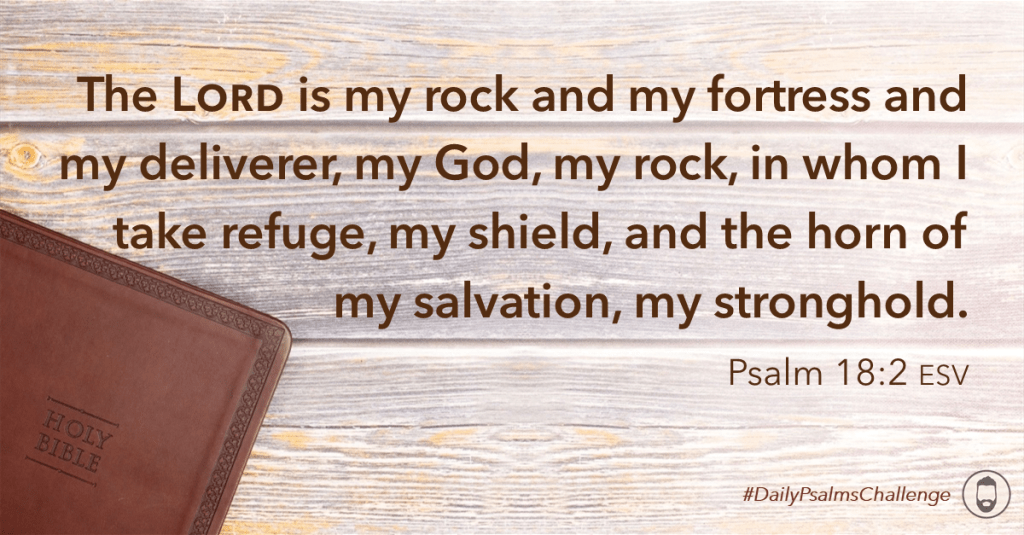
The LORD is my rock and my fortress and my deliverer, my God, my rock, in whom I take refuge, my shield, and the horn of my salvation, my stronghold.

Psalm 18:2

Psalm 18 is a song of triumph and thanksgiving from David to the Lord, celebrating God’s deliverance from King Saul. It is important to note that Psalm 18 is nearly identical to David’s song of praise in 2 Samuel 22 – the differences likely being Psalm 18 is adapted from David’s specific situation to be sung by the people (the Psalms is the songbook/hymnal of the Bible, remember). As such, this is not only a personal expression of David’s gratitude and praise but also a testimony to God’s faithfulness to His anointed king and His people. This psalm resonates with themes of refuge, rescue, and victory, ultimately pointing, as we’ll see later, to Jesus.

David opens with a declaration of love for the Lord, describing Him as his strength, rock, fortress, deliverer, and refuge (vv. 1-3). These metaphors emphasize God’s power, protection, and faithfulness. David’s words remind us that God is not some distant, uninvolved deity but a personal Savior who genuinely cares for His people.

The central part of the psalm recounts God’s dramatic intervention on David’s behalf (vv. 4-19). When David faced overwhelming danger, he cried out to the Lord, and God responded with awesome power. The imagery of the earth trembling, smoke rising, and hailstones falling paints a vivid picture of God as a divine Warrior, fighting for His anointed one. This points back all the way to the Lord’s deliverance of Israel from Egypt in the Exodus and points forward to His ultimate victory through Jesus.

David attributes his deliverance to his righteousness and integrity (vv. 20-24), not meaning that David was sinless but that he walked faithfully with God and sought to obey His commands. In the last part of the psalm, David praises God for equipping him for battle and giving him the victory (vv. 31-45) showing that he understood his victory was ultimately in the Lord’s goodness rather than his own. In fact, he acknowledges that every success of his was achieved as a result of God’s strength, guidance, and provision.

Psalm 18 concludes with a declaration of God’s faithfulness, not just toward David but also toward His people (vv. 46-50). David praises the Lord as his rock and Savior, again acknowledging that his victories are part of God’s covenant commitment to him and his descendants. Ultimately, this covenant finds fulfillment in Jesus, the eternal King and descendant of David, who brings salvation to all nations (Romans 15:9).

Seeing Jesus in Psalm 18

Psalm 18 foreshadows Jesus, the greater David. We can truly sing v. 46 in the context of Jesus: “The LORD lives, and blessed be my rock, and exalted be the God of my salvation”! The dramatic imagery of God’s intervention in David’s situation in this psalm reflects the power of the resurrection, where Jesus – the LORD – lives, defeating the ultimate enemies of sin and death (1 Corinthians 14:25-27).

Paul quotes v. 49 in Romans 15:9, showing that the salvation described in Psalm 18 is extended to the Gentiles through Jesus, who is the fulfillment of God’s promise to David – Jesus, who is the King who reigns forever and brings salvation to the ends of the earth.

Reflection

Psalm 18 invites us to rejoice in God’s faithfulness, to trust in His strength, and to find our ultimate hope in our eternal King, Jesus. 

As you reflect on Psalm 18, ask yourself how you can apply the imagery of God as rock, fortress, and shield to your current circumstances. Have there been times when He has delivered you? If so, how did that strengthen your faith?

Pray or sing Psalm 18 and rejoice in the God of your salvation!

The #dailyPSALMSchallenge gives us the opportunity to start 2025 in God’s Word by digging into a psalm a day. Each day will identify a key passage for us to meditate on as well as seeking to help us see Jesus in the psalm and reflect on what we have read.

Won’t you take the challenge?

“From Earthly Struggles to Eternal Joy” from Psalm 17 (#dailyPSALMSchallenge)

Keep me as the apple of Your eye; hide me in the shadow of Your wings….

Psalm 17:8

Psalm 17 is David’s heartfelt prayer for God to protect and vindicate him in the face of relentless enemies. This prayer reveals David’s perseverance in faith as he appeals to God on the basis of his innocence, God’s covenant love, and his ultimate hope in seeing God’s face.

David begins by asserting his innocence, inviting God to examine his heart, words, and actions (vv. 1-5). He is confident that God will find no wrongdoing. This doesn’t imply that David was sinlessly perfect but rather his sincere commitment to walk in God’s ways and avoid the paths of the wicked.

In the middle, David shifts his focus to God’s steadfast covenant love. He calls upon the LORD to demonstrate His love and loyalty, describing Him as the Savior of those who seek refuge (vv. 6-9). David prays using imagery to reflect his desire to be kept as the “apple of [God’s] eye” and hidden “in the shadow of [His] wings”, evoking a clear image of God’s tender care and protection (v. 8).

Psalm 17 then describes David’s enemies as ferocious, comparing them to a lion lying in wait for prey (vv. 10-12). David asks God to intervene and protect him from danger, entrusting his future and his enemies justice to the Lord. He contrasts his enemies, who find their portion in this life only, with his own hope in the eternal presence of God (vv. 13-15).

David concludes with a powerful declaration of his confidence in the Lord: “As for me, I shall behold your face in righteousness; when I awake, I shall be satisfied with Your likeness” (v. 15). His ultimate hope is not in earthly justice but in the joy of seeing God face-to-face, a longing that points us to eternal life.

Seeing Jesus in Psalm 17

Psalm 17 finds its ultimate fulfillment in Jesus. As David appeals to God for justice and vindication, we see a foreshadowing of the sinless Savior who fully trusted the Father’s will. Jesus, like David, faced accusations and violent enemies, yet He entrusted Himself to God’s righteous judgment (1 Peter 2:23).

Jesus also perfectly embodies the hope expressed in v. 15. Through His death and resurrection, He made it possible for us to behold God’s face in righteousness and enjoy eternal life in His presence (Revelation 22:3-4).

Reflection

Pray Psalm 17 and be reminded of Jesus’s faithfulness. Put your hope in Him. Know that God still hears, protects, and promises joy in His presence forevermore.

Be confident in God’s justice rather than seek your own revenge. Rest in God’s care, finding comfort in His wings and know that you are His delight, the apple of His eye. And seek to have a perspective grounded in the eternal life He gives and the hope we can have in Him rather than focusing on trials and suffering.

The #dailyPSALMSchallenge gives us the opportunity to start 2025 in God’s Word by digging into a psalm a day. Each day will identify a key passage for us to meditate on as well as seeking to help us see Jesus in the psalm and reflect on what we have read.

Won’t you take the challenge?

Songs for Sunday, January 19, 2025 @ Christ Community Church

Sunday’s coming, and I’m excited!

Every Sunday the Lord blesses us with is an opportunity to gather together and celebrate Jesus’s resurrection and anchor our heats in the hope of His return!

As we gather, we are reminded that the power of sin and death has been broken, and we rejoice in the steadfast love of the Lord, which turns mourning to dancing and sorrow into joy. This is illustrated in the passages we will read together Sunday morning.

The first passage is Psalm 30:8-12, and it beautifully captures this truth:

8To You, O LORD, I cry, and to the Lord I plead for mercy: 9“What profit is there in my death, if I go down to the pit? Will the dust praise You? Will it tell of Your faithfulness? 10Hear, O LORD, and be merciful to me! O LORD, be my helper!”

11You have turned for me my mourning into dancing; You have loosed my sackcloth and clothed me with gladness, 12that my glory may sing Your praise and not be silent. O LORD my God, I will give thanks to you forever!

In Psalm 30, David cries out to the LORD in his distress, and God answers, turning his mourning into dancing and clothing him with gladness (Psalm 30:11). This is the testimony of all who belong to Christ — to all who are rescued by Him from the sting of death and brought into everlasting life! This doesn’t mean that everything is always (or ever) hunky-dory or that we will never feel the sting of death here on earth. What this means is that death has an expiration date and that, if we are His, it is only temporary!

This victorious theme continues in our second passage for Sunday morning, 1 Corinthians 15:50-58:

50I tell you this, brothers: flesh and blood cannot inherit the Kingdom of God, nor does the perishable inherit the imperishable. 51Behold! I tell you a mystery. We shall not all sleep, but we shall all be changed, 52in a moment, in the twinkling of an eye, at the last trumpet. For the trumpet will sound, and the dead will be raised imperishable, and we shall be changed. 53For this perishable body must put on the imperishable, and this mortal body must put on immortality. 54When the perishable puts on the imperishable, and the mortal puts on immortality, then shall come to pass the saying that is written:

“Death is swallowed up in victory.” 55“O death, where is your victory? O death, where is your sting?”

56The sting of death is sin, and the power of sin is the law. 57But thanks be to God, who gives us the victory through our Lord Jesus Christ.

58Therefore, my beloved brothers, be steadfast, immovable, always abounding in the work of the Lord, knowing that in the Lord your labor is not in vain.

Throughout 1 Corinthians 15, Paul declares the certainty of Jesus’s resurrection and in 1 Corinthians 15:50-58, he calls us to steadfastness and hope in that certainty. Because Jesus has conquered death, our lives are filled with purpose. Every note we sing, every word we speak, every moment of worship is not in vain because our Savior — our GOD — is alive and not dead! It is part of God’s story of redemption because, if we are in Christ, we have been made alive in Him!

This Sunday (and honestly every Sunday at Christ Community), our hearts are fixed on Christ and excited by His resurrection. The songs we sing are about Him bearing our sin on the cross and giving life through His life when He exited His borrowed tomb. We will sing of it over and over again — as we should — because Jesus is alive and well, and we will do it all the more as we await His return!

John will open the Word and point us to Jesus.

We will lift our voices together, reading and singing, pointing each other to Jesus.

He is all we need!

Won’t you gather with us?

Everyone is invited.


Here are our Scriptures and songs:

8To You, O LORD, I cry, and to the Lord I plead for mercy: 9“What profit is there in my death, if I go down to the pit? Will the dust praise You? Will it tell of Your faithfulness? 10Hear, O LORD, and be merciful to me! O LORD, be my helper!”

11You have turned for me my mourning into dancing; You have loosed my sackcloth and clothed me with gladness, 12that my glory may sing Your praise and not be silent. O LORD my God, I will give thanks to you forever!


50I tell you this, brothers: flesh and blood cannot inherit the Kingdom of God, nor does the perishable inherit the imperishable. 51Behold! I tell you a mystery. We shall not all sleep, but we shall all be changed, 52in a moment, in the twinkling of an eye, at the last trumpet. For the trumpet will sound, and the dead will be raised imperishable, and we shall be changed. 53For this perishable body must put on the imperishable, and this mortal body must put on immortality. 54When the perishable puts on the imperishable, and the mortal puts on immortality, then shall come to pass the saying that is written:

“Death is swallowed up in victory.” 55“O death, where is your victory? O death, where is your sting?”

56The sting of death is sin, and the power of sin is the law. 57But thanks be to God, who gives us the victory through our Lord Jesus Christ.

58Therefore, my beloved brothers, be steadfast, immovable, always abounding in the work of the Lord, knowing that in the Lord your labor is not in vain.


“Hope in the Darkness: Trusting God’s Faithfulness” from Psalm 13 (#dailyPSALMSchallenge)

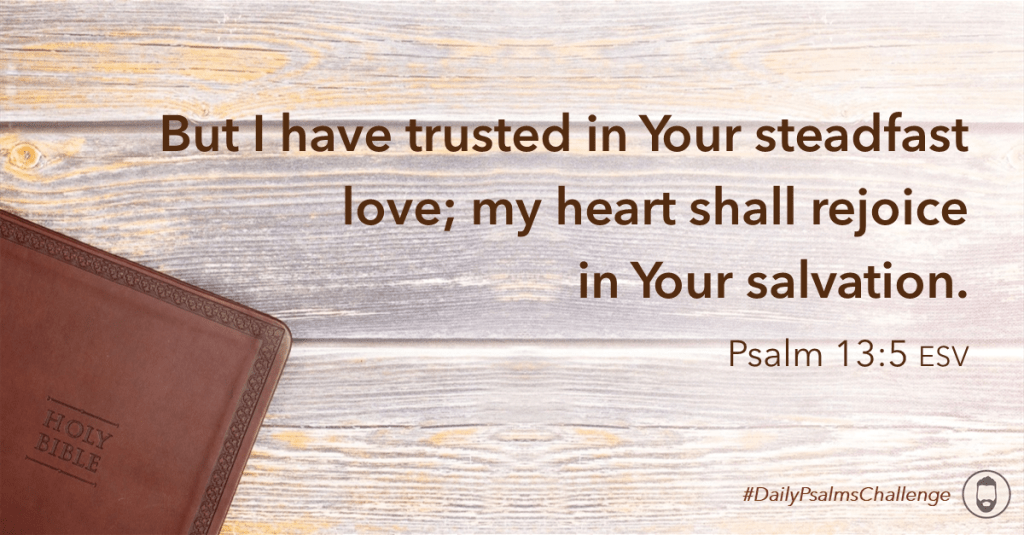
But I have trusted in Your steadfast love; my heart shall rejoice in Your salvation.

Psalm 13:5

Psalm 13 opens with a raw and relatable cry of distress: “How long?” (vv. 1-2). These are words everyone has uttered when in a long period of anguish or distress, and David shares the anguish he feels and how he feels as if he had been abandoned by God, weighed down by his sorrows, and oppressed by his enemies. This is another example of lament (letting out one’s grief or sorrow), and it reflects the universal experience of believes who face seasons in which they feel their prayers go unanswered, their suffering will never end, and heaven’s response to their pleas is silence.

David’s honest plea here shows that lament is a faithful response to suffering. Rather than turning away from God, David directs his questions – and his pain – toward God. He acknowledges these feelings by asking God: “Will you forget me forever? How long will you hide your face from me?” (v. 1). But he doesn’t stop at the lament; he begins praying, asking the Lord to “consider and answer me” and “light up my eyes” (v. 3). David knows that God alone holds the power to restore life and hope, even and especially when all seems lost.

Psalm 13 culminates in the declaration of trust and praise that David has “trusted in [God’s] steadfast love” and that his heart “shall rejoice in [the Lord’s] salvation” (v. 5). He again anchors his faith in the unchanging character of God (which is a theme that has shone up regularly in the psalms thus far). Even in the darkness, he remembers God’s past faithfulness and looks forward to his future deliverance and closing with a commitment to praise: “I will sing to the LORD, because He has dealt bountifully with me” (v. 6).

Seeing Jesus in Psalm 13

Jesus embodies the full reality of Psalm 13. In His humanity, He experienced the depths of lament, most vividly on the cross when He cried out “My God, my God, why have you forsaken me?” (Matthew 27:46). He knew the pain of feeling abandoned, yet He fully trusted Himself to the Father’s will.

Through His death and resurrection, the ultimate “How long?” has been answered. God’s steadfast love was displayed clearly and concretely. His victory over sin, and especially death, guarantees ultimate and eternal deliverance. We can face seasons of waiting and sorrow by looking to Jesus, who endured the cross for the joy set before Him (Hebrews 12:2).

Reflection

Psalm 13 teaches us that faith does not deny the reality of pain but clings to the truth of God’s love and promises. Lament can (and should) lead to intimacy with God as it allows us to bring our whole selves – questions, fears, hopes, etc. – into God’s presence (Hebrews 4:16).

Do you feel free to bring your honest emotions to God? We see here that God is big enough to handle our questions and more than faithful enough to carry us through.

Spend some time meditating on God’s steadfast love and faithfulness, remembering His past acts of kindness in your life. Trust that His promises are true even when His answers seem delayed. Let David’s journey from lament to praise inspire you to move to deeper intimacy with God, trusting that He hears, cares, and will answer in His perfect timing.

The #dailyPSALMSchallenge gives us the opportunity to start 2025 in God’s Word by digging into a psalm a day. Each day will identify a key passage for us to meditate on as well as seeking to help us see Jesus in the psalm and reflect on what we have read.

Won’t you take the challenge?
“Foundations of Faith” from Psalm 11 (#dailyPSALMSchallenge)

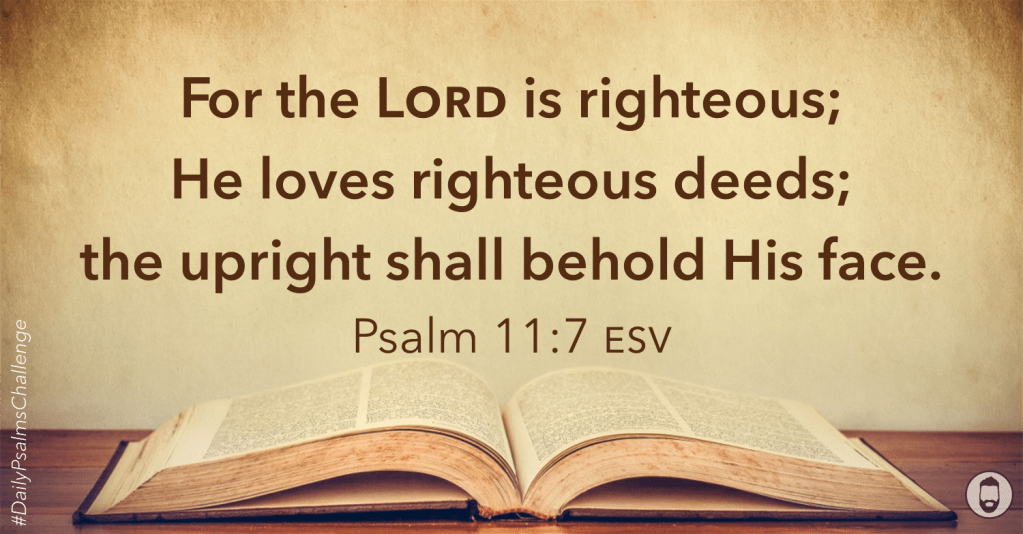
For the LORD is righteous; He loves righteous deeds; the upright shall behold His face.

Psalm 11:7

Psalm 11 speaks directly to a moment of crisis, when fear and doubt creep in while everything around David seems to be going wrong because of wicked enemies. David starts off with a declaration of his trust in the LORD: “In the LORD I take refuge” (v. 1). This is David’s response to being told to “flee like a bird” (v. 1) in the face of danger. He refused to flee anywhere other than to the LORD. Why? Because his hope is not found in his circumstances but in the sovereignty and power of God.

People looked at David and saw chaos – wicked men lurking in the shadows, preparing to strike out at the righteous (v. 2). They questioned what the righteous could do once “the foundations are destroyed” (v. 3), yet David’s confidence was not shaken. His response was to turn his gaze upward, away from the troubles and wicked enemies, declaring, “The LORD is in His holy temple; the LORD’s throne is in heaven” (v. 4). His foundations are too high and too deep to be in danger of crumbling or shaking! From His throne, He sees all, tests all men’s hearts, and brings judgment on the wicked while vindicating the righteous.

Psalm 11 culminates in a beautiful promise: “The upright shall behold His face” (v. 7). For those whose trust is in the LORD, there is not only refuge now but the ultimate reward of seeing God face-to-face. This hope is unshakable because it rests on the unchanging character of the LORD, who is righteous and loves justice (v. 7).

Seeing Jesus in Psalm 11

Jesus fulfills the promise of Psalm 11. In His life, He endured the attacks of the wicked, standing firm in the face of betrayal, violence, and the cross. He is the ultimate example of trusting the Father as a refuge. On the cross, He bore the judgment we deserve, drinking the cup of wrath described in v. 6 so that those who believe in Him can experience the joy of seeing God’s face (1 John 3:2).

Jesus triumphed over sin and death through His resurrection, ensuring that the righteous will one day be vindicated, and His return will bring ultimate justice, proving that no wickedness escapes His notice.

Reflection

In times of crisis, where do you turn for refuge? Psalm 11 challenges us to put our trust in the LORD not human solutions or fleeing.

Let the hope of seeing Jesus face-to-face sustain you as you navigate the challenges of life.

The #dailyPSALMSchallenge gives us the opportunity to start 2025 in God’s Word by digging into a psalm a day. Each day will identify a key passage for us to meditate on as well as seeking to help us see Jesus in the psalm and reflect on what we have read.

Won’t you take the challenge?
“Finding Hope in God’s Justice” from Psalm 10 (#dailyPSALMSchallenge

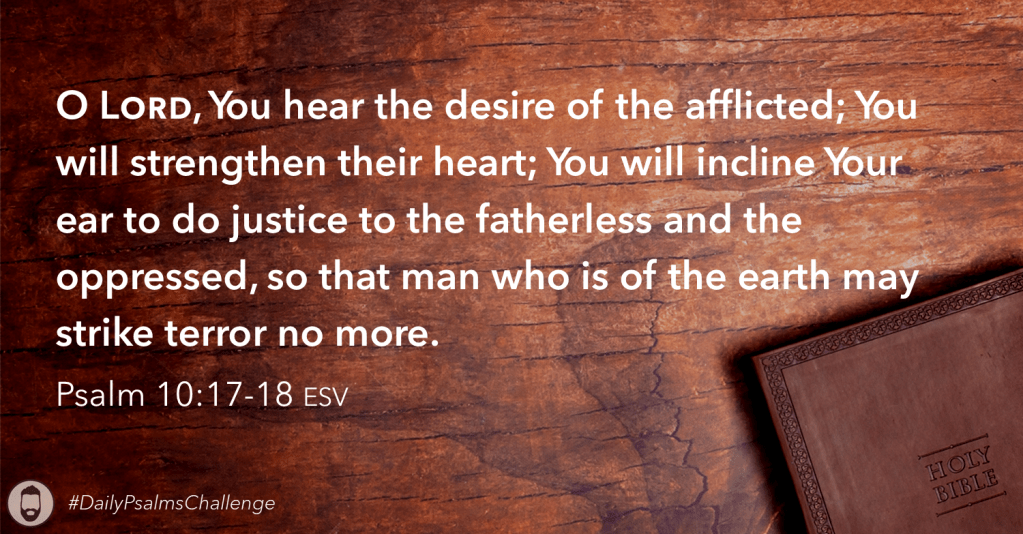
O LORD, You hear the desire of the afflicted; You will strengthen their heart; You will incline Your ear to do justice to the fatherless and the oppressed, so that man who is of the earth may strike terror no more.

Psalm 10:17-18

Psalm 10 opens with a heartfelt cry, “Why, O LORD, do you stand far away/ Why do You hide Yourself in times of trouble?” (v. 1). This lament resonates deeply with anyone who has ever tried to reconcile what may look like God being silent toward the rampant injustice in the world.

The psalmist (no one is specifically named as the writer of Psalm 10) paints a vivid picture of the wicked — arrogant, oppressive, and violent — preying upon the helpless with no fear of accountability (vv. 2-11). Their hearts are full of pride, and they make the bold proclamation that “There is no God” (v. 4).

The wicked seem to prosper — seem. Their prosperity is only temporary because their ways are deceptive and cruel. They lurk in ambush like predators, exploiting the vulnerable like their prey and doing so with what seems to be no punishment or repercussions. The psalmist pleads with GOd to respond — to rise up, defend the afflicted, and bring the wicked to account (vv. 12-15). These cries are not expressions of doubt but of trust that God is just and able to intervene.

Psalm 10 concludes with renewed confidence (rather than disappointment) in the Lord, who is “King forever and ever” (v. 16). The wicked may seem to prevail, but the power is fleeting. God hears the cries of the afflicted, strengthens their hearts, and ensures justice for the fatherless and the oppressed (vv. 17-18). This is the assurance that while human justice is rampant, divine justice will ultimately prevail.

Seeing Jesus in Psalm 10

Jesus embodies the heart of Psalm 10. He demonstrated God’s care for the afflicted and oppressed during His earthly ministry — healing the sick, comforting the grieving, and extending grace to the outcasts. On the cross, Jesus bore the ultimate injustice — dying for sins He did not commit — so that justice and mercy could be perfectly reconciled in Him.

When Jesus returns to establish His eternal Kingdom of justice and peace, He will fulfill the psalmist’s cry that “man who is of the earth may strike terror no more” (v. 18).

Reflect

Psalm 10 reminds us that even when God seems distant, He is neither unaware nor indifferent to injustice.

Are you wrestling with situations where the wicked appear to prosper? Bring your concerns — and even your laments — to the Lord, trusting that He sees, hears, and will act.

Consider ways you might be able to defend the weak, care for the vulnerable, and trust in His ultimate plan to right every wrong. May Psalm 10 strength your faith as you learn to wait on the Lord.

The #dailyPSALMSchallenge gives us the opportunity to start 2025 in God’s Word by digging into a psalm a day. Each day will identify a key passage for us to meditate on as well as seeking to help us see Jesus in the psalm and reflect on what we have read.

Won’t you take the challenge?
Songs for Sunday, January 12, 2025 @ Christ Community Church

Sunday’s coming, and I’m excited!

When I say that, I’m not talking about some sort or religious obligation for attending church or anything like that. My mind is drawn to my need for Jesus and the fact that He would deign to accept one like me.

There were times in my life when thinking of Sunday was more religious than relationship, but the older I get and the more I think about all that Jesus has done (and is doing and will do), the more I think of Sunday like the imagery in Hebrews 4:14-16.

The writer of Hebrews begins this section talking about Jesus as the “great high priest”. That phrase can definitely be acquainted with religious ideas and temple life and sacrifices, but Jesus is something different.

High priests are typically “chosen from among men” and “appointed to act on behalf of men in relation to God” (Hebrews 5:1). Jesus is different. He is God become man to be the sacrifice for men to be able to come to God.

High priests would typically need to “offer sacrifice” for their own sins “fust as [they do] for those of the people” (Hebrews 5:3). Jesus is different. He has no sins to sacrifice for because He “has been tempted as we are, yet without sin” (Hebrews 4:15). He is the Lamb of God bearing our sin.

High priests worked and worked and worked on behalf of the people before God, but all of their work was just a shadow of what was to come. Jesus is different. Jesus is all substance, and no shadow, being Himself “the source of eternal salvation to all who obey Him, being designated by God a high priest after the order of Melchizedek” (Hebrews 5:9-10).

Because Jesus is different, we are not limited to showing up for some religious observances over and over again, dwelling only in the suburbs of God’s grace and partaking only of shadows. Because Jesus is our high priest, He has made a way for us not just to be in relation to God but for us to be able to approach Him — to go directly to “the throne of grace” (Hebrews 4:16).

For those bringing their animals for the high priest to slaughter and make atonement for their sins, the idea of approaching God’s throne would be a frightening thing. Think of Isaiah’s “woe is me” talk when he had a vision of the holy, holy, holy God seated on His throne; he knew he was unclean and unworthy to look upon “the King, the LORD of hosts” (Isaiah 6:1-5)! The King of kings seated on the throne is still holy, holy, holy and we are still sinners. the King of kings seated on the throne is the divine word who discerns “the thoughts and intentions” of our hearts, laying us bare — “naked and exposed to the eyes of Him to whom we must give an account” (Hebrews 4:12-13).

Yes, Jesus is the King of kings.

Yes, Jesus is holy, holy, holy.

Yes, Jesus is Lord.

No, we are not any of those things and neither worthy nor holy. We are not God, and most of us could not stand even alongside Isaiah to state our “woe” in God’s presence. But Jesus is also our high priest! He has made atonement for our sins! He has made a way for us to come before Him (John 14:6, 2 Corinthians 5:21, 1 John 2:1-2)!

This is why the imagery of Hebrews 4:14-16 is so heavy on my mind. I have the opportunity and privilege to approach the throne of grace in my time of need. Because I have confessed Jesus as Lord and believed upon Him — but my trust in Him to save me, I have assurance to be able to approach Him without fear of death and punishment because He Himself has “bore [my] sins in His body on the tree, that [I] might die to sin and live to righteousness” (1 Peter 2:24). I don’t have to say “woe is me” because He put Himself through woes on my behalf.

Because of this, I can approach His throne with the confidence of a child waking a parent in the middle of the night for a drink of water. I can turn to Him with the assurance that I not only may approach Him for help but be confident that I will “receive mercy and find grace to help in time of need” (Hebrews 4:16).

That’s good news!

But it’s not just good news for me. It is good news for all who trust in Him, all who are saved by grace through faith in Him.

So, Sunday’s coming, and we have the opportunity to gather together on the first day of the week — the Lord’s day — and remember His death, burial, and resurrection. We have the opportunity to gather with brothers and sisters who have been saved by grace through faith and approach the throne of our Lord together, confident that His grace and mercy are enough, sufficient, and eternally flowing toward those He loves.

If this doesn’t describe you, know that there is good news and grace enough for you, too. Your sin can be forgiven. You can be saved. There is grace enough and room enough and good news enough for you and all who call on His name.

You won’t find anything relgiously impressive. You won’t find impressive priests or practices. You won’t find perfect people. You will find a bunch of sinners — and hypocrites — whose only hope is Jesus. He is who will will read about. He is who we will sing about. He is who we will preach about. And that’s because He’s our only hope. He’s our King. He’s our God. He made a way for us and there is no place we’d rather be than gathered around His throne in a small picture of how we will get to be when this world passes away and He gathers His people to Himself.

Won’t you join us?


Here are our Scriptures and songs:

14Since then we have a great high priest who has passed through the heavens, Jesus, the Son of God, let us hold fast our confession. 15For we do not have a high priest who is unable to sympathize with our weaknesses, but One who in every respect has been tempted as we are, yet without sin. 16Let us then with confidence draw near to the throne of grace, that we may receive mercy and find grace to help in time of need.


4We were buried therefore with Him by baptism into death, in order that, just as Christ was raised from the dead by the glory of the Father, we too might walk in newness of life.
5For if we have been united with Him in a death like His, we shall certainly be united with him in a resurrection like His. 6We know that our old self was crucified with Him in order that the body of sin might be brought to nothing, so that we would no longer be enslaved to sin. 7For one who has died has been set free from sin.