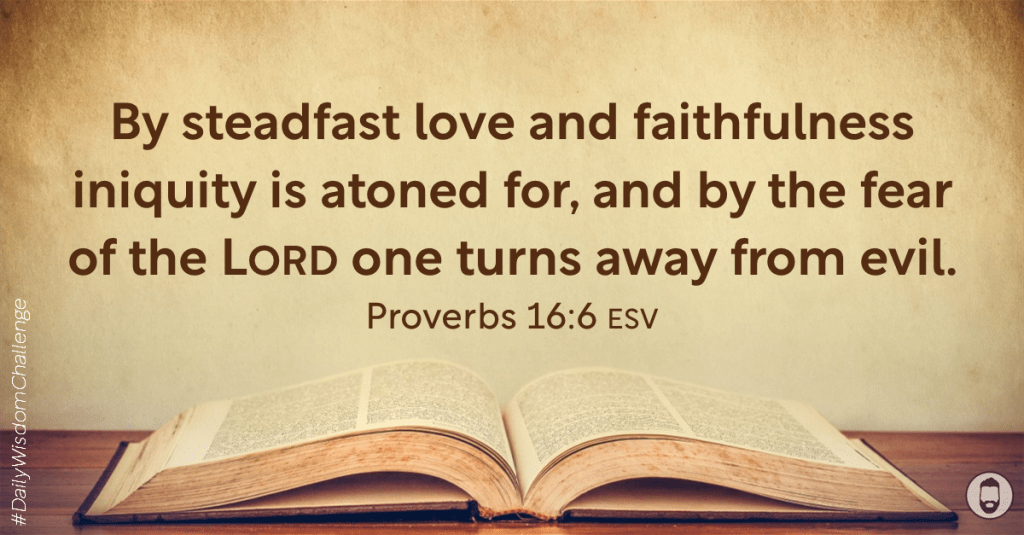
This proverb struck me as a poignant example of the perspective God gives us through His wisdom that counters the anti-wisdom of this world.
Whatever you revere or fear drives you, or at least steers you. Think about it. If there are certain holidays or people that you revere, you will act a certain way around them. Your life and behavior change in their presence or on those days. It works the same with fear. If you are afraid of someone or something, your body does its own thing in their presence. Your heart rate will elevate; your skin may grow clammy and/or sweaty; and your fight-or-flight response kicks in.
We live in a day and age when the powers-that-be use fear to motivate. This can be in the political arena as we have seen recently in many political ads and politically-driven social media posts. The news is always doom and gloom – and changes depending on the political leanings of one channel to the next. We have become accustomed to making decisions based on fear, and per the wisdom we see here, that sort of fear is a snare.
A snare is a device meant to catch something, and often carries with it the purpose of restraining something in order to kill it. If a hunter puts out a snare to catch an animal, it is often so that the animal can be caught, killed, and eaten. This reminds me of the description of Satan in 1 Peter 5:8 as one prowling “around like a roaring lion, seeking someone to devour”. Satan likes snares because they catch people unaware using camouflage and trickery. 2 Corinthians 4:4 describes this work as him blinding “the minds of unbelievers, to keep them from seeing the light of the gospel of the glory of Christ, who is the image of God.” He has no glory of his own and nothing of worth for people to follow, so he tricks and hoodwinks people, trying to keep them from seeing the Light.
While Satan is on the prowl seeking to devour and destroy, God offers His mighty hand to lift us up and offers the opportunity to cast “all [our] anxieties on Him, because He cares for [us]” (1 Peter 5:6-7). You can trust the Lord and be safe (Psalm 62:8). There is a big difference between prowling around like a lion and being the Lion of the tribe of Judah (Revelation 5:5)! Jesus is the genuine article and came to seek and save the lost instead of seeking destruction (Luke 19:10, John 3:17)!
Your fear of what man can do to you lays a snare. But trusting in God brings safety – from the snare, from destruction, from being devoured.
That’s good news to those who trust in the Lord! How about you? Will you be driven by your fear of man or your trust in God?
For the month of October (and November for slowpokes like me), we are answering the challenge John Goldwater, pastor of Christ Community Church in Grenada, MS, laid out — the #DailyWisdomChallenge. Each day, we are going to read through a chapter of Proverbs corresponding to the day of the month.
This fits with what we have studied in Colossians, specifically Colossians 3:1-2, namely that we should seek “the things that are above, where Christ is” and set our minds like a thermostat “on things that are above, not on things that are on earth”. Imagine what a month meditating on God’s Word daily can do for us.
Won’t you join us on this #DailyWisdomChallenge and set your minds on Christ?
This #DailyWisdomChallenge has been convicting for me. As I have walked through these proverbs, God’s wisdom has outshone the anti-wisdom of the world – the anti-wisdom that lures us to sin instead of illuminating our understanding that there is a God who loves us and made a way for us to come to Him. Proverb 28:13 is a good example of this.
Human beings mess up. A lot. When we mess up and our actions go against God’s righteous standard and expectation, going directly against what God has said, this is called sin. We all do it. First and foremost, we sin against God (Psalm 51:4). This is the case even when we are sinning against other people as well, which is the second point here. This is important to know because sometimes we like to subscribe to the idea that our sin only affects us. It doesn’t. The consequences of our sin affects others, especially when there are people who receive some of the sin we commit.
If we lie, we have sinned against God and the person we lied to. If the lie is about someone else, that adds to it.
If we murder, we have sinned against God. Clearly, we have sinned against the victim, but the sin extends to his or her family, friends, and so on. The toll can be catastrophic in some circles.
If we sin, we sin against God and others. Period.
The reality of sin is that judgment and condemnation is deserved. A holy God created this world and has the authority to say what is right and wrong, holy and righteous. We might not like it. We might wish He had decided that our pet sins were ok or to let something slide, but He is holy and cannot abide with sin. If He did, He would not be holy – definitely not righteous. The good news is that God has made a way for us to be reconciled to Him and not receive that wrath that is due for our sin (Romans 6:23, 1 Corinthians 15:16-21).
The word “reconcile” is helpful here in our understanding of sin. You see, when people talk about sin deserving death, they balk and try to explain how their sin does not warrant such a penalty. But reconcile does not leave room for that. Because we have sinned against God, we are in need of reconciliation because the relationship has been damaged. Sinning against Him puts enmity between us (Romans 5:10). Things need to be put right.
Our proverb today says that the only way for things to be made right between people, where one has done wrong and the other been wronged, is for the transgression to be confessed. Concealing it only allows it to fester – think along the lines of a boil beneath one’s skin. Reconciliation cannot happen unless the transgression is confessed and dealt with. This is essentially the message that Paul shared with the church at Corinth when he shared with them about how God through Christ offers opportunity to be reconciled to Him where He does not count “their trespasses against them” (2 Corinthians 5:19). And He explains this in one of the most beautifully succinct examples of the gospel – the good news of Jesus – in 2 Corinthians 5:21: “For our sake He made Him to be sin who knew no sin, so that in Him we might become the righteousness of God.”
Just as it happens between people, reconciliation means confession needs to be made. 2 Corinthians 5:21 gives us a picture of the God we have sinned against putting His perfect, sinless Son forward in our place to bear the punishment of sin. Those who believe in Him exchange their sin and the debt due for it for Jesus’s righteousness and favor. Jesus, the God we sinned against, puts forth the offering that makes our relationship right. He trades our sin debt for His eternal riches of grace, mercy, and love. He trades our rightful wages of death with a gracious portion of His eternal life. He trades our rap sheet for His righteousness.
Concealing our sin and acting like it does not exist only delays the inevitable. Confessing it – confessing Jesus as Lord and believing He rose from the grave (Romans 10:9) – gives opportunity for reconciliation and salvation. One side leads to death and the other to life.
The advice of Proverbs 28:13 points us toward God’s wisdom and counting all we have as loss for the “surpassing worth of knowing Christ Jesus” (Philippians 3:8) and forsaking the anti-wisdom of the world that leads us to think there is no consequence for sin.
Lord, thank you for offering reconciliation when we don’t deserve it – when no one else in the world would. Reconciliation is hard to come by, but it reflects Your heart toward those who turn to you. Help me to confess my sin to you instead of concealing it. Help me to do the same for others I sin against as well. Amen.
For the month of October (and *hopefully* the early part of November), we are answering the challenge John Goldwater, pastor of Christ Community Church in Grenada, MS, laid out — the #DailyWisdomChallenge. Each day, we are going to read through a chapter of Proverbs corresponding to the day of the month.
This fits with what we have studied in Colossians, specifically Colossians 3:1-2, namely that we should seek “the things that are above, where Christ is” and set our minds like a thermostat “on things that are above, not on things that are on earth”. Imagine what a month meditating on God’s Word daily can do for us.
Won’t you join us on this #DailyWisdomChallenge and set your minds on Christ?
This proverb has been working on me a lot — almost grating against some of the rough edges in my life. You see, I like to pride myself on my ability to be strong in the midst of adversity — in my ability to find another gear to get through whatever I need to get through. Well, you know what Proverbs 16:18 says: “Pride goes before destruction, and a haughty spirit before a fall.”
I guess I should have begun by saying that I used to pride myself on strength in the midst of and despite adversity. I really can’t say that any more. Over the last ten years, there has been plenty of adversity but a definite lack of strength on my part. If I once was able to find a gear to dig deep and get through trouble, my transmission has gone out leaving me with nothing more than low gear.
Several times over the last decade, I have found myself made low. My body has failed me. My mind has failed me. I have failed me. I look at Proverbs 24:10 and see a strength that is small because I have consistently fainted in the “day of adversity”.
I am so thankful that I did.
Yes, you read that right: I am thankful I failed and in the day of adversity and realized that my strength has always been small. The good news is my God has always been big, and His strength is more than enough.
In 2 Corinthians 12, Paul talks about his struggles with a “thorn” in his flesh “to keep [him] from becoming conceited because of the surpassing greatness” of visions God had given him (2 Corinthians 12:7). He pleaded with God to take away the thorn, but God did not remove the thorn (2 Corinthians 12:8). God’s answer to Paul is surprising, and it is so liberating to those who are trying to make it on their own steam and failing miserably:
“My grace is sufficient for you, for my power is made perfect in weakness.”
Jesus’s answer to Paul was not to remove the thorn and let Paul be strong. No, it was to keep the thorn and allow Paul the opportunity to lean on the strength of Christ and trust Him.
No one likes to be weak. No one likes to need trouble. But, truth be told, we are all weak at times and all need help more than we would like to admit. The apostle Paul seems at times to be some sort of superhero, but he is just a vessel of the Lord that was of use to the Lord. Any greatness seen in Paul is the Lord.
Any greatness seen in me is the Lord, too.
Any weakness is all mine. Any failure is mine, too.
When I found myself down and ready to tap out, Paul’s response to Jesus’s words in 2 Corinthians 12:9 inspired me to look at my failings and weakness differently. I needed to look at my weaknesses through the lens of the Lordship of Jesus and the reliance He has called me to — the same He had called Paul to. Look at Paul’s response:
“Therefore I will boast all the more gladly of my weaknesses, so that the power of Christ may rest upon me. For the sake of Christ, then, I am content with weaknesses, insults, hardships, persecutions, and calamities. For when I am weak, then I am strong.” (2 Corinthians 12:9-10)
So, this proverb does not have to beat me down because my strength is not an issue here; my God’s strength is more than enough! Because of Christ, I can “faint in the day of adversity” and be caught in “the mighty hand of God” waiting and ready to lift me up (1 Peter 5:6)! I can faint because He is strong.
That’s good news!
If you are like I was (and still too often am) and wondering how you are going to make it because you just don’t have the strength to carry on, look to Jesus. He is strong when we are not. Our weakness is an opportunity for Him to lift us up. Look to Jesus and let Him carry you. For when we are weak, then we are strong in Him.
For the month of October, we are answering the challenge John Goldwater, pastor of Christ Community Church in Grenada, MS, laid out — the #DailyWisdomChallenge. Each day, we are going to read through a chapter of Proverbs corresponding to the day of the month.
This fits with what we have studied in Colossians, specifically Colossians 3:1-2, namely that we should seek “the things that are above, where Christ is” and set our minds like a thermostat “on things that are above, not on things that are on earth”. Imagine what a month meditating on God’s Word daily can do for us.
Won’t you join us on this #DailyWisdomChallenge and set your minds on Christ?
For the month of October, we are answering the challenge John Goldwater, pastor of Christ Community Church in Grenada, MS, laid out — the #DailyWisdomChallenge. Each day, we are going to read through a chapter of Proverbs corresponding to the day of the month.
This fits with what we have studied in Colossians, specifically Colossians 3:1-2, namely that we should seek “the things that are above, where Christ is” and set our minds like a thermostat “on things that are above, not on things that are on earth”. Imagine what a month meditating on God’s Word daily can do for us.
Won’t you join us on this #DailyWisdomChallenge and set your minds on Christ?
I love this proverb because it shows hope in a couple of ways that I think we really need to see in this day and age.
First, there is hope to be found in Jesus that is greater than any darkness or depression or depravity. Hope in Jesus is not hypothetical hope, but it is instead fixed and sure, resting on the foundation of what Jesus has done, is doing, and will surely do. His victory transcends everything that remains unknown because He has already “overcome the world” (John 16:33).
In the context of Proverbs 19:18, there is obvious reference to trouble. Why else would there be need to discipline one’s son? Whatever trouble is pointed to here, it must be bad or represents the sum total of the bad a kid can get into because God in His wisdom advises the parent not “set [their] heart on putting him to death”. Kids, just like their parents, get sideways in sin sometimes. All of them, just like all parents, do. But when you are in the midst of having to discipline this child that you have raised and tried to point in the right direction, some trouble seems like it leaves no room for hope.
The Jesus-hope this proverb’s God-wisdom points to is pictured well in Romans 5:1-5: “Therefore, since we have been justified by faith, we have peace with God through our Lord Jesus Christ. Through Him we have also obtained access by faith into this grace in which we stand, and we rejoice in the hope of the glory of God. Not only that, but we rejoice in our sufferings, knowing that suffering produces endurance, and endurance produces character, and character produces hope, and hope does not put us to shame, because God’s love has been poured out in our hearts through the Holy Spirit who has been given to us.”
This sort of hope – hope only found by those who have been “justified by faith”, those who have received “peace” from God stemming from standing in His grace – works differently than worldly hope. Wordly hope is hypothetical and fails when suffering hits. Jesus-hope starts with suffering and grows as God’s Spirit gives endurance. That endurance produces fruit of the Spirit that defines one’s character. And once God has worked Himself into and out through your character, hope is a way of life. It is a byproduct of the eternal life He gives those who believe in Him.
The second hope is one that many do not agree with: as long as a child lives, I believe there is hope. Are there troubles and sins and crimes that have longlasting consequences? Absolutely. Are there things that can happen and be committed that can forever alter the life of a child? Yes. But the hope shown above is for sinners. It is hope for the ones who messed up. It is hope for those whose works earn death. It is hope for children like me – and children like you.
I find myself having to remind myself of this often as I work with students.
I find myself having to remind myself of this often as I parent my kiddos.
I find myself having to remind myself of this often because of my parent’s oldest kid (and to a lesser degree my inlaws youngest).
So, if you find yourself in the rough times of parenting and you wonder whether its worth keeping on keeping on with your kiddo, it is. God tells us here in His wisdom that there is hope in bearing with them in discipline. Things may look hopeless from your vantage point, but from the throne of the King of kings, He sees what we can’t. He sees and tells us to hope. And as He told us in Romans, hope will not put us to shame.
For the month of October, we are answering the challenge John Goldwater, pastor of Christ Community Church in Grenada, MS, laid out — the #DailyWisdomChallenge. Each day, we are going to read through a chapter of Proverbs corresponding to the day of the month.
This fits with what we have studied in Colossians, specifically Colossians 3:1-2, namely that we should seek “the things that are above, where Christ is” and set our minds like a thermostat “on things that are above, not on things that are on earth”. Imagine what a month meditating on God’s Word daily can do for us.
Won’t you join us on this #DailyWisdomChallenge and set your minds on Christ?
This proverb his my right square in my heart.
I spent the bulk of my childhood being the butt of many jokes, and made fun of quite mercilessly. I was beat up and often bullied. The bruises faded and broken glasses were replaced, but the scars — physical and emotional — remain.
This is one of the reasons I wanted to become a teacher. Throughout those years of being bullied, there were a handful that took notice, but most, for whatever reason, were oblivious or chalked it up to that’s just the way kids are. If you have never been treated like this (or were on the giving side of these sorts of encounters rather than the receiving), you do not know what a relief it is when someone notices and helps you. Carrie Mack and Linda Bumpers at Willa Wilson Elementary were blessings from God that helped me see my value despite the efforts of bus riders and drivers who were glad to see it stomped out. These ladies still to this day look for and out for me and are encouragements in my life. Seeing either of them today fills my heart with joy and encouragement and reminds me of light in the midst of darkness.
In middle school, I know teachers saw me being bullied. The example that first comes to mind is Mike Miles. He knew what I was going through without being told. He went and had my schedule changed so that I would be out of the study hall where my misery was always the subject of study to his study hall. He taught me how to play chess. He encouraged me to read books if that’s what I liked to do. In fact, that was the gist of what he taught me (other than the math he was tasked with): he taught me to be who God had made me to be and not let others diminish that. When I see him even today, I never hesitate to tell him how thankful I am that God used him to save my life — that when others worked to convince me my life had no value, God used him to remind me who and Whose I was.
There was one particular memory that came to mind when I read this verse that convicts me still to this day. When I think of this particular memory, I am filled with nauseating guilt even though it has been over twenty years ago.
In sixth grade, Carolyn Swanson saw that I had been bullied and mistreated as well. She also noticed other students who endured the same. Sixth grade back then meant mandatory PE a few days a week (some days library or music). For me, that was like painting a giant bullseye because that meant either getting picked last for teams or not at all (this was the 1990s; participation was not mandatory, and exclusion/mockery were allowed). Even though I did not want to be picked because that would mean I could go up into the stands and read rather than embarrassing myself athletically in a very public way, I really wanted to be picked. Well, I really wanted to belong.
One particular day, a group of the more popular guys approached me and pointed out one of my classmates. Me and this other guy were basically tied for least popular in the sixth grade as well as in who could be made fun of more. Neither of us were athletic. Neither of us came from families with much money. Both of us were quiet and clothed differently than others. The guys convinced me that the surest way to be one of them — to get picked for teams and get to hang out with them — was to make fun of the other guy. He had just gotten some new boots that he was proud of and had worn them to school. It made me sick to my stomach to think of doing that to someone else, but this could have meant that I got bumped up a level and got a reprieve from being made fun of. So, right there in the middle school gym, I let the other guy have it. I was ugly. It was shameful. He cried. And then the other guys started in — on me.
Their plan all along was to embarrass me and show that I was fake. They knew I professed to be a Christian and saw this as an opportunity to cast aspersions on that profession of faith. They gave me every bit of what I gave the other guy and worse. I cried, too, but not so much for what I was receiving but that I had allowed myself to do to the other guy what I knew was terrible.
Mrs. Swanson somehow found out about this, and I can remember what she said to me about it like it was yesterday. She told me that it was worse for me to do that than the others because I truly knew what it felt like to be treated like that. This was not a means for her to belittle me but to invest in me. She fussed at me, and I deserved it. She told me that she expected more out of me and knew that I would learn from this and grow into the man she knew I could be — despite my failure and because I would learn from it.
I am ashamed to say that it took months for me to get the courage to apologize to the other guy, and before I could, he moved away. It took nearly twenty years to get in contact with him again. I won’t tell you a story of apology and reconciliation here because I do not want to paint myself as a good guy for any of this. I want to help you understand Proverbs 17:5.
Everyone you come into contact with is made in the image of God. He created them and formed them in their mother’s womb. Each of us is unique, with unique features and personalities. Some of us, like myself, are more different than societal norms than others. And it is all too easy to make fun rather than to show care and respect.
This is not wrong merely for the human life you did not respect. It is a slap in the face of their “Maker”.
If someone is going through a tough time — some “calamity” — whether it is their fault, someone else’s fault, or nobody’s fault, it is not a time for mockery. Even if you think someone is getting the “calamity” they deserve, it is not a time to mock and make fun; we sure don’t enjoy it when calamities of our own making find us.
I guess this is really a plea to be kind to others and recognize that the same God who made you made them. There is never a time to mock or insult. There is always time to show love and care.
For me, this drove me to become a teacher. The examples of those who took up for me influence how I interact with kids — all of them I have and all that I can — on a daily basis. The example of the one who saw me becoming like the others and intervened has a daily impact, too, on the man God made me to be as well as in ways that I can watch out for others as well. I pray that this little bit of testimony helps you along the way, whether you are the bully, the bullied, or the bystander. Let us look out for others and look to God for how He would have us to treat folks.
For the month of October, we are answering the challenge John Goldwater, pastor of Christ Community Church in Grenada, MS, laid out — the #DailyWisdomChallenge. Each day, we are going to read through a chapter of Proverbs corresponding to the day of the month.
This fits with what we have studied in Colossians, specifically Colossians 3:1-2, namely that we should seek “the things that are above, where Christ is” and set our minds like a thermostat “on things that are above, not on things that are on earth”. Imagine what a month meditating on God’s Word daily can do for us.
Won’t you join us on this #DailyWisdomChallenge and set your minds on Christ?
Today’s proverb is another example of how we can see the gospel clearly pictured in the proverbs. This shows the beauty of God’s wisdom showing us how to come to Him and the danger of the anti-wisdom of the world that leads us away from Him.
We have looked at the “fear of the LORD” in most every chapter of Proverbs so far. To understand the “fear of the LORD” in the context of the gospel is especially important in present-day America when many preachers use fear as a means for convincing people to walk an aisle and make a decision for Jesus. This sort of fear-driven invitation time leads can lead to confusion and false conversion — and people wanting to be “re-saved” every time they sin and find themselves afraid of God’s wrath. When it comes to Biblical “fear of the LORD”, this definitely ain’t that!
The “fear of the LORD” described in the Bible (Proverbs 1:29, 2:4-6, 3:7, 8:13, 9:10, 14:26-27, 15:33, 16:6; Job 28:28; Psalm 34:11; Ecclesiastes 12:13; Acts 9:31) is best described as having deep respect, admiration, and awe for God. It is the basis for truly understanding and knowing Him and comes from having a relationship with Him because He saved and redeemed you. It changes your life and is fueled by having His Spirit within you and seeing Him influence your desires, attitudes, choices, feelings, actions, and goals. Knowing Him this way understands that He has a frightening level of power and wrath, but you do not have to live in fear of Him because He cares for you and His Son bore His wrath on your behalf.
This “fear of the LORD” gives us a desire to turn “away from evil” because you see Him and “the surpassing worth of knowing Christ Jesus [as] Lord” (Philippians 3:8). This “fear of the LORD” is fueled by His “steadfast love and faithfulness” despite our “iniquity”, knowing that He atones for sin for those He saves.
For those who do not turn to Him, those who reject Him and put their trust in themselves, there is much to fear, in the traditional, literal sense of fear, but this fear does not see people turn from their sin. People may curb their behaviors or hide their desires because of fear, but no real change happens. The change God brings in people through His steadfast love and faithful salvation brings real change, from the inside out.
What about you?
Do you fear the Lord in the Biblical sense, or are you merely scared of His wrath?
Is He the God of the universe or some vengeful and distant deity?
One is the God who saves as presented in the Bible. His name is Jesus.
It is my prayer that you see Him for who He is, confess Him as Lord, and believe in Him.
For the month of October, we are answering the challenge John Goldwater, pastor of Christ Community Church in Grenada, MS, laid out — the #DailyWisdomChallenge. Each day, we are going to read through a chapter of Proverbs corresponding to the day of the month.
This fits with what we have studied in Colossians, specifically Colossians 3:1-2, namely that we should seek “the things that are above, where Christ is” and set our minds like a thermostat “on things that are above, not on things that are on earth”. Imagine what a month meditating on God’s Word daily can do for us.
Won’t you join us on this #DailyWisdomChallenge and set your minds on Christ?
Today’s proverb is such a beautiful picture of what what Paul describes as being found in Christ, “not having a righteousness of [our] own that comes from the law, but that which comes through faith in Christ, the righteousness from God that depends on faith” (Philippians 3:9).
So often, talk of the righteousness and wickedness fuels complaints about religious people thinking they are better than others or even fuels the self-righteousness of some church folks. I wish I could say this never has applied to me, but as I wrote in the #DailyWisdomChallenge post for Proverb 11, it is too easy to forget we are all sinners — all wicked, as many of the Proverbs say.
If it were not for Jesus saving me, I would have no righteousness to speak of (Romans 3:10); all I would have is my sin and the death that my sin has earned (Romans 6:23). To clarify, I am not a righteous man. My heart is wicked. And, well, not to be a downer, but yours is too. All of us sin and “fall short of the glory of God” (Romans 3:23). He is righteous. He is perfect. He is sinless. The rest of us are not.
There will come a day when I will stand before this righteous, perfect, sinless God and be faced with my wickedness and sin. Everything I have ever done will be evidence of that. Everything I have ever said will make the case for my guilt. The Bible tells us that Satan is the Accuser — one who accuses us day and night “before our God” (Revelation 12:10). He is bringing to God’s attention, and not having to lie despite his great knack for deception, our sin and failures. And, scarier still, none of this is news to God, because He knew all that we would do and all that we would say before the foundation of the world.
For those who have been saved, however, a “guilt offering” has been made on our behalf. Those who confess Jesus as Lord and believe in His resurrection are saved (Romans 10:9), and God places our sin and guilt on Jesus, His sinless Son, in order that we can be made righteous (2 Corinthians 5:21). Jesus paid our sin debt “by cancelling the record…that stood against us with its legal demands” by “nailing it to the cross” — by allowing the sinless Savior to be nailed to the cross that we deserved (Colossians 2:14).
That’s good news!
What’s more is that God did not merely satisfy some legal demand. He did not issue some writ or declaration that can be passed to the accuser who is trying to prosecute us and shame God with our failures. No, the Bible tells us that we have an “advocate” who has taken our case, and his name and credentials are “Jesus Christ the Righteous” (1 John 2:1)! Think of every dramatic courtroom drama you have ever watched or read about, and know that they pale in comparison to the rich finality with which Jesus handles the case of those He has saved. When the accuser taunts and mocks, reminding us of sin and failure, Jesus answers with His own righteousness! He declares that by His blood and sacrifice — and the fact that He died and is now living and interceding on our behalf (Hebrews 7:25, Romans 8:34) — our sin has been removed “as far as the east is from the west” (Psalm 103:12) and “cast…into the depths of the sea” (Micah 7:19)!
Before the Accuser can plead his case any further, God smacks the gavel with finality and declares innocent based on the righteousness of Christ!
Proverbs say that fools “mock the guilt offering”. One thing I can surely testify to here today is that I “enjoy” God’s “acceptance” BECAUSE I know how serious my sin is and how eternally grateful I am that He would save a wretch such as me.
How about you?
Do you see Jesus’s death and resurrection as necessary, or do you find it silly and unnecessary?
Do you think you will stand before God and have acceptance through any other means — wealth, prosperity, good works?
Let me plead with you today to look to Jesus to save you!
And, if you have, rejoice in the acceptance that will never be taken away, and do not fear the accuser. He knows “his time is short” and is lashing out in anger, trying to hurt those God has saved and thereby hurt Him (Revelation 12:12). Be encouraged and fear not, because the same proclamation that brings news of the accuser also proclaims God’s victory and Satan’s doom:
“Now the salvation and the power and the Kingdom of our God and the authority of His Christ have come, for the accuser of our brothers HAS BEEN THROWN DOWN, who accuses them day and night before our God. And they have CONQUERED him BY THE BLOOD OF THE LAMB and the word of their testimony, for they loved not their lives even unto death.” (Revelation 12:10-11)
For the month of October, we are answering the challenge John Goldwater, pastor of Christ Community Church in Grenada, MS, laid out — the #DailyWisdomChallenge. Each day, we are going to read through a chapter of Proverbs corresponding to the day of the month.
This fits with what we have studied in Colossians, specifically Colossians 3:1-2, namely that we should seek “the things that are above, where Christ is” and set our minds like a thermostat “on things that are above, not on things that are on earth”. Imagine what a month meditating on God’s Word daily can do for us.
Won’t you join us on this #DailyWisdomChallenge and set your minds on Christ?
Today’s passage, like yesterday’s, gives us two contrasting groups. In Proverbs 9:8, we looked at the scoffers and the wise. Today, we have a comparison of the righteous and the wicked.
We need to make an important distinction here so that I can make sure we are on the same page: “none is righteous, no not one” (Psalm 14:3, 53:3; Romans 3:10). Any discussion of the righteous and the wicked needs the understanding — almost like a disclaimer — that none of us are righteous outside of “faith in Christ”, “the righteousness from God that depends on faith” (Philippians 3:9).
Sometimes we get sideways on this and talk about righteous as if we are inherently good. The Bible makes it clear that all of us are sinners (Romans 3:23). The sin that plagues our lives cannot be blamed solely on outside forces, either; our temptations often come from within when we are “lured and enticed by [our] own desire” (James 1:14). So, any appeal of an us v. them argument on this puts our “us” on the side of the wicked — and makes it an us v. HIM (Jesus Christ the Righteous — 1 John 2:1)!
The only way we can be made righteous is to trust in Jesus. I love the clarity of 2 Corinthians 5:21 on this subject. We’ll break it down phrase by phrase to help us get it (or as I tell my school kiddos, to pick up what I’m laying down).
For our sake. Jesus offers salvation because we need it. We are sinners, as we have seen above, and He is the only Savior. Sometimes we are offended when confronted with this truth, but it is good news — the God who stands holy and righteous offers an opportunity to be saved by grace through faith in His Son Jesus rather than having to receive His wrath reserved for sin.
He (God the Father) made Him (Jesus) to be sin who knew no sin. We deserve the wrath of God because He is the righteous and perfect Creator, and we have gone against His standard. This is not a popular view point. But, here’s the good news: Jesus becoming sin for us means that He willingly took the wrath of God for those He saves! Jesus, the only sinless One — God’s righteous standard in human flesh, pays the sin debt of those who trust in Him by grace through faith by the price of His own blood (Colossians 2:14; 1 Peter 1:18-19, 2:24).
So that in Him (Jesus) we might become the righteousness of God. The only way for us — sinners or “wicked” “evildoers” as Proverbs 10:27-29 puts it — to be righteous before God is to have Jesus’s righteous covering our sin. 2 Corinthians 5:21 shows us a glimpse of this great exchange between Jesus and those He saves where He takes their sin and exchanges it for His righteousness. 1 John 2:1-2 gives the picture a little clearer: Jesus Christ the righteous is our advocate and stands before God as our atoning sacrifice, His blood paying for our sin and covering us with His righteousness.
That’s good news! It’s tough and raw and infinitely unfair, but it is a picture of God’s love for His people in Jesus. It’s a picture of grace. It’s a picture of mercy. It’s a picture of Proverbs 10:27-29.
Biblical wisdom is knowing that we can do nothing to prolong our life and being well-aquainted with the reality of the wages of our sin being death (Romans 6:23). The hope of those who fear the LORD is Jesus, and from Him and the life He gives there is joy (Proverbs 10:28); any expectation other than what we can have in Jesus perishes when we do.
And, don’t miss this, Jesus came to seek and save the lost — to give His life as a ransom for the wicked, for people like me who confess Him as LORD and believe in Him. That’s good news for me and all who put their faith in Him. That news represents the “stronghold” I have in Him — not that I am “blameless” but that He is, but that news represents “destruction to evildoers” who do not put their faith in Him (Proverbs 10:29).
What about you? Where do you stand in the great exchange? Has Jesus taken your sin and counted you blameless, or are you banking on your own righteousness?
Tomorrow is Sunday, and Lord willing, we will have the opportunity to gather and worship Him!
Let me say that again — we will have the OPPORTUNITY to worship Him, gathered with other believers and pointing to Him with all that we do.
Why?
God is worthy! Revelation 4:11 says, “Worthy are you, our Lord and God, to receive glory and honor and power, for You created all things, and by your will they existed and were created.”
God is holy! Psalm 29:2 says, “Ascribe to the LORD the glory due His name; worship the LORD in the splendor of holiness.”
God is the mighty Creator! Psalm 95:6 says, “Oh come, let us worship and bow down; let us kneel before the LORD, out Maker!”
God is good, steadfastly loving, and eternally faithful! Psalm 100:4-5 says, “Enter His gates with thanksgiving, and His courts with praise! Give thank to Him; bless His name! For the LORD is good; His steadfast love endures forever, and His faithfulness to all generations.”
God is great and powerful — worthy to be praised! Psalm 96:4-5 says, “For great is the LORD, and greatly to be praised; He is to be feared above all gods. For all the gods of the peoples are worthless idols, but the LORD made the heavens.”
God is worthy to be praised because He is the Savior! In Isaiah 43:11, He tells us, “I, I am the LORD, and besides me there is no savior.”
Our God — Jesus, the King of kings and Lord of lords — is worthy to receive worship and praise and honor because He is the Redeemer! In Titus 2:13-14, Paul tells us that we are “waiting for our blessed hope, the appearing of the glory of our great God and Savior Jesus Christ, who gave Himself for us to redeem us from all lawlessness and to purify for Himself a people for His own possession who are zealous for good works.”
So, about that OPPORTUNITY tomorrow where, should the Lord let us wake, we GET to worship Him: what will you do with it?
We saw in the verses above that our God is not like the “worthless idols” of this earth — the vain things that charm us and distract us from Him. He is good and loving and sovereign and mighty, and He saves and redeems us. We can be sure that there are many frightening and concerning things going on around the world today, but none of them — NONE of them — frighten or concern our God because He has already won the victory and is undefeatable!
The words of Jesus’s words to His disciples at the end of John 16 when I think of the things that frighten me in the news and in my social media news feed of late — and these words move my heart to worship despite fear — they move me to comfort despite rising anxiety and unsurety. Listen to the words of our King:
I have said these things to you, that in Me you may have peace. In the world you will have tribulation. But take heart; I have overcome the world.
I feel those words in my soul — “take heart; I have overcome the world.”
That’s my God.
That’s my King.
He cares for us and has provided for us.
He has already — that’s right, past tense — “overcome the world”.
And tomorrow, we are going to celebrate Him and worship Him and praise Him and read His Word and preach His Word and make much of Him because He is God and He is worthy to be praised.
Won’t you gather with us?
Here are our Scriptures & songs:
Scripture | Romans 6:4-8 —
4 We were buried therefore with him by baptism into death, in order that, just as Christ was raised from the dead by the glory of the Father, we too might walk in newness of life. 5 For if we have been united with him in a death like his, we shall certainly be united with him in a resurrection like his. 6 We know that our old self was crucified with him in order that the body of sin might be brought to nothing, so that we would no longer be enslaved to sin. 7 For one who has died has been set free from sin. 8 Now if we have died with Christ, we believe that we will also live with him.
Song | Washed Clean — Scripture Inspiration: 2 Corinthians 4:4, Ephesians 1:17-18, Matthew 11:28-30, Romans 8:2, John 8:34-36, Psalm 51:2, Psalm 51:7, Jeremiah 33:8, 1 John 1:9, Titus 3:4-5, Proverbs 16:18, Proverbs 3:34, Ephesians 2:1-2, Acts 26:18-19
For the wages of sin is death, but the free gift of God is eternal life in Christ Jesus our Lord.
Song | What He’s Done — Scripture Inspiration: Matthew 7:33, Mark 15:22, Luke 23:33, John 19:7, Matthew 26:26, Colossians 1:19-20, 1 Peter 1:19, John 8:36, Isaiah 53, Psalm 147:3, John 3:16, John 15:13, Romans 8:5-8, 1 John 1:9-2:2, Acts 4:12, 1 Corinthians 15:21-22, Hebrews 2:14, Philippians 2:5-11, 1 Corinthians 15:50-57, Revelation 4:1-11, 1 John 5:4, Revelation 17:14, Revelation 5:12, Philippians 4:8
17 And whatever you do, in word or deed, do everything in the name of the Lord Jesus, giving thanks to God the Father through him. —
22 Bondservants, obey in everything those who are your earthly masters, not by way of eye-service, as people-pleasers, but with sincerity of heart, fearing the Lord. 23 Whatever you do, work heartily, as for the Lord and not for men, 24 knowing that from the Lord you will receive the inheritance as your reward. You are serving the Lord Christ. 25 For the wrongdoer will be paid back for the wrong he has done, and there is no partiality. 4:1Masters, treat your bondservants justly and fairly, knowing that you also have a Master in heaven.[1]
📖 Revelation 7After the terrifying events of Revelation 6, John is given a breathtaking glimpse of hope. Before judgment continues, God reveals that His people are known, sealed, and secure in Christ. The chapter culminates with one of Revelation's most beautiful pictures: the Lamb who was slain is also the Shepherd who leads His people forever.In this episode, Keith Harris and Jamie Harrison discuss:✔️ Why Revelation 7 is an interlude between the sixth and seventh seals✔️ What it means for God's servants to be sealed✔️ The two primary views of the 144,000—and why faithful Christians differ✔️ How John's pattern of hearing one thing and seeing another helps interpret the chapter✔️ The innumerable multitude worshiping before the throne✔️ Why Jesus, the Lamb, is also our Shepherd who leads us to living waterThis chapter reminds us that our greatest hope isn't solving every prophetic question—it's belonging to Christ. Those who trust Him are safe in Him, and one day He will wipe away every tear from their eyes.📖 "For the Lamb in the midst of the throne will be their shepherd, and he will guide them to springs of living water, and God will wipe away every tear from their eyes." (Revelation 7:17, ESV)🔗 If you'd like to see a written version of this podcast, complete with footnotes and cross-references, you can find it here.
Today’s Bible study has put me through the wringer. As I have said many times over, these Bible studies are not just for you but that they work on me first. It hit me as I type this final version that there is a great irony to how it has taken me so long to finish this Bible study. This Bible study is on what it means to be adorned with Christ in our vocations, and one of my vocations being an English teacher, one would think that the irony of me being unable to find the time to serve the Lord in writing this Bible study is because I have been working much more than usual. More than realizing the irony, though, is me sitting here and pondering whether my hard work of the last month or so has been “as for the Lord” or “for men” (Colossians 3:23).
For me, work has always been an easy idol. I like to work. I thrive when I get to multitask (with a reasonable number of tasks). I like the feeling of accomplishment I get when a task is complete, or a project goes well. Both of my vocations stem from God’s calling on my life and involve helping people in various capacities. Getting to see people receive needed help, whether it be the lightbulb clicking on when a student learns something or helping someone seek Christ, gives me an indescribable feeling. But, if I am not careful, I will take on more and more and more until I lose myself in the work.
I need accountability in this area, and I have people who are committed to helping me strike a correct balance in this area of my life so that I do not overindulge. I know I am a workaholic. I must be careful because I am a teetotaler and will add and add and add until I burn myself out. I know this because I have been there, having burned out and swapped careers just before my 30th birthday. It is part of the reason that I believe the Lord has allowed me to slowly ease back into pastoral ministry. I had to divorce my identity from my work and let Him define me in light of who He has made, is making, and will make me to be.
So, to answer my earlier question – and unfortunately confess to y’all, dear Sojourners: I have leaned more toward working for man than God as of late. Knowing that is, as they say, half the battle. Now, is the time for repentance.
Lest you think I am exaggerating because work is a good thing invented by God, too much of it or having it out of the balance of rest that exhibits faith in Jesus’s strength over my own reveals that I am not bearing fruit accordingly, namely the self-control that comes from being in Christ (Galatians 5:22-23). Look at a few passages of Scripture that illustrate this:
Proverb 25:16 – If you have found honey, eat only enough for you, lest you have your fill of it and vomit.
1 Corinthians 9:25 – Every athlete exercises self-control in all things. They do it to receive a perishable wreath, but we an imperishable.
Titus 2:11-12 – For the grace of God has appeared, bringing salvation for all people, training us to renounce ungodliness and worldly passions, and to live self-controlled, upright, and godly lives in the present age.
We will revisit these later on as we seek to apply our passage today, but it should be clear here that too much of a good thing can be bad – and yes, God invented work, so it is (or at least it was meant to be) good when done according to His Word and will.
In Genesis 2:15, we see that God put Adam into “the garden of Eden to work it and keep it”. This is not so much a mandate as it is a role or calling for Adam, and as his descendants, we have roles and callings as well. Initially, this work was easy for Adam as he was tasked with naming the animals in Eden and later his wife. God gave Adam the task of being “fruitful” and multiplying in order that the earth would be filled in Genesis 1:28, which the Bible describes as a part of God blessing them. These tasks were good and enjoyable – and probably much less of the toil we associate with work because, at the time, there was no sin in the world, no death (Genesis 1:31, Romans 5:12). Once the Fall occurred when Adam and Eve ate of the fruit of the tree of the knowledge of good and evil (Genesis 3:6), death and sin began to reign in the earth (Romans 5:17), and God cursed the ground, the very same ground that Adam had been tasked to keep and work (Genesis 3:17-19). Adam’s sin took that good and fruitful work and turned it to toil with the addition of pain and thorns and thistles and sweat and dust (Genesis 3:17-19). Work went from something that was good and revolved around the role God assigned and calling He gave as a blessing and introduced the toil and fruitless labor that we know all too well.
This is why we need Colossians 3:22-4:1. Because of the Fall, the image of God in us has been marred by sin, but God, when He saves us, begins conforming us to the image of His Son Jesus rather than the world around us (Romans 8:29, 12:1-2). We saw this earlier in Colossians 3:9-10 when Paul told the Colossian church (and us) that we are to be putting “off the old self with its practices” and putting “on the new self, which is being renewed in knowledge after the image of its creator”. We need Colossians 3:22-4:1 to see what we need to take off and what we need to put on. We need to understand that God has placed us in our vocations as His ambassadors and missionaries (2 Corinthians 5:19-20) and ask the Lord to let our work be adorned with Christ rather than conformed to this fallen world.
Bondservants, Obey in Everything Those Who are Your Earthly Masters (vv. 3:22-25)
On the surface, this passage is about slaves obeying their masters. That is what it is about.
What This Does NOT Mean
As we covered in our study of Philemon, the God of the Bible is not associated with the slavery that comes to mind from colonial America or present-day human trafficking. You can look back at the Appendices from that Bible study and see God’s stance on the treatment of slaves and on the ungodly horrors visited on people in chattel slavery and around the world today; He is against such things. When the Holy Spirit breathed this out and had Paul to write it down, He was not condoning chattel slavery or human trafficking – plain and simple (see Appendix III — Bible Passages Condemning Practices Related to Chattel Slavery and Modern-Day Slavery/Human Trafficking). So, operating under the presupposition that what Paul is talking about here is not that[2], let’s dive in and see what He does mean here.
What Does It Mean, Then?
The word translated “bondservant” in the ESV is the Greek word doulos. It can – and probably should – be simply translated as slave, but there is a connotation[3] in the present that is wrapped up in the sinful atrocities of chattel slavery as well as in the continued sinful treatment of African Americans in the century plus following the Civil War in the Deep South. Bondservant does not really have a connotation and allows for the denotation, or definition, of what God has for us here. That word doulos refered to a slave, “one who is in a permanent relation of servitude to another” where their will is “altogether consumed in the will of the other”, and it references one being “bound to serve”.[4] It is closer to the modern understanding of an indentured servant than it is to modern understanding of slavery.
It would be a cop-out and over-generalization to say that this is all that there was, especially throughout the Roman empire and around the world at that time. There were wicked masters, and when they were bad, they were terrible. Some slaves were severely mistreated. But there were those who served out their debt and returned to regular life. There were even some who would seek to remain in the service of their master after their debt was paid. Roman slavery was associated with vocation. These bondservants could be teachers or builders or whatever skills they had that could generate enough revenue to pay off their debt. In some cases, it was quite like work releases for people who are incarcerated today – or even in the way trustees are given responsibility or management oversight.
The emphasis here is less about the way they were taught and more about how those who found themselves bonded to a master and have confessed Jesus as Lord will serve. The emphasis is on their service rather than the quality of their master. Their service is to be marked by obedience “in everything” (Colossians 3:22). Their service is to flow out of sincere hearts and their fear of the Lord rather than “by way of eye-service, as people-pleasers” (Colossians 3:22). Whatever was required of them was a call to “work heartily, as for the Lord and not for men” because they were “serving the Lord Christ” and receiving the only reward that mattered from Him (Colossians 3:23-24). Those who are saved have submitted themselves to Jesus as Lord – as kurios, the Greek word for the master of a doulos. And this is what their heavenly Lord and Master required of them – what He requires of us.
Now, did this mean that they refused to be paid or for their debt to be worked off? Absolutely not. What it meant was, if they were in Christ, the fruit borne by their lives reflected an inheritance greater than any paycheck and that their redemption by the blood of Jesus meant more than being redeemed from earthly servitude. This also does not mean that they are above punishment if they did wrong because, with God, “there is no partiality” and “the wrongdoer will be paid back for the wrong he has done” (Colossians 3:25). This would also cover if an earthly master required a sinful act from their slave or bondservant. Just like we looked at in the relationships of fathers to children and husbands to wives, being in service to God above all means that we refuse to bow to the call of the world and sin even and especially if it means punishment or persecution (1 Peter 2:20-23). To clarify, this would not include the way a wicked master would punish but is meant to help us understand that, even for saved people, there are consequences for sin.
To be adorned in Christ as one works and serves means that they are serving the Lord above all, no matter their vocation. It means that Jesus has a plan for your vocation that goes beyond what you can see (Ephesians 2:10)! It means your quality of work matters, not because of your earthly masters or bosses but because you belong to Jesus and He has set you apart to shine His “marvelous light” in your workplace and find opportunity to “proclaim the excellencies of Him who called you out of darkness” (1 Peter 2:9).
Masters, Treat Your Bondservants Justly and Fairly (v. 4:1)
Since slavery was an integrated part of the Roman Empire and the Colossian church clearly had masters in her members, like Philemon, it is important for God to set a standard for how those masters would operate. This extends to those in both vocational authority and other areas of oversight or administration.
What Does It Mean, Then, to Be a Master Who is Just and Fair?
The way that Paul wrote it here is pretty clear who is in charge: “knowing you also have a Master in heaven” (Colossians 4:1). Earthly masters who are saved imitate their heavenly Master, their Lord Jesus Christ. I do not want to oversimplify this, but it means you are going to be different than most masters, the vast majority of bosses.
In the case of Roman slavery, it could have been a call for them to lose revenue by not having debts paid back because their Lord was calling them to free slaves – completely contrary to the culture around them (see Appendix II — Bible Passages Discussing the Release of Slaves). In the case of vocational authority today – being a boss or having oversight/authority over people, it means that you are called to bear fruit of God’s Spirit being in you. Earthly leaders and bosses like to lead with intimidation, but Jesus was a servant leader. He did not hesitate to humble Himself and wash His disciples feet. Saved bosses can lead by serving and humility as well. Earthly bosses can threaten and demoralize, but Jesus lifts up the lowly. Saved bosses can do the same.
Now, does this mean that a boss or leader who is saved is a pushover and allows their employees to run rough-shod over them? Absolutely not! Jesus holds people accountable for their actions. Jesus is a Master who has expectations for His people, but Jesus is consistent with who He is as He disciplines and corrects. So, if you are an earthly boss and Jesus is Lord, you do not conform to the ways of this world for material or vocational gain; no, you allow who His Spirit has transformed and is transforming you into – how He is conforming you back to the image of God in Christ – set the course for how you deal with people.
In a sense, those bosses who are saved and adorned in Christ function in regard to Christ as Paul describes a bondservant to serve. Saved bosses have a “sincerity of heart” stemming from their fear of the Lord (Colossians 3:22). They “work heartily, as for the Lord and not for men, knowing that from the Lord [they] will receive the inheritance as [their] reward (Colossians 3:23). They serve the “Lord Christ” (Colossians 3:24).
The remainder of Colossians 4:1 highlights what that looks like as Paul tells the masters that they should treat their bondservants “justly and fairly”. This is where the tough part of leadership comes in. If an employee has committed some sort of infraction that necessitates firing them, a godly master fires them. If there is a process that is to be followed to do so, the process is followed. This would prohibit office politics and replace it with a yearning to be just and fair as Jesus has been just and fair with them. In some cases, where grace and mercy can be shown, this calls for that, too – all in balance with how the Word teaches us and the Spirit of God leads, and all contrary to the way that this fallen world operates.
Wrapping Up
So, what does that look like? If you are like me, you look at some of this and it seems like this is a good way to get taken advantage of or to sign up to get a lot of extra junk to put up with at work. It is important to remember that our work is not our identity. Jesus gives us an identity in Him by redeeming us from the power of sin and death, rescuing us from the wrath of God, and eternally adopting us into His family. And we get to be adorned with Him and bear His family name into whatever vocation He has for us.
Here are some principles to consider:
Do everything for the Lord (v. 3:17). Whatever your job and whatever your task, work as if Jesus Himself had tasked you with it. This gives work meaning and views it in light of the Kingdom of God and not in whatever earthly kingdom you are employed at.
Work with sincerity and integrity (v. 3:22). Employees should not work merely for status and approval but should consistently act with the understanding that their ultimate accountability is to God.
Work heartily and diligently (v. 3:23). Workers should put their best effort into their work, recognizing that this is part of the calling of their Lord Jesus Christ. This calls for a strong work ethic – not a calling for workaholism – because the work is as to the Lord not men.
Focus on eternal rewards rather than temporal ones (v. 3:24). Earthly compensation matters. It does. It is a big reason why we have and need jobs. The Bible is not against us earning wages and even says if you do not work, you do not eat. But there is more to working than a paycheck. There is an inheritance from the Father for those who serve Him. This mindset helps maintain perspective, especially if your work environment is challenging or worse. If you work for a paycheck or merely for retirement, there are limits to your service. If you work for the One who has made a place for you in heaven (and based on His merit, not yours), your perspective changes.
Be accountable for what you do wrong (v. 3:25). Remember, God is a just God and is pro-discipline. An earmark of being in Christ is repentance. One of the best ways you can exhibit what Jesus has done in you through His salvation is by repenting when you have messed up. This is not a popular viewpoint, but even if your wrongdoing costs you your job, your standing with Jesus is based on His righteousness not your own — which is good news: God is pro-grace!
If you have authority over employees, treat them justly and fairly(v. 4:1). Treat employees as Jesus treats you. It really is that simple. No amount of earthly success or status is worth conforming to the world when Jesus has transformed you into something better.
Realize you are accountable to God (v. 4:1). This is true for believers whether you are a boss or an employee. If you have confessed Jesus as Lord, He is your master. He calls the shots. What He says goes. And serving Him even at the expense of losing a job is worth it. He will still be here when all of this passes away.
Do not let work become an idol (Proverb 25:16, 1 Corinthians 9:25, Titus 2:11-12). It is easy to get into the mindset that because you work as unto the Lord that you cannot quit or stop. The God who ordained work also ordained rest. He did not bring us from death to life in Him for our lives to be wrapped up in our vocations. Jesus gives us wisdom and self-control. While He may call some people to a single vocation and calling for their whole lives, He does not do that with everyone. Follow Him and be willing to change or quit if that is what He has for you. At the same token, be willing to dig in where you are if that is what He has for you.
This has not been my favorite Bible study. I have had to take a step back and realize that I am susceptible to getting my work life out of whack, even when I thought I had it all worked out. The good news is Jesus is the God who saves and a Lord who is active in the lives of His servants. No matter how many times I mess up, I can approach His throne and receive grace and mercy, which He has in an inexhaustible supply.
What about you? I do not mean to meddle, but I exhort you, dear Sojourner, to look at your life and your work and test it according to the Word of God. How can you apply this and shine more brightly His marvelous light rather than working in such a way that you hide the light of Christ.
Know this: I am praying for you and asking God to work in and through your work.