Good News of Great Joy | December 8 — “Faith Comes by Hearing”

Luke 8 highlights the transformative power of God’s Word and the necessity of faith. Jesus shows His authority over nature, demons, sickness, and death, calling us to trust Him in all circumstances. As Advent draws near, let us cultivate hearts like good soil—ready to receive God’s Word, bear fruit, and live by faith. May this season remind us that Jesus brings hope, healing, and new life to all who believe.

"The Lamb Who is Our Shepherd" from Revelation 7 (The KING is Coming) Refresh & Restore | A JustKeithHarris.com Podcast

📖 Revelation 7After the terrifying events of Revelation 6, John is given a breathtaking glimpse of hope. Before judgment continues, God reveals that His people are known, sealed, and secure in Christ. The chapter culminates with one of Revelation's most beautiful pictures: the Lamb who was slain is also the Shepherd who leads His people forever.In this episode, Keith Harris and Jamie Harrison discuss:✔️ Why Revelation 7 is an interlude between the sixth and seventh seals✔️ What it means for God's servants to be sealed✔️ The two primary views of the 144,000—and why faithful Christians differ✔️ How John's pattern of hearing one thing and seeing another helps interpret the chapter✔️ The innumerable multitude worshiping before the throne✔️ Why Jesus, the Lamb, is also our Shepherd who leads us to living waterThis chapter reminds us that our greatest hope isn't solving every prophetic question—it's belonging to Christ. Those who trust Him are safe in Him, and one day He will wipe away every tear from their eyes.📖 "For the Lamb in the midst of the throne will be their shepherd, and he will guide them to springs of living water, and God will wipe away every tear from their eyes." (Revelation 7:17, ESV)🔗 If you'd like to see a written version of this podcast, complete with footnotes and cross-references, you can find it here.
  1. "The Lamb Who is Our Shepherd" from Revelation 7 (The KING is Coming)
  2. "Who Can Stand Under the Wrath of God?" from Revelation 6 (The KING is Coming)
  3. "Musings on Marriage, Missions, and My Walk with Christ" (Refresh & Restore)
  4. "Light Momentary Afflictions, Eternal Weight of Glory" (Refresh & Restore)

The Parable of the Sower and the Lamp (8:1-21)[1]

Soon afterward he went on through cities and villages, proclaiming and bringing the good news of the kingdom of God. And the twelve were with him, and also some women who had been healed of evil spirits and infirmities: Mary, called Magdalene, from whom seven demons had gone out, and Joanna, the wife of Chuza, Herod’s household manager, and Susanna, and many others, who provided for them out of their means.

And when a great crowd was gathering and people from town after town came to him, he said in a parable, “A sower went out to sow his seed. And as he sowed, some fell along the path and was trampled underfoot, and the birds of the air devoured it. And some fell on the rock, and as it grew up, it withered away, because it had no moisture. And some fell among thorns, and the thorns grew up with it and choked it. And some fell into good soil and grew and yielded a hundredfold.” As he said these things, he called out, “He who has ears to hear, let him hear.”

And when his disciples asked him what this parable meant, 10 he said, “To you it has been given to know the secrets of the kingdom of God, but for others they are in parables, so that ‘seeing they may not see, and hearing they may not understand.’ 11 Now the parable is this: The seed is the word of God. 12 The ones along the path are those who have heard; then the devil comes and takes away the word from their hearts, so that they may not believe and be saved. 13 And the ones on the rock are those who, when they hear the word, receive it with joy. But these have no root; they believe for a while, and in time of testing fall away. 14 And as for what fell among the thorns, they are those who hear, but as they go on their way they are choked by the cares and riches and pleasures of life, and their fruit does not mature. 15 As for that in the good soil, they are those who, hearing the word, hold it fast in an honest and good heart, and bear fruit with patience.

16 “No one after lighting a lamp covers it with a jar or puts it under a bed, but puts it on a stand, so that those who enter may see the light. 17 For nothing is hidden that will not be made manifest, nor is anything secret that will not be known and come to light. 18 Take care then how you hear, for to the one who has, more will be given, and from the one who has not, even what he thinks that he has will be taken away.”

19 Then his mother and his brothers came to him, but they could not reach him because of the crowd. 20 And he was told, “Your mother and your brothers are standing outside, desiring to see you.” 21 But he answered them, “My mother and my brothers are those who hear the word of God and do it.”

Jesus Calms the Storm (8:22-25)[2]

22 One day he got into a boat with his disciples, and he said to them, “Let us go across to the other side of the lake.” So they set out, 23 and as they sailed he fell asleep. And a windstorm came down on the lake, and they were filling with water and were in danger. 24 And they went and woke him, saying, “Master, Master, we are perishing!” And he awoke and rebuked the wind and the raging waves, and they ceased, and there was a calm. 25 He said to them, “Where is your faith?” And they were afraid, and they marveled, saying to one another, “Who then is this, that he commands even winds and water, and they obey him?”

The Healing of the Demoniac (8:26-39)[3]

26 Then they sailed to the country of the Gerasenes, which is opposite Galilee. 27 When Jesus had stepped out on land, there met him a man from the city who had demons. For a long time he had worn no clothes, and he had not lived in a house but among the tombs. 28 When he saw Jesus, he cried out and fell down before him and said with a loud voice, “What have you to do with me, Jesus, Son of the Most High God? I beg you, do not torment me.” 29 For he had commanded the unclean spirit to come out of the man. (For many a time it had seized him. He was kept under guard and bound with chains and shackles, but he would break the bonds and be driven by the demon into the desert.) 30 Jesus then asked him, “What is your name?” And he said, “Legion,” for many demons had entered him. 31 And they begged him not to command them to depart into the abyss. 32 Now a large herd of pigs was feeding there on the hillside, and they begged him to let them enter these. So he gave them permission. 33 Then the demons came out of the man and entered the pigs, and the herd rushed down the steep bank into the lake and drowned.

34 When the herdsmen saw what had happened, they fled and told it in the city and in the country. 35 Then people went out to see what had happened, and they came to Jesus and found the man from whom the demons had gone, sitting at the feet of Jesus, clothed and in his right mind, and they were afraid. 36 And those who had seen it told them how the demon-possessed man had been healed. 37 Then all the people of the surrounding country of the Gerasenes asked him to depart from them, for they were seized with great fear. So he got into the boat and returned. 38 The man from whom the demons had gone begged that he might be with him, but Jesus sent him away, saying, 39 “Return to your home, and declare how much God has done for you.” And he went away, proclaiming throughout the whole city how much Jesus had done for him.

The Healing of the Woman and Raising of Jairus’s Daughter (8:40-56)[4]

40 Now when Jesus returned, the crowd welcomed him, for they were all waiting for him. 41 And there came a man named Jairus, who was a ruler of the synagogue. And falling at Jesus’ feet, he implored him to come to his house, 42 for he had an only daughter, about twelve years of age, and she was dying.

As Jesus went, the people pressed around him. 43 And there was a woman who had had a discharge of blood for twelve years, and though she had spent all her living on physicians, she could not be healed by anyone. 44 She came up behind him and touched the fringe of his garment, and immediately her discharge of blood ceased. 45 And Jesus said, “Who was it that touched me?” When all denied it, Peter said, “Master, the crowds surround you and are pressing in on you!” 46 But Jesus said, “Someone touched me, for I perceive that power has gone out from me.” 47 And when the woman saw that she was not hidden, she came trembling, and falling down before him declared in the presence of all the people why she had touched him, and how she had been immediately healed. 48 And he said to her, “Daughter, your faith has made you well; go in peace.”

49 While he was still speaking, someone from the ruler’s house came and said, “Your daughter is dead; do not trouble the Teacher any more.” 50 But Jesus on hearing this answered him, “Do not fear; only believe, and she will be well.” 51 And when he came to the house, he allowed no one to enter with him, except Peter and John and James, and the father and mother of the child. 52 And all were weeping and mourning for her, but he said, “Do not weep, for she is not dead but sleeping.” 53 And they laughed at him, knowing that she was dead. 54 But taking her by the hand he called, saying, “Child, arise.” 55 And her spirit returned, and she got up at once. And he directed that something should be given her to eat. 56 And her parents were amazed, but he charged them to tell no one what had happened.


[1] Jesus teaches about the varied responses to God’s Word through the parable of the sower. The seed symbolizes God’s Word, and the soils represent different hearts: some reject it, others fall away under trials, and some are distracted by life’s worries. Only good soil—those who hear, retain, and obey the Word—bears fruit (v. 15). Jesus also compares His Word to a lamp, meant to shine and transform lives. He concludes that His true family are those who hear and obey the Word.

[2] While crossing the Sea of Galilee with His disciples, Jesus calms a fierce storm with a simple command, revealing His authority over nature. The disciples, amazed and fearful, ask, “Who then is this, that he commands even winds and water, and they obey him?” (v. 25). This miracle shows Jesus as God, the Lord of Creation, as even the weather obeys Him.

[3] Jesus heals a man possessed by a legion of demons in the region of the Gerasenes (or Gadarenes). The demons recognize Jesus as “Son of the Most High God” (v. 28) and beg not to be sent into the abyss and instead enter a herd of pigs, which rush into the sea and drown. The man, now healed and in his right mind, becomes a witness to Jesus’ power and grace. Despite this miracle, the townspeople, frightened by what has happened, ask Jesus to leave their region.

[4] A desperate father, Jairus, pleads with Jesus to heal his dying daughter. On the way, a woman suffering from a long-term illness touches the fringe of Jesus’ garment and is healed instantly. Jesus tells her, “Daughter, your faith has made you well; go in peace” (v. 48). Shortly after, Jairus’s daughter dies, but Jesus tells him, “Do not fear; only believe” (v. 50). His healing of the woman and raising of Jairus’s daughter demonstrates His power over both disease and death.

Good News of Great Joy | December 7 — “The Power and Compassion of Jesus”

In Luke 7, Jesus reveals His compassion, power, and authority. He heals, raises the dead, and forgives sins, affirming His identity as the Messiah. His reassurance to John the Baptist reminds us to trust God’s plan even in uncertain times. The sinful woman’s story shows that faith in Jesus transforms hearts and leads to love and worship. This Advent, may we open our hearts to His grace, trusting Him as our Savior and Redeemer.

"The Lamb Who is Our Shepherd" from Revelation 7 (The KING is Coming) Refresh & Restore | A JustKeithHarris.com Podcast

📖 Revelation 7After the terrifying events of Revelation 6, John is given a breathtaking glimpse of hope. Before judgment continues, God reveals that His people are known, sealed, and secure in Christ. The chapter culminates with one of Revelation's most beautiful pictures: the Lamb who was slain is also the Shepherd who leads His people forever.In this episode, Keith Harris and Jamie Harrison discuss:✔️ Why Revelation 7 is an interlude between the sixth and seventh seals✔️ What it means for God's servants to be sealed✔️ The two primary views of the 144,000—and why faithful Christians differ✔️ How John's pattern of hearing one thing and seeing another helps interpret the chapter✔️ The innumerable multitude worshiping before the throne✔️ Why Jesus, the Lamb, is also our Shepherd who leads us to living waterThis chapter reminds us that our greatest hope isn't solving every prophetic question—it's belonging to Christ. Those who trust Him are safe in Him, and one day He will wipe away every tear from their eyes.📖 "For the Lamb in the midst of the throne will be their shepherd, and he will guide them to springs of living water, and God will wipe away every tear from their eyes." (Revelation 7:17, ESV)🔗 If you'd like to see a written version of this podcast, complete with footnotes and cross-references, you can find it here.
  1. "The Lamb Who is Our Shepherd" from Revelation 7 (The KING is Coming)
  2. "Who Can Stand Under the Wrath of God?" from Revelation 6 (The KING is Coming)
  3. "Musings on Marriage, Missions, and My Walk with Christ" (Refresh & Restore)
  4. "Light Momentary Afflictions, Eternal Weight of Glory" (Refresh & Restore)

Healing the Centurion’s Servant (7:1-10)[1]

After he had finished all his sayings in the hearing of the people, he entered Capernaum. Now a centurion had a servant who was sick and at the point of death, who was highly valued by him. When the centurion heard about Jesus, he sent to him elders of the Jews, asking him to come and heal his servant. And when they came to Jesus, they pleaded with him earnestly, saying, “He is worthy to have you do this for him, for he loves our nation, and he is the one who built us our synagogue.” And Jesus went with them. When he was not far from the house, the centurion sent friends, saying to him, “Lord, do not trouble yourself, for I am not worthy to have you come under my roof. Therefore I did not presume to come to you. But say the word, and let my servant be healed. For I too am a man set under authority, with soldiers under me: and I say to one, ‘Go,’ and he goes; and to another, ‘Come,’ and he comes; and to my servant, ‘Do this,’ and he does it.” When Jesus heard these things, he marveled at him, and turning to the crowd that followed him, said, “I tell you, not even in Israel have I found such faith.” 10 And when those who had been sent returned to the house, they found the servant well.

Raising the Widow’s Son (7:11-17)[2]

11 Soon afterward he went to a town called Nain, and his disciples and a great crowd went with him. 12 As he drew near to the gate of the town, behold, a man who had died was being carried out, the only son of his mother, and she was a widow, and a considerable crowd from the town was with her. 13 And when the Lord saw her, he had compassion on her and said to her, “Do not weep.” 14 Then he came up and touched the bier, and the bearers stood still. And he said, “Young man, I say to you, arise.” 15 And the dead man sat up and began to speak, and Jesus gave him to his mother. 16 Fear seized them all, and they glorified God, saying, “A great prophet has arisen among us!” and “God has visited his people!” 17 And this report about him spread through the whole of Judea and all the surrounding country.

The Question of John the Baptist (7:18-35)[3]

18 tThe disciples of John reported all these things to him. And John, 19 calling two of his disciples to him, sent them to the Lord, saying, “Are you the one who is to come, or shall we look for another?” 20 And when the men had come to him, they said, “John the Baptist has sent us to you, saying, ‘Are you the one who is to come, or shall we look for another?’ ” 21 In that hour he healed many people of diseases and plagues and evil spirits, and on many who were blind he bestowed sight. 22 And he answered them, “Go and tell John what you have seen and heard: the blind receive their sight, the lame walk, lepers are cleansed, and the deaf hear, the dead are raised up, the poor have good news preached to them. 23 And blessed is the one who is not offended by me.”

24 When John’s messengers had gone, Jesus began to speak to the crowds concerning John: “What did you go out into the wilderness to see? A reed shaken by the wind? 25 What then did you go out to see? A man dressed in soft clothing? Behold, those who are dressed in splendid clothing and live in luxury are in kings’ courts. 26 What then did you go out to see? A prophet? Yes, I tell you, and more than a prophet. 27 This is he of whom it is written,

“ ‘Behold, I send my messenger before your face, who will prepare your way before you.’

28 I tell you, among those born of women none is greater than John. Yet the one who is least in the kingdom of God is greater than he.” 29 (When all the people heard this, and the tax collectors too, they declared God just, having been baptized with the baptism of John, 30 but the Pharisees and the lawyers rejected the purpose of God for themselves, not having been baptized by him.)

31 “To what then shall I compare the people of this generation, and what are they like? 32 They are like children sitting in the marketplace and calling to one another, “ ‘We played the flute for you, and you did not dance; we sang a dirge, and you did not weep.’

33 For John the Baptist has come eating no bread and drinking no wine, and you say, ‘He has a demon.’ 34 The Son of Man has come eating and drinking, and you say, ‘Look at him! A glutton and a drunkard, a friend of tax collectors and sinners!’ 35 Yet wisdom is justified by all her children.”

The Sinful Woman Anoints Jesus (7:36-50)[4]

36 One of the Pharisees asked him to eat with him, and he went into the Pharisee’s house and reclined at table. 37 And behold, a woman of the city, who was a sinner, when she learned that he was reclining at table in the Pharisee’s house, brought an alabaster flask of ointment, 38 and standing behind him at his feet, weeping, she began to wet his feet with her tears and wiped them with the hair of her head and kissed his feet and anointed them with the ointment. 39 Now when the Pharisee who had invited him saw this, he said to himself, “If this man were a prophet, he would have known who and what sort of woman this is who is touching him, for she is a sinner.” 40 And Jesus answering said to him, “Simon, I have something to say to you.” And he answered, “Say it, Teacher.” 41 “A certain moneylender had two debtors. One owed five hundred denarii, and the other fifty. 42 When they could not pay, he cancelled the debt of both. Now which of them will love him more?” 43 Simon answered, “The one, I suppose, for whom he cancelled the larger debt.” And he said to him, “You have judged rightly.” 44 Then turning toward the woman he said to Simon, “Do you see this woman? I entered your house; you gave me no water for my feet, but she has wet my feet with her tears and wiped them with her hair. 45 You gave me no kiss, but from the time I came in she has not ceased to kiss my feet. 46 You did not anoint my head with oil, but she has anointed my feet with ointment. 47 Therefore I tell you, her sins, which are many, are forgiven—for she loved much. But he who is forgiven little, loves little.” 48 And he said to her, “Your sins are forgiven.” 49 Then those who were at table with him began to say among themselves, “Who is this, who even forgives sins?” 50 And he said to the woman, “Your faith has saved you; go in peace.”


[1] A Roman centurion sends Jewish elders to Jesus, asking for the healing of his servant. His faith is remarkable because he believes that Jesus can heal with just a word, showing a deep understanding of authority. Jesus praises his faith, saying, “Not even in Israel have I found such faith” (v. 9). The servant is healed at that moment, illustrating Jesus’ power to heal beyond physical proximity.

[2] As Jesus approaches the town of Nain, He encounters a funeral procession for a widow’s only son. Moved by compassion, Jesus touches the pall and commands the young man to rise, and he does! This miracle, which demonstrates Jesus’ authority over death, causes the people to glorify God, saying, “A great prophet has arisen among us!” (v. 16).

[3] John the Baptist, in prison for confronting King Herod’s sin, sends his disciples to ask Jesus if He is the promised Messiah. Jesus responds by pointing to His miracles—healing the sick and raising the dead—as evidence of His messianic role (Isaiah 35:5-6; 61:1). Jesus also critiques the religious leaders, comparing them to children who are never satisfied, whether they are called to joy or repentance. Despite their rejection, Jesus praises the faith of those who accept His message.

[4] A Pharisee named Simon invites Jesus to dinner, where a woman known for her sinful life comes to anoint Jesus’ feet with perfume and tears. Simon criticizes Jesus for allowing such a woman to touch Him, but Jesus uses the moment to teach about forgiveness. He tells a parable about two people forgiven of debts, one larger than the other, and emphasizes that the one forgiven more will love more. Jesus forgives the woman’s sins, showing that faith in Him leads to salvation.

Good News of Great Joy | December 5 — “Jesus’s Authority & the Call of His Disciples”

In Luke 5, we see Jesus demonstrating His divine authority through miraculous acts, healing the sick, and calling sinners to repentance. As we prepare for Advent, we are reminded that Jesus came not only to heal our bodies but to forgive our sins and transform our lives. His call to follow Him invites us to leave behind our old ways – our old selves, just as the disciples and Levi did, and embrace the new life He offers. Let us prepare our hearts to receive the Savior who brings healing, forgiveness, and a new way of life.

"The Lamb Who is Our Shepherd" from Revelation 7 (The KING is Coming) Refresh & Restore | A JustKeithHarris.com Podcast

📖 Revelation 7After the terrifying events of Revelation 6, John is given a breathtaking glimpse of hope. Before judgment continues, God reveals that His people are known, sealed, and secure in Christ. The chapter culminates with one of Revelation's most beautiful pictures: the Lamb who was slain is also the Shepherd who leads His people forever.In this episode, Keith Harris and Jamie Harrison discuss:✔️ Why Revelation 7 is an interlude between the sixth and seventh seals✔️ What it means for God's servants to be sealed✔️ The two primary views of the 144,000—and why faithful Christians differ✔️ How John's pattern of hearing one thing and seeing another helps interpret the chapter✔️ The innumerable multitude worshiping before the throne✔️ Why Jesus, the Lamb, is also our Shepherd who leads us to living waterThis chapter reminds us that our greatest hope isn't solving every prophetic question—it's belonging to Christ. Those who trust Him are safe in Him, and one day He will wipe away every tear from their eyes.📖 "For the Lamb in the midst of the throne will be their shepherd, and he will guide them to springs of living water, and God will wipe away every tear from their eyes." (Revelation 7:17, ESV)🔗 If you'd like to see a written version of this podcast, complete with footnotes and cross-references, you can find it here.
  1. "The Lamb Who is Our Shepherd" from Revelation 7 (The KING is Coming)
  2. "Who Can Stand Under the Wrath of God?" from Revelation 6 (The KING is Coming)
  3. "Musings on Marriage, Missions, and My Walk with Christ" (Refresh & Restore)
  4. "Light Momentary Afflictions, Eternal Weight of Glory" (Refresh & Restore)
  5. "Worthy is the Lion, the Slain Lamb Who Lives" from Revelation 5 (The KING is Coming)

The Calling of the First Disciples[1]

On one occasion, while the crowd was pressing in on him to hear the word of God, he was standing by the lake of Gennesaret, and he saw two boats by the lake, but the fishermen had gone out of them and were washing their nets. Getting into one of the boats, which was Simon’s, he asked him to put out a little from the land. And he sat down and taught the people from the boat. And when he had finished speaking, he said to Simon, “Put out into the deep and let down your nets for a catch.” And Simon answered, “Master, we toiled all night and took nothing! But at your word I will let down the nets.” And when they had done this, they enclosed a large number of fish, and their nets were breaking. They signaled to their partners in the other boat to come and help them. And they came and filled both the boats, so that they began to sink. But when Simon Peter saw it, he fell down at Jesus’ knees, saying, “Depart from me, for I am a sinful man, O Lord.” For he and all who were with him were astonished at the catch of fish that they had taken, 10 and so also were James and John, sons of Zebedee, who were partners with Simon. And Jesus said to Simon, “Do not be afraid; from now on you will be catching men.” 11 And when they had brought their boats to land, they left everything and followed him.

Jesus Heals a Leper[2]

12 While he was in one of the cities, there came a man full of leprosy. And when he saw Jesus, he fell on his face and begged him, “Lord, if you will, you can make me clean.” 13 And Jesus stretched out his hand and touched him, saying, “I will; be clean.” And immediately the leprosy left him. 14 And he charged him to tell no one, but “go and show yourself to the priest, and make an offering for your cleansing, as Moses commanded, for a proof to them.” 15 But now even more the report about him went abroad, and great crowds gathered to hear him and to be healed of their infirmities. 16 But he would withdraw to desolate places and pray.

Jesus Heals a Paralytic[3]

17 On one of those days, as he was teaching, Pharisees and teachers of the law were sitting there, who had come from every village of Galilee and Judea and from Jerusalem. And the power of the Lord was with him to heal. 18 And behold, some men were bringing on a bed a man who was paralyzed, and they were seeking to bring him in and lay him before Jesus, 19 but finding no way to bring him in, because of the crowd, they went up on the roof and let him down with his bed through the tiles into the midst before Jesus. 20 And when he saw their faith, he said, “Man, your sins are forgiven you.” 21 And the scribes and the Pharisees began to question, saying, “Who is this who speaks blasphemies? Who can forgive sins but God alone?” 22 When Jesus perceived their thoughts, he answered them, “Why do you question in your hearts? 23 Which is easier, to say, ‘Your sins are forgiven you,’ or to say, ‘Rise and walk’? 24 But that you may know that the Son of Man has authority on earth to forgive sins”—he said to the man who was paralyzed—“I say to you, rise, pick up your bed and go home.” 25 And immediately he rose up before them and picked up what he had been lying on and went home, glorifying God. 26 And amazement seized them all, and they glorified God and were filled with awe, saying, “We have seen extraordinary things today.”

The Calling of Levi and the Question About Fasting[4]

27 After this he went out and saw a tax collector named Levi, sitting at the tax booth. And he said to him, “Follow me.” 28 And leaving everything, he rose and followed him.

29 And Levi made him a great feast in his house, and there was a large company of tax collectors and others reclining at table with them. 30 And the Pharisees and their scribes grumbled at his disciples, saying, “Why do you eat and drink with tax collectors and sinners?” 31 And Jesus answered them, “Those who are well have no need of a physician, but those who are sick. 32 I have not come to call the righteous but sinners to repentance.”

33 And they said to him, “The disciples of John fast often and offer prayers, and so do the disciples of the Pharisees, but yours eat and drink.” 34 And Jesus said to them, “Can you make wedding guests fast while the bridegroom is with them? 35 The days will come when the bridegroom is taken away from them, and then they will fast in those days.” 36 He also told them a parable: “No one tears a piece from a new garment and puts it on an old garment. If he does, he will tear the new, and the piece from the new will not match the old. 37 And no one puts new wine into old wineskins. If he does, the new wine will burst the skins and it will be spilled, and the skins will be destroyed. 38 But new wine must be put into fresh wineskins. 39 And no one after drinking old wine desires new, for he says, ‘The old is good.’ ”


[1] Jesus teaches from Simon Peter’s boat and then instructs him to lower the nets. Despite catching nothing all night, Peter obeys and experiences a miraculous catch of fish. Awestruck, he falls to his knees, saying, “Depart from me, for I am a sinful man, O Lord” (v. 8). Jesus reassures him, telling him not to be afraid and commissioning him as a fisher of men (v. 10). Peter, James, and John leave everything to follow Jesus.

[2] A man with leprosy falls before Jesus, saying, “Lord, if you will, you can make me clean” (v. 12). Jesus touches him, saying, “I will; be clean”
(v. 13), and the leprosy immediately departs. Jesus instructs him to tell no one and to show himself to the priest as required by the law. Despite this, news about Jesus spreads, and crowds come to hear Him and be healed. Jesus, however, frequently withdraws to pray to the Father.

[3] A paralyzed man is brought to Jesus by friends who lower him through the roof. Jesus, seeing their faith, says, “Man, your sins are forgiven you” (v. 20). When the Pharisees question His authority to forgive sins, Jesus proves it by healing the man, who rises and glorifies God. The crowd is amazed, saying, “We have seen extraordinary things today” (v. 26).

[4] Jesus calls Levi (Matthew), a tax collector, saying, “Follow me” (v. 27). Levi hosts a feast for Jesus, and when Pharisees criticize Him for eating with sinners, Jesus replies, “I have not come to call the righteous but sinners to repentance” (v. 32). He uses the parable of new wine in old wineskins to explain that His ministry brings a new way that cannot fit within old traditions.

Good News of Great Joy | December 3 — “Prepare the Way for the Lord”

John’s message of repentance reminds us to prepare our hearts for Jesus and our need for Him as Savior. Jesus’s baptism reveals His humility and obedience, while the genealogy affirms that Jesus is the Savior of the world. During Advent, let us reflect on how Jesus fulfills every promise and calls us to live as His faithful followers.

"The Lamb Who is Our Shepherd" from Revelation 7 (The KING is Coming) Refresh & Restore | A JustKeithHarris.com Podcast

📖 Revelation 7After the terrifying events of Revelation 6, John is given a breathtaking glimpse of hope. Before judgment continues, God reveals that His people are known, sealed, and secure in Christ. The chapter culminates with one of Revelation's most beautiful pictures: the Lamb who was slain is also the Shepherd who leads His people forever.In this episode, Keith Harris and Jamie Harrison discuss:✔️ Why Revelation 7 is an interlude between the sixth and seventh seals✔️ What it means for God's servants to be sealed✔️ The two primary views of the 144,000—and why faithful Christians differ✔️ How John's pattern of hearing one thing and seeing another helps interpret the chapter✔️ The innumerable multitude worshiping before the throne✔️ Why Jesus, the Lamb, is also our Shepherd who leads us to living waterThis chapter reminds us that our greatest hope isn't solving every prophetic question—it's belonging to Christ. Those who trust Him are safe in Him, and one day He will wipe away every tear from their eyes.📖 "For the Lamb in the midst of the throne will be their shepherd, and he will guide them to springs of living water, and God will wipe away every tear from their eyes." (Revelation 7:17, ESV)🔗 If you'd like to see a written version of this podcast, complete with footnotes and cross-references, you can find it here.
  1. "The Lamb Who is Our Shepherd" from Revelation 7 (The KING is Coming)
  2. "Who Can Stand Under the Wrath of God?" from Revelation 6 (The KING is Coming)
  3. "Musings on Marriage, Missions, and My Walk with Christ" (Refresh & Restore)
  4. "Light Momentary Afflictions, Eternal Weight of Glory" (Refresh & Restore)

The Ministry of John the Baptist[1]

In the fifteenth year of the reign of Tiberius Caesar, Pontius Pilate being governor of Judea, and Herod being tetrarch of Galilee, and his brother Philip tetrarch of the region of Ituraea and Trachonitis, and Lysanias tetrarch of Abilene, during the high priesthood of Annas and Caiaphas, the word of God came to John the son of Zechariah in the wilderness. And he went into all the region around the Jordan, proclaiming a baptism of repentance for the forgiveness of sins. As it is written in the book of the words of Isaiah the prophet,

“The voice of one crying in the wilderness: ‘Prepare the way of the Lord, make his paths straight. Every valley shall be filled, and every mountain and hill shall be made low, and the crooked shall become straight, and the rough places shall become level ways, and all flesh shall see the salvation of God.’ ”

He said therefore to the crowds that came out to be baptized by him, “You brood of vipers! Who warned you to flee from the wrath to come? Bear fruits in keeping with repentance. And do not begin to say to yourselves, ‘We have Abraham as our father.’ For I tell you, God is able from these stones to raise up children for Abraham. Even now the axe is laid to the root of the trees. Every tree therefore that does not bear good fruit is cut down and thrown into the fire.”

10 And the crowds asked him, “What then shall we do?” 11 And he answered them, “Whoever has two tunics is to share with him who has none, and whoever has food is to do likewise.” 12 Tax collectors also came to be baptized and said to him, “Teacher, what shall we do?” 13 And he said to them, “Collect no more than you are authorized to do.” 14 Soldiers also asked him, “And we, what shall we do?” And he said to them, “Do not extort money from anyone by threats or by false accusation, and be content with your wages.”

15 As the people were in expectation, and all were questioning in their hearts concerning John, whether he might be the Christ, 16 John answered them all, saying, “I baptize you with water, but he who is mightier than I is coming, the strap of whose sandals I am not worthy to untie. He will baptize you with the Holy Spirit and fire. 17 His winnowing fork is in his hand, to clear his threshing floor and to gather the wheat into his barn, but the chaff he will burn with unquenchable fire.”

18 So with many other exhortations he preached good news to the people. 19 But Herod the tetrarch, who had been reproved by him for Herodias, his brother’s wife, and for all the evil things that Herod had done, 20 added this to them all, that he locked up John in prison.

The Baptism of Jesus[2]

21 Now when all the people were baptized, and when Jesus also had been baptized and was praying, the heavens were opened, 22 and the Holy Spirit descended on him in bodily form, like a dove; and a voice came from heaven, “You are my beloved Son; with you I am well pleased.”

The Genealogy of Jesus[3]

23 Jesus, when he began his ministry, was about thirty years of age, being the son (as was supposed) of Joseph, the son of Heli, 24 the son of Matthat, the son of Levi, the son of Melchi, the son of Jannai, the son of Joseph, 25 the son of Mattathias, the son of Amos, the son of Nahum, the son of Esli, the son of Naggai, 26 the son of Maath, the son of Mattathias, the son of Semein, the son of Josech, the son of Joda, 27 the son of Joanan, the son of Rhesa, the son of Zerubbabel, the son of Shealtiel, the son of Neri, 28 the son of Melchi, the son of Addi, the son of Cosam, the son of Elmadam, the son of Er, 29 the son of Joshua, the son of Eliezer, the son of Jorim, the son of Matthat, the son of Levi, 30 the son of Simeon, the son of Judah, the son of Joseph, the son of Jonam, the son of Eliakim, 31 the son of Melea, the son of Menna, the son of Mattatha, the son of Nathan, the son of David, 32 the son of Jesse, the son of Obed, the son of Boaz, the son of Sala, the son of Nahshon, 33 the son of Amminadab, the son of Admin, the son of Arni, the son of Hezron, the son of Perez, the son of Judah, 34 the son of Jacob, the son of Isaac, the son of Abraham, the son of Terah, the son of Nahor, 35 the son of Serug, the son of Reu, the son of Peleg, the son of Eber, the son of Shelah, 36 the son of Cainan, the son of Arphaxad, the son of Shem, the son of Noah, the son of Lamech, 37 the son of Methuselah, the son of Enoch, the son of Jared, the son of Mahalaleel, the son of Cainan, 38 the son of Enos, the son of Seth, the son of Adam, the son of God.


[1] Luke begins by situating John’s ministry within the historical context of Roman and Jewish leaders, showing how God’s Word came to John, not to elite political or religious figures. John’s ministry fulfilled Isaiah’s prophecy, calling people to repent and prepare for the Lord (Isaiah 40:3-5). He baptized them as a sign of repentance, warning about God’s coming judgment and teaching them how to live faithfully. When questioned, John pointed to the coming Messiah (vv. 4-6).

[2] Jesus was baptized by John as an example for us, not for repentance and obedience because He is without sin (2 Corinthians 5:21). When He came out of the water, the heavens opened, and the Holy Spirit descended on Him like a dove. God the Father declared, “You are my beloved Son; with you I am well pleased” (v. 22). This moment revealed Jesus as God’s Son and the promised Savior, with the Father, Son, and Holy Spirit all present.

[3] Luke traces Jesus’ lineage back to Adam, emphasizing that He is the Savior for all people, not just the Jews. This genealogy highlights Jesus’s identity as the Son of God and fulfills the requirements for the Messiah, showing His divine authority and His connection to humanity.

Songs for Sunday, December 1, 2024 @ Christ Community Church

Sunday’s coming, and I’m excited!

Tomorrow, we kick of the Advent season at Christ Community. The first week is all about hope. We’ll be singing Christmas songs and lighting the first Advent candle, but it’s about more than that — hope is about and found in Jesus!

The hope that comes from Jesus is not a vague, hypothetical wish but a confident expectation based on the promises of God. Advent draws our attention to God’s faithfulness, seen in His fulfillment of the prophecies surrounding Jesus’s first coming AND His promise that Jesus will return!

Isaiah 7:14 declares, “Behold, the virgin shall conceive and bear a son, and shall call His name Immanuel.” Centuries before Jesus’s birth in Bethlehem, God promised our redemption through His Son Jesus.

Romans 15:12-13 reminds us that hope isn’t limited to just Israel — or us — but extends to all peoples and nations: “The root of Jesse will come, even He who arises to rule the Gentiles; in Him will the Gentiles hope. May the God of hope fill you with all joy and peace in believing, so that by the power of the Holy Spirit you may abound in hope.” If you’re reading this, it is likely that you are one of the Gentiles. Paul wrote this letter to the church at Rome longer ago than Isaiah was before Jesus’s birth, and we can hope in it just the same! That’s good news, especially since we find out that this hope is not based on our feelings but on the Holy Spirit’s power within us!

So, we wait. We wait with expectation. We hope.

Lamentations 3:26 gives us a good picture of this: “It is good that one should wait quietly for the salvation of the Lord.” Well, Israel had centuries of silence, centuries without a prophet with a thus-saith-the-Lord, until the silence was broken by the cry of an infant — by the literal and divine Word of God (John 1:1-14)! We don’t have to wait in silence, though, waiting for a Word because we HAVE THE WORD FULLY — in Jesus and in His written Word! And it is in His Word — in Him — that we find hope as we wait for His promised return, trials and troubles and worldly sorrow notwithstanding because God’s hope has been poured out on us in love by the Holy Spirit to carry us through (Romans 5:1-5)!

Tomorrow, at Christ Community, we are going to sing a version of “O Come, O Come, Emmanuel” that has quickly become one of my favorite songs — not just at Christmas but of all time. This song captures the heart of Advent and calls us to reflect on the longing that Israel had for Jesus and see how our anticipation of Jesus’s return should be.

Rejoice! Rejoice! Emmanuel!
Shall by His Word our darkness dispel!

O Come, Thou King of nations bring
An end to all our suffering
Bid every pain and sorrow cease
And reign now as our Prince of Peace!

Rejoice! Rejoice! Emmanuel!

Rejoice! Emmanuel (God with us) has come and is coming again! Rejoice!

We can hope in Him because He has promised, and “He who promised is faithful” (Hebrews 10:23)!

Won’t you gather with us as we read from God’s Word, sing from God’s Word, and hear John open and preach from God’s Word tomorrow?


Here are our Scriptures & songs:

  • Scripture | John 1:1-5

1In the beginning was the Word, and the Word was with God, and the Word was God. 2He was in the beginning with God. 3All things were made through him, and without him was not any thing made that was made. 4In him was life, and the life was the light of men. 5The light shines in the darkness, and the darkness has not overcome it.


  • Scripture | John 1:9-14

9The true light, which gives light to everyone, was coming into the world. 10He was in the world, and the world was made through him, yet the world did not know him. 11He came to his own, and his own people did not receive him. 12But to all who did receive him, who believed in his name, he gave the right to become children of God, 13who were born, not of blood nor of the will of the flesh nor of the will of man, but of God.

14And the Word became flesh and dwelt among us, and we have seen his glory, glory as of the only Son from the Father, full of grace and truth.


Good News of Great Joy: Advent Readings from the Gospel of Luke

I believe that Luke’s words to Theophilus in the beginning of his gospel sum up what we are trying to do with this resource – to present to you “a narrative of the things that have been accomplished among us, just as those who were eyewitnesses and ministers of the Word have delivered to us” (Luke 1:1-2). There are twenty-four chapters in Luke’s narrative, and between December 1st and 24th (Christmas Eve), we have time to look at the full account of Jesus’s life.

We want to give you the opportunity to look at the whole Story of Jesus – not just the divine swaddled baby in the manger, but the young boy who taught the teachers in the temple, the man who served rather than being served, and the Savior who died and rose again “in accordance with the Scriptures” (1 Corinthians 15:3-4).

Luke addressed his gospel to Theophilus, a name combining the words Theos (God) and philos (love) to mean “lover of God”. Some speculate whether or not Theophilus was an individual or just Luke’s name for those who love God, but it is my hope that whether or not you begin this journey through Luke’s gospel a lover of God, you will find yourself on Christmas day enamored and enraptured in love, “waiting for our blessed hope, the appearing of the glory of our great God and Savior Jesus Christ, who gave Himself for us to redeem us” (Titus 2:13-14).

Won’t you join us?


Below, you can find audio for each day’s reading as well as brief commentary if needed for understanding, or you can download a pdf of the entire reading guide here:

"The Lamb Who is Our Shepherd" from Revelation 7 (The KING is Coming) Refresh & Restore | A JustKeithHarris.com Podcast

📖 Revelation 7After the terrifying events of Revelation 6, John is given a breathtaking glimpse of hope. Before judgment continues, God reveals that His people are known, sealed, and secure in Christ. The chapter culminates with one of Revelation's most beautiful pictures: the Lamb who was slain is also the Shepherd who leads His people forever.In this episode, Keith Harris and Jamie Harrison discuss:✔️ Why Revelation 7 is an interlude between the sixth and seventh seals✔️ What it means for God's servants to be sealed✔️ The two primary views of the 144,000—and why faithful Christians differ✔️ How John's pattern of hearing one thing and seeing another helps interpret the chapter✔️ The innumerable multitude worshiping before the throne✔️ Why Jesus, the Lamb, is also our Shepherd who leads us to living waterThis chapter reminds us that our greatest hope isn't solving every prophetic question—it's belonging to Christ. Those who trust Him are safe in Him, and one day He will wipe away every tear from their eyes.📖 "For the Lamb in the midst of the throne will be their shepherd, and he will guide them to springs of living water, and God will wipe away every tear from their eyes." (Revelation 7:17, ESV)🔗 If you'd like to see a written version of this podcast, complete with footnotes and cross-references, you can find it here.
  1. "The Lamb Who is Our Shepherd" from Revelation 7 (The KING is Coming)
  2. "Who Can Stand Under the Wrath of God?" from Revelation 6 (The KING is Coming)
  3. "Musings on Marriage, Missions, and My Walk with Christ" (Refresh & Restore)

I’m Thankful to Jesus for Being My Advocate — Gratitude & Hope Challenge | November 22

I’m thankful to Jesus for being my Advocate!

I touched on the subject of Jesus as our Advocate in the last entry in the #DailyWisdomChallenge, so I guess this has been on my mind and heart for a few weeks now.

Sin brings guilt, shame, and condemnation. our enemy, Satan, is quick to accuse us, pointing out our failures and declaring us unworthy before God (Revelation 12:10). But in 1 John 2:1-2, we are reminded of the incredible hope we have in Jesus as our Advocate. An advocate is someone who pleads on behalf of another, and Jesus does this perfectly for us. When we sin, He intercedes for us before the Father — not by minimizing our sin but by pointing to His finished work on the cross!

Jesus is described as “the righteous”, the One who lived a sinless life and was perfectly obedient to the Father. Because of His righteousness, He could offer Himself as the perfect sacrifice for our sins. John tells us that Jesus is the “propitiation for our sins” — a wrath-bearing atonement. On the cross, Jesus took upon Himself the punish our sins deserved, fully satisfying God’s justice and turning away His righteous wrath (Romans 3:25-26). His blood covers us, and through Him, we are forgiven and cleansed (1 John 1:7).

Now, when God looks at us, He sees us through the righteousness of His Son. Jesus speaks on our behalf, declaring that our debt has been paid in full and that we belong to Him. Because of Jesus, God does not deal with us according to our sin but according to His grace and mercy (Psalm 103:10-12).

Today, I am thankful that I don’t have to stand before God in my own strength or righteousness. When I fail, Jesus is my Advocate, reminding me that my sin has been dealt with once and for all.

If you are in Christ, this is true for you, too. Let this truth silence the voice of guilt and shame — the voice of our accuser, and fill your heart with gratitude to the Savior who stood in our place.

If you are not in Christ, understand that you stand before God as judge and represent yourself. There’s more than enough evidence of our sin to convict. Turn your life over to Jesus, confess Him as Lord and put your trust in Him. He will save all who call on Him (Romans 10:9-10, 13)!

That’s good news!

All through the month of November, our Christ Community Church family is focusing on what we are thankful for and expressing our thanks to our “great God and Savior Jesus Christ, who gave Himself for us to redeem us” (Titus 2:13-14).

This, like the #DailyWisdomChallenge we went through in October, is a challenge from our pastor John Goldwater — the #GRATITUDEandHOPEchallenge — where we have the opportunity to post Bible passages that move us to thanksgiving or in which we find hope. May this lead you to be grateful and find your hope in Jesus!

I’m Thankful Evil Meant Against Me Can Be Turned for Good — Gratitude & Hope Challenge | November 21

I’m thankful evil meant against me can be turned for good!

Joseph’s story is one of God’s sovereign grace working through even the darkest circumstances. As a young man, Joseph was betrayed by his brothers who sold him into slavery out of jealousy (Genesis 37:28). He was taken to Egypt where he endured years of hardship, including false accusations and imprisonment (Genesis 39:20). Yet, through it all, God was with him, blessing him with favor and wisdom.

This is not a health, wealth, prosperity gospel sort of story. Joseph was a slave and a prisoner through all of this blessing. No, this is God blessing Joseph despite the circumstances his brothers and Potiphar’s wife put him in. Over time, because of God blessing, Joseph rose to a position of great power in Egypt, ultimately saving countless lives — including his own family — by preparing for a severe famine (Genesis 41:39-41, 45:5-7).

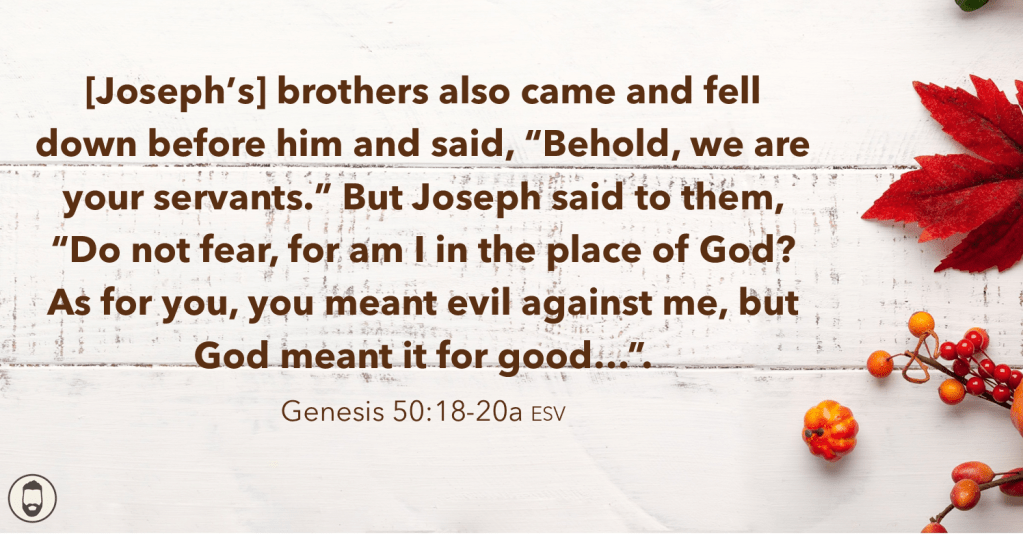
When Joseph’s brothers feared his vengeance after their father’s death, Joseph responded with mercy and a profound trust in God’s purposes. He acknowledged the evil intent behind their actions but pointed to God’s greater plan: “You meant evil against me, but God meant it for good.” What his brothers intended for harm, God used to save lives and fulfill His promises.

This truth reminds us that God is sovereign over every situation. Even when others act with malice, God can take what is meant for evil and use it to accomplish His good purposes (Romans 8:28). Joseph’s story points us to the ultimate example of this: Jesus. The cross, intended as a tool of destruction, death, and shame, was the means of salvation for all who trust in Him (Acts 2:23-24).

Today, I’m thankful for a God who is always at work, even in the most painful and unjust situations. He is faithful to bring good from what seems hopeless. How might God be using the challenges in your life to accomplish His purposes, both for your good and His glory?

Trust Him. He’s got a plan for your life (and your troubles)!


Lord, thank you for taking care of us even when others mean us harm. Thank you for the example of Your working in Joseph’s life and the reminder You gave us in Your Word of Your faithfulness. Help us to see that this is not a story of how to get blessed but a means for us to give You glory with our lives. Help us to be like Joseph and look to You in times of hardship and then respond to those who did us wrong like Joseph did — like You did on the cross when You asked the Father to forgive them. Amen.

All through the month of November, our Christ Community Church family is focusing on what we are thankful for and expressing our thanks to our “great God and Savior Jesus Christ, who gave Himself for us to redeem us” (Titus 2:13-14).

This, like the #DailyWisdomChallenge we went through in October, is a challenge from our pastor John Goldwater — the #GRATITUDEandHOPEchallenge — where we have the opportunity to post Bible passages that move us to thanksgiving or in which we find hope. May this lead you to be grateful and find your hope in Jesus!

I’m Thankful for the Father of Mercies and the God of All Comfort — Gratitude & Hope Challenge | November 20

I’m thankful for the Father of Mercies and the God of All Comfort!

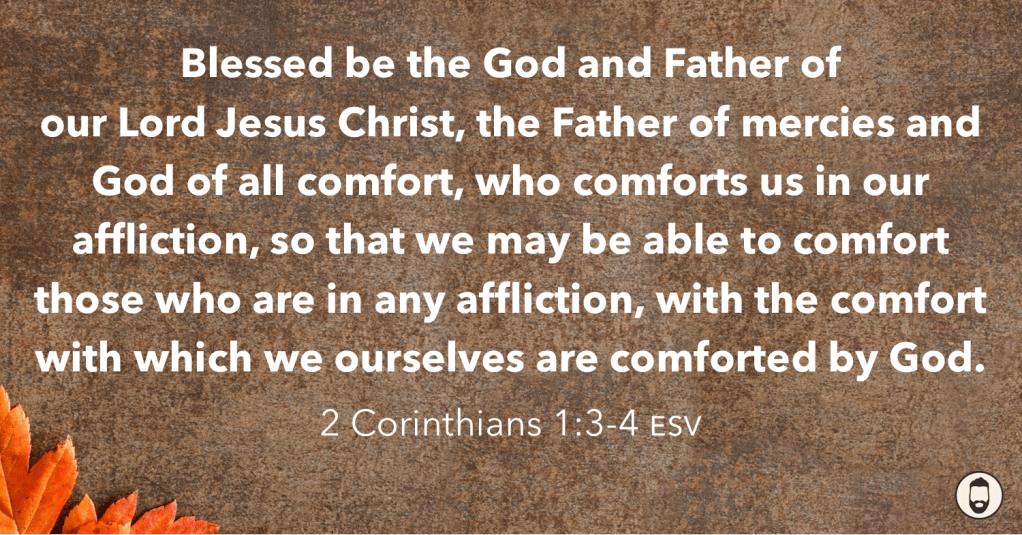
In 2 Corinthians 1:3-4, Paul invited the church at Corinth (and us today) to praise God for who He is — the source of mercy and comfort. God, in His great love, shows compassion to us in our pain and suffering. He doesn’t stand far off or push us away but instead draws near, meeting us in our affliction with His presence, peace, and sustaining grace. Whether we face sorrow or loss, trials or tribulations, we can cling to the promise that the “God of all comfort” is with us, strengthening and reminding us that we are never alone.

But God’s comfort doesn’t end with only Him comforting us. Paul emphasized here that as we receive mercy and comfort from the Lord, we are called to extend it to others. God often works through His people, the Church, to show His love and care to those in need. When we have experienced God’s mercy, we are uniquely equipped to share it with others and minister to them. Our struggles and the comfort we received become tools in His hands, allowing us to walk alongside those who are hurting, offering hope and encouragement.

As His Church, we are His hands and feet, bringing His comfort and gospel to a broken and lost world. This is a beautiful picture of God’s redemption, even in the midst of our suffering. He uses the suffering and trials we experience to shape us, sanctify us, draw us closer to Him, and equip us to serve others for His glory.

Today, I am thankful for the mercy and comfort God has shown me, and I’m challenged to share that same mercy and comfort with those around me.

How can you reflect the heart of the “Father of Mercies” in someone’s life today? Consider those around you who are hurting and mourning as we enter the holiday season. Not everyone is ready or willing to be holly and jolly because or real hurts and hangups in their lives. Think of how Jesus has brought you through your own hurts and hangups and extend His love to others in the midst of theirs.

Lord, I thank you for being the Father of mercies and God of all comfort. Thank You for never leaving me alone when all the world has and adopting me into your family. There is nothing like the comfort of a loving Father, and I thank You for allowing your people to reflect that love and comfort to others. Help us to notice those who need to be comforted by You. Amen.

All through the month of November, our Christ Community Church family is focusing on what we are thankful for and expressing our thanks to our “great God and Savior Jesus Christ, who gave Himself for us to redeem us” (Titus 2:13-14).

This, like the #DailyWisdomChallenge we went through in October, is a challenge from our pastor John Goldwater — the #GRATITUDEandHOPEchallenge — where we have the opportunity to post Bible passages that move us to thanksgiving or in which we find hope. May this lead you to be grateful and find your hope in Jesus!

I’m Thankful for Salvation in Christ Alone by Grace Alone through Faith Alone — Gratitude & Hope Challenge | November 19

I’m thankful for salvation in Christ alone by grace alone through faith alone!

What makes grace so amazing? It’s that God saves us not because of who we are or what we’ve done but because of who He is. In our sin, we are spiritually dead, unable to save ourselves. But God, rich in His mercy and overflowing with His love, makes us alive through Jesus. Salvation is not something we can earn; it is a gift of God’s grace that must be received through faith in Jesus (alone).

This means that our works, our goodness, or even our religious or church activities cannot save us. No one can ever be good enough to meet God’s perfect standard (Romans 3:10, 23) but Jesus (1 John 2:1-2). He lived the sinless life we couldn’t live, died the death we deserved on the cross, and rose again to offer us new life. When we trust in Jesus — put our faith in Him believing that He is enough and that He died and rose again, we are forgiven, made alive, and welcomed into God’s family through adoption (John 1:12, Romans 10:9-10).

Faith is not about trying harder to fix ourselves but about turning to Jesus and trusting Him fully.

Grace means that God does what we cannot do. Jesus makes the dead alive, the lost found, and the broken whole. That’s good news!

Today, if you’ve not experienced this grace, I invite you to put your faith and trust in Jesus. if you’ve already trusted in Christ, let your heart overflow with thankfulness for the gift that you did not earn but He gave freely — salvation by grace alone through faith alone in Christ alone!

This is why I’m thankful, and this is why I have hope. What about you?

All through the month of November, our Christ Community Church family is focusing on what we are thankful for and expressing our thanks to our “great God and Savior Jesus Christ, who gave Himself for us to redeem us” (Titus 2:13-14).

This, like the #DailyWisdomChallenge we went through in October, is a challenge from our pastor John Goldwater — the #GRATITUDEandHOPEchallenge — where we have the opportunity to post Bible passages that move us to thanksgiving or in which we find hope. May this lead you to be grateful and find your hope in Jesus!