Join Us as We Celebrate 27 Years at Christ Community Church — a Songs for Sunday post

Sunday’s coming, and I’m especially thankful this week.

Not only do we get to gather again as the people of God, but we also get to celebrate 27 years of God’s faithfulness to and through Christ Community Church. That’s no small thing. The local church is one of God’s greatest gifts to His people — where the gospel is proclaimed, disciples are made, and the love of Jesus is lived out in community.

I want to say how personally thankful I am that God has allowed me and my family to be a part of Christ Community. I’ve had the privilege of serving in churches for two decades, but this church has become the church home and faith family we had always hoped for. Candice, Keri, Xander, and I are genuinely grateful — not only to serve here, but to belong here. Christ Community is a gift, and we thank God for it.

That’s exactly the sentiment Paul had in Colossians 1:3-6 when he was opening his letter to the church at Colossae: sharing his gratitude for a gospel-shaped church.

Paul began in v. 3 by saying, “We always thank God, the Father of our Lord Jesus Christ, when we pray for you.” He’s not flattering them but pointing to God as the source of their growth and faithfulness. Every local church that stands firm in Christ is a reason to give thanks.

In v. 4, he reflects on what he’s heard about them: their “faith in Jesus” and the love they have “for all the saints”. These aren’t vague religious concepts. Their faith was real, anchored in Jesus. Their love was visible, expressed toward one another. This kind of gospel life is evidence of Christ working.

But where does that kind of faith and love come from? The answer is in v. 5: “because of the hope laid up for you in heaven”. Their faith and love are rooted in something eternal — not wishful thinking, but a secure hope. Their faith and love are rooted in something objective, already laid up, already theirs. That’s our shared hope, too: an imperishable inheritance kept in heaven (1 Peter 1:4), secured not by our own goodness but in Jesus’s blood and resurrection (1 Peter 1:18-21).

Then in vv. 5-6, Paul shifts the spotlight to the gospel itself, “the Word of the truth…which has come to you, as indeed in the whole world it is bearing fruit and increasing…”. You see, the gospel isn’t merely information. It’s power. Wherever it goes — when it’s understood and received by grace through faith in Jesus — it grows, it bears fruit, it transforms lives. That’s what God has done at Christ Community for 27 years, and that’s what we’re asking Him to keep on doing until Jesus returns.

When we gather Sunday, we’ll celebrate that very gospel in song. We’ll sing “Holy Water” thanking God for washing away our sin in His grace and mercy. We’ll sing “Graves Into Gardens” proclaiming the power of Jesus to bring life where there was death. We’ll sing “In Christ Alone” declaring our firm hope rooted in Jesus’s death and resurrection. We’ll sing “Thank You Jesus for the Blood” remembering the precious price He paid to redeem us.

We’ll be reminded of that gospel in our Scripture readings, as in Titus 3:4-7 where we’ll clearly see that our salvation is not in our works but Jesus’s, not in our righteousness (which we don’t have) but His mercy.

We’ll be reminded of that gospel and the Savior it proclaims as John opens up the Word of God and shows us the King of kings, unpacking the value and depth of His sacrifice for sinners like us and the salvation that comes only by grace through faith in Jesus alone.

So, let’s gather together.

Let’s gather on the Lord’s day — on Sunday — not just to mark an anniversary but to lift high the name of Jesus, the One who saved us, who brought us together as a church family, and who is still working in and through us for His glory and our good.

The gospel has borne fruit here, and we pray it continues to do so for generations to come — until Jesus comes.

Won’t you gather with us?


Here are our Scriptures and songs:

4But when the goodness and loving kindness of God our Savior appeared, 5He saved us, not because of works done by us in righteousness, but according to His own mercy, by the washing of regeneration and renewal of the Holy Spirit, 6whom He poured out on us richly through Jesus Christ our Savior, 7so that being justified by His grace we might become heirs according to the hope of eternal life.

18…knowing that you were ransomed from the futile ways inherited from your forefathers, not with perishable things such as silver or gold, 19but with the precious blood of Christ, like that of a lamb without blemish or spot. 20He was foreknown before the foundation of the world but was made manifest in the last times for the sake of you 21who through Him are believers in God, who raised Him from the dead and gave him glory, so that your faith and hope are in God.


Songs for Sunday, August 17, 2025 @ Christ Community Church

Sunday’s coming, and I’m excited!

Every week at Christ Community Church, we gather and lift our voices in worship of Jesus by reading Scripture together and singing to and about Him. The Scriptures we are reading this week remind us of who God is and what He has done. Psalm 103:8-13 is one of the most beautiful descriptions of the LORD’s mercy in the Bible, and when we look at it alongside the picture of redemption that is found in Christ in Colossians 1:13-14, it calls us to worship Him with grateful hearts.

Take a second and look at these passages and catch a glimpse of our great God and Savior Jesus Christ:
Psalm 103:8“The LORD is merciful and gracious, slow to anger and abounding in steadfast love.” This echoes how God introduced Himself in Exodus 34:6, the foundational confession of His character. He is not quick to flare up in wrath but abounds in His deep covenant love for His people.
Psalm 103:9“He will not always chide, nor will He keep His anger forever.” Like Psalm 30:5 and Micah 7:18, this shows that while God’s anger against sin is real, His mercy outlasts His anger for those who belong to Him. His justice is perfect but not greater than His grace.
Psalm 103:10“He does not deal with us according to our sins, nor repay us according to our iniquities.” If God gave us exactly what our sin deserved, none could stand (Ezra 9:13, Romans 6:23), but He shows mercy in judgment, forgiving sin, iniquity, and transgressions just as He promised in Exodus 34:7.
Psalm 103:11“For as high as the heavens are above the earth, so great is His steadfast love toward those who fear Him….” The psalmist piles up comparisons here to show the depth and height of God’s kindness, as abundantly immeasurable as the heavens, decisively removing our sin, and enduring like a father’s compassion toward his children. God’s love is higher than we can measure and deeper than we can comprehend (Psalm 36:5).
Psalm 103:12“…as far as the east is from the west, so far does He remove our transgressions from us.” East and west never meet. That’s how completely God forgives in Christ — our sins are gone, removed to never return (Micah 7:18-20, 2 Corinthians 5:21).
Psalm 103:13“As a father shows compassion to His children, so the LORD shows compassion to those who fear Him.” Unlike the gods of the nations who are apathetic and hostile, the LORD relates to His people as a true Father — compassionate, tender, and faithful. Jesus Himself taught us that we can approach God in this way (Matthew 6:9, Mark 14:36).

And how has this mercy been most clearly revealed to us? In Jesus!
Colossians 1:13-14He has delivered us from the domain of darkness and transferred us to the Kingdom of His beloved Son, in whom we have redemption, the forgiveness of sins. — Just as God rescued Israel from Egypt (Exodus 6:6, 14:30), He has rescued us from a greater slavery: the domain of darkness, the power of Satan and sin (Acts 26:18, Ephesians 5:8). Through JESUS, we have been drawn out of the shadows and placed into the Kingdom of His beloved Son. That’s redemption — the ransom paid through His blood, freeing us from bondage to sin and granting us forgiveness once and for all (Ephesians 1:7, 1 Peter 1:18-19).

This is the gospel. The mercy described in Psalm 103 is fulfilled in Jesus. Our sin is removed. Our debt is cancelled. And we are safely in Him.

That’s why tomorrow we can lift our voices and read these Scriptures. It’s why we can lift our voices to our holy, holy, holy God and sing that His mercy is more and we have hope in Christ alone. Every verse and lyric will remind us of who God is and what He has done for us in Jesus. Every verse preached will point us to Him and give opportunity to see Him more clearly.

So come on out and gather with us tomorrow. Come with gratitude, come with hope, come ready to worship the God who shows compassion like a Father and saves by the blood of His Son.

Won’t you gather with us?


Here are our Scriptures and songs:

8The LORD is merciful and gracious, slow to anger and abounding in steadfast love. He will not always chide, nor will He keep His anger forever. 10He does not deal with us according to our sins, nor repay us according to our iniquities. 11For as high as the heavens are above the earth, so great is His steadfast love toward those who fear Him; 12as far as the east is from the west, so far does He remove our transgressions from us. 13As a father shows compassion to his children, so the LORD shows compassion to those who fear Him.

13 He has delivered us from the domain of darkness and transferred us to the kingdom of his beloved Son, 14 in whom we have redemption, the forgiveness of sins.


#RomansChallenge | July 31 – 16:17-27

Click here for Romans 16:17-27 audio:


Read it. Pray it. Share it. Live it.

As Paul closes his letter, he gives a sobering warning to watch out for those who cause division and promote teachings that go against sound doctrine (v. 17). These individuals, driven by selfish appetites, use smooth talk and flattery to deceive the naive (v. 18). But Paul urges the church to be wise in what is good and innocent in what is evil, confident that God will soon crush Satan under their feet (vv. 19–20; cf. Gen. 3:15).

A brief set of greetings from Paul’s companions (vv. 21–23), including Timothy and Tertius (Paul’s scribe), reminds us that Paul ministered within a community of believers. Finally, Paul ends with a beautiful doxology, praising the God who strengthens His people through the gospel, the mystery once hidden but now revealed to the nations through Scripture to bring about the obedience of faith (vv. 25–26). All glory belongs to the only wise God, forever through Jesus Christ (v. 27).

🎯 Theme: Be alert to division and deception, cling to the gospel, and glorify the God who saves through Christ.

🌀 Reflection: The gospel that began with God’s promise in Genesis ends here with a shout of praise. Are your eyes open to falsehood, and is your heart anchored in the glory of Christ?

💬 Mission Challenge: Ask God to show you someone who may be spiritually naive or wavering, and gently guide them back to the truth of the gospel (v. 18; Gal. 6:1). Boldly declare Romans 16:27 in your own words to someone today.

#RomansChallenge | July 30 – 16:1-16

Click here for Romans 16:1-16 audio:


Read it. Pray it. Share it. Live it.

Paul ends his letter by commending and greeting a diverse group of believers who have labored faithfully for the gospel. He introduces Phoebe, a servant of the church and a generous supporter of many, likely the one delivering this letter (vv. 1–2). He honors Priscilla and Aquila, who risked their lives for him, and acknowledges house churches, early converts like Epaenetus, hard workers like Mary and Persis, and fellow prisoners Andronicus and Junia, who were in Christ before Paul (vv. 3–13).

Many names reflect a wide range of backgrounds—men and women, Jews and Gentiles, slaves and free—showcasing the unity of the church in Christ. Paul’s repeated affirmations (“beloved,” “fellow worker,” “approved in Christ”) highlight how gospel faithfulness is measured not by status but by service (vv. 8–12). He ends with a call to greet one another with a holy kiss and reminds them of the love of the wider church (vv. 16).🎯 Theme: Christian fellowship crosses every barrier—social, ethnic, and geographic. Gospel relationships are not merely friendships but partnerships in the mission of Christ.

🎯 Theme: Christian fellowship crosses every barrier—social, ethnic, and geographic. Gospel relationships are not merely friendships but partnerships in the mission of Christ.

🌀 Reflection: How are you investing in gospel friendships? Who in your life could you thank or encourage today for their partnership in the Lord?

💬 Mission Challenge: Choose one person from your church or community who has been faithfully serving behind the scenes. Write them a note of thanks for their service in Christ—and include a gospel tract or invite them to join you in reaching others with the good news.

#RomansChallenge | July 29 – 15:14-33

Click here for Romans 15:14-33 audio:


Read it. Pray it. Share it. Live it.

Paul closes the main body of his letter by affirming the Roman believers’ spiritual maturity—commending their goodness, knowledge, and ability to instruct one another (v. 14). Still, he reminds them boldly of their shared calling, especially his own unique role as a minister to the Gentiles (vv. 15–16). Describing his ministry in priestly terms, Paul presents the Gentiles as an offering made holy by the Spirit (v. 16). He boasts only in what Christ has accomplished through him—by word, deed, miraculous signs, and the Spirit’s power—as he preached from Jerusalem all the way to Illyricum (vv. 18–19).

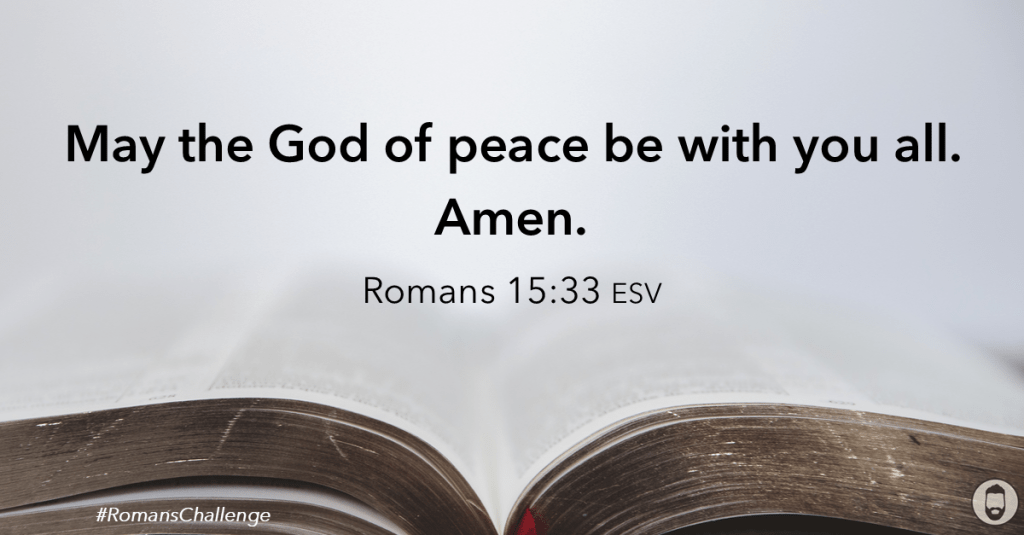
Paul’s aim has always been to preach the gospel where Christ is not yet known (v. 20; cf. Isa. 52:15), which explains why he had not yet visited Rome (v. 22). Now, with his work in the east complete, he hopes to visit them on his way to Spain (vv. 23–24, 28). But first, he must carry a financial gift from the Gentile churches in Macedonia and Achaia to the poor believers in Jerusalem—an offering of unity and gratitude (vv. 25–27). Paul asks for prayer: for protection from hostile unbelievers, for the offering to be received well, and for the joy of finally visiting the Romans in the blessing of Christ (vv. 30–32). He ends with a word of peace (v. 33).

🎯 Theme: Gospel ministry requires partnership, boldness, and sacrifice—and the unity of believers across cultural and geographic lines is part of God’s plan for His glory.

🌀 Reflection: How might God use your life as an offering for His glory—set apart and sanctified for gospel purposes? What are you holding back that might be used for His mission?

💬 Mission Challenge: Identify a missionary or church planter who is actively reaching unreached people. This week, write them a note of encouragement, pray fervently for their work, and consider giving to support the advance of the gospel.

#RomansChallenge | July 28 – 15:1-13

Click here for Romans 15:1-13 audio:


Read it. Pray it. Share it. Live it.

Paul calls on the “strong” to bear with the “weak” (v. 1), urging believers to imitate Christ, who did not please Himself but bore our reproach for the glory of God (v. 3). Rather than demanding our own way, we are called to build up others (v. 2), to live in harmony (v. 5), and to welcome one another as Christ welcomed us (v. 7). The Scriptures were given to instruct us, and through them God brings endurance, encouragement, and hope (v. 4).

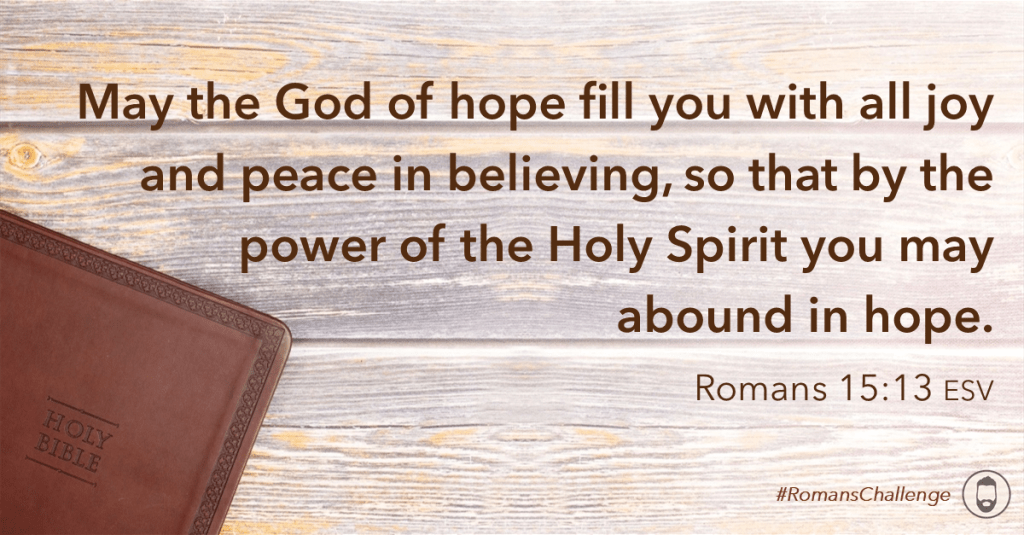
Christ came as a servant to the Jews to fulfill God’s promises and to bring salvation to the Gentiles, so that all people might glorify God (vv. 8–9). Paul strings together Old Testament passages (vv. 9–12) showing that this inclusion was always God’s plan. He ends with a prayer: that the God of hope would fill believers with joy, peace, and overflowing hope by the power of the Holy Spirit (v. 13).

🎯 Theme: Christ’s example calls us to selfless unity, mutual encouragement, and a shared hope in God.

🌀 Reflection: If Jesus bore reproach for us and welcomed us into God’s family, how can we withhold love or unity from fellow believers? True Christian strength shows itself in humility and a desire to build others up.

💬 Mission Challenge: Reach out this week to someone outside your cultural, racial, or generational circle—share a meal, a prayer, or your testimony—and demonstrate the unifying hope of the gospel.

#RomansChallenge | July 27 – 14:14-23

Click here for Romans 14:14-23 audio:


Read it. Pray it. Share it. Live it.

Paul affirms that nothing is unclean in itself (v. 14), but warns that if someone believes it to be unclean, they must not violate their conscience. Love is the greater priority, and if exercising your freedom in Christ causes distress or spiritual harm to another believer, you are no longer walking in love (v. 15). God’s kingdom is not about food and drink, but righteousness, peace, and joy in the Holy Spirit (v. 17).

We should aim for peace and mutual upbuilding rather than insisting on our own rights (v. 19). Though all things may be clean, it is wrong to cause someone else to stumble (v. 20). Whatever does not proceed from faith is sin (v. 23)—so we are called to walk in love, governed not only by truth, but by the spiritual good of others.

🎯 Theme: Love limits liberty—Christians must not use their freedom in ways that harm the faith of others or dishonor the gospel.

🌀 Reflection: We live in a world obsessed with personal rights, but Christ calls us to prioritize the spiritual health of others over our preferences. Real love lays down liberty for the sake of a brother or sister in Christ (vv. 15, 20).

💬 Mission Challenge: Consider someone in your life who may be struggling in their faith. Look for a way this week to build them up with grace and encouragement (v. 19), even if it means giving up a freedom you enjoy to help them grow in Christ.

#RomansChallenge | July 26 – 14:1-13

Click here for Romans 14:1-13 audio:


Read it. Pray it. Share it. Live it.

In the church at Rome, some believers were struggling over matters of conscience—like whether it was okay to eat certain foods or observe special days (vv. 2, 5). Paul calls those with stronger faith to welcome those who are weak in faith—not to argue over opinions (v. 1), but to walk in love. Whether someone eats or abstains, honors a special day or sees all days alike, what matters is that they do it in honor of the Lord and give thanks to God (v. 6).

We belong to Jesus in life and in death (v. 8), and each of us will give an account to God (vv. 10–12). That truth humbles us. Instead of judging each other, we’re called to stop putting stumbling blocks in the way of others (v. 13). Our unity in Christ matters more than our personal preferences or freedoms.

🎯 Theme: Believers must welcome one another in love, avoiding judgment and division over disputable matters of conscience.

🌀 Reflection: In a world that loves to argue and divide, the church is called to a higher standard—grace. Are your convictions anchored in honoring Christ, or are they a source of pride and judgment toward others? Love makes room for differences when Christ is the goal.

💬 Mission Challenge: This week, reach out to a believer whose practices or preferences differ from yours. Ask questions, listen with humility, and look for a way to honor Christ together—especially in front of a watching world (vv. 1, 3, 6, 13).

#RomansChallenge | July 25 – 13:1-14

Click here for Romans 13:1-14 audio:


Read it. Pray it. Share it. Live it.

Paul reminds believers that God is ultimately in control—even over earthly governments. Christians are called to be subject to the governing authorities, because every authority is instituted by God (v. 1). To resist lawful authority is to resist God’s design, inviting judgment (v. 2). Government, when functioning rightly, serves to restrain evil and promote good (vv. 3–4). That’s why believers are to pay taxes and give honor and respect where it is due (vv. 6–7).

But Paul doesn’t stop with civil responsibility—he moves to our spiritual debt: love (v. 8). Loving others fulfills the law because it keeps us from doing wrong to our neighbors (vv. 9–10). And since the day is at hand and our salvation is nearer now than ever (v. 11), we must cast off the works of darkness and put on the armor of light (v. 12). That means walking in holiness (v. 13) and clothing ourselves with the character of Christ, making no provision for sinful desires (v. 14).

🎯 Theme: God calls us to honor authority, love others, and live in the light of Christ’s return.

🌀 Reflection: Are you awake to the time you’re living in? With eternity drawing near, our lives should be marked by obedience, love, and holiness. Putting on Christ daily changes how we think, act, and engage the world.

💬 Mission Challenge: Reach out to someone who holds a different viewpoint—politically, culturally, or spiritually—and show them honor, not hostility. Let your love be genuine, and pray for an open door to share the hope you have in Christ (vv. 7–10, 14).

.

#RomansChallenge | July 24 – 12:9-21

Click here for Romans 12:9-21 audio:


Read it. Pray it. Share it. Live it.

Paul offers a rapid-fire list of what love looks like when it is genuine and rooted in Christ. He calls believers to abhor what is evil and hold fast to what is good (v. 9), to love one another with brotherly affection and outdo one another in showing honor (v. 10), and to serve the Lord with zeal and spiritual fervor (v. 11). Genuine love rejoices in hope, remains patient in tribulation, and perseveres in prayer (v. 12). It shares with the saints and extends hospitality (v. 13), blesses those who persecute us (v. 14), and walks in empathy and humility (vv. 15–16). Rather than seeking revenge or responding with evil, believers are called to live peaceably with all (v. 18), to leave vengeance to God (v. 19), and to overcome evil with good—even feeding our enemies if they are hungry (vv. 20–21).

🎯 Theme: Real love reflects Jesus in both devotion to others and kindness toward enemies.

🌀 Reflection: God’s mercy calls us not just to feel love, but to live it boldly and sincerely—even when it’s difficult. When we respond to hatred with kindness, we put the gospel on display.

💬 Mission Challenge: Intentionally bless someone who has wronged you or someone you find difficult to love—pray for them, serve them, or share the gospel with them as an act of overcoming evil with good (vv. 14, 20–21).

.