Songs for Sunday, January 7, 2024 @ Christ Community Church

This Sunday is the first Lord’s day of 2024, and guess what: Jesus is still alive! More importantly, it serves as a reminder of why we call Sunday the Lord’s Day and why we gather: He is risen as He said.

Look at Matthew 28:1-7:

Now after the Sabbath, toward the dawn of the first day of the week, Mary Magdalene and the other Mary went to see the tomb. And behold, there was a great earthquake, for an angel of the Lord descended from heaven and came and rolled back the stone and sat on it. His appearance was like lightning, and his clothing white as snow. And for fear of him the guards trembled and became like dead men. But the angel said to the women, “Do not be afraid, for I know that you seek Jesus who was crucified. He is not here, for he has risen, as he said. Come, see the place where he lay. Then go quickly and tell his disciples that he has risen from the dead, and behold, he is going before you to Galilee; there you will see him. See, I have told you.”

You might be surprised how many times I have been asked and continually get asked about what the deal is with the sabbath and why we gather on Sunday instead of Saturday (which is the sabbath day). A lot of times, people have them confused.

The Sabbath day was commanded in the OT to be observed as a “day of solemn rest, a Sabbath to the LORD” (Exodus 16:23). It recognized the rest that God Himself took on the 7th day of the Creation week (Genesis 2:1-3). Once Jesus came and fulfilled the requirements of the Law (Matthew 5:17-19, Galatians 4:4), He did something that no human being could ever do: fully obey and keep the Law. He was perfect and sinless — the opposite of all humankind. The Law, however, was never meant to save us. God revealed His righteous standard through the Law and pointed to our need for a Savior. Then, in Christ, He became flesh and made a Way for us to be made righteous — by grace through faith in Christ (John 1:14, John 14:6, 2 Corinthians 5:21, Ephesians 2:4-9). Now, that Christ has come those things that were meant to point people to Him, those “shadows” pointing to Christ, the “substance”, we are not to be judged on our keeping of the Law or even the Sabbath but on faith in Christ alone (Colossians 2:16-17). Resting in God’s work and faithfulness was, after all, the point of the Sabbath; we can rest in the finished work of Jesus, knowing full well that His work is and will be completely finished (John 19:30, Revelation 21:6)!

Now, that is a very streamlined explanation, but it gets right to the point of the Lord’s Day: it’s all substance and no shadow. It is not a place holder of a thing but the thing itself. It is not merely pointing to Jesus the Messiah’s coming; it is pointing to the fact that He has come, showing that “He who promised is faithful” (Hebrews 10:23). He is risen. He is risen as He said.

So, let’s get a good focus on the Lord’s Day and remember what He has done for us — on the cross, of course, but especially through the empty tomb. Our worship hinges on the tomb being borrowed. Our faith is founded on the Savior who defeated death, hell, and the grave. Our Savior is alive and well! And since He is alive and well, our worship is important because we don’t worship an idol or a figure but a real-life living Savior. He sees and knows and receives our worship.

And, Lord willing, that is our plan this Lord’s Day. We are going to make much of Jesus. We are going to worship Him by singing about/to Him, reading from His Word, and proclaiming His gospel. Our hope is in Him saving us, and we look forward to Him saving others. We hope to point ourselves and others to Him alone!

More than that, we gather in anticipation of His return. And He is coming — just as He said (Revelation 22:7, 12, 20)!

Won’t you gather with us?


Here are our Scriptures and songs:

  • Scripture | 1 Corinthians 15:1-5

Now I would remind you, brothers, of the gospel I preached to you, which you received, in which you stand, and by which you are being saved, if you hold fast to the word I preached to you—unless you believed in vain.

For I delivered to you as of first importance what I also received: that Christ died for our sins in accordance with the Scriptures, that he was buried, that he was raised on the third day in accordance with the Scriptures, and that he appeared to Cephas, then to the twelve.


  • Scripture | 1 Corinthians 15:12-22

12 Now if Christ is proclaimed as raised from the dead, how can some of you say that there is no resurrection of the dead? 13 But if there is no resurrection of the dead, then not even Christ has been raised. 14 And if Christ has not been raised, then our preaching is in vain and your faith is in vain. 15 We are even found to be misrepresenting God, because we testified about God that he raised Christ, whom he did not raise if it is true that the dead are not raised. 16 For if the dead are not raised, not even Christ has been raised. 17 And if Christ has not been raised, your faith is futile and you are still in your sins. 18 Then those also who have fallen asleep in Christ have perished. 19 If in Christ we have hope in this life only, we are of all people most to be pitied.

20 But in fact Christ has been raised from the dead, the firstfruits of those who have fallen asleep. 21 For as by a man came death, by a man has come also the resurrection of the dead. 22 For as in Adam all die, so also in Christ shall all be made alive.


"Before the Throne of God Above" from Revelation 4 (The KING is Coming) Refresh & Restore | A JustKeithHarris.com Podcast

📖 Revelation 4:1–11In this episode of The King is Coming, Keith Harris and Jamie Harrison move beyond Jesus’s letters to the churches and into the next part of John’s vision. In Revelation 4, John is invited through an open door into heaven—and what he sees is the throne room of God.At the center of everything is a throne, and seated on it is the Lord in all His glory. From this point forward in Revelation, the throne becomes the focal point of the entire book.John describes the scene the best way he can: the brilliance of precious stones, a rainbow surrounding the throne, flashes of lightning and thunder, and a crystal-like sea before it. Surrounding the throne are twenty-four elders and four living creatures who never cease to worship the Lord.Together, Keith and Jamie discuss:✔️ Why Revelation 4 marks a shift from the letters to the churches to John’s heavenly vision✔️ What the throne room reveals about God’s authority and security over all things✔️ Why John uses comparisons (“like” and “as”) to describe the glory he sees✔️ The mystery of the twenty-four elders and what we can—and cannot—know✔️ The constant worship of the living creatures crying “Holy, holy, holy”✔️ Why heaven’s worship centers on God simply because He is worthyIn the throne room, everything points to one truth: God alone is worthy of worship.“Worthy are you, our Lord and God, to receive glory and honor and power, for you created all things, and by your will they existed and were created.” (Revelation 4:11)🔗 If you would like to see a written version of this podcast, complete with footnotes and cross-references, you can find it here.
  1. "Before the Throne of God Above" from Revelation 4 (The KING is Coming)
  2. " Lukewarm Yet Not Without Hope: Jesus’s Letter to the Church at Laodicea" (The KING is Coming)
  3. "Kept Through the Trial: Jesus's Letter to the Church at Philadelphia" (The KING is Coming)
  4. Christ Has Come: The Promised King & His Gift of Love" (Advent 2025)
  5. Christ Has Come: The Promised King & His Gift of Peace (Advent 2025)

Songs for Sunday, December 31, 2023 @ Christ Community Church

2023, Lord willing, is coming to a close.

For some, this will be good news as 2023 has been anything but a banner year for them. Yet, for others, the close of the year may be a time of celebration because 2023 was the year for them — the year for good memories or accomplishments.

But if you have lived a few years, you likely realize that change is not as simple as the flip of a calendar’s page — that new beginnings are rarer and harder to come by than a clock ticking or a ball dropping. New beginnings can be hard and scary. They can require a lot of difficulty and risk. Moving from a good year to all the potential of a less-than-good year can produce anxiety. Placing all of your hope on a calendar and clock ending times of trouble can too. But things are different with Jesus!

I love the center of the book of Lamentations. Read that again: the center, not the whole book. Lamentations literally means cries of mourning. The book of the Bible is formed out of five poems of mourning, five eulogies marking the fall of Jerusalem. At the center, though, is hope.

The part of Lamentations 3 we will be reading in worship tomorrow is a good picture of the realities of this fallen world and the hope that comes only from Jesus. It would do us well to pay attention to this.

The first part of Lamentations 3 is terrible and, at the very least, terrifying. One of the things that is perhaps the scariest is the continual recognition that the Lord has allowed the trouble to be faced by His people. The writer says that he has “seen affliction” that came from “the rod” of God’s wrath (Lamentations 3:1). He recognizes that the trouble besetting Jerusalem stemmed from their own sinfulness. Their sins and unfaitfulness have brought on times of “bitterness and tribulation” (Lamentations 3:5). And in the midst of that self-wrought turmoil, it feels as though his cries for help and prayers have been shut out (Lamentations 3:7).

Depending on your life experience, this will either seem familiar or foreign. But if you have experienced pain and loss — especially if it follows your own unbelief or disobedience or sin, these feelings may feel all too familiar. Maybe you can empathize with the writer of these laments rather than merely sympathizing. Maybe you can say, “I’ve been there, brother.” You might even be there now. You know what it is to feel like your dinner has been gravel, your refuge ashes, your soul filled with fear rather than peace (Lamentations 3:16-17). The writer of Lamentations says his “endurance has perished” meaning he cannot go on anymore, and he feels as if his hope in the Lord has perished with his desire to continue (Lamentations 3:18). BUT he calls something to his mind that sparks that hope anew.

This is important, so don’t miss it.

He doesn’t call to mind that he really can endure or that he has inner strength and peace that he forgot about. He doesn’t remind himself that he can merely speak good into existence and it will be there. He doesn’t try to put positive vibes out into the universe. No, when you have gotten as low as he was all of those foolish notions perish first. He had exhausted all of his possibilities for helping himself, for digging himself out of the hole of his despair.

He reminds himself that God’s steadfast love — God’s never-ending, never-failing, never-giving-up love — will, well, remain steadfast and never stop; neither will His mercies (Lamentations 3:22). God’s love is not based on our faithfulness, so it does not stop because we have been unfaithful. His love and mercy and grace are all based on Him and His faithfulness (Lamentations 3:23)! They can be “new every morning” because His love and opportunities to repent and turn from our sin and despair to Him are as plentiful as there are days. That’s good news — as long as there are days!

The hope of the writer of Lamentations in his mourning is the same hope for us. The Lord is our “portion” means that He is our only inheritance — that when we die, we look forward to being with Him — that if all the things that are producing lament within us finally whoop us down, He is there — that finding the Rock of ages when we hit rock bottom produces “hope” rather than lament (Lamentations 3:24).

I am reminded here of the classic movie It’s a Wonderful Life. If you are unfamiliar with it, I am sure it will be playing somewhere all New Years Eve and Day on more than a few television channels. It follows the, well, wonderful life of George Bailey, a good man whose every single choice in life leads to the good of others and some sense of missing out for himself. His good deeds take away the hearing in one of his ears which causes him to miss out on getting to go and be a hero in WWII. He steps in to rescue the family business (which in turn rescues the majority of his home town from abject poverty at the hands of the wicked and greedy Mr. Potter) and misses out on untold riches and adventure. His kindness to his buffoon uncle inevitably risks it all and produces such a terrible situation that he stands to lose everything and end up in prison because of a mistake he did not commit nor deserve to pay for. He found himself drunk and feeling as if the only hope he had to offer his family was by death at his own hand. That is until an angel (don’t get your theology of angels or any sort of theology from this or any movie) is sent to show him what the lives of those around him would have been like (sad, devoid of hope or good things) if he had never been born, leading him to realize that he really did have a wonderful life — a life worth continuing, a life worth living.

What offers us that kind of hope in the midst of turmoil? What can show us that life is a gift and indeed wonderful in the midst of despair and fear? Well, the same thing that the author of Lamentations had and wants to show us. The Lord is our portion. His love is steadfast when everything in this fallen world shows us just how fleeting it is. His mercies are new when the old terror is choking us out. When we find ourselves at the end of our rope, we find the hand of mighty God outstretched to lift us up because He cares for us (1 Peter 5:6-7).

The Lord is “good to those who wait for Him, to the soul who seeks Him” (Lamentations 3:25), so might I suggest that rather than looking for hope in the turn of a calendar’s page, you turn to Him? He is good and takes care of His own despite all the troubles that we, through our sin, or this fallen world have to offer (Nahum 1:7). That’s a hope worth having!

And tomorrow that’s what we are singing about! That’s who we are singing TO and singing about. We are singing about, worshiping, and generally making much of Jesus! He is worthy. He is God. And He is good!

Won’t you join us?


Here are our Scriptures & songs:

  • Scripture | Lamentations 3:16-25

16 He has made my teeth grind on gravel, and made me cower in ashes; 17 my soul is bereft of peace; I have forgotten what happiness is; 18 so I say, “My endurance has perished; so has my hope from the Lord.”

19 Remember my affliction and my wanderings, the wormwood and the gall! 20 My soul continually remembers it and is bowed down within me. 21 But this I call to mind, and therefore I have hope:

22 The steadfast love of the Lord never ceases; His mercies never come to an end; 23 they are new every morning; great is Your faithfulness. 24 “The Lord is my portion,” says my soul, “therefore I will hope in Him.”

25 The Lord is good to those who wait for Him, to the soul who seeks Him.


  • Scripture | Philippians 2:5-11

Have this mind among yourselves, which is yours in Christ Jesus, who, though He was in the form of God, did not count equality with God a thing to be grasped, but emptied Himself, by taking the form of a servant, being born in the likeness of men. And being found in human form, He humbled Himself by becoming obedient to the point of death, even death on a cross. Therefore God has highly exalted Him and bestowed on Him the name that is above every name, 10 so that at the name of Jesus every knee should bow, in heaven and on earth and under the earth, 11 and every tongue confess that Jesus Christ is Lord, to the glory of God the Father.


"Before the Throne of God Above" from Revelation 4 (The KING is Coming) Refresh & Restore | A JustKeithHarris.com Podcast

📖 Revelation 4:1–11In this episode of The King is Coming, Keith Harris and Jamie Harrison move beyond Jesus’s letters to the churches and into the next part of John’s vision. In Revelation 4, John is invited through an open door into heaven—and what he sees is the throne room of God.At the center of everything is a throne, and seated on it is the Lord in all His glory. From this point forward in Revelation, the throne becomes the focal point of the entire book.John describes the scene the best way he can: the brilliance of precious stones, a rainbow surrounding the throne, flashes of lightning and thunder, and a crystal-like sea before it. Surrounding the throne are twenty-four elders and four living creatures who never cease to worship the Lord.Together, Keith and Jamie discuss:✔️ Why Revelation 4 marks a shift from the letters to the churches to John’s heavenly vision✔️ What the throne room reveals about God’s authority and security over all things✔️ Why John uses comparisons (“like” and “as”) to describe the glory he sees✔️ The mystery of the twenty-four elders and what we can—and cannot—know✔️ The constant worship of the living creatures crying “Holy, holy, holy”✔️ Why heaven’s worship centers on God simply because He is worthyIn the throne room, everything points to one truth: God alone is worthy of worship.“Worthy are you, our Lord and God, to receive glory and honor and power, for you created all things, and by your will they existed and were created.” (Revelation 4:11)🔗 If you would like to see a written version of this podcast, complete with footnotes and cross-references, you can find it here.
  1. "Before the Throne of God Above" from Revelation 4 (The KING is Coming)
  2. " Lukewarm Yet Not Without Hope: Jesus’s Letter to the Church at Laodicea" (The KING is Coming)
  3. "Kept Through the Trial: Jesus's Letter to the Church at Philadelphia" (The KING is Coming)
  4. Christ Has Come: The Promised King & His Gift of Love" (Advent 2025)
  5. Christ Has Come: The Promised King & His Gift of Peace (Advent 2025)

The Light of the World is Here! — a Christmas Reading from our Family to Yours

“The Light of the World is Here!”

For our Christmas Day reading, we wanted to look at the incarnation – the arrival of God in flesh, Emmanuel – through the eyes of a child. There is something wondrous that is lost as we grow older and become more and more jaded. Faith is easy for children because they are full of hope. Sometimes, we try and explain why hope is so hard to come by as adults, but, just as Paul reminds us in Romans 5, our God produces hope out of suffering “and hope does not put us to shame, because God’s love has been poured out into our hearts through the Holy Spirit who has been given to us” (Romans 5:5).

What better reminder could we have at Christmas than the hope that comes only from Jesus? Throughout our readings we have mentioned that Jesus is and is more than the reason for the season. We want you to see Him as the Bible presents Him. We do not want you to see a commercialized or sanitized Jesus. We want you to see God setting His affection on His people, laying aside His glory, and coming to Earth to seek and save them (Luke 19:10). We want you to see that there in the tumbledown stable in the manger is God – a God who loved us so much that He paid the price for our sin when He died on the cross, a God who loved us enough that even death could not keep Him from living for us. That’s good news!

Today’s reading is good for you whether you have children or not. Look in wonder and worship as you see the Christmas Story laid out simply. But, if you have children or grandchildren, consider how you can weave these readings into your Christmas tradition. It is split into two sections, so it can be read all at once or divided to be used twice throughout the day so as to keep Jesus central at His birthday celebration.

“He’s Here!”

Everything was ready. The moment God had been waiting for was here at last! God was coming to help His people, just as He promised in the beginning.

But how would He come? What would He be like? What would He do?

Mountains would have bowed down. Seas would have roared. Trees would have clapped their hands. But the earth held its breath. As silent as snow falling, He came in. And when no one was looking, in the darkness, He came.

There was a young girl who was engaged to a man named Joseph. (Joseph was the great-great-great-great-great grandson of King David.)

One morning, this girl was minding her own business when, suddenly, a great warrior of light appeared – right there, in her bedroom. He was Gabriel and he was an angel, a special messenger from heaven.

When she saw the tall shining man standing there, Mary was frightened.

“You don’t need to be scared,” Gabriel said. “God is very happy with you!”

Mary looked around to see if perhaps he was talking to someone else.

“Mary,” Gabriel said, and he laughed with such gladness that Mary’s eyes filled with sudden tears.

“Mary, you’re going to have a baby. A little boy. You will call Him Jesus. He is God’s own Son. He’s the One! He’s the Rescuer!”

The God who flung planets into space and kept them whirling around and around, the God who made the universe with just a word, the One who could do anything at all – was making Himself small. And coming down…as a baby.

Wait. God was sending a baby to rescue the world?

“But it’s too wonderful!” Mary said and felt her heart beating hard. “How can it be true?”

“Is anything too wonderful for God?” Gabriel asked.

So Mary trusted God more than what her eyes could see. And she believed. “I am God’s servant,” she said. “Whatever God says, I will do.”

Sure enough, it was just as the angel had said. Nine months later, Mary was almost ready to have her baby.

Now, Mary and Joseph had to take a trip to Bethlehem, the town King David was from. But when they reached the little town, they found every room was full. Every bed was taken.

“Go away!” the innkeepers told them. “There isn’t any place for you.”

Where would they stay? Soon Mary’s baby would come.

They couldn’t find anywhere except an old, tumbledown stable. So they stayed where the cows and the donkeys and the horses stayed.

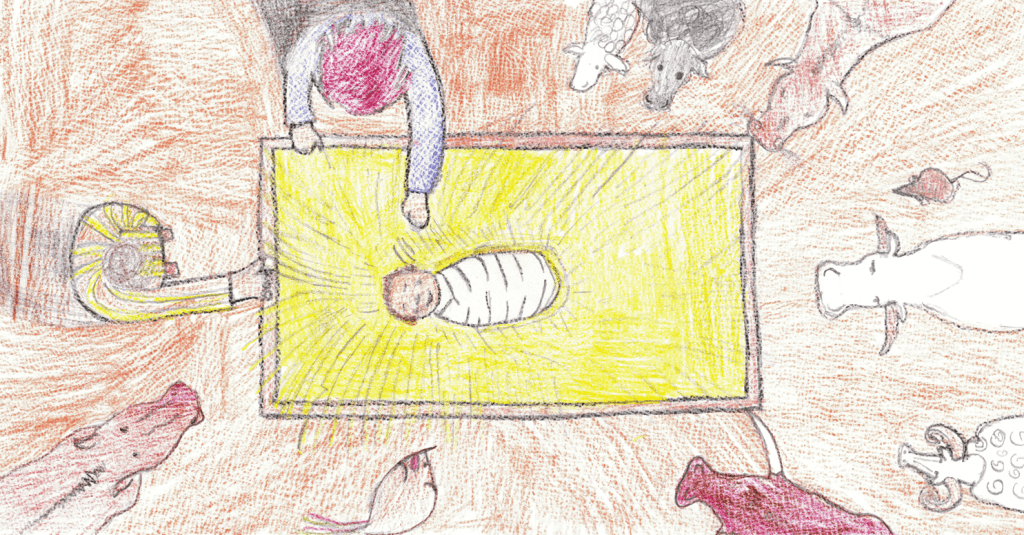
And there, in a stable, amongst the chickens and the donkeys and the cows, in the quiet of the night, God gave the world His wonderful gift. The baby that would change the world was born. His baby Son.

Mary and Joseph wrapped Him up to keep Him warm. They made a soft bed of straw and used the animals’ feeding trough as His cradle. And they gazed in wonder at God’s Great Gift, wrapped in swaddling clothes, and lying in a manger.

Mary and Joseph named Him Jesus, “Emmanuel” – which means “God has come to live with us.”

Because, of course, He had.

“The Light of the Whole World”

That same night, in amongst the other stars, suddenly a bright new star appeared. Of all the stars in the dark vaulted heavens, this one shone clearer. It blazed in the night and made the other stars look pale beside it.

God put it there when His baby Son was born – to be like a spotlight. Shining on Him. Lighting up the darkness. Showing people the way to Him.

You see, God was like a new daddy – He couldn’t keep the good news to Himself. He’d been waiting all these long years for this moment, and now He wanted to tell everyone.

So He pulled out all the stops. Hed’ sent an angel to tell Mary the good news. He’d put a special star in the sky to show where His boy was. And now He was going to send a big choir of angels to sing His happy song to the world: He’s here! He’s come! Go and see Him. My Son!

Now where would you send your splendid choir? To a big concert hall maybe? Or a palace perhaps? God sent His to a little hillside, outside a little town, in the middle of the night. He sent all those angels to sing for a raggedy old bunch of shepherds watching their sheep outside Bethlehem.

In those days, remember, people used to laugh at shepherds and say they were smelly and call them other rude names (which I can’t possibly mention here). You see, people thought shepherds were nobodies, just scruffy old riff-raff.

But God must have thought shepherds were very important indeed, because they’re the ones He chose to tell the good news to first.

That night some shepherds were out in the open fields, warming themselves by a campfire, when suddenly the sheep darted. They were frightened by something. The olive trees rustled. What was that…?

They turned around. Standing in front of them was a huge warrior of light, blazing in the darkness. “Don’t be afraid of me!” the bright shining man said. “I haven’t come to hurt you. I’ve come to bring you happy news for everyone everywhere. Today, in David’s town, Bethlehem, God’s Son has been born! You can go and see Him. He is sleeping in a manger.”

Behind the angel they saw a strange glowing cloud – except it wasn’t a cloud, it was angels…troops and troops of angels, armed with light! And they were singing a beautiful song: “Glory to God! To God be Fame and Honor and all of our Hoorays!”

Then as quickly as they appeared, the angels left.

The shepherds stamped out their fire, left their sheep, raced down the grassy hill, through the gates of Bethlehem, down the narrow cobble streets, through a courtyard, down some step, step, steps, past an inn, round a corner, through a hedge, until, at last, they reached…a tumbledown stable.

They caught their breath. Then quietly, they tiptoed inside.

They knelt on the dirt floor. They had heard about this Promised Child and now He was here. Heaven’s Son. The Maker of the Stars. A baby sleeping in His mother’s arms.

This baby would be like that bright star shining in the sky that night. A Light to light up the whole world. Chasing away darkness. Helping people to see.

And the darker the night gets, the brighter Jesus – the Light of the world – shines.


"Before the Throne of God Above" from Revelation 4 (The KING is Coming) Refresh & Restore | A JustKeithHarris.com Podcast

📖 Revelation 4:1–11In this episode of The King is Coming, Keith Harris and Jamie Harrison move beyond Jesus’s letters to the churches and into the next part of John’s vision. In Revelation 4, John is invited through an open door into heaven—and what he sees is the throne room of God.At the center of everything is a throne, and seated on it is the Lord in all His glory. From this point forward in Revelation, the throne becomes the focal point of the entire book.John describes the scene the best way he can: the brilliance of precious stones, a rainbow surrounding the throne, flashes of lightning and thunder, and a crystal-like sea before it. Surrounding the throne are twenty-four elders and four living creatures who never cease to worship the Lord.Together, Keith and Jamie discuss:✔️ Why Revelation 4 marks a shift from the letters to the churches to John’s heavenly vision✔️ What the throne room reveals about God’s authority and security over all things✔️ Why John uses comparisons (“like” and “as”) to describe the glory he sees✔️ The mystery of the twenty-four elders and what we can—and cannot—know✔️ The constant worship of the living creatures crying “Holy, holy, holy”✔️ Why heaven’s worship centers on God simply because He is worthyIn the throne room, everything points to one truth: God alone is worthy of worship.“Worthy are you, our Lord and God, to receive glory and honor and power, for you created all things, and by your will they existed and were created.” (Revelation 4:11)🔗 If you would like to see a written version of this podcast, complete with footnotes and cross-references, you can find it here.
  1. "Before the Throne of God Above" from Revelation 4 (The KING is Coming)
  2. " Lukewarm Yet Not Without Hope: Jesus’s Letter to the Church at Laodicea" (The KING is Coming)
  3. "Kept Through the Trial: Jesus's Letter to the Church at Philadelphia" (The KING is Coming)
  4. Christ Has Come: The Promised King & His Gift of Love" (Advent 2025)
  5. Christ Has Come: The Promised King & His Gift of Peace (Advent 2025)
“Good News of Great Joy” or “The Weary World Rejoices” — Advent Reading for December 24

For I passed on to you as of first importance what I also received, that Christ died for our sins according to the scriptures, and that he was buried, and that he was raised up on the third day according to the scriptures, and that he appeared to Cephas, then to the twelve, then he appeared to more than five hundred brothers at once, the majority of whom remain until now, but some have fallen asleep.

1 Corinthians 15:3-6

He made the one who did not know sin to be sin on our behalf, in order that we could become the righteousness of God in him.

2 Corinthians 5:21

But what does it say? “The word is near to you, in your mouth and in your heart” (that is, the word of faith that we proclaim), that if you confess with your mouth “Jesus is Lord” and believe in your heart that God raised him from the dead, you will be saved. 10 For with the heart one believes, resulting in righteousness, and with the mouth one confesses, resulting in salvation. 11 For the scripture says, “Everyone who believes in him will not be put to shame.” 12 For there is no distinction between Jew and Greek, for the same Lord is Lord of all, who is rich to all who call upon him. 13 For “everyone who calls upon the name of the Lord will be saved.”

Romans 10:8-13


“Good News of Great Joy”
or
“The Weary World Rejoices”

We have spent a good bit of time this week in Luke 2:10 and the verses around it. The declaration of the angels to those poor and frightened shepherds should just about be memorized at this point: “Do not be afraid, for behold, I bring good news to you of great joy which will be for all the people”. Good news. Great joy. For all people.

The word translated “good news” is often translated gospel, and the message that the angels proclaimed on that hillside 2,000 years ago is a beautiful and succinct picture of the gospel. They preached that the Savior “who is Christ the Lord” was born for them – for those dirty, stinky shepherds – and that He could be found that very day in Bethlehem. It was news that would and could change the trajectory of their lives. They just needed to believe in Him and receive the salvation He had to offer – they would receive grace by faith through Him.

Now, I know that on the day they heard that gospel message Jesus was still laying in the feeding trough, still an infant, and was decades away from His death, burial, and resurrection. But the babe in the manger was still “the Word [become] flesh” (John 1:14). He was still the Lamb slain “before the foundation of the world” (Ephesians 1:4).

We sometimes want to overcomplicate things. We know the whole story and want to add and fill in the gaps in the angels’ proclamation that day, but the “good news of great joy” is still just as simple. In fact, Paul gives very succinct proclamations of the gospel, too. The first can be found in 1 Corinthians 15 where he tells the church at Corinth that he is passing on to them the most important message he had to offer – the very same message that he received himself: Jesus died for our sins according to the way that the Bible said He would, He was buried, and He rose from the dead on the third day exactly as the Bible and His own preaching said He would. That’s good news!

Paul’s second succinct gospel summary comes in his next letter to the church at Corinth in 2 Corinthians 5:21. In one complex little sentence, he shares that God put the sins of those who would be saved on Jesus. Jesus had never sinned and did not deserve any condemnation, but He willingly bore our sin on our behalf. Those who trust in Him no longer are under the condemnation and shame due to their sin; Jesus bore that (Colossians 2:13-14). In a great exchange, Jesus traded His righteousness for our sin. He bore the wrath of God and exchanged that for God’s favor. Basically, He traded His extravagantly full bank account for our bankrupt one so that when God looks upon those who Jesus has saved, He does not see their sinfulness but Jesus’ righteousness! That’s good news!

The gospel is good news, but there is also bad news. Those who do not confess Jesus as Lord and believe He died for their sins and rose again to not receive part in that great exchange. They remain in their sin. Their condemnation remains their own. It does not have to be that way. All who call out to Jesus in faith will be saved. Anyone who believes in Him will not be but to shame, but not believing leaves the shame where it belongs – on the sinner.

Look at how the Christmas hymn “O Holy Night” puts it:

Long lay the world in sin and error pining
Till He appeared and the soul felt its worth
A thrill of hope, the weary world rejoices
For yonder breaks a new and glorious morn
Fall on your knees!

Those who are without Jesus are still in their sin and “pining” after the wrong things, sinful things. But everyone – all people – have the opportunity to fall on their knees, believe in Him – confess Him as Lord, and repent of their sin. And those who do will not only have heard the good news of great joy but also to have believed it and received the salvation Jesus offers.

I love the phrase “good news of great joy” because 1) it is straight from the Bible, and 2) it captures what Jesus offers. But I also love the way the writer of “O Holy Night” captured what it is to be a sinner and receive Christ: “a weary world rejoices”. If you have been reading with us over these past two weeks, you have read snippets of the “good news of great joy”, but have you received it? Have you believed on Jesus, or are you still on the fence? If you haven’t, I urge you: fall on your knees, believe what the Bible says about Him, confess Him as Lord, and rejoice in the salvation He brings!

Reflection Questions:

  1. This devotion emphasizes different outcomes for those who believe in Jesus and those who do not. How does this reality influence your understanding of the urgency of sharing the gospel with others?
  2. There is an earnest call to embrace Jesus and rejoice in the salvation He brings in today’s devotion. How does this challenge you to examine your own beliefs and relationship with Jesus? What steps can you take to deepen your faith in Jesus?

"Before the Throne of God Above" from Revelation 4 (The KING is Coming) Refresh & Restore | A JustKeithHarris.com Podcast

📖 Revelation 4:1–11In this episode of The King is Coming, Keith Harris and Jamie Harrison move beyond Jesus’s letters to the churches and into the next part of John’s vision. In Revelation 4, John is invited through an open door into heaven—and what he sees is the throne room of God.At the center of everything is a throne, and seated on it is the Lord in all His glory. From this point forward in Revelation, the throne becomes the focal point of the entire book.John describes the scene the best way he can: the brilliance of precious stones, a rainbow surrounding the throne, flashes of lightning and thunder, and a crystal-like sea before it. Surrounding the throne are twenty-four elders and four living creatures who never cease to worship the Lord.Together, Keith and Jamie discuss:✔️ Why Revelation 4 marks a shift from the letters to the churches to John’s heavenly vision✔️ What the throne room reveals about God’s authority and security over all things✔️ Why John uses comparisons (“like” and “as”) to describe the glory he sees✔️ The mystery of the twenty-four elders and what we can—and cannot—know✔️ The constant worship of the living creatures crying “Holy, holy, holy”✔️ Why heaven’s worship centers on God simply because He is worthyIn the throne room, everything points to one truth: God alone is worthy of worship.“Worthy are you, our Lord and God, to receive glory and honor and power, for you created all things, and by your will they existed and were created.” (Revelation 4:11)🔗 If you would like to see a written version of this podcast, complete with footnotes and cross-references, you can find it here.
  1. "Before the Throne of God Above" from Revelation 4 (The KING is Coming)
  2. " Lukewarm Yet Not Without Hope: Jesus’s Letter to the Church at Laodicea" (The KING is Coming)
  3. "Kept Through the Trial: Jesus's Letter to the Church at Philadelphia" (The KING is Coming)
  4. Christ Has Come: The Promised King & His Gift of Love" (Advent 2025)
  5. Christ Has Come: The Promised King & His Gift of Peace (Advent 2025)

Advent Reading for December 23, 2023 | “Because He is Love” from 1 John 4:9-10

9 In this the love of God was made manifest among us, that God sent His only Son into the world, so that we might live through Him. 10 In this is love, not that we have loved God but that He loved us and sent His Son to be the propitiation for our sins.

1 John 4:9-10


“Because He is Love”
by Robert Morman

Certain words in Scripture carry a massive amount of weight. One of those words is mentioned in verse 10 of I John 4. Propitiation is, as a hero of mine would say, a twenty-five-dollar word. It is huge to us as believers. It shows the amount of love the God the Father has for us. Propitiation means “appeasement or satisfaction”. These verses are discussing how God loves us. God loved us so much that, to satisfy the wrath of God, because of His holy standard, He, God the Father, sent Jesus to be the sacrifice to meet that holy standard for us. Let that sit with you for a moment. God, out of love (because He is love), sent Jesus, perfect and sinless, to be the sacrifice for our sins so that the debt of sin is paid in full for all time and we can have a relationship with God the Father. 

We must talk a minute about God’s wrath. This is an uncomfortable subject for some people. Some people even refuse to discuss it because “God is love”. Yes. God is love. But there is a wrath that is holy and sovereign. It is wrath brought on by sin and the brokenness of the world that came through Adam in the garden. But the “Second Adam” (referencing Jesus in 1 Corinthians 15:45-47) brought salvation to the world and gave us hope to have a restored relationship with God. Jesus’ love for the Father drove him to live a life of obedience even to death on the cross (Philippians 2:8). This is why Jesus is Lord of all. 

There is no greater expression of love than this. The Christ child would one day suffer and die for us because of the love of the Father. He would be betrayed. He would be beaten. He would be flogged. He would have thorns shoved down on his head. He would be forced to carry His cross. He would be nailed to that cross. He would suffer tremendously and die. Why? God’s love. This Child would be the ultimate expression of that love. A love sealed with the holy blood of Christ. 

As we approach Christmas Eve, remember that Jesus was the propitiation that settled the debt between you and God. The Christ Child would one day die and pay for our sins. He did this because only the perfect sacrifice could turn back the perfect wrath of God. Thank God today for His love for you. Thank Him for sending Jesus as the sacrifice for your sins. Thank God for His wrath turned back. 

Reflection Questions:

  1. Reflecting on that beautiful Bible-word propitiation, how does understanding that Jesus became the ultimate sacrifice to satisfy God’s wrath impact your perception on His love for His people?
  2. As Christmas approaches, how does understanding Jesus as the propitiation for our sins affect our gratitude and relationship with Him? How can you express your thankfulness for Him and to Him during this Christmas season?

"Before the Throne of God Above" from Revelation 4 (The KING is Coming) Refresh & Restore | A JustKeithHarris.com Podcast

📖 Revelation 4:1–11In this episode of The King is Coming, Keith Harris and Jamie Harrison move beyond Jesus’s letters to the churches and into the next part of John’s vision. In Revelation 4, John is invited through an open door into heaven—and what he sees is the throne room of God.At the center of everything is a throne, and seated on it is the Lord in all His glory. From this point forward in Revelation, the throne becomes the focal point of the entire book.John describes the scene the best way he can: the brilliance of precious stones, a rainbow surrounding the throne, flashes of lightning and thunder, and a crystal-like sea before it. Surrounding the throne are twenty-four elders and four living creatures who never cease to worship the Lord.Together, Keith and Jamie discuss:✔️ Why Revelation 4 marks a shift from the letters to the churches to John’s heavenly vision✔️ What the throne room reveals about God’s authority and security over all things✔️ Why John uses comparisons (“like” and “as”) to describe the glory he sees✔️ The mystery of the twenty-four elders and what we can—and cannot—know✔️ The constant worship of the living creatures crying “Holy, holy, holy”✔️ Why heaven’s worship centers on God simply because He is worthyIn the throne room, everything points to one truth: God alone is worthy of worship.“Worthy are you, our Lord and God, to receive glory and honor and power, for you created all things, and by your will they existed and were created.” (Revelation 4:11)🔗 If you would like to see a written version of this podcast, complete with footnotes and cross-references, you can find it here.
  1. "Before the Throne of God Above" from Revelation 4 (The KING is Coming)
  2. " Lukewarm Yet Not Without Hope: Jesus’s Letter to the Church at Laodicea" (The KING is Coming)
  3. "Kept Through the Trial: Jesus's Letter to the Church at Philadelphia" (The KING is Coming)
  4. Christ Has Come: The Promised King & His Gift of Love" (Advent 2025)
  5. Christ Has Come: The Promised King & His Gift of Peace (Advent 2025)
Advent Reading for December 22, 2023 | “From Slavery to Sonship: Embracing the Gift of Adoption” from Galatians 4:4-5

4 But when the fullness of time had come, God sent forth His Son, born of woman, born under the law, 5 to redeem those who were under the law, so that we might receive adoption as sons.

Galatians 4:4-5


“From Slavery to Sonship: Embracing the Gift of Adoption”
by Jamie Harrison

Wow! What a Story! Jesus gave up all the glory of heaven to come to earth for you and me!

He came at exactly the right time according to Galatians 4:4. The Roman Empire ruled most of the world, and people were ready for someone to save them from their oppression. Some estimate the number of slaves during this period was upwards of 70 million. Can you imagine living under an oppressive government who might enslave you at any moment? Can you imagine a life that devoid of hope? 

Enter Jesus.

Jesus came to “redeem those under the law, so that we might receive adoption as sons (Galatians 4:5). Take a minute and think about the hope found in this verse for so many during that period. Now, take a moment and think about how this provides hope for you and me. Jesus came to make us sons and daughters of God Almighty! 

“And because you are sons, God sent the Spirit of His Son into our hearts, crying, ‘Abba, Father!’ So, you are no longer a slave but a son, and if a son, then God has made you an heir.” (Galatians 4:6-7)

This was good news then, and it is good news now! 

The fact is, we are all slaves to sin: “For all have sinned and fallen short of the glory of God” (Romans 3:23). Because we are slaves to sin, we receive death: “The wages of sin is death” (Romans 6:23). What these verses tell us about sin is bad news, but there is a huge but coming in the next part of Romans 6:23 – the but of all buts: “…but the free gift of God is eternal life through Jesus Christ our Lord”! That’s right, Jesus came to earth to give us a way to become a child of God! We are no longer a slave but adopted as a son! But if we are a son and an heir with Christ, what does that mean?

Being a son and heir means we will be able to spend all of eternity in the presence of our Creator, our Savior, our Lord! The best news for us today is that we do not have to wonder how this will come to be. Romans 10:9 tells us, “If you confess with your mouth that Jesus is Lord and believe in your heart that God raised Him from the dead you will be saved.” If you do not know Him as Lord, it is time. If you are certain He rose from the grave, confess Him as Lord of your life. Give yourself over to Him – right here and right now. It is time to be adopted into His family. It is time to receive the love only a perfect Father can give. Allow Him to give you the greatest gift of all today: JESUS!

Reflection Questions:

  1. Consider the idea of being adopted as sons and daughters of God through Jesus. How does this promise of adoption offer hope both in the context of the Galatians passage and in your personal walk with Christ?
  2. Today’s devotion touches on how we are all initially slaves to sin and the consequences of that bondage. How does the promise of eternal life through Jesus’s contrast with this reality and impact our understanding of salvation?

"Before the Throne of God Above" from Revelation 4 (The KING is Coming) Refresh & Restore | A JustKeithHarris.com Podcast

📖 Revelation 4:1–11In this episode of The King is Coming, Keith Harris and Jamie Harrison move beyond Jesus’s letters to the churches and into the next part of John’s vision. In Revelation 4, John is invited through an open door into heaven—and what he sees is the throne room of God.At the center of everything is a throne, and seated on it is the Lord in all His glory. From this point forward in Revelation, the throne becomes the focal point of the entire book.John describes the scene the best way he can: the brilliance of precious stones, a rainbow surrounding the throne, flashes of lightning and thunder, and a crystal-like sea before it. Surrounding the throne are twenty-four elders and four living creatures who never cease to worship the Lord.Together, Keith and Jamie discuss:✔️ Why Revelation 4 marks a shift from the letters to the churches to John’s heavenly vision✔️ What the throne room reveals about God’s authority and security over all things✔️ Why John uses comparisons (“like” and “as”) to describe the glory he sees✔️ The mystery of the twenty-four elders and what we can—and cannot—know✔️ The constant worship of the living creatures crying “Holy, holy, holy”✔️ Why heaven’s worship centers on God simply because He is worthyIn the throne room, everything points to one truth: God alone is worthy of worship.“Worthy are you, our Lord and God, to receive glory and honor and power, for you created all things, and by your will they existed and were created.” (Revelation 4:11)🔗 If you would like to see a written version of this podcast, complete with footnotes and cross-references, you can find it here.
  1. "Before the Throne of God Above" from Revelation 4 (The KING is Coming)
  2. " Lukewarm Yet Not Without Hope: Jesus’s Letter to the Church at Laodicea" (The KING is Coming)
  3. "Kept Through the Trial: Jesus's Letter to the Church at Philadelphia" (The KING is Coming)
  4. Christ Has Come: The Promised King & His Gift of Love" (Advent 2025)
  5. Christ Has Come: The Promised King & His Gift of Peace (Advent 2025)

Advent Reading for December 21, 2023 | “The Redemptive Exodus of Jesus” from Matthew 2:13-18

13 Now when they had departed, behold, an angel of the Lord appeared to Joseph in a dream and said, “Rise, take the child and his mother, and flee to Egypt, and remain there until I tell you, for Herod is about to search for the child, to destroy Him.” 14 And he rose and took the child and his mother by night and departed to Egypt 15 and remained there until the death of Herod. This was to fulfill what the Lord had spoken by the prophet, “Out of Egypt I called my Son.”

Matthew 2:13-18


“The Redemptive Exodus of Jesus”

In our faith journey, moments often emerge that unveil divine orchestration in the seemingly ordinary. Joseph and Mary’s flight to Egypt, a seemingly minor part of the grand narrative, intricately fits into the prophetic design interwoven in the Old Testament. Matthew unveils these intricate threads of prophecy, drawing a striking parallel between Jesus and the exodus story. Hosea’s ancient words resound: “Out of Egypt, I called my son” (Hosea 11:1), affirming a redemptive pattern woven into history. 

Just as Israel, the son, was liberated from Egyptian slavery (Exodus 4:22), Jesus, the ultimate Son, is rescued from Herod’s grasp. Matthew’s keen insight captures not just a historical event but unravels a tapestry of divine intervention. The flight to Egypt and the subsequent return reveals a profound message—a message veiled in humility and saturated with redemptive purpose. This isn’t mere chance; this is God at work.

Consider Joseph’s obedience, his readiness to heed divine warnings in dreams (Matthew 2:13). It takes faith to uproot one’s life for obedience’s sake. Yet, in this obedience lies a profound lesson—a lesson of trust and reliance on God’s leading. It’s not just about escaping danger; it’s about fulfilling what was spoken ages before.

The significance of Jesus’ return from Egypt isn’t confined to a physical journey; it mirrors a deeper spiritual reality. It signifies deliverance, a new exodus—the rescue of humanity from the bondage of sin (Galatians 5:1). Jesus, the Son of God, embodies this deliverance, offering a path to liberation for all who believe (John 8:36).

The humility shown in these movements echoes the broader narrative of Christ’s life—a King born in a humble manger, raised in an obscure town (Micah 5:2; Luke 2:7). This humility isn’t just an aspect of His character; it’s foundational to His redemptive mission. He identifies with the lowly, embodies the marginalized, and offers hope to the outcast (Isaiah 53:3; Matthew 11:28-30).

As Matthew carefully presents these parallels, it’s an invitation—an invitation to recognize Jesus as more than a historical figure, but as the embodiment of God’s redemptive plan. It’s an invitation to follow in the footsteps of the humble King, to embrace humility, obedience, and trust in God’s guiding hand (Philippians 2:5-8). In this moment, the call echoes—not just out of Egypt but out of the depths of sin, out of bondage into the freedom found in Christ. It’s an invitation to embark on a journey of faith, to trust in the One who orchestrates history, and to find redemption in the arms of the Savior (Acts 4:12).

This journey, from Egypt to Israel, isn’t just a historical occurrence—it’s a call to a deeper understanding of God’s redemptive plan. It’s an invitation to journey out of the bondage of sin into the freedom found in Christ.

Reflection Questions:

  1. Joseph’s obedience to God’s warning led to his family being kept safe. In what ways does Joseph’s obedience help us see the importance of trust and reliance on God’s guidance in our lives, especially in moments of uncertainty?
  2. The way Matthew tells Jesus’s Story invites us to understand that Jesus is not just a historical figure but the embodiment of God’s redemptive plan. How does this perspective help us understand Jesus’s significance in our own lives and to the world?

"Before the Throne of God Above" from Revelation 4 (The KING is Coming) Refresh & Restore | A JustKeithHarris.com Podcast

📖 Revelation 4:1–11In this episode of The King is Coming, Keith Harris and Jamie Harrison move beyond Jesus’s letters to the churches and into the next part of John’s vision. In Revelation 4, John is invited through an open door into heaven—and what he sees is the throne room of God.At the center of everything is a throne, and seated on it is the Lord in all His glory. From this point forward in Revelation, the throne becomes the focal point of the entire book.John describes the scene the best way he can: the brilliance of precious stones, a rainbow surrounding the throne, flashes of lightning and thunder, and a crystal-like sea before it. Surrounding the throne are twenty-four elders and four living creatures who never cease to worship the Lord.Together, Keith and Jamie discuss:✔️ Why Revelation 4 marks a shift from the letters to the churches to John’s heavenly vision✔️ What the throne room reveals about God’s authority and security over all things✔️ Why John uses comparisons (“like” and “as”) to describe the glory he sees✔️ The mystery of the twenty-four elders and what we can—and cannot—know✔️ The constant worship of the living creatures crying “Holy, holy, holy”✔️ Why heaven’s worship centers on God simply because He is worthyIn the throne room, everything points to one truth: God alone is worthy of worship.“Worthy are you, our Lord and God, to receive glory and honor and power, for you created all things, and by your will they existed and were created.” (Revelation 4:11)🔗 If you would like to see a written version of this podcast, complete with footnotes and cross-references, you can find it here.
  1. "Before the Throne of God Above" from Revelation 4 (The KING is Coming)
  2. " Lukewarm Yet Not Without Hope: Jesus’s Letter to the Church at Laodicea" (The KING is Coming)
  3. "Kept Through the Trial: Jesus's Letter to the Church at Philadelphia" (The KING is Coming)
  4. Christ Has Come: The Promised King & His Gift of Love" (Advent 2025)
  5. Christ Has Come: The Promised King & His Gift of Peace (Advent 2025)
Advent Reading for December 20, 2023 | “A Wise Visit to the King” from Matthew 2:1-12

1 Now after Jesus was born in Bethlehem of Judea in the days of Herod the king, behold, wise men from the east came to Jerusalem, 2 saying, “Where is He who has been born king of the Jews? For we saw His star when it rose and have come to worship Him.”   3 When Herod the king heard this, he was troubled, and all Jerusalem with him; 4 and assembling all the chief priests and scribes of the people, he inquired of them where the Christ was to be born. 5 They told him, “In Bethlehem of Judea, for so it is written by the prophet:

6 “’And you, O Bethlehem, in the land of Judah,
are by no means least among the rulers of Judah;
for from you shall come a ruler
who will shepherd my people Israel.’”

7 Then Herod summoned the wise men secretly and ascertained from them what time the star had appeared. 8 And he sent them to Bethlehem, saying, “Go and search diligently for the child, and when you have found Him, bring me word, that I too may come and worship Him.” 9 After listening to the king, they went on their way. And behold, the star that they had seen when it rose went before them until it came to rest over the place where the child was. 10 When they saw the star, the rejoiced exceedingly with great joy. 11 And going into the house, they saw the child with Mary His mother, and they fell down and worshiped Him. Then, opening their treasures, they offered Him gifts, gold and frankincense and myrrh. 12 And being warned in a dream not to return to Herod, they departed to their own country by another way.

Matthew 2:1-12


“A Wise Visit to the King”

In the Gospel of Matthew, the account of the magi seeking the newborn King stands as a beacon of divine guidance amidst human intentions and deceit. The journey of the magi epitomizes the yearning within humanity for deeper significance and truth. Led by a celestial phenomenon—a guiding star—they embarked on a pilgrimage, seeking the birth of the prophesied King of the Jews. Yet, even within their noble quest, shadows of deceit loomed. 

King Herod, masking his wicked intentions, manipulated the magi, seeking to exploit their mission for his own selfish gains. This contrast underscores the importance of discernment—a call relevant in our times, where authentic pursuit of truth can be clouded by deceptive motives and personal agendas. Herod’s malicious intent, masked by a false desire to worship, is revealed as he schemes to eliminate any perceived threat to his rule. 

Bethlehem, the small town renowned as the birthplace of King David, becomes clear to be the prophesied site of the birth of the Messiah. Micah 5:2 is evoked as a direct prophecy fulfilled by Jesus’s birth in Bethlehem. This convergence of prophecy and reality underscores the divine orchestration of events, pointing towards Jesus’s role as the promised Messiah.

While the Magi seek to worship the newborn King, they present gifts—gold, frankincense, and myrrh—symbols that not only denote Jesus’s royalty and divinity but also foreshadow elements of His life, death, and purpose (Matthew 2:11). Gold, an emblem of kingship and divinity, prefigures Jesus’s royal lineage as the Son of God. Frankincense, used in sacred worship, symbolizes His sacrificial mission and holy nature. Myrrh, a substance associated with embalming and bitterness, prophetically hints at Jesus’s future suffering, death, and burial (Mark 15:23).

The unfolding narrative takes a darker turn as Herod, threatened by the mere existence of this prophesied King, devises a plan to murder Him. The holy family flees to Egypt, finding refuge there until Herod’s death. This flight mirrors the providential movements that underscore Jesus’s pivotal role in fulfilling divine prophecy and promises.

Fast-forwarding in Jesus’s life, His ministry leads to the events of His death, burial, and resurrection—the core elements that define Christian faith. The journey that began in Bethlehem culminates in Jerusalem, where Jesus willingly submits to the cross (Mark 15:22-24).

It ties to Jesus’s crucifixion—His ultimate act of love and sacrifice for humanity. His burial, marked by His descent from the cross and entombment, sets the stage for the awe-inspiring reality of His resurrection. In Jesus’s resurrection, the significance of Bethlehem intertwines with His ultimate victory over death, providing believers with hope, assurance, and salvation. His journey from Bethlehem to the cross, from crucifixion to resurrection, encapsulates the essence of God’s redemptive plan for humanity, inviting all to embrace the life-transforming truth of Christ’s sacrificial love and triumphant resurrection.

Reflection Questions:

  1. The gifts from the Magi – gold, frankincense, and myrrh – symbolically foreshadow various aspects of Jesus’s life, death, and purpose. How do these gifts deepen our understanding of Jesus’s identity and mission?
  2. How does Jesus’s sacrificial love and triumph over death offer believers hope and assurance in their lives?

"Before the Throne of God Above" from Revelation 4 (The KING is Coming) Refresh & Restore | A JustKeithHarris.com Podcast

📖 Revelation 4:1–11In this episode of The King is Coming, Keith Harris and Jamie Harrison move beyond Jesus’s letters to the churches and into the next part of John’s vision. In Revelation 4, John is invited through an open door into heaven—and what he sees is the throne room of God.At the center of everything is a throne, and seated on it is the Lord in all His glory. From this point forward in Revelation, the throne becomes the focal point of the entire book.John describes the scene the best way he can: the brilliance of precious stones, a rainbow surrounding the throne, flashes of lightning and thunder, and a crystal-like sea before it. Surrounding the throne are twenty-four elders and four living creatures who never cease to worship the Lord.Together, Keith and Jamie discuss:✔️ Why Revelation 4 marks a shift from the letters to the churches to John’s heavenly vision✔️ What the throne room reveals about God’s authority and security over all things✔️ Why John uses comparisons (“like” and “as”) to describe the glory he sees✔️ The mystery of the twenty-four elders and what we can—and cannot—know✔️ The constant worship of the living creatures crying “Holy, holy, holy”✔️ Why heaven’s worship centers on God simply because He is worthyIn the throne room, everything points to one truth: God alone is worthy of worship.“Worthy are you, our Lord and God, to receive glory and honor and power, for you created all things, and by your will they existed and were created.” (Revelation 4:11)🔗 If you would like to see a written version of this podcast, complete with footnotes and cross-references, you can find it here.
  1. "Before the Throne of God Above" from Revelation 4 (The KING is Coming)
  2. " Lukewarm Yet Not Without Hope: Jesus’s Letter to the Church at Laodicea" (The KING is Coming)
  3. "Kept Through the Trial: Jesus's Letter to the Church at Philadelphia" (The KING is Coming)
  4. Christ Has Come: The Promised King & His Gift of Love" (Advent 2025)
  5. Christ Has Come: The Promised King & His Gift of Peace (Advent 2025)

Advent Reading for December 19, 2023 | “Anna: A Prophetess for Jesus” from Luke 2:36-40

36 And there was a prophetess, Anna, the daughter of Phanuel, of the tribe of Asher. She was advanced in years, having lived with her husband seven years from when she was a virgin, 37 and then as a widow until she was eighty-four. She did not depart from the temple, worshiping with fasting and prayer night and day. 38 And coming up at the very hour she began to give thanks to God and to speak of Him to all who were waiting for the redemption of Jerusalem.

Luke 2:36-40


“Anna: A Prophetess for Jesus”
by Sarah Reeves

In Luke 2:36-40, we meet Anna who was a prophetess at a time when there were no prophets. Anna was Jewish, from the tribe of Asher. She was eighty-four years old and was widowed without any children. She had slowly watched as God stripped everything away from her, but she remained faithful. Anna believed the teachings from her childhood that one day the Messiah was coming, so she waited. She rarely left the temple as she prayed God would let her live to see the Messiah. Every day she worshiped at the temple and asked in her heart, “Will today be the day He comes?”

The long-awaited day finally came. Joseph and Mary brought their eight-day old son Jesus to the temple for His circumcision. Anna and her friend Simeon, who had also been waiting a long time for the Messiah, were overjoyed that God had let them recognize Him!

This touching story is such a reminder for us to never give up. We all face sorrows, tragedies, and heartaches in this life. We all lose our beloved family and friends. We ourselves have illnesses and pain. We all get discouraged, heartbroken, and sometimes bitter and mad at God for allowing those things to happen. There are broken homes and broken hearts. But in the middle of all these things there is one thing that has never changed: God is still on His throne!

He still loves you so much He sent His only Son to die for you (John 3:16)! So, let’s be like Anna and trust Him and know He is coming back just as He promised!

Reflection Questions:

  1. Anna’s life was marked by patience, faithfulness, and hope – devoted to God’s promise – despite experiencing immense loss personally. How does her perseverance challenge your understanding of faithfulness amid personal struggle and hardships?
  2. Anna’s unwavering faith allowed her to recognize Jesus for who He truly is – the Messiah. How can her story serve as an example for us in the world today?
  3. In today’s devotion, Ms. Sarah characterized Anna with the question: “Will today be the day Jesus comes?” How can living our lives with the expectant hope of Anna, asking ourselves, “Will today be the day Jesus comes back?”

"Before the Throne of God Above" from Revelation 4 (The KING is Coming) Refresh & Restore | A JustKeithHarris.com Podcast

📖 Revelation 4:1–11In this episode of The King is Coming, Keith Harris and Jamie Harrison move beyond Jesus’s letters to the churches and into the next part of John’s vision. In Revelation 4, John is invited through an open door into heaven—and what he sees is the throne room of God.At the center of everything is a throne, and seated on it is the Lord in all His glory. From this point forward in Revelation, the throne becomes the focal point of the entire book.John describes the scene the best way he can: the brilliance of precious stones, a rainbow surrounding the throne, flashes of lightning and thunder, and a crystal-like sea before it. Surrounding the throne are twenty-four elders and four living creatures who never cease to worship the Lord.Together, Keith and Jamie discuss:✔️ Why Revelation 4 marks a shift from the letters to the churches to John’s heavenly vision✔️ What the throne room reveals about God’s authority and security over all things✔️ Why John uses comparisons (“like” and “as”) to describe the glory he sees✔️ The mystery of the twenty-four elders and what we can—and cannot—know✔️ The constant worship of the living creatures crying “Holy, holy, holy”✔️ Why heaven’s worship centers on God simply because He is worthyIn the throne room, everything points to one truth: God alone is worthy of worship.“Worthy are you, our Lord and God, to receive glory and honor and power, for you created all things, and by your will they existed and were created.” (Revelation 4:11)🔗 If you would like to see a written version of this podcast, complete with footnotes and cross-references, you can find it here.
  1. "Before the Throne of God Above" from Revelation 4 (The KING is Coming)
  2. " Lukewarm Yet Not Without Hope: Jesus’s Letter to the Church at Laodicea" (The KING is Coming)
  3. "Kept Through the Trial: Jesus's Letter to the Church at Philadelphia" (The KING is Coming)
  4. Christ Has Come: The Promised King & His Gift of Love" (Advent 2025)
  5. Christ Has Come: The Promised King & His Gift of Peace (Advent 2025)

Advent Reading for December 18, 2023 | “Christmas Unveiling Easter’s Promise” from Luke 2:25-35

25 Now there was a man in Jerusalem, whose name was Simeon, and this man was righteous and devout, waiting for the consolation of Israel, and the holy Spirit was upon Him. 26 And it had been revealed to him by the Holy Spirit that he would not see death before he had seen the Lord’s Christ. 27 And he came in the Spirit into the temple, and when the parents brought in the child Jesus, to do for him according to the custom of the Law, 28 he took him up in his arms and blessed God and said,

29 “Lord, now you are letting your servant depart in peace,
according to Your Word;
30 for my eyes have seen your salvation
31 that you have prepared in the presence of all peoples,
32 a light for revelation to the Gentiles,
and for glory to your people Israel.”

          33 And his father and his mother marveled at what was said about him. 34 And Simeon blessed them and said to Mary His mother, “Behold, this child is appointed for the fall and rising of many in Israel, and for a sign that is opposed 35 (and a sword will pierce through your own soul also), so that thoughts from many hearts may be revealed.”

Luke 2:25-35


“Christmas Unveiling Easter’s Promise”

Cradling a newborn often leaves us grasping for words, yet, when Simeon embraced the infant Jesus in the temple, his words resounded with prophetic gravity. Simeon anticipated the fulfillment of God’s promise in this child, recognizing Jesus as the Savior not just for the Jewish nation but for the entire world (Luke 2:30-32).

Alongside this divine hope, Simeon foresaw a somber shadow of suffering. Amidst proclaiming salvation, he hinted at the division Jesus would bring, revealing the depths of people’s hearts. He tenderly forewarned Mary of the anguish she would endure because of her son’s destiny (Luke 2:34-35) – which reminds me of Good Friday and Easter

While Easter might not be the typical focus of Christmas, understanding the significance of Easter unlocks the very heart of Christmas itself. Simeon, with profound insight, pointed forward to the significance of Good Friday while welcoming the baby central to the Christmas narrative. His words connected the humble manger to the redemptive work accomplished on the rugged cross.

Christianity isn’t a moral code for self-improvement but the proclamation of Christ’s finished work. It isn’t about our merit but about God’s mighty ability to rescue, redeem, and restore. Much like the relief felt after settling a bill, God stamped “PAID” against our sins through the sacrificial death and resurrection of Jesus. The events that pierced Mary’s soul culminated in God’s unmistakable declaration: Jesus conquered death and paid the debt for all sinners (Luke 24:1-7).

Luke’s Gospel serves as a masterful bridge, connecting the Christmas story with Easter’s triumphant climax. Jesus, in his life and death, fulfilled Simeon’s prophecies—reaching out to the marginalized, facing opposition, and ultimately redeeming sinners through the sacrifice of the cross, all fueled by an unparalleled love for humanity.

Jesus, the embodiment of divine love, sacrificed himself for sinners like Simeon, Mary, Zechariah, the shepherds, and each of us—extending redemption despite our flaws and showcasing an immeasurable depth of love. This truth is the resounding heartbeat of Christmas, leading to the profound grace and unfathomable hope found in the resurrection of Easter.

Reflection Questions:

  1. Reflecting on Simeon’s anticipation of Jesus connecting Christmas to Easter, how does this deepen your appreciation for the entire Story of Christ?
  2. In what ways does Jesus’s sacrificial death resonate the idea of a fully paid debt, and how does this understanding impact the way you view God’s grace and forgiveness?

"Before the Throne of God Above" from Revelation 4 (The KING is Coming) Refresh & Restore | A JustKeithHarris.com Podcast

📖 Revelation 4:1–11In this episode of The King is Coming, Keith Harris and Jamie Harrison move beyond Jesus’s letters to the churches and into the next part of John’s vision. In Revelation 4, John is invited through an open door into heaven—and what he sees is the throne room of God.At the center of everything is a throne, and seated on it is the Lord in all His glory. From this point forward in Revelation, the throne becomes the focal point of the entire book.John describes the scene the best way he can: the brilliance of precious stones, a rainbow surrounding the throne, flashes of lightning and thunder, and a crystal-like sea before it. Surrounding the throne are twenty-four elders and four living creatures who never cease to worship the Lord.Together, Keith and Jamie discuss:✔️ Why Revelation 4 marks a shift from the letters to the churches to John’s heavenly vision✔️ What the throne room reveals about God’s authority and security over all things✔️ Why John uses comparisons (“like” and “as”) to describe the glory he sees✔️ The mystery of the twenty-four elders and what we can—and cannot—know✔️ The constant worship of the living creatures crying “Holy, holy, holy”✔️ Why heaven’s worship centers on God simply because He is worthyIn the throne room, everything points to one truth: God alone is worthy of worship.“Worthy are you, our Lord and God, to receive glory and honor and power, for you created all things, and by your will they existed and were created.” (Revelation 4:11)🔗 If you would like to see a written version of this podcast, complete with footnotes and cross-references, you can find it here.
  1. "Before the Throne of God Above" from Revelation 4 (The KING is Coming)
  2. " Lukewarm Yet Not Without Hope: Jesus’s Letter to the Church at Laodicea" (The KING is Coming)
  3. "Kept Through the Trial: Jesus's Letter to the Church at Philadelphia" (The KING is Coming)
  4. Christ Has Come: The Promised King & His Gift of Love" (Advent 2025)
  5. Christ Has Come: The Promised King & His Gift of Peace (Advent 2025)