1 Corinthians 16 on 12/6 | NT260 — Reading & Growing in Christ

Click here for 1 Corinthians 16 audio:


Read it. Pray it. Share it. Live it.

As Paul closes his letter, he moves from big doctrines to very practical details. He gives instructions about a collection for believers in Jerusalem who are in need, asking each person to set something aside on “the first day of every week”—the day believers gathered in honor of Jesus’s resurrection (vv. 1–2). Giving is to be regular, intentional, and proportionate, not random or forced (v. 2). Paul also shares his travel plans and explains why he is staying in Ephesus for a while longer: “a wide door for effective work has opened to me, and there are many adversaries” (vv. 5–9). Even in opposition, God is at work. He also urges the church to receive Timothy without fear and notes that Apollos will come when he has opportunity (vv. 10–12).

Then Paul gives a series of short but powerful commands: “Be watchful, stand firm in the faith, act like men, be strong. Let all that you do be done in love” (vv. 13–14). The church is to live alert and courageous, but always with a heart of love. He commends the household of Stephanas, “the first converts in Achaia,” as faithful servants and urges the church to be subject to such godly leaders and to honor those who labor among them (vv. 15–18). The letter closes with warm greetings from the churches in Asia, including Aquila and Prisca and the church that meets in their house, and with the reminder that believers should greet one another with a “holy kiss”—a sign of genuine family love in Christ (vv. 19–20).

Paul signs the ending with his own hand and gives both a sober warning and a hopeful cry: “If anyone has no love for the Lord, let him be accursed. Our Lord, come!” (vv. 21–22). Love for Jesus is not optional—it marks those who truly belong to Him. Yet even as he warns, Paul ends on grace and love: “The grace of the Lord Jesus be with you. My love be with you all in Christ Jesus” (vv. 23–24). Truth, warning, grace, and affection all come together in this closing, showing a pastor’s heart that longs for his people to stand firm in the gospel and live in love until Jesus returns.

🌀 Reflection:
Where do you most need these closing commands today—to stay alert, stand firm, be courageous and strong, and do everything in love (vv. 13–14)? Ask the Lord to help you hold onto truth without losing tenderness, and to shape your giving, your serving, and your relationships so that they clearly flow from love for Jesus and His people.

💬 Mission Challenge:
Set aside a specific gift or act of generosity this week—financial or otherwise—to bless a believer or ministry in need, and let them know you are doing it “in love” because of Jesus (vv. 2, 14).


Click here to return to the contents page for Phase 2.2 — The Savior, His Church, and the Mission.


1 Corinthians 15 on 12/5 | NT260 — Reading & Growing in Christ

Click here for 1 Corinthians 15 audio:


Read it. Pray it. Share it. Live it.

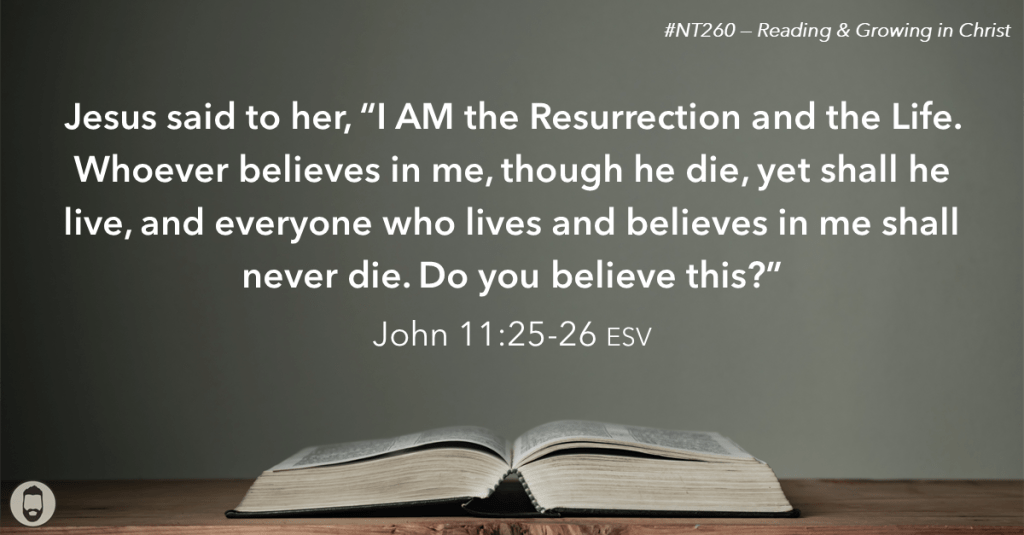
Paul turns to the heart of the gospel—the resurrection of Jesus—and shows why everything we believe depends on it. He reminds the Corinthians of the message they “received” and on which they “stand”: that Christ died for our sins, was buried, and was raised on the third day “in accordance with the Scriptures” (vv. 1–4; cf. Isa. 53:5–12; Ps. 16:10; Hos. 6:2). This isn’t myth or rumor—Jesus appeared to Peter, the Twelve, more than 500 at once, James, all the apostles, and finally to Paul himself (vv. 5–8). These eyewitnesses were living proof that the tomb was empty and Christ is alive. By God’s grace, this risen Christ transformed Paul from a persecutor into an apostle, and this same gospel is what all the apostles proclaim together (vv. 9–11).

Some in Corinth believed Jesus rose but denied that believers will be raised (v. 12). Paul shows that you cannot separate the two: if there is no resurrection for us, then Christ Himself has not been raised (vv. 13, 16). And if Christ is not raised, the consequences are devastating—our preaching is empty, our faith is useless, we remain in our sins, and those who have died in Christ are gone forever (vv. 14–18). But Christ has been raised—the “firstfruits” of a harvest that guarantees our own resurrection when He returns (vv. 20–23). In Adam, death spread to all, but in Christ all His people will be made alive (v. 22; cf. Rom. 5:12–21). When Jesus finally destroys every enemy—finishing with death itself—He will hand the kingdom to the Father, bringing God’s plan to its perfect completion (vv. 24–28).

To those who question how resurrection could work, Paul uses pictures from creation. A seed must die to be raised in a new, glorious form (vv. 35–38). In the same way, our earthly bodies are perishable, weak, and natural, but the resurrection body will be imperishable, glorious, powerful, and fully animated by the Spirit (vv. 42–44). Adam was the first man, made from the dust; Christ is the last Adam, the life-giving Spirit from heaven (vv. 45–49). What is sown mortal will be raised immortal (vv. 50–53). When Christ returns, death will be swallowed up in victory, fulfilling God’s promises (vv. 54–55; cf. Isa. 25:8; Hos. 13:14). Through Jesus, God has removed sin’s sting and broken death’s power forever (vv. 56–57). Therefore, because resurrection is certain, our labor for Christ is never wasted or forgotten (v. 58).

🌀 Reflection:
Where does the hope of resurrection shape the way you live today? Ask the Lord to help you see your body, your work, and your daily struggles in light of the victory Christ has already won—and the glory He has promised at His return.

💬 Mission Challenge:
Encourage someone today who is grieving, suffering, or weary by sharing a verse or truth from this chapter. Remind them that in Christ, death is defeated and their labor is not in vain.


Click here to return to the contents page for Phase 2.2 — The Savior, His Church, and the Mission.


1 Corinthians 14 on 12/4 | NT260 — Reading & Growing in Christ

Click here for 1 Corinthians 14 audio:


Read it. Pray it. Share it. Live it.

After lifting our eyes to the beauty of love, Paul brings that “more excellent way” (13:1, 13) right into the worship gathering. He urges the church to pursue love and still be eager for the gifts of the Spirit—especially prophecy, because it clearly builds up the church (vv. 1–5). Speaking in tongues is real prayer and praise to God, but when no one understands or interprets, it only benefits the one speaking (vv. 2, 4, 14–17). Prophecy, however, is intelligible speech that strengthens, encourages, and comforts others (vv. 3–5). The repeated question is: does this help other people understand and grow? Edification and clarity are the main tests for what should happen in the gathering (vv. 6–12, 19).

Paul also shows how these gifts affect unbelievers who visit the church. Uninterpreted tongues can make outsiders think Christians are out of their minds, which becomes a kind of judgment on their unbelief (vv. 21–23). But when God’s Word is clearly spoken, prophecy can expose the secrets of the heart, bring conviction, and lead someone to fall on their face, worship God, and confess that “God is really among you” (vv. 24–25). Because of this, Paul gives practical instructions: only a few should speak in tongues, and only if there is an interpreter; otherwise, they should be silent and pray quietly (vv. 27–28). Likewise, only a few should prophesy while the others carefully weigh what is said (vv. 29–31). Everything must be self-controlled, peaceful, and orderly because God is not a God of confusion but of peace (vv. 32–33). In that same spirit, Paul calls married women in Corinth to honor their husbands and not disrupt the weighing of prophecies in a way that overturns God’s good order in the church (vv. 34–35).

Paul closes by reminding them that his words are a command of the Lord, not just personal advice (v. 37). So the church should be eager for prophecy, should not forbid tongues when used rightly, and must make sure that “all things should be done decently and in order” (vv. 39–40). Love, clarity, and building up the body are to shape everything we do when we gather in Jesus’s name.

🌀 Reflection:
When you think about Sunday worship, do you primarily ask, “What will I get out of it?” or, “How can I help build others up today?” Ask the Lord to reshape your heart so that your prayers, words, and service—whether seen or unseen—aim at helping others understand God’s Word and experience His presence.

💬 Mission Challenge:
Before your next church gathering, pray intentionally for one way you can build up someone else—through a clear word of encouragement, a Scripture shared at the right time, or a quiet act of service—and then do it for Jesus’s sake and the good of His body.


Click here to return to the contents page for Phase 2.2 — The Savior, His Church, and the Mission.


1 Corinthians 13 on 12/3 | NT260 — Reading & Growing in Christ

Click here for 1 Corinthians 13 audio:


Read it. Pray it. Share it. Live it.

After talking about spiritual gifts, Paul pauses to show the “more excellent way” that must shape everything: love (v. 1; 12:31). He says even the most impressive gifts—speaking in tongues, powerful preaching, knowing “all mysteries,” mountain-moving faith, radical generosity, or even dying for Jesus—amount to nothing without love (vv. 1–3). God cares not just about what we do, but why we do it. Ministry without love is just religious noise.

Paul then paints a beautiful picture of what real, Christlike love looks like. Love is patient and kind; it does not envy, boast, or puff itself up (v. 4). Love doesn’t insist on its own way, fly off the handle, or keep a running record of how others have hurt us (v. 5). Instead, it rejoices in the truth and “bears all things, believes all things, hopes all things, endures all things” (vv. 6–7). This is the love Jesus has shown us, and it is the love He calls us to show one another (John 13:34–35).

Finally, Paul reminds the Corinthians that spiritual gifts are temporary, but love is forever. Prophecy, tongues, and special knowledge all belong to this present, “in part” age; they will pass away when “the perfect” comes and we see the Lord “face to face” (vv. 8–12). But faith, hope, and love remain—and “the greatest of these is love” (v. 13). Gifts are good and needed, but love is essential. In eternity, no one will be impressed with how gifted we were—but our love will still matter.

🌀 Reflection:
Where do you see yourself using your gifts without much love—maybe in your church, home, or online? Ask the Lord to show you any pride, impatience, or scorekeeping that has crept into your heart. Pray for His Spirit to help you move toward others with the patience, kindness, and endurance described in this chapter.

💬 Mission Challenge:
Practice one concrete act of love today that costs you something—time, attention, comfort, or preference—for the good of another person, and do it quietly, without drawing attention to yourself.


Click here to return to the contents page for Phase 2.2 — The Savior, His Church, and the Mission.


1 Corinthians 12 on 12/2 | NT260 — Reading & Growing in Christ

Click here for 1 Corinthians 12 audio:


Read it. Pray it. Share it. Live it.

Paul turns to the Corinthians’ confusion about spiritual gifts—areas where pride, comparison, and misuse had fractured their unity (v. 1). He reminds them that the Holy Spirit never leads anyone to dishonor Jesus; rather, the Spirit enables believers to confess from the heart that “Jesus is Lord” (v. 3). From there, Paul lifts their eyes to the triune God—Father, Son, and Spirit—who gives a rich variety of gifts but for one purpose: the common good of the church (vv. 4–7). Some believers are gifted to speak wisdom or knowledge, others with faith, healing, miracles, discernment, prophecy, tongues, or interpretation (vv. 8–10). Whatever the gift, each one is given sovereignly and intentionally by the Spirit “as he wills,” not for status but for service (v. 11).

To correct their rivalry, Paul gives the picture of the church as Christ’s body. By the Spirit, all believers—Jew or Greek, slave or free—have been brought into one body and made to drink of one Spirit (vv. 12–13). That means no Christian is unnecessary, inferior, or overlooked. A body cannot be all eye or all ear; every part is needed, and God Himself has arranged each member and each gift exactly as He intended (vv. 14–20). In Corinth, those with showy gifts were exalting themselves, while those with quieter gifts were discouraged. Paul insists that the “weaker” or less visible members are just as indispensable, worthy of honor and care (vv. 21–26). This vision of mutual concern reflects Christ’s heart for His church.

Paul closes by listing some of the church’s foundational roles—apostles, prophets, and teachers—along with other vital gifts like helping, leading, and tongues (v. 28). His series of rhetorical questions makes the point unmistakable: God never gave every gift to every person (vv. 29–30). Diversity is not a flaw but God’s design. And yet there is something more excellent than even the greatest gifts: love—the only attitude that makes any gift truly edifying (v. 31; cf. 13:1–3).

🌀 Reflection:
Do you ever look at your own gifts and feel jealous, discouraged, or proud? Take a moment to thank God for the particular ways He has equipped you—and for the brothers and sisters whose gifts complement yours. Ask Him to help you see your church family the way He does: one body, lovingly arranged for His glory.

💬 Mission Challenge:
Affirm a fellow believer’s gift today. Send a message, speak a word, or write a note that honors how God is using them in the body of Christ. Strengthen unity by strengthening someone’s courage.


Click here to return to the contents page for Phase 2.2 — The Savior, His Church, and the Mission.


1 Corinthians 11 on 12/1 | NT260 — Reading & Growing in Christ

Click here for 1 Corinthians 11 audio:


Read it. Pray it. Share it. Live it.

Paul begins by calling the Corinthians to “be imitators of me, as I am of Christ” (v. 1), then addresses how men and women conduct themselves in gathered worship. He reminds them that God has ordered relationships for our good: Christ is the head of every man, the husband is the head of his wife, and the head of Christ is God (v. 3). In Corinth’s culture, a wife’s head covering signaled respect for her husband and honored God’s design, while casting it off brought shame (vv. 5–6, 13–15). Paul’s concern is not about a particular piece of cloth for all times, but about honoring the Lord’s order and bearing ourselves in worship in ways that point to Christ rather than to ourselves (vv. 7–12, 16).

Then Paul turns to a serious problem with the Lord’s Supper. When they gathered, the wealthier believers were eating and drinking plenty while poorer believers went hungry—even to the point that some were getting drunk while others had nothing (vv. 20–22). Paul reminds them of what the Supper really is: on the night He was betrayed, Jesus took bread and the cup and gave them as signs of His body given and His blood of the new covenant, commanding His people to “do this in remembrance of me” (vv. 23–25). Every time the church eats this bread and drinks the cup, we proclaim the Lord’s death until He comes (v. 26). That means our behavior at the table must match the message of the cross—humble, self-giving, and full of love.

Because the Corinthians were treating this holy meal lightly and ignoring the needs of their brothers and sisters, many were experiencing the Lord’s discipline—even weakness, illness, and death (vv. 27–30). So Paul urges them to “examine” themselves before they eat and drink, to discern the body of Christ, and to wait for one another so that everyone may share together (vv. 28–29, 33–34). God’s goal, even in discipline, is mercy—to correct His children so they will not be condemned with the world (vv. 31–32). The Lord’s Supper is therefore not just a private moment with Jesus, but a family meal that should reflect the gospel we proclaim.

🌀 Reflection:
When you think about the Lord’s Supper, do you tend to see it mainly as a personal habit or a holy sharing with Christ and His people? Ask the Lord to search your heart for any selfishness, bitterness, or carelessness toward your church family, and to help you approach the table with humble remembrance, repentance, and gratitude for Jesus’s death for you (vv. 27–28).

💬 Mission Challenge:
Before the next time your church observes the Lord’s Supper, reach out to one fellow believer you’ve overlooked, avoided, or simply haven’t encouraged lately. Make a deliberate effort to honor Christ’s body—His people—through a text, call, or conversation that seeks their good and reflects the love of the cross (vv. 29, 33).


Click here to return to the contents page for Phase 2.2 — The Savior, His Church, and the Mission.


1 Corinthians 10 on 11/30 | NT260 — Reading & Growing in Christ

Click here for 1 Corinthians 10 audio:


Read it. Pray it. Share it. Live it.

Paul looks back to Israel’s story in the wilderness to warn the Corinthians—and us—about the danger of presumption. Israel experienced amazing spiritual privileges: they passed through the sea, were “baptized into Moses,” and received spiritual food and water from Christ, the true “Rock” who was with them (vv. 1–4). Yet “God was not pleased with most of them,” and they fell under judgment for idolatry, sexual immorality, testing the Lord, and grumbling (vv. 5–10). These events “took place as examples for us” so that we will not desire evil as they did (vv. 6, 11). So Paul warns, “Let anyone who thinks that he stands take heed lest he fall” and reminds us that God is faithful—He will not allow us to be tempted beyond what we can bear but will always provide a way of escape so that we can endure (vv. 12–13).

From that warning, Paul goes straight to the heart of the issue in Corinth: idolatry. Believers must “flee from idolatry” because we belong to Jesus and share in His death and life through the Lord’s Supper (vv. 14–17). To eat and drink at the Lord’s Table is to participate in Christ and in His people; to join idol feasts is to fellowship with demons behind false worship (vv. 18–21). We cannot “drink the cup of the Lord and the cup of demons” at the same time (v. 21). God is a jealous God who alone deserves our worship, so we dare not treat idol practices or spiritual compromise as harmless (v. 22; Ex. 20:4–5).

Finally, Paul applies gospel-shaped wisdom to everyday choices about food and conscience. “All things are lawful,” some claimed, but Paul reminds them that not everything is helpful or builds others up (v. 23). Believers are free to eat meat from the market without asking endless questions, because “the earth is the Lord’s” (vv. 25–26). Even when dining in an unbeliever’s home, we can eat what is served—unless someone points out that it has been offered to idols; then, for the sake of that person’s conscience, we should refrain (vv. 27–29). The guiding principle is simple but searching: “Whether you eat or drink, or whatever you do, do all to the glory of God,” seeking not our own advantage but the good of others, “that they may be saved” (vv. 31–33).

🌀 Reflection:
Where are you tempted to assume you’re “standing strong” and lower your guard—maybe with your habits, entertainment, relationships, or use of freedom? Ask the Lord to show you any areas of quiet compromise and to help you choose the “way of escape” He provides so that your life points away from idols and toward Jesus.

💬 Mission Challenge:
Choose one ordinary activity today—like a meal, a conversation, or a small decision—and intentionally aim to do it “to the glory of God” (v. 31). Ask, “How can I do this in a way that honors Christ and helps someone else move closer to Him?” Then act on it.


Click here to return to the contents page for Phase 2.2 — The Savior, His Church, and the Mission.


1 Corinthians 9 on 11/29 | NT260 — Reading & Growing in Christ

Click here for 1 Corinthians 9 audio:


Read it. Pray it. Share it. Live it.

Paul uses his own life as an example of how to lay down personal rights for the sake of the gospel. As an apostle, he truly has the right to be supported financially, to eat and drink at others’ expense, and even to travel with a believing wife like the other apostles do (vv.4–6, 11–14). The Corinthians themselves are the “seal” of his apostleship—living proof that God has really called and used him (vv. 1–2). Yet Paul refuses to claim these rights among them, working with his own hands and preaching “free of charge” so that no one can question his motives or hinder the message of Christ (vv. 12, 15–18).

Because he belongs to Jesus, Paul gladly makes himself a servant to all in order to win more people to Christ (v. 19). To Jews, he becomes “as a Jew”; to those under the law, “as one under the law”; to those outside the law, “as one outside the law”—always staying under “the law of Christ” (vv. 20–21). To the weak, he becomes weak. His aim is simple and focused: “I have become all things to all people, that by all means I might save some” (v. 22). Christian freedom, then, isn’t about doing whatever we want; it’s about flexing our preferences and comforts so that others can clearly hear and see the gospel (cf. 8:9–13).

Paul finishes with a picture from the athletic games the Corinthians knew so well. Runners and boxers train hard and practice strict self-control for a prize that soon fades (vv. 24–25). In the same way, Paul disciplines his body and orders his life with purpose so that he will not be “disqualified” from the reward when the race is over (vv. 26–27). The Christian life is not casual or half-hearted; it is a Spirit-empowered, disciplined pursuit of Jesus and the salvation of others.

🌀 Reflection:
Where might God be calling you to loosen your grip on comfort, preference, or “rights” so that someone else can see Jesus more clearly? Ask the Lord to give you Paul’s mindset—a willing heart that says, “I’ll gladly adjust my life if it helps others hear and believe the gospel.”

💬 Mission Challenge:
Identify one specific person or group you want to reach for Christ, and take one concrete step to “become all things” to them today—adjust your schedule, your style, or your approach so that you can listen well, love well, and point them to Jesus.


Click here to return to the contents page for Phase 2.2 — The Savior, His Church, and the Mission.


1 Corinthians 8 on 11/28 | NT260 — Reading & Growing in Christ

Click here for 1 Corinthians 8 audio:


Read it. Pray it. Share it. Live it.

Some believers in Corinth were saying, “We all possess knowledge” (v. 1), meaning they understood that idols are “nothing” and therefore felt free to eat food connected to pagan temples (v. 4). Paul agrees that there is only one God and one Lord, Jesus Christ (vv. 4–6), but he warns that knowledge without love becomes prideful and dangerous. Not every believer’s conscience is equally formed; some, freshly saved out of idol worship, still feel genuinely troubled by eating such food (v. 7). If mature believers use their freedom carelessly, their example could draw a “weaker” brother or sister back toward idolatry—something Paul calls a serious sin against Christ Himself (vv. 9–12).

Because love builds up, Paul urges Christians to lay aside any freedom that endangers another believer’s walk with Jesus. Even if the meat is spiritually neutral (v. 8), participating in pagan temple meals could confuse or even “destroy” someone whose conscience is tender (vv. 10–11; cf. Rom. 14:13, 20). For Paul, the good of others is worth far more than exercising personal rights. His conclusion is simple and sacrificial: he would rather never eat meat again than cause a fellow believer to stumble back into sin (v. 13).

🌀 Reflection:
Where might you be clinging to a spiritual “right” that could actually harm someone newer or weaker in the faith? Ask God to help you desire love over personal freedom, and to make your life a steady encouragement—not a stumbling block—to those walking beside you.

💬 Mission Challenge:
Choose one area of personal freedom—entertainment, habits, speech, or online choices—and intentionally lay it down today if it might confuse or burden someone around you. Let your love build others up in Christ.


Click here to return to the contents page for Phase 2.2 — The Savior, His Church, and the Mission.


1 Corinthians 7 on 11/27 | NT260 — Reading & Growing in Christ

Click here for 1 Corinthians 7 audio:


Read it. Pray it. Share it. Live it.

Some believers in Corinth were saying it was more spiritual to avoid all sexual relations, even within marriage (v. 1). Paul corrects this by teaching that marriage is God’s good context for sexual intimacy and mutual care, helping husbands and wives resist temptation (vv. 2–5). Singleness is also a gift, and Paul is thankful for his own calling to remain unmarried, but he recognizes that many will rightly marry rather than “burn with passion” (vv. 6–9). He then turns to divorce: believers married to believers must not separate, and if they do, they should remain unmarried or be reconciled (vv. 10–11; cf. Matt. 19:4–9).

Paul also addresses believers married to unbelievers. If the unbelieving spouse is willing to stay, the Christian must not seek a divorce, because the believing spouse brings a holy influence to the home and there is hope for the unbeliever’s salvation (vv. 12–14, 16). But if the unbelieving spouse chooses to leave, the believer is “not enslaved” and is called to live in peace (v. 15). From there, Paul gives a wider principle: each person should generally remain in the situation in which God called them—married or single, Jew or Gentile, slave or free—and serve Christ faithfully there, knowing they were “bought with a price” (vv. 17–24; cf. 6:20). Because of a “present distress” and the shortness of time, Paul says staying single can allow for undivided devotion to the Lord, yet marriage remains good and honorable for the engaged and for widows, so long as they marry “only in the Lord” (vv. 25–28, 32–35, 39–40).

🌀 Reflection:
Where has God placed you right now—married, single, widowed, or in a complicated in-between? Instead of wishing you were somewhere else, what would it look like today to receive your current situation as an assignment from the Lord and seek to honor Him with an undivided heart?

💬 Mission Challenge:
Reach out to someone in a different life stage than you (single, married, widowed, divorced, or engaged) and encourage them with a reminder that God sees them, loves them, and can use them right where they are.


Click here to return to the contents page for Phase 2.2 — The Savior, His Church, and the Mission.