And now, O Lord, for what do I wait? My hope is in You.
Psalm 39:7
In Psalm 39, we see David wrestle with just how brief human life is. He begins with a determination to guard his tongue (v. 1), but his inner turmoil grows as he begins to consider how short and fleeting life truly is. This psalm echoes themes we see in the book of Ecclesiastes, reminding us that life is like a breath (v. 5) and that accumulating wealth and worldly status is ultimately futile (v. 6).
Yet David does not fall into despair. He anchors himself to a greater hope, saying to the Lord, “My hope is in You” (v. 7). We have seen that in the face of life’s uncertainties, suffering, and even divine discipline, David looks beyond this world to the God who holds all things together.
David’s prayer in v. 10 acknowledges that God’s discipline can feel overwhelming, but he does not view it merely as punishment – rather, it is God’s refining work in his life. So, he confesses his sin (v. 8) and pleads for God’s mercy (v. 12). He ends the psalm with a sobering plea (v. 13): “Look away from me, that I may smile again, before I depart and am no more!” He is weary. His suffering makes him long for relief. He is enduring God’s divine discipline. But his trust in the Lord leads him to wait for the day when the glares of godly discipline turn to glances of God’s grace.
Seeing Jesus in Psalm 39
Jesus is the ultimate fulfillment of Psalm 39. He, too, was silent before His accusers (Isaiah 53:7, Matthew 27:12-14). He did not lash out when mocked, just as David sought to guard his tongue. But unlike David, Jesus did not plead for relief – He endured the full measure of God’s wrath for our sake (2 Corinthians 5:21). It is through His suffering that we have access and opportunity for the eternal hope given to those who trust in Him.
Reflection
Life is fleeting. Our time on earth is short. Reading Psalm 39 should lead us to ask some frank and honest questions.
What/who are we living for?
Are we storing up earthly treasures or living in light of eternity?
In what/whom do you find your hope?
Life is too short to spend it chasing after anything but Jesus. Let your hope be found in Him alone. That is a hope that echoes into eternity!
The #dailyPSALMSchallenge gives us the opportunity to start 2025 in God’s Word by digging into a psalm a day. Each day will identify a key passage for us to meditate on as well as seeking to help us see Jesus in the psalm and reflect on what we have read.
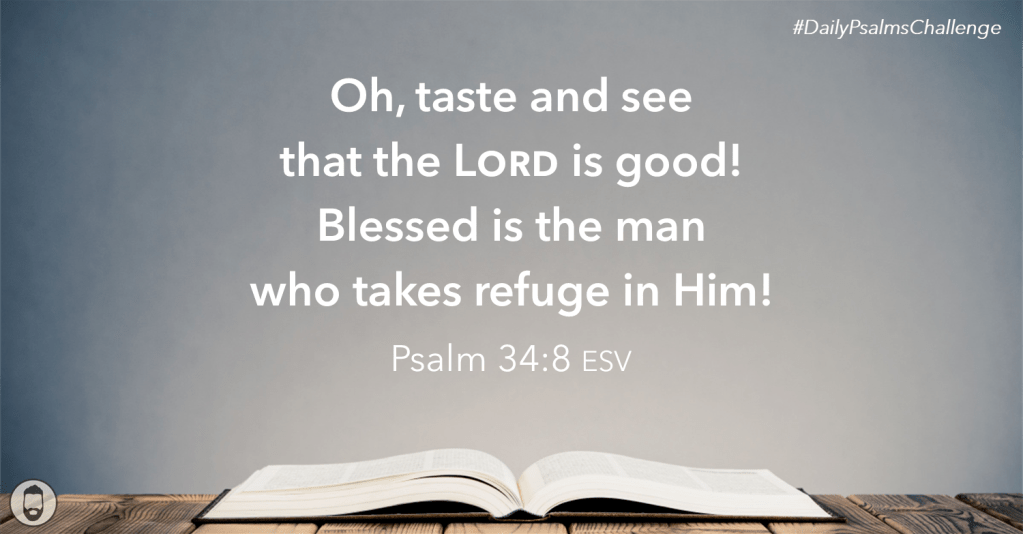
Oh, taste and see that the LORD is good! Blessed is the man who takes refuge in Him!
Psalm 34:8
Psalm 34 is an invitation for joyful trust in the Lord. This psalm was written by David after God delivered him from the king of Gath in 1 Samuel 21:10-15 when he, as the inscription says “changed his behavior”, pretended to be out of his mind (1 Samuel 21:13). These events obviously had a profound impact on David’s life as the result is this overflow of his gratitude and praise.
David begins with a commitment to continual worship: “I will bless the Lord at all times; His praise shall continually be in my mouth” (v. 1). He doesn’t stop at his own personal prayer, though; he calls others to join him and “magnify the Lord” with him and “exalt” the name of the Lord “together” (v. 3). Worship is meant to be shared communally, and our joy in God is deepened when we proclaim His goodness with others who have experienced it firsthand.
David shares his testimony from that event: “I sought the Lord, and He answered me and delivered me from all my fears” (v. 4). God’s faithfulness is not theoretical for him but proven by his experience with God. It is also proven in David’s life as he says that those who trust the Lord “are radiant” (v. 5), reflecting His light and joy even in the midst of difficult circumstances.
One of the most well-known verses comes next in this psalm (v. 8): “Oh, taste and see that the Lord is good!” This is more than an intellectual acknowledgment of God’s goodness but a call to come and experience it firsthand. Just as tasting food gives direct knowledge of its flavor, trusting the Lord allows us to personally experience His faithfulness and provision.
Speaking of firsthand experience, David confidently assures us that those who fear the Lord will lack nothing they truly need (vv. 9-10). Fear of the Lord is a common theme in Scripture and means having a reverence for Him, obeying Him, and trusting in His wisdom and care over our own. God is trustworthy. He watches over His people and hears their cries (v. 15), being “near to the brokenhearted” and saving “the crushed in spirit” (v. 18). Even and especially in affliction, God is present and faithful in “the afflictions of the righteous” and “delivers” them “out of them all” (v. 19).
Psalm 34 concludes with the reminder that God is His people’s redeemer (v. 22). None – not a single one – of “those who take refuge in Him will be condemned (v. 22). That’s good news for those who take refuge in Him.
Seeing Jesus in Psalm 34
Psalm 34 finds its ultimate fulfillment in Jesus, the One who fully tasted human suffering, yet remained without sin (Hebrews 4:15). John applies v. 20 (“He keeps all His bones; not one of them is broken”) to Jesus on the cross, showing Him as the righteous One who suffered on our behalf.
Furthermore, part of tasting and seeing that the Lord is good for those who are saved is knowing that no one who takes refuge in Jesus Christ, our Redeemer, will face condemnation (Romans 8:1). That’s good news!
Reflection
Have you personally tasted and seen the goodness of God in your life?
How have you been delivered from trials and suffering by the mighty hand of God?
Let Psalm 34 be an encouragement for you to experience the goodness of God firsthand. Take refuge in Him. Trust Him. Find comfort in His goodness and care.
The #dailyPSALMSchallenge gives us the opportunity to start 2025 in God’s Word by digging into a psalm a day. Each day will identify a key passage for us to meditate on as well as seeking to help us see Jesus in the psalm and reflect on what we have read.
But I trust in You, O LORD; I say, “You are my God.” My times are in Your hand; rescue me from the hand of my enemies and from my persecutors!
Psalm 31:14-15
Psalm 31 is a deeply emotional and personal psalm showing David’s trust for the Lord as he sought refuge amidst life-threatening circumstances. This psalm moves from David’s desperate cries for deliverance to an unwavering declaration in God’s sovereignty and goodness. In v. 5, David proclaims, “Into Your hand I commit my spirit”, words later echoed by Jesus on the cross (Luke 23:46), showing Psalm 31 to be a testament to the reality of suffering, the sufficiency of God’s grace, and the assurance of His steadfast love for His people.
David begins with the heartfelt plea for God to never let him “be put to shame” and for God to deliver him (v. 1). He describes God as his rock and fortress, emphasizing his complete dependence on the Lord for guidance, rescue, and protection (v. 3). In the midst of overwhelming affliction, David places his life in God’s hands.
David’s honesty about his pain is striking: “For my life is spent with sorrow, and my years with sighing”, citing his failing strength and bones wasting away (v. 10). He feels forgotten and rejected, yet he does not lose sight of God’s faithfulness. Instead, he declares his trust for the Lord and confess that He is his God (vv. 14-15). This declaration of faith reveals David’s confidence in God’s control over his times – literally every moment of his life, even and especially the darkness seasons and moments.
Psalm 31 concludes with a call to worship: “Love the Lord, all you His saints! The Lord preserves the faithful but abundantly repays the one who acts in pride. Be strong, and let your heart take courage, all you who wait for the Lord!” (vv. 23-24).
Seeing Jesus in Psalm 31
Psalm 31 points us directly to Jesus, who embodied perfect trust in the Father even in His most excruciating moment on the cross. When Jesus quoted v. 5, He demonstrated complete dependence on the Father, trusting Him even in death. His resurrection assures us that God’s goodness and steadfast love triumph over sin, suffering and death.
Reflection
Psalm 31 challenges us to entrust every aspect of our lives to God’s sovereign care. Through Jesus, we can confidently declare, “My times are in Your hand”, knowing that our lives are secure in Him, both now and forever.
Are there areas where you struggle to trust God’s timing or provision?
How does Jesus’s example committing His spirit to His Father encourage you to trust God, even in seasons of uncertainty or pain?
Take time today to entrust your burdens to the Lord, knowing that His steadfast love is abundant, His goodness is stored up for His people, and His plans for you are always perfect.
The #dailyPSALMSchallenge gives us the opportunity to start 2025 in God’s Word by digging into a psalm a day. Each day will identify a key passage for us to meditate on as well as seeking to help us see Jesus in the psalm and reflect on what we have read.
Have y’all ever gotten something stuck in your mind that you just couldn’t get unstuck? Of course you have – everyone has experienced this at some point and time. For me, it is the key verse from John’s sermon last week, Romans 12:15:
Rejoice with those who rejoice, weep with those who weep.
It’s simple. Straightforward. Clear. As John explained to us, this verse is really only four words in the Greek, essentially “rejoice — rejoicers, weep — weepers”. We, those of us who are saved and have been adopted into God’s family and grafted into His church, are to be there for our brothers and sisters, hurting when they hurt. That’s what family does, right? It should especially be so in the family of God.
As I have pondered on that verse (really simmered or stewed like a crockpot), it has had me thinking on why it is to be this way. And essentially, I have arrived at the conclusion that it stems from us extending grace to others as Jesus has extended grace to us.
One Scripture that came to mind is from the Sermon on the Mount right after Jesus gave us what we call “The Lord’s Prayer”. Look at Matthew 6:14-15:
For if you forgive others their trespasses, your heavenly Father will also forgive you, but if you do not forgive others their trespasses, neither will your Father forgive your trespasses.
This is not saying that we earn God’s forgiveness by forgiving others. If that were the case, we’d have no hope because humanity as a whole is not a forgiving people but rather quite selfish and self-serving. No, what Jesus is saying here is that the way we forgive is based on how we have been forgiven. If we understand that our sin put us at odds and enmity with Jesus and that He reconciled us to Himself and showed us love while we were still sinners, we will have an appreciation for that love and forgiveness that will show in how we forgive others.
This isn’t some theory on my part or some great epiphany. Jesus explained it similarly to Simon the Pharisee after the woman came in and washed Jesus’s feet with her tears, dried them with her hair, and anointed them with costly perfume. When Simon (and Jesus’s own disciples) were critical of the woman’s wastefulness with pouring out very expensive perfume on Jesus’s feet, Jesus told them that the woman’s sins “which are many” had been forgiven which was why she “loved much”, and He clarified that the one who has been “forgiven little, loves little” (Luke 7:47).
If you are saved, you know that you have been forgiven MUCH because your sin — no matter how the world might view it — is a LOT, and definitely more than our sinless Savior should’ve had to bear on the cross. We deserve the cross, not Jesus. We deserve death, not Jesus. But because of His great love and richness in grace and mercy, He forgave much, loved much, and gave much. That kind of forgiveness, love, and grace changes folks’ lives. If you are saved, you have received this from Jesus and cannot help but extend it to others.
Simon didn’t get it. He thought he had some earthly status as a Pharisee. But when you look at the other gospels, you get, as Paul Harvey would’ve said, the rest of the story. Matthew 26:6 doesn’t call Simon a Pharisee; there he is referred to as “Simon the leper”. You don’t have to read a lot of the Bible to know that folks typically kept their distance from lepers. They were considered unclean. Folks would walk on the opposite side of the road to keep from touching one. They surely wouldn’t touch one, much less go to his house for supper. Long story short, Jesus wasn’t at Simon’s house to honor him but because Jesus had compassion on those no one else did. Jesus was a friend to sinners. He ate with tax collectors. He showed compassionate care to those the world had thrown away. No one was lining up at Simon’s door because Simon was unclean, untouchable, and unmistakably ostracized from society. Yet he looked at that poor woman weeping at Jesus’s feet and had the audacity to remark how pitiful it is that Jesus would let her touch Him (when anyone passing by could’ve remarked how pitiful it was for Jesus to go in Simon the leper’s house).
Simon didn’t get it.
Do we?
That woman had received a lot of grace because she’d committed a lot of sin.
That woman had experienced greater love from God who not only forgave her sin but would go on to die on the cross her sin deserved.
That woman had reason to weep sorrowfully over her sin against a holy God but had more reason to weep out of rejoicing that her sin was wholly forgiven by God and show love to Him in return.
What about us? Do we get it?
Look at how Paul put it in 2 Corinthians 1:3-4:
Blessed be the God and Father of our Lord Jesus Christ, the Father of mercies and God of all comfort, who comforts us in our affliction, so that we may be able to comfort those who are in any affliction, with the comfort which we ourselves are comforted by God.
God has shown us grace and comfort because He loves us. We have the opportunity to show that grace and comfort to others. And this is sorely needed in a world today that seems like the rejoicing is getting more seldom and weeping is ever increasing.
Thankfully, Sunday’s coming. There is a coming Day when Jesus will return and gather His people to Him. The last tears of sorrow will be cried and wiped away by His nail-pierced hand. Death will be abolished. The sad things of this earth will come untrue. As the old hymn says, “What a Day — glorious Day — that will be!”
Until that day, we will gather and read God’s Word, sing God’s Word, and hear God’s Word preached. That’s what we’re singing about this Sunday: telling what Jesus has done for us. And as we do so, we will have brothers and sisters who are rejoicing about this or that. Rejoice with them. Assuredly there will be those with much to weep about. Weep with them. You have been given much grace and love. Christ Community family, it’s time to extend that grace and love to others.
Won’t you gather with us?
Here are our Scriptures & songs:
Scripture | Titus 3:1-7 —
1Remind them to be submissive to rulers and authorities, to be obedient, to be ready for every good work, 2to speak evil of no one, to avoid quarreling, to be gentle, and to show perfect courtesy toward all people. 3For we ourselves were once foolish, disobedient, led astray, slaves to various passions and pleasures, passing our days in malice and envy, hated by others and hating one another. 4But when the goodness and loving kindness of God our Savior appeared, 5He saved us, not because of works done by us in righteousness, but according to His own mercy, by the washing of regeneration and renewal of the Holy Spirit, 6whom He poured out on us richly through Jesus Christ our Savior, 7so that being justified by His grace we might become heirs according to the hope of eternal life.
17When I saw Him, I fell at His feet as though dead. But He laid His right hand on me, saying, “Fear not, I am the first and the last, 18and the living one. I died, and behold I am alive forevermore, and I have the keys of Death and Hades.
My God, my God, why have You forsaken me? Why are You so far from saving me, from the words of my groaning?
Psalm 22:1
Psalm 22 begins with a heart-wrenching cry: “My God, my God, why have You forsaken me?” (v. 1). David voices the raw emotions that come from feeling abandoned by God in amid intense suffering. He pleads for God’s presence, wrestling with the seeming silence of heaven even as he cries out day and night (vv. 1-2). This tension between despair and trust is central to the psalm.
While David feels forsaken, he also remembers the holiness and faithfulness of God: “In You our father’s trusted; they trusted, and You delivered them” (v. 4). He clings to this hope even as his circumstances overwhelm him.
David, in his agony, describes himself as “a worm and not a man”, scorned and mocked by those around him (vv. 6-7). His enemies taunt him, twisting his trust in God into mockery and ridicule: “He trusts in the Lord; let Him deliver him” (v. 8). At this point, David has become physically weak and broken – his strength dried up, his bones out of joint, and his hands and feet pierced (vv. 14-16). Even his garments are divided among his enemies (v. 18). This striking imagery paints a picture of unparalleled suffering that goes far beyond David’s personal struggles and points prophetically to the suffering Savior, Jesus.
Despite the suffering and feelings of abandonment, Psalm 22 doesn’t end in defeat. In v. 22, there is a sudden shift: “I will tell of Your name to my brothers; in the midst of the congregation I will praise You.” Those feelings of abandonment are replaced with David rejoicing in God’s faithfulness. As in many other psalms, we see David finding hope in the consistent nature of God’s character. Because of that, he knows that God has not despised or ignored him (v. 24). This praise expands beyond Israel to include “all the families of the nations”, who will remember and worship the Lord (v. 27) and concludes with the assurance that God’s righteousness will be proclaimed to future generations, declaring “He has done it” (v. 31).
Seeing Jesus in Psalm 22
Psalm 22 is tied to Jesus’s crucifixion as Jesus cried out the opening words from the cross: “My God, my God, why have You forsaken me?” (Matthew 27:46). Additionally, the vivid descriptions of pierced hands and feet (v. 16), divided garments (v. 18), and mocking enemies (vv. 7-8) are fulfilled in stunning detail and accuracy at Calvary. These connections reveal that David’s suffering pointed to Christ’s ultimate suffering, but Psalm 22 doesn’t end at the cross.
David’s shift from lament to praise reflects the resurrection, as Jesus declares, “I will tell of your name to my brothers” (v. 22, Hebrews 2:12). Through His death and resurrection, Jesus brings the nations ot worship God, fulfilling the psalms vision of the praise of the nations and eternal life (vv. 27-31). All in all, Psalm 22 reminds us that Jesus was truly forsaken so that we never have to be, and His victory ensures our hope.
Reflection
Psalm 22 invites us to honestly bring our pain to God, just as David and Jesus did. When we feel abandoned or overwhelmed, we can cry out to the Lord, trusting that He hears us even in His silence. At the same time, we are called to fix our eyes on God’s faithfulness – His deliverance in the past, His presence in the present, and His promises for the future.
Because Jesus bore the ultimate forsakenness on our behalf, we can trust that God is always with us, even in our darkest moments. As we meditate today on Christ’s suffering and victory, may we join David in proclaiming, “He has done it” (v. 31)!
The #dailyPSALMSchallenge gives us the opportunity to start 2025 in God’s Word by digging into a psalm a day. Each day will identify a key passage for us to meditate on as well as seeking to help us see Jesus in the psalm and reflect on what we have read.
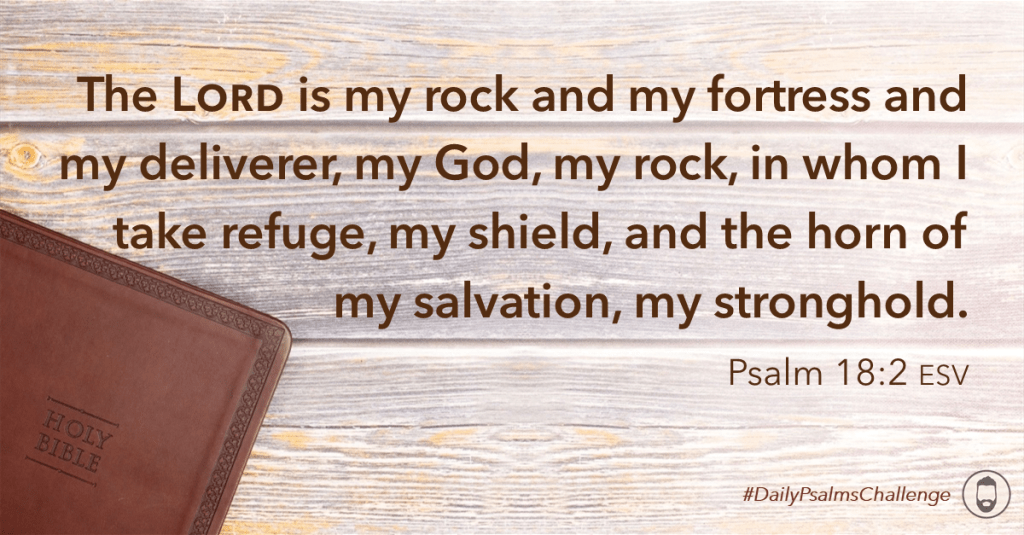
The LORD is my rock and my fortress and my deliverer, my God, my rock, in whom I take refuge, my shield, and the horn of my salvation, my stronghold.
Psalm 18:2
Psalm 18 is a song of triumph and thanksgiving from David to the Lord, celebrating God’s deliverance from King Saul. It is important to note that Psalm 18 is nearly identical to David’s song of praise in 2 Samuel 22 – the differences likely being Psalm 18 is adapted from David’s specific situation to be sung by the people (the Psalms is the songbook/hymnal of the Bible, remember). As such, this is not only a personal expression of David’s gratitude and praise but also a testimony to God’s faithfulness to His anointed king and His people. This psalm resonates with themes of refuge, rescue, and victory, ultimately pointing, as we’ll see later, to Jesus.
David opens with a declaration of love for the Lord, describing Him as his strength, rock, fortress, deliverer, and refuge (vv. 1-3). These metaphors emphasize God’s power, protection, and faithfulness. David’s words remind us that God is not some distant, uninvolved deity but a personal Savior who genuinely cares for His people.
The central part of the psalm recounts God’s dramatic intervention on David’s behalf (vv. 4-19). When David faced overwhelming danger, he cried out to the Lord, and God responded with awesome power. The imagery of the earth trembling, smoke rising, and hailstones falling paints a vivid picture of God as a divine Warrior, fighting for His anointed one. This points back all the way to the Lord’s deliverance of Israel from Egypt in the Exodus and points forward to His ultimate victory through Jesus.
David attributes his deliverance to his righteousness and integrity (vv. 20-24), not meaning that David was sinless but that he walked faithfully with God and sought to obey His commands. In the last part of the psalm, David praises God for equipping him for battle and giving him the victory (vv. 31-45) showing that he understood his victory was ultimately in the Lord’s goodness rather than his own. In fact, he acknowledges that every success of his was achieved as a result of God’s strength, guidance, and provision.
Psalm 18 concludes with a declaration of God’s faithfulness, not just toward David but also toward His people (vv. 46-50). David praises the Lord as his rock and Savior, again acknowledging that his victories are part of God’s covenant commitment to him and his descendants. Ultimately, this covenant finds fulfillment in Jesus, the eternal King and descendant of David, who brings salvation to all nations (Romans 15:9).
Seeing Jesus in Psalm 18
Psalm 18 foreshadows Jesus, the greater David. We can truly sing v. 46 in the context of Jesus: “The LORD lives, and blessed be my rock, and exalted be the God of my salvation”! The dramatic imagery of God’s intervention in David’s situation in this psalm reflects the power of the resurrection, where Jesus – the LORD – lives, defeating the ultimate enemies of sin and death (1 Corinthians 14:25-27).
Paul quotes v. 49 in Romans 15:9, showing that the salvation described in Psalm 18 is extended to the Gentiles through Jesus, who is the fulfillment of God’s promise to David – Jesus, who is the King who reigns forever and brings salvation to the ends of the earth.
Reflection
Psalm 18 invites us to rejoice in God’s faithfulness, to trust in His strength, and to find our ultimate hope in our eternal King, Jesus.
As you reflect on Psalm 18, ask yourself how you can apply the imagery of God as rock, fortress, and shield to your current circumstances. Have there been times when He has delivered you? If so, how did that strengthen your faith?
Pray or sing Psalm 18 and rejoice in the God of your salvation!
The #dailyPSALMSchallenge gives us the opportunity to start 2025 in God’s Word by digging into a psalm a day. Each day will identify a key passage for us to meditate on as well as seeking to help us see Jesus in the psalm and reflect on what we have read.
Keep me as the apple of Your eye; hide me in the shadow of Your wings….
Psalm 17:8
Psalm 17 is David’s heartfelt prayer for God to protect and vindicate him in the face of relentless enemies. This prayer reveals David’s perseverance in faith as he appeals to God on the basis of his innocence, God’s covenant love, and his ultimate hope in seeing God’s face.
David begins by asserting his innocence, inviting God to examine his heart, words, and actions (vv. 1-5). He is confident that God will find no wrongdoing. This doesn’t imply that David was sinlessly perfect but rather his sincere commitment to walk in God’s ways and avoid the paths of the wicked.
In the middle, David shifts his focus to God’s steadfast covenant love. He calls upon the LORD to demonstrate His love and loyalty, describing Him as the Savior of those who seek refuge (vv. 6-9). David prays using imagery to reflect his desire to be kept as the “apple of [God’s] eye” and hidden “in the shadow of [His] wings”, evoking a clear image of God’s tender care and protection (v. 8).
Psalm 17 then describes David’s enemies as ferocious, comparing them to a lion lying in wait for prey (vv. 10-12). David asks God to intervene and protect him from danger, entrusting his future and his enemies justice to the Lord. He contrasts his enemies, who find their portion in this life only, with his own hope in the eternal presence of God (vv. 13-15).
David concludes with a powerful declaration of his confidence in the Lord: “As for me, I shall behold your face in righteousness; when I awake, I shall be satisfied with Your likeness” (v. 15). His ultimate hope is not in earthly justice but in the joy of seeing God face-to-face, a longing that points us to eternal life.
Seeing Jesus in Psalm 17
Psalm 17 finds its ultimate fulfillment in Jesus. As David appeals to God for justice and vindication, we see a foreshadowing of the sinless Savior who fully trusted the Father’s will. Jesus, like David, faced accusations and violent enemies, yet He entrusted Himself to God’s righteous judgment (1 Peter 2:23).
Jesus also perfectly embodies the hope expressed in v. 15. Through His death and resurrection, He made it possible for us to behold God’s face in righteousness and enjoy eternal life in His presence (Revelation 22:3-4).
Reflection
Pray Psalm 17 and be reminded of Jesus’s faithfulness. Put your hope in Him. Know that God still hears, protects, and promises joy in His presence forevermore.
Be confident in God’s justice rather than seek your own revenge. Rest in God’s care, finding comfort in His wings and know that you are His delight, the apple of His eye. And seek to have a perspective grounded in the eternal life He gives and the hope we can have in Him rather than focusing on trials and suffering.
The #dailyPSALMSchallenge gives us the opportunity to start 2025 in God’s Word by digging into a psalm a day. Each day will identify a key passage for us to meditate on as well as seeking to help us see Jesus in the psalm and reflect on what we have read.
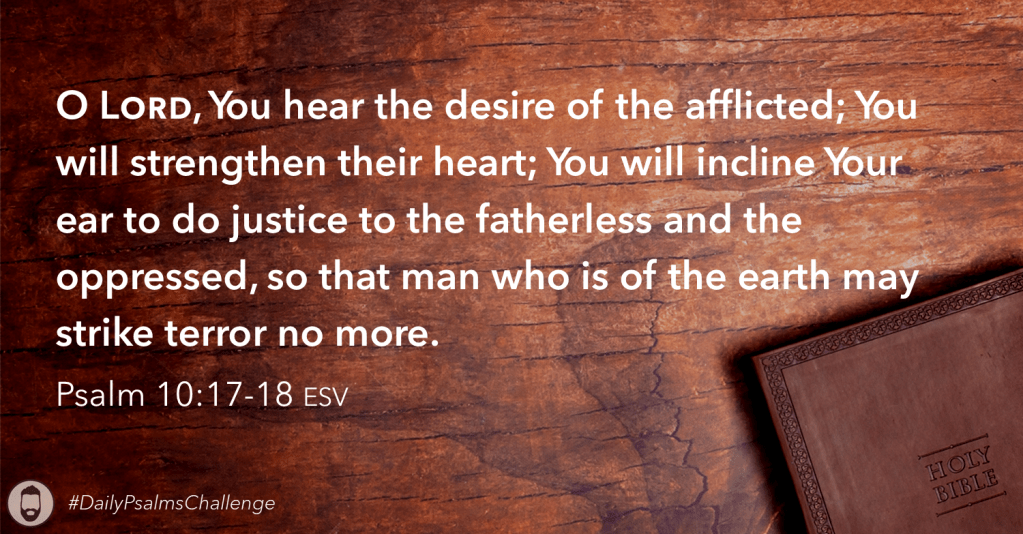
O LORD, You hear the desire of the afflicted; You will strengthen their heart; You will incline Your ear to do justice to the fatherless and the oppressed, so that man who is of the earth may strike terror no more.
Psalm 10:17-18
Psalm 10 opens with a heartfelt cry, “Why, O LORD, do you stand far away/ Why do You hide Yourself in times of trouble?” (v. 1). This lament resonates deeply with anyone who has ever tried to reconcile what may look like God being silent toward the rampant injustice in the world.
The psalmist (no one is specifically named as the writer of Psalm 10) paints a vivid picture of the wicked — arrogant, oppressive, and violent — preying upon the helpless with no fear of accountability (vv. 2-11). Their hearts are full of pride, and they make the bold proclamation that “There is no God” (v. 4).
The wicked seem to prosper — seem. Their prosperity is only temporary because their ways are deceptive and cruel. They lurk in ambush like predators, exploiting the vulnerable like their prey and doing so with what seems to be no punishment or repercussions. The psalmist pleads with GOd to respond — to rise up, defend the afflicted, and bring the wicked to account (vv. 12-15). These cries are not expressions of doubt but of trust that God is just and able to intervene.
Psalm 10 concludes with renewed confidence (rather than disappointment) in the Lord, who is “King forever and ever” (v. 16). The wicked may seem to prevail, but the power is fleeting. God hears the cries of the afflicted, strengthens their hearts, and ensures justice for the fatherless and the oppressed (vv. 17-18). This is the assurance that while human justice is rampant, divine justice will ultimately prevail.
Seeing Jesus in Psalm 10
Jesus embodies the heart of Psalm 10. He demonstrated God’s care for the afflicted and oppressed during His earthly ministry — healing the sick, comforting the grieving, and extending grace to the outcasts. On the cross, Jesus bore the ultimate injustice — dying for sins He did not commit — so that justice and mercy could be perfectly reconciled in Him.
When Jesus returns to establish His eternal Kingdom of justice and peace, He will fulfill the psalmist’s cry that “man who is of the earth may strike terror no more” (v. 18).
Reflect
Psalm 10 reminds us that even when God seems distant, He is neither unaware nor indifferent to injustice.
Are you wrestling with situations where the wicked appear to prosper? Bring your concerns — and even your laments — to the Lord, trusting that He sees, hears, and will act.
Consider ways you might be able to defend the weak, care for the vulnerable, and trust in His ultimate plan to right every wrong. May Psalm 10 strength your faith as you learn to wait on the Lord.
The #dailyPSALMSchallenge gives us the opportunity to start 2025 in God’s Word by digging into a psalm a day. Each day will identify a key passage for us to meditate on as well as seeking to help us see Jesus in the psalm and reflect on what we have read.
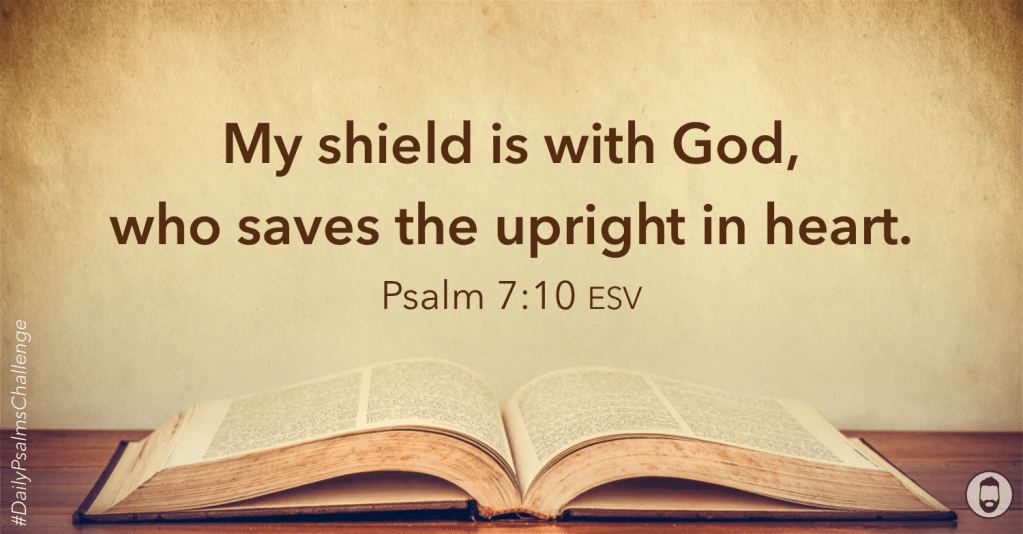
My shield is with God, who saves the upright in heart.
Psalm 7:10
Psalm 7 offers a vivid picture of David’s reliance on God in the midst of slander and false accusations. Faced with an attack from Cush, a Benjamite likely allied with Saul, David turns to God as his refuge (v. 1). He describes his pursuers as lions ready to tear him apart (v. 2), yet, instead of seeking personal revenge or justifying himself to others, David brings his case before the ultimate Judge.
David’s prayer begins with self-examination. In vv. 3-5, he acknowledges the possibility of wrongdoing (because he knows he is a sinner) and invites God to judge him if he is guilty. This humble request reveals David’s heart toward God, seeking to be the man God called him to be rather than be vindicated. His appeal for justice (v. 8) is grounded in his trust that God is a righteous judge who sees all hearts and minds (v. 9).
When he talks about the pit and hole in vv. 14-16, he paints a striking illustration of how sin traps people. This sort of poetic justice reminds us that God’s judgment is perfect, but it is also active. Despite his situation, David concludes Psalm 7 with confident praise in his God: “I will give to the LORD the thanks due to His righteousness” (v. 17).
Seeing Jesus in Psalm 7
David’s plea for justice and his willingness to entrust himself to God foreshadows Jesus who endured what David did and more. Jesus was reviled and slandered but “continued trusting Himself to Him who judges justly” (1 Peter 2:23) — to the Father. Unlike David, though, Jesus was (and is) sinless leaving no doubt to His righteousness.
When David talks about God’s bow being “bend and readied” toward those who don’t repent in v. 12, we are reminded of the reality of what our sin deserves. We need to be reminded that God hung His bow in the clouds a long time ago, reminded that for those who trust in God for salvation His bow is pointed toward heaven — toward His Son Jesus — instead.
Reflection
Psalm 7 invites us to bring our hurts and accusations to God and let Him sort them out rather than seeking personal revenge.
Are you carrying such a burden today?
Lay it before the righteous Judge who knows every heart. His justice may not be immediate, but it is certain.
Let this psalm inspire you to trust in God as your refuge, examine your own heart, and rest in the assurance that God’s justice — and, thankfully, His mercy — will prevail.
The #dailyPSALMSchallenge gives us the opportunity to start 2025 in God’s Word by digging into a psalm a day. Each day will identify a key passage for us to meditate on as well as seeking to help us see Jesus in the psalm and reflect on what we have read.
Turn, O LORD, deliver my life; save me for the sake of Your steadfast love.
Psalm 6:4
Psalm 6 is a cry of deep lament (which we defined in Psalm 3 as letting out one’s feelings of grief or sadness) as David is overwhelmed by distress and the apparent silence of God. This is the first of the penitential psalms (meaning Psalms of confession and repentance — including Psalms 32, 38, 51, 130, and 143). Here, rather than confessing specific sins, David cries out to God about his experiences with God’s discipline and his enemies’ torment.
David starts off with an urgent plea: “O Lord, rebuke me not in Your anger, nor discipline me in Your wrath” (v. 1). He feels the weight of God’s discipline but asks for God’s mercy instead of wrath. If God’s grace is giving His undeserved favor, His mercy is withholding punishment or wrath that we DO deserve. David’s plea for mercy is because his distress is affecting him physically and longs to know from the Lord how long the discipline will last (vv. 2-3).
The turning point in Psalm 6 comes when David appeals to God’s steadfast love (Hebrew: chesed) and sees that love as the basis for his hope. He has experienced God’s steadfast love in the past and trusts that God will not be angry with him forever and will move to rescue and save him (v. 4). David understands that God is just and does not dispute whether the discipline is warranted; knowing God loves him, though, he pleads for mercy.
What began as lament turns to worship with David pouring out his soul before the Lord. While he initially remarked that he felt God was being silent toward him, He had faith that God had heard his prayer (v. 9). This assurance fuels his boldness to call out his enemies, knowing that God is not done with him and will vindicate him.
Seeing Jesus in Psalm 6
This psalm points forward to Jesus, the Man of sorrows (Isaiah 53:3). Like David, Jesus experienced deep anguish as He prayed in the garden of Gethsemane (Luke 22:44). On the cross, He bore the full weight of God’s wrath and punishment for our sin — not His, but ours — so that we might be delivered and experience His steadfast love.
Jesus also fulfills David’s confidence that God hears the cries of the afflicted. In Him, have assurance that our prayers are heard and that our salvation is sure. More than that, Jesus’s resurrection turns our weeping to joy, proving that not even death can separate us from God’s love.
Reflection
Psalm 6 invites us to bring our deepest sorrows and fears to God, trusting in His steadfast love even when we are being disciplined (and our troubles stem from our own sin). When God seems silent, David’s faith and words in Psalm 6 can help us see that God’s mercy is greater than His discipline and that His salvation is certain for those who trust in Him.
The #dailyPSALMSchallenge gives us the opportunity to start 2025 in God’s Word by digging into a psalm a day. Each day will identify a key passage for us to meditate on as well as seeking to help us see Jesus in the psalm and reflect on what we have read.





 Just Keith Harris