The word advent refers to the arrival of someone or something important.
The season of Advent (basically the month prior to the celebration of Christmas) brings Titus 2:11-14 to mind:
For the grace of God has appeared, bringing salvation for all people, training us to renounce ungodliness and worldly passions, and to live self-controlled, upright, and godly lives in the present age, waiting for our blessed hope, the appearing of the glory of our great God and Savior Jesus Christ, who gave Himself for us to redeem us from all lawlessness and to purify for Himself a people for His own possession who are zealous for good works.
That phrase “waiting for our blessed hope” reminds me of those who had long-awaited Jesus’ first coming. It also reminds me of how we should be as we await His return!
We want to give you the opportunity to use this time – when people are trying to focus on and remember hope, peace, joy, and love – to focus on “our great God and Savior Jesus Christ”. Starting on December 1 and going up to Christmas day, we have a Bible passage to read and have curated devotions to help focus our hearts and minds on Jesus.
Or you can use the links or podcast player below to listen to the Bible reading and devotion.
If you would like to sign-up to receive weekly devotions and other content, enter your email address in the box below and click the “subscribe” button.
1 Oh sing to the Lord a new song; sing to the Lord, all the earth! 2 Sing to the Lord, bless his name; tell of his salvation from day to day. 3 Declare his glory among the nations, his marvelous works among all the peoples! 4 For great is the Lord, and greatly to be praised; he is to be feared above all gods. 5 For all the gods of the peoples are worthless idols, but the Lord made the heavens. 6 Splendor and majesty are before him; strength and beauty are in his sanctuary.
7 Ascribe to the Lord, O families of the peoples, ascribe to the Lord glory and strength! 8 Ascribe to the Lord the glory due his name; bring an offering, and come into his courts! 9 Worship the Lord in the splendor of holiness; tremble before him, all the earth!
10 Say among the nations, “The Lord reigns! Yes, the world is established; it shall never be moved; he will judge the peoples with equity.”
11 Let the heavens be glad, and let the earth rejoice; let the sea roar, and all that fills it; 12 let the field exult, and everything in it! Then shall all the trees of the forest sing for joy 13 before the Lord, for he comes, for he comes to judge the earth. He will judge the world in righteousness, and the peoples in his faithfulness.
8 And the four living creatures, each of them with six wings, are full of eyes all around and within, and day and night they never cease to say,
“Holy, holy, holy, is the Lord God Almighty, who was and is and is to come!”
9 And whenever the living creatures give glory and honor and thanks to him who is seated on the throne, who lives forever and ever, 10 the twenty-four elders fall down before him who is seated on the throne and worship him who lives forever and ever. They cast their crowns before the throne, saying,
11 “Worthy are you, our Lord and God, to receive glory and honor and power, for you created all things, and by your will they existed and were created.”
5 And one of the elders said to me, “Weep no more; behold, the Lion of the tribe of Judah, the Root of David, has conquered, so that he can open the scroll and its seven seals.”
6 And between the throne and the four living creatures and among the elders I saw a Lamb standing, as though it had been slain, with seven horns and with seven eyes, which are the seven spirits of God sent out into all the earth. 7 And he went and took the scroll from the right hand of him who was seated on the throne. 8 And when he had taken the scroll, the four living creatures and the twenty-four elders fell down before the Lamb, each holding a harp, and golden bowls full of incense, which are the prayers of the saints. 9 And they sang a new song, saying,
“Worthy are you to take the scroll and to open its seals, for you were slain, and by your blood you ransomed people for God from every tribe and language and people and nation, 10 and you have made them a kingdom and priests to our God, and they shall reign on the earth.”
11 Then I looked, and I heard around the throne and the living creatures and the elders the voice of many angels, numbering myriads of myriads and thousands of thousands, 12 saying with a loud voice,
“Worthy is the Lamb who was slain, to receive power and wealth and wisdom and might and honor and glory and blessing!”
13 And I heard every creature in heaven and on earth and under the earth and in the sea, and all that is in them, saying,
“To him who sits on the throne and to the Lamb be blessing and honor and glory and might forever and ever!”
14 And the four living creatures said, “Amen!” and the elders fell down and worshiped.
If you have not been gathering, consider gathering with your church family again. We have a 10:00 Bible study where Jamie Harrison is walking us through the book of Revelation. If you are at-risk, this Bible study would be perfect for you so you can spread out (and even dip out the side door before the 11:00 worship gathering begins).
***Announcement: We will be having a baptism service @ 1pm following our morning worship service at the Grenada Lake’s north-end abutment!
Here are our Scriptures & songs:
Scripture | Isaiah 55:1-9 —
1 Come, everyone who thirsts, come to the waters; and he who has no money, come, buy and eat! Come, buy wine and milk without money and without price. 2 Why do you spend your money for that which is not bread, and your labor for that which does not satisfy? Listen diligently to me, and eat what is good, and delight yourselves in rich food. 3 Incline your ear, and come to me; hear, that your soul may live; and I will make with you an everlasting covenant, my steadfast, sure love for David. 4 Behold, I made him a witness to the peoples, a leader and commander for the peoples. 5 Behold, you shall call a nation that you do not know, and a nation that did not know you shall run to you, because of the Lord your God, and of the Holy One of Israel, for he has glorified you.
6 “Seek the Lord while he may be found; call upon him while he is near; 7 let the wicked forsake his way, and the unrighteous man his thoughts; let him return to the Lord, that he may have compassion on him, and to our God, for he will abundantly pardon. 8 For my thoughts are not your thoughts, neither are your ways my ways, declares the Lord. 9 For as the heavens are higher than the earth, so are my ways higher than your ways and my thoughts than your thoughts.
Song | Come Ye Sinners — Scripture References / Inspiration for the Song:
Scripture | Lamentations 3:19-24 —
19 Remember my affliction and my wanderings, the wormwood and the gall! 20 My soul continually remembers it and is bowed down within me. 21 But this I call to mind, and therefore I have hope:
22 The steadfast love of the LORD never ceases; his mercies never come to an end; 23 they are new every morning; great is your faithfulness. 24 “The LORD is my portion,” says my soul, “therefore I will hope in Him.”
Song | His Mercy is More — Scripture References / Inspiration for the Song:
7 But if we walk in the light, as he is in the light, we have fellowship with one another, and the blood of Jesus his Son cleanses us from all sin. 8 If we say we have no sin, we deceive ourselves, and the truth is not in us. 9 If we confess our sins, he is faithful and just to forgive us our sins and to cleanse us from all unrighteousness.
If you have not been gathering, consider gathering with your church family again. We have a 10:00 Bible study where Jamie Harrison is walking us through the book of Revelation. If you are at-risk, this Bible study would be perfect for you so you can spread out (and even dip out the side door before the 11:00 worship gathering begins).
27 Make me understand the way of your precepts, and I will meditate on your wondrous works. 28 My soul melts away for sorrow; strengthen me according to your word![1]
Psalm 119:27-28
Greetings Sojourners!
I have written in the past regarding struggles that I have, so I will not revisit that here today. In fact, it is my plan to be brief.
It is not often when I am found at a loss for words, but there are a few things that are on my mind as I write this that I want to say – and I hope that it is helpful to someone.
First, it is okay to struggle. It is. The idea that any one of us can be self-sufficient and manage to never have anything overwhelming happen is on one side a pipe-dream and on the other utter foolishness.
I spent too many years in my twenties trying to give the impression that I had it (whatever it is) together. And, in all of that time putting up a façade of strength and resolve, I became more and more prideful, grew to try to rely more on my own strength (which was lacking in the first place), and forgot that complete and total surrender and reliance upon God is the bedrock of faith. We trust in Him because He is God. When we are weak, He is strong. When we are drowning in whatever this fallen world throws on us, He sets our feet on the rock (Psalm 40:2) – He is even the Rock!
Second, there are many people who are struggling. Sometimes, I pride myself in getting to be the guy God uses to help struggling people. I am not so foolish to think that I can fix people’s troubles, but I enjoy getting to point people to the Christ who is my hope – to the God who saves (eternally and in present times of trouble). Over the past few weeks, a sister and some brothers in Christ reminded me that it is good to be helped and not just try to help others. In the midst of some angst, exhaustion, and despair, they helped me like I have helped others. They pointed me to Jesus. They prayed for me. I rejoice that God is not only my Savior but that He has not left me alone. His Spirit never leaves me. And He moved in the hearts of these helpers to help me.
Lastly, there are varieties of struggles that I could not begin to enumerate. But the existence of those struggles does not mean that God is not there. He is. It does not negate the hope that is in Christ for us to struggle. The trials and tribulations of this life is why we “take heart” in the One who “has overcome the world” (John 16:33)!
I know have a dear sister in Christ who has gone through many sorrows and trials over the past few years than many will ever go through in their lifetimes. She has consistently reached out for people to pray and lift her up to the Lord. He hears those prayers. He loves her.
He loves me and you, too.
The verses above appeared in my quiet time yesterday, specifically verse 28, and reminded me of what I do when I find myself overwhelmed. I meditate on God’s Word – not ohmmmmmm with legs crossed, but listening to or reading chunks of God’s Word and let my mind dwell on Him rather than whatever has me bogged down in the moment. As I say this, I feel it necessary to say that this is not a magic cure. His Word is not a series of incantations that force my struggles into submission. This ain’t that. But fixing my mind upon Him, like we have been looking at in Colossians, means that my struggles are in perspective correctly with eternity.
Yesterday when I read verse 28 – “My soul melts away for sorrow; strengthen me according to Your Word” – I was reminded why I do what I do, both in personal pursuit and relationship with God and in getting to write these devotions. I seek to be strengthen by God through His Word. And I want to help you, dear Sojourner, to receive the very same thing – to point you to Him through His Word and receive the help and salvation you need.
I told you I wanted to be short and will live up to that. My feeble words are over, but I want to give you something so much better. I want to share with you some passages from the Word that help me when I am struggling. There is no better place to turn when our souls are melting away with sorrow that the Word of the King of kings and Lord of lords.
Passages for Meditation
7 The Lord is good, a stronghold in the day of trouble; He knows those who take refuge in Him.
Nahum 1:7
6 [Humble yourselves], therefore, under the mighty hand of God so that at the proper time He may exalt you, 7 casting all your anxieties on Him, because He cares for you.
1 Peter 5:6-7
19 Remember my affliction and my wanderings, the wormwood and the gall! 20 My soul continually remembers it and is bowed down within me. 21 But this I call to mind, and therefore I have hope:
22 The steadfast love of the Lord never ceases; His mercies never come to an end; 23 they are new every morning; great is your faithfulness. 24 “The Lord is my portion,” says my soul, “therefore I will hope in Him.”
25 The Lord is good to those who wait for Him, to the soul who seeks Him. 26 It is good that one should wait quietly for the salvation of the Lord.
Lamentations 3:19-26
8 Three times I pleaded with the Lord about this, that it should leave me. 9 But he said to me, “My grace is sufficient for you, for my power is made perfect in weakness.” Therefore I will boast all the more gladly of my weaknesses, so that the power of Christ may rest upon me. 10 For the sake of Christ, then, I am content with weaknesses, insults, hardships, persecutions, and calamities. For when I am weak, then I am strong.
2 Corinthians 12:8-10
21 Do you not know? Do you not hear? Has it not been told you from the beginning? Have you not understood from the foundations of the earth? 22 It is he who sits above the circle of the earth, and its inhabitants are like grasshoppers; who stretches out the heavens like a curtain, and spreads them like a tent to dwell in; 23 who brings princes to nothing, and makes the rulers of the earth as emptiness.
24 Scarcely are they planted, scarcely sown, scarcely has their stem taken root in the earth, when he blows on them, and they wither, and the tempest carries them off like stubble.
25 To whom then will you compare me, that I should be like him? says the Holy One. 26 Lift up your eyes on high and see: who created these? He who brings out their host by number, calling them all by name; by the greatness of his might and because he is strong in power, not one is missing.
27 Why do you say, O Jacob, and speak, O Israel, “My way is hidden from the Lord, and my right is disregarded by my God”? 28 Have you not known? Have you not heard? The Lord is the everlasting God, the Creator of the ends of the earth. He does not faint or grow weary; his understanding is unsearchable. 29 He gives power to the faint, and to him who has no might he increases strength. 30 Even youths shall faint and be weary, and young men shall fall exhausted; 31 but they who wait for the Lord shall renew their strength; they shall mount up with wings like eagles; they shall run and not be weary; they shall walk and not faint.
Isaiah 40:21-31
4 Rejoice in the Lord always; again I will say, rejoice. 5 Let your reasonableness be known to everyone. The Lord is at hand; 6 do not be anxious about anything, but in everything by prayer and supplication with thanksgiving let your requests be made known to God. 7 And the peace of God, which surpasses all understanding, will guard your hearts and your minds in Christ Jesus.
8 Finally, brothers, whatever is true, whatever is honorable, whatever is just, whatever is pure, whatever is lovely, whatever is commendable, if there is any excellence, if there is anything worthy of praise, think about these things. 9 What you have learned and received and heard and seen in me—practice these things, and the God of peace will be with you.
Philippians 4:4-9
28 Come to me, all who labor and are heavy laden, and I will give you rest. 29 Take my yoke upon you, and learn from me, for I am gentle and lowly in heart, and you will find rest for your souls. 30 For my yoke is easy, and my burden is light.”
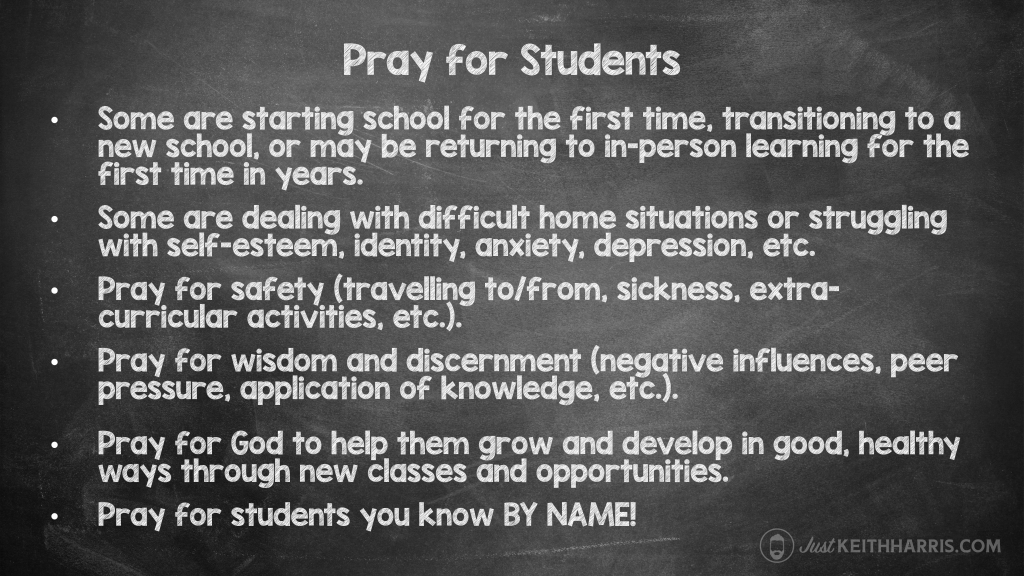
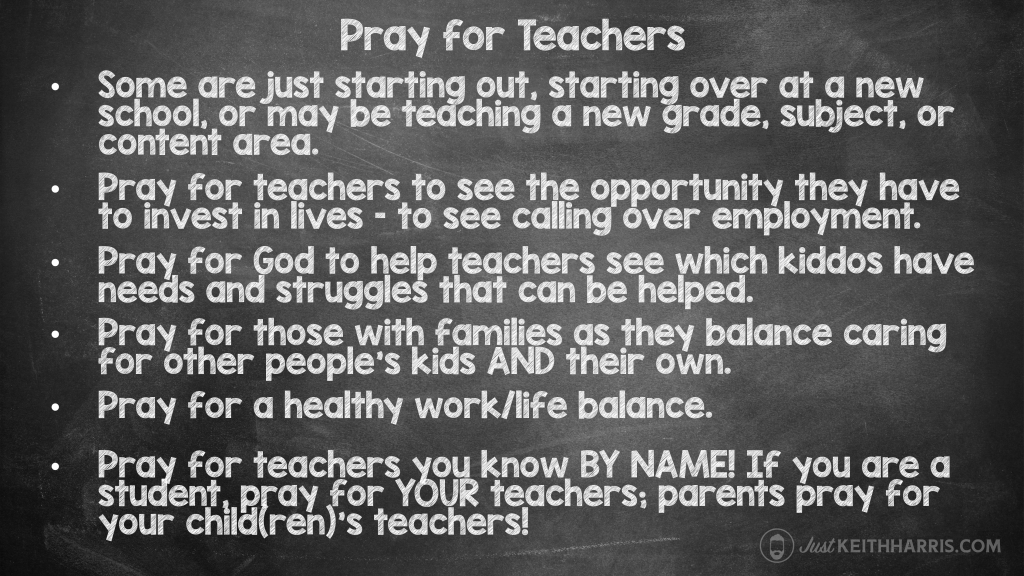
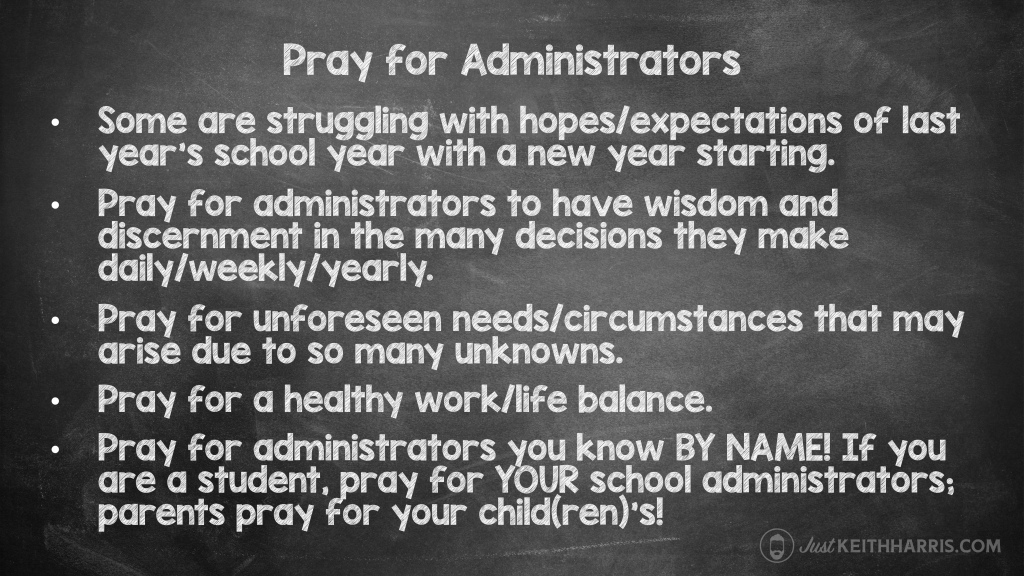
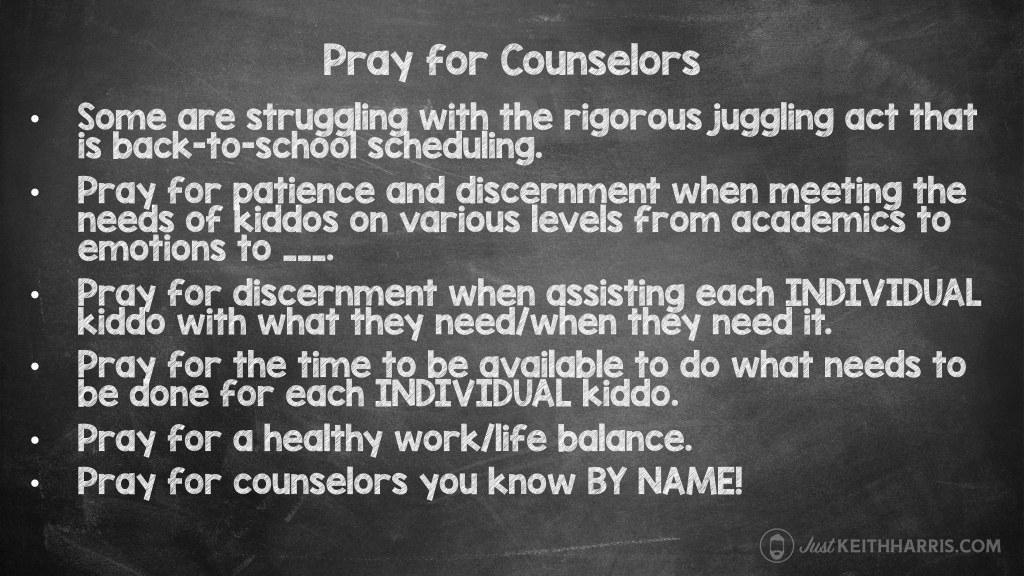
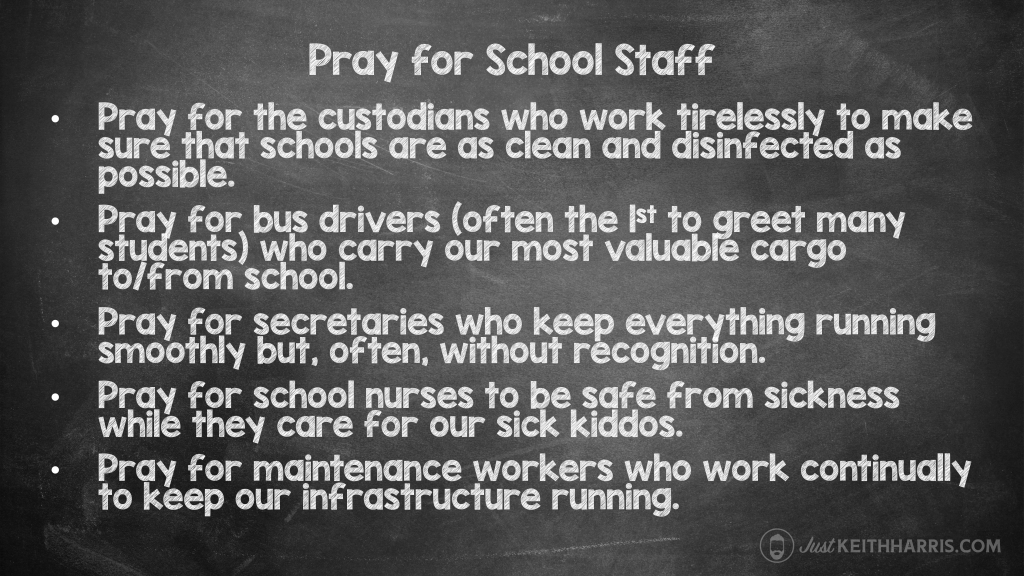
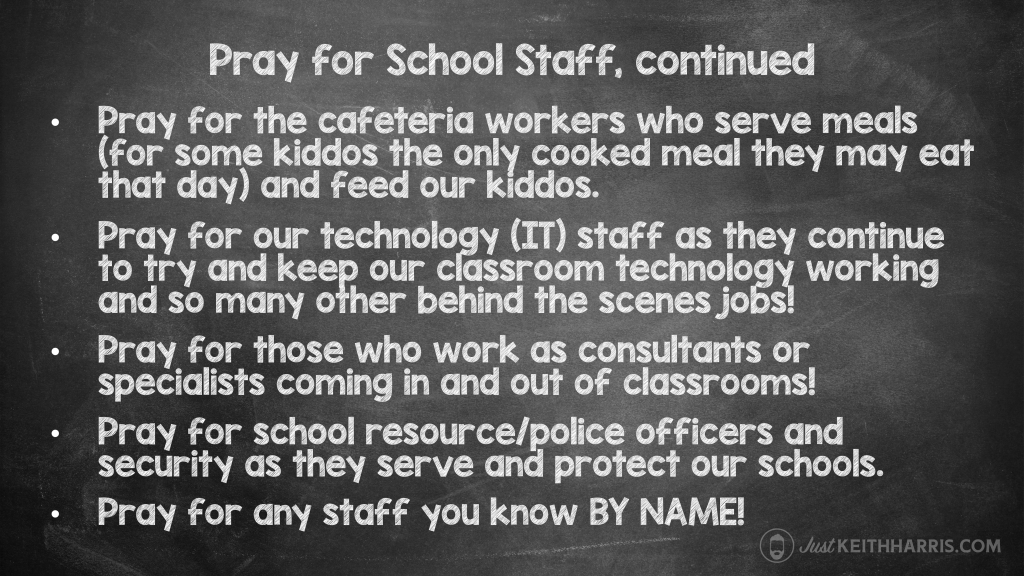
This is meant to be a resource to help you pray for the upcoming school year – local schools, students, parents, teachers, administration, and school staff.
Praying is the most we can do – handing our concerns and cares over to the sovereign, almighty God of the universe. The requests and guide below are just suggestions; feel free to pray for whatever comes to mind!
There are two passages of Scripture that drive our desire to do this and show us the goal, scope, and hope of turning things over to the Lord in prayer:
“The Lord is at hand; do not be anxious about anything, but in everything by prayer and supplication with thanksgiving let your requests be made known to God. And the peace of God that surpasses all understanding, will guard your hearts and your minds in Christ Jesus.” (Philippians 4:5b-7)
“May the God of hope fill you with all joy and peace in believing, so that by the power of the Holy Spirit you may abound in hope.” (Romans 15:13)
1 I will extol you, O LORD, for you have drawn me up and have not let my foes rejoice over me. 2 O LORD my God, I cried to you for help, and you have healed me. 3 O LORD, you have brought up my soul from Sheol; you restored me to life from among those who go down to the pit.
4 Sing praises to the LORD, O you his saints, and give thanks to his holy name. 5 For his anger is but for a moment, and his favor is for a lifetime. Weeping may tarry for the night, but joy comes with the morning.
6 As for me, I said in my prosperity, “I shall never be moved.” 7 By your favor, O LORD, you made my mountain stand strong; you hid your face; I was dismayed.
8 To you, O LORD, I cry, and to the Lord I plead for mercy: 9 “What profit is there in my death, if I go down to the pit? Will the dust praise you? Will it tell of your faithfulness? 10 Hear, O LORD, and be merciful to me! O LORD, be my helper!”
11 You have turned for me my mourning into dancing; you have loosed my sackcloth and clothed me with gladness, 12 that my glory may sing your praise and not be silent. O LORD my God, I will give thanks to you forever!
9 The true light, which gives light to everyone, was coming into the world. 10 He was in the world, and the world was made through him, yet the world did not know him. 11 He came to his own, and his own people did not receive him. 12 But to all who did receive him, who believed in his name, he gave the right to become children of God, 13 who were born, not of blood nor of the will of the flesh nor of the will of man, but of God.
14 And the Word became flesh and dwelt among us, and we have seen his glory, glory as of the only Son from the Father, full of grace and truth.
Invitation/Preparation for Lord’s Supper | Behold the Lamb (Communion Hymn) — Scripture References / Inspiration for the Song: 1 Corinthians 11:23-26, John 1:29, 1 Peter 1:19, 1 Peter 2:24, Revelation 13:8, Isaiah 53:5-7, 1 John 1:9, Ephesians 2:4-9, Ephesians 4:1, 1 Corinthians 6:19-20, Colossians 3:14, 1 John 1:7, Psalm 51:1-2, 1 Thessalonians 5:15-18, Luke 9:23-27, 1 Corinthians 12:12-13, Philippians 3:10
If you have not been gathering, consider gathering with your church family again. We have a 10:00 Bible study where Jamie Harrison is walking us through the book of Revelation. If you are at-risk, this Bible study would be perfect for you so you can spread out (and even dip out the side door before the 11:00 worship gathering begins).
16 “For God so loved the world, that he gave his only Son, that whoever believes in him should not perish but have eternal life. 17 For God did not send his Son into the world to condemn the world, but in order that the world might be saved through him. 18 Whoever believes in him is not condemned, but whoever does not believe is condemned already, because he has not believed in the name of the only Son of God. 19 And this is the judgment: the light has come into the world, and people loved the darkness rather than the light because their works were evil. 20 For everyone who does wicked things hates the light and does not come to the light, lest his works should be exposed. 21 But whoever does what is true comes to the light, so that it may be clearly seen that his works have been carried out in God.”
I have been crucified with Christ. It is no longer I who live, but Christ who lives in me. And the life I now live in the flesh I live by faith in the Son of God, who loved me and gave himself for me.
5 Have this mind among yourselves, which is yours in Christ Jesus, 6 who, though he was in the form of God, did not count equality with God a thing to be grasped, 7 but emptied himself, by taking the form of a servant, being born in the likeness of men. 8 And being found in human form, he humbled himself by becoming obedient to the point of death, even death on a cross. 9 Therefore God has highly exalted him and bestowed on him the name that is above every name, 10 so that at the name of Jesus every knee should bow, in heaven and on earth and under the earth, 11 and every tongue confess that Jesus Christ is Lord, to the glory of God the Father.
If you have not been gathering, consider gathering with your church family again. We have a 10:00 Bible study where Jamie Harrison is walking us through the book of Revelation. If you are at-risk, this Bible study would be perfect for you so you can spread out (and even dip out the side door before the 11:00 worship gathering begins).
1 Have mercy on me, O God, according to your steadfast love; according to your abundant mercy blot out my transgressions. 2 Wash me thoroughly from my iniquity, and cleanse me from my sin!
3 For I know my transgressions, and my sin is ever before me. 4 Against you, you only, have I sinned and done what is evil in your sight, so that you may be justified in your words and blameless in your judgment. 5 Behold, I was brought forth in iniquity, and in sin did my mother conceive me. 6 Behold, you delight in truth in the inward being, and you teach me wisdom in the secret heart.
7 Purge me with hyssop, and I shall be clean; wash me, and I shall be whiter than snow. 8 Let me hear joy and gladness; let the bones that you have broken rejoice. 9 Hide your face from my sins, and blot out all my iniquities. 10 Create in me a clean heart, O God, and renew a right spirit within me. 11 Cast me not away from your presence, and take not your Holy Spirit from me. 12 Restore to me the joy of your salvation, and uphold me with a willing spirit.
If you have not been gathering, consider gathering with your church family again. We have a 10:00 Bible study where Jamie Harrison is walking us through the book of Revelation. If you are at-risk, this Bible study would be perfect for you so you can spread out (and even dip out the side door before the 11:00 worship gathering begins.
1 If then you have been raised with Christ, seek the things that are above, where Christ is, seated at the right hand of God. 2 Set your minds on things that are above, not on things that are on earth. 3 For you have died, and your life is hidden with Christ in God. 4 When Christ who is your life appears, then you also will appear with him in glory.[1]
📖 Revelation 7After the terrifying events of Revelation 6, John is given a breathtaking glimpse of hope. Before judgment continues, God reveals that His people are known, sealed, and secure in Christ. The chapter culminates with one of Revelation's most beautiful pictures: the Lamb who was slain is also the Shepherd who leads His people forever.In this episode, Keith Harris and Jamie Harrison discuss:✔️ Why Revelation 7 is an interlude between the sixth and seventh seals✔️ What it means for God's servants to be sealed✔️ The two primary views of the 144,000—and why faithful Christians differ✔️ How John's pattern of hearing one thing and seeing another helps interpret the chapter✔️ The innumerable multitude worshiping before the throne✔️ Why Jesus, the Lamb, is also our Shepherd who leads us to living waterThis chapter reminds us that our greatest hope isn't solving every prophetic question—it's belonging to Christ. Those who trust Him are safe in Him, and one day He will wipe away every tear from their eyes.📖 "For the Lamb in the midst of the throne will be their shepherd, and he will guide them to springs of living water, and God will wipe away every tear from their eyes." (Revelation 7:17, ESV)🔗 If you'd like to see a written version of this podcast, complete with footnotes and cross-references, you can find it here.
I love the way that Paul’s letter to the Colossian church builds and builds and builds. Where we see sections or passages, there was just a letter from an apostle to a church that needed help. Paragraph by paragraph the help he offers them is pointing them to Jesus.
In chapter 1, we see Paul presenting Jesus in a beautiful hymn highlighting how Jesus, God incarnate, is preeminent over all and yet cares for them enough to deliver and redeem them (and us) “from the domain of darkness” to His Kingdom (ch 1:13-14). Chapter 2 saw Paul helping them to understand what it is to be alive in Christ and helped them understand that receiving Christ and walking in Him (ch 2:6-7) is necessary to combat the false teaching attacking their church.
And, as we begin chapter 3 where Paul lays out for the Colossian church – and again, the church today – what new life in Christ is and is not, the final verse from last week’s passage (ch 2:23) strikes me a bit stronger: “These (human precepts and teaching) have indeed an appearance of wisdom in promoting self-made religion and asceticism and severity to the body, but they are of no value in stopping the indulgence of the flesh.”
We looked at it in the context of last week’s passage, and we need to look at it as the hinge that opens the door between last week’s and ours today. The “human precepts and teaching” (ch 2:22) were spoken of in the context of the false teaching plaguing the Colossian church – that people were trying to tack on additional religious practices to the gospel and distract from it. But, as we are about to begin looking at precepts and teaching given by Paul, it is fitting that we clarify the difference between human precepts and those “breathed out by God” (2 Timothy 3:16). Sins are going to be listed – not Paul’s interpretation of a religion but speaking from God as He was “carried along by the Holy Spirit” (2 Peter 1:21). So, as we talk about what is taught in Colossians, we must be careful to focus on and look at what God is saying to the church – then and now – through Paul. We must be careful to recognize the authority of Scripture to teach us what to believe and correct us when we are wrong – to teach us how to live and correct us when we sin – to give us everything we need to live this new life in Him.
There is temptation to blunt what God makes sharp regarding sin – to call good what God called evil (Isaiah 5:20). There is also a temptation to take God’s Word and use it to hurt people rather than to point them to Him. Both are dangerous. Both are trying for “human precepts” instead of the divine. God’s Word says what it says, and it has power. But the former, the man-made or man-twisted have “no value in stopping the indulgence of the flesh”. Thankfully, Paul’s answer to both – the answer that has been consistent throughout Colossians and will continue to be through the end is Jesus.
If You Have Been Raised (vv. 1, 3)
The first word of today’s passage is “if”. As a parent and a high school teacher, I understand that this word carries the utmost importance.
Daddy, can I go to __’s house Friday? Yes, if, you clean your room. Mr. Harris, if we all make __ or above on the assessment, you should buy us donuts. I sure will if you hold up your end of the bargain. When Friday comes or the assessment is over both sides play the parts of expert lawyer explaining how I am bound to do this or how I should change my mind because of how close they got to the agreement. Yet if leaves extraordinarily little wiggle room. If is conditional. Any agreement containing if means that its completion is contingent upon whatever in-the-event-that occurs.
In the case of today’s passage – “Ifthen you have been raised with Christ”, the condition is if someone is in Christ, whether or not they have been “raised with Christ”. One either is or is not. Think back to the way that Paul has presented this state of being in Christ throughout the letter: either in “the domain of darkness” or “the kingdom of His beloved Son” (ch 1:13), either reconciled to Him through “the blood of His cross” or “alienated and hostile in mind, doing evil deeds” (ch 1:20-21), either “dead in your trespasses” or “made alive together with Him” (ch 2:13). So, to say “If then you have been raised with Christ” is to say you are either dead in your sins or raised to “walk in newness of life” (Romans 6:4).
It is important to the message Paul is communicating because the teachings are for those who have been “made alive…with Christ”, saved by grace through faith in Jesus (Ephesians 2:5). These are not principles for a good or successful life. They are not suggestions or even a how-to manual for faith or practice. Look at the rest of that conditional statement: “seek the things that are above, where Christ is seated at the right hand of God”. Basically, if you are in Christ, seek Him. Verse 3 clarifies it even further because, once one is saved, the former pre-salvation life is over and life is “hidden with Christ in God” – eternal life is contingent upon His life, His resurrection.
This is why the new life that comes from being in Christ is not simply a how-to manual or list of instructions – it is real and lasting transformation, life change that occurs when one goes from the “wages of sin”, which is death, to “the free gift of eternal life” (Romans 6:23). Seeking Christ is more than reading His Word or praying to Him as a religious exercise, it is seeking the One who rescued you and redeemed you – who saved you. If you have been raised with Christ, why would you not want to seek Him?
Set Your Minds (vv. 2, 4)
There is good news in the command to seek Jesus, namely that He will be found! Look at this beautiful passage in Isaiah 55:6-7:
Seek the Lord while He may be found; call upon Him while He is near; let the wicked forsake his way, and the unrighteous man his thoughts; let him return to the Lord, that he may have compassion on him, and to our God, for He will abundantly pardon.
This is often viewed as an invitation – which it is – for those who do not know Christ but let us look at what it means for those who do know Him. If you have been raised with Christ, He will be found when sought and near when He is called upon. But also, if one’s wicked ways have been forsaken and unrighteous thoughts laid aside, one surely has sought the Lord and received His compassion and forgiveness – received His life – because human beings do not lay aside their wickedness of choice easily.
The command here moves from seeking Him, though, to setting one’s mind on Him. That word “set” means be mindful of, to be devoted to”.[2] Think about it like we would set a thermostat or an alarm. A thermostat ensures that our house stays within the confines of temperatures that will keep us comfortable. An alarm ensures that appointments are kept and things that one really does not want to miss. As a resident of Mississippi in July, I am devoted to making sure my thermostat is set correctly as the humidity and heat would quickly overtake my home. Alarms are necessities for things I want to make sure I do not miss and things I must do and are set as needed – as often as needed, as often as I need to be mindful of a time or date. What about Jesus?
Paul tells the Colossian church to “set” their minds “on things that are above” – the same thing that he just commanded them to “seek”. The mind of the church, its members, should be set on Jesus “not on things that are on earth”. Set – like a thermostat – to keep one’s mind consistently where it needs to be, on Jesus. Set – like we would an alarm to remind us of where we need to be. Set.
Now, I have heard people say that there is a danger of being so heavenly minded that one is no earthly good, meaning that one can be so focused on “things that are above” that things below are forgotten about. They would have a sort of monastery view that would isolate them from the world.
I would argue that I am of no earthly good if my mind is not set on Christ. When we look at the rest of the larger section that today’s passage begins, what follows comes from setting one’s mind on Jesus. The sins that are crucified are because of focusing on Jesus and the life He gives. The behaviors that characterize the new life follow in the way that He lived – and lives!
This leads to the ultimate goal: meeting Jesus. If we look at verse 4, this is the goal – the expectation of seeking and setting one’s mind on Christ – “When Christ who is your life appears”.
This is the sort of expectant devotion that reminds me of my son. The first day I spend alone with my son, he was barely a month old. He screamed. He cried. He was upset. But everything changed when his mama called to see how everything went. As soon as he hit her arms when she got home, he was at rest. Now, I know it would be hard to say that as an infant he was thinking this or that. Yet last week while my wife – his mama – was chaperoning a youth mission trip for my daughter, every audible car noise from the street brought, “Are Mama and Keri home?” Every buzz on my phone brought questions whether it was his mama on the other end. And, as hard as he tried to play it cool when we picked them up at the church when they got back, everything was right in his world once his mama was home.
Expectantly setting one’s mind on Christ shows devotion. But, more than that, it is a connection between the one you confessed as Lord and the life you actually live. And when He appears – when He returns, He comes to take you with Him. And those who are His will be ready.
Wrapping Up
It is so easy to regiment our lives to fit everything that we want. We can schedule and plan. There are immovable commitments in our lives that will trump anything that comes up. I can be in the middle of something that has everything else in my schedule detouring around it and have it all upended with a single emergency call or text from my wife or kids. In that moment, everything else pales in comparison. The immovable becomes movable.
But how does God fit in my life? Is time with Him immovable in my schedule? I learned – and sadly later than I should have – that there are times that, if I do not schedule time with my wife I will run out of time – the same with my kids. I felt bad initially because it seems so impersonal to schedule things as important as time with my wife and kids. Then, I realized that it is better to schedule than miss something important and that was the reason I had a calendar in the first place – to ensure that important things do not get missed.
I must do the same with for my time with the Lord – in His Word and praying. It has become part of my daily routine (which I know also sounds impersonal). And, if I do not start my day in His Word and in prayer – if I do not set my mind on Him at the very beginning of my day, I will be off. I will be more like the old self than the new.
Important things are set. They are fixed.
And so, it must be for the minds of those who claim to be saved.
If you are reading this and find that you have no desire to set your mind on Christ or that you can make it through days or weeks or months or years without caring about spending time with Him in His Word or praying to Him, there is a problem. Remember that conditional if. If you are His, you will seek Him. If you are His, you will desire to spend time with Him. If you are His, there will have to come a time when you are set – fixed – on Him. It is conditional. Know I am praying for you. I am praying for you to have a desire to meet God in His Word and talk to Him. I am praying for His Spirit to help you set your mind on Him and seek Him while He may be found. And, if you come to realize that you are not in Him, know that I would love to talk with you and pray for you. I would love to introduce you to Jesus.
1 Therefore, since we have been justified by faith, we have peace with God through our Lord Jesus Christ. 2 Through him we have also obtained access by faith into this grace in which we stand, and we rejoice in hope of the glory of God. 3 Not only that, but we rejoice in our sufferings, knowing that suffering produces endurance, 4 and endurance produces character, and character produces hope, 5 and hope does not put us to shame, because God’s love has been poured into our hearts through the Holy Spirit who has been given to us.
6 For while we were still weak, at the right time Christ died for the ungodly. 7 For one will scarcely die for a righteous person—though perhaps for a good person one would dare even to die— 8 but God shows his love for us in that while we were still sinners, Christ died for us. 9 Since, therefore, we have now been justified by his blood, much more shall we be saved by him from the wrath of God. 10 For if while we were enemies we were reconciled to God by the death of his Son, much more, now that we are reconciled, shall we be saved by his life. 11 More than that, we also rejoice in God through our Lord Jesus Christ, through whom we have now received reconciliation.
If you have not been gathering, consider gathering with your church family again. Various variants are still issues in this prolonged pandemic, but prayerfully consider gathering in the 10:00 Bible study where there is plenty of room for social distancing and one could slip out before the worship crowd comes in for the 11:00 service.